

A statistical test suite for random and pseudorandom number generators for cryptographic applications
Open accessThe DOI matches its Crossref record; 33 of the 34 references it cites were found in a registry or an index; none of the 14 sources its claims cite is checked for support yet.
Abstract
The Information Technology Laboratory (ITL) at the National Institute of Standards and Technology (NIST) promotes the U.S. economy and public welfare by providing technical leadership for the nation's measurement and standards infrastructure. ITL develops tests, test methods, reference data, proof of concept implementations, and technical analysis to advance the development and productive use of information technology. ITL's responsibilities include the development of technical, physical, administrative, and management standards and guidelines for the cost-effective security and privacy of sensitive unclassified information in Federal computer systems.
Overview
CoChat Summary
TL;DR
This NIST Special Publication 800-22 Revision 1a presents a suite of 15 statistical tests for evaluating whether binary sequences produced by random or pseudorandom number generators are suitable for cryptographic applications. It provides test purposes, mathematical descriptions, examples, and guidance for interpreting P-values, while cautioning that statistical testing is only a first step and cannot replace cryptanalysis.
Key findings
- The suite consists of 15 tests: Frequency (Monobit), Frequency within a Block, Runs, Longest Run of Ones, Binary Matrix Rank, Discrete Fourier Transform (Spectral), Non-overlapping Template Matching, Overlapping Template Matching, Maurer’s “Universal Statistical,” Linear Complexity, Serial, Approximate Entropy, Cumulative Sums, Random Excursions, and Random Excursions Variant. The Frequency test is recommended first because it supplies the most basic evidence of non-randomness.
- Each test uses the null hypothesis \(H_0\) that the sequence is random; if P-value \(\ge \alpha\), the sequence is accepted as random, and if P-value \(<\alpha\), it is rejected. Examples use \(\alpha=0.01\), and NIST recommends \(\alpha\) in the range [0.001, 0.01].
- The document states that no finite set of statistical tests is “complete,” that statistical testing cannot absolutely certify a generator, and that statistical testing cannot serve as a substitute for cryptanalysis.
- Sample data files are 1,000,000 bits (binary expansions of \(e\), \(\pi\), \(\sqrt{2}\), \(\sqrt{3}\), and a G-SHA-1 sequence); reported example P-values include Frequency for \(\pi\) = 0.578211, for \(e\) = 0.953749, and for G-SHA-1 = 0.604458.
Methods
- Design: The NIST Statistical Test Suite is an ANSI C reference implementation of 15 tests; each test defines a test statistic, a reference distribution (e.g., normal, half-normal, chi-square), a P-value, and a decision rule at the 1% level.
- Data or sample: Tests apply to binary sequences from hardware or software RNGs/PRNGs; sample files are 1,000,000 bits, while many worked examples use small illustrative lengths such as \(n=100\).
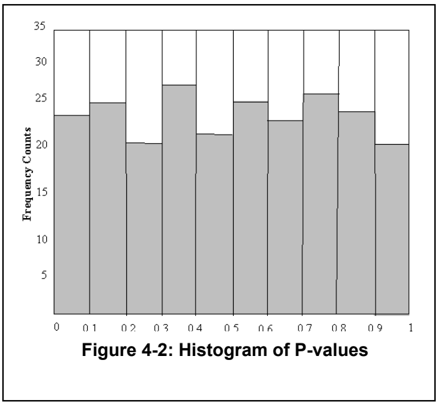
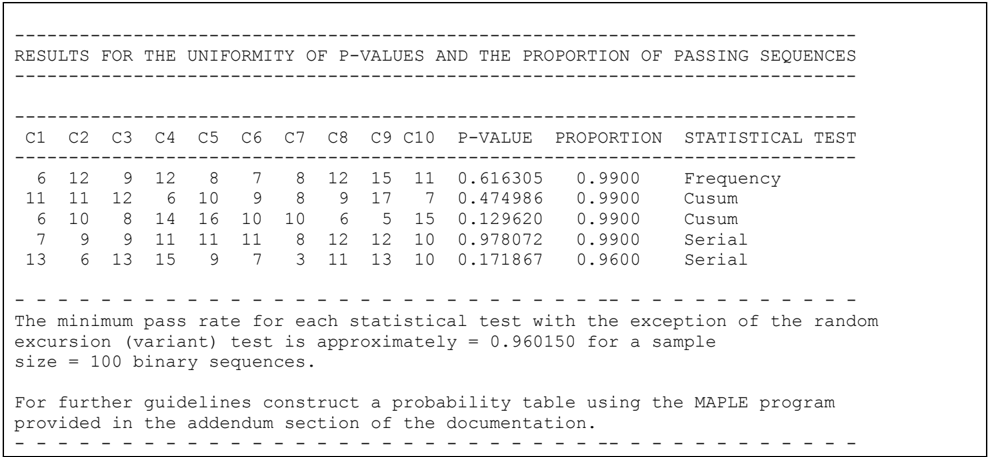
- Main analysis: For each sequence, P-values are computed and compared to \(\alpha\); empirical interpretation examines the proportion of sequences passing a test and the uniformity of P-values. A multiple-test dependence study applied 161 test P-values to Blum-Blum-Shub sequences of length 1,000,000 and used principal components/factor analysis, concluding there was no large redundancy among tests.
Limitations
- The paper states that no set of statistical tests can absolutely certify a generator as appropriate, that statistical testing cannot substitute for cryptanalysis, and that generator design and cryptanalysis are outside its scope.
- The paper states that many examples use small sample sizes for illustration only, e.g., \(n=10\), where the normal approximation is not really applicable; many tests rely on asymptotic reference distributions for large \(n\) (order \(10^3\) to \(10^7\)), and input parameter constraints apply.
- The text makes evident additional limitations: numerical precision can degrade for large incomplete gamma parameter \(a\); Maurer’s variance approximation can make the test 2.67 times more permissive than theoretically admitted; Random Excursions is discontinued if \(J<500\); and multiple tests can yield contradictory conclusions, as in the Random Excursions example where one state gave a non-random result while seven states gave random results.
Model-written summary. Check it against the paper before relying on it.
Integrity signals
Registry
Cites
Statistics
Figures

Verification
Claims the paper makes
0 Valid · 1 Not valid · 11 Not checked · 13 Own results and interpretations
A result the paper reports from its own data — it cites no other source for it, so there is none to check. The quote shows it is in the paper.
In the paper
“The asymptotic distribution of ( Ln -µ n ) / σ n along the sequence of even or odd values of n is that of a discrete random variable obtained via a mixture of two geometric random variables (one of them taking only negative values). Strictly speaking, the asymptotic distribution as such does not exist.”
A result the paper reports from its own data — it cites no other source for it, so there is none to check. The quote shows it is in the paper.
In the paper
“However, no set of statistical tests can absolutely certify a generator as appropriate for usage in a particular application, i.e., statistical testing cannot serve as a substitute for cryptanalysis.”
A result the paper reports from its own data — it cites no other source for it, so there is none to check. The quote shows it is in the paper.
In the paper
“This graph showed that there is no large redundancy among our tests.”
In the paper
“Ueli Maurer of the Department of Computer Science at Princeton University introduced this test in 1992. Maurer's test statistic relates closely to the per-bit entropy of the stream, which its author asserts is 'the correct quality measure for a secret-key source in a cryptographic application.'”
What the sources say
- Not matchedcites Maurer
This doesn’t read as a citation we can look up.
- Not matched
What the paper did — it cites no source for this, so there is none to check. The quote shows it is in the paper.
In the paper
“The test rejects the randomness hypothesis immediately if J is too small, i.e., if the following P-value is small:”
20 more claims
Create a free account to see all 25 claims and every source verdict.
Claims other papers make about this one
Each is checked against this paper’s own text: does it say what the citing paper says it does?
The source backs part of the claim, not all of it — or backs it for a different population, condition or comparison.
In the citing paper
“However, the latest version 2.1.2 [1], released in 2014, does not incorporate several modifications.”
From Checking the quality of approximation of p-values in statistical tests for random number generators by using a three-level test (2019) · cites this paper as [1]
Experimental — accuracy not yet measuredThe source backs part of the claim, not all of it — or backs it for a different population, condition or comparison.
In the citing paper
“The NIST test suite consists of 15 statistical tests for randomness of bit sequences, and its result is a list of 188 p -values.”
From Checking the quality of approximation of p-values in statistical tests for random number generators by using a three-level test (2019) · cites this paper as [1]
Experimental — accuracy not yet measuredThe cited source says what the claim attributes to it.
In the citing paper
“Note that the current implementation of the NIST test suite uses one-level or two-level tests, differently from the above experiments”
From Checking the quality of approximation of p-values in statistical tests for random number generators by using a three-level test (2019) · cites this paper as [1]
The cited source says what the claim attributes to it.
In the citing paper
“NIST SP-800.22 statistical test suite [90] and Die-hard test suite [91] and Test U01 [92] and AIS31 [93] are most common statistical test suites to evaluate their RNGs by researchers.”
From True Random Number Generators Using Electrical Noise (2019) · cites this paper as [90]
Self-check
Percentages, sums and reported differences re-computed from the paper’s own numbers.
Each contradiction between two passages listed here was confirmed by an independent check.
Rated minor: it would not touch a result — a value no result rests on, a p-value that stays on the same side of the significance level, or a conflict that is clerical, resolved elsewhere in the paper, or outside its own findings.
In the paper
§ 2.3.8 Example
“(input) τ = 0.02 (processing) π = 0.42 (processing) Vn(obs) = 52 (output) P-value = 0.500798 (conclusion) Since P-value ≥ 0.01 , accept the sequence as random.”
§ 2.3.4 Test Description
“If it can be shown that π -1 ≥τ , then the 2 Runs test need not be performed (i.e., the test should not have been run because of a failure to pass test 1, the Frequency (Monobit) test). If the test is not applicable, then the P-value is set to 0.0000.”
Rated minor: it would not touch a result — a value no result rests on, a p-value that stays on the same side of the significance level, or a conflict that is clerical, resolved elsewhere in the paper, or outside its own findings.
In the paper
§ 2.7.4 Test Description
“| 8-10 | 010 (hit) | 2 | 110 | 1 |”
§ 2.7.4 Test Description
“For the above example, if m = 3 and the template B = 001, then the examination proceeds as follows:”
Rated minor: it would not touch a result — a value no result rests on, a p-value that stays on the same side of the significance level, or a conflict that is clerical, resolved elsewhere in the paper, or outside its own findings.
In the paper
§ 2.9.3 Test Statistic and Reference Distribution
“f n : The sum of the log2 distances between matching Lbit templates, i.e., the sum of the number of digits in the distance between Lbit templates.”
§ 3.9 Maurer's 'Universal Statistical' Test
“Then it averages over all the expansion lengths by the number of test blocks.”
Rated minor: it would not touch a result — a value no result rests on, a p-value that stays on the same side of the significance level, or a conflict that is clerical, resolved elsewhere in the paper, or outside its own findings.
In the paper
§ Input Parameters:
“The parameters p , q and s are not fixed in code; thus, the user will not be able to reconstruct the original sequence because these values will vary (i.e., they are dependent on the system time).”
§ Input Parameters:
“The input parameters have been fixed so the code will reproduce the same results.”
Rated minor: it would not touch a result — a value no result rests on, a p-value that stays on the same side of the significance level, or a conflict that is clerical, resolved elsewhere in the paper, or outside its own findings.
In the paper
§ 5.5.2 Global Parameters
“| MAXNUMOFTEMPLATES | 40 | Non-overlapping Templates Test | | NUMOFTESTS | 16 | Max number of tests | | NUMOFGENERATORS | 12 | Max number of PRNGs |”
§ A.2 Configuration Information
“| 2. | #define MAXNUMOFTEMPLATES | 148 | | 3. | #define NUMOFTESTS | 15 | | 4. | #define NUMOFGENERATORS | 10 |”
2 more findings
Create a free account to see every finding of this check.
Citations
Cites
Handbook of Mathematical Functions
McQuarrie, D. A. (1966) · American Journal of Physics · doi:10.1119/1.1972842 · Cited by 40,433
Numerical recipes in C: the art of scientific computing
(1993) · Choice Reviews Online · doi:10.5860/choice.30-5638 · Cited by 17,933
Rayward-Smith, V. J. (1991) · Journal of the Operational Research Society · doi:10.1057/jors.1991.155 · Cited by 16,821
Handbook of applied cryptography
(1997) · Choice Reviews Online · doi:10.5860/choice.34-4512 · Cited by 10,357
Handbook of Mathematical Functions
(2018) · A Century of Excellence in MEASUREMENTS, STANDARDS, and TECHNOLOGY · doi:10.1201/9781351069397-39 · Cited by 9,062
A universal algorithm for sequential data compression
Ziv, J., & Lempel, A. (1977) · IEEE Transactions on Information Theory · doi:10.1109/tit.1977.1055714 · Cited by 5,456
The Art of Computer Programming
Worlton, W. J. (1968) · Nuclear Science and Engineering · doi:10.13182/nse68-a19548 · Cited by 2,251
Handbook of Applied Cryptography
Menezes, A. J., van Oorschot, P. C., & Vanstone, S. A. (2018) · CRC Press eBooks · doi:10.1201/9780429466335 · Cited by 1,770
Numerical Recipes in C-The Art of Scientific Computing.
G., W., Press, W. H., Flannery, B. P., Teukolsky, S. A., & Vetterling, W. T. (1989) · Mathematics of Computation · doi:10.2307/2008673 · Cited by 1,513
The Fourier Transform and its Applications
Cattermole, K. W. (1965) · Electronics and Power · doi:10.1049/ep.1965.0268 · Cited by 1,417
Cited by
Items 101–200 of 3,620
Analysis and Enhancement of Random Number Generator in FPGA Based on Oscillator Rings
Wold, K., & Tan, C. H. (2008) · 2008 International Conference on Reconfigurable Computing and FPGAs · doi:10.1109/reconfig.2008.17 · Cited by 137
“This experiments indicate that there is probably not necessary to have almost 100% certainty to hit at least one transition region in order to pass the NIST and DIEHARD statistical tests for this kind of TRNG. Table 1 shows the number of resources used for our TRNG in the Altera Cyclone II FPGA.”
MethodInfluentialPhoton arrival time quantum random number generation
Wayne, M. A., Jeffrey, E. R., Akselrod, G. M., & Kwiat, P. G. (2009) · Journal of Modern Optics · doi:10.1080/09500340802553244 · Cited by 135
Hardware implementation of pseudo-random number generators based on chaotic maps
de la Fraga, L. G., Torres-Pérez, E., Tlelo‐Cuautle, E., & Mancillas-López, C. (2017) · Nonlinear Dynamics · doi:10.1007/s11071-017-3755-z · Cited by 145
Advanced Data Encryption using 2D Materials
Wen, C., Li, X., Zanotti, T., Puglisi, F. M., Shi, Y., Saiz, F., Antidormi, A., Roche, S., Zheng, W., Liang, X., et al. (2021) · Advanced Materials · doi:10.1002/adma.202100185 · Cited by 151
“[27] The designed circuit passed all the randomness tests performed (see Figure S22 and Table S2, Supporting Information), which validates its use as TRNG.”
MethodA Highly Flexible Ring Oscillator PUF
Gao, M., Lai, K., & Qu, G. (2014) · Proceedings - ACM IEEE Design Automation Conference · doi:10.1145/2593069.2593072 · Cited by 126
Physical Unbiased Generation of Random Numbers With Coupled Resistive Switching Devices
Balatti, S., Ambrogio, S., Carboni, R., Milo, V., Wang, Z., Calderoni, A., Ramaswamy, N., & Ielmini, D. (2016) · IEEE Transactions on Electron Devices · doi:10.1109/ted.2016.2537792 · Cited by 127
“For this purpose, we evaluated randomness on one of our schemes, using the standard set of statistical tests developed by the National Institute of Standards and Technology (NIST) [21].”
MethodA Very High Speed True Random Number Generator with Entropy Assessment
Cherkaoui, A., Fischer, V., Fesquet, L., & Aubert, A. (2013) · Lecture notes in computer science · doi:10.1007/978-3-642-40349-1_11 · Cited by 150
LoRa-Key: Secure Key Generation System for LoRa-Based Network
Xu, W., Jha, S. K., & Hu, W. S. (2018) · IEEE Internet of Things Journal · doi:10.1109/jiot.2018.2888553 · Cited by 133
“In order to validate the randomness of the final key, we apply the NIST suite of statistical tests [28] to all the keys generated from our dataset.”
MethodCryptanalysis of an image encryption scheme based on a compound chaotic sequence
Li, C., Li, S., Chen, G., & Halang, W. A. (2009) · Image and Vision Computing · doi:10.1016/j.imavis.2008.09.004 · Cited by 123
“for the encryption of 256 × 256 images with the test suite proposed i n [17].”
MethodFast Random Bit Generation Using a Chaotic Laser: Approaching the Information Theoretic Limit
Oliver, N., Soriano, M. C., Sukow, D. W., & Fischer, I. (2013) · IEEE Journal of Quantum Electronics · doi:10.1109/jqe.2013.2280917 · Cited by 132
“To assess the statistical randomness of the bit sequences, we used the standard test suite for random number generators provided by the National Institute of Standards and Technology (NIST) [32].”
MethodInfluentialArchitecture and applications of a high resolution gated SPAD image sensor
Burri, S., Maruyama, Y., Michalet, X., Regazzoni, F., Bruschini, C. E., & Charbon, E. (2014) · Optics Express · doi:10.1364/oe.22.017573 · Cited by 143
Low-bias high-speed quantum random number generator via shaped optical pulses
Wayne, M. A., & Kwiat, P. G. (2010) · Optics Express · doi:10.1364/oe.18.009351 · Cited by 123
FPGA-Based True Random Number Generation Using Programmable Delays in Oscillator-Rings
Anandakumar, N. N., Sanadhya, S. K., & Hashmi, M. (2019) · IEEE Transactions on Circuits & Systems II Express Briefs · doi:10.1109/tcsii.2019.2919891 · Cited by 143
Demonstration of Nanosecond Operation in Stochastic Magnetic Tunnel Junctions
Safranski, C., Kaiser, J., Trouilloud, P. L., Hashemi, P., Hu, G., & Sun, J. (2021) · Nano Letters · doi:10.1021/acs.nanolett.0c04652 · Cited by 153
Asgari-Chenaghlu, M., Balafar, M.-A., & Feizi-Derakhshi, M.-R. (2019) · Signal Processing · doi:10.1016/j.sigpro.2018.11.010 · Cited by 121
Symmetric encryption algorithms using chaotic and non-chaotic generators: A review
Radwan, A. G., AbdElHaleem, S. H., & Abd-El-Hafiz, S. K. (2016) · Journal of Advanced Research · doi:10.1016/j.jare.2015.07.002 · Cited by 121
“Table 5 shows the results of the 15 NIST tests [41] performed on Lena 1024 (cid”
BackgroundInfluentialPseudo-random number generator based on mixing of three chaotic maps
François, M., Grosges, T., Barchiesi, D., & Erra, R. (2013) · Communications in Nonlinear Science and Numerical Simulation · doi:10.1016/j.cnsns.2013.08.032 · Cited by 128
Chaos-Based Bitwise Dynamical Pseudorandom Number Generator On FPGA
Garcia-Bosque, M., Pérez-Resa, A., Sánchez‐Azqueta, C., et al. (2018) · IEEE Transactions on Instrumentation and Measurement · doi:10.1109/tim.2018.2877859 · Cited by 120
“To test the statistical properties of the PRNG, 100 sequences of 106 bits have been generated and have been subjected to the NIST randomness tests [18], with a significance level of 0.”
MethodMassively parallel ultrafast random bit generation with a chip-scale laser
Kim, K., Bittner, S., Zeng, Y., Guazzotti, S., Hess, O. G., Wang, Q. J., & Cao, H. W. (2021) · Science · doi:10.1126/science.abc2666 · Cited by 147
Dynamic Parameter-Control Chaotic System
Hua, Z., & Zhou, Y. (2016) · IEEE Transactions on Cybernetics · doi:10.1109/tcyb.2015.2504180 · Cited by 118
“5) We propose a new PRNG using a chaotic map of DPCCS, and evaluate the performance of PRNG using four test standards including the National Institute of Standards and Technology (NIST) SP800-22, TestU01, Diehard statistical, and Federal Information Processing Standards Publication (FIPS PUB) 140-2 tests.”
MethodInfluentialFPGA Implementation of Metastability-Based True Random Number Generator
HATA, H., & ICHIKAWA, S. (2012) · IEICE Transactions on Information and Systems · doi:10.1587/transinf.e95.d.426 · Cited by 115
“NIST test [3], [4] is a statistical test suite for random numbers, which is provided by National Institute of Standards and Technology.”
MethodBreaking a modified substitution–diffusion image cipher based on chaotic standard and logistic maps
Li, C., Li, S., & Lo, K. (2010) · Communications in Nonlinear Science and Numerical Simulation · doi:10.1016/j.cnsns.2010.05.008 · Cited by 118
“0, we tested 100 PRNSs of length 512 × 512 = 262144 (the number of bytes used for encryption of a 512× 512 plain color image) by using the NIST statistical test suite [22].”
MethodAn algorithm for encryption of secret images into meaningful images
Kanso, A. A., & Ghebleh, M. (2016) · Optics and Lasers in Engineering · doi:10.1016/j.optlaseng.2016.10.009 · Cited by 116
Trends in Hardware Security: From Basics to ASICs
Alioto, M. (2019) · IEEE Solid-State Circuits Magazine · doi:10.1109/mssc.2019.2923503 · Cited by 122
“The more stringent suite of National Institute of Standards and Technology (NIST) statistical pass/fail tests [72] is routinely used to assess whether an adequate level of randomness is achieved.”
LAMED — A PRNG for EPC Class-1 Generation-2 RFID specification
Lopez, P. P., Hernandez-Castro, J. C., Tapiador, J., & Ribagorda, A. (2007) · Computer Standards & Interfaces · doi:10.1016/j.csi.2007.11.013 · Cited by 128
Mannalath, V., Mishra, S., & Pathak, A. (2023) · Quantum Information Processing · doi:10.1007/s11128-023-04175-y · Cited by 125
“PRNGs [6, 10, 11] are based on some deterministic algorithms which convert a small input string into a larger set of strings that satisfy specific tests such as NIST test [12], Die-Hard test [13], etc.”
MethodEnd-To-End Design of a PUF-Based Privacy Preserving Authentication Protocol
Aysu, A., Gulcan, E., Moriyama, D., Schaumont, P. R., & Yung, M. M. (2015) · Lecture notes in computer science · doi:10.1007/978-3-662-48324-4_28 · Cited by 110
Gao, H., Wang, A., Wang, L., Jia, Z., Guo, Y., Gao, Z., Yan, L., Qin, Y., & Wang, Y. (2021) · Light Science & Applications · doi:10.1038/s41377-021-00610-w · Cited by 121
“We further employed the NIST ’ s statistical test suite 32 random number generators to test the generated keys.”
MethodDigital image scrambling based on a new one-dimensional coupled Sine map
Irani, B. Y., Ayubi, P., Jabalkandi, F. A., Valandar, M. Y., & Barani, M. J. (2019) · Nonlinear Dynamics · doi:10.1007/s11071-019-05157-5 · Cited by 112
“Therefore, the most popular protocols and standards, namely NIST [67], Diehard [68,69], ENT [70], and TestU01 [71], suite have been used.”
MethodRandomness in quantum mechanics: philosophy, physics and technology
Bera, M. N., Acín, A., Kuś, M., Mitchell, M. W., & Lewenstein, M. (2017) · Reports on Progress in Physics · doi:10.1088/1361-6633/aa8731 · Cited by 148
“A common misconception is that the output of a random number generator can be tested for randomness, for example using statistical tests such as Diehard/Dieharder (Brown, 2004; Marsaglia, 2008), NIST SP800-22 (Rukhin et al., 2010), or TestU01 (L’Ecuyer and Simard, 2007).”
MethodQi, G. (2018) · Nonlinear Dynamics · doi:10.1007/s11071-018-4676-1 · Cited by 103
“4.5 NIST test The National Institute of Standards and Technology (NIST) [30] has established 15 tests to detect the statistical performance of a random or pseudo-random generator.”
MethodInfluentialImage Encryption Using Chebyshev Map and Rotation Equation
Stoyanov, B., & Kordov, K. (2015) · Entropy · doi:10.3390/e17042117 · Cited by 102
The design and realization of a new high speed FPGA-based chaotic true random number generator
Koyuncu, İ., & Özcerit, A. T. (2016) · Computers & Electrical Engineering · doi:10.1016/j.compeleceng.2016.07.005 · Cited by 108
A simple chaotic circuit with a hyperbolic sine function and its use in a sound encryption scheme
VOLOS, C. K., Akgül, A., Pham, V., Stouboulos, I. N., & Kyprianidis, I. M. (2017) · Nonlinear Dynamics · doi:10.1007/s11071-017-3499-9 · Cited by 103
“In order to assess the performance of the generated random numbers, randomness test with internationally highest standards like NIST-800-22 is used [87].”
MethodA new image encryption scheme based on coupling map lattices with mixed multi-chaos
Wang, X., Guan, N., Zhao, H., Wang, S., & Zhang, Y. (2020) · Scientific Reports · doi:10.1038/s41598-020-66486-9 · Cited by 111
Mathew, S. K., Johnston, D., Satpathy, S., Suresh, V., Newman, P., Anders, M. A., Kaul, H., Agarwal, A., Hsu, S. K., Chen, G., et al. (2016) · IEEE Journal of Solid-State Circuits · doi:10.1109/jssc.2016.2558490 · Cited by 102
A novel design method for discrete time chaos based true random number generators
Cicek, I., Pusane, A. E., & Dundar, G. (2014) · Integration · doi:10.1016/j.vlsi.2013.06.003 · Cited by 101
A new hyperchaotic map and its application in an image encryption scheme
Boriga, R., Dăscălescu, A. C., & Priescu, I. (2014) · Signal Processing: Image Communication · doi:10.1016/j.image.2014.04.001 · Cited by 101
Experimental Study on Key Generation for Physical Layer Security in Wireless Communications
Zhang, J., Woods, R., Duong, T. Q., Marshall, A., Ding, Y., Huang, Y., & Xu, Q. (2016) · IEEE Access · doi:10.1109/access.2016.2604618 · Cited by 99
“The randomness of the key sequence was evaluated by the National Institute of Standards and Technology (NIST) random test suite [50], which has been widely used in key generation applications [7], [8], [14], [15], [20], [21], [24], [26].”
MethodProbabilistic Neural Computing with Stochastic Devices
Misra, S., Bland, L. C., Cardwell, S., Incorvia, J. A. C., James, C. D., Kent, A. D., Schuman, C. D., Smith, J. D., & Aimone, J. B. (2022) · Advanced Materials · doi:10.1002/adma.202204569 · Cited by 135
A Framework for Chosen IV Statistical Analysis of Stream Ciphers
Englund, H., Johansson, T., & Sönmez Turan, M. (2007) · Lecture Notes in Computer Science · doi:10.1007/978-3-540-77026-8_20 · Cited by 101
Seeing through Network-Protocol Obfuscation
Wang, L., Dyer, K. P., Akella, A., Ristenpart, T., & Shrimpton, T. (2015) · ACM SIGSAC Conference on Computer and Communications Security (CCS) · doi:10.1145/2810103.2813715 · Cited by 130
“Entropy-based analyses have been used for various purposes such as randomness testing, network anomaly detection, and traffic classification [29,35,36,55].”
MethodEliminating Reconciliation Cost in Secret Key Generation for Body-Worn Health Monitoring Devices
Ali, S. T., Sivaraman, V., & Ostry, D. (2013) · IEEE Transactions on Mobile Computing · doi:10.1109/tmc.2013.71 · Cited by 112
“If the generated key successfully clears the battery of tests it ensures that the key cannot be distinguished from a random string using known statistical techniques, and is therefore suitable to be used in symmetric key-ciphers such as AES, and also lightweight block ciphers such as LED, XTEA,…”
MethodTaneja, S., Alvarez, A. B., & Alioto, M. (2018) · IEEE Journal of Solid-State Circuits · doi:10.1109/jssc.2018.2865584 · Cited by 100
Image Encryption Using Random Bit Sequence Based on Chaotic Maps
Khanzadi, H., Eshghi, M., & Borujeni, S. E. (2013) · Arabian Journal for Science and Engineering · doi:10.1007/s13369-013-0713-z · Cited by 106
Cryptanalysis of two chaotic encryption schemes based on circular bit shift and XOR operations
Li, C., Li, S., Alvarez, G., Chen, G., & Lo, K.-T. (2007) · Physics Letters A · doi:10.1016/j.physleta.2007.04.023 · Cited by 97
An Improved DCM-Based Tunable True Random Number Generator for Xilinx FPGA
Johnson, A. P., Chakraborty, R. S., & Debdeep, M. (2016) · IEEE Transactions on Circuits & Systems II Express Briefs · doi:10.1109/tcsii.2016.2566262 · Cited by 108
“The proposed TRNG has low hardware overhead, and the random bitstreams derived from the proposed TRNG pass all tests in the NIST statistical testsuite [4].”
MethodChaotic encryption algorithm based on alternant of stream cipher and block cipher
Wang, X., Wang, X., Zhao, J., & Zhang, Z. (2010) · Nonlinear Dynamics · doi:10.1007/s11071-010-9821-4 · Cited by 96
A 82-nW Chaotic Map True Random Number Generator Based on a Sub-Ranging SAR ADC
Kim, M., Ha, U., Lee, K. J., Lee, Y., & Yoo, H.-J. (2017) · IEEE Journal of Solid-State Circuits · doi:10.1109/jssc.2017.2694833 · Cited by 97
Substitution box generation using Chaos: An image encryption application
Silva-García, V. M., Flores-Carapia, R., Rentería-Márquez, C., Luna-Benoso, B., & Aldape-Pérez, M. (2018) · Applied Mathematics and Computation · doi:10.1016/j.amc.2018.03.019 · Cited by 97
Kim, J. S., Patel, M., Hassan, H., Orosa, L., & Mutlu, O. (2019) · IEEE International Symposium on High-Performance Computer Architecture (HPCA) · doi:10.1109/hpca.2019.00011 · Cited by 142
“Given our α = 0.0001, our proportion of passing sequences (1.0) falls within the range of acceptable propor- 6We test data obtained from 4 RNG cells from each of 59 DRAM chips, to maintain a reasonable NIST testing time and thus show that RNG cells across all tested DRAM chips reliably generate random values.”
MethodInfluentialPeriod Extension and Randomness Enhancement Using High-Throughput Reseeding-Mixing PRNG
Li, C.-Y., Chen, Y.-H., Chang, T.-Y., Deng, L.-Y., & To, K. (2012) · IEEE Transactions on Very Large Scale Integration (VLSI) Systems · doi:10.1109/tvlsi.2010.2103332 · Cited by 96
“Furthermore, good statistical qualities of the random numbers produced by our RM-PRNG are confirmed by SP800-22 tests [25].”
MethodA survey of AIS-20/31 compliant TRNG cores suitable for FPGA devices
Petura, O., Mureddu, U., Bochard, N., Fischer, V., & Bossuet, L. (2016) · International Conference on Field Programmable Logic and Applications (FPL) · doi:10.1109/fpl.2016.7577379 · Cited by 112
Robust uncorrelated bit extraction methodologies for wireless sensors
Croft, J., Patwari, N., & Kasera, S. K. (2010) · ACM/IEEE International Conference on Information Processing in Sensor Networks (IPSN) · doi:10.1145/1791212.1791222 · Cited by 102
Pseudo-random number generator based on discrete-space chaotic map
Lambić, D., & Nikolić, M. (2017) · Nonlinear Dynamics · doi:10.1007/s11071-017-3656-1 · Cited by 98
“4.1 NIST 800-22 test suite NIST test suite is standard for assessing randomness of binary sequences [19] and consists of 15 independent statistical tests which should reveal various deviations from random behavior.”
BackgroundInfluentialRandom property enhancement of a 1D chaotic PRNG with finite precision implementation
Elmanfaloty, R. A., & Abou-Bakr, E. (2018) · Chaos Solitons & Fractals · doi:10.1016/j.chaos.2018.11.019 · Cited by 104
Gu, C., Liu, W., Cui, Y., Hanley, N., OrNeill, M., & Lombardi, F. (2019) · IEEE Transactions on Emerging Topics in Computing · doi:10.1109/tetc.2019.2935465 · Cited by 96
“the context-tree weighting (CTW) method [45], as well as standardized randomness tests such as the Diehard test and the NIST test suite [46].”
MethodHardware assisted control flow obfuscation for embedded processors
Zhuang, X., Zhang, T., Lee, H.-H. S., et al. (2004) · International Conference on Compilers, Architecture, and Synthesis for Embedded Systems (CASES) · doi:10.1145/1023833.1023873 · Cited by 95
A Guideline on Pseudorandom Number Generation (PRNG) in the IoT
Kietzmann, P., Schmidt, T. C., & Wählisch, M. (2021) · ACM Computing Surveys · doi:10.1145/3453159 · Cited by 129
Breaking a chaotic image encryption algorithm based on perceptron model
Zhang, Y., Li, C., Li, Q., Zhang, D., & Shu, S. (2012) · Nonlinear Dynamics · doi:10.1007/s11071-012-0329-y · Cited by 95
Flores-Vergara, A., García-Guerrero, E. E., Inzunza-González, E., López-Bonilla, O. R., Rodríguez-Orozco, E., Cárdenas-Valdez, J. R., & Tlelo‐Cuautle, E. (2019) · Nonlinear Dynamics · doi:10.1007/s11071-019-04802-3 · Cited by 94
Image encryption using finite-precision error
Nardo, L. G., Nepomuceno, E. G., Arias-Garcia, J., & Butusov, D. N. (2019) · Chaos, Solitons & Fractals · doi:10.1016/j.chaos.2019.03.026 · Cited by 94
Optical Heterodyne Generation of High-Dimensional and Broadband White Chaos
Wang, A., Wang, B., Li, L., Wang, Y., & Shore, K. A. (2015) · IEEE Journal of Selected Topics in Quantum Electronics · doi:10.1109/jstqe.2015.2427253 · Cited by 94
“[39].”
Randomness Enhancement Using Digitalized Modified Logistic Map
Che, S.-L., Hwang, T., & Lin, W. (2010) · IEEE Transactions on Circuits & Systems II Express Briefs · doi:10.1109/tcsii.2010.2083170 · Cited by 103
“2083170 statistical weak points in testing results of SP800-22 [5] and TestU01 [6].”
BackgroundResultImproved Sine-Tangent chaotic map with application in medical images encryption
Belazi, A., Kharbech, S., Aslam, M. N., Talha, M., Xiang, W., Iliyasu, A. M., & El‐Latif, A. A. A. (2022) · Journal of Information Security and Applications · doi:10.1016/j.jisa.2022.103131 · Cited by 115
Performance metrics and empirical results of a PUF cryptographic key generation ASIC
Yu, M.-D., Sowell, R., Singh, A., et al. (2012) · IEEE International Symposium on Hardware Oriented Security and Trust (HOST) · doi:10.1109/hst.2012.6224329 · Cited by 93
“In Figure 7, the rightmost column on the top row (“RND”) represents the NIST pass rate distribution when NISTrecommended random bits are applied to the NIST statistical tests for randomness [15]; note that the top of each plot shows the min/max pass rates.”
MethodCurtsinger, C., & Berger, E. D. (2013) · doi:10.1145/2451116.2451141 · Cited by 93
Cryptographically secure random number generator with chaotic additional input
Özkaynak, F. (2014) · Nonlinear Dynamics · doi:10.1007/s11071-014-1591-y · Cited by 92
“Mathematically, chaos is randomness of a simple deterministic dynamical system [13,14].”
BackgroundRandomness Testing of the Advanced Encryption Standard Finalist Candidates
Soto, J., & Bassham, L. (2000) · Cited by 89
Self-citationImage encryption based on non-affine and balanced cellular automata
Ping, P., Xu, F., & Wang, Z. (2014) · Signal Processing · doi:10.1016/j.sigpro.2014.06.020 · Cited by 90
Liu, D., Liu, Z., Li, L., & Zou, X. (2016) · IEEE Transactions on Circuits & Systems II Express Briefs · doi:10.1109/tcsii.2016.2530800 · Cited by 103
Chuang, K.-H., Bury, E., Degraeve, R., et al. (2019) · IEEE Journal of Solid-State Circuits · doi:10.1109/jssc.2019.2920714 · Cited by 88
Lin, H., Wang, C., Du, S., Yao, W., & Sun, Y. (2023) · Chaos Solitons & Fractals · doi:10.1016/j.chaos.2023.113518 · Cited by 89
“According to the illustration in [56], the past-rate and 𝑝 -value 𝑇 greater than 0.9609 and 0.0001 are considered to pass related subtest.”
InfluentialDual-Metastability Time-Competitive True Random Number Generator
Wieczorek, P. Z., & Golofit, K. (2014) · IEEE Transactions on Circuits and Systems I: Regular Papers · doi:10.1109/tcsi.2013.2265952 · Cited by 87
“We chose a 1-Mbit length of analyzed streams, as suggested in [6], [13].”
BackgroundMethodEnergy-Efficient Stochastic Computing with Superparamagnetic Tunnel Junctions
Daniels, M. W., Madhavan, A., Talatchian, P., Mizrahi, F. A., & Stiles, M. D. (2020) · Physical Review Applied · doi:10.1103/physrevapplied.13.034016 · Cited by 100
“For general purpose applications, random number generators are required to pass certain tests of randomness; the NIST statistical test suite [45] is usually taken as a standard benchmark for validating good randomness in that sense.”
MethodStructural bias in population-based algorithms
Kononova, A. V., Corne, D., Wilde, P. D., Шнеер, В. В., & Caraffini, F. (2014) · Information Sciences · doi:10.1016/j.ins.2014.11.035 · Cited by 91
CMOS Image Sensor Based Physical Unclonable Function for Coherent Sensor-Level Authentication
Cao, Y., Zhang, L., Zalivaka, S. S., Chang, C.-H., & Chen, S. (2015) · IEEE Transactions on Circuits and Systems I Regular Papers · doi:10.1109/tcsi.2015.2476318 · Cited by 94
“While the maximum number of independent CRPs is intended as the primary assurance of unpredictability, these generated random output bits are also tested by the NIST suite [35].”
MethodA Novel Ultra-Compact FPGA-Compatible TRNG Architecture Exploiting Latched Ring Oscillators
Sala, R. D., Bellizia, D., & Scotti, G. (2021) · IEEE Transactions on Circuits & Systems II Express Briefs · doi:10.1109/tcsii.2021.3121537 · Cited by 102
Akizawa, Y., Yamazaki, T., Uchida, A., Harayama, T., Sunada, S., Arai, K., Yoshimura, K., & Davis, P. (2012) · IEEE Photonics Technology Letters · doi:10.1109/lpt.2012.2193388 · Cited by 89
“In order to evaluate the randomness of the generated bit sequences, we tested the random bits using de-facto standard statistical tests of randomness, known as NIST Special Publication (SP) 800-22 [11].”
BackgroundMethodAlvarez, A. B., Zhao, W., & Alioto, M. (2015) · Digest of technical papers/Digest of technical papers - IEEE International Solid-State Circuits Conference · doi:10.1109/isscc.2015.7063023 · Cited by 85
“SRAM_PUF [5], ring oscillator (RO_PUF), latch_PUF (implemented in same”
BackgroundA PUF scheme using competing oxide rupture with bit error rate approaching zero
Wu, M.-Y., Yang, T.-H., Chen, L.-C., Lin, C., Hu, H., Su, F.-Y., Wang, C., Huang, J. P.-H., Chen, H., Lu, C. C.-H., et al. (2018) · Digest of technical papers/Digest of technical papers - IEEE International Solid-State Circuits Conference · doi:10.1109/isscc.2018.8310218 · Cited by 86
“The proposed PUF passes all NIST randomness tests [6] (Fig.”
MethodAlshammari, B. M., Guesmi, R., Guesmi, T., Alsaif, H., & Alzamil, A. A. (2021) · Symmetry · doi:10.3390/sym13010129 · Cited by 93
“NIST Statistical Test Suite To evaluate the different aspects of the randomness of binary sequences, cryptographers refer to the 15 NIST tests [41].”
MethodPhysically Unclonable Surfaces via Dewetting of Polymer Thin Films
Torun, N., Torun, I., Sakir, M., Kalay, M., & Önses, M. S. (2021) · ACS Applied Materials & Interfaces · doi:10.1021/acsami.0c16846 · Cited by 88
Quantum generators of random numbers
Jacak, M. M., Jóźwiak, P. P., Niemczuk, J., & Jacak, J. E. (2021) · Scientific Reports · doi:10.1038/s41598-021-95388-7 · Cited by 113
“Without such detailed information, all the tests in the NIST STS kit should be used in the randomness analysis.”
BackgroundInfluentialGone in 360 Seconds: Hijacking with Hitag2
Verdult, R., Garcia, F. D., Balasch, J., et al. (2012) · Cited by 85
DRAM based Intrinsic Physical Unclonable Functions for System Level Security
Tehranipoor, F., Karimian, N., Xiao, K., & Chandy, J. A. (2015) · ACM Great Lakes Symposium on VLSI (GLSVLSI) · doi:10.1145/2742060.2742069 · Cited by 97
“01 would means that sequence would be considered to be random with a confidence of 99% [11].”
BackgroundHyperchaotic Maps and the Single Neuron Model: A Novel Framework for Chaos-Based Image Encryption
Alexan, W., Chen, Y.-L., Por, L. Y., & Gabr, M. (2023) · Symmetry · doi:10.3390/sym15051081 · Cited by 97
Lai, Q., & Yang, L. (2023) · Chaos Solitons & Fractals · doi:10.1016/j.chaos.2023.113807 · Cited by 84
Experimental evidence of quantum randomness incomputability
Calude, C. S., Dinneen, M. J., Dumitrescu, M. E. B., & Svozil, K. (2010) · Physical Review A · doi:10.1103/physreva.82.022102 · Cited by 90
“…of quantum random number generators with software-generated number generators on randomness inspired by algorithmic information theory (which complement some commonly used statistical tests implemented in “batteries” of test suites such as, for instance, diehard [16], NIST [17], or TestU01 [18]).”
MethodTruly random number generators based on a non-autonomous chaotic oscillator
Ergün, S., & Özoğuz, S. (2006) · AEU - International Journal of Electronics and Communications · doi:10.1016/j.aeue.2006.05.006 · Cited by 86
Ayubi, P., Setayeshi, S., & Rahmani, A. M. (2020) · Journal of Information Security and Applications · doi:10.1016/j.jisa.2020.102472 · Cited by 110
A hash-based image encryption algorithm
Cheddad, A., Condell, J. V., Curran, K., & McKevitt, P. (2009) · Optics Communications · doi:10.1016/j.optcom.2009.10.106 · Cited by 91
“Bear in mind that there are countless number of possible statistical tests, each of which reports the presence or absence of a " pattern " which, if detected, would indicate that the sequence is nonrandom [40].”
BackgroundA cryptosystem based on elementary cellular automata
Abdo, A. A., Lian, S., Ismail, I. A., Amin, M., & Diab, H. (2013) · Communications in Nonlinear Science and Numerical Simulation · doi:10.1016/j.cnsns.2012.05.023 · Cited by 82
Secret Key Establishment via RSS Trajectory Matching Between Wearable Devices
Li, Z., Pei, Q., Markwood, I., Liu, Y., & Zhu, H. (2017) · IEEE Transactions on Information Forensics and Security · doi:10.1109/tifs.2017.2768020 · Cited by 85
“We utilize the NIST randomness test suite for random number generators [34] to evaluate the ï'nal established keys.”
MethodAn Image Encryption Scheme Based on DNA Computing and Multiple Chaotic Systems
Samiullah, M., Aslam, W., Nazir, H., Lali, M. I., Shahzad, B., Mufti, M. R., & Afzal, H. (2020) · IEEE Access · doi:10.1109/access.2020.2970981 · Cited by 81
“To evaluate the randomness of fkey, NIST SP800-22 test suite [44], [45], consisting of 15 tests listed in Table 2,”
MethodA new chaotic complex map for robust video watermarking
Ayubi, P., Barani, M. J., Valandar, M. Y., Irani, B. Y., & Sadigh, R. S. M. (2020) · Artificial Intelligence Review · doi:10.1007/s10462-020-09877-8 · Cited by 85
“• NIST The NIST test is a statistical package with 15 tests developed by the National Institute of Standards and Technology (Rukhin et al. 2001).”
MethodAnalysis and Design of Digital Chaotic Systems With Desirable Performance via Feedback Control
Deng, Y., Hu, H., Xiong, W., Xiong, N. N., & Liu, L. (2015) · IEEE Transactions on Systems, Man, and Cybernetics: Systems · doi:10.1109/tsmc.2015.2398836 · Cited by 81
“We first verify the randomness of the proposed PRNG via the test standard NIST SP800-22 [53] at both level-one and level-two approaches as discussed in [56], where the level-one approach refers to a single sequence testing and the level-two approach corresponds to the passing ratio of multiple sequences and the unifor…”
MethodAlvarez, A. B., Zhao, W., & Alioto, M. (2016) · IEEE Journal of Solid-State Circuits · doi:10.1109/jssc.2015.2506641 · Cited by 81
“dom with 99% confidence, and higher values indicate a higher confidence about the source randomness [25].”
BackgroundMethodLi, J., & Seok, M. (2016) · IEEE Journal of Solid-State Circuits · doi:10.1109/jssc.2016.2586498 · Cited by 80
“The uniqueness and unpredictability of the proposed PUF design is evaluated through auto-correlation function (ACF) and the NIST random tests [23].”
MethodChaotic Image Encryption Using Hopfield and Hindmarsh–Rose Neurons Implemented on FPGA
Tlelo-Cuautle, E., Díaz-Muñoz, J. D., González-Zapata, A. M., Li, R., León-Salas, W. D., Fernández, F. V., Guillén-Fernández, O., & Cruz-Vega, I. (2020) · Sensors · doi:10.3390/s20051326 · Cited by 78
“In this Section, the results of the NIST tests [32,33] for both neural networks are shown.”
Method
Metadata
- Authors
- Bassham, L. E., Rukhin, A. L., Soto, J., Nechvatal, J. R., Smid, M. E., Barker, E. B., Leigh, S. D., Levenson, M., Vangel, M., Banks, D. L., Heckert, N. A., Dray, J. F., & Vo, S.
- Affiliations
- National Institute of Standards and Technology (US)
- Venue
- NIST Special Publication 800-22 Revision 1a
- Published
- 2010
- OpenAlex
- W1517403092
- Semantic Scholar
- 961fc0f6c68303cde94a28fdb24e6eaf3ef040b4
- Cited by
- 3,617
- References
- 34
- Citations by year
- 2026: 128 · 2025: 205 · 2024: 192 · 2023: 208 · 2022: 166 · 2021: 291 · 2020: 290 · 2019: 250 · 2018: 254 · 2017: 207 · 2016: 183 · 2015: 184 · 2014: 201 · 2013: 155 · 2012: 139
- Type
- report
- Language
- en
- Open access
- gold
- doi.org
- Topics
- Physical Sciences › Computer Science › Artificial Intelligence › Cryptographic Implementations and Security
- Physical Sciences › Mathematics › Discrete Mathematics and Combinatorics › Coding theory and cryptography
- Physical Sciences › Computer Science › Computer Vision and Pattern Recognition › Chaos-based Image/Signal Encryption
- Keywords
- random number generators, pseudorandom number generators, cryptographic randomness, NIST SP 800-22, randomness testing
About these checks
Registry, retraction, Cites and statistics results are computed, not judged, with one exception: a printed reference that no index lists is read once by a model before it counts as a citation error. Claims are extracted by a model and kept only when their quote appears verbatim in the text; each cited source is then checked, with a model’s help, for whether it says what the claim relies on. Those verdicts can be wrong — read the claim’s quote and the cited source before relying on one.
A language model drew the claims from the paper on 2026-09-27 (prompt extract-v2).
Statistics and arithmetic are recomputed, not judged.
Confidence bands are shown only for fields calibrated on our annotated test set. None is calibrated yet, so no band is shown.
What counts as a claim ›How we measure confidence ›How we check this ›
Are you an author, or do you see a problem with this page? Request a review
Data sources
Bibliographic data: Semantic Scholar, OpenAlex, Crossref.
Contains information from the Semantic Scholar Academic Graph Datasets, made available under the ODC Attribution License (ODC-BY 1.0).
Semantic Scholar’s data is described in: Kinney, R., et al. (2023). The Semantic Scholar Open Data Platform. arXiv:2301.10140.
