

The DOI matches its Crossref record; 13 of the 13 references it cites were found in a registry or an index.
The gravitational path integral from an observer’s point of view
Abstract
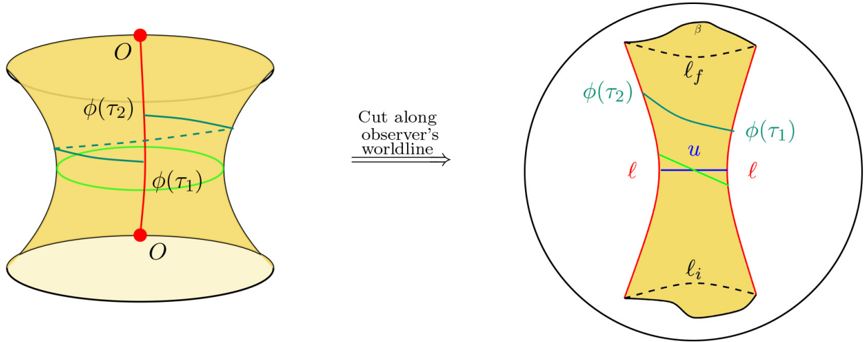
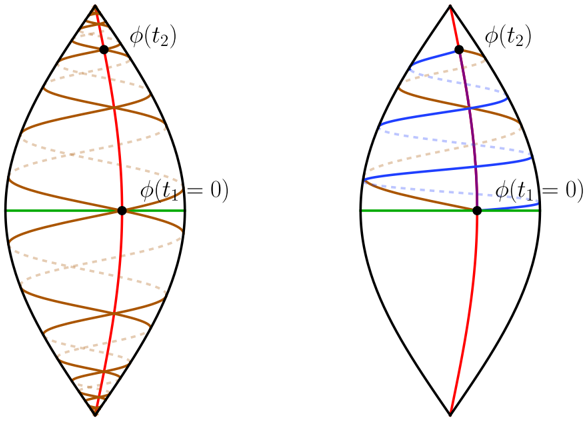
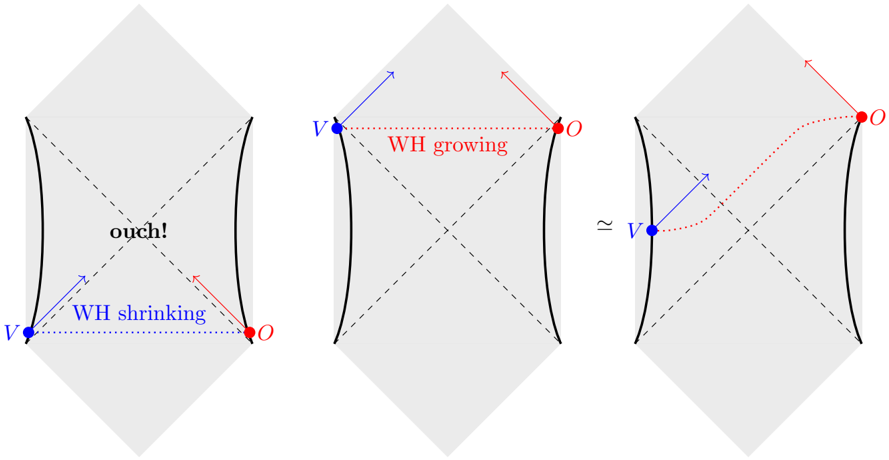
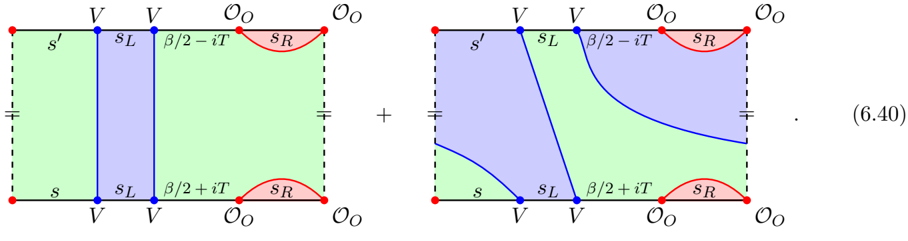
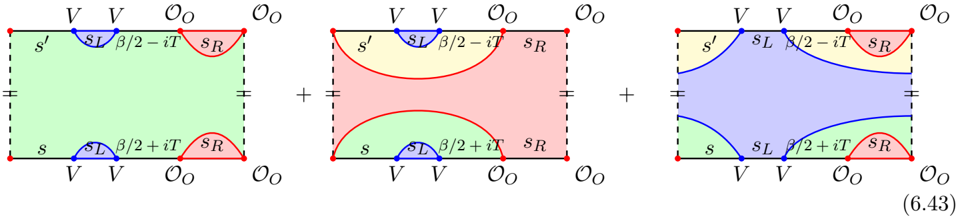
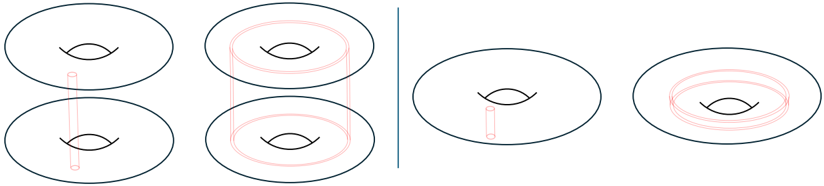
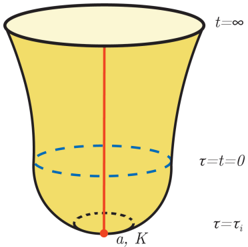
A bstract: One of the fundamental problems in quantum gravity is to describe the experience of a gravitating observer in generic spacetimes. In this paper, we develop a framework for describing non-perturbative physics relative to an observer using the gravitational path integral. We apply our proposal to an observer that lives in a closed universe and one that falls behind a black hole horizon. We find that the Hilbert space that describes the experience of the observer is much larger than the Hilbert space in the absence of an observer. In the case of closed universes, the Hilbert space is not one-dimensional, as calculations in the absence of the observer suggest. Rather, its dimension scales exponentially with $${G}_{N}^{-1}$$ . Similarly, from an observer’s perspective, the dimension of the Hilbert space in a two-sided black hole is increased. We compute various observables probing the experience of a gravitating observer in this Hilbert space. We find that an observer experiences non-trivial physics in the closed universe in contrast to what it would see in a one-dimensional Hilbert space. In the two-sided black hole setting, our proposal implies that non-perturbative corrections to effective field theory for an infalling observer are suppressed until times exponential in the black hole entropy, resolving a recently-raised puzzle in black hole physics. While the framework that we develop is exemplified in the toy-model of JT gravity, most of our analysis can be extended to higher dimensions and, in particular, to generic spacetimes not admitting a conventional holographic description, such as cosmological universes or black hole interiors.
Overview
The claims and statistics of this paper haven’t been checked yet.
Run the check — free, no account needed. It reads the open-access text and checks the sources it cites.
Integrity signals
Registry
Cites
Statistics
Figures



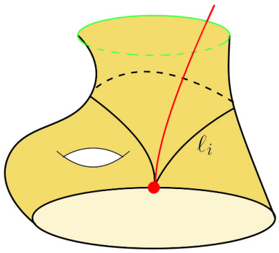
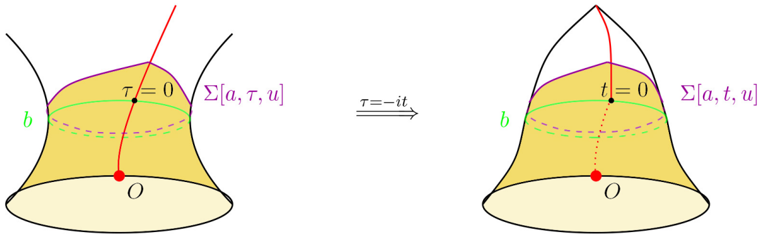
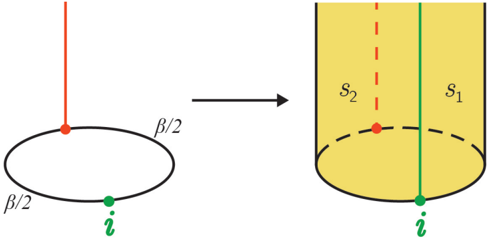
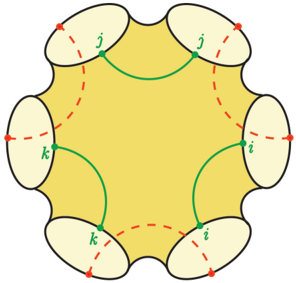



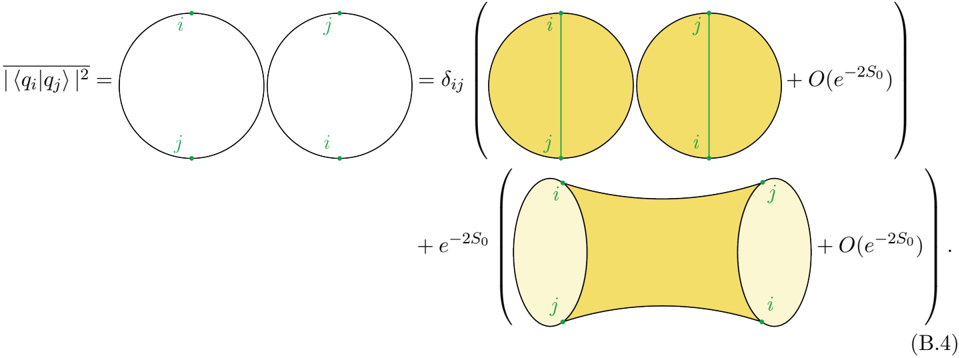
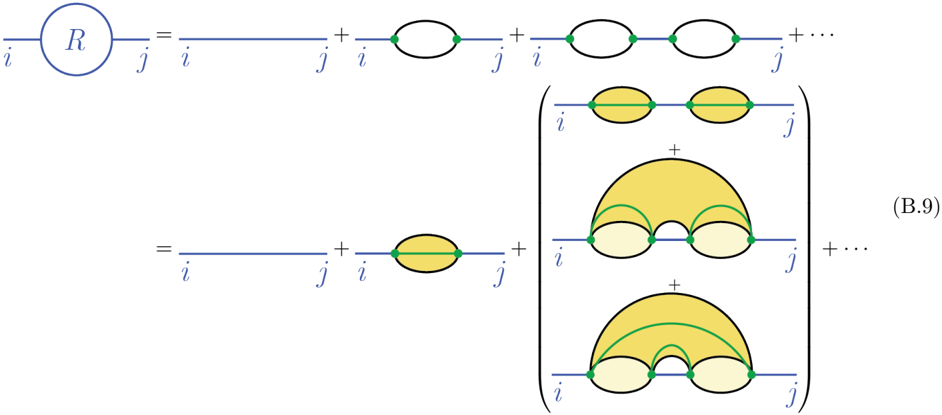
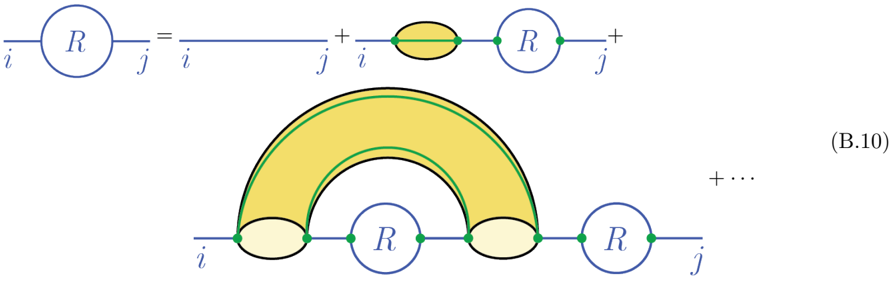
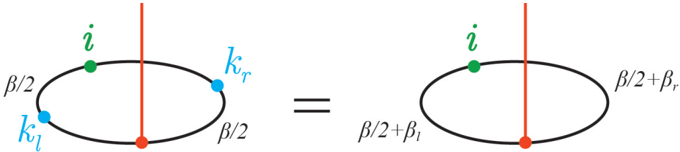
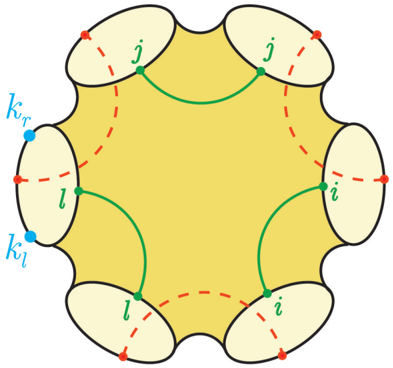
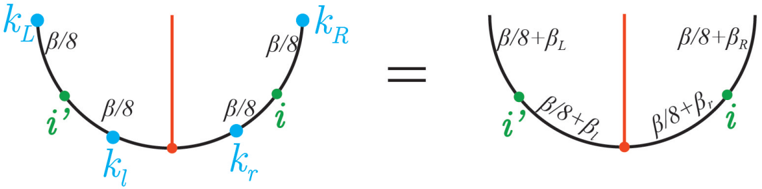
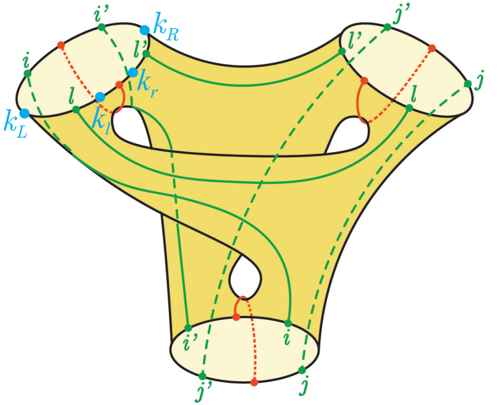
Verification
Claims the paper makes
The claims and statistics of this paper haven’t been checked yet.
Run the check — free, no account needed. It reads the open-access text and checks the sources it cites.
Claims other papers make about this one
Each is checked against this paper’s own text: does it say what the citing paper says it does?
In the citing paper
“Well-known arguments [52,53,109,111] indicate that the Hilbert space of the closed universe is one-dimensional in this regime.”
From The baby universe is fine and the CFT knows it: on holography for closed universes (2025) · cites this paper as [53]
Self-check
Percentages, sums and reported differences re-computed from the paper’s own numbers.
The self-check needs the paper’s full text.
Citations
Cites
Hartle, J. B., & Hawking, S. W. (1983) · Physical Review D · doi:10.1103/physrevd.28.2960 · Cited by 3,027
A covariant holographic entanglement entropy proposal
Hubeny, V. E., Rangamani, M., & Takayanagi, T. (2007) · Journal of High Energy Physics · doi:10.1088/1126-6708/2007/07/062 · Cited by 1,822
A Covariant Holographic Entanglement Entropy Proposal
Hubeny, V. E., Rangamani, M., & Takayanagi, T. (2007) · arXiv · doi:10.48550/arxiv.0705.0016 · Cited by 1,822
Black Holes: Complementarity or Firewalls?
Almheiri, A., Marolf, D., Polchinski, J., & Sully, J. (2012) · arXiv · doi:10.48550/arxiv.1207.3123 · Cited by 1,471
Entanglement wedge reconstruction and the information paradox
Penington, G. (2020) · Journal of High Energy Physics · doi:10.1007/jhep09(2020)002 · Cited by 968
Replica wormholes and the entropy of Hawking radiation
Almheiri, A., Hartman, T., Maldacena, J., Shaghoulian, E., & Tajdini, A. (2020) · Journal of High Energy Physics · doi:10.1007/jhep05(2020)013 · Cited by 910
Replica wormholes and the black hole interior
Penington, G., Shenker, S. H., Stanford, D., & Yang, Z. (2019) · arXiv · doi:10.48550/arxiv.1911.11977 · Cited by 809
An infalling observer in AdS/CFT
Papadodimas, K., & Raju, S. (2013) · Journal of High Energy Physics · doi:10.1007/jhep10(2013)212 · Cited by 335
Quantum computation vs. firewalls
Harlow, D., & Hayden, P. (2013) · Journal of High Energy Physics · doi:10.1007/jhep06(2013)085 · Cited by 310
Marolf, D., & Maxfield, H. (2020) · Journal of High Energy Physics · doi:10.1007/jhep08(2020)044 · Cited by 300
State-dependent bulk-boundary maps and black hole complementarity
Papadodimas, K., & Raju, S. (2014) · Physical Review D · doi:10.1103/physrevd.89.086010 · Cited by 267
Solvable models of quantum black holes: a review on Jackiw–Teitelboim gravity
Mertens, T. G., & Turiaci, G. J. (2023) · Living Reviews in Relativity · doi:10.1007/s41114-023-00046-1 · Cited by 181
Baby Universes, Holography, and the Swampland
McNamara, J., & Vafa, C. (2020) · arXiv · doi:10.48550/arxiv.2004.06738 · Cited by 118
Research works printed but not linked: 118
- L. Susskind, The World as a hologram, J. Math. Phys. 36 (1995) 6377 [hep-th/9409089] [INSPIRE]. · DOI · Paper page
- G. ’t Hooft, Dimensional reduction in quantum gravity, Conf. Proc. C 930308 (1993) 284 [gr-qc/9310026] [INSPIRE]. · arXiv
- J.M. Maldacena, The large N limit of superconformal field theories and supergravity, Adv. Theor. Math. Phys. 2 (1998) 231 [hep-th/9711200] [INSPIRE]. · DOI · Paper page
- E. Witten, Anti de Sitter space and holography, Adv. Theor. Math. Phys. 2 (1998) 253 [hep-th/9802150] [INSPIRE]. · DOI · Paper page
- O. Aharony et al., Large N field theories, string theory and gravity, Phys. Rept. 323 (2000) 183 [hep-th/9905111] [INSPIRE]. · DOI
- G.W. Gibbons and S.W. Hawking, Action Integrals and Partition Functions in Quantum Gravity, Phys. Rev. D 15 (1977) 2752 [INSPIRE]. · DOI · Paper page
- J.M. Maldacena and L. Maoz, Wormholes in AdS, JHEP 02 (2004) 053 [hep-th/0401024] [INSPIRE]. · DOI · Paper page
- A. Lewkowycz and J. Maldacena, Generalized gravitational entropy, JHEP 08 (2013) 090 [arXiv:1304.4926] [INSPIRE]. · DOI · Paper page
- T. Faulkner, A. Lewkowycz and J. Maldacena, Quantum corrections to holographic entanglement entropy, JHEP 11 (2013) 074 [arXiv:1307.2892] [INSPIRE]. · DOI · Paper page
- P. Saad, S.H. Shenker and D. Stanford, A semiclassical ramp in SYK and in gravity, arXiv:1806.06840 [INSPIRE]. · arXiv
- P. Saad, S.H. Shenker and D. Stanford, JT gravity as a matrix integral, arXiv:1903.11115 [INSPIRE]. · arXiv
- P. Saad, S.H. Shenker, D. Stanford and S. Yao, Wormholes without averaging, JHEP 09 (2024) 133 [arXiv:2103.16754] [INSPIRE]. · DOI · Paper page
- P. Saad, S.H. Shenker and S. Yao, Comments on wormholes and factorization, JHEP 10 (2024) 076 [arXiv:2107.13130] [INSPIRE]. · DOI
- A. Blommaert, L.V. Iliesiu and J. Kruthoff, Gravity factorized, JHEP 09 (2022) 080 [arXiv:2111.07863] [INSPIRE]. · DOI
- A. Blommaert, L.V. Iliesiu and J. Kruthoff, Alpha states demystified — towards microscopic models of AdS2 holography, JHEP 08 (2022) 071 [arXiv:2203.07384] [INSPIRE]. · DOI
- J. Boruch, L.V. Iliesiu and C. Yan, Constructing all BPS black hole microstates from the gravitational path integral, JHEP 09 (2024) 058 [arXiv:2307.13051] [INSPIRE]. · DOI
- L.V. Iliesiu, M. Kologlu and G.J. Turiaci, Supersymmetric indices factorize, JHEP 05 (2023) 032 [arXiv:2107.09062] [INSPIRE]. · DOI · Paper page
- L.V. Iliesiu, S. Murthy and G.J. Turiaci, Black hole microstate counting from the gravitational path integral, arXiv:2209.13602 [INSPIRE]. · arXiv
- D. Marolf, Gravitational thermodynamics without the conformal factor problem: partition functions and Euclidean saddles from Lorentzian path integrals, JHEP 07 (2022) 108 [arXiv:2203.07421] [INSPIRE]. · DOI
- E. Colafranceschi, X. Dong, D. Marolf and Z. Wang, Algebras and Hilbert spaces from gravitational path integrals. Understanding Ryu-Takayanagi/HRT as entropy without AdS/CFT, JHEP 10 (2024) 063 [arXiv:2310.02189] [INSPIRE]. · DOI
- D. Marolf, On the nature of ensembles from gravitational path integrals, J. Phys. A 58 (2025) 035204 [arXiv:2407.04625] [INSPIRE]. · DOI
- V. Balasubramanian, A. Lawrence, J.M. Magan and M. Sasieta, Microscopic Origin of the Entropy of Black Holes in General Relativity, Phys. Rev. X 14 (2024) 011024 [arXiv:2212.02447] [INSPIRE]. · arXiv
- V. Balasubramanian, A. Lawrence, J.M. Magan and M. Sasieta, Microscopic Origin of the Entropy of Astrophysical Black Holes, Phys. Rev. Lett. 132 (2024) 141501 [arXiv:2212.08623] [INSPIRE]. · DOI
- M. Sasieta, Wormholes from heavy operator statistics in AdS/CFT, JHEP 03 (2023) 158 [arXiv:2211.11794] [INSPIRE]. · DOI · Paper page
- S. Ryu and T. Takayanagi, Aspects of Holographic Entanglement Entropy, JHEP 08 (2006) 045 [hep-th/0605073] [INSPIRE]. · DOI · Paper page
- S. Ryu and T. Takayanagi, Holographic derivation of entanglement entropy from AdS/CFT, Phys. Rev. Lett. 96 (2006) 181602 [hep-th/0603001] [INSPIRE]. · DOI · Paper page
- N. Engelhardt and A.C. Wall, Quantum Extremal Surfaces: Holographic Entanglement Entropy beyond the Classical Regime, JHEP 01 (2015) 073 [arXiv:1408.3203] [INSPIRE]. · DOI · Paper page
- L. Susskind, Singularities, Firewalls, and Complementarity, arXiv:1208.3445 [INSPIRE]. · arXiv
- A. Almheiri et al., An Apologia for Firewalls, JHEP 09 (2013) 018 [arXiv:1304.6483] [INSPIRE]. · DOI · Paper page
- D. Stanford and Z. Yang, Firewalls from wormholes, arXiv:2208.01625 [INSPIRE]. · arXiv
- L.V. Iliesiu et al., On the non-perturbative bulk Hilbert space of JT gravity, JHEP 10 (2024) 220 [arXiv:2403.08696] [INSPIRE]. · DOI
- A. Blommaert, C.-H. Chen and Y. Nomura, Firewalls at exponentially late times, JHEP 10 (2024) 131 [arXiv:2403.07049] [INSPIRE]. · DOI
- A. Levine and E. Shaghoulian, Encoding beyond cosmological horizons in de Sitter JT gravity, JHEP 02 (2023) 179 [arXiv:2204.08503] [INSPIRE]. · DOI
- B. McInnes, Answering a basic objection to bang / crunch holography, JHEP 10 (2004) 018 [hep-th/0407189] [INSPIRE]. · DOI
- S. Cooper et al., Black hole microstate cosmology, JHEP 07 (2019) 065 [arXiv:1810.10601] [INSPIRE]. · DOI
- S. Antonini and B. Swingle, Cosmology at the end of the world, Nature Phys. 16 (2020) 881 [arXiv:1907.06667] [INSPIRE]. · DOI
- M. Van Raamsdonk, Comments on wormholes, ensembles, and cosmology, JHEP 12 (2021) 156 [arXiv:2008.02259] [INSPIRE]. · DOI
- M. Van Raamsdonk, Cosmology from confinement?, JHEP 03 (2022) 039 [arXiv:2102.05057] [INSPIRE]. · DOI
- S. Antonini, P. Simidzija, B. Swingle and M. Van Raamsdonk, Cosmology from the vacuum, Class. Quant. Grav. 41 (2024) 045008 [arXiv:2203.11220] [INSPIRE]. · DOI
- S. Antonini, P. Simidzija, B. Swingle and M. Van Raamsdonk, Accelerating Cosmology from a Holographic Wormhole, Phys. Rev. Lett. 130 (2023) 221601 [arXiv:2206.14821] [INSPIRE]. · DOI
- S. Antonini et al., Accelerating cosmology from Λ < 0 gravitational effective field theory, JHEP 05 (2023) 203 [arXiv:2212.00050] [INSPIRE]. · DOI
- A. Sahu, P. Simidzija and M. Van Raamsdonk, Bubbles of cosmology in AdS/CFT, JHEP 11 (2023) 010 [arXiv:2306.13143] [INSPIRE]. · DOI
- J. Chakravarty, A. Maloney, K. Namjou and S.F. Ross, A new observable for holographic cosmology, JHEP 10 (2024) 184 [arXiv:2407.04781] [INSPIRE]. · DOI
- S. Antonini and L.G.C. Bariuan, Magnetic braneworlds: cosmology and wormholes, JHEP 09 (2024) 070 [arXiv:2405.18465] [INSPIRE]. · DOI
- P. Betzios and O. Papadoulaki, Inflationary Cosmology from Anti-de Sitter Wormholes, Phys. Rev. Lett. 133 (2024) 021501 [arXiv:2403.17046] [INSPIRE]. · DOI
- M. Van Raamsdonk and C. Waddell, Holographic motivations and observational evidence for decreasing dark energy, arXiv:2406.02688 [INSPIRE]. · arXiv
- S. Antonini and P. Rath, Do holographic CFT states have unique semiclassical bulk duals?, arXiv:2408.02720 [INSPIRE]. · arXiv
- A. Sahu and M. Van Raamsdonk, Holographic black hole cosmologies, arXiv:2411.14673 [INSPIRE]. · arXiv
- V. Chandrasekaran, R. Longo, G. Penington and E. Witten, An algebra of observables for de Sitter space, JHEP 02 (2023) 082 [arXiv:2206.10780] [INSPIRE]. · DOI
- A. Strominger, The dS/CFT correspondence, JHEP 10 (2001) 034 [hep-th/0106113] [INSPIRE]. · DOI
- E. Coleman et al., De Sitter microstates from $$T\overline{T }$$ + Λ2 and the Hawking-Page transition, JHEP 07 (2022) 140 [arXiv:2110.14670] [INSPIRE]. · DOI
- X. Dong, E. Silverstein and G. Torroba, De Sitter Holography and Entanglement Entropy, JHEP 07 (2018) 050 [arXiv:1804.08623] [INSPIRE]. · DOI · Paper page
- G. Araujo-Regado, R. Khan and A.C. Wall, Cauchy slice holography: a new AdS/CFT dictionary, JHEP 03 (2023) 026 [arXiv:2204.00591] [INSPIRE]. · DOI
- P. McFadden and K. Skenderis, Holography for Cosmology, Phys. Rev. D 81 (2010) 021301 [arXiv:0907.5542] [INSPIRE]. · DOI
- D. Anninos, S.A. Hartnoll and D.M. Hofman, Static Patch Solipsism: Conformal Symmetry of the de Sitter Worldline, Class. Quant. Grav. 29 (2012) 075002 [arXiv:1109.4942] [INSPIRE]. · DOI
- D. Anninos, T. Anous, I. Bredberg and G.S. Ng, Incompressible Fluids of the de Sitter Horizon and Beyond, JHEP 05 (2012) 107 [arXiv:1110.3792] [INSPIRE]. · DOI
- S. Leutheusser and H. Liu, Subregion-subalgebra duality: Emergence of space and time in holography, Phys. Rev. D 111 (2025) 066021 [arXiv:2212.13266] [INSPIRE]. · DOI
- E. Witten, Gravity and the crossed product, JHEP 10 (2022) 008 [arXiv:2112.12828] [INSPIRE]. · DOI
- V. Chandrasekaran, G. Penington and E. Witten, Large N algebras and generalized entropy, JHEP 04 (2023) 009 [arXiv:2209.10454] [INSPIRE]. · DOI
- E. Witten, Algebras, regions, and observers, Proc. Symp. Pure Math. 107 (2024) 247 [arXiv:2303.02837] [INSPIRE]. · arXiv
- E. Witten, A background-independent algebra in quantum gravity, JHEP 03 (2024) 077 [arXiv:2308.03663] [INSPIRE]. · DOI
- E. Gesteau, Large N von Neumann Algebras and the Renormalization of Newton’s Constant, Commun. Math. Phys. 406 (2025) 40 [arXiv:2302.01938] [INSPIRE]. · DOI
- D.K. Kolchmeyer and H. Liu, Chaos and the Emergence of the Cosmological Horizon, arXiv:2411.08090 [INSPIRE]. · arXiv
- C.-H. Chen and G. Penington, A clock is just a way to tell the time: gravitational algebras in cosmological spacetimes, arXiv:2406.02116 [INSPIRE]. · arXiv
- J. Kudler-Flam, S. Leutheusser and G. Satishchandran, Algebraic Observational Cosmology, arXiv:2406.01669 [INSPIRE]. · arXiv
- J. De Vuyst, S. Eccles, P.A. Hoehn and J. Kirklin, Gravitational entropy is observer-dependent, arXiv:2405.00114 [INSPIRE]. · arXiv
- J. Boruch, L.V. Iliesiu, G. Lin and C. Yan, How the Hilbert space of two-sided black holes factorises, arXiv:2406.04396 [INSPIRE]. · arXiv
- S. Antonini, M. Sasieta and B. Swingle, Cosmology from random entanglement, JHEP 11 (2023) 188 [arXiv:2307.14416] [INSPIRE]. · DOI · Paper page
- M. Usatyuk, Z.-Y. Wang and Y. Zhao, Closed universes in two dimensional gravity, SciPost Phys. 17 (2024) 051 [arXiv:2402.00098] [INSPIRE]. · DOI
- M. Usatyuk and Y. Zhao, Closed universes, factorization, and ensemble averaging, JHEP 02 (2025) 052 [arXiv:2403.13047] [INSPIRE]. · DOI
- E. Di Valentino, A. Melchiorri and J. Silk, Planck evidence for a closed Universe and a possible crisis for cosmology, Nature Astron. 4 (2019) 196 [arXiv:1911.02087] [INSPIRE]. · DOI · Paper page
- W. Handley, Curvature tension: evidence for a closed universe, Phys. Rev. D 103 (2021) L041301 [arXiv:1908.09139] [INSPIRE]. · DOI · Paper page
- Planck collaboration, Planck 2018 results. VI. Cosmological parameters, Astron. Astrophys. 641 (2020) A6 [Erratum ibid. 652 (2021) C4] [arXiv:1807.06209] [INSPIRE]. · arXiv
- R. Jackiw, Lower Dimensional Gravity, Nucl. Phys. B 252 (1985) 343 [INSPIRE]. · DOI · Paper page
- C. Teitelboim, Gravitation and Hamiltonian Structure in Two Space-Time Dimensions, Phys. Lett. B 126 (1983) 41 [INSPIRE]. · DOI · Paper page
- P.-S. Hsin, L.V. Iliesiu and Z. Yang, A violation of global symmetries from replica wormholes and the fate of black hole remnants, Class. Quant. Grav. 38 (2021) 194004 [arXiv:2011.09444] [INSPIRE]. · DOI
- C. Akers and G. Penington, Quantum minimal surfaces from quantum error correction, SciPost Phys. 12 (2022) 157 [arXiv:2109.14618] [INSPIRE]. · DOI · Paper page
- C. Akers et al., The black hole interior from non-isometric codes and complexity, JHEP 06 (2024) 155 [arXiv:2207.06536] [INSPIRE]. · DOI · Paper page
- S. Antonini et al., Non-isometry, state dependence and holography, JHEP 02 (2025) 150 [arXiv:2411.07296] [INSPIRE]. · DOI · Paper page
- T. Hartman, Y. Jiang and E. Shaghoulian, Islands in cosmology, JHEP 11 (2020) 111 [arXiv:2008.01022] [INSPIRE]. · DOI
- D. Marolf and J. Polchinski, Violations of the Born rule in cool state-dependent horizons, JHEP 01 (2016) 008 [arXiv:1506.01337] [INSPIRE]. · DOI
- D. Stanford and L. Susskind, Complexity and Shock Wave Geometries, Phys. Rev. D 90 (2014) 126007 [arXiv:1406.2678] [INSPIRE]. · DOI
- D. Harlow and D. Jafferis, The Factorization Problem in Jackiw-Teitelboim Gravity, JHEP 02 (2020) 177 [arXiv:1804.01081] [INSPIRE]. · DOI · Paper page
- G. Penington and E. Witten, Algebras and States in JT Gravity, arXiv:2301.07257 [INSPIRE]. · arXiv
- D.K. Kolchmeyer, von Neumann algebras in JT gravity, JHEP 06 (2023) 067 [arXiv:2303.04701] [INSPIRE]. · DOI
- Z. Yang, The Quantum Gravity Dynamics of Near Extremal Black Holes, JHEP 05 (2019) 205 [arXiv:1809.08647] [INSPIRE]. · DOI · Paper page
- A. Kitaev and S.J. Suh, Statistical mechanics of a two-dimensional black hole, JHEP 05 (2019) 198 [arXiv:1808.07032] [INSPIRE]. · DOI · Paper page
- C.J. Isham, Canonical quantum gravity and the problem of time, NATO Sci. Ser. C 409 (1993) 157 [gr-qc/9210011] [INSPIRE]. · DOI
- J. Held and H. Maxfield, The Hilbert space of de Sitter JT: a case study for canonical methods in quantum gravity, arXiv:2410.14824 [INSPIRE]. · arXiv
- D.L. Jafferis, D.K. Kolchmeyer, B. Mukhametzhanov and J. Sonner, Jackiw-Teitelboim gravity with matter, generalized eigenstate thermalization hypothesis, and random matrices, Phys. Rev. D 108 (2023) 066015 [arXiv:2209.02131] [INSPIRE]. · DOI
- D. Stanford and E. Witten, JT gravity and the ensembles of random matrix theory, Adv. Theor. Math. Phys. 24 (2020) 1475 [arXiv:1907.03363] [INSPIRE]. · DOI · Paper page
- L.V. Iliesiu, M. Mezei and G. Sárosi, The volume of the black hole interior at late times, JHEP 07 (2022) 073 [arXiv:2107.06286] [INSPIRE]. · DOI · Paper page
- Y. Chen, V. Gorbenko and J. Maldacena, Bra-ket wormholes in gravitationally prepared states, JHEP 02 (2021) 009 [arXiv:2007.16091] [INSPIRE]. · DOI
- C. Akers, A. Levine, G. Penington and E. Wildenhain, One-shot holography, SciPost Phys. 16 (2024) 144 [arXiv:2307.13032] [INSPIRE]. · DOI
- E. D’Hoker and D.Z. Freedman, Supersymmetric gauge theories and the AdS/CFT correspondence, in the proceedings of the Theoretical Advanced Study Institute in Elementary Particle Physics (TASI 2001), Boulder, CO, U.S.A., 3–29 June 2001 [hep-th/0201253] [INSPIRE]. · arXiv
- L. Susskind, The Typical-State Paradox: Diagnosing Horizons with Complexity, Fortsch. Phys. 64 (2016) 84 [arXiv:1507.02287] [INSPIRE]. · DOI
- L. Susskind, Black Holes at Exp-time, arXiv:2006.01280 [INSPIRE]. · arXiv
- D. Stanford, More quantum noise from wormholes, arXiv:2008.08570 [INSPIRE]. · arXiv
- J. de Boer, D. Liska, B. Post and M. Sasieta, A principle of maximum ignorance for semiclassical gravity, JHEP 02 (2024) 003 [arXiv:2311.08132] [INSPIRE]. · DOI
- A. Climent et al., Universal construction of black hole microstates, Phys. Rev. D 109 (2024) 086024 [arXiv:2401.08775] [INSPIRE]. · DOI
- B.S. DeWitt, Quantum Theory of Gravity. 1. The Canonical Theory, Phys. Rev. 160 (1967) 1113 [INSPIRE]. · DOI · Paper page
- D.N. Page and W.K. Wootters, Evolution without evolution: dynamics described by stationary observables, Phys. Rev. D 27 (1983) 2885 [INSPIRE]. · DOI
- P.A. Hoehn, A.R.H. Smith and M.P.E. Lock, Trinity of relational quantum dynamics, Phys. Rev. D 104 (2021) 066001 [arXiv:1912.00033] [INSPIRE]. · DOI
- E. Shaghoulian, The central dogma and cosmological horizons, JHEP 01 (2022) 132 [arXiv:2110.13210] [INSPIRE]. · DOI
- E. Shaghoulian, Quantum gravity and the measurement problem in quantum mechanics, arXiv:2305.10635 [INSPIRE]. · arXiv
- E. Witten, Quantum Field Theory and the Jones Polynomial, Commun. Math. Phys. 121 (1989) 351 [INSPIRE]. · DOI · Paper page
- J. Frohlich and C. King, The Chern-Simons Theory and Knot Polynomials, Commun. Math. Phys. 126 (1989) 167 [INSPIRE]. · DOI
- V. Guillemin and S. Sternberg, Geometric quantization and multiplicities of group representations, Invent. Math. 67 (1982) 515. · DOI
- H. Murayama, Explicit Quantization of the Chern-Simons Action, Z. Phys. C 48 (1990) 79 [INSPIRE]. · DOI
- A.Y. Alekseev and A.Z. Malkin, Symplectic geometry of the Chern-Simons theory, Lect. Notes Phys. 436 (1994) 59 [INSPIRE]. · DOI
- S. Elitzur, G.W. Moore, A. Schwimmer and N. Seiberg, Remarks on the Canonical Quantization of the Chern-Simons-Witten Theory, Nucl. Phys. B 326 (1989) 108 [INSPIRE]. · DOI · Paper page
- J.M. Maldacena, Eternal black holes in anti-de Sitter, JHEP 04 (2003) 021 [hep-th/0106112] [INSPIRE]. · DOI · Paper page
- A.B. Zamolodchikov, Expectation value of composite field $$T\overline{T }$$ in two-dimensional quantum field theory, hep-th/0401146 [INSPIRE]. · arXiv
- F.A. Smirnov and A.B. Zamolodchikov, On space of integrable quantum field theories, Nucl. Phys. B 915 (2017) 363 [arXiv:1608.05499] [INSPIRE]. · DOI · Paper page
- A. Cavaglià, S. Negro, I.M. Szécsényi and R. Tateo, $$T\overline{T }$$-deformed 2D Quantum Field Theories, JHEP 10 (2016) 112 [arXiv:1608.05534] [INSPIRE]. · DOI
- V. Gorbenko, E. Silverstein and G. Torroba, dS/dS and $$T\overline{T }$$, JHEP 03 (2019) 085 [arXiv:1811.07965] [INSPIRE]. · DOI
- V. Ivo, Y.-Z. Li and J. Maldacena, The no boundary density matrix, JHEP 02 (2025) 124 [arXiv:2409.14218] [INSPIRE]. · DOI
- A. Goel, L.V. Iliesiu, J. Kruthoff and Z. Yang, Classifying boundary conditions in JT gravity: from energy-branes to α-branes, JHEP 04 (2021) 069 [arXiv:2010.12592] [INSPIRE]. · DOI
Cited by
Sorted by citations
The baby universe is fine and the CFT knows it: on holography for closed universes
Antonini, S., Rath, P., Sasieta, M., Swingle, B., & Vilar López, A. (2025) · Journal of High Energy Physics · doi:10.1007/jhep12(2025)159 · Cited by 35
Self-citationFurther Evidence Against a Semiclassical Baby Universe in AdS/CFT
Engelhardt, N., & Gesteau, E. (2025) · arXiv · doi:10.48550/arxiv.2504.14586 · Cited by 28
Metadata
- Authors
- Abdalla, A. I., Antonini, S., Iliesiu, L. V., & Levine, A.
- Venue
- Journal of High Energy Physics
- Published
- 2025-05-07
- Volume
- 2025
- Issue
- 5
- ISSN
- 1029-8479
- Cited by
- 30
- References
- 13
- Language
- en
About these checks
Registry, retraction, Cites and statistics results are computed, not judged, with one exception: a printed reference that no index lists is read once by a model before it counts as a citation error. Claims are extracted by a model and kept only when their quote appears verbatim in the text; each cited source is then checked, with a model’s help, for whether it says what the claim relies on. Those verdicts can be wrong — read the claim’s quote and the cited source before relying on one.
Statistics and arithmetic are recomputed, not judged.
Confidence bands are shown only for fields calibrated on our annotated test set. None is calibrated yet, so no band is shown.
What counts as a claim ›How we measure confidence ›How we check this ›
Are you an author, or do you see a problem with this page? Request a review
