

The DOI matches its Crossref record; 9 of the 9 references it cites were found in a registry or an index.
Aspects of AdS2 quantum gravity and the Karch-Randall braneworld
Abstract
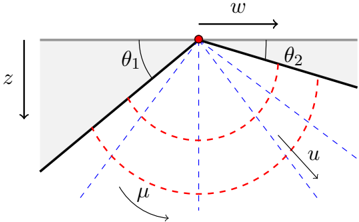
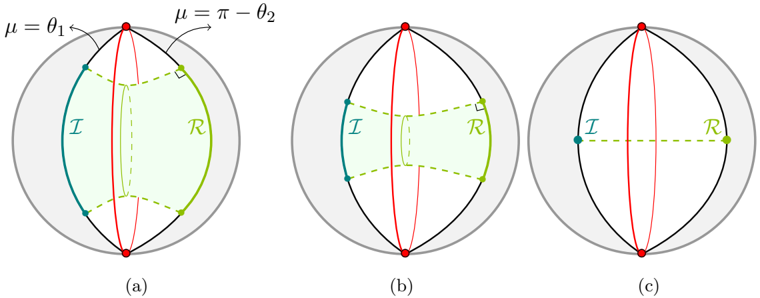
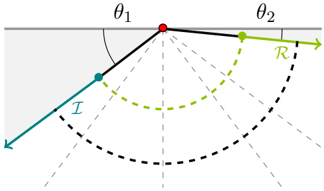
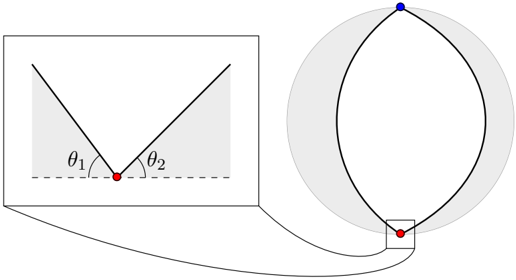
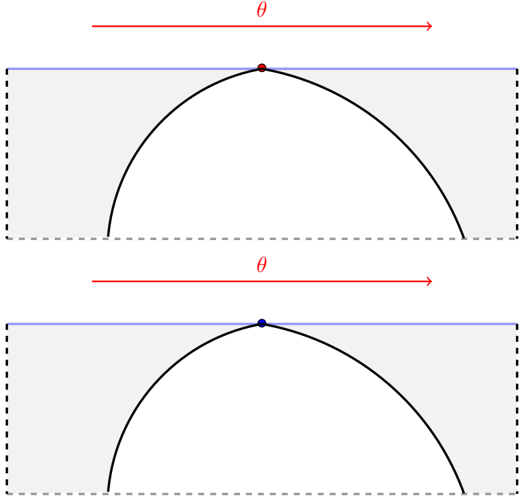
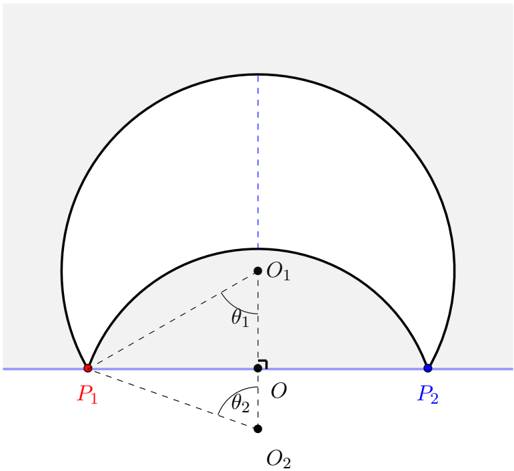
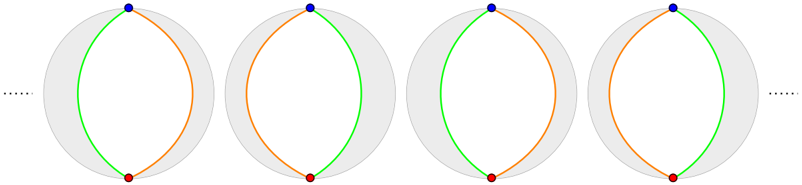
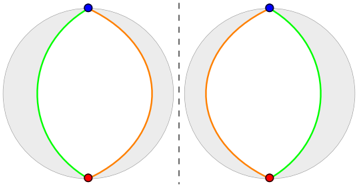
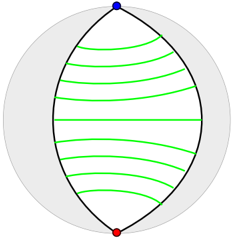
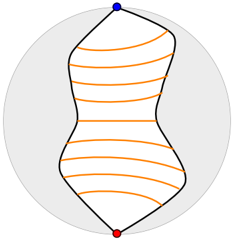
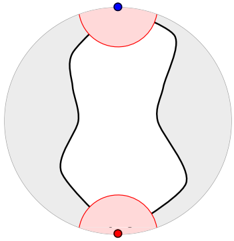
In this paper, we use the Karch-Randall braneworld to study theories of quantum gravity in two dimensional (nearly) anti-de Sitter space (AdS 2). We focus on effective gravitational theories in the setup with two Karch-Randall branes embedded in an asymptotically AdS 3 bulk forming a wedge. We find the appearance of two-dimensional Einstein-Hilbert gravity (or the Lorenzian version of the theory considered by Marolf and Maxfield) when the branes are rigid but the emergence of a class of dilaton gravity models parameterized by the tensions of the two branes when brane fluctuations are accounted for. A special case of our result is Jackiw-Teitelboim (JT) gravity, which has been proven useful to address many important problems in quantum gravity. An important implication of our work is that these models have holographic duals as one-dimensional quantum mechanics systems. At the end, we discuss a puzzle regarding the energy spectrum and its resolution.
Overview
The claims and statistics of this paper haven’t been checked yet.
Run the check — free, no account needed. It reads the open-access text and checks the sources it cites.
Integrity signals
Registry
Cites
Statistics
Figures
Verification
Claims the paper makes
The claims and statistics of this paper haven’t been checked yet.
Run the check — free, no account needed. It reads the open-access text and checks the sources it cites.
Claims other papers make about this one
Each is checked against this paper’s own text: does it say what the citing paper says it does?
In the citing paper
“For example, one may replace the brane action (3.11) with a non-minimally coupled dilaton theory, e.g., Jackiw-Teitelboim (JT) grav-ity [78,79], as done in [53].”
From Three-Dimensional Quantum Black Holes: A Primer (2024) · cites this paper as [79]
Self-check
Percentages, sums and reported differences re-computed from the paper’s own numbers.
The self-check needs the paper’s full text.
Citations
Cites
A covariant holographic entanglement entropy proposal
Hubeny, V. E., Rangamani, M., & Takayanagi, T. (2007) · Journal of High Energy Physics · doi:10.1088/1126-6708/2007/07/062 · Cited by 1,822 · cited 1×
“As a result, we have to use the bulk HRT proposal [62] looking for HRT surfaces connecting the two branes.”
MethodA Covariant Holographic Entanglement Entropy Proposal
Hubeny, V. E., Rangamani, M., & Takayanagi, T. (2007) · arXiv · doi:10.48550/arxiv.0705.0016 · Cited by 1,822
Cool horizons for entangled black holes
Maldacena, J., & Susskind, L. (2013) · Fortschritte der Physik · doi:10.1002/prop.201300020 · Cited by 1,304
Jensen, K. (2016) · Physical Review Letters · doi:10.1103/physrevlett.117.111601 · Cited by 695
Maldacena, J., Michelson, J., & Strominger, A. (1999) · Journal of High Energy Physics · doi:10.1088/1126-6708/1999/02/011 · Cited by 548
Relative entropy equals bulk relative entropy
Jafferis, D. L., Lewkowycz, A., Maldacena, J., & Suh, S. J. (2015) · arXiv · doi:10.48550/arxiv.1512.06431 · Cited by 534
Marolf, D., & Maxfield, H. (2020) · Journal of High Energy Physics · doi:10.1007/jhep08(2020)044 · Cited by 300
On the dynamics of near-extremal black holes
Nayak, P., Shukla, A., Soni, R. M., Trivedi, S. P., & Vishal, V. (2018) · Journal of High Energy Physics · doi:10.1007/jhep09(2018)048 · Cited by 206
A universal Schwarzian sector in two-dimensional conformal field theories
Ghosh, A., Maxfield, H., & Turiaci, G. J. (2020) · Journal of High Energy Physics · doi:10.1007/jhep05(2020)104 · Cited by 135
Research works printed but not linked: 72
- A. Karch and L. Randall, Open and closed string interpretation of SUSY CFT’s on branes with boundaries, JHEP 06 (2001) 063 [hep-th/0105132] [INSPIRE]. · DOI · Paper page
- A. Karch and L. Randall, Locally localized gravity, JHEP 05 (2001) 008 [hep-th/0011156] [INSPIRE]. · DOI · Paper page
- A. Almheiri, R. Mahajan and J. Maldacena, Islands outside the horizon, arXiv:1910.11077 [INSPIRE]. · arXiv
- A. Almheiri, R. Mahajan and J.E. Santos, Entanglement islands in higher dimensions, SciPost Phys. 9 (2020) 001 [arXiv:1911.09666] [INSPIRE]. · DOI
- H. Geng and A. Karch, Massive islands, JHEP 09 (2020) 121 [arXiv:2006.02438] [INSPIRE]. · DOI · Paper page
- H. Geng et al., Entanglement phase structure of a holographic BCFT in a black hole background, JHEP 05 (2022) 153 [arXiv:2112.09132] [INSPIRE]. · DOI · Paper page
- H.Z. Chen, R.C. Myers, D. Neuenfeld, I.A. Reyes and J. Sandor, Quantum Extremal Islands Made Easy, Part I: Entanglement on the Brane, JHEP 10 (2020) 166 [arXiv:2006.04851] [INSPIRE]. · DOI
- H.Z. Chen, R.C. Myers, D. Neuenfeld, I.A. Reyes and J. Sandor, Quantum Extremal Islands Made Easy, Part II: Black Holes on the Brane, JHEP 12 (2020) 025 [arXiv:2010.00018] [INSPIRE]. · DOI · Paper page
- H. Geng et al., Information Transfer with a Gravitating Bath, SciPost Phys. 10 (2021) 103 [arXiv:2012.04671] [INSPIRE]. · DOI
- H. Geng et al., Inconsistency of islands in theories with long-range gravity, JHEP 01 (2022) 182 [arXiv:2107.03390] [INSPIRE]. · DOI
- I. Akal, Y. Kusuki, T. Takayanagi and Z. Wei, Codimension two holography for wedges, Phys. Rev. D 102 (2020) 126007 [arXiv:2007.06800] [INSPIRE]. · DOI
- R.-X. Miao, An Exact Construction of Codimension two Holography, JHEP 01 (2021) 150 [arXiv:2009.06263] [INSPIRE]. · DOI
- H. Geng, S. Lüst, R.K. Mishra and D. Wakeham, Holographic BCFTs and Communicating Black Holes, jhep 08 (2021) 003 [arXiv:2104.07039] [INSPIRE]. · DOI
- R.-X. Miao, Codimension-n holography for cones, Phys. Rev. D 104 (2021) 086031 [arXiv:2101.10031] [INSPIRE]. · DOI
- S. Ryu and T. Takayanagi, Holographic derivation of entanglement entropy from AdS/CFT, Phys. Rev. Lett. 96 (2006) 181602 [hep-th/0603001] [INSPIRE]. · DOI · Paper page
- C. Teitelboim, Gravitation and Hamiltonian Structure in Two Space-Time Dimensions, Phys. Lett. B 126 (1983) 41 [INSPIRE]. · DOI · Paper page
- R. Jackiw, Lower Dimensional Gravity, Nucl. Phys. B 252 (1985) 343 [INSPIRE]. · DOI · Paper page
- T. Fukuyama and K. Kamimura, Gauge Theory of Two-dimensional Gravity, Phys. Lett. B 160 (1985) 259 [INSPIRE]. · DOI
- J. Maldacena, D. Stanford and Z. Yang, Conformal symmetry and its breaking in two dimensional Nearly Anti-de-Sitter space, PTEP 2016 (2016) 12C104 [arXiv:1606.01857] [INSPIRE]. · arXiv
- J. Engelsöy, T.G. Mertens and H. Verlinde, An investigation of AdS2 backreaction and holography, JHEP 07 (2016) 139 [arXiv:1606.03438] [INSPIRE]. · DOI · Paper page
- L.V. Iliesiu, J. Kruthoff, G.J. Turiaci and H. Verlinde, JT gravity at finite cutoff, SciPost Phys. 9 (2020) 023 [arXiv:2004.07242] [INSPIRE]. · DOI · Paper page
- D. Stanford and Z. Yang, Finite-cutoff JT gravity and self-avoiding loops, arXiv:2004.08005 [INSPIRE]. · arXiv
- L. Griguolo, R. Panerai, J. Papalini and D. Seminara, Nonperturbative effects and resurgence in Jackiw-Teitelboim gravity at finite cutoff, Phys. Rev. D 105 (2022) 046015 [arXiv:2106.01375] [INSPIRE]. · DOI
- J.M. Maldacena, The Large N limit of superconformal field theories and supergravity, Adv. Theor. Math. Phys. 2 (1998) 231 [hep-th/9711200] [INSPIRE]. · DOI · Paper page
- M.J. Duff, J.T. Liu and H. Sati, Complementarity of the Maldacena and Karch-Randall pictures, Phys. Rev. D 69 (2004) 085012 [hep-th/0207003] [INSPIRE]. · DOI
- G. Compere and D. Marolf, Setting the boundary free in AdS/CFT, Class. Quant. Grav. 25 (2008) 195014 [arXiv:0805.1902] [INSPIRE]. · DOI · Paper page
- W. Israel, Gravitational Collapse and Causality, Phys. Rev. 153 (1967) 1388 [INSPIRE]. · DOI
- P. Kraus, Dynamics of anti-de Sitter domain walls, JHEP 12 (1999) 011 [hep-th/9910149] [INSPIRE]. · DOI
- J.M. Maldacena, Eternal black holes in anti-de Sitter, JHEP 04 (2003) 021 [hep-th/0106112] [INSPIRE]. · DOI · Paper page
- M. Fujita, T. Takayanagi and E. Tonni, Aspects of AdS/BCFT, JHEP 11 (2011) 043 [arXiv:1108.5152] [INSPIRE]. · DOI · Paper page
- A. Karch and L. Randall, Geometries with mismatched branes, JHEP 09 (2020) 166 [arXiv:2006.10061] [INSPIRE]. · DOI
- X. Dong, D. Harlow and A.C. Wall, Reconstruction of Bulk Operators within the Entanglement Wedge in Gauge-Gravity Duality, Phys. Rev. Lett. 117 (2016) 021601 [arXiv:1601.05416] [INSPIRE]. · DOI · Paper page
- H. Geng, S. Grieninger and A. Karch, Entropy, Entanglement and Swampland Bounds in DS/dS, JHEP 06 (2019) 105 [arXiv:1904.02170] [INSPIRE]. · DOI
- S. Ryu and T. Takayanagi, Aspects of Holographic Entanglement Entropy, JHEP 08 (2006) 045 [hep-th/0605073] [INSPIRE]. · DOI · Paper page
- L. Randall and R. Sundrum, A Large mass hierarchy from a small extra dimension, Phys. Rev. Lett. 83 (1999) 3370 [hep-ph/9905221] [INSPIRE]. · DOI · Paper page
- L. Randall and R. Sundrum, An Alternative to compactification, Phys. Rev. Lett. 83 (1999) 4690 [hep-th/9906064] [INSPIRE]. · DOI · Paper page
- A. Achucarro and M.E. Ortiz, Relating black holes in two-dimensions and three-dimensions, Phys. Rev. D 48 (1993) 3600 [hep-th/9304068] [INSPIRE]. · DOI · Paper page
- T.G. Mertens, The Schwarzian theory — origins, JHEP 05 (2018) 036 [arXiv:1801.09605] [INSPIRE]. · DOI · Paper page
- D. Harlow and D. Jafferis, The Factorization Problem in Jackiw-Teitelboim Gravity, JHEP 02 (2020) 177 [arXiv:1804.01081] [INSPIRE]. · DOI · Paper page
- H. Maxfield and G.J. Turiaci, The path integral of 3D gravity near extremality; or, JT gravity with defects as a matrix integral, JHEP 01 (2021) 118 [arXiv:2006.11317] [INSPIRE]. · DOI · Paper page
- E. Verheijden and E. Verlinde, From the BTZ black hole to JT gravity: geometrizing the island, JHEP 11 (2021) 092 [arXiv:2102.00922] [INSPIRE]. · DOI
- T. Numasawa and I. Tsiares, Universal dynamics of heavy operators in boundary CFT2, JHEP 08 (2022) 156 [arXiv:2202.01633] [INSPIRE]. · DOI
- K. Suzuki and T. Takayanagi, BCFT and Islands in two dimensions, JHEP 06 (2022) 095 [arXiv:2202.08462] [INSPIRE]. · DOI
- L. Eberhardt, Off-shell Partition Functions in 3d Gravity, arXiv:2204.09789 [INSPIRE]. · arXiv
- Y. Kusuki, Semiclassical Gravity from Averaged Boundaries in two-dimensional BCFTs, arXiv:2206.03035 [INSPIRE]. · arXiv
- Z. Yang, The Quantum Gravity Dynamics of Near Extremal Black Holes, JHEP 05 (2019) 205 [arXiv:1809.08647] [INSPIRE]. · DOI · Paper page
- S. Sachdev, Universal low temperature theory of charged black holes with AdS2 horizons, J. Math. Phys. 60 (2019) 052303 [arXiv:1902.04078] [INSPIRE]. · DOI
- J. Maldacena, G.J. Turiaci and Z. Yang, Two dimensional Nearly de Sitter gravity, JHEP 01 (2021) 139 [arXiv:1904.01911] [INSPIRE]. · DOI · Paper page
- M. Heydeman, L.V. Iliesiu, G.J. Turiaci and W. Zhao, The statistical mechanics of near-BPS black holes, J. Phys. A 55 (2022) 014004 [arXiv:2011.01953] [INSPIRE]. · DOI · Paper page
- L.V. Iliesiu and G.J. Turiaci, The statistical mechanics of near-extremal black holes, JHEP 05 (2021) 145 [arXiv:2003.02860] [INSPIRE]. · DOI · Paper page
- U. Moitra, S.K. Sake and S.P. Trivedi, Aspects of Jackiw-Teitelboim gravity in Anti-de Sitter and de Sitter spacetime, JHEP 06 (2022) 138 [arXiv:2202.03130] [INSPIRE]. · DOI
- J. Boruch, M.T. Heydeman, L.V. Iliesiu and G.J. Turiaci, BPS and near-BPS black holes in AdS5 and their spectrum in $$ \mathcal{N} $$ = 4 SYM, arXiv:2203.01331 [INSPIRE]. · arXiv
- S. Gukov, V.S.H. Lee and K.M. Zurek, Near-Horizon Quantum Dynamics of 4 − D Einstein Gravity from 2 − D JT Gravity, arXiv:2205.02233 [INSPIRE]. · arXiv
- B. Knighton, Classical geometry from the tensionless string, arXiv:2207.01293 [INSPIRE]. · arXiv
- M. Cvetič and I. Papadimitriou, AdS2 holographic dictionary, JHEP 12 (2016) 008 [Erratum ibid. 01 (2017) 120] [arXiv:1608.07018] [INSPIRE]. · DOI
- O. Aharony, J. Marsano, S. Minwalla, K. Papadodimas and M. Van Raamsdonk, The Hagedorn - deconfinement phase transition in weakly coupled large N gauge theories, Adv. Theor. Math. Phys. 8 (2004) 603 [hep-th/0310285] [INSPIRE]. · DOI
- O. Aharony, J. Marsano, S. Minwalla, K. Papadodimas, M. Van Raamsdonk and T. Wiseman, The Phase structure of low dimensional large N gauge theories on Tori, JHEP 01 (2006) 140 [hep-th/0508077] [INSPIRE]. · DOI
- L. Álvarez-Gaumé, C. Gomez, H. Liu and S. Wadia, Finite temperature effective action, AdS5 black holes, and 1/N expansion, Phys. Rev. D 71 (2005) 124023 [hep-th/0502227] [INSPIRE]. · DOI
- H. Liu, Fine structure of Hagedorn transitions, hep-th/0408001 [INSPIRE]. · arXiv
- J. Maldacena and D. Stanford, Remarks on the Sachdev-Ye-Kitaev model, Phys. Rev. D 94 (2016) 106002 [arXiv:1604.07818] [INSPIRE]. · DOI · Paper page
- D. Stanford and E. Witten, Fermionic Localization of the Schwarzian Theory, JHEP 10 (2017) 008 [arXiv:1703.04612] [INSPIRE]. · DOI · Paper page
- P. Saad, S.H. Shenker and D. Stanford, JT gravity as a matrix integral, arXiv:1903.11115 [INSPIRE]. · arXiv
- L. McGough, M. Mezei and H. Verlinde, Moving the CFT into the bulk with $$ T\overline{T} $$, JHEP 04 (2018) 010 [arXiv:1611.03470] [INSPIRE]. · DOI · Paper page
- T.G. Mertens and G.J. Turiaci, Defects in Jackiw-Teitelboim Quantum Gravity, JHEP 08 (2019) 127 [arXiv:1904.05228] [INSPIRE]. · DOI · Paper page
- A. Blommaert, T.G. Mertens and H. Verschelde, Eigenbranes in Jackiw-Teitelboim gravity, JHEP 02 (2021) 168 [arXiv:1911.11603] [INSPIRE]. · DOI
- K. Okuyama and K. Sakai, FZZT branes in JT gravity and topological gravity, JHEP 09 (2021) 191 [arXiv:2108.03876] [INSPIRE]. · DOI
- A. Blommaert, L.V. Iliesiu and J. Kruthoff, Gravity factorized, arXiv:2111.07863 [INSPIRE]. · arXiv
- A. Blommaert and J. Kruthoff, Gravity without averaging, SciPost Phys. 12 (2022) 073 [arXiv:2107.02178] [INSPIRE]. · DOI
- H.W. Lin, J. Maldacena, L. Rozenberg and J. Shan, Holography for people with no time, arXiv:2207.00407 [INSPIRE]. · arXiv
- H.W. Lin, J. Maldacena, L. Rozenberg and J. Shan, Looking at supersymmetric black holes for a very long time, arXiv:2207.00408 [INSPIRE]. · arXiv
- Y.-k. Suzuki and S. Terashima, On the Dynamics in the AdS/BCFT Correspondence, arXiv:2205.10600 [INSPIRE]. · arXiv
- K. Izumi, T. Shiromizu, K. Suzuki, T. Takayanagi and N. Tanahashi, Brane Dynamics of Holographic BCFTs, arXiv:2205.15500 [INSPIRE]. · arXiv
Cited by
Sorted by citations
Three-Dimensional Quantum Black Holes: A Primer
Panella, E., Pedraza, J. F., & Svesko, A. (2024) · Universe · doi:10.3390/universe10090358 · Cited by 24
Islands in non-minimal dilaton gravity: exploring effective theories for black hole evaporation
Wu, C.-H., & Xu, J. (2023) · Journal of High Energy Physics · doi:10.1007/jhep10(2023)094 · Cited by 12
Metadata
- Authors
- Geng, H.
- ORCID
- Geng, Hao
- Venue
- Journal of High Energy Physics
- Published
- 2022-09-02
- Volume
- 2022
- Issue
- 9
- ISSN
- 1029-8479
- Cited by
- 46
- References
- 9
- Language
- en
About these checks
Registry, retraction, Cites and statistics results are computed, not judged, with one exception: a printed reference that no index lists is read once by a model before it counts as a citation error. Claims are extracted by a model and kept only when their quote appears verbatim in the text; each cited source is then checked, with a model’s help, for whether it says what the claim relies on. Those verdicts can be wrong — read the claim’s quote and the cited source before relying on one.
Statistics and arithmetic are recomputed, not judged.
Confidence bands are shown only for fields calibrated on our annotated test set. None is calibrated yet, so no band is shown.
What counts as a claim ›How we measure confidence ›How we check this ›
Are you an author, or do you see a problem with this page? Request a review
