

Role of CFTR in epithelial physiology
Open accessThe DOI matches its Crossref record; 231 of the 232 references it cites were found in a registry or an index.
Abstract
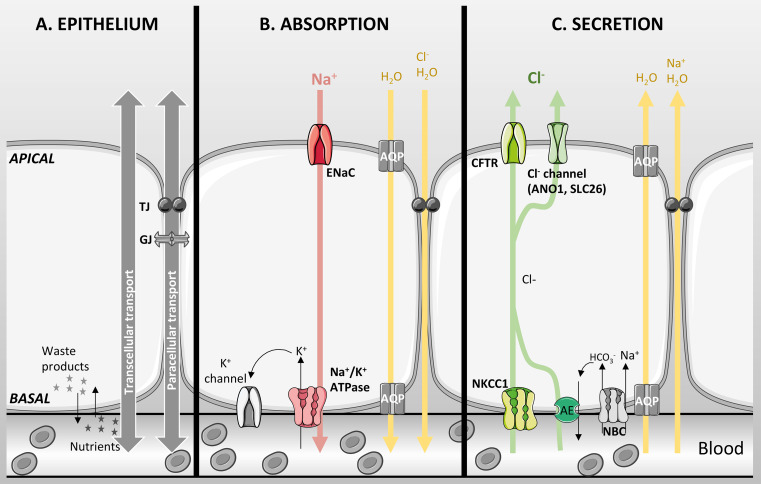
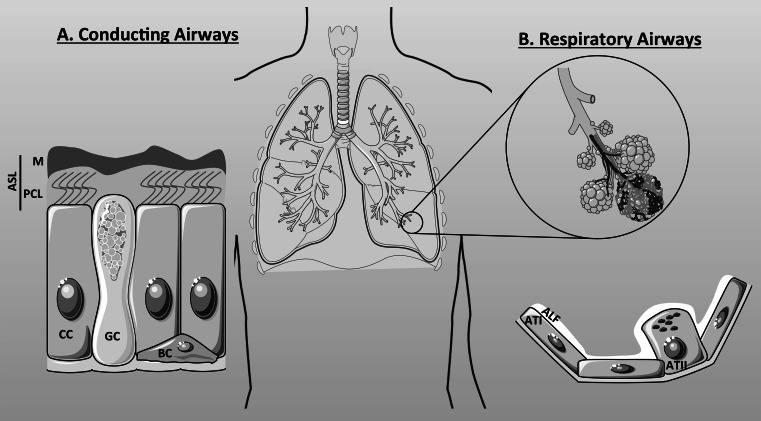
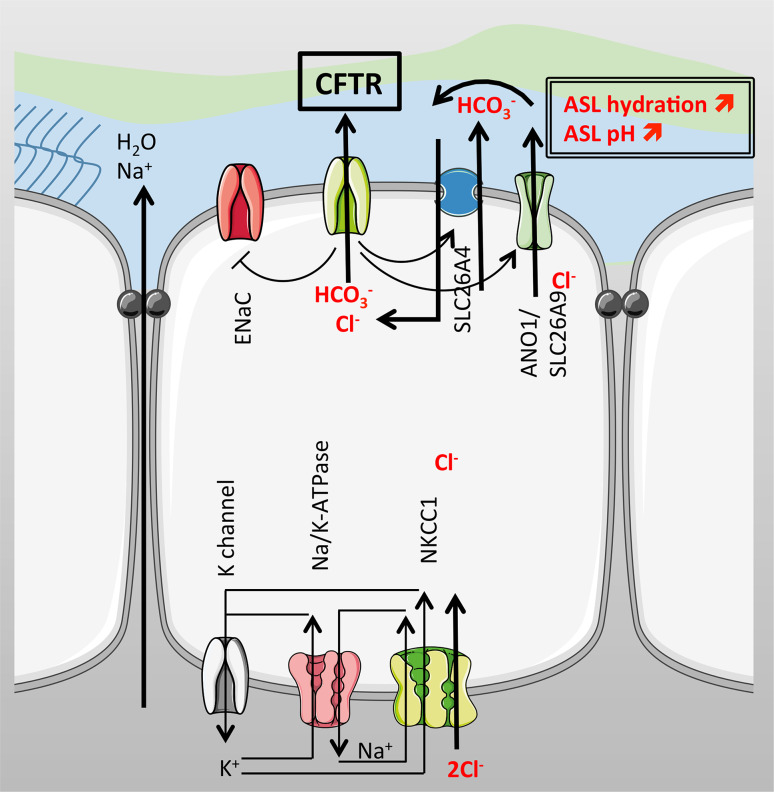
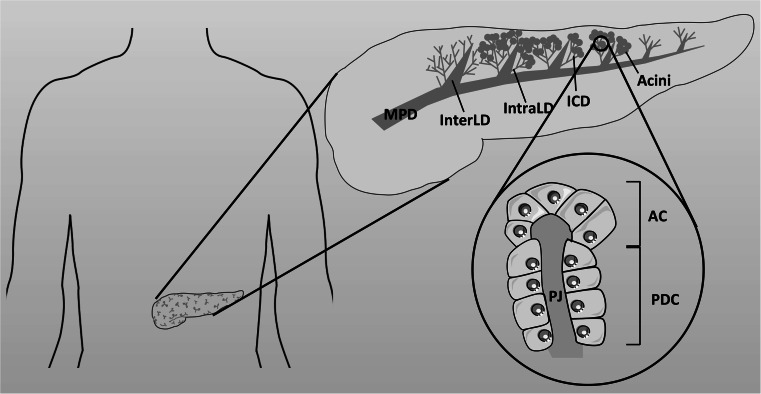
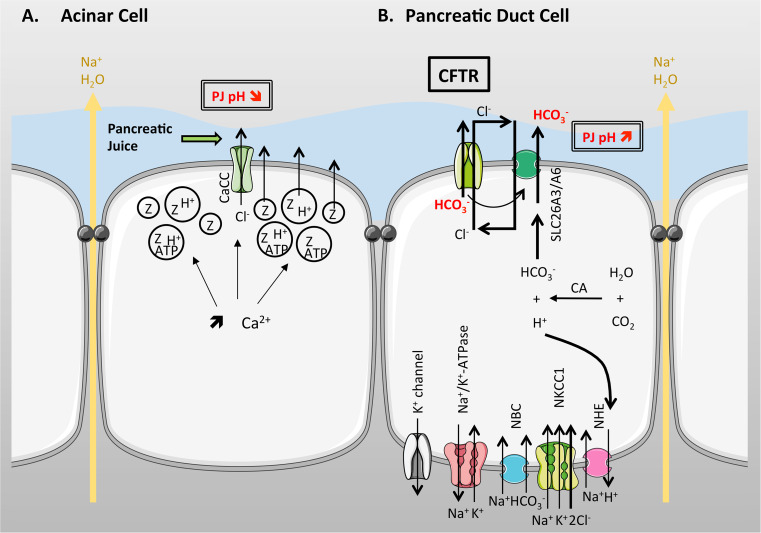
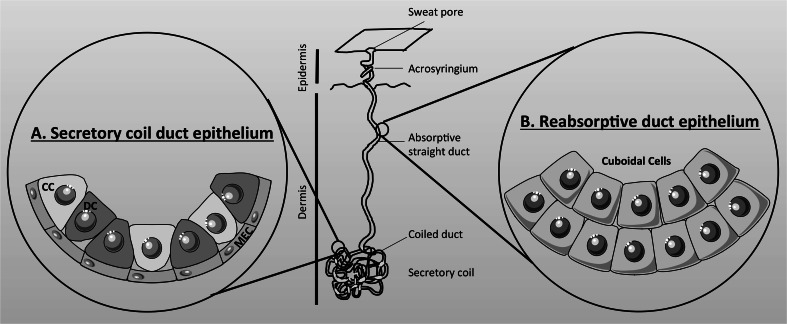
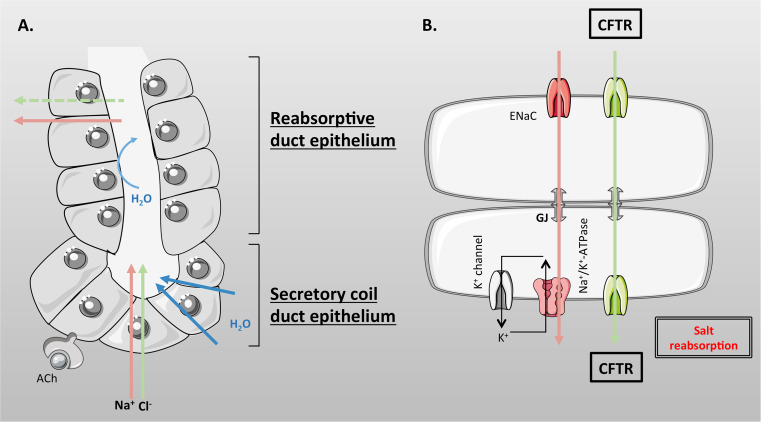
Salt and fluid absorption and secretion are two processes that are fundamental to epithelial function and whole body fluid homeostasis, and as such are tightly regulated in epithelial tissues. The CFTR anion channel plays a major role in regulating both secretion and absorption in a diverse range of epithelial tissues, including the airways, the GI and reproductive tracts, sweat and salivary glands. It is not surprising then that defects in CFTR function are linked to disease, including life-threatening secretory diarrhoeas, such as cholera, as well as the inherited disease, cystic fibrosis (CF), one of the most common life-limiting genetic diseases in Caucasian populations. More recently, CFTR dysfunction has also been implicated in the pathogenesis of acute pancreatitis, chronic obstructive pulmonary disease (COPD), and the hyper-responsiveness in asthma, underscoring its fundamental role in whole body health and disease. CFTR regulates many mechanisms in epithelial physiology, such as maintaining epithelial surface hydration and regulating luminal pH. Indeed, recent studies have identified luminal pH as an important arbiter of epithelial barrier function and innate defence, particularly in the airways and GI tract. In this chapter, we will illustrate the different operational roles of CFTR in epithelial function by describing its characteristics in three different tissues: the airways, the pancreas, and the sweat gland.
Overview
The claims and statistics of this paper haven’t been checked yet.
Free: it reads the open-access text and checks the first 5 claims that cite a source we can check. Create a free account to check every claim.
Integrity signals
Registry
Cites
Statistics
Figures
Verification
Claims the paper makes
The claims and statistics of this paper haven’t been checked yet.
Free: it reads the open-access text and checks the first 5 claims that cite a source we can check. Create a free account to check every claim.
Claims other papers make about this one
Each is checked against this paper’s own text: does it say what the citing paper says it does?
The cited source says what the claim attributes to it.
In the citing paper
“CFTR are also expressed on the apical membrane of clear cells and play a role in chloride secretion in response to beta-adrenergic stimulation”
From Physiological mechanisms determining eccrine sweat composition (2020) · cites this paper as Saint-Criq and Gray 2017
Self-check
Percentages, sums and reported differences re-computed from the paper’s own numbers.
The self-check needs the paper’s full text.
Citations
Cites
Meijer, L., Nelson, D. J., Riazanski, V., Gabdoulkhakova, A. G., Hery-Arnaud, G., Le Berre, R., Loaëc, N., Oumata, N., Galons, H., Nowak, E., et al. (2016) · Journal of Innate Immunity · doi:10.1159/000444256 · Cited by 4,992
Claudins and the Modulation of Tight Junction Permeability
Günzel, D., & Yu, A. S. L. (2013) · Physiological Reviews · doi:10.1152/physrev.00019.2012 · Cited by 1,456 · cited 1×
“junctions [5].”
Gibson, L. E., & Cooke, R. E. (1959) · Pediatrics · doi:10.1542/peds.23.3.545 · Cited by 1,434 · cited 1×
“diagnostic purposes [220, 221].”
TMEM16A confers receptor-activated calcium-dependent chloride conductance
Yang, Y. D., Cho, H., Koo, J. Y., Tak, M. H., Cho, Y., Shim, W.-S., Park, S. P., Lee, J., Lee, B., Kim, B.-M., et al. (2008) · Nature · doi:10.1038/nature07313 · Cited by 1,283 · cited 1×
“In a study from 2011, soon after the identification of the CaCC as being encoded by TMEM16A (also called Anoctamin 1, ANO1) [58–60], Ousingsawat et al.”
BackgroundTMEM16A, A Membrane Protein Associated with Calcium-Dependent Chloride Channel Activity
Caputo, A., Caci, E., Ferrera, L., Pedemonte, N., Barsanti, C., Sondo, E., Pfeffer, U., Ravazzolo, R., Zegarra-Moran, O., & Galietta, L. J. V. (2008) · Science · doi:10.1126/science.1163518 · Cited by 1,263 · cited 1×
“In a study from 2011, soon after the identification of the CaCC as being encoded by TMEM16A (also called Anoctamin 1, ANO1) [58–60], Ousingsawat et al.”
BackgroundExpression Cloning of TMEM16A as a Calcium-Activated Chloride Channel Subunit
Schroeder, B. C., Cheng, T., Jan, Y. N., & Jan, L. Y. (2008) · Cell · doi:10.1016/j.cell.2008.09.003 · Cited by 1,148 · cited 1×
“In a study from 2011, soon after the identification of the CaCC as being encoded by TMEM16A (also called Anoctamin 1, ANO1) [58–60], Ousingsawat et al.”
BackgroundMucus clearance as a primary innate defense mechanism for mammalian airways
Knowles, M. R., & Boucher, R. C. (2002) · Journal of Clinical Investigation · doi:10.1172/jci0215217 · Cited by 1,054 · cited 1×
“Studies using thin film cultured human bronchial epithelial cells (HBEs) have shown that both Na absorption and Cl secretion regulate ASL height and composition [28, 29].”
BackgroundEpidemiology of constipation in children and adults: A systematic review
Mugie, S. M., Benninga, M. A., & Di Lorenzo, C. (2011) · Best Practice & Research Clinical Gastroenterology · doi:10.1016/j.bpg.2010.12.010 · Cited by 941
Increased airway epithelial Na+ absorption produces cystic fibrosis-like lung disease in mice
Mall, M., Grubb, B. R., Harkema, J. R., O'Neal, W. K., & Boucher, R. C. (2004) · Nature Medicine · doi:10.1038/nm1028 · Cited by 911 · cited 1×
“Later work from a b-ENaC overexpressing mouse [40] provided further support, since these transgenic mice exhibited a lung phenotype characteristic of human CF airways.”
BackgroundKim, B. J., Nam, J. H., Kim, K. H., Joo, M., Ha, T. S., Weon, K. Y., Choi, S., Jun, J. Y., Park, E. J., Wie, J., et al. (2014) · Cellular Physiology and Biochemistry · doi:10.1159/000366306 · Cited by 886
Cited by
Items 401–445 of 445
Additional file 10 of Stellate cells are in utero markers of pancreatic disease in cystic fibrosis
Leir, S.-H., Tkachenko, S., Paranjapye, A., Meckler, F., Wettere, A. J. V., Kerschner, J. L., Kuznetsov, E., Schacht, M., Gillurkar, P., Regouski, M., et al. (2024) · Figshare · doi:10.6084/m9.figshare.26758592
Additional file 3 of Stellate cells are in utero markers of pancreatic disease in cystic fibrosis
Leir, S.-H., Tkachenko, S., Paranjapye, A., Meckler, F., Wettere, A. J. V., Kerschner, J. L., Kuznetsov, E., Schacht, M., Gillurkar, P., Regouski, M., et al. (2024) · Figshare · doi:10.6084/m9.figshare.26758571
Yang, D., & Wang, G. (2026) · Molecular Diagnosis & Therapy · doi:10.1007/s40291-025-00827-0
Two distinct mechanisms for GlyH‐101 block of the CFTR chloride channel
Chang, Y., Ma, Z., He, S., Sohma, Y., & Hwang, T. (2026) · The Journal of Physiology · doi:10.1113/jp288949
Transmembrane helix 8 as the main allosteric mediator of CFTR gating revealed by molecular dynamicsPreprint
Torres, O., Gereben, O., Marzaro, G., Lukács, G. L., & Hegedűs, T. (2026) · Research Square · doi:10.21203/rs.3.rs-8787223/v1
Epithelial plasma membrane transporters as drug targets
Verkman, A. S. (2026) · Physiological Reviews · doi:10.1152/physrev.00045.2025
Závoti, O., Simon, M. A., & Csanády, L. (2026) · The Journal of Physiology · doi:10.1113/jp290798
Participation à l'étude du rôle du système adénosinergique en pathologie cardiovasculaire
Vairo, D. (2018) · theses.fr (ABES) · doi:10.70675/80125e1dze909z48c7z92afz5ec81b88db71
Evaluation of skin absorption of inorganic ions with regard to their physicochemical properties
Tarnowska, M. (2019) · theses.fr (ABES) · doi:10.70675/63b7366fz8181z4fc1z9d3fzc9071b2df57f · Cited by 2
Etude des marqueurs de la neuropathie à l’oxaliplatine
Delmotte, J.-B. (2018) · theses.fr (ABES) · doi:10.70675/ce8124aez4a45z40f7zaf21z7133a63c3b0a
Baatallah, N. (2020) · theses.fr (ABES) · doi:10.70675/39bf0842z67aaz4136zac43z0d75dc58cdf4
Camus, L. (2020) · theses.fr (ABES) · doi:10.70675/ecddb701z1d6fz422fz86d0zc4e6a93d6a98 · Cited by 1
The organoid revolution to assess mycobacterial pulmonary infections
Leon‐Icaza, S. A. (2022) · theses.fr (ABES) · doi:10.70675/6e135d5fzb953z4ffcz9041z2684784040ad
Fonction et physiologie : la notion de fonction dans la physiologie contemporaine
Roux, É. (2021) · theses.fr (ABES) · doi:10.70675/a71c153dz2684z433fz9b95z7a42c3c40a3f · Cited by 1
Réponse clinique aux modulateurs de la protéine CFTR, des mécanismes d'action aux biomarqueurs
Lepissier, A. (2022) · theses.fr (ABES) · doi:10.70675/7f348587z8dfaz45f1z8389z099b3e7b20a0
Approche thérapeutique par suppression traductionnelle de mutations non-sens dans le gène CFTR
Karri, S. (2023) · theses.fr (ABES) · doi:10.70675/8556c5d7z6ae0z4393zad0az0051f58aa4fd
Simonneau, B. (2023) · theses.fr (ABES) · doi:10.70675/8438da55z2d64z4494zb09dz0edd1e9ed836
Barros, P., Pereira, M., Tomilov, A. A., Cortopassi, G. A., Jordan, P., & Matos, P. (2026) · Biochemical and Biophysical Research Communications · doi:10.1016/j.bbrc.2026.153757
Semykin, S. Y., Kositskaya, O. G., Petryaykina, E. E., Pytal, A. V., Prometnoy, D. V., & Putilina, E. A. (2026) · PULMONOLOGIYA · doi:10.18093/0869-0189-2026-36-2-273-280
Ludovico, A., Battistini, M., & Baroni, D. (2026) · International Journal of Molecular Sciences · doi:10.3390/ijms27114868
“In HBE epithelia, CFTR activation induced parallel increases in ion transport, fluid flux, and pH, consistent with a coordinated secretory response [46–48].”
The role of CFTR in spermatogenesis and sperm quality
Pereira, S., Monteiro, M. P., Bernardino, R. L., & Sousa, M. (2026) · Nature Reviews Urology · doi:10.1038/s41585-026-01173-4
Epithelial junctional proteins for physical defense, cell-cell contact, and polarity complex
Kuo, W. (2026) · Elsevier eBooks · doi:10.1016/b978-0-443-40306-4.00005-3
The redefined identity of Prevotella : new implications for oral, respiratory, and vaginal health
Ntamubano, S., Parker, D. T., & Kozik, A. J. (2026) · Journal of Bacteriology · doi:10.1128/jb.00133-26 · Cited by 3
“This can worsen inflammation in the lungs’ epithelial tissue, creating an opportunity for bacterial infection, such as Pseudomonas aeruginosa , Haemophilus influenzae , and Staphylococcus aureus (152–154).”
Sehmbhi, M., & Lucas, A. L. (2026) · Gastroenterology Clinics of North America · doi:10.1016/j.gtc.2026.06.002
Hadisuwarno, W., Harbuwono, D. S., Hadinata, E., Nugroho, P., Ginanjar, E., Kusumawindani, D., Tajndrawinata, R. R., Salamah, S., & Nurkolis, F. (2026) · Current Research in Biotechnology · doi:10.1016/j.crbiot.2026.100412
Potassium Channels of the Airway Epithelium
Villanueva, S., Vera, E., Apablaza, T., Catalán, M. A., & Flores, C. A. (2026) · Acta Physiologica · doi:10.1111/apha.70287
“The reduction of ASL volume and pH leads to mucus accumulation and small airway obstruction, driven by sustained epithelial inflammation [82].”
Picado, C., & Roca‐Ferrer, J. (2026) · Journal of Clinical Medicine · doi:10.3390/jcm15176908
Niyomugabo, A. P., Ntakirutimana, L., & Alagbonsi, A. I. (2026) · Channels · doi:10.1080/19336950.2026.2731660 · Cited by 3
“It is composed of five total functional regions, including two transmembrane domains (TMD1 and TMD2), two cytoplasmic nucleotide-binding domains (NBD1 and NBD2), and an unstructured regulatory domain (RD) [4].”
Clayton, L., Corbett, J., Shepherd, A. I., Massey, H. C., Urquhart, D. S., Maxwell, N., Connett, G. J., Allenby, M. I., Legg, J. P., Daniels, T. W. V., et al. (2026) · Experimental Physiology · doi:10.1113/ep093605
Regional Specialization of Electrolyte Transport Along the Trachea
Rajendran, V. M., Cornman‐Homonoff, J., & Sandle, G. I. (2026) · Acta Physiologica · doi:10.1111/apha.70319
“Such regional differences may prove highly relevant to airway diseases characterized by mucus accumulation, impaired mucociliary clearance, and altered epithelial transport, including asthma, chronic obstructive pulmonary disease, and cystic fibrosis [8, 9].”
Assessment of pMDI inhaler technique in children and adolescents with cystic fibrosis
Bastos, A. M. C., Pone, M. V. D. S., Costa, P. F. B. M., Varela, M. C., & Gomes, S. C. D. S. (2026) · Jornal de Pediatria · doi:10.1016/j.jped.2026.101624
“CFTR dysfunction disrupts ionic balance across epithelial surfaces, leading to chronic pulmonary disease and multiorgan dysfunction [1,2].”
The effectiveness of a generic CFTR-modulator in a prolonged multicenter study
Kondratyeva, E., Voronkova, A. Y., Zhekaite, E. K., Kovalev, V., Орлов, А. В., Pyaterkina, O. G., Ovsyannikova, E. A., & Георгиевна, Р. М. (2026) · Meditsinskiy sovet = Medical Council · doi:10.21518/ms2026-286
Nagase, H., Ohno, Y., Shitara, A., Nakamoto, T., Kashimata, M., & Satoh, K. (2026) · Journal of Oral Biosciences · doi:10.1016/j.job.2026.100825
Yang, S., Li, R., Yu, C., Li, J., & Zhou, X. (2026) · MedComm · doi:10.1002/mco2.71031
Warner, S. O., Whitsett, N. H., Dai, Y., SHEANON, N. M., Hoeting, B., Indihar, V., & Winnick, J. J. (2026) · Journal of Cystic Fibrosis · doi:10.1016/j.jcf.2026.09.016
The Cystic Fibrosis Transmembrane Conductance Regulator and Alcohol-Induced Pancreatic Damage
Venglovecz, V. (2026) · Springer eBooks · doi:10.1007/978-3-031-35658-2_123-1
Pernigo, G., de Pretis, N., Caldart, F., Torroni, L., Taus, F., Crucillà, S., Marchi, G. D., Amodio, A., & Frulloni, L. (2026) · Pancreatology · doi:10.1016/j.pan.2026.10.022
BindingDB (2023) · UC San Diego · doi:10.7270/q24b359j
BindingDB (2026) · UC San Diego · doi:10.7270/q2j10824
Metadata
- Authors
- Saint-Criq, V., & Gray, M. A.
- Affiliations
- Newcastle University (GB)
- Corresponding author
- Gray, Michael A.
- ORCID
- Gray, Michael A.
- Venue
- Cellular and Molecular Life Sciences
- Published
- 2016-10-06
- Volume
- 74
- Issue
- 1
- Pages
- 93-115
- ISSN
- 1420-682X (ISSN-L)
- 1420-9071
- PMC
- PMC5209439
- OpenAlex
- W2528194947
- Semantic Scholar
- ea463e9b4fdaa9bd5df690f6e4dc12719748b5cb
- Cited by
- 433
- References
- 232
- Citations by year
- 2026: 35 · 2025: 54 · 2024: 53 · 2023: 45 · 2022: 54 · 2021: 57 · 2020: 61 · 2019: 29 · 2018: 32 · 2017: 10 · 2016: 1
- FWCI
- 4.16
- Type
- journal article
- Language
- en
- Open access
- hybrid
- doi.org
- Locations
- Cellular and Molecular Life Sciences (publishedVersion, cc-by)
- Europe PMC (PubMed Central) (publishedVersion, cc-by)
- PubMed Central (publishedVersion, cc-by)
- PubMed (publishedVersion)
- HAL (submittedVersion, other-oa)
- Newcastle University ePrints (Newcastle Univesity) (cc-by)
- Funders
- Cystic Fibrosis Trust (SRC 003)
- Topics
- Health Sciences › Medicine › Pulmonary and Respiratory Medicine › Cystic Fibrosis Research Advances
- Life Sciences › Biochemistry, Genetics and Molecular Biology › Molecular Biology › Ion Transport and Channel Regulation
- Life Sciences › Biochemistry, Genetics and Molecular Biology › Molecular Biology › Ion channel regulation and function
- Keywords
- CFTR, cystic fibrosis, epithelial physiology, anion channels, secretion, fluid homeostasis, luminal pH, epithelial barrier function, respiratory tract, pancreas, sweat glands, secretory diarrhea, acute pancreatitis, chronic obstructive pulmonary disease
- MeSH terms
- Animals, Bicarbonates, Chlorides, Cystic Fibrosis, Epithelium, Humans, Immunity, Innate, Lung, Pancreas, Sweat Glands, Cystic Fibrosis Transmembrane Conductance Regulator
About these checks
Registry, retraction, Cites and statistics results are computed, not judged, with one exception: a printed reference that no index lists is read once by a model before it counts as a citation error. Claims are extracted by a model and kept only when their quote appears verbatim in the text; each cited source is then checked, with a model’s help, for whether it says what the claim relies on. Those verdicts can be wrong — read the claim’s quote and the cited source before relying on one.
Statistics and arithmetic are recomputed, not judged.
Confidence bands are shown only for fields calibrated on our annotated test set. None is calibrated yet, so no band is shown.
What counts as a claim ›How we measure confidence ›How we check this ›
Are you an author, or do you see a problem with this page? Request a review
Data sources
Bibliographic data: Semantic Scholar, OpenAlex, Crossref.
Contains information from the Semantic Scholar Academic Graph Datasets, made available under the ODC Attribution License (ODC-BY 1.0).
Semantic Scholar’s data is described in: Kinney, R., et al. (2023). The Semantic Scholar Open Data Platform. arXiv:2301.10140.
