

Social isolation, loneliness and depression in young adulthood: a behavioural genetic analysis
Open accessThe DOI matches its Crossref record; 60 of the 60 references it cites were found in a registry or an index.
Abstract
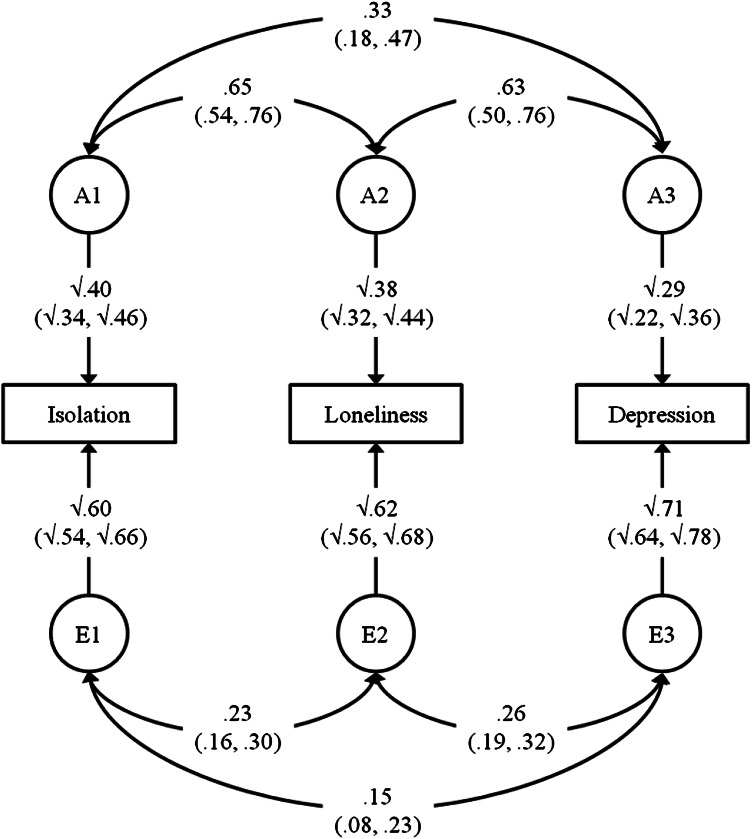
PURPOSE: To investigate the association between social isolation and loneliness, how they relate to depression, and whether these associations are explained by genetic influences. METHODS: We used data from the age-18 wave of the Environmental Risk Longitudinal Twin Study, a birth cohort of 1116 same-sex twin pairs born in England and Wales in 1994 and 1995. Participants reported on their levels of social isolation, loneliness and depressive symptoms. We conducted regression analyses to test the differential associations of isolation and loneliness with depression. Using the twin study design, we estimated the proportion of variance in each construct and their covariance that was accounted for by genetic and environmental factors. RESULTS: Social isolation and loneliness were moderately correlated (r = 0.39), reflecting the separateness of these constructs, and both were associated with depression. When entered simultaneously in a regression analysis, loneliness was more robustly associated with depression. We observed similar degrees of genetic influence on social isolation (40 %) and loneliness (38 %), and a smaller genetic influence on depressive symptoms (29 %), with the remaining variance accounted for by the non-shared environment. Genetic correlations of 0.65 between isolation and loneliness and 0.63 between loneliness and depression indicated a strong role of genetic influences in the co-occurrence of these phenotypes. CONCLUSIONS: Socially isolated young adults do not necessarily experience loneliness. However, those who are lonely are often depressed, partly because the same genes influence loneliness and depression. Interventions should not only aim at increasing social connections but also focus on subjective feelings of loneliness.
Overview
The claims and statistics of this paper haven’t been checked yet.
Free: it reads the open-access text and checks the first 5 claims that cite a source we can check. Create a free account to check every claim.
Integrity signals
Registry
Cites
Statistics
Figures
Verification
Claims the paper makes
The claims and statistics of this paper haven’t been checked yet.
Free: it reads the open-access text and checks the first 5 claims that cite a source we can check. Create a free account to check every claim.
Claims other papers make about this one
Each is checked against this paper’s own text: does it say what the citing paper says it does?
The cited source doesn’t support the claim as written.
In the citing paper
“Seven studies stated that they measured the impact of social isolation39 , 45 , 50 , 59 , 69 , 70 , 72 on mental health, but the social isolation measures used were either subscales or questions from loneliness scales, or strongly overlapped with the construct of loneliness. Therefore, we have considered them together with studies that measured loneliness.”
From Rapid Systematic Review: The Impact of Social Isolation and Loneliness on the Mental Health of Children and Adolescents in the Context of COVID-19 (2020) · cites this paper as [39]
Checked by a reasoning model — may be wrong.
Experimental — accuracy not yet measuredThe source backs part of the claim, not all of it — or backs it for a different population, condition or comparison.
In the citing paper
“Younger adults may be disproportionately affected by disease-containment policies (e.g., school/university closures) that increase social isolation placing them at higher risk of loneliness [32].”
From Loneliness in the UK during the COVID-19 pandemic: Cross-sectional results from the COVID-19 Psychological Wellbeing Study (2020) · cites this paper as [32]
Experimental — accuracy not yet measuredThe source backs part of the claim, not all of it — or backs it for a different population, condition or comparison.
In the citing paper
“Social isolation and peer victimisation do not occur randomly and are both heritable (30% to 70%), suggesting that genetic factors contribute to individual differences in these social difficulties (Fisher et al., 2015; Johansson et al., 2022; Matthews et al., 2016; Veldkamp et al., 2019).”
From A cross‐lagged twin study of emotional symptoms, social isolation and peer victimisation from early adolescence to emerging adulthood (2023) · cites this paper as Matthews et al., 2016
Experimental — accuracy not yet measuredThe source backs part of the claim, not all of it — or backs it for a different population, condition or comparison.
In the citing paper
“Although existing evidence indicates that loneliness and social isolation are independently associated with mental health conditions and mortality (Holt-Lunstad et al., 2015;Matthews et al., 2016), their independent effects on physical health conditions are less consistent and their independent effects on socioeconomic outcomes have not been investigated (Leigh-Hunt et al., 2017).”
From Investigating the interplay of loneliness and social isolation across adolescence: Findings from a nationally representative longitudinal study (2026) · cites this paper as Matthews et al., 2016
Experimental — accuracy not yet measuredThe source backs part of the claim, not all of it — or backs it for a different population, condition or comparison.
In the citing paper
“We used measures of social isolation that capture low embeddedness within age-appropriate social networks, which is consistent with prior research that conceptualizes childhood isolation in terms of peer relationships (e.g., Lacey et al., 2014;Matthews et al., 2016;Morneau-Vaillancourt et al., 2023;Thompson et al., 2023).”
From Investigating the interplay of loneliness and social isolation across adolescence: Findings from a nationally representative longitudinal study (2026) · cites this paper as Matthews et al., 2016
Experimental — accuracy not yet measured
8 more claims about this paper
Create a free account to see every claim other papers make about this one.
Self-check
Percentages, sums and reported differences re-computed from the paper’s own numbers.
The self-check needs the paper’s full text.
Citations
Cites
Diagnostic and Statistical Manual of Mental Disorders
Williams, J. B. W., & First, M. (2013) · Encyclopedia of Social Work · doi:10.1093/acrefore/9780199975839.013.104 · Cited by 109,519
Diagnostic and Statistical Manual of Mental Disorders
American Psychiatric Association (2022) · doi:10.1176/appi.books.9780890425787 · Cited by 23,476
Stress, social support, and the buffering hypothesis
Cohen, S., & Wills, T. A. (1985) · Psychological Bulletin · doi:10.1037/0033-2909.98.2.310 · Cited by 18,093 · cited 1×
“Young adults who were socially isolated experienced greater feelings of loneliness, and were also more likely to grapple with depression, suggesting that social relationships confer benefits for mental health over and above subjective feelings of connectedness, such as reducing the effects of stress [42].”
BackgroundThe Multidimensional Scale of Perceived Social Support
Zimet, G. D., Dahlem, N. W., Zimet, S. G., & Farley, G. K. (1988) · Journal of Personality Assessment · doi:10.1207/s15327752jpa5201_2 · Cited by 13,339
Genetics of Food Intake Self-Regulation in Childhood: Literature Review and Research Opportunities
Faith, M. S., Carnell, S., & Kral, T. V. E. (2013) · Human Heredity · doi:10.1159/000353879 · Cited by 7,601
UCLA loneliness scale (version 3): reliability, validity, and factor structure
Russell, D. W. (1996) · Journal of Personality Assessment · doi:10.1207/s15327752jpa6601_2 · Cited by 5,800 · cited 1×
“from the UCLA Loneliness Scale (Version 3): [33] ‘‘How often do you feel that you lack companionship?’’, ‘‘How often do you feel left out?’’, ‘‘How often do you feel isolated from others?’’ and ‘‘How often do you feel alone?’’ The full UCLA Scale consists of 20 items; however, a previous study has shown that a short f…”
BackgroundPsychometric Characteristics of the Multidimensional Scale of Perceived Social Support
Zimet, G. D., Powell, S. S., Farley, G. K., Werkman, S., & Berkoff, K. A. (1990) · Journal of Personality Assessment · doi:10.1080/00223891.1990.9674095 · Cited by 4,855
Psychometric Characteristics of the Multidimensional Scale of Perceived Social Support
Zimet, G., Powell, S., Farley, G., Werkman, S., & Berkoff, K. (1990) · Journal of Personality Assessment · doi:10.1207/s15327752jpa5503&4_17 · Cited by 4,854
From social integration to health: durkheim in the new millennium
Berkman, L. F., Glass, T., Brissette, I., & Seeman, T. E. (2000) · Social Science & Medicine · doi:10.1016/s0277-9536(00)00065-4 · Cited by 4,821 · cited 2×
“A smaller part of the correlation was explained by environmental factors, which may reflect the influence of broader socioeconomic and cultural forces that shape the context in which social relationships are formed [45].”
BackgroundLoneliness matters: a theoretical and empirical review of consequences and mechanisms
Hawkley, L. C., & Cacioppo, J. T. (2010) · Annals of Behavioral Medicine · doi:10.1007/s12160-010-9210-8 · Cited by 4,782 · cited 1×
“Crucially, although isolation and loneliness tend to co-occur, they can also be experienced independently of one another: it does not follow that isolated individuals necessarily feel lonely, nor does an abundance of social connections preclude one from experiencing loneliness [7, 8].”
Background
Research works printed but not linked: 2
- Nolen-Hoeksema S, Ahrens C (2002) Age differences and similarities in the correlates of depressive symptoms. Psychol Aging 17(1):116–124 · DOI
- Robins L, Cottler L, Bucholz K, Compton W (1995) Diagnostic Interview Schedule for DSM-IV. Washington University School of Medicine, St. Louis
Cited by
Items 401–500 of 534
Bryan, B. T., Thompson, K. N., Fisher, H. L., Matthews, T., Milne, B., & Arseneault, L. (2026) · Development and Psychopathology · doi:10.1017/s0954579426101758 · Cited by 1
Self-citationCard-Sort Tasks: Self-Harm and Prison Populations
Keatley, D. A. (2018) · Springer eBooks · doi:10.1007/978-3-319-75226-6_7 · Cited by 1
Murray, M. A., Obeid, N., Buchholz, A., Flament, M. F., & Goldfield, G. S. (2020) · Journal of Technology in Behavioral Science · doi:10.1007/s41347-020-00143-w · Cited by 2
“However, sedentary behaviors in the form of screen time are associated with social isolation (Primack et al. 2017), which is a predictor of depression (Matthews et al. 2016).”
BackgroundYoung adults with vision impairment in India: Loneliness and social networks
Gothwal, V. K., Kanchustambam, J., Kodavati, K., & Subramanian, A. (2024) · Ophthalmic and Physiological Optics · doi:10.1111/opo.13317 · Cited by 2
Bjørndal, L. D., Nes, R. B., Ayorech, Z., Vassend, O. M., & Røysamb, E. (2024) · Quality of Life Research · doi:10.1007/s11136-024-03832-8 · Cited by 2
“Previous studies have found evidence of genetic influence on associations between social factors and wellbeing in adolescents as loneliness and isolation, and mental disorders like depression, are high [40].”
Exome sequencing identifies protein-coding variants associated with loneliness and social isolation
Wang, Y., Fei, C.-J., Shen, C., Ou, Y., Liu, W., Yang, L., Wu, B., Deng, Y., Feng, J., Cheng, W., et al. (2025) · Journal of Affective Disorders · doi:10.1016/j.jad.2025.01.096 · Cited by 2
Goto, Y., Nawa, N., Nakayama, T., Sato, M., Satoh, I., Nitta, H., Okada, S., Wakabayashi, K., & Fujiwara, T. (2025) · Scientific Reports · doi:10.1038/s41598-025-01110-2 · Cited by 1
Helsa, Simanjuntak, E. J., & Theresia, A. (2025) · Jurnal Ilmu Keluarga dan Konsumen · doi:10.24156/jikk.2025.18.2.134 · Cited by 5
“…dan pesimis, mempersepsikan lingkungannya dengan lebih negatif, dan menggunakan pendekatan dalam interaksi sosial dengan cara yang lebih defensif (Matthews et al. , 2016 Penelitian selanjutnya dapat mengeksplorasi mattering dalam konteks lain yang juga relevan di masa perkembangan emerging…”
Salari, N., Sadeghi, A., Abdolmaleki, A., Zarei, H., Babajani, F., Shohaimi, S., & Mohammadi, M. (2025) · The Journal of Genetic Psychology · doi:10.1080/00221325.2025.2513342 · Cited by 1
The role of positive emotions in accelerated experiential dynamic psychotherapy
Gross, N., Bar‐Kalifa, E., & Shahar, B. (2025) · Psychotherapy Research · doi:10.1080/10503307.2025.2534972 · Cited by 1
Heu, L. C. (2025) · Annals of the New York Academy of Sciences · doi:10.1111/nyas.70082 · Cited by 1
“This may be explained by genetic disposition [20] or past relationship experiences, which can shape how people perceive, and act in, relationships [21, 22].”
O’Neill, S., Minehan, M., Knight-Agarwal, C. R., Lewis, V., & Pyne, D. B. (2025) · Frontiers in Nutrition · doi:10.3389/fnut.2025.1692643 · Cited by 2
Sun, W.-X., Sun, C., Zhang, H., Sun, P., Song, H., Wu, X., Chen, J., Fang, Y., & Zhang, X. (2025) · European Archives of Psychiatry and Clinical Neuroscience · doi:10.1007/s00406-025-02153-2 · Cited by 1
“While they often co-exist, they can also be independent: individuals who are socially isolated do not necessarily feel lonely, and those who are socially well-connected may still experience loneliness [14].”
Munjiza, A., Krunić, A., Kostic, M. V., Milenković, D., & Ljajić, L. (2025) · Medicinska istrazivanja · doi:10.5937/medi0-57081 · Cited by 1
Perizonius, S., Wesseldijk, L. W., Ullén, F., & Mosing, M. A. (2026) · European Journal of Personality · doi:10.1177/08902070261423583 · Cited by 1
“Social isolation, well-being, loneliness and primals have all been shown to be between 21% and 50% heritable (Bartels, 2015; Boomsma et al., 2005; Matthews et al., 2016; Perizonius et al., 2024).”
Liu, N., Zhu, S., Song, H., Tang, K., & Zhang, X. (2026) · BMC Public Health · doi:10.1186/s12889-026-26350-3 · Cited by 1
Liberacka-Dwojak, M., Tra, C., Wiłkość-Dębczyńska, M., Amoussou, J. R., Deligianni, M. L., Kukuła, D., Kuzyan, M., Piotrowski, J., Sculco, C., Jutras‐Aswad, D., et al. (2026) · Journal of Behavioral Addictions · doi:10.1556/2006.2025.00170 · Cited by 1
Meehan, D. E., Grunseit, A. C., HaGani, N., & Merom, D. (2026) · Epidemiologic Reviews · doi:10.1093/epirev/mxag007 · Cited by 3
The Campus Mental Health Problem Isn't Capacity - It's Access!
Bedmutha, M. S., Bedmutha, P. S., Averbuj, A., Pillai, V., Karumudi, S., May, N., Rataj, H., & Weibel, N. (2026) · CHI Conference Extended Abstracts on Human Factors in Computing Systems (CHI EA) · doi:10.1145/3772363.3799024 · Cited by 1
“These results align with prior work linking social isolation, loneliness, and depression [22], reinforcing the role of social connection as a potential protective factor.”
Multimodal approaches in precision psychiatry
Narita, Z. C., Mathur, A. K., & Yang, K. (2026) · International Review of Psychiatry · doi:10.1080/09540261.2026.2714136 · Cited by 1
Wang, X., Ma, H., Heianza, Y., Liang, Z., Franco, O. H., & Qi, L. (2026) · Nature Communications · doi:10.1038/s41467-026-74498-8 · Cited by 1
“Second, previous studies have shown that there is substantial overlap between genes that in fl uence loneliness and genes that in fl u-ence depression 26,27 .”
EFFECT OF RELATIONSHIP DYNAMICS AND ISOLATION ON MENTAL HEALTH OF INFERTILE WOMEN
Mir, R. Z., Zahid, S., & Ehsan, S. (2020) · Khyber Medical University Journal · doi:10.35845/kmuj.2020.19655 · Cited by 1
Zhan, X., Li, K., Zheng, Y., Yang, G., & Luo, X. (2022) · Frontiers in Public Health · doi:10.3389/fpubh.2022.1023749 · Cited by 2
Age-related features of self-attitude and loneliness experiences
Lvova, S. V. (2023) · CITISE · doi:10.15350/2409-7616.2023.1.21 · Cited by 1
“Теоретическая основа исследования базируется на зарубежных [14, 15, 16, 17, 18] и отечественных трудах [1, 2, 3, 4, 5, 6, 7, 8, 9, 10, 11, 12, 13] по исследованию феномена одиночества и самоотношения в разные возрастные периоды.”
University Student Perspectives Negotiating Positive and Negative Mental Health on Campus
Moran, R., & Litwiller, F. (2023) · Canadian Journal of Community Mental Health · doi:10.7870/cjcmh-2023-023 · Cited by 1
Chauvin, V., Villarino, R. T., Bernard, P., Yazbek, H., Kern, L., Hokayem, M., Mattar, L., Kotbagi, G., Rizk, M., Morvan, Y., et al. (2023) · Journal of Multimorbidity and Comorbidity · doi:10.1177/26335565231221609 · Cited by 4
“50 Also, the second wave took place at a time allowing an increase in social interactions which goes along with the reduction in feelings of isolation in many countries.”
BackgroundAnderson, A. R., & Lastrapes, M. (2024) · Psychological Reports · doi:10.1177/00332941241241632 · Cited by 2
“Some cross-sectional research indicates that social support and loneliness are the stronger predictors of mental health (Freak-Poli et al., 2021; Matthews et al., 2016), with loneliness consistently predicting depressive symptoms in older adults in cross-sectional and longitudinal research (Erzen &…”
Hu, J., Zhai, M., Fu, D., Duan, Z., & Chen, X. (2024) · Frontiers in Psychiatry · doi:10.3389/fpsyt.2024.1394289 · Cited by 2
Bould, E., Brusco, N. K., & Callaway, L. (2025) · Complementary Therapies in Clinical Practice · doi:10.1016/j.ctcp.2025.101970 · Cited by 3
When You Live, You Live with Others: The Culturally Salient Relational Dimensions of Flocking
Ebersöhn, L. (2019) · Springer eBooks · doi:10.1007/978-3-030-16435-5_5 · Cited by 1
Lima, T., Santana, R., Teodoro, M. L. M., & Nobre, C. N. (2019) · Lecture notes in computer science · doi:10.1007/978-3-030-33904-3_51 · Cited by 1
Comorbid Psychiatric Illnesses
Thorsteinsson, E., & Brown, R. F. (2019) · Springer eBooks · doi:10.1007/978-3-030-32545-9_6 · Cited by 2
COVID-19 Rehab Fright Management
Mumtaz, N., Saqulain, G., & Mumtaz, N. (2020) · Pakistan Journal of Medical Sciences · doi:10.12669/pjms.37.1.3187 · Cited by 2
ADOLESCENT BEHAVIORAL CHANGE DUE TO HOME QUARANTINE: AN EMPIRICAL STUDY
Ali, S. (2020) · Education Sustainability & Society · doi:10.26480/ess.02.2020.58.62 · Cited by 1
“These images of adolescent life were already unreal clichés, but even more so now: young people are grieving, recovering, even dying, subsisting and surviving, supporting family members, trapped in violent homes – the list goes on and so does the pandemic state (Mathews et al., 2016).”
BackgroundFatores de risco e proteção e sintomas de depressão na adolescência
Santos-Vitti, L., Faro, A., & Baptista, M. N. (2020) · Psico · doi:10.15448/1980-8623.2020.4.34353 · Cited by 10
Health Considerations During the COVID-19 Outbreak
Milea, E. C., Tiucsan, V.-M., Dorobantu, D. A., Nicolae, V., Tudorica, M. M., Grădinaru, A. V., Ybyraimova, A., & Păun, M. (2021) · International Journal of Applied Behavioral Economics · doi:10.4018/ijabe.2021070101 · Cited by 1
Passos, A. A., DeJesus, B. M., Santos, H. F., & Teixeira-Machado, L. (2022) · Research Society and Development · doi:10.33448/rsd-v11i12.34551 · Cited by 1
“Matthews et al. (2016) emphasize that social relationships are considered sources of support and that their absence can have implications for health and well-being.”
BackgroundTurgeon, L., Goulet, J., Plusquellec, P., Lévesque, J., & Brière, F. N. (2023) · Revue de psychoéducation · doi:10.7202/1099292ar · Cited by 2
Wood, C., Barton, J., & Smyth, N. (2020) · SportRxiv (OSF Preprints) · doi:10.31236/osf.io/qu73a · Cited by 2
Sumedrea, A. G., Sumedrea, C. M., & Minescu, I. (2023) · Preprints.org · doi:10.20944/preprints202310.1111.v2 · Cited by 1
Maliha, Z. T., Nahar, S. N., Mitra, D. K., Kakoly, N. S., Koly, K. N., Talukder, M. H. K., Ahmed, H. U., Gupta, R. D., & Hasan, M. T. (2025) · medRxiv · doi:10.1101/2025.01.30.25321378 · Cited by 1
Stefanidou, T., Evlat, G., Gray, H., Lagan, K. M., Harju‐Seppänen, J., O’Sullivan, M., Talwar, S., Lewis, G., Buckman, J. E. J., Pitman, A., et al. (2025) · medRxiv · doi:10.1101/2025.08.06.25333144 · Cited by 1
Eisberg, G. (2017) · UNM’s Digital Repository (University of New Mexico)
“Tails of the Hard Times” A Review Study of Depression
Babayiğit, A., & Karaaziz, M. (2018) · Anemon Muş Alparslan Üniversitesi Sosyal Bilimler Dergisi · doi:10.18506/anemon.339229 · Cited by 2
“Lack of communication between parents also increases the risk of depression (Matthews et al., 2016).”
BackgroundNeem eenzaamheid op in de DSM-5
Ploeg, J. V. D. (2019) · GZ - Psychologie · doi:10.1007/s41480-019-0006-6
The relationship between self-compassion and chronic depression: a cross-sectional clinical study
da Silva, J. E., & Simões, S. C. C. (2019) · The Psychologist Practice & Research Journal · doi:10.33525/pprj.v1i2.26 · Cited by 2
“December 2018 | DOI: https://doi.org/10.33525/pprj.v1i2.26 page 26 loneliness (intricately linked with depression in different populations; e.g. Matthews et al., 2016).”
BackgroundInfluentialDrożak, P., Bryliński, Ł., Bura, A., Duda, P., Augustowska, K., & Mizerski, G. (2020) · Journal of Education Health and Sport · doi:10.12775/jehs.2020.10.05.014
“shows a significant correlation between the presence of depressive symptoms and feelings of loneliness in the population of young adults [30].”
Backgroundعلى, غ. ع. (2020) · المجلة التربوية لکلية التربية بسوهاج · doi:10.21608/edusohag.2020.107765
Motivational Factors of Eating and Exercise Behaviors of Non-obese and Obese Young Adults
Siqueiros, S. (2019) · UA Campus Repository (The University of Arizona)
Fortier, M., McFadden, T., & Faulkner, G. (2020) · Promotion de la santé et prévention des maladies chroniques au Canada · doi:10.24095/hpcdp.40.10.01f
Emaziye, P. O., & Ebewore, S. O. (2020)
Mankollo, O. Y. B., & Kounou, T. A. (2020) · International Journal Of Medical Science And Clinical Invention · doi:10.18535/ijmsci/v7i09.012
Depression and its Association with Vitamin D Deficiency: A Review
Shoukry, H. S. (2020) · BioScientific Review · doi:10.32350/bsr.0204.04
“Subjective loneliness showed a significant relationship with both anxiety and depression [7].”
BackgroundLoneliness and Cardiovascular Disease
Agarwal, S. K. (2021) · International Journal of Medicine · doi:10.14419/ijm.v9i1.31462
Associations of State and Trait Loneliness with Gender and Psychosocial Factors in Undergraduates
Duman, E. A. (2021) · Boğaziçi Üniversitesi Eğitim Dergisi · doi:10.52597/buje.994847
“For instance, studies report associations between loneliness and social isolation, depression, selfesteem, life satisfaction and social support that may change by age and gender (Cacioppo et al., 2006; Matthews et al., 2016).”
BackgroundWu, Y., Ma, S., Zhang, H., Huang, X., & Shu, Y. (2022) · Heart and Mind · doi:10.4103/hm.hm_40_21
ОСОБЛИВОСТІ КОПІНГ-СТРАТЕГІЙ У ЛЮДЕЙ ІЗ РІЗНИМ СТАВЛЕННЯМ ДО ВІРУСУ COVID-19
Казакова, Є. (2022) · Дніпровський науковий часопис публічного управління психології права · doi:10.51547/ppp.dp.ua/2021.6.13
Young, L. E., Tang, J. L., & Nan, Y. (2022) · doi:10.2196/preprints.37982
Khan, F., Johnson, P. A., Johnson, J. C., Singh, J., & Mardon, A. A. (2022) · Canadian Journal of Medicine · doi:10.33844/cjm.2022.6018
“However, the psychological costs of quarantine are high; social isolation has previously been linked with depression, stress, and negative mood [2, 3].”
BackgroundLevesque, R. J. R. (2016) · Springer eBooks · doi:10.1007/978-3-319-32132-5_291-2 · Cited by 1
Levesque, R. J. R. (2018) · Springer eBooks · doi:10.1007/978-3-319-33228-4_291
Ge, L., Heng, B. H., & Tan, W. S. (2020) · doi:10.21203/rs.3.rs-15624/v1
Intellectual Extremism Influences in Social Media According to Some Psychological Variables
Mahmoud, F. M. A. (2022) · ARAB JOURNAL FOR SECURITY STUDIES · doi:10.26735/oruz2923
Empathic abilities, personal strength and depressive mood in spanish population in time of COVID-19
de Madrid, U. C., González, D., García, E. M., de Madrid, U. C., Elez, P. D. L. P., & Mancha, U. D. C. L. (2022) · Ehquidad Revista Internacional de Políticas de Bienestar y Trabajo Social · doi:10.15257/ehquidad.2022.0013
Yusinyu, D. D., Nkouonlack, C., Georges, T. D., Ngwayi, S. I., Tanue, E. A., Shey, N. D., & NJAMNSHI, A. K. (2022) · Research Square · doi:10.21203/rs.3.rs-1990751/v1
Ohnishi, T., & Wakamatsu, A. (2022) · doi:10.2196/preprints.42618
Impact On Loneliness During the COVID-19 Pandemic Lockdown Based On Age and Household Size
Cherry, A., Simler, A., Waldron, S., & London, C. (2022) · Psi Beta Research Journal - Brief Reports · doi:10.54581/ickm7428
Impact On Loneliness During the COVID-19 Pandemic Lockdown Based On Age and Household Size
Cherry, A., Simler, A., Waldron, S., & London, C. (2022) · Psi Beta Research Journal - Brief Reports · doi:10.54581/ickm7842
“Social isolation and solitary living are risk factors for loneliness (Gierveld, 1998; Matthews et al., 2016; Pinquart & Sörensen, 2001), and living alone has been associated with lower mental well-being (Jacob et al., 2019; Sundström et al., 2009).”
BackgroundUluslararası Üniversite Öğrencilerinin COVID-19 Pandemisinde Yaşadıkları Zorlukların İncelenmesi
Akbulut, Ö. F., & ŞAHİN, M. M. (2022) · Cumhuriyet International Journal of Education · doi:10.30703/cije.1137582
Social Avoidance among Patients with Major Depressive Disorder in Bangladesh
Shahid, S. F. B., Tushar, T. A., Khatun, M. M., & Noor, N. B. (2023) · Scholars Journal of Applied Medical Sciences · doi:10.36347/sjams.2023.v11i02.032
Salcedo, V. H. S. (2022) · Universidad Privada San Juan Bautista · doi:10.59590/upsjb/fcs.med.hum/tesis/3874
Sbarra, D. A., Ramadan, F. A., Choi, K. W., Treur, J. L., Levey, D. F., Wootton, R. E., Stein, M. B., Gelernter, J. E., & Klimentidis, Y. C. (2023) · doi:10.31234/osf.io/8s2v3
Danvers, A. F., Efinger, L., Mehl, M. R., Helm, P. J., Raison, C. L., Polsinelli, A. J., Moseley, S., & Sbarra, D. A. (2023) · PsyArXiv (OSF Preprints) · doi:10.31234/osf.io/akng8
นาวาบุญนิยม, ช., & พิสิษฐ์สังฆการ, ก. (2021) · Chula Digiverse · doi:10.58837/chula.the.2021.578
Atopic dermatitis in teenagers and adults: Clinical features of a tertiary referral hospital
Fernandes, L. S. D. A., Dortas, S. D., Lupi, O., & Valle, S. O. R. (2023) · Indian Journal of Skin Allergy · doi:10.25259/ijsa_21_2022
Perceived isolation, social disconnectedness, and the mental health of young adults in South KoreaPreprint
Choi, S., Lee, Y., & Park, S. (2023) · Research Square · doi:10.21203/rs.3.rs-3391444/v1
Sumedrea, A. G., Sumedrea, C. M., & Minescu, I. (2023) · Preprints.org · doi:10.20944/preprints202310.1111.v1
ЖИТТЄСТІЙКІСТЬ У ПОСТКОВІДНИЙ ПЕРІОД: ПОДОЛАННЯ НАСЛІДКІВ ПЕРЕЖИВАННЯ ВІДЧУТТЯ ВТРАТИ
Predko, V. (2023) · Науковий вісник Ужгородського національного університету Серія Психологія · doi:10.32782/psy-visnyk/2023.3.4 · Cited by 2
Genetic susceptibility to depression and the role of partnership status
Gueltzow, M., Lahtinen, H., Bijlsma, M. J., Myrskylä, M., & Martikainen, P. (2023) · doi:10.4054/mpidr-wp-2023-049
Fernandez, C. C., Maddock, J., Patalay, P., Fett, A.-K. J., Pitman, A., Vaughan, L., & Krenz, K. (2024) · Health & Place · doi:10.1016/j.healthplace.2024.103260
“Social isolation in young people is associated with negative mental health outcomes such as depression (Matthews et al., 2016), long-term mental illness (Christiansen et al., 2021), emotional and psychological problems (Copeland, 2018; H ¨ ogn ¨ as et al., 2020) and suicidal thoughts (Armstrong and…”
A Study of Emotions Intelligence, Self-Awareness and Behavioral Response for Student
Shivane, D. (2024) · International Journal of Advanced Research in Science Communication and Technology · doi:10.48175/ijarsct-18323
A Dominance Analysis on the Relationship between Schizotypy and Loneliness TypePreprint
Randell, J., Gray, D., Cleveland, M., & Manning, R. (2024) · SSRN Electronic Journal · doi:10.2139/ssrn.4847327
Academic burden and emotional problems among adolescents in China: a longitudinal mediation analysisPreprint
Wang, J., Wang, Z., Yang, Y., Wang, T., Lin, H., Zhang, W., Chen, X., & Fu, C. (2024) · Research Square · doi:10.21203/rs.3.rs-4435974/v1
Komorbide psychiatrische Erkrankungen
Thorsteinsson, E., & Brown, R. F. (2024) · Springer eBooks · doi:10.1007/978-3-031-55637-1_6
Rivela, A. L., Kotta, C. J. H., Tafonao, D., Rista, & Hasibuan, N. (2024) · SANCTUM DOMINE JURNAL TEOLOGI · doi:10.46495/sdjt.v13i2.240 · Cited by 2
Can We Take Advantage of ICT for Social Isolation and Loneliness?
Tachikawa, H., Shiratori, Y., Aiba, M., Kawakami, N., & Sugawara, D. (2024) · Iryo To Shakai · doi:10.4091/iken.34-71
Qi, K. (2024) · International Journal of Research Studies in Education · doi:10.5861/ijrse.2024.24729
A dominance analysis on the relationship between schizotypy and loneliness type
Randell, J., Gray, D., Cleveland, M., & Manning, R. (2024) · Schizophrenia Research · doi:10.1016/j.schres.2024.10.002 · Cited by 1
“…also suggested that the positive relationship between these variables is because even though social interactions are perceived as less rewarding, the need for them remains present, or because negative schizotypy strongly overlaps with depression (Achterbergh et al., 2020; Matthews et al., 2016).”
Sachs, A. L., Corigrato, E., Sprague, N. L., Turbyfill, A., Tillema, S., & Litt, J. (2024) · Journal of Advanced Nursing · doi:10.1111/jan.16540 · Cited by 1
Loneliness among first-year university students: Evaluating a peer support intervention
Bathelt, J. (2024) · Psychology Teaching Review · doi:10.53841/bpsptr.2024.30.2.7 · Cited by 2
Determination of the loneliness level and affecting factors in adolescents
Aslan, G., & Bakan, A. B. (2024) · Journal of Public Health · doi:10.1007/s10389-024-02376-y
“…positively associated with factors such as physical and mental problems (Richard et al. 2017), burnout (Eriş and Barut 2020), psychosocial problems (Ozturk and Ayaz-Alkaya 2021), not finding themselves attractive, social isolation (Matthews et al. 2016), and depression (Erzen and Çikrikci 2018).”
Loneliness and Health in Nurses: Scoping Review
Seo, H. G., & Kim, S. (2024) · Journal of Korean Academy of Fundamentals of Nursing · doi:10.7739/jkafn.2024.31.4.369 · Cited by 2
“외로움은 우울과 연 관되고 [13], 우울은 자살사고와 연관성이 높은 것으로 알려져 왔다 [13,14”
Kulari, G. (2024) · Education + Training · doi:10.1108/et-12-2023-0525 · Cited by 4
Petak, A. (2024) · Primenjena psihologija · doi:10.19090/pp.v17i4.2527 · Cited by 1
“Za neke ljude usamljenost proizlazi iz drugih čimbenika vezanih uz mentalno zdravlje, poput prisutnosti kognitivnih distorzija i depresije, a za neke je proizvod traume, stigme, socijalne izolacije, ili kombinacije svega navedenog (Matthews et al., 2016; Pitman et al., 2018).”
Monteiro, M., Frontini, R., Mindrico, T., & Pernencar, C. A. D. C. (2024) · Springer series in design and innovation · doi:10.1007/978-3-031-77566-6_22
Health as a Social Construct and a Lived Reality: Entangling Bodies in Health and Human Services
Skott-Myhre, H. A., Lyons, M., & Robins, W. (2025) · Journal of Progressive Human Services · doi:10.1080/10428232.2025.2485823
“…isolation), experience less favorable health outcomes across a broad spectrum of disease, including both depression and cardiovascular disease, when compared with those who have robust social connections (Hodgson et al., 2020; T. Matthews et al., 2016; Taylor et al., 2018; Valtorta et al., 2018).”
The pandemic coping project: a randomized clinical trial of strategies for coping with isolation
Berman, J. S., Lewin, R. K., Solomon, E. M., Glasgow, O. G., Pace, R. L., & Snell, A. N. (2025) · Psychology Health & Medicine · doi:10.1080/13548506.2025.2490228
“For example, isolation may be associated with depression (Cacioppo et al., 2015; De la Fuente et al., 2018; Gardiner et al., 2018; Matthews et al., 2016; Wilson et al., 2018) and other psychiatric symptoms (Cacioppo et al., 2015), as well as increased self-harm (Tayer et al., 2021) and suicide risk…”
Mack, J. (2023) · Rowan Digitals Works (Rowan University) · doi:10.31986/issn.2689-0690_rdw.stratford_research_day.87_2023
Metadata
- Authors
- Matthews, T., Danese, A., Wertz, J., Odgers, C. L., Ambler, A., Moffitt, T. E., & Arseneault, L.
- Affiliations
- King's College London (GB)
- National Health Service (GB)
- Duke University (US)
- Corresponding author
- Arseneault, Louise
- ORCID
- Venue
- Social Psychiatry and Psychiatric Epidemiology
- Published
- 2016-02-03
- Volume
- 51
- Issue
- 3
- Pages
- 339-348
- ISSN
- 0933-7954 (ISSN-L)
- 1433-9285
- PMC
- PMC4819590
- OpenAlex
- W2255620466
- Cited by
- 534
- References
- 59
- Citations by year
- 2026: 28 · 2025: 47 · 2024: 76 · 2023: 62 · 2022: 81 · 2021: 82 · 2020: 75 · 2019: 40 · 2018: 24 · 2017: 16 · 2016: 3
- FWCI
- 36.52
- Type
- journal article
- Language
- en
- Open access
- hybrid
- doi.org
- Licence
- cc-by
- creativecommons.org/licenses/by/4.0 (tdm)
- creativecommons.org/licenses/by/4.0 (vor)
- Locations
- Social Psychiatry and Psychiatric Epidemiology (publishedVersion, cc-by)
- Europe PMC (PubMed Central) (publishedVersion, cc-by)
- PubMed Central (publishedVersion, cc-by)
- PubMed (publishedVersion)
- eScholarship (California Digital Library) (submittedVersion, cc-by)
- Research Portal (King's College London) (submittedVersion, cc-by)
- Funders
- Medical Research Council (G1002190)
- Economic and Social Research Council (RES-177-25-0013)
- National Institute of Child Health and Human Development (HD061298)
- Jacobs Foundation (Advanced Research Fellowship)
- National Institute for Health Research
- Topics
- Social Sciences › Health › Health disparities and outcomes
- Life Sciences › Biochemistry, Genetics and Molecular Biology › Genetics › Genetic Associations and Epidemiology
- Social Sciences › Psychology › Experimental and Cognitive Psychology › Anxiety, Depression, Psychometrics, Treatment, Cognitive Processes
- Keywords
- social isolation, loneliness, depression, early adulthood, genetic factors, heritability, genetic correlation, nonshared environment, twin studies, depressive symptoms, subjective loneliness
- MeSH terms
- Depression, England, Female, Genetics, Behavioral, Humans, Loneliness, Longitudinal Studies, Male, Regression Analysis, Social Isolation, Wales, Young Adult, Gene-Environment Interaction
About these checks
Registry, retraction, Cites and statistics results are computed, not judged, with one exception: a printed reference that no index lists is read once by a model before it counts as a citation error. Claims are extracted by a model and kept only when their quote appears verbatim in the text; each cited source is then checked, with a model’s help, for whether it says what the claim relies on. Those verdicts can be wrong — read the claim’s quote and the cited source before relying on one.
Statistics and arithmetic are recomputed, not judged.
Confidence bands are shown only for fields calibrated on our annotated test set. None is calibrated yet, so no band is shown.
What counts as a claim ›How we measure confidence ›How we check this ›
Are you an author, or do you see a problem with this page? Request a review
Data sources
Bibliographic data: Semantic Scholar, OpenAlex, Crossref.
Contains information from the Semantic Scholar Academic Graph Datasets, made available under the ODC Attribution License (ODC-BY 1.0).
Semantic Scholar’s data is described in: Kinney, R., et al. (2023). The Semantic Scholar Open Data Platform. arXiv:2301.10140.
