

Social isolation, loneliness and depression in young adulthood: a behavioural genetic analysis
Open accessThe DOI matches its Crossref record; 60 of the 60 references it cites were found in a registry or an index.
Abstract
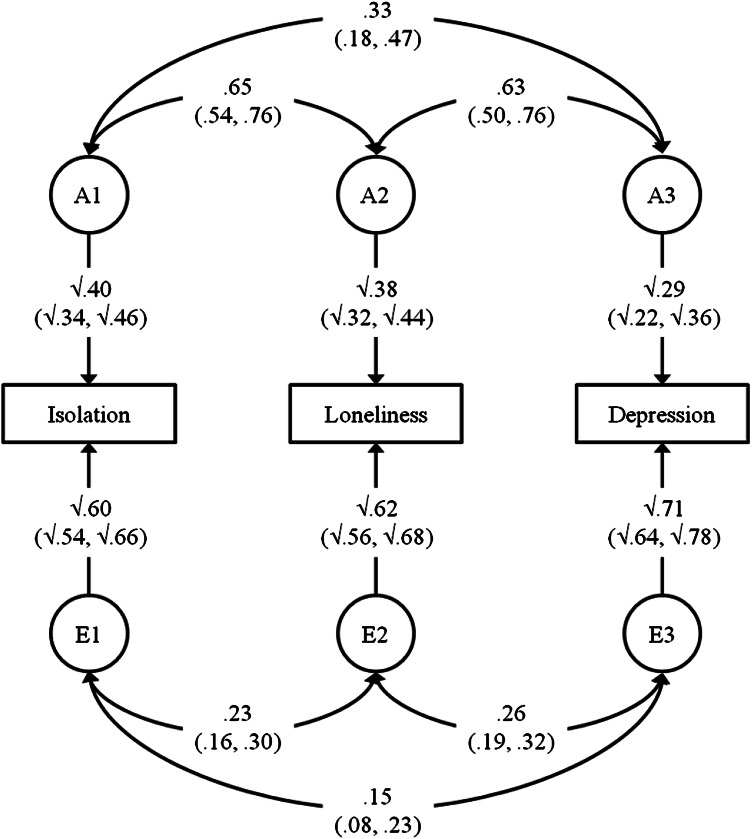
PURPOSE: To investigate the association between social isolation and loneliness, how they relate to depression, and whether these associations are explained by genetic influences. METHODS: We used data from the age-18 wave of the Environmental Risk Longitudinal Twin Study, a birth cohort of 1116 same-sex twin pairs born in England and Wales in 1994 and 1995. Participants reported on their levels of social isolation, loneliness and depressive symptoms. We conducted regression analyses to test the differential associations of isolation and loneliness with depression. Using the twin study design, we estimated the proportion of variance in each construct and their covariance that was accounted for by genetic and environmental factors. RESULTS: Social isolation and loneliness were moderately correlated (r = 0.39), reflecting the separateness of these constructs, and both were associated with depression. When entered simultaneously in a regression analysis, loneliness was more robustly associated with depression. We observed similar degrees of genetic influence on social isolation (40 %) and loneliness (38 %), and a smaller genetic influence on depressive symptoms (29 %), with the remaining variance accounted for by the non-shared environment. Genetic correlations of 0.65 between isolation and loneliness and 0.63 between loneliness and depression indicated a strong role of genetic influences in the co-occurrence of these phenotypes. CONCLUSIONS: Socially isolated young adults do not necessarily experience loneliness. However, those who are lonely are often depressed, partly because the same genes influence loneliness and depression. Interventions should not only aim at increasing social connections but also focus on subjective feelings of loneliness.
Overview
The claims and statistics of this paper haven’t been checked yet.
Free: it reads the open-access text and checks the first 5 claims that cite a source we can check. Create a free account to check every claim.
Integrity signals
Registry
Cites
Statistics
Figures
Verification
Claims the paper makes
The claims and statistics of this paper haven’t been checked yet.
Free: it reads the open-access text and checks the first 5 claims that cite a source we can check. Create a free account to check every claim.
Claims other papers make about this one
Each is checked against this paper’s own text: does it say what the citing paper says it does?
The cited source doesn’t support the claim as written.
In the citing paper
“Seven studies stated that they measured the impact of social isolation39 , 45 , 50 , 59 , 69 , 70 , 72 on mental health, but the social isolation measures used were either subscales or questions from loneliness scales, or strongly overlapped with the construct of loneliness. Therefore, we have considered them together with studies that measured loneliness.”
From Rapid Systematic Review: The Impact of Social Isolation and Loneliness on the Mental Health of Children and Adolescents in the Context of COVID-19 (2020) · cites this paper as [39]
Checked by a reasoning model — may be wrong.
Experimental — accuracy not yet measuredThe source backs part of the claim, not all of it — or backs it for a different population, condition or comparison.
In the citing paper
“Younger adults may be disproportionately affected by disease-containment policies (e.g., school/university closures) that increase social isolation placing them at higher risk of loneliness [32].”
From Loneliness in the UK during the COVID-19 pandemic: Cross-sectional results from the COVID-19 Psychological Wellbeing Study (2020) · cites this paper as [32]
Experimental — accuracy not yet measuredThe source backs part of the claim, not all of it — or backs it for a different population, condition or comparison.
In the citing paper
“Social isolation and peer victimisation do not occur randomly and are both heritable (30% to 70%), suggesting that genetic factors contribute to individual differences in these social difficulties (Fisher et al., 2015; Johansson et al., 2022; Matthews et al., 2016; Veldkamp et al., 2019).”
From A cross‐lagged twin study of emotional symptoms, social isolation and peer victimisation from early adolescence to emerging adulthood (2023) · cites this paper as Matthews et al., 2016
Experimental — accuracy not yet measuredThe source backs part of the claim, not all of it — or backs it for a different population, condition or comparison.
In the citing paper
“Although existing evidence indicates that loneliness and social isolation are independently associated with mental health conditions and mortality (Holt-Lunstad et al., 2015;Matthews et al., 2016), their independent effects on physical health conditions are less consistent and their independent effects on socioeconomic outcomes have not been investigated (Leigh-Hunt et al., 2017).”
From Investigating the interplay of loneliness and social isolation across adolescence: Findings from a nationally representative longitudinal study (2026) · cites this paper as Matthews et al., 2016
Experimental — accuracy not yet measuredThe source backs part of the claim, not all of it — or backs it for a different population, condition or comparison.
In the citing paper
“We used measures of social isolation that capture low embeddedness within age-appropriate social networks, which is consistent with prior research that conceptualizes childhood isolation in terms of peer relationships (e.g., Lacey et al., 2014;Matthews et al., 2016;Morneau-Vaillancourt et al., 2023;Thompson et al., 2023).”
From Investigating the interplay of loneliness and social isolation across adolescence: Findings from a nationally representative longitudinal study (2026) · cites this paper as Matthews et al., 2016
Experimental — accuracy not yet measured
8 more claims about this paper
Create a free account to see every claim other papers make about this one.
Self-check
Percentages, sums and reported differences re-computed from the paper’s own numbers.
The self-check needs the paper’s full text.
Citations
Cites
Diagnostic and Statistical Manual of Mental Disorders
Williams, J. B. W., & First, M. (2013) · Encyclopedia of Social Work · doi:10.1093/acrefore/9780199975839.013.104 · Cited by 109,519
Diagnostic and Statistical Manual of Mental Disorders
American Psychiatric Association (2022) · doi:10.1176/appi.books.9780890425787 · Cited by 23,476
Stress, social support, and the buffering hypothesis
Cohen, S., & Wills, T. A. (1985) · Psychological Bulletin · doi:10.1037/0033-2909.98.2.310 · Cited by 18,093 · cited 1×
“Young adults who were socially isolated experienced greater feelings of loneliness, and were also more likely to grapple with depression, suggesting that social relationships confer benefits for mental health over and above subjective feelings of connectedness, such as reducing the effects of stress [42].”
BackgroundThe Multidimensional Scale of Perceived Social Support
Zimet, G. D., Dahlem, N. W., Zimet, S. G., & Farley, G. K. (1988) · Journal of Personality Assessment · doi:10.1207/s15327752jpa5201_2 · Cited by 13,339
Genetics of Food Intake Self-Regulation in Childhood: Literature Review and Research Opportunities
Faith, M. S., Carnell, S., & Kral, T. V. E. (2013) · Human Heredity · doi:10.1159/000353879 · Cited by 7,601
UCLA loneliness scale (version 3): reliability, validity, and factor structure
Russell, D. W. (1996) · Journal of Personality Assessment · doi:10.1207/s15327752jpa6601_2 · Cited by 5,800 · cited 1×
“from the UCLA Loneliness Scale (Version 3): [33] ‘‘How often do you feel that you lack companionship?’’, ‘‘How often do you feel left out?’’, ‘‘How often do you feel isolated from others?’’ and ‘‘How often do you feel alone?’’ The full UCLA Scale consists of 20 items; however, a previous study has shown that a short f…”
BackgroundPsychometric Characteristics of the Multidimensional Scale of Perceived Social Support
Zimet, G. D., Powell, S. S., Farley, G. K., Werkman, S., & Berkoff, K. A. (1990) · Journal of Personality Assessment · doi:10.1080/00223891.1990.9674095 · Cited by 4,855
Psychometric Characteristics of the Multidimensional Scale of Perceived Social Support
Zimet, G., Powell, S., Farley, G., Werkman, S., & Berkoff, K. (1990) · Journal of Personality Assessment · doi:10.1207/s15327752jpa5503&4_17 · Cited by 4,854
From social integration to health: durkheim in the new millennium
Berkman, L. F., Glass, T., Brissette, I., & Seeman, T. E. (2000) · Social Science & Medicine · doi:10.1016/s0277-9536(00)00065-4 · Cited by 4,821 · cited 2×
“A smaller part of the correlation was explained by environmental factors, which may reflect the influence of broader socioeconomic and cultural forces that shape the context in which social relationships are formed [45].”
BackgroundLoneliness matters: a theoretical and empirical review of consequences and mechanisms
Hawkley, L. C., & Cacioppo, J. T. (2010) · Annals of Behavioral Medicine · doi:10.1007/s12160-010-9210-8 · Cited by 4,782 · cited 1×
“Crucially, although isolation and loneliness tend to co-occur, they can also be experienced independently of one another: it does not follow that isolated individuals necessarily feel lonely, nor does an abundance of social connections preclude one from experiencing loneliness [7, 8].”
Background
Research works printed but not linked: 2
- Nolen-Hoeksema S, Ahrens C (2002) Age differences and similarities in the correlates of depressive symptoms. Psychol Aging 17(1):116–124 · DOI
- Robins L, Cottler L, Bucholz K, Compton W (1995) Diagnostic Interview Schedule for DSM-IV. Washington University School of Medicine, St. Louis
Cited by
Items 501–534 of 534
Hayoung, C., & Hwang, S. G. (2025) · Journal of Interpersonal Violence · doi:10.1177/08862605251341283
“While prior studies have consistently demonstrated a strong association between social isolation and depression (Cacioppo & Hawkley, 2009; Luo et al., 2021; Matthews et al., 2016), most have treated social isolation as a unidimensional construct.”
Wang, Y., Zhou, D.-H. R., Ng, S., Wang, B., Feng, Y.-Y., & Weng, X. (2025) · JMIR Research Protocols · doi:10.2196/64518
Genetic and Environmental Associations Between Depressive Symptomatology and Loneliness in Adulthood
Lynch, M. E., Gonenne, M., Freilich, C. D., Arpawong, T. E., Finkel, D., Turkheimer, E. N., Beam, C. R., & Davis, D. W. (2026) · Behavior Genetics · doi:10.1007/s10519-026-10280-2
“Compared to one prior study in a young adult sample (Matthews et al. 2016), the genetic correlation in our sample of midlife adults is marginally smaller than the correlation found in young adults, whereas the non-shared environmental correlation is nearly identical (Matthews et al. 2016).”
InfluentialUnderstanding social connectedness: a phenomenological study on individuals with depression in India
Deka, T., Bano, S., & Srivastava, P. (2025) · Current Psychology · doi:10.1007/s12144-025-08187-y
“The loss of social connectedness, whether due to isolation or withdrawal, is often seen as both a cause and a consequence of depression, creating a vicious cycle of lone - liness and psychological distress (Matthews et al., 2016).”
Exploring loneliness: Prevalence and determinants among medical students in Bangladesh
Maliha, Z. T., Nahar, S. N., Mitra, D. K., Kakoly, N. S., Koly, K. N., Talukder, M. H. K., Ahmed, H. U., Gupta, R. D., & Hasan, M. T. (2025) · PLOS mental health. · doi:10.1371/journal.pmen.0000379
“Other studies have also demonstrated a significant correlation between loneliness and depression [23,24].”
Behavior Genetic Analysis of Loneliness
Dargan, S., MacDonald, K. B., & Schermer, J. A. (2025) · Springer eBooks · doi:10.1007/978-3-032-02959-1_13
Heu, L. C. (2025) · Springer eBooks · doi:10.1007/978-3-032-02959-1_26
Disrupted Sociocognitive Neural Responses in Loneliness
Lu, C., & Baek, E. C. (2025) · Springer eBooks · doi:10.1007/978-3-032-02959-1_12
The etiology of loneliness: insights from twin and family, genome-wide, and epigenetic studies
Freilich, C. D., & Krueger, R. F. (2025) · Current Opinion in Behavioral Sciences · doi:10.1016/j.cobeha.2025.101618
Park, K.-H., & Ha, S. M. (2025) · PLoS ONE · doi:10.1371/journal.pone.0338522
“Although these methods are valuable, they lack sensitivity to the broader dynamic aspects of social connectivity, leading to potential limitations in reliability and construct validity [25].”
Social Isolation in Youth: A Public Health Challenge and the Emerging Role of Telepsychotherapy
Rossetti, M. G., Girelli, F., Zovetti, N., Fanizza, I., Fave, A. D., Guarnieri, F. C., Brambilla, P., Trabacca, A., & Bellani, M. (2025) · IntechOpen eBooks · doi:10.5772/intechopen.1013387
Ji, J. L., Mor, N., & MacLeod, C. M. (2025) · Behaviour Research and Therapy · doi:10.1016/j.brat.2025.104940 · Cited by 1
Yu, M., Tian, F., Cui, Q., & Wu, H. (2021) · Figshare · doi:10.6084/m9.figshare.13668032
McKenna-Plumley, P. E., Groarke, J. M., Turner, R., & Yang, K. (2020) · Figshare · doi:10.6084/m9.figshare.13339307
Kottwitz, A., Mönkediek, B., Klatzka, C. H., Hufer, A., & Hildebrandt, J. (2024) · Figshare · doi:10.6084/m9.figshare.26585040
McKenna-Plumley, P. E., Groarke, J. M., Turner, R. N., & Yang, K. (2020) · Figshare · doi:10.6084/m9.figshare.13339304
Yang, X., Hu, H., Zhao, C., Xu, H., Tu, X., & Zhang, G. (2021) · Figshare · doi:10.6084/m9.figshare.14600617
McKenna-Plumley, P. E., Groarke, J. M., Turner, R. N., & Yang, K. (2020) · Figshare · doi:10.6084/m9.figshare.13339310
Association between Depression and Social Isolation among Women with Breast Cancer
Fadhel, H. M., & Jihad, S. K. (2025) · Medical Journal of Babylon · doi:10.4103/mjbl.mjbl_715_23
Koppert, V., Czaplicki, A., & Hegerl, U. (2026) · BMC Psychiatry · doi:10.1186/s12888-026-07915-3
“Overall, depression has been found to be correlated with fewer social relationships ( r =.21, p .001) [23].”
Hutten, E., Jongen, E. M. M., van den Berg, Y. H. M., & Verboon, P. (2026) · Journal of Applied Developmental Psychology · doi:10.1016/j.appdev.2026.101933
Lv, F., Lv, C., Abudurexiti, B., Ma, Q., Yang, Q., Ouyang, M., & Shi, D. (2026) · Frontiers in Psychology · doi:10.3389/fpsyg.2026.1792698 · Cited by 1
“These changes can disrupt existing social ties and create challenges in forming new relationships, leading to heightened feelings of loneliness (Matthews et al., 2016; Vanhalst et al., 2015).”
Powell, J., & Rehman, S. (2026) · Journal of Health Psychology · doi:10.1177/13591053261433210
Community severance and mental health-related hospital visits in New York City
Benavides, J., Cohen, G., Goldsmith, J., & Kioumourtzoglou, M. A. (2026) · Environmental Epidemiology · doi:10.1097/ee9.0000000000000482
“27 28–30 In contrast, isolation tends to co-occur with loneliness, 31 which may in turn directly heighten anxiety and depression 32 and intensify psychotic symptoms.”
Exploring Lonely Death as Social Death and Life-Stage Risk Factors
Ahn, K. (2026) · Social Integration Research · doi:10.46907/sir.2026.7.1.109
Rasmussen, E. B., & Alvarado, A. Y. (2026) · Perspectives on Behavior Science · doi:10.1007/s40614-026-00502-7
“Individuals who are isolated or report higher feelings of loneliness are at higher risk of depression, suicide, and even dementia (Leigh-Hunt et al., 2017; Matthews et al., 2016; Teo et al., 2013; Wolters et al., 2023).”
Ho, G., Yap, C. W., & Ge, L. (2026) · Scientific Reports · doi:10.1038/s41598-026-56960-1
Hate speech and rage bait on social media in Greece: Prevalence and association with mental healthPreprint
Galanis, P., Katsiroumpa, A., Peleka, P., Kolisiati, A., & Moisoglou, I. (2026) · Research Square · doi:10.21203/rs.3.rs-10270338/v1
Skaug, E., Waaktaar, T., & Torgersen, S. O. (2026) · Twin Research and Human Genetics · doi:10.1017/thg.2026.10090
“However, in line with our results, findings from a cross-sectional study of 18-year-old twins suggest that loneliness and depression share substantial genetic origins (Matthews et al., 2016).”
The Pathological Work-Life Model of the Chronic Glaucoma Patient: Risk Factors and Therapeutic Tips
Emmerich, G. M. (2026) · Klinische Monatsblätter für Augenheilkunde · doi:10.1055/a-2867-9942
“However, people who, objectively speaking, have few social contacts do not automatically feel lonely ([12], p. 17; [11]); this is demonstrated by studies that find a weak to moderate link be-tween social isolation and loneliness (e.g. [ 16]).”
Jung, D., Won, S. H., Yoon, S.-I., & Cho, J. A. (2026) · Journal of Nutrition and Health · doi:10.4163/jnh.2026.59.4.391
Jeon, J., Park, Y., Kim, M., Lee, K., Lee, J. E., Huh, W., Han, K., & Jang, H. R. (2026) · American Journal of Kidney Diseases · doi:10.1053/j.ajkd.2026.06.012
Isolated Cities: Mental Health Challenges and the Search for Connection
Kanwal, P., & Kumar, G. (2026) · IGI Global eBooks · doi:10.4018/979-8-2600-1318-2.ch001
Stefanidou, T., Li, S., Lagan, K., Evlat, G., Gray, H., Harju‐Seppänen, J., Jarvis, A., O’Sullivan, M., Talwar, S., Lewis, G., et al. (2026) · BMC Medicine · doi:10.1186/s12916-026-05252-6 · Cited by 1
“Furthermore, loneliness is associated with negative mental health outcomes, including increased symptoms of Common Mental Disorders (CMDs) [5, 11], suicidal thoughts, and suicide attempt [12].”
Metadata
- Authors
- Matthews, T., Danese, A., Wertz, J., Odgers, C. L., Ambler, A., Moffitt, T. E., & Arseneault, L.
- Affiliations
- King's College London (GB)
- National Health Service (GB)
- Duke University (US)
- Corresponding author
- Arseneault, Louise
- ORCID
- Venue
- Social Psychiatry and Psychiatric Epidemiology
- Published
- 2016-02-03
- Volume
- 51
- Issue
- 3
- Pages
- 339-348
- ISSN
- 0933-7954 (ISSN-L)
- 1433-9285
- PMC
- PMC4819590
- OpenAlex
- W2255620466
- Cited by
- 534
- References
- 59
- Citations by year
- 2026: 28 · 2025: 47 · 2024: 76 · 2023: 62 · 2022: 81 · 2021: 82 · 2020: 75 · 2019: 40 · 2018: 24 · 2017: 16 · 2016: 3
- FWCI
- 36.52
- Type
- journal article
- Language
- en
- Open access
- hybrid
- doi.org
- Licence
- cc-by
- creativecommons.org/licenses/by/4.0 (tdm)
- creativecommons.org/licenses/by/4.0 (vor)
- Locations
- Social Psychiatry and Psychiatric Epidemiology (publishedVersion, cc-by)
- Europe PMC (PubMed Central) (publishedVersion, cc-by)
- PubMed Central (publishedVersion, cc-by)
- PubMed (publishedVersion)
- eScholarship (California Digital Library) (submittedVersion, cc-by)
- Research Portal (King's College London) (submittedVersion, cc-by)
- Funders
- Medical Research Council (G1002190)
- Economic and Social Research Council (RES-177-25-0013)
- National Institute of Child Health and Human Development (HD061298)
- Jacobs Foundation (Advanced Research Fellowship)
- National Institute for Health Research
- Topics
- Social Sciences › Health › Health disparities and outcomes
- Life Sciences › Biochemistry, Genetics and Molecular Biology › Genetics › Genetic Associations and Epidemiology
- Social Sciences › Psychology › Experimental and Cognitive Psychology › Anxiety, Depression, Psychometrics, Treatment, Cognitive Processes
- Keywords
- social isolation, loneliness, depression, early adulthood, genetic factors, heritability, genetic correlation, nonshared environment, twin studies, depressive symptoms, subjective loneliness
- MeSH terms
- Depression, England, Female, Genetics, Behavioral, Humans, Loneliness, Longitudinal Studies, Male, Regression Analysis, Social Isolation, Wales, Young Adult, Gene-Environment Interaction
About these checks
Registry, retraction, Cites and statistics results are computed, not judged, with one exception: a printed reference that no index lists is read once by a model before it counts as a citation error. Claims are extracted by a model and kept only when their quote appears verbatim in the text; each cited source is then checked, with a model’s help, for whether it says what the claim relies on. Those verdicts can be wrong — read the claim’s quote and the cited source before relying on one.
Statistics and arithmetic are recomputed, not judged.
Confidence bands are shown only for fields calibrated on our annotated test set. None is calibrated yet, so no band is shown.
What counts as a claim ›How we measure confidence ›How we check this ›
Are you an author, or do you see a problem with this page? Request a review
Data sources
Bibliographic data: Semantic Scholar, OpenAlex, Crossref.
Contains information from the Semantic Scholar Academic Graph Datasets, made available under the ODC Attribution License (ODC-BY 1.0).
Semantic Scholar’s data is described in: Kinney, R., et al. (2023). The Semantic Scholar Open Data Platform. arXiv:2301.10140.
