

Worth the wait: effects of age of onset of marijuana use on white matter and impulsivity
Open accessThe DOI matches its Crossref record; 73 of the 76 references it cites were found in a registry or an index.
Abstract
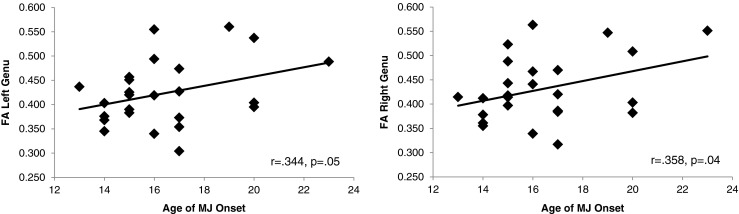
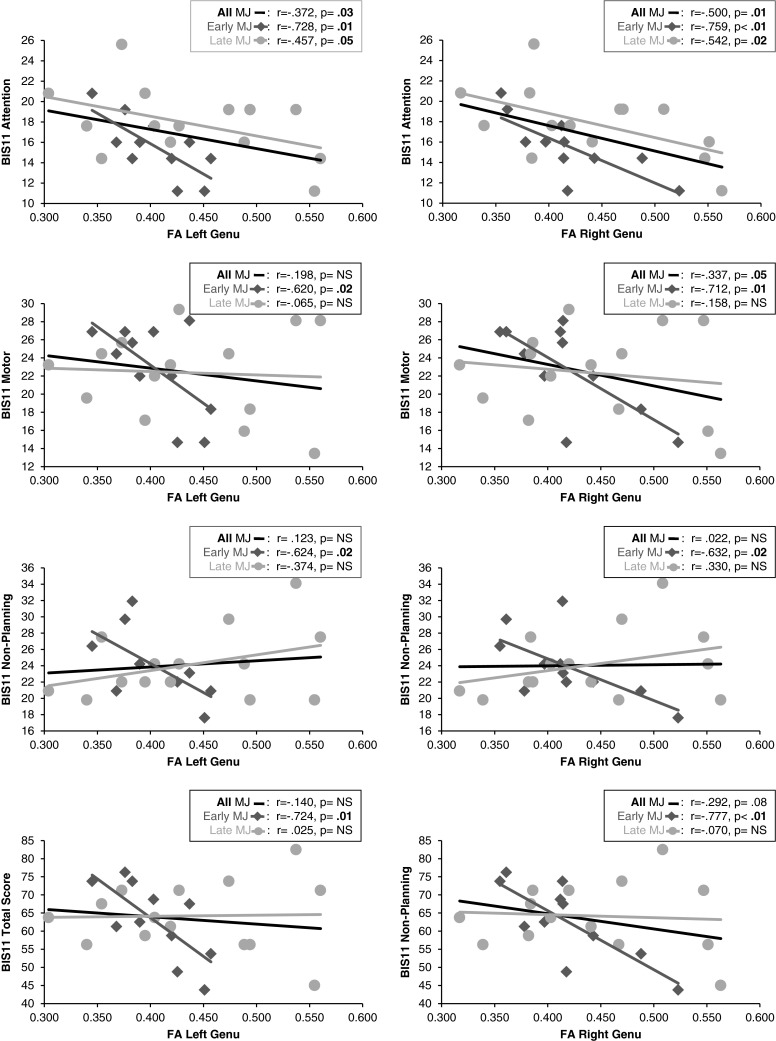
RATIONALE: Marijuana (MJ) use continues to rise, and as the perceived risk of using MJ approaches an all-time historic low, initiation of MJ use is occurring at even younger ages. As adolescence is a critical period of neuromaturation, teens and emerging adults are at greater risk for experiencing the negative effects of MJ on the brain. In particular, MJ use has been shown to be associated with alterations in frontal white matter microstructure, which may be related to reports of increased levels of impulsivity in this population. OBJECTIVES: The aim of this study was to examine the relationship between age of onset of MJ use, white matter microstructure, and reported impulsivity in chronic, heavy MJ smokers. METHODS: Twenty-five MJ smokers and 18 healthy controls underwent diffusion tensor imaging and completed the Barratt Impulsiveness Scale. MJ smokers were also divided into early onset (regular use prior to age 16) and late onset (age 16 or later) groups in order to clarify the impact of age of onset of MJ use on these variables. RESULTS: MJ smokers exhibited significantly reduced fractional anisotropy (FA) relative to controls, as well as higher levels of impulsivity. Earlier MJ onset was also associated with lower levels of FA. Interestingly, within the early onset group, higher impulsivity scores were correlated with lower FA, a relationship that was not observed in the late onset smokers. CONCLUSIONS: MJ use is associated with white matter development and reported impulsivity, particularly in early onset smokers.
Overview
The claims and statistics of this paper haven’t been checked yet.
Free: it reads the open-access text and checks the first 5 claims that cite a source we can check. Create a free account to check every claim.
Integrity signals
Registry
Cites
Statistics
Figures
Verification
Claims the paper makes
The claims and statistics of this paper haven’t been checked yet.
Free: it reads the open-access text and checks the first 5 claims that cite a source we can check. Create a free account to check every claim.
Claims other papers make about this one
Each is checked against this paper’s own text: does it say what the citing paper says it does?
In the citing paper
“lower FA values have been connected with earlier onset of among cannabis users (Gruber, Dahlgren, Sagar, Gönenç, & Lukas, 2014).”
From Substance abuse and white matter: Findings, limitations, and future of diffusion tensor imaging research (2019) · cites this paper as Gruber, Dahlgren, Sagar, Gönenç, & Lukas, 2014
In the citing paper
“Moreover, early-onset marijuana use (<16 years) is associated with reduced white matter fiber tract integrity in the corpus callosum compared to later-onset marijuana use (>16 years; Gruber et al., 2014).”
From Sensitive periods of substance abuse: Early risk for the transition to dependence (2017) · cites this paper as Gruber et al., 2014
Self-check
Percentages, sums and reported differences re-computed from the paper’s own numbers.
The self-check needs the paper’s full text.
Citations
Cites
An inventory for measuring depression
BECK, A. T. (1961) · Archives of General Psychiatry · doi:10.1001/archpsyc.1961.01710120031004 · Cited by 38,032 · cited 3×
“Briefly, self-report measures included the Profile ofMood States (Pollock et al. 1979), which provides a profile of current mood state for the individual domains of vigor, anger, confusion, tension, and depression, as well as a total mood disturbance score; the Beck Depression Inventory (Beck et al. 1961); and the Sta…”
BackgroundDevelopment and validation of brief measures of positive and negative affect: The PANAS scales.
Watson, D., Clark, L. A., & Tellegen, A. (1988) · Journal of Personality and Social Psychology · doi:10.1037/0022-3514.54.6.1063 · Cited by 32,433 · cited 3×
“Further, participants also completed the Positive andNegative Affect Scale (Watson et al. 1988), which provides a score for both positive and negative affect; the Montgomery–Asberg Depression Rating Scale (Montgomery and Asberg 1979); the Hamilton Anxiety Scale (Hamilton 1959); and the Young Mania Rating Scale (Young…”
Method(1970) · Cited by 24,983
A new depression scale designed to be sensitive to change
Montgomery, S. A., & Åsberg, M. (1979) · British Journal of Psychiatry · doi:10.1192/bjp.134.4.382 · Cited by 13,962 · cited 3×
“1988), which provides a score for both positive and negative affect; the Montgomery–Asberg Depression Rating Scale (Montgomery and Asberg 1979); the Hamilton Anxiety Scale (Hamilton 1959); and the Young Mania Rating Scale (Young et al.”
MethodThe assessment of anxiety states by rating
HAMILTON, M. (1959) · British Journal of Medical Psychology · doi:10.1111/j.2044-8341.1959.tb00467.x · Cited by 11,455 · cited 3×
“1988), which provides a score for both positive and negative affect; the Montgomery–Asberg Depression Rating Scale (Montgomery and Asberg 1979); the Hamilton Anxiety Scale (Hamilton 1959); and the Young Mania Rating Scale (Young et al.”
MethodA Rating Scale for Mania: Reliability, Validity and Sensitivity
Young, R. C., Biggs, J. T., Ziegler, V. E., & Meyer, D. A. (1978) · British Journal of Psychiatry · doi:10.1192/bjp.133.5.429 · Cited by 8,744 · cited 3×
“1988), which provides a score for both positive and negative affect; the Montgomery–Asberg Depression Rating Scale (Montgomery and Asberg 1979); the Hamilton Anxiety Scale (Hamilton 1959); and the Young Mania Rating Scale (Young et al. 1978).”
MethodScoville, W. B. (1949) · Journal of neurosurgery · doi:10.3171/jns.1949.6.1.0065 · Cited by 7,381
Johnston, L. D., O'Malley, P. M., Bachman, J. G., & Schulenberg, J. E. (2009) · PsycEXTRA Dataset · doi:10.1037/e560352009-001 · Cited by 6,921
Wechsler Abbreviated Scale of Intelligence
Dumont, R., Willis, J. O., Veizel, K., & Zibulsky, J. (2014) · Encyclopedia of Special Education · doi:10.1002/9781118660584.ese2519 · Cited by 5,521
Wechsler Abbreviated Scale of Intelligence
Wechsler, D. (2012) · PsycTESTS Dataset · doi:10.1037/t15170-000 · Cited by 4,596
McCrae, R. R., & Costa, P. T. (2010) · Medical Entomology and Zoology · Cited by 2,345
Evaluation of a behavioral measure of risk taking: The balloon analogue risk task (BART)
Lejuez, C. W., Read, J. P., Kahler, C. W., Richards, J. B., Ramsey, S. E., Stuart, G. L., Strong, D. R., & Brown, R. A. (2002) · Journal of Experimental Psychology: Applied · doi:10.1037/1076-898x.8.2.75 · Cited by 2,336 · cited 1×
“Higher levels of both self-reported impulsivity, as measured by the Barratt Impulsiveness Scale (BIS), and risk taking have previously been reported in some studies of substance abusers (Lejuez et al. 2002; Lejuez et al. 2003; Gruber and Yurgelun-Todd 2005).”
MethodRevised NEO Personality Inventory (NEO PI-R) and NEO Five-Factor Inventory (NEO-FFI)
Costa, P. T., & McCrea, R. B. (1992) · Medical Entomology and Zoology · Cited by 1,758
Structured Clinical Interview for DSM-III-R Personality Disorders
First, M. B., Spitzer, R. L., Gibbon, M., & Williams, J. B. W. (2012) · PsycTESTS Dataset · doi:10.1037/t07827-000 · Cited by 1,403
Glass, M., Faull, R. L. M., & Dragunow, M. (1997) · Neuroscience · doi:10.1016/s0306-4522(96)00428-9 · Cited by 1,052 · cited 1×
“All participants were administered the Structured Clinical Interview for DSM-IV, Patient Edition (SCID-P; First et al. 1994) to ensure that no Axis I pathology was present other than MJ use in the smoking group.”
MethodOffice of National Drug Control Policy: A scientist in drug policy in Washington, DC
Madras, B. K. (2010) · Annals of the New York Academy of Sciences · doi:10.1111/j.1749-6632.2009.05278.x · Cited by 858
Intrinsic connections and architectonics of posterior parietal cortex in the rhesus monkey
Pandya, D. N., & Seltzer, B. (1982) · Journal of Comparative Neurology · doi:10.1002/cne.902040208 · Cited by 729 · cited 2×
“…alterations inMJ smokers may also be related to the crossing of fibers through the genu, connecting the left and right dorsolateral prefrontal cortex (DLPFC), which has strong interconnections to the anterior cingulate cortex (ACC; Pandya and Seltzer 1982; Park et al. 2008).”
BackgroundLejuez, C. W., Aklin, W. M., Zvolensky, M. J., & Pedulla, C. M. (2003) · Journal of Adolescence · doi:10.1016/s0140-1971(03)00036-8 · Cited by 591
Regional Brain Abnormalities Associated With Long-term Heavy Cannabis Use
Yücel, M., Solowij, N., Respondek, C., Whittle, S., Fornito, A., Pantelis, C., & Lubman, D. I. (2008) · Archives of General Psychiatry · doi:10.1001/archpsyc.65.6.694 · Cited by 497 · cited 2×
“2006; Schneider and Koch, 2003) and human (Yucel et al. 2008; Mata et al. 2010) studies.”
BackgroundSchneider, M., & Koch, M. (2003) · Neuropsychopharmacology · doi:10.1038/sj.npp.1300225 · Cited by 427
Five-Factor Model personality profiles of drug users
Terracciano, A., Löckenhoff, C. E., Crum, R. M., Bienvenu, O. J., & Costa, P. T. (2008) · BMC Psychiatry · doi:10.1186/1471-244x-8-22 · Cited by 424 · cited 2×
“personality factors relative to nonsmokers (Terracciano et al. 2008; Berg et al. 2011), which could potentially account for some of the heightened impulsivity observed in MJ smokers, the present sample of MJ smokers exhibited no significant differences in personality measures relative to control participants, as asses…”
BackgroundMethodNew tricks for an old measure: The development of the Barratt Impulsiveness Scale–Brief (BIS-Brief).
Steinberg, L., Sharp, C., Stanford, M. S., & Tharp, A. T. (2013) · Psychological Assessment · doi:10.1037/a0030550 · Cited by 384 · cited 1×
“…using the standard threescore reportingmethod (Patton et al. 1995), we also utilized two alternative scoring methods, the BIS-Brief as described by Steinberg et al. (2013) which provides a condensed, unidimensional representation of self-reported impulsivity, as well as the Reise et al. (2013)…”
MethodThe Residual Cognitive Effects of Heavy Marijuana Use in College Students
Pope, H. G. (1996) · JAMA: The Journal of the American Medical Association · doi:10.1001/jama.1996.03530310027028 · Cited by 350 · cited 4×
“Numerous studies report impairment in executive function, specifically behavioral response inhibition, in individuals with marijuana use disorders (Pope and Yurgelun-Todd 1996; Bolla et al. 1999; Gruber et al. 2011a); however, current dialogues regarding legalization of marijuana (MJ) and the use of medical MJ have li…”
BackgroundInfluentialHeil, S. H., Johnson, M. W., Higgins, S. T., & Bickel, W. K. (2006) · Addictive Behaviors · doi:10.1016/j.addbeh.2005.09.005 · Cited by 333
Effect of long-term cannabis use on axonal fibre connectivity
Zalesky, A., Solowij, N., Yucel, M., Lubman, D. I., Takagi, M., Harding, I. H., Lorenzetti, V., Wang, R., Searle, K., Pantelis, C., et al. (2012) · Brain · doi:10.1093/brain/aws136 · Cited by 326
Reactive and Proactive Aggression Differentially Predict Later Conduct Problems
Vitaro, F., Gendreau, P. L., Tremblay, R. E., & Oligny, P. (1998) · Journal of Child Psychology and Psychiatry · doi:10.1017/s0021963097002102 · Cited by 318 · cited 1×
“Impulsivity is a complex and multidimensional construct and is well documented in individuals with substance use problems (Brady et al. 1998; Vitaro et al. 1998; Heil et al. 2006).”
BackgroundPuberty as a highly vulnerable developmental period for the consequences of cannabis exposure
Schneider, M. (2008) · Addiction Biology · doi:10.1111/j.1369-1600.2008.00110.x · Cited by 316 · cited 1×
“…with increasing evidence that the adolescent brain is more vulnerable to the effects of drugs than the adult brain (Monti et al. 2005), those at the greatest risk for adverse consequences represent a growing population of consumers of MJ (Schneider 2008), posing a serious public health concern.”
BackgroundFunctional MRI of inhibitory processing in abstinent adolescent marijuana users
Tapert, S. F., Schweinsburg, A. D., Drummond, S. P. A., Paulus, M. P., Brown, S. A., Yang, T. T., & Frank, L. R. (2007) · Psychopharmacology · doi:10.1007/s00213-007-0823-y · Cited by 299
Age of onset of marijuana use and executive function.
Gruber, S. A., Sagar, K. A., Dahlgren, M. K., Racine, M., & Lukas, S. E. (2012) · Psychology of Addictive Behaviors · doi:10.1037/a0026269 · Cited by 267 · cited 11×
“In addition, previous studies, including our own (Gruber et al. 2011b), have reported frontal white matter alterations in MJ smokers.”
BackgroundMethodInfluentialSelf-citationMoeller, F. G., Hasan, K. M., Steinberg, J. L., Kramer, L. A., Dougherty, D. M., Santos, R. M., Valdes, I., Swann, A. C., Barratt, E. S., & Narayana, P. A. (2005) · Neuropsychopharmacology · doi:10.1038/sj.npp.1300617 · Cited by 263 · cited 4×
“…focused on the specific association between alterations in white matter microstructure and impulsivity in MJ smokers, a relationship previously detected in other substance-abusing populations, including cocaine-dependent subjects (Moeller et al. 2005) and methamphetamine abusers (Salo et al. 2009).”
BackgroundResultInfluentialThe Barratt Impulsiveness Scale–11: Reassessment of its structure in a community sample.
Reise, S. P., Moore, T. M., Sabb, F. W., Brown, A. K., & London, E. D. (2013) · Psychological Assessment · doi:10.1037/a0032161 · Cited by 254 · cited 2×
“…utilized two alternative scoring methods, the BIS-Brief as described by Steinberg et al. (2013) which provides a condensed, unidimensional representation of self-reported impulsivity, as well as the Reise et al. (2013) model, which provides a twofactor model of cognitive and behavioral impulsivity.”
MethodCorpus callosal connection mapping using cortical gray matter parcellation and DT‐MRI
Park, H., Kim, J. J., Lee, S., Seok, J. H., Chun, J., Kim, D. I., & Lee, J. D. (2008) · Human Brain Mapping · doi:10.1002/hbm.20314 · Cited by 249
Neuroimaging of marijuana smokers during inhibitory processing: a pilot investigation
Gruber, S. A., & Yurgelun-Todd, D. A. (2005) · Cognitive Brain Research · doi:10.1016/j.cogbrainres.2005.02.016 · Cited by 242 · cited 5×
“Higher levels of both self-reported impulsivity, as measured by the Barratt Impulsiveness Scale (BIS), and risk taking have previously been reported in some studies of substance abusers (Lejuez et al. 2002; Lejuez et al. 2003; Gruber and Yurgelun-Todd 2005).”
BackgroundMethodInfluentialSelf-citationThe relationship between non‐acute adolescent cannabis use and cognition
HARVEY, M. A., SELLMAN, J. D., PORTER, R. J., & FRAMPTON, C. M. (2007) · Drug and Alcohol Review · doi:10.1080/09595230701247772 · Cited by 222 · cited 2×
“In addition to findings that suggest alterations in neurocognitive function (Pope and Yurgelun-Todd 1996; Harvey et al. 2007; McHale and Hunt 2008; Solowij and Pesa 2010; Gruber et al. 2011a; Lisdahl and Price 2012) and inhibitory processing (Gruber and Yurgelun-Todd 2005; Tapert et al.”
BackgroundDose-Related Neurobehavioral Effects of Chronic Cocaine Use
Bolla, K. I., Rothman, R., & Cadet, J. L. (1999) · The Journal of Neuropsychiatry and Clinical Neurosciences · doi:10.1176/jnp.11.3.361 · Cited by 214 · cited 2×
“Numerous studies report impairment in executive function, specifically behavioral response inhibition, in individuals with marijuana use disorders (Pope and Yurgelun-Todd 1996; Bolla et al. 1999; Gruber et al. 2011a); however, current dialogues regarding legalization of marijuana (MJ) and the use of medical MJ have li…”
BackgroundAdolescence: booze, brains, and behavior
Monti, P. M., Miranda, R., Nixon, K., Sher, K. J., Swartzwelder, H. S., Tapert, S. F., White, A., & Crews, F. T. (2005) · Alcoholism: Clinical & Experimental Research · doi:10.1097/01.alc.0000153551.11000.f3 · Cited by 206 · cited 2×
“…is a time of neuromaturation, with increasing evidence that the adolescent brain is more vulnerable to the effects of drugs than the adult brain (Monti et al. 2005), those at the greatest risk for adverse consequences represent a growing population of consumers of MJ (Schneider 2008), posing a…”
BackgroundBush, G., Spencer, T. J., Holmes, J., Shin, L. M., Valera, E. M., Seidman, L. J., Makris, N., Surman, C., Aleardi, M., Mick, E., et al. (2008) · Archives of General Psychiatry · doi:10.1001/archgenpsychiatry.2007.16 · Cited by 201 · cited 1×
“Impulsivity is a complex and multidimensional construct and is well documented in individuals with substance use problems (Brady et al. 1998; Vitaro et al. 1998; Heil et al. 2006).”
BackgroundDelay discounting in current and former marijuana-dependent individuals.
Johnson, M. W., Bickel, W. K., Baker, F., Moore, B. A., Badger, G. J., & Budney, A. J. (2010) · Experimental and Clinical Psychopharmacology · doi:10.1037/a0018333 · Cited by 199 · cited 3×
“…with previous studies of white matter microstructure in MJ smokers (Arnone et al. 2008; Ashtari et al. 2009; Bava et al. 2009; Jacobus et al. 2009a, 2009b), as well as studies that have independently examined impulsivity in substance-abusing populations (Vangsness et al. 2005; Johnson et al. 2010).”
BackgroundLim, K. O., Choi, S. J., Pomara, N., Wolkin, A., & Rotrosen, J. P. (2002) · Biological Psychiatry · doi:10.1016/s0006-3223(01)01355-5 · Cited by 191 · cited 2×
“DTI studies of substance abusers have revealed that reductions in FA are associated with impulsivity (Lim et al. 2002; Moeller et al. 2005; Gruber et al. 2011b).”
BackgroundAbstinent adolescent marijuana users show altered fMRI response during spatial working memory
Schweinsburg, A. D., Nagel, B. J., Schweinsburg, B. C., Park, A., Theilmann, R. J., & Tapert, S. F. (2008) · Psychiatry Research: Neuroimaging · doi:10.1016/j.pscychresns.2007.04.018 · Cited by 187 · cited 4×
“…Solowij and Pesa 2010; Gruber et al. 2011a; Lisdahl and Price 2012) and inhibitory processing (Gruber and Yurgelun-Todd 2005; Tapert et al. 2007; Schweinsburg et al. 2008; Jacobus et al. 2009a; Gruber et al. 2012a) in chronic MJ smokers relative to control participants, several investigations…”
BackgroundInfluentialWhite matter integrity in adolescents with histories of marijuana use and binge drinking
Jacobus, J., McQueeny, T., Bava, S., Schweinsburg, B. C., Frank, L. R., Yang, T. T., & Tapert, S. F. (2009) · Neurotoxicology and Teratology · doi:10.1016/j.ntt.2009.07.006 · Cited by 186 · cited 5×
“…study are consistent with previous studies of white matter microstructure in MJ smokers (Arnone et al. 2008; Ashtari et al. 2009; Bava et al. 2009; Jacobus et al. 2009a, 2009b), as well as studies that have independently examined impulsivity in substance-abusing populations (Vangsness et al.…”
BackgroundResultInfluentialFunctional consequences of marijuana use in adolescents
Jacobus, J., Bava, S., Cohen-Zion, M., Mahmood, O., & Tapert, S. F. (2009) · Pharmacology Biochemistry and Behavior · doi:10.1016/j.pbb.2009.04.001 · Cited by 185 · cited 5×
“…study are consistent with previous studies of white matter microstructure in MJ smokers (Arnone et al. 2008; Ashtari et al. 2009; Bava et al. 2009; Jacobus et al. 2009a, 2009b), as well as studies that have independently examined impulsivity in substance-abusing populations (Vangsness et al.…”
BackgroundResultInfluentialAltered white matter microstructure in adolescent substance users
Bava, S., Frank, L. R., McQueeny, T., Schweinsburg, B. C., Schweinsburg, A. D., & Tapert, S. F. (2009) · Psychiatry Research: Neuroimaging · doi:10.1016/j.pscychresns.2009.04.005 · Cited by 183 · cited 3×
“…to control participants, several investigations have also reported alterations in frontal white matter microstructure, measured with diffusion tensor imaging (DTI) techniques in adult MJ smokers (Arnone et al. 2008; Ashtari et al. 2009; Bava et al. 2009; Jacobus et al. 2009b; Gruber et al. 2011b).”
BackgroundResultImpulsivity, attention, memory, and decision-making among adolescent marijuana users
Dougherty, D. M., Mathias, C. W., Dawes, M. A., Furr, R. M., Charles, N. E., Liguori, A., Shannon, E. E., & Acheson, A. (2013) · Psychopharmacology · doi:10.1007/s00213-012-2908-5 · Cited by 181
Arnone, D., Barrick, T. R., Chengappa, S., Mackay, C. E., Clark, C. A., & Abou-Saleh, M. T. (2008) · NeuroImage · doi:10.1016/j.neuroimage.2008.02.064 · Cited by 178 · cited 3×
“…to control participants, several investigations have also reported alterations in frontal white matter microstructure, measured with diffusion tensor imaging (DTI) techniques in adult MJ smokers (Arnone et al. 2008; Ashtari et al. 2009; Bava et al. 2009; Jacobus et al. 2009b; Gruber et al. 2011b).”
BackgroundResultDifferential effects of delta9-THC on learning in adolescent and adult rats
Cha, Y. M., White, A. M., Kuhn, C. M., Wilson, W. A., & Swartzwelder, H. S. (2006) · Pharmacology Biochemistry and Behavior · doi:10.1016/j.pbb.2006.03.006 · Cited by 177 · cited 2×
“Early exposure to MJ during a vulnerable period of development may therefore result in lasting morphologic changes as evidenced in animal (Cha et al. 2006; Schneider and Koch, 2003) and human (Yucel et al.”
BackgroundChanges in brain water diffusion during childhood
Morriss, M. C., Zimmerman, R. A., Bilaniuk, L. T., Hunter, J. V., & Haselgrove, J. C. (1999) · Neuroradiology · doi:10.1007/s002340050869 · Cited by 174 · cited 1×
“During these years, age appropriate myelination is represented by progressive increases in FA and decreases in mean diffusivity (Morriss et al. 1999), which occurs in parallel with the process of cognitive development, most notably improvements in executive function.”
BackgroundDiffusion abnormalities in adolescents and young adults with a history of heavy cannabis use
Ashtari, M., Cervellione, K., Cottone, J., Ardekani, B. A., & Kumra, S. (2009) · Journal of Psychiatric Research · doi:10.1016/j.jpsychires.2008.12.002 · Cited by 159 · cited 5×
“Data from the present study are consistent with previous studies of white matter microstructure in MJ smokers (Arnone et al. 2008; Ashtari et al. 2009; Bava et al. 2009; Jacobus et al. 2009a, 2009b), as well as studies that have independently examined impulsivity in substance-abusing populations (Vangsness et al.”
BackgroundMethodResultInfluentialBrady, K. T., Myrick, H., & McElroy, S. (1998) · The American Journal on Addictions · doi:10.1111/j.1521-0391.1998.tb00340.x · Cited by 156 · cited 1×
“Impulsivity is a complex and multidimensional construct and is well documented in individuals with substance use problems (Brady et al. 1998; Vitaro et al. 1998; Heil et al. 2006).”
BackgroundAtypical location of cannabinoid receptors in white matter areas during rat brain development
Romero, J., Garcia-Palomero, E., Berrendero, F., Garcia-Gil, L., Hernandez, M. L., Ramos, J. A., & Fernandez-Ruiz, J. J. (1997) · Synapse · doi:10.1002/(sici)1098-2396(199707)26:3<317::aid-syn12>3.0.co;2-s · Cited by 152 · cited 1×
“Research in both animals and humans has suggested that the developing nervous system contains an abundance of cannabinoid receptors in neural fiber tracts, which diminishes over time and becomes redistributed heterogeneously throughout the adult brain (Romero et al. 1997; Glass et al. 1998).”
BackgroundGruber, S. A., Silveri, M. M., Dahlgren, M. K., & Yurgelun-Todd, D. (2011) · Experimental and Clinical Psychopharmacology · doi:10.1037/a0023034 · Cited by 151 · cited 10×
“In addition, previous studies, including our own (Gruber et al. 2011b), have reported frontal white matter alterations in MJ smokers.”
BackgroundMethodResultInfluentialSelf-citationAge-related changes in fibre composition of the human corpus callosum: sex differences
Aboitiz, F., Rodriguez, E., Olivares, R., & Zaidel, E. (1996) · NeuroReport · doi:10.1097/00001756-199607290-00013 · Cited by 150 · cited 1×
“This network may also be particularly susceptible to the effects of long-term exposure of MJ, as the fibers within the genu are thinner than those in other regions, such as the splenium (Aboitiz et al. 1996).”
BackgroundJacobsen, L. K., Picciotto, M. R., Heath, C. J., Frost, S. J., Tsou, K. A., Dwan, R. A., Jackowski, M. P., Constable, R. T., & Mencl, W. E. (2007) · The Journal of Neuroscience · doi:10.1523/jneurosci.2402-07.2007 · Cited by 147 · cited 4×
“However, as some previous studies have noted a relationship between white matter measures and cigarette smoking (Jacobsen et al. 2007; Paul et al. 2008; Hudkins et al. 2012), we also assessed how many individuals in both of the study groups used cigarettes and completed a chi-square analysis.”
MethodResultInfluentialLisdahl, K. M., & Price, J. S. (2012) · Journal of the International Neuropsychological Society · doi:10.1017/s1355617712000276 · Cited by 147 · cited 2×
“In addition to findings that suggest alterations in neurocognitive function (Pope and Yurgelun-Todd 1996; Harvey et al. 2007; McHale and Hunt 2008; Solowij and Pesa 2010; Gruber et al. 2011a; Lisdahl and Price 2012) and inhibitory processing (Gruber and Yurgelun-Todd 2005; Tapert et al.”
BackgroundProfile of Mood States: the factors and their physiological correlates.
POLLOCK, V., CHO, D. W., REKER, D., & VOLAVKA, J. (1979) · The Journal of Nervous and Mental Disease · doi:10.1097/00005053-197910000-00004 · Cited by 143 · cited 3×
“Briefly, self-report measures included the Profile ofMood States (Pollock et al. 1979), which provides a profile of current mood state for the individual domains of vigor, anger, confusion, tension, and depression, as well as a total mood disturbance score; the Beck Depression Inventory (Beck et al.”
MethodPaul, R., Grieve, S., Niaura, R., David, S., Laidlaw, D., Cohen, R., Sweet, L., Taylor, G., Clark, R., Pogun, S., et al. (2008) · Nicotine & Tobacco Research · doi:10.1080/14622200701767829 · Cited by 129 · cited 4×
“However, as some previous studies have noted a relationship between white matter measures and cigarette smoking (Jacobsen et al. 2007; Paul et al. 2008; Hudkins et al. 2012), we also assessed how many individuals in both of the study groups used cigarettes and completed a chi-square analysis.”
MethodResultInfluentialThe residual cognitive effects of heavy marijuana use in college students
Jnr, H. G. P., & Yurgelun-Todd, D. A. (1996) · Journal of Clinical Forensic Medicine · doi:10.1016/s1353-1131(96)90030-9 · Cited by 127
Age of onset of marijuana use impacts inhibitory processing
Gruber, S. A., Dahlgren, M. K., Sagar, K. A., Gönenc, A., & Killgore, W. D. S. (2012) · Neuroscience Letters · doi:10.1016/j.neulet.2012.01.039 · Cited by 105 · cited 1×
“Impulsivity”
Self-citationCigarette smoking and white matter microstructure
Hudkins, M., O’Neill, J., Tobias, M. C., Bartzokis, G., & London, E. D. (2012) · Psychopharmacology · doi:10.1007/s00213-011-2621-9 · Cited by 95 · cited 4×
“However, as some previous studies have noted a relationship between white matter measures and cigarette smoking (Jacobsen et al. 2007; Paul et al. 2008; Hudkins et al. 2012), we also assessed how many individuals in both of the study groups used cigarettes and completed a chi-square analysis.”
BackgroundMethodResultInfluentialSalo, R., Nordahl, T. E., Buonocore, M. H., Natsuaki, Y., Waters, C., Moore, C. D., Galloway, G. P., & Leamon, M. H. (2009) · Biological Psychiatry · doi:10.1016/j.biopsych.2008.08.004 · Cited by 94 · cited 2×
“…focused on the specific association between alterations in white matter microstructure and impulsivity in MJ smokers, a relationship previously detected in other substance-abusing populations, including cocaine-dependent subjects (Moeller et al. 2005) and methamphetamine abusers (Salo et al. 2009).”
ResultExecutive function deficits in short‐term abstinent cannabis users
McHale, S., & Hunt, N. (2008) · Human Psychopharmacology: Clinical and Experimental · doi:10.1002/hup.941 · Cited by 92 · cited 2×
“In addition to findings that suggest alterations in neurocognitive function (Pope and Yurgelun-Todd 1996; Harvey et al. 2007; McHale and Hunt 2008; Solowij and Pesa 2010; Gruber et al. 2011a; Lisdahl and Price 2012) and inhibitory processing (Gruber and Yurgelun-Todd 2005; Tapert et al.”
BackgroundImpulsivity, negative expectancies, and marijuana use: A test of the acquired preparedness model
Vangsness, L., Bry, B. H., & Labouvie, E. W. (2004) · Addictive Behaviors · doi:10.1016/j.addbeh.2004.11.003 · Cited by 92 · cited 3×
“Vangsness et al. (2005) examined the role of positive and negative MJ-related expectancies in MJ users and reported that individuals with higher levels of impulsivity held fewer negative expectancies related to MJ and, in turn, used MJ more often than those with lower levels of impulsivity.”
BackgroundAnormalidades cognitivas no uso da cannabis
Solowij, N., & Pesa, N. (2010) · Revista Brasileira de Psiquiatria · doi:10.1590/s1516-44462010000500006 · Cited by 91 · cited 1×
“In addition to findings that suggest alterations in neurocognitive function (Pope and Yurgelun-Todd 1996; Harvey et al. 2007; McHale and Hunt 2008; Solowij and Pesa 2010; Gruber et al. 2011a; Lisdahl and Price 2012) and inhibitory processing (Gruber and Yurgelun-Todd 2005; Tapert et al. 2007;…”
BackgroundGyrification brain abnormalities associated with adolescence and early-adulthood cannabis use
Mata, I. F., Pérez‐Iglesias, R., Roiz‐Santiáñez, R., Tordesillas‐Gutiérrez, D., Pazos, Á., Gutiérrez, A., Vázquez‐Barquero, J. L., & Crespo‐Facorro, B. (2010) · Brain Research · doi:10.1016/j.brainres.2009.12.069 · Cited by 89 · cited 1×
“Early exposure to MJ during a vulnerable period of development may therefore result in lasting morphologic changes as evidenced in animal (Cha et al. 2006; Schneider and Koch, 2003) and human (Yucel et al. 2008; Mata et al. 2010) studies.”
BackgroundWhite matter microstructure is associated with cognitive control in children
Chaddock-Heyman, L., Erickson, K. I., Voss, M. W., Powers, J. P., Knecht, A. M., Pontifex, M. B., Drollette, E. S., Moore, R. D., Raine, L. B., Scudder, M. R., et al. (2013) · Biological Psychology · doi:10.1016/j.biopsycho.2013.05.008 · Cited by 85 · cited 1×
“In a recent study of healthy children aged 7–9, Chaddock-Heyman et al. (2013) found a significant relationship between greater white matter integrity and better performance on trials of a task requiring cognitive control.”
BackgroundAbou‐Saleh, M. T., Arnone, D., Barrick, T. R., Chengappa, S., Clark, C., & Mackay, C. E. (2008) · The International Journal of Neuropsychopharmacology · Cited by 73
Working memory and impulsivity predict marijuana-related problems among frequent users
Day, A. M., Metrik, J., Spillane, N. S., & Kahler, C. W. (2013) · Drug and Alcohol Dependence · doi:10.1016/j.drugalcdep.2012.12.016 · Cited by 56
Brady, K. T., Myrick, H., & McElroy, S. L. (1998) · American Journal on Addictions · doi:10.3109/10550499808998354 · Cited by 53
Sneider, J. T., Pope, H. G., Silveri, M. M., Simpson, N. S., Gruber, S. A., & Yurgelun-Todd, D. A. (2008) · European Neuropsychopharmacology · doi:10.1016/j.euroneuro.2008.04.016 · Cited by 51
Self-citationConsequences of Adolescent Drug Use and Personality Factors on Adult Drug Use
Guy, S. M., Smith, G. M., & Bentler, P. M. (1994) · Journal of Drug Education · doi:10.2190/x4wu-bv3x-q483-y5bt · Cited by 49 · cited 2×
“Further, an impulsive personality style has previously been identified as both a risk factor and predictor of substance abuse and dependence (Guy et al. 1994).”
BackgroundMarijuana impacts mood in bipolar disorder: a pilot study
Gruber, S. A., Sagar, K. A., Dahlgren, M. K., Olson, D. P., Centorrino, F., & Lukas, S. E. (2012) · Mental Health and Substance Use · doi:10.1080/17523281.2012.659751 · Cited by 23 · cited 4×
“…that report alterations in response inhibition as well as decision making (Gruber and Yurgelun-Todd 2005; Tapert et al. 2007; Schweinsburg et al. 2008; Jacobus et al. 2009a; Gruber et al. 2012a), impulsivity may, in fact, reflect a stable trait in those who smoke MJ relative to those who do not.”
BackgroundMethodInfluentialSelf-citationBerg, C. J., Scheuermann, T. S., Grimsley, L., Rodd, J., & Smith, D. J. (2011) · Open Journal of Preventive Medicine · doi:10.4236/ojpm.2011.13015 · Cited by 10 · cited 2×
“personality factors relative to nonsmokers (Terracciano et al. 2008; Berg et al. 2011), which could potentially account for some of the heightened impulsivity observed in MJ smokers, the present sample of MJ smokers exhibited no significant differences in personality measures relative to control participants, as asses…”
BackgroundMethodFactor structure of the Barratt impulsiveness scale
Patton, J. H., Stanford, M. S., & Barratt, E. S. (1995) · Journal of Clinical Psychology · doi:10.1002/1097-4679(199511)51:6<768::aid-jclp2270510607>3.0.co;2-1 · cited 4×
“In order to assess self-reported impulsivity, all participants completed the Barratt Impulsiveness Scale (BIS 11; Patton et al. 1995), which provides subscales for three domains, including attention, motor, and non-planning, as well as a total impulsiveness score.”
MethodInfluential
Cited by
Sensitive periods of substance abuse: Early risk for the transition to dependence
Jordan, C. J., & Andersen, S. L. (2017) · Developmental Cognitive Neuroscience · doi:10.1016/j.dcn.2016.10.004 · Cited by 455
Lower-Risk Cannabis Use Guidelines: A Comprehensive Update of Evidence and Recommendations
Fischer, B., Russell, C., Sabioni, P., van den Brink, W., Le Foll, B., Hall, W., Rehm, J., & Room, R. (2017) · American Journal of Public Health · doi:10.2105/ajph.2017.303818 · Cited by 433
Cannabis and adolescent brain development.
Lubman, D. I., Cheetham, A., & Yücel, M. (2015) · Pharmacology & Therapeutics · doi:10.1016/j.pharmthera.2014.11.009 · Cited by 360
“Of interest, threeofthesestudieshaveprovidedcross-sectionaldatasupportingare-lationship between poorer white matter integrity and an earlier onset of cannabis use (Gruber et al., 2011; Zalesky et al., 2012; Gruber et al., 2014).”
Rosenberg, E. C., Tsien, R. W., Whalley, B. J., & Devinsky, O. (2015) · Neurotherapeutics · doi:10.1007/s13311-015-0375-5 · Cited by 276
Alcohol and Drug Use and the Developing Brain
Squeglia, L. M., & Gray, K. M. (2016) · Current Psychiatry Reports · doi:10.1007/s11920-016-0689-y · Cited by 249
Metadata
- Authors
- Gruber, S. A., Dahlgren, M. K., Sagar, K. A., Gönenç, A., & Lukas, S. E.
- Affiliations
- Harvard University (US)
- McLean Hospital (US)
- Corresponding author
- Gruber, Staci A.
- Venue
- Psychopharmacology
- Published
- 2013-11-05
- Volume
- 231
- Issue
- 8
- Pages
- 1455-1465
- ISSN
- 0033-3158 (ISSN-L)
- 1432-2072
- PMC
- PMC3967072
- OpenAlex
- W2133193293
- Cited by
- 177
- References
- 76
- Citations by year
- 2026: 1 · 2025: 13 · 2024: 9 · 2023: 10 · 2022: 14 · 2021: 17 · 2020: 20 · 2019: 22 · 2018: 17 · 2017: 16 · 2016: 19 · 2015: 13 · 2014: 6
- FWCI
- 9.32
- Type
- journal article
- Language
- en
- Open access
- hybrid
- doi.org
- Locations
- Psychopharmacology (publishedVersion, cc-by)
- Europe PMC (PubMed Central) (publishedVersion)
- PubMed Central (publishedVersion, cc-by-nc)
- PubMed (publishedVersion)
- Digital Access to Scholarship at Harvard (DASH) (Harvard University) (submittedVersion, cc-by)
- Funders
- National Institute on Drug Abuse (R21DA021241, R01DA032646)
- Topics
- Health Sciences › Medicine › Pharmacology (medical) › Cannabis and Cannabinoid Research
- Health Sciences › Medicine › Epidemiology › Substance Abuse Treatment and Outcomes
- Health Sciences › Medicine › Radiology, Nuclear Medicine and Imaging › Advanced Neuroimaging Techniques and Applications
- Keywords
- cannabis use, age of onset, white matter microstructure, impulsivity, fractional anisotropy, adolescent cannabis use, neuromaturation, Barratt Impulsiveness Scale
- MeSH terms
- Brain, Corpus Callosum, Female, Fluorescence Polarization, Humans, Impulsive Behavior, Functional Laterality, Male, Marijuana Smoking, Psychiatric Status Rating Scales, Age of Onset, Diffusion Magnetic Resonance Imaging, Young Adult, Diffusion Tensor Imaging, White Matter
About these checks
Registry, retraction, Cites and statistics results are computed, not judged, with one exception: a printed reference that no index lists is read once by a model before it counts as a citation error. Claims are extracted by a model and kept only when their quote appears verbatim in the text; each cited source is then checked, with a model’s help, for whether it says what the claim relies on. Those verdicts can be wrong — read the claim’s quote and the cited source before relying on one.
Statistics and arithmetic are recomputed, not judged.
Confidence bands are shown only for fields calibrated on our annotated test set. None is calibrated yet, so no band is shown.
What counts as a claim ›How we measure confidence ›How we check this ›
Are you an author, or do you see a problem with this page? Request a review
Data sources
Bibliographic data: Semantic Scholar, OpenAlex, Crossref.
Contains information from the Semantic Scholar Academic Graph Datasets, made available under the ODC Attribution License (ODC-BY 1.0).
Semantic Scholar’s data is described in: Kinney, R., et al. (2023). The Semantic Scholar Open Data Platform. arXiv:2301.10140.
