

Psilocybin with psychological support for treatment-resistant depression: six-month follow-up
Open accessThe DOI matches its Crossref record; 40 of the 40 references it cites were found in a registry or an index.
Abstract
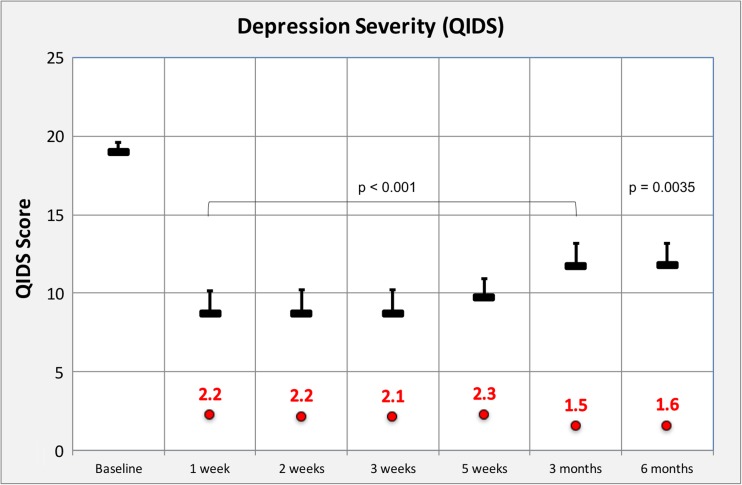
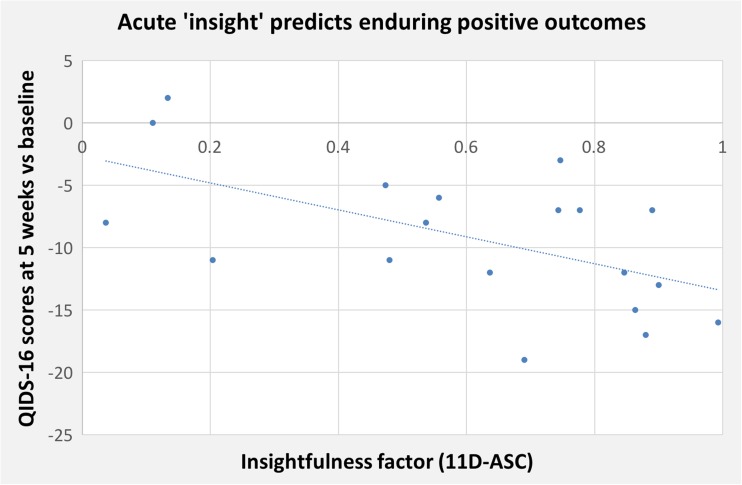
RATIONALE: Recent clinical trials are reporting marked improvements in mental health outcomes with psychedelic drug-assisted psychotherapy. OBJECTIVES: Here, we report on safety and efficacy outcomes for up to 6 months in an open-label trial of psilocybin for treatment-resistant depression. METHODS: Twenty patients (six females) with (mostly) severe, unipolar, treatment-resistant major depression received two oral doses of psilocybin (10 and 25 mg, 7 days apart) in a supportive setting. Depressive symptoms were assessed from 1 week to 6 months post-treatment, with the self-rated QIDS-SR16 as the primary outcome measure. RESULTS: Treatment was generally well tolerated. Relative to baseline, marked reductions in depressive symptoms were observed for the first 5 weeks post-treatment (Cohen's d = 2.2 at week 1 and 2.3 at week 5, both p < 0.001); nine and four patients met the criteria for response and remission at week 5. Results remained positive at 3 and 6 months (Cohen's d = 1.5 and 1.4, respectively, both p < 0.001). No patients sought conventional antidepressant treatment within 5 weeks of psilocybin. Reductions in depressive symptoms at 5 weeks were predicted by the quality of the acute psychedelic experience. CONCLUSIONS: Although limited conclusions can be drawn about treatment efficacy from open-label trials, tolerability was good, effect sizes large and symptom improvements appeared rapidly after just two psilocybin treatment sessions and remained significant 6 months post-treatment in a treatment-resistant cohort. Psilocybin represents a promising paradigm for unresponsive depression that warrants further research in double-blind randomised control trials.
Overview
The claims and statistics of this paper haven’t been checked yet.
Free: it reads the open-access text and checks the first 5 claims that cite a source we can check. Create a free account to check every claim.
Integrity signals
Registry
Cites
Statistics
Figures
Verification
Claims the paper makes
The claims and statistics of this paper haven’t been checked yet.
Free: it reads the open-access text and checks the first 5 claims that cite a source we can check. Create a free account to check every claim.
Claims other papers make about this one
Each is checked against this paper’s own text: does it say what the citing paper says it does?
The source backs part of the claim, not all of it — or backs it for a different population, condition or comparison.
In the citing paper
“Not only do they produce sustained therapeutic effects following a single administration, they also appear to have broad therapeutic potential”
From Psychedelics and Other Psychoplastogens for Treating Mental Illness. (2021) · cites this paper as [41]
Experimental — accuracy not yet measuredThe source backs part of the claim, not all of it — or backs it for a different population, condition or comparison.
In the citing paper
“Unlike traditional antidepressants, psychoplastogens produce both fast-acting and sustained beneficial behavioral effects after a single administration (Figure 1) (38–42).”
From Psychedelics and Other Psychoplastogens for Treating Mental Illness. (2021) · cites this paper as [41]
Experimental — accuracy not yet measuredThe source backs part of the claim, not all of it — or backs it for a different population, condition or comparison.
In the citing paper
“the mood-elevating properties of psilocybin seem to last significantly longer”
From Psychedelics and Other Psychoplastogens for Treating Mental Illness. (2021) · cites this paper as [41]
Experimental — accuracy not yet measuredThe source backs part of the claim, not all of it — or backs it for a different population, condition or comparison.
In the citing paper
“Remarkably, these benefits were incurred even after only a single psychedelic administration and were maintained for as long as 6 months.”
From Examining the Potential Synergistic Effects Between Mindfulness Training and Psychedelic-Assisted Therapy (2021) · cites this paper as [30]
Experimental — accuracy not yet measuredThe source backs part of the claim, not all of it — or backs it for a different population, condition or comparison.
In the citing paper
“Most of these studies however suffer from low methodological validity and are mostly open-label, yet they have yielded preliminary evidence for the capacity of psychedelic substances for treating addiction, depression, anxiety, and eating disorders (29–35).”
From Examining the Potential Synergistic Effects Between Mindfulness Training and Psychedelic-Assisted Therapy (2021) · cites this paper as [30]
Experimental — accuracy not yet measured
13 more claims about this paper
Create a free account to see every claim other papers make about this one.
Self-check
Percentages, sums and reported differences re-computed from the paper’s own numbers.
The self-check needs the paper’s full text.
Citations
Cites
Griffiths, R. R., Johnson, M. W., Carducci, M. A., Umbricht, A., Richards, W. A., Richards, B. D., Cosimano, M. P., & Klinedinst, M. A. (2016) · Journal of Psychopharmacology · doi:10.1177/0269881116675513 · Cited by 2,201 · cited 5×
“Recent studies (Griffiths et al. 2016; Ross et al. 2016; Carhart-Harris et al. 2016), including the present one, help demonstrate the feasibility of treating patients with major depressive disorder with psilocybin plus psychological support.”
BackgroundResultInfluentialRoss, S., Bossis, A., Guss, J., Agin-Liebes, G., Malone, T., Cohen, B., Mennenga, S. E., Belser, A., Kalliontzi, K., Babb, J., et al. (2016) · Journal of Psychopharmacology · doi:10.1177/0269881116675512 · Cited by 1,698 · cited 8×
“Recent studies (Griffiths et al. 2016; Ross et al. 2016; Carhart-Harris et al. 2016), including the present one, help demonstrate the feasibility of treating patients with major depressive disorder with psilocybin plus psychological support.”
BackgroundResultInfluentialCarhart-Harris, R. L., Bolstridge, M., Rucker, J., Day, C. M. J., Erritzoe, D., Kaelen, M., Bloomfield, M., Rickard, J. A., Forbes, B., Feilding, A., et al. (2016) · The Lancet Psychiatry · doi:10.1016/s2215-0366(16)30065-7 · Cited by 1,540 · cited 5×
“Recent studies (Griffiths et al. 2016; Ross et al. 2016; Carhart-Harris et al. 2016), including the present one, help demonstrate the feasibility of treating patients with major depressive disorder with psilocybin plus psychological support.”
BackgroundMethodResultInfluentialSelf-citationPilot Study of Psilocybin Treatment for Anxiety in Patients With Advanced-Stage Cancer
Grob, C. S., Danforth, A. L., Chopra, G. S., Hagerty, M., McKay, C. R., Halberstadt, A. L., & Greer, G. R. (2011) · Archives of General Psychiatry · doi:10.1001/archgenpsychiatry.2010.116 · Cited by 1,206 · cited 6×
“…separate trials have reported improvements in depressive symptoms after psilocybin-assisted psychotherapy (Griffiths et al. 2016; Ross et al. 2016; Grob et al. 2011; CarhartHarris et al. 2016), including one in which ‘treatment-resistant depression’ was the primary criterion for inclusion…”
BackgroundResultInfluentialHuman hallucinogen research: guidelines for safety
Johnson, M., Richards, W., & Griffiths, R. (2008) · Journal of Psychopharmacology · doi:10.1177/0269881108093587 · Cited by 1,203 · cited 2×
“Basic principles for safe therapeutic work with psychedelics can be found in guidelines (Johnson et al. 2008) and books (Richards 2015) but more systematic verification, refinement and (eventual) manualisation of treatment approaches are needed for subsequent roll-out (Carhart-Harris and Goodwin…”
BackgroundPsilocybin-assisted treatment for alcohol dependence: A proof-of-concept study
Bogenschutz, M. P., Forcehimes, A. A., Pommy, J. A., Wilcox, C. E., Barbosa, P., & Strassman, R. J. (2015) · Journal of Psychopharmacology · doi:10.1177/0269881114565144 · Cited by 1,151 · cited 1×
“Psilocybin has shown promise in the treatment of obsessive compulsive disorder (Moreno et al. 2006), alcohol (Bogenschutz et al. 2015) and tobacco addiction (Johnson et al. 2014) and anxiety related to terminal diagnoses (Griffiths et al. 2016; Ross et al. 2016; Grob et al. 2011).”
BackgroundPsilocybin induces schizophrenia-like psychosis in humans via a serotonin-2 agonist action
Vollenweider, F. X., Vollenweider-Scherpenhuyzen, M. F. I., Bäbler, A., Vogel, H., & Hell, D. (1998) · NeuroReport · doi:10.1097/00001756-199812010-00024 · Cited by 1,018 · cited 1×
“Like all serotonergic psychedelics, psilocybin initiates its characteristic effects via serotonin 2A receptor (5-HT2AR) agonism (Vollenweider et al. 1998).”
BackgroundPilot study of the 5-HT 2A R agonist psilocybin in the treatment of tobacco addiction
Johnson, M. W., Garcia-Romeu, A., Cosimano, M. P., & Griffiths, R. R. (2014) · Journal of Psychopharmacology · doi:10.1177/0269881114548296 · Cited by 914 · cited 1×
“Psilocybin has shown promise in the treatment of obsessive compulsive disorder (Moreno et al. 2006), alcohol (Bogenschutz et al. 2015) and tobacco addiction (Johnson et al. 2014) and anxiety related to terminal diagnoses (Griffiths et al. 2016; Ross et al. 2016; Grob et al. 2011).”
BackgroundGriffiths, R., Richards, W., Johnson, M., McCann, U., & Jesse, R. (2008) · Journal of Psychopharmacology · doi:10.1177/0269881108094300 · Cited by 905 · cited 2×
“involving appropriate psychological support), sustained improvements in well-being in healthy individuals were observed after a single dose of psilocybin in a doubleblind design incorporating an active placebo (Griffiths et al. 2008).”
BackgroundMethodSafety, tolerability, and efficacy of psilocybin in 9 patients with obsessive-compulsive disorder
Moreno, F. A., Wiegand, C. B., Taitano, E. K., & Delgado, P. L. (2006) · The Journal of Clinical Psychiatry · doi:10.4088/jcp.v67n1110 · Cited by 789 · cited 2×
“Psilocybin has shown promise in the treatment of obsessive compulsive disorder (Moreno et al. 2006),”
Background
Cited by
Items 901–969 of 969
Hosford, S., & Austin-Robillard, H. (2025) · Contemporary Family Therapy · doi:10.1007/s10591-025-09766-8 · Cited by 2
Salience and executive network connectivity analyses in schizophrenia during emotional memory tasks
Schollaert, L. (2025) · Cortica · doi:10.26034/cortica.2025.8569
MODERN STRATEGIES FOR THE TREATMENT OF TREATMENT-RESISTANT DEPRESSION – A LITERATURE REVIEW
Rożek, I., Gąska, W., Lekan, I., Mazurek, J., Brzezińska, A., Tuszyńska, W., Sodolska, A., Lenart, M., Madoń, B., & Teresińska, B. (2025) · International Journal of Innovative Technologies in Social Science · doi:10.31435/ijitss.3(47).2025.3822
Bhagavan, C., Glue, P., Evans, W., Reynolds, L., Turner, T., King, C., Russell, B. R., Morunga, E., Mills, J. L., Layton, G., et al. (2024) · Figshare · doi:10.6084/m9.figshare.25876232
Bhagavan, C., Glue, P., Evans, W., Reynolds, L., Turner, T., King, C., Russell, B. R., Morunga, E., Mills, J. L., Layton, G., et al. (2024) · Figshare · doi:10.6084/m9.figshare.25876328
‘Shrooms for the Blues: Psilocybin to alleviate difficult-to-treat depression
Graham, Z. (2022) · Journal of High School Science · doi:10.64336/001c.37945
Ryan, R. S., Copello, A., & Fox, A. P. (2024) · Figshare · doi:10.6084/m9.figshare.26575175
Bhagavan, C., Glue, P., Evans, W., Reynolds, L., Turner, T., King, C., Russell, B. R., Morunga, E., Mills, J. L., Layton, G., et al. (2024) · Figshare · doi:10.6084/m9.figshare.26723801
Stress, Anxiety, and Depression
O’Brien, K., & Bosak, C. (2025) · Springer eBooks · doi:10.1007/978-3-032-01737-6_3 · Cited by 1
Medicinal Mushrooms and Mental Disorders: How Mushrooms Affect Anxiety and Depression
Tarki, A., Hajikarim‐Hamedani, A., Rassa, S., & Khosravi, S. (2025) · Nutritional neurosciences · doi:10.1007/978-981-95-2774-8_6
Armstrong, S. B., DellaCrosse, M., Fuentes-Balderrama, J., Lancelotta, R., & Davis, A. K. (2025) · Psychedelics · doi:10.1016/j.psyche.2025.100006
Gordon, A. R., Carrithers, B. M., Pagni, B. A., Kettner, H., MRes, A. M., Nayak, S. M., Weiss, B., Carhart-Harris, R. L., Roberts, D. E., Erritzøe, D., et al. (2025) · Psychedelic Medicine · doi:10.1177/28314425251382930
Self-citationWoodruff, S., Hibicke, M., & Nichols, C. D. (2025) · Psychedelic Medicine · doi:10.1177/28314425251393186
Husein, A., Traylor, M., Vest, M. F., Wood, B. J., Brogan, M., Thomas, A., McNeil, S. E., Bhuiyan, M. A. N., Hendricks, P. S., Kelly, J. R., et al. (2025) · Psychedelic Medicine · doi:10.1177/28314425251381806
Animal models in psychedelic research – Tripping over translation
Hay, M. Y. A. E., Cukić, A., Schölvinck, M. L., & Havenith, M. N. (2026) · Translational Psychiatry · doi:10.64898/2026.01.14.699469
Hinchcliffe, J. K., Thomas, C. W., Gilmour, G., & Robinson, E. S. J. (2026) · bioRxiv (Cold Spring Harbor Laboratory) · doi:10.64898/2026.01.14.699553
Banzato, M., Colognesi, M., Lucatello, L., Comai, S., Pasut, G., Capolongo, F., Orian, L., Biasutto, L., Signor, A., Gabbia, D., et al. (2026) · Journal of Medicinal Chemistry · doi:10.1021/acs.jmedchem.5c01797 · Cited by 2
Deska, Ł., Kosmecki, C., Głaz, D., Kamińska, N., Sołtys, W., Stolarczyk, M., Głaz, M., Stronczyński, M., Jagura-Sukiennik, A., & Wawerska, J. (2026) · International Journal of Innovative Technologies in Social Science · doi:10.31435/ijitss.1(49).2026.4711
Mechanisms and management of treatment-resistant depression in clinical psychiatry
Khan, S. A., Kankouni, E., Alkhurayb, N. T., Alshakori, H., Alharbi, M., Alharthi, A. K. Z., Aljubran, A., Alajmi, A. F., Ahmed, S., & Aldoulah, H. (2026) · International Journal of Community Medicine and Public Health · doi:10.18203/2394-6040.ijcmph20260152
Psilocin fosters neuroplasticity in iPSC-derived human cortical neuronsPreprint
Schmidt, M., Hoffrichter, A., Davoudi, M., Horschitz, S., Lau, T., Meinhardt, M. W., Spanagel, R., Ladewig, J., Köhr, G., & Koch, P. J. (2026) · eLife · doi:10.7554/elife.104006.2 · Cited by 1
Psilocibina en depresión: mecanismos neurobiológicos y cambios cognitivos
Arias, A. V., Ramírez, M. C., López, A. H., & Becerra-Hernández, L. V. (2026) · Acta neurológica colombiana · doi:10.22379/anc.v42i1.1926
Predictors of the Effectiveness of Psychedelics in Treating Depression—A Scoping Review
Chmiel, J., & Rybakowski, F. (2026) · International Journal of Molecular Sciences · doi:10.3390/ijms27052202 · Cited by 2
“…1 week (d = 2.2) and 5 weeks (d = 2.3), and sustained benefits at 3 and 6 months (d = 1.5 and 1.4; all p < 0.001); at 5 weeks, nine responded and four remitted, with “unity/spiritual/bliss/insightfulness” during dosing predicting larger 5-week improvement (e.g., r = − 0.57 for insightfulness) [50].”
InfluentialHorowitz, R. K., Rosa, W. E., Zarrabi, A. J., & Swogger, M. T. (2026) · Journal of Palliative Medicine · doi:10.1177/10966218251392787
Trip killers: Addressing a critical knowledge gap in psychedelic research
O’Mahony, B. W., Harrington, C., Harkin, A., & Lally, N. (2026) · Journal of Psychopharmacology · doi:10.1177/02698811261431056
Skalski, P., Pękacka‐Falkowska, K., Pluto-Prądzyńska, A., & Owecki, M. K. (2026) · Brain Sciences · doi:10.3390/brainsci16040358
Associations Between Psilocybin Use Motives and Cognitive, Affective, and Behavioural Self-Stigma
Knibb, G., Ward, R., Christiansen, P., & Roberts, C. A. (2026) · Substance Use & Misuse · doi:10.1080/10826084.2026.2643418
Gu, E. Y., Irvine, N. M., Miller, M. J., Ramirez, E., Santaella-Tenorio, J., Lippincott, T., Bogenschutz, M. P., Bunting, A. M., Meacham, M. C., & Krawczyk, N. (2026) · Journal of Psychedelic Studies · doi:10.1556/2054.2026.00487
Stellmacher, J., Schmidt, C., Aicher, H., Eichel, K., Brakemeier, E., & Herwig, U. (2026) · Frontiers in Psychiatry · doi:10.3389/fpsyt.2026.1771726
“While recent studies assessing psychedelics in psychiatric indications have typically incorporated psychotherapeutic supervision within PAT protocols, they have largely concentrated on evaluating the pharmacological effects of the psychedelic substance itself (31, 32).”
Le LSD revisité : mécanismes d’action et potentiel en santé mentale
Bouloufa, A., Delcourte, S., Delannay, T., & Haddjeri, N. (2026) · L Encéphale · doi:10.1016/j.encep.2026.02.008
Meshkat, S., Jha, M. K., & Bhat, V. (2026) · FOCUS The Journal of Lifelong Learning in Psychiatry · doi:10.1176/appi.focus.20250043
Psychedelics: Future Therapeutics in Major Depression?
Olivier, B., & Olivier, J. D. A. (2026) · Advances in experimental medicine and biology · doi:10.1007/978-981-95-6872-7_25
The Neuropharmacology of Psychedelics
Pavăl, D. (2026) · SpringerBriefs in religious studies · doi:10.1007/978-3-032-20214-7_3
Walters, C. K., Chetty, S., Rants’o, T. A., Gossayn, S., & Lerotholi, L. J. (2026) · Research Square · doi:10.21203/rs.3.rs-9283280/v1
Historia cultural de los psicodélicos: cambio de valores y resignificación en la modernidad tardía
Gómez, N. P., Vilas, E. F., & Coca, J. R. (2025) · Cultura y Droga · doi:10.17151/culdr.2025.30.40.3
Kelly, C. M., Fradet, M., Bostian, C. M., Donnelly, A. J., Ellis, S., Ostacher, M. J., Aaronson, S. T., & Suppes, T. M. (2026) · Journal of Affective Disorders · doi:10.1016/j.jad.2026.122063
Ahmadian-Moghadam, S., Roshan‐Milani, S., & Saboory, E. (2026) · Translational Psychiatry · doi:10.1038/s41398-026-04151-x
“Importantly, Carhart-Harris et al. [128] found that psilocybin facilitated sustained improvements in emotional regulation and social functioning in patients with treatment-resistant depression, effects associated with increased brain network fl exibility [128].”
Personalised Perception: The Effect of Personality on the Sensory Effects of Psychedelics
Boardman, A. D., Whelan, J., & Ward, R. D. (2026) · Drug and Alcohol Review · doi:10.1111/dar.70172
Labra-Lorenzana, A., Lima-Sánchez, D. N., Delaflor-Wagner, C. A., Martínez-Hernández, D. G., Ramos-Jiménez, C., & Toledo-Lozano, C. G. (2026) · Psychiatry International · doi:10.3390/psychiatryint7030137
“Of the above-mentioned trials, the study by Gukasyan [20] is a 12-month follow-up from the study by Davis [10], and the 2018 study by Carhart-Harris [18] is a six-month follow-up from his 2016 work [9].”
InfluentialPsilocybin and Mental Health Outcomes: Scoping Review with ☸️SAIMSARA
SAIMSARA (2026) · SAIMSARA Journal · doi:10.62487/saimsara7a54f680
Ten practical suggestions for setting up a psychedelic study
Caulfield, A., Butler, M., & Mehta, M. A. (2026) · Journal of Psychopharmacology · doi:10.1177/02698811261458350
THE PSYCHEDELIC AND KETAMINE RENAISSANCE IN THE FACE OF THE CRISIS IN MODERN PSYCHIATRY
Osipowska, J., Kwolek, M., Judzińska, A., Piech, B., Sobczyńska, K., Ignarska, J., Terbosh, M., `Mzabi, S. K., Trojanowska, E., & Dubaj, M. (2026) · International Journal of Innovative Technologies in Social Science · doi:10.31435/ijitss.2(50).2026.5605
DESI-MSI-Based Multi-Organ Distribution Mapping of Psilocin in Zebrafish
Dong, M., Zhang, Y., Cao, M., Shi, T., Li, L., Zong, X., & Wang, C. (2026) · Molecules · doi:10.3390/molecules31122143
“Notably, a single high dose of 25 mg in human clinical trials produced rapid and sustained therapeutic effects lasting up to 12 months [37,38].”
Olejníková, L., Kútna, V., Mazochová, K., Šíchová, K., Danda, H., Lhotková, E., Uttl, L., Brejtr, V., Syrová, K., Mazoch, V., et al. (2026) · Pharmacology Biochemistry and Behavior · doi:10.1016/j.pbb.2026.174231
Estela-Fernandez, C. A., Elsheikh, R. M. Y., Beatrice, D. F., Alhendal, A. A., Ewe, C. I., Montesinos, S. Y., Wensel, J., Mishra, A. P., Yousif, A. A., & Ali, H. T. (2026) · Neuropsychiatrie · doi:10.1007/s40211-026-00584-4
Schuman, H. D. M., Mina, R., Barkova, S., Nguyen, T., Deleemans, J. M., & Carlson, L. E. (2026) · Global Advances in Integrative Medicine and Health · doi:10.1177/27536130261459354
Whitfield, H. J., Schepers, J., Mason, N. L., Luca, M., & Kuypers, K. P. C. (2026) · Journal of Psychedelic Studies · doi:10.1556/2054.2026.00530
Los, A. P. M., Szkodziński, K., Jakubczyk, I., Maternia, J., Majowicz-Czaszyńska, K. B., Pempuś, W., Król, N., Tomaszek, B., Blok, A., Wiater, D., et al. (2026) · International Journal of Innovative Technologies in Social Science · doi:10.31435/ijitss.2(50).2026.5755
“Normalization of DMN connectivity has been observed following the resolution of acute medication effects, suggesting that temporary destabilization may facilitate more adaptive long-term network reorganization (Carhart-Harris et al., 2017).”
The Evolution of Psychedelics and Psychedelic-Assisted Therapy
Brar, G., Lally, K., Kelly, J. R., & O'Connell, H. P. (2026) · Springer eBooks · doi:10.1007/978-3-032-27009-2_16
What About Psycholytic Therapy? A Historical Revisiting of Psychedelics Assisting Psychotherapy
Zaher, I., & Richard, J. (2026) · Psychedelic Medicine · doi:10.1177/28314425261455416
Multidimensional characterization of the physiological and behavioral effects of TCB-2 in micePreprint
Yamamoto, M., Inoue, H., Hayashi, K., Aota, I., Matsumoto, J., Yamada, K., & Toda, K. (2026) · bioRxiv (Cold Spring Harbor Laboratory) · doi:10.64898/2026.08.01.742216
Berkovitch, L., & Charif, S. (2025) · Elsevier eBooks · doi:10.1016/b978-2-294-78794-2.00074-9
Potential Role of Psychedelics in the Treatment of Depressive Disorder
Wang, S., & Bahk, W.-M. (2026) · Springer eBooks · doi:10.1007/978-981-92-1331-3_12
Kaadt, E., Søkilde, R., Hansen, H. D., Raval, N. R., Donovan, L. L., Just, J., Knudsen, G. M., & Elfving, B. (2026) · European Journal of Pharmacology · doi:10.1016/j.ejphar.2026.179222
Thaoboonruang, N., Tan, Y., Lohitnavy, O., Ya, K., Chen, S., & Lohitnavy, M. (2026) · European Journal of Drug Metabolism and Pharmacokinetics · doi:10.1007/s13318-026-01033-x
Psilocibina e neuroplasticidade: novas perspectivas terapêuticas para depressão resistente
Castro, L. A., Júnior, A. L. A. S., Simões, G. G. C., de Souza, V. R. S., Pereira, L. L. M. D., Lacerda, A. L. D. S., & da Silva, C. L. (2026) · Vértices · doi:10.19180/1809-2667.v28n22026.23658
Civardi, S. C., Besana, F., Durbano, F., Toscano, M. O. M., Raffone, F., Dell’Osso, B. M., & Olivola, M. (2026) · Frontiers in Psychiatry · doi:10.3389/fpsyt.2026.1858319
“Speci fi cally, the two studies conducted by Carhart-Harris et al. in 2016 (58) and 2018 (59), conducted on 12 and 20 patients respectively.”
InfluentialOrallo, D. E., Parise, A. R., Echarte, S. M., Iurlina, M. O., & Ramírez, C. L. (2026) · Studies in natural products chemistry · doi:10.1016/b978-0-443-51072-4.00016-8
Psychedelics and suicidality: A double-edged sword - risks, mechanisms, and moving forward
Mallevays, M., & Berkovitch, L. (2026) · European Neuropsychopharmacology · doi:10.1016/j.euroneuro.2026.113878
Moving beyond 5-HT2A: language models map neurotransmitter receptors to experiential semantics
Suresh, P., Kins, J., Levkovskyy, L., Thieme, A., Wren, P. B., Ray, T., Barrett, F. S., Carhart-Harris, R. L., & Bzdok, D. (2026) · Psychopharmacology · doi:10.1007/s00213-026-07170-0
Self-citationLewis, B. R., Garland, E. L., Schwartz, Z., Xin, Y., Byrne, K., & Brent, K. (2026) · Psychedelics · doi:10.1016/j.psyche.2026.100041
Eun, A., Yang, K. H., & Palamar, J. J. (2026) · Psychological Medicine · doi:10.1017/s0033291726106163
Szarpak, Ł., Pruc, M., Jablonska-Moczulo, D., Niewiadomska, I., Rybczynski, B., & Cubała, W. J. (2026) · Therapeutics · doi:10.3390/therapeutics3040021
AbouEich, H. K., Izadi, A., Lifshitz, J., Olson, D. E., & Gurkoff, G. G. (2026) · Journal of Neurotrauma · doi:10.1177/08977151261495030
Sun, R., & Wang, Y. (2026) · Networks and Spatial Economics · doi:10.1007/s11067-026-09795-2 · Cited by 1
Inserra, A., Persico, L., Rosati, A., Fabale, M., Cavallotto, C., d’Andrea, G., Zoratto, F., Pettorruso, M., Risio, L. D., Ventriglio, A., et al. (2026) · Behavioral Sciences · doi:10.3390/bs16111997
Frick, A., Blest‐Hopley, G., Grin, M., Erritzøe, D., Nutt, D. J., & Carhart-Harris, R. L. (2026) · Psychopharmacology · doi:10.21203/rs.3.rs-9880403/v1
Self-citationPsilocybin induces rapid and persistent growth of dendritic spines in frontal cortex in vivo
Shao, L.-X., Liao, C., Gregg, I., Davoudian, P. A., Savalia, N. K., Delagarza, K., & Kwan, A. C. (2021) · doi:10.1101/2021.02.17.431629 · Cited by 628
“Among serotonergic psychedelics, psilocybin is recently shown to relieve depression symptoms rapidly and with sustained benefits for several months (Carhart-Harris et al., 2016; Davis et al., 2020; Griffiths et al., 2016; Ross et al., 2016).”
Metadata
- Authors
- Carhart-Harris, R. L., Bolstridge, M., Day, C. M. J., Rucker, J., Watts, R., Erritzoe, D. E., Kaelen, M., Giribaldi, B., Bloomfield, M., Pilling, S., Rickard, J. A., Forbes, B., Feilding, A., Taylor, D., Curran, H. V., & Nutt, D. J.
- Affiliations
- Imperial College London (GB)
- South London and Maudsley NHS Foundation Trust (GB)
- King's College London (GB)
- University College London (GB)
- Barts Health NHS Trust (GB)
- Beckley Foundation (GB)
- Corresponding author
- Carhart-Harris, R. L.
- ORCID
- Venue
- Psychopharmacology
- Published
- 2017-11-08
- Volume
- 235
- Issue
- 2
- Pages
- 399-408
- ISSN
- 0033-3158 (ISSN-L)
- 1432-2072
- PMC
- PMC5813086
- OpenAlex
- W2767530231
- Semantic Scholar
- 54241eed73a6a87c456f4b880ffcb168b50851f0
- Cited by
- 970
- References
- 40
- Citations by year
- 2026: 87 · 2025: 153 · 2024: 171 · 2023: 143 · 2022: 152 · 2021: 110 · 2020: 93 · 2019: 29 · 2018: 27 · 2017: 4
- FWCI
- 51.90
- Type
- journal article
- Language
- en
- Open access
- hybrid
- doi.org
- Locations
- Psychopharmacology (publishedVersion, cc-by)
- Europe PMC (PubMed Central) (publishedVersion, cc-by)
- PubMed Central (publishedVersion, cc-by)
- PubMed (publishedVersion)
- UCL Discovery (University College London) (submittedVersion)
- eScholarship (California Digital Library) (submittedVersion, cc-by)
- Research Portal (King's College London) (submittedVersion, cc-by)
- Spiral (Imperial College London) (submittedVersion, other-oa)
- Funders
- Medical Research Council (MR/J00460X/1)
- Topics
- Social Sciences › Psychology › Clinical Psychology › Psychedelics and Drug Studies
- Health Sciences › Medicine › Pharmacology (medical) › Treatment of Major Depression
- Social Sciences › Psychology › Clinical Psychology › Psychotherapy Techniques and Applications
- Keywords
- psilocybin, treatment-resistant depression, psychedelic-assisted psychotherapy, major depressive disorder, depressive symptom reduction, tolerability, long-term follow-up, QIDS-SR16
- MeSH terms
- Psychosocial Support Systems, Adult, Antidepressive Agents, Combined Modality Therapy, Double-Blind Method, Feasibility Studies, Female, Follow-Up Studies, Hallucinogens, Humans, Male, Middle Aged, Psilocybin, Time Factors, Treatment Outcome, Depressive Disorder, Treatment-Resistant
About these checks
Registry, retraction, Cites and statistics results are computed, not judged, with one exception: a printed reference that no index lists is read once by a model before it counts as a citation error. Claims are extracted by a model and kept only when their quote appears verbatim in the text; each cited source is then checked, with a model’s help, for whether it says what the claim relies on. Those verdicts can be wrong — read the claim’s quote and the cited source before relying on one.
Statistics and arithmetic are recomputed, not judged.
Confidence bands are shown only for fields calibrated on our annotated test set. None is calibrated yet, so no band is shown.
What counts as a claim ›How we measure confidence ›How we check this ›
Are you an author, or do you see a problem with this page? Request a review
Data sources
Bibliographic data: Semantic Scholar, OpenAlex, Crossref.
Contains information from the Semantic Scholar Academic Graph Datasets, made available under the ODC Attribution License (ODC-BY 1.0).
Semantic Scholar’s data is described in: Kinney, R., et al. (2023). The Semantic Scholar Open Data Platform. arXiv:2301.10140.
