

Psilocybin with psychological support for treatment-resistant depression: six-month follow-up
Open accessThe DOI matches its Crossref record; 40 of the 40 references it cites were found in a registry or an index.
Abstract
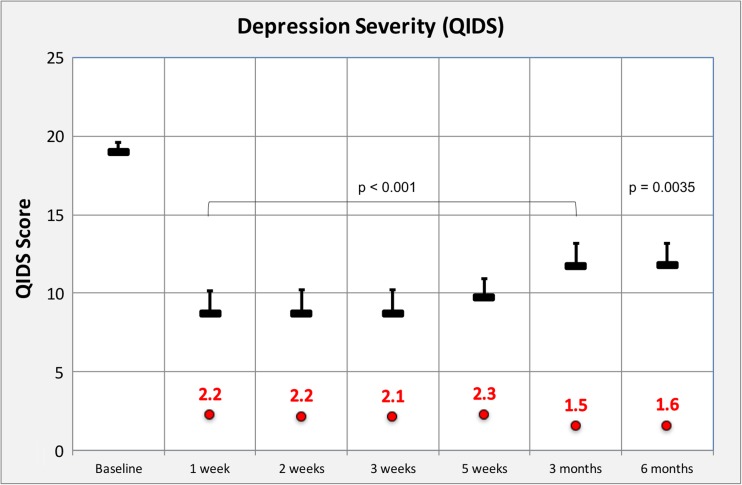
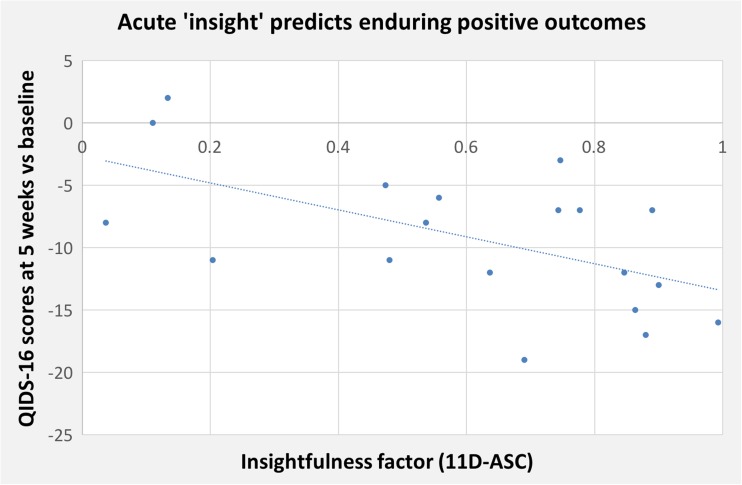
RATIONALE: Recent clinical trials are reporting marked improvements in mental health outcomes with psychedelic drug-assisted psychotherapy. OBJECTIVES: Here, we report on safety and efficacy outcomes for up to 6 months in an open-label trial of psilocybin for treatment-resistant depression. METHODS: Twenty patients (six females) with (mostly) severe, unipolar, treatment-resistant major depression received two oral doses of psilocybin (10 and 25 mg, 7 days apart) in a supportive setting. Depressive symptoms were assessed from 1 week to 6 months post-treatment, with the self-rated QIDS-SR16 as the primary outcome measure. RESULTS: Treatment was generally well tolerated. Relative to baseline, marked reductions in depressive symptoms were observed for the first 5 weeks post-treatment (Cohen's d = 2.2 at week 1 and 2.3 at week 5, both p < 0.001); nine and four patients met the criteria for response and remission at week 5. Results remained positive at 3 and 6 months (Cohen's d = 1.5 and 1.4, respectively, both p < 0.001). No patients sought conventional antidepressant treatment within 5 weeks of psilocybin. Reductions in depressive symptoms at 5 weeks were predicted by the quality of the acute psychedelic experience. CONCLUSIONS: Although limited conclusions can be drawn about treatment efficacy from open-label trials, tolerability was good, effect sizes large and symptom improvements appeared rapidly after just two psilocybin treatment sessions and remained significant 6 months post-treatment in a treatment-resistant cohort. Psilocybin represents a promising paradigm for unresponsive depression that warrants further research in double-blind randomised control trials.
Overview
The claims and statistics of this paper haven’t been checked yet.
Free: it reads the open-access text and checks the first 5 claims that cite a source we can check. Create a free account to check every claim.
Integrity signals
Registry
Cites
Statistics
Figures
Verification
Claims the paper makes
The claims and statistics of this paper haven’t been checked yet.
Free: it reads the open-access text and checks the first 5 claims that cite a source we can check. Create a free account to check every claim.
Claims other papers make about this one
Each is checked against this paper’s own text: does it say what the citing paper says it does?
The source backs part of the claim, not all of it — or backs it for a different population, condition or comparison.
In the citing paper
“Not only do they produce sustained therapeutic effects following a single administration, they also appear to have broad therapeutic potential”
From Psychedelics and Other Psychoplastogens for Treating Mental Illness. (2021) · cites this paper as [41]
Experimental — accuracy not yet measuredThe source backs part of the claim, not all of it — or backs it for a different population, condition or comparison.
In the citing paper
“Unlike traditional antidepressants, psychoplastogens produce both fast-acting and sustained beneficial behavioral effects after a single administration (Figure 1) (38–42).”
From Psychedelics and Other Psychoplastogens for Treating Mental Illness. (2021) · cites this paper as [41]
Experimental — accuracy not yet measuredThe source backs part of the claim, not all of it — or backs it for a different population, condition or comparison.
In the citing paper
“the mood-elevating properties of psilocybin seem to last significantly longer”
From Psychedelics and Other Psychoplastogens for Treating Mental Illness. (2021) · cites this paper as [41]
Experimental — accuracy not yet measuredThe source backs part of the claim, not all of it — or backs it for a different population, condition or comparison.
In the citing paper
“Remarkably, these benefits were incurred even after only a single psychedelic administration and were maintained for as long as 6 months.”
From Examining the Potential Synergistic Effects Between Mindfulness Training and Psychedelic-Assisted Therapy (2021) · cites this paper as [30]
Experimental — accuracy not yet measuredThe source backs part of the claim, not all of it — or backs it for a different population, condition or comparison.
In the citing paper
“Most of these studies however suffer from low methodological validity and are mostly open-label, yet they have yielded preliminary evidence for the capacity of psychedelic substances for treating addiction, depression, anxiety, and eating disorders (29–35).”
From Examining the Potential Synergistic Effects Between Mindfulness Training and Psychedelic-Assisted Therapy (2021) · cites this paper as [30]
Experimental — accuracy not yet measured
13 more claims about this paper
Create a free account to see every claim other papers make about this one.
Self-check
Percentages, sums and reported differences re-computed from the paper’s own numbers.
The self-check needs the paper’s full text.
Citations
Cites
Griffiths, R. R., Johnson, M. W., Carducci, M. A., Umbricht, A., Richards, W. A., Richards, B. D., Cosimano, M. P., & Klinedinst, M. A. (2016) · Journal of Psychopharmacology · doi:10.1177/0269881116675513 · Cited by 2,201 · cited 5×
“Recent studies (Griffiths et al. 2016; Ross et al. 2016; Carhart-Harris et al. 2016), including the present one, help demonstrate the feasibility of treating patients with major depressive disorder with psilocybin plus psychological support.”
BackgroundResultInfluentialRoss, S., Bossis, A., Guss, J., Agin-Liebes, G., Malone, T., Cohen, B., Mennenga, S. E., Belser, A., Kalliontzi, K., Babb, J., et al. (2016) · Journal of Psychopharmacology · doi:10.1177/0269881116675512 · Cited by 1,698 · cited 8×
“Recent studies (Griffiths et al. 2016; Ross et al. 2016; Carhart-Harris et al. 2016), including the present one, help demonstrate the feasibility of treating patients with major depressive disorder with psilocybin plus psychological support.”
BackgroundResultInfluentialCarhart-Harris, R. L., Bolstridge, M., Rucker, J., Day, C. M. J., Erritzoe, D., Kaelen, M., Bloomfield, M., Rickard, J. A., Forbes, B., Feilding, A., et al. (2016) · The Lancet Psychiatry · doi:10.1016/s2215-0366(16)30065-7 · Cited by 1,540 · cited 5×
“Recent studies (Griffiths et al. 2016; Ross et al. 2016; Carhart-Harris et al. 2016), including the present one, help demonstrate the feasibility of treating patients with major depressive disorder with psilocybin plus psychological support.”
BackgroundMethodResultInfluentialSelf-citationPilot Study of Psilocybin Treatment for Anxiety in Patients With Advanced-Stage Cancer
Grob, C. S., Danforth, A. L., Chopra, G. S., Hagerty, M., McKay, C. R., Halberstadt, A. L., & Greer, G. R. (2011) · Archives of General Psychiatry · doi:10.1001/archgenpsychiatry.2010.116 · Cited by 1,206 · cited 6×
“…separate trials have reported improvements in depressive symptoms after psilocybin-assisted psychotherapy (Griffiths et al. 2016; Ross et al. 2016; Grob et al. 2011; CarhartHarris et al. 2016), including one in which ‘treatment-resistant depression’ was the primary criterion for inclusion…”
BackgroundResultInfluentialHuman hallucinogen research: guidelines for safety
Johnson, M., Richards, W., & Griffiths, R. (2008) · Journal of Psychopharmacology · doi:10.1177/0269881108093587 · Cited by 1,203 · cited 2×
“Basic principles for safe therapeutic work with psychedelics can be found in guidelines (Johnson et al. 2008) and books (Richards 2015) but more systematic verification, refinement and (eventual) manualisation of treatment approaches are needed for subsequent roll-out (Carhart-Harris and Goodwin…”
BackgroundPsilocybin-assisted treatment for alcohol dependence: A proof-of-concept study
Bogenschutz, M. P., Forcehimes, A. A., Pommy, J. A., Wilcox, C. E., Barbosa, P., & Strassman, R. J. (2015) · Journal of Psychopharmacology · doi:10.1177/0269881114565144 · Cited by 1,151 · cited 1×
“Psilocybin has shown promise in the treatment of obsessive compulsive disorder (Moreno et al. 2006), alcohol (Bogenschutz et al. 2015) and tobacco addiction (Johnson et al. 2014) and anxiety related to terminal diagnoses (Griffiths et al. 2016; Ross et al. 2016; Grob et al. 2011).”
BackgroundPsilocybin induces schizophrenia-like psychosis in humans via a serotonin-2 agonist action
Vollenweider, F. X., Vollenweider-Scherpenhuyzen, M. F. I., Bäbler, A., Vogel, H., & Hell, D. (1998) · NeuroReport · doi:10.1097/00001756-199812010-00024 · Cited by 1,018 · cited 1×
“Like all serotonergic psychedelics, psilocybin initiates its characteristic effects via serotonin 2A receptor (5-HT2AR) agonism (Vollenweider et al. 1998).”
BackgroundPilot study of the 5-HT 2A R agonist psilocybin in the treatment of tobacco addiction
Johnson, M. W., Garcia-Romeu, A., Cosimano, M. P., & Griffiths, R. R. (2014) · Journal of Psychopharmacology · doi:10.1177/0269881114548296 · Cited by 914 · cited 1×
“Psilocybin has shown promise in the treatment of obsessive compulsive disorder (Moreno et al. 2006), alcohol (Bogenschutz et al. 2015) and tobacco addiction (Johnson et al. 2014) and anxiety related to terminal diagnoses (Griffiths et al. 2016; Ross et al. 2016; Grob et al. 2011).”
BackgroundGriffiths, R., Richards, W., Johnson, M., McCann, U., & Jesse, R. (2008) · Journal of Psychopharmacology · doi:10.1177/0269881108094300 · Cited by 905 · cited 2×
“involving appropriate psychological support), sustained improvements in well-being in healthy individuals were observed after a single dose of psilocybin in a doubleblind design incorporating an active placebo (Griffiths et al. 2008).”
BackgroundMethodSafety, tolerability, and efficacy of psilocybin in 9 patients with obsessive-compulsive disorder
Moreno, F. A., Wiegand, C. B., Taitano, E. K., & Delgado, P. L. (2006) · The Journal of Clinical Psychiatry · doi:10.4088/jcp.v67n1110 · Cited by 789 · cited 2×
“Psilocybin has shown promise in the treatment of obsessive compulsive disorder (Moreno et al. 2006),”
Background
Cited by
Items 801–900 of 969
The Effect of Psilocybin on Personality
LaBua, R. (2021) · CUNY Academic Works (City University of New York) · Cited by 1
The therapeutical role of psychedelic drugs in treatment of mental disorders
Oprea, D. C., Epure, L., Chiriță, V., & Cantemir, A. (2021) · Bulletin of Integrative Psychiatry · doi:10.36219/bpi.2021.3.09
Schmitz, G. P., Jain, M. K., Slocum, S. T., & Roth, B. L. (2021) · bioRxiv (Cold Spring Harbor Laboratory) · doi:10.1101/2021.12.09.472000
The use of psychoactive substances in the treatment of mental disorders
Karaś-Ruszczyk, K., Groblińska, K., Szczygieł, K., & Samochowiec, J. (2021) · Alcoholism and Drug Addiction · doi:10.5114/ain.2021.111791 · Cited by 2
Chafee, H. (2022) · Open Access Victoria University of Wellington | Te Herenga Waka (Figshare) · doi:10.26686/wgtn.19579795
Aharon-Almagor, A., & Barrett, F. S. (2022) · Research Square · doi:10.21203/rs.3.rs-1529935/v1
Psilocybe mexicana R. Heim – Mexikanischer Kahlkopf
Kuhn, A., & Melzig, M. F. (2022) · Zeitschrift für Phytotherapie · doi:10.1055/a-1540-9907
“In einer weiteren Studie mit 26 Patienten waren die antidepressiven Wir - kungen so effektiv, dass keiner der Patienten innerhalb der ersten 5 Wochen während der psychedelischen Therapie auf klassische Antidepressiva zurückgriff [23].”
BackgroundSitkoff, A. (2020) · Elsevier eBooks · doi:10.1016/b978-0-323-43044-9.00090-x
Carreno, F. R., & Frazer, A. (2021) · Elsevier eBooks · doi:10.1016/b978-0-12-820472-6.00044-x · Cited by 1
Mertens, L., Wall, M. B., Roseman, L., Demetriou, L., Nutt, D., & Carhart-Harris, R. L. (2019) · European Neuropsychopharmacology · doi:10.1016/j.euroneuro.2019.09.593
Self-citationBonson, K. R. (2020) · Wiley eBooks · doi:10.1002/9780470015902.a0029200 · Cited by 1
Forstmann, M., & Sagioglou, C. (2021) · PsyArXiv (OSF Preprints) · doi:10.31234/osf.io/2489x
Unravelling a New Conformer of Psilocin Through Computational MethodsPreprint
Bhadoria, P., & Ramanathan, V. (2022) · SSRN Electronic Journal · doi:10.2139/ssrn.4162669
Well-Being and the Outdoors: An Environmentalism Study Among a Religious Student Population
Pires-Gifford, L., Hoffmann, S., Arroyo, E., Jones, N., Waite, B., & Wright, R. R. (2022) · Psi Chi Journal of Psychological Research · doi:10.24839/2325-7342.jn27.3.185
Wright, R. R., Treadwell, K. R. H., & Hughes, J. L. (2022) · Psi Chi Journal of Psychological Research · doi:10.24839/2325-7342.jn27.3.223 · Cited by 1
P03-21 Magic mushrooms and psilocybin: pharmacokinetics, pharmacodynamics, and clinical applications
da Silva, D. D., Brito-da-Costa, A. M., Martins, S., Dinis‐Oliveira, R. J., & Madureira-Carvalho, Á. (2022) · Toxicology Letters · doi:10.1016/j.toxlet.2022.07.283
O Renascimento da Medicina Psicodélica
Kuligowski, R. C. M., Schroeder, E. M., Pelizzari, J. V., Fortunato, M., & Cavalli, R. O. (2022) · E-Acadêmica · doi:10.52076/eacad-v3i3.298 · Cited by 1
Hallucinogens as Therapeutic Agents: Past, Present, and Future
Vos, E., Snelders, S., & Pieters, T. (2022) · Springer eBooks · doi:10.1007/978-3-030-62059-2_425
Therapeutic Choice in the SUDs Treatment
Horák, M., & Verter, N. (2022) · Springer eBooks · doi:10.1007/978-3-031-16459-0_17
Neue und experimentelle medikamentöse Therapieverfahren
Mertens, L. J., Hart, X. M., Scharf, D., Spangemacher, M., & Gründer, G. (2022) · Springer eBooks · doi:10.1007/978-3-662-65734-8_11
Phenylketonuria with mental retardation and valproate-induced hyperammonemia
Sterpu, D. (2020) · Romanian Journal of Psychiatry & Psychotherapy · doi:10.37897/rjpp.2020.4.5
“Carhart Harris et al. conducted an open-label trial with 12 patients [23] and a follow-up that included 20 patients [24] with moderate-to-severe, unipolar, treatment-resistant major depression.”
How medical cannabis may influence the future of Western medicine
Rosenthal, M. S. (2023) · Elsevier eBooks · doi:10.1016/b978-0-323-90036-2.00041-7
Hasler, F. (2023) · transcript Verlag eBooks · doi:10.14361/9783839445716 · Cited by 3
Becher, L., Nanni, F., & Koslowski, M. (2023) · Nervenheilkunde · doi:10.1055/a-2101-9358 · Cited by 1
“Journal of Psychopharmacology 2015; 29: 1182–1190 [58] Carhart-Harris RL, Bolstridge M, Day CM et al.”
BackgroundTetem, J., Fischmann, T., & Möller, T. J. (2023) · PsyArXiv (OSF Preprints) · doi:10.31234/osf.io/ztyxh
Ortega, J. E., Meana, J. J., Horrillo, I., Erkizia-Santamaría, I., & Álvarez, N. M. (2023) · I. Ikergazte: Nazioarteko ikerketa euskaraz. Kongresuko artikulu-bilduma · doi:10.26876/ikergazte.v.04.14
Klassieke psychedelica: veiligheid, neveneffecten en medicatie-interacties
Geleyn, E., Kuypers, K. P. C., Seynaeve, M., & Lemmens, G. M. D. (2023) · Tijdschrift voor Geneeskunde · doi:10.47671/tvg.79.23.049
use of psilocybin in the treatment of psychiatric disorders – review
Woźniak, J., BOGACZ, R., Gaik, M., Ewa, U. R. A. M., MAGDA, I., Womperski, K., & OSUCH, M. (2023) · Journal of Education Health and Sport · doi:10.12775/jehs.2023.43.01.009
Classical psychedelics in psychiatry – renaissance of interest and therapeutic perspectives
Jachimowski, A., & Kucia, K. A. (2023) · Psychiatria Polska · doi:10.12740/pp/150053
“No serious side effects were observed during the experiment [33, 34].”
Unlocking the potential of psychedelics as medicine: Past obstacles and future outlooks
Kim, S. Y., Collins, R.-N., Teng, J., & Kalinowski, L. (2023) · MIT Science Policy Review · doi:10.38105/spr.osqbpecncp · Cited by 2
Psilocybin Use in Palliative Care #464
Sims, M. D., & Hendrick, J. (2023) · Journal of Palliative Medicine · doi:10.1089/jpm.2023.0180
Canale, L., Raval, D., Chatha, P., Penn, K., Weber, C. G., Stout, C., & Weleff, J. (2023) · American Journal of Psychiatry Residents Journal · doi:10.1176/appi.ajp-rj.2023.190103
Stevenson, R. M. (2023) · Journal of Community Safety and Well-Being · doi:10.35502/jcswb.339
Drugs and Psychedelics in Tourism
Alyu, F. (2023) · Advances in hospitality, tourism and the services industry (AHTSI) book series · doi:10.4018/978-1-6684-9255-0.ch009
Application of psilocybin in mental health disorders
Chen, J. (2023) · Theoretical and Natural Science · doi:10.54254/2753-8818/21/20230859
Wąsik, K., Tomaszuk, S., & Wojtuś, M. (2023) · Journal of Education Health and Sport · doi:10.12775/jehs.2023.50.01.005
Breeksema, J. J. (2024) · University of Groningen research database (University of Groningen / Centre for Information Technology) · doi:10.33612/diss.912040905 · Cited by 1
Masking influences: A systematic review of placebo control and blinding in psychedelic studiesPreprint
Barstowe, A., & Kajonius, P. (2024) · Research Square · doi:10.21203/rs.3.rs-3973393/v1
Introduction to the EMBARK Approach
Brennan, B., & Belser, A. (2024) · Oxford University Press eBooks · doi:10.1093/9780197762622.003.0003
Brennan, B., & Belser, A. (2024) · Oxford University Press eBooks · doi:10.1093/9780197762622.003.0006
Bringing It Home and Carrying It Forward
Brennan, B., & Belser, A. (2024) · Oxford University Press eBooks · doi:10.1093/9780197762622.003.0009
Considerations Prior to Meeting With a Participant
Brennan, B., & Belser, A. (2024) · Oxford University Press eBooks · doi:10.1093/9780197762622.003.0005
INTRODUCTION: A New Approach for the Whole Person
Brennan, B., & Belser, A. (2024) · Oxford University Press eBooks · doi:10.1093/9780197762622.003.0001
Choosing Suggested Integration Goals
Brennan, B., & Belser, A. (2024) · Oxford University Press eBooks · doi:10.1093/9780197762622.005.0004
Working Within the EMBARK Domains Cheat Sheet
Brennan, B., & Belser, A. (2024) · Oxford University Press eBooks · doi:10.1093/9780197762622.005.0003
Brennan, B., & Belser, A. (2024) · Oxford University Press eBooks · doi:10.1093/9780197762622.003.0007
Brennan, B., & Belser, A. (2024) · Oxford University Press eBooks · doi:10.1093/9780197762622.005.0002
An Overview of Psychedelic-Assisted Therapy
Brennan, B., & Belser, A. (2024) · Oxford University Press eBooks · doi:10.1093/9780197762622.003.0002
Personal Care for the Therapist
Brennan, B., & Belser, A. (2024) · Oxford University Press eBooks · doi:10.1093/9780197762622.005.0001
Brennan, B., & Belser, A. (2024) · Oxford University Press eBooks · doi:10.1093/9780197762622.003.0008
Brennan, B., & Belser, A. (2024) · Oxford University Press eBooks · doi:10.1093/9780197762622.002.0004
EMBARK Mechanisms of Change in the Treatment of Depression
Brennan, B., & Belser, A. (2024) · Oxford University Press eBooks · doi:10.1093/9780197762622.003.0004
Jensen, A. A., Cecchi, C. R., Hibicke, M., Bach, A. H., Kaadt, E., Märcher-Rørsted, E., Nichols, C. D., Elfving, B., & Kristensen, J. L. (2024) · bioRxiv (Cold Spring Harbor Laboratory) · doi:10.1101/2024.04.19.590212
SANTOS, R. G. D., & Hallak, J. E. C. (2024) · Elsevier eBooks · doi:10.1016/b978-0-443-18496-3.00015-x
POTENCIAL TERAPÊUTICO DA PSILOCIBINA NO TRATAMENTO DA DEPRESSÃO: UMA REVISÃO NARRATIVA
Coelho, B. B., Astrath, I. F., & Vismari, L. (2024) · Congresso Nacional de Neurologia Multidisciplinar · doi:10.29327/1399766.1-5
Psychedelics Use and the Risk of Reduced Formal Mental Health CarePreprint
Viña, S. M. (2024) · Research Square · doi:10.21203/rs.3.rs-4378944/v1
Fármacos enteógenos y la depresión resistente al tratamiento: Una revisión narrativa
Herrera-Solís, A., Morelos, J. C., Ruiz‐Contreras, A. E., Méndez‐Díaz, M., Ortega-Gómez, A., & Prospero-Garcia, O. E. (2024) · PSICUMEX · doi:10.36793/psicumex.v14i1.628 · Cited by 1
Zeifman, R. J. (2024) · doi:10.32920/26052859.v1 · Cited by 1
Gajardo, R. K. D. P. F. A., da Costa, C. D. S. C., Gonçalves, A. M. D. S., Zerbetto, S. R., Barbosa, D. J., da Silva, F. M. D., & Paulino, V. C. (2024) · Contribuciones a las Ciencias Sociales · doi:10.55905/revconv.17n.6-226
Foldi, C. J., Liknaitzky, P., Williams, M. L., & Oldfield, B. J. (2024) · FOCUS The Journal of Lifelong Learning in Psychiatry · doi:10.1176/appi.focus.24022012
Oliva, A. B., Earleywine, M., Low, F., Altman, B. R., & Leo, J. A. D. (2024) · Journal of Psychedelic Studies · doi:10.1556/2054.2024.00334 · Cited by 1
Psilocybin and other Psychedelics
Kaye, A. P., Kelmendi, B., Rivera, M. N., & Pittenger, C. (2024) · Elsevier eBooks · doi:10.1016/b978-0-323-95702-1.00178-0
PTSD Treatment: An Inquiry into the Promising Potential of Psilocybin
Folorunsho, I. L., Harry, N. M., Obiajunwa, C., Arubuolawe, O. O., Busari, A. K., Ibeneme, C., & Anugwom, G. (2024) · Journal of Advances in Medicine and Medical Research · doi:10.9734/jammr/2024/v36i85525
AVANÇOS CLÍNICOS NO USO DE PSICODÉLICOS PARA TRANSTORNOS PSIQUIÁTRICOS: UMA REVISÃO INTEGRATIVA
Almeida, A., da Silva, C. P., Guerzoni, C. M. G., Oliveira, E. D. P., Junior, E. R., Mesquita, G. R. J., Rosa, H. R., Dionisio, I. C. M. M., Thomé, J. L., Luz, K. L. R., et al. (2024) · Revista fisio&terapia. · doi:10.69849/revistaft/ni10202408151406
Holas, P., & Kamińska, J. (2024) · Research Square · doi:10.21203/rs.3.rs-4860906/v1
Mattu, J., & Sullivan, J. A. (2024) · Oxford University Press eBooks · doi:10.1093/oso/9780192898371.003.0007
An exploration of psychotherapists' readiness to join the psychedelic renaissance
Scanlon, S., & Donohue, G. (2024) · Counselling and Psychotherapy Research · doi:10.1002/capr.12828
Terao, I., & Kodama, W. (2024) · Psychiatry and Clinical Neurosciences Reports · doi:10.1002/pcn5.70042 · Cited by 1
“12,13 Assessing the relative rapidity of antidepressant effect, magnitude of antidepressant effect, and safety of these novel treatments at the present time would be useful for designing future RCTs.”
PSYCHEDELICS IN THE TREATMENT OF MENTAL DISORDERS
Lacerda, E. D. L., da Nóbrega, B. M. F., Gadelha, Y. M. D. F., Teixeira, L. R. F., Espinar, M. A., Carlini, B. T., Lins, G. S. C., Lima, A. L., Azevedo, I. M. M., & Bomtempo, P. H. S. (2025) · Health and Society · doi:10.51249/hs.v5i01.2377
Psychedelic Drugs as Treatment Agents
Yehuda, R., Lepow, L., Bonnano, P. A., Zaretsky, T. G., Antonio, J. H., & Jagodnik, K. M. (2025) · Oxford University Press eBooks · doi:10.1093/med/9780197640654.003.0074
Psychedelics for Substance Use Disorders: Updates for the Psychiatric Trainee
Wilseck, L., Chatha, P., Canale, L., Raval, D., & Weleff, J. (2025) · American Journal of Psychiatry Residents Journal · doi:10.1176/appi.ajp-rj.2025.200301
Exploring psilocybin’s role in mental health and palliative medicine: a path to improved well-being
Umbacia, M. A., León, M., Quintero, J.-M., Castro, L.-M., Páez, V., Dodd, S., & Bustos, R. (2025) · Expert Opinion on Emerging Drugs · doi:10.1080/14728214.2025.2488786
Totomanova, I., Haijen, E. C. H. M., Hurks, P. P. M., Ramaekers, J. G., & Kuypers, K. P. C. (2025) · International review of neurobiology · doi:10.1016/bs.irn.2025.03.002
Ayahuasca Retreats: The Role of Awe and Mystical Experiences in Well-Being
Maclean, B. R., Wilson, A. E., Allen, A., Schaffer, V., & Kannis‐Dymand, L. (2025) · Journal of Psychoactive Drugs · doi:10.1080/02791072.2025.2491378 · Cited by 1
“Psychedelic-assisted therapy can effectively address treat-ment-resistant depressive disorders, addiction, and end-of-life distress (Carhart-Harris et al. 2017; Daws et al. 2022; Griffiths et al. 2016; Roseman, Nutt, and Carhart-Harris 2018; Yu et al. 2021) with psychological benefits (e.g.,…”
Lasch, A., Schweikert, T., Dora, E., Kolb, T., Schurig, H. L., & Walther, A. (2025) · Nervenheilkunde · doi:10.1055/a-2517-1621
Oliva, A. B. (2024) · Scholars Archive - University at Albany (University at Albany, State University of New York) · doi:10.54014/q14h-xgen
Educational materials and image induction increase treatment credibility
Low, Z. L. F. (2022) · Scholars Archive - University at Albany (University at Albany, State University of New York) · doi:10.54014/d2ej-5hb3
Is there mush-room to improve the environmental sustainability of psilocybin production?
Lanham, L., McTaggart, A. R., & Falconer, J. R. (2025) · Journal of CO2 Utilization · doi:10.1016/j.jcou.2025.103137 · Cited by 1
Overall, J. S. (2025) · Applied Psychology Research · doi:10.59400/apr3074
ADVANCES IN TREATING DEPRESSION
Director of Pharmacy (retd.), S. J. C. M. H. S., & Tutupalli, L. V. (2025) · INDIAN DRUGS · doi:10.53879/id.62.06.15334
Skowron, C. S., Miłkowska, U., Piech, G. M., Lis, I., & Kurzyna, P. F. (2025) · Biuletyn Głównej Biblioteki Lekarskiej · doi:10.2478/bgbl-2025-0011
The Potential of Psychedelics in the Treatment of Eating Disorders
Gukasyan, N., Hilbert, S. N., & Guarda, Á. S. (2025) · Oxford University Press eBooks · doi:10.1093/9780197675212.003.0027
Mécanismes d’action et perspectives thérapeutiques du LSD : état des lieux actuel
Bouloufa, A., Delcourte, S., & Haddjeri, N. (2025) · Biologie Aujourd hui · doi:10.1051/jbio/2025008
Drugs under investigation for treatment-resistant depression
Costa, A. P., Machado‐Vieira, R., & Kaster, M. P. (2022) · Elsevier eBooks · doi:10.1016/b978-0-12-824067-0.00034-7 · Cited by 1
Psychedelic agents for treatment-resistant depression
Gukasyan, N., & Griffiths, R. R. (2022) · Elsevier eBooks · doi:10.1016/b978-0-12-824067-0.00014-1
The therapeutic use of psychedelic drugs: Legal, policy, and neuroscientific perspectives
Rahmani, S., Crupi, R., Riley, A. L., & Davidson, T. L. (2025) · Pharmacology Biochemistry and Behavior · doi:10.1016/j.pbb.2025.174087 · Cited by 1
White, A. M., Bauer, A. D., Faumont, S., & Lockery, S. R. (2025) · PLoS ONE · doi:10.1371/journal.pone.0329538 · Cited by 2
“Growing preclinical [1–4] and clinical evidence [5–7] suggest that psychedelics are effective in treating conditions such as depression, post-traumatic stress disorder, and substance use disorder [8–10].”
Why religious groups are pushing for psychedelics as sacrament
Mahdavi, P. (2025) · The Conversation · doi:10.64628/aai.4addn43y6
Zhang, X., Liu, D.-N., Miao, Q.-S., Cai, X., Zong, L.-X., Hou, Y.-K., & Xiong, J. (2025) · Pharmacology Biochemistry and Behavior · doi:10.1016/j.pbb.2025.174099
Self-Integration after Recreational Psychedelic Use: Is it a Bulwark against Identity Disturbance?
Versace, J., & Rucker, J. (2025) · Journal of Humanistic Psychology · doi:10.1177/00221678251369932
Self-citationCharacteristics of Ongoing Clinical Trials of Psychogenic Substances for Psychiatric Disorders
Havlik, J. L., Isaac, S., Raman, P., Tran, N., Hidalgo, K., & Suppes, T. M. (2025) · Journal of Clinical Psychopharmacology · doi:10.1097/jcp.0000000000002095
Shadani, S., Greaves, E., Andrews, Z. B., & Foldi, C. J. (2025) · bioRxiv (Cold Spring Harbor Laboratory) · doi:10.1101/2025.10.14.682467
“…(Bhatt & Weissman, 2024; Jungwirth et al., 2024), along with persisting prosocial outcomes, as well as anxiolytic and antidepressant effects (Carhart-Harris et al., 2018; Carhart-Harris et al., 2016; Davis et al., 2021; Goodwin et al., 2023; Griffiths et al., 2016; Grob et al., 2011; Ross…”
McGuigan, A. (2025) · Drugs & Therapy Perspectives · doi:10.1007/s40267-025-01199-5
“…time points up to 6 mos, with a maximum effect at wk 5 post-treatment; of the 9 responders at wk 5, QIDS response was maintained in 6 pts at 6 mos [8] Amongst 12 pts with TRD who had failed to respond to treatment with ≥ 5 antidepressants, 1 dose of psilocybin 25 mg in an open-label study…”
The shape of things to come-psychedelic assisted therapy and the role of the mental health nurse
Maile, C. (2025) · Archives of Psychiatric Nursing · doi:10.1016/j.apnu.2025.151991
Torre, J. T. L., Kam, A., Youngs, T., Rapp, J., & Sackett, N. B. (2025) · Journal of Psychedelic Studies · doi:10.1556/2054.2025.00467
Reuter, T. K., Sears, F., & Gezon, L. L. (2025) · Anthropology of Consciousness · doi:10.1111/anoc.70026
Metadata
- Authors
- Carhart-Harris, R. L., Bolstridge, M., Day, C. M. J., Rucker, J., Watts, R., Erritzoe, D. E., Kaelen, M., Giribaldi, B., Bloomfield, M., Pilling, S., Rickard, J. A., Forbes, B., Feilding, A., Taylor, D., Curran, H. V., & Nutt, D. J.
- Affiliations
- Imperial College London (GB)
- South London and Maudsley NHS Foundation Trust (GB)
- King's College London (GB)
- University College London (GB)
- Barts Health NHS Trust (GB)
- Beckley Foundation (GB)
- Corresponding author
- Carhart-Harris, R. L.
- ORCID
- Venue
- Psychopharmacology
- Published
- 2017-11-08
- Volume
- 235
- Issue
- 2
- Pages
- 399-408
- ISSN
- 0033-3158 (ISSN-L)
- 1432-2072
- PMC
- PMC5813086
- OpenAlex
- W2767530231
- Semantic Scholar
- 54241eed73a6a87c456f4b880ffcb168b50851f0
- Cited by
- 970
- References
- 40
- Citations by year
- 2026: 87 · 2025: 153 · 2024: 171 · 2023: 143 · 2022: 152 · 2021: 110 · 2020: 93 · 2019: 29 · 2018: 27 · 2017: 4
- FWCI
- 51.90
- Type
- journal article
- Language
- en
- Open access
- hybrid
- doi.org
- Locations
- Psychopharmacology (publishedVersion, cc-by)
- Europe PMC (PubMed Central) (publishedVersion, cc-by)
- PubMed Central (publishedVersion, cc-by)
- PubMed (publishedVersion)
- UCL Discovery (University College London) (submittedVersion)
- eScholarship (California Digital Library) (submittedVersion, cc-by)
- Research Portal (King's College London) (submittedVersion, cc-by)
- Spiral (Imperial College London) (submittedVersion, other-oa)
- Funders
- Medical Research Council (MR/J00460X/1)
- Topics
- Social Sciences › Psychology › Clinical Psychology › Psychedelics and Drug Studies
- Health Sciences › Medicine › Pharmacology (medical) › Treatment of Major Depression
- Social Sciences › Psychology › Clinical Psychology › Psychotherapy Techniques and Applications
- Keywords
- psilocybin, treatment-resistant depression, psychedelic-assisted psychotherapy, major depressive disorder, depressive symptom reduction, tolerability, long-term follow-up, QIDS-SR16
- MeSH terms
- Psychosocial Support Systems, Adult, Antidepressive Agents, Combined Modality Therapy, Double-Blind Method, Feasibility Studies, Female, Follow-Up Studies, Hallucinogens, Humans, Male, Middle Aged, Psilocybin, Time Factors, Treatment Outcome, Depressive Disorder, Treatment-Resistant
About these checks
Registry, retraction, Cites and statistics results are computed, not judged, with one exception: a printed reference that no index lists is read once by a model before it counts as a citation error. Claims are extracted by a model and kept only when their quote appears verbatim in the text; each cited source is then checked, with a model’s help, for whether it says what the claim relies on. Those verdicts can be wrong — read the claim’s quote and the cited source before relying on one.
Statistics and arithmetic are recomputed, not judged.
Confidence bands are shown only for fields calibrated on our annotated test set. None is calibrated yet, so no band is shown.
What counts as a claim ›How we measure confidence ›How we check this ›
Are you an author, or do you see a problem with this page? Request a review
Data sources
Bibliographic data: Semantic Scholar, OpenAlex, Crossref.
Contains information from the Semantic Scholar Academic Graph Datasets, made available under the ODC Attribution License (ODC-BY 1.0).
Semantic Scholar’s data is described in: Kinney, R., et al. (2023). The Semantic Scholar Open Data Platform. arXiv:2301.10140.
