

The DOI matches its Crossref record; 166 of the 166 references it cites were found in a registry or an index.
Gut microbiota functions: metabolism of nutrients and other food components
Open accessAbstract
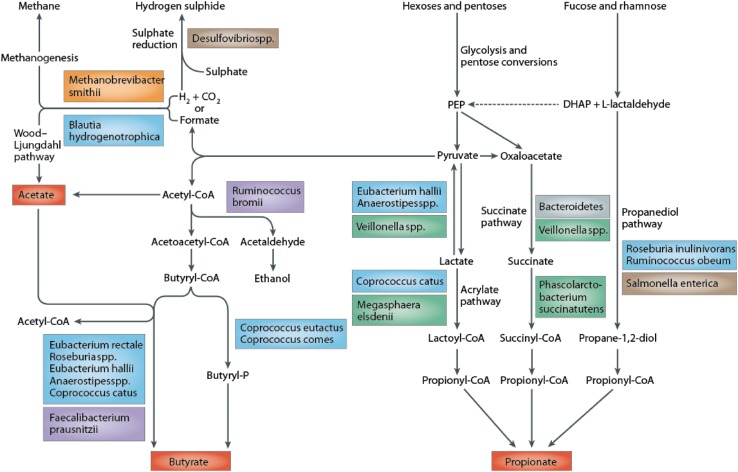
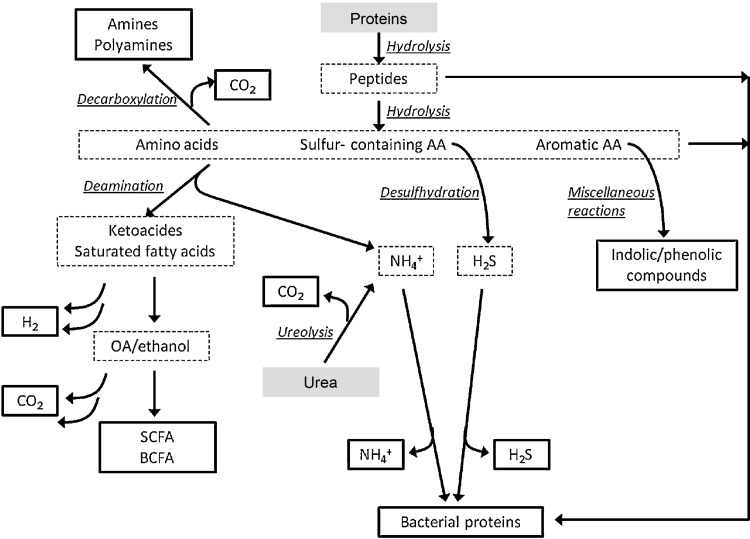
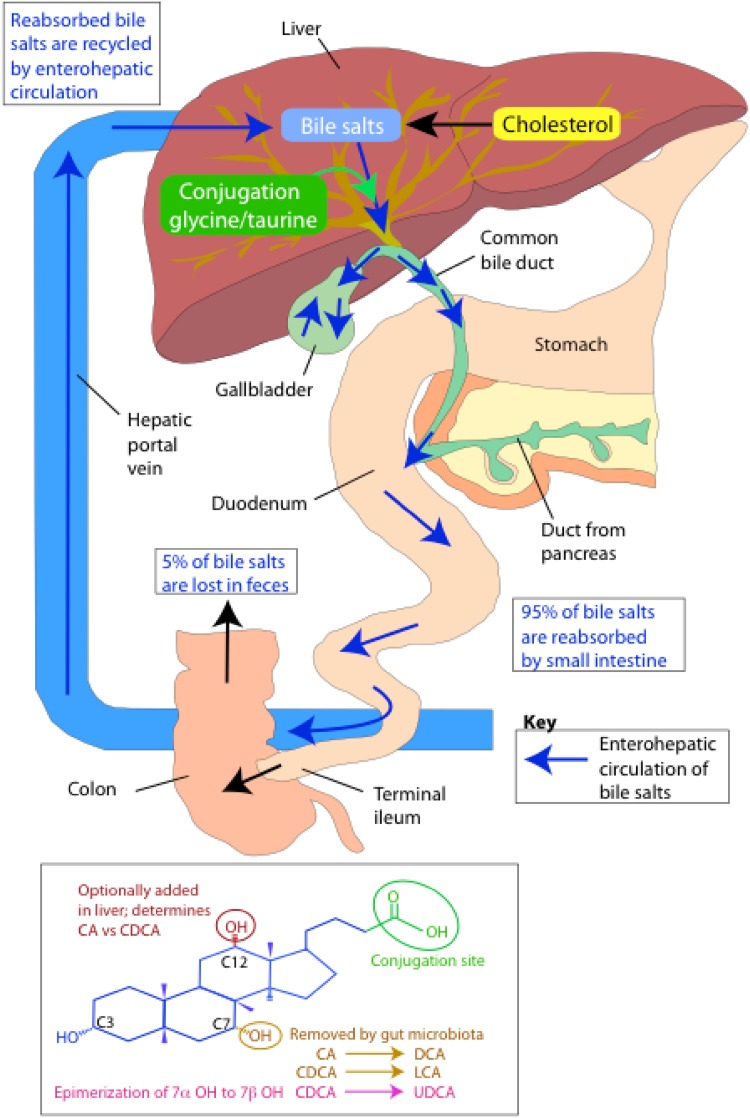
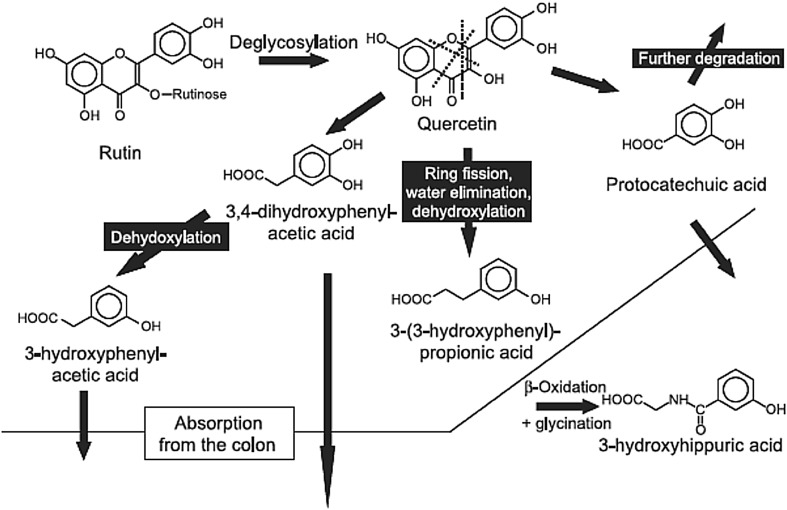
The diverse microbial community that inhabits the human gut has an extensive metabolic repertoire that is distinct from, but complements the activity of mammalian enzymes in the liver and gut mucosa and includes functions essential for host digestion. As such, the gut microbiota is a key factor in shaping the biochemical profile of the diet and, therefore, its impact on host health and disease. The important role that the gut microbiota appears to play in human metabolism and health has stimulated research into the identification of specific microorganisms involved in different processes, and the elucidation of metabolic pathways, particularly those associated with metabolism of dietary components and some host-generated substances. In the first part of the review, we discuss the main gut microorganisms, particularly bacteria, and microbial pathways associated with the metabolism of dietary carbohydrates (to short chain fatty acids and gases), proteins, plant polyphenols, bile acids, and vitamins. The second part of the review focuses on the methodologies, existing and novel, that can be employed to explore gut microbial pathways of metabolism. These include mathematical models, omics techniques, isolated microbes, and enzyme assays.
Overview
The claims and statistics of this paper haven’t been checked yet.
Run the check — free, no account needed. It reads the open-access text and checks the sources it cites.
Integrity signals
Registry
Cites
Statistics
Figures
Verification
Claims the paper makes
The claims and statistics of this paper haven’t been checked yet.
Run the check — free, no account needed. It reads the open-access text and checks the sources it cites.
Claims other papers make about this one
Each is checked against this paper’s own text: does it say what the citing paper says it does?
The source backs part of the claim, not all of it — or backs it for a different population, condition or comparison.
In the citing paper
“The intricate role of the gut microbiota in breaking down complex carbohydrates, proteins, and lipids enhances the digestive process, facilitating the absorption of essential nutrients.”
From Unveiling the therapeutic symphony of probiotics, prebiotics, and postbiotics in gut-immune harmony (2024) · cites this paper as [15]
Experimental — accuracy not yet measuredIn the citing paper
“The gut microbiota is an important factor that shapes both energy harvest and storage through metabolism of proteins and production of several metabolites including SCFAs, ammonia, sulfur-containing metabolites such as hydrogen sulfide and methanethiol, and neuroactive compounds such as tryptamine, serotonin, phenethylamine, tryptophan, and histamine [137, 138].”
From The athletic gut microbiota (2020) · cites this paper as [138]
In the citing paper
“It is well appreciated that the gut microbiota can synthesize certain vitamins, most notably vitamin K and B-group vitamins [e.g., cobalamin (B 12 ), folate, and riboflavin (144, 145)], some of which might be directly absorbed.”
From Diet and the Microbiota–Gut–Brain Axis: Sowing the Seeds of Good Mental Health (2021) · cites this paper as [145]
Self-check
Percentages, sums and reported differences re-computed from the paper’s own numbers.
The self-check needs the paper’s full text.
Citations
Cites
1 retracted
Kaoutari, A. E., Armougom, F., Leroy, Q., Vialettes, B., Million, M., Raoult, D., & Henrissat, B. (2013) · PLoS ONE · doi:10.1371/journal.pone.0084033 · Cited by 56
RetractedPolyphenols: Food sources and bioavailability
Manach, C., Scalbert, A., Morand, C., Rémésy, C., & Jiménez, L. (2004) · The American Journal of Clinical Nutrition · doi:10.1093/ajcn/79.5.727 · Cited by 8,175
A core gut microbiome in obese and lean twins
Turnbaugh, P. J., Hamady, M., Yatsunenko, T., Cantarel, B. L., Duncan, A., Ley, R. E., Sogin, M. L., Jones, W. J., Roe, B. A., Affourtit, J. P., et al. (2009) · Nature · doi:10.1038/nature07540 · Cited by 7,823
Gut flora metabolism of phosphatidylcholine promotes cardiovascular disease
Wang, Z., Klipfell, E., Bennett, B. J., Koeth, R., Levison, B. S., DuGar, B., Feldstein, A. E., Britt, E. B., Fu, X., Chung, Y.-M., et al. (2011) · Nature · doi:10.1038/nature09922 · Cited by 5,597
Host-gut microbiota metabolic interactions
Nicholson, J. K., Holmes, E., Kinross, J., Burcelin, R., Gibson, G., Jia, W., & Pettersson, S. (2012) · Science · doi:10.1126/science.1223813 · Cited by 4,760
Self-citationCirculating mitochondrial DAMPs cause inflammatory responses to injury
Zhang, Q., Raoof, M., Chen, Y., Sumi, Y., Sursal, T., Junger, W., Brohi, K., Itagaki, K., & Hauser, C. J. (2010) · Nature · doi:10.1038/nature08780 · Cited by 3,812
Formation of propionate and butyrate by the human colonic microbiota
Louis, P., & Flint, H. J. (2017) · Environmental Microbiology · doi:10.1111/1462-2920.13589 · Cited by 3,028
The gut microbiota, bacterial metabolites and colorectal cancer
Louis, P., Hold, G. L., & Flint, H. J. (2014) · Nature Reviews Microbiology · doi:10.1038/nrmicro3344 · Cited by 2,925
Bile salt biotransformations by human intestinal bacteria
Ridlon, J. M., Kang, D.-J., & Hylemon, P. B. (2006) · Journal of Lipid Research · doi:10.1194/jlr.r500013-jlr200 · Cited by 2,829
Metabolomics analysis reveals large effects of gut microflora on mammalian blood metabolites
Wikoff, W. R., Anfora, A. T., Liu, J., Schultz, P. G., Lesley, S. A., Peters, E. C., & Siuzdak, G. (2009) · Proceedings of the National Academy of Sciences · doi:10.1073/pnas.0812874106 · Cited by 2,677
Research works printed but not linked: 1
- Walker AW, Duncan SH, Louis P, Flint HJ (2014) Phylogeny, culturing, and metagenomics of the approaches to unravel multi-species microbial community functioning. Comput Struct. Biotechnol J 13:24–32
Cited by
Sorted by citations
Items 1,001–1,001 of 1,001
Rana, A., & Smriti (2026) · Journal of the Science of Food and Agriculture · doi:10.1002/jsfa.70275 · Cited by 7
Metadata
- Authors
- Rowland, I., Gibson, G., Heinken, A., Scott, K., Swann, J., Thiele, I., & Tuohy, K.
- Affiliations
- University of Reading (GB)
- University of Luxembourg (LU)
- University of Aberdeen (GB)
- Imperial College London (GB)
- Fondazione Edmund Mach (IT)
- Corresponding author
- Rowland, Ian
- Venue
- European Journal of Nutrition
- Published
- 2017-04-09
- Volume
- 57
- Issue
- 1
- Pages
- 1-24
- ISSN
- 1436-6207 (ISSN-L)
- 1436-6215
- PMC
- PMC5847071
- OpenAlex
- W2604323123
- Cited by
- 2,878
- References
- 166
- Citations by year
- 2026: 317 · 2025: 393 · 2024: 431 · 2023: 382 · 2022: 424 · 2021: 365 · 2020: 305 · 2019: 173 · 2018: 65 · 2017: 17
- FWCI
- 14.34
- Type
- journal article
- Language
- en
- Open access
- hybrid
- doi.org
- Locations
- European Journal of Nutrition (publishedVersion, cc-by)
- PubMed Central (publishedVersion, cc-by)
- PubMed (publishedVersion)
- CentAUR (University of Reading) (acceptedVersion, other-oa)
- ePrints Soton (University of Southampton) (acceptedVersion)
- Aberdeen University Research Archive (Aberdeen University) (submittedVersion, other-oa)
- CINECA IRIS Institutional Research Information System (Fondazione Edmund Mach) (submittedVersion, cc-by)
- Open Repository and Bibliography (University of Luxembourg) (submittedVersion, cc-by-nc-sa)
- Spiral (Imperial College London) (submittedVersion, cc-by)
- Funders
- International Life Sciences Institute Europe
- Topics
- Life Sciences › Biochemistry, Genetics and Molecular Biology › Molecular Biology › Gut microbiota and health
- Health Sciences › Nursing › Nutrition and Dietetics › Microbial Metabolites in Food Biotechnology
- Life Sciences › Agricultural and Biological Sciences › Food Science › Probiotics and Fermented Foods
- Keywords
- gut microbiota, host-microbe interactions, nutrient metabolism, dietary carbohydrates, short-chain fatty acids, protein metabolism, plant polyphenols, bile acids, vitamin metabolism, microbial metabolic pathways, enzyme activity assay
- MeSH terms
- Gastrointestinal Microbiome, Bacteria, Bile Acids and Salts, Diet, Dietary Carbohydrates, Dietary Proteins, Fatty Acids, Food, Health Promotion, Humans, Models, Theoretical, Plants, Edible, Vitamins, Proteomics, Metagenomics, Polyphenols, Phytochemicals
About these checks
Registry, retraction, Cites and statistics results are computed, not judged, with one exception: a printed reference that no index lists is read once by a model before it counts as a citation error. Claims are extracted by a model and kept only when their quote appears verbatim in the text; each cited source is then checked, with a model’s help, for whether it says what the claim relies on. Those verdicts can be wrong — read the claim’s quote and the cited source before relying on one.
Statistics and arithmetic are recomputed, not judged.
Confidence bands are shown only for fields calibrated on our annotated test set. None is calibrated yet, so no band is shown.
What counts as a claim ›How we measure confidence ›How we check this ›
Are you an author, or do you see a problem with this page? Request a review
