

Adaptations in mechanical muscle function, muscle morphology, and aerobic power to high-intensity endurance training combined with either traditional or power strength training in older adults: a randomized clinical trial
Open accessThe DOI matches its Crossref record; 57 of the 57 references it cites were found in a registry or an index.
Abstract
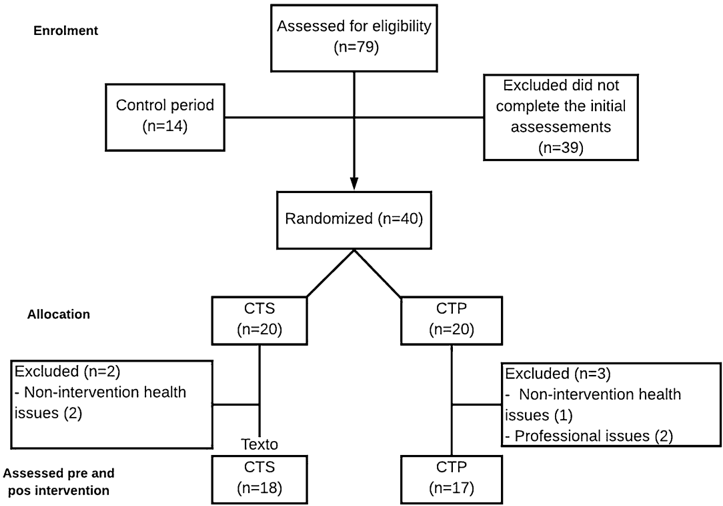
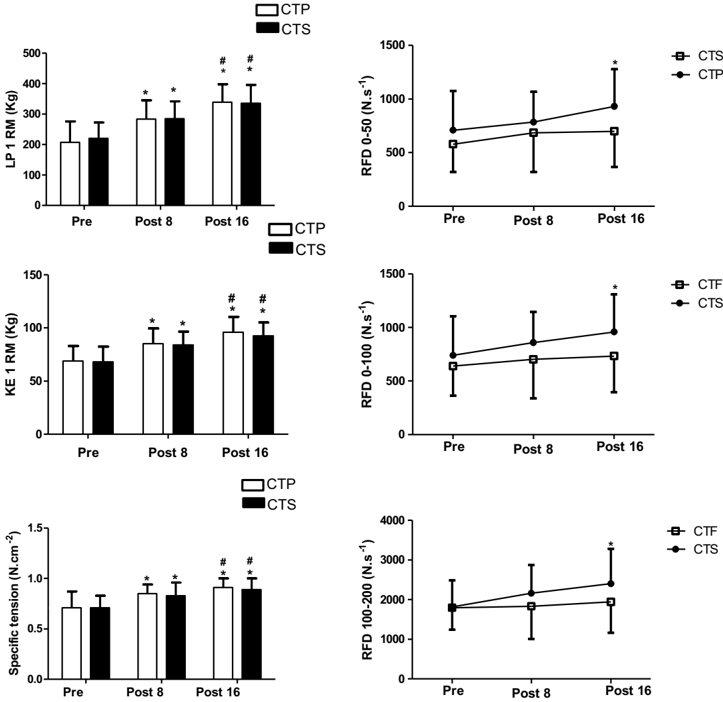
Purpose There is a lack of information on the effects of power training (PT) as an alternative to traditional strength training (TST) during concurrent training (CT) in older individuals. This study aimed to verify the neuromuscular adaptations that occurred following 16-week interventions with two CT models in older men: high-intensity interval training (HIIT) combined with either TST or PT.Methods Thirty-five older men (65.8 ± 3.9 years) were randomly assigned into one of two training groups CTS: TST + HIIT (n = 18) or CTP: PT + HIIT (n = 17). CTS performed resistance training at intensities ranging from 65 to 80% of 1 RM at slow controlled speed, whereas CTP trained at intensities ranging from 40 to 60% of 1 RM at maximal intentional speed. Lower body one-repetition maximum (1 RM), isometric rate of force development (RFD), countermovement jump (CMJ) muscle power output, quadriceps femoris muscles thickness (QF MT), and peak oxygen uptake (VO 2peak) were assessed before training and after 8 and 16 weeks of CT.Results Groups improved similarly in all primary outcomes (P < 0.05), with mean increases ranging: 1 RM (from 39.4 to 75.8%); RFD (from 9.9 to 64.8%); and CMJ muscle power (from 1.8 to 5.2%). Significant increases (P < 0.05) were observed in all secondary outcomes (QF MT, specific tension and VO 2peak) with no differences between groups.Conclusion CT models were effective for improving maximal and explosive force (1 RM, RFD, and CMJ power), QF MT, and VO 2peak. Moreover, despite that using lower loading intensities, PT induced similar adaptations to those of TST.
Overview
The claims and statistics of this paper haven’t been checked yet.
Free: it reads the open-access text and checks the first 5 claims that cite a source we can check. Create a free account to check every claim.
Integrity signals
Registry
Cites
Statistics
Figures
Verification
Claims the paper makes
The claims and statistics of this paper haven’t been checked yet.
Free: it reads the open-access text and checks the first 5 claims that cite a source we can check. Create a free account to check every claim.
Claims other papers make about this one
Each is checked against this paper’s own text: does it say what the citing paper says it does?
In the citing paper
“Power training combined with HIIT can enhance maximal strength, muscle mass, and cardiorespiratory fitness, providing benefits comparable to traditional combined training and improve explosive power in addition [235,236].”
From Global consensus on optimal exercise recommendations for enhancing healthy longevity in older adults (ICFSR) (2025) · cites this paper as [235]
Self-check
Percentages, sums and reported differences re-computed from the paper’s own numbers.
The self-check needs the paper’s full text.
Citations
Cites
Effect size, confidence interval and statistical significance: a practical guide for biologists
Nakagawa, S., & Cuthill, I. C. (2007) · Biological Reviews · doi:10.1111/j.1469-185x.2007.00027.x · Cited by 3,835
Aagaard, P., Simonsen, E. B., Andersen, J. L., Magnusson, P., & Dyhre-Poulsen, P. (2002) · Journal of Applied Physiology · doi:10.1152/japplphysiol.00283.2002 · Cited by 1,844
Self-citationPhysiological adaptations to low-volume, high-intensity interval training in health and disease
Gibala, M. J., Little, J. P., MacDonald, M. J., & Hawley, J. A. (2012) · The Journal of Physiology · doi:10.1113/jphysiol.2011.224725 · Cited by 1,744
Rate of force development: physiological and methodological considerations
Maffiuletti, N. A., Aagaard, P., Blazevich, A. J., Folland, J., Tillin, N., & Duchateau, J. (2016) · European Journal of Applied Physiology · doi:10.1007/s00421-016-3346-6 · Cited by 1,424
Self-citationFragala, M. S., Cadore, E. L., Dorgo, S., Izquierdo, M., Kraemer, W. J., Peterson, M. D., & Ryan, E. D. (2019) · Journal of Strength and Conditioning Research · doi:10.1519/jsc.0000000000003230 · Cited by 1,290
Self-citationSkeletal Muscle Power: A Critical Determinant of Physical Functioning in Older Adults
Reid, K. F., & Fielding, R. A. (2012) · Exercise and Sport Sciences Reviews · doi:10.1097/jes.0b013e31823b5f13 · Cited by 913 · cited 3×
“1999; Reid and Fielding 2012; Cadore et al.”
Aagaard, P., Suetta, C., Caserotti, P., Magnusson, S. P., & Kjær, M. (2010) · Scandinavian Journal of Medicine & Science in Sports · doi:10.1111/j.1600-0838.2009.01084.x · Cited by 709
Self-citationAndersen, L. L., & Aagaard, P. (2006) · European Journal of Applied Physiology · doi:10.1007/s00421-005-0070-z · Cited by 657
Self-citationRole of muscle loss in the age-associated reduction in VO2 max
Fleg, J. L., & Lakatta, E. G. (1988) · Journal of Applied Physiology · doi:10.1152/jappl.1988.65.3.1147 · Cited by 630
The relationship between leg power and physical performance in mobility-limited older people
Md, J. F. B., Kiely, D. K., Herman, S., Leveille, S. G., Mizer, K., Frontera, W. R., & Fielding, R. A. (2002) · Journal of the American Geriatrics Society · doi:10.1046/j.1532-5415.2002.50111.x · Cited by 605
Cross-validation of three jump power equations
SAYERS, S. P., HARACKIEWICZ, D. V., HARMAN, E. A., FRYKMAN, P. N., & ROSENSTEIN, M. T. (1999) · Medicine & Science in Sports & Exercise · doi:10.1097/00005768-199904000-00013 · Cited by 594
Neuromuscular adaptations during concurrent strength and endurance training versus strength training
Häkkinen, K., Alen, M., Kraemer, W. J., Gorostiaga, E., Izquierdo, M., Rusko, H., Mikkola, J., Häkkinen, A., Valkeinen, H., Kaarakainen, E., et al. (2003) · European Journal of Applied Physiology · doi:10.1007/s00421-002-0751-9 · Cited by 527
Self-citationCadore, E. L., Casas-Herrero, A., Zambom-Ferraresi, F., Idoate, F., Millor, N., Gómez, M., Rodriguez-Mañas, L., & Izquierdo, M. (2014) · AGE · doi:10.1007/s11357-013-9586-z · Cited by 526
Self-citationEffects of Muscular Strength on Cardiovascular Risk Factors and Prognosis
Artero, E. G., Lee, D.-C., Lavie, C. J., España-Romero, V., Sui, X., Church, T. S., & Blair, S. N. (2012) · Journal of Cardiopulmonary Rehabilitation and Prevention · doi:10.1097/hcr.0b013e3182642688 · Cited by 443
Effect of strength and power training on physical function in community-dwelling older adults.
Miszko, T. A., Cress, M. E., Slade, J. M., Covey, C. J., Agrawal, S. K., & Doerr, C. E. (2003) · The Journals of Gerontology Series A: Biological Sciences and Medical Sciences · doi:10.1093/gerona/58.2.m171 · Cited by 391
Muscle quality. II. Effects of strength training in 65- to 75-yr-old men and women
Tracy, B. L., Ivey, F. M., Hurlbut, D., Martel, G. F., Lemmer, J. T., Siegel, E. L., Metter, E. J., Fozard, J. L., Fleg, J. L., & Hurley, B. F. (1999) · Journal of Applied Physiology · doi:10.1152/jappl.1999.86.1.195 · Cited by 371
Izquierdo, Ibañez, Gorostiaga, Garrues, Zúñiga, Antón, Larrión, & Häkkinen (1999) · Acta Physiologica Scandinavica · doi:10.1046/j.1365-201x.1999.00590.x · Cited by 342
Self-citationAging of skeletal muscle fibers
Miljkovic, N., Lim, J.-Y., Miljkovic, I., & Frontera, W. R. (2015) · Annals of Rehabilitation Medicine · doi:10.5535/arm.2015.39.2.155 · Cited by 309
Bottaro, M., Machado, S. N., Nogueira, W., Scales, R., & Veloso, J. (2007) · European Journal of Applied Physiology · doi:10.1007/s00421-006-0343-1 · Cited by 305
Muscle fiber size and function in elderly humans: a longitudinal study
Frontera, W. R., Reid, K. F., Phillips, E. M., Krivickas, L. S., Hughes, V. A., Roubenoff, R., & Fielding, R. A. (2008) · Journal of Applied Physiology · doi:10.1152/japplphysiol.90332.2008 · Cited by 285
Caserotti, P., Aagaard, P., Buttrup Larsen, J., & Puggaard, L. (2008) · Scandinavian Journal of Medicine & Science in Sports · doi:10.1111/j.1600-0838.2007.00732.x · Cited by 254 · cited 1×
“, power training—PT) is an effective and safe strategy for minimizing aging decline and promoting increases in the muscle power output, rate of force development, and maximal strength (Izquierdo et al. 1999; Caserotti et al. 2008; Reid and Fielding 2012; Cadore et al. 2018a).”
Self-citationHuman motor unit recordings: Origins and insight into the integrated motor system
Duchateau, J., & Enoka, R. M. (2011) · Brain Research · doi:10.1016/j.brainres.2011.06.011 · Cited by 238
Ramírez-Campillo, R., Castillo, A., de la Fuente, C. I., Campos-Jara, C., Andrade, D. C., Álvarez, C., Martínez, C., Castro-Sepúlveda, M., Pereira, A., Marques, M. C., et al. (2014) · Experimental Gerontology · doi:10.1016/j.exger.2014.07.001 · Cited by 212
Self-citationMaximal voluntary force and rate of force development in humans - importance of instruction
Sahaly, R., Vandewalle, H., Driss, T., & Monod, H. (2001) · European Journal of Applied Physiology · doi:10.1007/s004210100451 · Cited by 204
Short-term strength training improves muscle quality and functional capacity of elderly women
Pinto, R. S., Correa, C. S., Radaelli, R., Cadore, E. L., Brown, L. E., & Bottaro, M. (2013) · AGE · doi:10.1007/s11357-013-9567-2 · Cited by 204
Self-citationRaymond, M. J., Bramley-Tzerefos, R. E., Jeffs, K. J., Winter, A., & Holland, A. E. (2013) · Archives of Physical Medicine and Rehabilitation · doi:10.1016/j.apmr.2013.02.022 · Cited by 202
Concurrent cardiovascular and resistance training in healthy older adults
WOOD, R. H., REYES, R., WELSCH, M. A., FAVALORO-SABATIER, J., SABATIER, M., MATTHEW LEE, C., JOHNSON, L. G., & HOOPER, P. F. (2001) · Medicine & Science in Sports & Exercise · doi:10.1097/00005768-200110000-00021 · Cited by 198
Tschopp, M., Sattelmayer, M. K., & Hilfiker, R. (2011) · Age and Ageing · doi:10.1093/ageing/afr005 · Cited by 187
Once weekly combined resistance and cardiovascular training in healthy older men
IZQUIERDO, M., IBA??EZ, J., H??KKINEN, K., KRAEMER, W. J., LARRI??N, J. L., & GOROSTIAGA, E. M. (2004) · Medicine & Science in Sports & Exercise · doi:10.1249/01.mss.0000117897.55226.9a · Cited by 185 · cited 4×
“In support of this notion, cycle ergometer exercise training appears to induce maximal lower body strength increases in older individuals, although these changes are substantially lower compared to the gains observed following isolated strength training (Izquierdo et al. 2004; Cadore et al. 2010).”
Self-citationHuman neuromuscular structure and function in old age: A brief review
Power, G. A., Dalton, B. H., & Rice, C. L. (2013) · Journal of Sport and Health Science · doi:10.1016/j.jshs.2013.07.001 · Cited by 174
Cadore, E. L., Izquierdo, M., Pinto, S. S., Alberton, C. L., Pinto, R. S., Baroni, B. M., Vaz, M. A., Lanferdini, F. J., Radaelli, R., González-Izal, M., et al. (2013) · AGE · doi:10.1007/s11357-012-9405-y · Cited by 166 · cited 4×
“On the other hand, to minimize the possibility of interference by the fatigue induced by each HIIT session on subsequent strength performance in the present study, we chose the strength-endurance exercise order, which may have maximized the strength gains observed (Cadore et al. 2013).”
Self-citationPhysiological Effects of Concurrent Training in Elderly Men
Cadore, E. L., Pinto, R. S., Lhullier, F. L. R., Correa, C. S., Alberton, C. L., Pinto, S. S., Almeida, A. P. V., Tartaruga, M. P., Silva, E. M., & Kruel, L. F. M. (2010) · International Journal of Sports Medicine · doi:10.1055/s-0030-1261895 · Cited by 166
Self-citationStraight, C. R., Lindheimer, J. B., Brady, A. O., Dishman, R. K., & Evans, E. M. (2016) · Sports Medicine · doi:10.1007/s40279-015-0418-4 · Cited by 162
Aging and muscle: a neuronʼs perspective
Manini, T. M., Hong, S. L., & Clark, B. C. (2013) · Current Opinion in Clinical Nutrition and Metabolic Care · doi:10.1097/mco.0b013e32835b5880 · Cited by 159
Hwang, C.-L., Yoo, J.-K., Kim, H.-K., Hwang, M.-H., Handberg, E. M., Petersen, J. W., & Christou, D. D. (2016) · Experimental Gerontology · doi:10.1016/j.exger.2016.06.009 · Cited by 142
Tillin, N. A., & Folland, J. P. (2014) · European Journal of Applied Physiology · doi:10.1007/s00421-013-2781-x · Cited by 140
Cadore, E. L., Izquierdo, M., Alberton, C. L., Pinto, R. S., Conceição, M., Cunha, G., Radaelli, R., Bottaro, M., Trindade, G. T., & Kruel, L. F. M. (2012) · Experimental Gerontology · doi:10.1016/j.exger.2011.11.013 · Cited by 135
Self-citationBody composition and fitness during strength and/or endurance training in older men
SILLANPÄÄ, E., HÄKKINEN, A., NYMAN, K., MATTILA, M., CHENG, S., KARAVIRTA, L., LAAKSONEN, D. E., HUUHKA, N., KRAEMER, W. J., & HÄKKINEN, K. (2008) · Medicine & Science in Sports & Exercise · doi:10.1249/mss.0b013e318165c854 · Cited by 130
Knowles, A., Herbert, P., Easton, C., Sculthorpe, N. F., & Grace, F. (2015) · AGE · doi:10.1007/s11357-015-9763-3 · Cited by 123
Wilhelm, E. N., Rech, A., Minozzo, F., Botton, C. E., Radaelli, R., Teixeira, B. C., Reischak-Oliveira, Á., & Pinto, R. S. (2014) · Experimental Gerontology · doi:10.1016/j.exger.2014.11.007 · Cited by 117
Self-citationEL, C., & M, I. (2013) · AGE · doi:10.1007/s11357-012-9503-x · Cited by 105 · cited 1×
“Indeed, because CT is an effective method to improve both cardiovascular and mechanical muscle function concomitantly in older individuals (Cadore and Izquierdo 2013), it becomes relevant to investigate different models of CT to improve exercise prescription in older populations.”
Casas-Herrero, A., Cadore, E. L., Zambom-Ferraresi, F., Idoate, F., Millor, N., Martínez-Ramirez, A., Gómez, M., Rodriguez-Mañas, L., Marcellán, T., de Gordoa, A. R., et al. (2013) · Rejuvenation Research · doi:10.1089/rej.2013.1438 · Cited by 105 · cited 1×
“Muscle power output and RFD are strong predictors of functional capacity in older adults (Reid and Fielding 2012; Bean et al. 2002; Casas-Herrero et al. 2013; Izquierdo et al. 1999) and are indispensable factors for maintaining independence with age.”
Self-citationEffects of power training on muscle thickness of older men.
Nogueira, W., Gentil, P., Mello, S., Oliveira, R., Bezerra, A., & Bottaro, M. (2009) · International Journal of Sports Medicine · doi:10.1055/s-0028-1104584 · Cited by 91
Cadore, E. L., Pinto, R. S., Pinto, S. S., Alberton, C. L., Correa, C. S., Tartaruga, M. P., Silva, E. M., Almeida, A. P. V., Trindade, G. T., & Kruel, L. F. M. (2011) · Journal of Strength and Conditioning Research · doi:10.1519/jsc.0b013e318207ed66 · Cited by 87
Self-citationBosco, C., & Rusko, H. K. (1983) · Acta Physiologica Scandinavica · doi:10.1111/j.1748-1716.1983.tb07331.x · Cited by 83
Effects of Strength and Power Training on Neuromuscular Variables in Older Adults
Wallerstein, L. F., Tricoli, V., Barroso, R., Rodacki, A. L. F., Russo, L., Aihara, A. Y., Correa Fernandes, A. D. R., de Mello, M. T., & Ugrinowitsch, C. (2012) · Journal of Aging and Physical Activity · doi:10.1123/japa.20.2.171 · Cited by 82
da Silva, L. X. N., Teodoro, J. L., Menger, E., Lopez, P., Grazioli, R., Farinha, J., Moraes, K., Bottaro, M., Pinto, R. S., Izquierdo, M., et al. (2018) · Experimental Gerontology · doi:10.1016/j.exger.2018.03.017 · Cited by 63
Self-citationEfficiency of twice weekly concurrent training in trained elderly men
Ferrari, R., Kruel, L. F. M., Cadore, E. L., Alberton, C. L., Izquierdo, M., Conceição, M., Pinto, R. S., Radaelli, R., Wilhelm, E., Bottaro, M., et al. (2013) · Experimental Gerontology · doi:10.1016/j.exger.2013.07.016 · Cited by 57
Self-citationFerrari, R., Fuchs, S. C., Kruel, L. F. M., Cadore, E. L., Alberton, C. L., Pinto, R. S., Radaelli, R., Schoenell, M., Izquierdo, M., Tanaka, H., et al. (2016) · Aging and disease · doi:10.14336/ad.2016.0504 · Cited by 48
Self-citationMARTINEZ-VALDES, E., FARINA, D., NEGRO, F., DEL VECCHIO, A., & FALLA, D. (2018) · Medicine & Science in Sports & Exercise · doi:10.1249/mss.0000000000001705 · Cited by 43
Explosive type of contractions should not be avoided during resistance training in elderly
Cadore, E. L., Pinto, R. S., Reischak-Oliveira, Á., & Izquierdo, M. (2017) · Experimental Gerontology · doi:10.1016/j.exger.2017.12.003 · Cited by 40
Self-citationRadaelli, R., Brusco, C. M., Lopez, P., Rech, A., Machado, C. L. F., Grazioli, R., Müller, D. C., Cadore, E. L., & Pinto, R. S. (2018) · Experimental Gerontology · doi:10.1016/j.exger.2018.04.015 · Cited by 40
Self-citationCadore, E. L., Menger, E., Teodoro, J. L., da Silva, L. X. N., Boeno, F. P., Umpierre, D., Botton, C. E., Ferrari, R., Cunha, G. D. S., Izquierdo, M., et al. (2018) · Experimental Gerontology · doi:10.1016/j.exger.2018.06.011 · Cited by 37
Self-citationOsuka, Y., Matsubara, M., Hamasaki, A., Hiramatsu, Y., Ohshima, H., & Tanaka, K. (2017) · European Review of Aging and Physical Activity · doi:10.1186/s11556-017-0184-4 · Cited by 29
ESSR Marks the Start of the 40th Volume Year
Clarkson, P. M. (2012) · Exercise and Sport Sciences Reviews · doi:10.1097/jes.0b013e31823cf07c · Cited by 18
Optimal loads for power in older men and women using plate-loaded resistance machines
Strand, K. L., Lucchi, L., Copo, T. G., Cherup, N. P., & Signorile, J. F. (2019) · Experimental Gerontology · doi:10.1016/j.exger.2019.110638 · Cited by 9
(1970) · Andalas University Repository (Andalas University)
Research works printed but not linked: 1
- Cadore EL, Izquierdo M, Pinto SS et al (2013) Neuromuscular adapta- tions to concurrent training in the elderly: effects of intra session exercise sequence. Age (Dordr) 35:891-903 · DOI · Paper page
Cited by
Izquierdo, M., de Souto Barreto, P., Arai, H., Bischoff-Ferrari, H. A., Cadore, E. L., Cesari, M., Chen, L.-K., Coen, P. M., Courneya, K. S., Duque, G., et al. (2025) · The Journal of nutrition, health and aging · doi:10.1016/j.jnha.2024.100401 · Cited by 273
Self-citationBalachandran, A. T., Steele, J., Angielczyk, D., Belio, M., Schoenfeld, B. J., Quiles, N., Askin, N., & Abou-Setta, A. M. (2022) · JAMA Network Open · doi:10.1001/jamanetworkopen.2022.11623 · Cited by 70
Markov, A., Hauser, L., & Chaabene, H. (2023) · Sports Medicine · doi:10.1007/s40279-022-01764-2 · Cited by 66
“Several studies indicated that CT produced positive effects on muscle strength [99–101], muscle power [100, 102, 103] and CRE [61, 92, 98] in healthy older adults, regardless of sex.”
BackgroundMartínez-Rodríguez, A., Rubio‐Arias, J. Á., Frutos, J. M. G.-D., Vicente-Martínez, M., & Gunnarsson, T. P. (2021) · International Journal of Environmental Research and Public Health · doi:10.3390/ijerph18126431 · Cited by 77
Radaelli, R., Trajano, G. S., Freitas, S. R., Izquierdo, M., Cadore, E. L., & Pinto, R. S. (2023) · Sports Medicine · doi:10.1007/s40279-022-01758-0 · Cited by 38
Self-citation
Metadata
- Authors
- Müller, D. C., Izquierdo, M., Boeno, F. P., Aagaard, P., Teodoro, J. L., Grazioli, R., Radaelli, R., Bayer, H., Neske, R., Pinto, R. S., & Cadore, E. L.
- Affiliations
- Universidade Federal do Rio Grande do Sul (BR)
- University of Southern Denmark (DK)
- Corresponding author
- Cadore, Eduardo Lusa
- ORCID
- Venue
- European Journal of Applied Physiology
- Published
- 2020-04-01
- Volume
- 120
- Issue
- 5
- Pages
- 1165-1177
- ISSN
- 0020-9376 (ISSN-L)
- 1439-6319
- 1439-6327
- OpenAlex
- W3014510258
- Cited by
- 35
- References
- 57
- Citations by year
- 2026: 6 · 2025: 7 · 2024: 4 · 2023: 4 · 2022: 9 · 2021: 4 · 2020: 1
- FWCI
- 4.49
- Type
- journal article
- Language
- en
- Open access
- green
- hdl.handle.net
- Licence
- cc-by-nc-sa
- www.springer.com/tdm (tdm)
- www.springer.com/tdm (vor)
- Locations
- European Journal of Applied Physiology (publishedVersion)
- PubMed (publishedVersion)
- University of Southern Denmark Research Portal (University of Southern Denmark) (publishedVersion)
- LA Referencia (Red Federada de Repositorios Institucionales de Publicaciones Científicas) (submittedVersion, cc-by-nc-sa)
- Topics
- Health Sciences › Medicine › Orthopedics and Sports Medicine › Sports Performance and Training
- Health Sciences › Medicine › Physiology (medical) › Cardiovascular and exercise physiology
- Health Sciences › Nursing › Nutrition and Dietetics › Muscle metabolism and nutrition
- Keywords
- concurrent training, power training, high-intensity interval training, older adults, neuromuscular adaptation, muscle power, rate of force development, countermovement jump, quadriceps thickness, peak oxygen uptake, aerobic power, resistance training
- MeSH terms
- High-Intensity Interval Training, Endurance Training, Adaptation, Physiological, Aged, Humans, Male, Muscle, Skeletal, Muscle Strength, Resistance Training
About these checks
Registry, retraction, Cites and statistics results are computed, not judged, with one exception: a printed reference that no index lists is read once by a model before it counts as a citation error. Claims are extracted by a model and kept only when their quote appears verbatim in the text; each cited source is then checked, with a model’s help, for whether it says what the claim relies on. Those verdicts can be wrong — read the claim’s quote and the cited source before relying on one.
Statistics and arithmetic are recomputed, not judged.
Confidence bands are shown only for fields calibrated on our annotated test set. None is calibrated yet, so no band is shown.
What counts as a claim ›How we measure confidence ›How we check this ›
Are you an author, or do you see a problem with this page? Request a review
Data sources
Bibliographic data: Semantic Scholar, OpenAlex, Crossref.
Contains information from the Semantic Scholar Academic Graph Datasets, made available under the ODC Attribution License (ODC-BY 1.0).
Semantic Scholar’s data is described in: Kinney, R., et al. (2023). The Semantic Scholar Open Data Platform. arXiv:2301.10140.
