

The DOI matches its Crossref record; 113 of the 116 references it cites were found in a registry or an index; none of the 95 sources its claims cite is checked for support yet.
The Cognitive Affective Model of Immersive Learning (CAMIL): a Theoretical Research-Based Model of Learning in Immersive Virtual Reality
Open accessAbstract
There has been a surge in interest and implementation of immersive virtual reality (IVR)-based lessons in education and training recently, which has resulted in many studies on the topic. There are recent reviews which summarize this research, but little work has been done that synthesizes the existing findings into a theoretical framework. The Cognitive Affective Model of Immersive Learning (CAMIL) synthesizes existing immersive educational research to describe the process of learning in IVR. The general theoretical framework of the model suggests that instructional methods which are based on evidence from research with less immersive media generalize to learning in IVR. However, the CAMIL builds on evidence that media interacts with method. That is, certain methods which facilitate the affordances of IVR are specifically relevant in this medium. The CAMIL identifies presence and agency as the general psychological affordances of learning in IVR, and describes how immersion, control factors, and representational fidelity facilitate these affordances. The model describes six affective and cognitive factors that can lead to IVR-based learning outcomes including interest, motivation, self-efficacy, embodiment, cognitive load, and self-regulation. The model also describes how these factors lead to factual, conceptual, and procedural knowledge acquisition and knowledge transfer. Implications for future research and instructional design are proposed.
Overview
AI snapshot
Written from the paper’s full text.
TL;DR
The Cognitive Affective Model of Immersive Learning (CAMIL) is a theoretical model proposing that learning in immersive virtual reality (IVR) is driven by the psychological affordances of presence and agency, which arise from immersion, control factors, and representational fidelity. It argues that media interacts with method, so instructional methods that leverage presence and agency are especially effective in IVR.
Key findings
- CAMIL identifies presence and agency as the general psychological affordances of learning in IVR; immersion, control factors, and representational fidelity are proposed to facilitate these affordances.
- The model specifies six affective and cognitive factors—interest, intrinsic motivation, self-efficacy, embodiment, cognitive load, and self-regulation—that lead to factual, conceptual, and procedural knowledge acquisition and knowledge transfer.
- The paper argues that media interacts with method: cited experiments show instructional methods such as pre-training, enactment, and teaching produce interactions, with benefits in IVR but not in video or desktop VR conditions (e.g., Meyer et al. 2019, n = 118; Makransky et al. 2020a, n = 165; Klingenberg et al. 2020, n = 89).
- Cognitive load and self-regulation are described as complicated factors: IVR can increase extraneous cognitive load and reduce reflection unless lessons are scaffolded; cited evidence includes Parong and Mayer (2018), where an immersive VR lesson was less effective than PowerPoint for factual knowledge but showed no significant difference for conceptual knowledge.
Methods
- Theoretical/conceptual paper: it synthesizes existing immersive educational research and educational psychology theories to specify CAMIL; no original empirical data or sample are reported.
- The model builds on prior frameworks and studies, including Lee et al. (2010), Makransky and Lilleholt (2018), and Makransky and Petersen (2019), and reviews media-and-methods experiments.
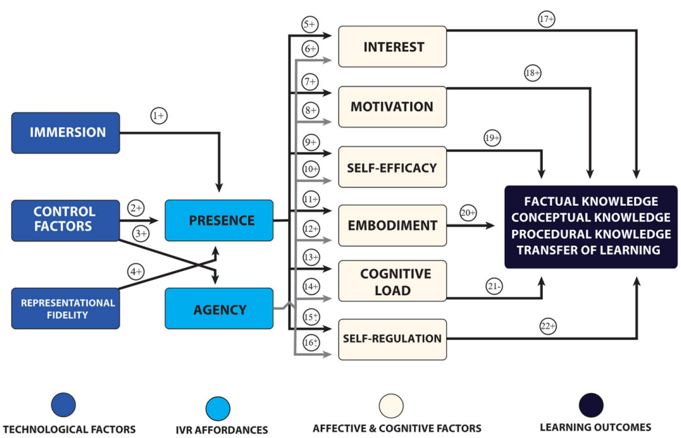
- Main analysis is model specification: it defines constructs and hypothesized paths (Fig. 2) from technological factors to presence and agency, then through affective/cognitive factors to learning outcomes.
Limitations
- Stated: few empirical studies have specifically tested the paths outlined in the model; more research is needed to test, extend, and revise it.
- Stated: external factors such as usability, social factors, and individual differences (age, cyber sickness, working memory, personality, absorption, spatial ability) influence the model but are not included in it; the directions of paths 15 and 16 for self-regulation are contingent on instructional design.
- Evident: the model is conceptual and not empirically validated in this paper; the paper also notes mixed findings for factual/declarative knowledge and states that IVR is not necessarily the ideal medium for teaching factual knowledge.
Model-written summary. Check it against the paper before relying on it.
Integrity signals
Registry
Cites
Statistics
Figures
Verification
Claims the paper makes
71 Not checked yet · 38 Own interpretation · 3 No basis given · 1 Own result
A result the paper reports from its own data — it cites no other source for it, so there is none to check. The quote shows it is in the paper.
In the paper
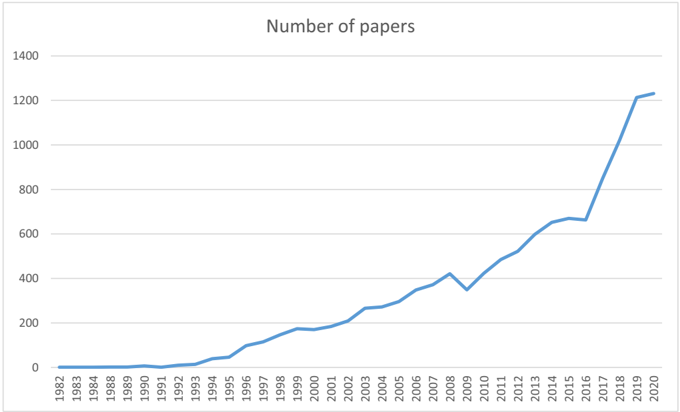
“A literature search shows that the number of publications on Scopus that refer to VR in combination with either learning, education, or training is quickly growing (see Fig. 1).”
§ The Cognitive Affective Model of Immersive Learning (CAMIL): a Theoretical Research-Based Model of Learning in Immersive Virtual Reality > Introduction
plain- Asserted: passes — The authors put it forward as true.
- Checkable: passes — It can be checked against evidence.
- Load-bearing: unclear — It is unclear whether the paper’s conclusions depend on it.
- Based: passes — The paper gives a reason why it holds.
A conclusion the paper draws from its own results — it cites no other source for it, so there is none to check. The quote shows it is in the paper.
In the paper
“The CAMIL predicts that the instructional effectiveness of the embodiment principle would be greater when learning through an IVR lesson compared to a video because learners will generally have a higher sense of presence in IVR.”
§ The Cognitive Affective Model of Immersive Learning (CAMIL): a Theoretical Research-Based Model of Learning in Immersive Virtual Reality > The Theoretical Perspective of CAMIL
hedgeddirect- Asserted: passes — The authors put it forward as true.
- Checkable: passes — It can be checked against evidence.
- Load-bearing: passes — The paper’s conclusions depend on it.
- Based: passes — The paper gives a reason why it holds.
None of the sources cited for this claim have been checked yet.
In the paper
“However, the CAMIL builds on evidence that media interacts with method.”
- Also stated in: § The Theoretical Perspective of CAMIL · plain
“the CAMIL takes the theoretical perspective that media interacts with method.”
§ The Cognitive Affective Model of Immersive Learning (CAMIL): a Theoretical Research-Based Model of Learning in Immersive Virtual Reality > Abstract
What the sources say
- Not checked yetcites Meyer et al. (2019) source
- Not checked yetcites Makransky et al. (2020a)
- Not checked yetcites Klingenberg et al. (2020)
plaincorrelational- Asserted: passes — The authors put it forward as true.
- Checkable: passes — It can be checked against evidence.
- Load-bearing: passes — The paper’s conclusions depend on it.
- Based: passes — The paper gives a reason why it holds.
- Also stated in: § The Theoretical Perspective of CAMIL · plain
A conclusion the paper draws from its own results — it cites no other source for it, so there is none to check. The quote shows it is in the paper.
In the paper
“The general theoretical framework of the model suggests that instructional methods which are based on evidence from research with less immersive media generalize to learning in IVR.”
- Also stated in: § The Theoretical Perspective of CAMIL · plain
“the CAMIL recognizes that motivational and learning theories that have been developed for less immersive media generalize to learning in IVR”
§ The Cognitive Affective Model of Immersive Learning (CAMIL): a Theoretical Research-Based Model of Learning in Immersive Virtual Reality > Abstract
plaindirect- Asserted: passes — The authors put it forward as true.
- Checkable: passes — It can be checked against evidence.
- Load-bearing: passes — The paper’s conclusions depend on it.
- Based: unclear — It is unclear why the paper says it holds.
- Also stated in: § The Theoretical Perspective of CAMIL · plain
In the paper
“There was an interaction between media and method with enactment resulting in significantly better procedural knowledge and transfer in the IVR group, but not in the video group.”
§ The Cognitive Affective Model of Immersive Learning (CAMIL): a Theoretical Research-Based Model of Learning in Immersive Virtual Reality > The Theoretical Perspective of CAMIL
What the sources say
- Not checked yetcites Makransky et al. (2020a)
plaindirect- Asserted: passes — The authors put it forward as true.
- Checkable: passes — It can be checked against evidence.
- Load-bearing: passes — The paper’s conclusions depend on it.
- Based: passes — The paper gives a reason why it holds.
A conclusion the paper draws from its own results — it cites no other source for it, so there is none to check. The quote shows it is in the paper.
In the paper
“So students' presence and agency, which are psychological constructs that arise from immersion and interaction, will generally be higher in immersive media.”
§ The Cognitive Affective Model of Immersive Learning (CAMIL): a Theoretical Research-Based Model of Learning in Immersive Virtual Reality > The Theoretical Perspective of CAMIL
hedgedcorrelational- Asserted: passes — The authors put it forward as true.
- Checkable: passes — It can be checked against evidence.
- Load-bearing: passes — The paper’s conclusions depend on it.
- Based: unclear — It is unclear why the paper says it holds.
In the paper
“An example is the embodiment principle, which states that people learn more deeply when onscreen agents display human-like gesturing, movement, eye contact, and facial expressions (Mayer 2014a).”
§ The Cognitive Affective Model of Immersive Learning (CAMIL): a Theoretical Research-Based Model of Learning in Immersive Virtual Reality > The Theoretical Perspective of CAMIL
What the sources say
- Not checked yetcites Mayer 2014a
plaindirect- Asserted: passes — The authors put it forward as true.
- Checkable: passes — It can be checked against evidence.
- Load-bearing: passes — The paper’s conclusions depend on it.
- Based: passes — The paper gives a reason why it holds.
None of the sources cited for this claim have been checked yet.
In the paper
“The factors are identified based on previous VR-based research (e.g., Lee et al. 2010;Makransky and Lilleholt 2018;Makransky and Petersen 2019).”
§ The Cognitive Affective Model of Immersive Learning (CAMIL): a Theoretical Research-Based Model of Learning in Immersive Virtual Reality > The Theoretical Perspective of CAMIL
What the sources say
plain- Asserted: passes — The authors put it forward as true.
- Checkable: passes — It can be checked against evidence.
- Load-bearing: passes — The paper’s conclusions depend on it.
- Based: passes — The paper gives a reason why it holds.
In the paper
“Another important determinant of presence is the representational fidelity of the environment, which has to do with how realistically the environment is displayed as well as the smoothness of view changes (Dalgarno and Lee 2010).”
§ The Cognitive Affective Model of Immersive Learning (CAMIL): a Theoretical Research-Based Model of Learning in Immersive Virtual Reality > What Factors Lead to Presence?
What the sources say
- Not checked yetcites Dalgarno and Lee 2010 source
plaindirect- Asserted: passes — The authors put it forward as true.
- Checkable: passes — It can be checked against evidence.
- Load-bearing: unclear — It is unclear whether the paper’s conclusions depend on it.
- Based: passes — The paper gives a reason why it holds.
A conclusion the paper draws from its own results — it cites no other source for it, so there is none to check. The quote shows it is in the paper.
In the paper
“That is, certain methods which facilitate the affordances of IVR are specifically relevant in this medium.”
§ The Cognitive Affective Model of Immersive Learning (CAMIL): a Theoretical Research-Based Model of Learning in Immersive Virtual Reality > Abstract
plaincorrelational- Asserted: passes — The authors put it forward as true.
- Checkable: passes — It can be checked against evidence.
- Load-bearing: passes — The paper’s conclusions depend on it.
- Based: unclear — It is unclear why the paper says it holds.
- Probably not a substantial claim. 26
- It may state two separate claims as one. 22
The paper states this without a source or data behind it here, so there is nothing to check it against. The quote shows it is in the paper.
In the paper
“Given that the number of research articles in the field of immersive learning is rapidly increasing, we hope that researchers will include measures of the variables included in the CAMIL, as well as the external factors, when conducting research on the use of IVR for learning.”
§ The Cognitive Affective Model of Immersive Learning (CAMIL): a Theoretical Research-Based Model of Learning in Immersive Virtual Reality > Conclusion
plain- Asserted: passes — The authors put it forward as true.
- Checkable: passes — It can be checked against evidence.
- Load-bearing: fails — The paper’s conclusions may not depend on it.
- Based: fails — The paper may give no reason why it holds.
Probably not a substantial claim. The paper’s conclusions may not depend on it. The paper may give no reason why it holds.
In the paper
“IVR is also qualitatively different from mixed or augmented reality technologies because these allow the learner to experience the virtual and the real world simultaneously, while IVR completely shuts out the real world, psychologically isolating the learner in the virtual environment (Loomis et al. 1999).”
§ The Cognitive Affective Model of Immersive Learning (CAMIL): a Theoretical Research-Based Model of Learning in Immersive Virtual Reality > Defining Immersive Virtual Reality
What the sources say
- Not checked yetcites Loomis et al. 1999 source
plaindirect- Asserted: passes — The authors put it forward as true.
- Checkable: passes — It can be checked against evidence.
- Load-bearing: passes — The paper’s conclusions depend on it.
- Based: passes — The paper gives a reason why it holds.
Probably not a substantial claim. It may state two separate claims as one.
The paper states this without a source or data behind it here, so there is nothing to check it against. The quote shows it is in the paper.
In the paper
“That is, interaction and immersion are limited with lessons presented on a video or PowerPoint, but are greater with IVR or other existing/future immersive technologies.”
§ The Cognitive Affective Model of Immersive Learning (CAMIL): a Theoretical Research-Based Model of Learning in Immersive Virtual Reality > The Theoretical Perspective of CAMIL
plaincorrelational- Asserted: passes — The authors put it forward as true.
- Checkable: passes — It can be checked against evidence.
- Load-bearing: passes — The paper’s conclusions depend on it.
- Based: fails — The paper may give no reason why it holds.
Probably not a substantial claim. The paper may give no reason why it holds. It may state two separate claims as one.
A conclusion the paper draws from its own results — it cites no other source for it, so there is none to check. The quote shows it is in the paper.
In the paper
“Furthermore, the CAMIL describes how these two affordances result from technological features, and how they predict learning through affective and cognitive processes.”
§ The Cognitive Affective Model of Immersive Learning (CAMIL): a Theoretical Research-Based Model of Learning in Immersive Virtual Reality > The Theoretical Perspective of CAMIL
plaindirect- Asserted: passes — The authors put it forward as true.
- Checkable: passes — It can be checked against evidence.
- Load-bearing: passes — The paper’s conclusions depend on it.
- Based: passes — The paper gives a reason why it holds.
It may state two separate claims as one.
In the paper
“The authors found a significant interaction between media and methods indicating that the generative learning strategy of teaching significantly improved retention, transfer, and self-efficacy when learning through IVR, but not desktop VR.”
§ The Cognitive Affective Model of Immersive Learning (CAMIL): a Theoretical Research-Based Model of Learning in Immersive Virtual Reality > The Theoretical Perspective of CAMIL
What the sources say
- Not checked yetcites Klingenberg et al. (2020)
hedgeddirect- Asserted: passes — The authors put it forward as true.
- Checkable: passes — It can be checked against evidence.
- Load-bearing: passes — The paper’s conclusions depend on it.
- Based: passes — The paper gives a reason why it holds.
It may state two separate claims as one.
None of the sources cited for this claim have been checked yet.
In the paper
“In summary, the CAMIL regards immersion (positive relation, path 1 in Fig. 2), control factors (positive relation, path 2 in Fig. 2), and representational fidelity (positive relation, path 4 in Fig. 2) as important factors for instigating a sense of presence in virtual environments.”
§ The Cognitive Affective Model of Immersive Learning (CAMIL): a Theoretical Research-Based Model of Learning in Immersive Virtual Reality > What Factors Lead to Presence?
What the sources say
plaindirect- Asserted: passes — The authors put it forward as true.
- Checkable: passes — It can be checked against evidence.
- Load-bearing: passes — The paper’s conclusions depend on it.
- Based: passes — The paper gives a reason why it holds.
It may state two separate claims as one.
None of the sources cited for this claim have been checked yet.
In the paper
“The model is built on previous research (Makransky and Lilleholt 2018;Makransky and Petersen 2019) that recognizes that affective and cognitive factors play a role in immersive learning.”
§ The Cognitive Affective Model of Immersive Learning (CAMIL): a Theoretical Research-Based Model of Learning in Immersive Virtual Reality > General Overview of the CAMIL
What the sources say
- Not checked yetcites Makransky and Lilleholt 2018 source
- Not checked yetcites Makransky and Petersen 2019
plaincorrelational- Asserted: passes — The authors put it forward as true.
- Checkable: passes — It can be checked against evidence.
- Load-bearing: passes — The paper’s conclusions depend on it.
- Based: passes — The paper gives a reason why it holds.
Probably not a substantial claim.
A conclusion the paper draws from its own results — it cites no other source for it, so there is none to check. The quote shows it is in the paper.
In the paper
“The model also describes how these factors lead to factual, conceptual, and procedural knowledge acquisition and knowledge transfer.”
§ The Cognitive Affective Model of Immersive Learning (CAMIL): a Theoretical Research-Based Model of Learning in Immersive Virtual Reality > Abstract
plaindirect- Asserted: passes — The authors put it forward as true.
- Checkable: passes — It can be checked against evidence.
- Load-bearing: passes — The paper’s conclusions depend on it.
- Based: unclear — It is unclear why the paper says it holds.
It may state two separate claims as one.
A conclusion the paper draws from its own results — it cites no other source for it, so there is none to check. The quote shows it is in the paper.
In the paper
“The CAMIL identifies presence and agency as the general psychological affordances of learning in IVR”
- Also stated in: § General Overview of the CAMIL · plain
“The general affordances of learning in IVR are presence and agency.”
§ The Cognitive Affective Model of Immersive Learning (CAMIL): a Theoretical Research-Based Model of Learning in Immersive Virtual Reality > Abstract
plain- Asserted: passes — The authors put it forward as true.
- Checkable: passes — It can be checked against evidence.
- Load-bearing: passes — The paper’s conclusions depend on it.
- Based: fails — The paper may give no reason why it holds.
Probably not a substantial claim. The paper may give no reason why it holds.
- Also stated in: § General Overview of the CAMIL · plain
A conclusion the paper draws from its own results — it cites no other source for it, so there is none to check. The quote shows it is in the paper.
In the paper
“As presence is related to perceiving, there is an individual component to it (i.e., different individuals may experience different amounts of presence in response to the same experience).”
§ The Cognitive Affective Model of Immersive Learning (CAMIL): a Theoretical Research-Based Model of Learning in Immersive Virtual Reality > What Factors Lead to Presence?
plaincorrelational- Asserted: passes — The authors put it forward as true.
- Checkable: passes — It can be checked against evidence.
- Load-bearing: unclear — It is unclear whether the paper’s conclusions depend on it.
- Based: passes — The paper gives a reason why it holds.
It may state two separate claims as one.
In the paper
“The authors found an interaction between media and method, where pre-training had a significant positive effect on the outcomes of knowledge retention, transfer, and self-efficacy; but no effect was found for any of these variables within the video condition.”
§ The Cognitive Affective Model of Immersive Learning (CAMIL): a Theoretical Research-Based Model of Learning in Immersive Virtual Reality > The Theoretical Perspective of CAMIL
What the sources say
- Not checked yetcites Meyer et al. (2019) source
plaindirect- Asserted: passes — The authors put it forward as true.
- Checkable: passes — It can be checked against evidence.
- Load-bearing: passes — The paper’s conclusions depend on it.
- Based: passes — The paper gives a reason why it holds.
It may state two separate claims as one.
A conclusion the paper draws from its own results — it cites no other source for it, so there is none to check. The quote shows it is in the paper.
In the paper
“To sum up, the CAMIL takes the theoretical perspective that media interacts with method.”
§ The Cognitive Affective Model of Immersive Learning (CAMIL): a Theoretical Research-Based Model of Learning in Immersive Virtual Reality > The Theoretical Perspective of CAMIL
plaincorrelational- Asserted: passes — The authors put it forward as true.
- Checkable: passes — It can be checked against evidence.
- Load-bearing: passes — The paper’s conclusions depend on it.
- Based: fails — The paper may give no reason why it holds.
Probably not a substantial claim. The paper may give no reason why it holds.
In the paper
“The major factor that distinguishes a VR learning session accessed through HMD and CAVE as compared with a VR session accessed through a desktop computer is the degree of immersion.”
§ The Cognitive Affective Model of Immersive Learning (CAMIL): a Theoretical Research-Based Model of Learning in Immersive Virtual Reality > Defining Immersive Virtual Reality
What the sources say
- Not checked yetcites Cummings and Bailenson 2016 source
plaindirect- Asserted: passes — The authors put it forward as true.
- Checkable: passes — It can be checked against evidence.
- Load-bearing: passes — The paper’s conclusions depend on it.
- Based: passes — The paper gives a reason why it holds.
Probably not a substantial claim.
In the paper
“The other defining factor of an IVR learning experience as compared to more traditional multimedia lessons-for instance those delivered through videos or PowerPoint-is the level of interaction that is possible (Makransky et al. 2020a).”
§ The Cognitive Affective Model of Immersive Learning (CAMIL): a Theoretical Research-Based Model of Learning in Immersive Virtual Reality > Defining Immersive Virtual Reality
What the sources say
- Not checked yetcites Makransky et al. 2020a
plaincorrelational- Asserted: passes — The authors put it forward as true.
- Checkable: passes — It can be checked against evidence.
- Load-bearing: passes — The paper’s conclusions depend on it.
- Based: passes — The paper gives a reason why it holds.
Probably not a substantial claim.
A conclusion the paper draws from its own results — it cites no other source for it, so there is none to check. The quote shows it is in the paper.
In the paper
“CAMIL provides a theory of change that describes how it is not the medium of IVR that causes more or less learning, but rather that the instructional method used in an IVR lesson will be specifically effective if it facilitates the unique affordances of the medium.”
§ The Cognitive Affective Model of Immersive Learning (CAMIL): a Theoretical Research-Based Model of Learning in Immersive Virtual Reality > The Theoretical Perspective of CAMIL
plainconditional- Asserted: passes — The authors put it forward as true.
- Checkable: passes — It can be checked against evidence.
- Load-bearing: passes — The paper’s conclusions depend on it.
- Based: unclear — It is unclear why the paper says it holds.
It may state two separate claims as one.
A conclusion the paper draws from its own results — it cites no other source for it, so there is none to check. The quote shows it is in the paper.
In the paper
“The Cognitive Affective Model of Immersive Learning (CAMIL) synthesizes existing immersive educational research to describe the process of learning in IVR.”
§ The Cognitive Affective Model of Immersive Learning (CAMIL): a Theoretical Research-Based Model of Learning in Immersive Virtual Reality > Abstract
plain- Asserted: passes — The authors put it forward as true.
- Checkable: passes — It can be checked against evidence.
- Load-bearing: passes — The paper’s conclusions depend on it.
- Based: passes — The paper gives a reason why it holds.
Probably not a substantial claim.
- Rests on an assumption: Little work has been done that synthesizes existing findings into a theoretical framework.
A conclusion the paper draws from its own results — it cites no other source for it, so there is none to check. The quote shows it is in the paper.
In the paper
“Therefore, the CAMIL recognizes that motivational and learning theories that have been developed for less immersive media generalize to learning in IVR; however, the model predicts that there will be an interaction when the instruction facilitates one of two principle affordances of learning in IVR: presence and agency.”
§ The Cognitive Affective Model of Immersive Learning (CAMIL): a Theoretical Research-Based Model of Learning in Immersive Virtual Reality > The Theoretical Perspective of CAMIL
plainconditional- Asserted: passes — The authors put it forward as true.
- Checkable: passes — It can be checked against evidence.
- Load-bearing: passes — The paper’s conclusions depend on it.
- Based: unclear — It is unclear why the paper says it holds.
It may state two separate claims as one.
A conclusion the paper draws from its own results — it cites no other source for it, so there is none to check. The quote shows it is in the paper.
In the paper
“The authors concluded that learning in IVR is not more effective than learning with video; but incorporating the generative learning strategy of enactment is specifically effective when learning through IVR because the affordances of presence and agency result in highly engaging experiences which do not necessarily facilitate self-regulated learning.”
§ The Cognitive Affective Model of Immersive Learning (CAMIL): a Theoretical Research-Based Model of Learning in Immersive Virtual Reality > The Theoretical Perspective of CAMIL
plaindirect- Asserted: passes — The authors put it forward as true.
- Checkable: passes — It can be checked against evidence.
- Load-bearing: passes — The paper’s conclusions depend on it.
- Based: passes — The paper gives a reason why it holds.
It may state two separate claims as one.
None of the sources cited for this claim have been checked yet.
In the paper
“Furthermore, the CAMIL distinguishes between three different dimensions of presence including physical, social, and self-presence (Lee 2004;Makransky et al. 2017).”
§ The Cognitive Affective Model of Immersive Learning (CAMIL): a Theoretical Research-Based Model of Learning in Immersive Virtual Reality > What Factors Lead to Presence?
What the sources say
plain- Asserted: passes — The authors put it forward as true.
- Checkable: passes — It can be checked against evidence.
- Load-bearing: fails — The paper’s conclusions may not depend on it.
- Based: passes — The paper gives a reason why it holds.
Probably not a substantial claim. The paper’s conclusions may not depend on it.
A conclusion the paper draws from its own results — it cites no other source for it, so there is none to check. The quote shows it is in the paper.
In the paper
“By definition, reflection requires a momentary decoupling from one's activities, which may be undermined by high presence and agency (potentially negative relations; paths 15 and 16 in Fig. 2, respectively).”
§ The Cognitive Affective Model of Immersive Learning (CAMIL): a Theoretical Research-Based Model of Learning in Immersive Virtual Reality > Self-Regulation
hedgedconditional- Asserted: passes — The authors put it forward as true.
- Checkable: passes — It can be checked against evidence.
- Load-bearing: fails — The paper’s conclusions may not depend on it.
- Based: passes — The paper gives a reason why it holds.
Probably not a substantial claim. The paper’s conclusions may not depend on it.
- Rests on an assumption: More agency in the form of activating participants in their own learning process can provide opportunities for self-regulated learning.
A conclusion the paper draws from its own results — it cites no other source for it, so there is none to check. The quote shows it is in the paper.
In the paper
“Heightened levels of situational interest, intrinsic motivation, self-efficacy, embodiment, and self-regulation and lower levels of cognitive load can have positive effects on learning outcomes, as predicted by the CAMIL (see Fig. 2).”
§ The Cognitive Affective Model of Immersive Learning (CAMIL): a Theoretical Research-Based Model of Learning in Immersive Virtual Reality > How Do the Six Affective and Cognitive Factors Lead to Learning Outcomes?
plainconditional- Asserted: passes — The authors put it forward as true.
- Checkable: passes — It can be checked against evidence.
- Load-bearing: passes — The paper’s conclusions depend on it.
- Based: passes — The paper gives a reason why it holds.
It may state two separate claims as one.
- The authors state this as an assumption: Enjoyment which results from intrinsically motivating learning activities positively impacts learning through facilitating the use of flexible, creative learning strategies.
In the paper
“Embodiment is especially relevant for developing procedural knowledge (e.g., Kilteni et al. 2013), but may also strengthen neural pathways during factual/conceptual learning, and thus lead to the development of factual and conceptual knowledge (positive relation, path 20 in Fig. 2).”
§ The Cognitive Affective Model of Immersive Learning (CAMIL): a Theoretical Research-Based Model of Learning in Immersive Virtual Reality > How Do the Six Affective and Cognitive Factors Lead to Learning Outcomes?
What the sources say
- Not checked yetcites Kilteni et al. 2013 source
hedgedconditional- Asserted: passes — The authors put it forward as true.
- Checkable: passes — It can be checked against evidence.
- Load-bearing: passes — The paper’s conclusions depend on it.
- Based: passes — The paper gives a reason why it holds.
It may state two separate claims as one.
A conclusion the paper draws from its own results — it cites no other source for it, so there is none to check. The quote shows it is in the paper.
In the paper
“These results suggest that IVR is not necessarily the ideal medium for teaching factual knowledge, and that the exact mechanisms that cause IVR to be more or less effective for developing factual and conceptual knowledge depend very much on how the IVR lesson is designed.”
§ The Cognitive Affective Model of Immersive Learning (CAMIL): a Theoretical Research-Based Model of Learning in Immersive Virtual Reality > Factual and Conceptual Knowledge
hedgedconditional- Asserted: passes — The authors put it forward as true.
- Checkable: passes — It can be checked against evidence.
- Load-bearing: passes — The paper’s conclusions depend on it.
- Based: passes — The paper gives a reason why it holds.
It may state two separate claims as one.
A conclusion the paper draws from its own results — it cites no other source for it, so there is none to check. The quote shows it is in the paper.
In the paper
“If instructional support and learning processes are not emphasized, even the latest technological advancements may have limited instructive value.”
§ The Cognitive Affective Model of Immersive Learning (CAMIL): a Theoretical Research-Based Model of Learning in Immersive Virtual Reality > What Are the Implications for Future Research Based on CAMIL?
hedgedconditional- Asserted: passes — The authors put it forward as true.
- Checkable: fails — It may be too vague to check against evidence.
- Load-bearing: passes — The paper’s conclusions depend on it.
- Based: passes — The paper gives a reason why it holds.
Probably not a substantial claim. It may be too vague to check against evidence.
- Rests on an assumption: The effect of novelty is only transient and may never take the place of instructional support.
In the paper
“Furthermore, Makransky et al. (2020a) found that the generative learning strategy of enacting improved procedural knowledge and transfer when used after an IVR simulation, but not when the same lesson was presented as a video.”
§ The Cognitive Affective Model of Immersive Learning (CAMIL): a Theoretical Research-Based Model of Learning in Immersive Virtual Reality > How Do the Six Affective and Cognitive Factors Lead to Learning Outcomes?
What the sources say
- Not checked yetcites Makransky et al. 2020a
plaindirect- Asserted: passes — The authors put it forward as true.
- Checkable: passes — It can be checked against evidence.
- Load-bearing: passes — The paper’s conclusions depend on it.
- Based: passes — The paper gives a reason why it holds.
It may state two separate claims as one.
In the paper
“In general, emerging technologies are said to progress through different levels of hype (i.e., expectations that surround a technology over time from its initial launch; Fenn and Blosch 2020).Such expectations are often exaggerated at first due to media coverage and heavy marketing campaigns (Fenn and Blosch 2020).”
§ The Cognitive Affective Model of Immersive Learning (CAMIL): a Theoretical Research-Based Model of Learning in Immersive Virtual Reality > What Are the Implications for Future Research Based on CAMIL?
What the sources say
- Not checked yetcites Fenn and Blosch 2020
plaindirect- Asserted: passes — The authors put it forward as true.
- Checkable: passes — It can be checked against evidence.
- Load-bearing: fails — The paper’s conclusions may not depend on it.
- Based: passes — The paper gives a reason why it holds.
Probably not a substantial claim. The paper’s conclusions may not depend on it. It may state two separate claims as one.
In the paper
“For instance, younger users have been shown to be more likely to accept immersive technologies compared to older users (Suh and Prophet 2018).”
§ The Cognitive Affective Model of Immersive Learning (CAMIL): a Theoretical Research-Based Model of Learning in Immersive Virtual Reality > Important External Factors that Influence the CAMIL
What the sources say
- Not checked yetcites Suh and Prophet 2018 source
hedgedcorrelational- Asserted: passes — The authors put it forward as true.
- Checkable: passes — It can be checked against evidence.
- Load-bearing: fails — The paper’s conclusions may not depend on it.
- Based: passes — The paper gives a reason why it holds.
Probably not a substantial claim. The paper’s conclusions may not depend on it.
In the paper
“Parong and Mayer (2018) found that an immersive VR lesson was less effective than a PowerPoint lesson for acquiring factual knowledge, but they found no significant difference in conceptual knowledge acquisition.”
§ The Cognitive Affective Model of Immersive Learning (CAMIL): a Theoretical Research-Based Model of Learning in Immersive Virtual Reality > Factual and Conceptual Knowledge
What the sources say
- Not checked yetcites Parong and Mayer 2018 source
plaindirect- Asserted: passes — The authors put it forward as true.
- Checkable: passes — It can be checked against evidence.
- Load-bearing: unclear — It is unclear whether the paper’s conclusions depend on it.
- Based: passes — The paper gives a reason why it holds.
It may state two separate claims as one.
In the paper
“The CAMIL builds on the work from Bandura (1977), who describes four major sources of information that can increase expectations of personal efficacy.The strongest is performance accomplishments, followed by vicarious experience, verbal persuasion, and physiological states.”
§ The Cognitive Affective Model of Immersive Learning (CAMIL): a Theoretical Research-Based Model of Learning in Immersive Virtual Reality > Self-Efficacy
What the sources say
- Not checked yetcites Bandura 1977 source
plaindirect- Asserted: passes — The authors put it forward as true.
- Checkable: passes — It can be checked against evidence.
- Load-bearing: passes — The paper’s conclusions depend on it.
- Based: passes — The paper gives a reason why it holds.
Probably not a substantial claim. It may state two separate claims as one.
In the paper
“For instance, Webster (2016) found that VR-based instruction produced higher declarative knowledge learning gain scores than lecture-based instruction.”
§ The Cognitive Affective Model of Immersive Learning (CAMIL): a Theoretical Research-Based Model of Learning in Immersive Virtual Reality > Factual and Conceptual Knowledge
What the sources say
- Not checked yetcites Webster 2016 source
plaindirect- Asserted: passes — The authors put it forward as true.
- Checkable: passes — It can be checked against evidence.
- Load-bearing: fails — The paper’s conclusions may not depend on it.
- Based: passes — The paper gives a reason why it holds.
Probably not a substantial claim. The paper’s conclusions may not depend on it.
In the paper
“Makransky et al. (2020a) describe how viewing a science simulation on video led to better factual knowledge acquisition than learning the same content while controlling the interaction and viewing in an IVR simulation, presumably due to extraneous CL.”
§ The Cognitive Affective Model of Immersive Learning (CAMIL): a Theoretical Research-Based Model of Learning in Immersive Virtual Reality > How Do the Six Affective and Cognitive Factors Lead to Learning Outcomes?
What the sources say
- Not checked yetcites Makransky et al. 2020a
hedgeddirect- Asserted: passes — The authors put it forward as true.
- Checkable: passes — It can be checked against evidence.
- Load-bearing: passes — The paper’s conclusions depend on it.
- Based: passes — The paper gives a reason why it holds.
It may state two separate claims as one.
None of the sources cited for this claim have been checked yet.
In the paper
“Cognitive load theory (CLT; Sweller et al. 2011) and the cognitive theory of multimedia learning (CTML; Mayer 2014b) describe how cognitive overload occurs when the information to be processed during learning exceeds the limited capacity of working memory.”
§ The Cognitive Affective Model of Immersive Learning (CAMIL): a Theoretical Research-Based Model of Learning in Immersive Virtual Reality > Cognitive Load
What the sources say
- Not checked yetcites Sweller et al. 2011
- Not checked yetcites Mayer 2014b
plaindirect- Asserted: passes — The authors put it forward as true.
- Checkable: passes — It can be checked against evidence.
- Load-bearing: passes — The paper’s conclusions depend on it.
- Based: passes — The paper gives a reason why it holds.
Probably not a substantial claim.
None of the sources cited for this claim have been checked yet.
In the paper
“Generative learning theory (Fiorella and Mayer 2016;Wittrock 1974) suggests that learning is the”
§ The Cognitive Affective Model of Immersive Learning (CAMIL): a Theoretical Research-Based Model of Learning in Immersive Virtual Reality > How Do the Six Affective and Cognitive Factors Lead to Learning Outcomes?
What the sources say
hedgeddirect- Asserted: passes — The authors put it forward as true.
- Checkable: passes — It can be checked against evidence.
- Load-bearing: passes — The paper’s conclusions depend on it.
- Based: passes — The paper gives a reason why it holds.
Probably not a substantial claim.
In the paper
“Importantly however, suitable system attributes can be instrumental in making it usable (ISO 2018).”
§ The Cognitive Affective Model of Immersive Learning (CAMIL): a Theoretical Research-Based Model of Learning in Immersive Virtual Reality > Important External Factors that Influence the CAMIL
What the sources say
- Not checked yetcites ISO 2018
plainconditional- Asserted: passes — The authors put it forward as true.
- Checkable: passes — It can be checked against evidence.
- Load-bearing: fails — The paper’s conclusions may not depend on it.
- Based: passes — The paper gives a reason why it holds.
Probably not a substantial claim. The paper’s conclusions may not depend on it.
None of the sources cited for this claim have been checked yet.
In the paper
“Evidence suggests that when a motoric modality is added to the learning experience, more neural pathways are activated, which results in more learning or memory trace (Broaders et al. 2007;Goldin-Meadow 2011).”
§ The Cognitive Affective Model of Immersive Learning (CAMIL): a Theoretical Research-Based Model of Learning in Immersive Virtual Reality > How Do the Six Affective and Cognitive Factors Lead to Learning Outcomes?
What the sources say
hedgeddirect- Asserted: passes — The authors put it forward as true.
- Checkable: passes — It can be checked against evidence.
- Load-bearing: passes — The paper’s conclusions depend on it.
- Based: passes — The paper gives a reason why it holds.
It may state two separate claims as one.
In the paper
“In their meta-analysis, Richardson et al. (2012) found a medium correlation of 0.31 between GPA and academic self-efficacy (i.e., general perceptions of academic capability), and a correlation of 0.59 between GPA and performance self-efficacy (i.e., perceptions of academic performance capability).”
§ The Cognitive Affective Model of Immersive Learning (CAMIL): a Theoretical Research-Based Model of Learning in Immersive Virtual Reality > How Do the Six Affective and Cognitive Factors Lead to Learning Outcomes?
What the sources say
- Not checked yetcites Richardson et al. 2012 source
plaincorrelational- Asserted: passes — The authors put it forward as true.
- Checkable: passes — It can be checked against evidence.
- Load-bearing: unclear — It is unclear whether the paper’s conclusions depend on it.
- Based: passes — The paper gives a reason why it holds.
It may state two separate claims as one.
In the paper
“Munafo et al. (2017) found indications of a gender difference in the occurrence of cyber sickness, with women being more susceptible than men.”
§ The Cognitive Affective Model of Immersive Learning (CAMIL): a Theoretical Research-Based Model of Learning in Immersive Virtual Reality > Important External Factors that Influence the CAMIL
What the sources say
- Not checked yetcites Munafo et al. 2017 source
hedgedcorrelational- Asserted: passes — The authors put it forward as true.
- Checkable: passes — It can be checked against evidence.
- Load-bearing: fails — The paper’s conclusions may not depend on it.
- Based: passes — The paper gives a reason why it holds.
Probably not a substantial claim. The paper’s conclusions may not depend on it.
In the paper
“Embodiment is a central part of embodied cognition, which suggests that the way we think and make sense of the world depends on our sensorimotor system and bodily interactions with the environment (Wilson 2002).”
§ The Cognitive Affective Model of Immersive Learning (CAMIL): a Theoretical Research-Based Model of Learning in Immersive Virtual Reality > Embodiment
What the sources say
- Not checked yetcites Wilson 2002 source
hedgedcorrelational- Asserted: passes — The authors put it forward as true.
- Checkable: passes — It can be checked against evidence.
- Load-bearing: fails — The paper’s conclusions may not depend on it.
- Based: passes — The paper gives a reason why it holds.
Probably not a substantial claim. The paper’s conclusions may not depend on it.
None of the sources cited for this claim have been checked yet.
In the paper
“Recent reviews and meta-analyses of IVR in education have highlighted challenges facing the research in this field, including not using learning theories (Radianti et al. 2020;Wu et al. 2020) and lack of theoretical and methodological rigor (Jensen and Konradsen 2018;Radianti et al. 2020).”
§ The Cognitive Affective Model of Immersive Learning (CAMIL): a Theoretical Research-Based Model of Learning in Immersive Virtual Reality > Conclusion
What the sources say
- Not checked yetcites Radianti et al. 2020
- Not checked yetcites Wu et al. 2020
- Not checked yetcites Jensen and Konradsen 2018 source
plain- Asserted: passes — The authors put it forward as true.
- Checkable: passes — It can be checked against evidence.
- Load-bearing: passes — The paper’s conclusions depend on it.
- Based: passes — The paper gives a reason why it holds.
It may state two separate claims as one.
A conclusion the paper draws from its own results — it cites no other source for it, so there is none to check. The quote shows it is in the paper.
In the paper
“This would make it possible to test the paths and relationships depicted in the CAMIL as well as further refine the model.”
§ The Cognitive Affective Model of Immersive Learning (CAMIL): a Theoretical Research-Based Model of Learning in Immersive Virtual Reality > Conclusion
hedged- Asserted: passes — The authors put it forward as true.
- Checkable: fails — It may be too vague to check against evidence.
- Load-bearing: passes — The paper’s conclusions depend on it.
- Based: passes — The paper gives a reason why it holds.
Probably not a substantial claim. It may be too vague to check against evidence.
In the paper
“Watjatrakul (2016) found that neuroticism and openness to experience influence university students' intentions to adopt online learning programs by influencing their perceived value of online learning.”
§ The Cognitive Affective Model of Immersive Learning (CAMIL): a Theoretical Research-Based Model of Learning in Immersive Virtual Reality > Important External Factors that Influence the CAMIL
What the sources say
- Not checked yetcites Watjatrakul 2016 source
plaindirect- Asserted: passes — The authors put it forward as true.
- Checkable: passes — It can be checked against evidence.
- Load-bearing: fails — The paper’s conclusions may not depend on it.
- Based: passes — The paper gives a reason why it holds.
Probably not a substantial claim. The paper’s conclusions may not depend on it.
A conclusion the paper draws from its own results — it cites no other source for it, so there is none to check. The quote shows it is in the paper.
In the paper
“Prior experience and familiarity with IVR is also an essential factor to consider as this makes it possible to investigate novelty effects.”
§ The Cognitive Affective Model of Immersive Learning (CAMIL): a Theoretical Research-Based Model of Learning in Immersive Virtual Reality > Important External Factors that Influence the CAMIL
plaindirect- Asserted: passes — The authors put it forward as true.
- Checkable: passes — It can be checked against evidence.
- Load-bearing: fails — The paper’s conclusions may not depend on it.
- Based: fails — The paper may give no reason why it holds.
Probably not a substantial claim. The paper’s conclusions may not depend on it. The paper may give no reason why it holds.
A conclusion the paper draws from its own results — it cites no other source for it, so there is none to check. The quote shows it is in the paper.
In the paper
“In conclusion, CAMIL extends previous research and theory from the fields of virtual reality, multimedia, educational psychology, and educational technology, to describe how IVR can lead to factual, conceptual, and procedural knowledge acquisition, as well as transfer of learning.”
§ The Cognitive Affective Model of Immersive Learning (CAMIL): a Theoretical Research-Based Model of Learning in Immersive Virtual Reality > Conclusion
plaindirect- Asserted: passes — The authors put it forward as true.
- Checkable: passes — It can be checked against evidence.
- Load-bearing: passes — The paper’s conclusions depend on it.
- Based: passes — The paper gives a reason why it holds.
Probably not a substantial claim.
A conclusion the paper draws from its own results — it cites no other source for it, so there is none to check. The quote shows it is in the paper.
In the paper
“Since the model is developed based on empirical research, we expect and encourage researchers to empirically test the assumptions and predictions made by the model, and to include other relevant variables.”
§ The Cognitive Affective Model of Immersive Learning (CAMIL): a Theoretical Research-Based Model of Learning in Immersive Virtual Reality > Conclusion
plain- Asserted: passes — The authors put it forward as true.
- Checkable: passes — It can be checked against evidence.
- Load-bearing: passes — The paper’s conclusions depend on it.
- Based: fails — The paper may give no reason why it holds.
Probably not a substantial claim. The paper may give no reason why it holds.
The paper relies on this without support.
Little work has been done that synthesizes existing findings into a theoretical framework.
“There are recent reviews which summarize this research, but little work has been done that synthesizes the existing findings into a theoretical framework.”
The authors state this as an assumption.
Enjoyment which results from intrinsically motivating learning activities positively impacts learning through facilitating the use of flexible, creative learning strategies.
“Enjoyment which results from intrinsically motivating learning activities is assumed to positively impact learning through facilitating the use of flexible, creative learning strategies as proposed in the CVTAE (path 19 in Fig. 2; Pekrun 2006).”
The paper relies on this without support.
Few empirical studies have specifically tested the paths outlined in CAMIL.
“Although the CAMIL is based on empirical research end existing educational theories, few empirical studies have specifically tested the paths outlined in the model.”
The paper relies on this without support.
Few studies within the field of immersive learning differentiate between factual, conceptual, procedural knowledge, and transfer.
“The CAMIL differentiates between factual, conceptual, procedural knowledge, and transfer, but few studies within the field of immersive learning differentiate between these constructs.”
The paper relies on this without support.
IVR systems increase the size of the visual field of view compared to a monitor, which can increase presence.
“IVR systems increases the size of the visual field of view compared to a monitor which can increase presence.”
The paper relies on this without support.
Even when IVR systems are not specifically designed to engage learners in hedonic activities, there is a risk that learners are overwhelmed by the engaging activities they experience in IVR, and the high levels of agency and presence.
“Even when IVR systems are not specifically designed to engage learners in hedonic activities, there is a risk that learners are overwhelmed by the engaging activities they experience in IVR, and the high levels of agency and presence.”
The paper relies on this without support.
More agency in the form of activating participants in their own learning process can provide opportunities for self-regulated learning.
“Nevertheless, more agencies in the form of activating participants in their own learning process can also provide opportunities for self-regulated learning.”
The paper relies on this without support.
The effect of novelty is only transient and may never take the place of instructional support.
“Nevertheless, the effect of novelty is only transient and may never take the place of instructional support.”
The paper relies on this without support.
Level of prior experience with IVR is an important external factor to control for.
“Consequently, level of prior experience with IVR is an important external factor to control for, as we discuss later in this manuscript.”
The paper relies on this without support.
Immersive lessons are typically situated, which could make it difficult to transfer knowledge to a different situation.
“however, immersive lessons are also typically situated, which could make it difficult to transfer knowledge to a different situation.”
The paper relies on this without support.
More complex visual representations and details represent better representational fidelity and can lead to higher presence, but may also lead to virtual environments that result in higher extraneous cognitive load and less learning.
“This is the case because more complex visual representations and details, which represent better representational fidelity and can lead to higher presence, may also lead to virtual environments that result in higher extraneous CL and less learning.”
The paper relies on this without support.
Low usability may result in breaks in presence.
“Low usability, e.g., by virtue of errors in navigating, may also result in breaks in presence.”
The paper relies on this without support.
Low usability may impair users' sense of agency through limiting their control.
“Likewise, low usability may impair the users' sense of agency through limiting their control.”
The paper relies on this without support.
Learners may possess different degrees of certain traits and dispositions that can moderate the impact of IVR learning interventions.
“It is also important to recognize that learners may possess different degrees of certain traits and dispositions that can moderate the impact of IVR learning interventions.”
The paper relies on this without support.
Cyber sickness can diminish learning from IVR by shifting the learners' focus.
“Cyber sickness is also a factor known to occur for some users of HMDs (Munafo et al. 2017), and can diminish learning from IVR by shifting the learners' focus.”
The paper relies on this without support.
No extensive investigations have been carried out on the influence of personality traits on IVR learning.
“Although no extensive investigations, to our knowledge, have been carried out with respect to the influence of personality traits on IVR learning, Watjatrakul (2016) found that neuroticism and openness to experience influence university students' intentions to adopt online learning programs by influencing their perceived value of online learning.”
Claims other papers make about this one
Each is checked against this paper’s own text: does it say what the citing paper says it does?
The check wasn’t confident either way, so it gives no verdict — never disputed.
In the citing paper
“Traditional 3D creation tools mainly rely on traditional 2D input devices such as mouse, keyboard, and touchpad, which are incompatible with the spatial computing and immersive characteristics of XR devices (Makransky and Petersen, 2021).”
From Interface design and interaction optimization for spatial computing 3D content creation and immersive environment generation using Apple Vision Pro (2025) · cites this paper as Makransky and Petersen, 2021
Experimental — accuracy not yet measuredIn the citing paper
“This usefulness and effectiveness can be explained by the degree of immersion in a strongly educational environment, which promotes the change of attitudes and beliefs [17].”
From Innovative Technology–Based Interventions to Reduce Stigma Toward People With Mental Illness: Systematic Review and Meta-analysis (2022) · cites this paper as [17]
Self-check
Percentages, sums and reported differences re-computed from the paper’s own numbers.
Each contradiction between two passages listed here was confirmed by an independent check.
Rated minor: it would not touch a result — a value no result rests on, a p-value that stays on the same side of the significance level, or a conflict that is clerical, resolved elsewhere in the paper, or outside its own findings.
In the paper
§ The Cognitive Affective Model of Immersive Learning (CAMIL): a Theoretical Research-Based Model of Learning in Immersive Virtual Reality > The Theoretical Perspective of CAMIL
“Students learned about the electron transport chain through desktop VR and IVR (media conditions), with about half of each group engaging in the subsequent generative learning activity of teaching a fellow student (method conditions).”
§ The Cognitive Affective Model of Immersive Learning (CAMIL): a Theoretical Research-Based Model of Learning in Immersive Virtual Reality > How Do the Six Affective and Cognitive Factors Lead to Learning Outcomes?
“Finally, Klingenberg et al. (2020), found that the generative learning strategy of summarization increased retention of declarative knowledge when conducted following an IVR simulation, as compared to the same lesson in a desktop simulation.”
Rated minor: it would not touch a result — a value no result rests on, a p-value that stays on the same side of the significance level, or a conflict that is clerical, resolved elsewhere in the paper, or outside its own findings.
In the paper
§ The Cognitive Affective Model of Immersive Learning (CAMIL): a Theoretical Research-Based Model of Learning in Immersive Virtual Reality > How Do the Six Affective and Cognitive Factors Lead to Learning Outcomes?
“Enjoyment which results from intrinsically motivating learning activities is assumed to positively impact learning through facilitating the use of flexible, creative learning strategies as proposed in the CVTAE (path 19 in Fig. 2; Pekrun 2006).”
§ The Cognitive Affective Model of Immersive Learning (CAMIL): a Theoretical Research-Based Model of Learning in Immersive Virtual Reality > How Do the Six Affective and Cognitive Factors Lead to Learning Outcomes?
“The CAMIL predicts a positive relation between self-efficacy and learning outcomes (path 19 in Fig. 2).”
Citations
Cites
Ryan, R. M., & Deci, E. L. (2000) · American Psychologist · doi:10.1037//0003-066x.55.1.68 · Cited by 54,599
Self-efficacy: Toward a unifying theory of behavioral change
Bandura, A. (1977) · Psychological Review · doi:10.1037/0033-295x.84.2.191 · Cited by 43,925
A Theoretical Extension of the Technology Acceptance Model: Four Longitudinal Field Studies
Venkatesh, V., & Davis, F. D. (2000) · Management Science · doi:10.1287/mnsc.46.2.186.11926 · Cited by 23,066
Understanding Media: The Extensions of Man
Levine, S., & McLuhan, M. (1964) · American Quarterly · doi:10.2307/2711172 · Cited by 12,221
Motivational beliefs, values, and goals
Eccles, J. S., & Wigfield, A. (2002) · Annual Review of Psychology · doi:10.1146/annurev.psych.53.100901.135153 · Cited by 7,587
Measuring Presence in Virtual Environments: A Presence Questionnaire
Witmer, B. G., & Singer, M. J. (1998) · Presence: Teleoperators and Virtual Environments · doi:10.1162/105474698565686 · Cited by 6,371
Sweller, J., Ayres, P., & Kalyuga, S. (2011) · Elsevier eBooks · doi:10.1007/978-1-4419-1428-6_446 · Cited by 6,172
Pekrun, R. (2006) · Educational Psychology Review · doi:10.1007/s10648-006-9029-9 · Cited by 5,566 · cited 3×
“2; Pekrun 2006).”
BackgroundMethodSweller, J., Ayres, P., & Kalyuga, S. (2011) · doi:10.1007/978-1-4419-8126-4 · Cited by 5,531
Six views of embodied cognition
Wilson, M. (2002) · Psychonomic Bulletin & Review · doi:10.3758/bf03196322 · Cited by 4,782
Research works printed but not linked: 2
- Boyd, J., Barnett, S. W., Bodrova, E., Leong, D. J., & Gomby, D. (2005). Promoting children’s social and emotional development through preschool education. In National Institute for Early Education Research Preschool Policy Brief. New Brunswick, NJ: Rutgers.
- Clark, R. E., & Salomon, G. (1986). Media in teaching. In M. Wittrock (Ed.), Handbook of research on teaching (3rd ed.). Macmillan). New York.
Cited by
Sorted by citations
A study of how immersion and interactivity drive VR learning
Petersen, G. B., Petkakis, G., & Makransky, G. (2022) · Computers & Education · doi:10.1016/j.compedu.2021.104429 · Cited by 519
Self-citationMakransky, G., & Mayer, R. E. (2022) · Educational Psychology Review · doi:10.1007/s10648-022-09675-4 · Cited by 386
Self-citationGkintoni, E., Antonopoulou, H., Sortwell, A., & Halkiopoulos, C. (2025) · Brain Sciences · doi:10.3390/brainsci15020203 · Cited by 309
Tang, Y. M., Chau, K. Y., Kwok, A. P. K., Zhu, T., & Ma, X. (2021) · Educational Research Review · doi:10.1016/j.edurev.2021.100429 · Cited by 306
Zhang, L., & Xu, J. (2025) · The Internet and Higher Education · doi:10.1016/j.iheduc.2024.100978 · Cited by 168
Crogman, H. T., Cano, V. D., Pacheco, E., Sonawane, R. B., & Boroon, R. (2025) · Education Sciences · doi:10.3390/educsci15030303 · Cited by 277
Lin, X. P., Li, B. B., Yao, Z. N., Yang, Z., & Zhang, M. (2024) · Frontiers in Psychology · doi:10.3389/fpsyg.2024.1360574 · Cited by 217
Conrad, M., Kablitz, D., & Schumann, S. (2024) · Computers & Education X Reality · doi:10.1016/j.cexr.2024.100053 · Cited by 199
Poupard, M., Larrue, F., Sauzeon, H., & Tricot, A. (2024) · British Journal of Educational Technology · doi:10.1111/bjet.13503 · Cited by 173
Exploring Immersive Learning Experiences: A Survey
Kuhail, M. A., ElSayary, A., Farooq, S., & Alghamdi, A. (2022) · Informatics · doi:10.3390/informatics9040075 · Cited by 131
Toward immersive communications in 6G
Shen, X. (., Gao, J., Li, M., Zhou, C., Hu, S., He, M., & Zhuang, W. (2023) · Frontiers in Computer Science · doi:10.3389/fcomp.2022.1068478 · Cited by 124
Sanfilippo, F., Blažauskas, T., Salvietti, G., Ramos, I. M. P., Vert, S., Radianti, J., Majchrzak, T. A., & Oliveira, D. (2022) · Robotics · doi:10.3390/robotics11020041 · Cited by 121
A meta-analysis of the effect of virtual reality technology use in education
Yu, Z. (2021) · Interactive Learning Environments · doi:10.1080/10494820.2021.1989466 · Cited by 128
Monterubbianesi, R., Tosco, V., Vitiello, F., Orilisi, G., Fraccastoro, F., Putignano, A., & Orsini, G. (2022) · Applied Sciences · doi:10.3390/app12020877 · Cited by 125
AILA Applied Linguistics Series
(2013) · AILA applied linguistics series · doi:10.1075/aals · Cited by 114
Lampropoulos, G., Keramopoulos, E., Diamantaras, K., & Evangelidis, G. (2022) · Education Sciences · doi:10.3390/educsci12110798 · Cited by 119
The impact of high-immersion virtual reality on foreign language anxiety
Kaplan‐Rakowski, R., & Gruber, A. (2023) · Smart Learning Environments · doi:10.1186/s40561-023-00263-9 · Cited by 148
Collaborative generative learning activities in immersive virtual reality increase learning
Petersen, G. B., Stenberdt, V. A., Mayer, R. E., & Makransky, G. (2023) · Computers & Education · doi:10.1016/j.compedu.2023.104931 · Cited by 128
Self-citationCognitive load in immersive media settings: the role of spatial presence and cybersickness
Breves, P. L., & Stein, J. (2022) · Virtual Reality · doi:10.1007/s10055-022-00697-5 · Cited by 104
Immersive virtual reality for increasing presence and empathy
Han, I., Shin, H. S., Ko, Y., & Shin, W. S. (2022) · Journal of Computer Assisted Learning · doi:10.1111/jcal.12669 · Cited by 101
Unintended consequences of spatial presence on learning in virtual reality
Ahn, S. J., Nowak, K. L., & Bailenson, J. N. (2022) · Computers & Education · doi:10.1016/j.compedu.2022.104532 · Cited by 85
Elme, L., Jørgensen, M. L. M., Dandanell, G., Mottelson, A., & Makransky, G. (2022) · Educational Technology Research and Development · doi:10.1007/s11423-022-10139-3 · Cited by 100
Self-citationHuang, Y., Richter, E., Kleickmann, T., & Richter, D. (2022) · British Journal of Educational Technology · doi:10.1111/bjet.13254 · Cited by 105
Makransky, G., & Klingenberg, S. (2022) · Journal of Computer Assisted Learning · doi:10.1111/jcal.12670 · Cited by 93
Self-citationLearning experience design with immersive virtual reality in physics education
Georgiou, Y., Tsivitanidou, O., & Ioannou, A. (2021) · Educational Technology Research and Development · doi:10.1007/s11423-021-10055-y · Cited by 110
Lee, S. W., Hsu, Y.-T., & Cheng, K. (2022) · Computers & Education · doi:10.1016/j.compedu.2022.104456 · Cited by 89
Immersive procedural training in virtual reality: A systematic literature review
Jongbloed, J., Chaker, R., & Lavoué, É. (2024) · Computers & Education · doi:10.1016/j.compedu.2024.105124 · Cited by 113
Mystakidis, S., & Lympouridis, V. (2023) · Encyclopedia · doi:10.3390/encyclopedia3020026 · Cited by 117
Maghaydah, S., Al‐Emran, M., Maheshwari, P., & Al-Sharafi, M. A. (2024) · Heliyon · doi:10.1016/j.heliyon.2024.e28602 · Cited by 95
A Systematic Review of Virtual Reality Features for Skill Training
Tusher, H. M., Mallam, S., & Nazir, S. (2024) · Technology Knowledge and Learning · doi:10.1007/s10758-023-09713-2 · Cited by 100
Wang, Q., & Li, Y. (2024) · Journal of Computer Assisted Learning · doi:10.1111/jcal.12949 · Cited by 104
Yang, H., Cai, M., Diao, Y., Liu, R., Лиу, Л., & Xiang, Q. (2023) · Frontiers in Psychology · doi:10.3389/fpsyg.2022.1081372 · Cited by 74
Can extended reality in the metaverse revolutionise health communication?
Plechatá, A., Makransky, G., & BOHM, R. M. (2022) · npj Digital Medicine · doi:10.1038/s41746-022-00682-x · Cited by 71
Self-citationThe influence of immersion on tourists’ satisfaction via perceived attractiveness and happiness
Li, F. S., Shang, Y., & Su, Q. (2022) · Tourism Review · doi:10.1108/tr-02-2022-0078 · Cited by 77
An Experimental Study on Reading in High-Immersion Virtual Reality
Kaplan‐Rakowski, R., & Gruber, A. (2022) · British Journal of Educational Technology · doi:10.1111/bjet.13392 · Cited by 85
Baceviciute, S., Lucas, G., Terkildsen, T. S., & Makransky, G. (2021) · Journal of Computer Assisted Learning · doi:10.1111/jcal.12595 · Cited by 78
Self-citationSong, Y., Wu, K., & Ding, J. (2024) · Computers & Education X Reality · doi:10.1016/j.cexr.2024.100069 · Cited by 96
Virtual vs. traditional learning in higher education: A systematic review of comparative studies
Santilli, T., Ceccacci, S., Mengoni, M., & Giaconi, C. (2024) · Computers & Education · doi:10.1016/j.compedu.2024.105214 · Cited by 109
Rodríguez-Rivas, M. E., Cangas, A. J., Cariola, L. A., Varela, J. J., & Valdebenito, S. (2022) · JMIR Serious Games · doi:10.2196/35099 · Cited by 68
Video-based reflection in teacher education: Comparing virtual reality and real classroom videos
Richter, E., Hußner, I., Huang, Y., Richter, D., & Lazarides, R. (2022) · Computers & Education · doi:10.1016/j.compedu.2022.104601 · Cited by 93
Mastery experiences in immersive virtual reality promote pro-environmental waste-sorting behavior
Stenberdt, V. A., & Makransky, G. (2023) · Computers & Education · doi:10.1016/j.compedu.2023.104760 · Cited by 87
Self-citationIncreasing awareness of climate change with immersive virtual reality
Thoma, S. P., Hartmann, M., Christen, J., Mayer, B., Mast, F. W., & Weibel, D. (2023) · Frontiers in Virtual Reality · doi:10.3389/frvir.2023.897034 · Cited by 73
Learning Spaces in Higher Education: A State-of-the-Art Review
Papaioannou, G., Volakaki, M.-G., Kokolakis, S., & Vouyioukas, D. (2023) · Trends in Higher Education · doi:10.3390/higheredu2030032 · Cited by 65
Plotzky, C., Loessl, B., Kuhnert, B., Friedrich, N., Kugler, C., König, P., & Kunze, C. (2023) · BMC Nursing · doi:10.1186/s12912-023-01384-9 · Cited by 66
“Other definitions add that specialised eye-and ear-wear is required to experience it [6, 9], which is referred to as immersive VR (iVR) in newer publications [10, 11].”
BackgroundWang, A., Thompson, M., Uz-Bilgin, C., & Klopfer, E. D. (2021) · Frontiers in Virtual Reality · doi:10.3389/frvir.2021.734083 · Cited by 78
Virtual reality assisted engineering education: A multimedia learning perspective
Oje, A. V., Hunsu, N. J., & May, D. (2023) · Computers & Education X Reality · doi:10.1016/j.cexr.2023.100033 · Cited by 94
Mulders, M., Buchner, J., & Kerres, M. (2022) · Technology Knowledge and Learning · doi:10.1007/s10758-022-09630-w · Cited by 85
Essoe, J., Reggente, N., Ohno, A., Baek, Y., Dell'Italia, J., & Rissman, J. (2022) · npj Science of Learning · doi:10.1038/s41539-022-00147-6 · Cited by 60
Meta-Analysis of STEM Learning Using Virtual Reality: Benefits Across the Board
Cromley, J. G., Chen, R., & Lawrence, L. (2023) · Journal of Science Education and Technology · doi:10.1007/s10956-023-10032-5 · Cited by 59
Ethical issues of educational virtual reality
Skulmowski, A. (2023) · Computers & Education X Reality · doi:10.1016/j.cexr.2023.100023 · Cited by 79
Salimi, S., Asgari, Z., Mohammadnejad, A., Teimazi, A., & Bakhtiari, M. (2024) · Anatomical Sciences Education · doi:10.1002/ase.2501 · Cited by 69
Papakostas, C., Troussas, C., Krouska, A., & Sgouropoulou, C. (2022) · Sensors · doi:10.3390/s22187059 · Cited by 57
Wang, X. (., Young, G. W., Plechatá, A., Guckin, C. M., & Makransky, G. (2023) · Computers & Education · doi:10.1016/j.compedu.2023.104815 · Cited by 65
Self-citationInfluence of augmented reality on shopping behavior
Dogra, P., Kaushik, A. K., Kalia, P., & Kaushal, A. (2023) · Management Decision · doi:10.1108/md-02-2022-0136 · Cited by 75
Huang, W., Roscoe, R. D., Craig, S. D., & Johnson‐Glenberg, M. C. (2021) · Journal of Educational Computing Research · doi:10.1177/07356331211053630 · Cited by 68
Klingenberg, S., Bosse, R., Mayer, R. E., & Makransky, G. (2024) · Educational Psychology Review · doi:10.1007/s10648-024-09956-0 · Cited by 69
Self-citationBaceviciute, S., Córdoba, A. L., Wismer, P., Jensen, T. V., Klausen, M., & Makransky, G. (2021) · Journal of Computer Assisted Learning · doi:10.1111/jcal.12630 · Cited by 66
Self-citationQueiroz, A. C. M., Fauville, G., Abeles, A. T., Levett, A., & Bailenson, J. N. (2023) · Sustainability · doi:10.3390/su15075814 · Cited by 65
Spangenberger, P., Freytag, S.-C., & Geiger, S. M. (2023) · Computers & Education · doi:10.1016/j.compedu.2023.104964 · Cited by 55
Comparing virtual reality, desktop-based 3D, and 2D versions of a category learning experiment
Barrett, R., Poe, R., O’Camb, J. W., Woodruff, C., Harrison, S., Dolguikh, K., Chuong, C., Klassen, A. D., Zhang, R., Joseph, R. B., et al. (2022) · PLoS ONE · doi:10.1371/journal.pone.0275119 · Cited by 57
Enabling Digital Twins to Support the UN SDGs
Hassani, H., Huang, X., & MacFeely, S. (2022) · Big Data and Cognitive Computing · doi:10.3390/bdcc6040115 · Cited by 58
Thomann, H., Zimmermann, J., & Deutscher, V. K. (2024) · Computers & Education · doi:10.1016/j.compedu.2024.105127 · Cited by 83
Popov, V., Mateju, N., Jeske, C., & Lewis, K. O. (2024) · Annals of Medicine · doi:10.1080/07853890.2024.2424450 · Cited by 65
Virtual reality reduces COVID-19 vaccine hesitancy in the wild: a randomized trial
Vandeweerdt, C., Luong, T., Atchapero, M., Mottelson, A., Holz, C., Makransky, G., & BOHM, R. M. (2022) · Scientific Reports · doi:10.1038/s41598-022-08120-4 · Cited by 56
Self-citationCao, Y., Ng, G. W., & Ye, S.-S. (2023) · Sustainability · doi:10.3390/su15031964 · Cited by 66
Wang, W., Lin, C., Lee, H., Wu, T., & Huang, Y. (2023) · International Journal of Human-Computer Interaction · doi:10.1080/10447318.2023.2209837 · Cited by 50
Fauville, G., Voşki, A., Mado, M., Bailenson, J. N., & Lantz-Andersson, A. (2024) · Environmental Education Research · doi:10.1080/13504622.2024.2326446 · Cited by 57
A state-of-the-art analysis of virtual reality applications in construction health and safety
Akindele, N. A., Taiwo, R., Sarvari, H., Oluleye, B. I., Awodele, I. A., & Olaniran, T. O. (2024) · Results in Engineering · doi:10.1016/j.rineng.2024.102382 · Cited by 50
Dengel, A. (2022) · International Conference of the Immersive Learning Research Network (iLRN) · doi:10.23919/ilrn55037.2022.9815941 · Cited by 49
Weibel, R. P., Kerr, J. I., Naegelin, M., Ferrario, A., Schinazi, V. R., Marca, R. L., Hölscher, C., Nater, U. M., & von Wangenheim, F. (2022) · Computers in Human Behavior · doi:10.1016/j.chb.2022.107607 · Cited by 63
Yan, W., Lowell, V. L., & Yang, L. (2024) · Virtual Reality · doi:10.1007/s10055-024-01061-5 · Cited by 108
A unified conceptual model of immersive experience in extended reality
Lee, H. (2025) · Computers in Human Behavior Reports · doi:10.1016/j.chbr.2025.100663 · Cited by 93
Li, W., Feng, Q., Zhu, X., Yu, Q., & Wang, Q. (2023) · Computers & Education · doi:10.1016/j.compedu.2023.104793 · Cited by 58
The Theory of Immersive Collaborative Learning (TICOL)
Makransky, G., & Petersen, G. B. (2023) · Educational Psychology Review · doi:10.1007/s10648-023-09822-5 · Cited by 70
Self-citationIt feels so real! Situated authentic language learning in immersive virtual reality
Lee, S., Wang, X., Park, I., & Lestiono, R. (2024) · Education and Information Technologies · doi:10.1007/s10639-024-12807-8 · Cited by 59
Lo, Y.-T., Yang, C., Yeh, T., Tu, H.-Y., & Chang, Y.-C. (2022) · Nurse Education Today · doi:10.1016/j.nedt.2022.105601 · Cited by 46
Javaid, M., Haleem, A., Singh, R. P., & Dhall, S. (2024) · Sustainable Futures · doi:10.1016/j.sftr.2024.100324 · Cited by 71
The Immersion Principle in Multimedia Learning
Makransky, G. (2021) · Cambridge University Press eBooks · doi:10.1017/9781108894333.031 · Cited by 47
Self-citationFacilitating learning in immersive virtual reality: Segmentation, summarizing, both or none?
Klingenberg, S., Fischer, R., Zettler, I., & Makransky, G. (2022) · Journal of Computer Assisted Learning · doi:10.1111/jcal.12741 · Cited by 58
Self-citationLee, H., Lin, C., Wang, W., Chang, W.-C., & Huang, Y. (2023) · International Journal of STEM Education · doi:10.1186/s40594-023-00444-5 · Cited by 59
Kaplan‐Rakowski, R., Cockerham, D., & Ferdig, R. E. (2023) · British Journal of Educational Technology · doi:10.1111/bjet.13417 · Cited by 54
Ka, J., Kim, H., Kim, J., & Kim, W. (2025) · Virtual Reality · doi:10.1007/s10055-024-01081-1 · Cited by 44
Plechatá, A., Morton, T., Pérez-Cueto, F. J. A., & Makransky, G. (2022) · Technology Mind and Behavior · doi:10.1037/tmb0000080 · Cited by 48
Self-citationThe Opportunities and challenges in virtual reality for virtual laboratories
Alnagrat, A. J. A., Ismail, R. C., & Idrus, S. Z. S. (2023) · Innovative Teaching and Learning Journal · doi:10.11113/itlj.v6.91 · Cited by 43
Systematic review of spatial abilities and virtual reality: The role of interaction
Gittinger, M., & Wiesche, D. (2023) · Journal of Engineering Education · doi:10.1002/jee.20568 · Cited by 43
Liu, J. Y. W., Mak, P. Y., Chan, K., Cheung, D. S. K., Cheung, K., Fong, K. N. K., Kor, P. P. K., Lai, T. K. H., & Maximo, T. (2024) · JMIR Medical Education · doi:10.2196/48566 · Cited by 43
Skulmowski, A., Nebel, S., Remmele, M., & Rey, G. D. (2021) · Educational Psychology Review · doi:10.1007/s10648-021-09638-1 · Cited by 52
Improvement of short-term outcomes with VR-based safety training for work at heights
Rey-Becerra, E., Barrero, L. H., Ellegast, R. P., & Kluge, A. (2023) · Applied Ergonomics · doi:10.1016/j.apergo.2023.104077 · Cited by 47
Investigating the effectiveness of immersive VR skill training and its link to physiological arousal
Radhakrishnan, U., Chinello, F., & Koumaditis, K. (2022) · Virtual Reality · doi:10.1007/s10055-022-00699-3 · Cited by 49
Song, Y., Cao, J., Wu, K., Yu, P. L. H., & Lee, J. C. (2023) · IEEE Transactions on Learning Technologies · doi:10.1109/tlt.2023.3276574 · Cited by 51
Liu, Z., Fan, X., Liu, Y., & Ye, X. (2022) · British Journal of Educational Technology · doi:10.1111/bjet.13237 · Cited by 41
The modality effect reverses in a virtual reality learning environment and influences cognitive load
Albus, P., & Seufert, T. (2023) · Instructional Science · doi:10.1007/s11251-022-09611-7 · Cited by 53
Yu, S., Liu, Q., Johnson‐Glenberg, M. C., Han, M., Ma, J., Ba, S., & Wu, L. (2023) · Computers & Education · doi:10.1016/j.compedu.2023.104764 · Cited by 48
Affective Computing in Augmented Reality, Virtual Reality, and Immersive Learning Environments
Λαμπρόπουλος, Γ., Fernández‐Arias, P., Antón‐Sancho, Á., & Vergara, D. (2024) · Electronics · doi:10.3390/electronics13152917 · Cited by 55
Liu, C., Meng, S., Zheng, W., & Zhou, Z. (2025) · Virtual Reality · doi:10.1007/s10055-025-01153-w · Cited by 38
Tang, Q., Wang, Y., Líu, H., Liu, Q., & Jiang, S. (2022) · Frontiers in Psychology · doi:10.3389/fpsyg.2022.957037 · Cited by 37
Virtual Reality in Teacher Education from 2010 to 2020
Huang, Y., Richter, E., Kleickmann, T., & Richter, D. (2023) · Edition ZfE · doi:10.1007/978-3-658-37895-0_16 · Cited by 66
Study of motivation and engagement for chemical laboratory safety training with VR serious game
Chan, P., Gerven, T. V., Dubois, J., & Bernaerts, K. (2023) · Safety Science · doi:10.1016/j.ssci.2023.106278 · Cited by 45
Applying Systems Thinking for Designing Immersive Virtual Reality Learning Experiences in Education
Lowell, V. L., & Yan, W. (2023) · TechTrends · doi:10.1007/s11528-023-00922-1 · Cited by 37
Seo, S., Park, H., & Koo, C. (2024) · Expert Systems with Applications · doi:10.1016/j.eswa.2024.124099 · Cited by 37
Metadata
- Authors
- Makransky, G., & Petersen, G. B.
- Affiliations
- University of Copenhagen (DK)
- Corresponding author
- Makransky, Guido
- Petersen, Gustav B.
- Venue
- Educational Psychology Review
- Published
- 2021-01-06
- Volume
- 33
- Issue
- 3
- Pages
- 937-958
- ISSN
- 1040-726X (ISSN-L)
- 1573-336X
- OpenAlex
- W3119399459
- Semantic Scholar
- 479c155a62550e75d248a7395681abf4bd7712bb
- Cited by
- 1,438
- References
- 116
- Citations by year
- 2026: 569 · 2025: 355 · 2024: 208 · 2023: 172 · 2022: 106 · 2021: 27
- FWCI
- 78.67
- Type
- journal article
- Language
- en
- Open access
- hybrid
- doi.org
- Locations
- Educational Psychology Review (publishedVersion, cc-by)
- Research at the University of Copenhagen (University of Copenhagen) (publishedVersion, cc-by)
- Funders
- Innovationsfonden (SIPROS)
- Topics
- Physical Sciences › Computer Science › Human-Computer Interaction › Virtual Reality Applications and Impacts
- Social Sciences › Psychology › Experimental and Cognitive Psychology › Visual and Cognitive Learning Processes
- Physical Sciences › Computer Science › Computer Vision and Pattern Recognition › Augmented Reality Applications
- Keywords
- immersive virtual reality, immersive learning, presence, agency, media affordances, teaching methods, self-efficacy, embodiment, cognitive load, self-regulation, motivation, knowledge acquisition, knowledge transfer, instructional design
About these checks
Registry, retraction, Cites and statistics results are computed, not judged, with one exception: a printed reference that no index lists is read once by a model before it counts as a citation error. Claims are extracted by a model and kept only when their quote appears verbatim in the text; each cited source is then checked, with a model’s help, for whether it says what the claim relies on. Those verdicts can be wrong — read the claim’s quote and the cited source before relying on one.
A language model drew the claims from the paper on 2026-10-09, under version 3 of the claim definition (model deepseek-v4.1-flash, prompt extract-v3).
A second model labelled each claim on 2026-10-09 (model jev-1.13-20260917, definition revision gold-guideline-v0.2).
Statistics and arithmetic are recomputed, not judged.
Confidence bands are shown only for fields calibrated on our annotated test set. None is calibrated yet, so no band is shown.
What counts as a claim ›How we measure confidence ›How we check this ›
Are you an author, or do you see a problem with this page? Request a review
