

A Pilot Randomised Control Trial Exploring the Feasibility and Acceptability of Delivering a Personalised Modular Psychological Intervention for Anxiety Experienced by Autistic Adults: Personalised Anxiety Treatment-Autism (PAT-A)
Open accessThe DOI matches its Crossref record; 42 of the 46 references it cites were found in a registry or an index, and 1 are not checked yet; 25 of the 44 sources its claims cite were checked for support.
Abstract
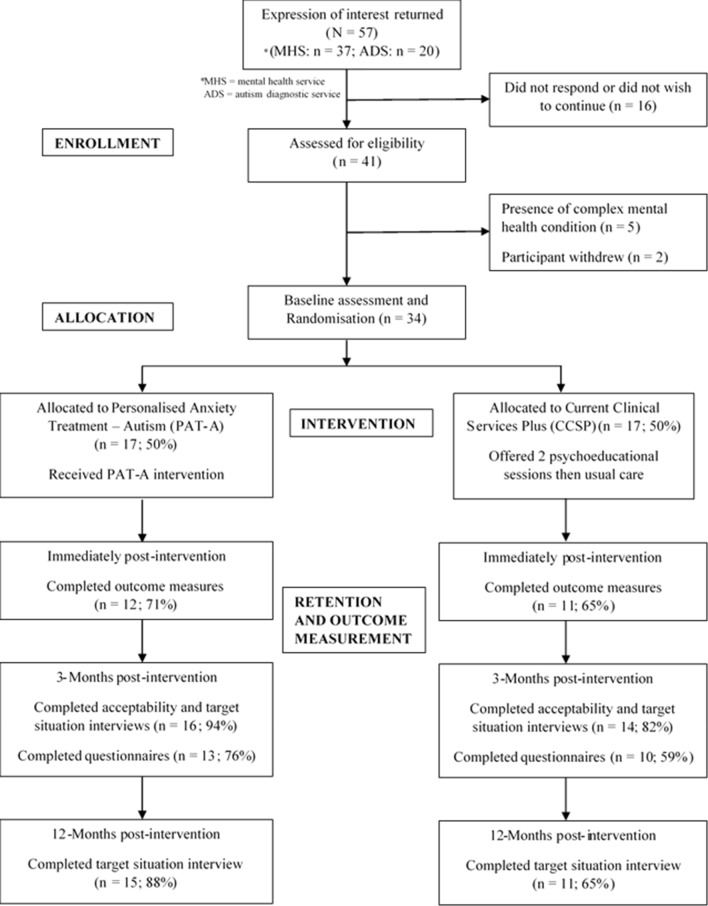
Anxiety is commonly experienced by autistic people and impacts on quality of life and social participation. New anxiety interventions are required to effectively meet the needs of autistic people. Personalised Anxiety Treatment-Autism (PAT-A©) is a bespoke, modular approach to treating anxiety in up to 12 sessions. This study explored the feasibility and acceptability of delivering PAT-A© in the UK National Health Service (NHS). A single-blind randomised controlled trial design. Thirty-four autistic adults were recruited via clinical services and randomised to receive either PAT-A© or enhanced treatment as usual (CCSP). Outcome assessments relating to anxiety, quality of life and related constructs were completed at baseline, immediately post intervention; and at 3 and 12 months. Seventy-one percent of the PAT-A© group and 65% of the CCSP met diagnostic threshold for at least three anxiety disorders. Retention was good across both groups, with 82% (N = 14/17) completing the full course of PAT-A© and 71% (N = 12/17) attending both psychoeducational sessions in CCSP. 94% in PAT-A© and 82% in CCSP completed some follow up assessment 3 months post-intervention. Thematic analysis of interview data revealed that many participants valued the personalised approach, developed transferable skills and experienced positive changes to their anxiety. Participants were willing to be recruited and randomised, PAT-A© was feasible to deliver in the NHS and the trial methods and materials were acceptable. Our findings indicate that a fully powered clinical and cost-effectiveness trial of PAT-A© is warranted. © The Author(s) 2023.
Verified 2026-11-25 · 1 reference not checked yet
Overview
CoChat Summary
## TL;DR
This pilot single-blind RCT found that PAT-A, a modular personalized anxiety intervention for autistic adults, was feasible to deliver in the NHS and was acceptable to participants. The study was not powered to test efficacy, but it provided early signals of reduced anxiety and improved day-to-day functioning, with results complicated by COVID-19 disruptions.
## Key findings
- Feasibility and retention were good: 34 autistic adults were randomized; 17 to PAT-A and 17 to CCSP. In PAT-A, 14/17 (82%) completed the full course; in CCSP, 12/17 (71%) attended both psychoeducational sessions.
- Participants generally accepted the trial procedures: at 3-month follow-up, 94% of PAT-A participants and 82% of CCSP participants completed some follow-up assessment. The paper reports that most trial methodology was acceptable to more than 90% of the sample.
- Clinical complexity was common: 71% of PAT-A and 65% of CCSP participants met diagnostic threshold for at least three anxiety disorders; the median number of current anxiety disorder diagnoses was 3 in each arm.
- Signals of improvement were observed, but descriptively: in PAT-A, 23% were rated “much improved” and 39% “minimally improved” on CGI-I, versus 30% and 0% in CCSP; no participant in either arm was rated “much worse” or “very much worse.” Mean anxiety scores (ASA-A and HADS-A) reduced from baseline to immediately post-intervention in both groups, with no substantial change in QoL by 3 months.
## Methods
- Design: Single-blind pilot randomized controlled trial with blind-to-group assessment, comparing PAT-A against Current Clinical Services Plus (CCSP).
- Sample/data: 34 autistic adults aged ≥18 were recruited via NHS adult mental health and adult autism services in Cumbria, Northumberland, Tyne and Wear NHS Foundation Trust.
- Main analysis: Primarily descriptive analyses of recruitment, retention, engagement, fidelity, and outcomes; qualitative interview data were analyzed using thematic analysis. Inter-rater reliability was assessed with ICC for some measures, including the ADIS-5/PAIS-A and fidelity coding.
## Limitations
- State in the paper: The trial was not designed as a fully powered study, so efficacy cannot be reliably reported; the authors say a definitive trial is needed.
- State in the paper: COVID-19 disrupted delivery and assessment, including forcing remote follow-up and preventing planned virtual reality exposure; this likely affected outcome interpretation and questionnaire return rates.
- Evident from the text: The sample was small (N = 34) and follow-up data were incomplete for some measures, which limits precision and generalizability. The paper also notes that the Target Situations measure lacked flexibility when treatment goals changed.
Model-written summary. Check it against the paper before relying on it.
Integrity signals
Registry
Cites
Statistics
Figures
Verification
Claims the paper makes
21 Valid · 0 Not valid · 14 Not checked · 147 Own results and interpretations
Every source the paper cites for this claim was checked and supports it.
In the paper
“Anxiety in social situations (Spain et al., 2018) and phobias/situation specific anxiety (Lever & Geurts, 2016) are particularly common for autistic people”
§ A Pilot Randomised Control Trial Exploring the Feasibility and Acceptability of Delivering a Personalised Modular Psychological Intervention for Anxiety Experienced by Autistic Adults: Personalised Anxiety Treatment-Autism (PAT-A) > Abstract Anxiety is commonly experienced by autistic people and impacts on quality of life and social participation. New anxiety interventions are required to effectively meet the needs of autistic people. Personalised Anxiety Treatment-Autism (PAT-A©) is a bespoke, modular approach to treating anxiety in up to 12 sessions. This study explored the feasibility and acceptability of delivering PAT-A© in the UK National Health Service (NHS). A single-blind randomised controlled trial design. Thirty-four autistic adults were recruited via clinical services and randomised to receive either PAT-A© or enhanced treatment as usual (CCSP). Outcome assessments relating to anxiety, quality of life and related constructs were completed at baseline, immediately post intervention; and at 3 and 12 months. Seventy-one percent of the PAT-A© group and 65% of the CCSP met diagnostic threshold for at least three anxiety disorders. Retention was good across both groups, with 82% (N = 14/17) completing the full course of PAT-A© and 71% (N = 12/17) attending both psychoeducational sessions in CCSP. 94% in PAT-A© and 82% in CCSP completed some follow up assessment 3 months post-intervention. Thematic analysis of interview data revealed that many participants valued the personalised approach, developed transferable skills and experienced positive changes to their anxiety. Participants were willing to be recruited and randomised, PAT-A© was feasible to deliver in the NHS and the trial methods and materials were acceptable. Our findings indicate that a fully powered clinical and cost-effectiveness trial of PAT-A© is warranted. > Supplementary Information
What the sources say
- Supportedcites Lever & Geurts, 2016 matched to “Psychiatric co-occurring symptoms and disorders in young, middle-aged, and older adults with autism spectrum disorder” (2016) source
Results, Table 4 (page not provided) reports higher lifetime rates of agoraphobia and specific phobia in adults with ASD than in the comparison group: 21.0% versus 3.5%, and 11.6% versus 4.7%, respectively. The Results also state that all anxiety disorders were more frequent in adults with ASD. The evidence concerns adults, rather than autistic people of all ages. (LLM, conf=0.90)
plainstates an association- Asserted: passes — The authors put it forward as true.
- Checkable: passes — It can be checked against evidence.
- Load-bearing: unclear — It is unclear whether the paper’s conclusions depend on it.
- Based: passes — The paper gives a reason why it holds.
- Supported
Every source the paper cites for this claim was checked and supports it.
In the paper
“Anxiety in social situations (Spain et al., 2018) and phobias/situation specific anxiety (Lever & Geurts, 2016) are particularly common for autistic people”
§ A Pilot Randomised Control Trial Exploring the Feasibility and Acceptability of Delivering a Personalised Modular Psychological Intervention for Anxiety Experienced by Autistic Adults: Personalised Anxiety Treatment-Autism (PAT-A) > Abstract Anxiety is commonly experienced by autistic people and impacts on quality of life and social participation. New anxiety interventions are required to effectively meet the needs of autistic people. Personalised Anxiety Treatment-Autism (PAT-A©) is a bespoke, modular approach to treating anxiety in up to 12 sessions. This study explored the feasibility and acceptability of delivering PAT-A© in the UK National Health Service (NHS). A single-blind randomised controlled trial design. Thirty-four autistic adults were recruited via clinical services and randomised to receive either PAT-A© or enhanced treatment as usual (CCSP). Outcome assessments relating to anxiety, quality of life and related constructs were completed at baseline, immediately post intervention; and at 3 and 12 months. Seventy-one percent of the PAT-A© group and 65% of the CCSP met diagnostic threshold for at least three anxiety disorders. Retention was good across both groups, with 82% (N = 14/17) completing the full course of PAT-A© and 71% (N = 12/17) attending both psychoeducational sessions in CCSP. 94% in PAT-A© and 82% in CCSP completed some follow up assessment 3 months post-intervention. Thematic analysis of interview data revealed that many participants valued the personalised approach, developed transferable skills and experienced positive changes to their anxiety. Participants were willing to be recruited and randomised, PAT-A© was feasible to deliver in the NHS and the trial methods and materials were acceptable. Our findings indicate that a fully powered clinical and cost-effectiveness trial of PAT-A© is warranted. > Supplementary Information
What the sources say
- Supportedcites Spain et al., 2018 matched to “Social anxiety in autism spectrum disorder: A systematic review” (2018) source
The paper states that social anxiety is especially common among people with ASD and reports prevalence estimates as high as 50%. This supports the part of the citing sentence attributed to Spain et al. (2018); no page number is provided in the supplied passage. (LLM, conf=0.94)
plainstates an association- Asserted: passes — The authors put it forward as true.
- Checkable: passes — It can be checked against evidence.
- Load-bearing: unclear — It is unclear whether the paper’s conclusions depend on it.
- Based: passes — The paper gives a reason why it holds.
- Supported
Every source the paper cites for this claim was checked and supports it.
In the paper
“autistic people may experience anxiety differently (Spain et al., 2017).”
§ A Pilot Randomised Control Trial Exploring the Feasibility and Acceptability of Delivering a Personalised Modular Psychological Intervention for Anxiety Experienced by Autistic Adults: Personalised Anxiety Treatment-Autism (PAT-A) > Abstract Anxiety is commonly experienced by autistic people and impacts on quality of life and social participation. New anxiety interventions are required to effectively meet the needs of autistic people. Personalised Anxiety Treatment-Autism (PAT-A©) is a bespoke, modular approach to treating anxiety in up to 12 sessions. This study explored the feasibility and acceptability of delivering PAT-A© in the UK National Health Service (NHS). A single-blind randomised controlled trial design. Thirty-four autistic adults were recruited via clinical services and randomised to receive either PAT-A© or enhanced treatment as usual (CCSP). Outcome assessments relating to anxiety, quality of life and related constructs were completed at baseline, immediately post intervention; and at 3 and 12 months. Seventy-one percent of the PAT-A© group and 65% of the CCSP met diagnostic threshold for at least three anxiety disorders. Retention was good across both groups, with 82% (N = 14/17) completing the full course of PAT-A© and 71% (N = 12/17) attending both psychoeducational sessions in CCSP. 94% in PAT-A© and 82% in CCSP completed some follow up assessment 3 months post-intervention. Thematic analysis of interview data revealed that many participants valued the personalised approach, developed transferable skills and experienced positive changes to their anxiety. Participants were willing to be recruited and randomised, PAT-A© was feasible to deliver in the NHS and the trial methods and materials were acceptable. Our findings indicate that a fully powered clinical and cost-effectiveness trial of PAT-A© is warranted. > Supplementary Information
What the sources say
- Supportedcites Spain et al., 2017 matched to “Cognitive behaviour therapy for social anxiety in autism spectrum disorder: a systematic review” (2017) source
The Introduction (page unavailable) describes ways autism-related cognitive and social difficulties may shape social anxiety. The Generalisability of study findings section (page unavailable) also raises the possibility that social anxiety in autistic people has different underlying factors than in other populations. This supports the citing sentence’s cautious wording, although the review focuses on social anxiety. (LLM, conf=0.85)
hedgedstates an association- Asserted: passes — The authors put it forward as true.
- Checkable: passes — It can be checked against evidence.
- Load-bearing: passes — The paper’s conclusions depend on it.
- Based: passes — The paper gives a reason why it holds.
- Supported
The cited sources support only part of this claim — read each source’s verdict below.
In the paper
“Behavioural interventions, such as mindfulness-based stress reduction, have also demonstrated efficacy in alleviating anxiety symptoms for autistic adults (Gaigg et al., 2020).”
§ A Pilot Randomised Control Trial Exploring the Feasibility and Acceptability of Delivering a Personalised Modular Psychological Intervention for Anxiety Experienced by Autistic Adults: Personalised Anxiety Treatment-Autism (PAT-A) > Abstract Anxiety is commonly experienced by autistic people and impacts on quality of life and social participation. New anxiety interventions are required to effectively meet the needs of autistic people. Personalised Anxiety Treatment-Autism (PAT-A©) is a bespoke, modular approach to treating anxiety in up to 12 sessions. This study explored the feasibility and acceptability of delivering PAT-A© in the UK National Health Service (NHS). A single-blind randomised controlled trial design. Thirty-four autistic adults were recruited via clinical services and randomised to receive either PAT-A© or enhanced treatment as usual (CCSP). Outcome assessments relating to anxiety, quality of life and related constructs were completed at baseline, immediately post intervention; and at 3 and 12 months. Seventy-one percent of the PAT-A© group and 65% of the CCSP met diagnostic threshold for at least three anxiety disorders. Retention was good across both groups, with 82% (N = 14/17) completing the full course of PAT-A© and 71% (N = 12/17) attending both psychoeducational sessions in CCSP. 94% in PAT-A© and 82% in CCSP completed some follow up assessment 3 months post-intervention. Thematic analysis of interview data revealed that many participants valued the personalised approach, developed transferable skills and experienced positive changes to their anxiety. Participants were willing to be recruited and randomised, PAT-A© was feasible to deliver in the NHS and the trial methods and materials were acceptable. Our findings indicate that a fully powered clinical and cost-effectiveness trial of PAT-A© is warranted. > Supplementary Information
What the sources say
- Partly supportedcites Gaigg et al., 2020 matched to “Self-guided mindfulness and cognitive behavioural practices reduce anxiety in autistic adults: A pilot 8-month waitlist-controlled trial of widely available online tools.” (2020) sourceExperimental — accuracy not yet measured
The Abstract reports significant anxiety decreases among autistic adults who completed the online mindfulness-based or cognitive behavioural programmes, and the Methods identify the mindfulness course as Be Mindful. The paper does not identify that course as mindfulness-based stress reduction specifically. As a pilot study whose conclusion is framed as suggestive, it also provides narrower evidence than the claim’s unqualified statement of demonstrated efficacy. (LLM, conf=0.84)
boostedstates a cause- Asserted: passes — The authors put it forward as true.
- Checkable: passes — It can be checked against evidence.
- Load-bearing: unclear — It is unclear whether the paper’s conclusions depend on it.
- Based: passes — The paper gives a reason why it holds.
- Partly supported
Every source the paper cites for this claim was checked and supports it.
In the paper
“Research also identified Intolerance of Uncertainty (IU) (Carleton, 2016) as a transdiagnostic factor in anxiety experienced by autistic people (Jenkinson et al., 2020).”
§ A Pilot Randomised Control Trial Exploring the Feasibility and Acceptability of Delivering a Personalised Modular Psychological Intervention for Anxiety Experienced by Autistic Adults: Personalised Anxiety Treatment-Autism (PAT-A) > Abstract Anxiety is commonly experienced by autistic people and impacts on quality of life and social participation. New anxiety interventions are required to effectively meet the needs of autistic people. Personalised Anxiety Treatment-Autism (PAT-A©) is a bespoke, modular approach to treating anxiety in up to 12 sessions. This study explored the feasibility and acceptability of delivering PAT-A© in the UK National Health Service (NHS). A single-blind randomised controlled trial design. Thirty-four autistic adults were recruited via clinical services and randomised to receive either PAT-A© or enhanced treatment as usual (CCSP). Outcome assessments relating to anxiety, quality of life and related constructs were completed at baseline, immediately post intervention; and at 3 and 12 months. Seventy-one percent of the PAT-A© group and 65% of the CCSP met diagnostic threshold for at least three anxiety disorders. Retention was good across both groups, with 82% (N = 14/17) completing the full course of PAT-A© and 71% (N = 12/17) attending both psychoeducational sessions in CCSP. 94% in PAT-A© and 82% in CCSP completed some follow up assessment 3 months post-intervention. Thematic analysis of interview data revealed that many participants valued the personalised approach, developed transferable skills and experienced positive changes to their anxiety. Participants were willing to be recruited and randomised, PAT-A© was feasible to deliver in the NHS and the trial methods and materials were acceptable. Our findings indicate that a fully powered clinical and cost-effectiveness trial of PAT-A© is warranted. > Supplementary Information
What the sources say
- Supportedcites Jenkinson et al., 2020 matched to “The relationship between intolerance of uncertainty and anxiety in autism: A systematic literature review and meta-analysis” (2020) source
The Introduction describes intolerance of uncertainty as associated with anxiety across diagnostic groups. The Discussion reports a consistent positive association in autistic people, and the Conclusion says the relationship is comparable to that in neurotypical populations. Together, these passages support the transdiagnostic characterization. (LLM, conf=0.89)
- Supportedcites Carleton, 2016 matched to “Into the unknown: A review and synthesis of contemporary models involving uncertainty” (2016) source
The Summary states that IU plays a transdiagnostic role in anxiety, supporting the point attributed to Carleton (2016). In the citing sentence, Jenkinson et al. (2020), rather than Carleton, is cited for the application to autistic people. (LLM, conf=0.92)
plainstates an association- Asserted: passes — The authors put it forward as true.
- Checkable: passes — It can be checked against evidence.
- Load-bearing: passes — The paper’s conclusions depend on it.
- Based: passes — The paper gives a reason why it holds.
- Supported
58 more claims
Create a free account to see all 182 claims and to verify the 1 reference still open.
- Probably not a substantial claim. 78
- It may state two separate claims as one. 62
Citations
Cites
Using thematic analysis in psychology
Braun, V., & Clarke, V. (2006) · Qualitative Research in Psychology · doi:10.1191/1478088706qp063oa · Cited by 194,414
Diagnostic and Statistical Manual of Mental Disorders
American Psychiatric Association (2013) · doi:10.1176/appi.books.9780890425596 · Cited by 116,369
The Hospital Anxiety and Depression Scale
Zigmond, A. S., & Snaith, R. P. (1983) · Acta Psychiatrica Scandinavica · doi:10.1111/j.1600-0447.1983.tb09716.x · Cited by 47,139 · cited 2×
“• Hospital Anxiety and Depression Scale ( HADS; Zigmond & Snaith, 1983) .”
BackgroundDepression and quality of life in older persons: A review
Sivertsen, H., Bjørkløf, G. H., Engedal, K., Selbæk, G., & Helvik, A.-S. (2015) · Dementia and Geriatric Cognitive Disorders · doi:10.1159/000437299 · Cited by 14,152
Development and preliminary testing of the new five-level version of EQ-5D (EQ-5D-5L)
Herdman, M., Gudex, C., Lloyd, A., Janssen, M., Kind, P., Parkin, D., Bonsel, G., & Badia, X. (2011) · Quality of Life Research · doi:10.1007/s11136-011-9903-x · Cited by 9,795 · cited 1×
“• EuroQoL 5 dimensions, 5 levels health survey (EQ-5D-5L; Herdman et al., 2011).”
BackgroundDevelopment of the World Health Organization WHOQOL-BREF Quality of Life Assessment
THE WHOQOL GROUP (1998) · Psychological Medicine · doi:10.1017/s0033291798006667 · Cited by 7,933 · cited 1×
“• WHO Quality of Life-BREF ( WHOQOL-BREF; World Health Organisation, 1998).”
MethodBagby, R. M., Parker, J. D. A., & Taylor, G. J. (1994) · Journal of Psychosomatic Research · doi:10.1016/0022-3999(94)90005-1 · Cited by 5,293 · cited 1×
“• Toronto Alexithymia Scale-20 ( TAS-20; Bagby et al., 1994): a measure of alexithymia comprising of three subscales: difficulty describing feelings, difficulty identifying feelings, and externally-orientated thinking.”
BackgroundThe clinical global impressions scale: applying a research tool in clinical practice.
Busner, J., & Targum, S. D. (2007) · PubMed Central · Cited by 2,817
Into the unknown: A review and synthesis of contemporary models involving uncertainty
Carleton, R. N. (2016) · Journal of Anxiety Disorders · doi:10.1016/j.janxdis.2016.02.007 · Cited by 1,104 · cited 1×
“Research also identified Intolerance of Uncertainty (IU) (Carleton, 2016) as a transdiagnostic factor in anxiety experienced by autistic people (Jenkinson et al., 2020).”
BackgroundHollocks, M. J., Lerh, J. W., Magiati, I., Meiser-Stedman, R., & Brugha, T. S. (2019) · Psychological Medicine · doi:10.1017/s0033291718002283 · Cited by 988
Constantino, J. N. (2013) · Encyclopedia of Autism Spectrum Disorders · doi:10.1007/978-1-4419-1698-3_296 · Cited by 908
Lever, A. G., & Geurts, H. M. (2016) · Journal of Autism and Developmental Disorders · doi:10.1007/s10803-016-2722-8 · Cited by 572 · cited 1×
“Anxiety in social situations (Spain et al., 2018) and phobias/situation specific anxiety (Lever & Geurts, 2016) are particularly common for autistic people and there is evidence supporting adapted CBT as an effective treat-ment for both (Maskey et al., 2019a; Maskey et al., 2019a, 2019b, 2019c,…”
BackgroundInvestigating alexithymia in autism: A systematic review and meta-analysis
Kinnaird, E., Stewart, C., & Tchanturia, K. (2019) · European Psychiatry · doi:10.1016/j.eurpsy.2018.09.004 · Cited by 545 · cited 1×
“Autistic people may experience alexithymia (difficulties identifying and describing emotions) (Kinnaird et al., 2019) and have difficulties coping with distress or regulating emotions (Weiss et al., 2014).”
BackgroundJoshi, G., Wozniak, J., Petty, C., Martelon, M. K., Fried, R., Bolfek, A., Kotte, A., Stevens, J., Furtak, S. L., Bourgeois, M., et al. (2013) · Journal of Autism and Developmental Disorders · doi:10.1007/s10803-012-1679-5 · Cited by 419 · cited 3×
“This sample presented with complex and pervasive anxiety difficulties, consistent with other studies (Joshi et al., 2013) as well as other co-occurring physical and mental health conditions.”
BackgroundResultInfluentialSocial anxiety in autism spectrum disorder: A systematic review
Spain, D., Sin, J., Linder, K. B., McMahon, J., & Happé, F. (2018) · Research in Autism Spectrum Disorders · doi:10.1016/j.rasd.2018.04.007 · Cited by 302 · cited 1×
“Anxiety in social situations (Spain et al., 2018) and phobias/situation specific anxiety (Lever & Geurts, 2016) are particularly common for autistic people and there is evidence supporting adapted CBT as an effective treat-ment for both (Maskey et al., 2019a; Maskey et al., 2019a, 2019b, 2019c,…”
BackgroundSensory, emotional and cognitive contributions to anxiety in autism spectrum disorders
South, M., & Rodgers, J. (2017) · Frontiers in Human Neuroscience · doi:10.3389/fnhum.2017.00020 · Cited by 270 · cited 2×
“Since anxiety may interact with autistic traits (Moore et al., 2021; South & Rodgers, 2017), autistic people may experience anxiety differently (Spain et al., 2017).”
BackgroundSelf-citationEnhancing the Validity of a Quality of Life Measure for Autistic People
McConachie, H., Mason, D., Parr, J. R., Garland, D., Wilson, C., & Rodgers, J. (2018) · Journal of Autism and Developmental Disorders · doi:10.1007/s10803-017-3402-z · Cited by 245
Self-citationARNOLD, L. E., VITIELLO, B., MCDOUGLE, C., SCAHILL, L., SHAH, B., GONZALEZ, N. M., CHUANG, S., DAVIES, M., HOLLWAY, J., AMAN, M. G., et al. (2003) · Journal of the American Academy of Child & Adolescent Psychiatry · doi:10.1097/00004583-200312000-00011 · Cited by 218 · cited 1×
“Using a well-recognised procedure with high levels of agreement between expert raters (Arnold et al., 2003; Maskey et al., 2014; Maskey et al., 2019a, 2019b, 2019c, 2019d), pairs of anonymised vignettes from baseline and 3 month follow-up were compared to identify whether there has been any change…”
MethodWeston, L., Hodgekins, J., & Langdon, P. E. (2016) · Clinical Psychology Review · doi:10.1016/j.cpr.2016.08.001 · Cited by 215 · cited 1×
“A meta-analysis reported CBT to be effective in treating affective disorders (primarily anxiety) experienced by autistic people; however, effect sizes were small to medium (Weston et al., 2016).”
Maskey, M., Lowry, J., Rodgers, J., McConachie, H., & Parr, J. R. (2014) · PLoS ONE · doi:10.1371/journal.pone.0100374 · Cited by 215 · cited 1×
“Using a well-recognised procedure with high levels of agreement between expert raters (Arnold et al., 2003; Maskey et al., 2014; Maskey et al., 2019a, 2019b, 2019c, 2019d), pairs of anonymised vignettes from baseline and 3 month follow-up were compared to identify whether there has been any change…”
MethodSelf-citationJenkinson, R., Milne, E., & Thompson, A. (2020) · Autism · doi:10.1177/1362361320932437 · Cited by 205 · cited 1×
“Research also identified Intolerance of Uncertainty (IU) (Carleton, 2016) as a transdiagnostic factor in anxiety experienced by autistic people (Jenkinson et al., 2020).”
BackgroundMaenner, M. J., Smith, L. E., Hong, J., Makuch, R., Greenberg, J. S., & Mailick, M. R. (2013) · Disability and Health Journal · doi:10.1016/j.dhjo.2012.08.005 · Cited by 198 · cited 1×
“• Waisman Activities of Daily Living Scale (W-ADL; Maenner et al., 2013 ) : a measure of adaptive functioning and daily living skills, validated in people with a broad range of developmental disability diagnoses.”
BackgroundKerns, C. M., Renno, P., Kendall, P. C., Wood, J. J., & Storch, E. A. (2017) · Journal of Clinical Child & Adolescent Psychology · doi:10.1080/15374416.2016.1233501 · Cited by 170 · cited 1×
“An adden-dum to the ADIS for autistic children has previously been developed and has demonstrated reliability and validity (Kerns et al., 2017).”
BackgroundSpain, D., Sin, J., Chalder, T., Murphy, D., & Happé, F. (2015) · Research in Autism Spectrum Disorders · doi:10.1016/j.rasd.2014.10.019 · Cited by 167 · cited 2×
“There is limited, but promising, evidence for the effectiveness of adapted CBT for autistic adults experiencing anxiety (Spain et al., 2015).”
BackgroundDevelopment of the WHOQOL disabilities module
The WHOQOL-Dis Group, Power, M. J., & Green, A. M. (2010) · Quality of Life Research · doi:10.1007/s11136-010-9616-6 · Cited by 158 · cited 1×
“The Disabilities module (Power et al., 2010) and the Autism Addendum ( ASQoL; McConachie et al., 2018) were also completed to assess disability-related and autism-related quality of life respectively.”
MethodWeiss, J. A., Thomson, K., & Chan, L. (2014) · Autism Research · doi:10.1002/aur.1426 · Cited by 132 · cited 1×
“Autistic people may experience alexithymia (difficulties identifying and describing emotions) (Kinnaird et al., 2019) and have difficulties coping with distress or regulating emotions (Weiss et al., 2014).”
BackgroundBarriers and Facilitators to Employment for Adults With Autism: A Scoping Review
Harmuth, E., Silletta, E., Bailey, A., Adams, T., Beck, C., & Barbic, S. P. (2018) · Annals of International Occupational Therapy · doi:10.3928/24761222-20180212-01 · Cited by 127 · cited 1×
“employment and education (Harmuth et al., 2018).”
Maskey, M., Rodgers, J., Grahame, V., Glod, M., Honey, E., Kinnear, J., Labus, M., Milne, J., Minos, D., McConachie, H., et al. (2019) · Journal of Autism and Developmental Disorders · doi:10.1007/s10803-018-3861-x · Cited by 112 · cited 3×
“Using a well-recognised procedure with high levels of agreement between expert raters (Arnold et al., 2003; Maskey et al., 2014; Maskey et al., 2019a, 2019b, 2019c, 2019d), pairs of anonymised vignettes from baseline and 3 month follow-up were compared to identify whether there has been any change…”
BackgroundMethodSelf-citationWalters, S., Loades, M., & Russell, A. (2016) · Review Journal of Autism and Developmental Disorders · doi:10.1007/s40489-016-0072-2 · Cited by 99 · cited 2×
“Additionally, a review of studies reporting on successful CBT interventions with autistic young people concluded such approaches offer more adjustments than those recommended in NICE guidelines (Walters et al., 2016).”
BackgroundSpain, D., & Happé, F. (2020) · Journal of Rational-Emotive & Cognitive-Behavior Therapy · doi:10.1007/s10942-019-00335-1 · Cited by 97 · cited 1×
“Clinicians Clinicians report that ‘autism specific’ adaptations accounted for around 40% of the ‘active ingredients’ that made CBT with autistic people more effective (Spain & Happé, 2020).”
BackgroundQuality of life for older autistic people: The impact of mental health difficulties
Mason, D., Mackintosh, J., McConachie, H., Rodgers, J., Finch, T., & Parr, J. R. (2019) · Research in Autism Spectrum Disorders · doi:10.1016/j.rasd.2019.02.007 · Cited by 89
Self-citationGaigg, S. B., Flaxman, P. E., McLaven, G., Shah, R., Bowler, D. M., Meyer, B., Roestorf, A., Haenschel, C., Rodgers, J., & South, M. (2020) · Autism · doi:10.1177/1362361320909184 · Cited by 80 · cited 1×
“Behavioural interventions, such as mindfulness-based stress reduction, have also demonstrated efficacy in alleviating anxiety symptoms for autistic adults (Gaigg et al., 2020).”
BackgroundSelf-citationDevelopment and Initial Evaluation of the Anxiety Scale for Autism-Adults
Rodgers, J., Farquhar, K., Mason, D., Brice, S., Wigham, S., Ingham, B., Freeston, M., & Parr, J. R. (2020) · Autism in Adulthood · doi:10.1089/aut.2019.0044 · Cited by 66 · cited 5×
“The Anxiety Scale for Autism-Adult (ASA-A) and Hospital Anxiety and Depression Scale (HADS) were also completed immediately post-intervention.”
BackgroundInfluentialSelf-citationMaskey, M., Rodgers, J., Ingham, B., Freeston, M., Evans, G., Labus, M., & Parr, J. R. (2019) · Autism in Adulthood · doi:10.1089/aut.2018.0019 · Cited by 62 · cited 3×
“Using a well-recognised procedure with high levels of agreement between expert raters (Arnold et al., 2003; Maskey et al., 2014; Maskey et al., 2019a, 2019b, 2019c, 2019d), pairs of anonymised vignettes from baseline and 3 month follow-up were compared to identify whether there has been any change…”
BackgroundMethodSelf-citationRodgers, J., Herrema, R., Honey, E., & Freeston, M. (2018) · Journal of Autism and Developmental Disorders · doi:10.1007/s10803-018-3550-9 · Cited by 51 · cited 1×
“See Rodgers et al. (2018) for a full description.”
Self-citationAn integrated early care pathway for autism
Green, J., Leadbitter, K., Ainsworth, J. D., & Bucci, S. (2022) · The Lancet Child & Adolescent Health · doi:10.1016/s2352-4642(22)00037-2 · Cited by 50 · cited 1×
“In light of recommendations for stepped care approaches across time (see Green et al., 2022), work should be undertaken with NHS clinical services to explore and respond to barriers implementing personalised and flexible anxiety interventions for autistic people.”
BackgroundRussell, A., Gaunt, D. M., Cooper, K., Barton, S., Horwood, J., Kessler, D., Metcalfe, C., Ensum, I., Ingham, B., Parr, J. R., et al. (2020) · Autism · doi:10.1177/1362361319889272 · Cited by 48 · cited 2×
“A smaller proportion of participants completed questionnaires at follow up than those who completed inter-views at the same time point, although questionnaire return rate was in line with other recent research (e.g., Russell et al., 2020).”
ResultSelf-citationBundy, R., Mandy, W., Crane, L., Belcher, H., Bourne, L., Brede, J., Hull, L., Brinkert, J., & Cook, J. (2022) · Autism · doi:10.1177/13623613211065543 · Cited by 43 · cited 1×
“Several studies have indicated the COVID-19 pandemic has impacted significantly on the mental health of autistic people (Bundy et al., 2022), meaning that any comparisons with anxiety measures that occurred before the pandemic are likely confounded by the considerable changes in contexts as a…”
BackgroundMoore, H. L., Brice, S., Powell, L., Ingham, B., Freeston, M., Parr, J. R., & Rodgers, J. (2022) · Journal of Autism and Developmental Disorders · doi:10.1007/s10803-021-05312-1 · Cited by 42 · cited 2×
“Since anxiety may interact with autistic traits (Moore et al., 2021; South & Rodgers, 2017), autistic people may experience anxiety differently (Spain et al., 2017).”
BackgroundSelf-citationMaskey, M., McConachie, H., Rodgers, J., Grahame, V., Maxwell, J., Tavernor, L., & Parr, J. R. (2019) · Research in Autism Spectrum Disorders · doi:10.1016/j.rasd.2018.11.005 · Cited by 37 · cited 6×
“…(Spain et al., 2018) and phobias/situation specific anxiety (Lever & Geurts, 2016) are particularly common for autistic people and there is evidence supporting adapted CBT as an effective treat-ment for both (Maskey et al., 2019a; Maskey et al., 2019a, 2019b, 2019c, 2019d; Spain et al., 2015).”
BackgroundMethodInfluentialSelf-citationCognitive behaviour therapy for social anxiety in autism spectrum disorder: a systematic review
Spain, D., Sin, J., Harwood, L., Mendez, M. A., & Happé, F. (2017) · Advances in Autism · doi:10.1108/aia-07-2016-0020 · Cited by 37 · cited 1×
“Since anxiety may interact with autistic traits (Moore et al., 2021; South & Rodgers, 2017), autistic people may experience anxiety differently (Spain et al., 2017).”
BackgroundParr, J. R., Brice, S., Welsh, P., Ingham, B., Le Couteur, A., Evans, G., Monaco, A., Freeston, M., & Rodgers, J. (2020) · Trials · doi:10.1186/s13063-020-4161-2 · Cited by 28 · cited 3×
“Measures completed at baseline and repeated as outcome measures are described below and in detail (including psychometric properties) in Parr et al. (2020).”
MethodInfluentialSelf-citationTreatment of anxiety in autistic adults: A systematic review
Menezes, M., Harkins, C., Robinson, M. F., Pappagianopoulos, J., Cross, R., Vasa, R. A., & Mazurek, M. O. (2022) · Research in Autism Spectrum Disorders · doi:10.1016/j.rasd.2022.102068 · Cited by 26
Research works printed but not linked: 4
- Brown, T. A., & Barlow, D. H. (2014). Anxiety and related disorders interview schedule for DSM-5 (ADIS-5) client interview schedule. Oxford University Press.
- Maskey, M., Rodgers, J., Ingham, B., Freeston, M., Evans, G., Labus, M., & Parr, J. R. (2019d). Using virtual reality environments to augment cognitive behavioural therapy for fears and phobias in autistic adults. Autism in Adulthood. 10.1089/aut.2018.0019 31032480 PMC6485262 · DOI · Paper page
- National Institute for Health and Care Excellence. (2011). Common mental health problems: identification and pathways to care. Clinical guideline [CG123]. Retrieved from https://www.nice.org.uk/guidance/cg123 31851443
- National Institute for Health and Care Excellence. (2013). Social anxiety disorder: recognition, assessment and treatment. Clinical guideline [CG159]. Retrieved from https://www.nice.org.uk/guidance/cg159 31869048
Cited by
Rodgers, J., Cassidy, S., Pelton, M., Goodwin, J., Wagnild, J. M., Bhattarai, N., Gordon, I., Wilson, C., Heslop, P., Ogundimu, E. O., et al. (2024) · EClinicalMedicine · doi:10.1016/j.eclinm.2024.102662 · Cited by 32
Self-citationSokołowska, E., Sokołowska, B., Chrapusta, S. J., & Sulejczak, D. (2025) · Frontiers in Neuroscience · doi:10.3389/fnins.2024.1461142 · Cited by 9
Miller, P. K., Bowden, S. L., Dewison, N., Ingham, B., Thwaites, R., & Dagnan, D. (2025) · Autism · doi:10.1177/13623613251341610 · Cited by 7
“However, specific protocols have been developed for autistic people experiencing anxiety disorders (Rodgers et al., 2023, 2024) and depression (Russell et al., 2020), and CBT-based psychological therapies remain the recommended interventions in the United Kingdom for autistic and non-autistic…”
Self-citationMiller, P. K., Dewison, N., Bowden, S. L., Ingham, B., Thwaites, R., & Dagnan, D. (2025) · Neurodiversity · doi:10.1177/27546330251350037 · Cited by 1
“…people with co-occurring depression and anxiety have also been explored for feasibility, though no fi rm evidence-base has yet been established (Rodgers et al., 2024; Russell et al., 2020) In England, psychological therapy for adults with an anxiety disorder and/or depression is chie fl y…”
Self-citationPilot trial of a community-based transition support program for autistic adults
Brewe, A. M., & White, S. W. (2025) · Neurodiversity · doi:10.1177/27546330251319884 · Cited by 3
“…our sample size was fairly small, our retention rate falls within a similar range found in general psychotherapy regardless of diagnosis (Hamilton et al., 2011), intervention trials with autistic people (Conner et al., 2019; Rodgers et al., 2024), and the previous STEPS RCT (White et al., 2021).”
Metadata
- Authors
- Rodgers, J., Brice, S., Welsh, P., Ingham, B., Wilson, C., Evans, G., Steele, K., Cropper, E., Le Couteur, A., Freeston, M., & Parr, J. R.
- Affiliations
- Newcastle University (GB)
- Cumbria Northumberland Tyne and Wear NHS Foundation Trust (GB)
- Corresponding author
- Rodgers, Jacqui
- Venue
- Journal of Autism and Developmental Disorders
- Published
- 2023-09-20
- Volume
- 54
- Issue
- 11
- Pages
- 4045-4060
- ISSN
- 0162-3257 (ISSN-L)
- 1573-3432
- PMC
- PMC11461680
- OpenAlex
- W4386878202
- Semantic Scholar
- f94127c842b5a5f277eede69e5965c32ee1c2fde
- Cited by
- 15
- References
- 46
- Citations by year
- 2026: 5 · 2025: 6 · 2024: 4
- FWCI
- 2.24
- Type
- journal article
- Language
- en
- Open access
- hybrid
- doi.org
- Licence
- cc-by
- creativecommons.org/licenses/by/4.0 (tdm)
- creativecommons.org/licenses/by/4.0 (vor)
- Locations
- Journal of Autism and Developmental Disorders (publishedVersion, cc-by)
- PubMed Central (publishedVersion, cc-by)
- PubMed (publishedVersion)
- Newcastle University ePrints (Newcastle Univesity) (cc-by)
- Funders
- Autistica (7245)
- Topics
- Life Sciences › Neuroscience › Cognitive Neuroscience › Autism Spectrum Disorder Research
- Social Sciences › Psychology › Experimental and Cognitive Psychology › Anxiety, Depression, Psychometrics, Treatment, Cognitive Processes
- Social Sciences › Psychology › Applied Psychology › Digital Mental Health Interventions
- Keywords
- autism spectrum disorder, anxiety disorders, feasibility, acceptability, autistic adults, treatment retention, psychoeducation, quality of life, National Health Service
- MeSH terms
- Psychosocial Intervention, Adult, Anxiety, Anxiety Disorders, Autistic Disorder, Feasibility Studies, Female, Humans, Male, Middle Aged, Patient Acceptance of Health Care, Pilot Projects, Quality of Life, Single-Blind Method, Treatment Outcome, Young Adult, Precision Medicine
About these checks
Registry, retraction, Cites and statistics results are computed, not judged, with one exception: a printed reference that no index lists is read once by a model before it counts as a citation error. Claims are extracted by a model and kept only when their quote appears verbatim in the text; each cited source is then checked, with a model’s help, for whether it says what the claim relies on. Those verdicts can be wrong — read the claim’s quote and the cited source before relying on one.
The claim verdicts this report counts are experimental: their accuracy is not yet measured.
A language model drew the claims from the paper on 2026-10-11, under version 3 of the claim definition (model deepseek-v4.1-flash, prompt extract-v3).
A second model labelled each claim on 2026-10-11 (model jev-1.13-20260917, definition revision gold-guideline-v0.2).
Cited sources are checked with a language model’s help (gpt-6-sol).
Statistics and arithmetic are recomputed, not judged.
Confidence bands are shown only for fields calibrated on our annotated test set. None is calibrated yet, so no band is shown.
What counts as a claim ›How we measure confidence ›How we check this ›
Are you an author, or do you see a problem with this page? Request a review
Data sources
Bibliographic data: Semantic Scholar, OpenAlex, Crossref.
Contains information from the Semantic Scholar Academic Graph Datasets, made available under the ODC Attribution License (ODC-BY 1.0).
Semantic Scholar’s data is described in: Kinney, R., et al. (2023). The Semantic Scholar Open Data Platform. arXiv:2301.10140.
