

Mental Illness and Mental Health: The Two Continua Model Across the Lifespan
Open accessThe DOI matches its Crossref record; 53 of the 58 references it cites were found in a registry or an index.
Abstract
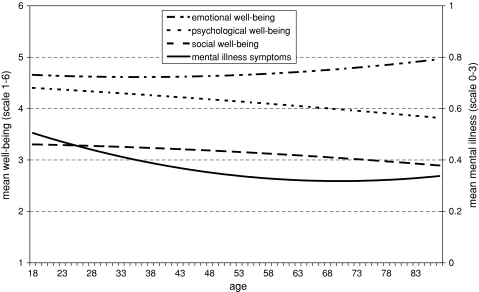
Mental health has long been defined as the absence of psychopathologies, such as depression and anxiety. The absence of mental illness, however, is a minimal outcome from a psychological perspective on lifespan development. This article therefore focuses on mental illness as well as on three core components of positive mental health: feelings of happiness and satisfaction with life (emotional well-being), positive individual functioning in terms of self-realization (psychological well-being), and positive societal functioning in terms of being of social value (social well-being). The two continua model holds that mental illness and mental health are related but distinct dimensions. This model was studied on the basis of a cross-sectional representative internet survey of Dutch adults (N = 1,340; 18-87 years). Mental illness was measured with the Brief Symptom Inventory and mental health with the Mental Health Continuum Short Form. It was found that older adults, except for the oldest-old, scored lower on psychopathological symptoms and were less likely to be mentally ill than younger adults. Although there were fewer age differences for mental health, older adults experienced more emotional, similar social and slightly lower psychological well-being. In sum, today's older adults have fewer mental illness problems, but they are not in a better positive mental health than today's younger adults. These findings support the validity of the two continua model in adult development.
Overview
The claims and statistics of this paper haven’t been checked yet.
Free: it reads the open-access text and checks the first 5 claims that cite a source we can check. Create a free account to check every claim.
Integrity signals
Registry
Cites
Statistics
Figures
Verification
Claims the paper makes
The claims and statistics of this paper haven’t been checked yet.
Free: it reads the open-access text and checks the first 5 claims that cite a source we can check. Create a free account to check every claim.
Claims other papers make about this one
Each is checked against this paper’s own text: does it say what the citing paper says it does?
The source backs part of the claim, not all of it — or backs it for a different population, condition or comparison.
In the citing paper
“The MHC-SF has demonstrated good psychometric properties across various age groups and nations (Lamers et al., 2011, Westerhof and Keyes, 2010).”
From The link between stress, well-being, and psychological flexibility during an Acceptance and Commitment Therapy self-help intervention (2018) · cites this paper as Westerhof and Keyes, 2010
Experimental — accuracy not yet measuredThe cited source says what the claim attributes to it.
In the citing paper
“The dual-factor model of mental health suggests that enhancing positive mental health and alleviating psychopathology do not automatically go hand-in-hand (Keyes, 2005a).”
From Both positive mental health and psychopathology should be monitored in psychotherapy: Confirmation for the dual-factor model in acceptance and commitment therapy (2017) · cites this paper as Westerhof & Keyes, 2009
The cited source says what the claim attributes to it.
In the citing paper
“Although the dual-factor model has been wellestablished in cross-sectional studies (e.g., Westerhof & Keyes, 2009), this is the first study to our knowledge that has investigated the applicability of the dual-factor model of mental health in an intervention study based on an effective psychotherapeutic intervention, namely, ACT (Fledderus et al., 2012).”
From Both positive mental health and psychopathology should be monitored in psychotherapy: Confirmation for the dual-factor model in acceptance and commitment therapy (2017) · cites this paper as Westerhof & Keyes, 2009
The cited source says what the claim attributes to it.
In the citing paper
“This model has been replicated in both American and international samples and across the lifespan (Keyes, 2002; Westerhof & Keyes, 2010).”
From Trajectories of change in well-being during cognitive behavioral therapies for anxiety disorders: Quantifying the impact and covariation with improvements in anxiety (2020) · cites this paper as Westerhof & Keyes, 2010
The cited source says what the claim attributes to it.
In the citing paper
“Nonetheless, mental health is not merely the absence of mental illness, and the two are related but distinct (Westerhof & Keyes, 2010); therefore, wellbeing services may also help to improve mental health without reducing symptoms.”
From Content Moderator Mental Health and Associations with Coping Styles: Replication and Extension of Previous Studies (2025) · cites this paper as Westerhof & Keyes, 2010
4 more claims about this paper
Create a free account to see every claim other papers make about this one.
Self-check
Percentages, sums and reported differences re-computed from the paper’s own numbers.
The self-check needs the paper’s full text.
Citations
Cites
Happiness is everything, or is it? Explorations on the meaning of psychological well-being.
Ryff, C. D. (1989) · Journal of Personality and Social Psychology · doi:10.1037/0022-3514.57.6.1069 · Cited by 14,847 · cited 5×
“Psychologists started to reflect on the notion of well-being in terms of individual strivings and optimal functioning (Ryan and Deci 2001; Ryff 1989), which gave rise to the second tradition of research, called eudaimonic well-being.”
BackgroundInfluentialSubjective well-being: Three decades of progress.
Diener, E., Suh, E. M., Lucas, R. E., & Smith, H. L. (1999) · Psychological Bulletin · doi:10.1037/0033-2909.125.2.276 · Cited by 12,910
On Happiness and Human Potentials: A Review of Research on Hedonic and Eudaimonic Well-Being
Ryan, R. M., & Deci, E. L. (2001) · Annual Review of Psychology · doi:10.1146/annurev.psych.52.1.141 · Cited by 11,567 · cited 4×
“Psychologists started to reflect on the notion of well-being in terms of individual strivings and optimal functioning (Ryan and Deci 2001; Ryff 1989), which gave rise to the second tradition of research, called eudaimonic well-being.”
BackgroundInfluentialDiener, E. (1984) · Psychological Bulletin · doi:10.1037/0033-2909.95.3.542 · Cited by 11,023
Diener, E. (2009) · Social Indicators Research Series · doi:10.1007/978-90-481-2350-6_2 · Cited by 10,950
The structure of psychological well-being revisited.
Ryff, C. D., & Keyes, C. L. M. (1995) · Journal of Personality and Social Psychology · doi:10.1037//0022-3514.69.4.719 · Cited by 10,285 · cited 5×
“This procedure resulted in a sample of 1,662 respondents who filled out the questionnaire in December 2007 (a response of 76% of those who participated in the panel).”
BackgroundMethodInfluentialSelf-citationВзаимосвязь статуса занятости и пола с уровнем психологического благополучия
М.Р., Н., & С.И., Б. (2026) · Cifra LLC Journals · doi:10.60797/irj.2026.170.43 · Cited by 7,950
The mental health continuum: from languishing to flourishing in life.
Keyes, C. L. M. (2002) · Journal of Health and Social Behavior · doi:10.2307/3090197 · Cited by 5,133 · cited 5×
“The findings of this study provide strong support for the two continua model of mental illness and health (Keyes 2002, 2005, 2007).”
BackgroundResultInfluentialSelf-citationThe Structure of Psychological Well-Being.
Mechanic, D., & Bradburn, N. M. (1970) · American Sociological Review · doi:10.2307/2093340 · Cited by 4,923 · cited 1×
“In the social sciences, this tradition dates back to survey research in the 1960s and 1970s, when scholars started to study the quality of American life from the perspective of citizens themselves (Andrews and Withey 1976; Bradburn 1969; Campbell et al. 1976; Cantril 1965; Gurin et al. 1960).”
BackgroundSocial Indicators of Well-Being
Andrews, F. M., & Withey, S. B. (1976) · Springer eBooks · doi:10.1007/978-1-4684-2253-5 · Cited by 3,653 · cited 1×
“In the social sciences, this tradition dates back to survey research in the 1960s and 1970s, when scholars started to study the quality of American life from the perspective of citizens themselves (Andrews and Withey 1976; Bradburn 1969; Campbell et al. 1976; Cantril 1965; Gurin et al. 1960).”
Background
Research works printed but not linked: 3
- Derogatis, L. R. (1975). The Brief Symptom Inventory. Baltimore, MD.: Clinical Psychometric Research.
- Westerhof, G. J. (2001). Wohlbefinden in der zweiten Lebenshälfte [Well-being in the second half of life]. In F. Dittmann-Kohli, C. Bode, & G. J. Westerhof (Eds.), Die zweite Lebenshälfte—Psychologische Perspektiven. Ergebnisse des Alters-Survey (pp. 79–128). Stuttgart: Kohlhammer.
- Westerhof, G. J., & Keyes, C. L. M. (2008). Geestelijke gezondheid is meer dan de afwezigheid van geestelijke ziekte [Mental health is more than the absence of mental illness]. Maandblad Geestelijke Volksgezondheid, 63, 808–820.
Cited by
Items 901–1,000 of 1,001
Latent Profile Analysis of Mental Health Among Children and Young Adults With Refugee Backgrounds
Andersson, J., Zhai, H., Kankaanpää, R., Bråhn, C., Mattelin, E., Peltonen, K., Münger, A.-C., & Korhonen, L. (2025) · JAACAP Open · doi:10.1016/j.jaacop.2025.06.003 · Cited by 2
Knowles, C., Thornton, E., Mills-Webb, K., Petersen, K. J., Marquez, J., Stojiljković, S., & Humphrey, N. (2025) · International Journal of Environmental Research and Public Health · doi:10.3390/ijerph22060951 · Cited by 2
Thibodeau, D. E., Lucibello, K. M., & Sabiston, C. M. (2025) · Journal of Sport and Exercise Psychology · doi:10.1123/jsep.2024-0197 · Cited by 3
Emotional wellbeing and language proficiencies in adolescence: A systematic review
Ticheloven, A., McMonagle, S., & Blom, E. (2025) · International Journal of Bilingualism · doi:10.1177/13670069251360172 · Cited by 3
“…also with regard to emotional wellbeing, the inclusion of multiple dimensions of emotional wellbeing may allow for a more comprehensive overview of different outcomes and explanatory mechanisms highlighted in different studies (McLellan et al., 2022; Suldo et al., 2011; Westerhof & Keyes, 2010).”
Antazo, B. G. (2025) · Measurement and Evaluation in Counseling and Development · doi:10.1080/07481756.2025.2553293 · Cited by 1
“…wellness monitoring, and program evaluation, the MHI-9 addresses the limitations of the MHI-5, the unidimensional structure and limited coverage of distress and well-being of which reduce its utility in dual-factor counseling models (Berwick et al., 1991; Keyes, 2005; Westerhof & Keyes, 2010).”
InfluentialKrishnan, S. G., & Orsmond, G. I. (2025) · Research in Autism · doi:10.1016/j.reia.2025.202717 · Cited by 1
Atıcı, İ., Kocataş, D. A., Şahan, İ. B., Özdemir, R., & Baş, A. U. (2025) · Humanistic Perspective · doi:10.47793/hp.1763342 · Cited by 1
Translation and Evaluation of the Indonesian Engagement in Meaningful Activities Survey
Sumaryanto, E., Kawakatsu, Y., Persch, A. C., Dik, B. J., & Eakman, A. M. (2025) · OTJR Occupational Therapy Journal of Research · doi:10.1177/15394492251379315 · Cited by 2
Tice, L. C., Salgado, G. N., Johnston, E. F., Nascimento, B., Bo-Hyeong, J. L., Proeschold‐Bell, R. J., & Eagle, D. E. (2025) · Mental Health Religion & Culture · doi:10.1080/13674676.2025.2536533 · Cited by 4
“A key aspect of the dual mental health continua model is that it is possible to have any of these levels of positive mental health while simultaneously having a degree of mental distress (Keyes, 2005, 2007; Westerhof & Keyes, 2010).”
Sarasjärvi, K. K., Elovainio, M. J., Appelqvist‐Schmidlechner, K., Solin, P., Tamminen, N., & Therman, S. (2025) · BMC Psychology · doi:10.1186/s40359-025-03571-6 · Cited by 2
Valverde, S., Joncheray, H., Stambulova, N. B., & Ruffault, A. (2025) · International Journal of Sport and Exercise Psychology · doi:10.1080/1612197x.2025.2590492 · Cited by 1
Fowler, K., Wareham‐Fowler, S., & Keyes, C. L. M. (2025) · Psychology Health & Medicine · doi:10.1080/13548506.2025.2594167 · Cited by 1
Self-citationBaran, P. M., Pereira, D., Pocinho, M. M. F. D. D., Rodrigues, N. M. V., & Mamcarz, P. J. (2025) · Scientific Reports · doi:10.1038/s41598-025-30165-4 · Cited by 5
“These results align with the dual-continua model of mental health 23,26 , which posits that positive mental health and psychopathology represent related but distinct dimensions rather than opposite poles of a single continuum.”
Pirola, V., Viganò, C. A., Bosi, M. F., Audisio, D., Reibman, Y. L., Palazzo, C., Caratozzolo, S., Cassina, N., Negri, L., Fave, A. D., et al. (2025) · Journal of Affective Disorders · doi:10.1016/j.jad.2025.120794 · Cited by 2
Auyeung, L., Mak, W. W. S., & Tsang, E. Z. (2025) · Computers in Human Behavior Reports · doi:10.1016/j.chbr.2025.100880 · Cited by 1
Simons, M., kurt, S., Stefens, M., Karos, K., Klippel, A., & Lataster, J. (2025) · International Journal of Migration Health and Social Care · doi:10.1108/ijmhsc-03-2024-0029 · Cited by 2
Youth Leisure during the Covid-19 Pandemic and Relations with Mental Health: A Systematic Review
Freire, T., Pereira, T., & Vieira, D. A. (2026) · Journal of Child and Family Studies · doi:10.1007/s10826-025-03247-0 · Cited by 1
“Mental health is seen as a developmental outcome across the lifespan (Westerhof & Keyes, 2010 ), influenced by sev - eral social and environmental factors, particularly during the early stages of development (Patel et al., 2018).”
Castillo-Díaz, M. A., & Periañez, C. A. H. (2026) · Frontiers in Psychology · doi:10.3389/fpsyg.2025.1735602 · Cited by 4
Classifying and Understanding Worldviews in Mental Health: A Scoping Review
Nyapati, S., Truijens, F. L., van Os, J. J., & Baars, E. W. (2026) · Journal of Cross-Cultural Psychology · doi:10.1177/00220221251406577 · Cited by 1
“The move towards a more integrative definition of mental health where there is also a positive side to it, includes the two continua model which not only shows that positive mental health and mental illness are related, but form two different dimensions of mental health (Westerhof & Keyes, 2010).”
Measuring Well-Being: A Multidimensional Framework
Li, H., & Shen, G. (2026) · Springer eBooks · doi:10.1007/978-981-95-4937-5_3 · Cited by 2
Personette, C. M., Nhem, M. K., MacKinnon, A., & Rioux, C. (2026) · Journal of Affective Disorders · doi:10.1016/j.jad.2026.121512 · Cited by 1
Wang, W., Schweickle, M. J., Hägglund, K., & Vella, S. A. (2026) · Journal of Sport and Exercise Psychology · doi:10.1123/jsep.2025-0077 · Cited by 3
Suárez, J. L. C. (2026) · Social Theory & Health · doi:10.1057/s41285-026-00252-1 · Cited by 3
Ogden, D. J., Woodman, T., Plateau, C. R., & Barker, J. B. (2026) · International Review of Sport and Exercise Psychology · doi:10.1080/1750984x.2026.2643699 · Cited by 3
Estudio comparativo del bienestar y el acceso al bienestar en la vejez
Cortese, R. H., & Canales, M. M. F. (2021) · Psicología del desarrollo · doi:10.59471/psicologia20215 · Cited by 1
Curle, M., Hunter, S., Leatherdale, S. T., Patte, K. A., Faulkner, G., Goldfield, G. S., Ferro, M. A., Turcotte‐Tremblay, A., & Carson, V. (2026) · Journal of Adolescence · doi:10.1002/jad.70151 · Cited by 3
Mendoza, N. B., Dizon, J. I. W. T., Buenconsejo, J. U., Simon, P. D., Yan, Z., & King, R. B. (2026) · Current Psychology · doi:10.1007/s12144-026-09359-0 · Cited by 3
Liebenberg, L., Simmonds, T., Eboreime, E., Johannesson, T. L., & Well-being, Y. R. F. S. F. Y. (2026) · Discover Public Health · doi:10.1186/s12982-026-01739-y · Cited by 2
“Much as good physical health is associated with a lower likelihood of catching a cold and, when a person does get sick, with faster recovery, good mental health is associated with reduced mental illness symptoms and improved prognosis [8, 12].”
Perrella, L., Zarbo, R., Buccheri, S. L., Cuccu, S., Fadda, D., Lodi, E., Patrizi, P., Guarnera, M. A., Magnano, P., Pedditzi, M., et al. (2026) · Frontiers in Education · doi:10.3389/feduc.2026.1758453 · Cited by 1
Homman, L. E., Augustine, L., & Granlund, M. (2026) · International Journal of Environmental Research and Public Health · doi:10.3390/ijerph23050632 · Cited by 1
“In contrast to viewing mental health problems and well-being as two ends of one spectrum, Keyes’ model of dual continua [1] hypothesised that mental health problems and well-being each consists of their own continua, where levels of one exists independently of the other, suggesting, for example,…”
Uno, A., Nagaoka, D., Minami, R., Tanaka, R., Sawai, Y., Okuma, A., Tomoshige, N., Yamaguchi, S., Yamasaki, S., Miyashita, M., et al. (2026) · Psychological Medicine · doi:10.1017/s0033291726104243 · Cited by 1
“Consistent with previous cross-sectional findings (Lereya, Patalay, & Deighton, 2022; Patalay & Fitzsimons, 2016; Westerhof & Keyes, 2010), this longitudinal study further revealed that SWB and PP were related but separate domains from an adolescent developmental perspective.”
Mælan, E. N. (2026) · Health Education · doi:10.1108/he-06-2025-0089 · Cited by 1
A two-continua model of sleep health and sleep disorders: Why framework proliferation is a feature
Chung, J. (2026) · Sleep Medicine Reviews · doi:10.1016/j.smrv.2026.102320 · Cited by 1
Le, D. T., & Nguyen, M. T. H. (2026) · Journal of Engineering Design and Technology · doi:10.1108/jedt-01-2026-0037 · Cited by 1
Periañez, C. A. H., Jaramillo-Bolívar, C. D., & Castillo-Díaz, M. A. (2026) · BMC Psychology · doi:10.1186/s40359-026-05123-y · Cited by 1
“From a theoretical perspective, the simultaneous examination of psychological distress and subjective well-being is supported by the dual-continuum model of mental health [15].”
Associations of Multifaceted Subjective Age with Health and Well-Being in Japan
Kinjo, H., Wettstein, M., & Wurm, S. (2026) · GeroPsych · doi:10.1024/1662-9647/a000372 · Cited by 1
Lee, W., Baik, J. S., Reimers, K., & Lam, J. A. (2026) · Psychiatric Annals · doi:10.3928/00485713-20260824-03 · Cited by 1
Well-Being in the West: Hygieia Before and After the Demographic Transition
Keyes, C. L. M., & Cartwright, K. (2013) · Cross-cultural advancements in positive psychology · doi:10.1007/978-94-007-6689-1_1 · Cited by 1
Self-citationFledderus, M. (2009) · Cited by 1
Stressors and coping strategies of undocumented Latinos in therapy
Hinojos, B. (2013) · Lincoln (University of Nebraska) · Cited by 3
The Study of Normal Psychic Life
van de Pol, A.-J., & Derksen, J. J. L. (2014) · Journal of Phenomenological Psychology · doi:10.1163/15691624-12341274 · Cited by 1
Entezar, R. K. (2014) · International Journal of Fundamental Psychology and Social Sciences · doi:10.14331/ijfpss.2013.330039 · Cited by 5
노상선, & Cho, Y. (2015) · The Korean Journal of Clinical Psychology · doi:10.15842/kjcp.2015.34.4.009 · Cited by 1
Validatieonderzoek Welzijnsmeter-dementie
Westerhof, G. J., Richters, K., & ten Klooster, P. M. (2017) · Tijdschrift voor Gerontologie en Geriatrie · doi:10.1007/s12439-016-0202-4 · Cited by 1
Self-citationUtmattede pasienter kan miste noe av sin identitet og selvfølelse
Fjerstad, E., Berge, T., & Bull-Hansen, B. (2020) · Sykepleien Forskning · doi:10.4220/sykepleiens.2020.80883 · Cited by 1
Be Your Best You: An Evaluation of a Positive Psychology Intervention Programme in Greece
Kotsoni, A., Mertika, A., & Stalikas, A. (2020) · Psychology · doi:10.4236/psych.2020.117067 · Cited by 2
“…Berking, Andersson, Quigley, Kleiboer, & Dobson, 2013; Hofman & Smits, 2008; Linde, Sigtermna, Kriston, Rücker, Meissner, & Schneider, 2015), focusing primarily on the reduction of negative symptoms rather than on the person’s flourishing (Huppert & Whittington, 2003; Westerhof & Keyes, 2010).”
Pescosolido, B. A., & Boyer, C. A. (2017) · Cambridge University Press eBooks · doi:10.1017/9781316471289.025 · Cited by 2
Impact of Hotel Employees’ Mental Health During Pandemic on The Level Of Quality Service
Cabarrubias, H. C., Cruz, N. D., Lazo, T. J., Mapande, P., & Sumaoang, B. (2022) · Logistic and Operation Management Research (LOMR) · doi:10.31098/lomr.v1i1.958 · Cited by 1
“According to World Health Organization (WHO, 2005), Emotional health (happiness and fulfillment), psychological well-being (purpose in life, self-realization), and social well-being (positive societal functioning in terms of being of social value) are the three basic components of mental Health (Westerhof & Keyes, 201…”
BackgroundInfluentialDanga, S. D., Adebiyi, B. O., Koegler, E., Joseph, C., & Roman, N. V. (2022) · Current Psychology · doi:10.1007/s12144-022-03929-8 · Cited by 1
Pozicioniranost mentalnog zdravlja djece i mladih u Republici Hrvatskoj
Šimunković, G. (2023) · JAHR · doi:10.21860/j.13.2.6 · Cited by 2
Art for Humanizing Mental Illness When Teaching Diagnosis
Sabados, D., & Potash, J. S. (2023) · Journal of Humanistic Psychology · doi:10.1177/00221678231161386 · Cited by 1
Meynet, S., Beaudoin, M., & Smeding, A. (2023) · Recherche en soins infirmiers · doi:10.3917/rsi.151.0018 · Cited by 1
Exploring Pathways and Obstacles to Well-Being in Victims of Terrorism: A Qualitative Approach
Pemau, A., Marín‐Martín, C., Hervás, G., Gómez, M. L. N., & Crespo, M. (2023) · The Spanish Journal of Psychology · doi:10.1017/sjp.2023.20 · Cited by 2
“…their own abilities and can cope with the stressors of the day to day, work productively and make contributions to their community ” (World Health Organization, 2004, p. 11); in other words, the absence of disease does not necessarily indicate the presence of health (Westerhof & Keyes, 2010).”
BackgroundDivecha, H., & Acharya, V. (2023) · British Journal of Occupational Therapy · doi:10.1177/03080226231190312 · Cited by 2
“Positive mental health (PMP) and mental illness are often conceptualized as two ends of the mental health continuum, along which people move throughout their lives (Westerhof and Keyes, 2010).”
BackgroundBrown, A., Haregu, T., Gee, G., Mensah, F. K., Waters, L. E., Brown, S., Nicholson, J. M., Hegarty, K. L., Smith, D., D’Amico, S., et al. (2023) · BMC Public Health · doi:10.1186/s12889-023-16817-y · Cited by 1
“Positive psychology has shown that distress and wellbeing can coexist [40] and resilience research has demonstrated people can grow and develop as a result of adversity [41].”
BackgroundMental Health of Children: The Dire Global Picture of a Core Human Right
Vaghri, Z., Ghorbani, A., Freeze, S. M., & Campbell, M. A. (2023) · Canadian Journal of Children s Rights / Revue canadienne des droits des enfants · doi:10.22215/cjcr.v10i2.4225 · Cited by 2
Perceptions of patients with psychosis on living an active lifestyle
Bentzen, M., Jardstadmarken, I., & Rugseth, G. (2023) · European Journal of Adapted Physical Activity · doi:10.5507/euj.2023.006 · Cited by 1
Resultados de la evaluación del Programa de Vida Independiente de la Diputación Foral de Gipuzkoa
Otxotorena, M. M., Encina, R. O., & Urbistondo, R. U. (2023) · ZERBITZUAN · doi:10.5569/1134-7147.81.04.es · Cited by 1
PRELIMINARY INFORMATION ON THE DEVELOPMENT OF MEASUREMENT TOOLS FOR PLANT AWAREN
Mercan, G. (2024) · International Journal Of Eurasia Social Sciences · doi:10.35826/ijoess.4418 · Cited by 4
Vice and Psychiatric Diagnosis
Sadler, J. Z. (2024) · doi:10.1093/oso/9780198876830.001.0001 · Cited by 5
Chafe, D., & Mongrain, M. (2024) · Journal of Psychiatry and Cognitive Behaviour · doi:10.29011/2574-7762.000070 · Cited by 5
“This is analogous to the research on positive and negative affect conceptualized as orthogonal dimensions rather than opposites [41-43].”
BackgroundResultMusic and parental mental wellbeing
Perkins, R., & Miele, M. (2024) · Oxford University Press eBooks · doi:10.1093/oso/9780192863287.003.0001 · Cited by 1
Aging Individuals and Their Capability to Adopt Green Lifestyles
Joseph, S., Khan, T., & Gandhe, R. J. (2024) · Climate change management · doi:10.1007/978-3-031-58261-5_25 · Cited by 1
Courbet, D., & Fourquet-Courbet, M.-P. (2024) · Revue française des sciences de l’information et de la communication · doi:10.4000/11ubp · Cited by 3
Thriving among Pakistani physicians: A qualitative study
Sohail, M. M., Nawaz, K., & Doolittle, B. R. (2024) · The International Journal of Psychiatry in Medicine · doi:10.1177/00912174241272545 · Cited by 1
“27 By understanding this model, we can assume that workers who experience burnout, can be equally capable of feeling life satisfaction.”
MacIsaac, A., Mann, V., Toombs, E., SCHMIDT, F. H., Olthuis, J. V., Stewart, S. H., Newton, A. S., Öhinmaa, A., & Mushquash, A. R. (2024) · Trials · doi:10.1186/s13063-024-08424-y · Cited by 2
“It is important to measure the impact of the JoyPop ™ app on wellbeing as it is theorized to represent an element of mental functioning that is partially independent from the presence/absence of mental illness among Canadian students [28, 36].”
BackgroundSupporting older adults’ mental health: a Delphi survey identifying audiology best practices
Bennett, R. J., Gerace, D., Meyer, C., Pachana, N. A., Saulsman, L. M., Eikelboom, R. H., Campbell, E., Timmer, B. H. B., Vitkovic, J., & Bucks, R. S. (2024) · International Journal of Audiology · doi:10.1080/14992027.2024.2383990 · Cited by 2
“Mental health is no longer considered a linear continuum from poor mental health (psychological diagnosis, mental disorder) to good mental health: rather, it is described across two interrelat-ing continua: the two-continua model (Westerhof and Keyes 2010; Figure 1).”
Herr, R. M., Birmingham, W. C., Deyerl, V. M., & Diehl, K. (2024) · Social Sciences · doi:10.3390/socsci13100538 · Cited by 2
Santos, F., Newman, T. J., Vella, S. A., Camiré, M., Rathwell, S., Strachan, L., MacDonald, D. J., Pierce, S., Ferreira, M., & Milistetd, M. (2024) · International Sport Coaching Journal · doi:10.1123/iscj.2023-0131 · Cited by 1
Arkadie, N. L., & Williams, M. J. (2024) · Canadian Journal of Art Therapy · doi:10.1080/26907240.2024.2408856 · Cited by 2
The Gendered Dimensions of Wellbeing of Students in Higher Education in South Africa
Graham, M. A., & Eloff, I. (2025) · Gender questions · doi:10.25159/2412-8457/17119 · Cited by 1
Mapping the Instruments Used to Measure Well‐Being on Children With Disabilities: A Scoping Review
Cabo, E. T., Granlund, M., & Ivarsson, M. (2025) · Child Care Health and Development · doi:10.1111/cch.70142
“This approach acknowledges that individuals can experience high states (flourishing) or low states of positive mental health (languishing) irrespective of the presence of mental problems (Westerhof and Keyes 2010).”
Uka, F., Zharku, L., Maliqi, R., Habibi, M., Podrimqaku, D., Musliu, A., Acik, A. N., Loshenko, O., Morales, R. F., Sopjani, V., et al. (2025) · BMC Psychology · doi:10.1186/s40359-025-03512-3 · Cited by 2
“The two continua model of mental health postulates that mental illness and positive mental health are two related but independent continua [7, 10–12].”
Ottová, V. (2012) · Cited by 1
Entezar, R. K., Othman, N., Kosnin, A. M., & Ghanbaripanah, A. (2013) · Cited by 4
MacDonald, K. E. (2016) · Scholarship@Western (Western University) · Cited by 3
Chování související se zdravím: determinanty, modely a konsekvence
Burešová, I., Dosedlová, J., Havigerová, J. M., Jelínek, M., Klimusová, H., Pučelíková, A., Slezáčková, A., & Vašina, L. (2016) · Masarykova univerzita eBooks · doi:10.5817/cz.muni.m210-8458-2016 · Cited by 8
The Two-Factor Model of Mental Health: In a Clinical Population
Kim, H. J., & Young-gun, K. (2012) · Korean Journal of Health Psychology · doi:10.17315/kjhp.2012.17.4.018 · Cited by 1
Interventions psychologiques centrées sur la spiritualité : revue de la question
Bernard, M., Hayek, A.-S., Spring, G., Borasio, G. D., & Diawara, F. (2017) · Psycho-Oncologie · doi:10.1007/s11839-017-0641-3 · Cited by 2
Predicting Students’ Psychological Well-Being through Different Types of Loneliness
Shahidi, M., French, F. G., Shojaee, M., & Zanin, G. B. (2019) · Cited by 1
Batool, N., & Hanif, R. (2019) · Khyber Medical University Journal · doi:10.35845/kmuj.2019.19409 · Cited by 2
On the year abroad experience and positive wellbeing
Potter, H. (2020) · doi:10.14705/rpnet.2020.39.1048 · Cited by 1
Adolescents’ Forgiveness Style And Mental Health
Vino, K. R. I., & Juan, M. V. T. (2020) · International journal of scientific and technology research · Cited by 1
Influence of Psychological Stress on Periodontal Diseases
Soares, L. M. S., Pontes, A. E. F., Corrêa, F. D. O. B., & Rabelo, C. C. (2020) · American Research Journal of Dentistry · doi:10.21694/2578-1448.20001 · Cited by 1
Community Mental Health Care Organizations
Dobransky, K. M. (2017) · Cambridge University Press eBooks · doi:10.1017/9781316471289.026 · Cited by 1
The Mental Health Consumers/Survivors Movement in the US
McLean, A. (2017) · Cambridge University Press eBooks · doi:10.1017/9781316471289.031 · Cited by 2
Hassan, M. U., & Butt, I. H. (2021) · Humanities & Social Sciences Reviews · doi:10.18510/hssr.2021.9379 · Cited by 1
“…and maintaining a healthy lifestyle (World Health 810|https://giapjournals.com/hssr/index © Hassan & Butt Organization, 2016), individuals emotional, psychological, and social well-being (Keyes, 2002), the approach of happiness towards successful community performance (Westerhof & Keyes, 2010).”
BackgroundStage-specific interventions for emotion dysregulation disorders in adolescents
Ivanova, V., Celen, Z., & Piguet, C. (2021) · Swiss Archives of Neurology Psychiatry and Psychotherapy · doi:10.4414/sanp.2021.03213 · Cited by 1
Sentido de vida, saúde mental e bem-estar em adultos: que relações?
Santos, R., Fonte, C., & Pimentão, C. (2021) · International Journal of Developmental and Educational Psychology Revista INFAD de psicología · doi:10.17060/ijodaep.2021.n1.v2.2110 · Cited by 2
“ISSN: 0214-9877. pp:315-326 323 o efeito positivo e o negativo são um continuum - não fins opostos (Westerhof & Keyes 2010).”
BackgroundJans-Beken, L. (2021) · Oxford University Press eBooks · doi:10.1093/med/9780197524480.003.0010 · Cited by 1
Boiroux, F., & Junot, A. (2022) · Psychologie Française · doi:10.1016/j.psfr.2021.10.005 · Cited by 1
Embalsado, J. V. M., Dizon, J. I. W. T., Medina, A. K. S., Estacio, L. V. S., Balilu, B. C., Montoya, M. A. J. T., Cruz, R. N. C., De, C. L. M., Tulabut, O. A. P., Mangalus, R. S., et al. (2022) · Journal of Educational Health and Community Psychology · doi:10.12928/jehcp.v11i1.21877 · Cited by 5
Understanding the Barriers and Facilitators to Help-Seeking in Irish Equestrian Sport
Tobin, G., & Losty, C. (2023) · European Journal of Sport Sciences · doi:10.24018/ejsport.2023.2.6.121
Castro, A. L. B., Morales-Zamorano, M. A., Varela, R. F., & Lizárraga, A. C. V. (2015) · Revista Facultad Nacional de Salud Pública · doi:10.17533/udea.rfnsp.19742 · Cited by 7
The relationship between stress and mental health among students at the University of Twente
Wilbert, C. (2012) · Cited by 1
Hsieh, W.-H. (2011) · Iowa State University Digital Repository (Iowa State University) · doi:10.31274/etd-180810-1845 · Cited by 1
Golena, N. (2016) · Cited by 2
Westfall, K. (2014) · The Atrium (University of Guelph) · Cited by 4
E-mindful health: Evaluation of mobile apps for mindfulness
Mani, M. (2017) · Queensland University of Technology · doi:10.5204/thesis.eprints.102651 · Cited by 6
Individual Values and Household FinancesPreprint
Gogolin, F., Dowling, M., & Cummins, M. (2011) · SSRN Electronic Journal · doi:10.2139/ssrn.1866508 · Cited by 1
Metadata
- Authors
- Westerhof, G. J., & Keyes, C. L. M.
- Affiliations
- University of Twente (NL)
- Emory University (US)
- Corresponding author
- Westerhof, Gerben J.
- Venue
- Journal of Adult Development
- Published
- 2009-08-26
- Volume
- 17
- Issue
- 2
- Pages
- 110-119
- ISSN
- 1068-0667 (ISSN-L)
- 1573-3440
- PMC
- PMC2866965
- OpenAlex
- W2117617786
- Cited by
- 1,345
- References
- 58
- Citations by year
- 2026: 131 · 2025: 148 · 2024: 158 · 2023: 135 · 2022: 137 · 2021: 134 · 2020: 104 · 2019: 66 · 2018: 60 · 2017: 83 · 2016: 43 · 2015: 43 · 2014: 24 · 2013: 27 · 2012: 22
- FWCI
- 21.92
- Type
- journal article
- Language
- en
- Open access
- hybrid
- doi.org
- Licence
- cc-by-nc
- Locations
- Journal of Adult Development (publishedVersion, cc-by-nc)
- Europe PMC (PubMed Central) (publishedVersion, cc-by-nc)
- PubMed Central (publishedVersion, cc-by-nc)
- PubMed (publishedVersion)
- University of Twente Research Information (submittedVersion)
- University of Twente Research Information (submittedVersion, other-oa)
- Topics
- Social Sciences › Psychology › Social Psychology › Psychological Well-being and Life Satisfaction
- Social Sciences › Psychology › Developmental and Educational Psychology › Aging and Gerontology Research
- Health Sciences › Medicine › Public Health, Environmental and Occupational Health › Aging, Health, and Disability
- Keywords
- mental illness, mental health, positive mental health, emotional well-being, psychological well-being, social well-being, lifespan development, age differences, older adults, psychiatric symptoms, happiness, life satisfaction, self-realization, social values
About these checks
Registry, retraction, Cites and statistics results are computed, not judged, with one exception: a printed reference that no index lists is read once by a model before it counts as a citation error. Claims are extracted by a model and kept only when their quote appears verbatim in the text; each cited source is then checked, with a model’s help, for whether it says what the claim relies on. Those verdicts can be wrong — read the claim’s quote and the cited source before relying on one.
Statistics and arithmetic are recomputed, not judged.
Confidence bands are shown only for fields calibrated on our annotated test set. None is calibrated yet, so no band is shown.
What counts as a claim ›How we measure confidence ›How we check this ›
Are you an author, or do you see a problem with this page? Request a review
Data sources
Bibliographic data: Semantic Scholar, OpenAlex, Crossref.
Contains information from the Semantic Scholar Academic Graph Datasets, made available under the ODC Attribution License (ODC-BY 1.0).
Semantic Scholar’s data is described in: Kinney, R., et al. (2023). The Semantic Scholar Open Data Platform. arXiv:2301.10140.
