

Mental Illness and Mental Health: The Two Continua Model Across the Lifespan
Open accessThe DOI matches its Crossref record; 53 of the 58 references it cites were found in a registry or an index.
Abstract
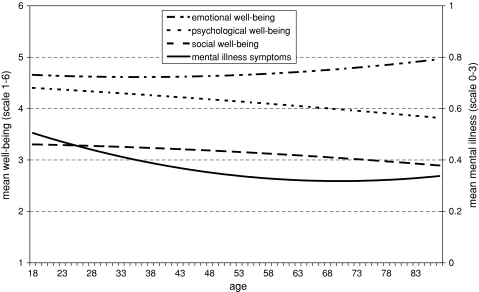
Mental health has long been defined as the absence of psychopathologies, such as depression and anxiety. The absence of mental illness, however, is a minimal outcome from a psychological perspective on lifespan development. This article therefore focuses on mental illness as well as on three core components of positive mental health: feelings of happiness and satisfaction with life (emotional well-being), positive individual functioning in terms of self-realization (psychological well-being), and positive societal functioning in terms of being of social value (social well-being). The two continua model holds that mental illness and mental health are related but distinct dimensions. This model was studied on the basis of a cross-sectional representative internet survey of Dutch adults (N = 1,340; 18-87 years). Mental illness was measured with the Brief Symptom Inventory and mental health with the Mental Health Continuum Short Form. It was found that older adults, except for the oldest-old, scored lower on psychopathological symptoms and were less likely to be mentally ill than younger adults. Although there were fewer age differences for mental health, older adults experienced more emotional, similar social and slightly lower psychological well-being. In sum, today's older adults have fewer mental illness problems, but they are not in a better positive mental health than today's younger adults. These findings support the validity of the two continua model in adult development.
Overview
The claims and statistics of this paper haven’t been checked yet.
Free: it reads the open-access text and checks the first 5 claims that cite a source we can check. Create a free account to check every claim.
Integrity signals
Registry
Cites
Statistics
Figures
Verification
Claims the paper makes
The claims and statistics of this paper haven’t been checked yet.
Free: it reads the open-access text and checks the first 5 claims that cite a source we can check. Create a free account to check every claim.
Claims other papers make about this one
Each is checked against this paper’s own text: does it say what the citing paper says it does?
The source backs part of the claim, not all of it — or backs it for a different population, condition or comparison.
In the citing paper
“The MHC-SF has demonstrated good psychometric properties across various age groups and nations (Lamers et al., 2011, Westerhof and Keyes, 2010).”
From The link between stress, well-being, and psychological flexibility during an Acceptance and Commitment Therapy self-help intervention (2018) · cites this paper as Westerhof and Keyes, 2010
Experimental — accuracy not yet measuredThe cited source says what the claim attributes to it.
In the citing paper
“The dual-factor model of mental health suggests that enhancing positive mental health and alleviating psychopathology do not automatically go hand-in-hand (Keyes, 2005a).”
From Both positive mental health and psychopathology should be monitored in psychotherapy: Confirmation for the dual-factor model in acceptance and commitment therapy (2017) · cites this paper as Westerhof & Keyes, 2009
The cited source says what the claim attributes to it.
In the citing paper
“Although the dual-factor model has been wellestablished in cross-sectional studies (e.g., Westerhof & Keyes, 2009), this is the first study to our knowledge that has investigated the applicability of the dual-factor model of mental health in an intervention study based on an effective psychotherapeutic intervention, namely, ACT (Fledderus et al., 2012).”
From Both positive mental health and psychopathology should be monitored in psychotherapy: Confirmation for the dual-factor model in acceptance and commitment therapy (2017) · cites this paper as Westerhof & Keyes, 2009
The cited source says what the claim attributes to it.
In the citing paper
“This model has been replicated in both American and international samples and across the lifespan (Keyes, 2002; Westerhof & Keyes, 2010).”
From Trajectories of change in well-being during cognitive behavioral therapies for anxiety disorders: Quantifying the impact and covariation with improvements in anxiety (2020) · cites this paper as Westerhof & Keyes, 2010
The cited source says what the claim attributes to it.
In the citing paper
“Nonetheless, mental health is not merely the absence of mental illness, and the two are related but distinct (Westerhof & Keyes, 2010); therefore, wellbeing services may also help to improve mental health without reducing symptoms.”
From Content Moderator Mental Health and Associations with Coping Styles: Replication and Extension of Previous Studies (2025) · cites this paper as Westerhof & Keyes, 2010
4 more claims about this paper
Create a free account to see every claim other papers make about this one.
Self-check
Percentages, sums and reported differences re-computed from the paper’s own numbers.
The self-check needs the paper’s full text.
Citations
Cites
Happiness is everything, or is it? Explorations on the meaning of psychological well-being.
Ryff, C. D. (1989) · Journal of Personality and Social Psychology · doi:10.1037/0022-3514.57.6.1069 · Cited by 14,847 · cited 5×
“Psychologists started to reflect on the notion of well-being in terms of individual strivings and optimal functioning (Ryan and Deci 2001; Ryff 1989), which gave rise to the second tradition of research, called eudaimonic well-being.”
BackgroundInfluentialSubjective well-being: Three decades of progress.
Diener, E., Suh, E. M., Lucas, R. E., & Smith, H. L. (1999) · Psychological Bulletin · doi:10.1037/0033-2909.125.2.276 · Cited by 12,910
On Happiness and Human Potentials: A Review of Research on Hedonic and Eudaimonic Well-Being
Ryan, R. M., & Deci, E. L. (2001) · Annual Review of Psychology · doi:10.1146/annurev.psych.52.1.141 · Cited by 11,567 · cited 4×
“Psychologists started to reflect on the notion of well-being in terms of individual strivings and optimal functioning (Ryan and Deci 2001; Ryff 1989), which gave rise to the second tradition of research, called eudaimonic well-being.”
BackgroundInfluentialDiener, E. (1984) · Psychological Bulletin · doi:10.1037/0033-2909.95.3.542 · Cited by 11,023
Diener, E. (2009) · Social Indicators Research Series · doi:10.1007/978-90-481-2350-6_2 · Cited by 10,950
The structure of psychological well-being revisited.
Ryff, C. D., & Keyes, C. L. M. (1995) · Journal of Personality and Social Psychology · doi:10.1037//0022-3514.69.4.719 · Cited by 10,285 · cited 5×
“This procedure resulted in a sample of 1,662 respondents who filled out the questionnaire in December 2007 (a response of 76% of those who participated in the panel).”
BackgroundMethodInfluentialSelf-citationВзаимосвязь статуса занятости и пола с уровнем психологического благополучия
М.Р., Н., & С.И., Б. (2026) · Cifra LLC Journals · doi:10.60797/irj.2026.170.43 · Cited by 7,950
The mental health continuum: from languishing to flourishing in life.
Keyes, C. L. M. (2002) · Journal of Health and Social Behavior · doi:10.2307/3090197 · Cited by 5,133 · cited 5×
“The findings of this study provide strong support for the two continua model of mental illness and health (Keyes 2002, 2005, 2007).”
BackgroundResultInfluentialSelf-citationThe Structure of Psychological Well-Being.
Mechanic, D., & Bradburn, N. M. (1970) · American Sociological Review · doi:10.2307/2093340 · Cited by 4,923 · cited 1×
“In the social sciences, this tradition dates back to survey research in the 1960s and 1970s, when scholars started to study the quality of American life from the perspective of citizens themselves (Andrews and Withey 1976; Bradburn 1969; Campbell et al. 1976; Cantril 1965; Gurin et al. 1960).”
BackgroundSocial Indicators of Well-Being
Andrews, F. M., & Withey, S. B. (1976) · Springer eBooks · doi:10.1007/978-1-4684-2253-5 · Cited by 3,653 · cited 1×
“In the social sciences, this tradition dates back to survey research in the 1960s and 1970s, when scholars started to study the quality of American life from the perspective of citizens themselves (Andrews and Withey 1976; Bradburn 1969; Campbell et al. 1976; Cantril 1965; Gurin et al. 1960).”
Background
Research works printed but not linked: 3
- Derogatis, L. R. (1975). The Brief Symptom Inventory. Baltimore, MD.: Clinical Psychometric Research.
- Westerhof, G. J. (2001). Wohlbefinden in der zweiten Lebenshälfte [Well-being in the second half of life]. In F. Dittmann-Kohli, C. Bode, & G. J. Westerhof (Eds.), Die zweite Lebenshälfte—Psychologische Perspektiven. Ergebnisse des Alters-Survey (pp. 79–128). Stuttgart: Kohlhammer.
- Westerhof, G. J., & Keyes, C. L. M. (2008). Geestelijke gezondheid is meer dan de afwezigheid van geestelijke ziekte [Mental health is more than the absence of mental illness]. Maandblad Geestelijke Volksgezondheid, 63, 808–820.
Cited by
Items 401–500 of 1,001
Regional agricultural cooperatives and subjective wellbeing of rural households in China
Wu, L., Li, C., & Gao, Y. (2021) · Regional Science Policy & Practice · doi:10.1111/rsp3.12502 · Cited by 27
Manoiu, R., Hammond, N. G., Yamin, S., & Stinchcombe, A. (2022) · Canadian Journal on Aging / La Revue canadienne du vieillissement · doi:10.1017/s0714980822000162 · Cited by 24
Assessment of the Mental Health Continuum in a Sample of Argentinean Adults
Góngora, V. C., & Solano, A. C. (2017) · Psychology · doi:10.4236/psych.2017.83018 · Cited by 20
“…regard to sex, studies have found higher levels of mental health in Italian and American men (Keyes, 2005; Petrillo et al., 2015), in Dutch women (Westerhof & Keyes, 2010), and no differences between Canadian, Korean, and Chinese men and women (Gilmour, 2014; Lim et al., 2013; Yin et al., 2013).”
BackgroundSalutogenic service user involvement in nursing research: A case study
Mjøsund, N. H., Vinje, H. F., Eriksson, M., Haaland‐Øverby, M., Jensen, S. L., Kjus, S. H. H., Norheim, I., Portaasen, I., & Espnes, G. A. (2018) · Journal of Advanced Nursing · doi:10.1111/jan.13708 · Cited by 18
Trompetter, H. R., Mols, F., & Westerhof, G. J. (2019) · Frontiers in Psychology · doi:10.3389/fpsyg.2019.02443 · Cited by 17
Self-citationThe relationship between education and self-reported mental and physical health
Kurspahić-Mujčić, A., & Mujčić, A. (2018) · Medicinski Glasnik · doi:10.17392/969-19 · Cited by 20
“Westerhof and Keyes found that older age was correlated with lower positive affect, less feeling of personal growth and purpose in life, less meaning in life and less social coherence and social contribution (33).”
BackgroundSocioeconomic Stratification and Mental Disorder
Eaton, W. W., & Muntaner, C. (2017) · Cambridge University Press eBooks · doi:10.1017/9781316471289.016 · Cited by 21
Kemp, A. H., Tree, J. J., Gracey, F., & Fisher, Z. (2022) · Frontiers in Psychology · doi:10.3389/fpsyg.2022.868810 · Cited by 21
“For instance, the two continua model (Westerhof and Keyes, 2010) presents mental illness and (positive) mental health as related but distinct phenomena, reinforcing the possibility that one can experience ill-health (including mental illness) at the same time as a moderate level of mental health.”
BackgroundLuruli, K., Mostert, K., & Jacobs, M. (2020) · Journal of Psychology in Africa · doi:10.1080/14330237.2020.1767925 · Cited by 23
Malboeuf‐Hurtubise, C., Tomaso, C. D., Lefrançois, D., Mageau, G. A., Taylor, G., Éthier, M., Gagnon, M., & Léger‐Goodes, T. (2021) · International Journal of Environmental Research and Public Health · doi:10.3390/ijerph182312332 · Cited by 28
“, symptoms of psychopathology such as anxiety, depression and inattention) [12].”
BackgroundFarmer, G. M., Ohan, J. L., Finlay‐jones, A. L., & Bayliss, D. M. (2022) · Mindfulness · doi:10.1007/s12671-022-02051-x · Cited by 31
Expectations of Leaders’ Mental Health
Cloutier, A. E., & Barling, J. I. (2023) · Journal of Leadership & Organizational Studies · doi:10.1177/15480518231178637 · Cited by 33
Scutt, K., Ali, K., Rieger, E., Monaghan, C., Ford, R., Fabry, E., & Fassnacht, D. (2023) · British Journal of Clinical Psychology · doi:10.1111/bjc.12439 · Cited by 15
Hermann, V., Söderqvist, F., Karlsson, A., Sarkadi, A., & Durbeej, N. (2024) · PLoS ONE · doi:10.1371/journal.pone.0299225 · Cited by 23
Perceived well-being and mental health in haemophilia
Negri, L., Buzzi, A., Aru, A. B., Cannavò, A., Castegnaro, C., Fasulo, M. R., Lassandro, G., Rocino, A., Santoro, C., Sottilotta, G., et al. (2020) · Psychology Health & Medicine · doi:10.1080/13548506.2020.1717556 · Cited by 16
Mækelæ, M. J., Reggev, N., Dutra, N. B., Tamayo, R. M., Defelipe, R. P., Klevjer, K., & Pfuhl, G. (2021) · Frontiers in Psychology · doi:10.3389/fpsyg.2021.661149 · Cited by 21
“Mental health relies on two distinct yet correlated dimensions of mental illness and positive mental health (Westerhof and Keyes, 2010; Provencher and Keyes, 2011).”
BackgroundPositive Mental Health and Wellbeing
White, S. C., & Eyber, C. (2017) · Palgrave Macmillan UK eBooks · doi:10.1057/978-1-137-39510-8_7 · Cited by 20
Individual values and household finances
Gogolin, F., Dowling, M., & Cummins, M. (2016) · Applied Economics · doi:10.1080/00036846.2016.1262528 · Cited by 23
“, 2012), mental health (Westerhof and Keyes, 2010), health insurance (von Ophem and Berkhout, 2012), and perceptions of equity market efficiency (Kaplanski et al.”
BackgroundMethodKeith, V. M., & Brown, D. R. (2009) · Cambridge University Press eBooks · doi:10.1017/cbo9780511984945.019 · Cited by 24
Tokarz, A., & Malinowska, D. (2019) · Sustainability · doi:10.3390/su11082222 · Cited by 23
“The two continua model, which holds that mental health and mental illness are related, but distinct dimensions, has been validated in other research within a European sample [25].”
ResultMorrish, L., Chin, T., Rikard, N., Sigley‐Taylor, P., & Vella‐Brodrick, D. (2019) · International Journal of Wellbeing · doi:10.5502/ijw.v9i2.730 · Cited by 24
“This represents a clear gap in our current understanding and fails to acknowledge the full spectrum of mental health, which includes distinct dimensions of positive and negative functioning (Westerhof & Keyes, 2010).”
BackgroundUnderstanding the Connection between Social Support and Mental Health
Brown, R. L., & Ciciurkaite, G. (2017) · Cambridge University Press eBooks · doi:10.1017/9781316471289.014 · Cited by 21
Corman, M., Dambrun, M., Ginzac, A., & Ménard, K. (2025) · BMC Palliative Care · doi:10.1186/s12904-025-01719-0 · Cited by 29
“This approach, conceptualized by Westerhof & Keyes [29] for example, considers health and illness as two distinct continua, where health is not only the absence of disease but also the presence of “positive” factors that promote well-being and resiliency [29].”
Foster, K., Alexander, L., Steele, M. C., Hale, T., Hutchison, L., Trejo, R., & Boardman, J. (2025) · BMC Nursing · doi:10.1186/s12912-025-03066-0 · Cited by 16
“The presence of mental distress does not necessarily mean a lack of wellbeing [42].”
Hugh-Jones, S., Ray, S., Wilding, A., Sutton, M., Humphrey, N., & Munford, L. A. (2025) · SSM - Population Health · doi:10.1016/j.ssmph.2025.101845 · Cited by 23
Gustafsson, B. M. (2018) · Linköping University medical dissertations · doi:10.3384/diss.diva-153581 · Cited by 16
Chinese international students’ conceptualizations of wellbeing: A prototype analysis
Huang, L., Kern, M. L., & Oades, L. G. (2022) · Frontiers in Psychology · doi:10.3389/fpsyg.2022.939576 · Cited by 21
“Alternatively, Keyes and colleagues have emphasized a dual continuum model, in which mental health and mental illness represent two separate dimensions (Westerhof and Keyes, 2010).”
BackgroundScalas, L. F., Lodi, E., Magnano, P., & Marsh, H. W. (2023) · BMC Psychology · doi:10.1186/s40359-023-01485-9 · Cited by 22
“…of three fundamental dimensions: “feelings of happiness and satisfaction with life (emotional well-being), positive individual functioning in terms of self-realization (psychological well-being), and positive societal functioning in terms of being of social value (social well-being)” [20, p. 110].”
BackgroundYıldırım, M., Batmaz, H., Kurtuluş, H. Y., & Kurtuluş, E. (2025) · Youth & Society · doi:10.1177/0044118x251317538 · Cited by 13
“…of these mental problems, but also the presence of positive emotions, and positive functionality in personal life and community life, it also shows the importance of the concept of the mental health continuum, which includes emotional, psychological, and social well-being (Westerhof & Keyes, 2010).”
Psychometric Properties of the Mental Health Continuum – Short Form in a Psychiatric Sample
Silverman, A. L., Forgeard, M. J. C., Beard, C., & Björgvinsson, Þ. (2018) · Journal of Well-Being Assessment · doi:10.1007/s41543-018-0011-3 · Cited by 15
Aruta, J. J. B. R., Almazan, J. U., Alamri, M. S., Adolfo, C. S., & Gonzales, F. (2022) · Current Psychology · doi:10.1007/s12144-022-02828-2 · Cited by 16
“The bidimensional model of mental health (Westerhoff & Keyes, 2010) argues that it is necessary to view mental health not only by the presence of psychopathology (i.e., negative mental health) but also by the flourishing of well-being (i.e., positive mental health).”
BackgroundMethodMarquez, J., Inchley, J., & Long, E. (2022) · Child Indicators Research · doi:10.1007/s12187-022-09930-8 · Cited by 16
Gustafsson, B. M., Gustafsson, P. A., Granlund, M., Proczkowska, M., & Almqvist, L. (2020) · Scandinavian Journal of Psychology · doi:10.1111/sjop.12700 · Cited by 25
“The result provides implicit support for Westerhof and Keyes et al .”
Wu, J., Li, Q., Chi, P., Zhao, J., & Zhao, J. (2021) · Current Psychology · doi:10.1007/s12144-021-01796-3 · Cited by 18
“According to the literature, indicators of well-being in individuals should take into account both positive and negative aspects, because the two aspects of well-being have distinct correlates despite being interrelated (Du et al., 2019; Westerhof & Keyes, 2010).”
BackgroundUnraveling resilience: Personality predicts exposure and reaction to stressful life events
Asselmann, E., Klimstra, T. A., & Denissen, J. J. A. (2021) · Personality Science · doi:10.5964/ps.6055 · Cited by 19
Gallagher, M. W., Phillips, C. A., D'Souza, J., Richardson, A., Long, L. J., Boswell, J. F., Farchione, T. J., & Barlow, D. H. (2020) · Psychotherapy · doi:10.1037/pst0000283 · Cited by 13
“This model has been replicated in both American and international samples and across the lifespan (Keyes, 2002; Westerhof & Keyes, 2010).”
ResultRisk and Causative Factors of Psychological Harm Among Construction Workers: A Systematic Review
Rahman, A., Leifels, K., & Osakwe, K. A. (2025) · Workplace Health & Safety · doi:10.1177/21650799241303529 · Cited by 23
“Mental wellbeing, as opposed to merely the absence of mental illness, involves a state of thriving mental health characterized by positive emotions, life satisfaction, and effective functioning in daily life (Westerhof & Keyes, 2010).”
InfluentialDiaconu‐Gherasim, L. R., & Mardari, C. R. (2021) · Journal of Happiness Studies · doi:10.1007/s10902-021-00390-5 · Cited by 19
Kabir, R. S., Doku, D. T., & Wiium, N. (2021) · Frontiers in Psychology · doi:10.3389/fpsyg.2021.676376 · Cited by 17
Lee, H.-C., & Fung, J. J. (2022) · Journal of Psychology and Theology · doi:10.1177/00916471221099543 · Cited by 23
Psychometric Properties of the Portuguese Version of The PERMA-Profiler
Alves, M. A., Palmer, S., & Gouveia, M. J. (2023) · Trends in Psychology · doi:10.1007/s43076-023-00261-3 · Cited by 23
“This construct derives, theoretically, from the understanding of mental health beyond the absence of mental disease, as a general state of positive feelings and functioning effectively in life (Huppert, 2009; Seligman, 2011; Westerhof & Keyes, 2010).”
Otten, D., Heller, A., Schmidt, P. S., Beutel, M. E., & Brähler, E. (2023) · Social Psychiatry and Psychiatric Epidemiology · doi:10.1007/s00127-023-02479-z · Cited by 19
“With regard to age effects, a Dutch study revealed self-reported prevalence of mental illnesses to be lower and general mental health to be better for the elderly [6].”
BackgroundLiu, Y., Hatch, S. L., Patalay, P., Schott, J. M., & Richards, M. (2023) · Journal of Affective Disorders · doi:10.1016/j.jad.2023.07.001 · Cited by 16
Aalto, E. P., Pons, J., Alcaraz, S., Zamora‐Solé, R., & Ramis, Y. (2024) · European Journal of Sport Science · doi:10.1002/ejsc.12218 · Cited by 34
Differences between Self-forgiveness and Interpersonal Forgiveness in Relation to Mental Health
Tenklová, L., & Slezáčková, A. (2016) · Journal of the Indian Academy of Applied Psychology · Cited by 18
Šinko, L., Zonp, Z., Schaitkin, C., & Arnault, D. S. (2021) · Journal of Family Violence · doi:10.1007/s10896-021-00333-x · Cited by 15
Victor, P. P., Schürmann‐Vengels, J., Muermans, M. M., Teismann, T., & Willutzki, U. (2019) · Zeitschrift für Psychiatrie Psychologie und Psychotherapie · doi:10.1024/1661-4747/a000388 · Cited by 13
Dose, É., Desrumaux, P., & Colombat, P. (2019) · Psychologie du Travail et des Organisations · doi:10.1016/j.pto.2019.09.002 · Cited by 21
Muslić, L., Burić, D. J., Markelić, M., & Milanović, S. M. (2021) · Socijalna psihijatrija · doi:10.24869/spsih.2020.324 · Cited by 34
A Polygenic Approach to Understanding Resilience to Peer Victimisation
Armitage, J. M., Wang, A., Davis, O. S. P., & Haworth, C. M. A. (2021) · Behavior Genetics · doi:10.1007/s10519-021-10085-5 · Cited by 15
“Well-being refers to feelings of satisfaction and happiness (Diener 2000) and is therefore more than the absence of a mental illness (Westerhof and Keyes 2010).”
BackgroundWagener, A., Stassart, C., & Etienne, A.-M. (2022) · International Journal of Environmental Research and Public Health · doi:10.3390/ijerph19105908 · Cited by 12
“The first one finds its source in the two continua model of mental illness developed by Westerhof and Keyes (2010) [54].”
BackgroundEkelöf, K., Almquist‐Tangen, G., Nyström, C. D., Löf, M., & Thomas, K. (2025) · BMC Pregnancy and Childbirth · doi:10.1186/s12884-025-07894-5 · Cited by 27
Social support and bidimensional mental health among primary-level teachers during COVID-19 crisis
Casanova, B. E. C., Felix, C. A. C., Balingit, N. D. Z., de Vera, A. M. F., Briones, M. D. M., & Aruta, J. J. B. R. (2022) · International Journal of School & Educational Psychology · doi:10.1080/21683603.2022.2105998 · Cited by 16
“This conceptualization is called bidimensional mental health, also known as dual-factor or twocontinua mental health (Greenspoon & Sasklofske, 2001; Westerhof & Keyes, 2010).”
BackgroundDevelopment and validation of the Nurse’s Workplace Mental Health Questionnaire
Lai, J., Zhang, R., Hong, M., & Li, N. (2022) · International Journal of Nursing Sciences · doi:10.1016/j.ijnss.2022.09.004 · Cited by 17
“Methods: The questionnaire was developed based on the two continua model of mental illness and health proposed by Keyes.”
MethodBulisig, J. A. C., & Aruta, J. J. B. R. (2022) · Mental Health Religion & Culture · doi:10.1080/13674676.2022.2031939 · Cited by 13
“The bidimensional mental health model argued that research and mental health intervention should not only focus on the psycho-pathological symptoms of mental health but also its fl ourishing aspect (Aruta & Montes, 2022; Greenspoon & Sasklofske, 2001; Westerhof & Keyes, 2010).”
MethodBarros, P., Assar, R., Botto, A., Leighton, C., Quevedo, Y., & Jiménez, J. P. (2022) · Healthcare · doi:10.3390/healthcare10122463 · Cited by 23
“This result can be explained by the two-continua model, where the presence/absence of mental illness and mental health are different but related phenomena [29].”
ResultInfluentialDating Violence and Mental Health in Emerging Adulthood
Aznar, M. P. M., Hernández-Lorenzo, D. E., Fortes, D., & Fernández, I. I. (2023) · Healthcare · doi:10.3390/healthcare11243172 · Cited by 27
“Moreover, although mental health has been traditionally defined as the absence of psychopathologies such as anxiety or depression [45], this conceptualization has been shown to be insufficient from a perspective on lifespan development, since mental health has been defined “as a positive phenomenon…”
BackgroundStudent well-being: In search of definitions, measures, and research designs
Wentzel, K. R. (2024) · Learning and Instruction · doi:10.1016/j.learninstruc.2024.101990 · Cited by 25
A dual-continuum framework to evaluate climate change impacts on mental health
Vergunst, F., Smith, R. W., Massazza, A., Berry, H. L., & Olff, M. (2024) · Nature Mental Health · doi:10.1038/s44220-024-00326-x · Cited by 19
“These studies support the validity of the approach at the phenotypic and genotypic levels 49,52 , across clinical and non-clinical populations 53–55 , in children, adolescents and adults 56–58 , and across the life course 19,59 .”
Silbersdorff, A., & Schneider, K. S. (2019) · International Journal of Environmental Research and Public Health · doi:10.3390/ijerph16204009 · Cited by 14
“Westerhof and Keyes [50] disentangled the effect of age on mental health (positive aspects) and mental illness with the help of four linear regression models with differing dependent variables.”
BackgroundBennett, R. J., Donaldson, S., Mansourian, Y., Olaithe, M., Kelsall-Foreman, I., Badcock, J. C., & Eikelboom, R. H. (2021) · American Journal of Audiology · doi:10.1044/2021_aja-21-00048 · Cited by 15
Feliu‐Soler, A., de Diego-Adeliño, J., Luciano, J. V., Castillo, I. I., Alemany, C., Puigdemont, D., Pérez, V., Portella, M. J., & Trujols, J. (2021) · International Journal of Environmental Research and Public Health · doi:10.3390/ijerph182010964 · Cited by 12
“, [20,81]) coherently with the two continua model of mental illness and mental health [82].”
BackgroundPacheco, T., Coulombe, S., & Meunier, S. (2021) · Frontiers in Psychology · doi:10.3389/fpsyg.2021.539582 · Cited by 15
Beyond depression: correlates of well-being in young adult survivors of childhood cancers
Kim, Y., Ritt‐Olson, A., Tobin, J. L., Haydon, M. D., & Milam, J. E. (2022) · Journal of Cancer Survivorship · doi:10.1007/s11764-022-01186-z · Cited by 16
“Mental health is more than simply the presence or absence of distress or mental illness [6].”
BackgroundPersonality traits and mental health care utilization: Longitudinal findings from the MIDUS
Goktan, A. J., Weston, S. J., Luo, J., Graham, E. K., & Mroczek, D. K. (2022) · Journal of Research in Personality · doi:10.1016/j.jrp.2022.104260 · Cited by 16
Laird, E., Bryant, C., Barr, C., & Bennett, R. J. (2022) · Ear and Hearing · doi:10.1097/aud.0000000000001257 · Cited by 13
Traducción al español y propiedades psicométricas del instrumento Positivity Self Test
Guzmán, L. G. C., & Berenzon, S. (2013) · Psicología Iberoamericana · doi:10.48102/pi.v21i1.166 · Cited by 23
Hope headquarters: recovery college
Jay, L., Macadam, B., Gardner, P., & Mahboub, L. (2017) · Health Promotion Journal of Australia · doi:10.1071/he17034 · Cited by 12
Improving Mental Health Outcomes Assessment with the Mental Health Inventory‐21
Hennessy, M., Patrick, J. C., & Swinbourne, A. L. (2017) · Australian Psychologist · doi:10.1111/ap.12330 · Cited by 12
“However, clinical research and consumer feedback support a focus on the positive aspects of mental health and the recovery journey (Andresen, Caputi, & Oades, 2010; Seligman, 2008; Westerhof & Keyes, 2010).”
BackgroundKuhdasht, R. N., Ghayeninejad, Z., & Nastiezaie, N. (2018) · Journal of Research and Health · doi:10.29252/jrh.8.2.189 · Cited by 17
Jiang, N., & Lü, N. (2018) · Clinical Gerontologist · doi:10.1080/07317115.2018.1470589 · Cited by 12
“Finally, based on the previous literature (Westerhof & Keyes, 2010), chronic diseases were measured with a checklist asking, “Have you ever been told by a health professional that you have . . .?” or “Have you ever been diagnosed with . . .?” for 11 conditions (e.g., stroke, diabetes,…”
BackgroundMethodResultInfluentialvan Zyl, L. E., & Olckers, C. (2019) · European Journal of Mental Health · doi:10.5708/ejmh.14.2019.2.2 · Cited by 12
Norozi, S. A. (2019) · Pastoral Care in Education · doi:10.1080/02643944.2019.1618378 · Cited by 26
Karajerjian, S. (2021) · Gender & Development · doi:10.1080/13552074.2021.1885216 · Cited by 14
Delivering national public mental health – experience from England
Walker, I., Stansfield, J., Makurah, L., Garnham, H., Robson, C., Lugton, C., Hey, N., & Henderson, G. (2019) · Journal of Public Mental Health · doi:10.1108/jpmh-06-2018-0032 · Cited by 15
The Contribution of Positive Self-Schemas to University Students’ Distress and Well-being
O’Byrne, R., Cherry, K. M., Collaton, J., & Lumley, M. N. (2020) · International Journal of Cognitive Therapy · doi:10.1007/s41811-020-00083-6 · Cited by 18
“…psychology; Seligman and Csikszentmihalyi 2014) that mental health and mental illness exist on separate continua, such that the presence of mental health cannot be inferred from the absence of mental illness (Keyes 2002, 2007; Moore et al. 2019; Pawelski 2016a, b; Westerhof and Keyes 2010).”
BackgroundMarquez, J., Lambert, L., & Cutts, M. (2022) · Child Indicators Research · doi:10.1007/s12187-022-09993-7 · Cited by 16
Examining sports coaches’ mental health literacy: evidence from UK athletics
Warden, S., Doncaster, G., Greenough, K., & Smith, A. W. (2023) · Sport Education and Society · doi:10.1080/13573322.2023.2214160 · Cited by 17
“…l the roles they are often expected to play in supporting athlete mental health, and their MHL more widely, it is necessary to go beyond quantitative survey data and explore their complex understandings of mental health and illness (Brossard & Chandler, 2022; Keyes, 2002; Westerhof & Keyes, 2010).”
Kloos, N., Kraiss, J. T., ten Klooster, P. M., & Bohlmeijer, E. T. (2023) · Journal of Clinical Psychology · doi:10.1002/jclp.23574 · Cited by 17
Public Mental Health Approaches to Online Radicalisation: An Empty Systematic Review
Mughal, R., DeMarinis, V., Nordendahl, M., Lone, H., Phillips, V., & Boyd-MacMillan, E. (2023) · International Journal of Environmental Research and Public Health · doi:10.3390/ijerph20166586 · Cited by 21
Mindfulness-based stress reduction for elementary school teachers: a randomized controlled trial
Lensen, J. H., Stoltz, S. E. M. J., Kleinjan, M., Kraiss, J. T., Scholte, R. H. J., & Speckens, A. E. M. (2024) · Frontiers in Education · doi:10.3389/feduc.2024.1385375 · Cited by 27
Ruini, C., Pira, G. L., Cordella, E., & Vescovelli, F. (2024) · Journal of Psychiatric and Mental Health Nursing · doi:10.1111/jpm.13099 · Cited by 19
“These frequencies provide important clinical data, since the presence/absence of well-being was found to predict mood and anxiety disorders in several longitudinal investigations (Iasiello et al., 2019 ; Schotanus-Dijkstra et al., 2019 ; Westerhof & Keyes, 2010 ; Wood & Joseph, 2010 ).”
Martínez-García, A., Montesino, S. V., & García, M. G. (2024) · International Journal of Qualitative Studies on Health and Well-Being · doi:10.1080/17482631.2024.2408831 · Cited by 19
“Second continuum is defined by flourishing (high mental health) and languishing (low mental health) each on every end of the continuum (Keyes, 2002, 2014b; Keyes, 2010; Westerhof & Keyes, 2010).”
BackgroundTeng, E., Venning, A., Winefield, H. R., & Crabb, S. (2015) · Social Inquiry into Well-Being · doi:10.13165/siiw-15-1-1-01 · Cited by 18
Solano, A. C., & Cosentino, A. C. (2019) · Europe’s Journal of Psychology · doi:10.5964/ejop.v15i4.1759 · Cited by 15
Fuller‐Thomson, E., & Ryckman, K. (2020) · Journal of Affective Disorders · doi:10.1016/j.jad.2019.12.004 · Cited by 13
“Although female gender was associated with complete mental health among those with anxiety in the fully adjusted logistic regression analysis, another study that looked at the general population did not find these relationships to be significant (Gilmour, 2014; Westerhof and Keyes, 2010).”
BackgroundRedmond, M. L., Buhrmann, A. S., & Fuller‐Thomson, E. (2021) · Substance Use & Misuse · doi:10.1080/10826084.2021.1922451 · Cited by 11
“…also found higher odds of CMH among older respondents (Baiden & Fuller‐Thomson, 2016)), which may reflect the fact that older respondents are better able to manage negative emotions (Westerhof & Keyes, 2010) and may purposefully focus on positive relationships and experiences (Carstensen, 1992).”
Backgroundde Carvalho, M. M., & Vale-Dias, M. D. L. (2021) · International Journal of Developmental and Educational Psychology Revista INFAD de psicología · doi:10.17060/ijodaep.2021.n2.v2.2234 · Cited by 12
“Considering that the prevalence of depression and anxiety disorders, at this age, is expressive (Westerhof & Keyes, 2010), having knowledge to identify mental health risks and protect mental well-being may lead to using appropriate coping strategies (Zhou et al., 2010).”
BackgroundTaniguchi, E., Thompson, C. M., & Reid, T. (2022) · Health Communication · doi:10.1080/10410236.2022.2086841 · Cited by 15
Baetens, I., Vanderfaeillie, J., Soyez, V., Vantilborgh, T., Meersschaut, J. V. D., Schotte, C., & Theuns, P. (2022) · Frontiers in Psychology · doi:10.3389/fpsyg.2022.889503 · Cited by 19
“This model distinguishes positive subjective wellbeing and psychopathology, as separate but related constructs (Keyes, 2005; Suldo and Shaffer, 2008; Westerhof and Keyes, 2010).”
BackgroundLapidos, A., Lopez-Vives, D., Sera, C. E., Ahearn, E., Vest, E., Senic, I., Voort, J. L. V., Frye, M. A., Goes, F. S., Achtyes, E. D., et al. (2022) · Journal of Affective Disorders · doi:10.1016/j.jad.2022.11.090 · Cited by 15
Mental Health among Young Adults during the COVID-19 Pandemic: A Two-Wave Longitudinal Investigation
Măirean, C., Zancu, S. A., Diaconu‐Gherasim, L. R., & Brumariu, L. E. (2023) · The Journal of Psychology · doi:10.1080/00223980.2023.2169230 · Cited by 12
Frimpong, S., Sunindijo, R. Y., Wang, C., Boadu, E. F., & Dansoh, A. (2023) · Buildings · doi:10.3390/buildings13041025 · Cited by 11
The emotion regulation strategies of flourishing adults
Richard-Sephton, P. B., Crisp, D. A., & Burns, R. A. (2023) · Current Psychology · doi:10.1007/s12144-023-05332-3 · Cited by 14
Happiness, Pain Intensity, Pain Interference, and Distress in Individuals with Physical Disabilities
Müller, R., Terrill, A. L., Jensen, M. P., Molton, I. R., Ravesloot, C., & Ipsen, C. (2015) · American Journal of Physical Medicine & Rehabilitation · doi:10.1097/phm.0000000000000294 · Cited by 13
“Research supports the latter case, indicating that individuals with fewer psychologic problems do not necessarily have better positive mental health.(55)”
BackgroundOf what use (or harm) is a positive health definition?
Hafen, M. (2016) · Journal of Public Health · doi:10.1007/s10389-016-0741-8 · Cited by 11
“tional definitions of health, or indirectly by means of a Btwo continua model of mental illness and mental health^ (Westerhof and Keyes 2010).”
BackgroundAscenso, S. (2021) · Frontiers in Psychology · doi:10.3389/fpsyg.2021.588905 · Cited by 14
Shirotsuki, K., Nonaka, Y., Abe, K., Adachi, S. I., Adachi, S., Kuboki, T., & Nakao, M. (2017) · BioPsychoSocial Medicine · doi:10.1186/s13030-017-0109-5 · Cited by 11
“In addition, it is often argued that management of psychological distress is important for optimum work performance, regardless of clinical significance [14, 15].”
BackgroundPsychosocial Health: Disparities Between Urban and Rural Communities
Wissing, M. P., Temane, Q. M., Khumalo, I. P., Kruger, A., & Vorster, H. H. (2013) · Cross-cultural advancements in positive psychology · doi:10.1007/978-94-007-6368-5_20 · Cited by 11
Seeing is believing: making wellbeing more tangible
Vella-Brodrick, D. A., Gill, A., & Patrick, K. (2022) · Frontiers in Psychology · doi:10.3389/fpsyg.2022.809108 · Cited by 10
Metadata
- Authors
- Westerhof, G. J., & Keyes, C. L. M.
- Affiliations
- University of Twente (NL)
- Emory University (US)
- Corresponding author
- Westerhof, Gerben J.
- Venue
- Journal of Adult Development
- Published
- 2009-08-26
- Volume
- 17
- Issue
- 2
- Pages
- 110-119
- ISSN
- 1068-0667 (ISSN-L)
- 1573-3440
- PMC
- PMC2866965
- OpenAlex
- W2117617786
- Cited by
- 1,345
- References
- 58
- Citations by year
- 2026: 131 · 2025: 148 · 2024: 158 · 2023: 135 · 2022: 137 · 2021: 134 · 2020: 104 · 2019: 66 · 2018: 60 · 2017: 83 · 2016: 43 · 2015: 43 · 2014: 24 · 2013: 27 · 2012: 22
- FWCI
- 21.92
- Type
- journal article
- Language
- en
- Open access
- hybrid
- doi.org
- Licence
- cc-by-nc
- Locations
- Journal of Adult Development (publishedVersion, cc-by-nc)
- Europe PMC (PubMed Central) (publishedVersion, cc-by-nc)
- PubMed Central (publishedVersion, cc-by-nc)
- PubMed (publishedVersion)
- University of Twente Research Information (submittedVersion)
- University of Twente Research Information (submittedVersion, other-oa)
- Topics
- Social Sciences › Psychology › Social Psychology › Psychological Well-being and Life Satisfaction
- Social Sciences › Psychology › Developmental and Educational Psychology › Aging and Gerontology Research
- Health Sciences › Medicine › Public Health, Environmental and Occupational Health › Aging, Health, and Disability
- Keywords
- mental illness, mental health, positive mental health, emotional well-being, psychological well-being, social well-being, lifespan development, age differences, older adults, psychiatric symptoms, happiness, life satisfaction, self-realization, social values
About these checks
Registry, retraction, Cites and statistics results are computed, not judged, with one exception: a printed reference that no index lists is read once by a model before it counts as a citation error. Claims are extracted by a model and kept only when their quote appears verbatim in the text; each cited source is then checked, with a model’s help, for whether it says what the claim relies on. Those verdicts can be wrong — read the claim’s quote and the cited source before relying on one.
Statistics and arithmetic are recomputed, not judged.
Confidence bands are shown only for fields calibrated on our annotated test set. None is calibrated yet, so no band is shown.
What counts as a claim ›How we measure confidence ›How we check this ›
Are you an author, or do you see a problem with this page? Request a review
Data sources
Bibliographic data: Semantic Scholar, OpenAlex, Crossref.
Contains information from the Semantic Scholar Academic Graph Datasets, made available under the ODC Attribution License (ODC-BY 1.0).
Semantic Scholar’s data is described in: Kinney, R., et al. (2023). The Semantic Scholar Open Data Platform. arXiv:2301.10140.
