

Mental Illness and Mental Health: The Two Continua Model Across the Lifespan
Open accessThe DOI matches its Crossref record; 53 of the 58 references it cites were found in a registry or an index.
Abstract
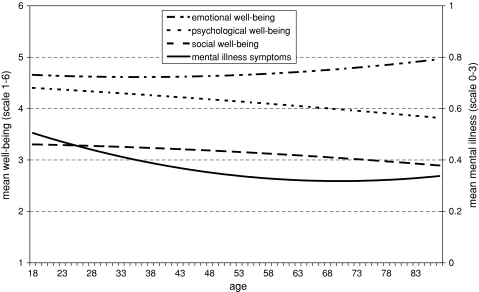
Mental health has long been defined as the absence of psychopathologies, such as depression and anxiety. The absence of mental illness, however, is a minimal outcome from a psychological perspective on lifespan development. This article therefore focuses on mental illness as well as on three core components of positive mental health: feelings of happiness and satisfaction with life (emotional well-being), positive individual functioning in terms of self-realization (psychological well-being), and positive societal functioning in terms of being of social value (social well-being). The two continua model holds that mental illness and mental health are related but distinct dimensions. This model was studied on the basis of a cross-sectional representative internet survey of Dutch adults (N = 1,340; 18-87 years). Mental illness was measured with the Brief Symptom Inventory and mental health with the Mental Health Continuum Short Form. It was found that older adults, except for the oldest-old, scored lower on psychopathological symptoms and were less likely to be mentally ill than younger adults. Although there were fewer age differences for mental health, older adults experienced more emotional, similar social and slightly lower psychological well-being. In sum, today's older adults have fewer mental illness problems, but they are not in a better positive mental health than today's younger adults. These findings support the validity of the two continua model in adult development.
Overview
The claims and statistics of this paper haven’t been checked yet.
Free: it reads the open-access text and checks the first 5 claims that cite a source we can check. Create a free account to check every claim.
Integrity signals
Registry
Cites
Statistics
Figures
Verification
Claims the paper makes
The claims and statistics of this paper haven’t been checked yet.
Free: it reads the open-access text and checks the first 5 claims that cite a source we can check. Create a free account to check every claim.
Claims other papers make about this one
Each is checked against this paper’s own text: does it say what the citing paper says it does?
The source backs part of the claim, not all of it — or backs it for a different population, condition or comparison.
In the citing paper
“The MHC-SF has demonstrated good psychometric properties across various age groups and nations (Lamers et al., 2011, Westerhof and Keyes, 2010).”
From The link between stress, well-being, and psychological flexibility during an Acceptance and Commitment Therapy self-help intervention (2018) · cites this paper as Westerhof and Keyes, 2010
Experimental — accuracy not yet measuredThe cited source says what the claim attributes to it.
In the citing paper
“The dual-factor model of mental health suggests that enhancing positive mental health and alleviating psychopathology do not automatically go hand-in-hand (Keyes, 2005a).”
From Both positive mental health and psychopathology should be monitored in psychotherapy: Confirmation for the dual-factor model in acceptance and commitment therapy (2017) · cites this paper as Westerhof & Keyes, 2009
The cited source says what the claim attributes to it.
In the citing paper
“Although the dual-factor model has been wellestablished in cross-sectional studies (e.g., Westerhof & Keyes, 2009), this is the first study to our knowledge that has investigated the applicability of the dual-factor model of mental health in an intervention study based on an effective psychotherapeutic intervention, namely, ACT (Fledderus et al., 2012).”
From Both positive mental health and psychopathology should be monitored in psychotherapy: Confirmation for the dual-factor model in acceptance and commitment therapy (2017) · cites this paper as Westerhof & Keyes, 2009
The cited source says what the claim attributes to it.
In the citing paper
“This model has been replicated in both American and international samples and across the lifespan (Keyes, 2002; Westerhof & Keyes, 2010).”
From Trajectories of change in well-being during cognitive behavioral therapies for anxiety disorders: Quantifying the impact and covariation with improvements in anxiety (2020) · cites this paper as Westerhof & Keyes, 2010
The cited source says what the claim attributes to it.
In the citing paper
“Nonetheless, mental health is not merely the absence of mental illness, and the two are related but distinct (Westerhof & Keyes, 2010); therefore, wellbeing services may also help to improve mental health without reducing symptoms.”
From Content Moderator Mental Health and Associations with Coping Styles: Replication and Extension of Previous Studies (2025) · cites this paper as Westerhof & Keyes, 2010
4 more claims about this paper
Create a free account to see every claim other papers make about this one.
Self-check
Percentages, sums and reported differences re-computed from the paper’s own numbers.
The self-check needs the paper’s full text.
Citations
Cites
Happiness is everything, or is it? Explorations on the meaning of psychological well-being.
Ryff, C. D. (1989) · Journal of Personality and Social Psychology · doi:10.1037/0022-3514.57.6.1069 · Cited by 14,847 · cited 5×
“Psychologists started to reflect on the notion of well-being in terms of individual strivings and optimal functioning (Ryan and Deci 2001; Ryff 1989), which gave rise to the second tradition of research, called eudaimonic well-being.”
BackgroundInfluentialSubjective well-being: Three decades of progress.
Diener, E., Suh, E. M., Lucas, R. E., & Smith, H. L. (1999) · Psychological Bulletin · doi:10.1037/0033-2909.125.2.276 · Cited by 12,910
On Happiness and Human Potentials: A Review of Research on Hedonic and Eudaimonic Well-Being
Ryan, R. M., & Deci, E. L. (2001) · Annual Review of Psychology · doi:10.1146/annurev.psych.52.1.141 · Cited by 11,567 · cited 4×
“Psychologists started to reflect on the notion of well-being in terms of individual strivings and optimal functioning (Ryan and Deci 2001; Ryff 1989), which gave rise to the second tradition of research, called eudaimonic well-being.”
BackgroundInfluentialDiener, E. (1984) · Psychological Bulletin · doi:10.1037/0033-2909.95.3.542 · Cited by 11,023
Diener, E. (2009) · Social Indicators Research Series · doi:10.1007/978-90-481-2350-6_2 · Cited by 10,950
The structure of psychological well-being revisited.
Ryff, C. D., & Keyes, C. L. M. (1995) · Journal of Personality and Social Psychology · doi:10.1037//0022-3514.69.4.719 · Cited by 10,285 · cited 5×
“This procedure resulted in a sample of 1,662 respondents who filled out the questionnaire in December 2007 (a response of 76% of those who participated in the panel).”
BackgroundMethodInfluentialSelf-citationВзаимосвязь статуса занятости и пола с уровнем психологического благополучия
М.Р., Н., & С.И., Б. (2026) · Cifra LLC Journals · doi:10.60797/irj.2026.170.43 · Cited by 7,950
The mental health continuum: from languishing to flourishing in life.
Keyes, C. L. M. (2002) · Journal of Health and Social Behavior · doi:10.2307/3090197 · Cited by 5,133 · cited 5×
“The findings of this study provide strong support for the two continua model of mental illness and health (Keyes 2002, 2005, 2007).”
BackgroundResultInfluentialSelf-citationThe Structure of Psychological Well-Being.
Mechanic, D., & Bradburn, N. M. (1970) · American Sociological Review · doi:10.2307/2093340 · Cited by 4,923 · cited 1×
“In the social sciences, this tradition dates back to survey research in the 1960s and 1970s, when scholars started to study the quality of American life from the perspective of citizens themselves (Andrews and Withey 1976; Bradburn 1969; Campbell et al. 1976; Cantril 1965; Gurin et al. 1960).”
BackgroundSocial Indicators of Well-Being
Andrews, F. M., & Withey, S. B. (1976) · Springer eBooks · doi:10.1007/978-1-4684-2253-5 · Cited by 3,653 · cited 1×
“In the social sciences, this tradition dates back to survey research in the 1960s and 1970s, when scholars started to study the quality of American life from the perspective of citizens themselves (Andrews and Withey 1976; Bradburn 1969; Campbell et al. 1976; Cantril 1965; Gurin et al. 1960).”
Background
Research works printed but not linked: 3
- Derogatis, L. R. (1975). The Brief Symptom Inventory. Baltimore, MD.: Clinical Psychometric Research.
- Westerhof, G. J. (2001). Wohlbefinden in der zweiten Lebenshälfte [Well-being in the second half of life]. In F. Dittmann-Kohli, C. Bode, & G. J. Westerhof (Eds.), Die zweite Lebenshälfte—Psychologische Perspektiven. Ergebnisse des Alters-Survey (pp. 79–128). Stuttgart: Kohlhammer.
- Westerhof, G. J., & Keyes, C. L. M. (2008). Geestelijke gezondheid is meer dan de afwezigheid van geestelijke ziekte [Mental health is more than the absence of mental illness]. Maandblad Geestelijke Volksgezondheid, 63, 808–820.
Cited by
Items 201–300 of 1,001
A Handbook for the Study of Mental Health: Social Contexts, Theories, and Systems
Scheid, T. L., & Wright, E. R. (2017) · Cambridge University Press eBooks · doi:10.1017/9781316471289 · Cited by 60
Groot, J., MacLellan, A., Butler, M., Todor, E., Zulfiqar, M., Thackrah, T., Clarke, C., Brosnan, M., & Ainsworth, B. (2023) · JMIR Mental Health · doi:10.2196/44658 · Cited by 37
“Traditionally, it was thought that mental well-being would arise in the absence of mental illness, as they were considered opposite ends of 1 continuum [4].”
BackgroundKocjan, G. Z., Lavtar, D., & Sočan, G. (2022) · Behavior Research Methods · doi:10.3758/s13428-022-01867-8 · Cited by 65
Horwitz, A. V. (2009) · Cambridge University Press eBooks · doi:10.1017/cbo9780511984945.004 · Cited by 65
Roldán-Merino, J. F., Lluch‐Canut, T., Casas, I., Sanromà‐Ortíz, M., Ferré‐Grau, C., Sequeira, C., Falcó‐Pegueroles, A., Soares, D., & Llobet, M. P. (2017) · Journal of Psychiatric and Mental Health Nursing · doi:10.1111/jpm.12358 · Cited by 53
“…models with dimensions and separate but interrelated axes, based on positive concepts such as happiness, flourishing, satisfaction with life, positive affect, and meaning of life (Keyes 2002, Peterson et al. 2005, Kashdan et al. 2009, Westerhof & Keyes 2010, Lamers 2012, Huppert & So 2013).”
BackgroundKloos, N., Austin, J., van ‘t Klooster, J.-W., Drossaert, C., & Bohlmeijer, E. (2022) · Journal of Happiness Studies · doi:10.1007/s10902-022-00586-3 · Cited by 36
Levels and Prevalence of Mental Health Functioning in Canadian University Student-Athletes
Van Slingerland, K. J., Durand-Bush, N., & Rathwell, S. (2018) · Canadian Journal of Higher Education · doi:10.47678/cjhe.v48i2.188105 · Cited by 36
“…a “syndrome of symptoms of positive feelings and positive functioning in life” (p. 604) that can be operationalized as the sum of the following core components of subjective well-being: emotional well-being (EWB), psychological well-being (PWB), and social well-being (SWB; Westerhof & Keyes, 2010).”
BackgroundLongitudinal Relations Between Depressive Symptoms and Life Satisfaction Over 15 Years
Joshanloo, M. (2022) · Applied Research in Quality of Life · doi:10.1007/s11482-022-10055-x · Cited by 43
“The two-continua model of mental 3117 M. Joshanloo 1 3 illness and mental health, for example, assumes that mental well-being and psychopathology are two distinct dimensions, rather than two sides of the same dimension (Westerhof & Keyes, 2009).”
Liang, K., Chen, S., & Chi, X. (2023) · Journal of Adolescent Health · doi:10.1016/j.jadohealth.2022.11.231 · Cited by 39
Schäfer, S. K., Lindner, S., Kunzler, A. M., Meerpohl, J. J., & Lieb, K. (2023) · Age and Ageing · doi:10.1093/ageing/afad170 · Cited by 41
Khan, A., Zeb, I., Zhang, Y., Fazal, S., & Ding, J. (2024) · Heliyon · doi:10.1016/j.heliyon.2024.e29472 · Cited by 56
de Carvalho, J. S., Pereira, N., Pinto, A. M., & Marôco, J. P. (2016) · Journal of Child and Family Studies · doi:10.1007/s10826-016-0396-7 · Cited by 46
“…properties such as high internal consistency ([.80) and discriminant validity, namely in adolescents from 12 to 18 years and adults in the United States (Keyes 2006), Netherlands (Lamers et al. 2010; Westerhof and Keyes 2010), South Africa (Keyes et al. 2008) and Portugal (Matos et al. 2010).”
BackgroundTurner, B., & Deane, F. P. (2016) · Therapeutic Communities The International Journal of Therapeutic Communities · doi:10.1108/tc-09-2015-0022 · Cited by 40
Turner, S. E., Taillieu, T., Fortier, J., Salmon, S., Cheung, K., & Afifi, T. O. (2018) · Canadian Journal of Public Health · doi:10.17269/s41997-018-0030-0 · Cited by 46
The broader aims of career development: mental health, wellbeing and work
Redekopp, D. E., & Huston, M. W. (2018) · British Journal of Guidance and Counselling · doi:10.1080/03069885.2018.1513451 · Cited by 63
Coulombe, S., & Krzesni, D. A. (2019) · Journal of Community Psychology · doi:10.1002/jcop.22186 · Cited by 33
Gouw, V. X. H., Jiang, Y., Seah, B., He, H. G., Hong, J., & Wang, W. (2019) · International Journal of Nursing Studies · doi:10.1016/j.ijnurstu.2019.06.009 · Cited by 43
A prototype analysis of New Zealand adolescents’ conceptualizations of wellbeing
Bharara, G., Duncan, S., Jarden, A., & Hinckson, E. (2019) · International Journal of Wellbeing · doi:10.5502/ijw.v9i4.975 · Cited by 36
“Informed by these approaches, many academic models of wellbeing have been proposed that denote different conceptualizations of wellbeing (Diener et al., 2010; Durie, 1985; Keyes, 2005; Renshaw et al., 2014; Ryff, 1989; Ryff & Keyes, 1995; Seligman, 2011; Westerhof & Keyes, 2010).”
Tian, L., Jiang, S., & Huebner, E. S. (2019) · School Psychology · doi:10.1037/spq0000257 · Cited by 38
“Given that positive and negative mental health appear to be related, but distinguishable, dimensions (Keyes, 2005; Westerhof & Keyes, 2010), we used one model to test the relations between these fundamental, higher order personality traits and negative and positive mental health to more fully…”
MethodBrown, E. L., Phillippo, K. L., Weston, K. J., & Rodger, S. (2019) · Teaching and Teacher Education · doi:10.1016/j.tate.2018.12.015 · Cited by 55
“Conversely, an individual with a mental illness with proper treatment may very well be fl ourishing, experiencing close social relationships, self-acceptance, self-actualization, and overall satisfaction with life (Westerhof & Keyes, 2010).”
BackgroundMental health and character strengths: the dual role of boosting well-being and reducing suffering
Niemiec, R. M. (2023) · Mental Health and Social Inclusion · doi:10.1108/mhsi-01-2023-0012 · Cited by 51
Carlén, K., Suominen, S., & Augustine, L. (2023) · BMC Psychology · doi:10.1186/s40359-023-01450-6 · Cited by 65
“The theoretical base for the variable of mental well-being is the mental health continuum [12], consisting of emotional, social, and psychological well-being [13].”
BackgroundMethodInfluentialThe Effect of Social Support on Psychological Flourishing and Distress Among Migrants in Australia
Plooy, D., Lyons, A., & Kashima, E. S. (2018) · Journal of Immigrant and Minority Health · doi:10.1007/s10903-018-0745-2 · Cited by 47
Cannabis use and mental health among young sexual and gender minority men: A qualitative study
Parent, N., Coulaud, P.-J., Amirie, M., Ferlatte, O., & Knight, R. (2020) · International Journal of Drug Policy · doi:10.1016/j.drugpo.2020.102980 · Cited by 40
Clarke, F. J., Kotera, Y., & McEwan, K. (2021) · Sustainability · doi:10.3390/su13126761 · Cited by 45
“According to practitioners, not only does forest bathing lower the prevalence of mental health symptoms, but it promotes flourishing and general well-being [92].”
BackgroundMental Well-Being: 2010–2018 Trends among Italian Adolescents
Bersia, M., Berchialla, P., Charrier, L., Lemma, P., Borraccino, A., Nardone, P., Pierannunzio, D., Ciardullo, S., Comoretto, R. I., & Dalmasso, P. (2022) · International Journal of Environmental Research and Public Health · doi:10.3390/ijerph19020863 · Cited by 41
“Globally, the findings of the present study enforce the Dual Factor Model conceptualization of well-being [50,51] as a multidimensional construct, in which the different components (i.”
ResultCorrelations of online social network size with well-being and distress: a meta-analysis
Huang, C. (2021) · Cyberpsychology: Journal of Psychosocial Research on Cyberspace · doi:10.5817/cp2021-2-3 · Cited by 33
“The traditional definition of mental health is the absence of mental illness (Westerhof & Keyes, 2010).”
BackgroundFrancis, G. A., Deniz, E., Torgerson, C. J., & Toseeb, U. (2022) · Autism & Developmental Language Impairments · doi:10.1177/23969415211073118 · Cited by 49
Joshanloo, M., & Blasco‐Belled, A. (2023) · International Journal of Environmental Research and Public Health · doi:10.3390/ijerph20032374 · Cited by 48
“This model assumes that mental health consists of two independent but interrelated continua: mental well-being and mental illness [2,4].”
BackgroundPromoting resilience in mental health nurses: A partially clustered randomised controlled trial
Foster, K., Shochet, I. M., Shakespeare‐Finch, J., Maybery, D. J., Bui, M. V., Gordon, I., Bagot, K. L., & Roche, M. A. (2024) · International Journal of Nursing Studies · doi:10.1016/j.ijnurstu.2024.104865 · Cited by 49
Fan, J. K., Mustard, C., & Smith, P. M. (2019) · Annals of Work Exposures and Health · doi:10.1093/annweh/wxz028 · Cited by 45
Monteiro, F., Fonseca, A., Pereira, M., & Canavarro, M. C. (2020) · Assessment (Odessa, Fla.) · doi:10.1177/1073191120910247 · Cited by 32
“This model has been supported by several studies in both general and clinical samples (e.g., Lamers et al., 2015; Trompetter et al., 2017; Westerhof & Keyes, 2010), and the presence of positive mental health has been associated with better psychosocial functioning, better physical health outcomes,…”
BackgroundMethodConnected Mental Health: Systematic Mapping Study
(2020) · doi:10.2196/19950 · Cited by 33
“Mental health issues can decrease the quality of life [1,2], increase the risk of communicable and noncommunicable diseases, and contribute to both unintentional and intentional injury [3].”
BackgroundHamid, T. A., Din, H. M., Bagat, M. F., & Ibrahim, R. (2021) · Frontiers in Public Health · doi:10.3389/fpubh.2021.624394 · Cited by 45
“The increasing numbers of older people come with a challenge to promote and maintain the health system and quality of life (1, 2, 4, 5).”
BackgroundPosttraumatic stress disorder among low-income women exposed to perinatal intimate partner violence
Kastello, J. C., Jacobsen, K. H., Gaffney, K. F., Kodadek, M. P., Bullock, L. C., & Sharps, P. W. (2015) · Archives of Women s Mental Health · doi:10.1007/s00737-015-0594-0 · Cited by 39
“Ideally, as children mature through adolescence and into adulthood, they grow into individuals who are emotionally, psychologically, and socially healthy (Shulenberg et al. 2004; Westerhof and Keyes, 2010).”
BackgroundMattheys, K., Bambra, C. L., Warren, J., Kasim, A., & Akhter, N. (2016) · SSM - Population Health · doi:10.1016/j.ssmph.2016.04.006 · Cited by 49
“Although happiness as a concept is not measured in the WEMWBS, one would expect there may be some association between the happiness scale as a predictor and mental wellbeing as an outcome: happiness is a feature of emotional wellbeing (Westerhof & Keyes 2010).”
BackgroundCarl, J. R., Gallagher, M. W., & Barlow, D. H. (2018) · Behavior Therapy · doi:10.1016/j.beth.2017.11.008 · Cited by 32
Hori, D., Oi, Y., Ohtaki, Y., Andrea, C.-S., Takahashi, T., Shiraki, N., Ikeda, T., Ikeda, Y., Doki, S., Sasahara, S., et al. (2019) · Environmental Health and Preventive Medicine · doi:10.1186/s12199-019-0823-7 · Cited by 43
“Previous studies have confirmed that the symptoms of mental health and mental illness do not reflect opposite ends of the same continuum, but rather, load onto two separate but related factors [2, 3].”
BackgroundMeasuring mental health and well-being of South African undergraduate students
Eloff, I., & Graham, M. A. (2020) · Cambridge Prisms Global Mental Health · doi:10.1017/gmh.2020.26 · Cited by 42
Okoro, C. S., Owojori, O. M., & Umeokafor, N. I. (2022) · International Journal of Environmental Research and Public Health · doi:10.3390/ijerph19094929 · Cited by 53
“Increased mental well-being has also been reported to reduce mental distress over a period, while declines in mental well-being reflect increased mental distress [24].”
BackgroundPrevalence and Correlates of Complete Mental Health in the South Korean Adult Population
Lim, Y., Young-gun, K., Shin, H.-C., & Cho, Y. (2012) · Springer eBooks · doi:10.1007/978-94-007-5195-8_5 · Cited by 36
Damásio, B. F., Borsa, J. C., & Koller, S. H. (2014) · Psicologia Reflexão e Crítica · doi:10.1590/1678-7153.201427213 · Cited by 41
Well-being among university students in the post-COVID-19 era: a cross-country survey
Bersia, M., Charrier, L., Zanaga, G., Gaspar, T., Moreno-Maldonado, C., Grimaldi, P., Koumantakis, E., Dalmasso, P., & Comoretto, R. I. (2024) · Scientific Reports · doi:10.1038/s41598-024-69141-9 · Cited by 31
“…aspects of well-being: (a) Overall well-being (items 1–14); (b) Emotional well-being (items 1–3), defined in terms of positive affect and satisfaction with life; (c) Social well-being (items 4–8), as described in Keyes’ model of social well-being 51 ; and (d) Psychological well-being (items 9–14).”
BackgroundPilot Mental Health, Methodologies, and Findings: A Systematic Review
Ackland, C. A., Molesworth, B. R. C., Grisham, J. R., & Lovibond, P. F. (2022) · Aerospace Medicine and Human Performance · doi:10.3357/amhp.6043.2022 · Cited by 42
Self-Compassion as a Resource of Resilience
Austin, J., Drossaert, C. H. C., & Bohlmeijer, E. T. (2023) · Mindfulness in behavioral health · doi:10.1007/978-3-031-22348-8_10 · Cited by 48
A review of the literature on wellbeing and modifiable dementia risk factors
Willroth, E. C., Pfund, G. N., Rule, P. D., Hill, P. L., John, A., Kyle, K., Hassenstab, J. J., & James, B. D. (2024) · Ageing Research Reviews · doi:10.1016/j.arr.2024.102380 · Cited by 38
“Although wellbeing and depression are related, prior theory and research indicates that they are distinct constructs rather than simply two ends of the same continuum (Agteren and Iasiello, 2020; Westerhof and Keyes, 2010).”
BackgroundCoulombe, S., Radziszewski, S., Meunier, S., Provencher, H. L., Hudon, C., Roberge, P., Provencher, M. D., & Houle, J. (2016) · Frontiers in Psychology · doi:10.3389/fpsyg.2016.00584 · Cited by 38
“However, Whitley and Drake (2010) recently proposed a theoretical conceptualization of recovery that encompasses both clinical and personal aspects.”
Discriminant validity of hedonic, social, and psychological well-being in two Italian samples
Joshanloo, M., Capone, V., Petrillo, G., & Caso, D. (2016) · Personality and Individual Differences · doi:10.1016/j.paid.2016.12.036 · Cited by 37
Mental health in underground coal miners
Joaquim, A. C., Lopes, M. S. M., Stangherlin, L., Castro, K., Ceretta, L. B., Longen, W. C., Ferraz, F., & Perry, I. D. S. (2017) · Archives of Environmental & Occupational Health · doi:10.1080/19338244.2017.1411329 · Cited by 33
“Mental health, a fundamental component of the definition of health,(1) is not dissociated from general health(2) and does not restrict itself to the simple absence of mental disorders.(3) Its broad concept involves cognitive and emotional life quality,(1) allowing people to reach their potential, to deal with the norm…”
BackgroundAppiah, R., Fadiji, A. W., Schutte, L., & Wissing, M. P. (2020) · Applied Psychology Health and Well-Being · doi:10.1111/aphw.12212 · Cited by 39
Høj, S. B., Paquet, C., Caron, J., & Daniel, M. (2021) · Health & Place · doi:10.1016/j.healthplace.2020.102501 · Cited by 34
Lindsay-Smith, G., Pyke, J., Gamage, A., Nguyen, V., & Lacy, T. D. (2022) · Tourism Management Perspectives · doi:10.1016/j.tmp.2022.100961 · Cited by 39
Hendriks, T., Schotanus-Dijkstra, M., Hassankhan, A., Sardjo, W., Graafsma, T., Bohlmeijer, E., & de Jong, J. (2020) · The Journal of Positive Psychology · doi:10.1080/17439760.2019.1590624 · Cited by 30
Positive mental health : measurement, relevance and implications
Lamers, S. M. A. (2012) · doi:10.3990/1.9789036533706 · Cited by 53
Clarifying concepts: “Well-being” in sport
Trainor, L. R., & Bundon, A. (2023) · Frontiers in Sports and Active Living · doi:10.3389/fspor.2023.1256490 · Cited by 39
“This means that one has positive feelings (hedonic), positive functioning (eudaimonic), and is contributing to society (social) (14, 56).”
BackgroundExamining the mental health services among people with mental disorders: a literature review
Gao, Y., Burns, R. A., Leach, L., Chilver, M. R., & Butterworth, P. (2024) · BMC Psychiatry · doi:10.1186/s12888-024-05965-z · Cited by 43
“Mental illness can reduce the quality of life, and increase the likelihood of communicable and non-communicable diseases [116, 137], and is among the costliest burdens in developed countries [22, 34, 80].”
BackgroundJovanović, V., & Žuljević, D. (2011) · Social Indicators Research · doi:10.1007/s11205-011-9916-4 · Cited by 35
Concepts and Principles of Mental Health Promotion
Barry, M. (2019) · Implementing Mental Health Promotion · doi:10.1007/978-3-030-23455-3_1 · Cited by 26
Correlates of mental health in occupations at risk for traumatization: a cross-sectional study
Schäfer, S. K., Sopp, M. R., Staginnus, M., Lass‐Hennemann, J., & Michael, T. (2020) · BMC Psychiatry · doi:10.1186/s12888-020-02704-y · Cited by 35
Monteiro, F., Fonseca, A., Pereira, M., & Canavarro, M. C. (2020) · Journal of Clinical Psychology · doi:10.1002/jclp.23081 · Cited by 38
Mendoza, N. B., King, R. B., & Haw, J. Y. (2023) · Educational Psychology · doi:10.1080/01443410.2023.2226846 · Cited by 38
Macaskill, A. (2012) · The Journal of Positive Psychology · doi:10.1080/17439760.2012.702783 · Cited by 43
Capone, V., Schettino, G., Marino, L., Camerlingo, C., Smith, A., & Depolo, M. (2024) · Frontiers in Psychology · doi:10.3389/fpsyg.2024.1340094 · Cited by 70
Languishing students: Linking complete mental health screening in schools to Tier 2 intervention
Moore, S. A., Mayworm, A. M., Stein, R., Sharkey, J. D., & Dowdy, E. T. (2019) · Journal of Applied School Psychology · doi:10.1080/15377903.2019.1577780 · Cited by 34
Hernández-Holguín, D. M. (2020) · Ciência & Saúde Coletiva · doi:10.1590/1413-81232020253.01322018 · Cited by 64
Protective factors for mental and psychological wellbeing in Australian adults: A review
Heinsch, M., Wells, H., Sampson, D. L., Wootten, A. C., Cupples, M., Sutton, C., & KAY‐LAMBKIN, F. J. (2020) · Mental Health & Prevention · doi:10.1016/j.mhp.2020.200192 · Cited by 49
Renshaw, T. L., Eklund, K. R., Bolognino, S. J., & Adodo, I. (2016) · Journal of Psychopathology and Behavioral Assessment · doi:10.1007/s10862-016-9558-6 · Cited by 42
“2010), and that while older adults selfreport fewer symptoms of psychological distress than younger adults, they do not necessarily endorse greater psychological wellbeing than their counterparts (Westerhoff and Keyes 2010).”
BackgroundInfluentialKip, R. M. V. E. T., & Hutschemaekers, G. J. M. (2018) · Journal of Clinical Psychology · doi:10.1002/jclp.22621 · Cited by 35
Edmonds, E. C., Martin, A. S., Palmer, B. W., Eyler, L. T., Rana, B. K., & Jeste, D. V. (2018) · Aging & Mental Health · doi:10.1080/13607863.2016.1251572 · Cited by 27
Coronel-Santos, M. A., & Macías, J. C. R. (2022) · Frontiers in Sociology · doi:10.3389/fsoc.2022.978804 · Cited by 45
World Psychiatric Association-Asian Journal of Psychiatry Commission on Public Mental Health
Bhugra, D. K., Liebrenz, M., Ventriglio, A., Ng, R., Javed, A., Kar, A., Chumakov, E. M., Moura, H. F., Tolentino, E. J., Gupta, S., et al. (2024) · Asian Journal of Psychiatry · doi:10.1016/j.ajp.2024.104105 · Cited by 35
Mjøsund, N. H., Eriksson, M., Norheim, I., Keyes, C. L. M., Espnes, G. A., & Vinje, H. F. (2015) · International Journal of Mental Health Promotion · doi:10.1080/14623730.2015.1039329 · Cited by 39
Self-citationExamining Negative Emotional Symptoms and Psychological Wellbeing of Australian Sport Officials
Carson, F., Dynon, N., Santoro, J., & Kremer, P. J. (2020) · International Journal of Environmental Research and Public Health · doi:10.3390/ijerph17218265 · Cited by 34
“An explanation for the combined high negative emotional symptoms score and the average PWB score can be based on the general consensus that MH and PWB are independent constructs [2], supporting the application of the two continua model of mental illness and health [12], and therefore highlighting the need to measure b…”
MethodTejada‐Gallardo, C., Blasco‐Belled, A., & Alsinet, C. (2022) · Applied Psychology Health and Well-Being · doi:10.1111/aphw.12363 · Cited by 29
Rees, G. (2017) · Child Indicators Research · doi:10.1007/s12187-017-9479-2 · Cited by 32
“For example, Westerhof and Keyes (2010) found in a study of Dutch adults that older adults had fewer mental illness problems than younger adults but did not have better positive mental health.”
BackgroundPetrovic, J., Mettler, J., Cho, S., & Heath, N. L. (2024) · Clinical Psychology Review · doi:10.1016/j.cpr.2024.102433 · Cited by 45
Guo, J. (2025) · Frontiers in Psychology · doi:10.3389/fpsyg.2025.1545370 · Cited by 36
Lindstrom, G., Sofija, E., & Riley, T. (2021) · Community Mental Health Journal · doi:10.1007/s10597-021-00786-w · Cited by 29
Tejada‐Gallardo, C., Blasco‐Belled, A., & Alsinet, C. (2021) · Journal of Adolescence · doi:10.1016/j.adolescence.2021.04.002 · Cited by 34
Naehrig, D. N., Schokman, A., Hughes, J. K., Epstein, R. M., Hickie, I. B., & Glozier, N. (2021) · BMJ Open · doi:10.1136/bmjopen-2020-046599 · Cited by 35
Abelson, S., Lipson, S. K., & Eisenberg, D. (2021) · Higher education · doi:10.1007/978-3-030-66959-1_6-1 · Cited by 43
Graham, M. A., & Eloff, I. (2022) · International Journal of Environmental Research and Public Health · doi:10.3390/ijerph19127438 · Cited by 39
Dextras-Gauthier, J., Gilbert, M., Dima, J., & Adou, L. B. (2023) · Frontiers in Psychology · doi:10.3389/fpsyg.2023.1237775 · Cited by 57
“Psychological health referred to a multidimensional construct comprising positive (e.g., well-being) and negative (psychological distress, burnout) aspects (e.g., Masse et al., 1998; Keyes, 2003; Westerhof and Keyes, 2010; Gilbert et al., 2011).”
Kearns, A., Ghosh, S., Mason, P., & Egan, M. (2020) · Health & Place · doi:10.1016/j.healthplace.2019.102262 · Cited by 34
“However, research suggests that wellbeing —comprising positive emotions, feelings and functioning— does not have the same correlates as mental disorders or symptoms, so the two should not be conflated (Patalay and Fitzsimmons, 2016; Westerhof and Keyes, 2010).”
BackgroundPredictive Power of Positive Mental Health: A Scoping Review
Margraf, J., Teismann, T., & Brailovskaia, J. (2024) · Journal of Happiness Studies · doi:10.1007/s10902-024-00788-x · Cited by 36
“The present scoping review thus complements the results of other literature compilations, which - based on different con - ceptualizations of PMH - arrive at very comparable results (Caspi & Moffitt, 2018 ; Keyes, 2007; Ryff, 2014 ; Westerhof & Keyes, 2010 ; Wood & Tarrier, 2010 ).”
Mendenhall, E., Yarris, K. E., & Kohrt, B. A. (2016) · Culture Medicine and Psychiatry · doi:10.1007/s11013-016-9502-y · Cited by 29
“Yet, scores on the CES-D may not so neatly communicate mental health (Westerhof and Keyes 2010).”
The Complete State Model of Mental Health
Keyes, C. L. M., & Martin, C. C. (2017) · Cambridge University Press eBooks · doi:10.1017/9781316339275.009 · Cited by 40
Self-citationMalighetti, C., Bernardelli, L., Pancini, E., Riva, G., & Villani, D. (2023) · Cyberpsychology Behavior and Social Networking · doi:10.1089/cyber.2022.0246 · Cited by 36
“15 From a broader perspective, such as that of the dual continuum model of mental health, 16 both the presence of mental well-being and the absence of mental illness can represent different critical dimensions in bolstering mental health during the pandemic.”
InfluentialA multidimensional perspective of the mental health of preclinical medical students
Michalec, B., & Keyes, C. L. M. (2012) · Psychology Health & Medicine · doi:10.1080/13548506.2012.687825 · Cited by 35
Self-citationTeodorczuk, K., Guse, T., & du Plessis, G. A. (2018) · British Journal of Guidance and Counselling · doi:10.1080/03069885.2018.1504880 · Cited by 35
Afifi, T. O., McTavish, J. R., Turner, S. E., MacMillan, H. L., & Wathen, C. N. (2018) · Child Abuse & Neglect · doi:10.1016/j.chiabu.2018.01.019 · Cited by 27
Chiang, H., Lee, T. S., & Sun, H.-F. (2019) · Journal of Medical Sciences · doi:10.4103/jmedsci.jmedsci_191_18 · Cited by 36
Abun, D., Magallanes, T., Foronda, S. L. G., & Encarnacion, M. J. (2020) · International Journal of Research in Business and Social Science (2147-4478) · doi:10.20525/ijrbs.v9i2.623 · Cited by 66
King, N., Davison, C., & Pickett, W. (2021) · BMJ Open · doi:10.1136/bmjopen-2020-041489 · Cited by 29
Surżykiewicz, J., Konaszewski, K., Skalski‐Bednarz, S. B., Dobrakowski, P. P., & Muszyńska, J. (2021) · Journal of Clinical Medicine · doi:10.3390/jcm10214974 · Cited by 35
Zhang, Q., Lu, J., & Quan, P. (2021) · BMC Psychology · doi:10.1186/s40359-021-00693-5 · Cited by 26
“The value of this theory has been validated by many studies [14].”
BackgroundLife satisfaction and mental health from age 17 to 21 years in a general population sample
Marquez, J., Katsantonis, I., Sellers, R., & Knies, G. (2022) · Current Psychology · doi:10.1007/s12144-022-03685-9 · Cited by 33
“…evidence that these two psychological constructs form two domains/constructs that are associated but may have different correlates and may follow different trajectories over the life course (Pata - lay & Fitzsimons, 2016, 2018; Westerhof & Keyes, 2010, Sharp et al., 2016, Kinderman et al., 2015).”
BackgroundEvans-Lacko, S. E., Araya, R., Bauer, A., Garman, E., Álvarez-Iglesias, A., McDaid, D., Hessel, P., Matijasevich, A., Paula, C. S., Park, A., et al. (2023) · Cambridge Prisms Global Mental Health · doi:10.1017/gmh.2023.4 · Cited by 29
McNeill, K., Durand‐Bush, N., & Lemyre, P. (2018) · International Sport Coaching Journal · doi:10.1123/iscj.2017-0042 · Cited by 30
Stewart-Tufescu, A., Salmon, S., Taillieu, T., Fortier, J., & Afifi, T. O. (2019) · International Journal of Bullying Prevention · doi:10.1007/s42380-019-00056-0 · Cited by 33
“…in the past month (30 days) was measured using the 14-item Mental Health Continuum-Short Form (MHC-SF) based on the work of Corey Keyes that assesses psychological, social, and emotional functioning and well-being (Keyes 2002; Keyes et al. 2008; Lamers et al. 2011; Westerhof and Keyes 2010).”
Method
Metadata
- Authors
- Westerhof, G. J., & Keyes, C. L. M.
- Affiliations
- University of Twente (NL)
- Emory University (US)
- Corresponding author
- Westerhof, Gerben J.
- Venue
- Journal of Adult Development
- Published
- 2009-08-26
- Volume
- 17
- Issue
- 2
- Pages
- 110-119
- ISSN
- 1068-0667 (ISSN-L)
- 1573-3440
- PMC
- PMC2866965
- OpenAlex
- W2117617786
- Cited by
- 1,345
- References
- 58
- Citations by year
- 2026: 131 · 2025: 148 · 2024: 158 · 2023: 135 · 2022: 137 · 2021: 134 · 2020: 104 · 2019: 66 · 2018: 60 · 2017: 83 · 2016: 43 · 2015: 43 · 2014: 24 · 2013: 27 · 2012: 22
- FWCI
- 21.92
- Type
- journal article
- Language
- en
- Open access
- hybrid
- doi.org
- Licence
- cc-by-nc
- Locations
- Journal of Adult Development (publishedVersion, cc-by-nc)
- Europe PMC (PubMed Central) (publishedVersion, cc-by-nc)
- PubMed Central (publishedVersion, cc-by-nc)
- PubMed (publishedVersion)
- University of Twente Research Information (submittedVersion)
- University of Twente Research Information (submittedVersion, other-oa)
- Topics
- Social Sciences › Psychology › Social Psychology › Psychological Well-being and Life Satisfaction
- Social Sciences › Psychology › Developmental and Educational Psychology › Aging and Gerontology Research
- Health Sciences › Medicine › Public Health, Environmental and Occupational Health › Aging, Health, and Disability
- Keywords
- mental illness, mental health, positive mental health, emotional well-being, psychological well-being, social well-being, lifespan development, age differences, older adults, psychiatric symptoms, happiness, life satisfaction, self-realization, social values
About these checks
Registry, retraction, Cites and statistics results are computed, not judged, with one exception: a printed reference that no index lists is read once by a model before it counts as a citation error. Claims are extracted by a model and kept only when their quote appears verbatim in the text; each cited source is then checked, with a model’s help, for whether it says what the claim relies on. Those verdicts can be wrong — read the claim’s quote and the cited source before relying on one.
Statistics and arithmetic are recomputed, not judged.
Confidence bands are shown only for fields calibrated on our annotated test set. None is calibrated yet, so no band is shown.
What counts as a claim ›How we measure confidence ›How we check this ›
Are you an author, or do you see a problem with this page? Request a review
Data sources
Bibliographic data: Semantic Scholar, OpenAlex, Crossref.
Contains information from the Semantic Scholar Academic Graph Datasets, made available under the ODC Attribution License (ODC-BY 1.0).
Semantic Scholar’s data is described in: Kinney, R., et al. (2023). The Semantic Scholar Open Data Platform. arXiv:2301.10140.
