

Mental Illness and Mental Health: The Two Continua Model Across the Lifespan
Open accessThe DOI matches its Crossref record; 53 of the 58 references it cites were found in a registry or an index.
Abstract
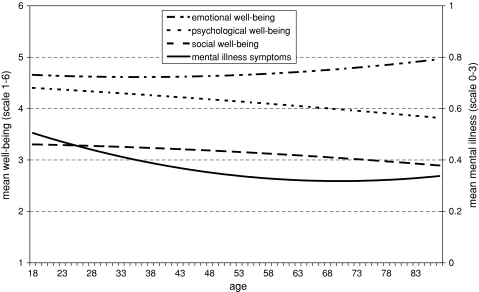
Mental health has long been defined as the absence of psychopathologies, such as depression and anxiety. The absence of mental illness, however, is a minimal outcome from a psychological perspective on lifespan development. This article therefore focuses on mental illness as well as on three core components of positive mental health: feelings of happiness and satisfaction with life (emotional well-being), positive individual functioning in terms of self-realization (psychological well-being), and positive societal functioning in terms of being of social value (social well-being). The two continua model holds that mental illness and mental health are related but distinct dimensions. This model was studied on the basis of a cross-sectional representative internet survey of Dutch adults (N = 1,340; 18-87 years). Mental illness was measured with the Brief Symptom Inventory and mental health with the Mental Health Continuum Short Form. It was found that older adults, except for the oldest-old, scored lower on psychopathological symptoms and were less likely to be mentally ill than younger adults. Although there were fewer age differences for mental health, older adults experienced more emotional, similar social and slightly lower psychological well-being. In sum, today's older adults have fewer mental illness problems, but they are not in a better positive mental health than today's younger adults. These findings support the validity of the two continua model in adult development.
Overview
The claims and statistics of this paper haven’t been checked yet.
Free: it reads the open-access text and checks the first 5 claims that cite a source we can check. Create a free account to check every claim.
Integrity signals
Registry
Cites
Statistics
Figures
Verification
Claims the paper makes
The claims and statistics of this paper haven’t been checked yet.
Free: it reads the open-access text and checks the first 5 claims that cite a source we can check. Create a free account to check every claim.
Claims other papers make about this one
Each is checked against this paper’s own text: does it say what the citing paper says it does?
The source backs part of the claim, not all of it — or backs it for a different population, condition or comparison.
In the citing paper
“The MHC-SF has demonstrated good psychometric properties across various age groups and nations (Lamers et al., 2011, Westerhof and Keyes, 2010).”
From The link between stress, well-being, and psychological flexibility during an Acceptance and Commitment Therapy self-help intervention (2018) · cites this paper as Westerhof and Keyes, 2010
Experimental — accuracy not yet measuredThe cited source says what the claim attributes to it.
In the citing paper
“The dual-factor model of mental health suggests that enhancing positive mental health and alleviating psychopathology do not automatically go hand-in-hand (Keyes, 2005a).”
From Both positive mental health and psychopathology should be monitored in psychotherapy: Confirmation for the dual-factor model in acceptance and commitment therapy (2017) · cites this paper as Westerhof & Keyes, 2009
The cited source says what the claim attributes to it.
In the citing paper
“Although the dual-factor model has been wellestablished in cross-sectional studies (e.g., Westerhof & Keyes, 2009), this is the first study to our knowledge that has investigated the applicability of the dual-factor model of mental health in an intervention study based on an effective psychotherapeutic intervention, namely, ACT (Fledderus et al., 2012).”
From Both positive mental health and psychopathology should be monitored in psychotherapy: Confirmation for the dual-factor model in acceptance and commitment therapy (2017) · cites this paper as Westerhof & Keyes, 2009
The cited source says what the claim attributes to it.
In the citing paper
“This model has been replicated in both American and international samples and across the lifespan (Keyes, 2002; Westerhof & Keyes, 2010).”
From Trajectories of change in well-being during cognitive behavioral therapies for anxiety disorders: Quantifying the impact and covariation with improvements in anxiety (2020) · cites this paper as Westerhof & Keyes, 2010
The cited source says what the claim attributes to it.
In the citing paper
“Nonetheless, mental health is not merely the absence of mental illness, and the two are related but distinct (Westerhof & Keyes, 2010); therefore, wellbeing services may also help to improve mental health without reducing symptoms.”
From Content Moderator Mental Health and Associations with Coping Styles: Replication and Extension of Previous Studies (2025) · cites this paper as Westerhof & Keyes, 2010
4 more claims about this paper
Create a free account to see every claim other papers make about this one.
Self-check
Percentages, sums and reported differences re-computed from the paper’s own numbers.
The self-check needs the paper’s full text.
Citations
Cites
Happiness is everything, or is it? Explorations on the meaning of psychological well-being.
Ryff, C. D. (1989) · Journal of Personality and Social Psychology · doi:10.1037/0022-3514.57.6.1069 · Cited by 14,847 · cited 5×
“Psychologists started to reflect on the notion of well-being in terms of individual strivings and optimal functioning (Ryan and Deci 2001; Ryff 1989), which gave rise to the second tradition of research, called eudaimonic well-being.”
BackgroundInfluentialSubjective well-being: Three decades of progress.
Diener, E., Suh, E. M., Lucas, R. E., & Smith, H. L. (1999) · Psychological Bulletin · doi:10.1037/0033-2909.125.2.276 · Cited by 12,910
On Happiness and Human Potentials: A Review of Research on Hedonic and Eudaimonic Well-Being
Ryan, R. M., & Deci, E. L. (2001) · Annual Review of Psychology · doi:10.1146/annurev.psych.52.1.141 · Cited by 11,567 · cited 4×
“Psychologists started to reflect on the notion of well-being in terms of individual strivings and optimal functioning (Ryan and Deci 2001; Ryff 1989), which gave rise to the second tradition of research, called eudaimonic well-being.”
BackgroundInfluentialDiener, E. (1984) · Psychological Bulletin · doi:10.1037/0033-2909.95.3.542 · Cited by 11,023
Diener, E. (2009) · Social Indicators Research Series · doi:10.1007/978-90-481-2350-6_2 · Cited by 10,950
The structure of psychological well-being revisited.
Ryff, C. D., & Keyes, C. L. M. (1995) · Journal of Personality and Social Psychology · doi:10.1037//0022-3514.69.4.719 · Cited by 10,285 · cited 5×
“This procedure resulted in a sample of 1,662 respondents who filled out the questionnaire in December 2007 (a response of 76% of those who participated in the panel).”
BackgroundMethodInfluentialSelf-citationВзаимосвязь статуса занятости и пола с уровнем психологического благополучия
М.Р., Н., & С.И., Б. (2026) · Cifra LLC Journals · doi:10.60797/irj.2026.170.43 · Cited by 7,950
The mental health continuum: from languishing to flourishing in life.
Keyes, C. L. M. (2002) · Journal of Health and Social Behavior · doi:10.2307/3090197 · Cited by 5,133 · cited 5×
“The findings of this study provide strong support for the two continua model of mental illness and health (Keyes 2002, 2005, 2007).”
BackgroundResultInfluentialSelf-citationThe Structure of Psychological Well-Being.
Mechanic, D., & Bradburn, N. M. (1970) · American Sociological Review · doi:10.2307/2093340 · Cited by 4,923 · cited 1×
“In the social sciences, this tradition dates back to survey research in the 1960s and 1970s, when scholars started to study the quality of American life from the perspective of citizens themselves (Andrews and Withey 1976; Bradburn 1969; Campbell et al. 1976; Cantril 1965; Gurin et al. 1960).”
BackgroundSocial Indicators of Well-Being
Andrews, F. M., & Withey, S. B. (1976) · Springer eBooks · doi:10.1007/978-1-4684-2253-5 · Cited by 3,653 · cited 1×
“In the social sciences, this tradition dates back to survey research in the 1960s and 1970s, when scholars started to study the quality of American life from the perspective of citizens themselves (Andrews and Withey 1976; Bradburn 1969; Campbell et al. 1976; Cantril 1965; Gurin et al. 1960).”
Background
Research works printed but not linked: 3
- Derogatis, L. R. (1975). The Brief Symptom Inventory. Baltimore, MD.: Clinical Psychometric Research.
- Westerhof, G. J. (2001). Wohlbefinden in der zweiten Lebenshälfte [Well-being in the second half of life]. In F. Dittmann-Kohli, C. Bode, & G. J. Westerhof (Eds.), Die zweite Lebenshälfte—Psychologische Perspektiven. Ergebnisse des Alters-Survey (pp. 79–128). Stuttgart: Kohlhammer.
- Westerhof, G. J., & Keyes, C. L. M. (2008). Geestelijke gezondheid is meer dan de afwezigheid van geestelijke ziekte [Mental health is more than the absence of mental illness]. Maandblad Geestelijke Volksgezondheid, 63, 808–820.
Cited by
Items 501–600 of 1,001
Cyberchondria and Chinese Adolescent Mental Health in the Age of COVID-19 Pandemic
Liu, Y., Peng, W., Cao, M., Zhang, S., Peng, J., & Zhou, Z. (2023) · Cyberpsychology Behavior and Social Networking · doi:10.1089/cyber.2022.0319 · Cited by 18
“8 Given that depressive symptoms were common symptoms of psychological distress, 9–11 depressive symptoms were assessed as the negative aspects of mental health in this study.”
Milk Fat Globule Membranes for Mental Health across the Human Lifespan
Slykerman, R. F., Davies, N., Fuad, M., & Dekker, J. (2024) · Foods · doi:10.3390/foods13111631 · Cited by 12
“Mental illness refers to the presence of psychiatric disorders such as depression and anxiety [113].”
BackgroundReitsma, L., Killikelly, C., Müller, H., Larsen, L. H., Nijborg, L. C. J., Boelen, P. A., & Lenferink, L. I. M. (2025) · Journal of Affective Disorders · doi:10.1016/j.jad.2025.02.078 · Cited by 16
Oberle, E., Ji, X. R., Molyneux, T. M., Guhn, M., Forer, B., Thomson, K., Alkawaja, M., Kassan, A., & Gadermann, A. (2025) · Social Science & Medicine · doi:10.1016/j.socscimed.2025.118201 · Cited by 15
Analysis of Worring among Lecturers of Indonesian Bethel Theology on Covid-19
Pakpahan, G. K. R. (2020) · Medico-Legal Update · doi:10.37506/mlu.v20i4.2014 · Cited by 10
Psychosocial Well-Being of Adults Who Are Deaf or Hard of Hearing
Muñoz, K. F., Baughman, K., Meibos, A., Ong, C. W., & Twohig, M. P. (2020) · Journal of the American Academy of Audiology · doi:10.1055/s-0040-1718928 · Cited by 10
Racial disparities in visitation and health among older adults incarcerated in prison
Prost, S. G. (2022) · Aging & Mental Health · doi:10.1080/13607863.2022.2098923 · Cited by 11
Bersia, M., Charrier, L., Berchialla, P., Cosma, A. P., Comoretto, R. I., & Dalmasso, P. (2022) · Children · doi:10.3390/children9121981 · Cited by 14
“This finding addressed the need to adopt multidimensional conceptualizations of mental well-being, contemplating different but correlated temporal trends of the involved elements [8,9], as observed previously in several other countries [16,22].”
BackgroundAlley, J. C., Brener, S. A., & Diamond, L. M. (2023) · LGBT Health · doi:10.1089/lgbt.2022.0240 · Cited by 10
“52 A key finding of the present research is that childhood vic-timization has indirect links with adult health through the pathway of adult revictimization (i.e., adult experiences of victimization and harassment that occur among individuals who were also exposed to maltreatment as children).”
Lee, C., & Rosales, A. (2019) · Journal of Psychology and Theology · doi:10.1177/0091647119870290 · Cited by 11
Furtak, A., & Barnard, A. (2021) · SA Journal of Industrial Psychology · doi:10.4102/sajip.v47i0.1809 · Cited by 19
“…well-being as being predominately a private phenomenon, Keyes (1998) was of the view that because life is social in nature and we are embedded in http://www.sajip.co.za Open Access society, it is important to consider how social health contributes to optimal functioning (Westerhof & Keyes, 2010).”
BackgroundModel Pengukuran Kesehatan Mental pada Mahasiswa di Perguruan Tinggi Islam
Aziz, R., Mangestuti, R., Sholichatun, Y., Rahayu, I. T., Purwaningtyas, E. K., & Wahyuni, E. N. (2022) · Journal of Islamic and Contemporary Psychology (JICOP) · doi:10.25299/jicop.v1i2.8251 · Cited by 21
Dithurbide, L., Boudreault, V., Durand‐Bush, N., MacLeod, L., & Gauthier, V. (2022) · Frontiers in Psychology · doi:10.3389/fpsyg.2022.937962 · Cited by 19
Bienestar emocional, psicológico y social en adultos argentinos en contexto de pandemia por COVID-19
Eidman, L., Bender, V., Arbizú, J., Lamboglia, A. T., & Correa, L. D. V. (2020) · Psychologia · doi:10.21500/19002386.4851 · Cited by 29
Perceptions of Quality of Life among Face Transplant Recipients: A Qualitative Content Analysis
Greenfield, J. A., Kimberly, L. L., Berman, Z. P., Ramly, E. P., Alfonso, A. R., Lee, O., Diep, G. K., & Rodriguez, E. D. (2020) · Plastic & Reconstructive Surgery Global Open · doi:10.1097/gox.0000000000002956 · Cited by 9
Modeling the Future of Prevention in Primary Mental Health Care: A Narrative Literature Review
Doyle, S. J., Feingold, J. H., & Gilder, T. J. V. (2023) · AJPM Focus · doi:10.1016/j.focus.2023.100092 · Cited by 16
“Mental well-being is not the absence of mental illness; it is the summative degree of emotional, psychological, and social well-being.(12,14) Research from multiple disciplines supports this concept.”
BackgroundInfluentialMental ill-health in semi-elite women’s soccer in England: a mixed-methods approach
Bramley, O., Healy, L. C., & Sarkar, M. (2024) · International Journal of Sport and Exercise Psychology · doi:10.1080/1612197x.2024.2311752 · Cited by 14
Orchard, C., Lin, E. H. B., Rosella, L. C., & Smith, P. M. (2024) · American Journal of Epidemiology · doi:10.1093/aje/kwae030 · Cited by 11
“5,6,21 A person with a diagnosable mental disorder can experience the presence or absence of well-being, and some studies have shown that persons with a mental illness who are deemed to be “flourishing” in their positive mental health have better functioning and resilience, as well as better mental…”
BackgroundStephens, J. M., Sgherza, T. R., DeMarree, K. G., & Naragon‐Gainey, K. (2025) · Journal of Affective Disorders · doi:10.1016/j.jad.2025.119432 · Cited by 20
“Historically, conceptualisations of mental health generally followed a medical model whereby mental illness and wellbeing form a single bipolar continuum (Keyes, 2005), and individuals are categorised as either mentally ill or healthy (Keyes, 2007; Westerhof and Keyes, 2010).”
Chan, S., & Weich, S. (2020) · BJPsych Open · doi:10.1192/bjo.2020.46 · Cited by 13
Wolbers, R., Bode, C., Siemerink, E., Siesling, S., & Pieterse, M. E. (2021) · JMIR Formative Research · doi:10.2196/18325 · Cited by 15
“Even when both concepts would be rather separate dimensions, strengthening vitality bias may still help attenuating adverse effects of fatigue bias, as has been shown convincingly by the two-continua approach in the positive psychology field: building positive mental health has shown to reduce the incidence of psychop…”
BackgroundSensing Psychological Well-being Using Social Media Language: Prediction Model Development Study
Han, N., Li, S., Huang, F., Wen, Y., Wang, X., Liu, X., Li, L., & Zhu, T. (2023) · Journal of Medical Internet Research · doi:10.2196/41823 · Cited by 17
“In the view of previous research, positive mental health has 3 core aspects: hedonic well-being and the psychological and societal aspects of eudaimonic well-being [2,3].”
Täljedal, T., Granlund, M., Almqvist, L., Osman, F., Selinus, E. N., & Fängström, K. (2023) · PLoS ONE · doi:10.1371/journal.pone.0288815 · Cited by 12
“Other children, in CL4 and CL2, displayed patterns of simultaneous mental health problems and well-being, in accordance with the two continua model [7].”
BackgroundResultPedersen, L. M., Laursen, S., & Buttenschøn, H. N. (2023) · Mental Health & Prevention · doi:10.1016/j.mhp.2023.200300 · Cited by 11
Mental Ill-Health and the Epidemiology of Representations
Kesner, L. (2018) · Frontiers in Psychiatry · doi:10.3389/fpsyt.2018.00289 · Cited by 9
Valiente, C., Espinosa, R., Contreras, A., Trucharte, A., Caballero, R., & Peinado, V. (2021) · The Journal of Positive Psychology · doi:10.1080/17439760.2021.1871940 · Cited by 10
“According to Westerhof and Keyes (2010), mental illness and mental health are two distinct but interrelated dimensions.”
BackgroundLink, B. G., & Phelan, J. C. (2017) · Cambridge University Press eBooks · doi:10.1017/9781316471289.024 · Cited by 13
Examining well‐being in posttraumatic stress disorder treatment: An explorative study
Radstaak, M., Hüning, L., Lamers, S. M. A., & Bohlmeijer, E. T. (2022) · Journal of Traumatic Stress · doi:10.1002/jts.22798 · Cited by 13
Changes in flourishing from adolescence to young adulthood: An 8‐year follow‐up
Palmer, A. N., Patel, M., Narendorf, S. C., Sledge, S. L., & Sanchez, K. (2022) · Child & Family Social Work · doi:10.1111/cfs.12953 · Cited by 12
Guo, B., Song, Y., Zhao, L., Cheng, X., Ma, H., Qiu, X., Yang, X., Qiao, Z., Zhao, E., Bu, T., et al. (2022) · Frontiers in Public Health · doi:10.3389/fpubh.2022.987372 · Cited by 14
“The theory of two continuous models and the tenets of positive psychology posit that individuals also manifest positive changes when confronted with adversity (52, 53).”
BackgroundFactors affecting the social and emotional health of adolescents: A cross-sectional study in Vietnam
Giang, T.-V., Huynh, V.-S., Do, T.-T., & Mai, M.-H. (2023) · Heliyon · doi:10.1016/j.heliyon.2023.e14717 · Cited by 14
Does Individual Placement and Support really ‘reflect client goals’?
van Essen, C. M. (2011) · Journal of Psychiatric and Mental Health Nursing · doi:10.1111/j.1365-2850.2011.01769.x · Cited by 14
Westerhof, G. J. (2012) · Springer eBooks · doi:10.1007/978-94-007-5195-8_3 · Cited by 11
Self-citationLove, N., Nelson, G. B., Pancer, S. M., Loomis, C., & Hasford, J. (2013) · Canadian Journal of Community Mental Health · doi:10.7870/cjcmh-2013-012 · Cited by 10
Góngora, V. C., & Solano, A. C. (2018) · Psicodebate · doi:10.18682/pd.v18i1.740 · Cited by 15
“…adultos mayores estadounidenses y canadienses, y adultos de edad media (30-60 años) italianos, en tanto no se encontraron diferencias en adultos chinos y holandeses (Gilmour, 2014; Karaś et al., 2014; Keyes, 2005; Lim et al., 2013; Petrillo et al., 2015; Westerhof & Keyes, 2010; Yin et al., 2013).”
BackgroundFactors related to psychopathological symptoms of female inmates of a prison in Lima
Esteban-Febres, S., Enoki-Miñano, K., Escudero-Moreira, T., Cunza-Peña, M. L., & Quispe-Gutiérrez, Y. (2019) · Revista Española de Sanidad Penitenciaria · doi:10.4321/s1575-06202019000100003 · Cited by 12
Utilizing the Health Belief Model to move post-secondary students toward flourishing mental health
Zaidlin, G., Lisnyj, K. T., Dougherty, B. P., Cook, N., & Papadopoulos, A. (2020) · The Journal of Positive Psychology · doi:10.1080/17439760.2020.1858331 · Cited by 15
Liu, J., Abdin, E., Vaingankar, J. A., Lim, M. S. M., Verma, S. K., Tang, C. Y. Z., Shafie, S., Shahwan, S., & Subramaniam, M. (2021) · Australian & New Zealand Journal of Psychiatry · doi:10.1177/00048674211053568 · Cited by 14
“inability to experience positive emotions and form close relationships) leads to poor mental health, which in turn increases the risk for mental disorders (Lynch et al., 2021; Westerhof and Keyes, 2010).”
BackgroundRosenfield, S., Kato, K., & Smith, D. T. (2017) · Cambridge University Press eBooks · doi:10.1017/9781316471289.017 · Cited by 10
An evaluation of Zippy's Friends, an emotional wellbeing programme for children in primary schools
Clarke, A. M. (2011) · Arrow@dit (Dublin Institute of Technology) · doi:10.13025/15854 · Cited by 18
Global Adversities, the Media, and Mental Health
Kesner, L., & Horáček, J. (2022) · Frontiers in Psychiatry · doi:10.3389/fpsyt.2021.809239 · Cited by 9
“Under the well-established dual-factor or two-continua models of mental health and illness (12) and the dimensional model of psychopathology (13), mental health presupposes not just the absence of mental illness, but also high degree of subjective well-being (12, 14).”
Petrovic, J., Mills, D. J., & Heath, N. L. (2024) · Journal of Clinical Psychology · doi:10.1002/jclp.23708 · Cited by 12
Wang, H., Zhang, M., He, J., Saiding, A., Zong, C., Zhang, Y., & Chen, C. (2024) · School Mental Health · doi:10.1007/s12310-024-09676-4 · Cited by 9
“The complete mental health model (Keyes, 2005; Westerhof & Keyes, 2009) proposed that mental health is determined by the absence of negative and the presence of positive indicators, highlighting the significance of examining both psychopathological symptoms and subjective well-being in considering…”
Sport mental health continuum in young Brazilian athletes: adaptation and psychometric properties
Tozetto, W. R., Milan, F. J., Lima, C. O. V., & Milistetd, M. (2024) · Scientific Reports · doi:10.1038/s41598-024-71752-1 · Cited by 9
“The final version of the instrument can be viewed in supplementary material 2.”
BackgroundExamining the connections between boredom proneness, resilience, mental well-being, and rumination
Akyıl, Y. (2024) · Personality and Individual Differences · doi:10.1016/j.paid.2024.112931 · Cited by 9
Mental health and mental health problems among users of AAC: a scoping review
Østvik, J., Granlund, M., & Seim, A. R. (2024) · Augmentative and Alternative Communication · doi:10.1080/07434618.2024.2434680 · Cited by 10
“People can simultaneously perceive mental health problems and mental health where mental health may protect from the consequences of mental health problems (Westerhof & Keyes, 2010).”
Nguyen, N. D., & Lin, Z. (2025) · The Journals of Gerontology Series B · doi:10.1093/geronb/gbaf066 · Cited by 10
Ronkainen, H., Lundgren, T., Kenttä, G., Ihalainen, J. K., Kalaja, S., Valtonen, M., & Lappalainen, R. I. (2025) · Journal of Applied Sport Psychology · doi:10.1080/10413200.2025.2521267 · Cited by 16
From surviving to thriving: How sleep, physical activity, and diet shape well-being in young adults
Cooper, J. R. H., Turner, R., & Conner, T. S. (2025) · PLoS ONE · doi:10.1371/journal.pone.0329689 · Cited by 17
Understanding Differential Stress and Mental Health Reactions to COVID-19-Related Events
Sebastião, R., Neto, D. D., & Costa, V. (2023) · International Journal of Environmental Research and Public Health · doi:10.3390/ijerph20105819 · Cited by 10
“However, this relationship may vary in certain aspects [15,16].”
BackgroundRäsänen, P., Muotka, J. S., & Lappalainen, R. I. (2023) · Journal of Contextual Behavioral Science · doi:10.1016/j.jcbs.2023.06.006 · Cited by 11
Enhancing mental wellbeing by changing mindsets? Results from two randomized controlled trials
Schreiber, C., & Schotanus-Dijkstra, M. (2024) · BMC Psychology · doi:10.1186/s40359-023-01470-2 · Cited by 15
Uncovering heterogeneity in mental health changes among first-year medical students
Polujanski, S., Nett, U. E., Rotthoff, T., Özsoy, M. D., & Schindler, A.-K. (2024) · Medical Education Online · doi:10.1080/10872981.2024.2317493 · Cited by 12
“Models that incorporate both factors (psychopathology and PMH) – known as dual-factor (e.g., [5]) or two-continua (e.g., [18]) models of mental health – conceptualize psychopathology and PMH as indicators of mental health that lie on separate but related continua [5,7].”
Petrogiannis, K., Sangeorzan, I., & Andriopoulou, P. (2024) · Adversity and Resilience Science · doi:10.1007/s42844-024-00134-3 · Cited by 10
Sebastião, R., & Neto, D. D. (2024) · Applied Psychology Health and Well-Being · doi:10.1111/aphw.12614 · Cited by 13
Larionow, P., Mazur, M., & Mudło‐Głagolska, K. (2025) · Healthcare · doi:10.3390/healthcare13040432 · Cited by 12
“We deem that the assessment of emotion-related constructs should include the perspective of the two continua model of mental health [41], with its mental illness and mental well-being dimensions.”
Occupational stress and mental well-being in a cohort of Black South African teachers
Boshoff, N., Potgieter, J. C., van Rensburg, E., & Ellis, S. M. (2014) · Journal of Psychology in Africa · doi:10.1080/14330237.2014.903069 · Cited by 16
Glasgow smiles better: An examination of adolescent mental well-being and the ‘Glasgow effect’
Levin, K. A. (2011) · Public Health · doi:10.1016/j.puhe.2011.10.010 · Cited by 13
Building capacities for change: Wellness coaching as a positive approach to student development
Larcus, J., Gibbs, T. A., & Hackman, T. (2016) · Philosophy of Coaching An International Journal · doi:10.22316/poc/01.1.05 · Cited by 12
Reorienting Norwegian mental healthcare services: listen to patients’ learning appetite
Mjøsund, N. H., Eriksson, M., Espnes, G. A., & Vinje, H. F. (2018) · Health Promotion International · doi:10.1093/heapro/day012 · Cited by 10
Lycett, K., McNamara, C., Mensah, F. K., Burgner, D. P., Kerr, J. A., Muller, J., & Wake, M. A. (2018) · Journal of Paediatrics and Child Health · doi:10.1111/jpc.13943 · Cited by 8
Dose, É., Desrumaux, P., Bernaud, J., & Machado, T. (2019) · L’Orientation scolaire et professionnelle · doi:10.4000/osp.11249 · Cited by 10
Duncan, M. J., Patte, K. A., & Leatherdale, S. T. (2020) · Social Psychiatry and Psychiatric Epidemiology · doi:10.1007/s00127-020-01900-1 · Cited by 8
“Positive mental well-being consists of life satisfaction, experiencing happiness, achieving self-determination, and the presence of positive social and societal relations [19]—that is, a state of psychosocial well-being.”
BackgroundHorwitz, A. V. (2017) · Cambridge University Press eBooks · doi:10.1017/9781316471289.004 · Cited by 11
Keith, V. M., & Brown, D. R. (2017) · Cambridge University Press eBooks · doi:10.1017/9781316471289.019 · Cited by 12
Response to TMS treatment for depression associated with higher levels of psychological well-being
Toth, C., Johnson, M. L. K., Heinzerling, A., & Trapp, N. T. (2022) · Journal of Psychiatric Research · doi:10.1016/j.jpsychires.2022.03.030 · Cited by 11
Na, H., Ekanayake, V., Padilla, V., & Elkins, G. (2022) · International Journal of Clinical and Experimental Hypnosis · doi:10.1080/00207144.2022.2124375 · Cited by 10
Vermeiden, M., Reijnders, J. S. A. M., van Duin, E., Simons, M., Janssens, M., Peeters, S. C. T., Jacobs, N., & Lataster, J. (2022) · BMC Psychology · doi:10.1186/s40359-022-00980-9 · Cited by 9
Sellars, E., Oliver, B. R., & Bowes, L. (2023) · Development and Psychopathology · doi:10.1017/s0954579423001323 · Cited by 14
Integrating Service Delivery Systems for Persons with a Severe Mental Illness
Cuddeback, G. S., & MORRISSEY, J. P. (2009) · Cambridge University Press eBooks · doi:10.1017/cbo9780511984945.031 · Cited by 9
Mental Health and Illness In Relation to Physical Health Across the Lifespan
Lamers, S. M. A., Westerhof, G. J., Bohlmeijer, E. T., & Keyes, C. L. M. (2013) · Springer eBooks · doi:10.1007/978-1-4614-7282-7_2 · Cited by 9
Self-citationRelationship between positive mental health and appreciation in Korean individuals
Lim, Y. (2015) · International Journal of Psychology · doi:10.1002/ijop.12220 · Cited by 14
“In concert with this opinion, the Mental Health Continuum model (Westerhof & Keyes, 2010) asserts that positive mental health and mental disorders are overlapping but distinct constructs.”
BackgroundJans-Beken, L. (2019) · Counselling Psychology Quarterly · doi:10.1080/09515070.2019.1638228 · Cited by 12
Well-Being across the Life Course
Mirowsky, J., & Ross, C. E. (2017) · Cambridge University Press eBooks · doi:10.1017/9781316471289.021 · Cited by 9
Mental health among people with psoriasis undergoing patient education in climate therapy
Langeland, E., Robinson, H. S., Moum, T., Larsen, M. H., & Wahl, A. K. (2013) · Scandinavian Journal of Psychology · doi:10.1111/sjop.12073 · Cited by 10
Chojak, A. (2023) · Journal of Contextual Behavioral Science · doi:10.1016/j.jcbs.2023.03.007 · Cited by 7
Frimpong, S., Sunindijo, R. Y., Wang, C., Hon, C. K. H., Boadu, E. F., Dansoh, A., & Yiu, T. W. (2023) · Construction Innovation · doi:10.1108/ci-06-2023-0139 · Cited by 8
Huijs, T., Braam, A. W., Kruizinga, R., Jacobs, N., Reijnders, J. S. A. M., & Simons, M. (2024) · Religions · doi:10.3390/rel15020179 · Cited by 10
Prati, G. (2024) · Social Science Quarterly · doi:10.1111/ssqu.13440 · Cited by 9
Murakami, Y., Goto, D., Tsukamoto, H., Yamaura, K., & Hashimoto, T. (2025) · Brain and Behavior · doi:10.1002/brb3.70284 · Cited by 10
“In particular, young adults face various stresses (academic, social, media influence, etc.; Ruini and Cesetti 2019), resulting in a greater risk of developing mental disorders than older individuals do (Westerhof and Keyes 2010).”
Kent, L., Havrilova, M., Dick, S., & Carbone, S. R. (2025) · Mental Health & Prevention · doi:10.1016/j.mhp.2025.200403 · Cited by 10
Pinto, A. M., Curral, L. A., Costa, M. D. R., Quadros, F., de Jesús, S. N., Martínez, I. M., Roazzi, A., & Oliveira, S. (2025) · Healthcare · doi:10.3390/healthcare13040371 · Cited by 14
“…[33], is directly associated with students’ perception of resources to meet academic demands [24,32], whereas personal well-being, encompassing a broader evaluation of emotional experience, life satisfaction, and psychosocial functioning [44], may be less directly linked to academic performance.”
Saboor, S., Ahmed, V., Anane, C., & Bahroun, Z. (2025) · Sustainability · doi:10.3390/su17114879 · Cited by 11
Hugh-Jones, S., & Munford, L. A. (2025) · Social Science & Medicine · doi:10.1016/j.socscimed.2025.118343 · Cited by 8
Contributing to a Healthier World: Exploring the Impact of Wellbeing on Nursing Burnout
Sanders, C., Burke, J., & Muzyk, A. J. (2022) · Journal of Happiness and Health · doi:10.47602/johah.v2i2.14 · Cited by 10
Flexible Working Arrangements and Millennials During COVID-19 : Work Better Leads to Feel Better?
Subramaniam, G., Rozlan, N. Z. A., Putit, L., & Maniam, B. (2022) · Environment-Behaviour Proceedings Journal · doi:10.21834/ebpj.v7i21.3729 · Cited by 16
Almweisheer, S., Bernstein, C. N., Graff, L. A., Patten, S. B., Bolton, J. M., Fisk, J. D., Hitchon, C. A., Marriott, J. J., & Marrie, R. A. (2023) · BMJ Open · doi:10.1136/bmjopen-2023-073782 · Cited by 9
Wu, J., & Chao, Q. (2023) · Current Psychology · doi:10.1007/s12144-023-04735-6 · Cited by 19
Philipose, J. V., Choubisa, R., & Dubey, A. (2025) · Discover Mental Health · doi:10.1007/s44192-025-00203-8 · Cited by 17
“Due to lack of positive emotions, college students may succumb to ‘languishing,’ which is regarded as a condition characterized by extremely low well-being [34].”
Massone, A., & Urquijo, S. (2016) · Salud & Sociedad · doi:10.22199/s07187475.2014.0003.00003 · Cited by 15
Prinsloo, C. D., Greeff, M., Kruger, A., & Ellis, S. M. (2016) · African Journal of AIDS Research · doi:10.2989/16085906.2016.1200640 · Cited by 8
“Moderate mental health reflects a condition in which a person is neither languishing nor flourishing (Keyes et al., 2010; Westerhof & Keyes, 2010).”
BackgroundThomas, K., & Bendtsen, M. (2019) · JMIR Research Protocols · doi:10.2196/12396 · Cited by 7
“Indeed, people afflicted by mental illness can have experiences of personal growth and feelings of hope, indicating that well-being and mental illness are not mutually exclusive [1-5].”
Serpas, D. G. (2021) · Health Equity · doi:10.1089/heq.2020.0095 · Cited by 18
“This study defines discrimination as unfair or disrespectful treatment based on a prejudicial assumption(15) and defines mental health as an absence of psychopathologies, including depression and anxiety.(16) Mounting evidence confirms a unique relationship between experiences of discrimination and depression and anxi…”
BackgroundEllwood, F. (2021) · Primary Dental Journal · doi:10.1177/20501684211029425 · Cited by 7
Khazaei, M., Holder, M., Sirois, F., Oades, L., & Gallagher, M. (2022) · Current Psychology · doi:10.1007/s12144-022-02970-x · Cited by 9
“…of the MHC-SF based on samples of adolescents drawn from several countries including the U.S.A. (Keyes, 2005), Netherlands (Lamers et al., 2011; Westerhof & Keyes, 2009), South Africa (Keyes et al., 2008), the Czech Republic (Klimusova et al., 2016), Poland (Karas, Cieciuch & Keyes,…”
Lenferink, L. I. M., Mouthaan, J., Fritz, A. M., Soydas, S., Eidhof, M. B., van Hoof, M., Groen, S., & Mooren, T. T. M. (2022) · BMJ Open · doi:10.1136/bmjopen-2021-055696 · Cited by 7
The good, the bad, and the mixed: Experiences during COVID-19 among an online sample of adults
Mills, D. J., Petrovic, J., Mettler, J., Hamza, C. A., & Heath, N. L. (2022) · PLoS ONE · doi:10.1371/journal.pone.0269382 · Cited by 9
“This finding is in line with previous literature [10, 14, 45, 46] which has found that individuals who have reported more negative experiences in response to the onset of COVID-19 have tended to be those already in a position of psychosocial or financial disadvantage.”
ResultMahmood, Q. K., Sohail, M. M., Qureshi, W. A., Zakar, R., Wrona, K. J., & Fischer, F. (2022) · BMC Psychology · doi:10.1186/s40359-022-00869-7 · Cited by 11
Joshanloo, M. (2022) · Journal of Personality Assessment · doi:10.1080/00223891.2022.2098755 · Cited by 11
Nicolás, I. M., Molina-Pizarro, C. A., Rosado-Franco, A., Castañeda, P. E. A., Maya‐Hernández, C., Barahona, I., Martínez‐Alés, G., Aroca, F., Delgado‐Gómez, D., Dervic, K., et al. (2022) · Current Psychology · doi:10.1007/s12144-022-03686-8 · Cited by 9
“…also points out that young adults without diagnosed mental illness (i.e., being free from disease and distress) have some-times impaired functioning (e.g. physical condition, health-care utilization, work or academic productivity), including psychosocial functioning (Westerhof & Keyes, 2010).”
Background
Metadata
- Authors
- Westerhof, G. J., & Keyes, C. L. M.
- Affiliations
- University of Twente (NL)
- Emory University (US)
- Corresponding author
- Westerhof, Gerben J.
- Venue
- Journal of Adult Development
- Published
- 2009-08-26
- Volume
- 17
- Issue
- 2
- Pages
- 110-119
- ISSN
- 1068-0667 (ISSN-L)
- 1573-3440
- PMC
- PMC2866965
- OpenAlex
- W2117617786
- Cited by
- 1,345
- References
- 58
- Citations by year
- 2026: 131 · 2025: 148 · 2024: 158 · 2023: 135 · 2022: 137 · 2021: 134 · 2020: 104 · 2019: 66 · 2018: 60 · 2017: 83 · 2016: 43 · 2015: 43 · 2014: 24 · 2013: 27 · 2012: 22
- FWCI
- 21.92
- Type
- journal article
- Language
- en
- Open access
- hybrid
- doi.org
- Licence
- cc-by-nc
- Locations
- Journal of Adult Development (publishedVersion, cc-by-nc)
- Europe PMC (PubMed Central) (publishedVersion, cc-by-nc)
- PubMed Central (publishedVersion, cc-by-nc)
- PubMed (publishedVersion)
- University of Twente Research Information (submittedVersion)
- University of Twente Research Information (submittedVersion, other-oa)
- Topics
- Social Sciences › Psychology › Social Psychology › Psychological Well-being and Life Satisfaction
- Social Sciences › Psychology › Developmental and Educational Psychology › Aging and Gerontology Research
- Health Sciences › Medicine › Public Health, Environmental and Occupational Health › Aging, Health, and Disability
- Keywords
- mental illness, mental health, positive mental health, emotional well-being, psychological well-being, social well-being, lifespan development, age differences, older adults, psychiatric symptoms, happiness, life satisfaction, self-realization, social values
About these checks
Registry, retraction, Cites and statistics results are computed, not judged, with one exception: a printed reference that no index lists is read once by a model before it counts as a citation error. Claims are extracted by a model and kept only when their quote appears verbatim in the text; each cited source is then checked, with a model’s help, for whether it says what the claim relies on. Those verdicts can be wrong — read the claim’s quote and the cited source before relying on one.
Statistics and arithmetic are recomputed, not judged.
Confidence bands are shown only for fields calibrated on our annotated test set. None is calibrated yet, so no band is shown.
What counts as a claim ›How we measure confidence ›How we check this ›
Are you an author, or do you see a problem with this page? Request a review
Data sources
Bibliographic data: Semantic Scholar, OpenAlex, Crossref.
Contains information from the Semantic Scholar Academic Graph Datasets, made available under the ODC Attribution License (ODC-BY 1.0).
Semantic Scholar’s data is described in: Kinney, R., et al. (2023). The Semantic Scholar Open Data Platform. arXiv:2301.10140.
