

Mental Illness and Mental Health: The Two Continua Model Across the Lifespan
Open accessThe DOI matches its Crossref record; 53 of the 58 references it cites were found in a registry or an index.
Abstract
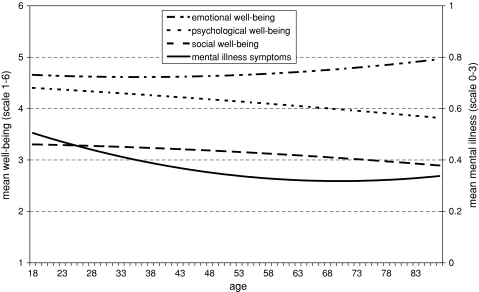
Mental health has long been defined as the absence of psychopathologies, such as depression and anxiety. The absence of mental illness, however, is a minimal outcome from a psychological perspective on lifespan development. This article therefore focuses on mental illness as well as on three core components of positive mental health: feelings of happiness and satisfaction with life (emotional well-being), positive individual functioning in terms of self-realization (psychological well-being), and positive societal functioning in terms of being of social value (social well-being). The two continua model holds that mental illness and mental health are related but distinct dimensions. This model was studied on the basis of a cross-sectional representative internet survey of Dutch adults (N = 1,340; 18-87 years). Mental illness was measured with the Brief Symptom Inventory and mental health with the Mental Health Continuum Short Form. It was found that older adults, except for the oldest-old, scored lower on psychopathological symptoms and were less likely to be mentally ill than younger adults. Although there were fewer age differences for mental health, older adults experienced more emotional, similar social and slightly lower psychological well-being. In sum, today's older adults have fewer mental illness problems, but they are not in a better positive mental health than today's younger adults. These findings support the validity of the two continua model in adult development.
Overview
The claims and statistics of this paper haven’t been checked yet.
Free: it reads the open-access text and checks the first 5 claims that cite a source we can check. Create a free account to check every claim.
Integrity signals
Registry
Cites
Statistics
Figures
Verification
Claims the paper makes
The claims and statistics of this paper haven’t been checked yet.
Free: it reads the open-access text and checks the first 5 claims that cite a source we can check. Create a free account to check every claim.
Claims other papers make about this one
Each is checked against this paper’s own text: does it say what the citing paper says it does?
The source backs part of the claim, not all of it — or backs it for a different population, condition or comparison.
In the citing paper
“The MHC-SF has demonstrated good psychometric properties across various age groups and nations (Lamers et al., 2011, Westerhof and Keyes, 2010).”
From The link between stress, well-being, and psychological flexibility during an Acceptance and Commitment Therapy self-help intervention (2018) · cites this paper as Westerhof and Keyes, 2010
Experimental — accuracy not yet measuredThe cited source says what the claim attributes to it.
In the citing paper
“The dual-factor model of mental health suggests that enhancing positive mental health and alleviating psychopathology do not automatically go hand-in-hand (Keyes, 2005a).”
From Both positive mental health and psychopathology should be monitored in psychotherapy: Confirmation for the dual-factor model in acceptance and commitment therapy (2017) · cites this paper as Westerhof & Keyes, 2009
The cited source says what the claim attributes to it.
In the citing paper
“Although the dual-factor model has been wellestablished in cross-sectional studies (e.g., Westerhof & Keyes, 2009), this is the first study to our knowledge that has investigated the applicability of the dual-factor model of mental health in an intervention study based on an effective psychotherapeutic intervention, namely, ACT (Fledderus et al., 2012).”
From Both positive mental health and psychopathology should be monitored in psychotherapy: Confirmation for the dual-factor model in acceptance and commitment therapy (2017) · cites this paper as Westerhof & Keyes, 2009
The cited source says what the claim attributes to it.
In the citing paper
“This model has been replicated in both American and international samples and across the lifespan (Keyes, 2002; Westerhof & Keyes, 2010).”
From Trajectories of change in well-being during cognitive behavioral therapies for anxiety disorders: Quantifying the impact and covariation with improvements in anxiety (2020) · cites this paper as Westerhof & Keyes, 2010
The cited source says what the claim attributes to it.
In the citing paper
“Nonetheless, mental health is not merely the absence of mental illness, and the two are related but distinct (Westerhof & Keyes, 2010); therefore, wellbeing services may also help to improve mental health without reducing symptoms.”
From Content Moderator Mental Health and Associations with Coping Styles: Replication and Extension of Previous Studies (2025) · cites this paper as Westerhof & Keyes, 2010
4 more claims about this paper
Create a free account to see every claim other papers make about this one.
Self-check
Percentages, sums and reported differences re-computed from the paper’s own numbers.
The self-check needs the paper’s full text.
Citations
Cites
Happiness is everything, or is it? Explorations on the meaning of psychological well-being.
Ryff, C. D. (1989) · Journal of Personality and Social Psychology · doi:10.1037/0022-3514.57.6.1069 · Cited by 14,847 · cited 5×
“Psychologists started to reflect on the notion of well-being in terms of individual strivings and optimal functioning (Ryan and Deci 2001; Ryff 1989), which gave rise to the second tradition of research, called eudaimonic well-being.”
BackgroundInfluentialSubjective well-being: Three decades of progress.
Diener, E., Suh, E. M., Lucas, R. E., & Smith, H. L. (1999) · Psychological Bulletin · doi:10.1037/0033-2909.125.2.276 · Cited by 12,910
On Happiness and Human Potentials: A Review of Research on Hedonic and Eudaimonic Well-Being
Ryan, R. M., & Deci, E. L. (2001) · Annual Review of Psychology · doi:10.1146/annurev.psych.52.1.141 · Cited by 11,567 · cited 4×
“Psychologists started to reflect on the notion of well-being in terms of individual strivings and optimal functioning (Ryan and Deci 2001; Ryff 1989), which gave rise to the second tradition of research, called eudaimonic well-being.”
BackgroundInfluentialDiener, E. (1984) · Psychological Bulletin · doi:10.1037/0033-2909.95.3.542 · Cited by 11,023
Diener, E. (2009) · Social Indicators Research Series · doi:10.1007/978-90-481-2350-6_2 · Cited by 10,950
The structure of psychological well-being revisited.
Ryff, C. D., & Keyes, C. L. M. (1995) · Journal of Personality and Social Psychology · doi:10.1037//0022-3514.69.4.719 · Cited by 10,285 · cited 5×
“This procedure resulted in a sample of 1,662 respondents who filled out the questionnaire in December 2007 (a response of 76% of those who participated in the panel).”
BackgroundMethodInfluentialSelf-citationВзаимосвязь статуса занятости и пола с уровнем психологического благополучия
М.Р., Н., & С.И., Б. (2026) · Cifra LLC Journals · doi:10.60797/irj.2026.170.43 · Cited by 7,950
The mental health continuum: from languishing to flourishing in life.
Keyes, C. L. M. (2002) · Journal of Health and Social Behavior · doi:10.2307/3090197 · Cited by 5,133 · cited 5×
“The findings of this study provide strong support for the two continua model of mental illness and health (Keyes 2002, 2005, 2007).”
BackgroundResultInfluentialSelf-citationThe Structure of Psychological Well-Being.
Mechanic, D., & Bradburn, N. M. (1970) · American Sociological Review · doi:10.2307/2093340 · Cited by 4,923 · cited 1×
“In the social sciences, this tradition dates back to survey research in the 1960s and 1970s, when scholars started to study the quality of American life from the perspective of citizens themselves (Andrews and Withey 1976; Bradburn 1969; Campbell et al. 1976; Cantril 1965; Gurin et al. 1960).”
BackgroundSocial Indicators of Well-Being
Andrews, F. M., & Withey, S. B. (1976) · Springer eBooks · doi:10.1007/978-1-4684-2253-5 · Cited by 3,653 · cited 1×
“In the social sciences, this tradition dates back to survey research in the 1960s and 1970s, when scholars started to study the quality of American life from the perspective of citizens themselves (Andrews and Withey 1976; Bradburn 1969; Campbell et al. 1976; Cantril 1965; Gurin et al. 1960).”
Background
Research works printed but not linked: 3
- Derogatis, L. R. (1975). The Brief Symptom Inventory. Baltimore, MD.: Clinical Psychometric Research.
- Westerhof, G. J. (2001). Wohlbefinden in der zweiten Lebenshälfte [Well-being in the second half of life]. In F. Dittmann-Kohli, C. Bode, & G. J. Westerhof (Eds.), Die zweite Lebenshälfte—Psychologische Perspektiven. Ergebnisse des Alters-Survey (pp. 79–128). Stuttgart: Kohlhammer.
- Westerhof, G. J., & Keyes, C. L. M. (2008). Geestelijke gezondheid is meer dan de afwezigheid van geestelijke ziekte [Mental health is more than the absence of mental illness]. Maandblad Geestelijke Volksgezondheid, 63, 808–820.
Cited by
A Handbook for the Study of Mental Health Second Edition
Scheid, T. L., & Brown, T. N. (2009) · Cited by 1,324
Diagnostic and Statistical Manual of Mental Disorders-5 (DSM-5)
Ma, F. (2020) · Encyclopedia of Gerontology and Population Aging · doi:10.1007/978-3-319-69892-2_419-2 · Cited by 1,198
Huta, V., & Waterman, A. S. (2014) · Journal of Happiness Studies · doi:10.1007/s10902-013-9485-0 · Cited by 1,127
Bohlmeijer, E., ten Klooster, P. M., Fledderus, M., Veehof, M., & Baer, R. (2011) · Assessment · doi:10.1177/1073191111408231 · Cited by 990
Effectiveness of positive psychology interventions: a systematic review and meta-analysis
Carr, A., Cullen, K., Keeney, C., Canning, C., Mooney, O., Chinseallaigh, E., & O’Dowd, A. (2021) · The Journal of Positive Psychology · doi:10.1080/17439760.2020.1818807 · Cited by 645
Rosenfield, S., & Mouzon, D. (2013) · Handbooks of Sociology and Social Research · doi:10.1007/978-94-007-4276-5_14 · Cited by 494
Keyes, C. L. M., Eisenberg, D., Perry, G. S., Dube, S. R., Kroenke, K., & Dhingra, S. S. (2012) · Journal of American College Health · doi:10.1080/07448481.2011.608393 · Cited by 480
Self-citationLongitudinal associations between cyberbullying involvement and adolescent mental health
Fahy, A. E., Stansfeld, S. A., Smuk, M., Smith, N. R., Cummins, S., & Clark, C. (2016) · Journal of Adolescent Health · doi:10.1016/j.jadohealth.2016.06.006 · Cited by 457
Diagnostic and Statistical Manual of Mental Disorders-5 (DSM-5)
Ma, F. (2021) · Encyclopedia of Gerontology and Population Aging · doi:10.1007/978-3-030-22009-9_419 · Cited by 412
Trompetter, H. R., de Kleine, E., & Bohlmeijer, E. T. (2017) · Cognitive Therapy and Research · doi:10.1007/s10608-016-9774-0 · Cited by 368
“There is accumulating evidence that psychopathology and positive mental health function along two different continua that are only moderately interrelated (Huppert and Whittington 2003; Keyes 2005; Lamers et al. 2011; Weich et al. 2011; Westerhof and Keyes 2009).”
BackgroundChakhssi, F., Kraiss, J. T., Sommers-Spijkerman, M., & Bohlmeijer, E. T. (2018) · BMC Psychiatry · doi:10.1186/s12888-018-1739-2 · Cited by 352
Mental health promotion and mental illness prevention: the economic case
Knapp, M. R. J., McDaid, D., & Parsonage, M. (2011) · London School of Economics and Political Science Research Online (London School of Economics and Political Science) · Cited by 520
Lombardo, P., Jones, W., Wang, L., Shen, X., & Goldner, E. M. (2018) · BMC Public Health · doi:10.1186/s12889-018-5235-x · Cited by 333
Positive psychology in a pandemic: buffering, bolstering, and building mental health
Waters, L., Algoe, S. B., Dutton, J., Emmons, R., Fredrickson, B. L., Heaphy, E., Moskowitz, J. T., Neff, K., Niemiec, R., Pury, C., et al. (2022) · The Journal of Positive Psychology · doi:10.1080/17439760.2021.1871945 · Cited by 377
“Aligned with the two continua model of mental illness (Westerhof & Keyes, 2010) we suggest that individuals can endure high levels of distress during this medical pandemic and yet still experience positive mental health (i.e., feeling good, functioning well and doing good), Waters et al., in press.”
MethodLink, B. G., & Phelan, J. C. (2013) · Handbooks of Sociology and Social Research · doi:10.1007/978-94-007-4276-5_25 · Cited by 269
Marshall, C. (2022) · International Review of Psychiatry · doi:10.1080/09540261.2022.2147420 · Cited by 298
Psychological well-being and psychological distress: is it necessary to measure both?
Winefield, H. R., Gill, T. K., Taylor, A. W., & Pilkington, R. M. (2012) · Psychology of Well-Being: Theory, Research and Practice · doi:10.1186/2211-1522-2-3 · Cited by 291
Mental Health as a Complete State: How the Salutogenic Perspective Completes the Picture
Keyes, C. L. M. (2014) · Bridging Occupational, Organizational and Public Health · doi:10.1007/978-94-007-5640-3_11 · Cited by 278
Self-citationThe Mental Health Continuum–Short Form (MHC–SF) as a Measure of Well-Being in the Italian Context
Petrillo, G., Capone, V., Caso, D., & Keyes, C. L. M. (2015) · Social Indicators Research · doi:10.1007/s11205-014-0629-3 · Cited by 278
Self-citationIasiello, M., van Agteren, J., & Muir Cochrane, E. (2020) · Evidence Base · doi:10.21307/eb-2020-001 · Cited by 270
“…et al., 2013), genetics (Bartels et al., 2013), risk of cardiovascular disease (Keyes, 2004), coping (Kinderman et al., 2015), positive psychology constructs, and general socio-demographic variables (Westerhof, 2013; Weich et al., 2011; Westerhof and Keyes, 2010; Huppert and Whittington, 2003).”
BackgroundManwell, L. A., Barbic, S. P., Roberts, K., Durisko, Z., Lee, C., Ware, E., & McKenzie, K. (2015) · BMJ Open · doi:10.1136/bmjopen-2014-007079 · Cited by 264
Wersebe, H., Lieb, R., Meyer, A. H., Hofer, P., & Gloster, A. T. (2018) · International Journal of Clinical and Health Psychology · doi:10.1016/j.ijchp.2017.09.002 · Cited by 250
Graupensperger, S., Benson, A. J., Kilmer, J. R., & Evans, M. B. (2020) · Journal of Adolescent Health · doi:10.1016/j.jadohealth.2020.08.001 · Cited by 237
“Studies evaluating this measure with young adults have reported strong support for internal consistency and discriminant validity [48].”
Backgroundvan Zyl, L. E., & ten Klooster, P. M. (2022) · Frontiers in Psychiatry · doi:10.3389/fpsyt.2021.795672 · Cited by 235
“Keyes (19) indicated that mental health lies on a continuum ranging from languishing to flourishing.”
BackgroundInfluentialRäsänen, P., Lappalainen, P., Muotka, J., Tolvanen, A., & Lappalainen, R. (2016) · Behaviour Research and Therapy · doi:10.1016/j.brat.2016.01.001 · Cited by 221
“In previous studies, the internal consistency of the MHC-SF has ranged between .80 and .89 (Keyes, 2005; Westerhof & Keyes, 2010).”
Capone, V., & Petrillo, G. (2020) · Current Psychology · doi:10.1007/s12144-018-9878-7 · Cited by 226
“Research has supported the hypothesis that anything less than complete mental health results in increased impairment and disability (Salama-Younes 2013; Westerhof and Keyes 2010).”
BackgroundInfluentialFredriksen-Goldsen, K. I., Kim, H.-J., Bryan, A. E. B., Shiu, C., & Emlet, C. A. (2017) · The Gerontologist · doi:10.1093/geront/gnw170 · Cited by 218
“To fully understand mental health, however, both the absence of mental illness and the presence of psychological well-being need to be considered (Westerhof & Keyes, 2010).”
BackgroundDevelopment and predictors of mental ill-health and wellbeing from childhood to adolescence
Patalay, P., & Fitzsimons, E. (2018) · Social Psychiatry and Psychiatric Epidemiology · doi:10.1007/s00127-018-1604-0 · Cited by 209
Keyes, C. L. M., & Westerhof, G. J. (2012) · Aging & Mental Health · doi:10.1080/13607863.2011.596811 · Cited by 209
Self-citationCreativity and Well‐being: A Meta‐analysis
Acar, S., Tadik, H., Myers, D., van der Sman, C., & Uysal, R. (2021) · The Journal of Creative Behavior · doi:10.1002/jocb.485 · Cited by 208
“Some (e.g., Herzlich, 1973; Westerhof & Keyes, 2010) argued that the lack of psychopathology does not necessarily imply the presence of well-being.”
BackgroundLamers, S. M. A., Westerhof, G. J., Glas, C. A. W., & Bohlmeijer, E. T. (2015) · The Journal of Positive Psychology · doi:10.1080/17439760.2015.1015156 · Cited by 207
“…symptoms and positive mental health, earlier cross-sectional studies have shown that the pattern becomes more differentiated when different mental illnesses as well as the different components of positive mental health are distinguished (Lamers et al., 2012; Westerhof & Keyes, 2009).”
BackgroundSelf-citationFledderus, M., Bohlmeijer, E. T., Smit, F., & Westerhof, G. J. (2010) · American Journal of Public Health · doi:10.2105/ajph.2010.196196 · Cited by 197
Self-citationde Vos, J. A., LaMarre, A., Radstaak, M., Bijkerk, C. A., Bohlmeijer, E. T., & Westerhof, G. J. (2017) · Journal of Eating Disorders · doi:10.1186/s40337-017-0164-0 · Cited by 189
“Recent studies show that psychopathology and wellbeing are separate but complementary aspects of mental health and reflect two related continua, instead of being opposites on one continuum [29, 37, 40].”
BackgroundSelf-citationTrompetter, H. R., ten Klooster, P. M., Schreurs, K. M. G., Fledderus, M., Westerhof, G. J., & Bohlmeijer, E. T. (2013) · Psychological Assessment · doi:10.1037/a0033813 · Cited by 184
Self-citationMental health rescue effects of women's outdoor tourism: A role in COVID-19 recovery
Buckley, R., & Westaway, D. (2020) · Annals of Tourism Research · doi:10.1016/j.annals.2020.103041 · Cited by 185
Wettstein, M., Eich, W., Bieber, C., & Tesarz, J. (2019) · Pain Medicine · doi:10.1093/pm/pny062 · Cited by 185
Diagnostic and Statistical Manual of Mental Disorders-5 (DSM-5)
Ma, F. (2020) · Encyclopedia of Gerontology and Population Aging · doi:10.1007/978-3-319-69892-2_419-1 · Cited by 182
Depression and Cognitive Control across the Lifespan: a Systematic Review and Meta-Analysis
Dotson, V. M., McClintock, S. M., Verhaeghen, P., Kim, J. U., Draheim, A. A., Syzmkowicz, S. M., Gradone, A. M., Bogoian, H. R., & Wit, L. D. (2020) · Neuropsychology Review · doi:10.1007/s11065-020-09436-6 · Cited by 173
Lamers, S. M. A., Westerhof, G. J., Kovács, V., & Bohlmeijer, E. T. (2012) · Journal of Research in Personality · doi:10.1016/j.jrp.2012.05.012 · Cited by 173
Self-citationTowards a science and practice of resilience in the face of pain
Goubert, L., & Trompetter, H. (2017) · European Journal of Pain · doi:10.1002/ejp.1062 · Cited by 172
Hendriks, T., de Jong, J., & Cramer, H. (2017) · The Journal of Alternative and Complementary Medicine · doi:10.1089/acm.2016.0334 · Cited by 166
Visser, M., & Law-van Wyk, E. (2021) · South African Journal of Psychology · doi:10.1177/00812463211012219 · Cited by 165
“Mental health includes the following three core components: emotional health (happiness and satisfaction), psychological wellbeing (purpose in life, self-realisation) and social wellbeing (being of social value) (Westerhof & Keyes, 2010).”
BackgroundMethodInfluentialKnapstad, M., Sivertsen, B., Knudsen, A. K., Smith, O. R. F., Aarø, L. E., Lønning, K. J., & Skogen, J. C. (2021) · Psychological Medicine · doi:10.1017/s0033291719003350 · Cited by 158
Weich, S., Brugha, T., King, M., McManus, S., Bebbington, P., Jenkins, R., Cooper, C., McBride, O., & Stewart-Brown, S. (2011) · British Journal of Psychiatry · doi:10.1192/bjp.bp.111.091496 · Cited by 153
Swami, V., Weis, L., Barron, D., & Furnham, A. (2018) · The Journal of Social Psychology · doi:10.1080/00224545.2017.1392278 · Cited by 152
Desrumaux, P., Lapointe, D., Ntsame Sima, M., Boudrias, J.-S., Savoie, A., & Brunet, L. (2015) · European Review of Applied Psychology · doi:10.1016/j.erap.2015.06.003 · Cited by 147
Renshaw, T. L., & Cohen, A. S. (2013) · Social Indicators Research · doi:10.1007/s11205-013-0342-7 · Cited by 179
Wisdom and Mental Health Across the Lifespan
Webster, J. D., Westerhof, G. J., & Bohlmeijer, E. T. (2014) · The Journals of Gerontology Series B: Psychological Sciences and Social Sciences · doi:10.1093/geronb/gbs121 · Cited by 139
Self-citationWinzer, R., Lindberg, L., Guldbrandsson, K., & Sidorchuk, A. (2018) · PeerJ · doi:10.7717/peerj.4598 · Cited by 140
Predicting the mental health of college students with psychological capital
Selvaraj, P. R., & Bhat, C. S. (2018) · Journal of Mental Health · doi:10.1080/09638237.2018.1469738 · Cited by 170
Lamers, S. M. A., Glas, C. A. W., Westerhof, G. J., & Bohlmeijer, E. T. (2012) · European Journal of Psychological Assessment · doi:10.1027/1015-5759/a000109 · Cited by 136
Self-citationPromoting and Protecting Positive Mental Health: Early and Often Throughout the Lifespan
Keyes, C. (2013) · Springer eBooks · doi:10.1007/978-94-007-5195-8_1 · Cited by 131
Self-citationAdamczyk, K. (2016) · Current Psychology · doi:10.1007/s12144-016-9478-3 · Cited by 167
“Recently the concept of mental health has extended beyond the simple definition of the absence of psychopathologies such as depression and anxiety (see Keyes 2002; Lamers et al. 2011; Westerhof and Keyes 2010).”
BackgroundMethodInfluentialTrajectories of resilience and mental distress to global major disruptions
Schäfer, S. K., Kunzler, A. M., Kalisch, R., Tüscher, O., & Lieb, K. (2022) · Trends in Cognitive Sciences · doi:10.1016/j.tics.2022.09.017 · Cited by 133
“This was, at first sight, surprising, but also in line with pre-pandemic research finding that older adults report better mental health and show more resilient responses when exposed to macro-stressors ([60,61], but see [62]).”
Well-being of students in higher education: The importance of a student perspective
Douwes, R., Metselaar, J., Pijnenborg, G., & Boonstra, N. (2023) · Cogent Education · doi:10.1080/2331186x.2023.2190697 · Cited by 114
“This is also reflected in the two continua model of mental health and well-being (Westerhof & Keyes, 2010), which holds that mental illness and mental health are related but distinct dimensions.”
Franken, K., Lamers, S. M. A., Ten Klooster, P. M., Bohlmeijer, E. T., & Westerhof, G. J. (2018) · Journal of Clinical Psychology · doi:10.1002/jclp.22659 · Cited by 131
Self-citationJohnson, J., & Wood, A. M. (2015) · Cognitive Therapy and Research · doi:10.1007/s10608-015-9728-y · Cited by 158
Hoffmann, M. D., Barnes, J. D., Tremblay, M. S., & Guerrero, M. D. (2022) · PLOS ONE · doi:10.1371/journal.pone.0268583 · Cited by 129
“Extending this definition, mental health can be understood as a state that involves both the absence of mental illness/difficulties but also the presence of mental health [9].”
BackgroundTebbe, E. A., & Budge, S. L. (2022) · Nature Reviews Psychology · doi:10.1038/s44159-022-00109-0 · Cited by 153
Positive mental health and mental illness.
Gilmour, H. (2014) · PubMed · Cited by 131
Trompetter, H. R., Lamers, S. M. A., Westerhof, G. J., Fledderus, M., & Bohlmeijer, E. T. (2017) · Behaviour Research and Therapy · doi:10.1016/j.brat.2017.01.008 · Cited by 126
Self-citationTeismann, T., Forkmann, T., Brailovskaia, J., Siegmann, P., Glaesmer, H., & Margraf, J. (2018) · International Journal of Clinical and Health Psychology · doi:10.1016/j.ijchp.2017.08.001 · Cited by 120
Resilience to suicide ideation: A cross‐cultural test of the buffering hypothesis
Siegmann, P., Teismann, T., Fritsch, N., Forkmann, T., Glaesmer, H., Zhang, X. C., Brailovskaia, J., & Margraf, J. (2018) · Clinical Psychology & Psychotherapy · doi:10.1002/cpp.2118 · Cited by 119
Rickard, N., Arjmand, H.-A., Bakker, D., & Seabrook, E. (2016) · JMIR Mental Health · doi:10.2196/mental.6202 · Cited by 118
“Mobile phone technology that differentiates the quadrants created by categorizing according to mental illness or languishing and mental health or flourishing [3,55] is therefore encouraged.”
Krieke, L. V. D., Jeronimus, B. F., Blaauw, F. J., Wanders, R. B. K., Emerencia, A. C., Schenk, H. M., Vos, S. D., Snippe, E., Wichers, M., Wigman, J. T. W., et al. (2016) · International Journal of Methods in Psychiatric Research · doi:10.1002/mpr.1495 · Cited by 115
Coughenour, C., Gakh, M., Pharr, J. R., Bungum, T. J., & Jalene, S. (2020) · Journal of Community Health · doi:10.1007/s10900-020-00918-5 · Cited by 130
Applicability of the Dual-Factor Model of Mental Health for College Students
Eklund, K., Dowdy, E., Jones, C., & Furlong, M. (2010) · Journal of College Student Psychotherapy · doi:10.1080/87568225.2011.532677 · Cited by 110
Personality and well-being in adolescents
Moreira, P., Cloninger, C. R., Dinis, L., Sá, L., Oliveira, J., Dias, A., & Oliveira, J. (2015) · Frontiers in Psychology · doi:10.3389/fpsyg.2014.01494 · Cited by 131
An affective neuroscience model of boosting resilience in adults
Tabibnia, G. (2020) · Neuroscience & Biobehavioral Reviews · doi:10.1016/j.neubiorev.2020.05.005 · Cited by 104
Positive affect and reward processing in the treatment of depression, anxiety and trauma
Craske, M. G., Dunn, B. D., Meuret, A. E., Rizvi, S. J., & Taylor, C. T. (2024) · Nature Reviews Psychology · doi:10.1038/s44159-024-00355-4 · Cited by 124
“Diminished positive affect is a specific facet within the broader construct of positive mental health and wellbeing 1,2 .”
Causal and mediating factors for anxiety, depression and well-being
Kinderman, P., Tai, S., Pontin, E., Schwannauer, M., Jarman, I., & Lisboa, P. (2015) · British Journal of Psychiatry · doi:10.1192/bjp.bp.114.147553 · Cited by 102
Religion and Well-Being: The Mediating Role of Positive Virtues
Sharma, S., & Singh, K. K. (2018) · Journal of Religion and Health · doi:10.1007/s10943-018-0559-5 · Cited by 122
“The short form of the MHC has previously shown excellent internal consistency (a[ .80) and discriminant validity (Keyes et al. 2008; Westerhof and Keyes 2010).”
BackgroundDual-factor Models of Mental Health: A Systematic Review of Empirical Evidence
Magalhães, E. (2024) · Psychosocial Intervention · doi:10.5093/pi2024a6 · Cited by 148
Declining mental health among disadvantaged Americans
Goldman, N., Glei, D. A., & Weinstein, M. (2018) · Proceedings of the National Academy of Sciences · doi:10.1073/pnas.1722023115 · Cited by 110
Moore, S. A., Dowdy, E. T., Nylund-Gibson, K. K., & Furlong, M. J. (2019) · Journal of School Psychology · doi:10.1016/j.jsp.2019.03.003 · Cited by 114
“Contemporary, dual-factor (e.g., Greenspoon & Saklofske, 2001) or two-continua (e.g., Westerhof & Keyes, 2010) models of mental health propose that positive (i.e., strengths, subjective well-being) and negative (i.e., distress, psychopathology) indicators of mental health lie on separate, related…”
Bohlmeijer, E., & Westerhof, G. (2021) · Frontiers in Psychology · doi:10.3389/fpsyg.2021.747999 · Cited by 95
Self-citationThe evidence-base for positive psychology interventions: a mega-analysis of meta-analyses
Carr, A., Finneran, L., Boyd, C., Shirey, C., Canning, C. J., Stafford, O., Lyons, J., Cullen, K., Prendergast, C., Corbett, C., et al. (2023) · The Journal of Positive Psychology · doi:10.1080/17439760.2023.2168564 · Cited by 136
“The need for PPIs arises from a recognition that well-being and psychopathology are related, yet independent constructs and that individuals who become symptom free following treatment with traditional psychotherapy often do not experience high levels of well-being (e.g., Westerhof & Keyes, 2010).”
BackgroundInfluentialUchida, Y., Takahashi, Y., & Kawahara, K. (2013) · Journal of Happiness Studies · doi:10.1007/s10902-013-9463-6 · Cited by 115
Tuntland, H. K., Aaslund, M. K., Langeland, E., Espehaug, B., & Kjeken, I. (2016) · Journal of Multidisciplinary Healthcare · doi:10.2147/jmdh.s113727 · Cited by 98
“This instrument measures three dimensions of the positive mental health concept.(30) Each of the 14 items is scored by rating the frequency of various feelings during the past month”
MethodStuber, F., Seifried-Dübon, T., Rieger, M. A., Gündel, H., Ruhle, S. A., Zipfel, S., & Junne, F. (2020) · International Archives of Occupational and Environmental Health · doi:10.1007/s00420-020-01583-w · Cited by 120
“2017; Westerhof and Keyes 2010).”
Backgroundvan Dijk, I., Lucassen, P. L. B. J., Akkermans, R. P., van Engelen, B. G. M., van Weel, C., & Speckens, A. E. M. (2017) · Academic Medicine · doi:10.1097/acm.0000000000001546 · Cited by 87
Promoting well-being through group drumming with mental health service users and their carers
Ascenso, S., Perkins, R., Atkins, L., Fancourt, D. E., & Williamon, A. (2018) · International Journal of Qualitative Studies on Health and Well-Being · doi:10.1080/17482631.2018.1484219 · Cited by 109
“…Eisenberg, Dhingra, Perry, & Dube, 2012; Keyes et al., 2008) and using different measurements and conceptualizations of mental health and illness (Compton, Smith, Cornish, & Qualls, 1996; Greenspoon & Saklofske, 2001; Headey, Kelley, & Wearing, 1993; Suldo & Shaffer, 2008; Westerhof & Keyes, 2010).”
Bluvstein, I., Moravchick, L., Sheps, D. S., Schreiber, S., & Bloch, M. (2012) · Journal of Clinical Psychology in Medical Settings · doi:10.1007/s10880-012-9318-z · Cited by 104
Wissing, M. P., Schutte, L., Liversage, C., Entwisle, B. M., Gericke, M., & Keyes, C. L. M. (2019) · Applied Research in Quality of Life · doi:10.1007/s11482-019-09771-8 · Cited by 110
Self-citationLauwers, L., Leone, M., Guyot, M., Pelgrims, I., Remmen, R., den Broeck, K. V., Keune, H., & Bastiaens, H. (2020) · Health & Place · doi:10.1016/j.healthplace.2020.102497 · Cited by 104
Resilience in the age of COVID-19
Kaye‐Kauderer, H., Feingold, J. H., Feder, A., Southwick, S. M., & Charney, D. S. (2021) · BJPsych Advances · doi:10.1192/bja.2021.5 · Cited by 112
Mental Illness Among Youth With Chronic Physical Conditions
Adams, J. S., Chien, A. T., & Wisk, L. E. (2019) · PEDIATRICS · doi:10.1542/peds.2018-1819 · Cited by 101
“One potential etiologic pathway is that chronic illness may interfere with activities important to psychological and social development in youth.(23) Development of autonomy and environmental mastery occurs across the life span, and expectations intensify across adolescence and early adulthood.”
BackgroundLee, S., O'Neill, D., & Moss, H. (2020) · Arts and Health · doi:10.1080/17533015.2020.1839776 · Cited by 49
Prospective Associations between Sport Participation and Indices of Mental Health across Adolescence
Graupensperger, S. A., Sutcliffe, J., & Vella, S. A. (2021) · Journal of Youth and Adolescence · doi:10.1007/s10964-021-01416-0 · Cited by 105
What Does Self Rated Mental Health Represent
Levinson, D., & Kaplan, G. (2014) · Journal of Public Health Research · doi:10.4081/jphr.2014.287 · Cited by 83
Stenhoff, A., Steadman, L., Nevitt, S., Benson, L., & White, R. G. (2020) · Journal of Contextual Behavioral Science · doi:10.1016/j.jcbs.2020.08.008 · Cited by 77
Breslin, G., Smith, A. W., Donohue, B. C., Donnelly, P., Shannon, S., Haughey, T. J., Vella, S. A., Swann, C., Cotterill, S. T., Macintyre, T. E., et al. (2019) · BMJ Open Sport & Exercise Medicine · doi:10.1136/bmjsem-2019-000585 · Cited by 86
“We propose trainers should be aware of sport-specific theories underlying mental health, as Keyes outlines, 16 including how athletes can function effectively in their sport and experience psychological well-being, while also having mental illness symptoms such as anxiety, depression, bulimia,…”
Viskovich, S., & Pakenham, K. I. (2018) · Journal of Clinical Psychology · doi:10.1002/jclp.22656 · Cited by 77
Psychometric Evaluation of the Mental Health Continuum–Short Form in French Canadian Young Adults
Doré, I., O’Loughlin, J. L., Sabiston, C. M., & Fournier, L. (2016) · The Canadian Journal of Psychiatry · doi:10.1177/0706743716675855 · Cited by 112
“emotional well-being and effective functioning at both individual and social levels.(44) As observed in at least one previous study,(17) our results suggest that the three factors derived from hedonic and eudaimonic dimensions are related to a more general construct of mental health as indicated by the second-order fa…”
ResultSingh, K. K., Bassi, M., Junnarkar, M., & Negri, L. (2015) · Journal of Adolescence · doi:10.1016/j.adolescence.2014.12.008 · Cited by 104
Chan, R. C. H., Mak, W. W. S., Chio, F. H. N., & Tong, A. C. Y. (2018) · Schizophrenia Bulletin · doi:10.1093/schbul/sbx120 · Cited by 79
Alat, P., Das, S. S., Arora, A., & Jha, A. K. (2023) · Current Psychology · doi:10.1007/s12144-021-01516-x · Cited by 79
Stewart, K., & Townley, G. (2020) · American Journal of Community Psychology · doi:10.1002/ajcp.12456 · Cited by 75
Mental Illness and the Criminal Justice System
Hiday, V. A., & Burns, P. J. (2009) · Cambridge University Press eBooks · doi:10.1017/cbo9780511984945.029 · Cited by 88
Bohlmeijer, E. T., Kraiss, J. T., Watkins, P., & Schotanus-Dijkstra, M. (2021) · Journal of Happiness Studies · doi:10.1007/s10902-020-00261-5 · Cited by 77
“2011; Westerhof and Keyes 2010).”
BackgroundInfluential
Metadata
- Authors
- Westerhof, G. J., & Keyes, C. L. M.
- Affiliations
- University of Twente (NL)
- Emory University (US)
- Corresponding author
- Westerhof, Gerben J.
- Venue
- Journal of Adult Development
- Published
- 2009-08-26
- Volume
- 17
- Issue
- 2
- Pages
- 110-119
- ISSN
- 1068-0667 (ISSN-L)
- 1573-3440
- PMC
- PMC2866965
- OpenAlex
- W2117617786
- Cited by
- 1,345
- References
- 58
- Citations by year
- 2026: 131 · 2025: 148 · 2024: 158 · 2023: 135 · 2022: 137 · 2021: 134 · 2020: 104 · 2019: 66 · 2018: 60 · 2017: 83 · 2016: 43 · 2015: 43 · 2014: 24 · 2013: 27 · 2012: 22
- FWCI
- 21.92
- Type
- journal article
- Language
- en
- Open access
- hybrid
- doi.org
- Licence
- cc-by-nc
- Locations
- Journal of Adult Development (publishedVersion, cc-by-nc)
- Europe PMC (PubMed Central) (publishedVersion, cc-by-nc)
- PubMed Central (publishedVersion, cc-by-nc)
- PubMed (publishedVersion)
- University of Twente Research Information (submittedVersion)
- University of Twente Research Information (submittedVersion, other-oa)
- Topics
- Social Sciences › Psychology › Social Psychology › Psychological Well-being and Life Satisfaction
- Social Sciences › Psychology › Developmental and Educational Psychology › Aging and Gerontology Research
- Health Sciences › Medicine › Public Health, Environmental and Occupational Health › Aging, Health, and Disability
- Keywords
- mental illness, mental health, positive mental health, emotional well-being, psychological well-being, social well-being, lifespan development, age differences, older adults, psychiatric symptoms, happiness, life satisfaction, self-realization, social values
About these checks
Registry, retraction, Cites and statistics results are computed, not judged, with one exception: a printed reference that no index lists is read once by a model before it counts as a citation error. Claims are extracted by a model and kept only when their quote appears verbatim in the text; each cited source is then checked, with a model’s help, for whether it says what the claim relies on. Those verdicts can be wrong — read the claim’s quote and the cited source before relying on one.
Statistics and arithmetic are recomputed, not judged.
Confidence bands are shown only for fields calibrated on our annotated test set. None is calibrated yet, so no band is shown.
What counts as a claim ›How we measure confidence ›How we check this ›
Are you an author, or do you see a problem with this page? Request a review
Data sources
Bibliographic data: Semantic Scholar, OpenAlex, Crossref.
Contains information from the Semantic Scholar Academic Graph Datasets, made available under the ODC Attribution License (ODC-BY 1.0).
Semantic Scholar’s data is described in: Kinney, R., et al. (2023). The Semantic Scholar Open Data Platform. arXiv:2301.10140.
