

Mental Illness and Mental Health: The Two Continua Model Across the Lifespan
Open accessThe DOI matches its Crossref record; 53 of the 58 references it cites were found in a registry or an index.
Abstract
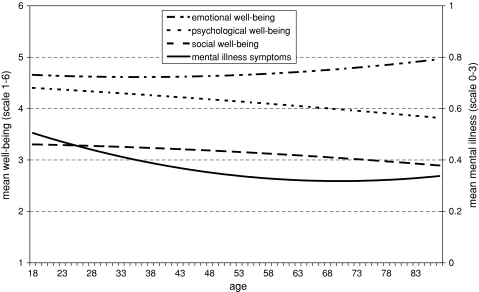
Mental health has long been defined as the absence of psychopathologies, such as depression and anxiety. The absence of mental illness, however, is a minimal outcome from a psychological perspective on lifespan development. This article therefore focuses on mental illness as well as on three core components of positive mental health: feelings of happiness and satisfaction with life (emotional well-being), positive individual functioning in terms of self-realization (psychological well-being), and positive societal functioning in terms of being of social value (social well-being). The two continua model holds that mental illness and mental health are related but distinct dimensions. This model was studied on the basis of a cross-sectional representative internet survey of Dutch adults (N = 1,340; 18-87 years). Mental illness was measured with the Brief Symptom Inventory and mental health with the Mental Health Continuum Short Form. It was found that older adults, except for the oldest-old, scored lower on psychopathological symptoms and were less likely to be mentally ill than younger adults. Although there were fewer age differences for mental health, older adults experienced more emotional, similar social and slightly lower psychological well-being. In sum, today's older adults have fewer mental illness problems, but they are not in a better positive mental health than today's younger adults. These findings support the validity of the two continua model in adult development.
Overview
The claims and statistics of this paper haven’t been checked yet.
Free: it reads the open-access text and checks the first 5 claims that cite a source we can check. Create a free account to check every claim.
Integrity signals
Registry
Cites
Statistics
Figures
Verification
Claims the paper makes
The claims and statistics of this paper haven’t been checked yet.
Free: it reads the open-access text and checks the first 5 claims that cite a source we can check. Create a free account to check every claim.
Claims other papers make about this one
Each is checked against this paper’s own text: does it say what the citing paper says it does?
The source backs part of the claim, not all of it — or backs it for a different population, condition or comparison.
In the citing paper
“The MHC-SF has demonstrated good psychometric properties across various age groups and nations (Lamers et al., 2011, Westerhof and Keyes, 2010).”
From The link between stress, well-being, and psychological flexibility during an Acceptance and Commitment Therapy self-help intervention (2018) · cites this paper as Westerhof and Keyes, 2010
Experimental — accuracy not yet measuredThe cited source says what the claim attributes to it.
In the citing paper
“The dual-factor model of mental health suggests that enhancing positive mental health and alleviating psychopathology do not automatically go hand-in-hand (Keyes, 2005a).”
From Both positive mental health and psychopathology should be monitored in psychotherapy: Confirmation for the dual-factor model in acceptance and commitment therapy (2017) · cites this paper as Westerhof & Keyes, 2009
The cited source says what the claim attributes to it.
In the citing paper
“Although the dual-factor model has been wellestablished in cross-sectional studies (e.g., Westerhof & Keyes, 2009), this is the first study to our knowledge that has investigated the applicability of the dual-factor model of mental health in an intervention study based on an effective psychotherapeutic intervention, namely, ACT (Fledderus et al., 2012).”
From Both positive mental health and psychopathology should be monitored in psychotherapy: Confirmation for the dual-factor model in acceptance and commitment therapy (2017) · cites this paper as Westerhof & Keyes, 2009
The cited source says what the claim attributes to it.
In the citing paper
“This model has been replicated in both American and international samples and across the lifespan (Keyes, 2002; Westerhof & Keyes, 2010).”
From Trajectories of change in well-being during cognitive behavioral therapies for anxiety disorders: Quantifying the impact and covariation with improvements in anxiety (2020) · cites this paper as Westerhof & Keyes, 2010
The cited source says what the claim attributes to it.
In the citing paper
“Nonetheless, mental health is not merely the absence of mental illness, and the two are related but distinct (Westerhof & Keyes, 2010); therefore, wellbeing services may also help to improve mental health without reducing symptoms.”
From Content Moderator Mental Health and Associations with Coping Styles: Replication and Extension of Previous Studies (2025) · cites this paper as Westerhof & Keyes, 2010
4 more claims about this paper
Create a free account to see every claim other papers make about this one.
Self-check
Percentages, sums and reported differences re-computed from the paper’s own numbers.
The self-check needs the paper’s full text.
Citations
Cites
Happiness is everything, or is it? Explorations on the meaning of psychological well-being.
Ryff, C. D. (1989) · Journal of Personality and Social Psychology · doi:10.1037/0022-3514.57.6.1069 · Cited by 14,847 · cited 5×
“Psychologists started to reflect on the notion of well-being in terms of individual strivings and optimal functioning (Ryan and Deci 2001; Ryff 1989), which gave rise to the second tradition of research, called eudaimonic well-being.”
BackgroundInfluentialSubjective well-being: Three decades of progress.
Diener, E., Suh, E. M., Lucas, R. E., & Smith, H. L. (1999) · Psychological Bulletin · doi:10.1037/0033-2909.125.2.276 · Cited by 12,910
On Happiness and Human Potentials: A Review of Research on Hedonic and Eudaimonic Well-Being
Ryan, R. M., & Deci, E. L. (2001) · Annual Review of Psychology · doi:10.1146/annurev.psych.52.1.141 · Cited by 11,567 · cited 4×
“Psychologists started to reflect on the notion of well-being in terms of individual strivings and optimal functioning (Ryan and Deci 2001; Ryff 1989), which gave rise to the second tradition of research, called eudaimonic well-being.”
BackgroundInfluentialDiener, E. (1984) · Psychological Bulletin · doi:10.1037/0033-2909.95.3.542 · Cited by 11,023
Diener, E. (2009) · Social Indicators Research Series · doi:10.1007/978-90-481-2350-6_2 · Cited by 10,950
The structure of psychological well-being revisited.
Ryff, C. D., & Keyes, C. L. M. (1995) · Journal of Personality and Social Psychology · doi:10.1037//0022-3514.69.4.719 · Cited by 10,285 · cited 5×
“This procedure resulted in a sample of 1,662 respondents who filled out the questionnaire in December 2007 (a response of 76% of those who participated in the panel).”
BackgroundMethodInfluentialSelf-citationВзаимосвязь статуса занятости и пола с уровнем психологического благополучия
М.Р., Н., & С.И., Б. (2026) · Cifra LLC Journals · doi:10.60797/irj.2026.170.43 · Cited by 7,950
The mental health continuum: from languishing to flourishing in life.
Keyes, C. L. M. (2002) · Journal of Health and Social Behavior · doi:10.2307/3090197 · Cited by 5,133 · cited 5×
“The findings of this study provide strong support for the two continua model of mental illness and health (Keyes 2002, 2005, 2007).”
BackgroundResultInfluentialSelf-citationThe Structure of Psychological Well-Being.
Mechanic, D., & Bradburn, N. M. (1970) · American Sociological Review · doi:10.2307/2093340 · Cited by 4,923 · cited 1×
“In the social sciences, this tradition dates back to survey research in the 1960s and 1970s, when scholars started to study the quality of American life from the perspective of citizens themselves (Andrews and Withey 1976; Bradburn 1969; Campbell et al. 1976; Cantril 1965; Gurin et al. 1960).”
BackgroundSocial Indicators of Well-Being
Andrews, F. M., & Withey, S. B. (1976) · Springer eBooks · doi:10.1007/978-1-4684-2253-5 · Cited by 3,653 · cited 1×
“In the social sciences, this tradition dates back to survey research in the 1960s and 1970s, when scholars started to study the quality of American life from the perspective of citizens themselves (Andrews and Withey 1976; Bradburn 1969; Campbell et al. 1976; Cantril 1965; Gurin et al. 1960).”
Background
Research works printed but not linked: 3
- Derogatis, L. R. (1975). The Brief Symptom Inventory. Baltimore, MD.: Clinical Psychometric Research.
- Westerhof, G. J. (2001). Wohlbefinden in der zweiten Lebenshälfte [Well-being in the second half of life]. In F. Dittmann-Kohli, C. Bode, & G. J. Westerhof (Eds.), Die zweite Lebenshälfte—Psychologische Perspektiven. Ergebnisse des Alters-Survey (pp. 79–128). Stuttgart: Kohlhammer.
- Westerhof, G. J., & Keyes, C. L. M. (2008). Geestelijke gezondheid is meer dan de afwezigheid van geestelijke ziekte [Mental health is more than the absence of mental illness]. Maandblad Geestelijke Volksgezondheid, 63, 808–820.
Cited by
Items 701–800 of 1,001
Marasca, A. R., Hoffmann, M. S., Gaya, A. R., & Bandeira, D. R. (2021) · Child Indicators Research · doi:10.1007/s12187-020-09792-y · Cited by 6
Miragall, M., Escrivá‐Martínez, T., Wrzesien, M., Vara, M. D., Herrero, R., Desdentado, L., & Baños, R. M. (2022) · Current Psychology · doi:10.1007/s12144-022-03638-2 · Cited by 4
“According to the Dual Continuum Model of Mental Health (Westerhof & Keyes, 2010), mental illness and positive mental health reflect two distinct continuums rather than the extremes of a single spectrum.”
InfluentialMani, C. (2022) · Arts & Health · doi:10.1080/17533015.2022.2140684 · Cited by 5
“Consequently, in line with the “two-continua model” of Westerhof and Keyes (2010), wellbeing and mental health are no longer linked to the mere absence of negative symptoms but rely also on acknowledging and amplifying positive indicators across multiple dimensions of life.”
Porter, E. F., Jessen, M., Coleman, J. J., Sinha, S., Devor, N. G., Sauer-Zavala, S. E., Levitt, H. M., Tao, K. W., Zanarini, M. C., Farchione, T. J., et al. (2023) · Counselling Psychology Quarterly · doi:10.1080/09515070.2023.2225033 · Cited by 7
“This recognition has spurred increasing consideration for dual-factor models of positive mental health that incorporate both the reduction of symptoms and the promotion of well-being (Westerhof & Keyes, 2010).”
The Relationship of Mental Health Continuum with Hedonic Hunger and Dietary Habits in Adults
Arslan, E., & Yaldiz, N. (2023) · İstanbul Gelişim Üniversitesi Sağlık Bilimleri Dergisi · doi:10.38079/igusabder.1268123 · Cited by 5
Parenting doctoral students: Who are they, and how are they doing?
Zhou, X., & Mollo, V. (2025) · Journal of Diversity in Higher Education · doi:10.1037/dhe0000540 · Cited by 10
Psychological Health and Life Satisfaction of Portuguese Teachers
Tomé, G., Rodrigues, N. N., & de Matos, M. G. (2024) · Future · doi:10.3390/future2020007 · Cited by 3
“Complete psychological health thus implies both conditions: high satisfaction with life and reduced psychological symptoms of malaise, as suggested in the dual model [8–10].”
BackgroundMethodFu, M. (2024) · Journal of Education Humanities and Social Sciences · doi:10.54097/3g493r69 · Cited by 8
“Westerhof and Keyes (2010) argue that PPIs stem from the understanding that well-being and psychopathology are distinct yet interconnected constructs [11].”
BackgroundRefugees and mental wellbeing. A call for community approaches in Aotearoa New Zealand
Brannelly, T., Bhatia, A., Malihi, A. Z., Vanderpyl, L., Brennan, B., Perez, L. G., Saeid, F., Holroyd, E. A., & Charania, N. A. (2024) · Mental Health and Social Inclusion · doi:10.1108/mhsi-04-2024-0049 · Cited by 6
Hedley, D., Uljarević, M., Bury, S. M., Haschek, A., Richdale, A. L., Trollor, J. N., & Stokes, M. A. (2024) · Journal of Autism and Developmental Disorders · doi:10.1007/s10803-024-06489-x · Cited by 6
“Psychological wellbeing encompasses constructs such as subjective happiness, life satisfaction, psychological functioning, and self-realization (Keyes, 2005; Keyes et al., 2002 ; Ryff & Keyes, 1995; Tennant et al., 2007; Waterman, 1993; Westerhof & Keyes, 2010).”
Impact of living arrangements and internet use on the mental health of Chinese older adults
Zhong, R., & Ning, W. (2024) · Frontiers in Public Health · doi:10.3389/fpubh.2024.1395181 · Cited by 4
Duque, M., Vo, D. H., Montero‐Zamora, P., Cobb, C. L., Sahbaz, S., Ertanir, B., Bautista, T. G., Watkins, L. G., Acaf, Y., Macias, M. A., et al. (2024) · Social Science & Medicine · doi:10.1016/j.socscimed.2024.117615 · Cited by 7
Toseeb, U., Deniz, E., & Noret, N. F. (2024) · Child Abuse & Neglect · doi:10.1016/j.chiabu.2024.107211 · Cited by 4
deJonge, M. L., Sabiston, C. M., Hamza, C. A., & Darnell, S. C. (2025) · Psychology of sport and exercise · doi:10.1016/j.psychsport.2025.102846 · Cited by 9
Li, Y., King, R. B., Chen, J., & Xu, W. (2025) · Higher Education Research & Development · doi:10.1080/07294360.2025.2482204 · Cited by 7
“This conceptualization has strong theoretical and empirical support having been validated internationally (Westerhof & Keyes, 2010).”
Healthy Habits: Positive Psychology, Journaling, Meditation, and Nature Therapy
Riddell, T., Nassif, J., Hategan, A., & Jarecki, J. (2020) · Springer eBooks · doi:10.1007/978-3-030-45627-6_14 · Cited by 9
Yotsidi, V. (2020) · Psychology the Journal of the Hellenic Psychological Society · doi:10.12681/psy_hps.25363 · Cited by 5
“…main findings, there is abundant evidence that well-being and psychiatric morbidity are two interrelated yet independent constructs of mental health; therefore, the treatment of symptoms alone does not necessarily result in improved wellbeing (e.g., Lamers et al., 2015; Westerhof & Keyes, 2010).”
BackgroundDahmen, A., Keller, F. M., Derksen, C., Kötting, L., & Lippke, S. (2021) · PPmP - Psychotherapie · Psychosomatik · Medizinische Psychologie · doi:10.1055/a-1503-5548 · Cited by 8
Psychometric Assessment of the 18-Item Bangla Mental Health Inventory (Bangla MHI-18)
Ahmed, O., Griffiths, M. D., & Hossain, M. A. (2022) · Psychological Studies · doi:10.1007/s12646-022-00645-y · Cited by 6
Social alignment matters: Following pandemic guidelines is associated with better wellbeing
Tunçgenç, B., Newson, M., Sulik, J., Zhao, Y., Dezecache, G., Deroy, O. D., & Zein, M. E. (2022) · BMC Public Health · doi:10.1186/s12889-022-13130-y · Cited by 6
“Positive wellbeing is marked by subjective feelings of happiness, life satisfaction and having a sense of purpose in connection with the social environment one lives in [1, 2].”
Abdel‐Khalek, A. M. (2022) · Mental Health Religion & Culture · doi:10.1080/13674676.2021.2009786 · Cited by 4
“Westerhof and Keyes (2010) empirically studied the two continua model across the lifespan.”
BackgroundLinden, B., Stuart, H. L., & Fortier, A. (2022) · Canadian Journal of Community Mental Health · doi:10.7870/cjcmh-2022-024 · Cited by 9
Tsur, N., Noyman-Veksler, G., Elbaz, I., Weisman, L., Brill, S., Shalev, H., Rudich, Z., & Shahar, G. (2022) · Psychiatry · doi:10.1080/00332747.2022.2129329 · Cited by 4
Mendoza, N., Bernardo, A. B. I., & Dizon, J. I. W. T. (2022) · Transactions of the National Academy of Science and Technology · doi:10.57043/transnastphl.2021.1135 · Cited by 4
What does it mean to age well with bipolar disorder? A qualitative study using photo elicitation
Warner, A., Lobban, F. A., Holland, C., Tyler, E., Settle, G., Rhodes, V., & Palmier‐Claus, J. E. (2023) · Psychology and Psychotherapy Theory Research and Practice · doi:10.1111/papt.12501 · Cited by 4
“Although these theories help to understand ageing well in the general population (Baltes & Carstensen, 1996), there is a lack of understanding of what is required to age well while experiencing severe mental health difficulties (Westerhof & Keyes, 2010).”
Well-Being and Mental Health Initiatives for Students in Universities
Aloka, P. J. O., Omare, J. M., Owuor, E. A., Okongo, C., & Owino, J. (2023) · Advances in higher education and professional development book series · doi:10.4018/979-8-3693-2833-0.ch001 · Cited by 6
Cheng, V., McTaggart-Cowan, H. M., Loree, J. M., Murphy, R. A., Barnes, M., Bechthold, H., Jansen, N., & Vera, M. A. D. (2024) · Cancer Medicine · doi:10.1002/cam4.70203 · Cited by 4
“7,8 Therefore, understanding experiences of patients with CRC with mental health necessitates a qualitative inquiry.”
BackgroundUn cadre de référence pour soutenir l’action en santé mentale des populations
Mantoura, P., Roberge, M.-C., & Fournier, L. (2017) · Santé mentale au Québec · doi:10.7202/1040246ar · Cited by 14
Stress and depression among Chinese new urban older adults: A moderated mediation model
Sun, Y., Wang, H., Zhang, L., Li, Z., Lv, S., & Li, B. (2020) · Social Behavior and Personality An International Journal · doi:10.2224/sbp.9446 · Cited by 7
Williams, D. R., Costa, M., & Leavell, J. P. (2017) · Cambridge University Press eBooks · doi:10.1017/9781316471289.018 · Cited by 26
Academic Integrity and Mental Well-being: Exploring an Unexplored Relationship
Pethrick, H., Eaton, S. E., & Turner, K. L. (2021) · Canadian Perspectives on Academic Integrity · doi:10.55016/ojs/cpai.v4i2.74182 · Cited by 4
Work and Unemployment as Stressors
Limonic, L., & Lennon, M. C. (2017) · Cambridge University Press eBooks · doi:10.1017/9781316471289.015 · Cited by 5
Johnson, R. J., Hobfoll, S. E., & Beulaygue, I. C. (2017) · Cambridge University Press eBooks · doi:10.1017/9781316471289.022 · Cited by 5
Cultural Diversity and Mental Health Treatment
Woo, B., Walton, E. C., & Takeuchi, D. T. (2017) · Cambridge University Press eBooks · doi:10.1017/9781316471289.029 · Cited by 5
Karaoylas, E. C. (2011) · Mspace (University of Manitoba) · Cited by 5
Knowles, C., Paradis, K. F., Shannon, S., Breslin, G., & Carlin, A. (2023) · medRxiv · doi:10.1101/2023.06.28.23292009 · Cited by 6
Olgun, D., & Serin, N. B. (2024) · International Online Journal of Primary Education · doi:10.55020/iojpe.1525567 · Cited by 3
van Baar, J., Ciofu, C., Thompson, F., Luik, A., Mereanu, O., Kramer, J., Schouten, F., Condrat, V., Voorham, L., Chihai, J., et al. (2025) · Journal of Affective Disorders Reports · doi:10.1016/j.jadr.2025.100876 · Cited by 4
Ogunmola, O. A., Tamambang, R. F., Kuti, K. M., Kuhns, L. M., Awolude, O. A., Adetunji, A. A., Oladeji, B. D., Olaleye, O., Oyerinde, A. M., Garofalo, R., et al. (2025) · JMIR Formative Research · doi:10.2196/71141 · Cited by 3
Torgalsbøen, A., Mohn, C., Larøi, F., & Czajkowski, N. O. (2025) · Frontiers in Psychiatry · doi:10.3389/fpsyt.2025.1588349 · Cited by 3
Homman, L. E., Augustine, L., & Granlund, M. (2025) · BMC Public Health · doi:10.1186/s12889-025-23388-7 · Cited by 7
Abdelrahman, R. M., Massoud, W. A., & Ahmed, M. (2025) · Psychiatric Quarterly · doi:10.1007/s11126-025-10173-3 · Cited by 3
“The Mental Health Continuum-Short Form (MHC-SF) is a self-report measure that has increased in use for assessing well-being at the population level [22, 49].”
Dubovi, A. S.-Y., & Edwards, J. A. (2025) · Health Promotion Practice · doi:10.1177/15248399251348164 · Cited by 6
“Research suggests that hindered flourishing may have greater negative health consequences than distress alone, and that enhancing engagement, purpose, and relationships often precedes symptom reduction (Westerhof & Keyes, 2010; Zhang et al., 2018).”
Burić, I., Žderić, L., Wrzesien, M., & de Bruin, E. I. (2025) · Mindfulness · doi:10.1007/s12671-025-02625-5 · Cited by 3
“Excellent discriminant validity and internal consistency (> 0.80) have been demonstrated by this short form of the MHC in adolescents (12–18 years of age) and adults in the U.S., the Netherlands, and South Africa (Keyes, 2005; Lamers et al., 2011; Westerhof & Keyes, 2010).”
InfluentialRombouts, M., Lensen, J. H., Kraiss, J. T., Duinhof, E. L., Monshouwer, K., Stoltz, S. E. M. J., Scholte, R. H. J., Speckens, A. E. M., & Kleinjan, M. (2025) · Mindfulness · doi:10.1007/s12671-025-02662-0 · Cited by 7
“The MHC-SF was validated and used in previous studies in the Netherlands (Franken et al., 2018; Westerhof & Keyes, 2010).”
Kairys, A., Jurkuvėnas, V., Skrūzkalne, I., Mikuličiūtė, V., Kalniņa, D., & Zamalijeva, O. (2025) · Frontiers in Psychology · doi:10.3389/fpsyg.2025.1649231 · Cited by 3
“Although, as noted earlier in the discussion, some of the findings were consistent with those reported in the United States (Grant et al., 2013; Wood and Joseph, 2010) and the Netherlands (Westerhof and Keyes, 2009), it is important to recognize that both depressive symptoms and psychological well-being are sensitive…”
InfluentialTie, B., Maheux, A. J., Xu, Y. V., Peng, Y., Wang, P., He, J., & Qiu, J. (2025) · Body Image · doi:10.1016/j.bodyim.2025.102006 · Cited by 3
Mendes, J. A. D. A., Lucassen, M. F. G., Doherty, S., Mahamud, A., Holter, C. T., Greenhalgh, C., Townsend, E., Hollis, C. P., & Jirotka, M. D. (2026) · Research Involvement and Engagement · doi:10.1186/s40900-026-00848-x · Cited by 4
“…youth mental health as a continuum, ranging from flourishing to languishing, and shaped by both personal (e.g., physical and psycho-emotional attributes) and interpersonal (e.g., social relationships and cultural contexts) determinants resonates with established frameworks in the field [59, 60].”
Szkup, M., Krsnik, S., Kożybska, M., Rousou, E., Fedortsiv, O., Burbela, E. I., Stanisavljević, S., Kleszcz, A., Fernandes, R., Mikla, M., et al. (2026) · Frontiers in Public Health · doi:10.3389/fpubh.2026.1771440 · Cited by 6
“…two-continua perspective on mental health, positive psychological resources and mental health symptoms represent related but distinct dimensions; individuals may therefore report substantial distress while simultaneously maintaining resilience-related capacities for adaptation and functioning (32).”
Sociological Approaches to Mental Illness
Thoits, P. A. (2017) · Cambridge University Press eBooks · doi:10.1017/9781316471289.010 · Cited by 6
Fuller‐Thomson, E., Nosrati-Inanlou, M., Sellors, A. E., & MacNeil, A. (2022) · Psychiatry Research · doi:10.1016/j.psychres.2022.114660 · Cited by 3
Awareness of Preschool Teachers on the Concept of Well-Being
Türen, Ş., & Turaşlı, N. K. (2023) · Asia Pacific Journal of Education and Society · doi:10.47215/aji.1308170 · Cited by 4
Hill, T. G., Heyland, L. K., Keddy, S., Kaser, A., & Langley, J. E. (2023) · Canadian Journal of Community Mental Health · doi:10.7870/cjcmh-2023-022 · Cited by 6
Positive psychology and palliative care: A call for an integrative approach
Bernard, M., & Arantzamendi, M. (2024) · Palliative & Supportive Care · doi:10.1017/s1478951524000452 · Cited by 3
“Importantly,thisconceptionofhealthreliesonscientific evidence,especiallytheworkofWesterhofandKeyes,whodemonstratedthatmentalhealth andillnessarecorrelatedbutdistinctdimensions(WesterhofandKeyes2010).”
Jagosh, J., McAuliffe, C., McGuinness, L., Goodyear, T., Haines‐Saah, R., Daly, Z., Halsall, T., Hill, T. G., Kruz, T., Wandolo, J., et al. (2024) · PLOS mental health. · doi:10.1371/journal.pmen.0000068 · Cited by 9
A Qualitative Investigation of Civic Engagement and Well-Being among Non-College-Bound Young Adults
Fenn, N. Q., AlSanea, A., McClean, E., Pearson‐Merkowitz, S., Yang, M., & Robbins, M. L. (2024) · Youth · doi:10.3390/youth4020058 · Cited by 4
“As conceptualized by Westerhof and Keyes [28], mental illness and mental health form a two-continua model.”
BackgroundDeSmet, A., Culot, C., Virani, D., Pabian, S., Ariño-Mateo, E., Royen, K. V., Oenema, A., & Liebmann, M. (2024) · Journal of Happiness Studies · doi:10.1007/s10902-024-00779-y · Cited by 6
“The Dual Continuum model of mental health states that mental illness and mental health are related but distinct phenomena (Westerhof & Keyes, 2010).”
Storch, B., & Reigada, L. C. (2024) · Translational Gastroenterology and Hepatology · doi:10.21037/tgh-24-2 · Cited by 5
“Sustainability is particularly relevant to examine when assessing desired outcomes, as positive well-being and the absence of psychopathology have not been found to be strongly correlated (98,99).”
The Drivers and Barriers of Clinical Health Professions Student Flourishing: An Integrative Review
Neary, S. L., Doolittle, B. R., & Nichols, M. G. (2025) · The Journal of Physician Assistant Education · doi:10.1097/jpa.0000000000000637 · Cited by 3
“58,59 This idea further links the concept of flourishing with the SDOH, as well as concepts of empowerment and entitlement, all gaps in the current flourishing literature.”
Assessing mental health of people with complex communication needs: A systematic review.
Pennacchia, J. M., Østvik, J., Dutia, I. M., Walsh, M., Coghill, D., Granlund, M., & Imms, C. (2025) · Journal of Communication Disorders · doi:10.1016/j.jcomdis.2025.106494 · Cited by 3
“Westerhof and Keyes (2010) characterise this as a dual continua model in which mental health and mental health problems are separate, but related, constructs.”
Fournier, V., Talbot, F., Hadjistavropoulos, H. D., Titov, N., Dear, B. F., Lang, R., Saulnier, V., Hébert, H., & Cloutier, G. (2025) · Internet Interventions · doi:10.1016/j.invent.2025.100813 · Cited by 3
“Moderate improvements were also found on the secondary outcome measures assessing resilience and life satisfaction suggesting that the iCBT programs may have an impact not only on mental illness but also on mental health, two correlated but distinct dimensions (Westerhof and Keyes, 2010).”
Workers’ well-being during viral pandemics and epidemics: A scoping review
Pacheco, T., Coulombe, S., Kocovski, N. L., & Carbone, J. (2025) · Comprehensive Psychoneuroendocrinology · doi:10.1016/j.cpnec.2025.100286 · Cited by 6
“Theories within positive psychology (Resilience Theory [19]; The Two Continua model [30,31]), industrial-organizational psychology (precarious work [34]), public health (Social Determinants of Mental Health [20]), and developmental and community psychology (Ecological Systems Theory [21]) are drawn…”
Prati, G. (2025) · Psychological Science · doi:10.1177/09567976251325449 · Cited by 7
“Mental health symptoms and well-being are distinct phenomena (Westerhof & Keyes, 2010).”
Ha, H., & Shim, E. (2025) · International Journal of Psychology · doi:10.1002/ijop.70049 · Cited by 4
Child Mental Health Measurement: Reflections and Future Directions
Ottová, V., Hjern, A., Rasche, C., Ravens‐Sieberer, U., & the RICHE Project Group (2012) · InTech eBooks · doi:10.5772/37830 · Cited by 5
Algilani, S., Tingö, L., Kihlgren, A. L., & Schröder, A. (2021) · Nursing Open · doi:10.1002/nop2.698 · Cited by 3
“Both depression and anxiety are known to affect an individual's ability to function (Westerhof & Keyes, 2010) and can also negatively affect an older adult's quality of life, daily living and everyday activities (Locke et al., 2015).”
BackgroundLegitimising depression: community perspectives and the help-seeking continuum
Gilbert, A. S., Antoniades, J., Bowen, Z., & Brijnath, B. (2019) · Health Sociology Review · doi:10.1080/14461242.2019.1670090 · Cited by 5
Understanding the Mental Health Implications of Emotion Regulation: A Journey Through Authenticity
Yücel, E., Karanfil, D., & İnan, E. (2020) · Psikoloji Çalışmaları / Studies in Psychology · doi:10.26650/sp2019-0042 · Cited by 6
“As stated before, in accordance with the suggestions of Keyes (2005) and Westerhof and Keyes (2010), psychological ill-being was conceptualized as both the presence of certain psychopathological symptoms (i.e., depression), and the absence of emotional well-being (i.e., lack of positive affect, and…”
BackgroundResultWhat Outcomes Should the Study of Mental Health Try to Explain?
Schnittker, J. (2017) · Cambridge University Press eBooks · doi:10.1017/9781316471289.008 · Cited by 3
Goulden, S., & Kerret, D. (2021) · Journal of Environmental Policy & Planning · doi:10.1080/1523908x.2021.1935223 · Cited by 5
“…a broader spectrum of positive psychology (Kern et al., 2019), as good mental health does not necessarily preclude mental illness (Keyes, 2002; Westerhof & Keyes, 2010) From the perspective of sustainability, this approach encourages a holistic view of the source of environmental problems and…”
BackgroundJie, Z., Roslan, S. B., Muhamad, M. M., Khambari, M. N. M., & Zaremohzzabieh, Z. (2021) · Journal of Educational and Social Research · doi:10.36941/jesr-2021-0131 · Cited by 4
“Studies have showed that the absence of negative emotions do not necessarily mean the automatic increases in positive constructs such as positive emotions (Westerhof & Keyes, 2010).”
BackgroundWistoft, K. (2021) · International Journal of Psychiatry Research · doi:10.33425/2641-4317.1100 · Cited by 3
“Even though much research based on the WHO definition of mental health has developed theories confirming that mental health is not only a question of failure to thrive but also of positive dimensions [4,8,9,15], failure to thrive and stress have remained central tools in surveys addressing the living conditions and qu…”
BackgroundHori, D., Arai, Y., Morita, E., Ikeda, Y., Muroi, K., Ishitsuka, M., Ikeda, T., Takahashi, T., Doki, S., Oi, Y., et al. (2022) · Chronobiology International · doi:10.1080/07420528.2022.2028801 · Cited by 3
Babić, D., Kamenečki, G., Milošević, M., Završnik, J., & Železnik, D. (2022) · Collegium Antropologicum · doi:10.5671/ca.46.1.6 · Cited by 6
Conceptualizing mental health among diverse Americans
Haymovitz, E., Barrett, K., Torres-Conley, B., Schaefer, A., Zimmerman, R., Zisman‐Ilani, Y., & Ortega, D. (2022) · Journal of Public Mental Health · doi:10.1108/jpmh-11-2021-0148 · Cited by 5
Huß, B., & Kaiser, F. (2022) · Zeitschrift für Soziologie · doi:10.1515/zfsoz-2022-0022 · Cited by 5
Nazarudin, M. N., Kamal, A. Z. I. B. M., Noordin, Z. B., Mazalan, N. S., & Pa, W. A. M. W. (2023) · International Journal of Academic Research in Progressive Education and Development · doi:10.6007/ijarped/v12-i3/18459 · Cited by 3
Kavanagh, N., & Heffernan, M. (2023) · The Irish Journal of Management · doi:10.2478/ijm-2023-0013 · Cited by 4
Black, O., Lane, T. J., Flatau‐Harrison, H., Canuto, K., & Smith, J. A. (2023) · American Journal of Men s Health · doi:10.1177/15579883231211054 · Cited by 3
“People with symptoms of mental illness but higher well-being exhibit better functioning than those with lower well-being (Westerhof & Keyes, 2010).”
BackgroundInfluentialHe, M., Lam, A. I. F., & Wong, P. W. C. (2023) · Asian Social Work and Policy Review · doi:10.1111/aswp.12303 · Cited by 3
İme, Y. (2024) · Polish Psychological Bulletin · doi:10.24425/ppb.2023.148052 · Cited by 6
“(Westerhof & Keyes, 2010).”
Improving career wellbeing of individuals with serious mental illness
Chen, C. P., & Siew, R. (2024) · British Journal of Guidance and Counselling · doi:10.1080/03069885.2023.2285333 · Cited by 6
Experiencias de carrera dual y salud mental en estudiantes deportistas de alto rendimiento
Devoto-Araya, M., Jordana, A., Pons, J., Zamora‐Solé, R., Regüela, S., Kegelaers, J. J., Brandt, K. D., & Torregrossa, M. (2023) · Revista Brasileira de Ciências do Esporte · doi:10.1590/rbce.45.e20230052 · Cited by 6
Fradley, K., Oldfield, J., Marshall, J., & Toseeb, U. (2024) · Journal of Research in Special Educational Needs · doi:10.1111/1471-3802.12654 · Cited by 5
Mostert, K., Beer, L. T. D., & de Beer, R. (2024) · African Journal of Psychological Assessment · doi:10.4102/ajopa.v6i0.143 · Cited by 6
“Although this instrument is widely used to measure mental health (Joshanloo et al., 2013; Keyes, 2009; Westerhof & Keyes, 2010), it is vital that assessment has been scientifically proven to be accurate and reliable, equitable and unbiased for all individuals and groups.”
Joshanloo, M. (2024) · The Open Psychology Journal · doi:10.2174/0118743501298966240516055209 · Cited by 8
Giosa, J., Kalles, E., Yogaratnam, K., Kim, T., McNeil, H., & Holyoke, P. (2024) · Canadian Journal on Aging / La Revue canadienne du vieillissement · doi:10.1017/s071498082400028x · Cited by 5
Positive Mental Health Promotion: State of the Field and Next Steps
Hill, T. G., & Terashima, M. (2024) · International Journal of Community Well-Being · doi:10.1007/s42413-024-00230-3 · Cited by 4
“According to Keyes’ (2002) theory (Keyes, 2005, 2007; Westerhof & Keyes, 2010), it is possible to have mental health while also having a mental illness, and likewise, it is possible to have poor mental health without having a mental illness.”
Positive mental health interventions for people with schizophrenia: A scoping review
Nogueira, C., Pereira, E. D., Coelho, J. C. F., Moreno‐Poyato, A. R., & Sequeira, C. (2025) · Schizophrenia Research · doi:10.1016/j.schres.2025.01.009 · Cited by 5
Depression in adolescence and the understanding of health—A phenomenographic study
Danielsson, K., Ahlborg, M. G., Mortazavi, R., Jarbin, H., & Larsson, I. (2025) · PLoS ONE · doi:10.1371/journal.pone.0318061 · Cited by 4
Kaubisch, S., Kloek, M., Primbs, R., Iglhaut, L., Piechaczek, C., Keim, P., Feldmann, L., Schulte‐Körne, G., & Greimel, E. (2025) · Internet Interventions · doi:10.1016/j.invent.2025.100872 · Cited by 4
“Mental health is increasingly understood as a state that involves both the presence of well-being and the absence of mental illness (Campion et al., 2012; Westerhof and Keyes, 2010).”
Kotsoni, A., Kanellakis, K., & Stalikas, A. (2019) · Psychology · doi:10.4236/psych.2020.111002 · Cited by 8
“…of psychopathology rather than on the development of well-being, which in turn means that even after successful treatment of depression or anxiety people’s well-being may still be languishing (Huppert & Whittington, 2003; Lames, Westerhof, Glas, & Bohlmeijer, 2015; Westerhof & Keyes, 2010).”
BackgroundBetween Selflessness and Differentiation in Postnatal Adjustment: Exploration of a Combined Model
Reshef, P., & Israelashvili, M. (2020) · Journal of Adult Development · doi:10.1007/s10804-020-09355-z · Cited by 3
Campos-Carreño, M. L., Srepel, C., & Campos, D. R. (2021) · psicogente · doi:10.17081/psico.24.46.4266 · Cited by 3
Marital Status and Mental Health
Williams, K., Frech, A., & Carlson, D. L. (2017) · Cambridge University Press eBooks · doi:10.1017/9781316471289.020 · Cited by 4
Psychometric Properties of the Farsi Version of the Schwartz Outcome Scale
Jamil, L., Dehghani, M., Lavasani, F. F., & Mahaki, B. (2019) · Iranian Journal of Psychiatry and Behavioral Sciences · doi:10.5812/ijpbs.90863 · Cited by 3
“Explicitly, participants who suffered from more psychiatric symptoms and felt worthless and hopeless and had higher levels of interpersonal problems scored lower on psychological health (7, 46).”
BackgroundMental Health Literacy and Initial Teacher Education: A Program Evaluation
Pandori-Chuckal, J. K. (2020) · Scholarship@Western (Western University) · Cited by 6
Appreciating cognitive and emotional growth in older adults
Patten, R. V., & Bellone, J. A. (2021) · International Psychogeriatrics · doi:10.1017/s1041610221000697 · Cited by 5
“Importantly, aging is related to maintenance and improvement in some of these skills and this is reflected in research on lower levels of mental illness in older compared to younger adults (Westerhof and Keyes, 2010), as well as in work on wisdom (Jeste et al.”
ResultZardkhaneh, S. A., Poursharifi, H., Rajabi, M., & Yaghoubi, H. (2021) · Journal of College Student Psychotherapy · doi:10.1080/87568225.2021.1911527 · Cited by 3
Metadata
- Authors
- Westerhof, G. J., & Keyes, C. L. M.
- Affiliations
- University of Twente (NL)
- Emory University (US)
- Corresponding author
- Westerhof, Gerben J.
- Venue
- Journal of Adult Development
- Published
- 2009-08-26
- Volume
- 17
- Issue
- 2
- Pages
- 110-119
- ISSN
- 1068-0667 (ISSN-L)
- 1573-3440
- PMC
- PMC2866965
- OpenAlex
- W2117617786
- Cited by
- 1,345
- References
- 58
- Citations by year
- 2026: 131 · 2025: 148 · 2024: 158 · 2023: 135 · 2022: 137 · 2021: 134 · 2020: 104 · 2019: 66 · 2018: 60 · 2017: 83 · 2016: 43 · 2015: 43 · 2014: 24 · 2013: 27 · 2012: 22
- FWCI
- 21.92
- Type
- journal article
- Language
- en
- Open access
- hybrid
- doi.org
- Licence
- cc-by-nc
- Locations
- Journal of Adult Development (publishedVersion, cc-by-nc)
- Europe PMC (PubMed Central) (publishedVersion, cc-by-nc)
- PubMed Central (publishedVersion, cc-by-nc)
- PubMed (publishedVersion)
- University of Twente Research Information (submittedVersion)
- University of Twente Research Information (submittedVersion, other-oa)
- Topics
- Social Sciences › Psychology › Social Psychology › Psychological Well-being and Life Satisfaction
- Social Sciences › Psychology › Developmental and Educational Psychology › Aging and Gerontology Research
- Health Sciences › Medicine › Public Health, Environmental and Occupational Health › Aging, Health, and Disability
- Keywords
- mental illness, mental health, positive mental health, emotional well-being, psychological well-being, social well-being, lifespan development, age differences, older adults, psychiatric symptoms, happiness, life satisfaction, self-realization, social values
About these checks
Registry, retraction, Cites and statistics results are computed, not judged, with one exception: a printed reference that no index lists is read once by a model before it counts as a citation error. Claims are extracted by a model and kept only when their quote appears verbatim in the text; each cited source is then checked, with a model’s help, for whether it says what the claim relies on. Those verdicts can be wrong — read the claim’s quote and the cited source before relying on one.
Statistics and arithmetic are recomputed, not judged.
Confidence bands are shown only for fields calibrated on our annotated test set. None is calibrated yet, so no band is shown.
What counts as a claim ›How we measure confidence ›How we check this ›
Are you an author, or do you see a problem with this page? Request a review
Data sources
Bibliographic data: Semantic Scholar, OpenAlex, Crossref.
Contains information from the Semantic Scholar Academic Graph Datasets, made available under the ODC Attribution License (ODC-BY 1.0).
Semantic Scholar’s data is described in: Kinney, R., et al. (2023). The Semantic Scholar Open Data Platform. arXiv:2301.10140.
