

Mental Illness and Mental Health: The Two Continua Model Across the Lifespan
Open accessThe DOI matches its Crossref record; 53 of the 58 references it cites were found in a registry or an index.
Abstract
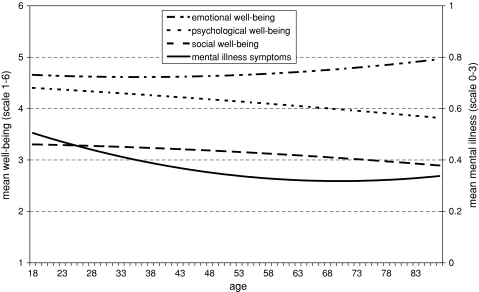
Mental health has long been defined as the absence of psychopathologies, such as depression and anxiety. The absence of mental illness, however, is a minimal outcome from a psychological perspective on lifespan development. This article therefore focuses on mental illness as well as on three core components of positive mental health: feelings of happiness and satisfaction with life (emotional well-being), positive individual functioning in terms of self-realization (psychological well-being), and positive societal functioning in terms of being of social value (social well-being). The two continua model holds that mental illness and mental health are related but distinct dimensions. This model was studied on the basis of a cross-sectional representative internet survey of Dutch adults (N = 1,340; 18-87 years). Mental illness was measured with the Brief Symptom Inventory and mental health with the Mental Health Continuum Short Form. It was found that older adults, except for the oldest-old, scored lower on psychopathological symptoms and were less likely to be mentally ill than younger adults. Although there were fewer age differences for mental health, older adults experienced more emotional, similar social and slightly lower psychological well-being. In sum, today's older adults have fewer mental illness problems, but they are not in a better positive mental health than today's younger adults. These findings support the validity of the two continua model in adult development.
Overview
The claims and statistics of this paper haven’t been checked yet.
Free: it reads the open-access text and checks the first 5 claims that cite a source we can check. Create a free account to check every claim.
Integrity signals
Registry
Cites
Statistics
Figures
Verification
Claims the paper makes
The claims and statistics of this paper haven’t been checked yet.
Free: it reads the open-access text and checks the first 5 claims that cite a source we can check. Create a free account to check every claim.
Claims other papers make about this one
Each is checked against this paper’s own text: does it say what the citing paper says it does?
The source backs part of the claim, not all of it — or backs it for a different population, condition or comparison.
In the citing paper
“The MHC-SF has demonstrated good psychometric properties across various age groups and nations (Lamers et al., 2011, Westerhof and Keyes, 2010).”
From The link between stress, well-being, and psychological flexibility during an Acceptance and Commitment Therapy self-help intervention (2018) · cites this paper as Westerhof and Keyes, 2010
Experimental — accuracy not yet measuredThe cited source says what the claim attributes to it.
In the citing paper
“The dual-factor model of mental health suggests that enhancing positive mental health and alleviating psychopathology do not automatically go hand-in-hand (Keyes, 2005a).”
From Both positive mental health and psychopathology should be monitored in psychotherapy: Confirmation for the dual-factor model in acceptance and commitment therapy (2017) · cites this paper as Westerhof & Keyes, 2009
The cited source says what the claim attributes to it.
In the citing paper
“Although the dual-factor model has been wellestablished in cross-sectional studies (e.g., Westerhof & Keyes, 2009), this is the first study to our knowledge that has investigated the applicability of the dual-factor model of mental health in an intervention study based on an effective psychotherapeutic intervention, namely, ACT (Fledderus et al., 2012).”
From Both positive mental health and psychopathology should be monitored in psychotherapy: Confirmation for the dual-factor model in acceptance and commitment therapy (2017) · cites this paper as Westerhof & Keyes, 2009
The cited source says what the claim attributes to it.
In the citing paper
“This model has been replicated in both American and international samples and across the lifespan (Keyes, 2002; Westerhof & Keyes, 2010).”
From Trajectories of change in well-being during cognitive behavioral therapies for anxiety disorders: Quantifying the impact and covariation with improvements in anxiety (2020) · cites this paper as Westerhof & Keyes, 2010
The cited source says what the claim attributes to it.
In the citing paper
“Nonetheless, mental health is not merely the absence of mental illness, and the two are related but distinct (Westerhof & Keyes, 2010); therefore, wellbeing services may also help to improve mental health without reducing symptoms.”
From Content Moderator Mental Health and Associations with Coping Styles: Replication and Extension of Previous Studies (2025) · cites this paper as Westerhof & Keyes, 2010
4 more claims about this paper
Create a free account to see every claim other papers make about this one.
Self-check
Percentages, sums and reported differences re-computed from the paper’s own numbers.
The self-check needs the paper’s full text.
Citations
Cites
Happiness is everything, or is it? Explorations on the meaning of psychological well-being.
Ryff, C. D. (1989) · Journal of Personality and Social Psychology · doi:10.1037/0022-3514.57.6.1069 · Cited by 14,847 · cited 5×
“Psychologists started to reflect on the notion of well-being in terms of individual strivings and optimal functioning (Ryan and Deci 2001; Ryff 1989), which gave rise to the second tradition of research, called eudaimonic well-being.”
BackgroundInfluentialSubjective well-being: Three decades of progress.
Diener, E., Suh, E. M., Lucas, R. E., & Smith, H. L. (1999) · Psychological Bulletin · doi:10.1037/0033-2909.125.2.276 · Cited by 12,910
On Happiness and Human Potentials: A Review of Research on Hedonic and Eudaimonic Well-Being
Ryan, R. M., & Deci, E. L. (2001) · Annual Review of Psychology · doi:10.1146/annurev.psych.52.1.141 · Cited by 11,567 · cited 4×
“Psychologists started to reflect on the notion of well-being in terms of individual strivings and optimal functioning (Ryan and Deci 2001; Ryff 1989), which gave rise to the second tradition of research, called eudaimonic well-being.”
BackgroundInfluentialDiener, E. (1984) · Psychological Bulletin · doi:10.1037/0033-2909.95.3.542 · Cited by 11,023
Diener, E. (2009) · Social Indicators Research Series · doi:10.1007/978-90-481-2350-6_2 · Cited by 10,950
The structure of psychological well-being revisited.
Ryff, C. D., & Keyes, C. L. M. (1995) · Journal of Personality and Social Psychology · doi:10.1037//0022-3514.69.4.719 · Cited by 10,285 · cited 5×
“This procedure resulted in a sample of 1,662 respondents who filled out the questionnaire in December 2007 (a response of 76% of those who participated in the panel).”
BackgroundMethodInfluentialSelf-citationВзаимосвязь статуса занятости и пола с уровнем психологического благополучия
М.Р., Н., & С.И., Б. (2026) · Cifra LLC Journals · doi:10.60797/irj.2026.170.43 · Cited by 7,950
The mental health continuum: from languishing to flourishing in life.
Keyes, C. L. M. (2002) · Journal of Health and Social Behavior · doi:10.2307/3090197 · Cited by 5,133 · cited 5×
“The findings of this study provide strong support for the two continua model of mental illness and health (Keyes 2002, 2005, 2007).”
BackgroundResultInfluentialSelf-citationThe Structure of Psychological Well-Being.
Mechanic, D., & Bradburn, N. M. (1970) · American Sociological Review · doi:10.2307/2093340 · Cited by 4,923 · cited 1×
“In the social sciences, this tradition dates back to survey research in the 1960s and 1970s, when scholars started to study the quality of American life from the perspective of citizens themselves (Andrews and Withey 1976; Bradburn 1969; Campbell et al. 1976; Cantril 1965; Gurin et al. 1960).”
BackgroundSocial Indicators of Well-Being
Andrews, F. M., & Withey, S. B. (1976) · Springer eBooks · doi:10.1007/978-1-4684-2253-5 · Cited by 3,653 · cited 1×
“In the social sciences, this tradition dates back to survey research in the 1960s and 1970s, when scholars started to study the quality of American life from the perspective of citizens themselves (Andrews and Withey 1976; Bradburn 1969; Campbell et al. 1976; Cantril 1965; Gurin et al. 1960).”
Background
Research works printed but not linked: 3
- Derogatis, L. R. (1975). The Brief Symptom Inventory. Baltimore, MD.: Clinical Psychometric Research.
- Westerhof, G. J. (2001). Wohlbefinden in der zweiten Lebenshälfte [Well-being in the second half of life]. In F. Dittmann-Kohli, C. Bode, & G. J. Westerhof (Eds.), Die zweite Lebenshälfte—Psychologische Perspektiven. Ergebnisse des Alters-Survey (pp. 79–128). Stuttgart: Kohlhammer.
- Westerhof, G. J., & Keyes, C. L. M. (2008). Geestelijke gezondheid is meer dan de afwezigheid van geestelijke ziekte [Mental health is more than the absence of mental illness]. Maandblad Geestelijke Volksgezondheid, 63, 808–820.
Cited by
Items 101–200 of 1,001
Growth mindset of socioeconomic status boosts subjective well-being: A longitudinal study
Zhao, S., Du, H., Li, Q., Wu, Q., & Chi, P. (2020) · Personality and Individual Differences · doi:10.1016/j.paid.2020.110301 · Cited by 86
Halamová, J., Kanovský, M., Gilbert, P., Troop, N. A., Zuroff, D. C., Hermanto, N., Petrocchi, N., Sommers-Spijkerman, M., Kirby, J. N., Shahar, B., et al. (2018) · Journal of Psychopathology and Behavioral Assessment · doi:10.1007/s10862-018-9686-2 · Cited by 77
“For example, it is now well established that psychopahology and mental health are not on a single continuum (Lamers et al. 2015; Westerhof and Keyes 2010).”
BackgroundSchotanus-Dijkstra, M., Drossaert, C. H., Pieterse, M. E., Walburg, J. A., & Bohlmeijer, E. T. (2015) · JMIR Research Protocols · doi:10.2196/resprot.4162 · Cited by 76
“Recent evidence indicates that positive mental health and mental illness are related but different continua [4-6].”
BackgroundPsychological Approaches to Mental Illness
Peterson, C. (2009) · Cambridge University Press eBooks · doi:10.1017/cbo9780511984945.008 · Cited by 78
Positive and negative mental health across the lifespan: A cross-cultural comparison
Schönfeld, P., Brailovskaia, J., & Margraf, J. (2017) · International Journal of Clinical and Health Psychology · doi:10.1016/j.ijchp.2017.06.003 · Cited by 75
Systematic review of interventions to improve the psychological well-being of general practitioners
Murray, M., Murray, L., & Donnelly, M. (2016) · BMC Family Practice · doi:10.1186/s12875-016-0431-1 · Cited by 75
de Vos, J. D., Radstaak, M., Bohlmeijer, E., & Westerhof, G. (2018) · Frontiers in Psychology · doi:10.3389/fpsyg.2018.02145 · Cited by 71
“Well-being consists of three components, namely emotional, psychological, and social well-being (Ryff and Keyes, 1995; Keyes, 2002; Westerhof and Keyes, 2010).”
BackgroundSelf-citationHedley, D., Uljarević, M., Bury, S. M., & Dissanayake, C. (2019) · Autism Research · doi:10.1002/aur.2064 · Cited by 71
Aldamman, K., Tamrakar, T., Dinesen, C., Wiedemann, N., Murphy, J., Hansen, M., Elsiddig Badr, E., Reid, T., & Vallières, F. (2019) · European Journal of Psychotraumatology · doi:10.1080/20008198.2019.1694811 · Cited by 70
The Relation of Ego Integrity and Despair to Personality Traits and Mental Health
Westerhof, G. J., Bohlmeijer, E. T., & McAdams, D. P. (2015) · The Journals of Gerontology Series B · doi:10.1093/geronb/gbv062 · Cited by 88
Self-citationMoving beyond disciplinary silos towards a transdisciplinary model of wellbeing: an invited review
Mead, J., Fisher, Z., & Kemp, A. H. (2021) · Frontiers in Psychology · doi:10.3389/fpsyg.2021.642093 · Cited by 71
“The theory of social wellbeing (Keyes, 1998, 2002; Westerhof and Keyes, 2010) is linked to the sense that society: is meaningful and understandable (social coherence); provides an opportunity for growth (social actualisation), is something that one belongs to and is accepted by (social acceptance…”
BackgroundBendtsen, M., Müssener, U., Linderoth, C., & Thomas, K. (2020) · JMIR mhealth and uhealth · doi:10.2196/17208 · Cited by 71
“Research on multicomponent PPIs has shown that these integral programs influence positive mental health and depression, and potentially anxiety and stress [16].”
BackgroundMethodJans-Beken, L., Lataster, J., Peels, D. A., Lechner, L., & Jacobs, N. (2017) · Journal of Happiness Studies · doi:10.1007/s10902-017-9893-7 · Cited by 97
“Complete mental health, following Keyes’ (2005) empirically grounded dual continuum model, consists of two related, yet distinct dimensions: psychopathology (or mental illness) and subjective well-being (or positive mental health; see also: Westerhof and Keyes 2010).”
BackgroundInfluentialGranlund, M., Imms, C., King, G. A., Andersson, A. K., Augustine, L., Brooks, R., Danielsson, H., Gothilander, J., Ivarsson, M., Lundqvist, L., et al. (2021) · International Journal of Environmental Research and Public Health · doi:10.3390/ijerph18041656 · Cited by 102
“Keyes argues that mental health consists of three partly overlapping dimensions of wellbeing: emotional wellbeing (entailing positive affect, absence of negative affect, and perceived satisfaction with life), psychological wellbeing (consisting of self-acceptance, positive relations with others, personal growth, purpo…”
BackgroundInfluentialExperiences of flourishing and languishing during the first year at university
Knoesen, R., & Naudé, L. (2018) · Journal of Mental Health · doi:10.1080/09638237.2017.1370635 · Cited by 70
Chaves, C., Castellanos, T., Abrams, M. P., & Vázquez, C. (2018) · Social Psychiatry and Psychiatric Epidemiology · doi:10.1007/s00127-018-1558-2 · Cited by 92
“Therefore, as previous studies have suggested, people who have high levels of individual well-being are likely to report less depression, and this is, at least in part, due to their social well-being [32, 66].”
BackgroundIllness Perception and Well-Being Among Persons with Multiple Sclerosis and Their Caregivers
Bassi, M., Falautano, M., Cilia, S., Goretti, B., Grobberio, M., Pattini, M., Pietrolongo, E., Viterbo, R. G., Amato, M. P., Benin, M., et al. (2015) · Journal of Clinical Psychology in Medical Settings · doi:10.1007/s10880-015-9425-8 · Cited by 79
“Even if well-being and mental illness are correlated, they are not opposite poles of a single continuum (Westerhof & Keyes, 2010), so that presence of well-being is not equivalent to absence of mental illness, and absence of well-being is not equivalent to presence of mental illness.”
BackgroundMarital Status and Mental Health
Williams, K., Frech, A., & Carlson, D. L. (2009) · Cambridge University Press eBooks · doi:10.1017/cbo9780511984945.020 · Cited by 101
Dreyer, B. C., Coulombe, S., Whitney, S., Riemer, M., & Labbé, D. (2018) · Frontiers in Psychology · doi:10.3389/fpsyg.2018.01583 · Cited by 94
Oliveira Carvalho, P., Hülsdünker, T., & Carson, F. (2021) · Behavioral Sciences · doi:10.3390/bs12010003 · Cited by 66
“The two continua model of mental illness and health [6] allows for mental health and mental illness to be separate, but related, constructs.”
BackgroundImpact of organized activities on mental health in children and adolescents: An umbrella review
Boelens, M., Smit, M. S., Raat, H., Bramer, W. M., & Jansen, W. (2022) · Preventive Medicine Reports · doi:10.1016/j.pmedr.2021.101687 · Cited by 65
“The outcomes of interest were indicators of me mental health as defined by the WHO and by Keyes (Galderisi et al., 2015; Keyes, 2002, 2005, 2007; Westerhof and Keyes, 2010; King et al., 2014; World Health Organization, 2004).”
BackgroundMethodInfluentialHuber, M. (2014) · Research Publications (Maastricht University) · doi:10.26481/dis.20141217mh · Cited by 130
School Engagement and Well-Being in Adolescents: Mediating Roles of Hope and Social Competence
Demırcı, İ. (2020) · Child Indicators Research · doi:10.1007/s12187-020-09722-y · Cited by 85
“…emotional well-being, which expresses the presence of positive feelings in daily life, psychological well-being, which expresses positive functioning in personal life, and social well-being, which expresses positive functioning in community life (Lamers et al. 2010; Westerhof and Keyes 2010).”
BackgroundInfluentialCapone, V., Borrelli, R., Marino, L., & Schettino, G. (2022) · International Journal of Environmental Research and Public Health · doi:10.3390/ijerph19063734 · Cited by 91
“In the Mental Health Continuum Model [10,19,20], mental health is regarded as a syndrome of symptoms of positive feelings and positive functioning in life.”
BackgroundGrowing Up, Naturally: The Mental Health Legacy of Early Nature Affiliation
Windhorst, E., & Williams, A. P. (2015) · Ecopsychology · doi:10.1089/eco.2015.0040 · Cited by 69
Nicholls, D., Chang, E. M. L., Johnson, A., & Edenborough, M. (2013) · Aging & Mental Health · doi:10.1080/13607863.2012.751581 · Cited by 90
Positive Mental Health Scale: Validation of the Mental Health Continuum - Short Form
Machado, W. D. L., & Bandeira, D. R. (2015) · Psico-USF · doi:10.1590/1413-82712015200207 · Cited by 86
An Empirical Approach to Complete Mental Health Classification in Adolescents
Moore, S. A., Dowdy, E. T., Nylund-Gibson, K. K., & Furlong, M. J. (2019) · School Mental Health · doi:10.1007/s12310-019-09311-7 · Cited by 72
Well-Being across the Life Course
Mirowsky, J., & Ross, C. E. (2009) · A Handbook for the Study of Mental Health · doi:10.1017/cbo9780511984945.023 · Cited by 61
Duncan, M. J., Patte, K. A., & Leatherdale, S. T. (2021) · Canadian Journal of School Psychology · doi:10.1177/0829573521997311 · Cited by 95
“…such as depression and anxiety have typically not been examined simultaneously, despite the dual-continua model that posits mental illness/dysfunction and mental well-being are separate but related aspects of overall mental health (Westerhof & Keyes, 2010; World Health Organization [WHO], 2004).”
BackgroundProeschold‐Bell, R. J., Eisenberg, A. N., Adams, C., Smith, B. W., LeGrand, S., & Wilk, A. R. (2015) · Journal for the Scientific Study of Religion · doi:10.1111/jssr.12234 · Cited by 71
“There is greater understanding now that positive and negative mental health do not occur on a single continuum (Westerhof and Keyes 2009; Payton 2009).”
BackgroundRecovery from mood and anxiety disorders: The influence of positive mental health
Schotanus-Dijkstra, M., Keyes, C. L. M., de Graaf, R., & ten Have, M. (2019) · Journal of Affective Disorders · doi:10.1016/j.jad.2019.04.051 · Cited by 59
Self-citationThe Mental Health of Elite-Level Coaches: A Systematic Scoping Review
Frost, J., Walton, C. C., Purcell, R., Fisher, K., Gwyther, K., Kocherginsky, M., & Rice, S. M. (2024) · Sports Medicine - Open · doi:10.1186/s40798-023-00655-8 · Cited by 59
“This dimen-sion can be generally determined by a combination of emotional (e.g. affective states), psychological (e.g. individual functioning) and social (e.g. societal functioning) wellbeing [32].”
BackgroundMethodAfifi, T. O., MacMillan, H. L., Taillieu, T., Turner, S., Cheung, K., Sareen, J., & Boyle, M. H. (2016) · The Canadian Journal of Psychiatry · doi:10.1177/0706743716651832 · Cited by 59
“Keyes states that the absence of mental disorders does not equal mental health, well-being, or happiness, but rather mental health is best understood as complete mental health, including the absence of mental disorders and the presence of mental well-being and functioning.(22,25) According to Keyes,(26) well-being and…”
BackgroundMethodThe temporal stability of the Kessler Psychological Distress Scale
Merson, F., Newby, J. M., Shires, A. G., Millard, M., & Mahoney, A. (2021) · Australian Psychologist · doi:10.1080/00050067.2021.1893603 · Cited by 69
“Indeed, such variation may support the overall validity of the measure given that psychological distress and symptoms of affective disorders are known to ebb and flow in severity over time (Westerhof & Keyes, 2010).”
BackgroundGroves, C. I., Huong, C., Porter, C. D., Summerville, B., Swafford, I., Witham, B., Hayward, M., KWAN, M. Y. W., & Brown, D. M. Y. (2024) · Journal of Activity Sedentary and Sleep Behaviors · doi:10.1186/s44167-024-00048-6 · Cited by 82
Durand‐Bush, N., McNeill, K., Harding, M., & Dobransky, J. S. (2015) · Canadian Journal of Counselling and Psychotherapy · Cited by 59
Parents’ Perceptions of Risk and the Influence on Children’s Everyday Activities
Niehues, A. N., Bundy, A. C., Broom, A. F., & Tranter, P. (2013) · Journal of Child and Family Studies · doi:10.1007/s10826-013-9891-2 · Cited by 81
“Mental Health” as Defined by Twitter: Frames, Emotions, Stigma
Pavlova, A., & Berkers, P. (2020) · Health Communication · doi:10.1080/10410236.2020.1862396 · Cited by 84
“…time, even in the presence of a clear health definition, the research community continues contestations of mental health definitions and trying to understand how it is different from being merely an absence of mental illness (Galderisi et al., 2015; Manwell et al., 2015; Westerhof & Keyes, 2010).”
BackgroundAbelson, S., Lipson, S. K., & Eisenberg, D. (2022) · Higher education · doi:10.1007/978-3-030-76660-3_6 · Cited by 83
Problematic Smartphone Use and Mental Health in Chinese Adults: A Population-Based Study
Guo, N., Luk, T. T., Ho, S. Y., Lee, J. J., Shen, C., Oliffe, J. L., Chan, S. S. C., Lam, T. H., & Wang, M. P. (2020) · International Journal of Environmental Research and Public Health · doi:10.3390/ijerph17030844 · Cited by 72
“Despite the correlations, the dual continuum model of mental health proposes that mental illness and well-being are on two distinct dimensions [17].”
BackgroundElfrink, T. R., Goldberg, J. M., Schreurs, K. M. G., Bohlmeijer, E. T., & Clarke, A. M. (2017) · Health Education · doi:10.1108/he-09-2016-0039 · Cited by 73
Niekerk, R. L. V., & van Gent, M. M. (2021) · South African Journal of Psychiatry · doi:10.4102/sajpsychiatry.v27i0.1589 · Cited by 77
Magalhães, E., & Calheiros, M. M. (2017) · Children and Youth Services Review · doi:10.1016/j.childyouth.2017.06.041 · Cited by 75
Structure and Continuity of Well-Being in Mid-Adulthood: A Longitudinal Study
Kokko, K., Korkalainen, A., Lyyra, A., & Feldt, T. (2012) · Journal of Happiness Studies · doi:10.1007/s10902-011-9318-y · Cited by 85
Momtaz, Y. A., Hamid, T. A., Haron, S. A., & Bagat, M. F. (2015) · Archives of Gerontology and Geriatrics · doi:10.1016/j.archger.2015.11.001 · Cited by 73
Hunt, C., Gibson, G. C., Horst, A. V., Cleveland, K. A., Wawrosch, C., Granot, M., Kuhn, T. A., Woolverton, C. J., & Hughes, J. W. (2021) · Psychology of Sexual Orientation and Gender Diversity · doi:10.1037/sgd0000461 · Cited by 67
Reinhardt, M., Horváth, Z., Morgan, A. R., & Kökönyei, G. (2020) · Health and Quality of Life Outcomes · doi:10.1186/s12955-020-01332-0 · Cited by 66
Bélanger, R. E., Patte, K. A., Leatherdale, S. T., Gansaonré, R. J., & Haddad, S. (2021) · Journal of Adolescent Health · doi:10.1016/j.jadohealth.2021.07.039 · Cited by 53
“To reflect Keyes’ model of complete mental health [41], where mental health and illness exist on separate continua, our outcomes assessed positive mental health (flourishing-languishing) and two of the most common mental illnesses among adolescents [42].”
Seow, L. S. E., Vaingankar, J. A., Abdin, E., Sambasivam, R., Jeyagurunathan, A., Pang, S., Chong, S. A., & Subramaniam, M. (2016) · Journal of Affective Disorders · doi:10.1016/j.jad.2015.10.021 · Cited by 53
“…in those who met criteria for lifetime or current diagnosis of mental disorders among the general population (Gilmour, 2014; Keyes, 2002; Westerhof and Keyes, 2010) but to the best of our knowledge, our study may be the first to provide such evidence from the perspective of a…”
BackgroundWhite, R. G., Imperiale, M. G., & Perera, E. (2016) · Globalization and Health · doi:10.1186/s12992-016-0150-3 · Cited by 53
“Theorists have proposed that mental illness and mental health exist on distinct continua [13].”
BackgroundAstleitner, H., Bains, A., & Hörmann, S. (2022) · Computers in Human Behavior · doi:10.1016/j.chb.2022.107436 · Cited by 81
Cheung, R. Y. M., Leung, S. S. W., & Mak, W. W. S. (2019) · Mindfulness · doi:10.1007/s12671-019-01208-5 · Cited by 65
Prior Military Service, Identity Stigma, and Mental Health Among Transgender Older Adults
Hoy‐Ellis, C. P., Shiu, C. A., Sullivan, K. M., Kim, H., Sturges, A. M., & Fredriksen‐Goldsen, K. I. (2017) · The Gerontologist · doi:10.1093/geront/gnw173 · Cited by 53
“Mental health, the absence of mental illness and the presence of psychological well-being, is integral to successful aging (Westerhof & Keyes, 2010), and as such can be described as a desired positive outcome of the HEPM—progress toward achieving health equity.”
BackgroundMead, J. P., Fisher, Z., Tree, J. J., Wong, P. T. P., & Kemp, A. H. (2021) · Frontiers in Psychology · doi:10.3389/fpsyg.2021.647951 · Cited by 50
“While this research has improved our understanding of the factors that can protect against ill-being during the pandemic, reducing ill-being is not the same as promoting wellbeing, as wellbeing does not necessarily emerge when illbeing is reduced (Ryff et al., 2006; Westerhof and Keyes, 2010).”
BackgroundFuller‐Thomson, E., Agbeyaka, S., LaFond, D. M., & Bern‐Klug, M. (2016) · Psychiatry Research · doi:10.1016/j.psychres.2016.04.041 · Cited by 55
“Specifically, being married or having a significant other has been shown to positively influence achieving complete mental health (Westerhof and Keyes, 2009) .”
BackgroundPhysical-mental multimorbidity in children and youth: a scoping review
Romano, I., Buchan, C., Baiocco-Romano, L., & Ferro, M. A. (2021) · BMJ Open · doi:10.1136/bmjopen-2020-043124 · Cited by 60
Sintomatologia depresiva y bienestar psicológico en estudiantes universitarios chilenos
Rossi, J. L., Jiménez, J. P., Barros, P., Assar, R., Jaramillo, K., Herrera, L., Quevedo, Y., Botto, A., Leighton, C., & Martínez, F. I. (2019) · Revista médica de Chile · doi:10.4067/s0034-98872019000500579 · Cited by 72
Vedøy, I. B., Anderssen, S. A., Tjomsland, H. E., Skulberg, K. R., & Thurston, M. N. (2020) · Mental health and physical activity · doi:10.1016/j.mhpa.2020.100322 · Cited by 67
A Randomized Clinical Trial of an Identity Intervention Programme for Women with Eating Disorders
Stein, K. F., Corte, C., Chen, D. (., Nuliyalu, U., & Wing, J. (2013) · European Eating Disorders Review · doi:10.1002/erv.2195 · Cited by 47
Factors facilitating a positive transition to secondary school: A systematic literature review
Bharara, G. (2019) · International Journal of School & Educational Psychology · doi:10.1080/21683603.2019.1572552 · Cited by 75
Economic Inequality is Associated with Long-Term Harm on Adolescent Well-Being in China
Du, H., Chi, P., & King, R. B. (2019) · Child Development · doi:10.1111/cdev.13253 · Cited by 48
Work and Unemployment as Stressors
Lennon, M. C., & Limonic, L. (2009) · Cambridge University Press eBooks · doi:10.1017/cbo9780511984945.015 · Cited by 55
Kraiss, J. T., Kohlhoff, M., & ten Klooster, P. M. (2022) · Current Psychology · doi:10.1007/s12144-022-02942-1 · Cited by 66
The next steps in the promotion and protection of positive mental health.
Keyes, C. L. M. (2010) · PubMed · Cited by 47
Self-citationThe Relationship between Mental Health Components and Locus of Control in Youth
Shojaee, M., & French, C. (2014) · Psychology · doi:10.4236/psych.2014.58107 · Cited by 54
van der Star, A., Pachankis, J. E., & Bränström, R. (2021) · Journal of Youth and Adolescence · doi:10.1007/s10964-020-01340-9 · Cited by 46
Cai, D., Zhu, M., Lin, M., Zhang, X. C., & Margraf, J. (2017) · Frontiers in Psychology · doi:10.3389/fpsyg.2017.01119 · Cited by 57
“…negative and positive aspects of mental health are only moderately related to each other, and that the association between the two is bidirectional, supported by the two-dimensional model of mental health (Westerhof and Keyes, 2010; Kendler et al., 2011; Weich et al., 2011; Lamers et al., 2015).”
BackgroundTo What Extent is Internet Activity Predictive of Psychological Well-Being?
Lippke, S., Dahmen, A., Gao, L., Guza, E., & Nigg, C. R. (2021) · Psychology Research and Behavior Management · doi:10.2147/prbm.s274502 · Cited by 57
The Gold Medal Profile for Sport Psychology (GMP-SP)
Durand‐Bush, N., Baker, J. R., Berg, F., Richard, V., & Bloom, G. A. (2022) · Journal of Applied Sport Psychology · doi:10.1080/10413200.2022.2055224 · Cited by 76
du Toit, A., Thomson, R. J., & Page, A. (2022) · International Journal of Wellbeing · doi:10.5502/ijw.v12i2.1897 · Cited by 65
Stephens, J. M., Iasiello, M. P., Ali, K., van Agteren, J. E., & Fassnacht, D. B. (2023) · Behavioral Sciences · doi:10.3390/bs13050436 · Cited by 75
“The model proposes that high levels of mental illness and mental wellbeing are coincidentally possible and that mental wellbeing can be improved despite the persistent presence of a mental illness [3,14].”
BackgroundThe association between social network factors and mental health at different life stages
Levula, A. V., Wilson, A. J., & Harré, M. (2015) · Quality of Life Research · doi:10.1007/s11136-015-1200-7 · Cited by 53
“This study is also confirmatory analysis in that mental health score increases with age and that seniors are likely to have higher mental health outcomes than adolescents and adults [32–35].”
ResultHaeyen, S., van Hooren, S., van der Veld, W. M., & Hutschemaekers, G. J. M. (2017) · The Arts in Psychotherapy · doi:10.1016/j.aip.2017.12.009 · Cited by 47
Yakın, D., Gençöz, T., Steenbergen, L., & Arntz, A. R. (2019) · Journal of Clinical Psychology · doi:10.1002/jclp.22755 · Cited by 66
“…and negative affective dimensions (Kahl, Winter, & Schweiger, 2012); for full mental health, the presence of positive emotions is as important as the absence of negative emotions and skills to regulate both positive and negative emotions (Gratz & Roemer, 2004; Keyes, 2005; Westerhof & Keyes, 2010).”
Augustine, L., Lygnegård, F., & Granlund, M. (2021) · Disability and Rehabilitation · doi:10.1080/09638288.2021.1955304 · Cited by 44
“Westerhof and Keyes [17] suggest that mental health defined as flourishing should be seen as existing on a separate continuum when related to mental health problems.”
BackgroundInfluentialSpotlight on eudaimonia and depression. A systematic review of the literature over the past 5 years
Ruini, C., & Cesetti, G. (2019) · Psychology Research and Behavior Management · doi:10.2147/prbm.s178255 · Cited by 43
“However, authors reported a higher variability in positive mental health in this group of outpatients, and these data confirmed the dual model continuum of mental health.(97) Similarly, Teisman et al(85) measured positive mental health in a sample of 130 patients with various anxiety disorders (phobias, panic attack,…”
ResultHuang, Q., Wang, X., Ge, Y., & Cai, D. (2021) · Current Psychology · doi:10.1007/s12144-021-02160-1 · Cited by 65
Arslan, İ. B., Lucassen, N., Keijsers, L., & Stevens, G. W. J. M. (2023) · Journal of Youth and Adolescence · doi:10.1007/s10964-022-01723-0 · Cited by 68
Williams, E., Glew, S., Newman, H., Kapka, A., Shaughnessy, N., Herbert, R., Walduck, J., Foster, A., Cooke, P. A., Pethybridge, R., et al. (2023) · Journal of Child Psychology and Psychiatry · doi:10.1111/jcpp.13900 · Cited by 58
Howell, A. J., Keyes, C. L. M., & Passmore, H. (2013) · Springer eBooks · doi:10.1007/978-94-007-6398-2_5 · Cited by 60
Self-citationPositive mental health among health professionals working at a psychiatric hospital
Picco, L., Yuan, Q., Vaingankar, J. A., Chang, S. S. H., Abdin, E., Chua, H. C., Chong, S. A., & Subramaniam, M. (2017) · PLoS ONE · doi:10.1371/journal.pone.0178359 · Cited by 54
Measuring PhD Student’s Psychological Well-being: Are we seeing the whole picture?
Scott, H., & Takarangi, M. K. T. (2019) · Student Success · doi:10.5204/ssj.v10i3.1294 · Cited by 54
Positive mental health and adjustment following life-stressors among young adults
Truskauskaitė‐Kunevičienė, I., Kazlauskas, E., Ostreikaite-Jurevice, R., Brailovskaia, J., & Margraf, J. (2020) · Current Psychology · doi:10.1007/s12144-020-00714-3 · Cited by 49
“Rather, PMH is seen as a separate factor that is negatively linked to psychopathology (Teismann et al. 2018a, 2018b; Westerhof and Keyes 2010).”
BackgroundGalanza, M. A. M. C., Aruta, J. J. B. R., Mateo, N. J., Resurreccion, R. R., & Bernardo, A. B. I. (2021) · The Educational and Developmental Psychologist · doi:10.1080/20590776.2021.1999168 · Cited by 47
“We adopted the bidimensional model, which posits that there are two distinct and co-occurring indicators of mental health: mental illness and positive affective experiences (Westerhof & Keyes, 2009).”
MethodAnxious or Depressed and Still Happy?
Spinhoven, P., Elzinga, B. M., Giltay, E. J., & Penninx, B. W. J. H. (2015) · PLoS ONE · doi:10.1371/journal.pone.0139912 · Cited by 49
Mælan, E. N., Tjomsland, H. E., Baklien, B., Samdal, O., & Thurston, M. N. (2018) · Pastoral Care in Education · doi:10.1080/02643944.2017.1422005 · Cited by 54
“Westerhof and Keyes (2010) developed their two continua model to describe mental health as more than the absence of © 2018 naPCe ARTICLE HISTORY received 12 June 2017 accepted 13 november 2017 KEYWORDS Pupils’ mental health; educational role; secondary school CONTACT ellen nesset Mælan…”
BackgroundWell-being in major depression and social phobia with and without comorbidity
Wersebe, H., Lieb, R., Meyer, A. H., Miche, M., Mikoteit, T., Imboden, C., Hoyer, J., Bader, K., Hatzinger, M., & Gloster, A. T. (2018) · International Journal of Clinical and Health Psychology · doi:10.1016/j.ijchp.2018.06.004 · Cited by 41
Yeo, Z. Z., & Suárez, L. (2022) · PLoS ONE · doi:10.1371/journal.pone.0268232 · Cited by 43
“Mental health, thus, is no longer tied to the presence or absence of mental illness, but rather, pertains to the combination of (i) the individual’s mental state, (ii) functioning within the social context, and (iii) the individual’s psychological functioning [18, 22].”
BackgroundRøset, L., Green, K., & Thurston, M. N. (2019) · Sport Education and Society · doi:10.1080/13573322.2019.1634043 · Cited by 52
“In this study, we draw upon Westerhof and Keyes (2010) two continua model, which conceptualizes positive mental health (or wellbeing), as related to, and distinct frommental illness.”
MethodComponents of psychosocial health
Husain, W. (2021) · Health Education · doi:10.1108/he-05-2021-0084 · Cited by 51
Black, L., Panayiotou, M., & Humphrey, N. (2019) · PLoS ONE · doi:10.1371/journal.pone.0213018 · Cited by 38
Kraiss, J. T., Redelinghuys, K., & Weiss, L. (2022) · Journal of Happiness Studies · doi:10.1007/s10902-022-00545-y · Cited by 56
A Grounded Theory of Filipino Wellness (Kaginhawaan)
Samaco-Zamora, M. C. F., & Fernandez, K. T. G. (2016) · Psychological Studies · doi:10.1007/s12646-016-0373-7 · Cited by 54
Plooy, D., Lyons, A., & Kashima, E. S. (2018) · Journal of Happiness Studies · doi:10.1007/s10902-018-9961-7 · Cited by 49
Griffith, G. J., & Jones, K. (2019) · Social Science & Medicine · doi:10.1016/j.socscimed.2019.112638 · Cited by 45
Moreno, R. L., Pérez, M. L. V., Ogallar, A., & Godoy‐Izquierdo, D. (2020) · Health Psychology Open · doi:10.1177/2055102920947905 · Cited by 48
“overall well-being or wealth, or positive health; Seligman, 2008), others as indicators of mental and psychosocial functioning which can be separated into positive and negative ones (Westerhof and Keyes, 2010), and still others view them in a casual path that starts with one and ends with the other (Keyes and Waterman…”
BackgroundToseeb, U., & Wolke, D. (2021) · Journal of Youth and Adolescence · doi:10.1007/s10964-021-01495-z · Cited by 47
Happiness and depression in psoriasis: a cross-sectional study in Germany
Schuster, B., Peifer, C., Ziehfreund, S., Tizek, L., Biedermann, T., Zink, A., & Schielein, M. C. (2021) · Quality of Life Research · doi:10.1007/s11136-021-02991-2 · Cited by 40
How gambling harms the wellbeing of family and others: a review
Tulloch, C., Browne, M., Hing, N., Rockloff, M., & Hilbrecht, M. (2021) · International Gambling Studies · doi:10.1080/14459795.2021.2002384 · Cited by 38
Metadata
- Authors
- Westerhof, G. J., & Keyes, C. L. M.
- Affiliations
- University of Twente (NL)
- Emory University (US)
- Corresponding author
- Westerhof, Gerben J.
- Venue
- Journal of Adult Development
- Published
- 2009-08-26
- Volume
- 17
- Issue
- 2
- Pages
- 110-119
- ISSN
- 1068-0667 (ISSN-L)
- 1573-3440
- PMC
- PMC2866965
- OpenAlex
- W2117617786
- Cited by
- 1,345
- References
- 58
- Citations by year
- 2026: 131 · 2025: 148 · 2024: 158 · 2023: 135 · 2022: 137 · 2021: 134 · 2020: 104 · 2019: 66 · 2018: 60 · 2017: 83 · 2016: 43 · 2015: 43 · 2014: 24 · 2013: 27 · 2012: 22
- FWCI
- 21.92
- Type
- journal article
- Language
- en
- Open access
- hybrid
- doi.org
- Licence
- cc-by-nc
- Locations
- Journal of Adult Development (publishedVersion, cc-by-nc)
- Europe PMC (PubMed Central) (publishedVersion, cc-by-nc)
- PubMed Central (publishedVersion, cc-by-nc)
- PubMed (publishedVersion)
- University of Twente Research Information (submittedVersion)
- University of Twente Research Information (submittedVersion, other-oa)
- Topics
- Social Sciences › Psychology › Social Psychology › Psychological Well-being and Life Satisfaction
- Social Sciences › Psychology › Developmental and Educational Psychology › Aging and Gerontology Research
- Health Sciences › Medicine › Public Health, Environmental and Occupational Health › Aging, Health, and Disability
- Keywords
- mental illness, mental health, positive mental health, emotional well-being, psychological well-being, social well-being, lifespan development, age differences, older adults, psychiatric symptoms, happiness, life satisfaction, self-realization, social values
About these checks
Registry, retraction, Cites and statistics results are computed, not judged, with one exception: a printed reference that no index lists is read once by a model before it counts as a citation error. Claims are extracted by a model and kept only when their quote appears verbatim in the text; each cited source is then checked, with a model’s help, for whether it says what the claim relies on. Those verdicts can be wrong — read the claim’s quote and the cited source before relying on one.
Statistics and arithmetic are recomputed, not judged.
Confidence bands are shown only for fields calibrated on our annotated test set. None is calibrated yet, so no band is shown.
What counts as a claim ›How we measure confidence ›How we check this ›
Are you an author, or do you see a problem with this page? Request a review
Data sources
Bibliographic data: Semantic Scholar, OpenAlex, Crossref.
Contains information from the Semantic Scholar Academic Graph Datasets, made available under the ODC Attribution License (ODC-BY 1.0).
Semantic Scholar’s data is described in: Kinney, R., et al. (2023). The Semantic Scholar Open Data Platform. arXiv:2301.10140.
