

Mental Illness and Mental Health: The Two Continua Model Across the Lifespan
Open accessThe DOI matches its Crossref record; 53 of the 58 references it cites were found in a registry or an index.
Abstract
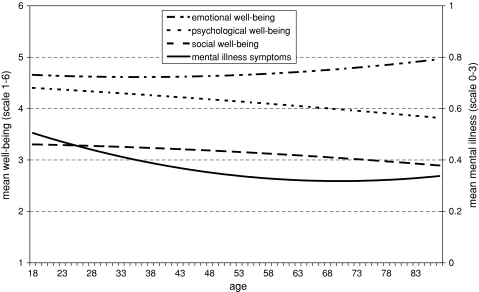
Mental health has long been defined as the absence of psychopathologies, such as depression and anxiety. The absence of mental illness, however, is a minimal outcome from a psychological perspective on lifespan development. This article therefore focuses on mental illness as well as on three core components of positive mental health: feelings of happiness and satisfaction with life (emotional well-being), positive individual functioning in terms of self-realization (psychological well-being), and positive societal functioning in terms of being of social value (social well-being). The two continua model holds that mental illness and mental health are related but distinct dimensions. This model was studied on the basis of a cross-sectional representative internet survey of Dutch adults (N = 1,340; 18-87 years). Mental illness was measured with the Brief Symptom Inventory and mental health with the Mental Health Continuum Short Form. It was found that older adults, except for the oldest-old, scored lower on psychopathological symptoms and were less likely to be mentally ill than younger adults. Although there were fewer age differences for mental health, older adults experienced more emotional, similar social and slightly lower psychological well-being. In sum, today's older adults have fewer mental illness problems, but they are not in a better positive mental health than today's younger adults. These findings support the validity of the two continua model in adult development.
Overview
The claims and statistics of this paper haven’t been checked yet.
Free: it reads the open-access text and checks the first 5 claims that cite a source we can check. Create a free account to check every claim.
Integrity signals
Registry
Cites
Statistics
Figures
Verification
Claims the paper makes
The claims and statistics of this paper haven’t been checked yet.
Free: it reads the open-access text and checks the first 5 claims that cite a source we can check. Create a free account to check every claim.
Claims other papers make about this one
Each is checked against this paper’s own text: does it say what the citing paper says it does?
The source backs part of the claim, not all of it — or backs it for a different population, condition or comparison.
In the citing paper
“The MHC-SF has demonstrated good psychometric properties across various age groups and nations (Lamers et al., 2011, Westerhof and Keyes, 2010).”
From The link between stress, well-being, and psychological flexibility during an Acceptance and Commitment Therapy self-help intervention (2018) · cites this paper as Westerhof and Keyes, 2010
Experimental — accuracy not yet measuredThe cited source says what the claim attributes to it.
In the citing paper
“The dual-factor model of mental health suggests that enhancing positive mental health and alleviating psychopathology do not automatically go hand-in-hand (Keyes, 2005a).”
From Both positive mental health and psychopathology should be monitored in psychotherapy: Confirmation for the dual-factor model in acceptance and commitment therapy (2017) · cites this paper as Westerhof & Keyes, 2009
The cited source says what the claim attributes to it.
In the citing paper
“Although the dual-factor model has been wellestablished in cross-sectional studies (e.g., Westerhof & Keyes, 2009), this is the first study to our knowledge that has investigated the applicability of the dual-factor model of mental health in an intervention study based on an effective psychotherapeutic intervention, namely, ACT (Fledderus et al., 2012).”
From Both positive mental health and psychopathology should be monitored in psychotherapy: Confirmation for the dual-factor model in acceptance and commitment therapy (2017) · cites this paper as Westerhof & Keyes, 2009
The cited source says what the claim attributes to it.
In the citing paper
“This model has been replicated in both American and international samples and across the lifespan (Keyes, 2002; Westerhof & Keyes, 2010).”
From Trajectories of change in well-being during cognitive behavioral therapies for anxiety disorders: Quantifying the impact and covariation with improvements in anxiety (2020) · cites this paper as Westerhof & Keyes, 2010
The cited source says what the claim attributes to it.
In the citing paper
“Nonetheless, mental health is not merely the absence of mental illness, and the two are related but distinct (Westerhof & Keyes, 2010); therefore, wellbeing services may also help to improve mental health without reducing symptoms.”
From Content Moderator Mental Health and Associations with Coping Styles: Replication and Extension of Previous Studies (2025) · cites this paper as Westerhof & Keyes, 2010
4 more claims about this paper
Create a free account to see every claim other papers make about this one.
Self-check
Percentages, sums and reported differences re-computed from the paper’s own numbers.
The self-check needs the paper’s full text.
Citations
Cites
Happiness is everything, or is it? Explorations on the meaning of psychological well-being.
Ryff, C. D. (1989) · Journal of Personality and Social Psychology · doi:10.1037/0022-3514.57.6.1069 · Cited by 14,847 · cited 5×
“Psychologists started to reflect on the notion of well-being in terms of individual strivings and optimal functioning (Ryan and Deci 2001; Ryff 1989), which gave rise to the second tradition of research, called eudaimonic well-being.”
BackgroundInfluentialSubjective well-being: Three decades of progress.
Diener, E., Suh, E. M., Lucas, R. E., & Smith, H. L. (1999) · Psychological Bulletin · doi:10.1037/0033-2909.125.2.276 · Cited by 12,910
On Happiness and Human Potentials: A Review of Research on Hedonic and Eudaimonic Well-Being
Ryan, R. M., & Deci, E. L. (2001) · Annual Review of Psychology · doi:10.1146/annurev.psych.52.1.141 · Cited by 11,567 · cited 4×
“Psychologists started to reflect on the notion of well-being in terms of individual strivings and optimal functioning (Ryan and Deci 2001; Ryff 1989), which gave rise to the second tradition of research, called eudaimonic well-being.”
BackgroundInfluentialDiener, E. (1984) · Psychological Bulletin · doi:10.1037/0033-2909.95.3.542 · Cited by 11,023
Diener, E. (2009) · Social Indicators Research Series · doi:10.1007/978-90-481-2350-6_2 · Cited by 10,950
The structure of psychological well-being revisited.
Ryff, C. D., & Keyes, C. L. M. (1995) · Journal of Personality and Social Psychology · doi:10.1037//0022-3514.69.4.719 · Cited by 10,285 · cited 5×
“This procedure resulted in a sample of 1,662 respondents who filled out the questionnaire in December 2007 (a response of 76% of those who participated in the panel).”
BackgroundMethodInfluentialSelf-citationВзаимосвязь статуса занятости и пола с уровнем психологического благополучия
М.Р., Н., & С.И., Б. (2026) · Cifra LLC Journals · doi:10.60797/irj.2026.170.43 · Cited by 7,950
The mental health continuum: from languishing to flourishing in life.
Keyes, C. L. M. (2002) · Journal of Health and Social Behavior · doi:10.2307/3090197 · Cited by 5,133 · cited 5×
“The findings of this study provide strong support for the two continua model of mental illness and health (Keyes 2002, 2005, 2007).”
BackgroundResultInfluentialSelf-citationThe Structure of Psychological Well-Being.
Mechanic, D., & Bradburn, N. M. (1970) · American Sociological Review · doi:10.2307/2093340 · Cited by 4,923 · cited 1×
“In the social sciences, this tradition dates back to survey research in the 1960s and 1970s, when scholars started to study the quality of American life from the perspective of citizens themselves (Andrews and Withey 1976; Bradburn 1969; Campbell et al. 1976; Cantril 1965; Gurin et al. 1960).”
BackgroundSocial Indicators of Well-Being
Andrews, F. M., & Withey, S. B. (1976) · Springer eBooks · doi:10.1007/978-1-4684-2253-5 · Cited by 3,653 · cited 1×
“In the social sciences, this tradition dates back to survey research in the 1960s and 1970s, when scholars started to study the quality of American life from the perspective of citizens themselves (Andrews and Withey 1976; Bradburn 1969; Campbell et al. 1976; Cantril 1965; Gurin et al. 1960).”
Background
Research works printed but not linked: 3
- Derogatis, L. R. (1975). The Brief Symptom Inventory. Baltimore, MD.: Clinical Psychometric Research.
- Westerhof, G. J. (2001). Wohlbefinden in der zweiten Lebenshälfte [Well-being in the second half of life]. In F. Dittmann-Kohli, C. Bode, & G. J. Westerhof (Eds.), Die zweite Lebenshälfte—Psychologische Perspektiven. Ergebnisse des Alters-Survey (pp. 79–128). Stuttgart: Kohlhammer.
- Westerhof, G. J., & Keyes, C. L. M. (2008). Geestelijke gezondheid is meer dan de afwezigheid van geestelijke ziekte [Mental health is more than the absence of mental illness]. Maandblad Geestelijke Volksgezondheid, 63, 808–820.
Cited by
Items 601–700 of 1,001
Religiosity over the Life Course and Flourishing: Are There Educational Differences?
Upenieks, L., & Schieman, S. (2022) · Review of Religious Research · doi:10.1007/s13644-022-00497-y · Cited by 10
Dalgıç, A., Demir, M., & Ergen, F. D. (2023) · Tourism · doi:10.37741/t.71.1.5 · Cited by 9
“While mental health has long been defined as the absence of psychopathologies such as depression and anxiety (Westerhof & Keyes, 2009), the World Health Organization (WHO, 2018) describes it more specifically as “an individual who realizes his abilities, copes with the normal stresses of life, can…”
BackgroundCOVID-19, Wellness and Life Satisfaction in Adolescence: Individual and Contextual Issues
de Matos, M. G., Carvalho, M., Branquinho, C., Noronha, C., Moraes, B., Gaspar, T., Guedes, F. B., Cerqueira, A., Santos, O., & Rodrigues, N. N. (2023) · International Journal of Environmental Research and Public Health · doi:10.3390/ijerph20085600 · Cited by 9
Stornæs, A. V., Sundgot-Borgen, J. K., Pettersen, G., Rosenvinge, J. H., & Nordin‐Bates, S. M. (2023) · Psychology of sport and exercise · doi:10.1016/j.psychsport.2023.102474 · Cited by 8
Nnubia, U. I., Ibeanu, V. N., & Okechukwu, F. O. (2023) · Community Work & Family · doi:10.1080/13668803.2023.2230347 · Cited by 7
Cosme, D., Mobasser, A., & Pfeifer, J. H. (2023) · Social Cognitive and Affective Neuroscience · doi:10.1093/scan/nsad065 · Cited by 10
“For example, longitudinal evidence suggests that while older adults experience lower levels of mental illness (e.g. depression and anxiety) than younger adults, these groups do not differ in the level of well-being (Westerhof and Keyes, 2010).”
BackgroundCarbone, S. R. (2024) · Mental Health & Prevention · doi:10.1016/j.mhp.2024.200324 · Cited by 7
Öğretmenlerde Mental İyi Oluş ve İş Yaşam Kalitesi
Boyalıoğlu, Ş., & Çobanoğlu, F. (2024) · Batı anadolu eğitim bilimleri dergisi · doi:10.51460/baebd.1442988 · Cited by 7
Peter, T. (2017) · Journal of Homosexuality · doi:10.1080/00918369.2017.1364557 · Cited by 9
“…deemed to have complete mental health (i.e., flourishing without mental illness), whereas 10.6% were classified as having complete mental illness (i.e., mentally ill and not flourishing) (Westerhof & Keyes, 2010; see Provencher & Keyes, 2011; for rates of complete health using an American sample).”
BackgroundInfluentialDefining Mental Disorders: Sociological Investigations into the Classification of Mental Disorders
Whooley, O. (2017) · Cambridge University Press eBooks · doi:10.1017/9781316471289.006 · Cited by 8
Managers’ perceptions of mental illness in Barbadian workplaces: an exploratory study
Devonish, D. (2017) · The Journal of Mental Health Training Education and Practice · doi:10.1108/jmhtep-09-2016-0047 · Cited by 10
Spence, R., & DeMarco, J. (2025) · Behavioral Sciences · doi:10.3390/bs15040487 · Cited by 6
“Nonetheless, mental health is not merely the absence of mental illness, and the two are related but distinct (Westerhof & Keyes, 2010); therefore, wellbeing services may also help to improve mental health without reducing symptoms.”
Brown, D. M. Y., Lerner, I., Cairney, J., & KWAN, M. Y. W. (2024) · International Journal of Behavioral Medicine · doi:10.1007/s12529-024-10280-8 · Cited by 11
Cognitive control: modeling the impact on mental health
Alker, L. (2025) · Frontiers in Psychology · doi:10.3389/fpsyg.2025.1452714 · Cited by 7
“…Gere et al. (2009) suggested that sensory processing problems negatively affect emotional, social and psychological well-being, which can thus deteriorate overall mental health (according to Westerhof and Keyes, 2010, mental health is composed of social, emotional and psychological well-being).”
Ko, S., & Woo, H. (2025) · JMIR mhealth and uhealth · doi:10.2196/64622 · Cited by 10
“Consequently, there is an urgent need for ongoing mental health management [2,3].”
Husain, W., Ammar, A., Trabelsi, K., AlSaleh, A. F. F., & Jahrami, H. (2025) · European Journal of Investigation in Health Psychology and Education · doi:10.3390/ejihpe15060114 · Cited by 7
Yang, N., & Gong, Y. R. (2025) · Perspectives in Public Health · doi:10.1177/17579139251353431 · Cited by 15
“The other aspects of mental health, namely the social wellbeing component, which refers to having feelings of social acceptance and contribution, 7 are overlooked, 8 indicating a need for a more holistic approach.”
Wu, J., Li, Y., & Chao, Q. (2025) · BMC Geriatrics · doi:10.1186/s12877-025-06449-9 · Cited by 7
“Within the conceptual framework of psychosocial resources, positive mental health—comprising positive emotion, psychological functioning, and social functioning [15, 16], and positive attitudes to aging— represents constructive cognitive frameworks for interpreting the aging process [17].”
Machulska, A., & Klucken, T. (2025) · Scientific Reports · doi:10.1038/s41598-025-26492-1 · Cited by 7
Hicks, L. J., Mushquash, C. J., & Toombs, E. (2023) · Frontiers in Public Health · doi:10.3389/fpubh.2023.1073817 · Cited by 11
“With respect to age, studies with non-Indigenous populations have found that older adults tend to report fewer problems related to mental illness (42, 43).”
BackgroundStudent wellness: Interest and program ideas & pilot of a student wellness program
Futch, W., Gordon, N. S., & Gerdes, A. C. (2023) · Journal of American College Health · doi:10.1080/07448481.2023.2214241 · Cited by 9
Coxon, C., Hepsomali, P., Brandt, K. R., Vauzour, D., & Costabile, A. (2023) · Health Science Reports · doi:10.1002/hsr2.1525 · Cited by 10
Brailovskaia, J., von Brachel, R., van Hall, F., Teismann, T., Hirschfeld, G. H. F., & Margraf, J. (2024) · Frontiers in Psychiatry · doi:10.3389/fpsyt.2023.1295032 · Cited by 9
“In support of the dual-factor model, a wide range of studies has shown that positive mental health and psychopathology form two negatively related – but not identical – dimensions of mental health [e.g., (1, 13, 29)], and that both can be present at the same time [e.g., (3, 30, 31)].”
BackgroundDevelopment and validation of the Autonomy Scale Amsterdam
Bergamin, J., Hoven, M., van Holst, R. J., Bockting, C., Denys, D. A. J. P., Nevicka, B., & Luigjes, J. (2024) · Comprehensive Psychiatry · doi:10.1016/j.comppsych.2024.152466 · Cited by 10
Existential Well-Being in Nature: A Cross-Cultural and Descriptive Phenomenological Approach
Baklien, B., Marthoenis, M., & Thurston, M. N. (2024) · Journal of Medical Humanities · doi:10.1007/s10912-024-09846-0 · Cited by 10
Masculine Discrepancy Stress, Subjective Well-Being, and the Buffering Role of Religiosity
Upenieks, L., McGowan, A. C., & Hill, T. D. (2024) · American Journal of Men s Health · doi:10.1177/15579883241255187 · Cited by 7
Depression: implications for learning and education
Nørby, S. (2024) · Emotional and Behavioural Difficulties · doi:10.1080/13632752.2024.2434982 · Cited by 6
“…not only help correct what is dysfunctional but also actively nurture what is best in an individual (Seligman and Csikszentmihalyi 2000; Slade 2010; Westerhof and Keyes 2010) and encompass countering negative thinking patterns, supporting positive thinking patterns and maintaining progress,…”
Well-Being and Mental Health: Where Do We Stand After COVID-19 Pandemic?
Nibbio, G., Calzavara‐Pinton, I., Barlati, S., Necchini, N., Bertoni, L., Lisoni, J., Stanga, V., Deste, G., Turrina, C., & Vita, A. (2024) · The Journal of Nervous and Mental Disease · doi:10.1097/nmd.0000000000001815 · Cited by 8
Unveiling subjective well-being: the role of reward processing and resilience
Oltean, L.-E., Șoflău, R., Miu, A. C., & Szentágotai‐Tătar, A. (2025) · Current Psychology · doi:10.1007/s12144-024-07247-z · Cited by 8
“Although at first a focus on symptom reduction was generally accepted, this approach faced intense scrutiny in light of findings indi - cating that well-being is not the mere absence of pathology (e.g., Westerhof & Keyes, 2010 ).”
Chen, R., Gao, X. Y., Zhang, Z., Hong, M., & Zhang, L. (2025) · BMC Psychology · doi:10.1186/s40359-025-02498-2 · Cited by 9
“The dual-factor mental health model conceptualizes mental health as a holistic state, encompassing both the absence of mental illness and the presence of positive well-being, which enables individuals to develop their full potential [11, 15, 16].”
Mental Health: A person-centred approach
Procter, N. G., Hamer, H. P., McGarry, D. E., Wilson, R. L., & Froggatt, T. (2018) · Cambridge University Press eBooks · doi:10.1017/9781316718278 · Cited by 6
Jackson, R., & Robertson, M. (2020) · JOURNAL OF MENTAL HEALTH AND CLINICAL PSYCHOLOGY · doi:10.29245/2578-2959/2019/1.1192 · Cited by 7
Fuller-Thomson, E., Baiden, P., Mahoney, I. P., & MacNeil, A. (2021) · Archives of Suicide Research · doi:10.1080/13811118.2021.1950088 · Cited by 6
“This supports existing research that has found older adults to have lower levels of MI and higher levels of life satisfaction than their younger counterparts (Westerhof & Keyes, 2010).”
ResultConversations about mental illness and health in adult audiological rehabilitation
Laird, E., Bryant, C., Barr, C., & Bennett, R. J. (2022) · International Journal of Audiology · doi:10.1080/14992027.2022.2034060 · Cited by 7
Carrà, G., Crocamo, C., Bartoli, F., Angermeyer, M. C., Brugha, T. S., Toumi, M., & Bebbington, P. (2022) · Schizophrenia Research · doi:10.1016/j.schres.2022.04.009 · Cited by 6
Family Predictability and Psychological Wellness: Do Personal Predictability Beliefs Matter?
Ross, L. T., Owensby, A., & Kolak, A. M. (2022) · Journal of Child and Family Studies · doi:10.1007/s10826-022-02383-1 · Cited by 9
“…more than the absence of distress (i.e., a lack of depression does not necessarily signify a person is satis fi ed and happy with life); research by Westerhof & Keyes, (2009) supports this distinction, as older adults reported fewer mental illness symptoms than did younger adults, but older adults…”
ResultArslan, İ. B., Lucassen, N., de Haan, A. D., Jongerling, J., Bakker, A. B., & Prinzie, P. (2023) · International Journal of Behavioral Development · doi:10.1177/01650254231152422 · Cited by 8
Reitsma, L., Killikelly, C., Müller, H., Larsen, L. H., Boelen, P. A., & Lenferink, L. I. M. (2023) · F1000Research · doi:10.12688/f1000research.130397.1 · Cited by 7
Bountress, K. E., Cusack, S. E., Hawn, S. E., Grotzinger, A. D., Bustamante, D., Kirkpatrick, R. M., Edenberg, H. J., & Amstadter, A. B. (2023) · Scientific Reports · doi:10.1038/s41598-023-40199-1 · Cited by 6
Hendriks, T., de Jong, J. T. V. M., Hassankhan, A., & van Woerkom, M. (2024) · International Journal of Applied Positive Psychology · doi:10.1007/s41042-023-00139-w · Cited by 7
“Although the prevalence of PTSD and other psychological problems among refugees is relatively high, mental well-being is more than the mere absence of pathological symptoms (Westerhof & Keyes, 2010).”
Multimorbidity in children and youth: a scoping review protocol
Romano, I., Buchan, M. C., & Ferro, M. A. (2018) · BMJ Open · doi:10.1136/bmjopen-2018-022413 · Cited by 7
Mental Health in the Times of Corona: A model for Positive Mental Health During the Global Pandemic
Mathew, J., Gomes, R. F., Bhaskar, S., Yadav, P., & Nair, S. (2021) · Psychological Studies · doi:10.1007/s12646-021-00606-x · Cited by 9
Wash, A., Hastings, T. J., Murugappan, M. N., Watterson, T. L., & Murry, L. T. (2021) · Journal of the American Pharmacists Association · doi:10.1016/j.japh.2021.12.016 · Cited by 6
Dose, É., Desrumaux, P., & Bernaud, J. (2022) · International Journal for Educational and Vocational Guidance · doi:10.1007/s10775-022-09522-6 · Cited by 12
The prevalence of perfectionism and positive mental health in undergraduate students
Käser, A., Keddy, S., & Hill, T. G. (2022) · Healthy Populations Journal · doi:10.15273/hpj.v2i1.10904 · Cited by 6
“According to Keyes’s (2002) theory and empirical testing (Keyes, 2005, 2007; Westerhof & Keyes, 2010), it is possible to have positive mental health while also having a mental illness, and likewise, it is possible to have languishing mental health without having a mental illness.”
MethodWellbeing and Schooling: Why Are Cross-Cultural and Cross-Disciplinary Perspectives Needed?
McLellan, R., Faucher, C., & Simovska, V. (2022) · Transdisciplinary perspectives in educational research · doi:10.1007/978-3-030-95205-1_1 · Cited by 10
The Measurement of Mental Disorder
Wakefield, J. C., & Schmitz, M. F. (2017) · Cambridge University Press eBooks · doi:10.1017/9781316471289.005 · Cited by 9
Stability and change in maternal wellbeing and illbeing from pregnancy to three years postpartum
Mayerhofer, L., Nes, R. B., Yu, B., Ayorech, Z., Lan, X., Ystrøm, E., & Røysamb, E. (2024) · Quality of Life Research · doi:10.1007/s11136-024-03730-z · Cited by 7
“Wellbeing is not the diametral opposite of illbe - ing, but partly distinct entities [ 3, 4].”
BackgroundNething, E., Stoll, E., Dobson, K. S., Szeto, A. C. H., & Tomczyk, S. (2024) · BMJ Open · doi:10.1136/bmjopen-2024-084916 · Cited by 5
“24 The mental health continuum model also constitutes the centrepiece of the intervention The Working Mind (TWM).”
BackgroundWorkplace Spirituality and Psychosocial Safety Climate: Moderating Role of Gratitude
Pahuja, S., Garg, P., & Punia, B. K. (2024) · Journal of Human Values · doi:10.1177/09716858241287480 · Cited by 8
“According to the two continua model and positive psychology theories, positive emotions provide a sense of protection or safety, potentially impacting psychological safety in the workplace (Westerhof & Keyes, 2009).”
Examining the dual continua model of mental health in student-athletes
Sullivan, P., & Celebre, J. (2025) · Psychology of sport and exercise · doi:10.1016/j.psychsport.2025.102820 · Cited by 10
Claes, S., Wielle, F. V. D., Clays, E., & Annemans, L. (2025) · JMIR Mental Health · doi:10.2196/72458 · Cited by 6
“Mental well-being is commonly conceptualized in terms of three core components: (1) subjective well-being, including life satisfaction, frequent positive emotions, and infrequent negative emotions; (2) positive psychological functioning and self-actualization; and (3) optimal social functioning [4].”
Sutin, A. R., Luchetti, M., Stéphan, Y., Karaköse, S., Mansor, N. B., & Terracciano, A. (2025) · Journal of Affective Disorders · doi:10.1016/j.jad.2025.120881 · Cited by 6
“Although correlated, well-being and psychological distress are theoretically and empirically distinct (Veit and Ware, 1983; Westerhof and Keyes, 2010).”
Yeoh, S. A., Bowie, A., Windsor, T. D., Russell, H., Kumar, S., & Beatty, L. (2026) · Cancer Medicine · doi:10.1002/cam4.71368 · Cited by 7
“Traditionally, mental wellbeing has been operationalized based on the presence or absence of clinically relevant symptoms of psychopathology or psychological distress [8].”
Aruta, J. J. B. R., & Montes, L. A. (2021) · Asia Pacific Journal of Public Health · doi:10.1177/10105395211051847 · Cited by 5
The impact of living in a bio-secure bubble on mental health: An examination in elite cricket
Ely, G., Woodman, T., Roberts, R., Jones, E. S., Wedatilake, T., Sanders, P., & Peirce, N. S. (2023) · Psychology of sport and exercise · doi:10.1016/j.psychsport.2023.102447 · Cited by 6
Ngamwongwiwat, B., Kongsuwan, V., & Songwathana, P. (2023) · Pacific Rim International Journal of Nursing Research · doi:10.60099/prijnr.2023.261505 · Cited by 12
Henricsson, S., Bengtsson, V. W., Renvert, S., Berglund, J. S., Lundegren, N., & Andersson, P. (2024) · Acta Odontologica Scandinavica · doi:10.2340/aos.v83.40574 · Cited by 6
“One plausible explanation is that older adults have been shown to experience more emotional well-being [38], and that aging is associated with increased self-perceived well-being and reduced depressive symptoms compared to younger adults [39].”
BackgroundAkyıl, Y., & İme, Y. (2024) · e-Kafkas Eğitim Araştırmaları Dergisi · doi:10.30900/kafkasegt.1433531 · Cited by 9
Zadworna, M., & Ardelt, M. (2025) · Aging & Mental Health · doi:10.1080/13607863.2025.2452943 · Cited by 9
Lezon, R., Rohlf, V., Rayment, D., & Howell, T. J. (2025) · Animals · doi:10.3390/ani15030420 · Cited by 7
Caring to care: Nurturing ICU healthcare professionals’ wellbeing for enhanced patient safety
Rodríguez‐Ruiz, E., van Mol, M. M. C., Latour, J. M., & Fuest, K. E. (2025) · Medicina Intensiva · doi:10.1016/j.medin.2024.02.014 · Cited by 7
Home Away from Home: Examining Adolescent Refugees’ Well-Being in Australia
Mahadevan, R., & Jayasinghe, M. S. (2021) · Journal of Refugee Studies · doi:10.1093/jrs/feab065 · Cited by 5
A Naturalistic Study of Time to Recovery in Adults with Treatment-refractory Disorders
Perry, J. C., & Fowler, J. C. (2021) · Psychiatry · doi:10.1080/00332747.2021.1907869 · Cited by 7
Reininghaus, U., Rauschenberg, C., Schick, A., & Hartmann, J. (2023) · Bundesgesundheitsblatt - Gesundheitsforschung - Gesundheitsschutz · doi:10.1007/s00103-023-03673-9 · Cited by 6
Mental Health, Well-Being and Climate Change: Scope and Challenges
Fonte, C., Caridade, S., & Dinis, M. A. P. (2023) · Climate change management · doi:10.1007/978-3-031-26592-1_3 · Cited by 7
Lähdepuro, A., Lahti‐Pulkkinen, M., Girchenko, P. V., Villa, P., Heinonen, K., Lahti, J. M. T., Pyhälä, R., Laivuori, H. M., Kajantie, E., & Räikkönen, K. (2023) · Development and Psychopathology · doi:10.1017/s0954579423001244 · Cited by 7
Pacheco, T., Coulombe, S., & Kocovski, N. L. (2024) · International Journal of Applied Positive Psychology · doi:10.1007/s41042-023-00142-1 · Cited by 5
“Aligned with the Two Continua Model (Keyes, 2005; Westerhof & Keyes, 2010), it is of importance to explore workers’ negative (pathogenic) and positive (salutogenic) well-being in their general lives and at work.”
Alan, H. (2024) · Behaviour and Information Technology · doi:10.1080/0144929x.2024.2303626 · Cited by 12
Saboor, S., & Ahmed, V. (2024) · Sustainability · doi:10.3390/su162411307 · Cited by 9
Health and Disease: Experimental Philosophy of Medicine
Varga, S., Latham, A. J., & Machery, É. (2026) · Cambridge University Press eBooks · doi:10.1017/9781009673679 · Cited by 9
Cullen, G. J. (2021) · The Atrium (University of Guelph) · doi:10.1007/s10560-021-00748-x · Cited by 1
Disentangling the Concept of Well-Being in Very Old Age Using Rodgers’ Evolutionary Concept Analysis
Näsman, M., Nyqvist, F., & Nygård, M. (2022) · Journal of Happiness Studies · doi:10.1007/s10902-022-00496-4 · Cited by 8
Improving the Health Care Sector with a Happiness-Based Approach
Weiss, L., Kedzia, S., Francissen, A., & Westerhof, G. J. (2014) · Happiness studies book series · doi:10.1007/978-3-319-06459-8_4 · Cited by 5
Self-citationSelvaraj, P. R. (2015) · OhioLink ETD Center (Ohio Library and Information Network) · Cited by 21
Nicholson, R., Mackenzie, C. S., Afifi, T. O., & Sareen, J. (2018) · Journal of Gambling Studies · doi:10.1007/s10899-018-9801-z · Cited by 9
Hanson, H. A., Hay, W. W., Tobin, J. N., Barkin, S. L., Atkins, M., Karagas, M. R., Dozier, A. M., Wetmore, C., Konstan, M. W., & Heubi, J. E. (2018) · Journal of Clinical and Translational Science · doi:10.1017/cts.2018.29 · Cited by 5
“One area that appears underrepresented in current databases is patient-reported measures, such as subjective well-being, which has been shown to be distinct from mental illness and predictive of long-term health and longevity [24, 25].”
Background[Polyacetylenes as components of the roots of bur].
SCHULTE, K. E., Rücker, G., & Boehme, R. (1967) · PubMed · Cited by 14
Liersch-Sumskis, S. (2013) · Research Online (University of Wollongong) · Cited by 10
Body illusions for mental health: a systematic reviewPreprint
Matamala-Gomez, M., Maselli, A., Malighetti, C., Realdon, O., Mantovani, F., & Riva, G. (2020) · PsyArXiv (OSF Preprints) · doi:10.31234/osf.io/mk69x · Cited by 10
van der Horst, A., Meijer, L., van Os - Medendorp, H., Jukema, J. S., Bohlmeijer, E., Schreurs, K. M., & Kelders, S. (2024) · JMIR Formative Research · doi:10.2196/54600 · Cited by 4
“Mental well-being comprises positive emotional, psychological, and social functioning [26].”
BackgroundVan Der Horst, A. Y., Bohlmeijer, E. T., Schreurs, K. M. G., & Kelders, S. M. (2023) · Frontiers in Psychology · doi:10.3389/fpsyg.2023.1117357 · Cited by 4
“The presence of higher levels of these three dimensions of well-being is an indicator of flourishing (Keyes, 2005, 2007; Westerhof and Keyes, 2010).”
BackgroundLiberalizing reforms do not cause suicide: Causal estimation using matching, 1980–2019
Rutar, T., & Rutar, M. (2025) · Journal of Comparative Economics · doi:10.1016/j.jce.2025.01.003 · Cited by 6
Identifying signals of mental health crisis in calls for police service
Yang, S., Park, S., Lu, Y.-F., & Gill, C. E. (2025) · Journal of Criminal Justice · doi:10.1016/j.jcrimjus.2025.102356 · Cited by 4
Sinarajoo, N., Kong, Y., Kaur, R., Bustamam, R. S., Satar, N. F. A., Jaya-Prakason, S., Rajah, H. D. A., Danaee, M., Yip, C. H., & Bhoo‐Pathy, N. (2025) · ecancermedicalscience · doi:10.3332/ecancer.2025.1873 · Cited by 8
“…and empirical evidence in healthy individuals suggests that positive psychology, which focuses on positive psychological states, positive psychological traits, positive relationships and positive institutions are also important as they have been associated with better health and longevity [4].”
Experience-sampling methods for self-compassion research: A meta-analysis
Fraser, M. I., Yap, K., Sahdra, B. K., Li, W., Andreacchio, M. T., Wong, T. Y., & Ciarrochi, J. (2025) · Journal of Contextual Behavioral Science · doi:10.1016/j.jcbs.2025.100913 · Cited by 5
Emran, A. N. W., & Islam, A. B. M. A. A. (2025) · Humanities and Social Sciences Communications · doi:10.1057/s41599-025-05053-x · Cited by 5
“…on age indicates that younger individuals in the United States tend to experience more psychological distress (Twenge et al. 2019), while older adults (50 – 64 years) tend to experience fewer mental health issues compared to today ’ s younger adults (18 – 29 years) (Westerhof and Keyes, 2010).”
Loureiro, L. M. D. J., Rosa, A., Morgado, T. M. M., & Simões, R. (2025) · European Journal of Investigation in Health Psychology and Education · doi:10.3390/ejihpe15090169 · Cited by 7
“According to this model, individuals with low levels of distress can experience low WB, while others, despite exhibiting psychopathological symptoms, can flourish (Westerhof & Keyes, 2009; L. Loureiro, 2024).”
Beyond the bipolar: allowing satisfaction and dissatisfaction to coexist
Souders, D. J., & Yu, Y. (2025) · Frontiers in Psychology · doi:10.3389/fpsyg.2025.1572220 · Cited by 8
Chen, X., Hoek, G., Frijters, P., Dyer, G. M. C., Gössling, S., Khomenko, S., Khreis, H., Kolb, E., Mueller, N., Staatsen, B. A. M., et al. (2026) · Environment International · doi:10.1016/j.envint.2026.110067 · Cited by 4
Nhem, M. K., Personette, C. M., Childers-Rockey, Z. A., Bissa, M. B., & Rioux, C. (2026) · Current Psychology · doi:10.1007/s12144-025-08919-0 · Cited by 6
“The absence of psychopathology does not necessarily indicate the presence of psychological well-being, therefore there is a need to address both sides of mental health as related but distinct continua (Westerhof & Keyes, 2010).”
Mahadevan, R., & Jayasinghe, M. S. (2022) · Journal of Social Policy · doi:10.1017/s0047279422000435 · Cited by 5
Kaya, E. Ü. (2022) · American Journal of Health Behavior · doi:10.5993/ajhb.46.6.9 · Cited by 4
Positive Mental Health Questionnaire (PMHQ) for Healthcare Workers: A Psychometric Evaluation
Sienra-Monge, J. J. L., Luna, D., Figuerola-Escoto, R. P., Montufar-Burgos, I. I., Hernández-Roque, A., Soria-Magaña, A., & Toledano‐Toledano, F. (2023) · Healthcare · doi:10.3390/healthcare11233041 · Cited by 7
“The positive items are 4, 5, 11, 15–18, 20–23, 25–29, 32 and 35–37; the negative items are 1–3, 6–10, 12–14, 19, 24, 30, 31, 33, 34, 38 and 39.”
BackgroundSebastião, R., & Neto, D. D. (2024) · Journal of Contextual Behavioral Science · doi:10.1016/j.jcbs.2024.100736 · Cited by 8
Huțul, T., Karner‐Huțuleac, A., & Huțul, A. (2024) · Entertainment Computing · doi:10.1016/j.entcom.2024.100649 · Cited by 6
Samnøy, S., Thurston, M. N., & Tjomsland, H. E. (2024) · Journal of Curriculum Studies · doi:10.1080/00220272.2024.2420361 · Cited by 8
“One model that has assisted in this regard is the dual continua model (Keyes, 2002; Westerhof & Keyes, 2010), which presents two distinct but related axes, one referring to mental illness (and recovery) and the other to mental wellbeing.”
Cultural participation and psychological wellbeing: the mediating role of transcendence
Huang, Y., He, Q., & Li, B. (2025) · Humanities and Social Sciences Communications · doi:10.1057/s41599-025-05691-1 · Cited by 7
“Individual wellbeing was measured using 9 items from the Mental Health Continuum-Short Form (Keyes, 2006), which has been applied and validated across different cultures (e.g., United States (Gallagher et al. 2009), Netherlands (Lamers et al. 2011), South Africa (Westerhof and Keyes, 2010).”
Mental health and the news media in Aotearoa New Zealand: Key informant perspectives
Oliver, N., Beddoe, L., & Adamson, C. E. (2020) · Aotearoa New Zealand Social Work · doi:10.11157/anzswj-vol32iss4id802 · Cited by 4
“It is increasingly recognised that people will experience varying states of mental health throughout their lives, often in response to changing circumstances and environments (Petrillo, Capone, Caso, & Keyes, 2015; Romm, 2015; Westerhof & Keyes, 2010).”
Background
Metadata
- Authors
- Westerhof, G. J., & Keyes, C. L. M.
- Affiliations
- University of Twente (NL)
- Emory University (US)
- Corresponding author
- Westerhof, Gerben J.
- Venue
- Journal of Adult Development
- Published
- 2009-08-26
- Volume
- 17
- Issue
- 2
- Pages
- 110-119
- ISSN
- 1068-0667 (ISSN-L)
- 1573-3440
- PMC
- PMC2866965
- OpenAlex
- W2117617786
- Cited by
- 1,345
- References
- 58
- Citations by year
- 2026: 131 · 2025: 148 · 2024: 158 · 2023: 135 · 2022: 137 · 2021: 134 · 2020: 104 · 2019: 66 · 2018: 60 · 2017: 83 · 2016: 43 · 2015: 43 · 2014: 24 · 2013: 27 · 2012: 22
- FWCI
- 21.92
- Type
- journal article
- Language
- en
- Open access
- hybrid
- doi.org
- Licence
- cc-by-nc
- Locations
- Journal of Adult Development (publishedVersion, cc-by-nc)
- Europe PMC (PubMed Central) (publishedVersion, cc-by-nc)
- PubMed Central (publishedVersion, cc-by-nc)
- PubMed (publishedVersion)
- University of Twente Research Information (submittedVersion)
- University of Twente Research Information (submittedVersion, other-oa)
- Topics
- Social Sciences › Psychology › Social Psychology › Psychological Well-being and Life Satisfaction
- Social Sciences › Psychology › Developmental and Educational Psychology › Aging and Gerontology Research
- Health Sciences › Medicine › Public Health, Environmental and Occupational Health › Aging, Health, and Disability
- Keywords
- mental illness, mental health, positive mental health, emotional well-being, psychological well-being, social well-being, lifespan development, age differences, older adults, psychiatric symptoms, happiness, life satisfaction, self-realization, social values
About these checks
Registry, retraction, Cites and statistics results are computed, not judged, with one exception: a printed reference that no index lists is read once by a model before it counts as a citation error. Claims are extracted by a model and kept only when their quote appears verbatim in the text; each cited source is then checked, with a model’s help, for whether it says what the claim relies on. Those verdicts can be wrong — read the claim’s quote and the cited source before relying on one.
Statistics and arithmetic are recomputed, not judged.
Confidence bands are shown only for fields calibrated on our annotated test set. None is calibrated yet, so no band is shown.
What counts as a claim ›How we measure confidence ›How we check this ›
Are you an author, or do you see a problem with this page? Request a review
Data sources
Bibliographic data: Semantic Scholar, OpenAlex, Crossref.
Contains information from the Semantic Scholar Academic Graph Datasets, made available under the ODC Attribution License (ODC-BY 1.0).
Semantic Scholar’s data is described in: Kinney, R., et al. (2023). The Semantic Scholar Open Data Platform. arXiv:2301.10140.
