

Mental Illness and Mental Health: The Two Continua Model Across the Lifespan
Open accessThe DOI matches its Crossref record; 53 of the 58 references it cites were found in a registry or an index.
Abstract
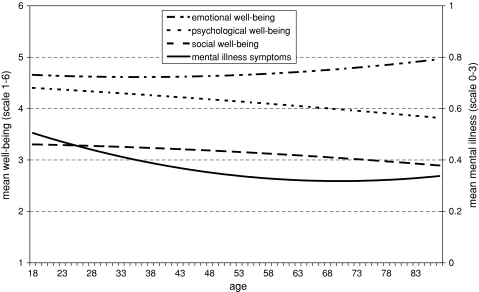
Mental health has long been defined as the absence of psychopathologies, such as depression and anxiety. The absence of mental illness, however, is a minimal outcome from a psychological perspective on lifespan development. This article therefore focuses on mental illness as well as on three core components of positive mental health: feelings of happiness and satisfaction with life (emotional well-being), positive individual functioning in terms of self-realization (psychological well-being), and positive societal functioning in terms of being of social value (social well-being). The two continua model holds that mental illness and mental health are related but distinct dimensions. This model was studied on the basis of a cross-sectional representative internet survey of Dutch adults (N = 1,340; 18-87 years). Mental illness was measured with the Brief Symptom Inventory and mental health with the Mental Health Continuum Short Form. It was found that older adults, except for the oldest-old, scored lower on psychopathological symptoms and were less likely to be mentally ill than younger adults. Although there were fewer age differences for mental health, older adults experienced more emotional, similar social and slightly lower psychological well-being. In sum, today's older adults have fewer mental illness problems, but they are not in a better positive mental health than today's younger adults. These findings support the validity of the two continua model in adult development.
Overview
The claims and statistics of this paper haven’t been checked yet.
Free: it reads the open-access text and checks the first 5 claims that cite a source we can check. Create a free account to check every claim.
Integrity signals
Registry
Cites
Statistics
Figures
Verification
Claims the paper makes
The claims and statistics of this paper haven’t been checked yet.
Free: it reads the open-access text and checks the first 5 claims that cite a source we can check. Create a free account to check every claim.
Claims other papers make about this one
Each is checked against this paper’s own text: does it say what the citing paper says it does?
The source backs part of the claim, not all of it — or backs it for a different population, condition or comparison.
In the citing paper
“The MHC-SF has demonstrated good psychometric properties across various age groups and nations (Lamers et al., 2011, Westerhof and Keyes, 2010).”
From The link between stress, well-being, and psychological flexibility during an Acceptance and Commitment Therapy self-help intervention (2018) · cites this paper as Westerhof and Keyes, 2010
Experimental — accuracy not yet measuredThe cited source says what the claim attributes to it.
In the citing paper
“The dual-factor model of mental health suggests that enhancing positive mental health and alleviating psychopathology do not automatically go hand-in-hand (Keyes, 2005a).”
From Both positive mental health and psychopathology should be monitored in psychotherapy: Confirmation for the dual-factor model in acceptance and commitment therapy (2017) · cites this paper as Westerhof & Keyes, 2009
The cited source says what the claim attributes to it.
In the citing paper
“Although the dual-factor model has been wellestablished in cross-sectional studies (e.g., Westerhof & Keyes, 2009), this is the first study to our knowledge that has investigated the applicability of the dual-factor model of mental health in an intervention study based on an effective psychotherapeutic intervention, namely, ACT (Fledderus et al., 2012).”
From Both positive mental health and psychopathology should be monitored in psychotherapy: Confirmation for the dual-factor model in acceptance and commitment therapy (2017) · cites this paper as Westerhof & Keyes, 2009
The cited source says what the claim attributes to it.
In the citing paper
“This model has been replicated in both American and international samples and across the lifespan (Keyes, 2002; Westerhof & Keyes, 2010).”
From Trajectories of change in well-being during cognitive behavioral therapies for anxiety disorders: Quantifying the impact and covariation with improvements in anxiety (2020) · cites this paper as Westerhof & Keyes, 2010
The cited source says what the claim attributes to it.
In the citing paper
“Nonetheless, mental health is not merely the absence of mental illness, and the two are related but distinct (Westerhof & Keyes, 2010); therefore, wellbeing services may also help to improve mental health without reducing symptoms.”
From Content Moderator Mental Health and Associations with Coping Styles: Replication and Extension of Previous Studies (2025) · cites this paper as Westerhof & Keyes, 2010
4 more claims about this paper
Create a free account to see every claim other papers make about this one.
Self-check
Percentages, sums and reported differences re-computed from the paper’s own numbers.
The self-check needs the paper’s full text.
Citations
Cites
Happiness is everything, or is it? Explorations on the meaning of psychological well-being.
Ryff, C. D. (1989) · Journal of Personality and Social Psychology · doi:10.1037/0022-3514.57.6.1069 · Cited by 14,847 · cited 5×
“Psychologists started to reflect on the notion of well-being in terms of individual strivings and optimal functioning (Ryan and Deci 2001; Ryff 1989), which gave rise to the second tradition of research, called eudaimonic well-being.”
BackgroundInfluentialSubjective well-being: Three decades of progress.
Diener, E., Suh, E. M., Lucas, R. E., & Smith, H. L. (1999) · Psychological Bulletin · doi:10.1037/0033-2909.125.2.276 · Cited by 12,910
On Happiness and Human Potentials: A Review of Research on Hedonic and Eudaimonic Well-Being
Ryan, R. M., & Deci, E. L. (2001) · Annual Review of Psychology · doi:10.1146/annurev.psych.52.1.141 · Cited by 11,567 · cited 4×
“Psychologists started to reflect on the notion of well-being in terms of individual strivings and optimal functioning (Ryan and Deci 2001; Ryff 1989), which gave rise to the second tradition of research, called eudaimonic well-being.”
BackgroundInfluentialDiener, E. (1984) · Psychological Bulletin · doi:10.1037/0033-2909.95.3.542 · Cited by 11,023
Diener, E. (2009) · Social Indicators Research Series · doi:10.1007/978-90-481-2350-6_2 · Cited by 10,950
The structure of psychological well-being revisited.
Ryff, C. D., & Keyes, C. L. M. (1995) · Journal of Personality and Social Psychology · doi:10.1037//0022-3514.69.4.719 · Cited by 10,285 · cited 5×
“This procedure resulted in a sample of 1,662 respondents who filled out the questionnaire in December 2007 (a response of 76% of those who participated in the panel).”
BackgroundMethodInfluentialSelf-citationВзаимосвязь статуса занятости и пола с уровнем психологического благополучия
М.Р., Н., & С.И., Б. (2026) · Cifra LLC Journals · doi:10.60797/irj.2026.170.43 · Cited by 7,950
The mental health continuum: from languishing to flourishing in life.
Keyes, C. L. M. (2002) · Journal of Health and Social Behavior · doi:10.2307/3090197 · Cited by 5,133 · cited 5×
“The findings of this study provide strong support for the two continua model of mental illness and health (Keyes 2002, 2005, 2007).”
BackgroundResultInfluentialSelf-citationThe Structure of Psychological Well-Being.
Mechanic, D., & Bradburn, N. M. (1970) · American Sociological Review · doi:10.2307/2093340 · Cited by 4,923 · cited 1×
“In the social sciences, this tradition dates back to survey research in the 1960s and 1970s, when scholars started to study the quality of American life from the perspective of citizens themselves (Andrews and Withey 1976; Bradburn 1969; Campbell et al. 1976; Cantril 1965; Gurin et al. 1960).”
BackgroundSocial Indicators of Well-Being
Andrews, F. M., & Withey, S. B. (1976) · Springer eBooks · doi:10.1007/978-1-4684-2253-5 · Cited by 3,653 · cited 1×
“In the social sciences, this tradition dates back to survey research in the 1960s and 1970s, when scholars started to study the quality of American life from the perspective of citizens themselves (Andrews and Withey 1976; Bradburn 1969; Campbell et al. 1976; Cantril 1965; Gurin et al. 1960).”
Background
Research works printed but not linked: 3
- Derogatis, L. R. (1975). The Brief Symptom Inventory. Baltimore, MD.: Clinical Psychometric Research.
- Westerhof, G. J. (2001). Wohlbefinden in der zweiten Lebenshälfte [Well-being in the second half of life]. In F. Dittmann-Kohli, C. Bode, & G. J. Westerhof (Eds.), Die zweite Lebenshälfte—Psychologische Perspektiven. Ergebnisse des Alters-Survey (pp. 79–128). Stuttgart: Kohlhammer.
- Westerhof, G. J., & Keyes, C. L. M. (2008). Geestelijke gezondheid is meer dan de afwezigheid van geestelijke ziekte [Mental health is more than the absence of mental illness]. Maandblad Geestelijke Volksgezondheid, 63, 808–820.
Cited by
Items 301–400 of 1,001
Studying Stress in the Twenty-First-Century: An Update of Stress Concepts and Research
Wheaton, B., & Montazer, S. (2017) · Cambridge University Press eBooks · doi:10.1017/9781316471289.013 · Cited by 30
Kim, J. H., Islam, S. J., Topel, M. L., Ko, Y.-A., Mujahid, M. S., Vaccarino, V., Liu, C., Sims, M., Mubasher, M., Searles, C. D., et al. (2020) · Circulation: Cardiovascular Quality and Outcomes · doi:10.1161/circoutcomes.120.006638 · Cited by 23
“$25 000 to <$50 000 51 (26) 57 (30) 57 (29) 51 (27)”
Räsänen, P., Muotka, J., & Lappalainen, R. (2020) · Internet Interventions · doi:10.1016/j.invent.2020.100343 · Cited by 23
Bartolo, M. G., Palermiti, A. L., Servidio, R. C., & Costabile, A. (2023) · Sustainability · doi:10.3390/su152316207 · Cited by 36
Vaingankar, J. A., Subramaniam, M., Tan, L. W. L., Abdin, E., Lim, W. Y., Wee, H. L., Chong, S. A., & van Dam, R. M. (2018) · BMC Medical Research Methodology · doi:10.1186/s12874-018-0487-9 · Cited by 24
Chakhssi, F., Zoet, J. M., Oostendorp, J. M., Noordzij, M. L., & Sommers‐Spijkerman, M. (2019) · Journal of Personality Disorders · doi:10.1521/pedi_2019_33_439 · Cited by 30
Moreira, P., Pedras, S., Silva, M., Moreira, M., & Oliveira, J. (2020) · Journal of Happiness Studies · doi:10.1007/s10902-020-00299-5 · Cited by 42
Performers of the night: Examining the mental health of electronic music artists
Kegelaers, J. J., Jessen, L., Audenaerde, E. V., & Oudejans, R. R. D. (2021) · Psychology of Music · doi:10.1177/0305735620976985 · Cited by 35
The psychometric network structure of mental health in eating disorder patients
de Vos, J. D., Radstaak, M., Bohlmeijer, E., & Westerhof, G. (2021) · European eating disorders review · doi:10.1002/erv.2832 · Cited by 20
Self-citationBarbeau, K., Guertin, C., Boileau, K., & Pelletier, L. G. (2021) · Psychology of Women Quarterly · doi:10.1177/03616843211013465 · Cited by 36
“This is especially important considering that the absence of pathological functioning does not infer optimal or adaptive functioning (Westerhof & Keyes, 2010).”
BackgroundWinzer, R., Vaez, M., Lindberg, L., & Sorjonen, K. (2021) · BMC Psychology · doi:10.1186/s40359-021-00673-9 · Cited by 16
“This may seem contradictory, but it is possible given that positive and negative mental health may be seen as a dual continuum, whereby an individual can experience well-being despite a status of mental ill health [7, 8].”
Bernard, M., Poncin, E., Althaus, B., & Borasio, G. D. (2022) · Palliative & Supportive Care · doi:10.1017/s1478951521002066 · Cited by 30
“Indeed, the non-significance of the negative association between positive and negative changes reported by our participants supports one of the key postulates in PTG theory, namely that positive and negative psychological responses to trauma are likely to coexist, and that mental “health” and “illness” evolve on two l…”
Aruta, J. J. B. R., Crisostomo, K. A., Canlas, N. F., Almazan, J. U., & Peñaranda, G. (2022) · International Journal of Disaster Risk Reduction · doi:10.1016/j.ijdrr.2022.102853 · Cited by 28
“The bidimensional model of mental health [26] emphasized that mental health consists not only of psychopathological symptoms (negative mental health) but also of flourishing well-being [93].”
BackgroundMethodBeyond polarization towards dynamic balance: harmony as the core of mental health
Fave, A. D., Wissing, M. P., & Brdar, I. (2023) · Frontiers in Psychology · doi:10.3389/fpsyg.2023.1177657 · Cited by 33
“These varying patterns emerged for the Psychological Well Being Scales (Ryff et al., 2002; Pancheva et al., 2021), the MHC-SF (Westerhof and Keyes, 2010), the Basic Psychological Needs Scale (Ryan and Deci, 2000; Ginevra et al., 2015), and the Satisfaction with Life Scale (Diener et al., 2013; Joshanloo and Jovanović,…”
MethodInfluentialBoström, P., Johnels, J. Å., Thorson, M., & Broberg, M. (2016) · Journal of Mental Health Research in Intellectual Disabilities · doi:10.1080/19315864.2016.1186254 · Cited by 29
“Positive mental health distinguishes between persons with same-level mental health problems in terms of better functioning, which is an important part of general well-being (Westerhof & Keyes, 2010).”
BackgroundBoström, P., & Broberg, M. (2017) · Journal of Applied Research in Intellectual Disabilities · doi:10.1111/jar.12364 · Cited by 27
Roy, M., Levasseur, M., Doré, I., St‐Hilaire, F., Michallet, B., Couturier, Y., Maltais, D., Lindström, B., & Généreux, M. (2018) · Preventive Medicine · doi:10.1016/j.ypmed.2018.02.014 · Cited by 30
“The MHC-SF has good reliability and was validated with many languages (Lamers et al., 2011; Westerhof and Keyes, 2010) including Canadian French (Doré et al.”
BackgroundLamborn, P. B., Cramer, K. M., & Riberdy, A. (2018) · Journal of Well-Being Assessment · doi:10.1007/s41543-018-0007-z · Cited by 24
“In a more recent study, this was further differentiated to suggest that as age increases, levels of EWB increase, levels of SWB remain the same, and levels of PWB decrease (Westerhof and Keyes 2010).”
BackgroundFerentinos, P. P., Yotsidi, V., Porichi, E., Douzenis, A., Papageorgiou, C., & Stalikas, A. (2019) · Journal of Clinical Psychology · doi:10.1002/jclp.22780 · Cited by 23
The impact of a teacher-based positive education intervention on student wellbeing literacy
Waters, L. E., & Higgins, M. C. (2021) · Journal of School and Educational Psychology · doi:10.47602/josep.v2i1.12 · Cited by 33
“…conceptualized as a multidimensional construct (Forgeard et al., 2011; Seligman, 2018; Stutzer & Frey, 2010) characterized by a profile of indicators that fall on the positive end of the mental health 23 Journal of School and Educational Psychology continuum (Keyes, 2007; Westerhof & Keyes, 2010).”
BackgroundBoström, P., Johnels, J. Å., & Broberg, M. (2017) · Journal of Intellectual Disability Research · doi:10.1111/jir.12432 · Cited by 23
A Salutogenic Mental Health Model: Flourishing as a Metaphor for Good Mental Health
Mjøsund, N. H. (2021) · Springer eBooks · doi:10.1007/978-3-030-63135-2_5 · Cited by 46
Vlachopanou, P., & Karagiannopoulou, E. (2021) · The Journal of Nervous and Mental Disease · doi:10.1097/nmd.0000000000001423 · Cited by 26
“Mental health is not only the absence of mental illness but also the presence of flourishing (Keyes, 2005; Westerhof and Keyes, 2010).”
BackgroundRelationship between Prosocial Behaviours and Addiction Problems: A Systematic Review
Esparza-Reig, J., Vilar, M. M., Merino‐Soto, C., & Casique, A. G. (2021) · Healthcare · doi:10.3390/healthcare10010074 · Cited by 27
“This stream arises from the basis that psychopathologies and well-being are independent constructs but closely related [12].”
BackgroundErschens, R. S., Seifried-Dübon, T., Stuber, F., Rieger, M. A., Zipfel, S., Nikendei, C., Genrich, M., Angerer, P., Maatouk, I., Gündel, H., et al. (2022) · PLoS ONE · doi:10.1371/journal.pone.0278597 · Cited by 40
“Mental health has been conceptualized as a continuum (for an alternative two continua model, see for example [11]) which extends from negative to positive mental health states (see [12], based on WHO’s definition [13]).”
BackgroundFoster, K., Shakespeare‐Finch, J., Shochet, I. M., Maybery, D. J., Bui, M. V., Steele, M. C., & Roche, M. A. (2024) · International Journal of Mental Health Nursing · doi:10.1111/inm.13354 · Cited by 31
Doyle, L., Ellilä, H., Jormfeldt, H., Lahti, M., Higgins, A., Keogh, B., Meade, O., Sitvast, J. E., Skärsäter, I., Stickley, T., et al. (2017) · International Journal of Mental Health Nursing · doi:10.1111/inm.12370 · Cited by 22
Promoting and Implementing the Mediterranean Diet in the Southern Hemisphere: the Chilean Experience
Echeverría, G., Catalina Dussaillant, K., McGee, E. E., Mena, C., Nitsche, M. P., Urquiaga, I., Marcela Bitran, C., Nuria Pedrals, G., & Rigotti, A. (2018) · European Journal of Clinical Nutrition · doi:10.1038/s41430-018-0307-7 · Cited by 26
Arslan, G. (2019) · Journal of Psychologists and Counsellors in Schools · doi:10.1017/jgc.2018.24 · Cited by 23
Schäfer, A., Jírů-Hillmann, S., Widmann, J., Montellano, F. A., Salmen, J., Pryss, R., Wöckel, A., & Heuschmann, P. U. (2025) · Journal of Cancer Survivorship · doi:10.1007/s11764-023-01470-6 · Cited by 23
“The following outcomes had been defined as relevant for the scope of our review [3, 12, 15, 18, 21, 22]: psychological distress (e.g. measured via distress thermometer [23], PSS-10 [24] or BSI [25]), anxiety (e.g. via HADS [26, 27] or GAD-7 [28]), depression (e.g. via HADS or PHQ-9 [29]) and…”
Huß, B. (2021) · Journal of Happiness Studies · doi:10.1007/s10902-020-00350-5 · Cited by 34
Assessing the Transitional Impact and Mental Health Consequences of the COVID-19 Pandemic Onset
Heanoy, E. Z., Shi, L., & Brown, N. R. (2021) · Frontiers in Psychology · doi:10.3389/fpsyg.2020.607976 · Cited by 26
“, 2020a,b), Also, as predicted and consistent with prior research (Taylor et al., 2008; Westerhof and Keyes, 2010; Cheng et al., 2014; Bruine de Bruin, 2020; Hyland et al., 2020; Lopes and Jaspal, 2020; Qiu et al., 2020; Salari et al., 2020), we found that younger respondents scored higher on the three DASS subscales…”
ResultAesthetic experiences and flourishing in science: A four-country study
Jacobi, C. J., Varga, P. J., & Vaidyanathan, B. (2022) · Frontiers in Psychology · doi:10.3389/fpsyg.2022.923940 · Cited by 29
“, 2002) as well as a key dimension of burnout, which allowed us to distinguish negative and positive domains of mental health (Westerhof and Keyes, 2010).”
BackgroundMachado, T., Desrumaux, P., & Droogenbroeck, A. V. (2016) · Bulletin de psychologie · doi:10.3917/bupsy.541.0019 · Cited by 29
Mori, M., Tajima, M., Kimura, R., Sasaki, N., Somemura, H., Ito, Y., Okanoya, J., Yamamoto, M., Nakamura, S., & Tanaka, K. (2014) · JMIR Research Protocols · doi:10.2196/resprot.3629 · Cited by 21
“Further, to improve work performance, increasing emphasis is being placed on managing psychological distress regardless of clinical significance [6,7].”
BackgroundThe distinct link of perfectionism with positive and negative mental health outcomes
Simon, P. D., Salanga, M. G. C., & Aruta, J. J. B. R. (2025) · Frontiers in Psychiatry · doi:10.3389/fpsyt.2025.1492466 · Cited by 31
Houle, J., Coulombe, S., Radziszewski, S., Boileau, G., Morin, P., Leloup, X., Bohémier, H., & Robert, S. (2016) · Journal of Social Work · doi:10.1177/1468017316679906 · Cited by 26
“Several studies have established that positive mental health and mental illness represent two distinct continuums (Keyes, 2005; Westerhof & Keyes, 2010).”
BackgroundA mentális egészség kontinuum skála rövid változatának hazai validációja
Melinda, R., Horváth, Z., Tóth, L., & Gyöngyi, K. (2020) · Magyar Pszichológiai Szemle · doi:10.1556/0016.2020.00014 · Cited by 17
Appiah, R., Fadiji, A. W., Wissing, M. P., & Schutte, L. (2021) · International Journal of Qualitative Studies on Health and Well-Being · doi:10.1080/17482631.2021.1891760 · Cited by 28
“Although a significant number of people present with mental disorders at the global level (Gil-Rivas et al., 2019), the majority of individuals exhibit moderate mental health, in the absence of psychopathological symptoms (Keyes, 2005; Westerhof & Keyes, 2010; Wissing & Temane, 2013).”
BackgroundMethodLevin, R. L., & Rawana, J. S. (2021) · Anxiety Stress & Coping · doi:10.1080/10615806.2021.2018419 · Cited by 27
Predicting student mental wellbeing and loneliness and the importance of digital skills
Dinu, L. M., Byrom, N., Mehta, K. J., Everett, S., Foster, J., & Dommett, E. J. (2022) · Journal of Further and Higher Education · doi:10.1080/0309877x.2022.2038780 · Cited by 39
Hutton, E. A., Skues, J., Sullivan, J., & Wise, L. Z. (2022) · Mental Health & Prevention · doi:10.1016/j.mhp.2022.200249 · Cited by 28
Tang, D., Mair, C. A., & Hu, Q. (2023) · Frontiers in Psychology · doi:10.3389/fpsyg.2023.1142036 · Cited by 27
“However, based on the dual factor model of mental health (DFM), which conceptualizes mental health as having simultaneous positive and negative mental states (Greenspoon and Saklofske, 2001; Keyes, 2007; Suldo and Shaffer, 2008; Westerhof and Keyes, 2010; Wang et al., 2011), a focus on only poor mental health (e.”
Cortisol Awakening Response as an Index of Mental Health and Well-Being in Adolescents
Rickard, N. S., Chin, T., & Vella‐Brodrick, D. (2015) · Journal of Happiness Studies · doi:10.1007/s10902-015-9706-9 · Cited by 25
Polenick, C. A., Fredman, S. J., Birditt, K. S., & Zarit, S. H. (2016) · Family Process · doi:10.1111/famp.12275 · Cited by 24
“This study examined dyadic associations between wives’ and husbands’ perceptions of relationship quality with their own parents and their reports of depressive symptoms and life satisfaction, which are two related but distinct indicators of psychological well-being (Westerhof & Keyes, 2010).”
BackgroundHoule, J., Coulombe, S., Radziszewski, S., Leloup, X., Saïas, T., Torres, J., & Morin, P. (2017) · BMC Public Health · doi:10.1186/s12889-017-4730-9 · Cited by 22
“health are two distinct constructs (although they are somewhat correlated) [50, 51], and that improvement in”
BackgroundGribble, R., Goodwin, L., Oram, S., & Fear, N. T. (2019) · Health Psychology Open · doi:10.1177/2055102919838909 · Cited by 33
“Perceived influences on well-being were identified as descriptions of positive or negative emotional responses to their experiences in accordance with the two continuum model of health and well-being (Westerhof and Keyes, 2010) and discussion of a priori themes of identity, agency/ autonomy, relatedness and incorporat…”
MethodThe Measurement of Mental Disorder
Wakefield, J. C., & Schmitz, M. F. (2009) · Cambridge University Press eBooks · doi:10.1017/cbo9780511984945.005 · Cited by 21
Correlation between African Hospitality and Human Flourishing among Young African adults in Kenya
Wanjiru, K. J., Selvam, S. G., & Njiru, L. (2019) · International Journal of Scientific and Research Publications · doi:10.29322/ijsrp.9.09.2019.p9327 · Cited by 20
Appiah, R. (2022) · New Ideas in Psychology · doi:10.1016/j.newideapsych.2022.100931 · Cited by 21
Li, J., Dou, K., & Liu, Z.-H. (2022) · Child and Adolescent Psychiatry and Mental Health · doi:10.1186/s13034-022-00451-4 · Cited by 24
“Discussion According to the two continua model of mental health and ideas from positive psychology [11, 13], young people may also experience positive changes when they are faced with uncertainty and adversity.”
BackgroundMethodKhumalo, I. P., Appiah, R., & Fadiji, A. W. (2022) · Frontiers in Psychology · doi:10.3389/fpsyg.2022.885278 · Cited by 25
“The two constructs are distinct from each other and negatively correlated (Keyes, 2005, 2014; Westerhof and Keyes, 2010).”
BackgroundHermann, V., Durbeej, N., Karlsson, A., & Sarkadi, A. (2022) · Journal of Advanced Nursing · doi:10.1111/jan.15496 · Cited by 29
“…social actualization (‘the belief that the community has potential and can evolve positively’), social contribution (‘the feeling that one's activities contribute to and are valued by society’) and social integration (‘a sense of belonging to a community’) (Westerhof & Keyes, 2010 , p. 111).”
BackgroundResultInfluential“It’s loving yourself for you”: Happiness in trans and nonbinary adults.
Tebbe, E. A., Bell, H. L., Cassidy, K., Lindner, S., Wilson, E., & Budge, S. L. (2022) · Psychology of Sexual Orientation and Gender Diversity · doi:10.1037/sgd0000613 · Cited by 26
Happiness before and during the COVID-19 pandemic in Italy: A population-based longitudinal study
Prati, G., & Mancini, A. D. (2023) · International Journal of Disaster Risk Reduction · doi:10.1016/j.ijdrr.2023.103711 · Cited by 23
“Indeed, the two continua model of mental health holds that mental health symptoms and positive mental health (e.g., well-being) are related but distinct dimensions (e.g., [47], [48]).”
Jayasinghe, A., Wrobel, A. L., Filia, K., Byrne, L. K., Melvin, G. A., Murrihy, S., Moller, C. I., Berk, L., Berk, M., & Cotton, S. (2023) · Psychological Medicine · doi:10.1017/s0033291723001733 · Cited by 22
“This is problematic as strong evidence suggests mental illness and wellbeing are related but distinct continuums, such that the absence of mental illness does not indicate greater wellbeing (Westerhof & Keyes, 2010).”
Background‘Even if you don’t care…you do care after all’: ‘Othering’ and physical education in Norway
Røset, L., Green, K., & Thurston, M. N. (2020) · European Physical Education Review · doi:10.1177/1356336x19862303 · Cited by 30
The Dual Continua Model: The Foundation of the Sociology of Mental Health and Mental Illness
Keyes, C. L. M. (2017) · Cambridge University Press eBooks · doi:10.1017/9781316471289.007 · Cited by 30
Self-citationEvaluation of a Programme to Enhance Flourishing in Adolescents
Schalkwyk, I. V., & Wissing, M. P. (2013) · Cross-cultural advancements in positive psychology · doi:10.1007/978-94-007-6368-5_27 · Cited by 25
Development of an Online Well-Being Intervention for Young People: An Evaluation Protocol
Antezana, G., Bidargaddi, N. P., Blake, V., Schrader, G. D., Kaambwa, B., Quinn, S. J., Orlowski, S., Winsall, M., & Battersby, M. (2015) · JMIR Research Protocols · doi:10.2196/resprot.4098 · Cited by 22
Emotional Vitality: Concept of Importance for Rehabilitation
Barbic, S. P., Bartlett, S. J., & Mayo, N. E. (2012) · Archives of Physical Medicine and Rehabilitation · doi:10.1016/j.apmr.2012.11.045 · Cited by 29
Weiss, L., Westerhof, G. J., & Bohlmeijer, E. T. (2013) · Health and Quality of Life Outcomes · doi:10.1186/1477-7525-11-159 · Cited by 22
Self-citationPositive Clinical Psychology: An Introduction
Wood, A. M., & Johnson, J. (2016) · The Wiley Handbook of Positive Clinical Psychology · doi:10.1002/9781118468197.ch1 · Cited by 19
The Complex Construct of Wellbeing and the Role of Vagal Function
Wilkie, L., Fisher, Z., & Kemp, A. H. (2022) · Frontiers in Integrative Neuroscience · doi:10.3389/fnint.2022.925664 · Cited by 18
“While illbeing and wellbeing are partly related, they are also distinct (Westerhof, 2010; Fisher et al., 2020; Hunter, 2020).”
BackgroundWieners, L., van Zyl, L. E., Radstaak, M., & Schotanus-Dijkstra, M. (2021) · International Journal of Wellbeing · doi:10.5502/ijw.v11i4.1489 · Cited by 23
“This idea aligns with the Two-Continua Model of mental health which suggests that psychological distress is independent of, yet related to, mental wellbeing (Westerhof & Keyes, 2010).”
ResultGatto, A. J., Elliott, T. J., Briganti, J. S., Stamper, M. J., Porter, N. D., Brown, A. M., Harden, S. M., Cooper, L. D., & Dunsmore, J. C. (2022) · Frontiers in Public Health · doi:10.3389/fpubh.2022.858370 · Cited by 27
“Mental health is often divided intomental illness and wellness, though these are better conceptualized as ends of a spectrum than dichotomous categories (3).”
BackgroundAznar, M. P. M., del Pino, M. J., Pérez, J. M. B., & Hernández-Lorenzo, D. E. (2022) · Applied Research in Quality of Life · doi:10.1007/s11482-022-10140-1 · Cited by 19
Carreno, D. F., Eisenbeck, N., Greville, W. J., & Wong, P. T. P. (2023) · Journal of Happiness Studies · doi:10.1007/s10902-023-00633-7 · Cited by 31
Allen, R. E., Kannangara, C. S., & Carson, J. F. (2023) · British Journal of Educational Studies · doi:10.1080/00071005.2023.2215857 · Cited by 28
“Building on the work of Antonovsky (1979), this study is underpinned by the ‘two continua’ model (Keyes, 2002), that argues mental well-being and mental illness are, while strongly related, two independent dimensions (Huppert and Whittington, 2003; Westerhof and Keyes, 2010).”
MethodMental health, gender, and higher education attainment
Burger, K., & Rocha, D. S. (2023) · Zeitschrift für Erziehungswissenschaft · doi:10.1007/s11618-023-01187-3 · Cited by 23
Arslan, İ. B., Boele, S., Dietvorst, E., Lucassen, N., & Keijsers, L. (2024) · Journal of Adolescence · doi:10.1002/jad.12299 · Cited by 25
Vaingankar, J. A., Subramaniam, M., Abdin, E., Picco, L., Chua, B. Y., Eng, G. K., Sambasivam, R., Shafie, S., Zhang, Y., & Chong, S. A. (2013) · Quality of Life Research · doi:10.1007/s11136-013-0589-0 · Cited by 20
Beyond positive and negative trait affect: Flourishing through music engagement
Chin, T., & Rickard, N. S. (2014) · Psychology of Well-Being Theory Research and Practice · doi:10.1186/s13612-014-0025-4 · Cited by 33
Richards, J. S., Hartman, C. A., Jeronimus, B. F., Ormel, J., Reijneveld, S. A., Veenstra, R., Verhulst, F. C., Vollebergh, W., & Oldehinkel, A. J. (2018) · Psychological Medicine · doi:10.1017/s0033291718001976 · Cited by 20
Nishimi, K. M., Koenen, K. C., Coull, B. A., Chen, R., & Kubzansky, L. D. (2021) · Proceedings of the National Academy of Sciences · doi:10.1073/pnas.2102619118 · Cited by 22
“Both dimensions of the psychological experience are necessary to comprehensively capture psychological health (23, 24) and are particularly relevant in the context of manifesting psychological resilience to adversity (25).”
BackgroundToussaint, L. L., Cheadle, A. C. D., Dezutter, J., & Williams, D. R. (2021) · Frontiers in Psychology · doi:10.3389/fpsyg.2021.731017 · Cited by 26
“However, while advanced age may create biological vulnerability to disease including COVID-19, generally older adults report good mental health (Westerhof and Keyes, 2010).”
BackgroundFrom Failure to Flourishing: The Roles of Acceptance and Goal Reengagement
North, R. J., Holahan, C. J., Carlson, C. L., & Pahl, S. A. (2014) · Journal of Adult Development · doi:10.1007/s10804-014-9195-9 · Cited by 23
Ronkainen, H., Lundgren, T., Kenttä, G., Ihalainen, J. K., Valtonen, M., & Lappalainen, R. I. (2024) · Psychology and Behavioral Sciences · doi:10.11648/j.pbs.20241302.14 · Cited by 22
Hawsawi, A. A., Nixon, N. L., & Nixon, E. (2025) · PLoS ONE · doi:10.1371/journal.pone.0318399 · Cited by 32
“This acknowledges that mental health is not just about the absence of illness as per the Dual Continuum Model of mental health and illness [85] but is also about the presence of positive emotions, engagement, relationships, meaning, and accomplishment, as outlined by Seligman [65].”
Johnson, R. J., & Hobfoll, S. E. (2009) · Cambridge University Press eBooks · doi:10.1017/cbo9780511984945.024 · Cited by 19
Giblett, A., & Hodgins, G. A. (2021) · Psychological Reports · doi:10.1177/00332941211040432 · Cited by 23
Denisse Zúñiga, P., Torres-Sahli, M., Rigotti, A., Nuria Pedrals, G., Echeverría, G., Padilla, O., Lagos, A., Peter McColl, C., Trucco, O., Marcela Cisternas, M., et al. (2021) · Mindfulness · doi:10.1007/s12671-021-01774-7 · Cited by 26
Black, L., Humphrey, N., Panayiotou, M., & Marquez, J. (2023) · Assessment · doi:10.1177/10731911231158623 · Cited by 25
“Furthermore, proposed domains within general mental health and well-being frameworks, including for example, hedonic, eudaimonic, and complete state models (Ryff et al., 2021; Westerhof & Keyes, 2010), are often conceptually similar (Alexandrova & Haybron, 2016; Black, Panayiotou, & Humphrey, 2022).”
BackgroundGilbert, M., Dextras-Gauthier, J., Boulet, M., Auclair, I., Dima, J., & Boucher, F. (2023) · Journal of Health Organization and Management · doi:10.1108/jhom-12-2021-0442 · Cited by 24
Duncan, M. J., Kuzik, N., Silva, D. A. S., Bélanger, R. E., Carson, V., Chaput, J., Faulkner, G., Ferro, M. A., Turcotte‐Tremblay, A., Leatherdale, S. T., et al. (2023) · Mental health and physical activity · doi:10.1016/j.mhpa.2023.100572 · Cited by 19
Simonsen, C., Åsbø, G., Slade, M., Wold, K. F., Widing, L. H., Flaaten, C. B., Engen, M. J., Lyngstad, S. H., Gardsjord, E. S., Bjella, T. D., et al. (2024) · Psychological Medicine · doi:10.1017/s0033291724000205 · Cited by 18
“According to the ‘ complete state model of mental health ’ , positive outcomes involve the absence of ‘ mental illness ’ or the presence of ‘ positive mental health ’ , which are related but distinct unipolar dimensions (Keyes, 2005; Keyes & Martin, 2017; Slade, 2010; Westerhof & Keyes, 2010).”
BackgroundGovindasamy, D., Seeley, J., Olaru, I. D., Wiyeh, A. B., Mathews, C., & Ferrari, G. (2020) · Health and Quality of Life Outcomes · doi:10.1186/s12955-020-01352-w · Cited by 23
Weijers, A., Rasing, S. P. A., Creemers, D. H. M., Vermulst, A. A., Schellekens, A., & Westerhof, G. J. (2020) · Journal of Clinical Psychology · doi:10.1002/jclp.23083 · Cited by 19
“…mainly been tested in community samples (Gilmour, 2014; Huppert & Whittington, 2003; Keyes, 2005; Lamers et al., 2011, 2012; Perugini et al., 2017; Westerhof & Keyes, 2010), students (Keyes et al., 2012; Renshaw & Cohen, 2014) and people with mild mental health problems (Trompetter et al., 2017).”
BackgroundSelf-citationInterpersonal Violence and Mental Health Outcomes: Mediation by Self-efficacy and Coping
Magalhães, E., Grych, J. H., Ferreira, C., Antunes, C., Prioste, A., & Jongenelen, I. (2021) · Victims & Offenders · doi:10.1080/15564886.2021.1880508 · Cited by 19
“In the present study, mental health is conceptualized as including both positive (well-being) and negative (psychopathology) outcomes (Westerhof & Keyes, 2010).”
BackgroundGriffith, G. J., & Jones, K. (2020) · Health & Place · doi:10.1016/j.healthplace.2020.102401 · Cited by 20
The experience of sacred moments and mental health benefits over time.
Magyar‐Russell, G., Pargäment, K. I., Grubbs, J. B., Wilt, J. A., & Exline, J. J. (2020) · Psychology of Religion and Spirituality · doi:10.1037/rel0000394 · Cited by 17
Bueno-Pacheco, A., Satorres, E., Delhom, I., & Meléndez, J. C. (2021) · Current Psychology · doi:10.1007/s12144-021-01978-z · Cited by 16
Well-being and ill-being on campus
Morrison, P. S., Liu, I., & Zeng, D. (2023) · International Journal of Wellbeing · doi:10.5502/ijw.v13i3.2785 · Cited by 23
“7 For definitions of flourishing and languishing see Westerhof and Keyes (2010: 111).”
BackgroundHusain, W., Ijaz, F., Husain, M. A., Zulfiqar, M., & Khalique, J. (2024) · OBM Integrative and Complementary Medicine · doi:10.21926/obm.icm.2401011 · Cited by 19
Positive self-beliefs mediate the association between body appreciation and positive mental health
Swami, V., Voracek, M., Todd, J., Furnham, A. F., Horne, G., & Tran, U. S. (2024) · Body Image · doi:10.1016/j.bodyim.2024.101685 · Cited by 23
Hernández, D., & Ibrayeva, L. (2024) · The Asia-Pacific Education Researcher · doi:10.1007/s40299-024-00839-0 · Cited by 19
“Still, these findings reinforce that positive mental health and psychopathology are not simply opposite points on a single spectrum but rather two distinct yet related dimensions that can co-occur in the same person (Westerhof & Keyes, 2010).”
Callahan, J. L., Borja, S. E., Herbert, G. L., Maxwell, K., & Ruggero, C. J. (2013) · Traumatology An International Journal · doi:10.1177/1534765613476098 · Cited by 19
Wettstein, M., Eich, W., Bieber, C. S., & Tesarz, J. (2018) · Pain Medicine · doi:10.1093/pm/pny162 · Cited by 21
Self-rated global health in the Norwegian general population
Bonsaksen, T., Ekeberg, Ø., Skogstad, L., Heir, T., Grimholt, T. K., Lerdal, A., & Schou‐Bredal, I. (2019) · Health and Quality of Life Outcomes · doi:10.1186/s12955-019-1258-y · Cited by 16
Vedøy, I. B., Skulberg, K. R., Anderssen, S. A., Fagerland, M. W., Tjomsland, H. E., & Thurston, M. N. (2021) · International Journal of Behavioral Nutrition and Physical Activity · doi:10.1186/s12966-021-01211-x · Cited by 23
“According to Westerhof and Keyes’ [17] two continua model, MHP or mental disorders and MWB are presented as two distinct but related dimensions.”
MethodInfluential
Metadata
- Authors
- Westerhof, G. J., & Keyes, C. L. M.
- Affiliations
- University of Twente (NL)
- Emory University (US)
- Corresponding author
- Westerhof, Gerben J.
- Venue
- Journal of Adult Development
- Published
- 2009-08-26
- Volume
- 17
- Issue
- 2
- Pages
- 110-119
- ISSN
- 1068-0667 (ISSN-L)
- 1573-3440
- PMC
- PMC2866965
- OpenAlex
- W2117617786
- Cited by
- 1,345
- References
- 58
- Citations by year
- 2026: 131 · 2025: 148 · 2024: 158 · 2023: 135 · 2022: 137 · 2021: 134 · 2020: 104 · 2019: 66 · 2018: 60 · 2017: 83 · 2016: 43 · 2015: 43 · 2014: 24 · 2013: 27 · 2012: 22
- FWCI
- 21.92
- Type
- journal article
- Language
- en
- Open access
- hybrid
- doi.org
- Licence
- cc-by-nc
- Locations
- Journal of Adult Development (publishedVersion, cc-by-nc)
- Europe PMC (PubMed Central) (publishedVersion, cc-by-nc)
- PubMed Central (publishedVersion, cc-by-nc)
- PubMed (publishedVersion)
- University of Twente Research Information (submittedVersion)
- University of Twente Research Information (submittedVersion, other-oa)
- Topics
- Social Sciences › Psychology › Social Psychology › Psychological Well-being and Life Satisfaction
- Social Sciences › Psychology › Developmental and Educational Psychology › Aging and Gerontology Research
- Health Sciences › Medicine › Public Health, Environmental and Occupational Health › Aging, Health, and Disability
- Keywords
- mental illness, mental health, positive mental health, emotional well-being, psychological well-being, social well-being, lifespan development, age differences, older adults, psychiatric symptoms, happiness, life satisfaction, self-realization, social values
About these checks
Registry, retraction, Cites and statistics results are computed, not judged, with one exception: a printed reference that no index lists is read once by a model before it counts as a citation error. Claims are extracted by a model and kept only when their quote appears verbatim in the text; each cited source is then checked, with a model’s help, for whether it says what the claim relies on. Those verdicts can be wrong — read the claim’s quote and the cited source before relying on one.
Statistics and arithmetic are recomputed, not judged.
Confidence bands are shown only for fields calibrated on our annotated test set. None is calibrated yet, so no band is shown.
What counts as a claim ›How we measure confidence ›How we check this ›
Are you an author, or do you see a problem with this page? Request a review
Data sources
Bibliographic data: Semantic Scholar, OpenAlex, Crossref.
Contains information from the Semantic Scholar Academic Graph Datasets, made available under the ODC Attribution License (ODC-BY 1.0).
Semantic Scholar’s data is described in: Kinney, R., et al. (2023). The Semantic Scholar Open Data Platform. arXiv:2301.10140.
