

Mental Illness and Mental Health: The Two Continua Model Across the Lifespan
Open accessThe DOI matches its Crossref record; 53 of the 58 references it cites were found in a registry or an index.
Abstract
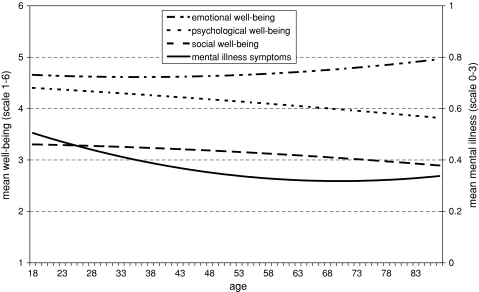
Mental health has long been defined as the absence of psychopathologies, such as depression and anxiety. The absence of mental illness, however, is a minimal outcome from a psychological perspective on lifespan development. This article therefore focuses on mental illness as well as on three core components of positive mental health: feelings of happiness and satisfaction with life (emotional well-being), positive individual functioning in terms of self-realization (psychological well-being), and positive societal functioning in terms of being of social value (social well-being). The two continua model holds that mental illness and mental health are related but distinct dimensions. This model was studied on the basis of a cross-sectional representative internet survey of Dutch adults (N = 1,340; 18-87 years). Mental illness was measured with the Brief Symptom Inventory and mental health with the Mental Health Continuum Short Form. It was found that older adults, except for the oldest-old, scored lower on psychopathological symptoms and were less likely to be mentally ill than younger adults. Although there were fewer age differences for mental health, older adults experienced more emotional, similar social and slightly lower psychological well-being. In sum, today's older adults have fewer mental illness problems, but they are not in a better positive mental health than today's younger adults. These findings support the validity of the two continua model in adult development.
Overview
The claims and statistics of this paper haven’t been checked yet.
Free: it reads the open-access text and checks the first 5 claims that cite a source we can check. Create a free account to check every claim.
Integrity signals
Registry
Cites
Statistics
Figures
Verification
Claims the paper makes
The claims and statistics of this paper haven’t been checked yet.
Free: it reads the open-access text and checks the first 5 claims that cite a source we can check. Create a free account to check every claim.
Claims other papers make about this one
Each is checked against this paper’s own text: does it say what the citing paper says it does?
The source backs part of the claim, not all of it — or backs it for a different population, condition or comparison.
In the citing paper
“The MHC-SF has demonstrated good psychometric properties across various age groups and nations (Lamers et al., 2011, Westerhof and Keyes, 2010).”
From The link between stress, well-being, and psychological flexibility during an Acceptance and Commitment Therapy self-help intervention (2018) · cites this paper as Westerhof and Keyes, 2010
Experimental — accuracy not yet measuredThe cited source says what the claim attributes to it.
In the citing paper
“The dual-factor model of mental health suggests that enhancing positive mental health and alleviating psychopathology do not automatically go hand-in-hand (Keyes, 2005a).”
From Both positive mental health and psychopathology should be monitored in psychotherapy: Confirmation for the dual-factor model in acceptance and commitment therapy (2017) · cites this paper as Westerhof & Keyes, 2009
The cited source says what the claim attributes to it.
In the citing paper
“Although the dual-factor model has been wellestablished in cross-sectional studies (e.g., Westerhof & Keyes, 2009), this is the first study to our knowledge that has investigated the applicability of the dual-factor model of mental health in an intervention study based on an effective psychotherapeutic intervention, namely, ACT (Fledderus et al., 2012).”
From Both positive mental health and psychopathology should be monitored in psychotherapy: Confirmation for the dual-factor model in acceptance and commitment therapy (2017) · cites this paper as Westerhof & Keyes, 2009
The cited source says what the claim attributes to it.
In the citing paper
“This model has been replicated in both American and international samples and across the lifespan (Keyes, 2002; Westerhof & Keyes, 2010).”
From Trajectories of change in well-being during cognitive behavioral therapies for anxiety disorders: Quantifying the impact and covariation with improvements in anxiety (2020) · cites this paper as Westerhof & Keyes, 2010
The cited source says what the claim attributes to it.
In the citing paper
“Nonetheless, mental health is not merely the absence of mental illness, and the two are related but distinct (Westerhof & Keyes, 2010); therefore, wellbeing services may also help to improve mental health without reducing symptoms.”
From Content Moderator Mental Health and Associations with Coping Styles: Replication and Extension of Previous Studies (2025) · cites this paper as Westerhof & Keyes, 2010
4 more claims about this paper
Create a free account to see every claim other papers make about this one.
Self-check
Percentages, sums and reported differences re-computed from the paper’s own numbers.
The self-check needs the paper’s full text.
Citations
Cites
Happiness is everything, or is it? Explorations on the meaning of psychological well-being.
Ryff, C. D. (1989) · Journal of Personality and Social Psychology · doi:10.1037/0022-3514.57.6.1069 · Cited by 14,847 · cited 5×
“Psychologists started to reflect on the notion of well-being in terms of individual strivings and optimal functioning (Ryan and Deci 2001; Ryff 1989), which gave rise to the second tradition of research, called eudaimonic well-being.”
BackgroundInfluentialSubjective well-being: Three decades of progress.
Diener, E., Suh, E. M., Lucas, R. E., & Smith, H. L. (1999) · Psychological Bulletin · doi:10.1037/0033-2909.125.2.276 · Cited by 12,910
On Happiness and Human Potentials: A Review of Research on Hedonic and Eudaimonic Well-Being
Ryan, R. M., & Deci, E. L. (2001) · Annual Review of Psychology · doi:10.1146/annurev.psych.52.1.141 · Cited by 11,567 · cited 4×
“Psychologists started to reflect on the notion of well-being in terms of individual strivings and optimal functioning (Ryan and Deci 2001; Ryff 1989), which gave rise to the second tradition of research, called eudaimonic well-being.”
BackgroundInfluentialDiener, E. (1984) · Psychological Bulletin · doi:10.1037/0033-2909.95.3.542 · Cited by 11,023
Diener, E. (2009) · Social Indicators Research Series · doi:10.1007/978-90-481-2350-6_2 · Cited by 10,950
The structure of psychological well-being revisited.
Ryff, C. D., & Keyes, C. L. M. (1995) · Journal of Personality and Social Psychology · doi:10.1037//0022-3514.69.4.719 · Cited by 10,285 · cited 5×
“This procedure resulted in a sample of 1,662 respondents who filled out the questionnaire in December 2007 (a response of 76% of those who participated in the panel).”
BackgroundMethodInfluentialSelf-citationВзаимосвязь статуса занятости и пола с уровнем психологического благополучия
М.Р., Н., & С.И., Б. (2026) · Cifra LLC Journals · doi:10.60797/irj.2026.170.43 · Cited by 7,950
The mental health continuum: from languishing to flourishing in life.
Keyes, C. L. M. (2002) · Journal of Health and Social Behavior · doi:10.2307/3090197 · Cited by 5,133 · cited 5×
“The findings of this study provide strong support for the two continua model of mental illness and health (Keyes 2002, 2005, 2007).”
BackgroundResultInfluentialSelf-citationThe Structure of Psychological Well-Being.
Mechanic, D., & Bradburn, N. M. (1970) · American Sociological Review · doi:10.2307/2093340 · Cited by 4,923 · cited 1×
“In the social sciences, this tradition dates back to survey research in the 1960s and 1970s, when scholars started to study the quality of American life from the perspective of citizens themselves (Andrews and Withey 1976; Bradburn 1969; Campbell et al. 1976; Cantril 1965; Gurin et al. 1960).”
BackgroundSocial Indicators of Well-Being
Andrews, F. M., & Withey, S. B. (1976) · Springer eBooks · doi:10.1007/978-1-4684-2253-5 · Cited by 3,653 · cited 1×
“In the social sciences, this tradition dates back to survey research in the 1960s and 1970s, when scholars started to study the quality of American life from the perspective of citizens themselves (Andrews and Withey 1976; Bradburn 1969; Campbell et al. 1976; Cantril 1965; Gurin et al. 1960).”
Background
Research works printed but not linked: 3
- Derogatis, L. R. (1975). The Brief Symptom Inventory. Baltimore, MD.: Clinical Psychometric Research.
- Westerhof, G. J. (2001). Wohlbefinden in der zweiten Lebenshälfte [Well-being in the second half of life]. In F. Dittmann-Kohli, C. Bode, & G. J. Westerhof (Eds.), Die zweite Lebenshälfte—Psychologische Perspektiven. Ergebnisse des Alters-Survey (pp. 79–128). Stuttgart: Kohlhammer.
- Westerhof, G. J., & Keyes, C. L. M. (2008). Geestelijke gezondheid is meer dan de afwezigheid van geestelijke ziekte [Mental health is more than the absence of mental illness]. Maandblad Geestelijke Volksgezondheid, 63, 808–820.
Cited by
Items 801–900 of 1,001
Mental Illness and the Criminal Justice System
Hiday, V. A., & Ray, B. R. (2017) · Cambridge University Press eBooks · doi:10.1017/9781316471289.028 · Cited by 3
Naudé, L., Nel, L., & de Beer, A. (2022) · Disability & Society · doi:10.1080/09687599.2022.2071224 · Cited by 5
“Social wellbeing relates to experiences of positive functioning in society and being of social value (Keyes and Lee 2006; Westerhof, Lee, and Keyes 2010).”
BackgroundThe paradox of mental health versus mental disease in elite athletes: a scoping review
Colagrai, A. C., Barreira, J., Nascimento, F. T., & Fernandes, P. T. (2022) · Motriz Revista de Educação Física · doi:10.1590/s1980-6574202200001722 · Cited by 7
Fernandez, D. K., Singh, S., Deane, F. P., & Vella, S. A. (2022) · Community Mental Health Journal · doi:10.1007/s10597-022-01005-w · Cited by 5
Experiência com a música, bem-estar e saúde mental: que relações?
Marques, A., & Fonte, C. (2018) · Revista Música · doi:10.11606/rm.v18i2.147267 · Cited by 9
The Artopia Program: An Examination of Art Therapy’s Effect on Veterans’ Moods
Alexander, A. (2020) · Art Therapy · doi:10.1080/07421656.2020.1721400 · Cited by 3
Mental Health in Cross-Cultural Context
Lefley, H. P. (2017) · Cambridge University Press eBooks · doi:10.1017/9781316471289.011 · Cited by 3
Different Approaches to Teaching Positive Psychology
Fineburg, A. C., & Monk, A. (2015) · Wiley eBooks · doi:10.1002/9781118996874.ch16 · Cited by 4
Bernal, D. R. (2014) · Cited by 6
Loneliness as predictor of mental health components
Shahidi, M. (2013) · Cited by 3
Faculty of Landscape Architecture, Horticulture and Crop Production Science
von Essen, E. (2015) · Cited by 3
Weiss, L. (2016) · doi:10.3990/1.9789036541817 · Cited by 5
Fostering Musicians’ Wellbeing
Ascenso, S., Fave, A. D., Perkins, R., & Williamon, A. (2022) · Oxford University Press eBooks · doi:10.1093/oxfordhb/9780190058869.013.27 · Cited by 5
Exploring the mental health of Australian construction apprentices: a dual-continuum approach
Hutton, E. A., Skues, J., & Wise, L. Z. (2024) · Construction Innovation · doi:10.1108/ci-09-2023-0217 · Cited by 3
Kratom (Mitragyna speciosa) Use and Mental Health: A Systematic Review and Multilevel Meta-Analysis
Yang, Y., Müller, C. P., & Singh, D. (2024) · European Addiction Research · doi:10.1159/000539338 · Cited by 5
“…Health (DFM), in fl uenced by positive psychology proposed by Greenspoon and Sa-klofske [82] and Suldo and Shaffer [83], does not only integrate PTH and subjective well-being into a model of mental health but also nulli fi es the limitation of mental health in the absence of mental disorders [84].”
COVID-19 Public Health Restrictions and New Mothers’ Mental Health: A Qualitative Scoping Review
Abdul‐Fatah, A., Bezanson, M., Steven, S. L., Tippins, E., Jones, S., MacDonald, H. R., & Ysseldyk, R. (2024) · Qualitative Health Research · doi:10.1177/10497323241251984 · Cited by 4
“A focus on mental health rather than mental illness (two related yet distinct terms; Westerhof & Keyes, 2010) was chosen to provide a broader view on the health of new mothers.”
Duque, M., Acaf, Y., Montero‐Zamora, P., Cobb, C. L., Vo, D. H., Sahbaz, S., Ertanir, B., Bautista, T. G., Watkins, L. G., Alpysbekova, A., et al. (2025) · Applied Developmental Science · doi:10.1080/10888691.2025.2451837 · Cited by 3
Exploring the Needs of Stakeholders For Successful Patient Involvement in Mental Health Education
Klarenbeek, M., de Bruin, E. J., & Namer, Y. (2025) · Public health reviews · doi:10.3389/phrs.2025.1608124 · Cited by 3
“Additionally, adopting a positive psychology perspective that portrays patients as multidimensional individuals beyond their symptoms (see e.g., [40]) is essential for fostering positive interpersonal relations.”
Mental health service contact in children with and without physical-mental multimorbidity
Reaume, S. V., Dubin, J. A., Perlman, C. M., & Ferro, M. A. (2025) · Social Psychiatry and Psychiatric Epidemiology · doi:10.1007/s00127-025-02877-5 · Cited by 5
“…[2] and estimates suggest that children with a chronic physical illness account for a disproportionate amount of pediatric healthcare costs [3]. illness experienced early life often continues into adulthood [20–23], placing considerable strain on children, families, and health and social systems.”
Supporting mental health during professionalisation: Insights from UK women’s domestic cricket
Ogden, D. J., Plateau, C. R., Woodman, T., Wedatilake, T., Peirce, N. S., & Barker, J. B. (2025) · Journal of Applied Sport Psychology · doi:10.1080/10413200.2025.2500967 · Cited by 3
“Complete mental health is made up of two separate but related areas, mental health and mental illness, that both exist along a dual continuum and symptoms on each dimension may range independently (Henriksen et al., 2020; Kuettel & Larsen, 2020; Lundqvist & Andersson, 2021; Westerhof & Keyes, 2010).”
Makas, S., Batmaz, H., Aslan, E. L., & Çelik, E. (2025) · Current Psychology · doi:10.1007/s12144-025-08069-3 · Cited by 6
“The concept of the mental health continuum is a basic framework that views mental health and mental illness as existing on separate but related dimensions (Westerhof & Keyes, 2009).”
Hayashi, E. F., Hoffmann, M. D., Brice, J., & WILSON, K. S. (2025) · Journal of Clinical Sport Psychology · doi:10.1123/jcsp.2024-0053 · Cited by 2
Stoyanova, A., Foster, F., Savin, P., Amanzholov, N., & Alibekova, R. (2025) · HIV Medicine · doi:10.1111/hiv.70100 · Cited by 3
“Independent socio-demographic factors such as gender, age, education level and occupational status can affect complete mental health categories but show varying results [ 11, 22, 24 – 27].”
Davis, E. M., Heesch, K. C., Rachele, J. N., Burton, N. W., & Turrell, G. (2025) · Social Science & Medicine · doi:10.1016/j.socscimed.2025.118631 · Cited by 3
Zhang, Q., Xu, C., & Li, M. (2025) · Frontiers in Psychiatry · doi:10.3389/fpsyt.2025.1691043 · Cited by 2
Positive psychological well-being and psychological distress in higher education students
Lam, J. A., Seo, V., Overhage, L., Keane, E. P., Dobbins, A. R., Granoff, M. D., Progovac, A. M., & Amonoo, H. L. (2025) · Journal of Affective Disorders · doi:10.1016/j.jad.2025.120550 · Cited by 8
Ricciardelli, R., McKendy, L., Johnston, M. S., Taillieu, T., Ghodrati, M., Coulling, R., Herzog-Evans, M., & Carleton, R. N. (2025) · Social Sciences & Humanities Open · doi:10.1016/j.ssaho.2025.102191 · Cited by 2
Ingrassia, M., Khachatryan, N., Rollo, S., Arakelyan, E., Mikayelyan, T., & Benedetto, L. (2025) · European Journal of Investigation in Health Psychology and Education · doi:10.3390/ejihpe15120244 · Cited by 2
“As outlined by the Dual Continua Model (Keyes, 2005; see also Westerhof & Keyes, 2010), mental health and mental illness are not merely opposite ends of a single continuum; rather, they are distinct yet correlated dimensions.”
Moon, D. J., Jeon, J., Cruce, A., Lee, H., Ma, R., & Case, B. W. (2025) · SSM - Mental Health · doi:10.1016/j.ssmmh.2025.100518 · Cited by 3
Self-Defining Memories and Well-Being in European American and Chinese Emerging Adults
Li, W. C., Duman, Ç., Hou, W., Koh, J. B. K., & Wang, Q. (2026) · Behavioral Sciences · doi:10.3390/bs16030408 · Cited by 2
“Furthermore, following prior work (Diener et al., 2010; Westerhof & Keyes, 2010), we operationalized well-being using complementary indicators of positive functioning and maladjustment to capture affect (i.e., positive and negative affect states), psychological strength (i.e., flourishing), and…”
Han, C., Wang, C., Sun, J., & Fang, T. (2026) · Frontiers in Psychology · doi:10.3389/fpsyg.2026.1795601 · Cited by 3
“…satisfaction, and favorable psychological and social functioning—has emerged as a crucial component of mental health, reflecting a positive state of health distinct from negative mental health disorders (Keyes, 2006; Keyes et al., 2008; Westerhof and CLM, 2009; Seligman and Csikszentmihalyi, 2000).”
Epilogue: The Three Solitudes of the Sociology of Mental Health
Avison, W. R. (2017) · Cambridge University Press eBooks · doi:10.1017/9781316471289.034 · Cited by 2
Pir, S., Hashemi, L., Gulliver, P. J., Wiles, J. L., McIntosh, T., & Fanslow, J. (2021) · Violence Against Women · doi:10.1177/10778012211037380 · Cited by 2
Come into Bloom: A Grounded Theory of Well-Being among Filipino University Students
Cristobal, N. V., & Bance, L. O. (2021) · Philippine Social Science Journal · doi:10.52006/main.v4i4.419 · Cited by 5
“…illustrating the connection of the current findings to the existing literature, such as the psycho-emotional aspect (Samaco-Zamora & Fernandez, 2016), social wellness (Westerhof & Keyes, 2010), physical and social self (Myers & Sweeney, 2004), and positive relations dimension (Ryff & Keyes, 1995).”
BackgroundNandinee, D., Rana, S., & Seema, N. (2022) · Qualitative Research Journal · doi:10.1108/qrj-08-2021-0086 · Cited by 2
Household Physical Activity for Adults in the Context of the Pandemic: A Systematic Review
Zhang, Y., Li, J., & Jiang, X. (2022) · Sustainability · doi:10.3390/su142215257 · Cited by 2
Al‐Wattary, N., & WYNESS, M. G. (2023) · Cogent Psychology · doi:10.1080/23311908.2023.2200349 · Cited by 3
“In recent years, the interest in implementing social and emotional learning (SEL) initiatives in schools to promote students’ wellbeing has increased worldwide (Najaka et al., 2001; Westerhof & Keyes, 2010).”
BackgroundBienestar, salud mental óptima y florecimiento: esclareciendo y diferenciando conceptos complejos
Consultoría, Z. P., & Estrada, A. R. B. (2023) · Liberabit Revista Peruana de Psicología · doi:10.24265/liberabit.2023.v29n2.680 · Cited by 17
The Toolbox Approach: Towards a Novel Flexible Way of Implementing and Testing Positive Education
Lucciarini, E., & Boniwell, I. (2023) · Springer eBooks · doi:10.1007/978-981-99-5609-8_8 · Cited by 2
Measurement Scepticism, Construct Validation, and Methodology of Well-Being Theorising
Lange, V., & Grünbaum, T. (2023) · Ergo an Open Access Journal of Philosophy · doi:10.3998/ergo.4663 · Cited by 3
Validity and reliability of the agentive steadfastness index
Vosloo, C., & van Staden, W. (2023) · International Journal of Psychology · doi:10.1002/ijop.13098 · Cited by 3
A qualitative study exploring psychotherapy recipients’ perspectives on positive mental health
Vaingankar, J. A., Sambasivam, R., Chang, S. S. H., Seow, E., Lu, S. H., Assudani, H. A., Tan, G. C.-Y., Chong, S. A., & Subramaniam, M. (2024) · Current Psychology · doi:10.1007/s12144-023-05603-z · Cited by 5
“Elaborating on these co-occurring processes of mental health and illness, a two-continua model of mental health was proposed by Westerhof and Keyes (2010) to show that the absence of mental illness does not equate to presence of mental health and vice versa.”
Boiroux, F. (2024) · European Review of Applied Psychology · doi:10.1016/j.erap.2022.100853 · Cited by 5
Caring to care: Nurturing ICU healthcare professionals’ wellbeing for enhanced patient safety
Rodríguez‐Ruiz, E., van Mol, M. M. C., Latour, J. M., & Fuest, K. E. (2024) · Medicina Intensiva (English Edition) · doi:10.1016/j.medine.2024.03.008 · Cited by 3
Assessing Mental Health and Psychological Wellbeing in Medical Students: A Systematic Review
Hawsawi, A. A., Nixon, N. L., Derbyshire, A., & Nixon, E. (2024) · European journal of behavioral sciences · doi:10.33422/ejbs.v7i1.1248 · Cited by 6
“This diversity in methodological emphasis raises a critical consideration: the potential oversight of the overall psychological wellbeing state of medical students when the focus is primarily placed on negative aspects per se (Diehl et al., 2011; Keyes, 2005; Westerhof & Keyes, 2010).”
BackgroundMethodExploration of factors associated with complete mental health among postsecondary students
Thaivalappil, A., Stringer, J., Wong, A., Young, I., Burnett, A., & Papadopoulos, A. (2024) · Discover Psychology · doi:10.1007/s44202-024-00228-0 · Cited by 4
Carson, J., Demetriou, K., Barlow, G., Wright, K. A., Loades, M. E., & Dunn, B. D. (2024) · Behaviour Research and Therapy · doi:10.1016/j.brat.2024.104646 · Cited by 3
Nelson, P. M., Scheiber, F. A., Laughlin, H. M., & Demir‐Lira, Ö. E. (2025) · Child Development · doi:10.1111/cdev.14187 · Cited by 3
“…across the lifespan; interventions targeting each dimension yield complementary yet distinguishable outcomes, and the determinants and mechanisms underlying ill-being are different from those underlying well-being (Iasiello & Van Agteren, 2020; Kinderman et al., 2015; Westerhof & Keyes, 2010).”
Neary, S. L., Doolittle, B. R., Mueller, M., & Nichols, M. G. (2024) · Medical Science Educator · doi:10.1007/s40670-024-02182-x · Cited by 2
“However, it has been found that the intersection of mental illness and flourishing does not follow a uniform trajectory across the lifespan, and little is known how intensive medical and nursing training programs further influence these patterns [16, 17].”
Trajectories of Canadian Workers’ Well-Being During the Onset of the COVID-19 Pandemic
Pacheco, T., Coulombe, S., & Kocovski, N. L. (2025) · Applied Research in Quality of Life · doi:10.1007/s11482-024-10397-8 · Cited by 3
“Posited by the Two Continua Model (e.g., Westerhof & Keyes, 2010), combining these distinct but related dimensions of well-being provides a more complete perspective that would not otherwise be obtained by solely investigating the individual dimensions.”
Ham, L., Kohli, M., Tang, B., Grant, I., & Moore, D. J. (2025) · AIDS and Behavior · doi:10.1007/s10461-025-04636-8 · Cited by 3
“…to improve health and well-being for PWH. Positive psychological factors (also referred to as psychological reserve [15] or reserve capacity [16, 17]) are strengths-based, non-cognitive characteristics related to well-being and are independent of negative affect [ 18–20] and psychopathology [21].”
Four scales measuring mental wellbeing in the Nordic countries: do they tell the same story?
Aarø, L. E., Smith, O. R. F., Damsgaard, M. T., Fismen, A., Knapstad, M., Lyyra, N., Samdal, O., Thorsteinsson, E., & Eriksson, C. C.-G. (2025) · Health and Quality of Life Outcomes · doi:10.1186/s12955-025-02351-5 · Cited by 4
Measuring positive mental health in children with attention-deficit/hyperactive disorder
Gómez-Cabezas, J. R., Stavraki, M., Márquez, R., Díaz, D., & Bajo, M. (2025) · Scientific Reports · doi:10.1038/s41598-025-00049-8 · Cited by 2
“One of the most widely used models to assess the presence of positive mental health is the Two-continua Model of Mental Health 22,23 .”
Trauma and well-being in terrorism survivors in Spain
Marín‐Martín, C., Gómez, M. L. N., Vázquez, C., Crespo, M., & Hervás, G. (2025) · Journal of Health Psychology · doi:10.1177/13591053251324246 · Cited by 2
“As the dual-factor model of mental health proposes, mental health conditions are relatively independent from positive aspects of functioning (e.g. strengths, positive affect, or well-being) and this approach is crucial for understanding clinical phenomena (Westerhof and Keyes, 2010).”
Legierse, I. P., van Middendorp, H., Borgonjen, M., Bronkhorst, E. M., Pisters, M. F., Vissers, K. C. P., & Steegers, M. A. H. (2025) · Pain Practice · doi:10.1111/papr.70047 · Cited by 2
The mental health of musicians: A scoping review
Kegelaers, J. J., & Gibney, A. (2025) · Psychology of Music · doi:10.1177/03057356251384977 · Cited by 5
Ribeiro, J. L. P. (2021) · Psicologia Saúde & Doenças · doi:10.15309/21psd220103 · Cited by 2
Watson, J., Lee, T., & Handayani, S. S. (2022) · Frontiers in Communication · doi:10.3389/fcomm.2022.959677 · Cited by 7
““normal” as the determinants for defining mental health discourse for decades (Westerhof and Keyes, 2010).”
BackgroundFathers' mental health and wellbeing: Why is it significant to health visiting?
Baldwin, S. (2015) · Journal of Health Visiting · doi:10.12968/johv.2015.3.2.76 · Cited by 4
Indicatoren van emotioneel welbevinden in de psychogeriatrische praktijk
Diesfeldt, H. (2014) · Tijdschrift voor Gerontologie en Geriatrie · doi:10.1007/s12439-014-0107-z · Cited by 2
About positive psychology - between light and shadow
Jelonkiewicz, I. (2020) · Problemy Opiekuńczo-Wychowawcze · doi:10.5604/01.3001.0013.7911 · Cited by 2
Günay, A. (2020) · METU Journal of the Faculty of Architecture · doi:10.4305/metu.jfa.2020.1.1 · Cited by 3
“Explanations about eudaimonic well-being include psychological and social well-being (Westerhof and Keyes, 2010; Lambert et al., 2015).”
BackgroundInfluentialKhir, S. M., Yunus, W. M. A. W. M., Mahmud, N. B., & Arif, L. S. M. (2020) · Cited by 8
The HIV-Mental Health Challenge
Walkup, J. T., & Crystal, S. (2017) · Cambridge University Press eBooks · doi:10.1017/9781316471289.032 · Cited by 2
Augustine, L., Lygnegård, F., Adolfsson, M., & Granlund, M. (2021) · Disability and Rehabilitation · doi:10.1080/09638288.2021.1884295 · Cited by 3
“The present study supports the argument that mental health and mental illness are different constructs and not just different ends on the same continuum [23].”
Fuller‐Thomson, E. (2021) · doi:10.30756/ahmj.2021.05.02 · Cited by 2
Levels of Covid fear in a sample of adolescents: does mental health literacy helps?
Vale-Dias, M. D. L., & de Carvalho, M. M. (2022) · International Journal of Developmental and Educational Psychology Revista INFAD de psicología · doi:10.17060/ijodaep.2022.n1.v2.2345 · Cited by 2
PARENTAL BURNOUT AND MENTAL HEALTH OF MARRIED INDIVIDUALS DURING COVID-19 PANDEMIC
(2022) · INTERNATIONAL JOURNAL OF PSYCHOLOGICAL AND BEHAVIOURAL RESEARCH (IJPBR) · doi:10.37605/ijpbr.v2i2.29 · Cited by 1
Parenteau, C., Séguin‐Lemire, A., & Dagenais‐Desmarais, V. (2023) · Humain et Organisation · doi:10.7202/1095891ar · Cited by 2
A New Look at Psychological Health and Life Satisfaction: A Quadripartite Model
de Matos, M. G., Branquinho, C., Gaspar, T., Noronha, C., Moraes, B., Guedes, F. B., Cerqueira, A., Carvalho, M., Santos, O., Rodrigues, N. N., et al. (2023) · IntechOpen eBooks · doi:10.5772/intechopen.111506 · Cited by 2
Koululaisten terveys ja muuttuvat haasteet 2022: WHO-Koululaistutkimus 40 vuotta
Gustafsson, J., Kulmala, M., Lahti, H., Lyyra, N., Markkanen, I., Ng, K., Ojala, K., Paakkari, L. T., Paakkari, O., Simonsen, N., et al. (2023) · JYU Reports · doi:10.17011/jyureports/2023/25 · Cited by 36
Assar, R., Barros, P., & Jiménez, J. P. (2024) · CES Psicología · doi:10.21615/cesp.7061 · Cited by 12
“…de los dos continuos sugiere que salud y enfermedad son dos dimensiones que, si bien se relacionan en un punto, corresponden a variables distintas (Westerhof & Keyes, 2010), por tanto, un puntaje por sobre 126 en SPWB, sólo puede ser interpretado en términos de su relación con la sintomatología…”
BackgroundMoss, P. (2023) · UCL Press eBooks · doi:10.14324/111.9781800084032 · Cited by 5
Olszewski, J. K. (2012) · Psychiatria i Psychologia Kliniczna · Cited by 2
What is the effect of active music participation on well-being among adults with Down's syndrome?
Bradford, N. (2021) · Royal College of Music · doi:10.24379/rcm.00001948 · Cited by 7
Mental health components and locus of control
Shojaee, M. (2014) · Cited by 3
Warner, R. C. (2018) · e-Publications@Marquette (Marquette University) · doi:10.13140/rg.2.2.18962.91848 · Cited by 4
Relationship Between Non-Cognitive Skills And GPA In A Rural Maine Community College
Martin, R. A. (2019) · DUNE - DigitalUNE (University of New England) · Cited by 4
Francis, G. A., Deniz, E., Torgerson, C. J., & Toseeb, U. (2021) · doi:10.31234/osf.io/q4e9k · Cited by 2
Stubbs, B., & Rosenbaum, S. (2018) · Elsevier eBooks · doi:10.1016/b978-0-12-812605-9.02001-3 · Cited by 2
Reimagining effective workplace support for health workers
Liu, J. X., Nazarov, A., Smith, P., Phelps, A. J., Forbes, D., Sadler, N., Hosseiny, F., Dougherty, S., Peto, R., Cooper, M., et al. (2024) · Bulletin of the World Health Organization · doi:10.2471/blt.24.291896 · Cited by 3
Mental Health Mass Communication
Yzer, M. C., & Siegel, J. T. (2025) · Wiley eBooks · doi:10.1002/9781394179909.ch1 · Cited by 2
Estudio del bienestar psicológico, emocional y social en la vejez
Cortese, R., & Canales, M. M. F. (2018) · Revista Iberoamericana ConCiencia. · doi:10.32654/concienciaepg.3-1.7 · Cited by 1
Gulati, I., & Shukla, J. (2021) · International Journal of Cyber Behavior Psychology and Learning · doi:10.4018/ijcbpl.2021010104 · Cited by 1
Psychometric Properties of Two Implicit Associations Tests measuring Adult Attachment
Visser, L., Lataster, J., Pat‐El, R., van Lankveld, J. J. D. M., & Jacobs, N. (2021) · Psychologica Belgica · doi:10.5334/pb.1042 · Cited by 3
“…research has demonstrated that adult attachment styles have broad consequences for mental health, we expect significant associations between both IATs and measures of psychopathology and well-being, the last two representing the two continua of mental health (Keyes, 2005; Westerhof & Keyes, 2010).”
BackgroundAn Examination of the Mental Health Status of Canadian Children and Youth with Disabilities
O’Rourke, R. H., Brown, D. M. Y., Ginis, K. A. M., & Arbour‐Nicitopoulos, K. P. (2022) · Canadian Journal of Community Mental Health · doi:10.7870/cjcmh-2022-033 · Cited by 4
Mental Health and Service-Learning in the Canadian Context
Smeltzer, S., & Sperduti, V. R. (2022) · International Journal of Research on Service-Learning and Community Engagement · doi:10.37333/001c.66278 · Cited by 4
Häufige psychische Erkrankungen bei Leistungssportler:innen
Ströhle, A. (2023) · Springer eBooks · doi:10.1007/978-3-662-66208-3_17 · Cited by 1
Supporting older youth in care: The role of caregivers
Cullen, G. J. (2024) · Adoption & Fostering · doi:10.1177/03085759231216068 · Cited by 3
“Thus, the presence of psychopathology does not equal the absence of mental health and vice versa (Westerhof and Keyes, 2010).”
BackgroundCollege student mental health: Psychiatric risk and psychological wellbeing
Nestor, P. G., Boodai, S. B., O’Donovan, K., Hasler, V. C., & Hunter, R. G. (2024) · Journal of American College Health · doi:10.1080/07448481.2024.2329953 · Cited by 1
“32 And perhaps most important for college mental health, the model provides a vehicle to provide support for students without diagnosable mental illness but who may nonetheless be lan-guishing and who might be overlooked by traditional university counseling centers.”
“The Sum Is Greater Than the Parts?”—The Role of Student Covitality in Flourishing
Lau, E. Y. Y., Zhang, X., Sun, R. W., & Lee, J. C. (2024) · Journal of Happiness Studies · doi:10.1007/s10902-024-00759-2 · Cited by 5
“Traditionally, mental health was conceptualised as the absence of mental health problems, predominantly from a deficit-based perspective (Renshaw et al., 2016 ; Westerhof & Keyes, 2010).”
Waddell, L., & Harkness, S. (2024) · European Societies · doi:10.1080/14616696.2024.2362146 · Cited by 1
“We use ‘ mental health ’ to broadly mean both the presence of positive emotional, psychological, and social functioning, as well as the absence of distress, worry, depression, and anxiety (Westerhof and Keyes 2010).”
A Scoping Review of the Impact of the COVID-19 Pandemic on Family Wellbeing in Africa
Chigeza, S., Fadiji, A. W., & Matamela, N. A. (2024) · The Family Journal · doi:10.1177/10664807241269507 · Cited by 1
Development of Positive Psychology Among Freshmen at Universities
Aloka, P. J. O., Ajayi, O. B., & Mnyamana, N. (2024) · Springer eBooks · doi:10.1007/978-3-031-72520-3_1 · Cited by 1
Dobson, K. G., Chien, Y.-C., Carnide, N., Furlan, A. D., Smith, P. M., & Mustard, C. (2024) · Journal of Occupational Rehabilitation · doi:10.1007/s10926-024-10254-3 · Cited by 2
“This framework—sometimes referred to as the dual-continuum model [9, 10]—defines complete mental health along two continuums.”
Wiersma, I. C., Wouters, H., Timmerman, K., Heijman, J., Westerhof, G. J., Radstaak, M., & Haeyen, S. (2024) · BMJ Open · doi:10.1136/bmjopen-2024-090275 · Cited by 1
Self-citationÇalışan Kadınlarda Mental İyi Oluş: İnsana Yakışır İşe Sahip Olmanın Yordayıcı Etkisi
Söner, O., ŞEN, R., Karaaslan, M., Ölçücüoğlu, H., Küçük, Z., & Aydın, G. (2024) · Uluslararası İnsan Çalışmaları Dergisi · doi:10.35235/uicd.1336113 · Cited by 1
Rose, S., Burton, D., Son, J. S., Grindley, E., Richardson, C. M. E., Hammermeister, J., & Pickering, M. A. (2025) · Journal of Sport and Exercise Psychology · doi:10.1123/jsep.2024-0116 · Cited by 2
Johansson, D., Skillmark, M., & Allgurin, M. (2025) · Frontiers in Psychology · doi:10.3389/fpsyg.2025.1574303 · Cited by 2
“While previous research has demonstrated two-dimensionality of wellbeing in common illness (Westerhof and Keyes, 2010), it is arguably even more critical to investigate this phenomenon in the context of SMI due to the nature of these disabilities.”
Metadata
- Authors
- Westerhof, G. J., & Keyes, C. L. M.
- Affiliations
- University of Twente (NL)
- Emory University (US)
- Corresponding author
- Westerhof, Gerben J.
- Venue
- Journal of Adult Development
- Published
- 2009-08-26
- Volume
- 17
- Issue
- 2
- Pages
- 110-119
- ISSN
- 1068-0667 (ISSN-L)
- 1573-3440
- PMC
- PMC2866965
- OpenAlex
- W2117617786
- Cited by
- 1,345
- References
- 58
- Citations by year
- 2026: 131 · 2025: 148 · 2024: 158 · 2023: 135 · 2022: 137 · 2021: 134 · 2020: 104 · 2019: 66 · 2018: 60 · 2017: 83 · 2016: 43 · 2015: 43 · 2014: 24 · 2013: 27 · 2012: 22
- FWCI
- 21.92
- Type
- journal article
- Language
- en
- Open access
- hybrid
- doi.org
- Licence
- cc-by-nc
- Locations
- Journal of Adult Development (publishedVersion, cc-by-nc)
- Europe PMC (PubMed Central) (publishedVersion, cc-by-nc)
- PubMed Central (publishedVersion, cc-by-nc)
- PubMed (publishedVersion)
- University of Twente Research Information (submittedVersion)
- University of Twente Research Information (submittedVersion, other-oa)
- Topics
- Social Sciences › Psychology › Social Psychology › Psychological Well-being and Life Satisfaction
- Social Sciences › Psychology › Developmental and Educational Psychology › Aging and Gerontology Research
- Health Sciences › Medicine › Public Health, Environmental and Occupational Health › Aging, Health, and Disability
- Keywords
- mental illness, mental health, positive mental health, emotional well-being, psychological well-being, social well-being, lifespan development, age differences, older adults, psychiatric symptoms, happiness, life satisfaction, self-realization, social values
About these checks
Registry, retraction, Cites and statistics results are computed, not judged, with one exception: a printed reference that no index lists is read once by a model before it counts as a citation error. Claims are extracted by a model and kept only when their quote appears verbatim in the text; each cited source is then checked, with a model’s help, for whether it says what the claim relies on. Those verdicts can be wrong — read the claim’s quote and the cited source before relying on one.
Statistics and arithmetic are recomputed, not judged.
Confidence bands are shown only for fields calibrated on our annotated test set. None is calibrated yet, so no band is shown.
What counts as a claim ›How we measure confidence ›How we check this ›
Are you an author, or do you see a problem with this page? Request a review
Data sources
Bibliographic data: Semantic Scholar, OpenAlex, Crossref.
Contains information from the Semantic Scholar Academic Graph Datasets, made available under the ODC Attribution License (ODC-BY 1.0).
Semantic Scholar’s data is described in: Kinney, R., et al. (2023). The Semantic Scholar Open Data Platform. arXiv:2301.10140.
