

The Ethics of AI Ethics: An Evaluation of Guidelines
Open accessThe DOI matches its Crossref record; 97 of the 100 references it cites were found in a registry or an index, and 3 are not checked yet; 6 of the 88 sources its claims cite were checked for support.
Abstract
Abstract Current advances in research, development and application of artificial intelligence (AI) systems have yielded a far-reaching discourse on AI ethics. In consequence, a number of ethics guidelines have been released in recent years. These guidelines comprise normative principles and recommendations aimed to harness the “disruptive” potentials of new AI technologies. Designed as a semi-systematic evaluation, this paper analyzes and compares 22 guidelines, highlighting overlaps but also omissions. As a result, I give a detailed overview of the field of AI ethics. Finally, I also examine to what extent the respective ethical principles and values are implemented in the practice of research, development and application of AI systems—and how the effectiveness in the demands of AI ethics can be improved.
Verified 2026-11-25 · 3 references not checked yet
Overview
CoChat Summary
## TL;DR
This paper semi-systematically reviews 22 AI ethics guidelines, finding strong overlap on a few technicalizable topics but many important omissions. It argues that AI ethics is often ineffective in practice and should be supplemented by more concrete technical guidance and a shift toward virtue ethics.
## Key findings
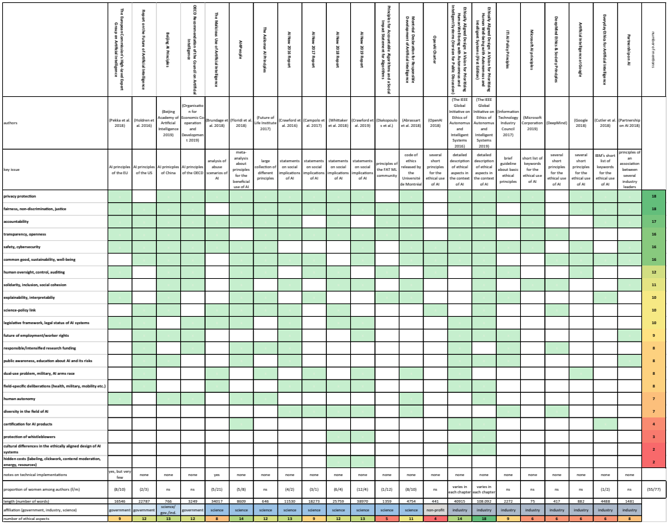
- The paper analyzes and compares 22 AI ethics guidelines and finds that accountability, privacy, and fairness appear in about 80% of them, making them the closest thing to a common minimum standard.
- The author reports that guidelines from industrial contexts name on average 9.1 distinct ethical aspects, while science-based ethics codes average 10.8.
- Only two guidelines contain genuinely technical explanations, and these are described as very sparse; the most extensive technical commentary is in “The Malicious Use of AI”.
- The paper says a controlled study found the effectiveness of ethics guidelines or codes to be “almost zero”: among 63 software engineering students and 105 professional software developers, there was no statistically significant difference in responses between those who did and did not see the ACM code of ethics.
- The paper highlights major omissions across guidelines, including political abuse of AI, hidden social and ecological costs, lack of diversity, robot ethics, trolley problems, and public-private partnerships/industry-funded research.
## Methods
- Semi-systematic literature analysis of AI ethics guidelines, with a deliberate focus on comprehensive guideline documents rather than all AI-ethics-related writings.
- The final sample consisted of 22 major ethical guidelines, identified through searches in Google, Google Scholar, Web of Science, ACM Digital Library, arXiv, and SSRN, plus manual reference screening and the Algorithm Watch AI Ethics Guidelines Global Inventory.
- The paper compares which ethical issues are present or absent in the guidelines, and then relates those principles to practice using cited empirical studies and examples from AI development and deployment.
## Limitations
- The author states the sample is biased toward western/northern documents and excludes guidelines not written in English.
- The selection deliberately excludes guidelines focused on robot ethics, big data, algorithms, or robotics, so omissions in those areas are partly a result of the sampling method.
- The paper notes that its list of omissions is non-exhaustive.
- Evident from the text: the paper is primarily a theoretical/semi-systematic overview, not a direct empirical test of all AI ethics guideline implementations.
Model-written summary. Check it against the paper before relying on it.
Integrity signals
Registry
Cites
Statistics
Figures
Verification
Claims the paper makes
5 Valid · 3 Not valid · 62 Not checked · 64 Own results and interpretations
The cited sources support only part of this claim — read each source’s verdict below.
In the paper
“So far, some papers have been published on the subject of teaching ethics to data scientists (Garzcarek and Steuer 2019; Burton etal. 2017; Goldsmith and Burton 2017; Johnson 2017) but by and large very little to nothing has been written about the tangible implementation of ethical goals and values.”
What the sources say
- Supportedcites Garzcarek and Steuer 2019 matched to “Approaching Ethical Guidelines for Data Scientists” (2019) source
The citation is attached to the statement that papers have discussed teaching ethics to data scientists, not to the citing authors’ subsequent assessment of writing on tangible implementation. Section 5.2 (p. 14) explicitly argues that ethics should be part of the data-science curriculum. (LLM, conf=0.90)
- Not matchedcites Burton etal. 2017
An author–year citation the paper’s reference list doesn’t settle. We don’t search these by name.
- Supportedcites Goldsmith and Burton 2017 matched to “Why Teaching Ethics to AI Practitioners Is Important” (2017) source
The citation appears in a list of papers about teaching ethics to data scientists, not as support for the sentence’s later claim about how little has been written on implementation. The Introduction (p. 1) presents the paper as an argument for ethical training for AI students and practitioners, and the Conclusions (p. 4) advocate teaching ethics in AI classes. (LLM, conf=0.91)
plain- Asserted: passes — The authors put it forward as true.
- Checkable: passes — It can be checked against evidence.
- Load-bearing: passes — The paper’s conclusions depend on it.
- Based: passes — The paper gives a reason why it holds.
- Supported
The cited sources support only part of this claim — read each source’s verdict below.
In the paper
“Leading, of course, is the military use of AI in cyber warfare or regarding weaponized unmanned vehicles or drones (Ernest and Carroll 2016; Anderson and Waxman 2013).”
What the sources say
- Partly supportedcites Ernest and Carroll 2016 matched to “Genetic Fuzzy based Artificial Intelligence for Unmanned Combat Aerial Vehicle Control in Simulated Air Combat Missions” (2016) sourceExperimental — accuracy not yet measured
Our copy does support the drone half of the claim as an identification citation: the paper is squarely about applying AI to a weaponized unmanned vehicle (Introduction: UCAV research, 'this white paper will primarily focus on the increase in capabilities of real-time decision making'; Problem Statement: ALPHA controlling aircraft motion and firing in AFSIM). But it does not support the claim's core assertion that military AI is a leading area of unwanted side effects and malevolent use — the nearest passage (Introduction, 'There are a number of obstacles to a system being an effective AI within this context') frames the issues as engineering and verification difficulties (adversaries trying to 'fool and exploit the system', V&V, safety specifications, crashes/sensor failures), and the Results and Conclusions treat autonomy as 'a revolutionary leap in capability of airpower' and a way of 'reducing risk to our pilots'. Cyber appears only once, as an unrelated civilian/defence application domain of the GFT method ('Examples include robotic surgery, design automation, and cyber security'), not as cyber warfare, so that element of the claim is not from this source. (LLM, conf=0.72)
- Not checked — no full text of the sourcecites Anderson and Waxman 2013 matched to “Law and Ethics for Autonomous Weapon Systems: Why a Ban Won't Work and How the Laws of War Can” (2013) source
boostedstates an association- Asserted: passes — The authors put it forward as true.
- Checkable: passes — It can be checked against evidence.
- Load-bearing: unclear — It is unclear whether the paper’s conclusions depend on it.
- Based: passes — The paper gives a reason why it holds.
- Partly supported
The cited sources support only part of this claim — read each source’s verdict below.
In the paper
“In the light of these two approaches, the traditional type of AI ethics can be assigned to the deontological concept (Mittelstadt 2019).”
What the sources say
- Partly supportedcites Mittelstadt 2019 matched to “Principles alone cannot guarantee ethical AI” (2019) sourceExperimental — accuracy not yet measured
The paper describes a prominent, principle-based approach to AI ethics and says AI ethics initiatives have converged around principles resembling those of medical ethics (opening section; page unavailable). It does not classify that approach as deontological, so the claimed assignment to the deontological concept is not supported by our copy. (LLM, conf=0.78)
plainstates an association- Asserted: passes — The authors put it forward as true.
- Checkable: passes — It can be checked against evidence.
- Load-bearing: passes — The paper’s conclusions depend on it.
- Based: passes — The paper gives a reason why it holds.
- Partly supported
A result the paper reports from its own data — it cites no other source for it, so there is none to check. The quote shows it is in the paper.
In the paper
“My analysis of the distribution of female and male authors of the guidelines, as far as authors were indicated in the documents, showed that the proportion of women was 41.7%.”
plain- Asserted: passes — The authors put it forward as true.
- Checkable: passes — It can be checked against evidence.
- Load-bearing: passes — The paper’s conclusions depend on it.
- Based: passes — The paper gives a reason why it holds.
A result the paper reports from its own data — it cites no other source for it, so there is none to check. The quote shows it is in the paper.
In the paper
“Finally, yet importantly, it is noteworthy that almost all guidelines suggest that technical solutions exist for many of the problems described.”
hedged- Asserted: passes — The authors put it forward as true.
- Checkable: passes — It can be checked against evidence.
- Load-bearing: unclear — It is unclear whether the paper’s conclusions depend on it.
- Based: passes — The paper gives a reason why it holds.
54 more claims
Create a free account to see all 134 claims and to verify the 1 reference still open.
- Probably not a substantial claim. 59
- It may state two separate claims as one. 29
Claims other papers make about this one
Each is checked against this paper’s own text: does it say what the citing paper says it does?
The source backs part of the claim, not all of it — or backs it for a different population, condition or comparison.
In the citing paper
“Ethical concerns arising from the design and deployment of AI technology have motivated a number of initiatives [47]—such as the Ethical Guidelines for Trustworthy AI by the European Commission expert group on AI, and Microsoft’s FATE: Fairness, Accountability, Transparency, and Ethics in AI—addressing issues including mitigating bias and discrimination in AI systems and fairness in the use of AI”
From Future directions for chatbot research: An interdisciplinary research agenda (2021) · cites this paper as [47]
Experimental — accuracy not yet measuredThe source backs part of the claim, not all of it — or backs it for a different population, condition or comparison.
In the citing paper
“Additional recommendations on AI ethics teaching content include “explainability,” “liability,” and “accountability,” which are also considered important by available guidelines [30,40].”
From Proposing a Principle-Based Approach for Teaching AI Ethics in Medical Education (2024) · cites this paper as [30]
Experimental — accuracy not yet measuredThe source backs part of the claim, not all of it — or backs it for a different population, condition or comparison.
In the citing paper
“This emphasis is also echoed by existing guidelines and frameworks regarding AI ethics [30].”
From Proposing a Principle-Based Approach for Teaching AI Ethics in Medical Education (2024) · cites this paper as [30]
Experimental — accuracy not yet measuredThe source backs part of the claim, not all of it — or backs it for a different population, condition or comparison.
In the citing paper
“En dépit de nombreuses chartes, discussions et nombreux documents sur les bonnes pratiques éthiques, l’espoir est faible que l’IA puisse éventuellement se montrer généralement conforme (Hagendorff, 2020) :”
From Gouvernance algorithmique, intelligence artificielle, enjeux, éthique : esquisse d’une analyse critique (2021) · cites this paper as Hagendorff, 2020
Experimental — accuracy not yet measuredThe source backs part of the claim, not all of it — or backs it for a different population, condition or comparison.
In the citing paper
“The experience of mixed emotional responses and ethnical navigation was supported by literature (Hagendorff, 2020;Mamo et al., 2024;Mittelstadt, 2019).”
From Into the Unknown: AI Adoption and Job Satisfaction of Christian Faculty (2026) · cites this paper as Hagendorff, 2020
Experimental — accuracy not yet measured
13 more claims about this paper
Create a free account to see every claim other papers make about this one.
Citations
Cites
The spread of true and false news online
Vosoughi, S., Roy, D., & Aral, S. (2018) · Science · doi:10.1126/science.aap9559 · Cited by 8,847
The future of employment: How susceptible are jobs to computerisation?
Frey, C. B., & Osborne, M. A. (2017) · Technological Forecasting and Social Change · doi:10.1016/j.techfore.2016.08.019 · Cited by 8,727
The global landscape of AI ethics guidelines
Jobin, A., Ienca, M., & Vayena, E. (2019) · Nature Machine Intelligence · doi:10.1038/s42256-019-0088-2 · Cited by 6,220
Floridi, L., Cowls, J., Beltrametti, M., Chatila, R., Chazerand, P., Dignum, V., Luetge, C., Madelin, R., Pagallo, U., Rossi, F., et al. (2018) · Minds and Machines · doi:10.1007/s11023-018-9482-5 · Cited by 4,774 · cited 2×
“They include the adoption of legal framework conditions, the establishment of mechanisms for an independent auditing of technologies, the establishment of institutions for complaints, which also compensate for harms caused by AI systems, and the expansion of university curricula in particular through content from ethi…”
Background(2011) · Cited by 4,430
Lazer, D. M. J., Baum, M. A., Benkler, Y., Berinsky, A. J., Greenhill, K. M., Menczer, F., Metzger, M. J., Nyhan, B., Pennycook, G., Rothschild, D., et al. (2018) · Science · doi:10.1126/science.aao2998 · Cited by 4,160
The Black Box Society: The Secret Algorithms That Control Money and Information
Pasquale, F. (2015) · doi:10.4159/harvard.9780674736061 · Cited by 3,796
Experimental evidence of massive-scale emotional contagion through social networks
Kramer, A. D. I., Guillory, J. E., & Hancock, J. T. (2014) · Proceedings of the National Academy of Sciences · doi:10.1073/pnas.1320040111 · Cited by 3,687
(2018) · Cited by 3,510
Private traits and attributes are predictable from digital records of human behavior
Kosinski, M., Stillwell, D., & Graepel, T. (2013) · Proceedings of the National Academy of Sciences · doi:10.1073/pnas.1218772110 · Cited by 2,829
Research works printed but not linked: 24
- Abrassart, C., Bengio, Y., Chicoisne, G., de Marcellis-Warin, N., Dilhac, M.-A., Gambs, S., Gautrais, V., etal. (2018). Montréal declaration for responsible development of artificial intelligence (pp. 1-21).
- Asimov, I. (2004). I, Robot . New York: Random House LLC.
- Bakewell, J. D., Clement-Jones, T. F., Giddens, A., Grender, R. M., Hollick, C. R., Holmes, C., Levene, P. K. etal. (2018). AI in the UK: Ready, willing and able?. Select committee on artificial intelligence (pp. 1-183).
- Baron, B., Musolesi, M. (2017). Interpretable machine learning for privacy-preserving pervasive systems. arXiv (pp. 1-10).
- Bourdieu, P. (1984). Distinction: A social critique of the judgement of taste . Cambridge: Harvard University Press.
- Brahnam, S. (2006). Gendered bots and bot abuse. In Antonella de Angeli, Sheryl Brahnam, Peter Wallis, & Peter Dix (Eds.), Misuse and abuse of interactive technologies (pp. 1-4). Montreal: ACM.
- Derrida, J. (1997). Of grammatology . Baltimore: Johns Hopkins Univ. Press.
- Gebru, T., Morgenstern, J., Vecchione, B., Vaughan, J. W., Wallach, H., Daumeé, III, H., Crawford, K. (2018). Datasheets for datasets. arXiv (pp. 1-17).
- Google. (2019). Perspectives on issues in AI governance (pp. 1-34). Retrieved February 11, 2019. https :// ai.googl e/stati c/docum ents/persp ectiv es-on-issue s-in-ai-gover nance .pdf.
- Helbing, D. (Ed.). (2019). Towards digital enlightment: Essays on the darf and light sides of the digital revolution. Cham: Springer.
- Johnson, D. G. (2017). Can engineering ethics be taught? The Bridge, 47 (1), 59-64.
- Luhmann, N. (1988). Die Wirtschaft der Gesellschaft . Frankfurt A.M: Suhrkamp.
- Morley, J., Floridi, L., Kinsey, L., Elhalal, A. (2019). From what to how. An overview of AI ethics tools, methods and research to translate principles into practices. arXiv (pp. 1-21).
- Organisation for Economic Co-operation and Development. (2019). Recommendation of the Council on Artificial Intelligence (pp. 1-12). Retrieved June 18, 2019. https ://legal instr ument s.oecd.org/en/ instr ument s/OECD-LEGAL -0449.
- Pekka, A.-P., Bauer, W., Bergmann, U., Bieliková, M., Bonefeld-Dahl, C., Bonnet, Y., Bouarfa, L. etal. (2018). The European Commission's high-level expert group on artificial intelligence: Ethics guidelines for trustworthy ai . Working Document for stakeholders' consultation. Brussels (pp. 1-37).
- Pistono, F., Yampolskiy, R. (2016). Unethical research: How to create a malevolent artificial intelligence. arXiv (pp. 1-6).
- Podgaiska, I., Shklovski, I. Nordic engineers’ stand on artificial intelligence and ethics: Policy recommendations and guidelines (pp. 1–40).
- Rawls, J. (1975). Eine Theorie Der Gerechtigkeit . Frankfurt am Main: Suhrkamp.
- Shoham, Y., Perrault, R., Brynjolfsson, E., Clark, J., Manyika, J., Niebles, J. C., Lyons, T., Etchemendy, J., Grosz, B., Bauer, Z. (2018). The AI index 2018 annual report. Stanford, Kalifornien (pp. 1-94). <!-- image --> 1 3
- Sitawarin, C., Bhagoji, A. N., Mosenia, A., Chiang, M., Mittal, P. (2018). DARTS: Deceiving autonomous cars with toxic signs. arXiv (pp. 1-27).
- Tegmark, A. (2017). Life 3.0: Being human in the age of artificial intelligence . New York: Alfred A. Knopf.
- The IEEE Global Initiative on Ethics of Autonomous and Intelligent Systems. (2016). Ethically aligned design: A vision for prioritizing human well-being with artificial intelligence and autonomous systems (pp. 1-138).
- Whittaker, M., Crawford, K., Dobbe, R., Fried, G., Kaziunas, E., Mathur, V., West, S. M., Richardson, R., Schultz, J., Schwartz, O. (2018). AI now report 2018 (pp. 1-62).
- Zeng, Y., Lu, E., Huangfu, C. (2018). Linking artificial intelligence principles. arXiv (pp. 1-4). Publisher's Note Springer Nature remains neutral with regard to jurisdictional claims in published maps and institutional affiliations. <!-- image --> 1 3
Cited by
Items 601–700 of 1,821
Zhang, X., Hu, J., & Zhou, Y. (2025) · Education and Information Technologies · doi:10.1007/s10639-025-13535-3 · Cited by 17
“While ethical considerations have been discussed in various fields—particularly in relation to emerging technologies like AI—this study formalizes their role within an adoption framework (Hagendorff, 2020; Heilinger, 2022).”
Jorolan, J., Cabillo, F., Batucan, R. R., Camansi, C. M., Etoquilla, A., Gapo, J., Hallarte, D. K., Milano, M. L., Gonzales, R. R., & Gonzales, G. G. (2025) · Computers & Education · doi:10.1016/j.compedu.2025.105346 · Cited by 15
Fairness in AI systems development: EU AI Act compliance and beyond
Westerstrand, S. (2025) · Information and Software Technology · doi:10.1016/j.infsof.2025.107864 · Cited by 23
Henderson, L. H., & Wilson, J. (2022) · Futures · doi:10.1016/j.futures.2022.103047 · Cited by 15
Artificial Intelligence in Digital Health: Issues and Dimensions of Ethical Concerns
Ishengoma, F. (2022) · Innovación y software · doi:10.48168/innosoft.s8.a48 · Cited by 17
“In such a setting, some scholars argue that policies and rules for ethical AI in health care should are inevitable to these rising challenges [13].”
BackgroundExigencias éticas para un periodismo responsable en el contexto de la inteligencia artificial
Esteban, E. G., & Sanahuja, R. S. (2023) · Daímon · doi:10.6018/daimon.557391 · Cited by 16
L’intelligence artificielle peut-elle être une innovation responsable ?
Vuarin, L., Lopes, P. G., & Massé, D. (2023) · Innovations · doi:10.3917/inno.pr2.0153 · Cited by 18
Responsible use of AI in military systems: prospects and challenges
Schraagen, J. M. (2023) · Ergonomics · doi:10.1080/00140139.2023.2278394 · Cited by 30
“…by some for being (i) too abstract to be practical, (ii) reflecting mainly the values of the experts chosen to create them (hence, not being inclusive), and (iii) serving the priorities of the private entities which funded some of this work (‘ethics washing’) (Hagendorff 2020; Hickok 2021).”
BackgroundA Lifecycle Approach for Artificial Intelligence Ethics in Energy Systems
El-Haber, N., Burnett, D., Halford, A., Stamp, K., Silva, D. D., Manic, M., & Jennings, A. (2024) · Energies · doi:10.3390/en17143572 · Cited by 17
Explanation needs and ethical demands: unpacking the instrumental value of XAI
Alpsancar, S., Buhl, H. M., Matzner, T., & Scharlau, I. (2024) · AI and Ethics · doi:10.1007/s43681-024-00622-3 · Cited by 24
Masso, A., Gerassimenko, J., Kasapoğlu, T., & Beilmann, M. (2025) · Journal of Responsible Technology · doi:10.1016/j.jrt.2025.100112 · Cited by 28
Maclure, J., & Morin-Martel, A. (2025) · Digital Society · doi:10.1007/s44206-025-00174-x · Cited by 19
“However, the concrete effect of these codes on prac - tices has been slow to materialize, and at best modest (Hagendorff, 2020 : 108).”
Fagbola, T. M., & Thakur, S. C. (2019) · International Conference on Intelligent Informatics and Biomedical Sciences (ICIIBMS) · doi:10.1109/iciibms46890.2019.8991505 · Cited by 19
Daly, A., Devitt, S. K., & Mann, M. (2021) · University of Westminster Press eBooks · doi:10.16997/book55.g · Cited by 22
“Law is one way of enforcing ethical principles but not the only one, and Hagendorff (2020) points to a broader issues with AI ethics ‘usually lack[ing] mechanisms to reinforce its own normative claims’, mechanisms that include law but also cover technical implementations and business process…”
BackgroundInfluentialRespect as a Lens for the Design of AI Systems
Seymour, W., Kleek, M. G. V., Binns, R., & Murray-Rust, D. (2022) · Proceedings of the AAAI/ACM Conference on AI Ethics and Society · doi:10.1145/3514094.3534186 · Cited by 22
“[5]), this is arguably in contrast with dominant forms of ethics in AI debates [48].”
ResultArtificial Intelligence in the Russian Media and Journalism: The Issue of Ethics
Lukina, M., Владимирович, З. А., Krasheninnikova, M., & Кульчицкая, Д. Ю. (2022) · Theoretical and Practical Issues of Journalism · doi:10.17150/2308-6203.2022.11(4).680-694 · Cited by 41
Distribution of Forward-Looking Responsibility in the EU Process on AI Regulation
Hedlund, M. (2022) · Frontiers in Human Dynamics · doi:10.3389/fhumd.2022.703510 · Cited by 12
“For instance, the gender imbalance in the tech industry with an overwhelming majority of men8, and the observation that women have a tendency to focus on different things than men, may increase the risk that certain perspectives will be lost (Hagendorff, 2020; Resseguier and Rodrigues, 2021).”
BackgroundArtificial Intelligence, Structure of Knowledge, and the Future Directions for Macromarketing
Dholakia, N., Repo, P., Fırat, A. F., Campos, I., & Timonen, P. (2025) · Journal of Macromarketing · doi:10.1177/02761467251323840 · Cited by 12
“In the realm of ethics, there is a conspicuous lack of guidelines in matters such as care, welfare, social responsibility, and social and ecological relationships, and this re fl ects the male dominance of focusing on aspects such as accountability, privacy, or fairness (Hagendorff, 2020).”
Besio, C., Fedtke, C., Grothe‐Hammer, M., Karafillidis, A., & Pronzini, A. (2024) · Systems Research and Behavioral Science · doi:10.1002/sres.3028 · Cited by 20
Dutta, D., & Poyil, A. K. (2025) · Behaviour and Information Technology · doi:10.1080/0144929x.2025.2496722 · Cited by 17
A Discussion on Ethical Cybersecurity Issues in Digital Service Chains
Tronnier, F., Pape, S., Löbner, S., & Rannenberg, K. (2022) · Lecture notes in computer science · doi:10.1007/978-3-031-04036-8_10 · Cited by 18
Müller, R., Kuhn, E. M., Ranisch, R., Hunger, J., & Primc, N. (2023) · Ethics and Information Technology · doi:10.1007/s10676-023-09677-y · Cited by 11
“…ethics guidelines and frameworks have been proposed in recent years for identifying, considering and resolving ethical questions associated with data-driven technologies in healthcare and research (Hagendorff, 2020; Ienca et al., 2018; Jobin et al., 2019; Vayena et al., 2018; Xafis et al., 2019).”
BackgroundThe State of Ethical AI in Practice: A Multiple Case Study of Estonian Public Service Organizations
Hinton, C. (2023) · International Journal of Technoethics · doi:10.4018/ijt.322017 · Cited by 19
Teaching the Future: The Vision of AI/ChatGPT in Education
Bahrami, M. R., Bahrami, B., Behboodi, F., & Pourrafie, S. (2023) · Smart innovation, systems and technologies · doi:10.1007/978-981-99-3068-5_37 · Cited by 19
Making Sense of Responsibility: A Semio-Ethic Perspective on TikTok’s Algorithmic Pluralism
Scalvini, M. (2023) · Social Media + Society · doi:10.1177/20563051231180625 · Cited by 30
“There has been a significant increase in the amount of discussion about the ethical principles and ideals that should guide the development and deployment of recommendation systems (e.g., Hagendorff, 2020).”
BackgroundAn overview of artificial intelligence in medical physics and radiation oncology
Liu, J., Xiao, H., Fan, J., Hu, W., Yang, Y., Dong, P., Xing, L., & Cai, J. (2023) · Journal of the National Cancer Center · doi:10.1016/j.jncc.2023.08.002 · Cited by 20
McDonald, N., Massey, A. K., & Hamidi, F. (2023) · Journal of Problem Based Learning in Higher Education · doi:10.54337/ojs.jpblhe.v11i2.7667 · Cited by 16
“What is missing from much of AI ethics is an understanding of the relationships of power in which AI systems are situated and the contexts in which they interact with individuals (Hagendorff, 2020; McDonald et al., 2022).”
BackgroundAI IN FINANCIAL INDUSTRY: ETHIC ISSUES
Glavina, S. G. (2024) · Journal of Trends and Challenges in Artificial Intelligence · doi:10.61552/jai.2024.01.002 · Cited by 12
Nutsugah, N., & Senanu, B. (2024) · Journal of Public Relations Research · doi:10.1080/1062726x.2024.2368485 · Cited by 22
“Existing literature suggests that ethical guidelines are not necessarily the sole foundation for individual ethical decision-making (Hagendorff, 2020).”
Acuña, B. P., & Alcalá, F. D. R. (2024) · Frontiers in Virtual Reality · doi:10.3389/frvir.2024.1357595 · Cited by 31
Youth perceptions of AI ethics: a Q methodology approach
Ko, J., & Song, A. (2024) · Ethics & Behavior · doi:10.1080/10508422.2024.2396582 · Cited by 12
“However, fairness is a critical issue in AI ethics, particularly regarding the accessibility and global sharing of the technology’s benefits (Fjeld et al., 2020; Hagendorff, 2020; Hickok, 2021; Jobin et al., 2019; UNICEF, 2020).”
Gazos, A., Kahn, J., Kusche, I., Büscher, C., & Götz, M. (2024) · Safety Science · doi:10.1016/j.ssci.2024.106731 · Cited by 24
Kouloukoui, D., de Marcellis-Warin, N., & Warin, T. (2025) · AI & Society · doi:10.1007/s00146-025-02232-x · Cited by 19
“It is crucial to establish independent panels to monitor the use of AI and detect possible biases, as highlighted by Hagendorff (2020).”
InfluentialArtificial intelligence misconduct and ESG risk ratings
Monfort, A., Méndez-Suárez, M., & García, N. V. (2025) · Review of Managerial Science · doi:10.1007/s11846-025-00850-9 · Cited by 18
“The increasing adoption of AI has led to an increase in ethical violations, such as the misuse of personal data and algorithmic discrimination, resulting in intensified regulatory and social scru - tiny (Floridi and Cowls 2021; Hagendorff 2020).”
“That is scary!”: consumer perceptions and discourses on ChatGPT
Fares, O. H. (2025) · Qualitative Market Research An International Journal · doi:10.1108/qmr-07-2024-0122 · Cited by 13
Lee, J., Park, J. J., & Mostafa, N. A. (2025) · Data Science and Management · doi:10.1016/j.dsm.2025.05.002 · Cited by 18
Work in Progress: Pedagogy of Engineering Ethics: A Bibliometric and Curricular Analysis
Nasir, O., Muntaha, S., Javed, R. T., & Qadir, J. (2021) · IEEE Global Engineering Education Conference (EDUCON) · doi:10.1109/educon46332.2021.9453923 · Cited by 15
“And yet the effectiveness of these efforts is still getting questioned [7].”
BackgroundSposini, L. (2024) · Journal of Digital Technologies and Law · doi:10.21202/jdtl.2024.5 · Cited by 13
An Ecosystem Approach to Ethical AI and Data Use: Experimental Reflections
Findlay, M., & Seah, J. (2020) · 2020 IEEE / ITU International Conference on Artificial Intelligence for Good (AI4G) · doi:10.1109/ai4g50087.2020.9311069 · Cited by 11
“Private companies like Google, Microsoft, IBM and Tencent have taken the lead in publishing their own ethics documents and principles [2], [5].”
BackgroundInfluentialThe wheel of artificial intelligence governance
Monteiro, N., & Singh, V. (2025) · Sustainable Futures · doi:10.1016/j.sftr.2025.101279 · Cited by 26
The trust trifecta: How transparency, ethics, and benefits shape public confidence in government AI
Bian, X., Bin, W., & Yang, A. (2025) · Government Information Quarterly · doi:10.1016/j.giq.2025.102083 · Cited by 19
Zaidan, E., Truby, J., Ibrahim, I. A., & Hoppe, T. (2025) · Technology in Society · doi:10.1016/j.techsoc.2025.103159 · Cited by 25
Embedding AI ethics in the data lifecycle: A framework for enterprise AI governance
Huang, X., Kou, T., & Zhou, Q. (2026) · Technology in Society · doi:10.1016/j.techsoc.2026.103261 · Cited by 15
21. Yüzyılda Kariyer Psikolojik Danışmanlığı ve Yapay Zeka Uygulamaları
ÖZDOĞAN, H. K., & Özdemir, N. K. (2023) · Buca eğitim fakültesi dergisi (Online)/Buca Eğitim Fakültesi dergisi · doi:10.53444/deubefd.1326692 · Cited by 17
Kieslich, K., & Lünich, M. (2024) · ACM Conference on Fairness, Accountability, and Transparency (FAccT) · doi:10.1145/3630106.3658548 · Cited by 21
“Nevertheless, AI ethics guidelines have been published by several bodies, which formulate proposals on how to mitigate the ethical risks of AI systems [2, 19, 22, 26, 30, 51].”
BackgroundEnabling Human-Centered AI: A Methodological Perspective
Xu, W., & Gao, Z. (2024) · IEEE International Conference on Human-Machine Systems (ICHMS) · doi:10.1109/ichms59971.2024.10555771 · Cited by 30
“Based on existing studies and our previous research (e.g., [8][17][18][19][20], we define 28 HCAI design principles across the HCAI dimensions of user-technology-ethics; for example, “Empower users to make informed decisions and retain control.””
BackgroundMethodBiden’s Executive Order on AI: strengths, weaknesses, and possible reform steps
Wörsdörfer, M. (2024) · AI and Ethics · doi:10.1007/s43681-024-00510-w · Cited by 14
Automation scenarios: citizen attitudes towards automated decision-making in the public sector
Kaun, A., Larsson, A. O., & Masso, A. (2024) · Information Communication & Society · doi:10.1080/1369118x.2024.2375261 · Cited by 19
“Therefore, based on an original survey instrument, this article engages with citizens’ awareness of, attitudes toward and experiences with ADM in the welfare sector from a comparative perspective (Hagendorff, 2020).”
Saatçi, E. Y. (2025) · International Journal of Economic Behavior and Organization · doi:10.11648/j.ijebo.20251301.14 · Cited by 13
Disruptive Technology Capabilities in Local Governments: An Empirical Study
Aristovnik, A., Murko, E., Kristl, N., & Ravšelj, D. (2025) · Information Polity · doi:10.1177/15701255251321682 · Cited by 26
“…of a comprehensive legal framework specifically for DT further complicates these issues, impacting the understanding of rights and responsibilities necessary for successful DT implementation (Balfaqih & Alharbi, 2022; Dash & Sharma, 2022; Hagendorff, 2020; Nam et al., 2021; Rjab et al., 2023).”
Towards an experiential ethics of AI and robots: A review of empirical research on human encounters
Fischer, B., & Frennert, S. (2025) · Technological Forecasting and Social Change · doi:10.1016/j.techfore.2025.124264 · Cited by 16
The psychological mechanism of value co-creation with human-centred generative AI robot assistants
Li, Z., Yuen, K. F., & Teo, C. (2025) · Technology in Society · doi:10.1016/j.techsoc.2025.103015 · Cited by 13
Liu, J., Chu, C., Zhao, Y., Aoki, G., & Xiao, Z. (2025) · Emerging Media · doi:10.1177/27523543251365678 · Cited by 19
“…for establishing foundational safety and accountability standards and re fl ecting a desire that AI should not override human decision-making (Hagendorff, 2020), can be outpaced by technological shifts, potentially sti fl ing innovation or failing to address speci fi c risks associated with…”
Pudney, S., Mills, D., Alaei, A., Sellers, S., Dvořák, J., & Potluka, O. (2025) · Evaluation · doi:10.1177/13563890251350677 · Cited by 18
“In effect, by adopting AI principles, such as those promoted by the OECD, as the only design guidance, designers are asking stakeholders in AI-enhanced systems to trust their interpretation (Hagendorff, 2020).”
When the frameworks don’t work: data protection, trust and artificial intelligence
Fritz, Z. B. M. (2022) · Journal of Medical Ethics · doi:10.1136/medethics-2022-108263 · Cited by 12
Research on Ethical Issues of Artificial Intelligence in Education
Chu, J., Xi, L., Zhang, Q., & Lin, R. (2022) · Lecture notes in educational technology · doi:10.1007/978-981-19-5967-7_12 · Cited by 15
Reexamining computer ethics in light of AI systems and AI regulation
Jacobs, M., & Simon, J. (2022) · AI and Ethics · doi:10.1007/s43681-022-00229-6 · Cited by 15
“The rapid development and dissemination of AI systems in recent years has been “accompanied by constant calls for applied ethics” [29].”
BackgroundApprehending AI moral purpose in practical wisdom
Graves, M. (2022) · AI & Society · doi:10.1007/s00146-022-01597-7 · Cited by 16
“Although principle-based approaches pervade AI ethics (Floridi et al. 2018; Hagendorff 2020), Mittelstadt (2019) and others have voiced concerns about an uncritical mapping from bioethical principles, where the approach originated, to AI.”
Prioritizing Policies for Furthering Responsible Artificial Intelligence in the United States
Hadley, E. (2022) · IEEE International Conference on Big Data (BigData) · doi:10.1109/bigdata55660.2022.10020551 · Cited by 16
Navigating the Ethical Landscape of AI in Healthcare: Insights From a Content Analysis
Wu, Y., & Liu, X. M. (2023) · IEEE Technology and Society Magazine · doi:10.1109/mts.2023.3306543 · Cited by 15
“For instance, research by Hagendorff [11] and Jobin et al. [12] have shed light on the field of AI ethics by presenting overviews of current corpus of ethical AI, revealing divergence on ethical requirements in a global scope, and examining implementation of ethical values and principles within the…”
An Ethics Framework for the Internet of Musical Things
Brusseau, J., & Turchet, L. (2024) · IEEE Transactions on Technology and Society · doi:10.1109/tts.2024.3398423 · Cited by 14
“A cascade of them have been proposed in recent years [24].”
Delecraz, S., Eltarr, L., Becuwe, M., Bouxin, H., Boutin, N., & Oullier, O. (2022) · 2022 IEEE/ACM International Workshop on Equitable Data & Technology (FairWare) · doi:10.1145/3524491.3527309 · Cited by 30
Nemat, A. T., Becker, S. J., Lucas, S., Thomas, S., Gadea, I., & Charton, J. E. (2023) · Minds and Machines · doi:10.1007/s11023-023-09654-w · Cited by 14
“…made to identify ethical principles that should be safeguarded during the development, deployment and use of digital innovations (Floridi et al., 2018 ; Jobin et al., 2019; Fjeld et al., 2020 ; Hagendorff, 2020 ), and many organisations have adopted ethics guidelines based on these prin - ciples.”
Pokholkova, M., Boch, A., Hohma, E., & Lütge, C. (2024) · AI and Ethics · doi:10.1007/s43681-024-00468-9 · Cited by 15
“23 This paper seeks to contribute to the current research on AI ethics implementability by using the elicitations of experts, a technique already implemented to solve problems in political science, government, statistics, management science, and psychology.”
Willet, K. B. S., & Na, H. (2024) · Online Learning · doi:10.24059/olj.v28i2.4434 · Cited by 19
“However, in terms of challenges, ethical concerns and data privacy are two significant issues among many others, as illustrated by a recent study assessing 22 AI ethics guidelines (Hagendorff, 2020).”
BackgroundA critical inquiry into the personal and societal perils of Artificial Intelligence
Christou, P. (2024) · AI and Ethics · doi:10.1007/s43681-024-00556-w · Cited by 12
“In fact, the academic community commenced examining the multifaceted impacts of AI on society, and exploring how AI affects various aspects, such as privacy, healthcare, markets, social equity, and ethical boundaries [23, 27, 48].”
Transparency in AI usage within fact-checking platforms in Spain and its ethical challenges
Cuartielles, R., Mauri-Ríos, M., & Rodríguez-Martínez, R. (2024) · Communication & Society · doi:10.15581/003.37.4.257-271 · Cited by 19
“Notable contributions include those by Jobin et al. (2019), Fjeld et al. (2020) and Hagendorff (2020), where transparency in AI use is closely linked to the concept of explainability.”
BackgroundLearning about AI ethics from cases: a scoping review of AI incident repositories and cases
Knight, S., McGrath, C., Viberg, O., & Pargman, T. C. (2025) · AI and Ethics · doi:10.1007/s43681-024-00639-8 · Cited by 14
On the ethical governance of swarm robotic systems in the real world
Winfield, A. F. T., Swana, M., Ives, J., & Hauert, S. (2025) · Philosophical Transactions of the Royal Society A Mathematical Physical and Engineering Sciences · doi:10.1098/rsta.2024.0142 · Cited by 21
“Hagendorff [15] is notably critical, concluding that, ‘Currently, AI ethics is failing in many cases.”
Uncovering the gap: challenging the agential nature of AI responsibility problems
Albareda, J. L. (2025) · AI and Ethics · doi:10.1007/s43681-025-00685-w · Cited by 18
A Bibliometric Analysis to Study the Evolution of Artificial Intelligence in Business Ethics
Tani, M., Muto, V., Basile, G., & Nevi, G. (2025) · Business Ethics the Environment & Responsibility · doi:10.1111/beer.12797 · Cited by 15
Bartlett, B. (2024) · The New Bioethics · doi:10.1080/20502877.2025.2482282 · Cited by 20
“Principles lack enforcement mechanisms which means that they are easily overwritten by economic incentives (Hagendorff 2020); and are designed to delay or escape regulation (Nemitz 2018, Wagner 2018).”
Exploring the Impact of AI-Driven Personalization on Consumer Engagement in Digital Marketing.
AL-Ghaswyneh, O. F. M. (2025) · Management · doi:10.58691/man/200968 · Cited by 28
“Hagendorff (2020) recommended ethical AI policies emphasizing accountability and transparency to build trust.”
Cao, H. J., Lee, H. R., & Peng, W. (2025) · CHI Conference on Human Factors in Computing Systems · doi:10.1145/3706598.3713254 · Cited by 20
“However, AI ethics is often taken as a guiding principle integrated into the understanding, use and evaluation of AI [23, 30].”
A capability approach to ethical development and internal auditing of AI technology
Graves, M., & Ratti, E. (2025) · Journal of Responsible Technology · doi:10.1016/j.jrt.2025.100121 · Cited by 16
Dahlin, E. (2025) · AI & Society · doi:10.1007/s00146-025-02429-0 · Cited by 13
Algorithmic ethics in AI-enabled workplace systems for food delivery employees
Zhao, H., Yuan, B., Wen, M., & Zhang, T. (2025) · Service Industries Journal · doi:10.1080/02642069.2025.2538071 · Cited by 21
Amram, D., Cignoni, A., Banfi, T., & Ciuti, G. (2022) · Open Research Europe · doi:10.12688/openreseurope.14524.1 · Cited by 7
Kontiainen, L. E., Koulu, R., & Sankari, S. (2022) · Frontiers in Artificial Intelligence · doi:10.3389/frai.2022.882134 · Cited by 20
Esteban, C. L. (2023) · Ediciones Universidad de Salamanca eBooks · doi:10.14201/0aq0347 · Cited by 17
Use of Artificial Intelligence with Ethics and Privacy for Personalized Customer Services
Gupta, D. G., & Jain, V. (2023) · Springer eBooks · doi:10.1007/978-3-031-33898-4_10 · Cited by 16
A Reference Architecture of Human Cyber-Physical Systems – Part I: Fundamental Concepts
Damm, W., Hess, D. J., Schweda, M., Sztipanovits, J., Bengler, K. J., Biebl, B., Fränzle, M., Hagemann, W., Held, M., Ihme, K. A., et al. (2024) · ACM Transactions on Cyber-Physical Systems · doi:10.1145/3622879 · Cited by 21
“…self-learning systems has triggered debates leading to the development of new principles for AI design [ 5 , 4 , 6 , 10 , 11 , 23 , 24 , 28 , 30 , 31 , 38 , 39 , 41 , 43 , 44 , 49 , 55 , 56 , 66 , 70 , 73 ] and new types of certification procedures [ 8 , 9 , 14 , 19 , 20 , 37 , 38 , 42 , 48 , 51…”
Conti, L. G., & Seele, P. (2023) · Ethics and Information Technology · doi:10.1007/s10676-023-09724-8 · Cited by 13
“…(iii) the cor-porations’ manipulative behaviour within institutional ethics boards; (iv) and the system’s secretive and untransparent negotiation and decision-making process (Bank et al., 2021; Floridi, 2019; Hagendorff, 2020; Peukert & Kloker, 2020; Schyns, 2023; Whittlestone et al., 2019).”
BackgroundNichol, A. A., Sankar, P. L., Halley, M. C., Federico, C. A., & Cho, M. K. (2023) · Journal of Medical Internet Research · doi:10.2196/47609 · Cited by 11
“In light of the broad interest in ethics codes to help manage conduct [55,57], it is important to consider possible reasons for their limited success.”
The Educational Axiology of Al-Maqbul Traditional Pesantren
Sulton, A. (2023) · Analisa: Jurnal Pengkajian Masalah Sosial Keagamaan · doi:10.18784/analisa.v8i1.1843 · Cited by 7
“Ethical values are related to a collection of knowledge regarding the assessment of human actions that are good or bad (Hagendorff 2020).”
BackgroundStracke, C. M. (2024) · Lecture notes in educational technology · doi:10.1007/978-981-97-8638-1_7 · Cited by 19
Affective Response Categories—Toward Personalized Reactions in Affect-Adaptive Tutoring Systems
Schmitz-Hübsch, A., Stasch, S.-M., Becker, R., Fuchs, S., & Wirzberger, M. (2022) · Frontiers in Artificial Intelligence · doi:10.3389/frai.2022.873056 · Cited by 15
“Ethical Considerations Ethical considerations are becoming increasingly important in the development of artificial intelligence (AI) systems (Hagendorff, 2020).”
BackgroundThe Tower of Babel in Explainable Artificial Intelligence (XAI)
Schneeberger, D. M., Röttger, R., Cabitza, F., Campagner, A., Plass, M., Müller, H., & Holzinger, A. (2023) · Lecture notes in computer science · doi:10.1007/978-3-031-40837-3_5 · Cited by 19
Alegría, J. P. (2023) · Revista de Derecho · doi:10.22235/rd28.3264 · Cited by 16
“…también podría ser sometido a una evaluación de conformidad para garantizar que cumple con ciertos estándares éticos, entendidos estos como la utilización de datos de entrenamiento equitativos con la población del país, disminución de los sesgos o la explicabilidad, por ejemplo (Hagendorff, 2020).”
BackgroundThe Quest for Actionable AI Ethics
Ruttkamp, E. (2020) · Communications in computer and information science · doi:10.1007/978-3-030-66151-9_3 · Cited by 20
“A virtue ethics approach to AI ethics is thus not focused on universal codes of conduct or abstract guidelines (Hagendorff 2020), but on the individual level at which everyone in society has a duty to ensure that they themselves, as well as everyone else and the companies that employ them and that…”
BackgroundInfluentialDonnelly, D.-L. (2022) · Potchefstroom Electronic Law Journal · doi:10.17159/1727-3781/2022/v25i0a11118 · Cited by 8
Funer, F., Tinnemeyer, S., Liedtke, W., & Salloch, S. (2024) · BMC Medical Ethics · doi:10.1186/s12910-024-01109-w · Cited by 11
Preventing promotion-focused goals: The impact of regulatory focus on responsible AI
Kirshner, S. N., & Lawson, J. (2024) · Computers in Human Behavior Artificial Humans · doi:10.1016/j.chbah.2024.100112 · Cited by 10
Rashid, S. F. A., Sanusi, S., & Hassan, N. S. A. (2024) · Springer eBooks · doi:10.1007/978-981-97-7808-9_7 · Cited by 22
AI4Bangladesh: AI Ethics for Bangladesh - Challenges, Risks, Principles, and Suggestions
Mayeesha, T. T., Islam, F., & Ahmed, N. (2024) · International Conference on Information and Communication Technologies and Development (ICTD) · doi:10.1145/3700794.3700820 · Cited by 13
“Given AI’s potent revolutionary potential and significant influence across a wide range of societal spheres, there has been much discussion regarding the underlying principles that ought to guide its creation and application [29, 51, 54, 68, 77, 108].”
Liang, L., Sun, Y., & Yang, B. (2025) · Aslib Journal of Information Management · doi:10.1108/ajim-08-2024-0684 · Cited by 11
Can Work Be Meaningful Under Algorithmic Management? A MacIntyrean Perspective
Ruiz, P. G., & Rocchi, M. (2025) · Business Ethics Quarterly · doi:10.1017/beq.2025.5 · Cited by 13
“However, we hold that these systems do not qualify as moral agents since they do not have necessary conditions to be considered as such (Sison and Redín 2023a; Hagendorff 2020).”
Large-scale moral machine experiment on large language models
Zaim bin Ahmad, M. S., & Takemoto, K. (2025) · PLOS One · doi:10.1371/journal.pone.0322776 · Cited by 9
“As LLMs evolve, their potential integration into critical systems has become a subject of intense scrutiny and research [6–8].”
Kim, C., Passonneau, R. J., Lee, E., Karizaki, M. S., Gnesdilow, D., & Puntambekar, S. (2025) · British Journal of Educational Technology · doi:10.1111/bjet.13596 · Cited by 14
Shi, L., & Li, M. (2025) · Global Media and China · doi:10.1177/20594364251348583 · Cited by 12
“The turning point emerged in the global controversies surrounding AI ethics (Hagendorff, 2020).”
Metadata
- Authors
- Hagendorff, T.
- Affiliations
- University of Tübingen (DE)
- Corresponding author
- Hagendorff, Thilo
- ORCID
- Hagendorff, Thilo
- Venue
- Minds and Machines
- Published
- 2020-02-01
- Volume
- 30
- Issue
- 1
- Pages
- 99-120
- ISSN
- 0924-6495 (ISSN-L)
- 1572-8641
- OpenAlex
- W3003385079
- Semantic Scholar
- 11159bdb213aaa243916f42f576396d483ba474b
- Cited by
- 1,911
- References
- 86
- Citations by year
- 2026: 370 · 2025: 446 · 2024: 361 · 2023: 290 · 2022: 239 · 2021: 160 · 2020: 41
- FWCI
- 248.38
- Type
- journal article
- Language
- en
- Update notices
- correction (2020-07-28)
- Open access
- hybrid
- doi.org
- Licence
- cc-by
- creativecommons.org/licenses/by/4.0 (tdm)
- creativecommons.org/licenses/by/4.0 (vor)
- Locations
- Minds and Machines (publishedVersion, cc-by)
- arXiv (Cornell University) (submittedVersion)
- arXiv (Cornell University)
- Funders
- Deutsche Forschungsgemeinschaft (390727645)
- Topics
- Physical Sciences › Computer Science › Artificial Intelligence › Ethics and Social Impacts of AI
- Social Sciences › Law › Digitalization, Law, and Regulation
- Social Sciences › Business, Management and Accounting › Organizational Behavior and Human Resource Management › Ethics in Business and Education
- Keywords
- AI ethics, ethics guidelines, normative principles, moral values
About these checks
Registry, retraction, Cites and statistics results are computed, not judged, with one exception: a printed reference that no index lists is read once by a model before it counts as a citation error. Claims are extracted by a model and kept only when their quote appears verbatim in the text; each cited source is then checked, with a model’s help, for whether it says what the claim relies on. Those verdicts can be wrong — read the claim’s quote and the cited source before relying on one.
The claim verdicts this report counts are experimental: their accuracy is not yet measured.
A language model drew the claims from the paper on 2026-10-12, under version 3 of the claim definition (model deepseek-v4.1-flash, prompt extract-v3).
A second model labelled each claim on 2026-10-12 (model jev-1.13-20260917, definition revision gold-guideline-v0.2).
Cited sources are checked with a language model’s help (gpt-6-sol and qwen3.8-omni-flash).
Statistics and arithmetic are recomputed, not judged.
Confidence bands are shown only for fields calibrated on our annotated test set. None is calibrated yet, so no band is shown.
What counts as a claim ›How we measure confidence ›How we check this ›
Are you an author, or do you see a problem with this page? Request a review
Data sources
Bibliographic data: Semantic Scholar, OpenAlex, Crossref.
Contains information from the Semantic Scholar Academic Graph Datasets, made available under the ODC Attribution License (ODC-BY 1.0).
Semantic Scholar’s data is described in: Kinney, R., et al. (2023). The Semantic Scholar Open Data Platform. arXiv:2301.10140.
