

The Ethics of AI Ethics: An Evaluation of Guidelines
Open accessThe DOI matches its Crossref record; 97 of the 100 references it cites were found in a registry or an index, and 3 are not checked yet; 6 of the 88 sources its claims cite were checked for support.
Abstract
Abstract Current advances in research, development and application of artificial intelligence (AI) systems have yielded a far-reaching discourse on AI ethics. In consequence, a number of ethics guidelines have been released in recent years. These guidelines comprise normative principles and recommendations aimed to harness the “disruptive” potentials of new AI technologies. Designed as a semi-systematic evaluation, this paper analyzes and compares 22 guidelines, highlighting overlaps but also omissions. As a result, I give a detailed overview of the field of AI ethics. Finally, I also examine to what extent the respective ethical principles and values are implemented in the practice of research, development and application of AI systems—and how the effectiveness in the demands of AI ethics can be improved.
Verified 2026-11-25 · 3 references not checked yet
Overview
CoChat Summary
## TL;DR
This paper semi-systematically reviews 22 AI ethics guidelines, finding strong overlap on a few technicalizable topics but many important omissions. It argues that AI ethics is often ineffective in practice and should be supplemented by more concrete technical guidance and a shift toward virtue ethics.
## Key findings
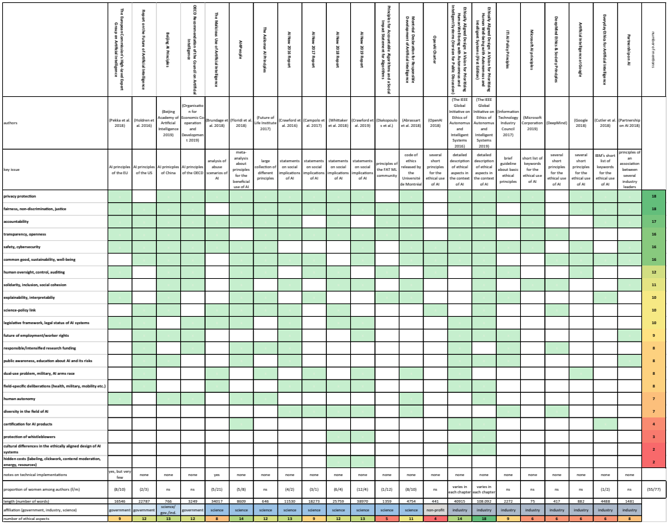
- The paper analyzes and compares 22 AI ethics guidelines and finds that accountability, privacy, and fairness appear in about 80% of them, making them the closest thing to a common minimum standard.
- The author reports that guidelines from industrial contexts name on average 9.1 distinct ethical aspects, while science-based ethics codes average 10.8.
- Only two guidelines contain genuinely technical explanations, and these are described as very sparse; the most extensive technical commentary is in “The Malicious Use of AI”.
- The paper says a controlled study found the effectiveness of ethics guidelines or codes to be “almost zero”: among 63 software engineering students and 105 professional software developers, there was no statistically significant difference in responses between those who did and did not see the ACM code of ethics.
- The paper highlights major omissions across guidelines, including political abuse of AI, hidden social and ecological costs, lack of diversity, robot ethics, trolley problems, and public-private partnerships/industry-funded research.
## Methods
- Semi-systematic literature analysis of AI ethics guidelines, with a deliberate focus on comprehensive guideline documents rather than all AI-ethics-related writings.
- The final sample consisted of 22 major ethical guidelines, identified through searches in Google, Google Scholar, Web of Science, ACM Digital Library, arXiv, and SSRN, plus manual reference screening and the Algorithm Watch AI Ethics Guidelines Global Inventory.
- The paper compares which ethical issues are present or absent in the guidelines, and then relates those principles to practice using cited empirical studies and examples from AI development and deployment.
## Limitations
- The author states the sample is biased toward western/northern documents and excludes guidelines not written in English.
- The selection deliberately excludes guidelines focused on robot ethics, big data, algorithms, or robotics, so omissions in those areas are partly a result of the sampling method.
- The paper notes that its list of omissions is non-exhaustive.
- Evident from the text: the paper is primarily a theoretical/semi-systematic overview, not a direct empirical test of all AI ethics guideline implementations.
Model-written summary. Check it against the paper before relying on it.
Integrity signals
Registry
Cites
Statistics
Figures
Verification
Claims the paper makes
5 Valid · 3 Not valid · 62 Not checked · 64 Own results and interpretations
The cited sources support only part of this claim — read each source’s verdict below.
In the paper
“So far, some papers have been published on the subject of teaching ethics to data scientists (Garzcarek and Steuer 2019; Burton etal. 2017; Goldsmith and Burton 2017; Johnson 2017) but by and large very little to nothing has been written about the tangible implementation of ethical goals and values.”
What the sources say
- Supportedcites Garzcarek and Steuer 2019 matched to “Approaching Ethical Guidelines for Data Scientists” (2019) source
The citation is attached to the statement that papers have discussed teaching ethics to data scientists, not to the citing authors’ subsequent assessment of writing on tangible implementation. Section 5.2 (p. 14) explicitly argues that ethics should be part of the data-science curriculum. (LLM, conf=0.90)
- Not matchedcites Burton etal. 2017
An author–year citation the paper’s reference list doesn’t settle. We don’t search these by name.
- Supportedcites Goldsmith and Burton 2017 matched to “Why Teaching Ethics to AI Practitioners Is Important” (2017) source
The citation appears in a list of papers about teaching ethics to data scientists, not as support for the sentence’s later claim about how little has been written on implementation. The Introduction (p. 1) presents the paper as an argument for ethical training for AI students and practitioners, and the Conclusions (p. 4) advocate teaching ethics in AI classes. (LLM, conf=0.91)
plain- Asserted: passes — The authors put it forward as true.
- Checkable: passes — It can be checked against evidence.
- Load-bearing: passes — The paper’s conclusions depend on it.
- Based: passes — The paper gives a reason why it holds.
- Supported
The cited sources support only part of this claim — read each source’s verdict below.
In the paper
“Leading, of course, is the military use of AI in cyber warfare or regarding weaponized unmanned vehicles or drones (Ernest and Carroll 2016; Anderson and Waxman 2013).”
What the sources say
- Partly supportedcites Ernest and Carroll 2016 matched to “Genetic Fuzzy based Artificial Intelligence for Unmanned Combat Aerial Vehicle Control in Simulated Air Combat Missions” (2016) sourceExperimental — accuracy not yet measured
Our copy does support the drone half of the claim as an identification citation: the paper is squarely about applying AI to a weaponized unmanned vehicle (Introduction: UCAV research, 'this white paper will primarily focus on the increase in capabilities of real-time decision making'; Problem Statement: ALPHA controlling aircraft motion and firing in AFSIM). But it does not support the claim's core assertion that military AI is a leading area of unwanted side effects and malevolent use — the nearest passage (Introduction, 'There are a number of obstacles to a system being an effective AI within this context') frames the issues as engineering and verification difficulties (adversaries trying to 'fool and exploit the system', V&V, safety specifications, crashes/sensor failures), and the Results and Conclusions treat autonomy as 'a revolutionary leap in capability of airpower' and a way of 'reducing risk to our pilots'. Cyber appears only once, as an unrelated civilian/defence application domain of the GFT method ('Examples include robotic surgery, design automation, and cyber security'), not as cyber warfare, so that element of the claim is not from this source. (LLM, conf=0.72)
- Not checked — no full text of the sourcecites Anderson and Waxman 2013 matched to “Law and Ethics for Autonomous Weapon Systems: Why a Ban Won't Work and How the Laws of War Can” (2013) source
boostedstates an association- Asserted: passes — The authors put it forward as true.
- Checkable: passes — It can be checked against evidence.
- Load-bearing: unclear — It is unclear whether the paper’s conclusions depend on it.
- Based: passes — The paper gives a reason why it holds.
- Partly supported
The cited sources support only part of this claim — read each source’s verdict below.
In the paper
“In the light of these two approaches, the traditional type of AI ethics can be assigned to the deontological concept (Mittelstadt 2019).”
What the sources say
- Partly supportedcites Mittelstadt 2019 matched to “Principles alone cannot guarantee ethical AI” (2019) sourceExperimental — accuracy not yet measured
The paper describes a prominent, principle-based approach to AI ethics and says AI ethics initiatives have converged around principles resembling those of medical ethics (opening section; page unavailable). It does not classify that approach as deontological, so the claimed assignment to the deontological concept is not supported by our copy. (LLM, conf=0.78)
plainstates an association- Asserted: passes — The authors put it forward as true.
- Checkable: passes — It can be checked against evidence.
- Load-bearing: passes — The paper’s conclusions depend on it.
- Based: passes — The paper gives a reason why it holds.
- Partly supported
A result the paper reports from its own data — it cites no other source for it, so there is none to check. The quote shows it is in the paper.
In the paper
“My analysis of the distribution of female and male authors of the guidelines, as far as authors were indicated in the documents, showed that the proportion of women was 41.7%.”
plain- Asserted: passes — The authors put it forward as true.
- Checkable: passes — It can be checked against evidence.
- Load-bearing: passes — The paper’s conclusions depend on it.
- Based: passes — The paper gives a reason why it holds.
A result the paper reports from its own data — it cites no other source for it, so there is none to check. The quote shows it is in the paper.
In the paper
“Finally, yet importantly, it is noteworthy that almost all guidelines suggest that technical solutions exist for many of the problems described.”
hedged- Asserted: passes — The authors put it forward as true.
- Checkable: passes — It can be checked against evidence.
- Load-bearing: unclear — It is unclear whether the paper’s conclusions depend on it.
- Based: passes — The paper gives a reason why it holds.
54 more claims
Create a free account to see all 134 claims and to verify the 1 reference still open.
- Probably not a substantial claim. 59
- It may state two separate claims as one. 29
Claims other papers make about this one
Each is checked against this paper’s own text: does it say what the citing paper says it does?
The source backs part of the claim, not all of it — or backs it for a different population, condition or comparison.
In the citing paper
“Ethical concerns arising from the design and deployment of AI technology have motivated a number of initiatives [47]—such as the Ethical Guidelines for Trustworthy AI by the European Commission expert group on AI, and Microsoft’s FATE: Fairness, Accountability, Transparency, and Ethics in AI—addressing issues including mitigating bias and discrimination in AI systems and fairness in the use of AI”
From Future directions for chatbot research: An interdisciplinary research agenda (2021) · cites this paper as [47]
Experimental — accuracy not yet measuredThe source backs part of the claim, not all of it — or backs it for a different population, condition or comparison.
In the citing paper
“Additional recommendations on AI ethics teaching content include “explainability,” “liability,” and “accountability,” which are also considered important by available guidelines [30,40].”
From Proposing a Principle-Based Approach for Teaching AI Ethics in Medical Education (2024) · cites this paper as [30]
Experimental — accuracy not yet measuredThe source backs part of the claim, not all of it — or backs it for a different population, condition or comparison.
In the citing paper
“This emphasis is also echoed by existing guidelines and frameworks regarding AI ethics [30].”
From Proposing a Principle-Based Approach for Teaching AI Ethics in Medical Education (2024) · cites this paper as [30]
Experimental — accuracy not yet measuredThe source backs part of the claim, not all of it — or backs it for a different population, condition or comparison.
In the citing paper
“En dépit de nombreuses chartes, discussions et nombreux documents sur les bonnes pratiques éthiques, l’espoir est faible que l’IA puisse éventuellement se montrer généralement conforme (Hagendorff, 2020) :”
From Gouvernance algorithmique, intelligence artificielle, enjeux, éthique : esquisse d’une analyse critique (2021) · cites this paper as Hagendorff, 2020
Experimental — accuracy not yet measuredThe source backs part of the claim, not all of it — or backs it for a different population, condition or comparison.
In the citing paper
“The experience of mixed emotional responses and ethnical navigation was supported by literature (Hagendorff, 2020;Mamo et al., 2024;Mittelstadt, 2019).”
From Into the Unknown: AI Adoption and Job Satisfaction of Christian Faculty (2026) · cites this paper as Hagendorff, 2020
Experimental — accuracy not yet measured
13 more claims about this paper
Create a free account to see every claim other papers make about this one.
Citations
Cites
The spread of true and false news online
Vosoughi, S., Roy, D., & Aral, S. (2018) · Science · doi:10.1126/science.aap9559 · Cited by 8,847
The future of employment: How susceptible are jobs to computerisation?
Frey, C. B., & Osborne, M. A. (2017) · Technological Forecasting and Social Change · doi:10.1016/j.techfore.2016.08.019 · Cited by 8,727
The global landscape of AI ethics guidelines
Jobin, A., Ienca, M., & Vayena, E. (2019) · Nature Machine Intelligence · doi:10.1038/s42256-019-0088-2 · Cited by 6,220
Floridi, L., Cowls, J., Beltrametti, M., Chatila, R., Chazerand, P., Dignum, V., Luetge, C., Madelin, R., Pagallo, U., Rossi, F., et al. (2018) · Minds and Machines · doi:10.1007/s11023-018-9482-5 · Cited by 4,774 · cited 2×
“They include the adoption of legal framework conditions, the establishment of mechanisms for an independent auditing of technologies, the establishment of institutions for complaints, which also compensate for harms caused by AI systems, and the expansion of university curricula in particular through content from ethi…”
Background(2011) · Cited by 4,430
Lazer, D. M. J., Baum, M. A., Benkler, Y., Berinsky, A. J., Greenhill, K. M., Menczer, F., Metzger, M. J., Nyhan, B., Pennycook, G., Rothschild, D., et al. (2018) · Science · doi:10.1126/science.aao2998 · Cited by 4,160
The Black Box Society: The Secret Algorithms That Control Money and Information
Pasquale, F. (2015) · doi:10.4159/harvard.9780674736061 · Cited by 3,796
Experimental evidence of massive-scale emotional contagion through social networks
Kramer, A. D. I., Guillory, J. E., & Hancock, J. T. (2014) · Proceedings of the National Academy of Sciences · doi:10.1073/pnas.1320040111 · Cited by 3,687
(2018) · Cited by 3,510
Private traits and attributes are predictable from digital records of human behavior
Kosinski, M., Stillwell, D., & Graepel, T. (2013) · Proceedings of the National Academy of Sciences · doi:10.1073/pnas.1218772110 · Cited by 2,829
Research works printed but not linked: 24
- Abrassart, C., Bengio, Y., Chicoisne, G., de Marcellis-Warin, N., Dilhac, M.-A., Gambs, S., Gautrais, V., etal. (2018). Montréal declaration for responsible development of artificial intelligence (pp. 1-21).
- Asimov, I. (2004). I, Robot . New York: Random House LLC.
- Bakewell, J. D., Clement-Jones, T. F., Giddens, A., Grender, R. M., Hollick, C. R., Holmes, C., Levene, P. K. etal. (2018). AI in the UK: Ready, willing and able?. Select committee on artificial intelligence (pp. 1-183).
- Baron, B., Musolesi, M. (2017). Interpretable machine learning for privacy-preserving pervasive systems. arXiv (pp. 1-10).
- Bourdieu, P. (1984). Distinction: A social critique of the judgement of taste . Cambridge: Harvard University Press.
- Brahnam, S. (2006). Gendered bots and bot abuse. In Antonella de Angeli, Sheryl Brahnam, Peter Wallis, & Peter Dix (Eds.), Misuse and abuse of interactive technologies (pp. 1-4). Montreal: ACM.
- Derrida, J. (1997). Of grammatology . Baltimore: Johns Hopkins Univ. Press.
- Gebru, T., Morgenstern, J., Vecchione, B., Vaughan, J. W., Wallach, H., Daumeé, III, H., Crawford, K. (2018). Datasheets for datasets. arXiv (pp. 1-17).
- Google. (2019). Perspectives on issues in AI governance (pp. 1-34). Retrieved February 11, 2019. https :// ai.googl e/stati c/docum ents/persp ectiv es-on-issue s-in-ai-gover nance .pdf.
- Helbing, D. (Ed.). (2019). Towards digital enlightment: Essays on the darf and light sides of the digital revolution. Cham: Springer.
- Johnson, D. G. (2017). Can engineering ethics be taught? The Bridge, 47 (1), 59-64.
- Luhmann, N. (1988). Die Wirtschaft der Gesellschaft . Frankfurt A.M: Suhrkamp.
- Morley, J., Floridi, L., Kinsey, L., Elhalal, A. (2019). From what to how. An overview of AI ethics tools, methods and research to translate principles into practices. arXiv (pp. 1-21).
- Organisation for Economic Co-operation and Development. (2019). Recommendation of the Council on Artificial Intelligence (pp. 1-12). Retrieved June 18, 2019. https ://legal instr ument s.oecd.org/en/ instr ument s/OECD-LEGAL -0449.
- Pekka, A.-P., Bauer, W., Bergmann, U., Bieliková, M., Bonefeld-Dahl, C., Bonnet, Y., Bouarfa, L. etal. (2018). The European Commission's high-level expert group on artificial intelligence: Ethics guidelines for trustworthy ai . Working Document for stakeholders' consultation. Brussels (pp. 1-37).
- Pistono, F., Yampolskiy, R. (2016). Unethical research: How to create a malevolent artificial intelligence. arXiv (pp. 1-6).
- Podgaiska, I., Shklovski, I. Nordic engineers’ stand on artificial intelligence and ethics: Policy recommendations and guidelines (pp. 1–40).
- Rawls, J. (1975). Eine Theorie Der Gerechtigkeit . Frankfurt am Main: Suhrkamp.
- Shoham, Y., Perrault, R., Brynjolfsson, E., Clark, J., Manyika, J., Niebles, J. C., Lyons, T., Etchemendy, J., Grosz, B., Bauer, Z. (2018). The AI index 2018 annual report. Stanford, Kalifornien (pp. 1-94). <!-- image --> 1 3
- Sitawarin, C., Bhagoji, A. N., Mosenia, A., Chiang, M., Mittal, P. (2018). DARTS: Deceiving autonomous cars with toxic signs. arXiv (pp. 1-27).
- Tegmark, A. (2017). Life 3.0: Being human in the age of artificial intelligence . New York: Alfred A. Knopf.
- The IEEE Global Initiative on Ethics of Autonomous and Intelligent Systems. (2016). Ethically aligned design: A vision for prioritizing human well-being with artificial intelligence and autonomous systems (pp. 1-138).
- Whittaker, M., Crawford, K., Dobbe, R., Fried, G., Kaziunas, E., Mathur, V., West, S. M., Richardson, R., Schultz, J., Schwartz, O. (2018). AI now report 2018 (pp. 1-62).
- Zeng, Y., Lu, E., Huangfu, C. (2018). Linking artificial intelligence principles. arXiv (pp. 1-4). Publisher's Note Springer Nature remains neutral with regard to jurisdictional claims in published maps and institutional affiliations. <!-- image --> 1 3
Cited by
Items 701–800 of 1,821
Corsini, F., Annesi, N., & Frey, M. (2025) · Technovation · doi:10.1016/j.technovation.2025.103280 · Cited by 19
Responsible scaling of artificial intelligence in healthcare: standardization meets customization
Lukkien, D., Nap, H. H., Peine, A., Minkman, M. M. N., Moors, E. H. M., & Boon, W. (2025) · Ethics and Information Technology · doi:10.1007/s10676-025-09842-5 · Cited by 14
“…leave much room for interpretation as to how they can be applied to specific AI technologies, and in differ - ent social and cultural contexts (Fjeld et al., 2020 ; Floridi, 2019 ; Hagendorff, 2020; Jobin et al., 2019 ; Laux et al., 2024; ÓhÉigeartaigh et al., 2020; Whittlestone et al., 2019 ).”
Kessler, M., Valle, J. M. R., Çekmegeli, K., & Farrell, S. (2025) · Foreign Language Annals · doi:10.1111/flan.70005 · Cited by 17
Mussgnug, A. M. (2025) · Philosophy & Technology · doi:10.1007/s13347-025-00938-w · Cited by 15
“Thilo Hagendorff finds evidence for a lack of engagement with AI practice not only in the absence of on-the-ground technical tools and methods for implementing principles but also in the lack of technical specifics in the language of these guidelines (Hagendorff, 2020, p. 111).”
Asamoah, M. K., & Amarteifio, J. (2025) · SN Social Sciences · doi:10.1007/s43545-025-01184-9 · Cited by 13
“Instead, the focus remains on virtue and deontological ethics, which prioritize the ethical conduct of inquiry itself, essential in evaluating GenAI’s role in authorship and research integrity (Hagendorff 2020; Boddington 2023).”
Ten reasons why—the case for more and better AI regulation
Wörsdörfer, M. (2025) · AI and Ethics · doi:10.1007/s43681-025-00865-8 · Cited by 12
Groen, E. L. M., Sharon, T., & Becker, M. (2026) · AI and Ethics · doi:10.1007/s43681-025-00955-7 · Cited by 12
“…of the existing lists of principles and guidelines for AI that should ensure that AI is developed in line with existing rules, norms, and values [18, 29, 34, 37, 124], such as the EU’s prominent Ethics Guidelines for Trustworthy AI, which lists four ethical principles that should be respected…”
InfluentialA Toolkit to Enable the Design of Trustworthy AI
Schmager, S., & Sousa, S. (2021) · Lecture notes in computer science · doi:10.1007/978-3-030-90963-5_41 · Cited by 18
No-boundary thinking: a viable solution to ethical data-driven AI in precision medicine
Obafemi-Ajayi, T., Perkins, A., Nanduri, B., Wunsch, D. C., Foster, J. A., & Peckham, J. (2021) · AI and Ethics · doi:10.1007/s43681-021-00118-4 · Cited by 12
“Ethical problems are usually unintended consequences of the application of the technology [7].”
BackgroundNg, D. T. K., Leung, J. K. L., Su, M. J., Yim, I. H. Y., Qiao, M. S., & Chu, S. K. W. (2022) · Springer eBooks · doi:10.1007/978-3-031-18880-0_3 · Cited by 14
Tharkude, D. (2023) · Emerald Group Publishing Limited eBooks · doi:10.1108/978-1-80455-662-720230004 · Cited by 9
Wernick, A., Banzuzi, E., & Mörelius-Wulff, A. (2023) · Internet Policy Review · doi:10.14763/2023.1.1698 · Cited by 12
Ethics and Responsible Research and Innovation in Practice: The ETHNA System Project
Esteban, E. G., Feenstra, R. A., & Camarinha-Matos, L. M. (2023) · Lecture notes in computer science · doi:10.1007/978-3-031-33177-0 · Cited by 9
Ethical Plateaus in Danish Child Protection Services: The Rise and Demise of Algorithmic Models
Ratner, H., & Schrøder, I. (2023) · Science & Technology Studies · doi:10.23987/sts.126011 · Cited by 33
Paltiel, M., Cheong, M., Coghlan, S., & Lederman, R. (2023) · AJIS. Australasian journal of information systems/AJIS. Australian journal of information systems/Australian journal of information systems · doi:10.3127/ajis.v27i0.4517 · Cited by 13
“Hagendorff (2020) reviewed a series of guidelines in AI ethics and examined the extent to which the ethical principles expressed in these guidelines are implemented in AI research and application.”
BackgroundInfluentialGuardians of the Algorithm: Human Oversight in the Ethical Evolution of AI and Data Analysis
Dwivedi, D. N., & Mahanty, G. (2024) · Advances in computational intelligence and robotics book series · doi:10.4018/979-8-3693-2964-1.ch012 · Cited by 8
Justifying Our Credences in the Trustworthiness of AI Systems: A Reliabilistic Approach
Ferrario, A. (2024) · Science and Engineering Ethics · doi:10.1007/s11948-024-00522-z · Cited by 24
“Different guidelines for trustworthy AI explicitly mention the need to assess the properties constituting the system’s trustworthiness by quantitative and qualitative methods altogether (ISO24028:2020, 2020; Kaur et al., 2022).”
Heymans, F., & Heyman, R. (2024) · Data & Policy · doi:10.1017/dap.2024.66 · Cited by 16
“Here, actors leverage the unique characteristics of AI, such as its rapid evolution and inherent complexity, to advocate for self-regulation as the preferred approach and delay legislative intervention as much as possible (Butcher and Beridze, 2019; Hagendorff, 2020).”
ВИКОРИСТАННЯ ШТУЧНОГО ІНТЕЛЕКТУ В ОСВІТІ: ТЕНДЕНЦІЇ ТА ПЕРСПЕКТИВИ В УКРАЇНІ ТА ЗА КОРДОНОМ
Hrytsenchuk, O. O. (2024) · UNESCO Chair Journal Lifelong Professional Education in the XXI Century · doi:10.35387/ucj.2(10).2024.0012 · Cited by 86
Alao, O. B., Nwokocha, G. C., & Filani, O. M. (2025) · International Journal of Scientific Research in Humanities and Social Sciences · doi:10.32628/ijsrssh242557 · Cited by 21
A Neo-Republican Critique of AI ethics
Maas, J. (2021) · Journal of Responsible Technology · doi:10.1016/j.jrt.2021.100022 · Cited by 12
Nickelsen, N. C. M., & Abildgaard, J. S. (2022) · Sociology of Health & Illness · doi:10.1111/1467-9566.13434 · Cited by 11
Collaborative Artificial Intelligence Needs Stronger Assurances Driven by Risks
Adigun, J. G., Camilli, M., Felderer, M., Giusti, A., Matt, D. T., Perini, A., Russo, B., & Susi, A. (2022) · Computer · doi:10.1109/mc.2021.3131990 · Cited by 14
Yin, S., & Zhang, N. (2022) · Frontiers in Psychology · doi:10.3389/fpsyg.2022.926133 · Cited by 12
“The assessment methods of engineering ethics courses are as follows (Hess and Fore, 2018; Hagendorff, 2020).”
MethodEthicisation and Reliance on Ethics Expertise
Hedlund, M. (2023) · Res Publica · doi:10.1007/s11158-023-09592-5 · Cited by 10
“For instance, datasets that are used to ‘train’ AI systems by supervised machine-learning methods need to be prepared by humans (Hagendorff 2020 ).”
InfluentialThe Human Likeness of Government Chatbots – An Empirical Study from Norwegian Municipalities
Følstad, A., Larsen, A. G., & Bjerkreim-Hanssen, N. (2023) · Lecture notes in computer science · doi:10.1007/978-3-031-41138-0_8 · Cited by 11
What a Philosopher Learned at an AI Ethics Evaluation
Brusseau, J. (2020) · AI Ethics Journal · doi:10.47289/aiej20201214 · Cited by 9
Hejnowicz, A. P., & Chaplowe, S. G. (2021) · Canadian Journal of Program Evaluation · doi:10.3138/cjpe.71527 · Cited by 15
Lessons learned from developing a COVID‐19 algorithm governance framework in Aotearoa New Zealand
Wilson, D., Tweedie, F., Rumball‐Smith, J., Ross, K., Kazemi, A., Galvin, V., Dobbie, G., Dare, T., Brown, P., & Blakey, J. (2022) · Journal of the Royal Society of New Zealand · doi:10.1080/03036758.2022.2121290 · Cited by 12
Ai Human Impact: Toward a Model for Ethical Investing in Ai-Intensive CompaniesPreprint
Brusseau, J. (2020) · SSRN Electronic Journal · doi:10.2139/ssrn.3648545 · Cited by 8
Perils and Opportunities in Using Large Language Models in Psychological ResearchPreprint
Abdurahman, S., Atari, M., Karimi-Malekabadi, F., Xue, M. J., Trager, J. P., Park, P. S., Golazizian, P., Omrani, A., & Dehghani, M. (2023) · PsyArXiv (OSF Preprints) · doi:10.31234/osf.io/d695y · Cited by 11
What Could Safety Research Contribute to Technology Design?
Hallamaa, J. (2021) · Lecture Notes in Computer Science · doi:10.1007/978-3-030-77431-8_4 · Cited by 7
Social participation as an ethical criterion for AI governance in public administration
De Carvalho, L. L., Buchbinder, F., Da Hora, D. A. B., Ferreira, V. B., & De Carvalho, D. M. (2026) · AI and Ethics · doi:10.1007/s43681-026-01010-9 · Cited by 7
“Hagendorff [36] 2020 It analyzes 22 AI ethics guidelines highlighting the need to integrate more specific and effective principles that go beyond deontological approaches, emphasizing the importance of diverse stakeholder participation to ensure fair, accountable AI technologies that reflect a…”
A pluralist hybrid model for moral AIs
Song, F., & Yeung, F. S. H. (2022) · AI & Society · doi:10.1007/s00146-022-01601-0 · Cited by 15
“Second, if the moral framework is developed purely out of training data acquired from ordinary persons, then trained machines may inherit or even reinforce undesirable preju-dices and biases of ordinary persons (Hagendorff 2020).”
SAF: Stakeholders’ Agreement on Fairness in the Practice of Machine Learning Development
Curto, G., & Comim, F. (2023) · Science and Engineering Ethics · doi:10.1007/s11948-023-00448-y · Cited by 11
“These have been found to converge on specific topics (Hagendorff, 2020 ; Zeng et al., 2019 ) and have been summarized as 5 ethical principles: transparency, justice and fairness, non-maleficence, responsibility and privacy (Jobin, 2019 ).”
BackgroundArtificial Intelligence’s Black Box: Posing New Ethical and Legal Challenges on Modern Societies
Papadouli, V. (2023) · Law, governance and technology series · doi:10.1007/978-3-031-41081-9_4 · Cited by 13
Palomino-Flores, P., Cristi-López, R., & Paul, D. (2024) · IEEE World Engineering Education Conference (EDUNINE) · doi:10.1109/edunine60625.2024.10500654 · Cited by 9
Bulawan Aieron, A., Louie, T. R., Laika, B., Warren, P., & Pauline, C. (2024) · International Journal of Advanced Multidisciplinary Research and Studies · doi:10.62225/2583049x.2024.4.3.2809 · Cited by 13
“AI in education is a double-edged sword in that it generates and poses both a benefit and a threat to the existing educational system; it is also a weapon that could be abused by those with malicious intent (Hagendorff, T., 2020) [13] .”
BackgroundSystems Thinking on Artificial Intelligence Integration into Higher Education: Causal Loops
Liew, Y. Z., Tan, A. H. P., Yap, E. H., Lim, C. S., Majeed, A. P. P. A., Zhu, Y., Chen, W., Chen, S.-H., & Lo, J. Y. T. (2024) · IntechOpen eBooks · doi:10.5772/intechopen.1008246 · Cited by 17
Harnessing AI for Sustainability: Innovations, Policies, and Investment Paradigms
Pancholi, K., & Shukla, P. S. (2025) · Advances in computational intelligence and robotics book series · doi:10.4018/979-8-3693-6011-8.ch005 · Cited by 8
Implementing ethical principles in AI: an initial discussion
Danilevskyi, M., Tellez, F. P., & Buscaldi, D. (2025) · AI and Ethics · doi:10.1007/s43681-025-00710-y · Cited by 13
Identifying Risks and Ethical Considerations of AI in Gambling: A Scoping Review
Binesh, F., & Ghaharian, K. (2025) · International Journal of Hospitality & Tourism Administration · doi:10.1080/15256480.2025.2494575 · Cited by 15
“Key areas include data privacy, bias and fairness, transparency, accountability, and the societal impact of AI (Hagendorff, 2020).”
Integration of Soft and Hard Laws: Profiling Legal Protection for “AI for All”
Xiao, Y., & Sun, X. (2025) · International Journal of Digital Law and Governance · doi:10.1515/ijdlg-2025-0003 · Cited by 10
Adams, J. (2025) · AI & Society · doi:10.1007/s00146-025-02398-4 · Cited by 10
“Among these impacts, ethical concerns have understandably been prioritized, with scholarly and institutional documents emphasizing both theoretical and practical aspects (Hagendorff 2020).”
Ethical requirements for generative AI in brand content creation: a qualitative comparative analysis
Plessis, C. D. (2025) · Frontiers in Communication · doi:10.3389/fcomm.2025.1523077 · Cited by 22
Ethical and Epistemological Reflections on Autonomous AI-powered Agents (AAIAs)
Farina, M., Wang, Y., & Kladko, S. (2025) · Topoi · doi:10.1007/s11245-025-10218-z · Cited by 12
Artificial intelligence applications in human resource management: it is a mixed bag!
Singh, A., & Pandey, J. (2025) · International Journal of Productivity and Performance Management · doi:10.1108/ijppm-09-2024-0599 · Cited by 14
Ethical AI in the workplace: ensuring fairness and transparency
Rauhala, M., Drake, M., & Saaranen, P. (2025) · AI and Ethics · doi:10.1007/s43681-025-00903-5 · Cited by 14
Categorization and challenges of utilitarianisms in the context of artificial intelligence
Cvik, Š. (2021) · AI & Society · doi:10.1007/s00146-021-01169-1 · Cited by 8
“In closing, I would like to echo Hagendorff (2020) and emphasize that—if we are to deal with all the different challenges artificial moral agents and artificial intelligence in general bring—further research is needed and ethical questions related to artificial moral agents and artificial…”
BackgroundThe Social and Ethical Component in AI Systems Design and Management
Mantelero, A. (2022) · Information technology and law series/Information technology & law series · doi:10.1007/978-94-6265-531-7_3 · Cited by 11
The Impact of Procedural Law on Artificial Intelligence by Improving the Healthcare Systems
Bozorgi, M. (2023) · Advances in healthcare information systems and administration book series · doi:10.4018/978-1-6684-8337-4.ch010 · Cited by 9
Value Sensitive Design meets Participatory Value Evaluation for autonomous systems in Defence
Burken, C. B., Spruit, S., Fillerup, L., & Mouter, N. (2023) · Ethics: An International Journal of Social, Political, and Legal Philosophy · doi:10.1109/ethics57328.2023.10155025 · Cited by 10
“[6]–[9]), but includes the voice of developers, industry, users of such technologies and the ‘silent majority’ of Australian citizens.”
BackgroundAutomating Bias Testing of LLMs
Morales, S., Clarisó, R., & Cabot, J. (2023) · IEEE/ACM International Conference on Automated Software Engineering (ASE) · doi:10.1109/ase56229.2023.00018 · Cited by 11
Şenocak, D., Bozkurt, A., & Koçdar, S. (2024) · Advances in educational technologies and instructional design book series · doi:10.4018/979-8-3693-1351-0.ch010 · Cited by 16
Neural Networks in Media: Opportunities, Problems, Prospects for Future Media Specialists
RUBTSOVA, N. V. (2024) · Theoretical and Practical Issues of Journalism · doi:10.17150/2308-6203.2024.13(1).156-171 · Cited by 25
Data Ethics Emergency Drill: A Toolbox for Discussing Responsible AI for Industry Teams
Hanschke, V. A., Rees, D., Alanyali, M., Hopkinson, D., & Marshall, P. (2024) · CHI Conference on Human Factors in Computing Systems · doi:10.1145/3613904.3642402 · Cited by 13
“The literature shows there is no shortage of AI ethics frameworks [25], not to mention ethical frameworks in general.”
BackgroundShanley, D., & Meacham, D. (2024) · Journal of Responsible Technology · doi:10.1016/j.jrt.2024.100085 · Cited by 10
Sadek, M., Calvo, R. A., & Mougenot, C. (2024) · IEEE Technology and Society Magazine · doi:10.1109/mts.2024.3392280 · Cited by 7
“…focus, and toward concrete practices with nontechnical focuses, one can begin to: 1) work around the limitations of abstract and inactionable principles and 2) focus on a socio–technical dimen-sion of these systems that is traditionally overlooked and does not have quick engineering “fixes” [9].”
BackgroundEthics in AI for energy systems safety
Arunthavanathan, R., Sajid, Z., & Amin, M. T. (2024) · Methods in chemical process safety · doi:10.1016/bs.mcps.2024.08.002 · Cited by 10
Perception and Ethical Challenges for the Future of AI as Encountered by Surveyed New Engineers
Khogali, H. O., & Mekid, S. (2024) · Societies · doi:10.3390/soc14120271 · Cited by 15
Cohen, M. C., Kim, N., Ba, Y., Pan, A., Bhatti, S. A., Salehi, P., Sung, J., Blasch, E., Mancenido, M. V., & Chiou, E. K. (2025) · AI Magazine · doi:10.1002/aaai.70000 · Cited by 11
“…the need to account for context and mission-specific criteria of what makes an AI system trustworthy renders some design frameworks impractical for guiding actual design processes (Hagendorff, 2020) because they were written to be broadly generalizable rather than for specific domains (Prem, 2023).”
Yadav, A., & Ansari, M. T. J. (2025) · AI and Ethics · doi:10.1007/s43681-025-00745-1 · Cited by 15
Active Human Agency in Artificial Intelligence Mediation
Fanni, R., Steinkogler, V. E., Zampedri, G., & Pierson, J. (2020) · EAI International Conference on Smart Objects and Technologies for Social Good (GOODTECHS) · doi:10.1145/3411170.3411226 · Cited by 7
“While the increased implementation favours economic efficiency, socio-technical research raised questions and concerns about the notion of human intervention [1], control and oversight over AI systems [2].”
BackgroundMachine morality, moral progress, and the looming environmental disaster
Kenward, B., & Sinclair, T. (2021) · Cognitive Computation and Systems · doi:10.1049/ccs2.12027 · Cited by 13
Improving human collective decision-making through animal and artificial intelligence
Sueur, C., Bousquet, C. A. H., Espinosa, R., & Deneubourg, J. (2021) · Peer Community Journal · doi:10.24072/pcjournal.31 · Cited by 7
The European way of doing Artificial Intelligence: The state of play implementing Trustworthy AI
Beckert, B. (2021) · doi:10.1109/fitce53297.2021.9588560 · Cited by 7
(2022) · Proceedings of the Institute of State and Law of the RAS · doi:10.35427/2073-4522-2022-17-1-lizikova · Cited by 9
Artificial Intelligent Systems and Ethical Agency
Cheruvalath, R. (2022) · Journal of Human Values · doi:10.1177/09716858221119546 · Cited by 13
“…(d) incorporate the stable states of character with motivational and emotional elements (Carr et al., 2017) and consider everyday actions and decisions (Ruitenberg, 2016) to ensure that virtues are followed habitually and are exemplary moral virtues (Govindarajulu et al., 2019; Hagendorff, 2020).”
BackgroundLessons learn on responsible AI implementation: the ASSISTANT use case
Vyhmeister, E., Castañé, G. G., Buchholz, J., & Östberg, P.-O. (2022) · IFAC-PapersOnLine · doi:10.1016/j.ifacol.2022.09.422 · Cited by 8
Ethical Artificial Intelligence in the Italian Defence: a Case Study
Fanni, R., & Giancotti, F. (2023) · Digital Society · doi:10.1007/s44206-023-00056-0 · Cited by 9
“Civilian AI ethics guidelines also consider AI systems with an imbalanced weighting between algorithmic or human decision routines, nontransparent public–private-partnerships or biased industry-funded research for potentially harmful AI uses (Hagendorff, 2020) as “not ethical”.”
BackgroundArtificial intelligence changing the future of healthcare diagnostics
Mishra, V. H., Ugemuge, S., & Tiwade, Y. R. (2023) · Journal of Cellular Biotechnology · doi:10.3233/jcb-230118 · Cited by 11
“While AI has the potential to significantly improve efficiency and patient outcomes, it is important to balance the benefits with the potential social and economic costs and to ensure that human workers remain an integral part of the healthcare system [52].”
A Holistic Approach to Quantum Ethics Education
Arrow, J. É., Marsh, S., & Meyer, J. C. (2023) · IEEE International Conference on Quantum Computing and Engineering (QCE) · doi:10.1109/qce57702.2023.20332 · Cited by 21
Ethical and Social Implications of Industry 4.0 in SCM
Khan, A., Jhanjhi, N. Z., Ray, S. K., Amsaad, F., & Sujatha, R. (2024) · Advances in logistics, operations, and management science book series · doi:10.4018/979-8-3693-1363-3.ch009 · Cited by 7
Artificial Intelligence in Healthcare
Sharma, A. (2024) · Advances in medical technologies and clinical practice book series · doi:10.4018/979-8-3693-3731-8.ch001 · Cited by 20
Pérez-Ugena Coromina, M. (2024) · Anuario Iberoamericano de Justicia Constitucional · doi:10.18042/cepc/aijc.28.05 · Cited by 7
The Siren Song of LLMs: How Users Perceive and Respond to Dark Patterns in Large Language Models
Shi, Y., Xiao, Q., Hu, Q., Shen, H., & Shen, H. (2026) · Proceedings of the 2026 CHI Conference on Human Factors in Computing Systems · doi:10.1145/3772318.3791149 · Cited by 7
Silveira, P. V. D. R., & Paravidini, J. L. L. (2024) · Revista Pesquisa Qualitativa · doi:10.33361/rpq.2024.v.12.n.30.717 · Cited by 18
Defining risk in AI legislation: perspectives and implications in the Korean context
Kim, J. (2024) · Communication Research and Practice · doi:10.1080/22041451.2024.2346417 · Cited by 7
“Put differently, the proposal suggests resolving issues not through regulation but through ethical and autonomous approaches, which has proven ineffective (Hagendorff, 2020).”
Cociancig, C., Heuer, H., & Breiter, A. (2024) · AI and Ethics · doi:10.1007/s43681-024-00638-9 · Cited by 14
Isop, W. A. (2025) · Frontiers in Artificial Intelligence · doi:10.3389/frai.2024.1377938 · Cited by 17
Bennett, S., Catanzariti, B., & Tollon, F. (2025) · AI & Society · doi:10.1007/s00146-024-02162-0 · Cited by 11
“…(Pasquinelli 2024) situates empirical studies of data work and data design (DiSalvo et al. 2024; Miceli and Posada 2022; Miceli et al. 2021b, 2020; Feinberg 2017) within the longer history of framings of skill and intelligence as they relate to automation, and further illuminates the power…”
Gupta, R., & Banerjee, P. (2025) · Evidence-based HRM a Global Forum for Empirical Scholarship · doi:10.1108/ebhrm-11-2024-0397 · Cited by 20
Kallina, E., & Singh, J. (2025) · Proceedings of the Extended Abstracts of the CHI Conference on Human Factors in Computing Systems · doi:10.1145/3706599.3719726 · Cited by 6
“Do As Your Teacher Tells You!” How Is AI Use Regulated in Nordic Higher Education Institutions?
Jóhannesdóttir, S., Kousa, P., Korkala, S., Tarvainen, J., Björnsdóttir, K., Háhn, J., Dau, S., Brooks, E., Sjöberg, J., Kjartansdóttir, S. H., et al. (2025) · Lecture notes in computer science · doi:10.1007/978-3-031-93539-8_14 · Cited by 8
Zahlan, A. (2025) · Technovation · doi:10.1016/j.technovation.2025.103272 · Cited by 9
Exploring Laws of Robotics: A Synthesis of Constitutional AI and Constitutional Economics
Küsters, A., & Wörsdörfer, M. (2025) · Digital Society · doi:10.1007/s44206-025-00204-8 · Cited by 11
Artificial Intelligence and Enterprise Technological Innovation: Evidence From China
Zhang, Y., Chang, Y., Zhang, X., & Zhou, H. (2025) · Managerial and Decision Economics · doi:10.1002/mde.70002 · Cited by 16
“…it is essential to address potential risks posed by AI, such as data security, privacy protection, and ethical concerns (Stahl and Wright 2018; Chang et al. 2025; Hagendorff 2020; Zhang et al. 2021; Khalid et al. 2023; Sun et al. 2024), to ensure the sustainability of innovation efforts.”
Sklavenitis, D., & Kalles, D. (2025) · Applied Sciences · doi:10.3390/app15137165 · Cited by 15
Lee, J. W., & Lee, K. (2025) · Government Information Quarterly · doi:10.1016/j.giq.2025.102060 · Cited by 18
Yao, M., Wei, Y., & Liu, H. (2026) · Ethics & Behavior · doi:10.1080/10508422.2025.2549310 · Cited by 6
“To date, much of the discourse surrounding AI ethics has been shaped by researchers from fields such as Computer Science and Machine Learning (e.g., Hagendorff, 2020; Jobin et al., 2019; Mittelstadt, 2019; Siau & Wang, 2020).”
Subías-Beltrán, P., Unceta, I., de Lecuona, I., & Pujol, O. (2025) · AI & Society · doi:10.1007/s00146-025-02611-4 · Cited by 11
“While individuals should be treated as autonomous agents with rights, AI systems are often designed and deployed in ways that compromise informed choice (Hagendorff 2020).”
Authorship in the age of artificial intelligence
Hajibayova, L., & Lee, S. (2025) · Journal of Documentation · doi:10.1108/jd-04-2025-0109 · Cited by 11
Model Cards Revisited: Bridging the Gap Between Theory and Practice for Ethical AI Requirements
Puhlfürß, T., Butzke, J., & Maalej, W. (2025) · IEEE International Requirements Engineering Conference (RE) · doi:10.1109/re63999.2025.00034 · Cited by 12
“The query creation was guided by insights from two significant secondary studies that formed the basis of the data collection process [10], [11].”
InfluentialFairness-Aware Intelligent Reinforcement (FAIR): An AI-Powered Hospital Scheduling Framework
Abualrous, R., Zouzou, H., Zgheib, R., Hasan, A., Hijazi, B., & Kolankeh, A. K. (2025) · Information · doi:10.3390/info16121039 · Cited by 12
Ethics in the Metaverse: responsible innovation as a pathway for policy and industry
Giannelos, K. (2026) · Journal of Responsible Innovation · doi:10.1080/23299460.2025.2597075 · Cited by 11
States of Solidarity: How to Build a Society
Prainsack, B. (2026) · doi:10.1093/9780198965336.001.0001 · Cited by 11
AI Ethics Guidelines: Time to Include Animals
Coghlan, S., Parker, C., & Lederman, R. (2026) · Science and Engineering Ethics · doi:10.1007/s11948-025-00578-5 · Cited by 9
“…and include for-profit companies and tech giants, governments and their departments, intergovernmental bodies, supranational bodies, NGOs, professional computing and other organisations, think tanks, and academic groups (Hagendorff, 2020; Jobin et al., 2019; Prem, 2023; Schiff et al., 2020).”
AI ethics in geoscience: Toward trustworthy and responsible innovation
Wu, J., Tian, X., Wang, Y., Li, T., Liu, Q., Li, Y., Cui, L., Tian, Z., Xu, J. W., Lyu, X., et al. (2026) · Geography and sustainability · doi:10.1016/j.geosus.2026.100414 · Cited by 16
Primec, A., Belak, J., & Čufar, M. (2026) · Sustainability · doi:10.3390/su18052278 · Cited by 19
Repensar la robótica y la inteligencia artificial desde la ética de los cuidados
Vallès-Peris, N. (2021) · Teknokultura Revista de Cultura Digital y Movimientos Sociales · doi:10.5209/tekn.73983 · Cited by 18
“…mecanismos regulatorios de los sistemas de IA, que incluyen los robots, no se contemplen las tensiones que pueden surgir entre los intereses comerciales o de negocio y cuestiones vinculadas con el bienestar individual y colectivo o las necesidades y organización de los cuidados (Hagendorff, 2020).”
Background
Metadata
- Authors
- Hagendorff, T.
- Affiliations
- University of Tübingen (DE)
- Corresponding author
- Hagendorff, Thilo
- ORCID
- Hagendorff, Thilo
- Venue
- Minds and Machines
- Published
- 2020-02-01
- Volume
- 30
- Issue
- 1
- Pages
- 99-120
- ISSN
- 0924-6495 (ISSN-L)
- 1572-8641
- OpenAlex
- W3003385079
- Semantic Scholar
- 11159bdb213aaa243916f42f576396d483ba474b
- Cited by
- 1,911
- References
- 86
- Citations by year
- 2026: 370 · 2025: 446 · 2024: 361 · 2023: 290 · 2022: 239 · 2021: 160 · 2020: 41
- FWCI
- 248.38
- Type
- journal article
- Language
- en
- Update notices
- correction (2020-07-28)
- Open access
- hybrid
- doi.org
- Licence
- cc-by
- creativecommons.org/licenses/by/4.0 (tdm)
- creativecommons.org/licenses/by/4.0 (vor)
- Locations
- Minds and Machines (publishedVersion, cc-by)
- arXiv (Cornell University) (submittedVersion)
- arXiv (Cornell University)
- Funders
- Deutsche Forschungsgemeinschaft (390727645)
- Topics
- Physical Sciences › Computer Science › Artificial Intelligence › Ethics and Social Impacts of AI
- Social Sciences › Law › Digitalization, Law, and Regulation
- Social Sciences › Business, Management and Accounting › Organizational Behavior and Human Resource Management › Ethics in Business and Education
- Keywords
- AI ethics, ethics guidelines, normative principles, moral values
About these checks
Registry, retraction, Cites and statistics results are computed, not judged, with one exception: a printed reference that no index lists is read once by a model before it counts as a citation error. Claims are extracted by a model and kept only when their quote appears verbatim in the text; each cited source is then checked, with a model’s help, for whether it says what the claim relies on. Those verdicts can be wrong — read the claim’s quote and the cited source before relying on one.
The claim verdicts this report counts are experimental: their accuracy is not yet measured.
A language model drew the claims from the paper on 2026-10-12, under version 3 of the claim definition (model deepseek-v4.1-flash, prompt extract-v3).
A second model labelled each claim on 2026-10-12 (model jev-1.13-20260917, definition revision gold-guideline-v0.2).
Cited sources are checked with a language model’s help (gpt-6-sol and qwen3.8-omni-flash).
Statistics and arithmetic are recomputed, not judged.
Confidence bands are shown only for fields calibrated on our annotated test set. None is calibrated yet, so no band is shown.
What counts as a claim ›How we measure confidence ›How we check this ›
Are you an author, or do you see a problem with this page? Request a review
Data sources
Bibliographic data: Semantic Scholar, OpenAlex, Crossref.
Contains information from the Semantic Scholar Academic Graph Datasets, made available under the ODC Attribution License (ODC-BY 1.0).
Semantic Scholar’s data is described in: Kinney, R., et al. (2023). The Semantic Scholar Open Data Platform. arXiv:2301.10140.
