

Mindfulness Meditation for Chronic Pain: Systematic Review and Meta-analysis
Open accessThe DOI matches its Crossref record; 67 of the 68 references it cites were found in a registry or an index.
Abstract
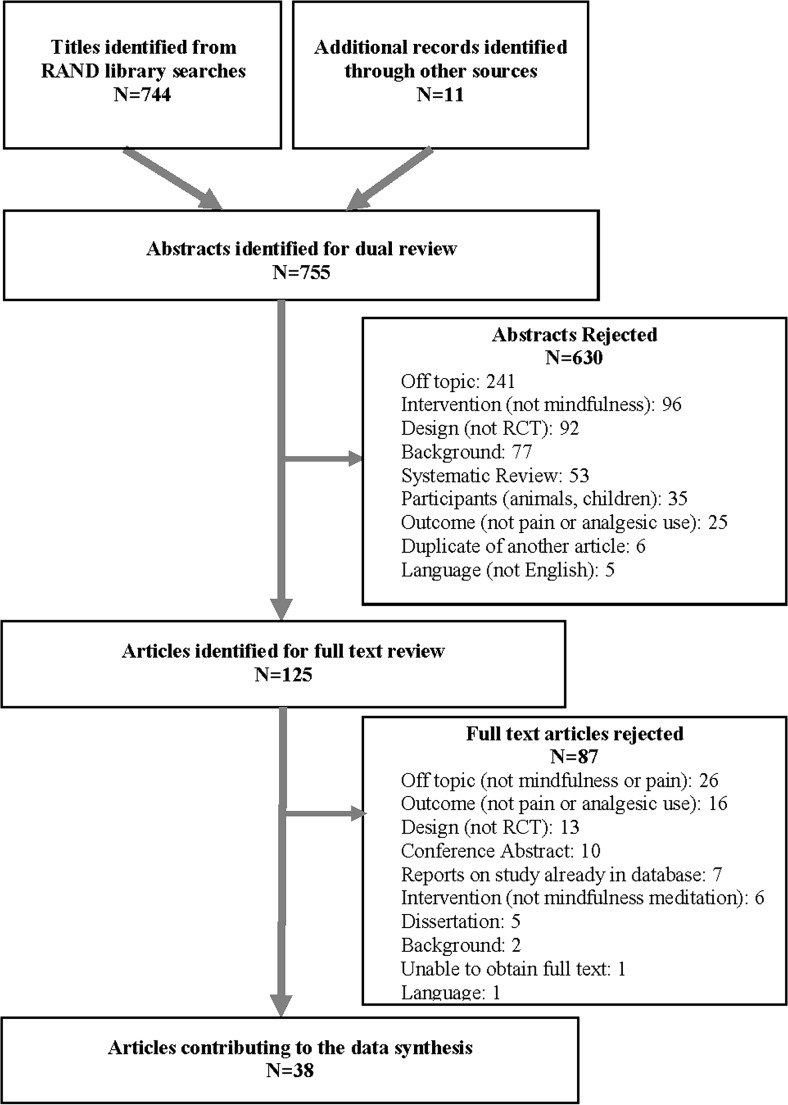
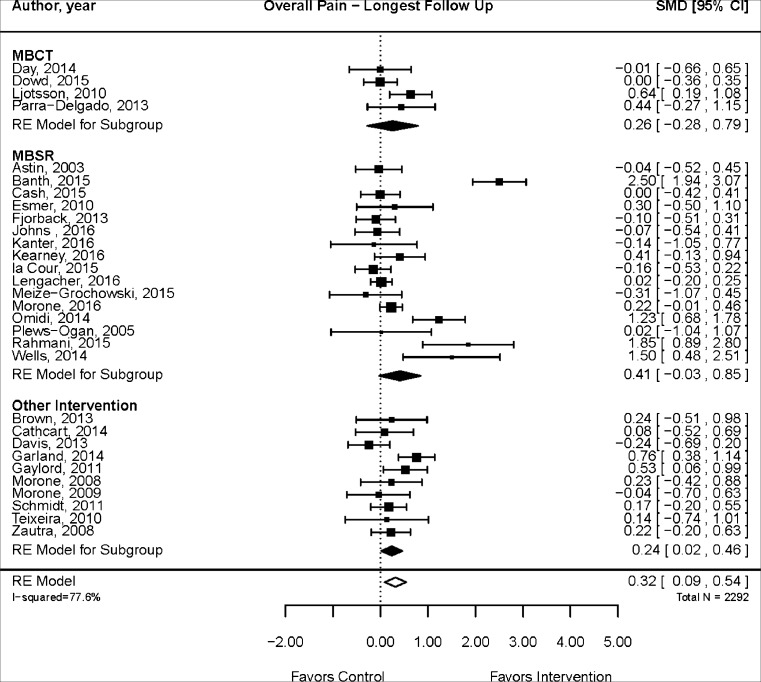
BACKGROUND: Chronic pain patients increasingly seek treatment through mindfulness meditation. PURPOSE: This study aims to synthesize evidence on efficacy and safety of mindfulness meditation interventions for the treatment of chronic pain in adults. METHOD: We conducted a systematic review on randomized controlled trials (RCTs) with meta-analyses using the Hartung-Knapp-Sidik-Jonkman method for random-effects models. Quality of evidence was assessed using the GRADE approach. Outcomes included pain, depression, quality of life, and analgesic use. RESULTS: Thirty-eight RCTs met inclusion criteria; seven reported on safety. We found low-quality evidence that mindfulness meditation is associated with a small decrease in pain compared with all types of controls in 30 RCTs. Statistically significant effects were also found for depression symptoms and quality of life. CONCLUSIONS: While mindfulness meditation improves pain and depression symptoms and quality of life, additional well-designed, rigorous, and large-scale RCTs are needed to decisively provide estimates of the efficacy of mindfulness meditation for chronic pain.
Overview
The claims and statistics of this paper haven’t been checked yet.
Free: it reads the open-access text and checks the first 5 claims that cite a source we can check. Create a free account to check every claim.
Integrity signals
Registry
Cites
Statistics
Figures
Verification
Claims the paper makes
The claims and statistics of this paper haven’t been checked yet.
Free: it reads the open-access text and checks the first 5 claims that cite a source we can check. Create a free account to check every claim.
Claims other papers make about this one
Each is checked against this paper’s own text: does it say what the citing paper says it does?
The source backs part of the claim, not all of it — or backs it for a different population, condition or comparison.
In the citing paper
“MBIs have been shown to alleviate physical and psychological symptoms in many medical conditions including cancer, cardiovascular disease, and chronic pain, as well as psychiatric illnesses (notably, anxiety, and depressive disorders) (Bawa et al., 2015; Evans et al., 2008; Hilton et al., 2017; Lin et al., 2022; Marino et al., 2021; Piet & Hougaard, 2011).”
From Online Mindfulness-Based Cognitive Therapy for People with Parkinson’s Disease and Their Caregivers: a Pilot Study (2022) · cites this paper as Hilton et al., 2017
Experimental — accuracy not yet measuredThe source backs part of the claim, not all of it — or backs it for a different population, condition or comparison.
In the citing paper
“research demonstrating that MM can lead to reductions in pain intensity,[16] pain interference,[15, 29] and pain-related affect,[30, 31]”
From The chronic pain skills study: Protocol for a randomized controlled trial comparing hypnosis, mindfulness meditation and pain education in Veterans (2020) · cites this paper as [16]
Experimental — accuracy not yet measuredThe source backs part of the claim, not all of it — or backs it for a different population, condition or comparison.
In the citing paper
“Evidence indicates that mindfulness-based interventions (MBIs) may be effective for patients with chronic pain, reducing perceived pain and decreasing harmful psychological features often associated with chronic pain, such as depression and pain catastrophizing.1,7,19,24,37”
From Randomized, wait-list–controlled pilot study of app-delivered mindfulness for patients reporting chronic pain (2021) · cites this paper as [19]
Experimental — accuracy not yet measuredThe source backs part of the claim, not all of it — or backs it for a different population, condition or comparison.
In the citing paper
“Although mindfulness can be an effective approach to the self-management of chronic pain, most research to date has been conducted on either brief inductions of mindfulness14,28,49 or on more time-intensive and resource-intensive group-based interventions.7,19”
From Randomized, wait-list–controlled pilot study of app-delivered mindfulness for patients reporting chronic pain (2021) · cites this paper as [19]
Experimental — accuracy not yet measuredThe source backs part of the claim, not all of it — or backs it for a different population, condition or comparison.
In the citing paper
“Mindfulness-based interventions (MBIs) have been found to be effective in reducing stress, anxiety, and depression, as well as improving overall quality of life in individuals with chronic illnesses (Gotink et al. 2015;Hilton et al. 2017;Niazi and Niazi 2011).”
From Lessons from Master Hongyi’s Experiences with Impermanence for Death Education (2024) · cites this paper as Hilton et al. 2017
Experimental — accuracy not yet measured
21 more claims about this paper
Create a free account to see every claim other papers make about this one.
Self-check
Percentages, sums and reported differences re-computed from the paper’s own numbers.
The self-check needs the paper’s full text.
Citations
Cites
Bias in meta-analysis detected by a simple, graphical test
Egger, M., Smith, G. D., Schneider, M., & Minder, C. (1997) · BMJ · doi:10.1136/bmj.315.7109.629 · Cited by 56,722 · cited 1×
“The quality of the body of evidence was assessed using the GRADE approach [22, 26] by which a determination of high, moderate, low, or very low was made for each major outcome [27].”
MethodGRADE guidelines: 3. Rating the quality of evidence
Balshem, H., Helfand, M., Schünemann, H. J., Oxman, A. D., Kunz, R., Brozek, J., Vist, G. E., Falck-Ytter, Y., Meerpohl, J., & Norris, S. (2011) · Journal of Clinical Epidemiology · doi:10.1016/j.jclinepi.2010.07.015 · Cited by 8,285 · cited 1×
“The quality of the body of evidence was assessed using the GRADE approach [22, 26] by which a determination of high, moderate, low, or very low was made for each major outcome [27].”
MethodMeditation Programs for Psychological Stress and Well-being: A Systematic Review and Meta-analysis
Goyal, M., Singh, S., Sibinga, E. M. S., Gould, N. F., Rowland-Seymour, A., Sharma, R., Berger, Z., Sleicher, D., Maron, D. D., Shihab, H. M., et al. (2014) · JAMA Internal Medicine · doi:10.1001/jamainternmed.2013.13018 · Cited by 2,380
The clinical use of mindfulness meditation for the self-regulation of chronic pain
Kabat-Zinn, J., Lipworth, L., & Burney, R. (1985) · Journal of Behavioral Medicine · doi:10.1007/bf00845519 · Cited by 1,745 · cited 2×
“Early mindfulness studies in pain patients showed promising outcomes on pain symptoms, mood disturbance, anxiety, and depression, as well as pain-related drug utilization [5].”
BackgroundChou, R., Turner, J. A., Devine, E. B., Hansen, R. N., Sullivan, S. D., Blazina, I., Dana, T., Bougatsos, C., & Deyo, R. A. (2015) · Annals of Internal Medicine · doi:10.7326/m14-2559 · Cited by 1,606 · cited 1×
“Systematic review Introduction Chronic pain, often defined as pain lasting longer than 3 months or past the normal time for tissue healing [1], can lead to significant medical, social, and economic consequences, relationship issues, lost productivity, and larger health care costs.”
BackgroundFjorback, L. O., Arendt, M., Ørnbøl, E., Fink, P., & Walach, H. (2011) · Acta Psychiatrica Scandinavica · doi:10.1111/j.1600-0447.2011.01704.x · Cited by 803
A refined method for the meta-analysis of controlled clinical trials with binary outcome
Hartung, J., & Knapp, G. (2001) · Statistics in Medicine · doi:10.1002/sim.1009 · Cited by 775
Cherkin, D. C., Sherman, K. J., Balderson, B. H., Cook, A. J., Anderson, M. L., Hawkes, R. J., Hansen, K. E., & Turner, J. A. (2016) · JAMA · doi:10.1001/jama.2016.2323 · Cited by 729 · cited 3×
“Likewise, a trial of MBSR for back pain [38] found no significant difference between groups in self-reported use of pain medication.”
BackgroundMedical Journal of the Islamic Republic of Iran
(2020) · Medical Journal of the Islamic Republic of Iran · doi:10.14196/mjiri · Cited by 620
Morone, N. E., Greco, C. M., & Weiner, D. K. (2008) · Pain · doi:10.1016/j.pain.2007.04.038 · Cited by 546
Cited by
Items 701–800 of 976
Psychological Interventions for Persistent Orofacial Pain
Barker, S., Urbanek, M., & Penlington, C. (2022) · BDJ clinician's guides · doi:10.1007/978-3-030-86634-1_5 · Cited by 1
Use of Mind Body Complementary Therapies (MBCT) among Thalassemia Patients
Ismail, W. I., Farooqui, M., Latif, R. A., & Ali, R. S. (2022) · Environment-Behaviour Proceedings Journal · doi:10.21834/ebpj.v7i20.3521 · Cited by 1
“The previous study showed mindful meditation impacted physical and psychological symptoms and syndromes, including reduced anxiety, pain, depression, enhanced mood, self-esteem, and decreased stress (Hilton et al, 2017).”
Background李, 桃. (2022) · Advances in Clinical Medicine · doi:10.12677/acm.2022.126844 · Cited by 1
Fonia, D., & Aisenberg-Shafran, D. (2022) · Journal of Clinical Psychology in Medical Settings · doi:10.1007/s10880-022-09911-7 · Cited by 2
Graded Chronic Pain Scale (GCPS)
Nabors, L., Toledano‐Toledano, F., & Workman, B. (2022) · Springer eBooks · doi:10.1007/978-3-030-77644-2_65-1 · Cited by 1
Shahkhaseh, M. S., Hassani, J., & Shakeri, M. T. (2023) · The Journal Of Psychological Science · doi:10.52547/jps.21.120.2519 · Cited by 1
Feasibility of Mindfulness for Burn Survivors and Parents of Children with Burns
Papamikrouli, E., Kool, M. B., van Schie, C. H. M., & Loey, N. E. E. V. (2023) · European Burn Journal · doi:10.3390/ebj4020020 · Cited by 1
“The efficacy of MBSR has also been investigated in a variety of clinical populations suffering from chronic conditions and diseases, for example, chronic pain [23] and cancer [24].”
BackgroundValidation of the Brazilian Version of the Langer Mindfulness Scale
Fernandes, M. N. D. F., Ciol, M. A., Júnior, E. B. C., Zanetti, A. C. G., & Gherardi‐Donato, E. C. D. S. (2023) · Journal of Nursing Measurement · doi:10.1891/jnm-2021-0096 · Cited by 2
Koenig, H. G., VanderWeele, T. J., & Peteet, J. R. (2023) · Oxford University Press eBooks · doi:10.1093/oso/9780190088859.003.0027 · Cited by 1
Koenig, H. G., VanderWeele, T. J., & Peteet, J. R. (2023) · Oxford University Press eBooks · doi:10.1093/oso/9780190088859.003.0008 · Cited by 2
Public Health and Human Flourishing
Koenig, H. G., VanderWeele, T. J., & Peteet, J. R. (2023) · Oxford University Press eBooks · doi:10.1093/oso/9780190088859.003.0032 · Cited by 1
Understanding the Religion–Physical Health Relationship
Koenig, H. G., VanderWeele, T. J., & Peteet, J. R. (2023) · Oxford University Press eBooks · doi:10.1093/oso/9780190088859.003.0031 · Cited by 1
Koenig, H. G., VanderWeele, T. J., & Peteet, J. R. (2023) · Oxford University Press eBooks · doi:10.1093/oso/9780190088859.003.0017 · Cited by 1
Koenig, H. G., VanderWeele, T. J., & Peteet, J. R. (2023) · Oxford University Press eBooks · doi:10.1093/oso/9780190088859.003.0006 · Cited by 1
Epidemiology of Non-Oncological High-Impact Chronic Pain in Ecuadorian Adults in 2022
Martineau, D. B., Fornasini, M., Suárez, D., Paz, M., Valarezo, C., Loor, E., Guerrero, M., & Baldeon, M. E. (2023) · Pain Management · doi:10.2217/pmt-2023-0055 · Cited by 1
Définir la guérison et l’autoguérison
Laurence, D., & Malpel, S. (2024) · HEGEL - HEpato-GastroEntérologie Libérale · doi:10.3917/heg.134.0311 · Cited by 1
Vikhe, C. S., & Ramteke, S. U. (2024) · F1000Research · doi:10.12688/f1000research.151306.1 · Cited by 2
“24 The rationale for exploring mindfulness training in PFPS is further supported by its potential to improve proprioceptive awareness and motor control 25 which are critical in mitigating symptoms and preventing injury recurrence in individuals with PFPS.”
Revisiting The Contemplative Life in The Contemporary Era
Simarmata, P. S., Pinem, M. L., & Pinem, F. L. (2024) · Jurnal Filsafat Indonesia · doi:10.23887/jfi.v7i1.67079 · Cited by 4
“For example, Hilton et al. (2017) found through conducting a meta-analysis that mindfulness meditation interventions demonstrated efficacy in reducing symptoms of anxiety and depression in patients with anxiety and depression.”
BackgroundYalfani, A., & Asgarpoor, A. (2024) · مجله علمی دانشگاه علوم پزشکی رفسنجان · doi:10.61186/jrums.23.6.552 · Cited by 1
Separating the Mechanisms of Mindfulness Meditation and Placebo
Rodrigues, B., & Colloca, L. (2024) · Biological Psychiatry · doi:10.1016/j.biopsych.2024.10.011 · Cited by 1
Herbert, M. S., Tynan, M. E., Higdon, A., Backhaus, A., Chu, G. M., & Afari, N. (2025) · Journal of Contextual Behavioral Science · doi:10.1016/j.jcbs.2025.100885 · Cited by 2
Bhambhani, Y., Gallo, L., McNamara, E. O., Stotts, A. L., & Gabbay, V. (2025) · Journal of Contextual Behavioral Science · doi:10.1016/j.jcbs.2025.100888 · Cited by 2
Zhu, Y., Zhang, H., Liu, B., & Dou, J. (2025) · Applied Mathematics and Nonlinear Sciences · doi:10.2478/amns-2025-0157 · Cited by 1
Young, S. D., Kim, J. P., & Hanley, A. W. (2025) · Cureus · doi:10.7759/cureus.80485 · Cited by 3
Adamowicz, J. L., Sirotiak, Z., Thomas, E. B. K., Lund, B. C., Hadlandsmyth, K., & Driscoll, M. (2025) · European Journal of Integrative Medicine · doi:10.1016/j.eujim.2025.102443 · Cited by 1
Petrie, D. J., Knapp, K. S., Freet, C. S., Deneke, E., Stankoski, D. M., Brick, T. R., Cleveland, H. H., & Bunce, S. C. (2025) · Substance Use & Misuse · doi:10.1080/10826084.2025.2478590 · Cited by 1
“Mindfulness interventions have also been used to reduce pain (Garland & Howard, 2013; Hilton et al., 2017; Kabat-Zinn, 1982) by decreasing reactivity to aversive mental experiences and reframing pain sensations as merely sensory signals (Garland et al., 2012).”
Patterson, S. L., Ruvalcaba, D., Issa, A., Rai, K., Katz, P., & Koenig, C. J. (2025) · The Journal of Rheumatology · doi:10.3899/jrheum.2024-1218 · Cited by 1
The Essence of Mindfulness: A Detailed Primer
Salvi, D. K., Shah, R., & Tripathi, R. (2025) · Springer eBooks · doi:10.1007/978-981-96-4210-6_17 · Cited by 1
Biopsychosocial Rehabilitation Approaches for Older Adults
Jones, C., Kishino, N. D., & Gatchel, R. J. (2018) · Handbooks in health, work, and disability · doi:10.1007/978-3-030-03916-5_3 · Cited by 2
Mindfulness: del optimismo de lo nuevo a la moderación de la ciencia
Aires, U. D. B., Korman, G. P., Garay, C. J., & Aires, U. D. B. (2019) · Revista Mexicana de Investigación en Psicología · doi:10.32870/rmip.v10i2.602 · Cited by 2
“Esta postura del autor se sustenta en su propia experiencia y en los hallazgos de otros investigadores (Hilton et al., 2016; Kabat-Zinn, 1982; Lengacher et al., 2007; Moscoso, Reheiser, & Hann, 2004; Segal, Williams, & Teasdale, 2002; Teasdale, Segal, Williams, Ridgeway, Soulsby, & Lau, 2000;…”
BackgroundThe moral significance of empathy
Jefferson, W. (2019) · Oxford University Research Archive (ORA) (University of Oxford) · doi:10.5287/ora-ko874w7bv · Cited by 4
Anderson-Ross, K. (2019) · Journal of Restorative Medicine · doi:10.14200/jrm.2019.0116 · Cited by 1
“This cultivation of moment-to-moment awareness of thoughts and feelings as neutral mental events, rather than as reality or truths about the self, has been shown to change negative thought patterns and reduce reactivity in both healthy and clinical populations.(14,15) It has been suggested that this process can initia…”
BackgroundRéflexions sur la pleine conscience et l’autocompassion pour le traitement des addictions
von Hammerstein, C., & Romo, L. (2019) · Psychotropes · doi:10.3917/psyt.252.0031 · Cited by 3
Psychological and Cardiovascular Effects of Meditation and Yoga
Bigliassi, M. (2020) · Springer eBooks · doi:10.1007/978-3-030-28008-6_57 · Cited by 1
Srikaew, N., Kietinun, S., Sriyakul, K., Tungsukruthai, P., & Pawa, K. K. (2021) · Advances in Integrative Medicine · doi:10.1016/j.aimed.2021.07.006 · Cited by 2
Spiritual Knowledge and Practices to Conquer Chronic Pain: A Systematic Review
Salgaonkar, S. V., Shetty, Y. C., & Singh, V. (2021) · Indian Journal of Pain · doi:10.4103/ijpn.ijpn_114_20 · Cited by 3
Gonçalves, D. B. (2021) · Brazilian Journal of Health Review · doi:10.34119/bjhrv4n6-040 · Cited by 1
Neurobiology of Mindfulness-Based Interventions
Desormeau, P. A., & Farb, N. A. S. (2021) · Springer eBooks · doi:10.1007/978-3-030-81245-4_10 · Cited by 3
Musculoskeletal Medicine in Hemophilia (Including Pain Control)
la Corte‐Rodríguez, H. D., Liddle, A. D., & Rodriguez-Merchan, E. C. (2022) · Springer eBooks · doi:10.1007/978-3-030-93990-8_12 · Cited by 1
Dhawan, A., Patil, V., Gupta, S., & Chugh, G. (2021) · Springer eBooks · doi:10.1007/978-3-030-57296-9_108 · Cited by 2
Intervenciones basadas en mindfulness para el manejo de pacientes con dolor
Schuler, G. S. R., & Badoui, N. (2021) · Universitas Médica · doi:10.11144/javeriana.umed62-4.mind · Cited by 3
Intégrer la méditation en éducation thérapeutique du patient : Enquête et réflexions
Brozzetti, A., Tribonnière, X. D. L., & Corbeau, C. (2023) · Education thérapeutique du patient - Therapeutic patient education · doi:10.1051/tpe/2023010 · Cited by 2
Reflections on hybrid transdiagnostic treatment, pain reduction, and emotion regulation
Lumley, M. A. (2019) · Pain · doi:10.1097/j.pain.0000000000001576 · Cited by 1
“On the one hand, substantial pain reduction is rarely seen in trials of CBT, acceptance, and mindfulness interventions.(6,11,18) Indeed, many pain scholars and clinicians believe pain reduction is neither a reasonable nor feasible goal, and treatments should aim for improved functioning and mood.”
BackgroundYang, S., Xu, Z., Zhou, T., Yang, X., Hui, Y., Zhou, H., & Fang, Z. (2022) · Research Square · doi:10.21203/rs.3.rs-1266126/v1 · Cited by 1
Koenig, H. G., VanderWeele, T. J., & Peteet, J. R. (2023) · Oxford University Press eBooks · doi:10.1093/oso/9780190088859.002.0003 · Cited by 1
Daniels, H., Osborne, T., McBride, A., Hughes, O., Joseph‐Williams, N., Edwards, A., Akbari, A., Bailey, R., & Owen, R. K. (2025) · medRxiv · doi:10.1101/2025.06.28.25330404 · Cited by 2
Budwany, R., Yadav, A., Arias-Garau, J., & George, T. K. (2025) · How to Treat Low Back Pain · doi:10.1016/b978-0-443-15962-6.00008-4
Principe, E., Pirrotta, M., Fava, N., Marchio, C., Catalano, L. M., Iannacchero, R., & Bosco, D. (2025) · Confinia Cephalalgica · doi:10.4081/cc.2025.15788
“(24) Furthermore, studies specifically focusing on headache populations, such as Wells et al. (2014), have highlighted MBSR’s ability to reduce headache frequency and improve coping strategies, which likely contribute to better quality of life and reduced psychological comorbidities.”
Vugts, M. A. P., Joosen, M. C. W., Mert, A., Zedlitz, A. M. E. E., & Vrijhoef, H. J. (2018) · Journal of Medical Internet Research · doi:10.2196/jmir.9739 · Cited by 14
“The current state of evidence provides little support as to identify those circumstances in which patients with CP or FSS will likely have best experiences and outcomes from which (computer-based) biopsychosocial or alternative treatments and why [10,18,66,67].”
Meditation: A Strategy With Promise in Chronic Disease
Perazzo, J. D. (2017) · The Journal of Cardiovascular Nursing · doi:10.1097/jcn.0000000000000434
The role of prayer in race differences in pain sensitivity
Meints, S. M. (2017) · Purdue e-Pubs (Purdue University System) · doi:10.7912/c29q1v
Bénéfices de la méditation de pleine conscience
Antunes, T. L. P. (2018) · Soins Aides-Soignantes · doi:10.1016/j.sasoi.2018.03.004
Howard, A. P. (2018) · Scholarship at UWindsor (University of Windsor) · Cited by 1
Stabolidis, A. (2018) · Minerva Access (University of Melbourne)
Spinal fusioniert – Rehabilitation nach lumbaler Fusions-OP
Thalhamer, C. (2019) · physiopraxis · doi:10.1055/a-0732-7042
Should We Meditate While We Wait?
Robins, J. L. W. (2019) · Journal of Women s Health · doi:10.1089/jwh.2018.7576
Small fiber neuropathy: from underlying conditions to treatment
Greef, D. T. T. (2019) · Research Publications (Maastricht University) · doi:10.26481/dis.20190315bg
Evidencia empírica de las intervenciones basadas en Mindfulness en patología somática.
Ibáñez, Á., & León-Quismondo, L. (2019) · Revista de Investigación y Educación en Ciencias de la Salud (RIECS) · doi:10.37536/riecs.2019.4.s1.120
“Una revisión más reciente [3], que incluye 37 ensayos controlados aleatorizados, muestra un efecto significativo de los programas de mindfulness sobre la mejoría de los síntomas depresivos y la calidad de vida, y un efecto menor sobre la reducción del dolor en 30 estudios, si bien en este caso la evidencia disponible…”
BackgroundWyckoff, A. (2019) · doi:10.15760/honors.791
“It may be worth mentioning that the Hilton et al. (2016) meta-analysis neglected to mention the analgesic effects meditation was found to have in the Zgierska et al. (2016) study, and mentioned only the data on morphine equivalence, which was found to be insignificant between the control group and…”
BackgroundComplementary and Integrative Health in Chronic Pain and Palliative Care
Davis, D. L., Grossman, L., Kutner, J. S., Navarro-Leahy, A., & Smith, M. C. (2018) · Springer eBooks · doi:10.1007/978-3-319-95369-4_33
Mindfulness Training and Smoking Cessation
Ok, J., Lee, E. S., & Paek, Y. (2019) · Journal of the Korean Society for Research on Nicotine and Tobacco · doi:10.25055/jksrnt.2019.10.1.13
“(5-7) 본 장에서는 마음챙김 기법을 소개하고 현재 금연과 관련된 마음챙김 기법에 대한 연구와 앞으로의 과제를 제시 하고자 한다.”
Photobiomodulation therapy and the brain: an innovative tool for therapy and discovery
Arany, P. R. (2019) · Elsevier eBooks · doi:10.1016/b978-0-12-815305-5.00001-4
Miniszewska, J. (2019) · Wydawnictwo Uniwersytetu Łódzkiego eBooks · doi:10.18778/8142-277-2 · Cited by 2
Saracutu, M. M. (2019) · Cronfa (Swansea University) · doi:10.23889/suthesis.54524
Can Mindfulness foster well-being and performance at work? A compendium of intervention studies
Coo, C. (2020) · Tesis Doctorals en Xarxa (Consorci de Serveis Universitaris de Catalunya) · doi:10.6035/14109.2020.593997 · Cited by 3
Centralized Pain: Status Review and Medical Management
Shanti, I. F., Shanti, B. F., Otom, A. H., Rjoub, A. A., & Al-Abbadi, K. (2020) · Acta Scientific Neurology · doi:10.31080/asne.2020.03.0205
Clinicians Applying Yoga Principles and Practices in Pain Care: An Evidence-Informed Approach
Prosko, S., & Taylor, M. J. (2020) · Advances in medical diagnosis, treatment, and care (AMDTC) book series · doi:10.4018/978-1-7998-3254-6.ch013
Harper, C. M. (2019) · UA Campus Repository (The University of Arizona)
The Potential Health Benefits of Meditation
Allen, C. (2020) · ACSMʼs Health & Fitness Journal · doi:10.1249/fit.0000000000000624 · Cited by 1
“Meditation and Chronic Pain In a review article and meta-analysis examining mindfulness meditation for chronic pain, researchers reported evidence in 30 of 38 randomly controlled trials that mindfulness meditation was associated with a small decrease in pain (10).”
BackgroundStructural and functional brain changes after a 40-days short-term mindfulness meditation training
Yang, C.-C. (2020) · Digitalen Hochschulbibliothek Sachsen-Anhalt (Universitäts- und Landesbibliothek Sachsen-Anhalt) · doi:10.25673/35073
Satô, A., Itagaki, S., Matsumoto, T., Ise, Y., Yokokura, S., Wada, T., Hayashi, K., Kakamu, T., Fukushima, T., Nikaido, T., et al. (2021) · Research Square · doi:10.21203/rs.3.rs-150296/v2
Complementary and Alternative Medicine
Ali, R., Ciccone, J., & Dalal, P. J. (2019) · Springer eBooks · doi:10.1007/978-3-030-18005-8_26
Hackett, K. L., & Cartner, H. (2021) · Oxford University Press eBooks · doi:10.1093/med/9780198806684.003.0023
Senior WISE intervention: Gender differences in bodily pain and trait anxiety
McDougall, G. J., Pituch, K. A., Martorella, G., & Monroe, T. B. (2021) · Archives of Psychiatric Nursing · doi:10.1016/j.apnu.2021.05.001
Nieuwe interventie voor paren met chronische pijn en relatieproblemen: een pilotstudie
Tankha, H., Caño, A., Corley, A., Dillaway, H. E., Lumley, M. A., & Clark, S. (2021) · Gezinstherapie Wereldwijd · doi:10.1007/s12440-021-00154-w
“…de pijn, vermoeidheid en symptomen van depressie verminderen en de algehele kwaliteit van leven verhogen, maar tot nu toe zijn deze interventies individueel, en worden de partners er dus niet direct bij betrokken (Hilton et al. 2017; Kabat-Zinn 1982; Wicksell et al. 2010; Zautra et al. 2008).”
BackgroundKey Mental Health Approaches and Interventions With Young People Experiencing Homelessness
Vitopoulos, N. A., Kielburger, L. C., & Kidd, S. A. (2021) · Elsevier eBooks · doi:10.1016/b978-0-12-818697-8.00175-8
Factors affecting health - related quality of life of HIV - infected key population in Myanmar
Naing, T. H., Thavorncharoensap, M., Riewpaiboon, A., Oo, H. N., & Aung, M. S. (2021) · AIDS Care · doi:10.1080/09540121.2021.2001417
“reduction, pain reduction, and improving quality of life (Goyal et al., 2014; Hilton et al., 2017).”
BackgroundTitle: Novel Analgesic Potential of ß2-Agonists for Neuropathic Pain via ß2-Agonist Action
Tran, J. P., & Horine, S. V. (2022) · Current Pain and Headache Reports · doi:10.1007/s11916-022-01006-0
Pasqualucci, P. L., Seifert, G., Filho, V. O., & dos Santos, A. C. (2022) · Research Square · doi:10.21203/rs.3.rs-1466033/v1
Kang, H., An, S. C., Kim, B., Song, Y.-J., Yoo, J.-S., Koh, E., Lee, S., & Yang, H. (2022) · Evidence-based Complementary and Alternative Medicine · doi:10.1155/2022/6149052 · Cited by 2
“In a recent meta-analysis of 30 RCTs, meditation was related with a small decrease of pain compared to different types of controls [9].”
BackgroundAssiri, K. I., Hosmani, J., & Alqarni, A. (2022) · World Journal of Dentistry · doi:10.5005/jp-journals-10015-2046 · Cited by 1
Psikodramanın Üniversite Öğrencilerinin Bilinçli Farkındalık Düzeyine Etkisi
Bakalım, O. (2022) · Nesne Psikoloji Dergisi · doi:10.7816/nesne-10-23-05
Nia, M. S., Asgari, P., khorrami, N. S., Naderi, F., & Safarzadeh, S. (2021) · International journal of basic science in medicine · doi:10.34172/ijbsm.2021.26
Rosa, N. I., Sousa, A. L. R. S., de Souza, D. G., & Weel, I. C. (2022) · Editora Inovar eBooks · doi:10.36926/editorainovar-978-65-5388-026-9
Satô, A., Itagaki, S., Matsumoto, T., Ise, Y., Yokokura, S., Wada, T., Hayashi, K., Kakamu, T., Fukushima, T., Nikaido, T., et al. (2021) · Research Square · doi:10.21203/rs.3.rs-150296/v1
PMP : techniques adjuvantes, traitements non médicamenteux
Morel-Fatio, M., & Leroy, B. (2019) · Elsevier eBooks · doi:10.1016/b978-2-294-76083-9.00009-8
Mindfulness and its Application for Older Adults with Chronically Painful Osteoarthritis
Marks, R. (2022) · International Journal of Geriatrics and Gerontology · doi:10.29011/2577-0748.100031
“Empirical evidence of mindfulness as an intervention for people suffering specifically with chronic pain such as that occurring in osteoarthritis is indeed generally supportive of this line of intervention, despite a lack any large scale well-controlled studies with diverse as well as adequate samples [13,16].”
BackgroundNOVEL FINDINGS ON CARDIORESPIRATORY ROLE SWAPPING BY ASSESSING NONLINEAR DYNAMICAL INTERACTIONS
Lo, P.-C. (2022) · Biomedical Engineering Applications Basis and Communications · doi:10.4015/s1016237222500399
Gaylord, S. A., Kadro, Z. O., & Toche, J. (2022) · Cambridge University Press eBooks · doi:10.1017/9781108942751.056
An Exploration of the Effects of Mindfulness on Pain: The Role of Pain Catastrophizing
Haliwa, I. (2022) · The Research Repository @ WVU (West Virginia University) · doi:10.33915/etd.11302
Meditation: Altes Wissen in neuem Kontext
Uhrig, S. (2022) · Springer eBooks · doi:10.1007/978-3-658-37411-2_14
عمارة, إ. ع. ا. م. (2022) · المجلة التربوية لکلية التربية بسوهاج · doi:10.21608/edusohag.2022.270079
Gonçalves, A. S., Monteleone, F., Couto, M. B., Machado, M. E., & Pereira, M. E. (2022) · Revista Dor · doi:10.24875/dor.22000003
Primjenjivost tehnike mindfulnessa u obrazovnom kontekstu
Prijatelj, K., Bagarić, E. S., & Kukulj, I. (2022) · Nastavnička revija · doi:10.52444/nr.3.2.1 · Cited by 1
Determinants of Meditation Practice Inventory (DMPI)
Williams, A.-L. (2022) · Springer eBooks · doi:10.1007/978-3-030-77644-2_68-1 · Cited by 1
A INTELIGÊNCIA ARTIFICIAL E SUAS IMPLICAÇÕES NO CAMPO DA GENÉTICA
Neto, B. R. D. S. (2023) · doi:10.22533/at.ed.7932305011
OBESIDADE MONOGÊNICA NÃO SINDRÔMICA: DOS GENES À TERAPIA
Salum, K. C. R., Kohlrausch, F. B., & da Fonseca, A. C. P. (2023) · doi:10.22533/at.ed.7932305014
Metadata
- Authors
- Hilton, L., Hempel, S., Ewing, B. A., Apaydin, E., Xenakis, L., Newberry, S., Colaiaco, B., Maher, A. R., Shanman, R. M., Sorbero, M. E., & Maglione, M. A.
- Affiliations
- RAND Corporation (US)
- Corresponding author
- Hilton, Lara
- ORCID
- Venue
- Annals of Behavioral Medicine
- Publisher
- Oxford University Press (OUP)
- Published
- 2016-09-22
- Volume
- 51
- Issue
- 2
- Pages
- 199-213
- ISSN
- 0742-5554 (ISSN-L)
- 0883-6612
- 1532-4796
- PMC
- PMC5368208
- OpenAlex
- W2521208344
- Semantic Scholar
- c2a7b6ba6b4cb1795860f4f990a38fb8128dd178
- Cited by
- 977
- References
- 68
- Citations by year
- 2026: 60 · 2025: 118 · 2024: 122 · 2023: 156 · 2022: 121 · 2021: 130 · 2020: 113 · 2019: 75 · 2018: 69 · 2017: 12 · 2016: 1
- FWCI
- 7.76
- Type
- journal article
- Language
- en
- Open access
- hybrid
- doi.org
- Locations
- Annals of Behavioral Medicine (publishedVersion, cc-by)
- Europe PMC (PubMed Central) (publishedVersion, cc-by)
- PubMed Central (publishedVersion, cc-by)
- PubMed (publishedVersion)
- Funders
- Defense Centers of Excellence for Psychological Health and Traumatic Brain Injury (14-539.2)
- Topics
- Social Sciences › Psychology › Clinical Psychology › Mindfulness and Compassion Interventions
- Health Sciences › Health Professions › Physical Therapy, Sports Therapy and Rehabilitation › Musculoskeletal pain and rehabilitation
- Life Sciences › Neuroscience › Cognitive Neuroscience › Pain Management and Placebo Effect
- Keywords
- mindfulness meditation, chronic pain, analgesia, depressive symptoms, quality of life, analgesic use, treatment safety, non-pharmacological pain management
- MeSH terms
- Humans, Quality of Life, Treatment Outcome, Meditation, Chronic Pain, Pain Management, Mindfulness
About these checks
Registry, retraction, Cites and statistics results are computed, not judged, with one exception: a printed reference that no index lists is read once by a model before it counts as a citation error. Claims are extracted by a model and kept only when their quote appears verbatim in the text; each cited source is then checked, with a model’s help, for whether it says what the claim relies on. Those verdicts can be wrong — read the claim’s quote and the cited source before relying on one.
Statistics and arithmetic are recomputed, not judged.
Confidence bands are shown only for fields calibrated on our annotated test set. None is calibrated yet, so no band is shown.
What counts as a claim ›How we measure confidence ›How we check this ›
Are you an author, or do you see a problem with this page? Request a review
Data sources
Bibliographic data: Semantic Scholar, OpenAlex, Crossref.
Contains information from the Semantic Scholar Academic Graph Datasets, made available under the ODC Attribution License (ODC-BY 1.0).
Semantic Scholar’s data is described in: Kinney, R., et al. (2023). The Semantic Scholar Open Data Platform. arXiv:2301.10140.
