

Smart tourism: foundations and developments
Open accessThe DOI matches its Crossref record; 79 of the 81 references it cites were found in a registry or an index; 3 of the 66 sources its claims cite were checked for support.
Abstract
Abstract Smart tourism is a new buzzword applied to describe the increasing reliance of tourism destinations, their industries and their tourists on emerging forms of ICT that allow for massive amounts of data to be transformed into value propositions. However, it remains ill-defined as a concept, which hinders its theoretical development. The paper defines smart tourism, sheds light on current smart tourism trends, and then lays out its technological and business foundations. This is followed by a brief discussion on the prospects and drawbacks of smart tourism. The paper further draws attention to the great need for research to inform smart tourism development and management.
Overview
CoChat Summary
## TL;DR
This paper defines smart tourism and argues it is more than e-tourism or isolated tech projects: it is a destination-level system that uses integrated ICT and big data to create on-site experiences and business value. It also says the concept is under-theorized, heavily influenced by smart city ideas, and in need of much more critical research.
## Key findings
- Smart tourism is defined as “tourism supported by integrated efforts at a destination to collect and aggregate/harness data” from physical infrastructure, social connections, government/organizational sources, and human bodies/minds, using advanced technologies to transform that data into “on-site experiences and business value-propositions” with a focus on efficiency, sustainability, and experience enrichment.
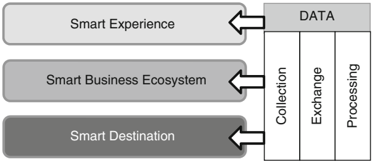
- The paper identifies three basic components of smart tourism: smart destinations, smart business ecosystems, and smart experiences; it also says smart tourism spans three layers: a smart information layer, smart exchange layer, and smart processing layer.
- The paper contrasts smart tourism with e-tourism: smart tourism bridges the digital and physical spheres, relies on sensors & smartphones rather than websites, focuses on the during-trip phase rather than pre- and post-travel, uses big data as its lifeblood, and is organized as an ecosystem rather than a value chain/intermediary structure.
- It notes that smart tourism research is still limited and mostly case-study based, with a strong consumer focus and an overly optimistic, uncritical stance; the paper itself proposes a research agenda and says existing smart tourism initiatives are mostly in development and often government-subsidized.
## Methods
- Conceptual/theoretical paper: it provides definitional clarification and an overview of the foundations of smart tourism rather than reporting an empirical dataset.
- It synthesizes prior literature on ICT, smart cities, service ecosystems, business models, and tourism technology to build its framework and definitions.
- It uses a conceptual comparison with e-tourism and organizes the discussion around technological foundations, business foundations, and research implications.
## Limitations
- The paper itself states that research in smart tourism is “very limited,” mostly case studies, and largely focused on the consumer perspective with an optimistic, uncritical stance.
- It explicitly says the proposed research agenda is “far from being comprehensive.”
- Evident from the text: the paper is conceptual and does not present original empirical data or tests, so its claims are theoretical rather than evidence from a study sample.
Model-written summary. Check it against the paper before relying on it.
Integrity signals
Registry
Cites
Statistics
Figures
Verification
Claims the paper makes
2 Valid · 17 Not valid · 47 Not checked · 59 Own results and interpretations
The cited sources support only part of this claim — read each source’s verdict below.
In the paper
“It has been identified as an important foundation for the services to be provided by smart tourism cities (Guo et al. 2014;Perera et al. 2014).”
§ Smart tourism: foundations and developments > Technological foundations of smart tourism
What the sources say
- Supportedcites Guo et al. 2014
The Introduction calls IoT technology the “core carrier” of the smart tourism information system. The Conclusion also identifies a tourism IoT information platform as critical to smart tourism development in China, supporting the claim that IoT is an important foundation for its services. (LLM, conf=0.93)
- Partly supportedcites Perera et al. 2014 matched to “Sensing as a service model for smart cities supported by Internet of Things” (2014) sourceExperimental — accuracy not yet measured
Section 3 (p. 2) describes an IoT-based sensing-as-a-service model as infrastructure for addressing smart-city challenges. The paper supports the general link between IoT and smart-city services, but the cited passages do not address tourism cities or their services specifically. (LLM, conf=0.85)
plainstates a cause- Asserted: passes — The authors put it forward as true.
- Checkable: passes — It can be checked against evidence.
- Load-bearing: unclear — It is unclear whether the paper’s conclusions depend on it.
- Based: passes — The paper gives a reason why it holds.
- Supported
A result the paper states — it cites no source for it, so there is none to check. The quote shows it is in the paper.
In the paper
“It also revealed a lack of critical literature that scrutinizes smart tourism assumptions and questioned its feasibility and positive experiential, economic and societal impacts.”
§ Smart tourism: foundations and developments > Conclusion
plain- Asserted: passes — The authors put it forward as true.
- Checkable: passes — It can be checked against evidence.
- Load-bearing: passes — The paper’s conclusions depend on it.
- Based: passes — The paper gives a reason why it holds.
In the paper
“Governments in China and South Korea are heavily funding initiatives mostly focused on building the technological infrastructure that supports smart tourism (Hwang et al. 2015).”
§ Smart tourism: foundations and developments > Abstract
What the sources say
- Not checked — no full text of the sourcecites Hwang et al. 2015 matched to “Constructivism in Smart Tourism Research : Seoul Destination Image” (2015) source
plain- Asserted: passes — The authors put it forward as true.
- Checkable: passes — It can be checked against evidence.
- Load-bearing: unclear — It is unclear whether the paper’s conclusions depend on it.
- Based: passes — The paper gives a reason why it holds.
A claim is checked only against the cited paper’s full text, never its abstract, and none is available for its sources.
In the paper
“Academic work is largely focused on describing the phenomenon in the form of case studies (e.g., Boes et al. 2015a, b;Bakıcı et al. 2013;Wang et al. 2013) or on discussing isolated technological developments (e.g., Huang and Chen 2015;Boes et al. 2015a, b) rather than on laying the theoretical foundations for its advancement and/or critique.”
§ Smart tourism: foundations and developments > Abstract
What the sources say
- Not checked — no full text of the sourcecites Boes et al. 2015a, b matched to “The Acceptance of NFC Smart Posters in Tourism” (2015) source
- Not checked — no full text of the sourcecites Bakıcı et al. 2013 matched to “A Smart City Initiative: the Case of Barcelona” (2013) source
- Not checked — no full text of the sourcecites Wang et al. 2013 matched to “China's “smart tourism destination” initiative: A taste of the service-dominant logic” (2013) source
plain- Asserted: passes — The authors put it forward as true.
- Checkable: passes — It can be checked against evidence.
- Load-bearing: passes — The paper’s conclusions depend on it.
- Based: passes — The paper gives a reason why it holds.
In the paper
“Remaining largely a vision at this stage, the Internet of Things has the potential to rapidly become a new reality as a technological infrastructure (Atzori et al. 2010).”
§ Smart tourism: foundations and developments > Technological foundations of smart tourism
What the sources say
- Not checked — no full text of the sourcecites Atzori et al. 2010 matched to “The Internet of Things: A survey” (2010) source
hedged- Asserted: passes — The authors put it forward as true.
- Checkable: passes — It can be checked against evidence.
- Load-bearing: unclear — It is unclear whether the paper’s conclusions depend on it.
- Based: passes — The paper gives a reason why it holds.
21 more claims
Create a free account to see all 125 claims and to verify the 3 references still open.
- It may state two separate claims as one. 46
- Probably not a substantial claim. 81
Citations
Cites
The Internet of Things: A survey
Atzori, L., Iera, A., & Morabito, G. (2010) · Computer Networks · doi:10.1016/j.comnet.2010.05.010 · Cited by 15,613
Business models, business strategy and innovation
Teece, D. J. (2010) · Long Range Planning · doi:10.1016/j.lrp.2009.07.003 · Cited by 8,335
Service-dominant logic: continuing the evolution
Vargo, S. L., & Lusch, R. F. (2008) · Journal of the Academy of Marketing Science · doi:10.1007/s11747-007-0069-6 · Cited by 7,824 · cited 1×
“In this vein, labels and roles assigned to players like travelers, firms and intermediaries are not valid anymore (Vargo and Lusch 2008).”
BackgroundBuhalis, D., & Law, R. (2008) · Tourism Management · doi:10.1016/j.tourman.2008.01.005 · Cited by 5,903 · cited 2×
“tion and of tourism consumers (Buhalis and Law 2008; Wang et al. 2012).”
BackgroundInternet of things: Vision, applications and research challenges
Miorandi, D., Sicari, S., De Pellegrini, F., & Chlamtac, I. (2012) · Ad Hoc Networks · doi:10.1016/j.adhoc.2012.02.016 · Cited by 3,578 · cited 1×
“Content and services will all be around us, persistently available, creating conditions for new applications and enabling new ways of working, interacting, entertainment, and living (Miorandi et al. 2012).”
BackgroundOn value and value co-creation: A service systems and service logic perspective
Vargo, S. L., Maglio, P. P., & Akaka, M. A. (2008) · European Management Journal · doi:10.1016/j.emj.2008.04.003 · Cited by 3,152 · cited 1×
“Vargo et al. (2008) and Spohrer et al. (2007) described a service ecosystem as a spontaneously sensing and responding spatial and temporal structure of largely loosely-coupled value-proposing social and economic actors interacting through institutions and technology, to: (1) co-produce service…”
BackgroundDahlander, L., & Gann, D. M. (2010) · Research Policy · doi:10.1016/j.respol.2010.01.013 · Cited by 2,435 · cited 1×
“Open innovation is based on the assumption that an organisation cannot just rely on its own resources, but has to engage with partners in order to innovate (Dahlander and Gann 2010; West and Gallagher 2006).”
BackgroundMacKenzie, D., & Millo, Y. (2003) · American Journal of Sociology · doi:10.1086/374404 · Cited by 1,464 · cited 1×
“By introducing new business models, firms develop new markets (Callon and Muniesa 2005; MacKenzie and Millo 2003; Pollock and Williams 2009; Inversini and Masiero 2014; Storbacka and Nenonen 2011).”
BackgroundPeripheral Vision: Economic Markets as Calculative Collective Devices
Callon, M., & Muniesa, F. (2005) · Organization Studies · doi:10.1177/0170840605056393 · Cited by 1,378 · cited 1×
“By introducing new business models, firms develop new markets (Callon and Muniesa 2005; MacKenzie and Millo 2003; Pollock and Williams 2009; Inversini and Masiero 2014; Storbacka and Nenonen 2011).”
Foundations for Smarter Cities
Harrison, C., Eckman, B., Hamilton, R., Hartswick, P., Kalagnanam, J., Paraszczak, J., & Williams, P. (2010) · IBM Journal of Research and Development · doi:10.1147/jrd.2010.2048257 · Cited by 1,347 · cited 1×
“Harrison et al. (2010) conceptualize smart as exploiting operational, near-real-time real-world data, integrating and sharing data, and using complex analytics, modelling, optimization and visualization to make better operational decisions.”
Background
Research works printed but not linked: 4
- 3. Anuar, F. I. & Gretzel, U. (2011). Privacy Concerns in the Context of Location Based Services for Tourism. ENTER 2011 Conference, Innsbruck, Austria, January 26-28, 2011. Accessed online (March 1, 2015) at http://ertr.tamu.edu/enter-2011-short-papers/.
- 16. Lopez de Avila, A. (2015). Smart Destinations: XXI Century Tourism. Presented at the ENTER2015 Conference on Information and Communication Technologies in Tourism, Lugano, Switzerland, February 4-6, 2015.
- 58. Tu, Q. & Liu, A. (2014). Framework of Smart Tourism Research and Related Progress in China. In International Conference on Management and Engineering (CME 2014), pp. 140-146.
- 77. In R. Egger, I. Gula, & D. Walcher (Eds.), Open Tourism - Open Innovation, Crowdsourcing and Collaborative Consumption challenging the tourism industry. Heidelberg: Springer Verlag.
Cited by
Items 401–500 of 2,494
Smart services: The move to customer orientation
Alt, R., Demirkan, H., Ehmke, J. F., Moen, A., & Winter, A. (2019) · Electronic Markets · doi:10.1007/s12525-019-00338-x · Cited by 30
Treiblmaier, H. (2020) · Springer eBooks · doi:10.1007/978-3-030-05324-6_28-1 · Cited by 53
Liu, C.-H. S., Jiang, J.-F., & Gan, B. K. (2021) · Asia Pacific Journal of Tourism Research · doi:10.1080/10941665.2021.1908384 · Cited by 40
Nematpour, M., Khodadadi, M., Makian, S., & Ghaffari, M. (2022) · International Journal of Hospitality & Tourism Administration · doi:10.1080/15256480.2022.2081279 · Cited by 45
Smart tourism destination: A bibliometric review
Ercan, F. (2023) · European Journal of Tourism Research · doi:10.54055/ejtr.v34i.2788 · Cited by 58
Open innovation in the tourism field: A systematic literature review
Cardoso, R. C., Sohn, A. P. L., Ferasso, M., & Júnior, S. P. (2024) · Journal of Open Innovation Technology Market and Complexity · doi:10.1016/j.joitmc.2024.100359 · Cited by 40
AI-powered smart tourism 2.0: A 10-year retrospective and updated model
Koo, C., Shin, S., Gretzel, U., & Xiang, Z. (2025) · Electronic Markets · doi:10.1007/s12525-025-00847-y · Cited by 70
Self-citationPark, S., & Kim, D.-Y. (2017) · Technological Forecasting and Social Change · doi:10.1016/j.techfore.2017.03.031 · Cited by 31
Bolici, F., Acciarini, C., Marchegiani, L., & Pirolo, L. (2020) · The TQM Journal · doi:10.1108/tqm-01-2020-0016 · Cited by 47
Suanpang, P., Jamjuntr, P., Jermsittiparsert, K., & Kaewyong, P. (2022) · Energies · doi:10.3390/en15051906 · Cited by 32
Smart Tourism Destinations: un estudio basado en lavisión de los stakeholders
Santos-Júnior, A., Filho, L. M., Almeida‐García, F., & Simões, J. M. (2017) · Revista Turismo em Análise · doi:10.11606/issn.1984-4867.v28i3p358-379 · Cited by 56
The Digital Transformation of Tourism. Case Study of Greek Tourism
Bakalis, A., Halkiopoulos, C., & Antonopoulou, H. (2024) · Springer proceedings in business and economics · doi:10.1007/978-3-031-54338-8_9 · Cited by 28
Tran, H. M., Huertas, A., & Moreno, A. (2017) · Universidad de Alicante eBooks · doi:10.14198/destinos-turisticos-inteligentes.2017.09 · Cited by 43
The antecedents of hashtag and geotag use in smart tourism: case study in Indonesia
Krisna, D. F., Handayani, P. W., & Azzahro, F. (2019) · Asia Pacific Journal of Tourism Research · doi:10.1080/10941665.2019.1665559 · Cited by 19
Protecting privacy in tourism – a perspective article
Hall, C. M., & Ram, Y. (2019) · Tourism Review · doi:10.1108/tr-09-2019-0398 · Cited by 34
Mobile Apps in Tourism Communication: The Strengths and Weaknesses on Tourism Trips
Rashid, R. A., Ismail, R. B., Ahmad, M., et al. (2020) · Journal of Physics Conference Series · doi:10.1088/1742-6596/1529/4/042056 · Cited by 28
Smart Technologies for Smart Tourism Development
Gajdošík, T., & Orelová, A. (2020) · Advances in intelligent systems and computing · doi:10.1007/978-3-030-51971-1_27 · Cited by 36
Web Scraping: Collecting and Retrieving Data from the Web
Egger, R., Kroner, M., & Stöckl, A. (2022) · Tourism on the verge · doi:10.1007/978-3-030-88389-8_5 · Cited by 35
Chang, S. (2022) · Journal of Hospitality and Tourism Technology · doi:10.1108/jhtt-07-2020-0182 · Cited by 39
Marchesani, F. (2022) · Current Issues in Tourism · doi:10.1080/13683500.2022.2153652 · Cited by 33
Human centered digital transformation in travel: a horizon 2050 paper
Inversini, A. (2024) · Tourism Review · doi:10.1108/tr-12-2023-0886 · Cited by 39
Standardisation of enterprise architecture development for smart cities
Pourzolfaghar, Z., Bastidas, V., & Helfert, M. (2019) · Journal of the Knowledge Economy · doi:10.1007/s13132-019-00601-8 · Cited by 36
WITHDRAWN: Big data analytic of contexts and cascading tourism for smart city
Balasaraswathi, M., Srinivasan, K., Udayakumar, L., Sivasakthiselvan, S., & Sumithra, M. G. (2020) · Materials Today Proceedings · doi:10.1016/j.matpr.2020.10.132 · Cited by 33
RetractedTreiblmaier, H. (2022) · Springer eBooks · doi:10.1007/978-3-030-48652-5_28 · Cited by 35
Demystifying the nexus between social media usage and overtourism: evidence from Hangzhou, China
Song, Q., & Wondirad, A. N. (2023) · Asia Pacific Journal of Tourism Research · doi:10.1080/10941665.2023.2230313 · Cited by 46
Voyage Virtuoso: Artificial Intelligence in Transforming Tourism
Manoharan, G., Rao, C. V. G., Ashtikar, S. P., Kumar, S., & Nivedha, M. (2024) · Advances in hospitality, tourism and the services industry (AHTSI) book series · doi:10.4018/979-8-3693-1978-9.ch004 · Cited by 32
Analysing how AI-powered chatbots influence destination decisions
Orden-Mejía, M. A., Carvache‐Franco, M., Huertas, A., Carvache‐Franco, O., & Carvache‐Franco, W. (2025) · PLoS ONE · doi:10.1371/journal.pone.0319463 · Cited by 55
Jo, Y., & Shin, H. (2025) · Journal of Travel Research · doi:10.1177/00472875251332961 · Cited by 40
Ham, J., Koo, C., & Chung, N. (2019) · Current Issues in Tourism · doi:10.1080/13683500.2019.1566303 · Cited by 33
Self-citationGelenekselden Dijitale Turizm Sektörü
Atar, A. (2020) · Turk Turizm Arastirmalari Dergisi · doi:10.26677/tr1010.2020.417 · Cited by 27
Robles, C. F., & Galindo-Pérez-de-Azpillaga, L. (2021) · Technology in Society · doi:10.1016/j.techsoc.2020.101459 · Cited by 32
Smart tourism destinations: an overview of current research trends and a future research agenda
Gürsoy, D., Luongo, S., Corte, V. D., & Sepe, F. (2024) · Journal of Hospitality and Tourism Technology · doi:10.1108/jhtt-10-2023-0339 · Cited by 50
Promoting historical irrigation canals as natural and cultural heritage in mass-tourism destinations
Ricart, S., Palom, A. R., Gamero, D. P., Gabarda-Mallorquí, A., & Roset, D. (2019) · Journal of Cultural Heritage Management and Sustainable Development · doi:10.1108/jchmsd-12-2017-0089 · Cited by 30
Marchesani, F., Masciarelli, F., & Ceci, F. (2023) · Cities · doi:10.1016/j.cities.2023.104749 · Cited by 36
Lee, S., Wu, Q., & Hyun, S. S. (2024) · Journal of Hospitality Marketing & Management · doi:10.1080/19368623.2024.2358888 · Cited by 32
Boulaalam, O., Aghoutane, B., Ouadghiri, D. E., Moumen, A., & Malinine, M. L. C. (2018) · Procedia Computer Science · doi:10.1016/j.procs.2018.07.200 · Cited by 34
Yalçinkaya, P., Atay, L., & Karakaş, E. (2018) · Gastroia Journal of Gastronomy And Travel Research · doi:10.32958/gastoria.433831 · Cited by 47
New Technologies in Smart Tourism Development: The #iziTRAVELSicilia Experience
Giaccone, S. C., & Bonacini, E. (2019) · Tourism Analysis · doi:10.3727/108354219x15511864843867 · Cited by 30
Communication Factors Affecting Tourist Adoption of Social Network Sites
Ho, C. B., & Gebsombut, N. (2019) · Sustainability · doi:10.3390/su11154198 · Cited by 37
The concept of smartness in cyber–physical systems and connection to urban environment
Kalluri, B., Chronopoulos, C., & KOZINE, I. O. (2020) · Annual Reviews in Control · doi:10.1016/j.arcontrol.2020.10.009 · Cited by 29
The Human Digitalisation Journey: Technology First at the Expense of Humans?
Hassani, H., Huang, X., & Silva, E. S. (2021) · Information · doi:10.3390/info12070267 · Cited by 45
Balasubramanian, K., Kunasekaran, P., Konar, R., & Sakkthivel, A. M. (2022) · Palgrave studies of marketing in emerging economies · doi:10.1007/978-3-030-95581-6_3 · Cited by 46
Developing a model for smart tourism destinations: an interpretive structural modelling approach
Shafiee, S., Ghatari, A. R., Hasanzadeh, A., & Jahanyan, S. (2022) · Information Technology & Tourism · doi:10.1007/s40558-022-00236-7 · Cited by 35
Smart Tourism Experience Design in Amusement Parks: A Quality Function Deployment (QFD) Application
Tsang, N. K. F., & Au, W. C. W. (2023) · Journal of Hospitality & Tourism Research · doi:10.1177/10963480231171304 · Cited by 33
AlmaWhere: A prototype of accessible indoor wayfinding and navigation system
Delnevo, G., Monti, L., Vignola, F., Salomoni, P., & Mirri, S. (2018) · IEEE Consumer Communications and Networking Conference · doi:10.1109/ccnc.2018.8319242 · Cited by 26
Quel smart retailing en magasin pour quelle expérience omnicanal vécue ?
Bèzes, C. (2018) · Recherche et Applications en Marketing (French Edition) · doi:10.1177/0767370118795420 · Cited by 34
The Development of Mobile Tourism in the Upper Silesian Metropolitan Area of Poland
Naramski, M., & Herman, K. (2019) · Sustainability · doi:10.3390/su12010044 · Cited by 27
E-Tourism Research, Cultural Understanding, and Netnography
Kozinets, R. V. (2020) · Springer eBooks · doi:10.1007/978-3-030-05324-6_43-1 · Cited by 49
Lee, H., & Hlee, S. (2021) · Sustainability · doi:10.3390/su13074031 · Cited by 34
Social, Ethical, and Moral Issues in Smart Tourism Development in Destinations
Pan, B., Lin, M. S., Liang, Y., Akyildiz, A., & Park, S. Y. (2021) · Journal of Smart Tourism · doi:10.52255/smarttourism.2021.1.1.3 · Cited by 36
Towards an Ecosystem of Hospitality: The Dynamic Future of Destinations
Philipp, J., Thees, H., Olbrich, N., & Pechlaner, H. (2022) · Sustainability · doi:10.3390/su14020821 · Cited by 44
Acceleration of Environmental Sustainability in Tourism Village
Lemy, D. M., Pramono, R., & Juliana, J. (2022) · International Journal of Sustainable Development and Planning · doi:10.18280/ijsdp.170425 · Cited by 39
Arif, Y. M., Putra, D. D., Wardani, D., Nugroho, S. M. S., & Hariadi, M. (2023) · Heliyon · doi:10.1016/j.heliyon.2023.e14267 · Cited by 34
Afren, S. (2024) · World Journal of Advanced Research and Reviews · doi:10.30574/wjarr.2024.21.1.2668 · Cited by 74
Gomes, E. L., Gândara, J. M. G., & Baidal, J. A. I. (2017) · Revista Brasileira de Pesquisa em Turismo · doi:10.7784/rbtur.v11i3.1318 · Cited by 54
Towards a Conceptual Model of Intelligent Information System for Smart Tourism Destinations
Gajdošík, T. (2018) · Advances in intelligent systems and computing · doi:10.1007/978-3-319-91186-1_8 · Cited by 32
Bernabéu, M. A. C., Mazón, J.-N., & Sánchez, D. G. (2018) · Investigaciones Turísticas · doi:10.14198/inturi2018.15.03 · Cited by 56
Novotny, M., Dodds, R., & Walsh, P. R. (2023) · International Journal of Tourism Research · doi:10.1002/jtr.2605 · Cited by 31
Engaging passengers across digital channels: An international study of 100 airports
Straker, K., & Wrigley, C. (2018) · Journal of Hospitality and Tourism Management · doi:10.1016/j.jhtm.2018.01.001 · Cited by 24
Suggesting a Framework for Performance Evaluation of Tourist Attractions: A Balance Score Approach
Wang, Y., Shen, S., Sotiriadis, M. D., & Zhang, L. (2020) · Sustainability · doi:10.3390/su12156220 · Cited by 31
Google Popular Times: towards a better understanding of tourist customer patronage behavior
Möhring, M., Keller, B., Schmidt, R., & Dacko, S. G. (2020) · Tourism Review · doi:10.1108/tr-10-2018-0152 · Cited by 35
Security, Privacy and Ethical Concerns of IoT Implementations in Hospitality Domain
Mercan, S., Akkaya, K., Cain, L., & Thomas, J. (2020) · IEEE International Conference on Internet of Things (iThings) and IEEE Green Computing and Communications (GreenCom) and IEEE Cyber, Physical and Social Computing (CPSCom) and IEEE Smart Data (SmartData) · doi:10.1109/ithings-greencom-cpscom-smartdata-cybermatics50389.2020.00048 · Cited by 39
Koliopoulos, T., Kouloumbis, P., Ciarkowska, K., Antonkiewicz, J., & Gambuś, F. (2020) · Smart innovation, systems and technologies · doi:10.1007/978-981-33-4256-9_10 · Cited by 34
Opportunities and challenges of Blockchain-Oriented systems in the tourism industry
Caddeo, F., & Pinna, A. (2021) · doi:10.1109/wetseb52558.2021.00009 · Cited by 24
An investigation of developing smart tourism from the perspective of stakeholders
Ye, H., Sun, S., & Law, R. (2021) · Asia Pacific Journal of Tourism Research · doi:10.1080/10941665.2021.1953086 · Cited by 33
Sustacha, I., Baños-Pino, J. F., & Tuero, E. A. D. V. (2022) · Cuadernos de Gestión · doi:10.5295/cdg.211501is · Cited by 34
Artifical Intelligence (AI) Technology in Smart Tourism
Başer, M. Y., & Olcay, A. (2022) · Gaziantep University Journal of Social Sciences · doi:10.21547/jss.1084783 · Cited by 34
Impact of Deep Learning Models for Technology Sustainability in Tourism Using Big Data Analytics
Kumar, A., & Vohra, R. (2023) · Advanced technologies and societal change · doi:10.1007/978-981-19-5723-9_6 · Cited by 29
Does privacy still matter in smart technology experience? A conditional mediation analysis
Chang, J. Y., Konar, R., Cheah, J., & Lim, X. (2023) · Journal of Marketing Analytics · doi:10.1057/s41270-023-00240-8 · Cited by 33
Vecchio, P. D., Secundo, G., & Passıante, G. (2018) · Kybernetes · doi:10.1108/k-07-2017-0273 · Cited by 35
BLE-Based Indoor Tracking System with Overlapping-Resistant IoT Solution for Tourism Applications
Belka, R., Deniziak, S. R., Łukawski, G., & Pięta, P. (2021) · Sensors · doi:10.3390/s21020329 · Cited by 27
Amoako, G. K., Obuobisa‐Darko, T., Dartey‐Baah, K., & Sedalo, G. (2023) · International Journal of Tourism Cities · doi:10.1108/ijtc-12-2021-0238 · Cited by 24
Mobile Application Design for Heritage Tourism Uses Gamification Approach in Indonesia
Widarti, E., Suyoto, S., & Emanuel, A. W. R. (2020) · International Journal of Engineering Pedagogy (iJEP) · doi:10.3991/ijep.v10i5.13205 · Cited by 37
Applied Data Science in Tourism: Interdisciplinary Approaches, Methodologies, and Applications
Egger, R. (2021) · Zeitschrift für Tourismuswissenschaft · doi:10.1515/tw-2021-0018 · Cited by 23
Bermejo, A. M., & Gallego-Galán, I. (2022) · Journal of Sustainable Tourism · doi:10.1080/09669582.2021.2024551 · Cited by 35
An Architecture for Service Integration to Fully Support Novel Personalized Smart Tourism Offerings
Sabbioni, A., Villano, T., & Antonio Corradi, A. (2022) · Sensors · doi:10.3390/s22041619 · Cited by 28
Technology Application in the Chinese Tourism Industry
Musa, M. A., Rahman, P., Kang, Z., & Hossain, S. F. A. (2022) · Springer eBooks · doi:10.1007/978-981-16-5461-9_13 · Cited by 26
Technology in Tourism Marketing
Uğurlu, K. (2022) · Springer eBooks · doi:10.1007/978-981-16-2210-6_4 · Cited by 25
Accessibility and smart tourism: tourism for all and reducing inequalities: a tourism agenda 2030
Arbidāne, I., Puzule, A., Znotiņa, D., et al. (2023) · Worldwide Hospitality and Tourism Themes · doi:10.1108/whatt-06-2023-0078 · Cited by 23
Halkiopoulos, C., Igoumenakis, G., & Theodoropoulou, A. (2024) · Springer proceedings in business and economics · doi:10.1007/978-3-031-54338-8_18 · Cited by 25
Dimensions of Smart Tourism and Its Levels: An Integrative Literature Review
Otowicz, M. H., Macedo, M., & Biz, A. A. (2022) · Journal of Smart Tourism · doi:10.52255/smarttourism.2022.2.1.2 · Cited by 44
Veréb, V. N., & Azevedo, A. (2019) · Journal of Hospitality and Tourism Management · doi:10.1016/j.jhtm.2019.10.003 · Cited by 30
Križaj, D., Bratec, M., Kopić, P., & Rogelja, T. (2021) · Sustainability · doi:10.3390/su131810279 · Cited by 32
Residents’ Perceptions of Sustainable Tourism Destination Recovery: The Case of Northern Cyprus
Seyedabolghasemi, M. A., Kılıç, H., Avcí, T., Eluwole, K. K., & Lasisi, T. T. (2022) · Land · doi:10.3390/land11010094 · Cited by 34
Magasic, M., & Gretzel, U. (2020) · Tourist Studies · doi:10.1177/1468797619899343 · Cited by 36
Self-citationTian, F., & Weng, G. (2024) · Journal of Cleaner Production · doi:10.1016/j.jclepro.2024.143672 · Cited by 31
Khoshroo, M., & Soltani, M. (2025) · European Journal of Innovation Management · doi:10.1108/ejim-11-2023-1018 · Cited by 37
Adding or destroying value? User experiences of tourism self-service technologies
Kelly, P., & Lawlor, J. (2019) · Journal of Hospitality and Tourism Insights · doi:10.1108/jhti-08-2018-0051 · Cited by 34
Gračan, D., Zadel, Z., & Pavlović, D. (2021) · Ekonomski pregled · doi:10.32910/ep.72.2.2 · Cited by 26
Plattfaut, R., & Koch, J. (2021) · Journal of Business Research · doi:10.1016/j.jbusres.2021.07.024 · Cited by 34
How to exploit Big Social Data in the Covid-19 pandemic: the case of the Italian tourism industry
Solazzo, G., Maruccia, Y., Ndou, V., & Vecchio, P. D. (2022) · Service Business · doi:10.1007/s11628-022-00487-8 · Cited by 24
Heritage protection and tourism income: the tourism heritage Kuznets curve
Barnes, S. J. (2022) · Tourism Review · doi:10.1108/tr-03-2022-0125 · Cited by 29
TOURISM 4.0: OPPORTUNITIES FOR APPLYING INDUSTRY 4.0 TECHNOLOGIES IN TOURISM
Abdurakhmanova, G. K., Astanakulov, O. T., Goyipnazarov, S. B., & Irmatova, A. B. (2022) · International Conference on Future Networks and Distributed Systems (ICFNDS) · doi:10.1145/3584202.3584208 · Cited by 35
Schoor, M., Arenas-Salazar, A. P., Torres‐Pacheco, I., Guevara-González, R. G., & Rico-García, E. (2023) · Sustainability · doi:10.3390/su15097638 · Cited by 34
Ammirato, S., Felicetti, A. M., Gala, M. D., Raso, C., & Cozza, M. (2018) · IFIP advances in information and communication technology · doi:10.1007/978-3-319-99127-6_54 · Cited by 29
The way of generation Y enjoying Jazz festival: a case of the Korea (Jarasum) music festival
Nguyen, T., Lee, K., Chung, N., & Koo, C. (2019) · Asia Pacific Journal of Tourism Research · doi:10.1080/10941665.2019.1580755 · Cited by 23
Self-citationSmart tourism destinations and sustainability: evidence from the tourism industry
Samancıoğlu, E., KUMLU, S. T., & Özkul, E. (2024) · Worldwide Hospitality and Tourism Themes · doi:10.1108/whatt-07-2024-0167 · Cited by 40
How smartness affects customer-based brand equity in rural tourism destinations
Sustacha, I., Baños-Pino, J. F., & Tuero, E. A. D. V. (2024) · Journal of Destination Marketing & Management · doi:10.1016/j.jdmm.2024.100949 · Cited by 38
Pérez-Aranda, J., Robles, E. M. G., & Urbistondo, P. A. (2019) · Information Technology & Tourism · doi:10.1007/s40558-019-00161-2 · Cited by 25
Examination of Individual Preferences for Green Hotels in Crete
Apostolakis, A., Jaffry, S., & Kourgiantakis, M. (2020) · Sustainability · doi:10.3390/su12208294 · Cited by 25
Metadata
- Authors
- Gretzel, U., Sigala, M., Xiang, Z., & Koo, C.
- Affiliations
- Virginia Tech (US)
- Kyung Hee University (KR)
- Corresponding author
- Koo, Chulmo
- Venue
- Electronic Markets
- Published
- 2015-08-01
- Volume
- 25
- Issue
- 3
- Pages
- 179-188
- ISSN
- 1019-6781 (ISSN-L)
- 1422-8890
- OpenAlex
- W974480840
- Cited by
- 2,589
- References
- 81
- Citations by year
- 2026: 532 · 2025: 364 · 2024: 307 · 2023: 255 · 2022: 283 · 2021: 239 · 2020: 232 · 2019: 163 · 2018: 93 · 2017: 82 · 2016: 36 · 2015: 2
- FWCI
- 234.92
- Type
- journal article
- Language
- en
- Open access
- hybrid
- doi.org
- Licence
- cc-by
- creativecommons.org/licenses/by/4.0/ (tdm)
- creativecommons.org/licenses/by/4.0/ (vor)
- Locations
- Electronic Markets (publishedVersion, cc-by)
- UniSA Research Outputs Repository (University of South Australia) (acceptedVersion)
- Adelaide Research & Scholarship (AR&S) (University of Adelaide) (submittedVersion, cc-by)
- Funders
- National Research Foundation
- National Research Foundation of Korea (NRF-2013S1A3A2043345)
- Topics
- Social Sciences › Business, Management and Accounting › Tourism, Leisure and Hospitality Management › Diverse Aspects of Tourism Research
- Social Sciences › Business, Management and Accounting › Management of Technology and Innovation › Digital Innovation in Industries
- Social Sciences › Business, Management and Accounting › Marketing › AI in Service Interactions
- Keywords
- smart tourism, information and communication technologies, tourism destinations, tourism industry, big data, value proposition, conceptual definitions, tourism management, technological foundations, business foundations
About these checks
Registry, retraction, Cites and statistics results are computed, not judged, with one exception: a printed reference that no index lists is read once by a model before it counts as a citation error. Claims are extracted by a model and kept only when their quote appears verbatim in the text; each cited source is then checked, with a model’s help, for whether it says what the claim relies on. Those verdicts can be wrong — read the claim’s quote and the cited source before relying on one.
The claim verdicts this report counts are experimental: their accuracy is not yet measured.
A language model drew the claims from the paper on 2026-10-10, under version 3 of the claim definition (model deepseek-v4.1-flash, prompt extract-v3).
A second model labelled each claim on 2026-10-10 (model jev-1.13-20260917, definition revision gold-guideline-v0.2).
Cited sources are checked with a language model’s help (gpt-6-sol).
Statistics and arithmetic are recomputed, not judged.
Confidence bands are shown only for fields calibrated on our annotated test set. None is calibrated yet, so no band is shown.
What counts as a claim ›How we measure confidence ›How we check this ›
Are you an author, or do you see a problem with this page? Request a review
Data sources
Bibliographic data: Semantic Scholar, OpenAlex, Crossref.
Contains information from the Semantic Scholar Academic Graph Datasets, made available under the ODC Attribution License (ODC-BY 1.0).
Semantic Scholar’s data is described in: Kinney, R., et al. (2023). The Semantic Scholar Open Data Platform. arXiv:2301.10140.
