

Smart tourism: foundations and developments
Open accessThe DOI matches its Crossref record; 79 of the 81 references it cites were found in a registry or an index; 3 of the 66 sources its claims cite were checked for support.
Abstract
Abstract Smart tourism is a new buzzword applied to describe the increasing reliance of tourism destinations, their industries and their tourists on emerging forms of ICT that allow for massive amounts of data to be transformed into value propositions. However, it remains ill-defined as a concept, which hinders its theoretical development. The paper defines smart tourism, sheds light on current smart tourism trends, and then lays out its technological and business foundations. This is followed by a brief discussion on the prospects and drawbacks of smart tourism. The paper further draws attention to the great need for research to inform smart tourism development and management.
Overview
CoChat Summary
## TL;DR
This paper defines smart tourism and argues it is more than e-tourism or isolated tech projects: it is a destination-level system that uses integrated ICT and big data to create on-site experiences and business value. It also says the concept is under-theorized, heavily influenced by smart city ideas, and in need of much more critical research.
## Key findings
- Smart tourism is defined as “tourism supported by integrated efforts at a destination to collect and aggregate/harness data” from physical infrastructure, social connections, government/organizational sources, and human bodies/minds, using advanced technologies to transform that data into “on-site experiences and business value-propositions” with a focus on efficiency, sustainability, and experience enrichment.
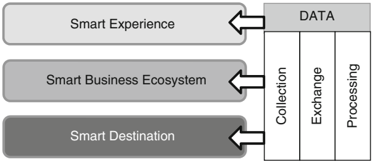
- The paper identifies three basic components of smart tourism: smart destinations, smart business ecosystems, and smart experiences; it also says smart tourism spans three layers: a smart information layer, smart exchange layer, and smart processing layer.
- The paper contrasts smart tourism with e-tourism: smart tourism bridges the digital and physical spheres, relies on sensors & smartphones rather than websites, focuses on the during-trip phase rather than pre- and post-travel, uses big data as its lifeblood, and is organized as an ecosystem rather than a value chain/intermediary structure.
- It notes that smart tourism research is still limited and mostly case-study based, with a strong consumer focus and an overly optimistic, uncritical stance; the paper itself proposes a research agenda and says existing smart tourism initiatives are mostly in development and often government-subsidized.
## Methods
- Conceptual/theoretical paper: it provides definitional clarification and an overview of the foundations of smart tourism rather than reporting an empirical dataset.
- It synthesizes prior literature on ICT, smart cities, service ecosystems, business models, and tourism technology to build its framework and definitions.
- It uses a conceptual comparison with e-tourism and organizes the discussion around technological foundations, business foundations, and research implications.
## Limitations
- The paper itself states that research in smart tourism is “very limited,” mostly case studies, and largely focused on the consumer perspective with an optimistic, uncritical stance.
- It explicitly says the proposed research agenda is “far from being comprehensive.”
- Evident from the text: the paper is conceptual and does not present original empirical data or tests, so its claims are theoretical rather than evidence from a study sample.
Model-written summary. Check it against the paper before relying on it.
Integrity signals
Registry
Cites
Statistics
Figures
Verification
Claims the paper makes
2 Valid · 17 Not valid · 47 Not checked · 59 Own results and interpretations
The cited sources support only part of this claim — read each source’s verdict below.
In the paper
“It has been identified as an important foundation for the services to be provided by smart tourism cities (Guo et al. 2014;Perera et al. 2014).”
§ Smart tourism: foundations and developments > Technological foundations of smart tourism
What the sources say
- Supportedcites Guo et al. 2014
The Introduction calls IoT technology the “core carrier” of the smart tourism information system. The Conclusion also identifies a tourism IoT information platform as critical to smart tourism development in China, supporting the claim that IoT is an important foundation for its services. (LLM, conf=0.93)
- Partly supportedcites Perera et al. 2014 matched to “Sensing as a service model for smart cities supported by Internet of Things” (2014) sourceExperimental — accuracy not yet measured
Section 3 (p. 2) describes an IoT-based sensing-as-a-service model as infrastructure for addressing smart-city challenges. The paper supports the general link between IoT and smart-city services, but the cited passages do not address tourism cities or their services specifically. (LLM, conf=0.85)
plainstates a cause- Asserted: passes — The authors put it forward as true.
- Checkable: passes — It can be checked against evidence.
- Load-bearing: unclear — It is unclear whether the paper’s conclusions depend on it.
- Based: passes — The paper gives a reason why it holds.
- Supported
A result the paper states — it cites no source for it, so there is none to check. The quote shows it is in the paper.
In the paper
“It also revealed a lack of critical literature that scrutinizes smart tourism assumptions and questioned its feasibility and positive experiential, economic and societal impacts.”
§ Smart tourism: foundations and developments > Conclusion
plain- Asserted: passes — The authors put it forward as true.
- Checkable: passes — It can be checked against evidence.
- Load-bearing: passes — The paper’s conclusions depend on it.
- Based: passes — The paper gives a reason why it holds.
In the paper
“Governments in China and South Korea are heavily funding initiatives mostly focused on building the technological infrastructure that supports smart tourism (Hwang et al. 2015).”
§ Smart tourism: foundations and developments > Abstract
What the sources say
- Not checked — no full text of the sourcecites Hwang et al. 2015 matched to “Constructivism in Smart Tourism Research : Seoul Destination Image” (2015) source
plain- Asserted: passes — The authors put it forward as true.
- Checkable: passes — It can be checked against evidence.
- Load-bearing: unclear — It is unclear whether the paper’s conclusions depend on it.
- Based: passes — The paper gives a reason why it holds.
A claim is checked only against the cited paper’s full text, never its abstract, and none is available for its sources.
In the paper
“Academic work is largely focused on describing the phenomenon in the form of case studies (e.g., Boes et al. 2015a, b;Bakıcı et al. 2013;Wang et al. 2013) or on discussing isolated technological developments (e.g., Huang and Chen 2015;Boes et al. 2015a, b) rather than on laying the theoretical foundations for its advancement and/or critique.”
§ Smart tourism: foundations and developments > Abstract
What the sources say
- Not checked — no full text of the sourcecites Boes et al. 2015a, b matched to “The Acceptance of NFC Smart Posters in Tourism” (2015) source
- Not checked — no full text of the sourcecites Bakıcı et al. 2013 matched to “A Smart City Initiative: the Case of Barcelona” (2013) source
- Not checked — no full text of the sourcecites Wang et al. 2013 matched to “China's “smart tourism destination” initiative: A taste of the service-dominant logic” (2013) source
plain- Asserted: passes — The authors put it forward as true.
- Checkable: passes — It can be checked against evidence.
- Load-bearing: passes — The paper’s conclusions depend on it.
- Based: passes — The paper gives a reason why it holds.
In the paper
“Remaining largely a vision at this stage, the Internet of Things has the potential to rapidly become a new reality as a technological infrastructure (Atzori et al. 2010).”
§ Smart tourism: foundations and developments > Technological foundations of smart tourism
What the sources say
- Not checked — no full text of the sourcecites Atzori et al. 2010 matched to “The Internet of Things: A survey” (2010) source
hedged- Asserted: passes — The authors put it forward as true.
- Checkable: passes — It can be checked against evidence.
- Load-bearing: unclear — It is unclear whether the paper’s conclusions depend on it.
- Based: passes — The paper gives a reason why it holds.
21 more claims
Create a free account to see all 125 claims and to verify the 3 references still open.
- It may state two separate claims as one. 46
- Probably not a substantial claim. 81
Citations
Cites
The Internet of Things: A survey
Atzori, L., Iera, A., & Morabito, G. (2010) · Computer Networks · doi:10.1016/j.comnet.2010.05.010 · Cited by 15,613
Business models, business strategy and innovation
Teece, D. J. (2010) · Long Range Planning · doi:10.1016/j.lrp.2009.07.003 · Cited by 8,335
Service-dominant logic: continuing the evolution
Vargo, S. L., & Lusch, R. F. (2008) · Journal of the Academy of Marketing Science · doi:10.1007/s11747-007-0069-6 · Cited by 7,824 · cited 1×
“In this vein, labels and roles assigned to players like travelers, firms and intermediaries are not valid anymore (Vargo and Lusch 2008).”
BackgroundBuhalis, D., & Law, R. (2008) · Tourism Management · doi:10.1016/j.tourman.2008.01.005 · Cited by 5,903 · cited 2×
“tion and of tourism consumers (Buhalis and Law 2008; Wang et al. 2012).”
BackgroundInternet of things: Vision, applications and research challenges
Miorandi, D., Sicari, S., De Pellegrini, F., & Chlamtac, I. (2012) · Ad Hoc Networks · doi:10.1016/j.adhoc.2012.02.016 · Cited by 3,578 · cited 1×
“Content and services will all be around us, persistently available, creating conditions for new applications and enabling new ways of working, interacting, entertainment, and living (Miorandi et al. 2012).”
BackgroundOn value and value co-creation: A service systems and service logic perspective
Vargo, S. L., Maglio, P. P., & Akaka, M. A. (2008) · European Management Journal · doi:10.1016/j.emj.2008.04.003 · Cited by 3,152 · cited 1×
“Vargo et al. (2008) and Spohrer et al. (2007) described a service ecosystem as a spontaneously sensing and responding spatial and temporal structure of largely loosely-coupled value-proposing social and economic actors interacting through institutions and technology, to: (1) co-produce service…”
BackgroundDahlander, L., & Gann, D. M. (2010) · Research Policy · doi:10.1016/j.respol.2010.01.013 · Cited by 2,435 · cited 1×
“Open innovation is based on the assumption that an organisation cannot just rely on its own resources, but has to engage with partners in order to innovate (Dahlander and Gann 2010; West and Gallagher 2006).”
BackgroundMacKenzie, D., & Millo, Y. (2003) · American Journal of Sociology · doi:10.1086/374404 · Cited by 1,464 · cited 1×
“By introducing new business models, firms develop new markets (Callon and Muniesa 2005; MacKenzie and Millo 2003; Pollock and Williams 2009; Inversini and Masiero 2014; Storbacka and Nenonen 2011).”
BackgroundPeripheral Vision: Economic Markets as Calculative Collective Devices
Callon, M., & Muniesa, F. (2005) · Organization Studies · doi:10.1177/0170840605056393 · Cited by 1,378 · cited 1×
“By introducing new business models, firms develop new markets (Callon and Muniesa 2005; MacKenzie and Millo 2003; Pollock and Williams 2009; Inversini and Masiero 2014; Storbacka and Nenonen 2011).”
Foundations for Smarter Cities
Harrison, C., Eckman, B., Hamilton, R., Hartswick, P., Kalagnanam, J., Paraszczak, J., & Williams, P. (2010) · IBM Journal of Research and Development · doi:10.1147/jrd.2010.2048257 · Cited by 1,347 · cited 1×
“Harrison et al. (2010) conceptualize smart as exploiting operational, near-real-time real-world data, integrating and sharing data, and using complex analytics, modelling, optimization and visualization to make better operational decisions.”
Background
Research works printed but not linked: 4
- 3. Anuar, F. I. & Gretzel, U. (2011). Privacy Concerns in the Context of Location Based Services for Tourism. ENTER 2011 Conference, Innsbruck, Austria, January 26-28, 2011. Accessed online (March 1, 2015) at http://ertr.tamu.edu/enter-2011-short-papers/.
- 16. Lopez de Avila, A. (2015). Smart Destinations: XXI Century Tourism. Presented at the ENTER2015 Conference on Information and Communication Technologies in Tourism, Lugano, Switzerland, February 4-6, 2015.
- 58. Tu, Q. & Liu, A. (2014). Framework of Smart Tourism Research and Related Progress in China. In International Conference on Management and Engineering (CME 2014), pp. 140-146.
- 77. In R. Egger, I. Gula, & D. Walcher (Eds.), Open Tourism - Open Innovation, Crowdsourcing and Collaborative Consumption challenging the tourism industry. Heidelberg: Springer Verlag.
Cited by
Items 201–300 of 2,494
Kumar, S., Kumar, V., Bhatt, I. K., Kumar, S., & Attri, K. (2023) · Journal of Hospitality and Tourism Insights · doi:10.1108/jhti-10-2022-0472 · Cited by 126
Tourism Destination Marketing: Academic Knowledge
Sotiriadis, M. D. (2020) · Encyclopedia · doi:10.3390/encyclopedia1010007 · Cited by 119
Innovation and smart destinations: Critical insights
Williams, A. M., Rodríguez, I., & Makkonen, T. (2020) · Annals of Tourism Research · doi:10.1016/j.annals.2020.102930 · Cited by 94
Reframing urban overtourism through the Smart-City Lens
Pasquinelli, C., & Trunfio, M. (2020) · Cities · doi:10.1016/j.cities.2020.102729 · Cited by 89
The emerging smart event experience: an interpretative phenomenological analysis
Bustard, J., Bolan, P., Devine, A., & Hutchinson, K. (2018) · Tourism Review · doi:10.1108/tr-10-2017-0156 · Cited by 92
Is smart scary? A mixed-methods study on privacy in smart tourism
Femenia-Serra, F., Ioannou, A., & Tussyadiah, I. P. (2021) · Current Issues in Tourism · doi:10.1080/13683500.2021.1987399 · Cited by 90
Web-Based Recommendation System for Smart Tourism: Multiagent Technology
Hassannia, R., Barenji, A. V., Li, Z., & Alipour, H. (2019) · Sustainability · doi:10.3390/su11020323 · Cited by 97
Applications, Experiences, and Challenges of Smart Tourism Development in China
Wang, X., Zhen, F., Tang, J., Shen, L., & Liu, D. (2021) · Journal of Urban Technology · doi:10.1080/10630732.2021.1879605 · Cited by 94
Molina, A., Gómez, M., Σιγάλα, Μ., Molina, M. V., García, E. A., & Martín, M. Y. S. (2022) · Information Technology & Tourism · doi:10.1007/s40558-022-00227-8 · Cited by 95
Smart tourism city governance: exploring the impact on stakeholder networks
Baidal, J. A. I., Casado‐Díaz, A. B., Navarro-Ruiz, S., & Fuster, M. (2023) · International Journal of Contemporary Hospitality Management · doi:10.1108/ijchm-03-2022-0322 · Cited by 104
Machine learning applied to tourism: A systematic review
Núñez, J. C. S., Gomez-Pulido, J. A., & Ramírez, R. R. (2024) · Wiley Interdisciplinary Reviews Data Mining and Knowledge Discovery · doi:10.1002/widm.1549 · Cited by 122
Strategies and measures directed towards overtourism: a perspective of European DMOs
Eckert, C., Zacher, D., Pechlaner, H., Namberger, P., & Schmude, J. (2019) · International Journal of Tourism Cities · doi:10.1108/ijtc-12-2018-0102 · Cited by 87
A review of audio guides in the era of smart tourism
Lee, S. (2016) · Information Systems Frontiers · doi:10.1007/s10796-016-9666-6 · Cited by 85
Sannino, G., Carlo, F. D., & Lucchese, M. (2020) · Management Decision · doi:10.1108/md-10-2019-1360 · Cited by 89
How does IT affect design centricity approaches: Evidence from Spain’s smart tourism ecosystem
Arenas, A. E., Goh, J. M., & Urueña, A. (2018) · International Journal of Information Management · doi:10.1016/j.ijinfomgt.2018.10.015 · Cited by 89
Circular economy business model for smart tourism: the case of Ecobnb
Vecchio, P. D., Malandugno, C., Passıante, G., & Sakka, G. (2021) · EuroMed Journal of Business · doi:10.1108/emjb-09-2020-0098 · Cited by 94
Promoting smart tourism personalised services via a combination of deep learning techniques
Kontogianni, A., Alepis, E., & Patsakis, C. (2021) · Expert Systems with Applications · doi:10.1016/j.eswa.2021.115964 · Cited by 89
Smart city and smart destination planning: Examining instruments and perceived impacts in Spain
Baidal, J. A. I., Bernabéu, M. A. C., Femenia-Serra, F., Perles‐Ribes, J. F., & Rebollo, J. F. V. (2023) · Cities · doi:10.1016/j.cities.2023.104266 · Cited by 101
Smart destinations: a new planning and management approach?
Soares, J. C., Ruiz, T. C. D., & Baidal, J. A. I. (2021) · Current Issues in Tourism · doi:10.1080/13683500.2021.1991897 · Cited by 92
Artificial Intelligence Tools for Smart Tourism Development
Gajdošík, T., & Marciš, M. (2019) · Advances in intelligent systems and computing · doi:10.1007/978-3-030-19810-7_39 · Cited by 91
Open Innovation for Sustainability or Not: Literature Reviews of Global Research Trends
Payán‐Sánchez, B., Ureña, L. J. B., Plaza‐Úbeda, J. A., Vázquez‐Brust, D., Yakovleva, N. P., & Pérez‐Valls, M. (2021) · Sustainability · doi:10.3390/su13031136 · Cited by 85
A systematic literature review of data privacy and security research on smart tourism
Gong, Y., & Schroeder, A. (2022) · Tourism Management Perspectives · doi:10.1016/j.tmp.2022.101019 · Cited by 85
Smart tourists as a profiling market segment: Implications for DMOs
Gajdošík, T. (2019) · Tourism Economics · doi:10.1177/1354816619844368 · Cited by 81
BlockTour: A blockchain-based smart tourism platform
Luo, L., & Zhou, J. (2021) · Computer Communications · doi:10.1016/j.comcom.2021.05.011 · Cited by 78
Smart Tourism: Concepts and Insights from Central Europe
Gajdošík, T. (2018) · Czech Journal of Tourism · doi:10.1515/cjot-2018-0002 · Cited by 105
Applied Data Science in Tourism
(2022) · Tourism on the verge · doi:10.1007/978-3-030-88389-8 · Cited by 64
Stylos, N. D., & Zwiegelaar, J. (2019) · Springer eBooks · doi:10.1007/978-981-13-6339-9_11 · Cited by 117
Making sense of smart tourism destinations: A qualitative text analysis from Sweden
Gelter, J., Fuchs, M., & Lexhagen, M. (2022) · Journal of Destination Marketing & Management · doi:10.1016/j.jdmm.2022.100690 · Cited by 115
Digital tourism experience for tourist site revisit: an empirical view from Ghana
Preko, A., Amoako, G. K., Dzogbenuku, R. K., & Kosiba, J. P. (2022) · Journal of Hospitality and Tourism Insights · doi:10.1108/jhti-10-2021-0294 · Cited by 90
Kalia, P., Mladenović, D., & Acevedo-Duque, Á. (2022) · SAGE Open · doi:10.1177/21582440221128179 · Cited by 97
Pranita, D., Sarjana, S., Musthofa, B. M., Kusumastuti, H., & Rasul, M. S. (2023) · Sustainability · doi:10.3390/su15065342 · Cited by 100
Make your travel smarter: Summarizing urban tourism information from massive blog data
Yuan, H., Xu, H., Qian, Y., & Li, Y. (2016) · International Journal of Information Management · doi:10.1016/j.ijinfomgt.2016.02.009 · Cited by 68
Conceptualizing the Smart Tourism Mindset: Fostering Utopian Thinking in Smart Tourism Development
Gretzel, U. (2021) · Journal of Smart Tourism · doi:10.52255/smarttourism.2021.1.1.2 · Cited by 83
Self-citationRosário, A. T., & Dias, J. C. (2024) · Administrative Sciences · doi:10.3390/admsci14020022 · Cited by 62
Actualizing big data analytics for smart cities: A cascading affordance study
Zeng, D., Tim, Y., Yu, J., & Liu, W. (2020) · International Journal of Information Management · doi:10.1016/j.ijinfomgt.2020.102156 · Cited by 80
Gonçalves, A. R., Dorsch, L. L. P., & Figueiredo, M. J. G. (2022) · Sustainability · doi:10.3390/su14052912 · Cited by 102
Exploring the Impact of Smart Technologies on the Tourism Industry
Ionescu, A.-M., & Sârbu, F. A. (2024) · Sustainability · doi:10.3390/su16083318 · Cited by 96
Systematic Review of Contextual Suggestion and Recommendation Systems for Sustainable e-Tourism
Khan, H. U. R., Lim, C. K., Ahmed, M. F., Tan, K. L., & MOKHTAR, M. B. (2021) · Sustainability · doi:10.3390/su13158141 · Cited by 86
Place Branding for Smart Cities and Smart Tourism Destinations: Do They Communicate Their Smartness?
Huertas, A., Moreno, A., & Pascual-Fontanilles, J. (2021) · Sustainability · doi:10.3390/su131910953 · Cited by 83
Corte, V. D., Gaudio, G. D., Sepe, F., & Luongo, S. (2021) · Sustainability · doi:10.3390/su132212632 · Cited by 94
Rodríguez, R. G., Stepchenkova, S. O., & Kirilenko, A. (2020) · Tourism Management Perspectives · doi:10.1016/j.tmp.2019.100625 · Cited by 82
Sánchez-Teba, E. M., Mestanza, J. G., & Rodríguez-Fernández, M. (2020) · Sustainability · doi:10.3390/su12239926 · Cited by 102
Prospects of the fourth industrial revolution for the hospitality industry: a literature review
Osei, B. A., Ragavan, N. A., & Mensah, H. K. (2020) · Journal of Hospitality and Tourism Technology · doi:10.1108/jhtt-08-2019-0107 · Cited by 80
Residents’ Quality of Life in Smart Tourism Destinations: A Theoretical Approach
Santos-Júnior, A., Almeida‐García, F., Morgado, P., & Filho, L. M. (2020) · Sustainability · doi:10.3390/su12208445 · Cited by 80
The role emotions play in loyalty and WOM intention in a Smart Tourism Destination Management
Nieves-Pavón, S., López-Mosquera, N., & Jiménez-Naranjo, H. V. (2023) · Cities · doi:10.1016/j.cities.2023.104681 · Cited by 92
Christou, E., Giannopoulos, A. A., & Simeli, I. (2025) · Sustainability · doi:10.3390/su17136016 · Cited by 126
Creating the City Destination of the Future: The Case of Smart Seoul
Gretzel, U., Ham, J., & Koo, C. (2018) · Perspectives on Asian tourism · doi:10.1007/978-981-10-8426-3_12 · Cited by 77
Self-citationWhat kind of in-store smart retailing for an omnichannel real-life experience?
Bèzes, C. (2018) · Recherche et Applications en Marketing (English Edition) · doi:10.1177/2051570718808132 · Cited by 86
A recommender system based on personal constraints for smart tourism city
Choi, I. Y., Ryu, Y. U., & Kim, J. K. (2019) · Asia Pacific Journal of Tourism Research · doi:10.1080/10941665.2019.1592765 · Cited by 74
Dabeedooal, Y. J., Dindoyal, V., Allam, Z., & Jones, D. S. (2019) · Smart Cities · doi:10.3390/smartcities2020011 · Cited by 79
ICT and the Sustainability of World Heritage Sites. Analysis of Senior Citizens’ Use of Tourism Apps
Soler, I. R., Martínez‐Sala, A., & Alhama, C. C. (2019) · Sustainability · doi:10.3390/su11113203 · Cited by 83
Agritourism Activity—A “Smart Chance” for Mountain Rural Environment’s Sustainability
Ciolac, R. M., Iancu, T., Brad, I., Popescu, G., Marin, D. C., & ADAMOV, T. C. (2020) · Sustainability · doi:10.3390/su12156237 · Cited by 105
Tourism and sustainable transformation: a discussion and application to tourism food consumption
Fennell, D. A., & Bowyer, E. (2020) · Tourism Recreation Research · doi:10.1080/02508281.2019.1694757 · Cited by 58
Smart application of learning ecotourism for young eco-tourists
Chai-Arayalert, S. (2020) · Cogent Social Sciences · doi:10.1080/23311886.2020.1772558 · Cited by 68
Li, L., Lee, K. Y., & Yang, S.-B. (2019) · Information Processing & Management · doi:10.1016/j.ipm.2018.03.009 · Cited by 58
Privacy Protection in Tourism: Where We Are and Where We Should Be Heading For
Tussyadiah, I. P., Li, S., & Miller, G. A. (2018) · Springer eBooks · doi:10.1007/978-3-030-05940-8_22 · Cited by 74
Discovering IoT implications in business and management: A computational thematic analysis
Delgosha, M. S., Hajiheydari, N., & Talafidaryani, M. (2021) · Technovation · doi:10.1016/j.technovation.2021.102236 · Cited by 69
Koo, C., Filho, L. M., & Buhalis, D. (2019) · Tourism Review · doi:10.1108/tr-02-2019-208 · Cited by 64
Self-citationHamrouni, B., Bourouis, A., Korichi, A., & Brahmi, M. (2021) · Sustainability · doi:10.3390/su13179819 · Cited by 77
O’Connor, P. (2023) · Tourism Review · doi:10.1108/tr-09-2022-0431 · Cited by 68
Mandić, A. (2020) · Environment Systems & Decisions · doi:10.1007/s10669-020-09759-y · Cited by 74
Iftikhar, A., Shiraz, M., Hayat, B., Idrees, M., Sajid, A., Ullah, R., Ayub, N., & Kim, K. (2021) · Electronics · doi:10.3390/electronics10151811 · Cited by 78
Accessible Tourism – understanding blind and vision-impaired tourists’ behaviour towards inclusion
Qiao, G., Cao, Y., & Zhang, J. (2022) · Tourism Review · doi:10.1108/tr-03-2022-0129 · Cited by 72
The impact of the uses and gratifications of tourist attraction fan page
Ho, K. K. W., & See-To, E. W. K. (2018) · Internet Research · doi:10.1108/intr-04-2017-0175 · Cited by 73
Tourism 4.0: Challenges in Marketing a Paradigm Shift
Peceny, U. S., Urbančič, J., Mokorel, S., Kuralt, V., & Ilijaš, T. (2019) · IntechOpen eBooks · doi:10.5772/intechopen.84762 · Cited by 85
Mittal, A., Bhandari, H., & Chand, P. K. (2021) · International Journal of Culture Tourism and Hospitality Research · doi:10.1108/ijcthr-12-2020-0287 · Cited by 79
Social Media in Sustainable Tourism Recovery
Hysa, B., Zdonek, I., & Karasek, A. (2022) · Sustainability · doi:10.3390/su14020760 · Cited by 73
How does the digital economy affect carbon emissions from tourism? Empirical evidence from China
Wang, L., Zhao, H., Liu, J., He, T., Zhu, H., & Liu, Y. (2024) · Journal of Cleaner Production · doi:10.1016/j.jclepro.2024.143175 · Cited by 61
Gu, Z., Zhang, Y., Chen, Y. A., & Chang, X. (2016) · ISPRS International Journal of Geo-Information · doi:10.3390/ijgi5110210 · Cited by 54
Evaluating the effectiveness of tourist advertising to improve the competitiveness of destinations
de Souza, J., Filho, L. M., & Buhalis, D. (2019) · Tourism Economics · doi:10.1177/1354816619846748 · Cited by 73
Gómez-Oliva, A., Alvarado-Uribe, J., Meroño, M. C. P., & Jara, A. J. (2019) · Sustainability · doi:10.3390/su11143848 · Cited by 78
Abu-Salim, T., Barachi, M. E., Onyia, O. P., & Mathew, S. S. (2020) · Information Technology and People · doi:10.1108/itp-06-2019-0300 · Cited by 68
Looking back three decades of hospitality and tourism technology research: a bibliometric approach
Shin, H. H., Shin, S., & Gim, J. (2022) · International Journal of Contemporary Hospitality Management · doi:10.1108/ijchm-03-2022-0376 · Cited by 62
Archi, Y. E., Benbba, B., Zhu, K., Andaloussi, Z. E., Pataki, L., & Dávid, L. D. (2023) · Sustainability · doi:10.3390/su15129717 · Cited by 84
Wider, W., Gao, Y., Chan, C. K., Lin, J., Li, J., Tanucan, J. C. M., & Fauzi, M. A. (2023) · Environmental and Sustainability Indicators · doi:10.1016/j.indic.2023.100308 · Cited by 105
Travelers’ Perception of Smart Tourism Experiences in Smart Tourism Destinations
Corrêa, S. C. H., & Gosling, M. (2020) · Tourism Planning & Development · doi:10.1080/21568316.2020.1798689 · Cited by 70
Xiang, Z., Fesenmaier, D. R., & Werthner, H. (2020) · Journal of Travel Research · doi:10.1177/0047287520933669 · Cited by 67
Self-citationSocial Support and Commitment within Social Networking Site in Tourism Experience
Chung, N., Tyan, I., & Chung, H. (2017) · Sustainability · doi:10.3390/su9112102 · Cited by 64
Kiatkawsin, K., Sutherland, I., & Lee, S. K. (2020) · Sustainability · doi:10.3390/su12124934 · Cited by 68
Hsu, H., & Tseng, K.-F. (2022) · Journal of Hospitality and Tourism Technology · doi:10.1108/jhtt-04-2021-0120 · Cited by 71
Digital tourism research: a bibliometric visualisation review (2002–2023) and research agenda
Li, Z., Huo, M., Huo, T., & Luo, H. (2023) · Tourism Review · doi:10.1108/tr-03-2023-0176 · Cited by 72
Tourism, Culture and Heritage in a Smart Economy
Katsoni, V., Upadhya, A., Stratigea, A., et al. (2017) · Springer proceedings in business and economics · doi:10.1007/978-3-319-47732-9 · Cited by 50
Tourism planning in Spain. From traditional paradigms to new approaches: smart tourism planning
Baidal, J. A. I., & Rebollo, J. F. V. (2019) · Boletín de la Asociación de Geógrafos Españoles · doi:10.21138/bage.2765 · Cited by 96
Digital tools and smart technologies in marketing: a thematic evolution
Díaz, E., Talaya, Á. E., Carranza, R., & Martín‐Consuegra, D. (2021) · International Marketing Review · doi:10.1108/imr-12-2020-0307 · Cited by 73
Blended Tourism Experiencescape: A Conceptualisation of Live-Streaming Tourism
Deng, Z.-M., Benckendorff, P., & Wang, J. (2018) · Information and Communication Technologies in Tourism · doi:10.1007/978-3-030-05940-8_17 · Cited by 46
Fontanari, M., & Traskevich, A. (2022) · Tourism Planning & Development · doi:10.1080/21568316.2022.2056234 · Cited by 65
Buonincontri, P., & Marasco, A. (2017) · European Journal of Tourism Research · doi:10.54055/ejtr.v17i.295 · Cited by 72
Using innovations to understand tourist mobility in national parks
Hardy, A., & Aryal, J. (2019) · Journal of Sustainable Tourism · doi:10.1080/09669582.2019.1670186 · Cited by 54
The dark side of digital technology to overtourism: the case of Barcelona
Bourliataux‐Lajoinie, S., Dosquet, F., & Arriaga, J. L. D. O. (2019) · Worldwide Hospitality and Tourism Themes · doi:10.1108/whatt-06-2019-0041 · Cited by 69
Industry 4.0 base technologies and business models: a bibliometric analysis
Ferrigno, G., Sarto, N. D., Piccaluga, A., & Baroncelli, A. (2023) · European Journal of Innovation Management · doi:10.1108/ejim-02-2023-0107 · Cited by 73
Gajić, T., Ranjbaran, A., Vukolić, D., Bugarćič, J., Spasojević, A., Boljanović, J. Đ., Vujačić, D., Mandarić, M., Kostić, M., Sekulić, D., et al. (2024) · Sustainability · doi:10.3390/su16093663 · Cited by 63
EXPLORING THE CONCEPT OF SMART TOURIST DESTINATION
Sánchez, A. V. (2016) · ENLIGHTENING TOURISM A PATHMAKING JOURNAL · doi:10.33776/et.v6i2.2913 · Cited by 69
Smart Korea: Governance for smart justice during a global pandemic
Choi, J., Lee, S.-H., & Jamal, T. B. (2020) · Journal of Sustainable Tourism · doi:10.1080/09669582.2020.1777143 · Cited by 60
Tourists’ shifting perceptions of UNESCO heritage sites: lessons from Jeju Island-South Korea
Kim, K. H., Park, O., Barr, J. C., & Yun, H. (2018) · Tourism Review · doi:10.1108/tr-09-2017-0140 · Cited by 52
Managing a Smart City Integrated Model through Smart Program Management
Barletta, V. S., Caivano, D., Dimauro, G., Nannavecchia, A., & Scalera, M. (2020) · Applied Sciences · doi:10.3390/app10020714 · Cited by 55
Evolution and perspectives of electronic markets
Alt, R. (2020) · Electronic Markets · doi:10.1007/s12525-020-00413-8 · Cited by 46
Li, C., Fang, Y., & Sukoco, B. M. (2021) · Service Business · doi:10.1007/s11628-021-00443-y · Cited by 53
Gao, Z., Cheah, J., Lim, X., Ng, S. I., Cham, T., & Yee, C. L. (2023) · Journal Of Vacation Marketing · doi:10.1177/13567667231152938 · Cited by 68
Wei, W., Önder, İ., & Uysal, M. (2024) · Current Issues in Tourism · doi:10.1080/13683500.2023.2296587 · Cited by 69
Mobile tourist guide supporting a smart city initiative: a Brazilian case study
Cacho, A. D. N. B., Filho, L. M., Estaregue, D., Moura, B., Cacho, N., Lopes, F., & Alves, C. (2016) · International Journal of Tourism Cities · doi:10.1108/ijtc-12-2015-0030 · Cited by 59
Metadata
- Authors
- Gretzel, U., Sigala, M., Xiang, Z., & Koo, C.
- Affiliations
- Virginia Tech (US)
- Kyung Hee University (KR)
- Corresponding author
- Koo, Chulmo
- Venue
- Electronic Markets
- Published
- 2015-08-01
- Volume
- 25
- Issue
- 3
- Pages
- 179-188
- ISSN
- 1019-6781 (ISSN-L)
- 1422-8890
- OpenAlex
- W974480840
- Cited by
- 2,589
- References
- 81
- Citations by year
- 2026: 532 · 2025: 364 · 2024: 307 · 2023: 255 · 2022: 283 · 2021: 239 · 2020: 232 · 2019: 163 · 2018: 93 · 2017: 82 · 2016: 36 · 2015: 2
- FWCI
- 234.92
- Type
- journal article
- Language
- en
- Open access
- hybrid
- doi.org
- Licence
- cc-by
- creativecommons.org/licenses/by/4.0/ (tdm)
- creativecommons.org/licenses/by/4.0/ (vor)
- Locations
- Electronic Markets (publishedVersion, cc-by)
- UniSA Research Outputs Repository (University of South Australia) (acceptedVersion)
- Adelaide Research & Scholarship (AR&S) (University of Adelaide) (submittedVersion, cc-by)
- Funders
- National Research Foundation
- National Research Foundation of Korea (NRF-2013S1A3A2043345)
- Topics
- Social Sciences › Business, Management and Accounting › Tourism, Leisure and Hospitality Management › Diverse Aspects of Tourism Research
- Social Sciences › Business, Management and Accounting › Management of Technology and Innovation › Digital Innovation in Industries
- Social Sciences › Business, Management and Accounting › Marketing › AI in Service Interactions
- Keywords
- smart tourism, information and communication technologies, tourism destinations, tourism industry, big data, value proposition, conceptual definitions, tourism management, technological foundations, business foundations
About these checks
Registry, retraction, Cites and statistics results are computed, not judged, with one exception: a printed reference that no index lists is read once by a model before it counts as a citation error. Claims are extracted by a model and kept only when their quote appears verbatim in the text; each cited source is then checked, with a model’s help, for whether it says what the claim relies on. Those verdicts can be wrong — read the claim’s quote and the cited source before relying on one.
The claim verdicts this report counts are experimental: their accuracy is not yet measured.
A language model drew the claims from the paper on 2026-10-10, under version 3 of the claim definition (model deepseek-v4.1-flash, prompt extract-v3).
A second model labelled each claim on 2026-10-10 (model jev-1.13-20260917, definition revision gold-guideline-v0.2).
Cited sources are checked with a language model’s help (gpt-6-sol).
Statistics and arithmetic are recomputed, not judged.
Confidence bands are shown only for fields calibrated on our annotated test set. None is calibrated yet, so no band is shown.
What counts as a claim ›How we measure confidence ›How we check this ›
Are you an author, or do you see a problem with this page? Request a review
Data sources
Bibliographic data: Semantic Scholar, OpenAlex, Crossref.
Contains information from the Semantic Scholar Academic Graph Datasets, made available under the ODC Attribution License (ODC-BY 1.0).
Semantic Scholar’s data is described in: Kinney, R., et al. (2023). The Semantic Scholar Open Data Platform. arXiv:2301.10140.
