

Smart tourism: foundations and developments
Open accessThe DOI matches its Crossref record; 79 of the 81 references it cites were found in a registry or an index; 3 of the 66 sources its claims cite were checked for support.
Abstract
Abstract Smart tourism is a new buzzword applied to describe the increasing reliance of tourism destinations, their industries and their tourists on emerging forms of ICT that allow for massive amounts of data to be transformed into value propositions. However, it remains ill-defined as a concept, which hinders its theoretical development. The paper defines smart tourism, sheds light on current smart tourism trends, and then lays out its technological and business foundations. This is followed by a brief discussion on the prospects and drawbacks of smart tourism. The paper further draws attention to the great need for research to inform smart tourism development and management.
Overview
CoChat Summary
## TL;DR
This paper defines smart tourism and argues it is more than e-tourism or isolated tech projects: it is a destination-level system that uses integrated ICT and big data to create on-site experiences and business value. It also says the concept is under-theorized, heavily influenced by smart city ideas, and in need of much more critical research.
## Key findings
- Smart tourism is defined as “tourism supported by integrated efforts at a destination to collect and aggregate/harness data” from physical infrastructure, social connections, government/organizational sources, and human bodies/minds, using advanced technologies to transform that data into “on-site experiences and business value-propositions” with a focus on efficiency, sustainability, and experience enrichment.
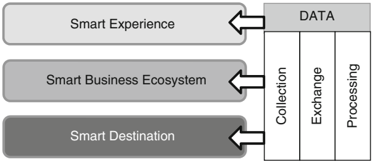
- The paper identifies three basic components of smart tourism: smart destinations, smart business ecosystems, and smart experiences; it also says smart tourism spans three layers: a smart information layer, smart exchange layer, and smart processing layer.
- The paper contrasts smart tourism with e-tourism: smart tourism bridges the digital and physical spheres, relies on sensors & smartphones rather than websites, focuses on the during-trip phase rather than pre- and post-travel, uses big data as its lifeblood, and is organized as an ecosystem rather than a value chain/intermediary structure.
- It notes that smart tourism research is still limited and mostly case-study based, with a strong consumer focus and an overly optimistic, uncritical stance; the paper itself proposes a research agenda and says existing smart tourism initiatives are mostly in development and often government-subsidized.
## Methods
- Conceptual/theoretical paper: it provides definitional clarification and an overview of the foundations of smart tourism rather than reporting an empirical dataset.
- It synthesizes prior literature on ICT, smart cities, service ecosystems, business models, and tourism technology to build its framework and definitions.
- It uses a conceptual comparison with e-tourism and organizes the discussion around technological foundations, business foundations, and research implications.
## Limitations
- The paper itself states that research in smart tourism is “very limited,” mostly case studies, and largely focused on the consumer perspective with an optimistic, uncritical stance.
- It explicitly says the proposed research agenda is “far from being comprehensive.”
- Evident from the text: the paper is conceptual and does not present original empirical data or tests, so its claims are theoretical rather than evidence from a study sample.
Model-written summary. Check it against the paper before relying on it.
Integrity signals
Registry
Cites
Statistics
Figures
Verification
Claims the paper makes
2 Valid · 17 Not valid · 47 Not checked · 59 Own results and interpretations
The cited sources support only part of this claim — read each source’s verdict below.
In the paper
“It has been identified as an important foundation for the services to be provided by smart tourism cities (Guo et al. 2014;Perera et al. 2014).”
§ Smart tourism: foundations and developments > Technological foundations of smart tourism
What the sources say
- Supportedcites Guo et al. 2014
The Introduction calls IoT technology the “core carrier” of the smart tourism information system. The Conclusion also identifies a tourism IoT information platform as critical to smart tourism development in China, supporting the claim that IoT is an important foundation for its services. (LLM, conf=0.93)
- Partly supportedcites Perera et al. 2014 matched to “Sensing as a service model for smart cities supported by Internet of Things” (2014) sourceExperimental — accuracy not yet measured
Section 3 (p. 2) describes an IoT-based sensing-as-a-service model as infrastructure for addressing smart-city challenges. The paper supports the general link between IoT and smart-city services, but the cited passages do not address tourism cities or their services specifically. (LLM, conf=0.85)
plainstates a cause- Asserted: passes — The authors put it forward as true.
- Checkable: passes — It can be checked against evidence.
- Load-bearing: unclear — It is unclear whether the paper’s conclusions depend on it.
- Based: passes — The paper gives a reason why it holds.
- Supported
A result the paper states — it cites no source for it, so there is none to check. The quote shows it is in the paper.
In the paper
“It also revealed a lack of critical literature that scrutinizes smart tourism assumptions and questioned its feasibility and positive experiential, economic and societal impacts.”
§ Smart tourism: foundations and developments > Conclusion
plain- Asserted: passes — The authors put it forward as true.
- Checkable: passes — It can be checked against evidence.
- Load-bearing: passes — The paper’s conclusions depend on it.
- Based: passes — The paper gives a reason why it holds.
In the paper
“Governments in China and South Korea are heavily funding initiatives mostly focused on building the technological infrastructure that supports smart tourism (Hwang et al. 2015).”
§ Smart tourism: foundations and developments > Abstract
What the sources say
- Not checked — no full text of the sourcecites Hwang et al. 2015 matched to “Constructivism in Smart Tourism Research : Seoul Destination Image” (2015) source
plain- Asserted: passes — The authors put it forward as true.
- Checkable: passes — It can be checked against evidence.
- Load-bearing: unclear — It is unclear whether the paper’s conclusions depend on it.
- Based: passes — The paper gives a reason why it holds.
A claim is checked only against the cited paper’s full text, never its abstract, and none is available for its sources.
In the paper
“Academic work is largely focused on describing the phenomenon in the form of case studies (e.g., Boes et al. 2015a, b;Bakıcı et al. 2013;Wang et al. 2013) or on discussing isolated technological developments (e.g., Huang and Chen 2015;Boes et al. 2015a, b) rather than on laying the theoretical foundations for its advancement and/or critique.”
§ Smart tourism: foundations and developments > Abstract
What the sources say
- Not checked — no full text of the sourcecites Boes et al. 2015a, b matched to “The Acceptance of NFC Smart Posters in Tourism” (2015) source
- Not checked — no full text of the sourcecites Bakıcı et al. 2013 matched to “A Smart City Initiative: the Case of Barcelona” (2013) source
- Not checked — no full text of the sourcecites Wang et al. 2013 matched to “China's “smart tourism destination” initiative: A taste of the service-dominant logic” (2013) source
plain- Asserted: passes — The authors put it forward as true.
- Checkable: passes — It can be checked against evidence.
- Load-bearing: passes — The paper’s conclusions depend on it.
- Based: passes — The paper gives a reason why it holds.
In the paper
“Remaining largely a vision at this stage, the Internet of Things has the potential to rapidly become a new reality as a technological infrastructure (Atzori et al. 2010).”
§ Smart tourism: foundations and developments > Technological foundations of smart tourism
What the sources say
- Not checked — no full text of the sourcecites Atzori et al. 2010 matched to “The Internet of Things: A survey” (2010) source
hedged- Asserted: passes — The authors put it forward as true.
- Checkable: passes — It can be checked against evidence.
- Load-bearing: unclear — It is unclear whether the paper’s conclusions depend on it.
- Based: passes — The paper gives a reason why it holds.
21 more claims
Create a free account to see all 125 claims and to verify the 3 references still open.
- It may state two separate claims as one. 46
- Probably not a substantial claim. 81
Citations
Cites
The Internet of Things: A survey
Atzori, L., Iera, A., & Morabito, G. (2010) · Computer Networks · doi:10.1016/j.comnet.2010.05.010 · Cited by 15,613
Business models, business strategy and innovation
Teece, D. J. (2010) · Long Range Planning · doi:10.1016/j.lrp.2009.07.003 · Cited by 8,335
Service-dominant logic: continuing the evolution
Vargo, S. L., & Lusch, R. F. (2008) · Journal of the Academy of Marketing Science · doi:10.1007/s11747-007-0069-6 · Cited by 7,824 · cited 1×
“In this vein, labels and roles assigned to players like travelers, firms and intermediaries are not valid anymore (Vargo and Lusch 2008).”
BackgroundBuhalis, D., & Law, R. (2008) · Tourism Management · doi:10.1016/j.tourman.2008.01.005 · Cited by 5,903 · cited 2×
“tion and of tourism consumers (Buhalis and Law 2008; Wang et al. 2012).”
BackgroundInternet of things: Vision, applications and research challenges
Miorandi, D., Sicari, S., De Pellegrini, F., & Chlamtac, I. (2012) · Ad Hoc Networks · doi:10.1016/j.adhoc.2012.02.016 · Cited by 3,578 · cited 1×
“Content and services will all be around us, persistently available, creating conditions for new applications and enabling new ways of working, interacting, entertainment, and living (Miorandi et al. 2012).”
BackgroundOn value and value co-creation: A service systems and service logic perspective
Vargo, S. L., Maglio, P. P., & Akaka, M. A. (2008) · European Management Journal · doi:10.1016/j.emj.2008.04.003 · Cited by 3,152 · cited 1×
“Vargo et al. (2008) and Spohrer et al. (2007) described a service ecosystem as a spontaneously sensing and responding spatial and temporal structure of largely loosely-coupled value-proposing social and economic actors interacting through institutions and technology, to: (1) co-produce service…”
BackgroundDahlander, L., & Gann, D. M. (2010) · Research Policy · doi:10.1016/j.respol.2010.01.013 · Cited by 2,435 · cited 1×
“Open innovation is based on the assumption that an organisation cannot just rely on its own resources, but has to engage with partners in order to innovate (Dahlander and Gann 2010; West and Gallagher 2006).”
BackgroundMacKenzie, D., & Millo, Y. (2003) · American Journal of Sociology · doi:10.1086/374404 · Cited by 1,464 · cited 1×
“By introducing new business models, firms develop new markets (Callon and Muniesa 2005; MacKenzie and Millo 2003; Pollock and Williams 2009; Inversini and Masiero 2014; Storbacka and Nenonen 2011).”
BackgroundPeripheral Vision: Economic Markets as Calculative Collective Devices
Callon, M., & Muniesa, F. (2005) · Organization Studies · doi:10.1177/0170840605056393 · Cited by 1,378 · cited 1×
“By introducing new business models, firms develop new markets (Callon and Muniesa 2005; MacKenzie and Millo 2003; Pollock and Williams 2009; Inversini and Masiero 2014; Storbacka and Nenonen 2011).”
Foundations for Smarter Cities
Harrison, C., Eckman, B., Hamilton, R., Hartswick, P., Kalagnanam, J., Paraszczak, J., & Williams, P. (2010) · IBM Journal of Research and Development · doi:10.1147/jrd.2010.2048257 · Cited by 1,347 · cited 1×
“Harrison et al. (2010) conceptualize smart as exploiting operational, near-real-time real-world data, integrating and sharing data, and using complex analytics, modelling, optimization and visualization to make better operational decisions.”
Background
Research works printed but not linked: 4
- 3. Anuar, F. I. & Gretzel, U. (2011). Privacy Concerns in the Context of Location Based Services for Tourism. ENTER 2011 Conference, Innsbruck, Austria, January 26-28, 2011. Accessed online (March 1, 2015) at http://ertr.tamu.edu/enter-2011-short-papers/.
- 16. Lopez de Avila, A. (2015). Smart Destinations: XXI Century Tourism. Presented at the ENTER2015 Conference on Information and Communication Technologies in Tourism, Lugano, Switzerland, February 4-6, 2015.
- 58. Tu, Q. & Liu, A. (2014). Framework of Smart Tourism Research and Related Progress in China. In International Conference on Management and Engineering (CME 2014), pp. 140-146.
- 77. In R. Egger, I. Gula, & D. Walcher (Eds.), Open Tourism - Open Innovation, Crowdsourcing and Collaborative Consumption challenging the tourism industry. Heidelberg: Springer Verlag.
Cited by
Items 601–700 of 2,494
Koutsi, D., & Stratigea, A. (2021) · Tourism, hospitality & event management · doi:10.1007/978-3-030-65524-2_4 · Cited by 16
Berenguer, A., Ros, D. F., Gómez-Oliva, A., Baidal, J. A. I., Jara, A. J., Laborda, J., Mazón, J.-N., & Perles, Á. (2022) · Electronics · doi:10.3390/electronics11060835 · Cited by 18
The Role of Information and Communication Technologies (ICTs) in Marketing Tourism Experiences
Yoo, K., & Gretzel, U. (2016) · Emerald Group Publishing Limited eBooks · doi:10.1108/978-1-78635-290-320161017 · Cited by 25
Self-citationQualitative analysis of virtual reality adoption by tourism operators in low-density regions
Martins, J., Gonçalves, R., Au‐Yong‐Oliveira, M., Moreira, F., & Branco, F. (2020) · IET Software · doi:10.1049/iet-sen.2019.0038 · Cited by 21
Does the rural digital economy promote shared prosperity among farmers? Evidence from China
Lu, Z., Gou, D., Wu, Q., & Feng, H. (2025) · Frontiers in Sustainable Food Systems · doi:10.3389/fsufs.2025.1649753 · Cited by 18
Users’ Acceptance of Connected and Automated Shuttles for Tourism Purposes: A Survey Study
Battistini, R., Mantecchini, L., & Postorino, M. N. (2020) · Sustainability · doi:10.3390/su122310188 · Cited by 21
Social Inclusion in Smart Cities
Nápoles, V. M. P., Páez, D. G., Penelas, J. L. E., Pérez, O. G., de Pablos, F. M., & Gil, R. M. (2021) · Springer eBooks · doi:10.1007/978-3-030-69698-6_42 · Cited by 24
Johnson, A., & Mehta, B. (2022) · Journal of Sustainable Tourism · doi:10.1080/09669582.2022.2091582 · Cited by 27
Hlee, S., & Lee, H. (2022) · Information Processing & Management · doi:10.1016/j.ipm.2022.103246 · Cited by 15
Quiroz-Fabra, J., Valencia-Arías, A., Londoño-Celis, W., & Pineda, V. G. (2022) · Human Behavior and Emerging Technologies · doi:10.1155/2022/2851044 · Cited by 24
CYBER SECURITY AND TOURISM: BIBLIOMETRIC ANALYSIS
Kovačić, M., Čičin-Šain, M., & Milojica, V. (2022) · Journal of Process Management New Technologies · doi:10.5937/jouproman2203075k · Cited by 22
An Overview of the Impact of the Food Sector “Intelligent Packaging” and “Smart Packaging”
Poli, M. D., Malagas, K., Nomikos, S., PAPAPOSTOLOU, A., & VLASSAS, G. (2023) · European Journal of Interdisciplinary Studies · doi:10.24818/ejis.2023.09 · Cited by 17
Mota, B., Rua, O. L., & Gómez, I. N. (2023) · Journal of Open Innovation Technology Market and Complexity · doi:10.1016/j.joitmc.2023.100154 · Cited by 30
Futuristic hospitality conceptualized: DASH - Decentralized Autonomous and Smart Hotel system
Aggarwal, S., & Mittal, A. (2024) · Journal of Open Innovation Technology Market and Complexity · doi:10.1016/j.joitmc.2024.100223 · Cited by 21
Aarabe, M., Bouizgar, M., Khizzou, N. B., Alla, L., & Benjelloun, A. S. (2024) · Advances in hospitality, tourism and the services industry (AHTSI) book series · doi:10.4018/979-8-3693-5678-4.ch011 · Cited by 17
Analysis of factors of smart tourism development in Serbia
Savić, J., & Pavlović, G. (2018) · Menadzment u hotelijerstvu i turizmu · doi:10.5937/menhottur1801081s · Cited by 19
Chen, X., Cheah, S. L., & Shen, A. (2019) · Sustainability · doi:10.3390/su11123404 · Cited by 19
Towards Smart Tourism Destination: An Empirical Study on Sharm El Sheikh City, Egypt
Rady, H. A., & khalf, A. (2019) · International Journal of Heritage, Tourism, and Hospitality · doi:10.21608/ijhth.2019.35106 · Cited by 18
Kontogianni, A., & Alepis, E. (2019) · Computer Science and Electronic Engineering Conference · doi:10.1109/ceec47804.2019.8974337 · Cited by 21
Decentralized Tourism Destinations Rating System Using 6AsTD Framework and Blockchain
Arif, Y. M., Nurhayati, H., Harini, S., Nugroho, S. M. S., & Hariadi, M. (2020) · International Conference on Smart Technology and Applications (ICoSTA) · doi:10.1109/icosta48221.2020.1570614662 · Cited by 18
Aftermath of pandemic Covid-19 on tourism industry: A review on virtual tourism platform
Rahim, N. Z. A., Nasaruddin, N. I. S., Shah, N. B. A., Halim, F. H., Samah, K. A. F. A., Saman, F. I., & Rum, S. F. M. (2021) · AIP conference proceedings · doi:10.1063/5.0052855 · Cited by 18
Guo, X., Wang, Y., Mao, J., Deng, Y., Chan, F. T. S., & Ruan, J. (2021) · Mobile Networks and Applications · doi:10.1007/s11036-021-01813-6 · Cited by 15
Sumrit, D. (2022) · Production & Manufacturing Research · doi:10.1080/21693277.2022.2064931 · Cited by 19
Mohamed, A. A. D., Alkhateeb, Y. M., Agarwal, P., Abdelwahab, A. R., & Alrababah, O. (2022) · International journal of information systems and project management · doi:10.12821/ijispm100302 · Cited by 24
Kim, H., Lee, K., Joh, C., Kim, J., Moon, S., Lee, C., Lee, S., Lee, J., & Lim, H. (2023) · Information Processing & Management · doi:10.1016/j.ipm.2022.103263 · Cited by 20
Assessing the User Resistance to Recommender Systems in Exhibition
Koo, C., Chung, N., & Ham, J. (2017) · Sustainability · doi:10.3390/su9112041 · Cited by 19
Self-citationTechnology as a tool to rebuild heritage sites: the second life of the Abbey of Cluny
Esteban, N. R. R. (2018) · Journal of Heritage Tourism · doi:10.1080/1743873x.2018.1468762 · Cited by 15
Bueno, I., Carrasco, R. A., Ureña, R., et al. (2019) · Procedia Computer Science · doi:10.1016/j.procs.2019.12.021 · Cited by 15
Linton, G., & Öberg, C. (2020) · Technology Innovation Management Review · doi:10.22215/timreview/1372 · Cited by 25
THE ROLE OF AUGMENTED REALITY IN DESTINATION BRANDING
Huertas, A., & Iglesia, J. L. G. (2020) · Tourism and hospitality management · doi:10.20867/thm.26.2.8 · Cited by 22
Smart Tourism Destinations: (Mis)Aligning Touristic Destinations and Smart City Initiatives
Cavalheiro, M. B., Jóia, L. A., Cavalheiro, G. M. D. C., & Mayer, V. F. (2021) · BAR - Brazilian Administration Review · doi:10.1590/1807-7692bar2021190132 · Cited by 20
Study on Business Ecosystem Research Trend Using Network Text Analysis
Shin, M. M., Jung, S., & Rha, J. S. (2021) · Sustainability · doi:10.3390/su131910727 · Cited by 25
Toward a critical geopolitics of smart tourism
Oakes, T. (2024) · Routledge eBooks · doi:10.1080/14616688.2024.2360633 · Cited by 19
Cybersecurity and smart tourist destinations resilience
Ghaderi, Z., Béal, L., Hall, C. M., Zaman, M., Rather, R. A., & Som, A. P. M. (2024) · Tourism Recreation Research · doi:10.1080/02508281.2024.2434791 · Cited by 22
Abdelmalak, F. (2024) · Journal of Smart Tourism · doi:10.52255/smarttourism.2024.4.2.5 · Cited by 27
When ChatGPT Designs Your Trip: How GenAI Adds a Cognitive Layer to Smart Tourism
Nicolau, J. L. (2025) · Journal of Smart Tourism · doi:10.1177/27652157251371101 · Cited by 25
Digitalization and sustainable branding in tourism destinations from a systematic review perspective
Alhaddar, M., & Kummitha, H. R. (2025) · Discover Sustainability · doi:10.1007/s43621-025-01751-3 · Cited by 51
Ljubisavljević, T., Vujko, A., Arsić, M., & Mirčetić, V. (2025) · World · doi:10.3390/world6040148 · Cited by 28
IOT based Smart solution for Traffic congestion at Metro Cities
Rao, T. V. J., Rajasekaran, A. S., Drakshyani, B., et al. (2022) · International Conference on Innovative Computing, Intelligent Communication and Smart Electrical Systems (ICSES) · doi:10.1109/icses55317.2022.9914174 · Cited by 14
TOURISM 4.0: OPPORTUNITIES FOR APPLYING INDUSTRY 4.0 TECHNOLOGIES IN TOURISM
Astanakulov, O. T., & Goyipnazarov, S. B. (2022) · doi:10.55439/eced/vol23_iss3/a51 · Cited by 15
Digital Transformation in Tourism Ecosystems: What Impact on Sustainability and Innovation?
Troisi, O., Grimaldi, M., & Visvizi, A. (2023) · Springer proceedings in complexity · doi:10.1007/978-3-031-19560-0_5 · Cited by 21
Smart Management Information Systems (Smis): Concept, Evolution, Research Hotspots and Applications
Liang, C., Wang, X., Gu, D., Li, P., Chen, H., & Xu, Z. (2023) · Data Intelligence · doi:10.1162/dint_a_00231 · Cited by 22
Assessing the role of technology in enhancing the authentic tourist experience
Shekhar, S., & Valeri, M. (2024) · EuroMed Journal of Business · doi:10.1108/emjb-12-2023-0347 · Cited by 21
Assessing the economic effects of investment in smart tourism platform
Lee, H., Koo, C., & Chung, N. (2024) · Tourism Economics · doi:10.1177/13548166241263643 · Cited by 20
Self-citationBouizgar, M., Aarabe, M., Khizzou, N. B., Alla, L., & Benjelloun, A. S. (2024) · Advances in marketing, customer relationship management, and e-services book series · doi:10.4018/979-8-3693-9775-6.ch005 · Cited by 15
Revolutionising Heritage Interpretation with Smart Technologies: A Blueprint for Sustainable Tourism
Özdemir, G., & Zonah, S. (2025) · Sustainability · doi:10.3390/su17104330 · Cited by 49
Yin, P., Zheng, X., Duan, L., Xu, X., & He, M. (2019) · Journal of Global Information Management · doi:10.4018/jgim.2019040103 · Cited by 15
From Triple Bottom Line to Circular Monitoring in Evaluation of Food Tourism Events
Cortese, D., Cantino, V., Solazzo, G., & Fassio, F. (2019) · Tourism Analysis · doi:10.3727/108354219x15511864843812 · Cited by 14
Graziano, T., & Albanese, V. E. (2020) · Heritage · doi:10.3390/heritage3040085 · Cited by 21
Tung, F.-W. (2021) · Sustainability · doi:10.3390/su13074033 · Cited by 18
Construction and Design of a Smart Tourism Model Based on Big Data Technologies
Jia, Q., Cui, Y., LIU, E. N. X. U. A. N., et al. (2022) · Mobile Information Systems · doi:10.1155/2022/1120541 · Cited by 14
A typology of tourism mobility apps
Birenboim, A., Bulis, Y., & Omer, I. (2023) · Tourism Management Perspectives · doi:10.1016/j.tmp.2023.101161 · Cited by 30
McLeod, M., Lewis, E. H., & Spencer, A. (2016) · Journal of Destination Marketing & Management · doi:10.1016/j.jdmm.2016.08.009 · Cited by 19
MANAGING A COMPLEX ADAPTIVE ECOSYSTEM: TOWARDS A SMART MANAGEMENT OF INDUSTRIAL HERITAGE TOURISM
Perfetto, M. C., Sánchez, A. V., & Presenza, A. (2016) · Journal of Tourism, Sustainability and Well-being · Cited by 22
Introduction: The Evolution of Wine Tourism Business Management
Σιγάλα, Μ., & Robinson, R. N. S. (2018) · Springer eBooks · doi:10.1007/978-3-319-75462-8_1 · Cited by 23
Pelet, J., Barton, M., & Chapuis, C. (2018) · Springer eBooks · doi:10.1007/978-3-319-75462-8_11 · Cited by 20
Tourist Attractions Classification using ResNet
Firdaus, N. M., Chahyati, D., & Fanany, M. I. (2018) · International Conference on Advanced Computer Science and Information Systems · doi:10.1109/icacsis.2018.8618235 · Cited by 15
On-demand UAV base station deployment for wireless service of crowded tourism areas
Yin, L., Zhang, N., & Tang, C. (2021) · Personal and Ubiquitous Computing · doi:10.1007/s00779-020-01515-y · Cited by 14
Editorial 25/3: Electronic Markets on ecosystems and tourism
Alt, R., & Zimmermann, H. (2015) · Electronic Markets · doi:10.1007/s12525-015-0197-7 · Cited by 15
Special issue on smart tourism cities
Koo, C., Gretzel, U., & Donnellan, B. (2021) · Asia Pacific Journal of Tourism Research · doi:10.1080/10941665.2021.1898905 · Cited by 20
Self-citationRethinking smartness in hospitality and tourism: a critical reflection
Nam, S., & Heo, J. (2025) · International Journal of Contemporary Hospitality Management · doi:10.1108/ijchm-04-2025-0546 · Cited by 15
Kim, Y. (2021) · Sustainability · doi:10.3390/su13063434 · Cited by 24
RETRACTED CHAPTER: Intelligent Development of Smart Cities: Deepint.net Case Studies
Corchado, J. M., Pinto-Santos, F., Aghmou, O., & Trabelsi, S. (2021) · Lecture notes in networks and systems · doi:10.1007/978-3-030-78901-5_19 · Cited by 13
RetractedCustomers’ motives to co-create in smart services interactions
Roy, S. K., Singh, G., Hatton, C., Dey, B. L., Ameen, N., & Kumar, S. (2022) · Electronic Commerce Research · doi:10.1007/s10660-022-09633-w · Cited by 23
Examining the importance of spatial aspects of travel routes: A multi-method approach
Yhee, Y., Shin, S., Lee, E., & Kim, J. (2023) · Information Processing & Management · doi:10.1016/j.ipm.2023.103281 · Cited by 19
Yilmazer, A., & ÇAKMAK, D. (2023) · Turk Turizm Arastirmalari Dergisi · doi:10.26677/tr1010.2023.1202 · Cited by 15
Constructing Spanish smart destinations: a new guide for the tourism industry
Florido‐Benítez, L. (2023) · International Journal of Tourism Cities · doi:10.1108/ijtc-09-2023-0193 · Cited by 13
Lin, Y.-H., & Chen, C.-L. (2024) · Sustainability · doi:10.3390/su16093567 · Cited by 14
Smart Experience and Green Health Tourism: The Moderating Role of Content Marketing
sardari, Z. A., Mohamadabadi, T. A., Nazarian-Jashnabadi, J., Tesoriere, G., & Campisi, T. (2024) · Sustainability · doi:10.3390/su16114546 · Cited by 25
The readiness assessment of Jakarta as a smart tourism city
Akbar, P. N. G., Auliya, A., Pranita, D., & Oktadiana, H. (2024) · Cogent Social Sciences · doi:10.1080/23311886.2024.2364386 · Cited by 31
Landscapes of Watermills: A Rural Cultural Heritage Perspective in an East-Central European Context
Drăgan, A., Creţan, R., & Terian, M. I. (2024) · Heritage · doi:10.3390/heritage7090227 · Cited by 14
BARAN, Z., & Karaca, Ş. (2024) · Current Issues in Tourism · doi:10.1080/13683500.2024.2440809 · Cited by 22
Balancing Growth and Preservation: Sustainable Strategies for Overtourism Management
Wani, M. D., Ganai, S. A., Wani, S. A., Dada, Z. A., & Shah, S. A. (2025) · Advances in hospitality, tourism and the services industry (AHTSI) book series · doi:10.4018/979-8-3693-8347-6.ch001 · Cited by 14
Mining graphs from travel blogs: a review in the context of tour planning
Haris, E., & Gan, K. H. (2017) · Information Technology & Tourism · doi:10.1007/s40558-017-0095-2 · Cited by 15
Vargas-Sánchez, A., & Saltos, A. H. E. (2019) · Worldwide Hospitality and Tourism Themes · doi:10.1108/whatt-09-2019-0057 · Cited by 15
Designing an advanced system for destination management: a case study of Northern Indiana
Choe, Y., & Fesenmaier, D. R. (2020) · Industrial Management & Data Systems · doi:10.1108/imds-02-2020-0063 · Cited by 16
Conceptualizing multi actors’ collaboration in smart tourism destination
Damayanti, M., Tyas, W. P., & Aswad, W. O. S. J. (2021) · IOP Conference Series Earth and Environmental Science · doi:10.1088/1755-1315/673/1/012027 · Cited by 18
The Touristic Sector in the 5G Technology Era: The 5G-TOURS Project Approach
Vignaroli, L., Gramaglia, M., Fuentes, M., et al. (2020) · doi:10.1109/gcwkshps50303.2020.9367418 · Cited by 13
El turismo, ¿fin de època?. Desafíos de España como destino turístico en un nuevo escenario
Palomeque, F. L. (2022) · Universitat de València eBooks · doi:10.7203/puv-oa-863-4 · Cited by 34
POLÍTICAS PÚBLICAS Y OVERTOURISM EN DESTINOS URBANOS: UN ANÁLISIS COMPARADO ENTRE BARCELONA Y PALMA
Gutiérrez, V. P., Aguilera, D. S., & Coll-Ramis, M. À. (2022) · Cuadernos de Turismo · doi:10.6018/turismo.521871 · Cited by 22
Depicting urban multi-scale tourist activity spaces using digital footprints for smart destinations
Zhao, P., Zhong-fu, M., Chen, J., Law, R., Zhang, Y., & Liu, Y. (2022) · Current Issues in Tourism · doi:10.1080/13683500.2022.2104696 · Cited by 16
An integrative framework for business model innovation in the tourism industry旅游业商业模式创新的综合框架
Kraus, S., Kallmuenzer, A., Kanbach, D. K., Krysta, P. M., & Steinhoff, M. M. (2022) · Service Industries Journal · doi:10.1080/02642069.2022.2127690 · Cited by 20
Analysis of Scientific Production- Smart Tourism Destination, Technology and Sustainability
Rafael, C. (2019) · Smart innovation, systems and technologies · doi:10.1007/978-981-15-2024-2_52 · Cited by 15
Technology-Assisted Mindfulness in the Co-creation of Tourist Experiences
Stankov, U., & Filimonau, V. (2020) · Springer eBooks · doi:10.1007/978-3-030-05324-6_128-1 · Cited by 19
Dimensões que influenciam a percepção dos turistas sobre Destinos Turísticos Inteligentes
Filho, L. M., Mayer, V. F., & Corrêa, C. H. W. (2022) · Revista Brasileira de Pesquisa em Turismo · doi:10.7784/rbtur.v16.2332 · Cited by 36
Smart Tourism and Smart Destinations for a Sustainable Future
Rocha, J. (2020) · Encyclopedia of the UN sustainable development goals · doi:10.1007/978-3-319-71058-7_88-1 · Cited by 17
Moderating Technology Acceptance Model on Resident Empowerment in Support for Sustainable Tourism
Megawati, V., Otok, B. W., & Purnomo, J. D. T. (2025) · Sustainability · doi:10.3390/su17094217 · Cited by 28
Exploring the Transformation of Digital Tourism: Trends, Impacts, and Future Prospects
Sivarethinamohan, R. (2023) · International Conference on Digital Applications, Transformation & Economy (ICDATE) · doi:10.1109/icdate58146.2023.10248691 · Cited by 30
Zengin, B., & Bayhan, M. (2023) · Seyahat ve Otel İşletmeciliği Dergisi · doi:10.24010/soid.1190552 · Cited by 17
Scientific mapping of smart tourism: a content analysis study
Özköse, H., Oğuz, H. U., & Aslan, A. (2023) · Asia Pacific Journal of Tourism Research · doi:10.1080/10941665.2023.2283601 · Cited by 19
Yuan, F., & Vui, C. N. (2023) · Journal Of Advanced Zoology · doi:10.17762/jaz.v44is6.2471 · Cited by 41
Technology-driven sustainable tourism destinations: perspectives from key policymakers
Socratous, M., Thrasyvoulou, G., & Stylianou, C. (2025) · Worldwide Hospitality and Tourism Themes · doi:10.1108/whatt-12-2024-0298 · Cited by 25
GEORGE, B. P., & Mattathil, A. P. (2025) · Societies · doi:10.3390/soc15020034 · Cited by 25
Ye, S., Shi, L., Feng, Z., & Hyuk, G. (2025) · Heliyon · doi:10.1016/j.heliyon.2025.e42704 · Cited by 21
Smart port city: Digital interfaces for enhancing RoPax port and city co-existence
Tsvetkova, A., Wahlström, I., Edelman, K., Franzén, R., Zhou, Y. C., & Hellström, M. (2025) · Cities · doi:10.1016/j.cities.2025.105936 · Cited by 15
The Reality of Encounters with Local Life in Other Cultures
Kim, J.-Y. (2017) · Sustainability · doi:10.3390/su10010027 · Cited by 12
Akıllı Kentleri Anlamak: Konya ve Barcelona Üzerinden Bir Değerlendirme
Örselli, E., & DİNÇER, S. (2019) · Uluslararası Yönetim Akademisi Dergisi · doi:10.33712/mana.547086 · Cited by 27
Journal of Smart Tourism: A New Platform to Support and Define an Emerging Field
Xiang, Z. (2021) · Journal of Smart Tourism · doi:10.52255/smarttourism.2021.1.1.1 · Cited by 13
Self-citationManero, M. D. C. B., Tartaglione, A. M., Russo, G. M., & Cavacece, Y. (2022) · Journal of Intellectual Capital · doi:10.1108/jic-07-2021-0201 · Cited by 27
Technology Innovation and Social Media as a Global Platform for Tourism Events
Rahman, M. K., Hossain, M. M., Akter, S., & Hassan, A. (2022) · Springer eBooks · doi:10.1007/978-981-16-8070-0_7 · Cited by 17
Metadata
- Authors
- Gretzel, U., Sigala, M., Xiang, Z., & Koo, C.
- Affiliations
- Virginia Tech (US)
- Kyung Hee University (KR)
- Corresponding author
- Koo, Chulmo
- Venue
- Electronic Markets
- Published
- 2015-08-01
- Volume
- 25
- Issue
- 3
- Pages
- 179-188
- ISSN
- 1019-6781 (ISSN-L)
- 1422-8890
- OpenAlex
- W974480840
- Cited by
- 2,589
- References
- 81
- Citations by year
- 2026: 532 · 2025: 364 · 2024: 307 · 2023: 255 · 2022: 283 · 2021: 239 · 2020: 232 · 2019: 163 · 2018: 93 · 2017: 82 · 2016: 36 · 2015: 2
- FWCI
- 234.92
- Type
- journal article
- Language
- en
- Open access
- hybrid
- doi.org
- Licence
- cc-by
- creativecommons.org/licenses/by/4.0/ (tdm)
- creativecommons.org/licenses/by/4.0/ (vor)
- Locations
- Electronic Markets (publishedVersion, cc-by)
- UniSA Research Outputs Repository (University of South Australia) (acceptedVersion)
- Adelaide Research & Scholarship (AR&S) (University of Adelaide) (submittedVersion, cc-by)
- Funders
- National Research Foundation
- National Research Foundation of Korea (NRF-2013S1A3A2043345)
- Topics
- Social Sciences › Business, Management and Accounting › Tourism, Leisure and Hospitality Management › Diverse Aspects of Tourism Research
- Social Sciences › Business, Management and Accounting › Management of Technology and Innovation › Digital Innovation in Industries
- Social Sciences › Business, Management and Accounting › Marketing › AI in Service Interactions
- Keywords
- smart tourism, information and communication technologies, tourism destinations, tourism industry, big data, value proposition, conceptual definitions, tourism management, technological foundations, business foundations
About these checks
Registry, retraction, Cites and statistics results are computed, not judged, with one exception: a printed reference that no index lists is read once by a model before it counts as a citation error. Claims are extracted by a model and kept only when their quote appears verbatim in the text; each cited source is then checked, with a model’s help, for whether it says what the claim relies on. Those verdicts can be wrong — read the claim’s quote and the cited source before relying on one.
The claim verdicts this report counts are experimental: their accuracy is not yet measured.
A language model drew the claims from the paper on 2026-10-10, under version 3 of the claim definition (model deepseek-v4.1-flash, prompt extract-v3).
A second model labelled each claim on 2026-10-10 (model jev-1.13-20260917, definition revision gold-guideline-v0.2).
Cited sources are checked with a language model’s help (gpt-6-sol).
Statistics and arithmetic are recomputed, not judged.
Confidence bands are shown only for fields calibrated on our annotated test set. None is calibrated yet, so no band is shown.
What counts as a claim ›How we measure confidence ›How we check this ›
Are you an author, or do you see a problem with this page? Request a review
Data sources
Bibliographic data: Semantic Scholar, OpenAlex, Crossref.
Contains information from the Semantic Scholar Academic Graph Datasets, made available under the ODC Attribution License (ODC-BY 1.0).
Semantic Scholar’s data is described in: Kinney, R., et al. (2023). The Semantic Scholar Open Data Platform. arXiv:2301.10140.
