

The DOI matches its Crossref record; 36 of the 36 references it cites were found in a registry or an index.
Phenomenological Fingerprints of Four Meditations: Differential State Changes in Affect, Mind-Wandering, Meta-Cognition, and Interoception Before and After Daily Practice Across 9 Months of Training
Open accessAbstract
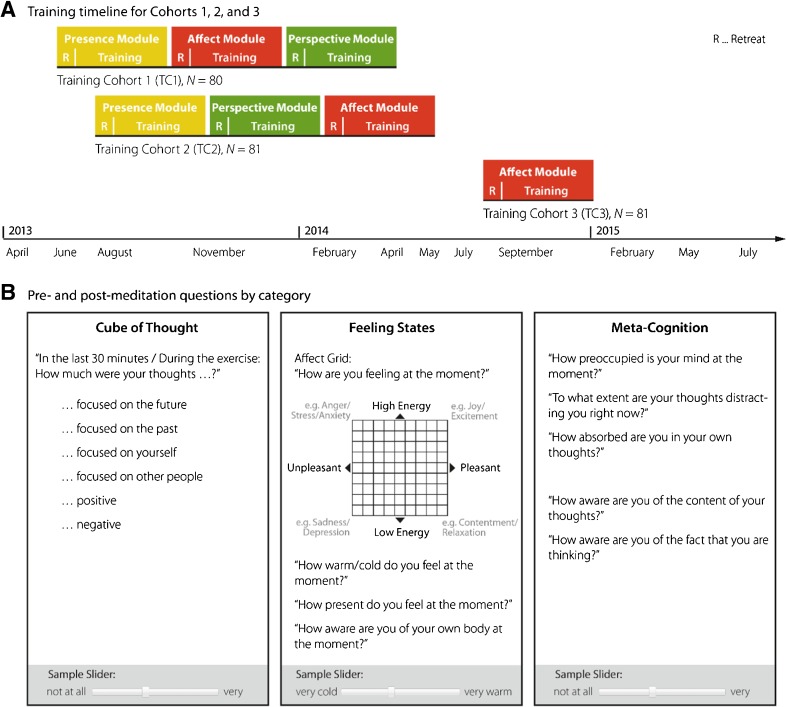
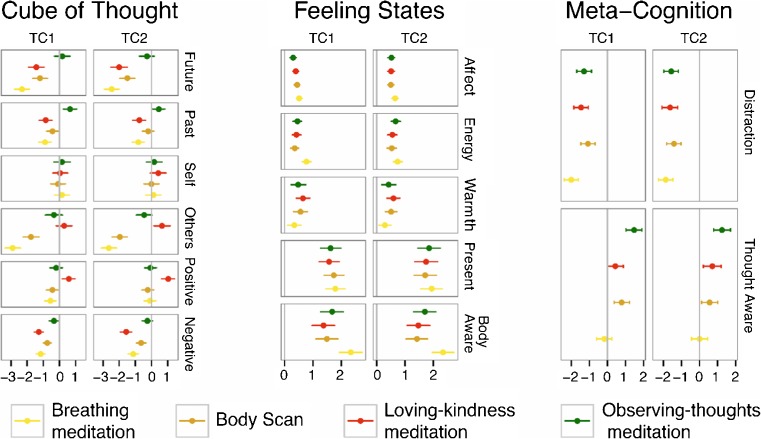
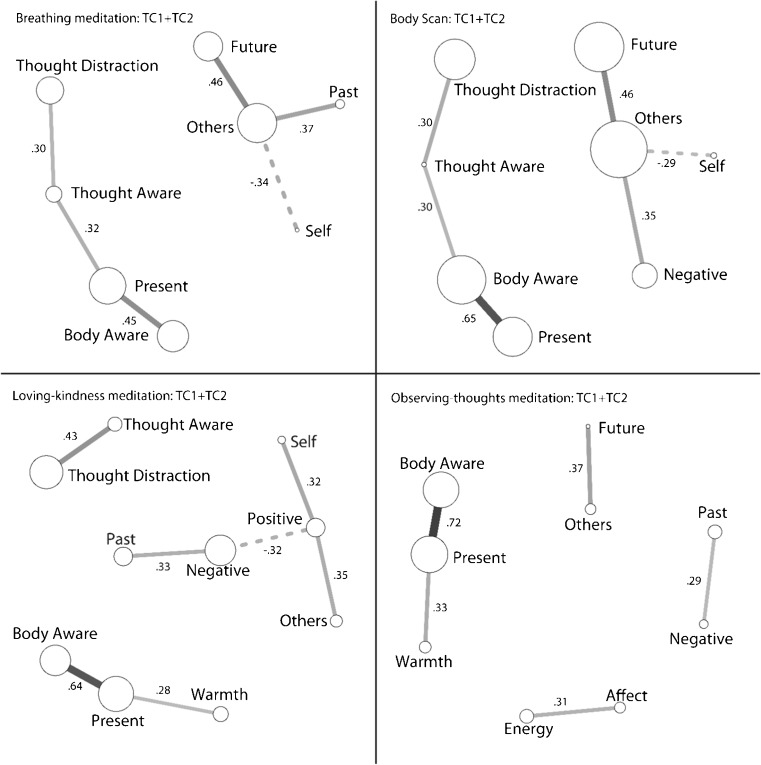
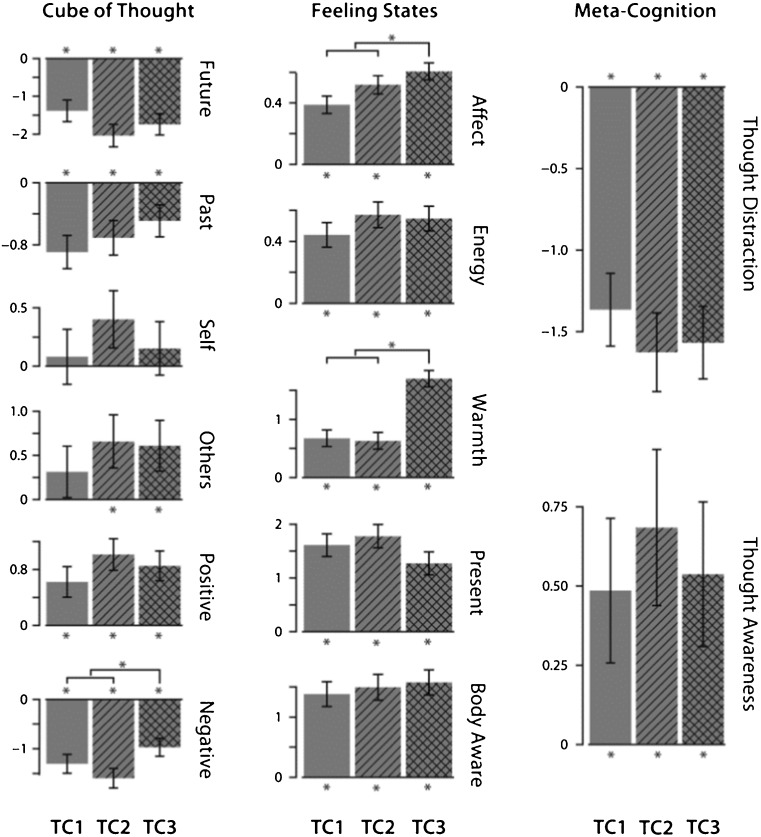
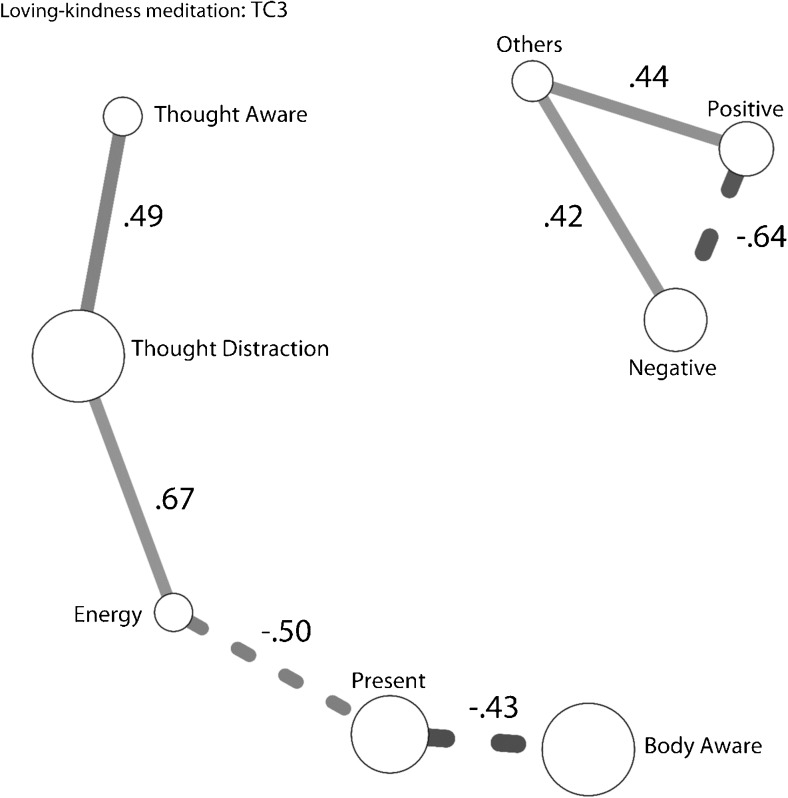
Despite increasing interest in the effects of mental training practices such as meditation, there is much ambiguity regarding whether and to what extent the various types of mental practice have differential effects on psychological change. To address this gap, we compare the effects of four common meditation practices on measures of state change in affect, mind-wandering, meta-cognition, and interoception. In the context of a 9-month mental training program called the ReSource Project, 229 mid-life adults (mean age 41) provided daily reports before and after meditation practice. Participants received training in the following three successive modules: the first module (presence) included breathing meditation and body scan, the second (affect) included loving-kindness meditation, and the third (perspective) included observing-thought meditation. Using multilevel modeling, we found that body scan led to the greatest state increase in interoceptive awareness and the greatest decrease in thought content, loving-kindness meditation led to the greatest increase in feelings of warmth and positive thoughts about others, and observing-thought meditation led to the greatest increase in meta-cognitive awareness. All practices, including breathing meditation, increased positivity of affect, energy, and present focus and decreased thought distraction. Complementary network analysis of intervariate relationships revealed distinct phenomenological clusters of psychological change congruent with the content of each practice. These findings together suggest that although different meditation practices may have common beneficial effects, each practice can also be characterized by a distinct short-term psychological fingerprint, the latter having important implications for the use of meditative practices in different intervention contexts and with different populations.
Overview
The claims and statistics of this paper haven’t been checked yet.
Run the check — free, no account needed. It reads the open-access text and checks the sources it cites.
Integrity signals
Registry
Cites
Statistics
Figures
Verification
Claims the paper makes
The claims and statistics of this paper haven’t been checked yet.
Run the check — free, no account needed. It reads the open-access text and checks the sources it cites.
Claims other papers make about this one
Each is checked against this paper’s own text: does it say what the citing paper says it does?
The source backs part of the claim, not all of it — or backs it for a different population, condition or comparison.
In the citing paper
“socio-cognitive perspective-taking practices led to improvements in meta-cognitive awareness and Theory of Mind [30,31]”
From 10-Week Trajectories of Candidate Psychological Processes Differentially Predict Mental Health Gains from Online Dyadic versus Mindfulness Interventions: A Randomized Clinical Trial (2024) · cites this paper as [30]
Experimental — accuracy not yet measuredThe source backs part of the claim, not all of it — or backs it for a different population, condition or comparison.
In the citing paper
“prior studies [30,98] have demonstrated that attention-focused meditation reduces past- and future-related thoughts while socio-emotional practices increase positive other-related thoughts.”
From 10-Week Trajectories of Candidate Psychological Processes Differentially Predict Mental Health Gains from Online Dyadic versus Mindfulness Interventions: A Randomized Clinical Trial (2024) · cites this paper as [30]
Experimental — accuracy not yet measuredThe cited source says what the claim attributes to it.
In the citing paper
“in a large-scale 9-month study, the ReSource project [29] employing three distinct intervention modules, it was shown that attention-focused mindfulness practices led to enhanced interoceptive awareness and attention control [30,31]”
The cited source says what the claim attributes to it.
In the citing paper
“Different meditation practices have shown distinct neural signatures [55,56] and can produce different psychological effects [57].”
From Testing the efficacy of a multicomponent, self-guided, smartphone-based meditation app: Three-armed randomized controlled trial (2020) · cites this paper as [57]
Self-check
Percentages, sums and reported differences re-computed from the paper’s own numbers.
The self-check needs the paper’s full text.
Citations
Cites
(2008) · Medical Entomology and Zoology · Cited by 7,477
Network analysis: An integrative approach to the structure of psychopathology
Borsboom, D., & Cramer, A. O. J. (2013) · Annual Review of Clinical Psychology · doi:10.1146/annurev-clinpsy-050212-185608 · Cited by 4,359
Attention regulation and monitoring in meditation
Lutz, A., Slagter, H. A., Dunne, J. D., & Davidson, R. J. (2008) · Trends in Cognitive Sciences · doi:10.1016/j.tics.2008.01.005 · Cited by 2,659
Fredrickson, B. L., Cohn, M. A., Coffey, K. A., Pek, J., & Finkel, S. M. (2008) · Journal of Personality and Social Psychology · doi:10.1037/a0013262 · Cited by 2,365 · cited 3×
“Other studies have shown that repeated subjective experiences such as anxiety (Kubzansky et al. 2006) or positive affect (Fredrickson et al. 2008; Kok et al. 2013) can have significant and far-reaching consequences for life, health, and longevity.”
BackgroundAffect Grid: A single-item scale of pleasure and arousal.
Russell, J. A., Weiss, A., & Mendelsohn, G. A. (1989) · Journal of Personality and Social Psychology · doi:10.1037/0022-3514.57.3.493 · Cited by 1,951
Chiesa, A., & Serretti, A. (2009) · The Journal of Alternative and Complementary Medicine · doi:10.1089/acm.2008.0495 · Cited by 1,681 · cited 1×
“…as a potential treatment for mental disorders from schizophrenia (Johnson et al. 2011) to PTSD (Lang et al. 2012) to depression and anxiety (Strauss et al. 2014), among others, and as a method for improving quality of life in individuals not diagnosed with a disorder (Chiesa and Serretti 2009).”
MethodJain, S., Shapiro, S. L., Swanick, S., Roesch, S. C., Mills, P. J., Bell, I., & Schwartz, G. E. R. (2007) · Annals of Behavioral Medicine · doi:10.1207/s15324796abm3301_2 · Cited by 1,300 · cited 2×
“Mindfulness meditation including an observing-thought component effectively reduced rumination relative to both relaxation training and measurement control groups (Jain et al. 2007).”
Singer, T., & Klimecki, O. M. (2014) · Current Biology · doi:10.1016/j.cub.2014.06.054 · Cited by 1,254
Self-citationFjorback, L. O., Arendt, M., Ørnbøl, E., Fink, P., & Walach, H. (2011) · Acta Psychiatrica Scandinavica · doi:10.1111/j.1600-0447.2011.01704.x · Cited by 803
Kok, B. E., Coffey, K. A., Cohn, M. A., Catalino, L. I., Vacharkulksemsuk, T., Algoe, S. B., Brantley, M., & Fredrickson, B. L. (2013) · Psychological Science · doi:10.1177/0956797612470827 · Cited by 755
Self-citationA systematic review of neurobiological and clinical features of mindfulness meditations
Chiesa, A., & Serretti, A. (2010) · Psychological Medicine · doi:10.1017/s0033291709991747 · Cited by 749
Differential pattern of functional brain plasticity after compassion and empathy training
Klimecki, O. M., Leiberg, S., Ricard, M., & Singer, T. (2014) · Social Cognitive and Affective Neuroscience · doi:10.1093/scan/nst060 · Cited by 676
Self-citationFunctional Neural Plasticity and Associated Changes in Positive Affect After Compassion Training
Klimecki, O. M., Leiberg, S., Lamm, C., & Singer, T. (2013) · Cerebral Cortex · doi:10.1093/cercor/bhs142 · Cited by 634
Self-citationKuyken, W., Hayes, R., Barrett, B., Byng, R., Dalgleish, T., Kessler, D., Lewis, G., Watkins, E., Brejcha, C., Cardy, J., et al. (2015) · The Lancet · doi:10.1016/s0140-6736(14)62222-4 · Cited by 527
Meditation practices for health: state of the research.
(2007) · PubMed Central · Cited by 516
Strauss, C., Cavanagh, K., Oliver, A., & Pettman, D. (2014) · PLoS ONE · doi:10.1371/journal.pone.0096110 · Cited by 495
Feldman, G., Greeson, J., & Senville, J. (2010) · Behaviour Research and Therapy · doi:10.1016/j.brat.2010.06.006 · Cited by 455
Williams, J. M. G., Crane, C., Barnhofer, T., Brennan, K., Duggan, D. S., Fennell, M. J. V., Hackmann, A., Krusche, A., Muse, K., Von Rohr, I. R., et al. (2014) · Journal of Consulting and Clinical Psychology · doi:10.1037/a0035036 · Cited by 420
Antoine Lutz, A., & Thompson, E. T. (2003) · Journal of Consciousness Studies · Cited by 403
Specificity of rumination in anxiety and depression: A multimodal meta‐analysis.
Olatunji, B. O., Naragon-Gainey, K., & Wolitzky-Taylor, K. B. (2013) · Clinical Psychology: Science and Practice · doi:10.1037/h0101719 · Cited by 380
The validation of an active control intervention for Mindfulness Based Stress Reduction (MBSR)
MacCoon, D. G., Imel, Z. E., Rosenkranz, M. A., Sheftel, J. G., Weng, H. Y., Sullivan, J. C., Bonus, K. A., Stoney, C. M., Salomons, T. V., Davidson, R. J., et al. (2012) · Behaviour Research and Therapy · doi:10.1016/j.brat.2011.10.011 · Cited by 335
Ruby, F. J. M., Smallwood, J., Engen, H., & Singer, T. (2013) · PLoS ONE · doi:10.1371/journal.pone.0077554 · Cited by 275
Meditation alters perceptual rivalry in Tibetan Buddhist monks
Carter, O. L., Presti, D. E., Callistemon, C., Ungerer, Y., Liu, G. B., & Pettigrew, J. D. (2005) · Current Biology · doi:10.1016/j.cub.2005.05.043 · Cited by 262
[Solitary median maxillary central incisor syndrome:a case of report].
Kang, L.-Y., & Liu, X. (2014) · PubMed · Cited by 208
The art of living : Vipassana meditation as taught by S.N. Goenka
Hart, W., & Goenka, S. N. (1990) · Cited by 207
Kubzansky, L. D., Cole, S. R., Kawachi, I., Vokonas, P., & Sparrow, D. (2006) · Annals of Behavioral Medicine · doi:10.1207/s15324796abm3101_5 · Cited by 203 · cited 2×
“Other studies have shown that repeated subjective experiences such as anxiety (Kubzansky et al. 2006) or positive affect (Fredrickson et al.”
BackgroundA pilot study of loving-kindness meditation for the negative symptoms of schizophrenia
Johnson, D. P., Penn, D. L., Fredrickson, B. L., Kring, A. M., Meyer-Kalos, P., Catalino, L. I., & Brantley, M. M. (2011) · Schizophrenia Research · doi:10.1016/j.schres.2011.02.015 · Cited by 172
The Theoretical and Empirical Basis for Meditation as an Intervention for PTSD
Lang, A. J., Strauss, J. L., Bomyea, J. A., Bormann, J. E., Hickman, S. D., Good, R. C., & Essex, M. (2012) · Behavior Modification · doi:10.1177/0145445512441200 · Cited by 161
Brief body-scan meditation practice improves somatosensory perceptual decision making
Mirams, L., Poliakoff, E., Brown, R. J., & Lloyd, D. M. (2013) · Consciousness and Cognition · doi:10.1016/j.concog.2012.07.009 · Cited by 157
Clinical Trials of Meditation Practices in Health Care: Characteristics and Quality
Ospina, M., Bond, K., Karkhaneh, M., Buscemi, N., Dryden, D., Barnes, V., Carlson, L., Dusek, J., & Shannahoff-Khalsa, D. (2008) · Journal of Alternative and Complementary Medicine · doi:10.1089/acm.2008.0307 · Cited by 153
Sauer-Zavala, S. E., Walsh, E. C., Eisenlohr-Moul, T. A., & Lykins, E. L. B. (2013) · Mindfulness · doi:10.1007/s12671-012-0139-9 · Cited by 128
(2016) · Max Planck Digital Library · Cited by 80
Obasi, C. N., Brown, R., Ewers, T., Barlow, S., Gassman, M., Zgierska, A. E., Coe, C. L., & Barrett, B. P. (2012) · Influenza and Other Respiratory Viruses · doi:10.1111/irv.12053 · Cited by 34
Meditation Based Therapies—A Systematic Review and Some Critical Observations
Fjorback, L. O., & Walach, H. (2012) · Religions · doi:10.3390/rel3010001 · Cited by 26
Mipham, S. (2003) · Cited by 20
Louchakova-Schwartz, O. (2013) · Springer eBooks · doi:10.1007/978-1-4614-7239-1_3 · Cited by 16
Cited by
Sorted by citations
Psychological interventions to foster resilience in healthcare professionals
Kunzler, A. M., Helmreich, I., Chmitorz, A., König, J., Binder, H., Wessa, M., & Lieb, K. (2020) · Cochrane Database of Systematic Reviews · doi:10.1002/14651858.cd012527.pub2 · Cited by 390
Knowing Ourselves Together: The Cultural Origins of Metacognition
Heyes, C., Bang, D., Shea, N., Frith, C. D., & Fleming, S. M. (2020) · Trends in Cognitive Sciences · doi:10.1016/j.tics.2020.02.007 · Cited by 232
Helping People by Being in the Present: Mindfulness Increases Prosocial Behavior
Hafenbrack, A. C., Cameron, L. D., Spreitzer, G. M., Zhang, C., Noval, L. J., & Shaffakat, S. (2020) · Organizational Behavior and Human Decision Processes · doi:10.1016/j.obhdp.2019.08.005 · Cited by 189
Singer, T., & Engert, V. (2019) · Current Opinion in Psychology · doi:10.1016/j.copsyc.2018.12.005 · Cited by 176
Self-citationImprovement of Interoceptive Processes after an 8-Week Body Scan Intervention
Fischer, D., Messner, M., & Pollatos, O. (2017) · Frontiers in Human Neuroscience · doi:10.3389/fnhum.2017.00452 · Cited by 159
“In line with the aforementioned results of Khalsa et al. (2008), no relationship between mindfulness and heartbeat perception (IAc) was found, but participants with higher mindfulness scores were more confident regarding their heartbeat perception performance (IS; see also Kok and Singer, 2016).”
Result
Metadata
- Authors
- Kok, B. E., & Singer, T.
- Affiliations
- Max Planck Institute for Human Cognitive and Brain Sciences (DE)
- Corresponding author
- Kok, Bethany E.
- ORCID
- Singer, Tania
- Venue
- Mindfulness
- Published
- 2016-08-19
- Volume
- 8
- Issue
- 1
- Pages
- 218-231
- ISSN
- 1868-8527 (ISSN-L)
- 1868-8535
- PMC
- PMC5241345
- OpenAlex
- W2518497773
- Cited by
- 144
- References
- 36
- Citations by year
- 2026: 11 · 2025: 14 · 2024: 16 · 2023: 19 · 2022: 14 · 2021: 20 · 2020: 14 · 2019: 14 · 2018: 13 · 2017: 9
- FWCI
- 16.05
- Type
- journal article
- Language
- en
- Update notices
- correction (2016-10-22)
- Open access
- hybrid
- doi.org
- Locations
- Mindfulness (publishedVersion, cc-by)
- PubMed Central (publishedVersion, cc-by)
- PubMed (publishedVersion)
- Max Planck Digital Library (submittedVersion, other-oa)
- MPG.PuRe (Max Planck Society) (submittedVersion, other-oa)
- Funders
- European Research Council (BE) (ERC-2007-StG)
- Topics
- Social Sciences › Psychology › Clinical Psychology › Mindfulness and Compassion Interventions
- Social Sciences › Psychology › Social Psychology › Psychological Well-being and Life Satisfaction
- Life Sciences › Neuroscience › Cognitive Neuroscience › Mind wandering and attention
- Keywords
- meditation, mindfulness training, affect, mind wandering, metacognition, interoception, interoceptive awareness, loving-kindness meditation, body scanning, breathing meditation, resource projects, middle-aged adults, psychological change, positive affect
About these checks
Registry, retraction, Cites and statistics results are computed, not judged, with one exception: a printed reference that no index lists is read once by a model before it counts as a citation error. Claims are extracted by a model and kept only when their quote appears verbatim in the text; each cited source is then checked, with a model’s help, for whether it says what the claim relies on. Those verdicts can be wrong — read the claim’s quote and the cited source before relying on one.
Statistics and arithmetic are recomputed, not judged.
Confidence bands are shown only for fields calibrated on our annotated test set. None is calibrated yet, so no band is shown.
What counts as a claim ›How we measure confidence ›How we check this ›
Are you an author, or do you see a problem with this page? Request a review
