

The DOI matches its Crossref record; 36 of the 36 references it cites were found in a registry or an index.
Phenomenological Fingerprints of Four Meditations: Differential State Changes in Affect, Mind-Wandering, Meta-Cognition, and Interoception Before and After Daily Practice Across 9 Months of Training
Open accessAbstract
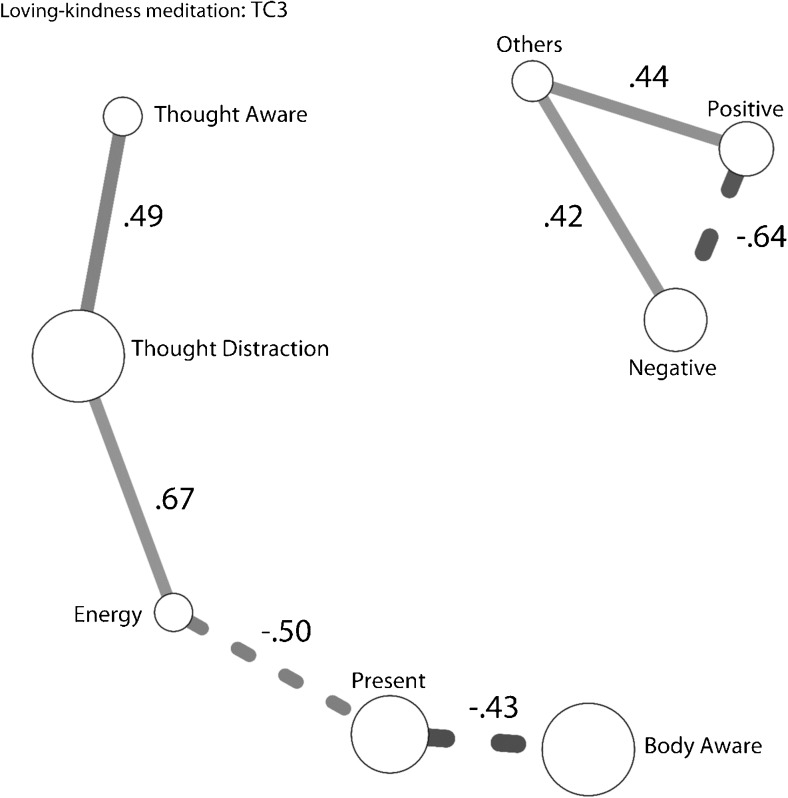
Despite increasing interest in the effects of mental training practices such as meditation, there is much ambiguity regarding whether and to what extent the various types of mental practice have differential effects on psychological change. To address this gap, we compare the effects of four common meditation practices on measures of state change in affect, mind-wandering, meta-cognition, and interoception. In the context of a 9-month mental training program called the ReSource Project, 229 mid-life adults (mean age 41) provided daily reports before and after meditation practice. Participants received training in the following three successive modules: the first module (presence) included breathing meditation and body scan, the second (affect) included loving-kindness meditation, and the third (perspective) included observing-thought meditation. Using multilevel modeling, we found that body scan led to the greatest state increase in interoceptive awareness and the greatest decrease in thought content, loving-kindness meditation led to the greatest increase in feelings of warmth and positive thoughts about others, and observing-thought meditation led to the greatest increase in meta-cognitive awareness. All practices, including breathing meditation, increased positivity of affect, energy, and present focus and decreased thought distraction. Complementary network analysis of intervariate relationships revealed distinct phenomenological clusters of psychological change congruent with the content of each practice. These findings together suggest that although different meditation practices may have common beneficial effects, each practice can also be characterized by a distinct short-term psychological fingerprint, the latter having important implications for the use of meditative practices in different intervention contexts and with different populations.
Overview
The claims and statistics of this paper haven’t been checked yet.
Run the check — free, no account needed. It reads the open-access text and checks the sources it cites.
Integrity signals
Registry
Cites
Statistics
Figures
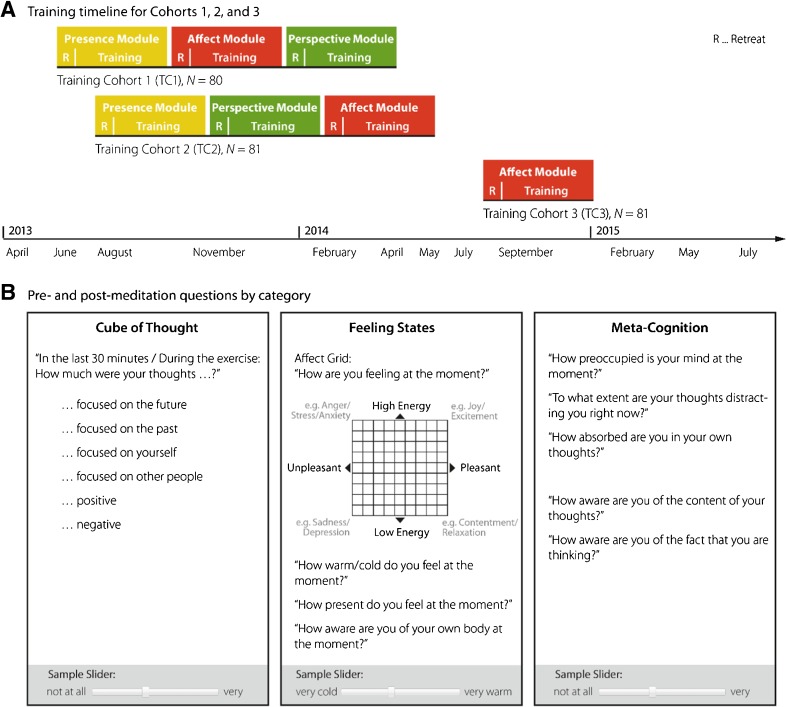
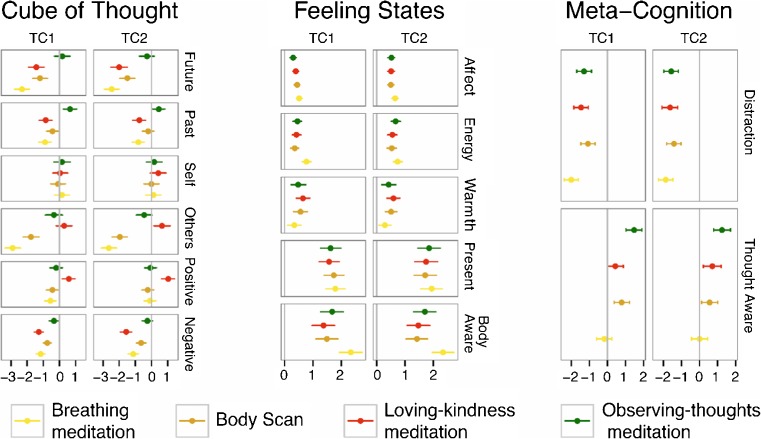
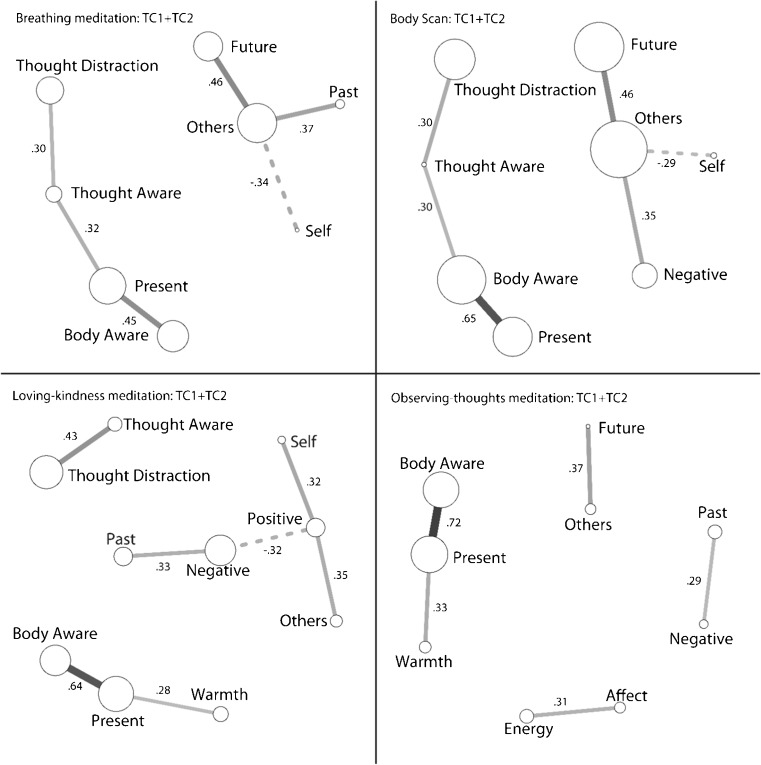
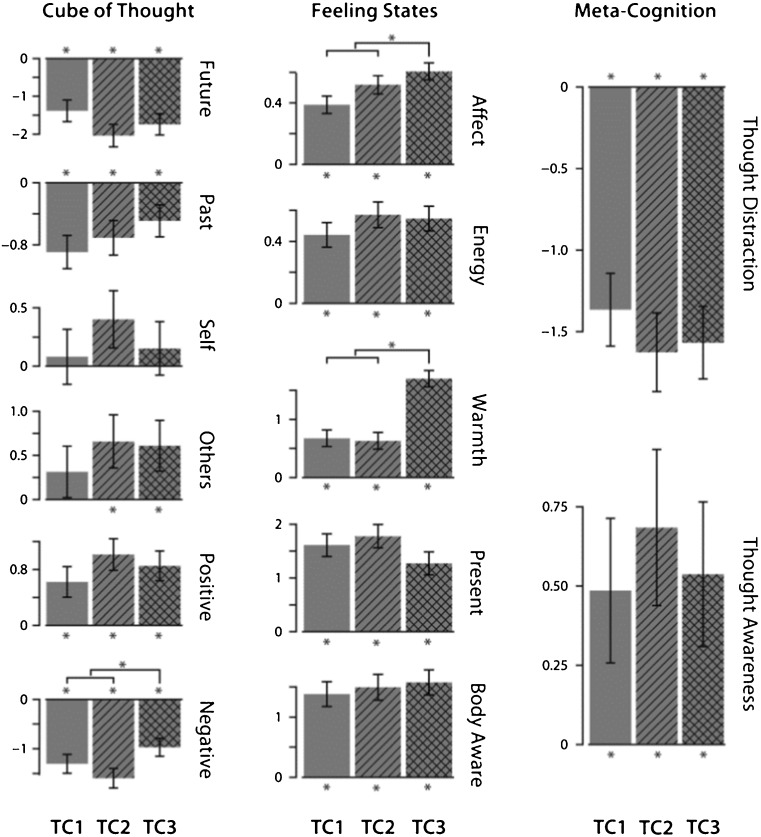
Verification
Claims the paper makes
The claims and statistics of this paper haven’t been checked yet.
Run the check — free, no account needed. It reads the open-access text and checks the sources it cites.
Claims other papers make about this one
Each is checked against this paper’s own text: does it say what the citing paper says it does?
The source backs part of the claim, not all of it — or backs it for a different population, condition or comparison.
In the citing paper
“socio-cognitive perspective-taking practices led to improvements in meta-cognitive awareness and Theory of Mind [30,31]”
From 10-Week Trajectories of Candidate Psychological Processes Differentially Predict Mental Health Gains from Online Dyadic versus Mindfulness Interventions: A Randomized Clinical Trial (2024) · cites this paper as [30]
Experimental — accuracy not yet measuredThe source backs part of the claim, not all of it — or backs it for a different population, condition or comparison.
In the citing paper
“prior studies [30,98] have demonstrated that attention-focused meditation reduces past- and future-related thoughts while socio-emotional practices increase positive other-related thoughts.”
From 10-Week Trajectories of Candidate Psychological Processes Differentially Predict Mental Health Gains from Online Dyadic versus Mindfulness Interventions: A Randomized Clinical Trial (2024) · cites this paper as [30]
Experimental — accuracy not yet measuredThe cited source says what the claim attributes to it.
In the citing paper
“in a large-scale 9-month study, the ReSource project [29] employing three distinct intervention modules, it was shown that attention-focused mindfulness practices led to enhanced interoceptive awareness and attention control [30,31]”
The cited source says what the claim attributes to it.
In the citing paper
“Different meditation practices have shown distinct neural signatures [55,56] and can produce different psychological effects [57].”
From Testing the efficacy of a multicomponent, self-guided, smartphone-based meditation app: Three-armed randomized controlled trial (2020) · cites this paper as [57]
Self-check
Percentages, sums and reported differences re-computed from the paper’s own numbers.
The self-check needs the paper’s full text.
Citations
Cites
(2008) · Medical Entomology and Zoology · Cited by 7,477
Network analysis: An integrative approach to the structure of psychopathology
Borsboom, D., & Cramer, A. O. J. (2013) · Annual Review of Clinical Psychology · doi:10.1146/annurev-clinpsy-050212-185608 · Cited by 4,359
Attention regulation and monitoring in meditation
Lutz, A., Slagter, H. A., Dunne, J. D., & Davidson, R. J. (2008) · Trends in Cognitive Sciences · doi:10.1016/j.tics.2008.01.005 · Cited by 2,659
Fredrickson, B. L., Cohn, M. A., Coffey, K. A., Pek, J., & Finkel, S. M. (2008) · Journal of Personality and Social Psychology · doi:10.1037/a0013262 · Cited by 2,365 · cited 3×
“Other studies have shown that repeated subjective experiences such as anxiety (Kubzansky et al. 2006) or positive affect (Fredrickson et al. 2008; Kok et al. 2013) can have significant and far-reaching consequences for life, health, and longevity.”
BackgroundAffect Grid: A single-item scale of pleasure and arousal.
Russell, J. A., Weiss, A., & Mendelsohn, G. A. (1989) · Journal of Personality and Social Psychology · doi:10.1037/0022-3514.57.3.493 · Cited by 1,951
Chiesa, A., & Serretti, A. (2009) · The Journal of Alternative and Complementary Medicine · doi:10.1089/acm.2008.0495 · Cited by 1,681 · cited 1×
“…as a potential treatment for mental disorders from schizophrenia (Johnson et al. 2011) to PTSD (Lang et al. 2012) to depression and anxiety (Strauss et al. 2014), among others, and as a method for improving quality of life in individuals not diagnosed with a disorder (Chiesa and Serretti 2009).”
MethodJain, S., Shapiro, S. L., Swanick, S., Roesch, S. C., Mills, P. J., Bell, I., & Schwartz, G. E. R. (2007) · Annals of Behavioral Medicine · doi:10.1207/s15324796abm3301_2 · Cited by 1,300 · cited 2×
“Mindfulness meditation including an observing-thought component effectively reduced rumination relative to both relaxation training and measurement control groups (Jain et al. 2007).”
Singer, T., & Klimecki, O. M. (2014) · Current Biology · doi:10.1016/j.cub.2014.06.054 · Cited by 1,254
Self-citationFjorback, L. O., Arendt, M., Ørnbøl, E., Fink, P., & Walach, H. (2011) · Acta Psychiatrica Scandinavica · doi:10.1111/j.1600-0447.2011.01704.x · Cited by 803
Kok, B. E., Coffey, K. A., Cohn, M. A., Catalino, L. I., Vacharkulksemsuk, T., Algoe, S. B., Brantley, M., & Fredrickson, B. L. (2013) · Psychological Science · doi:10.1177/0956797612470827 · Cited by 755
Self-citation
Cited by
Sorted by citations
Psychological interventions to foster resilience in healthcare professionals
Kunzler, A. M., Helmreich, I., Chmitorz, A., König, J., Binder, H., Wessa, M., & Lieb, K. (2020) · Cochrane Database of Systematic Reviews · doi:10.1002/14651858.cd012527.pub2 · Cited by 390
Knowing Ourselves Together: The Cultural Origins of Metacognition
Heyes, C., Bang, D., Shea, N., Frith, C. D., & Fleming, S. M. (2020) · Trends in Cognitive Sciences · doi:10.1016/j.tics.2020.02.007 · Cited by 232
Helping People by Being in the Present: Mindfulness Increases Prosocial Behavior
Hafenbrack, A. C., Cameron, L. D., Spreitzer, G. M., Zhang, C., Noval, L. J., & Shaffakat, S. (2020) · Organizational Behavior and Human Decision Processes · doi:10.1016/j.obhdp.2019.08.005 · Cited by 189
Singer, T., & Engert, V. (2019) · Current Opinion in Psychology · doi:10.1016/j.copsyc.2018.12.005 · Cited by 176
Self-citationImprovement of Interoceptive Processes after an 8-Week Body Scan Intervention
Fischer, D., Messner, M., & Pollatos, O. (2017) · Frontiers in Human Neuroscience · doi:10.3389/fnhum.2017.00452 · Cited by 159
“In line with the aforementioned results of Khalsa et al. (2008), no relationship between mindfulness and heartbeat perception (IAc) was found, but participants with higher mindfulness scores were more confident regarding their heartbeat perception performance (IS; see also Kok and Singer, 2016).”
ResultBurke, A., Lam, C. N., Stussman, B. J., & Yang, H. (2017) · BMC Complementary and Alternative Medicine · doi:10.1186/s12906-017-1827-8 · Cited by 173
Timmermann, C., Bauer, P. R., Gosseries, O., Vanhaudenhuyse, A., Vollenweider, F., Laureys, S., Singer, T., Antonova, E., & Lutz, A. (2023) · Trends in Cognitive Sciences · doi:10.1016/j.tics.2022.11.006 · Cited by 150
Self-citationEngert, V., Kok, B. E., Papassotiriou, I., Chrousos, G. P., & Singer, T. (2017) · Science Advances · doi:10.1126/sciadv.1700495 · Cited by 151
Self-citationKang, Y., Rahrig, H., Eichel, K., Niles, H. F., Rocha, T., Lepp, N. E., Gold, J., & Britton, W. B. (2018) · Journal of School Psychology · doi:10.1016/j.jsp.2018.03.004 · Cited by 143
The neuroscience of meditation: classification, phenomenology, correlates, and mechanisms
Brandmeyer, T., Arnaud Delorme, A., & Wahbeh, H. (2019) · Progress in brain research · doi:10.1016/bs.pbr.2018.10.020 · Cited by 164
Interoception and the origin of feelings: A new synthesis
Carvalho, G. B., & Damasio, A. (2021) · BioEssays · doi:10.1002/bies.202000261 · Cited by 132
Lebares, C. C., Hershberger, A. O., Guvva, E. V., Desai, A., Mitchell, J., Shen, W., Reilly, L. M., Delucchi, K. L., O’Sullivan, P. S., Ascher, N. L., et al. (2018) · JAMA Surgery · doi:10.1001/jamasurg.2018.2734 · Cited by 134
Goldberg, S. B., Imhoff-Smith, T., Bolt, D. M., Wilson-Mendenhall, C. D., Dahl, C. J., Davidson, R. J., & Rosenkranz, M. A. (2020) · JMIR Mental Health · doi:10.2196/23825 · Cited by 97
Flor-Henry, P., Shapiro, Y., & Sombrun, C. (2017) · Cogent Psychology · doi:10.1080/23311908.2017.1313522 · Cited by 101
The Impact of Mindfulness Meditation on the Wandering Mind: a Systematic Review
Feruglio, S., Matiz, A., Pagnoni, G., Fabbro, F., & Crescentini, C. (2021) · Neuroscience & Biobehavioral Reviews · doi:10.1016/j.neubiorev.2021.09.032 · Cited by 110
Geiger, S. M., Fischer, D., Schrader, U., & Grossman, P. (2019) · Environment and Behavior · doi:10.1177/0013916519880897 · Cited by 104
Goldberg, S. B., Imhoff-Smith, T., Bolt, D. M., Wilson-Mendenhall, C. D., Dahl, C. J., Davidson, R. J., & Rosenkranz, M. A. (2020) · doi:10.2196/preprints.23825 · Cited by 97
Mindfulness and the contemplative life: pathways to connection, insight, and purpose
Dahl, C. J., & Davidson, R. J. (2018) · Current Opinion in Psychology · doi:10.1016/j.copsyc.2018.11.007 · Cited by 85
Przyrembel, M., & Singer, T. (2018) · Consciousness and Cognition · doi:10.1016/j.concog.2018.04.004 · Cited by 77
Puhlmann, L. M. C., Valk, S. L., Engert, V., Bernhardt, B. C., Lin, J., Epel, E. S., Vrtička, P., & Singer, T. (2019) · JAMA Network Open · doi:10.1001/jamanetworkopen.2019.9687 · Cited by 65
Mindfulness training induces structural connectome changes in insula networks
Sharp, P. B., Sutton, B. P., Paul, E. J., Sherepa, N., Hillman, C. H., Cohen, N. J., Kramer, A. F., Prakash, R. S., Heller, W., Telzer, E. H., et al. (2018) · Scientific Reports · doi:10.1038/s41598-018-26268-w · Cited by 70
What Do Meditators Do When They Meditate? Proposing a Novel Basis for Future Meditation Research
Matko, K., Ott, U., & Sedlmeier, P. (2021) · Mindfulness · doi:10.1007/s12671-021-01641-5 · Cited by 64
“Some studies found significant increases in body awareness or interoception (the processing of internal bodily signals) when participants practiced body-centered techniques compared to an active control activity (Fischer et al., 2017) or other meditation techniques (Kok & Singer, 2017).”
MethodInteroceptive Interaction: An Embodied Metaphor Inspired Approach to Designing for Meditation
Roquet, C. D., & Sas, C. (2021) · CHI Conference on Human Factors in Computing Systems · doi:10.1145/3411764.3445137 · Cited by 64
“This can have important wellbeing and health benefts, as interoceptive awareness is needed for regulation processes from emotional regulation to mindfulness meditation [25, 29, 31, 46, 70, 92].”
Meditation training modulates brain electric microstates and felt states of awareness
Zanesco, A. P., Skwara, A. C., King, B. G., Powers, C., Wineberg, K., & Saron, C. D. (2021) · Human Brain Mapping · doi:10.1002/hbm.25430 · Cited by 55
Upregulating positive affect through compassion: Psychological and physiological evidence
Förster, K., & Kanske, P. (2022) · International Journal of Psychophysiology · doi:10.1016/j.ijpsycho.2022.03.009 · Cited by 59
Heeter, C., Lehto, R. H., Allbritton, M. M., Day, T., & Wiseman, M. (2017) · Journal of Hospice and Palliative Nursing · doi:10.1097/njh.0000000000000349 · Cited by 56
Fincham, G. W., Mavor, K., & Dritschel, B. (2023) · Mindfulness · doi:10.1007/s12671-023-02119-2 · Cited by 48
Deng, Y., Zhang, B., Zheng, X., Liu, Y., Wang, X., & Zhou, C. (2018) · Personality and Individual Differences · doi:10.1016/j.paid.2018.12.020 · Cited by 47
Abdoun, O., Zorn, J. V., Poletti, S., Fucci, E., & Antoine Lutz, A. (2019) · Consciousness and Cognition · doi:10.1016/j.concog.2019.01.004 · Cited by 40
Godara, M., Silveira, S., Matthäus, H., Heim, C., Voelkle, M., Hecht, M., Binder, E. B., & Singer, T. (2021) · PLOS ONE · doi:10.1371/journal.pone.0256323 · Cited by 38
Self-citationIndividual differences in meditation interventions: A meta‐analytic study
Burić, I., Farias, M., Driessen, J. M. A., & Brazil, I. A. (2022) · British Journal of Health Psychology · doi:10.1111/bjhp.12589 · Cited by 38
Feruglio, S., Matiz, A., Grecucci, A., Pascut, S., Fabbro, F., & Crescentini, C. (2020) · Psychology and Health · doi:10.1080/08870446.2020.1836178 · Cited by 38
Metaphor can influence meta-thinking and affective levels in guided meditation
Silvestre-López, A.-J., Pinazo, D., & Barrós‐Loscertales, A. (2021) · Current Psychology · doi:10.1007/s12144-021-01655-1 · Cited by 39
“Meditation practices involving the observation of thought are within the range of exercises that can help to cultivate mindfulness (Kok & Singer, 2017).”
BackgroundAvvenuti, G., Leo, A., Cecchetti, L., Franco, M. F., Travis, F. T., Caramella, D., Bernardi, G., Ricciardi, E., & Pietrini, P. (2020) · Brain and Cognition · doi:10.1016/j.bandc.2020.105517 · Cited by 34
Suicidal Ideation and Eating Disorder Symptoms in Adolescents: The Role of Interoceptive Deficits
Perkins, N. M., Ortiz, S. N., Smith, A. R., & Brausch, A. M. (2021) · Behavior Therapy · doi:10.1016/j.beth.2021.03.005 · Cited by 34
Effects of compassion training on brain responses to suffering others
Ashar, Y. K., Andrews‐Hanna, J. R., Halifax, J. S., Dimidjian, S., & Wager, T. D. (2021) · Social Cognitive and Affective Neuroscience · doi:10.1093/scan/nsab052 · Cited by 37
Interoceptive awareness: MBSR training alters information processing of salience network
Guu, S.-F., Chao, Y., Huang, F., Cheng, Y.-T., Ng, H. H., Hsu, C., Chuang, C., Huang, C., & Wu, C. W. (2023) · Frontiers in Behavioral Neuroscience · doi:10.3389/fnbeh.2023.1008086 · Cited by 30
Reddy, J. S. K., & Roy, S. (2019) · Frontiers in Psychology · doi:10.3389/fpsyg.2019.01827 · Cited by 31
Ardi, Z., Golland, Y., Shafir, R., Sheppes, G., & Levit‐Binnun, N. (2021) · Psychosomatic Medicine · doi:10.1097/psy.0000000000000994 · Cited by 31
The Resilience Bank Account: Skills for Optimal Performance
Maddaus, M. A. (2019) · The Annals of Thoracic Surgery · doi:10.1016/j.athoracsur.2019.07.063 · Cited by 30
“22 There were, however, unique and signi fi - cant differences found between the different practices.”
Antoine Lutz, A., Abdoun, O., Dor‐Ziderman, Y., Trautwein, F., & Berkovich‐Ohana, A. (2024) · Biological Psychiatry Cognitive Neuroscience and Neuroimaging · doi:10.1016/j.bpsc.2024.11.008 · Cited by 35
Frank, P., Fischer, D., Stanszus, L., Grossman, P., & Schrader, U. (2021) · The Journal of Environmental Education · doi:10.1080/00958964.2021.1966352 · Cited by 33
The Effects of a 3-Week Heartbeat Perception Training on Interoceptive Abilities
Schillings, C., Karanassios, G., Schulte, N., Schultchen, D., & Pollatos, O. (2022) · Frontiers in Neuroscience · doi:10.3389/fnins.2022.838055 · Cited by 34
“…by Murphy et al. (2019), ecological momentary assessments might be used to assess interoceptive states in everyday life (Bornemann and Singer, 2017; Kok and Singer, 2017) and to sensitize for a more frequent attention to interoceptive signals, i.e., potentially, not only focusing on cardiac but…”
Exploiting the plasticity of compassion to improve psychotherapy
Förster, K., & Kanske, P. (2021) · Current Opinion in Behavioral Sciences · doi:10.1016/j.cobeha.2021.01.010 · Cited by 27
“While the valence of an empathically shared emotion resonates with the observed emotion, compassion is inherently positive and can increase positive affect more generally [22].”
Karayannis, N. V., Sturgeon, J. A., Kemani, M. K., Mackey, S. C., Greco, C. M., Wicksell, R. K., & McCracken, L. M. (2023) · Scandinavian Journal of Pain · doi:10.1515/sjpain-2022-0107 · Cited by 25
Woods, T. J., Windt, J., & Carter, O. L. (2020) · Frontiers in Psychology · doi:10.3389/fpsyg.2020.01259 · Cited by 24
Ng, H. H., Wu, C. W., Huang, F., Cheng, Y., Guu, S.-F., Huang, C., Hsu, C., Chao, Y., Jung, T., & Chuang, C. (2021) · Frontiers in Psychology · doi:10.3389/fpsyg.2021.748584 · Cited by 25
Baas, M., Nevicka, B., & Velden, F. S. T. (2020) · European Journal of Work and Organizational Psychology · doi:10.1080/1359432x.2020.1727889 · Cited by 29
Cochrane, K. A., Loke, L., de Bérigny, C., & Campbell, A. (2018) · Australian Conference on Computer-Human Interaction (OzCHI) · doi:10.1145/3292147.3292215 · Cited by 20
Matko, K., Sedlmeier, P., & Bringmann, H. C. (2022) · International Journal of Environmental Research and Public Health · doi:10.3390/ijerph191811734 · Cited by 21
“Kok and Singer [37] examined four different types of meditation and discovered that all practices enhanced positivity of affect; however, the body scan led to the greatest state increase in interoceptive awareness.”
BackgroundPre-sleep Cognitive Arousal Decreases Following a 4-Week Introductory Mindfulness Course
Hassirim, Z., Lim, E., Lo, J. C.-Y., & Lim, J. (2019) · Mindfulness · doi:10.1007/s12671-019-01217-4 · Cited by 20
“Mindfulness training enhances metacognitive processes (higher-order functions that monitor and assess cognition) (Kok and Singer 2017; Teasdale 1999), which raise the awareness of the contents of conscious experience (Jankowski and Holas 2014).”
BackgroundEkman, E., & Simon-Thomas, E. R. (2021) · Global Advances in Health and Medicine · doi:10.1177/21649561211023097 · Cited by 22
Karanassios, G., Schultchen, D., Möhrle, M., Berberich, G., & Pollatos, O. (2021) · Brain Sciences · doi:10.3390/brainsci11101355 · Cited by 22
Lu, F., Xu, Y., Yu, Y., Zhao, R., Peng, L., Liu, B., & Li, M. (2023) · Nurse Education in Practice · doi:10.1016/j.nepr.2023.103640 · Cited by 17
Subjective Experiences of Committed Meditators Across Practices Aiming for Contentless States
Woods, T. J., Windt, J., Brown, L., Carter, O. L., & Dam, N. T. V. (2023) · Mindfulness · doi:10.1007/s12671-023-02145-0 · Cited by 17
Be well: A systems-based wellness intervention using mindfulness in the workplace – A case study
Levett, K. M., Coughlan, S., Longridge, S., Roumeliotis, V., & Adams, J. (2017) · Journal of Management & Organization · doi:10.1017/jmo.2017.41 · Cited by 19
Silveira, S., Godara, M., Faschinger, A., & Singer, T. (2023) · Journal of Affective Disorders · doi:10.1016/j.jad.2023.08.093 · Cited by 16
Self-citationMeditation and interoception: a conceptual framework for the narrative and experiential self
Gibson, J. (2024) · Frontiers in Psychology · doi:10.3389/fpsyg.2024.1393969 · Cited by 19
Scattolin, M., Panasiti, M. S., & Aglioti, S. M. (2022) · Royal Society Open Science · doi:10.1098/rsos.220061 · Cited by 15
The path to contentless experience in meditation: An evidence synthesis based on expert texts
Woods, T. J., Windt, J., & Carter, O. L. (2022) · Phenomenology and the Cognitive Sciences · doi:10.1007/s11097-022-09812-y · Cited by 14
“Future research could examine the techniques and interim-states using partic-ipant-based methods like questionnaires (e.g., Kok & Singer, 2017; Woods et al., 2022b) or microphenomenology (e.g., Petitmengin et al., 2019; Przyrembel & Singer, 2018).”
Synchrony with distress in affective empathy and compassion
Dor‐Ziderman, Y., Cohen, D., Levit‐Binnun, N., & Golland, Y. (2021) · Psychophysiology · doi:10.1111/psyp.13889 · Cited by 16
Lumma, A., Böckler, A., Vrtička, P., & Singer, T. (2017) · Self and Identity · doi:10.1080/15298868.2017.1294107 · Cited by 13
Robinson, C. S. H., Armenta, M., Combs, A., Lamphere, M. L., Garza, G. J., Neary, J., Wolfe, J. H., Molina, E., Semey, D. E., McKee, C. M., et al. (2017) · Social Neuroscience · doi:10.1080/17470919.2017.1397054 · Cited by 13
Godara, M., Hecht, M., & Singer, T. (2024) · Journal of Affective Disorders · doi:10.1016/j.jad.2024.03.037 · Cited by 12
Wu, Q., Mao, X., Luo, W., Fan, J., Liu, X., & Wu, Y. (2021) · Psychophysiology · doi:10.1111/psyp.13991 · Cited by 11
Spreading positive change: Societal benefits of meditation
Engert, V., Klimecki, O., & Kanske, P. (2023) · Frontiers in Psychiatry · doi:10.3389/fpsyt.2023.1038051 · Cited by 22
Maloney, S., Surawy, C., Martin, M., Montero-Marin, J., & Kuyken, W. (2023) · Mindfulness · doi:10.1007/s12671-023-02193-6 · Cited by 10
“…that is shared across all MBPs. Early research has provided empirical support (Blanck et al., 2018; Car-mody & Baer, 2008; Sauer-Zavala et al., 2013; Schumer et al., 2018; Singer & Kok, 2017) demonstrating that mind-fulness practices can produce independent effects outside the framework of MBPs.”
BackgroundHooi, L. Y., Chen, P. L., Tan, K. W., de Vries, M., & Wong, H. K. (2025) · Scientific Reports · doi:10.1038/s41598-025-23727-z · Cited by 17
Joshi, N., Vinu, V., Jois, S. N., Begum, F., & Salagame, K. K. K. (2021) · Community Mental Health Journal · doi:10.1007/s10597-021-00869-8 · Cited by 11
Abdoun, O., Poublan‐Couzardot, A., Offort, S., Pagnoni, G., & Antoine Lutz, A. (2025) · Biological Psychiatry Global Open Science · doi:10.1016/j.bpsgos.2025.100474 · Cited by 11
“The LAMP adopted 1 question on the distractibility of thoughts from Kok and Singer (mental stickiness), as well as 4 questions that pertain to the temporal orientation and self/ other orientation of spontaneous thoughts (13).”
InfluentialA neuroscience perspective on the plasticity of the social and relational brain
Singer, T. (2025) · Annals of the New York Academy of Sciences · doi:10.1111/nyas.15319 · Cited by 18
Hunt, C., Goodman, R. D., Hilert, A. J., Hurley, W., & Hill, C. E. (2021) · Counselling Psychology Quarterly · doi:10.1080/09515070.2021.1895724 · Cited by 11
Pagni, B. A., Williams, C., Abrams, G., Blais, C., Brewer, G. A., & Braden, B. B. (2023) · Mindfulness · doi:10.1007/s12671-023-02195-4 · Cited by 10
Brahmi, M., Soni, D., Sarkar, S., Desai, A., Sahni, P., & Kumar, J. (2025) · Annals of Neurosciences · doi:10.1177/09727531251326302 · Cited by 11
Malandrone, F., Urru, S., Berchialla, P., Rossini, P. G., Oliva, F., Bianchi, S., Ottaviano, M., Gonzalez-Martinez, S., Carli, V., Valenza, G., et al. (2024) · JMIR Mental Health · doi:10.2196/57415 · Cited by 9
Zen meditation neutralizes emotional evaluation, but not implicit affective processing of words
Lusnig, L., Radach, R. R., Mueller, C. J., & Hofmann, M. (2020) · PLoS ONE · doi:10.1371/journal.pone.0229310 · Cited by 12
Out of sight, out of mind? Exploring the long-term effects of Relational Mindfulness Training (RMT)
Vich, M., Lukeš, M., & Burian, J. (2020) · Journal of Contextual Behavioral Science · doi:10.1016/j.jcbs.2020.04.001 · Cited by 10
Linz, R., Puhlmann, L. M. C., Engert, V., & Singer, T. (2022) · Psychoneuroendocrinology · doi:10.1016/j.psyneuen.2022.105800 · Cited by 8
Matko, K., & Sedlmeier, P. (2023) · Mindfulness · doi:10.1007/s12671-023-02248-8 · Cited by 8
Fostering Holistic Hand Therapy: Emergent Themes of Client Experiences of Mind–Body Interventions
Takata, S. C., Hardison, M. E., & Roll, S. C. (2019) · OTJR Occupational Therapy Journal of Research · doi:10.1177/1539449219888835 · Cited by 8
Petzold, P., Silveira, S., Godara, M., Matthaeus, H., & Singer, T. (2023) · Scientific Reports · doi:10.1038/s41598-023-40636-1 · Cited by 7
Ritz, T., Meuret, A. E., & Corner, S. E. (2024) · Springer eBooks · doi:10.1007/978-3-031-68521-7_12 · Cited by 7
Zarate‐Guerrero, S., Duran, J. M., & Naismith, I. (2022) · Clinical Psychology & Psychotherapy · doi:10.1002/cpp.2704 · Cited by 11
Todd, J., Hina, F., & Aspell, J. E. (2020) · Experimental Brain Research · doi:10.1007/s00221-020-05740-y · Cited by 9
The Impact of a Short Body–Focused Meditation on Body Ownership and Interoceptive Abilities
Schroter, F. A., Siebertz, M., & Jansen, P. (2022) · Mindfulness · doi:10.1007/s12671-022-02039-7 · Cited by 11
“The presence module, which included breathing meditation and body-scan, especially led to improved body awareness, e.g., IS and IAc (Bornemann & Singer, 2017; Bornemann et al., 2015; Kok & Singer, 2017).”
BackgroundMethodInfluentialGolubickis, M., Tan, L., Jalalian, P., Falbén, J. K., & Macrae, N. (2024) · Quarterly Journal of Experimental Psychology · doi:10.1177/17470218241228859 · Cited by 10
“Notable psychological fingerprints of this practice include heightened meta-cognitive awareness, enhanced emotional regulation, and increased present-moment focus (Kok & Singer, 2017; Kropp & Sedlmeier, 2019).”
BackgroundEmpowering Students Through Mindfulness and Meditation Practices
Singha, R. (2024) · Advances in educational marketing, administration, and leadership book series · doi:10.4018/979-8-3693-1455-5.ch006 · Cited by 6
Mylius, M., Guendelman, S., Iliopoulos, F., Gallese, V., & Kaltwasser, L. (2024) · Psychophysiology · doi:10.1111/psyp.14712 · Cited by 6
Ge, Y., Ashwin, C., Li, F., Cao, W., Zhang, Y., Zhao, X., Sun, B., & Li, W. (2023) · PLoS ONE · doi:10.1371/journal.pone.0275903 · Cited by 6
Godara, M., & Singer, T. (2024) · Journal of Clinical Medicine · doi:10.3390/jcm13113295 · Cited by 5
“…intervention modules, it was shown that attention-focused mindfulness practices led to enhanced interoceptive awareness and attention control [30,31], socio-cognitive perspective-taking practices led to improvements in meta-cognitive awareness and Theory of Mind [30,31], and socio-affective…”
BackgroundResultMeditation as an Intervention for Health: A Framework for Understanding Meditation Research
Allbritton, M. M., & Heeter, C. (2018) · OBM Integrative and Complementary Medicine · doi:10.21926/obm.icm.1804025 · Cited by 5
Meditation affects word recognition of meditation novices
Lusnig, L., Radach, R. R., & Hofmann, M. (2021) · Psychological Research · doi:10.1007/s00426-021-01522-5 · Cited by 9
Happiness: Developing Skills for Meditation
Vinh, T. H. (2023) · Springer eBooks · doi:10.1007/978-981-99-2637-4_17 · Cited by 4
Resilience Building Practices for Women Physicians
Hobgood, C., & Jarman, A. F. (2023) · Journal of Women s Health · doi:10.1089/jwh.2022.0502 · Cited by 5
“53 LK meditation is focused primarily on affect.”
Evaluation of Mindfulness Eating Apps
Guluzade, L., & Sas, C. (2023) · Electronic workshops in computing · doi:10.14236/ewic/bcshci2023.29 · Cited by 4
Hsu, A., Wu, C., Ng, H. H., Chuang, C., Huang, C., Wu, C. W., & Chao, Y. (2024) · Computer Methods and Programs in Biomedicine · doi:10.1016/j.cmpb.2024.108446 · Cited by 4
Mikkelsen, M. B., & O’Toole, M. S. (2023) · Journal of Psychotherapy Integration · doi:10.1037/int0000302 · Cited by 4
Introducing brief mindfulness practices to mitigate faculty burnout in the post-COVID era
Bitting, K. S., & Sweet, M. S. (2025) · The International Journal for Academic Development · doi:10.1080/1360144x.2025.2451318 · Cited by 4
Zammatteo, N., & Botman, M. (2018) · European Journal of Trauma & Dissociation · doi:10.1016/j.ejtd.2018.06.003 · Cited by 3
Reddy, J. S. K., Pereira, A., Leite, E. D. S., & Roy, S. (2019) · New Ideas in Psychology · doi:10.1016/j.newideapsych.2019.100774 · Cited by 3
Metadata
- Authors
- Kok, B. E., & Singer, T.
- Affiliations
- Max Planck Institute for Human Cognitive and Brain Sciences (DE)
- Corresponding author
- Kok, Bethany E.
- ORCID
- Singer, Tania
- Venue
- Mindfulness
- Published
- 2016-08-19
- Volume
- 8
- Issue
- 1
- Pages
- 218-231
- ISSN
- 1868-8527 (ISSN-L)
- 1868-8535
- PMC
- PMC5241345
- OpenAlex
- W2518497773
- Cited by
- 144
- References
- 36
- Citations by year
- 2026: 11 · 2025: 14 · 2024: 16 · 2023: 19 · 2022: 14 · 2021: 20 · 2020: 14 · 2019: 14 · 2018: 13 · 2017: 9
- FWCI
- 16.05
- Type
- journal article
- Language
- en
- Update notices
- correction (2016-10-22)
- Open access
- hybrid
- doi.org
- Locations
- Mindfulness (publishedVersion, cc-by)
- PubMed Central (publishedVersion, cc-by)
- PubMed (publishedVersion)
- Max Planck Digital Library (submittedVersion, other-oa)
- MPG.PuRe (Max Planck Society) (submittedVersion, other-oa)
- Funders
- European Research Council (BE) (ERC-2007-StG)
- Topics
- Social Sciences › Psychology › Clinical Psychology › Mindfulness and Compassion Interventions
- Social Sciences › Psychology › Social Psychology › Psychological Well-being and Life Satisfaction
- Life Sciences › Neuroscience › Cognitive Neuroscience › Mind wandering and attention
- Keywords
- meditation, mindfulness training, affect, mind wandering, metacognition, interoception, interoceptive awareness, loving-kindness meditation, body scanning, breathing meditation, resource projects, middle-aged adults, psychological change, positive affect
About these checks
Registry, retraction, Cites and statistics results are computed, not judged, with one exception: a printed reference that no index lists is read once by a model before it counts as a citation error. Claims are extracted by a model and kept only when their quote appears verbatim in the text; each cited source is then checked, with a model’s help, for whether it says what the claim relies on. Those verdicts can be wrong — read the claim’s quote and the cited source before relying on one.
Statistics and arithmetic are recomputed, not judged.
Confidence bands are shown only for fields calibrated on our annotated test set. None is calibrated yet, so no band is shown.
What counts as a claim ›How we measure confidence ›How we check this ›
Are you an author, or do you see a problem with this page? Request a review
