

Testing general relativity in cosmology
Open accessThe DOI matches its Crossref record; 1,143 of the 1,256 references it cites were found in a registry or an index, and 3 are not checked yet; 96 of the 510 sources its claims cite were checked for support.
Abstract
We review recent developments and results in testing general relativity (GR) at cosmological scales. The subject has witnessed rapid growth during the last two decades with the aim of addressing the question of cosmic acceleration and the dark energy associated with it. However, with the advent of precision cosmology, it has also become a well-motivated endeavor by itself to test gravitational physics at cosmic scales. We overview cosmological probes of gravity, formalisms and parameterizations for testing deviations from GR at cosmological scales, selected modified gravity (MG) theories, gravitational screening mechanisms, and computer codes developed for these tests. We then provide summaries of recent cosmological constraints on MG parameters and selected MG models. We supplement these cosmological constraints with a summary of implications from the recent binary neutron star merger event. Next, we summarize some results on MG parameter forecasts with and without astrophysical systematics that will dominate the uncertainties. The review aims at providing an overall picture of the subject and an entry point to students and researchers interested in joining the field. It can also serve as a quick reference to recent results and constraints on testing gravity at cosmological scales.
Verified 2026-11-22 · 3 references not checked yet
Overview
CoChat Summary
TL;DR
This review surveys how general relativity is tested at cosmological scales, emphasizing the split between background expansion/geometry probes and growth-of-structure probes, and how their combination constrains modified gravity. It also summarizes the status of major model classes, current data constraints, the impact of GW170817/GRB170817A, and the role of systematic effects and forecasting for future surveys.
Key findings
- The review argues that cosmology offers two complementary probe classes: expansion/geometry and structure growth; for testing deviations from GR, the growth sector is described as “rather the most useful” because many MG models can mimic the same expansion history as CDM while differing in growth.
- Current data generally remain consistent with GR, but often only at the level of relatively large uncertainties; the paper notes that constraints are tightening and that for upcoming surveys the dominant uncertainty will be systematic rather than statistical.
- Specific examples summarized in the text include:
- TeVeS was ruled out by Planck-based analyses, with one study reporting a best-fit Hubble constant that was “hard to reconcile” with other measurements and a goodness-of-fit worse than CDM.
- The self-accelerating DGP branch is described as disfavored/inconsistent with observations, while the normal branch remains useful as a benchmark.
- Galileon models are strongly constrained: cubic Galileons are ruled out by ISW data, and quartic/quintic Galileons are ruled out by GW170817/GRB170817A.
- f(R) models are driven very close to CDM by cosmological and astrophysical constraints, and the paper states that combining stringent cosmological constraints, astrophysical bounds, and no-go theorems “practically rules out” f(R) as an explanation for cosmic acceleration.
- The GW170817/GRB170817A event is presented as a major discriminator: it forces the GW speed to be practically equal to light speed and removes large parts of Horndeski/beyond-Horndeski and related model space, while leaving some viable subclasses (for example, generalized Brans–Dicke-like or certain no-slip scenarios) and several non-scalar-tensor classes.
Methods
- Narrative review of the literature on testing GR in cosmology, organized around: GR basics, standard cosmology, probes of gravity, formalisms for modified gravity, model classes, screening mechanisms, current constraints, GW170817 implications, software tools, systematics, and forecasts.
- Summarizes results from many published analyses and data sets, including Planck CMB, BAO, SN Ia, RSD, weak lensing, ISW, galaxy clustering, CMB lensing, and the GW170817/GRB170817A multimessenger event.
- Reviews analysis frameworks such as phenomenological modified-growth parameters, EFT, PPF, growth-index approaches, and model-specific Boltzmann/Einstein codes like CAMB, CLASS, ISiTGR, MGCAMB, hi_class, and EFTCAMB.
Limitations
- The paper explicitly states that it is not a comprehensive review of modified gravity models; it gives an overview of the current status of testing GR at cosmological scales and only outlines selected models as illustrative examples.
- It also notes that many current MG constraints are still limited by the constraining power of available data, and that scale-dependent MG parameters are often not meaningfully constrained by current data.
- Evident from the text: many quoted results are drawn from different papers using different parameterizations, data combinations, and modeling assumptions, so the review is synthesizing heterogeneous literature rather than presenting a single uniform analysis.
Model-written summary. Check it against the paper before relying on it.
Integrity signals
Registry
Cites
Statistics
Figures
Verification
Claims the paper makes
83 Valid · 9 Not valid · 289 Not checked · 144 Own results and interpretations
At least one cited source doesn’t support this claim or points to a different paper, and none confirmed it — see the verdicts below.
In the paper
“Incidentally, the bound in (327) is consistent with the bound derived in Moore and Nelson (2001) and Kimura and Yamamoto (2012) from gravitational Cherenkov radiation which constrains GW speed to not exceed the speed of light, assuming a galactic origin for the high energy cosmic rays.”
§ Testing general relativity in cosmology > Constraints on deviations from GR and MG models from neutron star merger event GW170817/GRB170817A
What the sources say
- Disputedcites Moore and Nelson (2001) matched to “Lower bound on the propagation speed of gravity from gravitational Cherenkov radiation” (2001) sourceExperimental — accuracy not yet measured
The Introduction says gravitational Cherenkov radiation places a strong lower bound on gravitational-wave speed, not a bound requiring it to stay below light speed. The discussion following equation (4.2) explicitly says Cherenkov radiation is impossible when gravity travels faster than light. The paper therefore does not derive the upper bound attributed to it; it does not address the later GW170817/GRB170817A result. (LLM, conf=0.91)
Checked by a reasoning model — may be wrong.
- Disputedcites Kimura and Yamamoto (2012) matched to “Constraints on general second-order scalar-tensor models from gravitational Cherenkov radiation” (2012) sourceExperimental — accuracy not yet measured
Kimura & Yamamoto (2012) state the opposite sense of the bound: in the Introduction (p. 1) eq. (1.1) is explicitly called 'the lower bound on the propagation speed of gravity from gravitational Cherenkov radiation', c − c_T < 2×10⁻¹⁵ c (assuming a galactic origin for the ultra-high-energy cosmic rays), i.e. it forbids the GW speed from falling BELOW c. Sec. 2 (eq. 2.6) and Sec. 6 repeat that Cherenkov radiation constrains models 'when the propagation speed of gravitational waves is less than the speed of light', and Sec. 4 applies it as c_T > 1 − ε with ε = 2×10⁻¹⁵. So while the galactic-origin assumption and the existence of a ~10⁻¹⁵ bound are in our copy, the attribution that gravitational Cherenkov radiation 'constrains GW speed to not exceed the speed of light' (an upper bound) is contrary to what this paper says; it places no constraint on superluminal propagation. (LLM, conf=0.85)
Checked by a reasoning model — may be wrong.
plainstates an association- Asserted: passes — The authors put it forward as true.
- Checkable: passes — It can be checked against evidence.
- Load-bearing: unclear — It is unclear whether the paper’s conclusions depend on it.
- Based: passes — The paper gives a reason why it holds.
- Rests on an assumption not shown here.
- Disputed
At least one cited source doesn’t support this claim or points to a different paper, and none confirmed it — see the verdicts below.
In the paper
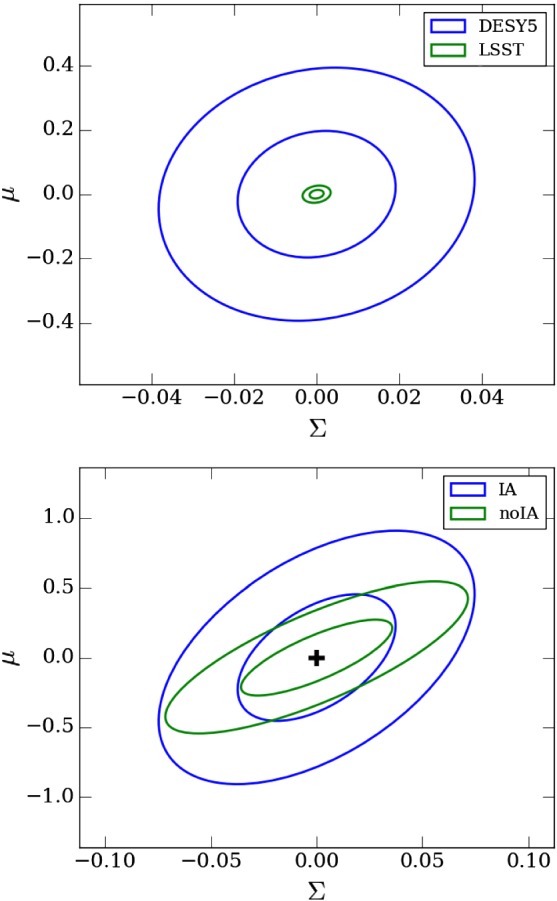
“They found that ignoring the effect of calibration bias or photometric redshift bias does affect significantly the constraints on MG parameters.”
§ Testing general relativity in cosmology > Systematic effects in cosmological probes and degeneracies with modifications to GR
What the sources say
- Disputedcites Ferté et al. (2017) matched to “Testing gravity on cosmological scales with cosmic shear, cosmic microwave background anisotropies, and redshift-space distortions” (2017) sourceExperimental — accuracy not yet measured
The ‘Impact of systematics’ section (p. 4) says the opposite: ignoring shear calibration bias or photometric redshift bias does not significantly affect constraints on the modified-gravity parameters Σ₀ and µ₀. It identifies intrinsic alignment, rather than either bias, as shifting the constraints. (LLM, conf=0.95)
Checked by a reasoning model — may be wrong.
plainstates a cause- Asserted: passes — The authors put it forward as true.
- Checkable: passes — It can be checked against evidence.
- Load-bearing: passes — The paper’s conclusions depend on it.
- Based: passes — The paper gives a reason why it holds.
- Disputed
The cited sources that could be checked couldn’t confirm or dispute this claim.
In the paper
“These seed fluctuations would have originated from microscopic quantum fluctuations that have been blown up to macroscopic scales by cosmic inflation (Guth 1981; Bardeen et al. 1983; Albrecht and Steinhardt 1982).”
§ Testing general relativity in cosmology > The standard model of cosmology > The inhomogeneous lumpy universe and the growth of large-scale structure
What the sources say
- Could not verifycites Guth 1981 matched to “Inflationary universe: A possible solution to the horizon and flatness problems” (1981) sourceExperimental — accuracy not yet measured
The passages on exponential expansion and inhomogeneities (indexed as Abstract; page unavailable) discuss inflation and random bubble formation, but do not identify microscopic quantum fluctuations as the origin of seed fluctuations. Searches for quantum fluctuations, density perturbations, and seed fluctuations found no passage making that connection. (LLM, conf=0.75)
- Not checked — no full text of the sourcecites Bardeen et al. 1983 matched to “Spontaneous creation of almost scale-free density perturbations in an inflationary universe” (1983) source
- Not checked — no full text of the sourcecites Albrecht and Steinhardt 1982 matched to “Cosmology for Grand Unified Theories with Radiatively Induced Symmetry Breaking” (1982) source
hedgedstates a cause- Asserted: passes — The authors put it forward as true.
- Checkable: passes — It can be checked against evidence.
- Load-bearing: unclear — It is unclear whether the paper’s conclusions depend on it.
- Based: passes — The paper gives a reason why it holds.
- Could not verify
Every source the paper cites for this claim was checked and supports it.
In the paper
“it has established very stringent constraints at the level of the solar system that any gravity theory must pass.”
§ Testing general relativity in cosmology > Introduction
What the sources say
- Supportedcites Will 2014 matched to “The Confrontation between General Relativity and Experiment” (2014) source
In “Tests of the strong equivalence principle” (page unavailable), the review describes solar-system experiments that test effects expected in many metric theories of gravity. It also calls the solar-system Cassini bound on a scalar-tensor parameter “very tight” and notes that alternative theories seek to preserve GR’s solar-system phenomenology. Together, these support the claim that gravity theories face stringent solar-system constraints. (LLM, conf=0.90)
boostedstates a cause- Asserted: passes — The authors put it forward as true.
- Checkable: passes — It can be checked against evidence.
- Load-bearing: passes — The paper’s conclusions depend on it.
- Based: passes — The paper gives a reason why it holds.
- Supported
The cited sources that could be checked couldn’t confirm or dispute this claim.
In the paper
“The standard picture of structure formation in the universe is that structures have grown by gravitational infall and clustering from primordial small fluctuations in the matter density field.”
§ Testing general relativity in cosmology > The standard model of cosmology > The inhomogeneous lumpy universe and the growth of large-scale structure
What the sources say
- Could not verifycites Guth 1981 matched to “Inflationary universe: A possible solution to the horizon and flatness problems” (1981) sourceExperimental — accuracy not yet measured
The Introduction and Conclusion passages discuss the early universe’s homogeneity, horizon and flatness problems, and possible inhomogeneity from inflationary bubble formation. Searches for gravitational clustering, primordial density fluctuations, and galaxy formation found no passage in our copy describing the claimed mechanism of structure formation. (LLM, conf=0.73)
- Not checked — no full text of the sourcecites Bardeen et al. 1983 matched to “Spontaneous creation of almost scale-free density perturbations in an inflationary universe” (1983) source
- Not checked — no full text of the sourcecites Albrecht and Steinhardt 1982 matched to “Cosmology for Grand Unified Theories with Radiatively Induced Symmetry Breaking” (1982) source
plainstates a cause- Asserted: passes — The authors put it forward as true.
- Checkable: passes — It can be checked against evidence.
- Load-bearing: unclear — It is unclear whether the paper’s conclusions depend on it.
- Based: passes — The paper gives a reason why it holds.
- Could not verify
219 more claims · 33 with their cited sources checked
Create a free account to see all 525 claims and to verify the 294 references still open.
- It may state two separate claims as one. 223
- Probably not a substantial claim. 125
- The quote only partly states this claim. 15
Citations
Cites
Items 401–600 of 1,146
Cosmology of the Lifshitz universe
Calcagni, G. (2009) · Journal of High Energy Physics · doi:10.1088/1126-6708/2009/09/112 · Cited by 264
Lorentz symmetry breaking as a quantum field theory regulator
Visser, M. (2009) · Physical Review D · doi:10.1103/physrevd.80.025011 · Cited by 264
Report of the Dark Energy Task Force
Albrecht, A., Bernstein, G., Cahn, R., Freedman, W. L., Hewitt, J., Hu, W., Huth, J., Kamionkowski, M., Kolb, E. W., Knox, L., et al. (2006) · doi:10.2172/897600 · Cited by 262
Lombriser, L., & Lima, N. A. (2017) · Physics Letters B · doi:10.1016/j.physletb.2016.12.048 · Cited by 261 · cited 1×
“Indeed, the scientific community was well-prepared to exploit such an event since a number of papers had already studied the implications that can be drawn from comparing the propagation of gravitational and electromagnetic waves (Amendola et al, 2013; Nishizawa and Nakamura, 2014; Amendola et al, 2014; Linder, 2014;…”
BackgroundGeneral covariance in quantum gravity at a Lifshitz point
Hořava, P., & Melby-Thompson, C. M. (2010) · Physical Review D · doi:10.1103/physrevd.82.064027 · Cited by 261
Rham, C. D., & Tolley, A. J. (2010) · Journal of Cosmology and Astroparticle Physics · doi:10.1088/1475-7516/2010/05/015 · Cited by 260
General Relativity and Flat Space. I
Rosen, N. (1940) · Physical Review · doi:10.1103/physrev.57.147 · Cited by 259
Hawking, S. W., Hertog, T., & Reall, H. S. (2000) · Physical Review D · doi:10.1103/physrevd.62.043501 · Cited by 259
Gravitational waves from inflation on the brane
Langlois, D., Maartens, R., & Wands, D. (2000) · Physics Letters B · doi:10.1016/s0370-2693(00)00957-6 · Cited by 258
Gravitational Lensing Effect on Cosmic Microwave Background Anisotropies: A Power Spectrum Approach
Seljak, U. (1996) · The Astrophysical Journal · doi:10.1086/177218 · Cited by 257
Degravitation of the cosmological constant and graviton width
Dvali, G., Hofmann, S., & Khoury, J. (2007) · Physical Review D · doi:10.1103/physrevd.76.084006 · Cited by 254
Scalar-tensor theories and modified gravity in the wake of GW170817
Langlois, D., Saito, R., Yamauchi, D., & Noui, K. (2018) · Physical Review D · doi:10.1103/physrevd.97.061501 · Cited by 254
Cosmic acceleration from Abelian symmetry breaking
Tasinato, G. (2014) · Journal of High Energy Physics · doi:10.1007/jhep04(2014)067 · Cited by 253
Gómez-Valent, A., & Amendola, L. (2018) · Journal of Cosmology and Astroparticle Physics · doi:10.1088/1475-7516/2018/04/051 · Cited by 251
Mimetic gravity: a review of recent developments and applications to cosmology and astrophysics
Sebastiani, L., Vagnozzi, S., & Myrzakulov, R. (2016) · arXiv · doi:10.48550/arxiv.1612.08661 · Cited by 251
Causal field theory with an infinite speed of sound
Afshordi, N., Chung, D. J. H., & Geshnizjani, G. (2007) · Physical Review D · doi:10.1103/physrevd.75.083513 · Cited by 250
The effective theory of quintessence: the w< −1 side unveiled
Creminelli, P., D'Amico, G., Noreña, J., & Vernizzi, F. (2009) · Journal of Cosmology and Astroparticle Physics · doi:10.1088/1475-7516/2009/02/018 · Cited by 250
The phenomenology of Dvali–Gabadadze–Porrati cosmologies
Lue, A. (2006) · Physics Reports · doi:10.1016/j.physrep.2005.10.007 · Cited by 249
Izotov, Y. I., Thuan, T. X., & Guseva, N. G. (2014) · Monthly Notices of the Royal Astronomical Society · doi:10.1093/mnras/stu1771 · Cited by 248
Fosalba, P., Gaztaaga, E., & Castander, F. J. (2003) · The Astrophysical Journal · doi:10.1086/379848 · Cited by 247
Hořava-Lifshitz gravity: a status report
Sotiriou, T. P. (2011) · Journal of Physics: Conference Series · doi:10.1088/1742-6596/283/1/012034 · Cited by 247
Okumura, T., Hikage, C., Totani, T., Tonegawa, M., Okada, H., Glazebrook, K., Blake, C., Ferreira, P. G., More, S., Taruya, A., et al. (2016) · Publications of the Astronomical Society of Japan · doi:10.1093/pasj/psw029 · Cited by 245
Milgrom, M. (2009) · Physical Review D · doi:10.1103/physrevd.80.123536 · Cited by 243
Matter instability in modified gravity
Faraoni, V. (2006) · Physical Review D · doi:10.1103/physrevd.74.104017 · Cited by 242
Felice, A. D., & Tsujikawa, S. (2012) · Journal of Cosmology and Astroparticle Physics · doi:10.1088/1475-7516/2012/02/007 · Cited by 241
Making the Case for Conformal GravityPreprint
Mannheim, P. D. (2011) · Cited by 241
Quantizing fourth-order gravity theories: The functional integral
Barth, N. H., & Christensen, S. M. (1983) · Physical Review D · doi:10.1103/physrevd.28.1876 · Cited by 238
De Felice, A., Kobayashi, T., & Tsujikawa, S. (2011) · Physics Letters B · doi:10.1016/j.physletb.2011.11.028 · Cited by 236
Structure formation in the Dvali–Gabadadze–Porrati cosmological model
Koyama, K., & Maartens, R. (2006) · Journal of Cosmology and Astroparticle Physics · doi:10.1088/1475-7516/2006/01/016 · Cited by 235
Analytic Solutions in Nonlinear Massive Gravity
Koyama, K., Niz, G., & Tasinato, G. (2011) · Physical Review Letters · doi:10.1103/physrevlett.107.131101 · Cited by 233
(2018) · doi:10.1103/physrevd.97.103503 · Cited by 233
Effective field theory of cosmic acceleration: An implementation in CAMB
Hu, B., Raveri, M., Frusciante, N., & Silvestri, A. (2014) · Physical Review D · doi:10.1103/physrevd.89.103530 · Cited by 231
The Morphology of Type IA Supernovae Light Curves
Hamuy, M., Phillips, M. M., Suntzeff, N. B., Schommer, R. A., Maza, J., Smith, R. C., Lira, P., & Aviles, R. (1996) · The Astronomical Journal · doi:10.1086/118193 · Cited by 231
Blake, C., Davis, T., Poole, G. B., Parkinson, D., Brough, S., Colless, M., Contreras, C., Couch, W., Croom, S., Drinkwater, M. J., et al. (2011) · Monthly Notices of the Royal Astronomical Society · doi:10.1111/j.1365-2966.2011.19077.x · Cited by 231
Nonsingular exponential gravity: A simple theory for early- and late-time accelerated expansion
Elizalde, E., Nojiri, S., Odintsov, S. D., Sebastiani, L., & Zerbini, S. (2011) · Physical Review D · doi:10.1103/physrevd.83.086006 · Cited by 229
Anisotropic Stress as a Signature of Nonstandard Propagation of Gravitational Waves
Saltas, I. D., Sawicki, I., Amendola, L., & Kunz, M. (2014) · Physical Review Letters · doi:10.1103/physrevlett.113.191101 · Cited by 229 · cited 1×
“, αT = 0) and its consequences for the slip parameter (Saltas et al. 2014; Sawicki et al. 2017), the study Linder (2018) considered scalar–tensor models where the slip parameter is identically zero.”
BackgroundNesseris, S., Pantazis, G., & Perivolaropoulos, L. (2017) · Physical Review D · doi:10.1103/physrevd.96.023542 · Cited by 229
(1921) · Cited by 228
Einstein-æther gravity: a status report
Jacobson, T. (2008) · Proceedings of From Quantum to Emergent Gravity: Theory and Phenomenology — PoS(QG-Ph) · doi:10.22323/1.043.0020 · Cited by 228
Scale-invariant cosmological perturbations from Hořava-Lifshitz gravity without inflation
Mukohyama, S. (2009) · Journal of Cosmology and Astroparticle Physics · doi:10.1088/1475-7516/2009/06/001 · Cited by 226
Kaiser, N. (1996) · CERN Document Server (European Organization for Nuclear Research) · Cited by 225
Cosmic microwave weak lensing data as a test for the dark universe
Calabrese, E., Slosar, A., Melchiorri, A., Smoot, G. F., & Zahn, O. (2008) · Physical Review D · doi:10.1103/physrevd.77.123531 · Cited by 224
Chamseddine, A. H., Mukhanov, V., & Vikman, A. (2014) · Journal of Cosmology and Astroparticle Physics · doi:10.1088/1475-7516/2014/06/017 · Cited by 224
A bi-metric theory of gravitation
Rosen, N. (1973) · General Relativity and Gravitation · doi:10.1007/bf01215403 · Cited by 224
Oka, A., Saito, S., Nishimichi, T., Taruya, A., & Yamamoto, K. (2014) · Monthly Notices of the Royal Astronomical Society · doi:10.1093/mnras/stu111 · Cited by 223
Strong interactions and exact solutions in nonlinear massive gravity
Koyama, K., Niz, G., & Tasinato, G. (2011) · Physical Review D · doi:10.1103/physrevd.84.064033 · Cited by 223
Testing gravity with CAMB and CosmoMC
Hojjati, A., Pogosian, L., & Zhao, G.-B. (2011) · Journal of Cosmology and Astroparticle Physics · doi:10.1088/1475-7516/2011/08/005 · Cited by 222
Nonlocal gravity and dark energy
Maggiore, M., & Mancarella, M. (2014) · Physical Review D · doi:10.1103/physrevd.90.023005 · Cited by 221
Linder, E. V. (2009) · Physical Review D · doi:10.1103/physrevd.80.123528 · Cited by 221
More on ghosts in the Dvali-Gabadaze-Porrati model
Gorbunov, D., Koyama, K., & Sibiryakov, S. (2006) · Physical Review D · doi:10.1103/physrevd.73.044016 · Cited by 220
Median Statistics,H0, and the Accelerating Universe
Gott III, J. R., Vogeley, M. S., Podariu, S., & Ratra, B. (2001) · The Astrophysical Journal · doi:10.1086/319055 · Cited by 219
Derivative self-interactions for a massive vector field
Beltrán Jiménez, J., & Heisenberg, L. (2016) · Physics Letters B · doi:10.1016/j.physletb.2016.04.017 · Cited by 218
Correlation of CMB with large-scale structure. II. Weak lensing
Hirata, C. M., Ho, S., Padmanabhan, N., Seljak, U., & Bahcall, N. A. (2008) · Physical Review D · doi:10.1103/physrevd.78.043520 · Cited by 217
Unified description of screened modified gravity
Brax, P., Davis, A.-C., Li, B., & Winther, H. A. (2012) · Physical Review D · doi:10.1103/physrevd.86.044015 · Cited by 216
The Phenomenology of Dvali-Gabadadze-Porrati Cosmologies
Lue, A. (2005) · CERN Document Server (European Organization for Nuclear Research) · Cited by 216
Singularity Problem withf(R)Models for Dark Energy
Frolov, A. V. (2008) · Physical Review Letters · doi:10.1103/physrevlett.101.061103 · Cited by 216
de Rham, C., Deskins, J. T., Tolley, A. J., & Zhou, S.-Y. (2017) · Reviews of Modern Physics · doi:10.1103/revmodphys.89.025004 · Cited by 216
Gravitational lensing effect on the fluctuations of the cosmic background radiation
Blanchard, A., & Schneider, J. M. (1987) · Cited by 216
Relic gravity waves from braneworld inflation
Sahni, V., Sami, M., & Souradeep, T. (2001) · Physical Review D · doi:10.1103/physrevd.65.023518 · Cited by 215
Bamba, K., & Odintsov, S. D. (2008) · Journal of Cosmology and Astroparticle Physics · doi:10.1088/1475-7516/2008/04/024 · Cited by 215
Planck 2013 results. XIX. The integrated Sachs-Wolfe effect
Ade, P. A. R., Aghanim, N., Armitage-Caplan, C., Arnaud, M., Ashdown, M., Atrio-Barandela, F., Aumont, J., Baccigalupi, C., Banday, A. J., Barreiro, R. B., et al. (2014) · Astronomy and Astrophysics · doi:10.1051/0004-6361/201321526 · Cited by 214
Dark Energy versus Modified Gravity
Kunz, M., & Sapone, D. (2007) · Physical Review Letters · doi:10.1103/physrevlett.98.121301 · Cited by 214
General relativity with spin and torsion and its deviations from Einstein's theory
Hehl, F. W., von der Heyde, P., & Kerlick, G. D. (1974) · Physical Review D · doi:10.1103/physrevd.10.1066 · Cited by 213
Bridle, S., & King, L. J. (n.d.) · UCL Discovery (University College London) · Cited by 213
Saridakis, E. N. (2010) · The European Physical Journal C · doi:10.1140/epjc/s10052-010-1294-6 · Cited by 209
Lower bound on the propagation speed of gravity from gravitational Cherenkov radiation
Moore, G. D., & Nelson, A. E. (2001) · Journal of High Energy Physics · doi:10.1088/1126-6708/2001/09/023 · Cited by 208
Diluting the cosmological constant in infinite volume extra dimensions
Dvali, G., Gabadadze, G., & Shifman, M. (2003) · Physical Review D · doi:10.1103/physrevd.67.044020 · Cited by 207 · cited 1×
“Indeed, just a few years after GR was introduced, Weyl gravity was proposed by Weyl (1918), and so were the theories of Eddington (1924), Cartan (1922b) and Brans and Dicke (1961), and many others.”
BackgroundGravitational-wave luminosity distance in modified gravity theories
Belgacem, E., Dirian, Y., Foffa, S., & Maggiore, M. (2018) · Physical Review D · doi:10.1103/physrevd.97.104066 · Cited by 207
Nolta, M. R., Wright, E. L., Page, L., Bennett, C. L., Halpern, M., Hinshaw, G., Jarosik, N., Kogut, A., Limon, M., Meyer, S. S., et al. (2004) · The Astrophysical Journal · doi:10.1086/386536 · Cited by 205
Ellis, G. F. R., & Elst, H. (1999) · Theoretical and Observational Cosmology · doi:10.1007/978-94-011-4455-1_1 · Cited by 203
The Scalar-Tensor Theory of Gravitation
Fujii, Y., & Maeda, K.-I. (2003) · Classical and Quantum Gravity · doi:10.1088/0264-9381/20/20/601 · Cited by 203
de la Torre, S., Guzzo, L., Peacock, J. A., Branchini, E., Iovino, A., Granett, B. R., Abbas, U., Adami, C., Arnouts, S., Bel, J., et al. (2013) · arXiv (Cornell University) · doi:10.48550/arxiv.1303.2622 · Cited by 201
Cosmological Model Predictions for Weak Lensing: Linear and Nonlinear Regimes
Jain, B., Seljak, U. (.-S. C. F. A., & Max-Planck-Institut fuer Astrophysik, G. (. (1996) · OpenGrey (Institut de l'Information Scientifique et Technique) · Cited by 201
General brane cosmologies and their global spacetime structure
Bowcock, P., Charmousis, C., & Gregory, R. (2000) · CERN Document Server (European Organization for Nuclear Research) · Cited by 201
KiDS-450: testing extensions to the standard cosmological model
Joudaki, S., Mead, A., Blake, C., Choi, A., de Jong, J., Erben, T., Fenech Conti, I., Herbonnet, R., Heymans, C., Hildebrandt, H., et al. (2017) · Monthly Notices of the Royal Astronomical Society · doi:10.1093/mnras/stx998 · Cited by 200
N-body simulations forf(R)gravity using a self-adaptive particle-mesh code
Zhao, G.-B., Li, B., & Koyama, K. (2011) · Physical Review D · doi:10.1103/physrevd.83.044007 · Cited by 198
Dark matter as integration constant in Hořava-Lifshitz gravity
Mukohyama, S. (2009) · Physical Review D · doi:10.1103/physrevd.80.064005 · Cited by 198
Reconstructing projected matter density power spectrum from cosmic microwave background
Zaldarriaga, M., & Seljak, U. (1999) · Physical Review D · doi:10.1103/physrevd.59.123507 · Cited by 196 · cited 2×
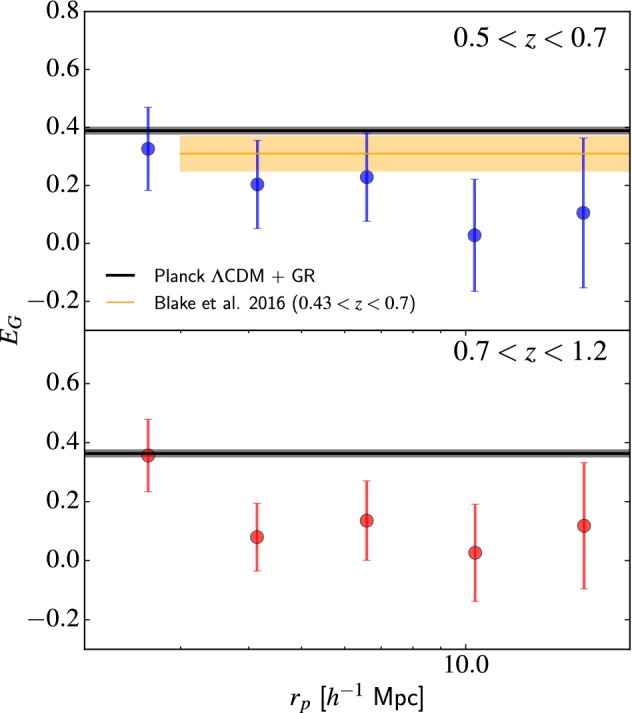
“For GRΛCDM, EG is independent of length scale and is given by Zhang et al. (2007)”
MethodAn Early Proposal of "Brane World"
Akama, K. (2000) · arXiv · doi:10.48550/arxiv.hep-th/0001113 · Cited by 196
Modified gravitational-wave propagation and standard sirens
Belgacem, E., Dirian, Y., Foffa, S., & Maggiore, M. (2018) · Physical Review D · doi:10.1103/physrevd.98.023510 · Cited by 195
Galileon gravity in light of ISW, CMB, BAO and H0data
Renk, J., Zumalacárregui, M., Montanari, F., & Barreira, A. (2017) · Journal of Cosmology and Astroparticle Physics · doi:10.1088/1475-7516/2017/10/020 · Cited by 193
Solar system experiments do not yet veto modified gravity models
Faraoni, V. (2006) · Physical Review D · doi:10.1103/physrevd.74.023529 · Cited by 191
Steep inflation: Ending braneworld inflation by gravitational particle production
Copeland, E. J., Liddle, A. R., & Lidsey, J. E. (2001) · Physical Review D · doi:10.1103/physrevd.64.023509 · Cited by 191
Dynamical dark energy: Current constraints and forecasts
Upadhye, A., Ishak, M., & Steinhardt, P. J. (2005) · Physical Review D · doi:10.1103/physrevd.72.063501 · Cited by 191
Self-citationSpeed of gravitational waves and the fate of scalar-tensor gravity
Bettoni, D., Ezquiaga, J. M., Hinterbichler, K., & Zumalacárregui, M. (2017) · Physical Review D · doi:10.1103/physrevd.95.084029 · Cited by 189
Cosmographic bounds on the cosmological deceleration-acceleration transition redshift inf(R)gravity
Capozziello, S., Farooq, O., Luongo, O., & Ratra, B. (2014) · Physical Review D · doi:10.1103/physrevd.90.044016 · Cited by 189
Charmousis, C., Gregory, R., Kaloper, N., & Padilla, A. (2006) · Journal of High Energy Physics · doi:10.1088/1126-6708/2006/10/066 · Cited by 188
ASTROPHYSICAL TESTS OF MODIFIED GRAVITY: CONSTRAINTS FROM DISTANCE INDICATORS IN THE NEARBY UNIVERSE
Jain, B., Vikram, V., & Sakstein, J. (2013) · The Astrophysical Journal · doi:10.1088/0004-637x/779/1/39 · Cited by 188
CFHTLenS: testing the laws of gravity with tomographic weak lensing and redshift-space distortions
Simpson, F., Heymans, C., Parkinson, D., Blake, C., Kilbinger, M., Benjamin, J., Erben, T., Hildebrandt, H., Hoekstra, H., Kitching, T. D., et al. (2013) · Monthly Notices of the Royal Astronomical Society · doi:10.1093/mnras/sts493 · Cited by 187
Hamiltonian analysis of higher derivative scalar-tensor theories
Langlois, D., & Noui, K. (2016) · Journal of Cosmology and Astroparticle Physics · doi:10.1088/1475-7516/2016/07/016 · Cited by 185
Effective description of higher-order scalar-tensor theories
Langlois, D., Mancarella, M., Noui, K., & Vernizzi, F. (2017) · Journal of Cosmology and Astroparticle Physics · doi:10.1088/1475-7516/2017/05/033 · Cited by 185
Supernovae, CMB, and gravitational leakage into extra dimensions
Deffayet, C., Landau, S. J., Raux, J., Zaldarriaga, M., & Astier, P. (2002) · Physical Review D · doi:10.1103/physrevd.66.024019 · Cited by 185
Current constraints on the cosmic growth history
Bean, R., & Tangmatitham, M. (2010) · Physical Review D · doi:10.1103/physrevd.81.083534 · Cited by 184
The tensor-vector-scalar theory and its cosmology
Skordis, C. (2009) · Classical and Quantum Gravity · doi:10.1088/0264-9381/26/14/143001 · Cited by 184
The Atacama Cosmology Telescope: likelihood for small-scale CMB data
Dunkley, J., Calabrese, E., Sievers, J., Addison, G. E., Battaglia, N., Battistelli, E. S., Bond, J. R., Das, S., Devlin, M. J., Dünner, R., et al. (2013) · Journal of Cosmology and Astroparticle Physics · doi:10.1088/1475-7516/2013/07/025 · Cited by 184
Bassett, B. A., & Hložek, R. (2010) · Cambridge University Press eBooks · doi:10.1017/cbo9781139193627.010 · Cited by 183
Ade, P. A. R., Akiba, Y., Anthony, A. E., Arnold, K., Atlas, M., Barron, D., Boettger, D., Borrill, J., Chapman, S., Chinone, Y., et al. (2014) · Physical Review Letters · doi:10.1103/physrevlett.113.021301 · Cited by 182
Puchwein, E., Baldi, M., & Springel, V. (2013) · Monthly Notices of the Royal Astronomical Society · doi:10.1093/mnras/stt1575 · Cited by 182 · cited 1×
“This is the case also for other systematics such as baryonic feedback effects that can enhance growth of structure and be degenerate with some modifications to gravity as reflected on the matter power spectrum at smaller scales (Puchwein et al. 2013).”
BackgroundCosmology in generalized Proca theories
Felice, A. D., Heisenberg, L., Kase, R., Mukohyama, S., Tsujikawa, S., & Zhang, Y.-L. (2016) · Journal of Cosmology and Astroparticle Physics · doi:10.1088/1475-7516/2016/06/048 · Cited by 182
Planck 2015 results: XXI. The integrated Sachs-Wolfe effect
Planck Collaboration, Ade, P. A. R., Aghanim, N., Arnaud, M., Ashdown, M., Aumont, J., Baccigalupi, C., Banday, A. J., Barreiro, R. B., Bartolo, N., et al. (2016) · Astronomy & Astrophysics · doi:10.1051/0004-6361/201525831 · Cited by 182
Recent developments in bimetric theory
Schmidt-May, A., & von Strauss, M. (2016) · Repository for Publications and Research Data (ETH Zurich) · doi:10.3929/ethz-b-000114983 · Cited by 181
Accelerated expansion from ghost-free bigravity: a statistical analysis with improved generality
Akrami, Y., Koivisto, T. S., & Sandstad, M. (2013) · Journal of High Energy Physics · doi:10.1007/jhep03(2013)099 · Cited by 179
Testing general relativity with current cosmological data
Daniel, S. F., Linder, E. V., Smith, T. L., Caldwell, R. R., Cooray, A., Leauthaud, A., & Lombriser, L. (2010) · Physical Review D · doi:10.1103/physrevd.81.123508 · Cited by 177
Dark energy and cosmological solutions in second-order string gravity
Calcagni, G., Tsujikawa, S., & Sami, M. (2005) · Classical and Quantum Gravity · doi:10.1088/0264-9381/22/19/011 · Cited by 176
Perturbations in massive gravity cosmology
Comelli, D., Crisostomi, M., & Pilo, L. (2012) · Journal of High Energy Physics · doi:10.1007/jhep06(2012)085 · Cited by 176
Recent developments in bimetric theory
Schmidt-May, A., & Strauss, M. V. (2016) · Journal of Physics A: Mathematical and Theoretical · doi:10.1088/1751-8113/49/18/183001 · Cited by 176
(2017) · Utrecht University Repository (Utrecht University) · Cited by 176
Effect of the Cosmological Constant on Largescale Anisotropies in the Microwave Background
Kofman, L. A., & Старобинский, А. А. (1985) · Astronomy Letters · Cited by 175
On the Growth of Perturbations as a Test of Dark Energy and Gravity
Bertschinger, E. (2006) · The Astrophysical Journal · doi:10.1086/506021 · Cited by 175
Galaxy Alignments: Observations and Impact on Cosmology
Kirk, D., Brown, M. L., Hoekstra, H., Joachimi, B., Kitching, T. D., Mandelbaum, R., Sifón, C., Cacciato, M., Choi, A., Kiessling, A., et al. (2015) · Space Science Reviews · doi:10.1007/s11214-015-0213-4 · Cited by 175
Effective field theory of cosmic acceleration: Constraining dark energy with CMB data
Raveri, M., Hu, B., Frusciante, N., & Silvestri, A. (2014) · Physical Review D · doi:10.1103/physrevd.90.043513 · Cited by 175
Nonlocal action for long-distance modifications of gravity theory
Barvinsky, A. O. (2003) · Physics Letters B · doi:10.1016/j.physletb.2003.08.055 · Cited by 175
Okumura, T., Jing, Y. P., & Li, C. (2009) · The Astrophysical Journal · doi:10.1088/0004-637x/694/1/214 · Cited by 173
Hořava gravity at a Lifshitz point: A progress report
Wang, A. (2017) · International Journal of Modern Physics D · doi:10.1142/s0218271817300142 · Cited by 173
hi_class: Horndeski in the Cosmic Linear Anisotropy Solving System
Zumalacárregui, M., Bellini, E., Sawicki, I., Lesgourgues, J., & Ferreira, P. G. (2017) · Journal of Cosmology and Astroparticle Physics · doi:10.1088/1475-7516/2017/08/019 · Cited by 172
The Classification of Spaces Defining Gravitational Fields
Petrov, A. Z. (2000) · General Relativity and Gravitation · doi:10.1023/a:1001910908054 · Cited by 171
Bimetric gravity is cosmologically viable
Akrami, Y., Hassan, S. F., Könnig, F., Schmidt-May, A., & Solomon, A. R. (2015) · Physics Letters B · doi:10.1016/j.physletb.2015.06.062 · Cited by 171 · cited 2×
“These theories have a branch of models that admit a limit in which the Planck mass associated to the second metric is small and any scalar instabilities can be pushed to very early times where they are not observable (Koennig et al. 2014a; Lagos and Ferreira 2014; Cusin et al. 2015a, b, 2016; Akrami et al. 2015; Schmi…”
BackgroundTrautman, A. (2006) · Encyclopedia of Mathematical Physics · doi:10.1016/b0-12-512666-2/00014-6 · Cited by 171
Baker, T., Ferreira, P. G., & Skordis, C. (2013) · Physical Review D · doi:10.1103/physrevd.87.024015 · Cited by 170
Non-Local Modification of Gravity and the Cosmological Constant Problem
Nima Arkani-hamed, A., Dimopoulos, S., Dvali, G., & Gabadadze, G. (2002) · arXiv (Cornell University) · doi:10.48550/arxiv.hep-th/0209227 · Cited by 169
Testing the Landau gauge operator product expansion on the lattice with a〈A2〉condensate
Boucaud, P., Yaouanc, A. L., Leroy, J. P., Micheli, J., Pène, O., & Rodríguez-Quintero, J. (2001) · Physical Review D · doi:10.1103/physrevd.63.114003 · Cited by 169
Generalized Proca action for an Abelian vector field
Allys, E., Peter, P., & Rodríguez, Y. (2016) · Journal of Cosmology and Astroparticle Physics · doi:10.1088/1475-7516/2016/02/004 · Cited by 169
Weyl, H. (1923) · Das Relativitätsprinzip · doi:10.1007/978-3-663-19510-8_11 · Cited by 166
Eigenmode Analysis of Galaxy Redshift Surveys. I. Theory and Methods
Vogeley, M. S., & Szalay, A. S. (1996) · The Astrophysical Journal · doi:10.1086/177399 · Cited by 166
Cosmological perturbations in brane-world theories: Formalism
van de Bruck, C., Dorca, M., Brandenberger, R. H., & Lukas, A. (2000) · Physical Review D · doi:10.1103/physrevd.62.123515 · Cited by 166
Large-scale cosmological perturbations on the brane
Langlois, D., Maartens, R., Sasaki, M., & Wands, D. (2001) · Physical review. D. Particles, fields, gravitation, and cosmology/Physical review. D. Particles and fields · doi:10.1103/physrevd.63.084009 · Cited by 166
Observational constraints on self-accelerating cosmology
Maartens, R., & Majerotto, E. (2006) · Physical Review D · doi:10.1103/physrevd.74.023004 · Cited by 165
Chuang, C.-H., & Wang, Y. (2012) · Monthly Notices of the Royal Astronomical Society · doi:10.1111/j.1365-2966.2012.21565.x · Cited by 165
Constraints on Einstein-aether theory after GW170817
Oost, J., Mukohyama, S., & Wang, A. (2018) · Physical review. D/Physical review. D. · doi:10.1103/physrevd.97.124023 · Cited by 165
Median Statistics and the Hubble Constant
Chen, G., & Ratra, B. (2011) · Publications of the Astronomical Society of the Pacific · doi:10.1086/662131 · Cited by 164
Gauge-invariant gravitational perturbations of maximally symmetric spacetimes
Mukohyama, S. (2000) · Physical Review D · doi:10.1103/physrevd.62.084015 · Cited by 163
Einstein Gravity on the Codimension 2 Brane?
Bostock, P., Gregory, R., Navarro, I., & Santiago, J. (2004) · Physical Review Letters · doi:10.1103/physrevlett.92.221601 · Cited by 163
The hypothesis of locality in relativistic physics
Mashhoon, B. (1990) · Physics Letters A · doi:10.1016/0375-9601(90)90670-j · Cited by 162
On the growth of linear perturbations
Polarski, D., & Gannouji, R. (2008) · Physics Letters B · doi:10.1016/j.physletb.2008.01.032 · Cited by 161
Nonlocal gravity. Conceptual aspects and cosmological predictions
Belgacem, E., Dirian, Y., Foffa, S., & Maggiore, M. (2018) · Journal of Cosmology and Astroparticle Physics · doi:10.1088/1475-7516/2018/03/002 · Cited by 161 · cited 1×
“of recent analyses including Bellini and Zumalacárregui (2015), Bellini et al.”
MethodCascading Gravity: Extending the Dvali-Gabadadze-Porrati Model to Higher Dimension
de Rham, C., Dvali, G., Hofmann, S., Khoury, J., Pujolàs, O., Redi, M., & Tolley, A. J. (2008) · Physical Review Letters · doi:10.1103/physrevlett.100.251603 · Cited by 159
Dynamics of nonlocal cosmology
Koivisto, T. (2008) · Physical Review D · doi:10.1103/physrevd.77.123513 · Cited by 159
Status of dark matter in the universe
Freese, K. (2017) · International Journal of Modern Physics D · doi:10.1142/s0218271817300129 · Cited by 158
Pogosian, L., Silvestri, A., Koyama, K., & Zhao, G.-B. (2010) · Physical Review D · doi:10.1103/physrevd.81.104023 · Cited by 157
Ghosts in the self-accelerating universe
Koyama, K. (2007) · Classical and Quantum Gravity · doi:10.1088/0264-9381/24/24/r01 · Cited by 157
Modified-source gravity and cosmological structure formation
Carroll, S. M., Sawicki, I., Silvestri, A., & Trodden, M. (2006) · New Journal of Physics · doi:10.1088/1367-2630/8/12/323 · Cited by 156
Limits on the number of spacetime dimensions from GW170817
Pardo, K., Fishbach, M., Holz, D. E., & Spergel, D. N. (2018) · Journal of Cosmology and Astroparticle Physics · doi:10.1088/1475-7516/2018/07/048 · Cited by 156 · cited 1×
“(75) and (78) to combine the effect with caution though about some limitations and the need for some accurate simulations as discussed in for example Percival and White (2009). Indeed, other combined models including contributions from nonlinear effects and numerical simulations are used to fully explore RSDmodeling a…”
BackgroundBlake, C., Davis, T. M., Poole, G. B., Parkinson, D., Brough, S., Colless, M., Contreras, C., Couch, W. J., Croom, S. M., Drinkwater, M. J., et al. (2024) · doi:10.25916/sut.26215247.v1 · Cited by 155
Cosmological perturbations in Horava-Lifshitz theory without detailed balance
Wang, A., & Maartens, R. (2010) · Physical Review D · doi:10.1103/physrevd.81.024009 · Cited by 155
Ghosts, instabilities, and superluminal propagation in modified gravity models
Felice, A. D., Hindmarsh, M., & Trodden, M. (2006) · Journal of Cosmology and Astroparticle Physics · doi:10.1088/1475-7516/2006/08/005 · Cited by 155
Detection of the ISW and SZ effects from the CMB-Galaxy correlationPreprint
Fosalba, P., GAZTAÑAGA, E., & Castander, F. J. (2003) · arXiv (Cornell University) · doi:10.48550/arxiv.astro-ph/0307249 · Cited by 154
Mandelbaum, R., Hirata, C. M., Ishak, M., et al. (2005) · CERN Document Server (European Organization for Nuclear Research) · Cited by 154
Self-citationA trouble with Hořava-Lifshitz gravity
Li, M., & Pang, Y. (2009) · Journal of High Energy Physics · doi:10.1088/1126-6708/2009/08/015 · Cited by 153
Practical approach to cosmological perturbations in modified gravity
Silvestri, A., Pogosian, L., & Buniy, R. V. (2013) · Physical Review D · doi:10.1103/physrevd.87.104015 · Cited by 152
Generalized gravity and a ghost
Chiba, T. (2005) · Journal of Cosmology and Astroparticle Physics · doi:10.1088/1475-7516/2005/03/008 · Cited by 152
Cascading gravity and degravitation
de Rham, C., Hofmann, S., Khoury, J., & Tolley, A. J. (2008) · Journal of Cosmology and Astroparticle Physics · doi:10.1088/1475-7516/2008/02/011 · Cited by 150
Observables and unobservables in dark energy cosmologies
Amendola, L., Kunz, M., Motta, M., Saltas, I. D., & Sawicki, I. (2013) · Physical Review D · doi:10.1103/physrevd.87.023501 · Cited by 150
Dirian, Y., Foffa, S., Khosravi, N., Kunz, M., & Maggiore, M. (2014) · Journal of Cosmology and Astroparticle Physics · doi:10.1088/1475-7516/2014/06/033 · Cited by 150 · cited 3×
“From using the flat FLRW perturbed metric in the Newtonian gauge plus linear perturbations of the auxiliary fields U and W , with adiabatic initial conditions, the resulting perturbation evolutions were found to be stable (Dirian et al. 2014).”
MethodInfluentialLimits of quasistatic approximation in modified-gravity cosmologies
Sawicki, I., & Bellini, E. (2015) · Physical Review D · doi:10.1103/physrevd.92.084061 · Cited by 149
Algebraic invariants of the Riemann tensor in a four-dimensional Lorentzian space
Carminati, J., & McLenaghan, R. G. (1991) · Journal of Mathematical Physics · doi:10.1063/1.529470 · Cited by 149
No-Go Theorems for Generalized Chameleon Field Theories
Wang, J., Hui, L., & Khoury, J. (2012) · Physical Review Letters · doi:10.1103/physrevlett.109.241301 · Cited by 149
Vielva, P., Martínez-González, E., & Tucci, M. (2005) · Monthly Notices of the Royal Astronomical Society · doi:10.1111/j.1365-2966.2005.09764.x · Cited by 149
Trace anomaly driven inflation
Hawking, S. W., Hertog, T., & Reall, H. S. (2001) · Physical Review D · doi:10.1103/physrevd.63.083504 · Cited by 148
Challenges to the DGP model from horizon-scale growth and geometry
Fang, W., Wang, S., Hu, W., Haiman, Z., Hui, L., & May, M. (2008) · Physical Review D · doi:10.1103/physrevd.78.103509 · Cited by 147
Resolving cosmological singularities
Chamseddine, A. H., & Mukhanov, V. (2017) · Journal of Cosmology and Astroparticle Physics · doi:10.1088/1475-7516/2017/03/009 · Cited by 147
Keisler, R., Hoover, S., Harrington, N., Henning, J. W., Ade, P. A. R., Aird, K. A., Austermann, J. E., Beall, J. A., Bender, A. N., Benson, B. A., et al. (2015) · The Astrophysical Journal · doi:10.1088/0004-637x/807/2/151 · Cited by 146
Modified gravity N-body code comparison project
Winther, H. A., Schmidt, F., Barreira, A., Arnold, C., Bose, S., Llinares, C., Baldi, M., Falck, B., Hellwing, W. A., Koyama, K., et al. (2015) · Monthly Notices of the Royal Astronomical Society · doi:10.1093/mnras/stv2253 · Cited by 146
Probing modifications of general relativity using current cosmological observations
Zhao, G.-B., Giannantonio, T., Pogosian, L., Silvestri, A., Bacon, D. J., Koyama, K., Nichol, R. C., & Song, Y.-S. (2010) · Physical Review D · doi:10.1103/physrevd.81.103510 · Cited by 146
Self-consistent cosmological simulations of DGP braneworld gravity
Schmidt, F. (2009) · Physical Review D · doi:10.1103/physrevd.80.043001 · Cited by 146
Angus, G. W. (2009) · Monthly Notices of the Royal Astronomical Society · doi:10.1111/j.1365-2966.2008.14341.x · Cited by 145
Lematre, A. G., & Eddington, A. S. (1931) · Monthly Notices of the Royal Astronomical Society · doi:10.1093/mnras/91.5.490 · Cited by 144
Growth of cosmic structure: Probing dark energy beyond expansion
Huterer, D., Kirkby, D., Bean, R., Connolly, A., Dawson, K., Dodelson, S., Evrard, A., Jain, B., Jarvis, M., Linder, E., et al. (2015) · Astroparticle Physics · doi:10.1016/j.astropartphys.2014.07.004 · Cited by 143
Vainshtein mechanism after GW170817
Crisostomi, M., & Koyama, K. (2018) · Physical Review D · doi:10.1103/physrevd.97.021301 · Cited by 143
Can Cosmic Structure Form without Dark Matter?
Dodelson, S., & Liguori, M. (2006) · Physical Review Letters · doi:10.1103/physrevlett.97.231301 · Cited by 142 · cited 1×
“(175), the scalar field energy density is found to track the matter energy density (Dodelson and Liguori 2006; Skordis et al. 2006; Skordis 2009) with”
BackgroundGalileon Gravity in Light of ISW, CMB, BAO and $H_0$ data
Renk, J. J., Zumalacárregui, M., Montanari, F., et al. (2017) · eScholarship (California Digital Library) · doi:10.48550/arxiv.1707.02263 · Cited by 142
Nonlinear evolution of the matter power spectrum in modified theories of gravity
Koyama, K., Taruya, A., & Hiramatsu, T. (2009) · Physical Review D · doi:10.1103/physrevd.79.123512 · Cited by 141
Horndeski: beyond, or not beyond?
Crisostomi, M., Hull, M., Koyama, K., & Tasinato, G. (2016) · Journal of Cosmology and Astroparticle Physics · doi:10.1088/1475-7516/2016/03/038 · Cited by 141
New observational constraints onf(R) gravity from cosmic chronometers
Nunes, R. C., Pan, S., Saridakis, E. N., & Abreu, É. M. C. (2017) · Journal of Cosmology and Astroparticle Physics · doi:10.1088/1475-7516/2017/01/005 · Cited by 141
Constraints on a new post-general relativity cosmological parameter
Caldwell, R., Cooray, A., & Melchiorri, A. (2007) · Physical Review D · doi:10.1103/physrevd.76.023507 · Cited by 140 · cited 2×
“(29) is done indirectly by defining a modified field equation containing the parameter μ(k, a) plus a gravitational slip parameter, η(k, a) (Zhao et al. 2009, 2010; Hojjati et al. 2011; Caldwell et al. 2007; Amendola et al. 2008).”
BackgroundMethodDETERMINING THE HUBBLE CONSTANT FROM HUBBLE PARAMETER MEASUREMENTS
Chen, Y., Kumar, S., & Ratra, B. (2017) · The Astrophysical Journal · doi:10.3847/1538-4357/835/1/86 · Cited by 140
Non-linear cosmological power spectra in real and redshift space
Taylor, A. N., & Hamilton, A. J. S. (1996) · Monthly Notices of the Royal Astronomical Society · doi:10.1093/mnras/282.3.767 · Cited by 140
Relativistic stars in beyond Horndeski theories
Babichev, E., Koyama, K., Langlois, D., Saito, R., & Sakstein, J. (2016) · Classical and Quantum Gravity · doi:10.1088/0264-9381/33/23/235014 · Cited by 140
Solution to the Ghost Problem in Fourth Order Derivative Theories
Mannheim, P. D. (2007) · Foundations of Physics · doi:10.1007/s10701-007-9119-7 · Cited by 139
Brane-world extra dimensions in light of GW170817
Visinelli, L., Bolis, N., & Vagnozzi, S. (2018) · Physical Review D · doi:10.1103/physrevd.97.064039 · Cited by 139
Beyond generalized Proca theories
Heisenberg, L., Kase, R., & Tsujikawa, S. (2016) · Physics Letters B · doi:10.1016/j.physletb.2016.07.052 · Cited by 138
Large-scale tests of the Dvali-Gabadadze-Porrati model
Song, Y.-S., Sawicki, I., & Hu, W. (2007) · Physical Review D · doi:10.1103/physrevd.75.064003 · Cited by 137
The impact of intrinsic alignment on current and future cosmic shear surveys
Krause, E., Eifler, T., & Blazek, J. (2016) · Monthly Notices of the Royal Astronomical Society · doi:10.1093/mnras/stv2615 · Cited by 136
Massive symmetric tensor field in spacetimes with a positive cosmological constant
Higuchi, A. (1989) · Nuclear Physics B · doi:10.1016/0550-3213(89)90507-5 · Cited by 136
Baldauf, T., Smith, R. E., Seljak, U., & Mandelbaum, R. (2010) · Physical Review D · doi:10.1103/physrevd.81.063531 · Cited by 136
Gravitational waves from inflation on the brane
Langlois, D., Maartens, R., & Wands, D. (2000) · CERN Document Server (European Organization for Nuclear Research) · Cited by 136
Can codimension-two branes solve the cosmological constant problem?
Vinet, J., & Cline, J. M. (2004) · Physical Review D · doi:10.1103/physrevd.70.083514 · Cited by 135
The Genesis of General Relativity
Renn, J., Smeenk, C., Schemmel, M., et al. (2007) · Springer eBooks · doi:10.1007/978-1-4020-4000-9 · Cited by 135
Horava-Lifshitz Dark EnergyPreprint
Saridakis, E. N. (2009) · Cited by 135
Brane cosmological perturbations
Langlois, D. (2000) · Physical Review D · doi:10.1103/physrevd.62.126012 · Cited by 134
Probing Gravity with Spacetime Sirens
Deffayet, C., & Menou, K. (2007) · The Astrophysical Journal · doi:10.1086/522931 · Cited by 134
Can we see Lorentz-violating vector fields in the CMB?
Lim, E. A. (2005) · Physical Review D · doi:10.1103/physrevd.71.063504 · Cited by 133
Cosmology of codimension-two braneworlds
Cline, J. M., Descheneau, J., Giovannini, M., & Vinet, J. (2003) · Journal of High Energy Physics · doi:10.1088/1126-6708/2003/06/048 · Cited by 133 · cited 1×
“These higher co-dimensional or cascading gravitymodels have been useful in trying to address the cosmological constant problem (Carroll and Guica 2003; Cline et al. 2003;Vinet andCline 2004;Aghababaie et al. 2004;Dvali et al. 2003b;Gabadadze and Shifman 2004) by for example using a degravitation mechanism for the cosm…”
BackgroundPhantom dark energy from nonlocal infrared modifications of general relativity
Maggiore, M. (2014) · Physical Review D · doi:10.1103/physrevd.89.043008 · Cited by 133
Observational future of cosmological scalar-tensor theories
Alonso, D., Bellini, E., Ferreira, P. G., & Zumalacárregui, M. (2017) · Physical Review D · doi:10.1103/physrevd.95.063502 · Cited by 133
Nonlocal gravity simulates dark matter
Hehl, F. W., & Mashhoon, B. (2009) · Physics Letters B · doi:10.1016/j.physletb.2009.02.033 · Cited by 132
Beltrán Jiménez, J., Piazza, F., & Velten, H. (2016) · Physical Review Letters · doi:10.1103/physrevlett.116.061101 · Cited by 129
Astrophysical probes of the Vainshtein mechanism: Stars and galaxies
Koyama, K., & Sakstein, J. (2015) · Physical Review D · doi:10.1103/physrevd.91.124066 · Cited by 129
Thermodynamics and classification of cosmological models in the Horava-Lifshitz theory of gravity
Wang, A., & Wu, Y. (2009) · Journal of Cosmology and Astroparticle Physics · doi:10.1088/1475-7516/2009/07/012 · Cited by 129
Cuscuton cosmology: Dark energy meets modified gravity
Afshordi, N., Chung, D. J. H., Doran, M., & Geshnizjani, G. (2007) · Physical Review D · doi:10.1103/physrevd.75.123509 · Cited by 129
Observational constraints on dark radiation in brane cosmology
Ichiki, K., Yahiro, M., Kajino, T., Orito, M., & Mathews, G. J. (2002) · Physical review. D. Particles, fields, gravitation, and cosmology/Physical review. D. Particles and fields · doi:10.1103/physrevd.66.043521 · Cited by 129
Research works printed but not linked: 11
- Cartan E (1922a) Sur les équations de la gravitation d’Einstein. J Math Pures Appl 1922(1):141–202
- Debever R Le rayonnement gravitationnel. le tenseur de Riemann en relativité générale Cah Phys 1964 168 303
- Eddington A The mathematical theory of general relativity 1924 Cambridge CUP
- Ellis GFR Schatzman E Relativistic cosmology Cargèse lectures in physics 1973 New York Gordon and Breach 1
- Klein O Quantentheorie und Fünfdimensionale Relativitätstheorie Z Phys A 1926 37 895?906
- Könnig F, Akrami Y, Amendola L, Motta M, Solomon A (2014) Stable and unstable cosmological models in bimetric massive gravity. Phys Rev D 90:124014. 10.1103/PhysRevD.90.124014. arXiv:1407.4331 · DOI · Paper page
- Lifshitz EM On the theory of second-order phase transitions I Zh Eksp Teor Fiz 1941 11 255
- Misner CW Thorne KS Wheeler JA Gravitation 1973 Princeton Princeton University Press
- Peacock JA Cosmological physics 1999 Cambridge Cambridge University Press
- Schwarzschild K Über das Gravitationsfeld eines Massenpunktes nach der Einsteinschen Theorie Sitzungsber Koenigl Preuss Akad Wiss 1916 7 189 196
- Segre C Sulla teoria e sulla classificazione delle omografie in uno spazio lineare ad uno numero qualunque di dimensioni Mem R Accad Lincei, Ser 3 1884 XIX 127 148
Cited by
Modified gravity and cosmology
Clifton, T., Ferreira, P. G., Padilla, A., & Skordis, C. (2012) · Physics Reports · doi:10.1016/j.physrep.2012.01.001 · Cited by 4,146
Theory and Experiment in Gravitational Physics
Will, C. M. (2018) · doi:10.1017/9781316338612 · Cited by 3,637
DESI 2024 VI: cosmological constraints from the measurements of baryon acoustic oscillations
Adame, A. G., Aguilar, J., Ahlen, S., Alam, S., Alexander, D. M., Alvarez, M., Alves, O., Anand, A., Andrade, U., Armengaud, E., et al. (2025) · Journal of Cosmology and Astroparticle Physics · doi:10.1088/1475-7516/2025/02/021 · Cited by 1,136
Self-citationChallenges for Λ CDM: An update
Perivolaropoulos, L., & Skara, F. (2022) · New Astronomy Reviews · doi:10.1016/j.newar.2022.101659 · Cited by 902
DESI DR2 results. II. Measurements of baryon acoustic oscillations and cosmological constraints
Abdul Karim, M., Aguilar, J., Ahlen, S., Alam, S., Allen, L., Prieto, C. A., Alves, O., Anand, A., Andrade, U., Armengaud, E., et al. (2025) · Physical Review D · doi:10.1103/tr6y-kpc6 · Cited by 856
Self-citation
Metadata
- Authors
- Ishak, M.
- Affiliations
- The University of Texas at Dallas (US)
- Corresponding author
- Ishak, Mustapha
- ORCID
- Ishak, Mustapha
- Venue
- Living Reviews in Relativity
- Published
- 2018-12-18
- Volume
- 22
- Issue
- 1
- Pages
- 1-1
- ISSN
- 1433-8351 (ISSN-L)
- 2367-3613
- PMC
- PMC6299071
- OpenAlex
- W2809838409
- Cited by
- 449
- References
- 1,256
- Citations by year
- 2026: 28 · 2025: 69 · 2024: 60 · 2023: 46 · 2022: 52 · 2021: 49 · 2020: 70 · 2019: 57 · 2018: 15
- FWCI
- 4.35
- Type
- journal article
- Language
- en
- Open access
- diamond
- doi.org
- Licence
- cc-by
- creativecommons.org/licenses/by/4.0 (tdm)
- creativecommons.org/licenses/by/4.0 (vor)
- Locations
- Living Reviews in Relativity (publishedVersion, cc-by)
- arXiv (Cornell University) (publishedVersion)
- Europe PMC (PubMed Central) (publishedVersion, other-oa)
- PubMed Central (publishedVersion, cc-by)
- PubMed (publishedVersion)
- DOAJ (DOAJ: Directory of Open Access Journals) (submittedVersion, cc-by-sa)
- OSTI OAI (U.S. Department of Energy Office of Scientific and Technical Information) (submittedVersion)
- arXiv (Cornell University)
- Funders
- National Science Foundation (AST-1517768)
- Office of Science (DE-SC0019206)
- Topics
- Physical Sciences › Physics and Astronomy › Astronomy and Astrophysics › Cosmology and Gravitation Theories
- Physical Sciences › Physics and Astronomy › Nuclear and High Energy Physics › Noncommutative and Quantum Gravity Theories
- Physical Sciences › Physics and Astronomy › Astronomy and Astrophysics › Pulsars and Gravitational Waves Research
- Keywords
- tests of general relativity, modified gravity, cosmic acceleration, dark energy, gravitational screening, binary neutron star mergers, precision cosmology
About these checks
Registry, retraction, Cites and statistics results are computed, not judged, with one exception: a printed reference that no index lists is read once by a model before it counts as a citation error. Claims are extracted by a model and kept only when their quote appears verbatim in the text; each cited source is then checked, with a model’s help, for whether it says what the claim relies on. Those verdicts can be wrong — read the claim’s quote and the cited source before relying on one.
The claim verdicts this report counts are experimental: their accuracy is not yet measured.
A language model drew the claims from the paper on 2026-10-10, under version 3 of the claim definition (model deepseek-v4.1-flash, prompt extract-v3).
A second model labelled each claim on 2026-10-10 (model jev-1.13-20260917, definition revision gold-guideline-v0.2).
Cited sources are checked with a language model’s help (gpt-6-sol and qwen3.8-omni-flash).
Statistics and arithmetic are recomputed, not judged.
Confidence bands are shown only for fields calibrated on our annotated test set. None is calibrated yet, so no band is shown.
What counts as a claim ›How we measure confidence ›How we check this ›
Are you an author, or do you see a problem with this page? Request a review
Data sources
Bibliographic data: Semantic Scholar, OpenAlex, Crossref.
Contains information from the Semantic Scholar Academic Graph Datasets, made available under the ODC Attribution License (ODC-BY 1.0).
Semantic Scholar’s data is described in: Kinney, R., et al. (2023). The Semantic Scholar Open Data Platform. arXiv:2301.10140.
