

Testing general relativity in cosmology
Open accessThe DOI matches its Crossref record; 1,143 of the 1,256 references it cites were found in a registry or an index, and 3 are not checked yet; 96 of the 510 sources its claims cite were checked for support.
Abstract
We review recent developments and results in testing general relativity (GR) at cosmological scales. The subject has witnessed rapid growth during the last two decades with the aim of addressing the question of cosmic acceleration and the dark energy associated with it. However, with the advent of precision cosmology, it has also become a well-motivated endeavor by itself to test gravitational physics at cosmic scales. We overview cosmological probes of gravity, formalisms and parameterizations for testing deviations from GR at cosmological scales, selected modified gravity (MG) theories, gravitational screening mechanisms, and computer codes developed for these tests. We then provide summaries of recent cosmological constraints on MG parameters and selected MG models. We supplement these cosmological constraints with a summary of implications from the recent binary neutron star merger event. Next, we summarize some results on MG parameter forecasts with and without astrophysical systematics that will dominate the uncertainties. The review aims at providing an overall picture of the subject and an entry point to students and researchers interested in joining the field. It can also serve as a quick reference to recent results and constraints on testing gravity at cosmological scales.
Verified 2026-11-22 · 3 references not checked yet
Overview
CoChat Summary
TL;DR
This review surveys how general relativity is tested at cosmological scales, emphasizing the split between background expansion/geometry probes and growth-of-structure probes, and how their combination constrains modified gravity. It also summarizes the status of major model classes, current data constraints, the impact of GW170817/GRB170817A, and the role of systematic effects and forecasting for future surveys.
Key findings
- The review argues that cosmology offers two complementary probe classes: expansion/geometry and structure growth; for testing deviations from GR, the growth sector is described as “rather the most useful” because many MG models can mimic the same expansion history as CDM while differing in growth.
- Current data generally remain consistent with GR, but often only at the level of relatively large uncertainties; the paper notes that constraints are tightening and that for upcoming surveys the dominant uncertainty will be systematic rather than statistical.
- Specific examples summarized in the text include:
- TeVeS was ruled out by Planck-based analyses, with one study reporting a best-fit Hubble constant that was “hard to reconcile” with other measurements and a goodness-of-fit worse than CDM.
- The self-accelerating DGP branch is described as disfavored/inconsistent with observations, while the normal branch remains useful as a benchmark.
- Galileon models are strongly constrained: cubic Galileons are ruled out by ISW data, and quartic/quintic Galileons are ruled out by GW170817/GRB170817A.
- f(R) models are driven very close to CDM by cosmological and astrophysical constraints, and the paper states that combining stringent cosmological constraints, astrophysical bounds, and no-go theorems “practically rules out” f(R) as an explanation for cosmic acceleration.
- The GW170817/GRB170817A event is presented as a major discriminator: it forces the GW speed to be practically equal to light speed and removes large parts of Horndeski/beyond-Horndeski and related model space, while leaving some viable subclasses (for example, generalized Brans–Dicke-like or certain no-slip scenarios) and several non-scalar-tensor classes.
Methods
- Narrative review of the literature on testing GR in cosmology, organized around: GR basics, standard cosmology, probes of gravity, formalisms for modified gravity, model classes, screening mechanisms, current constraints, GW170817 implications, software tools, systematics, and forecasts.
- Summarizes results from many published analyses and data sets, including Planck CMB, BAO, SN Ia, RSD, weak lensing, ISW, galaxy clustering, CMB lensing, and the GW170817/GRB170817A multimessenger event.
- Reviews analysis frameworks such as phenomenological modified-growth parameters, EFT, PPF, growth-index approaches, and model-specific Boltzmann/Einstein codes like CAMB, CLASS, ISiTGR, MGCAMB, hi_class, and EFTCAMB.
Limitations
- The paper explicitly states that it is not a comprehensive review of modified gravity models; it gives an overview of the current status of testing GR at cosmological scales and only outlines selected models as illustrative examples.
- It also notes that many current MG constraints are still limited by the constraining power of available data, and that scale-dependent MG parameters are often not meaningfully constrained by current data.
- Evident from the text: many quoted results are drawn from different papers using different parameterizations, data combinations, and modeling assumptions, so the review is synthesizing heterogeneous literature rather than presenting a single uniform analysis.
Model-written summary. Check it against the paper before relying on it.
Integrity signals
Registry
Cites
Statistics
Figures
Verification
Claims the paper makes
83 Valid · 9 Not valid · 289 Not checked · 144 Own results and interpretations
At least one cited source doesn’t support this claim or points to a different paper, and none confirmed it — see the verdicts below.
In the paper
“Incidentally, the bound in (327) is consistent with the bound derived in Moore and Nelson (2001) and Kimura and Yamamoto (2012) from gravitational Cherenkov radiation which constrains GW speed to not exceed the speed of light, assuming a galactic origin for the high energy cosmic rays.”
§ Testing general relativity in cosmology > Constraints on deviations from GR and MG models from neutron star merger event GW170817/GRB170817A
What the sources say
- Disputedcites Moore and Nelson (2001) matched to “Lower bound on the propagation speed of gravity from gravitational Cherenkov radiation” (2001) sourceExperimental — accuracy not yet measured
The Introduction says gravitational Cherenkov radiation places a strong lower bound on gravitational-wave speed, not a bound requiring it to stay below light speed. The discussion following equation (4.2) explicitly says Cherenkov radiation is impossible when gravity travels faster than light. The paper therefore does not derive the upper bound attributed to it; it does not address the later GW170817/GRB170817A result. (LLM, conf=0.91)
Checked by a reasoning model — may be wrong.
- Disputedcites Kimura and Yamamoto (2012) matched to “Constraints on general second-order scalar-tensor models from gravitational Cherenkov radiation” (2012) sourceExperimental — accuracy not yet measured
Kimura & Yamamoto (2012) state the opposite sense of the bound: in the Introduction (p. 1) eq. (1.1) is explicitly called 'the lower bound on the propagation speed of gravity from gravitational Cherenkov radiation', c − c_T < 2×10⁻¹⁵ c (assuming a galactic origin for the ultra-high-energy cosmic rays), i.e. it forbids the GW speed from falling BELOW c. Sec. 2 (eq. 2.6) and Sec. 6 repeat that Cherenkov radiation constrains models 'when the propagation speed of gravitational waves is less than the speed of light', and Sec. 4 applies it as c_T > 1 − ε with ε = 2×10⁻¹⁵. So while the galactic-origin assumption and the existence of a ~10⁻¹⁵ bound are in our copy, the attribution that gravitational Cherenkov radiation 'constrains GW speed to not exceed the speed of light' (an upper bound) is contrary to what this paper says; it places no constraint on superluminal propagation. (LLM, conf=0.85)
Checked by a reasoning model — may be wrong.
plainstates an association- Asserted: passes — The authors put it forward as true.
- Checkable: passes — It can be checked against evidence.
- Load-bearing: unclear — It is unclear whether the paper’s conclusions depend on it.
- Based: passes — The paper gives a reason why it holds.
- Rests on an assumption not shown here.
- Disputed
At least one cited source doesn’t support this claim or points to a different paper, and none confirmed it — see the verdicts below.
In the paper
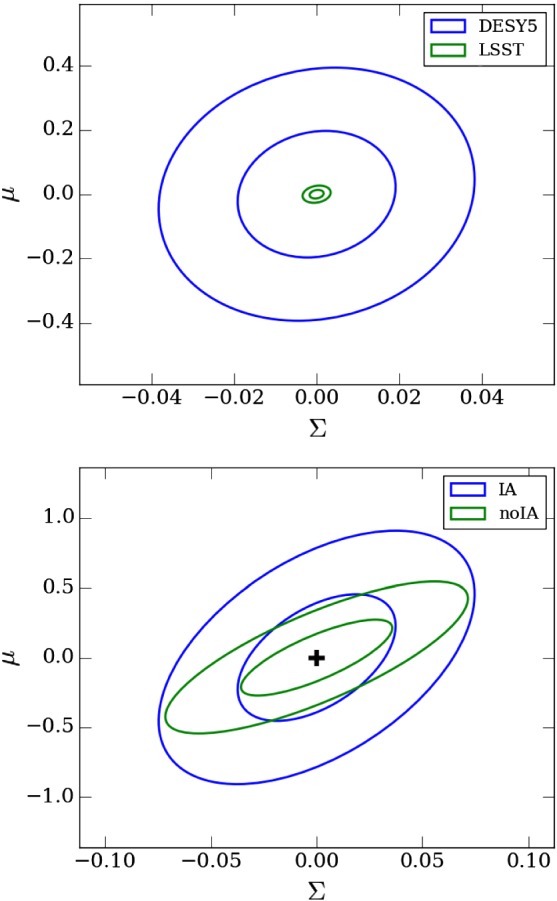
“They found that ignoring the effect of calibration bias or photometric redshift bias does affect significantly the constraints on MG parameters.”
§ Testing general relativity in cosmology > Systematic effects in cosmological probes and degeneracies with modifications to GR
What the sources say
- Disputedcites Ferté et al. (2017) matched to “Testing gravity on cosmological scales with cosmic shear, cosmic microwave background anisotropies, and redshift-space distortions” (2017) sourceExperimental — accuracy not yet measured
The ‘Impact of systematics’ section (p. 4) says the opposite: ignoring shear calibration bias or photometric redshift bias does not significantly affect constraints on the modified-gravity parameters Σ₀ and µ₀. It identifies intrinsic alignment, rather than either bias, as shifting the constraints. (LLM, conf=0.95)
Checked by a reasoning model — may be wrong.
plainstates a cause- Asserted: passes — The authors put it forward as true.
- Checkable: passes — It can be checked against evidence.
- Load-bearing: passes — The paper’s conclusions depend on it.
- Based: passes — The paper gives a reason why it holds.
- Disputed
The cited sources that could be checked couldn’t confirm or dispute this claim.
In the paper
“These seed fluctuations would have originated from microscopic quantum fluctuations that have been blown up to macroscopic scales by cosmic inflation (Guth 1981; Bardeen et al. 1983; Albrecht and Steinhardt 1982).”
§ Testing general relativity in cosmology > The standard model of cosmology > The inhomogeneous lumpy universe and the growth of large-scale structure
What the sources say
- Could not verifycites Guth 1981 matched to “Inflationary universe: A possible solution to the horizon and flatness problems” (1981) sourceExperimental — accuracy not yet measured
The passages on exponential expansion and inhomogeneities (indexed as Abstract; page unavailable) discuss inflation and random bubble formation, but do not identify microscopic quantum fluctuations as the origin of seed fluctuations. Searches for quantum fluctuations, density perturbations, and seed fluctuations found no passage making that connection. (LLM, conf=0.75)
- Not checked — no full text of the sourcecites Bardeen et al. 1983 matched to “Spontaneous creation of almost scale-free density perturbations in an inflationary universe” (1983) source
- Not checked — no full text of the sourcecites Albrecht and Steinhardt 1982 matched to “Cosmology for Grand Unified Theories with Radiatively Induced Symmetry Breaking” (1982) source
hedgedstates a cause- Asserted: passes — The authors put it forward as true.
- Checkable: passes — It can be checked against evidence.
- Load-bearing: unclear — It is unclear whether the paper’s conclusions depend on it.
- Based: passes — The paper gives a reason why it holds.
- Could not verify
Every source the paper cites for this claim was checked and supports it.
In the paper
“it has established very stringent constraints at the level of the solar system that any gravity theory must pass.”
§ Testing general relativity in cosmology > Introduction
What the sources say
- Supportedcites Will 2014 matched to “The Confrontation between General Relativity and Experiment” (2014) source
In “Tests of the strong equivalence principle” (page unavailable), the review describes solar-system experiments that test effects expected in many metric theories of gravity. It also calls the solar-system Cassini bound on a scalar-tensor parameter “very tight” and notes that alternative theories seek to preserve GR’s solar-system phenomenology. Together, these support the claim that gravity theories face stringent solar-system constraints. (LLM, conf=0.90)
boostedstates a cause- Asserted: passes — The authors put it forward as true.
- Checkable: passes — It can be checked against evidence.
- Load-bearing: passes — The paper’s conclusions depend on it.
- Based: passes — The paper gives a reason why it holds.
- Supported
The cited sources that could be checked couldn’t confirm or dispute this claim.
In the paper
“The standard picture of structure formation in the universe is that structures have grown by gravitational infall and clustering from primordial small fluctuations in the matter density field.”
§ Testing general relativity in cosmology > The standard model of cosmology > The inhomogeneous lumpy universe and the growth of large-scale structure
What the sources say
- Could not verifycites Guth 1981 matched to “Inflationary universe: A possible solution to the horizon and flatness problems” (1981) sourceExperimental — accuracy not yet measured
The Introduction and Conclusion passages discuss the early universe’s homogeneity, horizon and flatness problems, and possible inhomogeneity from inflationary bubble formation. Searches for gravitational clustering, primordial density fluctuations, and galaxy formation found no passage in our copy describing the claimed mechanism of structure formation. (LLM, conf=0.73)
- Not checked — no full text of the sourcecites Bardeen et al. 1983 matched to “Spontaneous creation of almost scale-free density perturbations in an inflationary universe” (1983) source
- Not checked — no full text of the sourcecites Albrecht and Steinhardt 1982 matched to “Cosmology for Grand Unified Theories with Radiatively Induced Symmetry Breaking” (1982) source
plainstates a cause- Asserted: passes — The authors put it forward as true.
- Checkable: passes — It can be checked against evidence.
- Load-bearing: unclear — It is unclear whether the paper’s conclusions depend on it.
- Based: passes — The paper gives a reason why it holds.
- Could not verify
219 more claims · 33 with their cited sources checked
Create a free account to see all 525 claims and to verify the 294 references still open.
- It may state two separate claims as one. 223
- Probably not a substantial claim. 125
- The quote only partly states this claim. 15
Citations
Cites
Items 201–400 of 1,146
Imperfect dark energy from kinetic gravity braiding
Deffayet, C., Pujolàs, O., Sawicki, I., & Vikman, A. (2010) · Journal of Cosmology and Astroparticle Physics · doi:10.1088/1475-7516/2010/10/026 · Cited by 704 · cited 2×
“They tabulated models explicitly indicating that, in the Horndeski general class, Brans–Dicke, f(R), kinetic gravity braiding (Deffayet et al. 2010) are not affected, while quartic and quintic Galileons (Nicolis et al.”
BackgroundPlanck 2015 results: XIV. Dark energy and modified gravity
Planck Collaboration, Ade, P. A. R., Aghanim, N., Arnaud, M., Ashdown, M., Aumont, J., Baccigalupi, C., Banday, A. J., Barreiro, R. B., Bartolo, N., et al. (2016) · Astronomy & Astrophysics · doi:10.1051/0004-6361/201525814 · Cited by 699
A Remarkable Property of the Riemann-Christoffel Tensor in Four Dimensions
Lanczos, C. (1938) · The Annals of Mathematics · doi:10.2307/1968467 · Cited by 690
Screening Long-Range Forces through Local Symmetry Restoration
Hinterbichler, K., & Khoury, J. (2010) · Physical Review Letters · doi:10.1103/physrevlett.104.231301 · Cited by 689
Padmanabhan, N., Xu, X., Eisenstein, D. J., Scalzo, R., Cuesta, A. J., Mehta, K. T., & Kazin, E. (2012) · Monthly Notices of the Royal Astronomical Society · doi:10.1111/j.1365-2966.2012.21888.x · Cited by 687
The Four-Dimensionality of Space and the Einstein Tensor
Lovelock, D. (1972) · Journal of Mathematical Physics · doi:10.1063/1.1666069 · Cited by 685
Karch, A., & Randall, L. (2001) · Journal of High Energy Physics · doi:10.1088/1126-6708/2001/05/008 · Cited by 674 · cited 1×
“Other models based on Braneworld constructions include the Karsh-Randal model (Karch and Randall 2001; Kaloper 1999), the Gregory, Rubakov and Sibiryakov model (Gregory et al.”
MethodStrong interactions and stability in the DGP model
Luty, M. A., Porrati, M., & Rattazzi, R. (2003) · Journal of High Energy Physics · doi:10.1088/1126-6708/2003/09/029 · Cited by 672 · cited 1×
“It was shown in a number of studies that, unlike the normal branch, the self-accelerating branch of the DGP theory suffers from ghost instabilities (Luty et al. 2003; Charmousis et al. 2006; Gregory et al. 2007; Gorbunov et al. 2006; Koyama 2007).”
BackgroundA test of the nature of cosmic acceleration using galaxy redshift distortions
Guzzo, L., Pierleoni, M., Meneux, B., Branchini, E., Le Fèvre, O., Marinoni, C., Garilli, B., Blaizot, J., De Lucia, G., Pollo, A., et al. (2008) · Nature · doi:10.1038/nature06555 · Cited by 654 · cited 1×
“2014), VVDS (Guzzo et al. 2008), VIPERS (de la Torre et al.”
BackgroundDegenerate higher derivative theories beyond Horndeski: evading the Ostrogradski instability
Langlois, D., & Noui, K. (2016) · Journal of Cosmology and Astroparticle Physics · doi:10.1088/1475-7516/2016/02/034 · Cited by 653
Delgaty, M. S. R., & Lake, K. (1998) · Computer Physics Communications · doi:10.1016/s0010-4655(98)00130-1 · Cited by 651
Heymans, C., Grocutt, E., Heavens, A., Kilbinger, M., Kitching, T. D., Simpson, F., Benjamin, J., Erben, T., Hildebrandt, H., Hoekstra, H., et al. (2013) · Monthly Notices of the Royal Astronomical Society · doi:10.1093/mnras/stt601 · Cited by 649
Lukas, A., Ovrut, B. A., Stelle, K. S., & Waldram, D. (1999) · Physical Review D · doi:10.1103/physrevd.59.086001 · Cited by 641
Gravity in the Randall-Sundrum Brane World
Garriga, J., & Tanaka, T. (2000) · Physical Review Letters · doi:10.1103/physrevlett.84.2778 · Cited by 634 · cited 1×
“However, it is considered incomplete because, on the two branes, the effective theory of gravity is not GR but rather Brans–Dicke gravity with a BD parameter related to the branes and is being not consistent with current observational constraints on the BD parameter (Garriga and Tanaka 2000).”
ResultGaztañaga, E., Cabré, A., & Hui, L. (2009) · Monthly Notices of the Royal Astronomical Society · doi:10.1111/j.1365-2966.2009.15405.x · Cited by 633
Introducing Einstein’s Relativity
d’Invemo, R. (1992) · doi:10.1093/oso/9780198596530.001.0001 · Cited by 624
Karhunen-Loève eigenvalue problems in cosmology: How should we tackle large data setsPreprint
Tegmark, M., Taylor, A. N., & Heavens, A. (1997) · Cited by 618
Scalar–tensor–vector gravity theory
Moffat, J. W. (2006) · Journal of Cosmology and Astroparticle Physics · doi:10.1088/1475-7516/2006/03/004 · Cited by 610
Cosmology with cosmic shear observations: a review
Kilbinger, M. (2015) · Reports on Progress in Physics · doi:10.1088/0034-4885/78/8/086901 · Cited by 604
Cosmology of generalized modified gravity models
Carroll, S. M., De Felice, A., Duvvuri, V., Easson, D. A., Trodden, M., & Turner, M. S. (2005) · Physical Review D · doi:10.1103/physrevd.71.063513 · Cited by 604
Kinematics and World-Structure
Robertson, H. P. (1935) · The Astrophysical Journal · doi:10.1086/143681 · Cited by 603
A spinor approach to general relativity
Penrose, R. (1960) · Annals of Physics · doi:10.1016/0003-4916(60)90021-x · Cited by 601
(1970) · Cited by 600
Unifying inflation with ΛCDM epoch in modified f(R) gravity consistent with Solar System tests
Nojiri, S., & Odintsov, S. D. (2007) · Physics Letters B · doi:10.1016/j.physletb.2007.10.027 · Cited by 591
Consistent Extension of Hořava Gravity
Blas, D., Pujolàs, O., & Sibiryakov, S. (2010) · Physical Review Letters · doi:10.1103/physrevlett.104.181302 · Cited by 591 · cited 1×
“The theory avoids persistent instabilities in the original theory and remains power-counting renormalizable (Blas et al. 2010).”
BackgroundRelativity: Special, General, and Cosmological
Rindler, W., & Salisbury, D. (2003) · American Journal of Physics · doi:10.1119/1.1622355 · Cited by 590
Intrinsic alignment-lensing interference as a contaminant of cosmic shear
Hirata, C. M., & Seljak, U. (2004) · Physical Review D · doi:10.1103/physrevd.70.063526 · Cited by 586
Fluctuations at the Threshold of Classical Cosmology
Harrison, E. R. (1970) · Physical Review D · doi:10.1103/physrevd.1.2726 · Cited by 574 · cited 1×
“These primordial fluctuations would be scale invariant and described by the power spectrum (Harrison, 1970; Peebles and Yu, 1970; Zeldovich, 1972)”
BackgroundThe Analysis of Counts of the Extragalactic Nebulae in Terms of a Fluctuating Density Field. II.
Limber, D. N. (1954) · The Astrophysical Journal · doi:10.1086/145870 · Cited by 568
Quasar-Lyman α forest cross-correlation from BOSS DR11: Baryon Acoustic Oscillations
Font-Ribera, A., Kirkby, D., Busca, N., Miralda-Escudé, J., Ross, N. P., Slosar, A., Rich, J., Aubourg, É., Bailey, S., Bhardwaj, V., et al. (2014) · Journal of Cosmology and Astroparticle Physics · doi:10.1088/1475-7516/2014/05/027 · Cited by 566
Effective field theory for inflation
Weinberg, S. (2008) · Physical Review D · doi:10.1103/physrevd.77.123541 · Cited by 565
Forbidden mass range for spin-2 field theory in de Sitter spacetime
Higuchi, A. (1987) · Nuclear Physics B · doi:10.1016/0550-3213(87)90691-2 · Cited by 562
Classical and Quantum Consistency of the DGP Model
Nicolis, A., & Rattazzi, R. (2004) · Journal of High Energy Physics · doi:10.1088/1126-6708/2004/06/059 · Cited by 550
Zumalacárregui, M., & García-Bellido, J. (2014) · Physical Review D · doi:10.1103/physrevd.89.064046 · Cited by 546
Gravitational phenomenology in higher-dimensional theories and strings
Kostelecký, V. A., & Samuel, S. (1989) · Physical Review D · doi:10.1103/physrevd.40.1886 · Cited by 546
Do consistent models mimic general relativity plus Λ?
Appleby, S. A., & Battye, R. A. (2007) · Physics Letters B · doi:10.1016/j.physletb.2007.08.037 · Cited by 529
Dudal, D., Gracey, J. A., Sorella, S. P., Vandersickel, N., & Verschelde, H. (2008) · Physical Review D · doi:10.1103/physrevd.78.065047 · Cited by 529
Über das Gravitationsfeld eines Massenpunktes nach der EINSTEINschen Theorie
Schwarzschild, K. (1992) · Gesammelte Werke/Collected Works · doi:10.1007/978-3-642-58084-0_21 · Cited by 528
A Modification of the Newtonian Dynamics - Implications for Galaxy Systems
Milgrom, M. (1983) · The Astrophysical Journal · doi:10.1086/161132 · Cited by 527
Blake, C., Brough, S., Colless, M., Contreras, C., Couch, W., Croom, S., Davis, T., Drinkwater, M. J., Forster, K., Gilbank, D., et al. (2011) · Monthly Notices of the Royal Astronomical Society · doi:10.1111/j.1365-2966.2011.18903.x · Cited by 523
Large scale structure off(R)gravity
Song, Y.-S., Hu, W., & Sawicki, I. (2007) · Physical Review D · doi:10.1103/physrevd.75.044004 · Cited by 518
Will, C. M., & Nordtvedt, K., Jr. (1972) · The Astrophysical Journal · doi:10.1086/151754 · Cited by 516
Bizouard, M. A. (2016) · Cited by 512
The effective field theory of dark energy
Gubitosi, G., Piazza, F., & Vernizzi, F. (2013) · Journal of Cosmology and Astroparticle Physics · doi:10.1088/1475-7516/2013/02/032 · Cited by 510 · cited 2×
“The action satisfying the above restrictions, that is up to quadratic order in the perturbations, and contains only operators that lead to at most second-order equations of motion, takes the following form in the Jordan frame (Gubitosi et al. 2013; Bloomfield et al. 2013; Gleyzes et al. 2013; Creminelli et al. 2009):”
BackgroundCluster Abundance Constraints on Quintessence ModelsPreprint
Wang, L.-M., & Steinhardt, P. J. (1998) · doi:10.48550/arxiv.astro-ph/9804015 · Cited by 509
Beutler, F., Blake, C., Colless, M., Jones, D. H., Staveley-Smith, L., Poole, G. B., Campbell, L., Parker, Q., Saunders, W., & Watson, F. (2012) · Monthly Notices of the Royal Astronomical Society · doi:10.1111/j.1365-2966.2012.21136.x · Cited by 506
Inflation Driven by the Galileon Field
Kobayashi, T., Yamaguchi, M., & Yokoyama, J. (2010) · Physical Review Letters · doi:10.1103/physrevlett.105.231302 · Cited by 502 · cited 1×
“He found guidance in Mach’s ideas about relativity and the nature of inertia (Mach et al, 1905, 1988), although, he had to abandon some of them later on. From the principle of equivalence between gravity and inertia that we provide below, Einstein developed the important insight that gravity seems to have a privileged…”
BackgroundGravity on a brane in infinite-volume extra space
Dvali, G., & Gabadadze, G. (2001) · Physical Review D · doi:10.1103/physrevd.63.065007 · Cited by 500
Relation between physical and gravitational geometry
Bekenstein, J. D. (1993) · Physical Review D · doi:10.1103/physrevd.48.3641 · Cited by 498
Chaotic inflation on the brane
Maartens, R., Wands, D., Bassett, B. A., & Heard, I. P. C. (2000) · Physical Review D · doi:10.1103/physrevd.62.041301 · Cited by 497
Renormalization of a Classical Gravitational Field Interacting with Quantized Matter Fields
Utiyama, R., & DeWitt, B. S. (1962) · Journal of Mathematical Physics · doi:10.1063/1.1724264 · Cited by 492
Bridle, S., & King, L. (2007) · New Journal of Physics · doi:10.1088/1367-2630/9/12/444 · Cited by 492
Gravitational lensing effect on cosmic microwave background polarization
Zaldarriaga, M., & Seljak, U. (1998) · Physical Review D · doi:10.1103/physrevd.58.023003 · Cited by 488
Reid, B. A., Percival, W. J., Eisenstein, D. J., Verde, L., Spergel, D. N., Skibba, R. A., Bahcall, N. A., Budavari, T., Frieman, J. A., Fukugita, M., et al. (2010) · Monthly Notices of the Royal Astronomical Society · doi:10.1111/j.1365-2966.2010.16276.x · Cited by 487
The Cosmic Linear Anisotropy Solving System (CLASS) I: Overview
Julien Lesgourgues, A. (2011) · HAL (Le Centre pour la Communication Scientifique Directe) · doi:10.48550/arxiv.1104.2932 · Cited by 476
Cosmic microwave background lensing reconstruction on the full sky
Okamoto, T., & Hu, W. (2003) · Physical Review D · doi:10.1103/physrevd.67.083002 · Cited by 472 · cited 1×
“This lensing smears out the CMB temperature power spectrum and produces non-guaussianities in the temperature and polarization maps, generating 3- and 4-point correlations (Bernardeau 1998; Zaldarriaga and Seljak 1999; Okamoto and Hu 2003), and converting E-mode polarization of the CMB photons into lensing B-mode (Zal…”
MethodPrimordial nucleosynthesis: From precision cosmology to fundamental physics
Iocco, F., Mangano, G., Miele, G., Pisanti, O., & Serpico, P. D. (2009) · Physics Reports · doi:10.1016/j.physrep.2009.02.002 · Cited by 472
Avoiding Dark Energy with 1/R Modifications of Gravity
Woodard, R. P. (2006) · CERN Document Server (European Organization for Nuclear Research) · Cited by 467
Exploring gravitational theories beyond Horndeski
Gleyzes, J., Langlois, D., Piazza, F., & Vernizzi, F. (2015) · Journal of Cosmology and Astroparticle Physics · doi:10.1088/1475-7516/2015/02/018 · Cited by 466
Dark Energy Versus Modified Gravity
Joyce, A., Lombriser, L., & Schmidt, F. (2016) · Annual Review of Nuclear and Particle Science · doi:10.1146/annurev-nucl-102115-044553 · Cited by 463 · cited 1×
“For our review, we focus on the notions of universality of free fall and the matter coupling in the context of GR+dark energy versus modified gravity (MG) models following for example Joyce et al (2016).”
MethodCosmic Background Anisotropies in Cold Dark Matter Cosmology
Sugiyama, N. (1995) · The Astrophysical Journal Supplement Series · doi:10.1086/192220 · Cited by 462
A Critique of Rees's Theory of Primordial Gravitational Radiation
Jackson, J. C. (1972) · Monthly Notices of the Royal Astronomical Society · doi:10.1093/mnras/156.1.1p · Cited by 461
CARNEGIE HUBBLE PROGRAM: A MID-INFRARED CALIBRATION OF THE HUBBLE CONSTANT
Freedman, W. L., Madore, B. F., Scowcroft, V., Burns, C., Monson, A., Persson, S. E., Seibert, M., & Rigby, J. (2012) · The Astrophysical Journal · doi:10.1088/0004-637x/758/1/24 · Cited by 460
Avoiding Dark Energy with 1/R Modifications of Gravity
Woodard, R. (2007) · Lecture Notes in Physics · doi:10.1007/978-3-540-71013-4_14 · Cited by 455
General Second-Order Scalar-Tensor Theory and Self-Tuning
Charmousis, C., Copeland, E. J., Padilla, A., & Saffin, P. M. (2012) · Physical Review Letters · doi:10.1103/physrevlett.108.051101 · Cited by 455
Hasselfield, M., Hilton, M., Marriage, T. A., Addison, G. E., Barrientos, L. F., Battaglia, N., Battistelli, E. S., Bond, J. R., Crichton, D., Das, S., et al. (2013) · Journal of Cosmology and Astroparticle Physics · doi:10.1088/1475-7516/2013/07/008 · Cited by 453
Modifiedf(R)gravity unifyingRminflation with theΛCDMepoch
Nojiri, S., & Odintsov, S. D. (2008) · Physical Review D · doi:10.1103/physrevd.77.026007 · Cited by 452
Planck 2015 results: XI. CMB power spectra, likelihoods, and robustness of parameters
Aghanim, N., Arnaud, M., Ashdown, M., Aumont, J., Baccigalupi, C., Banday, A. J., Barreiro, R. B., Bartlett, J. G., Bartolo, N., Battaner, E., et al. (2016) · ORCA Online Research @Cardiff (Cardiff University) · doi:10.17863/cam.44053 · Cited by 450
The Physical Structure of General Relativity
SCIAMA, D. W. (1964) · Reviews of Modern Physics · doi:10.1103/revmodphys.36.463 · Cited by 446
Torsion-balance tests of the weak equivalence principle
Wagner, T. A., Schlamminger, S., Gundlach, J. H., & Adelberger, E. G. (2012) · Classical and Quantum Gravity · doi:10.1088/0264-9381/29/18/184002 · Cited by 437
The Atomicity of Electricity as a Quantum Theory Law
KLEIN, O. (1926) · Nature · doi:10.1038/118516a0 · Cited by 435
Singularity-free cosmological solutions of the superstring effective action
Antoniadis, I., Rizos, J., & Tamvakis, K. (1994) · Nuclear Physics B · doi:10.1016/0550-3213(94)90120-1 · Cited by 431
The Lyα Forest Power Spectrum from the Sloan Digital Sky Survey
McDonald, P., Seljak, U., Burles, S., Schlegel, D. J., Weinberg, D. H., Cen, R., Shih, D., Schaye, J., Schneider, D. P., Bahcall, N. A., et al. (2006) · The Astrophysical Journal Supplement Series · doi:10.1086/444361 · Cited by 425
Deser, S., & Woodard, R. P. (2007) · Physical Review Letters · doi:10.1103/physrevlett.99.111301 · Cited by 425
Structure Formation with Generalized Dark Matter
Wayne Hu, B. (1998) · CERN Document Server (European Organization for Nuclear Research) · Cited by 424
Alternatives to dark matter and dark energy
MANNHEIM, P. (2006) · Progress in Particle and Nuclear Physics · doi:10.1016/j.ppnp.2005.08.001 · Cited by 424
Weak Gravitational Lensing and Its Cosmological Applications
Hoekstra, H., & Jain, B. (2008) · Annual Review of Nuclear and Particle Science · doi:10.1146/annurev.nucl.58.110707.171151 · Cited by 423
Bent domain walls as braneworlds
Kaloper, N. (1999) · Physical Review D · doi:10.1103/physrevd.60.123506 · Cited by 422
Maximal freedom at minimum cost: linear large-scale structure in general modifications of gravity
Bellini, E., & Sawicki, I. (2014) · Journal of Cosmology and Astroparticle Physics · doi:10.1088/1475-7516/2014/07/050 · Cited by 421
Planck 2015 results: XV. Gravitational lensing
Planck Collaboration, Ade, P. A. R., Aghanim, N., Arnaud, M., Ashdown, M., Aumont, J., Baccigalupi, C., Banday, A. J., Barreiro, R. B., Bartlett, J. G., et al. (2016) · Astronomy & Astrophysics · doi:10.1051/0004-6361/201525941 · Cited by 420
Structure Formation with Generalized Dark Matter
Hu, W. (1998) · The Astrophysical Journal · doi:10.1086/306274 · Cited by 420
The effects of He I λ10830 on helium abundance determinations
Aver, E., Olive, K. A., & Skillman, E. D. (2015) · Journal of Cosmology and Astroparticle Physics · doi:10.1088/1475-7516/2015/07/011 · Cited by 419 · cited 1×
“In order to be consistent with current observations (see, e.g., Izotov et al. 2014; Aver et al. 2015), the cosmological gravitational constant must satisfy the constraint (Oost et al.”
ResultIntroducing Einstein's Relativity: A Deeper Understanding
d'Inverno, R., & Vickers, J. (2022) · doi:10.1093/oso/9780198862024.001.0001 · Cited by 416
A class of inhomogeneous cosmological models
Szekeres, P. (1975) · Communications in Mathematical Physics · doi:10.1007/bf01608547 · Cited by 415
Large-scale Density Inhomogeneities in the Universe
REES, M. J., & SCIAMA, D. W. (1968) · Nature · doi:10.1038/217511a0 · Cited by 414 · cited 1×
“The Integrated Sachs–Wolfe (ISW) effect is a secondary anisotropy in the CMB temperature fluctuations that is caused by time variations in the gravitational potentials (Sachs and Wolfe 1967; Kofman and Starobinskij 1985; Rees and Sciama 1968).”
BackgroundParametrized post-Friedmann framework for modified gravity
Hu, W., & Sawicki, I. (2007) · Physical Review D · doi:10.1103/physrevd.76.104043 · Cited by 414
Hassan, S. F., & Rosen, R. A. (2012) · Journal of High Energy Physics · doi:10.1007/jhep04(2012)123 · Cited by 414
Weak Lensing for Precision Cosmology
Mandelbaum, R. (2018) · Annual Review of Astronomy and Astrophysics · doi:10.1146/annurev-astro-081817-051928 · Cited by 409 · cited 1×
“Weinberg et al (2013); Mandelbaum (2017); Nishizawa (2014) and references therein.”
BackgroundOn Milne's Theory of World-Structure*
Walker, A. G. (1937) · Proceedings of the London Mathematical Society · doi:10.1112/plms/s2-42.1.90 · Cited by 408
Cartan, E. (1924) · Annales scientifiques de l'École normale supérieure · doi:10.24033/asens.753 · Cited by 406
Parameterized beyond-Einstein growth
Linder, E. V., & Cahn, R. N. (2007) · Astroparticle Physics · doi:10.1016/j.astropartphys.2007.09.003 · Cited by 403
Essential building blocks of dark energy
Gleyzes, J., Langlois, D., Piazza, F., & Vernizzi, F. (2013) · Journal of Cosmology and Astroparticle Physics · doi:10.1088/1475-7516/2013/08/025 · Cited by 401
Measuring the dark side (with weak lensing)
Amendola, L., Kunz, M., & Sapone, D. (2008) · Journal of Cosmology and Astroparticle Physics · doi:10.1088/1475-7516/2008/04/013 · Cited by 400 · cited 10×
“It was argued in, for example Amendola et al. (2013a), that in such a regime, which is relevant to weak lensing surveys and galaxy surveys, such a minimal subset is more practical to compare with observation but Baker et al. (2013) explains that such a PPF formalism can extend to horizon scales and can serve for compa…”
BackgroundMethodInfluentialExtended scalar-tensor theories of gravity
Crisostomi, M., Koyama, K., & Tasinato, G. (2016) · Journal of Cosmology and Astroparticle Physics · doi:10.1088/1475-7516/2016/04/044 · Cited by 399
Degenerate higher order scalar-tensor theories beyond Horndeski up to cubic order
Achour, J. B., Crisostomi, M., Koyama, K., Langlois, D., Noui, K., & Tasinato, G. (2016) · Journal of High Energy Physics · doi:10.1007/jhep12(2016)100 · Cited by 399
Zhang, P., Liguori, M., Bean, R., & Dodelson, S. (2007) · Physical Review Letters · doi:10.1103/physrevlett.99.141302 · Cited by 398
Kiritsis, E., & Kofinas, G. (2009) · Nuclear Physics B · doi:10.1016/j.nuclphysb.2009.05.005 · Cited by 394
Breaking a dark degeneracy with gravitational waves
Lombriser, L., & Taylor, A. (2016) · Journal of Cosmology and Astroparticle Physics · doi:10.1088/1475-7516/2016/03/031 · Cited by 394
The WiggleZ Dark Energy Survey: joint measurements of the expansion and growth history at z 1
Blake, C., Brough, S., Colless, M., Contreras, C., Couch, W. J., Croom, S. M., Croton, D., Davis, T. M., Drinkwater, M. J., Förster, K., et al. (2024) · doi:10.25916/sut.26242559.v1 · Cited by 393
Akbar, M., & Cai, R.-G. (2006) · Physics Letters B · doi:10.1016/j.physletb.2006.02.035 · Cited by 392
Planck 2013 results. XVII. Gravitational lensing by large-scale structure
Planck Collaboration, Ade, P. A. R., Aghanim, N., Armitage-Caplan, C., Arnaud, M., Ashdown, M., Atrio-Barandela, F., Aumont, J., Baccigalupi, C., Banday, A. J., et al. (2014) · Astronomy & Astrophysics · doi:10.1051/0004-6361/201321543 · Cited by 391
Report of the Dark Energy Task Force
Albrecht, A., Bernstein, G., Cahn, R. N., Freedman, W. L., Hewitt, J. N., Hu, W., Huth, J., Kamionkowski, M., Kolb, E. W., Knox, L., et al. (2006) · arXiv (Cornell University) · doi:10.48550/arxiv.astro-ph/0609591 · Cited by 391
Freedman, W. L., & Madore, B. F. (2010) · Annual Review of Astronomy and Astrophysics · doi:10.1146/annurev-astro-082708-101829 · Cited by 390
Modified gravity and its reconstruction from the universe expansion history
Nojiri, S., & Odintsov, S. D. (2007) · Journal of Physics: Conference Series · doi:10.1088/1742-6596/66/1/012005 · Cited by 390
Cosmological dynamics on the brane
Maartens, R. (2000) · Physical Review D · doi:10.1103/physrevd.62.084023 · Cited by 386
Chamseddine, A. H., & Mukhanov, V. (2013) · Journal of High Energy Physics · doi:10.1007/jhep11(2013)135 · Cited by 384
Large Synoptic Survey Telescope: Dark Energy Science CollaborationPreprint
LSST Dark Energy Science Collaboration (2012) · arXiv (Cornell University) · doi:10.48550/arxiv.1211.0310 · Cited by 383
Jacobson, T., & Mattingly, D. (2004) · Physical Review D · doi:10.1103/physrevd.70.024003 · Cited by 382
MICROSCOPE Mission: First Results of a Space Test of the Equivalence Principle
Touboul, P., Métris, G., Rodrigues, M., André, Y., Baghi, Q., Bergé, J., Boulanger, D., Bremer, S., Carle, P., Chhun, R., et al. (2017) · Physical Review Letters · doi:10.1103/physrevlett.119.231101 · Cited by 380
Measuring the cosmological constant with redshift surveys
Ballinger, W. E., Peacock, J. A., & Heavens, A. F. (1996) · Monthly Notices of the Royal Astronomical Society · doi:10.1093/mnras/282.3.877 · Cited by 377
On non-linear actions for massive gravity
Hassan, S. F., & Rosen, R. A. (2011) · Journal of High Energy Physics · doi:10.1007/jhep07(2011)009 · Cited by 376
Generalization of the Proca Action
Heisenberg, L. (2014) · Journal of Cosmology and Astroparticle Physics · doi:10.1088/1475-7516/2014/05/015 · Cited by 373
Scalar-Tensor-Vector Gravity TheoryPreprint
Moffat, J. W. (2005) · Cited by 373
Evidence of the accelerated expansion of the Universe from weak lensing tomography with COSMOS
Schrabback, T., Hartlap, J., Joachimi, B., Kilbinger, M., Simon, P., Benabed, K., Bradač, M., Eifler, T., Erben, T., Fassnacht, C. D., et al. (2010) · Astronomy and Astrophysics · doi:10.1051/0004-6361/200913577 · Cited by 372
Samushia, L., Percival, W. J., & Raccanelli, A. (2012) · Monthly Notices of the Royal Astronomical Society · doi:10.1111/j.1365-2966.2011.20169.x · Cited by 371
Kaiser, N. (1998) · The Astrophysical Journal · doi:10.1086/305515 · Cited by 370
Burrage, C., & Sakstein, J. (2018) · Living Reviews in Relativity · doi:10.1007/s41114-018-0011-x · Cited by 366
Construction of cosmologically viable gravity models
De Felice, A., & Tsujikawa, S. (2009) · Physics Letters B · doi:10.1016/j.physletb.2009.03.060 · Cited by 366
Farooq, O., Madiyar, F. R., Crandall, S., & Ratra, B. (2017) · The Astrophysical Journal · doi:10.3847/1538-4357/835/1/26 · Cited by 365
A correlation between the cosmic microwave background and large-scale structure in the Universe
Boughn, S., & Crittenden, R. (2004) · Nature · doi:10.1038/nature02139 · Cited by 363
Einstein-aether gravity: a status reportPreprint
Jacobson, T. (2008) · arXiv (Cornell University) · doi:10.48550/arxiv.0801.1547 · Cited by 363
Models of non-relativistic quantum gravity: the good, the bad and the healthy
Blas, D., Pujolàs, O., & Sibiryakov, S. (2011) · Journal of High Energy Physics · doi:10.1007/jhep04(2011)018 · Cited by 362
1/Rcurvature corrections as the source of the cosmological acceleration
Vollick, D. N. (2003) · Physical Review D · doi:10.1103/physrevd.68.063510 · Cited by 361
Opening up Extra Dimensions at Ultralarge Scales
Gregory, R., Rubakov, V. A., & Sibiryakov, S. M. (2000) · Physical Review Letters · doi:10.1103/physrevlett.84.5928 · Cited by 361
Savchenko, V., Ferrigno, C., Erik Kuulkers, A., et al. (2017) · Technical University of Denmark, DTU Orbit (Technical University of Denmark, DTU) · Cited by 359
Strong coupling in Hořava gravity
Charmousis, C., Niz, G., Padilla, A., & Saffin, P. M. (2009) · Journal of High Energy Physics · doi:10.1088/1126-6708/2009/08/070 · Cited by 353
CFHTLenS: combined probe cosmological model comparison using 2D weak gravitational lensing
Kilbinger, M., Fu, L., Heymans, C., Simpson, F., Benjamin, J., Erben, T., Harnois-Déraps, J., Hoekstra, H., Hildebrandt, H., Kitching, T. D., et al. (2013) · Monthly Notices of the Royal Astronomical Society · doi:10.1093/mnras/stt041 · Cited by 349
FIVE-YEAR WILKINSON MICROWAVE ANISOTROPY PROBE OBSERVATIONS: ANGULAR POWER SPECTRA
Nolta, M. R., Dunkley, J., Hill, R. S., Hinshaw, G., Komatsu, E., Larson, D., Page, L., Spergel, D. N., Bennett, C. L., Gold, B., et al. (2009) · The Astrophysical Journal Supplement Series · doi:10.1088/0067-0049/180/2/296 · Cited by 348
Rest, A., Scolnic, D., Foley, R. J., Huber, M. E., Chornock, R., Narayan, G., Tonry, J. L., Berger, E., Soderberg, A. M., Stubbs, C. W., et al. (2014) · The Astrophysical Journal · doi:10.1088/0004-637x/795/1/44 · Cited by 341
No-Ghost Theorem for the Fourth-Order Derivative Pais-Uhlenbeck Oscillator Model
Bender, C. M., & Mannheim, P. D. (2008) · Physical Review Letters · doi:10.1103/physrevlett.100.110402 · Cited by 341
Classical and quantum consistency of the DGP model
Nicolis, A., & Rattazzi, R. (2004) · Infoscience (Ecole Polytechnique Fédérale de Lausanne) · Cited by 340
Lorentz-violating vector fields slow the universe down
Carroll, S., & Lim, E. (2004) · Physical Review D · doi:10.1103/physrevd.70.123525 · Cited by 340 · cited 2×
“The observational bound on the deviation from GR is provided from the measurement of the primordial abundance of He4 which gives (Jacobson, 2008; Carroll and Lim, 2004) |Geff−cosm/GN − 1| ≤ 0.”
BackgroundMethodInvariant Formulation of Gravitational Radiation Theory
Pirani, F. A. E. (1957) · Physical Review · doi:10.1103/physrev.105.1089 · Cited by 338
Forecasting Cosmic Parameter Errors from Microwave Background Anisotropy ExperimentsPreprint
Bond, J. R., Efstathiou, G., & Tegmark, M. (1997) · arXiv (Cornell University) · doi:10.48550/arxiv.astro-ph/9702100 · Cited by 336
Hanson, D., Hoover, S., Crites, A., Ade, P. A. R., Aird, K. A., Austermann, J. E., Beall, J. A., Bender, A. N., Benson, B. A., Bleem, L. E., et al. (2013) · Physical Review Letters · doi:10.1103/physrevlett.111.141301 · Cited by 335
Pattern of growth in viablef(R)cosmologies
Pogosian, L., & Silvestri, A. (2008) · Physical Review D · doi:10.1103/physrevd.77.023503 · Cited by 335
Cosmology of the Lifshitz universePreprint
Calcagni, G. (2013) · Cited by 334
Environmental dependence of masses and coupling constants
Olive, K. A., & Pospelov, M. (2008) · Physical Review D · doi:10.1103/physrevd.77.043524 · Cited by 333
Confirmation of general relativity on large scales from weak lensing and galaxy velocities
Reyes, R., Mandelbaum, R., Seljak, U., Baldauf, T., Gunn, J. E., Lombriser, L., & Smith, R. E. (2010) · Nature · doi:10.1038/nature08857 · Cited by 332
Degenerate higher order scalar-tensor theories beyond Horndeski and disformal transformations
Ben Achour, J., Langlois, D., & Noui, K. (2016) · Physical Review D · doi:10.1103/physrevd.93.124005 · Cited by 331
Delgaty, M. S. R., & Lake, K. (1998) · CERN Document Server (European Organization for Nuclear Research) · Cited by 330
Ho, S., Hirata, C., Padmanabhan, N., Seljak, U., & Bahcall, N. (2008) · Physical Review D · doi:10.1103/physrevd.78.043519 · Cited by 329
Matter bounce in Hořava-Lifshitz cosmology
Brandenberger, R. (2009) · Physical Review D · doi:10.1103/physrevd.80.043516 · Cited by 329
Upper limits to submillimetre-range forces from extra space-time dimensions
Long, J. C., Chan, H. W., Churnside, A. B., Gulbis, E. A., Varney, M. C. M., & Price, J. C. (2003) · Nature · doi:10.1038/nature01432 · Cited by 328
Making the Case for Conformal Gravity
Mannheim, P. D. (2012) · Foundations of Physics · doi:10.1007/s10701-011-9608-6 · Cited by 326
Primordial Nucleosynthesis: from precision cosmology to fundamental physicsPreprint
Iocco, F., Mangano, G., Miele, G., Pisanti, O., & Serpico, P. D. (2013) · Cited by 323
Dark energy or modified gravity? An effective field theory approach
Bloomfield, J., Flanagan, É. É., Park, M., & Watson, S. (2013) · Journal of Cosmology and Astroparticle Physics · doi:10.1088/1475-7516/2013/08/010 · Cited by 322
Modifying gravity with the aether: An alternative to dark matter
Zlosnik, T. G., Ferreira, P. G., & Starkman, G. D. (2007) · Physical Review D · doi:10.1103/physrevd.75.044017 · Cited by 320
Lue, A., Scoccimarro, R., & Starkman, G. D. (2004) · Physical Review D · doi:10.1103/physrevd.69.124015 · Cited by 319
Yu, H., Ratra, B., & Wang, F.-Y. (2018) · The Astrophysical Journal · doi:10.3847/1538-4357/aab0a2 · Cited by 319
Efstathiou, G. (2014) · Monthly Notices of the Royal Astronomical Society · doi:10.1093/mnras/stu278 · Cited by 319
Towards a naturally small cosmological constant from branes in 6D supergravity
Aghababaie, Y., Burgess, C. P., Parameswaran, S. L., & Quevedo, F. (2004) · Nuclear Physics B · doi:10.1016/j.nuclphysb.2003.12.015 · Cited by 319
Cosmological Model Predictions for Weak Lensing: Linear and Nonlinear Regimes
Jain, B., & Seljak, U. (1997) · The Astrophysical Journal · doi:10.1086/304372 · Cited by 317
Hořava–Lifshitz cosmology: a review
Mukohyama, S. (2010) · Classical and Quantum Gravity · doi:10.1088/0264-9381/27/22/223101 · Cited by 316
Quantum gravity without Lorentz invariance
Sotiriou, T. P., Visser, M., & Weinfurtner, S. (2009) · Journal of High Energy Physics · doi:10.1088/1126-6708/2009/10/033 · Cited by 314
Relativity: Special, General, And Cosmological Second Edition
Rindler, W. (2006) · doi:10.1093/oso/9780198567318.001.0001 · Cited by 314
de la Torre, S., Guzzo, L., Peacock, J. A., Branchini, E., Iovino, A., Granett, B. R., Abbas, U., Adami, C., Arnouts, S., Bel, J., et al. (2013) · Astronomy & Astrophysics · doi:10.1051/0004-6361/201321463 · Cited by 313
Distinguishing modified gravity from dark energy
Bertschinger, E., & Zukin, P. (2008) · Physical Review D · doi:10.1103/physrevd.78.024015 · Cited by 311
Cosmology of modified Gauss-Bonnet gravity
Li, B., Barrow, J. D., & Mota, D. F. (2007) · Physical Review D · doi:10.1103/physrevd.76.044027 · Cited by 311
On the extra mode and inconsistency of Hořava gravity
Blas, D., Pujolàs, O., & Sibiryakov, S. (2009) · Journal of High Energy Physics · doi:10.1088/1126-6708/2009/10/029 · Cited by 310
Dbi and the galileon reunitedPreprint
de Rham, C., & Tolley, A. J. (2010) · Cited by 309
Dynamics of linear perturbations inf(R)gravity
Bean, R., Bernat, D., Pogosian, L., Silvestri, A., & Trodden, M. (2007) · Physical Review D · doi:10.1103/physrevd.75.064020 · Cited by 307
Chow, N., & Khoury, J. (2009) · Physical Review D · doi:10.1103/physrevd.80.024037 · Cited by 305
Linear Redshift Distortions: A Review
Hamilton, A. J. S. (1998) · Astrophysics and Space Science Library · doi:10.1007/978-94-011-4960-0_17 · Cited by 300
The dark side of gravity: Modified theories of gravityPreprint
Lobo, F. S. N. (2008) · arXiv (Cornell University) · doi:10.48550/arxiv.0807.1640 · Cited by 298
Jain, B., & Khoury, J. (2010) · Annals of Physics · doi:10.1016/j.aop.2010.04.002 · Cited by 298
Wang, Y., & Mukherjee, P. (2006) · The Astrophysical Journal · doi:10.1086/507091 · Cited by 298
P. A. R. Ade, T. P. C., Akiba, Y., Anthony, A. E., Arnold, K., Atlas, M., Barron, D., Boettger, D., Borrill, J., Chapman, S., Chinone, Y., et al. (2014) · The Astrophysical Journal · doi:10.1088/0004-637x/794/2/171 · Cited by 298
Tsujikawa, S. (2007) · Physical Review D · doi:10.1103/physrevd.76.023514 · Cited by 297
Testing cosmological structure formation using redshift-space distortions
Percival, W. J., & White, M. (2009) · Monthly Notices of the Royal Astronomical Society · doi:10.1111/j.1365-2966.2008.14211.x · Cited by 296
An Imprint of Superstructures on the Microwave Background due to the Integrated Sachs-Wolfe Effect
Granett, B. R., Neyrinck, M. C., & Szapudi, I. (2008) · The Astrophysical Journal · doi:10.1086/591670 · Cited by 295
Large Scale Structure in Bekenstein’s Theory of Relativistic Modified Newtonian Dynamics
Skordis, C., Mota, D. F., Ferreira, P. G., & Bœhm, C. (2006) · Physical Review Letters · doi:10.1103/physrevlett.96.011301 · Cited by 295
The WiggleZ Dark Energy Survey: The growth rate of cosmic structure since redshift z=0.9
Blake, C., Brough, S., Colless, M., et al. (2024) · Figshare · doi:10.25916/sut.26217998.v1 · Cited by 294
Brane world cosmology: Gauge-invariant formalism for perturbation
Kodama, H., Ishibashi, A., & Seto, O. (2000) · Physical Review D · doi:10.1103/physrevd.62.064022 · Cited by 293
The WiggleZ Dark Energy Survey: The growth rate of cosmic structure since redshift z=0.9
Blake, C., Brough, S., Colless, M., et al. (2024) · Figshare · doi:10.25916/sut.26217998 · Cited by 293
Joudaki, S., Blake, C., Johnson, A., Amon, A., Asgari, M., Choi, A., Erben, T., Glazebrook, K., Harnois-Déraps, J., Heymans, C., et al. (2018) · Monthly Notices of the Royal Astronomical Society · doi:10.1093/mnras/stx2820 · Cited by 291 · cited 5×
“derivatives become important realizing the Vainshtein mechanism (Vainshtein 1972), see also review Joyce et al. (2015). A typical choice of action that leads to the k-mouflage mechanism is of the form”
BackgroundMethodInfluentialGeneralization of the Proca Action
Heisenberg, L. (2014) · Archive ouverte UNIGE (University of Geneva) · Cited by 288
Troxel, M. A., & Ishak, M. (2015) · Physics Reports · doi:10.1016/j.physrep.2014.11.001 · Cited by 287
Self-citationCombined analysis of the integrated Sachs-Wolfe effect and cosmological implications
Giannantonio, T., Scranton, R., Crittenden, R. G., Nichol, R. C., Boughn, S. P., Myers, A. D., & Richards, G. T. (2008) · Physical Review D · doi:10.1103/physrevd.77.123520 · Cited by 287
Farooq, O., Madiyar, F. R., Crandall, S., & Ratra, B. (2017) · K-State Research Exchange (Kansas State University) · Cited by 287
L.Dubovsky, S. (2004) · Journal of High Energy Physics · doi:10.1088/1126-6708/2004/10/076 · Cited by 286
Modified non-local-F(R) gravity as the key for the inflation and dark energy
Nojiri, S., & Odintsov, S. D. (2008) · Physics Letters B · doi:10.1016/j.physletb.2007.12.001 · Cited by 285
Hirata, C. M., Mandelbaum, R., Ishak, M., Seljak, U., Nichol, R., Pimbblet, K. A., Ross, N. P., & Wake, D. (2007) · Monthly Notices of the Royal Astronomical Society · doi:10.1111/j.1365-2966.2007.12312.x · Cited by 283
Self-citationNojiri, S., & Odintsov, S. D. (2008) · Physical Review D · doi:10.1103/physrevd.78.046006 · Cited by 283
The WiggleZ Dark Energy Survey: Final data release and cosmological results
Parkinson, D., Riemer-Sørensen, S., Blake, C., Poole, G. B., Davis, T. M., Brough, S., Colless, M., Contreras, C., Couch, W., Croom, S., et al. (2012) · Physical Review D · doi:10.1103/physrevd.86.103518 · Cited by 283
Linear redshift distortions: A reviewPreprint
Hamilton, A. J. S. (1998) · Cited by 282
BABICHEV, E., DEFFAYET, C., & ZIOUR, R. (2009) · International Journal of Modern Physics D · doi:10.1142/s0218271809016107 · Cited by 278 · cited 1×
“The JDB like models (327) can be divided in two sub-classes as discussed in Baker et al (2017). The first sub-class is the generalized JDB where the scalar field does not evolve significantly on cosmic timescales.”
MethodDas, S., Sherwin, B. D., Aguirre, P., Appel, J. W., Bond, J. R., Carvalho, C. S., Devlin, M. J., Dunkley, J., Dünner, R., Essinger-Hileman, T., et al. (2011) · Physical Review Letters · doi:10.1103/physrevlett.107.021301 · Cited by 278
General brane cosmologies and their global spacetime structure
Bowcock, P., Charmousis, C., & Gregory, R. (2000) · Classical and Quantum Gravity · doi:10.1088/0264-9381/17/22/313 · Cited by 276
Phenomenologically Viable Lorentz-Violating Quantum Gravity
Sotiriou, T. P., Visser, M., & Weinfurtner, S. (2009) · Physical Review Letters · doi:10.1103/physrevlett.102.251601 · Cited by 274
Mandelbaum, R., Hirata, C. M., Ishak, M., Seljak, U., & Brinkmann, J. (2006) · Monthly Notices of the Royal Astronomical Society · doi:10.1111/j.1365-2966.2005.09946.x · Cited by 272
Self-citationTroxel, M. A., & Ishak, M. (2016) · Cited by 271
Self-citationSamushia, L., Reid, B. A., White, M., Percival, W. J., Cuesta, A. J., Zhao, G.-B., Ross, A. J., Manera, M., Aubourg, É., Beutler, F., et al. (2014) · Monthly Notices of the Royal Astronomical Society · doi:10.1093/mnras/stu197 · Cited by 269
Interpreting large-scale redshift-space distortion measurementsPreprint
Samushia, L., Percival, W. J., & Raccanelli, A. (2013) · Cited by 269
A MEASUREMENT OF GRAVITATIONAL LENSING OF THE MICROWAVE BACKGROUND USING SOUTH POLE TELESCOPE DATA
van Engelen, A., Keisler, R., Zahn, O., Aird, K. A., Benson, B. A., Bleem, L. E., Carlstrom, J. E., Chang, C. L., Cho, H. M., Crawford, T. M., et al. (2012) · The Astrophysical Journal · doi:10.1088/0004-637x/756/2/142 · Cited by 267
Dark Energy Survey Year 1 Results: A Precise H0 Estimate from DES Y1, BAO, and D/H Data
Abbott, T. M. C., Abdalla, F. B., Annis, J., Bechtol, K., Blazek, J., Benson, B. A., Bernstein, R. A., Bernstein, G. M., Bertin, E., Brooks, D., et al. (2018) · Monthly Notices of the Royal Astronomical Society · doi:10.1093/mnras/sty1939 · Cited by 267
The correlation function of galaxy ellipticities produced by gravitational lensing
Miralda-Escude, J. (1991) · The Astrophysical Journal · doi:10.1086/170555 · Cited by 266
Hasselfield, M., Hilton, M., Marriage, T. A., et al. (2018) · Figshare · doi:10.1184/r1/6509297.v1 · Cited by 266
Hasselfield, M., Hilton, M., Marriage, T. A., Battaglia, N., Trac, H., & Collaboration, A. (2018) · Figshare · doi:10.1184/r1/6509297 · Cited by 266
Searching for modified growth patterns with tomographic surveys
Zhao, G.-B., Pogosian, L., Silvestri, A., & Zylberberg, J. (2009) · Physical Review D · doi:10.1103/physrevd.79.083513 · Cited by 265
Research works printed but not linked: 11
- Cartan E (1922a) Sur les équations de la gravitation d’Einstein. J Math Pures Appl 1922(1):141–202
- Debever R Le rayonnement gravitationnel. le tenseur de Riemann en relativité générale Cah Phys 1964 168 303
- Eddington A The mathematical theory of general relativity 1924 Cambridge CUP
- Ellis GFR Schatzman E Relativistic cosmology Cargèse lectures in physics 1973 New York Gordon and Breach 1
- Klein O Quantentheorie und Fünfdimensionale Relativitätstheorie Z Phys A 1926 37 895?906
- Könnig F, Akrami Y, Amendola L, Motta M, Solomon A (2014) Stable and unstable cosmological models in bimetric massive gravity. Phys Rev D 90:124014. 10.1103/PhysRevD.90.124014. arXiv:1407.4331 · DOI · Paper page
- Lifshitz EM On the theory of second-order phase transitions I Zh Eksp Teor Fiz 1941 11 255
- Misner CW Thorne KS Wheeler JA Gravitation 1973 Princeton Princeton University Press
- Peacock JA Cosmological physics 1999 Cambridge Cambridge University Press
- Schwarzschild K Über das Gravitationsfeld eines Massenpunktes nach der Einsteinschen Theorie Sitzungsber Koenigl Preuss Akad Wiss 1916 7 189 196
- Segre C Sulla teoria e sulla classificazione delle omografie in uno spazio lineare ad uno numero qualunque di dimensioni Mem R Accad Lincei, Ser 3 1884 XIX 127 148
Cited by
Modified gravity and cosmology
Clifton, T., Ferreira, P. G., Padilla, A., & Skordis, C. (2012) · Physics Reports · doi:10.1016/j.physrep.2012.01.001 · Cited by 4,146
Theory and Experiment in Gravitational Physics
Will, C. M. (2018) · doi:10.1017/9781316338612 · Cited by 3,637
DESI 2024 VI: cosmological constraints from the measurements of baryon acoustic oscillations
Adame, A. G., Aguilar, J., Ahlen, S., Alam, S., Alexander, D. M., Alvarez, M., Alves, O., Anand, A., Andrade, U., Armengaud, E., et al. (2025) · Journal of Cosmology and Astroparticle Physics · doi:10.1088/1475-7516/2025/02/021 · Cited by 1,136
Self-citationChallenges for Λ CDM: An update
Perivolaropoulos, L., & Skara, F. (2022) · New Astronomy Reviews · doi:10.1016/j.newar.2022.101659 · Cited by 902
DESI DR2 results. II. Measurements of baryon acoustic oscillations and cosmological constraints
Abdul Karim, M., Aguilar, J., Ahlen, S., Alam, S., Allen, L., Prieto, C. A., Alves, O., Anand, A., Andrade, U., Armengaud, E., et al. (2025) · Physical Review D · doi:10.1103/tr6y-kpc6 · Cited by 856
Self-citation
Metadata
- Authors
- Ishak, M.
- Affiliations
- The University of Texas at Dallas (US)
- Corresponding author
- Ishak, Mustapha
- ORCID
- Ishak, Mustapha
- Venue
- Living Reviews in Relativity
- Published
- 2018-12-18
- Volume
- 22
- Issue
- 1
- Pages
- 1-1
- ISSN
- 1433-8351 (ISSN-L)
- 2367-3613
- PMC
- PMC6299071
- OpenAlex
- W2809838409
- Cited by
- 449
- References
- 1,256
- Citations by year
- 2026: 28 · 2025: 69 · 2024: 60 · 2023: 46 · 2022: 52 · 2021: 49 · 2020: 70 · 2019: 57 · 2018: 15
- FWCI
- 4.35
- Type
- journal article
- Language
- en
- Open access
- diamond
- doi.org
- Licence
- cc-by
- creativecommons.org/licenses/by/4.0 (tdm)
- creativecommons.org/licenses/by/4.0 (vor)
- Locations
- Living Reviews in Relativity (publishedVersion, cc-by)
- arXiv (Cornell University) (publishedVersion)
- Europe PMC (PubMed Central) (publishedVersion, other-oa)
- PubMed Central (publishedVersion, cc-by)
- PubMed (publishedVersion)
- DOAJ (DOAJ: Directory of Open Access Journals) (submittedVersion, cc-by-sa)
- OSTI OAI (U.S. Department of Energy Office of Scientific and Technical Information) (submittedVersion)
- arXiv (Cornell University)
- Funders
- National Science Foundation (AST-1517768)
- Office of Science (DE-SC0019206)
- Topics
- Physical Sciences › Physics and Astronomy › Astronomy and Astrophysics › Cosmology and Gravitation Theories
- Physical Sciences › Physics and Astronomy › Nuclear and High Energy Physics › Noncommutative and Quantum Gravity Theories
- Physical Sciences › Physics and Astronomy › Astronomy and Astrophysics › Pulsars and Gravitational Waves Research
- Keywords
- tests of general relativity, modified gravity, cosmic acceleration, dark energy, gravitational screening, binary neutron star mergers, precision cosmology
About these checks
Registry, retraction, Cites and statistics results are computed, not judged, with one exception: a printed reference that no index lists is read once by a model before it counts as a citation error. Claims are extracted by a model and kept only when their quote appears verbatim in the text; each cited source is then checked, with a model’s help, for whether it says what the claim relies on. Those verdicts can be wrong — read the claim’s quote and the cited source before relying on one.
The claim verdicts this report counts are experimental: their accuracy is not yet measured.
A language model drew the claims from the paper on 2026-10-10, under version 3 of the claim definition (model deepseek-v4.1-flash, prompt extract-v3).
A second model labelled each claim on 2026-10-10 (model jev-1.13-20260917, definition revision gold-guideline-v0.2).
Cited sources are checked with a language model’s help (gpt-6-sol and qwen3.8-omni-flash).
Statistics and arithmetic are recomputed, not judged.
Confidence bands are shown only for fields calibrated on our annotated test set. None is calibrated yet, so no band is shown.
What counts as a claim ›How we measure confidence ›How we check this ›
Are you an author, or do you see a problem with this page? Request a review
Data sources
Bibliographic data: Semantic Scholar, OpenAlex, Crossref.
Contains information from the Semantic Scholar Academic Graph Datasets, made available under the ODC Attribution License (ODC-BY 1.0).
Semantic Scholar’s data is described in: Kinney, R., et al. (2023). The Semantic Scholar Open Data Platform. arXiv:2301.10140.
