

The DOI matches its Crossref record; 295 of the 295 references it cites were found in a registry or an index; 4 of the 179 sources its claims cite were checked for support.
Smarter eco-cities and their leading-edge artificial intelligence of things solutions for environmental sustainability: A comprehensive systematic review
Open accessAbstract
The recent advancements made in the realms of Artificial Intelligence (AI) and Artificial Intelligence of Things (AIoT) have unveiled transformative prospects and opportunities to enhance and optimize the environmental performance and efficiency of smart cities. These strides have, in turn, impacted smart eco-cities, catalyzing ongoing improvements and driving solutions to address complex environmental challenges. This aligns with the visionary concept of smarter eco-cities, an emerging paradigm of urbanism characterized by the seamless integration of advanced technologies and environmental strategies. However, there remains a significant gap in thoroughly understanding this new paradigm and the intricate spectrum of its multifaceted underlying dimensions. To bridge this gap, this study provides a comprehensive systematic review of the burgeoning landscape of smarter eco-cities and their leading-edge AI and AIoT solutions for environmental sustainability. To ensure thoroughness, the study employs a unified evidence synthesis framework integrating aggregative, configurative, and narrative synthesis approaches. At the core of this study lie these subsequent research inquiries: What are the foundational underpinnings of emerging smarter eco-cities, and how do they intricately interrelate, particularly urbanism paradigms, environmental solutions, and data-driven technologies? What are the key drivers and enablers propelling the materialization of smarter eco-cities? What are the primary AI and AIoT solutions that can be harnessed in the development of smarter eco-cities? In what ways do AI and AIoT technologies contribute to fostering environmental sustainability practices, and what potential benefits and opportunities do they offer for smarter eco-cities? What challenges and barriers arise in the implementation of AI and AIoT solutions for the development of smarter eco-cities? The findings significantly deepen and broaden our understanding of both the significant potential of AI and AIoT technologies to enhance sustainable urban development practices, as well as the formidable nature of the challenges they pose. Beyond theoretical enrichment, these findings offer invaluable insights and new perspectives poised to empower policymakers, practitioners, and researchers to advance the integration of eco-urbanism and AI- and AIoT-driven urbanism. Through an insightful exploration of the contemporary urban landscape and the identification of successfully applied AI and AIoT solutions, stakeholders gain the necessary groundwork for making well-informed decisions, implementing effective strategies, and designing policies that prioritize environmental well-being.
Overview
AI snapshot
Written from the paper’s full text.
TL;DR
This comprehensive systematic review synthesizes 235 documents (2015–2023) to map how AI and AIoT solutions are being applied to smarter eco-cities for environmental sustainability. It finds strong potential across energy, water, waste, transport, biodiversity, climate adaptation, and disaster resilience, but also identifies major environmental, technical, ethical, and governance challenges.
Key findings
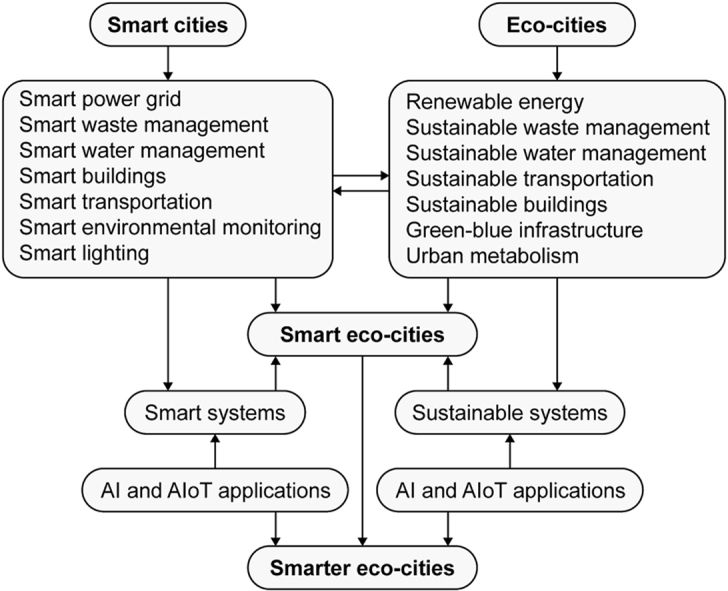
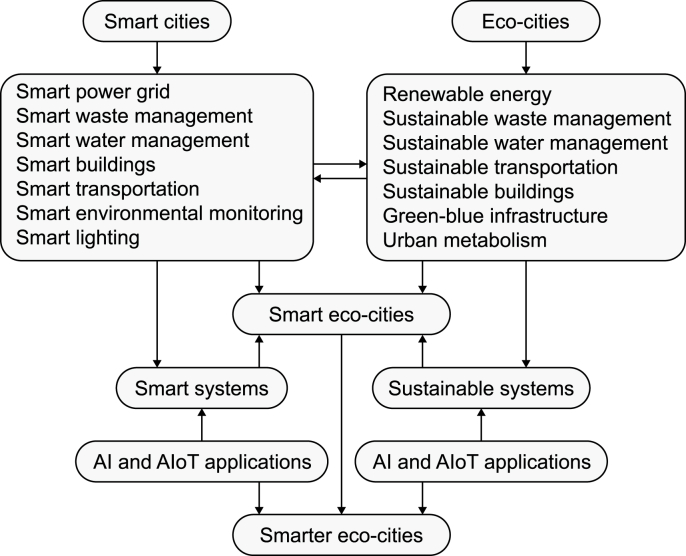
- The review defines smarter eco-cities as an evolution of smart eco-cities that integrate AI and AIoT with environmental technologies and strategies to optimize sustainable systems and smart systems, producing combined effects greater than the sum of their separate effects.
- It identifies AI/AIoT applications across energy conservation and renewable energy, sustainable transportation and traffic control, water resources conservation, waste management, biodiversity and ecosystem services, environmental monitoring and control, climate change adaptation and mitigation, and disaster resilience and management.
- Reported benefits include optimized resource management, increased energy efficiency, enhanced waste management, improved transportation and mobility management, reduced environmental impacts, increased resilience, and enhanced decision-making in urban management and planning.
- Challenges include environmental costs and high energy demand of AI/AIoT, e-waste and toxic pollution, privacy and cybersecurity risks, public trust and social acceptance issues, limited technical expertise, lack of robust regulatory frameworks, and ethical/societal concerns; the paper also cites estimates that global electricity demand for advanced ICT could rise to 20% compared with around 1% today, and that AI may advance 134 SDG targets while hindering 59.
Methods
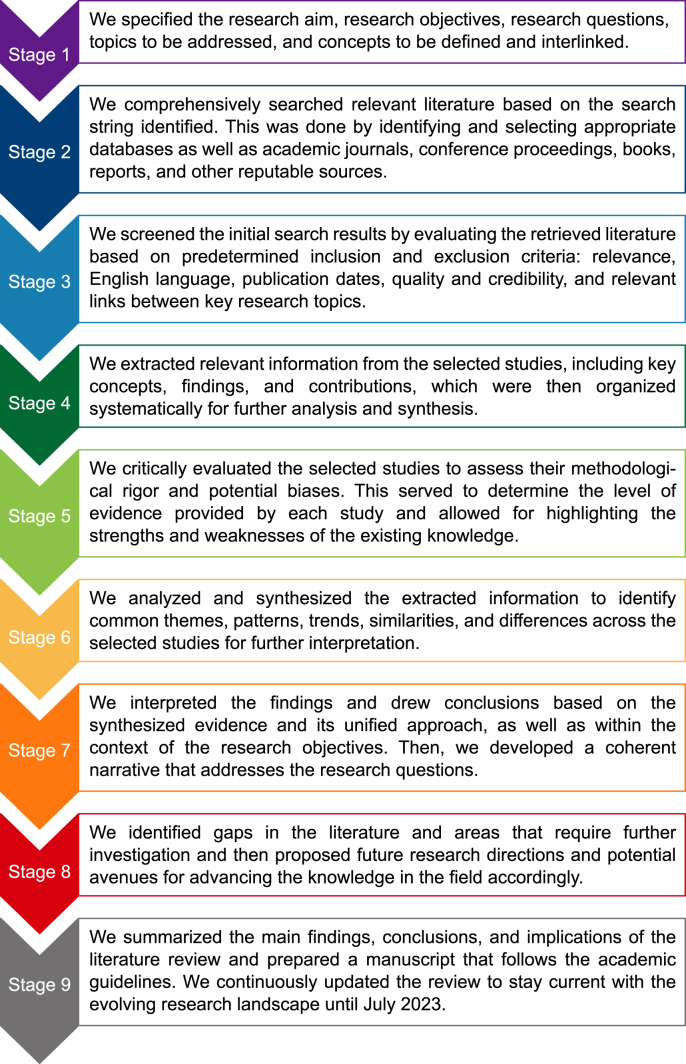
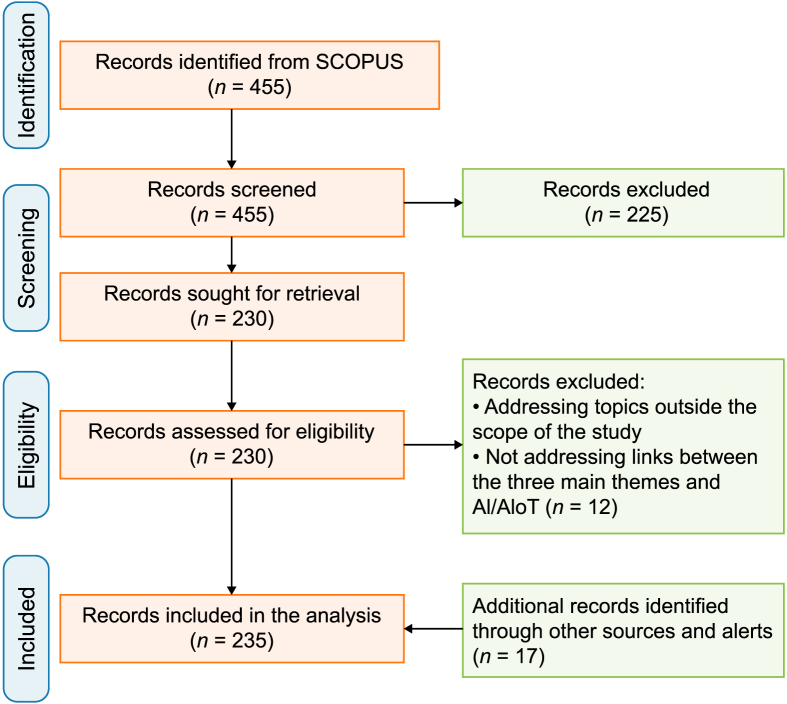
- A systematic literature review with nine stages, following PRISMA for search and selection, using SCOPUS and a broad search string; the search was conducted in late March 2023 and covered 2015–2023, returning 455 documents, reduced to 230 after excluding overlaps, then 12 excluded and 17 added via citation tracking, yielding a final database of 235 documents.
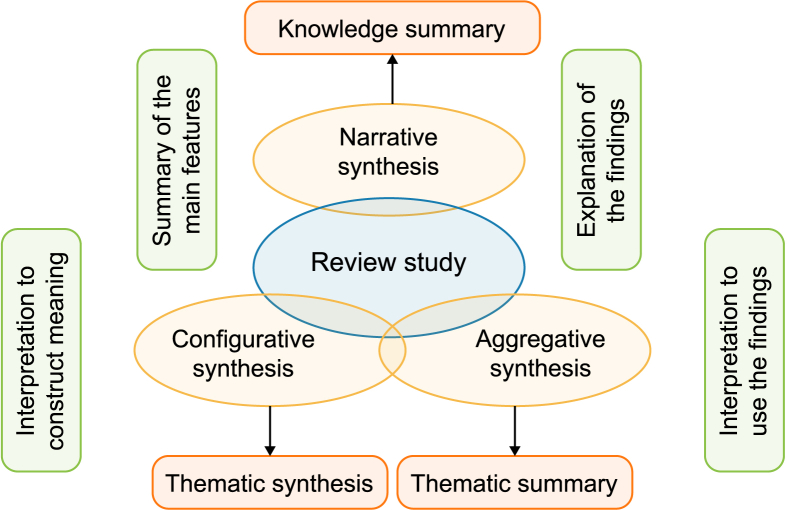
- The synthesis used a unified evidence synthesis framework integrating configurative, aggregative, and narrative synthesis approaches, with deductive content analysis via a structured Excel spreadsheet and critical appraisal of selected studies.
Limitations
- The paper states that the search strategy may have missed relevant studies due to database selection, search keywords, language restriction, and inclusion/exclusion criteria; reliance on peer-reviewed documents risks excluding grey literature and stakeholder input.
- It also states publication bias (positive results more likely published), English-language bias, and potential funding-source bias, plus data extraction and synthesis challenges from heterogeneity in study designs and reporting formats.
- The text makes evident that the review is a qualitative evidence synthesis rather than a quantitative meta-analysis, so it does not pool effect sizes or provide statistical estimates of AI/AIoT impacts.
Model-written summary. Check it against the paper before relying on it.
Integrity signals
Registry
Cites
Statistics
Figures
Verification
Claims the paper makes
118 Own interpretation · 115 Not checked yet · 66 No basis given · 7 Own method · 3 Supported · 2 Own result · 1 Couldn’t confirm · accuracy not yet measured
The cited sources that could be checked couldn’t confirm or dispute this claim.
In the paper
“This was considered reliable when conducting a systematic review [113].”
§ Smarter eco-cities and their leading-edge artificial intelligence of things solutions for environmental sustainability: A comprehensive systematic review > Materials and methods
What the sources say
- Could not verifycites [113] Talan G. Sharma G.D. Doing well by doing good: a systematic review and research agenda for sustainable investment Sustainability 11 2 2019 sourceExperimental — accuracy not yet measured
Section 3.1 describes the source paper’s own selection process: 225 records were identified and 213 articles were finally reviewed. It does not assess whether a separate database of 235 documents is reliable for a systematic review. Searches for a reliability or sample-size criterion found no such passage. (LLM, conf=0.76)
plain- Asserted: passes — The authors put it forward as true.
- Checkable: passes — It can be checked against evidence.
- Load-bearing: passes — The paper’s conclusions depend on it.
- Based: passes — The paper gives a reason why it holds.
- Could not verify
Every source the paper cites for this claim was checked and supports it.
In the paper
“This is determined by an earlier bibliometric study conducted by Bibri et al. [1], highlighting several urban trends and events highly relevant to the current study.”
§ Smarter eco-cities and their leading-edge artificial intelligence of things solutions for environmental sustainability: A comprehensive systematic review > Materials and methods
What the sources say
- Supportedcites [1] Bibri S.E. Alahi A. Sharifi A. Krogstie J. Environmentally sustainable smart cities and their converging AI, IoT, and big data technologies and solutions: an integrated approach to an extensive literature review Energy Inform 6 2023 9 10.1186/s42162-023-00259-2 2023 37032812 PMC10074362 source
The Materials and methods passage identifies 2015 as a milestone associated with international urban-sustainability policy frameworks. The Results passage on publication trends reports rapid growth in relevant research from the mid-2010s. The cited paper is a bibliometric study highlighting the trends and events the citing authors invoke; selecting 2015–2023 is the citing authors’ own decision, not a finding attributed to the source. (LLM, conf=0.88)
plaindirect- Asserted: passes — The authors put it forward as true.
- Checkable: passes — It can be checked against evidence.
- Load-bearing: unclear — It is unclear whether the paper’s conclusions depend on it.
- Based: passes — The paper gives a reason why it holds.
- Supported
The paper states this without a source or data behind it here, so there is nothing to check it against. The quote shows it is in the paper.
In the paper
“The research review on waste management demonstrates the significant contributions of AI in waste management, ranging from enhanced waste sorting to optimized collection routes, predictive maintenance, and Decision Support Systems (DSS).”
§ Smarter eco-cities and their leading-edge artificial intelligence of things solutions for environmental sustainability: A comprehensive systematic review > A review of related literature studies > AI for environmental sustainability and climate change
boosteddirect- Asserted: passes — The authors put it forward as true.
- Checkable: passes — It can be checked against evidence.
- Load-bearing: unclear — It is unclear whether the paper’s conclusions depend on it.
- Based: passes — The paper gives a reason why it holds.
None of the sources cited for this claim have been checked yet.
In the paper
“Some reviews have been conducted on the link between AI, IoT, and Big Data in smart cities from a more general perspective (e.g., Ref. [1,106,107]), broadly addressing different domains beyond environmental sustainability without providing technical details.”
§ Smarter eco-cities and their leading-edge artificial intelligence of things solutions for environmental sustainability: A comprehensive systematic review > A review of related literature studies > AI for smart cities
What the sources say
- Not checked yetcites [1] Bibri S.E. Alahi A. Sharifi A. Krogstie J. Environmentally sustainable smart cities and their converging AI, IoT, and big data technologies and solutions: an integrated approach to an extensive literature review Energy Inform 6 2023 9 10.1186/s42162-023-00259-2 2023 37032812 PMC10074362 source
- Not checked yetcites [106] Allam Z. Dhunny A.Z. On big data, artificial intelligence and smart cities Cities 89 2019 80 91 source
- Not checked yetcites [107] Navarathna P.J. Malagi V.P. Artificial Intelligence in Smart City Analysis International Conference on Smart Systems Inventive Technology 2018 ICSSIT 44 47 2018 https://doi:10.1109/ICSSIT.2018.8748476
plaincorrelational- Asserted: passes — The authors put it forward as true.
- Checkable: passes — It can be checked against evidence.
- Load-bearing: unclear — It is unclear whether the paper’s conclusions depend on it.
- Based: passes — The paper gives a reason why it holds.
None of the sources cited for this claim have been checked yet.
In the paper
“These models and techniques have also been applied to hydro-meteorological forecasting and leak detection [[165], [166], [167]].”
§ Smarter eco-cities and their leading-edge artificial intelligence of things solutions for environmental sustainability: A comprehensive systematic review > Results > The rise of AI and AIoT in environmental sustainability, climate change, and smart cities: solutions, use cases, and applications
What the sources say
- Not checked yetcites [165] Calp M.H. A hybrid anfis-ga approach for estimation of regional rainfall amount J. Sci. 32 2019 145 162
- Not checked yetcites [166] Ferreira L. Duarte A. Cunha F. Fernandes-Filho E. Multivariate adaptive regression splines (MARS) applied to daily reference evapotranspiration modeling with limited weather data Acta Sci. Agron. 41 2019 10.4025/actasciagron.v41i1.39880 source
- Not checked yetcites [167] Rojek I. Studzinski J. Detection and localization of water leaks in water nets supported by an ICT system with artificial intelligence methods as a way forward for smart cities Sustainablity vol. 11 2019 518 2 source
plain- Asserted: passes — The authors put it forward as true.
- Checkable: passes — It can be checked against evidence.
- Load-bearing: unclear — It is unclear whether the paper’s conclusions depend on it.
- Based: passes — The paper gives a reason why it holds.
In the paper
“Consequently, IoT and Big Data technologies gained further momentum in the pursuit of environmental sustainability across the different domains of smart cities, especially transport, mobility, energy, waste, pollution control, air quality, and planning (e.g., Ref. [[137], [138], [139], [140]]).”
§ Smarter eco-cities and their leading-edge artificial intelligence of things solutions for environmental sustainability: A comprehensive systematic review > Results > The relationship between data-driven technologies, environmental sustainability, smart cities, and smart eco-cities
What the sources say
- Not checked yetcites [[137], [138], [139], [140]]
plaincorrelational- Asserted: passes — The authors put it forward as true.
- Checkable: passes — It can be checked against evidence.
- Load-bearing: unclear — It is unclear whether the paper’s conclusions depend on it.
- Based: passes — The paper gives a reason why it holds.
In the paper
“They also demonstrate the clear synergy between the eco-city and smart city solutions as to producing “combined effects greater than the sum of their separate effects — concerning energy efficiency and conservation improvement, environmental pollution reduction, renewable energy adoption, and real-time feedback on energy and material flows.””
§ Smarter eco-cities and their leading-edge artificial intelligence of things solutions for environmental sustainability: A comprehensive systematic review > Results > The relationship between data-driven technologies, environmental sustainability, smart cities, and smart eco-cities
What the sources say
- Not checked yetcites [53] Bibri S.E. Krogstie J. Environmentally data-driven smart sustainable cities: applied innovative solutions for energy efficiency, pollution reduction, and urban metabolism Energy Informat. 3 1 2020 29 10.1186/s42162-020-00130-8 source
boosteddirect- Asserted: passes — The authors put it forward as true.
- Checkable: passes — It can be checked against evidence.
- Load-bearing: passes — The paper’s conclusions depend on it.
- Based: passes — The paper gives a reason why it holds.
In the paper
“Energy-related studies have harnessed ML and DSS with techniques such as ANN, FL, SVM, DT, Evolution Strategies (ES), Evolutionary Computing (EC), BN (an algorithmic method that makes the training of DNN faster and more stable), and ANFIS for tasks including energy operation, production, distribution, maintenance, and planning (e.g., Ref. [92,161,[168], [169], [170]]).”
§ Smarter eco-cities and their leading-edge artificial intelligence of things solutions for environmental sustainability: A comprehensive systematic review > Results > The rise of AI and AIoT in environmental sustainability, climate change, and smart cities: solutions, use cases, and applications
What the sources say
- Not checked yetcites [92,161,[168], [169], [170]]
plain- Asserted: passes — The authors put it forward as true.
- Checkable: passes — It can be checked against evidence.
- Load-bearing: unclear — It is unclear whether the paper’s conclusions depend on it.
- Based: passes — The paper gives a reason why it holds.
In the paper
“Overall, policy instruments play a crucial role in the materialization of smart eco-cities by providing a framework for planning, implementing, and regulating various initiatives.”
§ Smarter eco-cities and their leading-edge artificial intelligence of things solutions for environmental sustainability: A comprehensive systematic review > Results > The relationship between data-driven technologies, environmental sustainability, smart cities, and smart eco-cities
What the sources say
- Not checked yetcites [35,55,56,[154], [155], [156]]
plaindirect- Asserted: passes — The authors put it forward as true.
- Checkable: passes — It can be checked against evidence.
- Load-bearing: unclear — It is unclear whether the paper’s conclusions depend on it.
- Based: passes — The paper gives a reason why it holds.
In the paper
“It is until around 2014 that smart cities started to have a significant impact on eco-cities for environmental sustainability (e.g., Ref. [57,[147], [148], [149], [150], [151]) thanks to the adoption of IoT and Big Data technologies as advanced forms of ICT.”
§ Smarter eco-cities and their leading-edge artificial intelligence of things solutions for environmental sustainability: A comprehensive systematic review > Results > The relationship between data-driven technologies, environmental sustainability, smart cities, and smart eco-cities
What the sources say
- Not checked yetcites [57,[147], [148], [149], [150], [151]
plaindirect- Asserted: passes — The authors put it forward as true.
- Checkable: passes — It can be checked against evidence.
- Load-bearing: unclear — It is unclear whether the paper’s conclusions depend on it.
- Based: passes — The paper gives a reason why it holds.
- It may state two separate claims as one. 99
- Probably not a substantial claim. 167
- The quote only partly states this claim. 1
Every source the paper cites for this claim was checked and supports it.
In the paper
“Regarding the technical challenges related to DL-based AIoT, they include [13]:•Multimodal heterogeneous data processing, transmission, and storage pertaining to the massive numbers of heterogeneous sensors and the vast data streams of different formats, sizes, and timestamps they generate.•Limited computational and storage resources in relation to using DL models for real-time data stream”
§ Smarter eco-cities and their leading-edge artificial intelligence of things solutions for environmental sustainability: A comprehensive systematic review > Discussion: challenges, open issues, and limitations > Technical and computational challenges of AI and AIoT technologies
What the sources say
- Supportedcites [13] Zhang J. Tao D. Empowering things with intelligence: a survey of the progress, challenges, and opportunities in artificial intelligence of things IEEE Internet Things J. 8 10 2021 7789 7817 10.1109/JIOT.2020.3039359 15 May15 source
The five numbered challenges in “A. Challenges” (p. 21) match the claim: multimodal data handling, limited edge-device resources, computational scheduling, unlabeled data, and data monopoly. The source also links the resource constraint to real-time processing and low latency. (LLM, conf=0.95)
plain- Asserted: passes — The authors put it forward as true.
- Checkable: passes — It can be checked against evidence.
- Load-bearing: unclear — It is unclear whether the paper’s conclusions depend on it.
- Based: passes — The paper gives a reason why it holds.
It may state two separate claims as one.
- Supported
Every source the paper cites for this claim was checked and supports it.
In the paper
“However, Kassens-Noor and Hintze [303] argue that the adoption rate of AI technology, coupled with policy regulations and unforeseen events, has the potential to transform bustling metropolises into deserted ghost cities.”
§ Smarter eco-cities and their leading-edge artificial intelligence of things solutions for environmental sustainability: A comprehensive systematic review > Discussion: challenges, open issues, and limitations > Ethical and Societal Challenges of AI and AIoT technologies
What the sources say
- Supportedcites [303] Kassens-Noor E. Hintze A. Cities of the future? The potential impact of artificial intelligence AI 1 2020 192 197 10.3390/ai1020012 source
The Conclusions state that AI may turn metropolises into ghost cities and that this depends on the rate of AI adoption, policy regulations, and unpredictable events such as COVID-19. The citing sentence accurately paraphrases this conditional argument. (LLM, conf=0.95)
hedgedconditional- Asserted: fails — The authors may not put it forward as true.
- Checkable: passes — It can be checked against evidence.
- Load-bearing: fails — The paper’s conclusions may not depend on it.
- Based: passes — The paper gives a reason why it holds.
Probably not a substantial claim. The authors may not put it forward as true. The paper’s conclusions may not depend on it.
- Supported
The paper states this without a source or data behind it here, so there is nothing to check it against. The quote shows it is in the paper.
In the paper
“The review studies on energy conservation and renewable energy contribute to understanding various approaches and strategies for achieving energy efficiency and promoting renewable energy sources in different contexts.”
§ Smarter eco-cities and their leading-edge artificial intelligence of things solutions for environmental sustainability: A comprehensive systematic review > A review of related literature studies > AI for environmental sustainability and climate change
plaindirect- Asserted: passes — The authors put it forward as true.
- Checkable: fails — It may be too vague to check against evidence.
- Load-bearing: fails — The paper’s conclusions may not depend on it.
- Based: passes — The paper gives a reason why it holds.
Probably not a substantial claim. It may be too vague to check against evidence. The paper’s conclusions may not depend on it.
The paper states this without a source or data behind it here, so there is nothing to check it against. The quote shows it is in the paper.
In the paper
“Several reviews have been performed on AI and AIoT in improving or advancing the different areas of environmental sustainability and climate change (Table 1).”
§ Smarter eco-cities and their leading-edge artificial intelligence of things solutions for environmental sustainability: A comprehensive systematic review > A review of related literature studies
plain- Asserted: passes — The authors put it forward as true.
- Checkable: passes — It can be checked against evidence.
- Load-bearing: fails — The paper’s conclusions may not depend on it.
- Based: passes — The paper gives a reason why it holds.
Probably not a substantial claim. The paper’s conclusions may not depend on it.
The paper states this without a source or data behind it here, so there is nothing to check it against. The quote shows it is in the paper.
In the paper
“In the field of water resources conservation, review studies contribute to the knowledge on water management practices, including efficient water use, water conservation strategies, and the impact of climate change on water resources.”
§ Smarter eco-cities and their leading-edge artificial intelligence of things solutions for environmental sustainability: A comprehensive systematic review > A review of related literature studies > AI for environmental sustainability and climate change
plaindirect- Asserted: passes — The authors put it forward as true.
- Checkable: passes — It can be checked against evidence.
- Load-bearing: fails — The paper’s conclusions may not depend on it.
- Based: passes — The paper gives a reason why it holds.
Probably not a substantial claim. The paper’s conclusions may not depend on it.
The paper states this without a source or data behind it here, so there is nothing to check it against. The quote shows it is in the paper.
In the paper
“The review studies on biodiversity and ecosystem services provide insights into the importance of biodiversity conservation and the role of ecosystem services in sustaining human well-being.”
§ Smarter eco-cities and their leading-edge artificial intelligence of things solutions for environmental sustainability: A comprehensive systematic review > A review of related literature studies > AI for environmental sustainability and climate change
plaincorrelational- Asserted: passes — The authors put it forward as true.
- Checkable: passes — It can be checked against evidence.
- Load-bearing: fails — The paper’s conclusions may not depend on it.
- Based: fails — The paper may give no reason why it holds.
Probably not a substantial claim. The paper’s conclusions may not depend on it. The paper may give no reason why it holds. It may state two separate claims as one.
The paper states this without a source or data behind it here, so there is nothing to check it against. The quote shows it is in the paper.
In the paper
“It was not until more recently that the literature on AI and AIoT applications for environmental sustainability and climate change started to grow and extend across many domains and disciplines.”
§ Smarter eco-cities and their leading-edge artificial intelligence of things solutions for environmental sustainability: A comprehensive systematic review > A review of related literature studies
plain- Asserted: passes — The authors put it forward as true.
- Checkable: passes — It can be checked against evidence.
- Load-bearing: fails — The paper’s conclusions may not depend on it.
- Based: fails — The paper may give no reason why it holds.
Probably not a substantial claim. The paper’s conclusions may not depend on it. The paper may give no reason why it holds.
The paper states this without a source or data behind it here, so there is nothing to check it against. The quote shows it is in the paper.
In the paper
“Few review studies have been carried out on AIoT as an emerging technological area.”
§ Smarter eco-cities and their leading-edge artificial intelligence of things solutions for environmental sustainability: A comprehensive systematic review > A review of related literature studies > AIoT: theoretical foundations and practical applications
plain- Asserted: passes — The authors put it forward as true.
- Checkable: passes — It can be checked against evidence.
- Load-bearing: passes — The paper’s conclusions depend on it.
- Based: fails — The paper may give no reason why it holds.
Probably not a substantial claim. The paper may give no reason why it holds.
The paper states this without a source or data behind it here, so there is nothing to check it against. The quote shows it is in the paper.
In the paper
“In the domain of climate change adaptation and mitigation, review studies contribute to understanding the challenges and opportunities in addressing climate change impacts.”
§ Smarter eco-cities and their leading-edge artificial intelligence of things solutions for environmental sustainability: A comprehensive systematic review > A review of related literature studies > AI for environmental sustainability and climate change
plaindirect- Asserted: passes — The authors put it forward as true.
- Checkable: passes — It can be checked against evidence.
- Load-bearing: fails — The paper’s conclusions may not depend on it.
- Based: passes — The paper gives a reason why it holds.
Probably not a substantial claim. The paper’s conclusions may not depend on it.
The paper states this without a source or data behind it here, so there is nothing to check it against. The quote shows it is in the paper.
In the paper
“These studies highlight the potential of sustainable transportation solutions in reducing CO2 emissions, improving air quality, and enhancing urban mobility.”
§ Smarter eco-cities and their leading-edge artificial intelligence of things solutions for environmental sustainability: A comprehensive systematic review > A review of related literature studies > AI for environmental sustainability and climate change
plainconditional- Asserted: passes — The authors put it forward as true.
- Checkable: passes — It can be checked against evidence.
- Load-bearing: fails — The paper’s conclusions may not depend on it.
- Based: passes — The paper gives a reason why it holds.
Probably not a substantial claim. The paper’s conclusions may not depend on it. It may state two separate claims as one.
The paper states this without a source or data behind it here, so there is nothing to check it against. The quote shows it is in the paper.
In the paper
“The previous review studies on AI and environmental sustainability, AI and climate change, AI and smart cities, and AIoT have laid a strong foundation for understanding the opportunities, benefits, and challenges in creating environmentally sustainable and technologically advanced urban environments.”
§ Smarter eco-cities and their leading-edge artificial intelligence of things solutions for environmental sustainability: A comprehensive systematic review > A review of related literature studies > AIoT: theoretical foundations and practical applications
boosteddirect- Asserted: passes — The authors put it forward as true.
- Checkable: fails — It may be too vague to check against evidence.
- Load-bearing: passes — The paper’s conclusions depend on it.
- Based: fails — The paper may give no reason why it holds.
Probably not a substantial claim. It may be too vague to check against evidence. The paper may give no reason why it holds.
In the paper
“Among the policy instruments that facilitate the materialization of smart eco-cities [35,55,56,[154], [155], [156]] are:”
§ Smarter eco-cities and their leading-edge artificial intelligence of things solutions for environmental sustainability: A comprehensive systematic review > Results > The relationship between data-driven technologies, environmental sustainability, smart cities, and smart eco-cities
What the sources say
- Not checked yetcites [35,55,56,[154], [155], [156]]
plaindirect- Asserted: passes — The authors put it forward as true.
- Checkable: passes — It can be checked against evidence.
- Load-bearing: unclear — It is unclear whether the paper’s conclusions depend on it.
- Based: passes — The paper gives a reason why it holds.
It may state two separate claims as one.
None of the sources cited for this claim have been checked yet.
In the paper
“To put it differently, governance is at the core of smart eco-cities (e.g., Refs. [35,53,56,57,155]), and its key function is to make and implement policy.”
§ Smarter eco-cities and their leading-edge artificial intelligence of things solutions for environmental sustainability: A comprehensive systematic review > Results > The relationship between data-driven technologies, environmental sustainability, smart cities, and smart eco-cities
What the sources say
- Not checked yetcites [35] Caprotti F. Cowley R. Bailey I. Joss S. Sengers F. Raven R. Spaeth P. Jolivet E. Tan-Mullins M. Cheshmehzangi A. Smart Eco-City Development in Europe and China: Policy Directions 2017 University of Exter (SMART-ECO Project
- Not checked yetcites [53] Bibri S.E. Krogstie J. Environmentally data-driven smart sustainable cities: applied innovative solutions for energy efficiency, pollution reduction, and urban metabolism Energy Informat. 3 1 2020 29 10.1186/s42162-020-00130-8 source
- Not checked yetcites [56] Späth P. Hawxwell T. John R. Li S. Löffler E. Riener V. Utkarsh S. Smart-eco Cities in Germany: Trends and City Profiles 2017 University of Exeter Press
- Not checked yetcites [57] Bibri S.E. Krogstie J. Smart eco-city strategies and solutions for sustainability: the cases of royal seaport, Stockholm, and Western Harbor, Malmö, Sweden Urban Sci. 4 2020 11 10.3390/urbansci4010011 2020 source
- Not checked yetcites [155] Kramers A. Wangel J. Höjer M. Governing the smart sustainable city: the case of the Stockholm Royal Seaport ICT Sustain. 46 2016 99 108 2016
plaincorrelational- Asserted: passes — The authors put it forward as true.
- Checkable: passes — It can be checked against evidence.
- Load-bearing: unclear — It is unclear whether the paper’s conclusions depend on it.
- Based: passes — The paper gives a reason why it holds.
It may state two separate claims as one.
In the paper
“A recent comprehensive state-of-the-art review conducted by Bibri [27] on smart eco-cities reveals that the newly planned and ongoing eco-city project developments are increasingly trialing innovative smart technologies to improve several aspects of environmental sustainability and climate change.”
§ Smarter eco-cities and their leading-edge artificial intelligence of things solutions for environmental sustainability: A comprehensive systematic review > Results > The relationship between data-driven technologies, environmental sustainability, smart cities, and smart eco-cities
What the sources say
- Not checked yetcites [27] Bibri S.E. Data-driven smart eco-cities and sustainable integrated districts: a best-evidence synthesis approach to an extensive literature review Eur. J. For. Res. 9 1 2021 16 10.1186/s40309-021-00181-4
plaincorrelational- Asserted: passes — The authors put it forward as true.
- Checkable: passes — It can be checked against evidence.
- Load-bearing: fails — The paper’s conclusions may not depend on it.
- Based: passes — The paper gives a reason why it holds.
Probably not a substantial claim. The paper’s conclusions may not depend on it.
In the paper
“During the period 2012–2015, smart cities gained traction as a model for sustainable urban development, with great potential to improve environmental sustainability based on IoT and Big Data Technologies (e.g., Ref. [[130], [131], [132], [133], [134], [135], [136]]).”
§ Smarter eco-cities and their leading-edge artificial intelligence of things solutions for environmental sustainability: A comprehensive systematic review > Results > The relationship between data-driven technologies, environmental sustainability, smart cities, and smart eco-cities
What the sources say
- Not checked yetcites [[130], [131], [132], [133], [134], [135], [136]]
plainconditional- Asserted: passes — The authors put it forward as true.
- Checkable: passes — It can be checked against evidence.
- Load-bearing: unclear — It is unclear whether the paper’s conclusions depend on it.
- Based: passes — The paper gives a reason why it holds.
It may state two separate claims as one.
In the paper
“This was manifested in the processes and practices of smart cities becoming “highly responsive to a form of data-driven urbanism” [146].”
§ Smarter eco-cities and their leading-edge artificial intelligence of things solutions for environmental sustainability: A comprehensive systematic review > Results > The relationship between data-driven technologies, environmental sustainability, smart cities, and smart eco-cities
What the sources say
- Not checked yetcites [146] Kitchin R. The ethics of smart cities and urban science Phil. Trans. Math. Phys. Eng. Sci. 374 2083 2016 1 15 10.1098/rsta.2016.0115 PMC5124065 28336794
plaindirect- Asserted: passes — The authors put it forward as true.
- Checkable: passes — It can be checked against evidence.
- Load-bearing: fails — The paper’s conclusions may not depend on it.
- Based: passes — The paper gives a reason why it holds.
Probably not a substantial claim. The paper’s conclusions may not depend on it.
The paper states this without a source or data behind it here, so there is nothing to check it against. The quote shows it is in the paper.
In the paper
“To become environmentally smarter and more sustainable, both smart cities and eco-cities have undergone large-scale digital transformation enabled by the convergence of IoT, Big Data, and AI technologies.”
§ Smarter eco-cities and their leading-edge artificial intelligence of things solutions for environmental sustainability: A comprehensive systematic review > Results > The relationship between data-driven technologies, environmental sustainability, smart cities, and smart eco-cities
plaindirect- Asserted: passes — The authors put it forward as true.
- Checkable: passes — It can be checked against evidence.
- Load-bearing: fails — The paper’s conclusions may not depend on it.
- Based: fails — The paper may give no reason why it holds.
Probably not a substantial claim. The paper’s conclusions may not depend on it. The paper may give no reason why it holds.
In the paper
“Similar to Stockholm City [53], the energy transition model of Barcelona as one of the leading smart cities in Europe, aims to produce a 100 % certified renewable energy supply plan through smart energy [154].”
§ Smarter eco-cities and their leading-edge artificial intelligence of things solutions for environmental sustainability: A comprehensive systematic review > Results > The relationship between data-driven technologies, environmental sustainability, smart cities, and smart eco-cities
What the sources say
- Not checked yetcites [154] Noori N. Hoppe T. de Jong M. Classifying pathways for smart city development: comparing design, governance and implementation in Amsterdam, Barcelona, Dubai, and Abu Dhabi Sustainability 12 10 2020 4030 source
plaindirect- Asserted: passes — The authors put it forward as true.
- Checkable: passes — It can be checked against evidence.
- Load-bearing: fails — The paper’s conclusions may not depend on it.
- Based: passes — The paper gives a reason why it holds.
Probably not a substantial claim. The paper’s conclusions may not depend on it.
The paper states this without a source or data behind it here, so there is nothing to check it against. The quote shows it is in the paper.
In the paper
“Accordingly, in the early 2010s, numerous studies addressed the role of ICT in tackling the challenges of environmental sustainability in the realm of smart cities in various domains, notably:”
§ Smarter eco-cities and their leading-edge artificial intelligence of things solutions for environmental sustainability: A comprehensive systematic review > Results > The relationship between data-driven technologies, environmental sustainability, smart cities, and smart eco-cities
plaincorrelational- Asserted: passes — The authors put it forward as true.
- Checkable: passes — It can be checked against evidence.
- Load-bearing: fails — The paper’s conclusions may not depend on it.
- Based: passes — The paper gives a reason why it holds.
Probably not a substantial claim. The paper’s conclusions may not depend on it.
The paper states this without a source or data behind it here, so there is nothing to check it against. The quote shows it is in the paper.
In the paper
“The studies on marine resources management have provided new perspectives on tackling different relevant challenges and enhancing the sustainable management of marine resources.”
§ Smarter eco-cities and their leading-edge artificial intelligence of things solutions for environmental sustainability: A comprehensive systematic review > Results > The rise of AI and AIoT in environmental sustainability, climate change, and smart cities: solutions, use cases, and applications
plaindirect- Asserted: passes — The authors put it forward as true.
- Checkable: passes — It can be checked against evidence.
- Load-bearing: fails — The paper’s conclusions may not depend on it.
- Based: fails — The paper may give no reason why it holds.
Probably not a substantial claim. The paper’s conclusions may not depend on it. The paper may give no reason why it holds.
The paper states this without a source or data behind it here, so there is nothing to check it against. The quote shows it is in the paper.
In the paper
“Disaster resilience studies have enhanced disaster resilience, enabling effective preparedness, response, and recovery measures.”
§ Smarter eco-cities and their leading-edge artificial intelligence of things solutions for environmental sustainability: A comprehensive systematic review > Results > The rise of AI and AIoT in environmental sustainability, climate change, and smart cities: solutions, use cases, and applications
plaindirect- Asserted: passes — The authors put it forward as true.
- Checkable: passes — It can be checked against evidence.
- Load-bearing: fails — The paper’s conclusions may not depend on it.
- Based: fails — The paper may give no reason why it holds.
Probably not a substantial claim. The paper’s conclusions may not depend on it. The paper may give no reason why it holds.
The paper states this without a source or data behind it here, so there is nothing to check it against. The quote shows it is in the paper.
In the paper
“and their outcomes provide insights into the development of evidence-based approaches for building more sustainable and resilient smart eco-cities.”
§ Smarter eco-cities and their leading-edge artificial intelligence of things solutions for environmental sustainability: A comprehensive systematic review > Results > The rise of AI and AIoT in environmental sustainability, climate change, and smart cities: solutions, use cases, and applications
plaincorrelational- Asserted: passes — The authors put it forward as true.
- Checkable: passes — It can be checked against evidence.
- Load-bearing: passes — The paper’s conclusions depend on it.
- Based: passes — The paper gives a reason why it holds.
Probably not a substantial claim.
In the paper
“Biodiversity-related studies have explored modeling competition and population dynamics, often employing ML techniques like cellular automata [188].”
§ Smarter eco-cities and their leading-edge artificial intelligence of things solutions for environmental sustainability: A comprehensive systematic review > Results > The rise of AI and AIoT in environmental sustainability, climate change, and smart cities: solutions, use cases, and applications
What the sources say
- Not checked yetcites [188] Kalmykov L.V. Kalmykov V.L. A solution to the biodiversity paradox by logical deterministic cellular automata Acta Biotheor. 63 2 2015 203 221 10.1007/s10441-015-9257-9 25980478 source
plaincorrelational- Asserted: passes — The authors put it forward as true.
- Checkable: passes — It can be checked against evidence.
- Load-bearing: fails — The paper’s conclusions may not depend on it.
- Based: passes — The paper gives a reason why it holds.
Probably not a substantial claim. The paper’s conclusions may not depend on it.
The paper states this without a source or data behind it here, so there is nothing to check it against. The quote shows it is in the paper.
In the paper
“Overall, these empirical studies provide valuable insights and advancements in understanding climate change challenges in the context of emerging smarter eco-cities.”
§ Smarter eco-cities and their leading-edge artificial intelligence of things solutions for environmental sustainability: A comprehensive systematic review > Results > The rise of AI and AIoT in environmental sustainability, climate change, and smart cities: solutions, use cases, and applications
plain- Asserted: passes — The authors put it forward as true.
- Checkable: fails — It may be too vague to check against evidence.
- Load-bearing: fails — The paper’s conclusions may not depend on it.
- Based: passes — The paper gives a reason why it holds.
Probably not a substantial claim. It may be too vague to check against evidence. The paper’s conclusions may not depend on it.
The paper states this without a source or data behind it here, so there is nothing to check it against. The quote shows it is in the paper.
In the paper
“Regarding natural disaster analysis, the key insights gained pertain to predicting and forecasting natural disasters, resilient infrastructure planning, and environmental hazard detection.”
§ Smarter eco-cities and their leading-edge artificial intelligence of things solutions for environmental sustainability: A comprehensive systematic review > Results > The rise of AI and AIoT in environmental sustainability, climate change, and smart cities: solutions, use cases, and applications
plain- Asserted: passes — The authors put it forward as true.
- Checkable: passes — It can be checked against evidence.
- Load-bearing: unclear — It is unclear whether the paper’s conclusions depend on it.
- Based: passes — The paper gives a reason why it holds.
It may state two separate claims as one.
The paper states this without a source or data behind it here, so there is nothing to check it against. The quote shows it is in the paper.
In the paper
“In scenario analysis, various modeling techniques are used, including Generative Adversarial Networks (GANs), DL (CNNs and RNNs) and NLP, to create and analyze these scenarios.”
§ Smarter eco-cities and their leading-edge artificial intelligence of things solutions for environmental sustainability: A comprehensive systematic review > Results > The rise of AI and AIoT in environmental sustainability, climate change, and smart cities: solutions, use cases, and applications
plain- Asserted: passes — The authors put it forward as true.
- Checkable: passes — It can be checked against evidence.
- Load-bearing: fails — The paper’s conclusions may not depend on it.
- Based: passes — The paper gives a reason why it holds.
Probably not a substantial claim. The paper’s conclusions may not depend on it.
The paper states this without a source or data behind it here, so there is nothing to check it against. The quote shows it is in the paper.
In the paper
“The research on sustainable transportation has provided insights into traffic management, transportation planning, and improving the overall efficiency and sustainability of transportation systems.”
§ Smarter eco-cities and their leading-edge artificial intelligence of things solutions for environmental sustainability: A comprehensive systematic review > Results > The rise of AI and AIoT in environmental sustainability, climate change, and smart cities: solutions, use cases, and applications
plaindirect- Asserted: passes — The authors put it forward as true.
- Checkable: passes — It can be checked against evidence.
- Load-bearing: fails — The paper’s conclusions may not depend on it.
- Based: fails — The paper may give no reason why it holds.
Probably not a substantial claim. The paper’s conclusions may not depend on it. The paper may give no reason why it holds.
The paper states this without a source or data behind it here, so there is nothing to check it against. The quote shows it is in the paper.
In the paper
“Specifically, the research on scenario analysis has provided insights into climate change impacts, vulnerability, and adaptation strategies; the interdependencies and interactions between different aspects of sustainability; understanding and managing CO2 emissions; and enabling the development of strategies for reducing carbon footprints.”
§ Smarter eco-cities and their leading-edge artificial intelligence of things solutions for environmental sustainability: A comprehensive systematic review > Results > The rise of AI and AIoT in environmental sustainability, climate change, and smart cities: solutions, use cases, and applications
plaindirect- Asserted: passes — The authors put it forward as true.
- Checkable: passes — It can be checked against evidence.
- Load-bearing: fails — The paper’s conclusions may not depend on it.
- Based: fails — The paper may give no reason why it holds.
Probably not a substantial claim. The paper’s conclusions may not depend on it. The paper may give no reason why it holds. It may state two separate claims as one.
The paper states this without a source or data behind it here, so there is nothing to check it against. The quote shows it is in the paper.
In the paper
“It considers a range of potential future outcomes for climate change, including different levels of GHG emissions, temperature increases, sea-level rise, and other climate-related factors.”
§ Smarter eco-cities and their leading-edge artificial intelligence of things solutions for environmental sustainability: A comprehensive systematic review > Results > The rise of AI and AIoT in environmental sustainability, climate change, and smart cities: solutions, use cases, and applications
plain- Asserted: passes — The authors put it forward as true.
- Checkable: passes — It can be checked against evidence.
- Load-bearing: fails — The paper’s conclusions may not depend on it.
- Based: passes — The paper gives a reason why it holds.
Probably not a substantial claim. The paper’s conclusions may not depend on it.
None of the sources cited for this claim have been checked yet.
In the paper
“The domain of disaster resilience has witnessed significant AI-driven contributions in prediction and forecasting and resilient infrastructure and urban planning.”
§ Smarter eco-cities and their leading-edge artificial intelligence of things solutions for environmental sustainability: A comprehensive systematic review > Results > The rise of AI and AIoT in environmental sustainability, climate change, and smart cities: solutions, use cases, and applications
boosteddirect- Asserted: passes — The authors put it forward as true.
- Checkable: passes — It can be checked against evidence.
- Load-bearing: unclear — It is unclear whether the paper’s conclusions depend on it.
- Based: passes — The paper gives a reason why it holds.
It may state two separate claims as one.
The paper states this without a source or data behind it here, so there is nothing to check it against. The quote shows it is in the paper.
In the paper
“Concerning the studies in biodiversity conservation they contribute to our understanding of biodiversity and the sustainable management of ecosystems.”
§ Smarter eco-cities and their leading-edge artificial intelligence of things solutions for environmental sustainability: A comprehensive systematic review > Results > The rise of AI and AIoT in environmental sustainability, climate change, and smart cities: solutions, use cases, and applications
plaindirect- Asserted: passes — The authors put it forward as true.
- Checkable: passes — It can be checked against evidence.
- Load-bearing: fails — The paper’s conclusions may not depend on it.
- Based: fails — The paper may give no reason why it holds.
Probably not a substantial claim. The paper’s conclusions may not depend on it. The paper may give no reason why it holds.
The paper states this without a source or data behind it here, so there is nothing to check it against. The quote shows it is in the paper.
In the paper
“Furthermore, scenario analysis focuses on developing and analyzing different scenarios of future climate conditions based on various parameters, data inputs, and assumptions.”
§ Smarter eco-cities and their leading-edge artificial intelligence of things solutions for environmental sustainability: A comprehensive systematic review > Results > The rise of AI and AIoT in environmental sustainability, climate change, and smart cities: solutions, use cases, and applications
plain- Asserted: passes — The authors put it forward as true.
- Checkable: passes — It can be checked against evidence.
- Load-bearing: fails — The paper’s conclusions may not depend on it.
- Based: passes — The paper gives a reason why it holds.
Probably not a substantial claim. The paper’s conclusions may not depend on it.
The paper states this without a source or data behind it here, so there is nothing to check it against. The quote shows it is in the paper.
In the paper
“The research on water resource conservation has provided insights into effective water resource management strategies.”
§ Smarter eco-cities and their leading-edge artificial intelligence of things solutions for environmental sustainability: A comprehensive systematic review > Results > The rise of AI and AIoT in environmental sustainability, climate change, and smart cities: solutions, use cases, and applications
plaindirect- Asserted: passes — The authors put it forward as true.
- Checkable: passes — It can be checked against evidence.
- Load-bearing: fails — The paper’s conclusions may not depend on it.
- Based: fails — The paper may give no reason why it holds.
Probably not a substantial claim. The paper’s conclusions may not depend on it. The paper may give no reason why it holds.
The paper states this without a source or data behind it here, so there is nothing to check it against. The quote shows it is in the paper.
In the paper
“Regarding energy conservation and renewable energy, the studies in this area have contributed to optimizing energy operations, promoting energy efficiency, and fostering the adoption of renewable energy technologies.”
§ Smarter eco-cities and their leading-edge artificial intelligence of things solutions for environmental sustainability: A comprehensive systematic review > Results > The rise of AI and AIoT in environmental sustainability, climate change, and smart cities: solutions, use cases, and applications
plaindirect- Asserted: passes — The authors put it forward as true.
- Checkable: passes — It can be checked against evidence.
- Load-bearing: fails — The paper’s conclusions may not depend on it.
- Based: passes — The paper gives a reason why it holds.
Probably not a substantial claim. The paper’s conclusions may not depend on it. It may state two separate claims as one.
The paper states this without a source or data behind it here, so there is nothing to check it against. The quote shows it is in the paper.
In the paper
“This focus has yielded significant contributions to advancing smarter eco-cities:”
§ Smarter eco-cities and their leading-edge artificial intelligence of things solutions for environmental sustainability: A comprehensive systematic review > Results > The rise of AI and AIoT in environmental sustainability, climate change, and smart cities: solutions, use cases, and applications
boosteddirect- Asserted: passes — The authors put it forward as true.
- Checkable: fails — It may be too vague to check against evidence.
- Load-bearing: fails — The paper’s conclusions may not depend on it.
- Based: passes — The paper gives a reason why it holds.
Probably not a substantial claim. It may be too vague to check against evidence. The paper’s conclusions may not depend on it.
The paper states this without a source or data behind it here, so there is nothing to check it against. The quote shows it is in the paper.
In the paper
“Overall, these theoretical and literature review studies collectively contribute to the advancement of smarter eco-cities”
§ Smarter eco-cities and their leading-edge artificial intelligence of things solutions for environmental sustainability: A comprehensive systematic review > Results > The rise of AI and AIoT in environmental sustainability, climate change, and smart cities: solutions, use cases, and applications
plaindirect- Asserted: passes — The authors put it forward as true.
- Checkable: passes — It can be checked against evidence.
- Load-bearing: fails — The paper’s conclusions may not depend on it.
- Based: passes — The paper gives a reason why it holds.
Probably not a substantial claim. The paper’s conclusions may not depend on it.
The paper states this without a source or data behind it here, so there is nothing to check it against. The quote shows it is in the paper.
In the paper
“Many more studies were conducted during the second period, indicating increased scholarly interest in climate change and its relation to AI and AIoT.”
§ Smarter eco-cities and their leading-edge artificial intelligence of things solutions for environmental sustainability: A comprehensive systematic review > Results > The rise of AI and AIoT in environmental sustainability, climate change, and smart cities: solutions, use cases, and applications
hedgedcorrelational- Asserted: passes — The authors put it forward as true.
- Checkable: passes — It can be checked against evidence.
- Load-bearing: unclear — It is unclear whether the paper’s conclusions depend on it.
- Based: passes — The paper gives a reason why it holds.
It may state two separate claims as one.
The paper states this without a source or data behind it here, so there is nothing to check it against. The quote shows it is in the paper.
In the paper
“Extensive research conducted during the second period highlights the urgency of addressing climate change as cities contribute significantly to CO2 emissions through high energy consumption.”
§ Smarter eco-cities and their leading-edge artificial intelligence of things solutions for environmental sustainability: A comprehensive systematic review > Results > The rise of AI and AIoT in environmental sustainability, climate change, and smart cities: solutions, use cases, and applications
plain- Asserted: passes — The authors put it forward as true.
- Checkable: passes — It can be checked against evidence.
- Load-bearing: fails — The paper’s conclusions may not depend on it.
- Based: passes — The paper gives a reason why it holds.
Probably not a substantial claim. The paper’s conclusions may not depend on it.
- Rests on an assumption: High energy consumption in urban areas contributes significantly to GHG and CO2 emissions.
The paper states this without a source or data behind it here, so there is nothing to check it against. The quote shows it is in the paper.
In the paper
“Compared to the first period, AI, AIoT, and Blockchain technologies have proliferated and expanded, attracting more research interest, especially with their applications in smart cities.”
§ Smarter eco-cities and their leading-edge artificial intelligence of things solutions for environmental sustainability: A comprehensive systematic review > Results > The rise of AI and AIoT in environmental sustainability, climate change, and smart cities: solutions, use cases, and applications
plaincorrelational- Asserted: passes — The authors put it forward as true.
- Checkable: passes — It can be checked against evidence.
- Load-bearing: fails — The paper’s conclusions may not depend on it.
- Based: fails — The paper may give no reason why it holds.
Probably not a substantial claim. The paper’s conclusions may not depend on it. The paper may give no reason why it holds. It may state two separate claims as one.
In the paper
“Some studies proposed benchmark datasets with additional modeling components for better climate change prediction [243].”
§ Smarter eco-cities and their leading-edge artificial intelligence of things solutions for environmental sustainability: A comprehensive systematic review > Results > The rise of AI and AIoT in environmental sustainability, climate change, and smart cities: solutions, use cases, and applications
What the sources say
- Not checked yetcites [243] Buis A. Study confirms climate models are getting future warming projections right 2020 https://climate.nasa.gov/news/2943/study-confirms-climate-models-are-getting-future-warming-projections-right/Google.Scholar 2020
plaindirect- Asserted: passes — The authors put it forward as true.
- Checkable: passes — It can be checked against evidence.
- Load-bearing: fails — The paper’s conclusions may not depend on it.
- Based: passes — The paper gives a reason why it holds.
Probably not a substantial claim. The paper’s conclusions may not depend on it.
The paper states this without a source or data behind it here, so there is nothing to check it against. The quote shows it is in the paper.
In the paper
“The research on biodiversity and conservation is instrumental in supporting the development of eco-friendly and sustainable environments.”
§ Smarter eco-cities and their leading-edge artificial intelligence of things solutions for environmental sustainability: A comprehensive systematic review > Results > The rise of AI and AIoT in environmental sustainability, climate change, and smart cities: solutions, use cases, and applications
plaindirect- Asserted: passes — The authors put it forward as true.
- Checkable: fails — It may be too vague to check against evidence.
- Load-bearing: fails — The paper’s conclusions may not depend on it.
- Based: fails — The paper may give no reason why it holds.
Probably not a substantial claim. It may be too vague to check against evidence. The paper’s conclusions may not depend on it. The paper may give no reason why it holds.
The paper states this without a source or data behind it here, so there is nothing to check it against. The quote shows it is in the paper.
In the paper
“Studies on clean water security and resource conservation are pivotal for ensuring sustainable water resource management.”
§ Smarter eco-cities and their leading-edge artificial intelligence of things solutions for environmental sustainability: A comprehensive systematic review > Results > The rise of AI and AIoT in environmental sustainability, climate change, and smart cities: solutions, use cases, and applications
plaindirect- Asserted: passes — The authors put it forward as true.
- Checkable: fails — It may be too vague to check against evidence.
- Load-bearing: fails — The paper’s conclusions may not depend on it.
- Based: fails — The paper may give no reason why it holds.
Probably not a substantial claim. It may be too vague to check against evidence. The paper’s conclusions may not depend on it. The paper may give no reason why it holds.
The paper states this without a source or data behind it here, so there is nothing to check it against. The quote shows it is in the paper.
In the paper
“The research in sustainable transportation research plays a crucial role in promoting eco-friendly and efficient urban transport systems.”
§ Smarter eco-cities and their leading-edge artificial intelligence of things solutions for environmental sustainability: A comprehensive systematic review > Results > The rise of AI and AIoT in environmental sustainability, climate change, and smart cities: solutions, use cases, and applications
plaindirect- Asserted: passes — The authors put it forward as true.
- Checkable: fails — It may be too vague to check against evidence.
- Load-bearing: fails — The paper’s conclusions may not depend on it.
- Based: fails — The paper may give no reason why it holds.
Probably not a substantial claim. It may be too vague to check against evidence. The paper’s conclusions may not depend on it. The paper may give no reason why it holds.
None of the sources cited for this claim have been checked yet.
In the paper
“Energy conservation and air quality efforts encompass pollution reduction and prevention, pollution monitoring, pollutant filtering and capture, air quality prediction, and early hazard warning, as well as the promotion of clean and renewable energy sources (e.g., Ref. [21,86,87,99,[221], [222], [223], [224]]) and environmental quality control [225].”
§ Smarter eco-cities and their leading-edge artificial intelligence of things solutions for environmental sustainability: A comprehensive systematic review > Results > The rise of AI and AIoT in environmental sustainability, climate change, and smart cities: solutions, use cases, and applications
What the sources say
- Not checked yetcites [21,86,87,99,[221], [222], [223], [224]]
- Not checked yetcites [225] Liu Z. Yang Z. Osmani M. The relationship between sustainable built environment, art therapy and therapeutic design in promoting health and well-being Int. J. Environ. Res. Publ. Health 18 20 2021 10906 Retrieved from https://www.mdpi.com/1660-4601/18/20/10906 PMC8535433 34682646 source
plaincorrelational- Asserted: passes — The authors put it forward as true.
- Checkable: passes — It can be checked against evidence.
- Load-bearing: unclear — It is unclear whether the paper’s conclusions depend on it.
- Based: passes — The paper gives a reason why it holds.
It may state two separate claims as one.
The paper states this without a source or data behind it here, so there is nothing to check it against. The quote shows it is in the paper.
In the paper
“The rapidly growing body of research in environmental sustainability, climate change, and smart cities has made further valuable contributions and advancements in the context of emerging smarter eco-cities, enhancing and extending the knowledge gained for the strategies and solutions for addressing and overcoming environmental challenges.”
§ Smarter eco-cities and their leading-edge artificial intelligence of things solutions for environmental sustainability: A comprehensive systematic review > Results > The rise of AI and AIoT in environmental sustainability, climate change, and smart cities: solutions, use cases, and applications
plaindirect- Asserted: passes — The authors put it forward as true.
- Checkable: fails — It may be too vague to check against evidence.
- Load-bearing: fails — The paper’s conclusions may not depend on it.
- Based: passes — The paper gives a reason why it holds.
Probably not a substantial claim. It may be too vague to check against evidence. The paper’s conclusions may not depend on it.
The paper states this without a source or data behind it here, so there is nothing to check it against. The quote shows it is in the paper.
In the paper
“This increase and expansion pertain to energy conservation and renewable energy, water resources conservation, sustainable transport and mobility, biodiversity conservation, pollution control, climate adaptation and mitigation, and disaster management and resilience.”
§ Smarter eco-cities and their leading-edge artificial intelligence of things solutions for environmental sustainability: A comprehensive systematic review > Results > The rise of AI and AIoT in environmental sustainability, climate change, and smart cities: solutions, use cases, and applications
plain- Asserted: passes — The authors put it forward as true.
- Checkable: passes — It can be checked against evidence.
- Load-bearing: unclear — It is unclear whether the paper’s conclusions depend on it.
- Based: passes — The paper gives a reason why it holds.
It may state two separate claims as one.
The paper states this without a source or data behind it here, so there is nothing to check it against. The quote shows it is in the paper.
In the paper
“There was a shift during this period in academic interest from focusing on environmental sustainability challenges toward focusing on the massive deployment and implementation of digital technologies and applied solutions offered by smart cities.”
§ Smarter eco-cities and their leading-edge artificial intelligence of things solutions for environmental sustainability: A comprehensive systematic review > Results > The rise of AI and AIoT in environmental sustainability, climate change, and smart cities: solutions, use cases, and applications
plaincorrelational- Asserted: passes — The authors put it forward as true.
- Checkable: passes — It can be checked against evidence.
- Load-bearing: fails — The paper’s conclusions may not depend on it.
- Based: fails — The paper may give no reason why it holds.
Probably not a substantial claim. The paper’s conclusions may not depend on it. The paper may give no reason why it holds.
The paper states this without a source or data behind it here, so there is nothing to check it against. The quote shows it is in the paper.
In the paper
“Data-driven insights enhance the effectiveness of environmental strategies, ultimately contributing to creating more resilient, livable, and environmentally friendly urban environments.”
§ Smarter eco-cities and their leading-edge artificial intelligence of things solutions for environmental sustainability: A comprehensive systematic review > Conclusion
plaindirect- Asserted: passes — The authors put it forward as true.
- Checkable: fails — It may be too vague to check against evidence.
- Load-bearing: passes — The paper’s conclusions depend on it.
- Based: passes — The paper gives a reason why it holds.
Probably not a substantial claim. It may be too vague to check against evidence. It may state two separate claims as one.
The paper states this without a source or data behind it here, so there is nothing to check it against. The quote shows it is in the paper.
In the paper
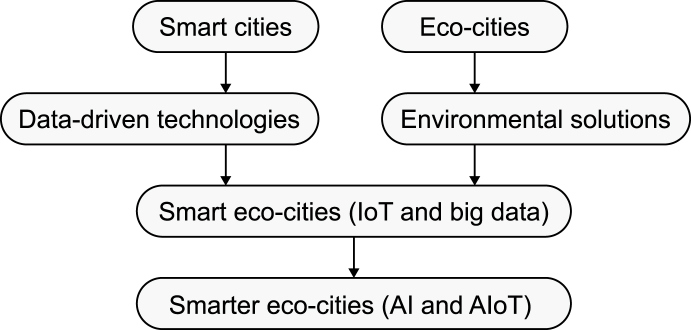
“The study showed that the fundamental concepts underpinning smarter eco-cities are intricately interconnected and build one on another on various scales.”
§ Smarter eco-cities and their leading-edge artificial intelligence of things solutions for environmental sustainability: A comprehensive systematic review > Conclusion
plaincorrelational- Asserted: passes — The authors put it forward as true.
- Checkable: fails — It may be too vague to check against evidence.
- Load-bearing: passes — The paper’s conclusions depend on it.
- Based: passes — The paper gives a reason why it holds.
Probably not a substantial claim. It may be too vague to check against evidence.
The paper states this without a source or data behind it here, so there is nothing to check it against. The quote shows it is in the paper.
In the paper
“Data-driven technologies enable real-time monitoring, analysis, and decision-making, while environmental solutions focus on optimizing resource efficiency and minimizing ecological footprint.”
§ Smarter eco-cities and their leading-edge artificial intelligence of things solutions for environmental sustainability: A comprehensive systematic review > Conclusion
plain- Asserted: passes — The authors put it forward as true.
- Checkable: fails — It may be too vague to check against evidence.
- Load-bearing: fails — The paper’s conclusions may not depend on it.
- Based: passes — The paper gives a reason why it holds.
Probably not a substantial claim. It may be too vague to check against evidence. The paper’s conclusions may not depend on it. It may state two separate claims as one.
A result the paper reports from its own data — it cites no other source for it, so there is none to check. The quote shows it is in the paper.
In the paper
“The study identified and evaluated the key challenges pertaining to environmental costs, privacy concerns related to data collection and usage, cybersecurity risks related to interconnected systems, public trust, and social acceptance, limited technical expertise and knowledge, the lack of robust regulatory frameworks to ensure ethical and responsible AI and AIoT deployment and the requirement for”
§ Smarter eco-cities and their leading-edge artificial intelligence of things solutions for environmental sustainability: A comprehensive systematic review > Conclusion
plain- Asserted: passes — The authors put it forward as true.
- Checkable: passes — It can be checked against evidence.
- Load-bearing: passes — The paper’s conclusions depend on it.
- Based: passes — The paper gives a reason why it holds.
It may state two separate claims as one.
The paper states this without a source or data behind it here, so there is nothing to check it against. The quote shows it is in the paper.
In the paper
“The study identified the opportunities and benefits offered by AI and AIoT technologies in the context of environmental sustainability.”
§ Smarter eco-cities and their leading-edge artificial intelligence of things solutions for environmental sustainability: A comprehensive systematic review > Conclusion
plaindirect- Asserted: passes — The authors put it forward as true.
- Checkable: passes — It can be checked against evidence.
- Load-bearing: passes — The paper’s conclusions depend on it.
- Based: passes — The paper gives a reason why it holds.
It may state two separate claims as one. The quote only partly states this claim.
A result the paper reports from its own data — it cites no other source for it, so there is none to check. The quote shows it is in the paper.
In the paper
“The study identified many applied solutions of AI and AIoT technologies, demonstrating their role in urban planning, management, and development.”
- Also stated in: § Conclusion · plain
“These solutions encompass energy conservation and renewable energy, sustainable transportation management, traffic control, water resources conservation, waste management for efficient resource utilization, biodiversity and ecosystem services, environmental monitoring and control, climate change adaptation and mitigation, and disaster resilience and management.”
§ Smarter eco-cities and their leading-edge artificial intelligence of things solutions for environmental sustainability: A comprehensive systematic review > Conclusion
boosted- Asserted: passes — The authors put it forward as true.
- Checkable: passes — It can be checked against evidence.
- Load-bearing: passes — The paper’s conclusions depend on it.
- Based: passes — The paper gives a reason why it holds.
It may state two separate claims as one.
- Also stated in: § Conclusion · plain
The paper states this without a source or data behind it here, so there is nothing to check it against. The quote shows it is in the paper.
In the paper
“The key underlying urbanism paradigms, namely smart cities and eco-cities, serve as the foundation for integrating data-driven technologies and environmental solutions.”
§ Smarter eco-cities and their leading-edge artificial intelligence of things solutions for environmental sustainability: A comprehensive systematic review > Conclusion
plaindirect- Asserted: passes — The authors put it forward as true.
- Checkable: passes — It can be checked against evidence.
- Load-bearing: passes — The paper’s conclusions depend on it.
- Based: passes — The paper gives a reason why it holds.
Probably not a substantial claim.
The paper states this without a source or data behind it here, so there is nothing to check it against. The quote shows it is in the paper.
In the paper
“Data-driven technologies enable real-time monitoring, analysis, and decision-making, while environmental solutions focus on optimizing resource efficiency and minimizing ecological footprint.”
§ Smarter eco-cities and their leading-edge artificial intelligence of things solutions for environmental sustainability: A comprehensive systematic review > Conclusion
plaindirect- Asserted: passes — The authors put it forward as true.
- Checkable: passes — It can be checked against evidence.
- Load-bearing: passes — The paper’s conclusions depend on it.
- Based: passes — The paper gives a reason why it holds.
Probably not a substantial claim.
What the paper did — it cites no source for this, so there is none to check. The quote shows it is in the paper.
In the paper
“Moreover, we evaluated the quality and relevance of the selected documents through a critical appraisal process.”
§ Smarter eco-cities and their leading-edge artificial intelligence of things solutions for environmental sustainability: A comprehensive systematic review > Materials and methods
plain- Asserted: passes — The authors put it forward as true.
- Checkable: passes — It can be checked against evidence.
- Load-bearing: fails — The paper’s conclusions may not depend on it.
- Based: passes — The paper gives a reason why it holds.
Probably not a substantial claim. The paper’s conclusions may not depend on it.
A conclusion the paper draws from its own results — it cites no other source for it, so there is none to check. The quote shows it is in the paper.
In the paper
“They prioritize environmental sustainability, employing cutting-edge technologies and innovative approaches to energy, waste, water, transportation, and urban planning to create more resilient, sustainable, and technologically advanced urban environments.”
§ Smarter eco-cities and their leading-edge artificial intelligence of things solutions for environmental sustainability: A comprehensive systematic review > Conceptual background > Smarter eco-cities and their underlying urbanism paradigms
plaindirect- Asserted: passes — The authors put it forward as true.
- Checkable: fails — It may be too vague to check against evidence.
- Load-bearing: fails — The paper’s conclusions may not depend on it.
- Based: fails — The paper may give no reason why it holds.
Probably not a substantial claim. It may be too vague to check against evidence. The paper’s conclusions may not depend on it. The paper may give no reason why it holds. It may state two separate claims as one.
The paper states this without a source or data behind it here, so there is nothing to check it against. The quote shows it is in the paper.
In the paper
“Nonetheless, to the best of our knowledge, no review study has systematically analyzed and synthesized the existing corpus of knowledge regarding the interconnections and synergies between these three domains, coupled with their intersection with smart eco-cities with respect to AI and AIoT technologies and solutions.”
§ Smarter eco-cities and their leading-edge artificial intelligence of things solutions for environmental sustainability: A comprehensive systematic review > Introduction
hedged- Asserted: passes — The authors put it forward as true.
- Checkable: passes — It can be checked against evidence.
- Load-bearing: passes — The paper’s conclusions depend on it.
- Based: fails — The paper may give no reason why it holds.
Probably not a substantial claim. The paper may give no reason why it holds.
A conclusion the paper draws from its own results — it cites no other source for it, so there is none to check. The quote shows it is in the paper.
In the paper
“Similar to AI, AIoT has become integral to the functioning of smart cities and, hence, smarter eco-cities.”
§ Smarter eco-cities and their leading-edge artificial intelligence of things solutions for environmental sustainability: A comprehensive systematic review > Introduction
plaincorrelational- Asserted: passes — The authors put it forward as true.
- Checkable: passes — It can be checked against evidence.
- Load-bearing: passes — The paper’s conclusions depend on it.
- Based: passes — The paper gives a reason why it holds.
Probably not a substantial claim.
A conclusion the paper draws from its own results — it cites no other source for it, so there is none to check. The quote shows it is in the paper.
In the paper
“Overall, while smart cities hold great potential for advancing sustainable urban development, they pose significant challenges that require a comprehensive approach to build successful and inclusive ecosystems.”
§ Smarter eco-cities and their leading-edge artificial intelligence of things solutions for environmental sustainability: A comprehensive systematic review > Conceptual background > Smarter eco-cities and their underlying urbanism paradigms
plain- Asserted: passes — The authors put it forward as true.
- Checkable: fails — It may be too vague to check against evidence.
- Load-bearing: fails — The paper’s conclusions may not depend on it.
- Based: passes — The paper gives a reason why it holds.
Probably not a substantial claim. It may be too vague to check against evidence. The paper’s conclusions may not depend on it. It may state two separate claims as one.
A conclusion the paper draws from its own results — it cites no other source for it, so there is none to check. The quote shows it is in the paper.
In the paper
“In addition, with the extensive use of data and connected devices in smart cities, ensuring the security and privacy of their infrastructure becomes paramount.”
§ Smarter eco-cities and their leading-edge artificial intelligence of things solutions for environmental sustainability: A comprehensive systematic review > Conceptual background > Smarter eco-cities and their underlying urbanism paradigms
plain- Asserted: passes — The authors put it forward as true.
- Checkable: fails — It may be too vague to check against evidence.
- Load-bearing: fails — The paper’s conclusions may not depend on it.
- Based: passes — The paper gives a reason why it holds.
Probably not a substantial claim. It may be too vague to check against evidence. The paper’s conclusions may not depend on it.
What the paper did — it cites no source for this, so there is none to check. The quote shows it is in the paper.
In the paper
“Among the available pool of academic research databases, SCOPUS was selected given its broad coverage of 455 high-quality peer-reviewed studies related to the topic on focus that meets strict standards for rigor.”
§ Smarter eco-cities and their leading-edge artificial intelligence of things solutions for environmental sustainability: A comprehensive systematic review > Materials and methods
plain- Asserted: passes — The authors put it forward as true.
- Checkable: passes — It can be checked against evidence.
- Load-bearing: passes — The paper’s conclusions depend on it.
- Based: passes — The paper gives a reason why it holds.
Probably not a substantial claim.
A conclusion the paper draws from its own results — it cites no other source for it, so there is none to check. The quote shows it is in the paper.
In the paper
“Notably, it has demonstrated innovative potential in addressing complex environmental challenges.”
§ Smarter eco-cities and their leading-edge artificial intelligence of things solutions for environmental sustainability: A comprehensive systematic review > Introduction
boostedconditional- Asserted: passes — The authors put it forward as true.
- Checkable: passes — It can be checked against evidence.
- Load-bearing: passes — The paper’s conclusions depend on it.
- Based: fails — The paper may give no reason why it holds.
Probably not a substantial claim. The paper may give no reason why it holds.
A conclusion the paper draws from its own results — it cites no other source for it, so there is none to check. The quote shows it is in the paper.
In the paper
“In this context, AIoT is poised to offer innovative solutions to the mounting environmental challenges confronting smart cities and, by extension, smart eco-cities.”
§ Smarter eco-cities and their leading-edge artificial intelligence of things solutions for environmental sustainability: A comprehensive systematic review > Introduction
plainconditional- Asserted: passes — The authors put it forward as true.
- Checkable: fails — It may be too vague to check against evidence.
- Load-bearing: passes — The paper’s conclusions depend on it.
- Based: fails — The paper may give no reason why it holds.
Probably not a substantial claim. It may be too vague to check against evidence. The paper may give no reason why it holds.
What the paper did — it cites no source for this, so there is none to check. The quote shows it is in the paper.
In the paper
“The synthesis approach applied seamlessly integrated configurative, aggregative, and narrative synthesis as qualitative analytical approaches.”
§ Smarter eco-cities and their leading-edge artificial intelligence of things solutions for environmental sustainability: A comprehensive systematic review > Materials and methods
plain- Asserted: passes — The authors put it forward as true.
- Checkable: passes — It can be checked against evidence.
- Load-bearing: fails — The paper’s conclusions may not depend on it.
- Based: passes — The paper gives a reason why it holds.
Probably not a substantial claim. The paper’s conclusions may not depend on it.
In the paper
“The experimentation within eco-cities extends beyond climate change to encompass energy transition, resource conservation, transport efficiency, biodiversity conservation, and experimental simulation and modeling [[37], [38], [39]].”
§ Smarter eco-cities and their leading-edge artificial intelligence of things solutions for environmental sustainability: A comprehensive systematic review > Introduction
What the sources say
- Not checked yetcites [[37], [38], [39]]
plain- Asserted: passes — The authors put it forward as true.
- Checkable: passes — It can be checked against evidence.
- Load-bearing: unclear — It is unclear whether the paper’s conclusions depend on it.
- Based: passes — The paper gives a reason why it holds.
It may state two separate claims as one.
None of the sources cited for this claim have been checked yet.
In the paper
“The impact of AI on urban systems and activities has been consistently expanding [7,8], with its computing capabilities experiencing exponential growth to accommodate the mounting influx of data from diverse sources facilitated by IoT.”
§ Smarter eco-cities and their leading-edge artificial intelligence of things solutions for environmental sustainability: A comprehensive systematic review > Introduction
What the sources say
- Not checked yetcites [7] Lu H. Li Y. Chen M. Kim H. Serikawa S.J.M.N. Applications Brain intelligence: go beyond artificial intelligence Mobile Network. Appl. 23 2 2018 368 375 source
- Not checked yetcites [8] Batty M. Artificial intelligence and smart cities Environ. Plan. B Urban Anal. City Sci. 45 1 2018 3 6 10.1177/2399808317751169 source
plaincorrelational- Asserted: passes — The authors put it forward as true.
- Checkable: passes — It can be checked against evidence.
- Load-bearing: fails — The paper’s conclusions may not depend on it.
- Based: passes — The paper gives a reason why it holds.
Probably not a substantial claim. The paper’s conclusions may not depend on it.
None of the sources cited for this claim have been checked yet.
In the paper
“Several studies (e.g., Ref. [47,48]) highlight the importance of addressing data security and privacy issues and device-level vulnerability in the context of smart cities.”
§ Smarter eco-cities and their leading-edge artificial intelligence of things solutions for environmental sustainability: A comprehensive systematic review > Conceptual background > Smarter eco-cities and their underlying urbanism paradigms
What the sources say
- Not checked yetcites [47] Haque A.B. Bhushan B. Dhiman G. Conceptualizing smart city applications: requirements, architecture, security issues, and emerging trends Expet Syst. 39 5 2022 e12753
- Not checked yetcites [48] Manchanda C. Sharma N. Rathi R. Bhushan B. Grover M. Neoteric security and privacy sanctuary technologies in smart cities 2020 IEEE 9th International Conference on Communication Systems and Network Technologies 2020 CSNT) Gwalior, India 236 241 10.1109/CSNT48778.2020.9115780
plain- Asserted: passes — The authors put it forward as true.
- Checkable: passes — It can be checked against evidence.
- Load-bearing: fails — The paper’s conclusions may not depend on it.
- Based: passes — The paper gives a reason why it holds.
Probably not a substantial claim. The paper’s conclusions may not depend on it.
The paper states this without a source or data behind it here, so there is nothing to check it against. The quote shows it is in the paper.
In the paper
“The centralized infrastructure of IoT is grappling with significant challenges, primarily driven by the extensive strain imposed by the immense volume of data being generated and processed.”
§ Smarter eco-cities and their leading-edge artificial intelligence of things solutions for environmental sustainability: A comprehensive systematic review > Introduction
plaindirect- Asserted: passes — The authors put it forward as true.
- Checkable: passes — It can be checked against evidence.
- Load-bearing: passes — The paper’s conclusions depend on it.
- Based: fails — The paper may give no reason why it holds.
Probably not a substantial claim. The paper may give no reason why it holds.
A conclusion the paper draws from its own results — it cites no other source for it, so there is none to check. The quote shows it is in the paper.
In the paper
“The AI/AIoT-driven system consists of five pillars: (1) sensing, (2) perceiving, (3) learning, (4) visualizing, and (5) acting.”
§ Smarter eco-cities and their leading-edge artificial intelligence of things solutions for environmental sustainability: A comprehensive systematic review > Conceptual background > Data-driven technologies
plain- Asserted: passes — The authors put it forward as true.
- Checkable: passes — It can be checked against evidence.
- Load-bearing: fails — The paper’s conclusions may not depend on it.
- Based: passes — The paper gives a reason why it holds.
Probably not a substantial claim. The paper’s conclusions may not depend on it.
A conclusion the paper draws from its own results — it cites no other source for it, so there is none to check. The quote shows it is in the paper.
In the paper
“Most notably in certain domains, AIoT paves the way for autonomous and intelligent decision-making by IoT devices, enabling them to learn, adapt, and optimize operations in response to shifting environmental conditions and user requirements.”
§ Smarter eco-cities and their leading-edge artificial intelligence of things solutions for environmental sustainability: A comprehensive systematic review > Introduction
plaindirect- Asserted: passes — The authors put it forward as true.
- Checkable: passes — It can be checked against evidence.
- Load-bearing: fails — The paper’s conclusions may not depend on it.
- Based: passes — The paper gives a reason why it holds.
Probably not a substantial claim. The paper’s conclusions may not depend on it. It may state two separate claims as one.
A conclusion the paper draws from its own results — it cites no other source for it, so there is none to check. The quote shows it is in the paper.
In the paper
“These strategies and principles, in turn, form the fundamental driving forces behind the evolution of smart eco-cities.”
§ Smarter eco-cities and their leading-edge artificial intelligence of things solutions for environmental sustainability: A comprehensive systematic review > Introduction
plaindirect- Asserted: passes — The authors put it forward as true.
- Checkable: fails — It may be too vague to check against evidence.
- Load-bearing: fails — The paper’s conclusions may not depend on it.
- Based: passes — The paper gives a reason why it holds.
Probably not a substantial claim. It may be too vague to check against evidence. The paper’s conclusions may not depend on it.
A conclusion the paper draws from its own results — it cites no other source for it, so there is none to check. The quote shows it is in the paper.
In the paper
“However, with the rapid advancement of AI and AIoT technologies, there is a need to explore the specific intersection of these technologies and existing smart eco-cities and their underlying multifaceted dimensions.”
§ Smarter eco-cities and their leading-edge artificial intelligence of things solutions for environmental sustainability: A comprehensive systematic review > A review of related literature studies > AIoT: theoretical foundations and practical applications
plain- Asserted: passes — The authors put it forward as true.
- Checkable: fails — It may be too vague to check against evidence.
- Load-bearing: passes — The paper’s conclusions depend on it.
- Based: passes — The paper gives a reason why it holds.
Probably not a substantial claim. It may be too vague to check against evidence.
A conclusion the paper draws from its own results — it cites no other source for it, so there is none to check. The quote shows it is in the paper.
In the paper
“They also emphasize a more holistic and comprehensive approach to urban development by integrating the environmental, social, and economic dimensions of sustainability.”
§ Smarter eco-cities and their leading-edge artificial intelligence of things solutions for environmental sustainability: A comprehensive systematic review > Conceptual background > Smarter eco-cities and their underlying urbanism paradigms
plain- Asserted: passes — The authors put it forward as true.
- Checkable: passes — It can be checked against evidence.
- Load-bearing: fails — The paper’s conclusions may not depend on it.
- Based: passes — The paper gives a reason why it holds.
Probably not a substantial claim. The paper’s conclusions may not depend on it.
A conclusion the paper draws from its own results — it cites no other source for it, so there is none to check. The quote shows it is in the paper.
In the paper
“The full period, 2015–2023, captures the multifaceted nature of the topic of smarter eco-cities from the perspective of AI and AIoT technologies concerning environmental sustainability, climate change, and smart cities.”
§ Smarter eco-cities and their leading-edge artificial intelligence of things solutions for environmental sustainability: A comprehensive systematic review > Materials and methods
plain- Asserted: passes — The authors put it forward as true.
- Checkable: passes — It can be checked against evidence.
- Load-bearing: passes — The paper’s conclusions depend on it.
- Based: passes — The paper gives a reason why it holds.
Probably not a substantial claim.
None of the sources cited for this claim have been checked yet.
In the paper
“Regarding stages 2 and 3, we followed the Preferred Reporting Items for Systematic Reviews and Meta-analyses (PRISMA) approach for literature search and selection [[111], [112]].”
§ Smarter eco-cities and their leading-edge artificial intelligence of things solutions for environmental sustainability: A comprehensive systematic review > Materials and methods
What the sources say
- Not checked yetcites [111] Moher D. Liberati A. Tetzlaff J. Altman D.G. The P.G. Preferred reporting items for systematic reviews and meta-analyses: the PRISMA Statement PLoS Med. 6 7 2009 e1000097 10.1371/journal.pmed.1000097 PMC2707599 19621072 source
- Not checked yetcites [112] Page M.J., McKenzie J.E., Bossuyt P.M., Boutron I., Hoffmann T.C., Mulrow C.D., Shamseer L., Tetzlaff J.M., Akl E.A., Brennan S.E., Chou.R, Glanville J., Grimshaw J.M., Hróbjartsson A., Lalu M.M., Li T., Loder E.W., Mayo-Wilson E., McDonald S. et al (2021) The PRISMA 2020 statement: an updated guideline for reporting systematic reviews. BMJ 372:n71. 10.1136/bmj.n71. PMC8005924 33782057 source
plain- Asserted: passes — The authors put it forward as true.
- Checkable: passes — It can be checked against evidence.
- Load-bearing: fails — The paper’s conclusions may not depend on it.
- Based: passes — The paper gives a reason why it holds.
Probably not a substantial claim. The paper’s conclusions may not depend on it.
The paper states this without a source or data behind it here, so there is nothing to check it against. The quote shows it is in the paper.
In the paper
“Furthermore, coordinating and integrating various domains to create a cohesive and integrated smart city ecosystem is a complex challenge.”
§ Smarter eco-cities and their leading-edge artificial intelligence of things solutions for environmental sustainability: A comprehensive systematic review > Conceptual background > Smarter eco-cities and their underlying urbanism paradigms
plain- Asserted: passes — The authors put it forward as true.
- Checkable: fails — It may be too vague to check against evidence.
- Load-bearing: fails — The paper’s conclusions may not depend on it.
- Based: passes — The paper gives a reason why it holds.
Probably not a substantial claim. It may be too vague to check against evidence. The paper’s conclusions may not depend on it.
In the paper
“AI is rapidly reshaping both the technological and urban landscapes, serving as a pivotal driving force behind the advancement of smart cities and smart eco-cities (e.g., Ref. [[1], [2], [3], [4]]).”
§ Smarter eco-cities and their leading-edge artificial intelligence of things solutions for environmental sustainability: A comprehensive systematic review > Introduction
What the sources say
- Not checked yetcites [[1], [2], [3], [4]]
plaindirect- Asserted: passes — The authors put it forward as true.
- Checkable: passes — It can be checked against evidence.
- Load-bearing: passes — The paper’s conclusions depend on it.
- Based: passes — The paper gives a reason why it holds.
Probably not a substantial claim. It may state two separate claims as one.
A conclusion the paper draws from its own results — it cites no other source for it, so there is none to check. The quote shows it is in the paper.
In the paper
“The emerging field of AI and AIoT presents new possibilities for tackling the complexity of ecological degradation and the climate crisis in urban areas.”
§ Smarter eco-cities and their leading-edge artificial intelligence of things solutions for environmental sustainability: A comprehensive systematic review > A review of related literature studies > AIoT: theoretical foundations and practical applications
plainconditional- Asserted: passes — The authors put it forward as true.
- Checkable: fails — It may be too vague to check against evidence.
- Load-bearing: passes — The paper’s conclusions depend on it.
- Based: fails — The paper may give no reason why it holds.
Probably not a substantial claim. It may be too vague to check against evidence. The paper may give no reason why it holds.
A conclusion the paper draws from its own results — it cites no other source for it, so there is none to check. The quote shows it is in the paper.
In the paper
“Smarter eco-cities represent an evolution or advancement of smart eco-cities.”
§ Smarter eco-cities and their leading-edge artificial intelligence of things solutions for environmental sustainability: A comprehensive systematic review > Conceptual background > Smarter eco-cities and their underlying urbanism paradigms
plaindirect- Asserted: passes — The authors put it forward as true.
- Checkable: passes — It can be checked against evidence.
- Load-bearing: fails — The paper’s conclusions may not depend on it.
- Based: fails — The paper may give no reason why it holds.
Probably not a substantial claim. The paper’s conclusions may not depend on it. The paper may give no reason why it holds.
A conclusion the paper draws from its own results — it cites no other source for it, so there is none to check. The quote shows it is in the paper.
In the paper
“However, it is worth acknowledging that while AI and AIoT technologies hold immense potential yet to unlock, they pose environmental risks and amplify a spectrum of societal, ethical, legal, and regulatory challenges.”
§ Smarter eco-cities and their leading-edge artificial intelligence of things solutions for environmental sustainability: A comprehensive systematic review > Introduction
plaindirect- Asserted: passes — The authors put it forward as true.
- Checkable: passes — It can be checked against evidence.
- Load-bearing: fails — The paper’s conclusions may not depend on it.
- Based: fails — The paper may give no reason why it holds.
Probably not a substantial claim. The paper’s conclusions may not depend on it. The paper may give no reason why it holds. It may state two separate claims as one.
In the paper
“To begin with, AIoT capitalizes on the synergies between AI and IoT technologies, facilitating more intelligent and efficient data processing, analysis, and decision-making (e.g., Ref. [[9], [10], [11]]).”
§ Smarter eco-cities and their leading-edge artificial intelligence of things solutions for environmental sustainability: A comprehensive systematic review > Introduction
What the sources say
- Not checked yetcites [[9], [10], [11]]
plaindirect- Asserted: passes — The authors put it forward as true.
- Checkable: passes — It can be checked against evidence.
- Load-bearing: fails — The paper’s conclusions may not depend on it.
- Based: passes — The paper gives a reason why it holds.
Probably not a substantial claim. The paper’s conclusions may not depend on it.
What the paper did — it cites no source for this, so there is none to check. The quote shows it is in the paper.
In the paper
“After excluding overlaps, 230 documents remained in the database. These were checked, and 12 papers were excluded as they did not include information on the relationships in question.”
- Also stated in: § Materials and methods · plain
“Accordingly, the reference sections of the remaining papers were checked, and 17 other relevant papers were added to the final database, which included 235 documents in total.”
§ Smarter eco-cities and their leading-edge artificial intelligence of things solutions for environmental sustainability: A comprehensive systematic review > Materials and methods
plain- Asserted: passes — The authors put it forward as true.
- Checkable: passes — It can be checked against evidence.
- Load-bearing: unclear — It is unclear whether the paper’s conclusions depend on it.
- Based: passes — The paper gives a reason why it holds.
It may state two separate claims as one.
- Also stated in: § Materials and methods · plain
The paper states this without a source or data behind it here, so there is nothing to check it against. The quote shows it is in the paper.
In the paper
“The body of literature exploring AI and AIoT solutions within the realm of environmental sustainability, climate change, and smart cities is rapidly expanding.”
§ Smarter eco-cities and their leading-edge artificial intelligence of things solutions for environmental sustainability: A comprehensive systematic review > Introduction
plain- Asserted: passes — The authors put it forward as true.
- Checkable: passes — It can be checked against evidence.
- Load-bearing: fails — The paper’s conclusions may not depend on it.
- Based: fails — The paper may give no reason why it holds.
Probably not a substantial claim. The paper’s conclusions may not depend on it. The paper may give no reason why it holds.
A conclusion the paper draws from its own results — it cites no other source for it, so there is none to check. The quote shows it is in the paper.
In the paper
“Smarter eco-cities go a step further by incorporating social and economic dimensions, leveraging emerging AI and IoT technologies for a more holistic approach to urban development.”
§ Smarter eco-cities and their leading-edge artificial intelligence of things solutions for environmental sustainability: A comprehensive systematic review > Conceptual background > Smarter eco-cities and their underlying urbanism paradigms
plaindirect- Asserted: passes — The authors put it forward as true.
- Checkable: passes — It can be checked against evidence.
- Load-bearing: fails — The paper’s conclusions may not depend on it.
- Based: fails — The paper may give no reason why it holds.
Probably not a substantial claim. The paper’s conclusions may not depend on it. The paper may give no reason why it holds. It may state two separate claims as one.
A conclusion the paper draws from its own results — it cites no other source for it, so there is none to check. The quote shows it is in the paper.
In the paper
“This lack of clarity has led to confusion and inconsistency in the planning and implementation of smart city initiatives.”
§ Smarter eco-cities and their leading-edge artificial intelligence of things solutions for environmental sustainability: A comprehensive systematic review > Conceptual background > Smarter eco-cities and their underlying urbanism paradigms
plaindirect- Asserted: passes — The authors put it forward as true.
- Checkable: passes — It can be checked against evidence.
- Load-bearing: fails — The paper’s conclusions may not depend on it.
- Based: fails — The paper may give no reason why it holds.
Probably not a substantial claim. The paper’s conclusions may not depend on it. The paper may give no reason why it holds.
A conclusion the paper draws from its own results — it cites no other source for it, so there is none to check. The quote shows it is in the paper.
In the paper
“In sum, while smart cities focus on technology-driven urban development, smart eco-cities place a stronger emphasis on achieving environmental sustainability through IoT and Big Data technologies.”
§ Smarter eco-cities and their leading-edge artificial intelligence of things solutions for environmental sustainability: A comprehensive systematic review > Conceptual background > Smarter eco-cities and their underlying urbanism paradigms
plaincorrelational- Asserted: passes — The authors put it forward as true.
- Checkable: passes — It can be checked against evidence.
- Load-bearing: fails — The paper’s conclusions may not depend on it.
- Based: fails — The paper may give no reason why it holds.
Probably not a substantial claim. The paper’s conclusions may not depend on it. The paper may give no reason why it holds. It may state two separate claims as one.
The paper states this without a source or data behind it here, so there is nothing to check it against. The quote shows it is in the paper.
In the paper
“Furthermore, while a few recent review studies have taken a broader perspective on smart eco-cities, none have ventured into exploring their emerging technological and environmental solutions from an integrative perspective.”
§ Smarter eco-cities and their leading-edge artificial intelligence of things solutions for environmental sustainability: A comprehensive systematic review > Introduction
plain- Asserted: passes — The authors put it forward as true.
- Checkable: passes — It can be checked against evidence.
- Load-bearing: passes — The paper’s conclusions depend on it.
- Based: fails — The paper may give no reason why it holds.
Probably not a substantial claim. The paper may give no reason why it holds. It may state two separate claims as one.
The paper states this without a source or data behind it here, so there is nothing to check it against. The quote shows it is in the paper.
In the paper
“Moreover, the existing smart city infrastructures are not designed to support the integration of advanced technologies and data-driven systems.”
§ Smarter eco-cities and their leading-edge artificial intelligence of things solutions for environmental sustainability: A comprehensive systematic review > Conceptual background > Smarter eco-cities and their underlying urbanism paradigms
plain- Asserted: passes — The authors put it forward as true.
- Checkable: passes — It can be checked against evidence.
- Load-bearing: fails — The paper’s conclusions may not depend on it.
- Based: fails — The paper may give no reason why it holds.
Probably not a substantial claim. The paper’s conclusions may not depend on it. The paper may give no reason why it holds.
A conclusion the paper draws from its own results — it cites no other source for it, so there is none to check. The quote shows it is in the paper.
In the paper
“They leverage the advanced technologies and solutions offered by smarter cities, notably AI and AIoT, to optimize urban systems and address complex challenges in a more integrated and intelligent manner.”
§ Smarter eco-cities and their leading-edge artificial intelligence of things solutions for environmental sustainability: A comprehensive systematic review > Conceptual background > Smarter eco-cities and their underlying urbanism paradigms
plaindirect- Asserted: passes — The authors put it forward as true.
- Checkable: fails — It may be too vague to check against evidence.
- Load-bearing: passes — The paper’s conclusions depend on it.
- Based: fails — The paper may give no reason why it holds.
Probably not a substantial claim. It may be too vague to check against evidence. The paper may give no reason why it holds.
The paper states this without a source or data behind it here, so there is nothing to check it against. The quote shows it is in the paper.
In the paper
“More so, the social, ethical, political, legal, and regulatory challenges facing smart cities have shown to be difficult to deal with.”
§ Smarter eco-cities and their leading-edge artificial intelligence of things solutions for environmental sustainability: A comprehensive systematic review > Conceptual background > Smarter eco-cities and their underlying urbanism paradigms
plain- Asserted: passes — The authors put it forward as true.
- Checkable: fails — It may be too vague to check against evidence.
- Load-bearing: fails — The paper’s conclusions may not depend on it.
- Based: fails — The paper may give no reason why it holds.
Probably not a substantial claim. It may be too vague to check against evidence. The paper’s conclusions may not depend on it. The paper may give no reason why it holds.
The paper states this without a source or data behind it here, so there is nothing to check it against. The quote shows it is in the paper.
In the paper
“Fundamentally, however, there is a strong interconnection between smart cities and eco-cities in that they have significantly influenced one another over the last decade, particularly in the domains of environmental sustainability and climate change.”
§ Smarter eco-cities and their leading-edge artificial intelligence of things solutions for environmental sustainability: A comprehensive systematic review > Introduction
boostedcorrelational- Asserted: passes — The authors put it forward as true.
- Checkable: passes — It can be checked against evidence.
- Load-bearing: passes — The paper’s conclusions depend on it.
- Based: fails — The paper may give no reason why it holds.
Probably not a substantial claim. The paper may give no reason why it holds. It may state two separate claims as one.
A conclusion the paper draws from its own results — it cites no other source for it, so there is none to check. The quote shows it is in the paper.
In the paper
“Harnessing actionable insights from these data necessitates the integration of AI models and algorithms to effectively manage the data flow, storage, and processing inherent in the IoT infrastructure.”
§ Smarter eco-cities and their leading-edge artificial intelligence of things solutions for environmental sustainability: A comprehensive systematic review > Introduction
plaindirect- Asserted: passes — The authors put it forward as true.
- Checkable: passes — It can be checked against evidence.
- Load-bearing: passes — The paper’s conclusions depend on it.
- Based: passes — The paper gives a reason why it holds.
Probably not a substantial claim.
The paper states this without a source or data behind it here, so there is nothing to check it against. The quote shows it is in the paper.
In the paper
“As mentioned earlier, one of the primary problems in this regard is the lack of a standardized definition for smart cities.”
§ Smarter eco-cities and their leading-edge artificial intelligence of things solutions for environmental sustainability: A comprehensive systematic review > Conceptual background > Smarter eco-cities and their underlying urbanism paradigms
plain- Asserted: passes — The authors put it forward as true.
- Checkable: passes — It can be checked against evidence.
- Load-bearing: fails — The paper’s conclusions may not depend on it.
- Based: fails — The paper may give no reason why it holds.
Probably not a substantial claim. The paper’s conclusions may not depend on it. The paper may give no reason why it holds.
A conclusion the paper draws from its own results — it cites no other source for it, so there is none to check. The quote shows it is in the paper.
In the paper
“These strides have, in turn, impacted smart eco-cities, catalyzing ongoing improvements and driving solutions to address complex environmental challenges.”
§ Smarter eco-cities and their leading-edge artificial intelligence of things solutions for environmental sustainability: A comprehensive systematic review > Abstract
plaindirect- Asserted: passes — The authors put it forward as true.
- Checkable: passes — It can be checked against evidence.
- Load-bearing: passes — The paper’s conclusions depend on it.
- Based: fails — The paper may give no reason why it holds.
Probably not a substantial claim. The paper may give no reason why it holds. It may state two separate claims as one.
A conclusion the paper draws from its own results — it cites no other source for it, so there is none to check. The quote shows it is in the paper.
In the paper
“The recent advancements made in the realms of Artificial Intelligence (AI) and Artificial Intelligence of Things (AIoT) have unveiled transformative prospects and opportunities to enhance and optimize the environmental performance and efficiency of smart cities.”
§ Smarter eco-cities and their leading-edge artificial intelligence of things solutions for environmental sustainability: A comprehensive systematic review > Abstract
plainconditional- Asserted: passes — The authors put it forward as true.
- Checkable: passes — It can be checked against evidence.
- Load-bearing: passes — The paper’s conclusions depend on it.
- Based: fails — The paper may give no reason why it holds.
Probably not a substantial claim. The paper may give no reason why it holds.
A conclusion the paper draws from its own results — it cites no other source for it, so there is none to check. The quote shows it is in the paper.
In the paper
“These advancements can improve resource efficiency, reduce environmental impact, and promote sustainable waste management practices.”
§ Smarter eco-cities and their leading-edge artificial intelligence of things solutions for environmental sustainability: A comprehensive systematic review > A review of related literature studies > AI for environmental sustainability and climate change
plaindirect- Asserted: passes — The authors put it forward as true.
- Checkable: passes — It can be checked against evidence.
- Load-bearing: passes — The paper’s conclusions depend on it.
- Based: passes — The paper gives a reason why it holds.
It may state two separate claims as one.
In the paper
“Eco-cities have long been associated with these two domains, serving as a well-established paradigm of sustainable urbanism (e.g., Ref. [[27], [28], [29], [30], [31], [32], [33]]).”
§ Smarter eco-cities and their leading-edge artificial intelligence of things solutions for environmental sustainability: A comprehensive systematic review > Introduction
What the sources say
- Not checked yetcites [[27], [28], [29], [30], [31], [32], [33]]
boostedcorrelational- Asserted: passes — The authors put it forward as true.
- Checkable: passes — It can be checked against evidence.
- Load-bearing: fails — The paper’s conclusions may not depend on it.
- Based: passes — The paper gives a reason why it holds.
Probably not a substantial claim. The paper’s conclusions may not depend on it. It may state two separate claims as one.
A conclusion the paper draws from its own results — it cites no other source for it, so there is none to check. The quote shows it is in the paper.
In the paper
“AIoT holds the potential to unlock avenues for improving resource efficiency, reducing energy consumption, streamlining waste management, enhancing transportation management, conserving biodiversity, and mitigating environmental impacts.”
§ Smarter eco-cities and their leading-edge artificial intelligence of things solutions for environmental sustainability: A comprehensive systematic review > Introduction
hedgedconditional- Asserted: passes — The authors put it forward as true.
- Checkable: passes — It can be checked against evidence.
- Load-bearing: passes — The paper’s conclusions depend on it.
- Based: fails — The paper may give no reason why it holds.
Probably not a substantial claim. The paper may give no reason why it holds. It may state two separate claims as one.
What the paper did — it cites no source for this, so there is none to check. The quote shows it is in the paper.
In the paper
“The literature search was conducted in late March 2023 and returned 455 documents covering 2015 to 2023.”
§ Smarter eco-cities and their leading-edge artificial intelligence of things solutions for environmental sustainability: A comprehensive systematic review > Materials and methods
plain- Asserted: passes — The authors put it forward as true.
- Checkable: passes — It can be checked against evidence.
- Load-bearing: passes — The paper’s conclusions depend on it.
- Based: passes — The paper gives a reason why it holds.
Probably not a substantial claim. It may state two separate claims as one.
The paper states this without a source or data behind it here, so there is nothing to check it against. The quote shows it is in the paper.
In the paper
“However, smart cities face several challenges that need to be addressed to ensure their successful implementation as well as their integration with other emerging paradigms of urbanism.”
§ Smarter eco-cities and their leading-edge artificial intelligence of things solutions for environmental sustainability: A comprehensive systematic review > Conceptual background > Smarter eco-cities and their underlying urbanism paradigms
plain- Asserted: passes — The authors put it forward as true.
- Checkable: passes — It can be checked against evidence.
- Load-bearing: fails — The paper’s conclusions may not depend on it.
- Based: passes — The paper gives a reason why it holds.
Probably not a substantial claim. The paper’s conclusions may not depend on it.
The paper states this without a source or data behind it here, so there is nothing to check it against. The quote shows it is in the paper.
In the paper
“However, there remains a significant gap in thoroughly understanding this new paradigm and the intricate spectrum of its multifaceted underlying dimensions.”
§ Smarter eco-cities and their leading-edge artificial intelligence of things solutions for environmental sustainability: A comprehensive systematic review > Abstract
plain- Asserted: passes — The authors put it forward as true.
- Checkable: fails — It may be too vague to check against evidence.
- Load-bearing: passes — The paper’s conclusions depend on it.
- Based: fails — The paper may give no reason why it holds.
Probably not a substantial claim. It may be too vague to check against evidence. The paper may give no reason why it holds.
In the paper
“As revealed by Joss and Cowley [304], based on a comparative case study analysis, policy is found to exercise a strong shaping role in what sustainable development for cities is understood to be, which helps explain the considerable differences in priorities and approaches across countries.”
§ Smarter eco-cities and their leading-edge artificial intelligence of things solutions for environmental sustainability: A comprehensive systematic review > Results > The relationship between data-driven technologies, environmental sustainability, smart cities, and smart eco-cities
What the sources say
- Not checked yetcites Joss and Cowley [304] Joss S. Cowley R. National policies for local urban sustainability: a new governance approach? Eames M. Dixon T. Hunt M. Lannon S. Retrofitting Cities for Tomorrow’s World 2017 Wiley-Blackwell Oxford
boosteddirect- Asserted: passes — The authors put it forward as true.
- Checkable: passes — It can be checked against evidence.
- Load-bearing: unclear — It is unclear whether the paper’s conclusions depend on it.
- Based: passes — The paper gives a reason why it holds.
It may state two separate claims as one.
A conclusion the paper draws from its own results — it cites no other source for it, so there is none to check. The quote shows it is in the paper.
In the paper
“Public-private partnerships: Governments can partner with technology and energy companies, research institutions, and industry stakeholders to develop and implement sustainable solutions. These partnerships leverage expertise, resources, and funding to implement smart applications successfully.”
§ Smarter eco-cities and their leading-edge artificial intelligence of things solutions for environmental sustainability: A comprehensive systematic review > Results > The relationship between data-driven technologies, environmental sustainability, smart cities, and smart eco-cities
plaindirect- Asserted: passes — The authors put it forward as true.
- Checkable: passes — It can be checked against evidence.
- Load-bearing: fails — The paper’s conclusions may not depend on it.
- Based: passes — The paper gives a reason why it holds.
Probably not a substantial claim. The paper’s conclusions may not depend on it.
A conclusion the paper draws from its own results — it cites no other source for it, so there is none to check. The quote shows it is in the paper.
In the paper
“However, policy instruments play a crucial role in shaping and guiding the development of smart eco-cities.”
§ Smarter eco-cities and their leading-edge artificial intelligence of things solutions for environmental sustainability: A comprehensive systematic review > Results > The relationship between data-driven technologies, environmental sustainability, smart cities, and smart eco-cities
boosteddirect- Asserted: passes — The authors put it forward as true.
- Checkable: passes — It can be checked against evidence.
- Load-bearing: fails — The paper’s conclusions may not depend on it.
- Based: passes — The paper gives a reason why it holds.
Probably not a substantial claim. The paper’s conclusions may not depend on it.
In the paper
“Pasichnyi et al. [153] propose, as part of case study research, a novel data-driven smart approach to the strategic planning of retrofitting building energy that allows a holistic city-level analysis and assesses change in total energy demand from large-scale retrofitting.”
§ Smarter eco-cities and their leading-edge artificial intelligence of things solutions for environmental sustainability: A comprehensive systematic review > Results > The relationship between data-driven technologies, environmental sustainability, smart cities, and smart eco-cities
What the sources say
- Not checked yetcites [153] Pasichnyi O. Levihn F. Shahrokni H. Wallin J. Kordas O. Data-driven strategic planning of building energy retrofitting: the case of Stockholm J. Clean. Prod. 233 2019 546 560 source
plain- Asserted: passes — The authors put it forward as true.
- Checkable: passes — It can be checked against evidence.
- Load-bearing: fails — The paper’s conclusions may not depend on it.
- Based: passes — The paper gives a reason why it holds.
Probably not a substantial claim. The paper’s conclusions may not depend on it. It may state two separate claims as one.
A conclusion the paper draws from its own results — it cites no other source for it, so there is none to check. The quote shows it is in the paper.
In the paper
“This has occurred at varying degrees and in different periods, given the specific focus of these two paradigms of urbanism in terms of strategies, solutions, and policies.”
§ Smarter eco-cities and their leading-edge artificial intelligence of things solutions for environmental sustainability: A comprehensive systematic review > Results > The relationship between data-driven technologies, environmental sustainability, smart cities, and smart eco-cities
plaincorrelational- Asserted: passes — The authors put it forward as true.
- Checkable: passes — It can be checked against evidence.
- Load-bearing: fails — The paper’s conclusions may not depend on it.
- Based: passes — The paper gives a reason why it holds.
Probably not a substantial claim. The paper’s conclusions may not depend on it.
A conclusion the paper draws from its own results — it cites no other source for it, so there is none to check. The quote shows it is in the paper.
In the paper
“Policy frameworks, regulations, and incentives create an enabling environment for implementing sustainable practices and innovative technologies and ensure the effective integration of smart solutions into urban environments.”
§ Smarter eco-cities and their leading-edge artificial intelligence of things solutions for environmental sustainability: A comprehensive systematic review > Results > The relationship between data-driven technologies, environmental sustainability, smart cities, and smart eco-cities
plaindirect- Asserted: passes — The authors put it forward as true.
- Checkable: passes — It can be checked against evidence.
- Load-bearing: passes — The paper’s conclusions depend on it.
- Based: fails — The paper may give no reason why it holds.
Probably not a substantial claim. The paper may give no reason why it holds. It may state two separate claims as one.
- Rests on an assumption: The effective use of policy instruments is essential in harnessing the full potential of technological advancements and addressing environmental challenges to realize the vision of smart eco-cities.
In the paper
“as “a potential niche where environmental and economic reforms can be tested and introduced in areas which are both spatially proximate … and in an international context … through networks of knowledge, technology and policy transfer and learning” ([56], p. 1).”
§ Smarter eco-cities and their leading-edge artificial intelligence of things solutions for environmental sustainability: A comprehensive systematic review > Results > The relationship between data-driven technologies, environmental sustainability, smart cities, and smart eco-cities
What the sources say
- Not checked yetcites [56] Späth P. Hawxwell T. John R. Li S. Löffler E. Riener V. Utkarsh S. Smart-eco Cities in Germany: Trends and City Profiles 2017 University of Exeter Press
plain- Asserted: passes — The authors put it forward as true.
- Checkable: passes — It can be checked against evidence.
- Load-bearing: fails — The paper’s conclusions may not depend on it.
- Based: passes — The paper gives a reason why it holds.
Probably not a substantial claim. The paper’s conclusions may not depend on it.
A conclusion the paper draws from its own results — it cites no other source for it, so there is none to check. The quote shows it is in the paper.
In the paper
“Government regulations: The government enacts regulations that mandate specific sustainability standards and requirements for smart eco-city development, e.g., setting energy efficiency targets for buildings, enforcing waste management practices, and promoting renewable energy integration.”
§ Smarter eco-cities and their leading-edge artificial intelligence of things solutions for environmental sustainability: A comprehensive systematic review > Results > The relationship between data-driven technologies, environmental sustainability, smart cities, and smart eco-cities
plaindirect- Asserted: passes — The authors put it forward as true.
- Checkable: passes — It can be checked against evidence.
- Load-bearing: fails — The paper’s conclusions may not depend on it.
- Based: passes — The paper gives a reason why it holds.
Probably not a substantial claim. The paper’s conclusions may not depend on it. It may state two separate claims as one.
A conclusion the paper draws from its own results — it cites no other source for it, so there is none to check. The quote shows it is in the paper.
In the paper
“One of the key roles of urban policy — as a set of plans, laws, rules, regulations, and actions — lies in aligning and mobilizing the stakeholders involved in the governance of smart eco-cities.”
§ Smarter eco-cities and their leading-edge artificial intelligence of things solutions for environmental sustainability: A comprehensive systematic review > Results > The relationship between data-driven technologies, environmental sustainability, smart cities, and smart eco-cities
plaindirect- Asserted: passes — The authors put it forward as true.
- Checkable: passes — It can be checked against evidence.
- Load-bearing: fails — The paper’s conclusions may not depend on it.
- Based: passes — The paper gives a reason why it holds.
Probably not a substantial claim. The paper’s conclusions may not depend on it.
A conclusion the paper draws from its own results — it cites no other source for it, so there is none to check. The quote shows it is in the paper.
In the paper
“Smart eco-cities require targeted policies to drive progress in various environmental sustainability areas and effectively implement innovative data-driven solutions.”
§ Smarter eco-cities and their leading-edge artificial intelligence of things solutions for environmental sustainability: A comprehensive systematic review > Results > The relationship between data-driven technologies, environmental sustainability, smart cities, and smart eco-cities
plaindirect- Asserted: passes — The authors put it forward as true.
- Checkable: fails — It may be too vague to check against evidence.
- Load-bearing: passes — The paper’s conclusions depend on it.
- Based: passes — The paper gives a reason why it holds.
Probably not a substantial claim. It may be too vague to check against evidence. It may state two separate claims as one.
In the paper
“Regarding the latter, expert systems are associated with the capability of AI to solve complex problems, e.g., assessment of climate change impacts, and to aid decision-making by relying on specific knowledge derived from databases [17].”
§ Smarter eco-cities and their leading-edge artificial intelligence of things solutions for environmental sustainability: A comprehensive systematic review > Results > The rise of AI and AIoT in environmental sustainability, climate change, and smart cities: solutions, use cases, and applications
What the sources say
- Not checked yetcites [17] Nishant R. Kennedy M. Corbett J. Artificial intelligence for sustainability: challenges, opportunities, and a research agenda Int. J. Inf. Manag. 53 2020 102104
plaincorrelational- Asserted: passes — The authors put it forward as true.
- Checkable: passes — It can be checked against evidence.
- Load-bearing: fails — The paper’s conclusions may not depend on it.
- Based: passes — The paper gives a reason why it holds.
Probably not a substantial claim. The paper’s conclusions may not depend on it. It may state two separate claims as one.
None of the sources cited for this claim have been checked yet.
In the paper
“The studies carried out by Cheng and Hoang [305], Choubin et al. [202], and Ji et al. [203] have advanced the field by employing different AI models and techniques.”
§ Smarter eco-cities and their leading-edge artificial intelligence of things solutions for environmental sustainability: A comprehensive systematic review > Results > The rise of AI and AIoT in environmental sustainability, climate change, and smart cities: solutions, use cases, and applications
What the sources say
- Not checked yetcites Cheng and Hoang [305]
- Not checked yetcites Choubin et al. [202] Choubin B. Borji M. Mosavi A. Sajedi-Hosseini F. Singh V.P. Shamshirband S. Snow avalanche hazard prediction using machine learning methods J. Hydrol. 577 2019 123929 10.1016/j.jhydrol.2019.123929
- Not checked yetcites Ji et al. [203] Ji L. Wang Z. Chen M. Fan S. Wang Y. Shen Z. How much can AI techniques improve surface air temperature forecast? —a report from AI challenger 2018 global weather forecast contest J. Meteorol. Res. 33 5 2019 989 992 10.1007/s13351-019-9601-0
plaindirect- Asserted: passes — The authors put it forward as true.
- Checkable: passes — It can be checked against evidence.
- Load-bearing: fails — The paper’s conclusions may not depend on it.
- Based: passes — The paper gives a reason why it holds.
Probably not a substantial claim. The paper’s conclusions may not depend on it.
A conclusion the paper draws from its own results — it cites no other source for it, so there is none to check. The quote shows it is in the paper.
In the paper
“This body of research underscores the critical role of AI in addressing climate change challenges, highlighting its potential to inform smarter eco-city initiatives and promote sustainable urban development.”
§ Smarter eco-cities and their leading-edge artificial intelligence of things solutions for environmental sustainability: A comprehensive systematic review > Results > The rise of AI and AIoT in environmental sustainability, climate change, and smart cities: solutions, use cases, and applications
boostedconditional- Asserted: passes — The authors put it forward as true.
- Checkable: passes — It can be checked against evidence.
- Load-bearing: passes — The paper’s conclusions depend on it.
- Based: passes — The paper gives a reason why it holds.
Probably not a substantial claim. It may state two separate claims as one.
None of the sources cited for this claim have been checked yet.
In the paper
“Among these are ML in predictive modeling, pattern recognition, and damage assessment; NLP in sentiment analysis and information extraction; CV in image analysis and object recognition; AI-driven Geographic Information Systems (GIS) in spatial analysis and mapping and visualization; reinforcement learning in resource allocation optimization; and DSS in dynamic resource allocation.”
§ Smarter eco-cities and their leading-edge artificial intelligence of things solutions for environmental sustainability: A comprehensive systematic review > Results > The rise of AI and AIoT in environmental sustainability, climate change, and smart cities: solutions, use cases, and applications
What the sources say
- Not checked yetcites Cheng and Hoang [305]
- Not checked yetcites Choubin et al. [202] Choubin B. Borji M. Mosavi A. Sajedi-Hosseini F. Singh V.P. Shamshirband S. Snow avalanche hazard prediction using machine learning methods J. Hydrol. 577 2019 123929 10.1016/j.jhydrol.2019.123929
- Not checked yetcites Ji et al. [203] Ji L. Wang Z. Chen M. Fan S. Wang Y. Shen Z. How much can AI techniques improve surface air temperature forecast? —a report from AI challenger 2018 global weather forecast contest J. Meteorol. Res. 33 5 2019 989 992 10.1007/s13351-019-9601-0
plain- Asserted: passes — The authors put it forward as true.
- Checkable: passes — It can be checked against evidence.
- Load-bearing: unclear — It is unclear whether the paper’s conclusions depend on it.
- Based: passes — The paper gives a reason why it holds.
It may state two separate claims as one.
In the paper
“AIoT has been deployed in multiple ways to help users efficiently manage energy to reduce cost as well as energy producers optimize their equipment for better service delivery [219].”
§ Smarter eco-cities and their leading-edge artificial intelligence of things solutions for environmental sustainability: A comprehensive systematic review > Results > The rise of AI and AIoT in environmental sustainability, climate change, and smart cities: solutions, use cases, and applications
What the sources say
- Not checked yetcites [219] Antonopoulos I. Robu V. Couraud B. Artificial intelligence and machine learning approaches to energy demand-side response: a systematic review Renew. Sustain. Energy Rev. 130 2020 109899 source
plaindirect- Asserted: passes — The authors put it forward as true.
- Checkable: passes — It can be checked against evidence.
- Load-bearing: unclear — It is unclear whether the paper’s conclusions depend on it.
- Based: passes — The paper gives a reason why it holds.
It may state two separate claims as one.
None of the sources cited for this claim have been checked yet.
In the paper
“Some of these models and techniques include ML, DL (e.g., CNNs and RNNs), GA, and ML-based Species Distribution Models (SDMs), NLP, time series forecasting, Autonomous Underwater Vehicles (AUVs) and Remotely Operated Vehicles (ROVs), and DSS.”
§ Smarter eco-cities and their leading-edge artificial intelligence of things solutions for environmental sustainability: A comprehensive systematic review > Results > The rise of AI and AIoT in environmental sustainability, climate change, and smart cities: solutions, use cases, and applications
What the sources say
- Not checked yetcites Lu et al. [204] Lu H. Li H. Liu T. Fan Y. Yuan Y. Xie M. Qian X. Simulating heavy metal concentrations in an aquatic environment using artificial intelligence models and physicochemical indexes Sci. Total Environ. 694 2019 133591 10.1016/j.scitotenv.2019.133591 31386956
- Not checked yetcites Wang et al. [205] Wang P. Yao J. Wang G. Hao F. Shrestha S. Xue B. Exploring the application of artificial intelligence technology for identification of water pollution characteristics and tracing the source of water quality pollutants Sci. Total Environ. 693 2019 133440 10.1016/j.scitotenv.2019.07.246 31374492
plain- Asserted: passes — The authors put it forward as true.
- Checkable: passes — It can be checked against evidence.
- Load-bearing: unclear — It is unclear whether the paper’s conclusions depend on it.
- Based: passes — The paper gives a reason why it holds.
It may state two separate claims as one.
A conclusion the paper draws from its own results — it cites no other source for it, so there is none to check. The quote shows it is in the paper.
In the paper
“Overall, IoT's technical capabilities within the AIoT framework enable comprehensive data collection, analysis, and automation, fostering environmentally sustainable practices and informed decision-making across various domains.”
§ Smarter eco-cities and their leading-edge artificial intelligence of things solutions for environmental sustainability: A comprehensive systematic review > Results > The rise of AI and AIoT in environmental sustainability, climate change, and smart cities: solutions, use cases, and applications
plaindirect- Asserted: passes — The authors put it forward as true.
- Checkable: passes — It can be checked against evidence.
- Load-bearing: passes — The paper’s conclusions depend on it.
- Based: fails — The paper may give no reason why it holds.
Probably not a substantial claim. The paper may give no reason why it holds. It may state two separate claims as one.
- Rests on an assumption: IoT devices equipped with sensors and actuators collect real-time data on environmental parameters.
- Rests on an assumption: IoT enables seamless data transmission to centralized platforms such as cloud computing.
- Rests on an assumption: AI algorithms process IoT-generated data to identify patterns, anomalies, and trends.
- Rests on an assumption: AI-driven predictive models utilize historical and real-time IoT-driven data to forecast environmental changes.
- Rests on an assumption: IoT's integration with AI allows for autonomous control of systems and processes.
- Rests on an assumption: AI algorithms optimize resource allocation and utilization.
- Rests on an assumption: IoT-enabled devices can be remotely controlled and monitored.
A conclusion the paper draws from its own results — it cites no other source for it, so there is none to check. The quote shows it is in the paper.
In the paper
“AI models can identify potential issues in advance by analyzing data patterns, allowing for timely maintenance and minimizing downtime.”
§ Smarter eco-cities and their leading-edge artificial intelligence of things solutions for environmental sustainability: A comprehensive systematic review > Results > The rise of AI and AIoT in environmental sustainability, climate change, and smart cities: solutions, use cases, and applications
plaindirect- Asserted: passes — The authors put it forward as true.
- Checkable: passes — It can be checked against evidence.
- Load-bearing: fails — The paper’s conclusions may not depend on it.
- Based: fails — The paper may give no reason why it holds.
Probably not a substantial claim. The paper’s conclusions may not depend on it. The paper may give no reason why it holds.
The paper states this without a source or data behind it here, so there is nothing to check it against. The quote shows it is in the paper.
In the paper
“However, these techniques still lack precision and require a long execution time.”
§ Smarter eco-cities and their leading-edge artificial intelligence of things solutions for environmental sustainability: A comprehensive systematic review > Results > The rise of AI and AIoT in environmental sustainability, climate change, and smart cities: solutions, use cases, and applications
plain- Asserted: passes — The authors put it forward as true.
- Checkable: passes — It can be checked against evidence.
- Load-bearing: passes — The paper’s conclusions depend on it.
- Based: fails — The paper may give no reason why it holds.
Probably not a substantial claim. The paper may give no reason why it holds. It may state two separate claims as one.
In the paper
“To solve the load forecasting problem in energy management, Han et al. [250] propose a DL–based framework to predict future energy consumption in smart residential homes and industries, where the IoT network is connected to smart grids to maintain energy demand and supply activities effectively.”
§ Smarter eco-cities and their leading-edge artificial intelligence of things solutions for environmental sustainability: A comprehensive systematic review > Results > The rise of AI and AIoT in environmental sustainability, climate change, and smart cities: solutions, use cases, and applications
What the sources say
- Not checked yetcites [250] Han T. Muhammad K. Hussain T. An efficient deep learning framework for intelligent energy management in IoT networks IEEE IoT J 8 2020 3170 3179
plaindirect- Asserted: passes — The authors put it forward as true.
- Checkable: passes — It can be checked against evidence.
- Load-bearing: fails — The paper’s conclusions may not depend on it.
- Based: passes — The paper gives a reason why it holds.
Probably not a substantial claim. The paper’s conclusions may not depend on it.
None of the sources cited for this claim have been checked yet.
In the paper
“AI applications related to the latter theme also include the management of transport systems of cities in terms of shared autonomous mobility-on-demand [245], autonomous cities [246], and autonomous vehicles (e.g., Ref. [[247], [248], [249]]).”
§ Smarter eco-cities and their leading-edge artificial intelligence of things solutions for environmental sustainability: A comprehensive systematic review > Results > The rise of AI and AIoT in environmental sustainability, climate change, and smart cities: solutions, use cases, and applications
What the sources say
- Not matchedcites [245] M. Gueriau, F. Cugurullo, R. A. Acheampong and I. Dusparic, "Shared Autonomous Mobility on Demand: A Learning-Based Approach and Its Performance in the Presence of Traffic Congestion," in IEEE Intelligent Transportation Systems Magazine, vol. 12, no. 4, pp. 208-218, winter 2020, doi: 10.1109/MITS.2020.3014417.J.
Couldn’t be matched to a paper in Crossref, so it can’t be checked.
- Not checked yetcites [246] Cugurullo F. Urban artificial intelligence: from automation to autonomy in the smart city Front. Sustain. Cities 2 2020 38 10.3389/frsc.2020.00038 source
- Not matchedcites [[247], [248], [249]]
Couldn’t be matched to a paper in Crossref, so it can’t be checked.
plain- Asserted: passes — The authors put it forward as true.
- Checkable: passes — It can be checked against evidence.
- Load-bearing: unclear — It is unclear whether the paper’s conclusions depend on it.
- Based: passes — The paper gives a reason why it holds.
It may state two separate claims as one.
- Not matched
In the paper
“Moreover, Zhang and Tao [13] synthesize several studies on the application of AIoT using DL in smart transportation (e.g., traffic participants, traffic infrastructures, connected logistics, and in-car driver behavior monitoring) as well as smart grids (grid fault diagnosis, building management and optimization, load monitoring and scheduling, and cyber-attack detection).”
§ Smarter eco-cities and their leading-edge artificial intelligence of things solutions for environmental sustainability: A comprehensive systematic review > Results > The rise of AI and AIoT in environmental sustainability, climate change, and smart cities: solutions, use cases, and applications
What the sources say
- Not checked yetcites [13] Zhang J. Tao D. Empowering things with intelligence: a survey of the progress, challenges, and opportunities in artificial intelligence of things IEEE Internet Things J. 8 10 2021 7789 7817 10.1109/JIOT.2020.3039359 15 May15 source
plain- Asserted: passes — The authors put it forward as true.
- Checkable: passes — It can be checked against evidence.
- Load-bearing: unclear — It is unclear whether the paper’s conclusions depend on it.
- Based: passes — The paper gives a reason why it holds.
It may state two separate claims as one.
None of the sources cited for this claim have been checked yet.
In the paper
“Moreover, it is distinguished by its core attributes, including anonymity, transparency, auditability, permanence, persistence, and decentralization, which collectively translate into improved operational performance, efficiency gains, and cost reductions [258,260].”
§ Smarter eco-cities and their leading-edge artificial intelligence of things solutions for environmental sustainability: A comprehensive systematic review > Results > The rise of AI and AIoT in environmental sustainability, climate change, and smart cities: solutions, use cases, and applications
What the sources say
- Not checked yetcites [258] Lampropoulos G. Siakas K. Viana J. Reinhold O. Artificial intelligence, blockchain, big data analytics, machine learning and data mining in traditional CRM and Social CRM: a critical review The 21st IEEE/WIC/ACM International Joint Conference on Web Intelligence and Intelligent Agent Technology (WI-IAT) 2022 504 510 10.1109/WI-IAT55865.2022.00080 Niagara Falls, Canada
- Not checked yetcites [260] Zheng Z. Xie S. Dai H.N. Chen X. Wang H. Blockchain challenges and opportunities: a survey Int. J. Web Grid Serv. 14 4 2018 352 10.1504/ijwgs.2018.095647 source
plaindirect- Asserted: passes — The authors put it forward as true.
- Checkable: passes — It can be checked against evidence.
- Load-bearing: fails — The paper’s conclusions may not depend on it.
- Based: passes — The paper gives a reason why it holds.
Probably not a substantial claim. The paper’s conclusions may not depend on it.
A conclusion the paper draws from its own results — it cites no other source for it, so there is none to check. The quote shows it is in the paper.
In the paper
“Also, AI models can enable powerful DSS for waste management.”
§ Smarter eco-cities and their leading-edge artificial intelligence of things solutions for environmental sustainability: A comprehensive systematic review > Results > The rise of AI and AIoT in environmental sustainability, climate change, and smart cities: solutions, use cases, and applications
plaindirect- Asserted: passes — The authors put it forward as true.
- Checkable: passes — It can be checked against evidence.
- Load-bearing: fails — The paper’s conclusions may not depend on it.
- Based: passes — The paper gives a reason why it holds.
Probably not a substantial claim. The paper’s conclusions may not depend on it.
A conclusion the paper draws from its own results — it cites no other source for it, so there is none to check. The quote shows it is in the paper.
In the paper
“Overall, it demonstrates that implementing AI-driven solutions can improve the sustainability of future cities and contribute to climate change mitigation efforts.”
§ Smarter eco-cities and their leading-edge artificial intelligence of things solutions for environmental sustainability: A comprehensive systematic review > Results > The rise of AI and AIoT in environmental sustainability, climate change, and smart cities: solutions, use cases, and applications
boosteddirect- Asserted: passes — The authors put it forward as true.
- Checkable: passes — It can be checked against evidence.
- Load-bearing: passes — The paper’s conclusions depend on it.
- Based: passes — The paper gives a reason why it holds.
It may state two separate claims as one.
In the paper
“operationalizing transport systems via mobility-as-a-service (MaaS).”
§ Smarter eco-cities and their leading-edge artificial intelligence of things solutions for environmental sustainability: A comprehensive systematic review > Results > The rise of AI and AIoT in environmental sustainability, climate change, and smart cities: solutions, use cases, and applications
What the sources say
- Not checked yetcites [244] Yigitcanlar T. Desouza K.C. Butler L. Roozkhosh F. Contributions and risks of artificial intelligence (AI) in building smarter cities: insights from a systematic review of the literature Energies 13 6 2020 1473 source
plaindirect- Asserted: passes — The authors put it forward as true.
- Checkable: passes — It can be checked against evidence.
- Load-bearing: fails — The paper’s conclusions may not depend on it.
- Based: passes — The paper gives a reason why it holds.
Probably not a substantial claim. The paper’s conclusions may not depend on it.
A conclusion the paper draws from its own results — it cites no other source for it, so there is none to check. The quote shows it is in the paper.
In the paper
“Furthermore, AIoT applications are converging in smart cities.”
§ Smarter eco-cities and their leading-edge artificial intelligence of things solutions for environmental sustainability: A comprehensive systematic review > Results > The rise of AI and AIoT in environmental sustainability, climate change, and smart cities: solutions, use cases, and applications
plaincorrelational- Asserted: passes — The authors put it forward as true.
- Checkable: passes — It can be checked against evidence.
- Load-bearing: fails — The paper’s conclusions may not depend on it.
- Based: fails — The paper may give no reason why it holds.
Probably not a substantial claim. The paper’s conclusions may not depend on it. The paper may give no reason why it holds.
In the paper
“Worth pointing out is that, during 2020–2021, COVID-19-related publications received 20 % of all citations, and 98 of the 100 most-cited publications were associated with COVID-19 [1].”
§ Smarter eco-cities and their leading-edge artificial intelligence of things solutions for environmental sustainability: A comprehensive systematic review > Results > The rise of AI and AIoT in environmental sustainability, climate change, and smart cities: solutions, use cases, and applications
What the sources say
- Not checked yetcites [1] Bibri S.E. Alahi A. Sharifi A. Krogstie J. Environmentally sustainable smart cities and their converging AI, IoT, and big data technologies and solutions: an integrated approach to an extensive literature review Energy Inform 6 2023 9 10.1186/s42162-023-00259-2 2023 37032812 PMC10074362 source
plaincorrelational- Asserted: passes — The authors put it forward as true.
- Checkable: passes — It can be checked against evidence.
- Load-bearing: fails — The paper’s conclusions may not depend on it.
- Based: passes — The paper gives a reason why it holds.
Probably not a substantial claim. The paper’s conclusions may not depend on it. It may state two separate claims as one.
In the paper
“Concerning the latter, the deployment of AIoT at the network edge and secure trust models offer potential solutions for the real-time processing of sensor data to enable fast response to complex scenarios, such as obstacle avoidance and velocity adaptation [10].”
§ Smarter eco-cities and their leading-edge artificial intelligence of things solutions for environmental sustainability: A comprehensive systematic review > Results > The rise of AI and AIoT in environmental sustainability, climate change, and smart cities: solutions, use cases, and applications
What the sources say
- Not checked yetcites [10] Seng K.P. Ang L.M. Ngharamike E. Artificial intelligence Internet of Things: a new paradigm of distributed sensor networks Int. J. Distributed Sens. Netw. 18 3 2022 10.1177/15501477211062835
hedgedconditional- Asserted: passes — The authors put it forward as true.
- Checkable: passes — It can be checked against evidence.
- Load-bearing: unclear — It is unclear whether the paper’s conclusions depend on it.
- Based: passes — The paper gives a reason why it holds.
It may state two separate claims as one.
A conclusion the paper draws from its own results — it cites no other source for it, so there is none to check. The quote shows it is in the paper.
In the paper
“This also implies that smart cities are embracing AI and AIoT solutions developed initially for the different areas of environmental sustainability and climate change as separate fields.”
§ Smarter eco-cities and their leading-edge artificial intelligence of things solutions for environmental sustainability: A comprehensive systematic review > Results > The rise of AI and AIoT in environmental sustainability, climate change, and smart cities: solutions, use cases, and applications
hedgeddirect- Asserted: passes — The authors put it forward as true.
- Checkable: passes — It can be checked against evidence.
- Load-bearing: fails — The paper’s conclusions may not depend on it.
- Based: fails — The paper may give no reason why it holds.
Probably not a substantial claim. The paper’s conclusions may not depend on it. The paper may give no reason why it holds.
The paper states this without a source or data behind it here, so there is nothing to check it against. The quote shows it is in the paper.
In the paper
“It has been used by many governments to improve environmental sustainability.”
§ Smarter eco-cities and their leading-edge artificial intelligence of things solutions for environmental sustainability: A comprehensive systematic review > Results > The rise of AI and AIoT in environmental sustainability, climate change, and smart cities: solutions, use cases, and applications
plaindirect- Asserted: passes — The authors put it forward as true.
- Checkable: passes — It can be checked against evidence.
- Load-bearing: fails — The paper’s conclusions may not depend on it.
- Based: passes — The paper gives a reason why it holds.
Probably not a substantial claim. The paper’s conclusions may not depend on it.
In the paper
“These are embedded with several sensing instruments (e.g., cameras, Light Detection and Ranging (LIDAR), and radar) and thus generate massive amounts of data [220].”
§ Smarter eco-cities and their leading-edge artificial intelligence of things solutions for environmental sustainability: A comprehensive systematic review > Results > The rise of AI and AIoT in environmental sustainability, climate change, and smart cities: solutions, use cases, and applications
What the sources say
- Not checked yetcites [220] Zhang J. Letaief K.B. Mobile edge intelligence and computing for the internet of vehicles Proc. IEEE 108 2019 246 261 source
plaindirect- Asserted: passes — The authors put it forward as true.
- Checkable: passes — It can be checked against evidence.
- Load-bearing: fails — The paper’s conclusions may not depend on it.
- Based: passes — The paper gives a reason why it holds.
Probably not a substantial claim. The paper’s conclusions may not depend on it. It may state two separate claims as one.
A conclusion the paper draws from its own results — it cites no other source for it, so there is none to check. The quote shows it is in the paper.
In the paper
“They enable data-driven decision-making, resource optimization, and resilience-building, all crucial components in addressing the challenges posed by climate change.”
§ Smarter eco-cities and their leading-edge artificial intelligence of things solutions for environmental sustainability: A comprehensive systematic review > Results > The rise of AI and AIoT in environmental sustainability, climate change, and smart cities: solutions, use cases, and applications
plaindirect- Asserted: passes — The authors put it forward as true.
- Checkable: passes — It can be checked against evidence.
- Load-bearing: passes — The paper’s conclusions depend on it.
- Based: passes — The paper gives a reason why it holds.
It may state two separate claims as one.
A conclusion the paper draws from its own results — it cites no other source for it, so there is none to check. The quote shows it is in the paper.
In the paper
“Further, however, AI models can be applied to predict equipment failures in waste management facilities.”
§ Smarter eco-cities and their leading-edge artificial intelligence of things solutions for environmental sustainability: A comprehensive systematic review > Results > The rise of AI and AIoT in environmental sustainability, climate change, and smart cities: solutions, use cases, and applications
plainconditional- Asserted: passes — The authors put it forward as true.
- Checkable: passes — It can be checked against evidence.
- Load-bearing: fails — The paper’s conclusions may not depend on it.
- Based: fails — The paper may give no reason why it holds.
Probably not a substantial claim. The paper’s conclusions may not depend on it. The paper may give no reason why it holds.
The paper states this without a source or data behind it here, so there is nothing to check it against. The quote shows it is in the paper.
In the paper
“It also found important applications in vehicles and transportation, especially self-driving or autonomous vehicles.”
§ Smarter eco-cities and their leading-edge artificial intelligence of things solutions for environmental sustainability: A comprehensive systematic review > Results > The rise of AI and AIoT in environmental sustainability, climate change, and smart cities: solutions, use cases, and applications
plaincorrelational- Asserted: passes — The authors put it forward as true.
- Checkable: passes — It can be checked against evidence.
- Load-bearing: fails — The paper’s conclusions may not depend on it.
- Based: passes — The paper gives a reason why it holds.
Probably not a substantial claim. The paper’s conclusions may not depend on it.
A conclusion the paper draws from its own results — it cites no other source for it, so there is none to check. The quote shows it is in the paper.
In the paper
“Blockchain technology is gaining widespread popularity across various domains, including energy, environmental conservation, and urban development, owing to its capacity to decentralize data and processes while ensuring robust security measures.”
§ Smarter eco-cities and their leading-edge artificial intelligence of things solutions for environmental sustainability: A comprehensive systematic review > Results > The rise of AI and AIoT in environmental sustainability, climate change, and smart cities: solutions, use cases, and applications
plaindirect- Asserted: passes — The authors put it forward as true.
- Checkable: passes — It can be checked against evidence.
- Load-bearing: fails — The paper’s conclusions may not depend on it.
- Based: passes — The paper gives a reason why it holds.
Probably not a substantial claim. The paper’s conclusions may not depend on it.
A conclusion the paper draws from its own results — it cites no other source for it, so there is none to check. The quote shows it is in the paper.
In the paper
“These advancements can reshape the landscape of urban development models beyond smarter eco-cities in response to the growing wave of urbanization, making cities more intelligent and environmentally conscious.”
§ Smarter eco-cities and their leading-edge artificial intelligence of things solutions for environmental sustainability: A comprehensive systematic review > Results > The rise of AI and AIoT in environmental sustainability, climate change, and smart cities: solutions, use cases, and applications
plaindirect- Asserted: passes — The authors put it forward as true.
- Checkable: passes — It can be checked against evidence.
- Load-bearing: fails — The paper’s conclusions may not depend on it.
- Based: passes — The paper gives a reason why it holds.
Probably not a substantial claim. The paper’s conclusions may not depend on it.
A conclusion the paper draws from its own results — it cites no other source for it, so there is none to check. The quote shows it is in the paper.
In the paper
“Consequently, it fosters enhanced collaboration and interaction among various organizations and individuals participating in the network.”
§ Smarter eco-cities and their leading-edge artificial intelligence of things solutions for environmental sustainability: A comprehensive systematic review > Results > The rise of AI and AIoT in environmental sustainability, climate change, and smart cities: solutions, use cases, and applications
plaindirect- Asserted: passes — The authors put it forward as true.
- Checkable: passes — It can be checked against evidence.
- Load-bearing: fails — The paper’s conclusions may not depend on it.
- Based: passes — The paper gives a reason why it holds.
Probably not a substantial claim. The paper’s conclusions may not depend on it.
In the paper
“Integrating blockchain into renewable energy sources can unlock energy sustainability by facilitating the development of a decentralized and democratized energy system while aiding in improved climate governance through its attributes of transparency, global decentralization, and collaborative capabilities [261].”
§ Smarter eco-cities and their leading-edge artificial intelligence of things solutions for environmental sustainability: A comprehensive systematic review > Results > The rise of AI and AIoT in environmental sustainability, climate change, and smart cities: solutions, use cases, and applications
What the sources say
- Not checked yetcites [261] Siakas D. Lampropoulos G. Rahanu H. Georgiadou E. Siakas K. Emerging technologies enabling the transition toward a sustainable and circular economy: the 4R sustainability framework Yilmaz M. Clarke P. Riel A. Messnarz R. Systems, Software and Services Process Improvement. EuroSPI 2023. Communications in Computer and Information Science vol. 1891 2023 Springer Cham 10.1007/978-3-031-42310-9_12
plaindirect- Asserted: passes — The authors put it forward as true.
- Checkable: passes — It can be checked against evidence.
- Load-bearing: unclear — It is unclear whether the paper’s conclusions depend on it.
- Based: passes — The paper gives a reason why it holds.
It may state two separate claims as one.
In the paper
“Samadi [20] notes that the convergence of AI and IoT has the potential to accurately predict floods and accelerate the convergence of AI models and techniques to advance flood analytics research.”
§ Smarter eco-cities and their leading-edge artificial intelligence of things solutions for environmental sustainability: A comprehensive systematic review > Results > The rise of AI and AIoT in environmental sustainability, climate change, and smart cities: solutions, use cases, and applications
What the sources say
- Not checked yetcites [20] Samadi S. The convergence of AI, IoT, and big data for advancing flood analytics research Front. Water 4 2022 786040 10.3389/frwa.2022.786040 source
hedgedconditional- Asserted: passes — The authors put it forward as true.
- Checkable: passes — It can be checked against evidence.
- Load-bearing: fails — The paper’s conclusions may not depend on it.
- Based: passes — The paper gives a reason why it holds.
Probably not a substantial claim. The paper’s conclusions may not depend on it. It may state two separate claims as one.
A conclusion the paper draws from its own results — it cites no other source for it, so there is none to check. The quote shows it is in the paper.
In the paper
“In the context of climate change mitigation and adaptation, IoT as a core component of AIoT brings critical technical aspects to the forefront.”
§ Smarter eco-cities and their leading-edge artificial intelligence of things solutions for environmental sustainability: A comprehensive systematic review > Results > The rise of AI and AIoT in environmental sustainability, climate change, and smart cities: solutions, use cases, and applications
plaindirect- Asserted: passes — The authors put it forward as true.
- Checkable: passes — It can be checked against evidence.
- Load-bearing: passes — The paper’s conclusions depend on it.
- Based: passes — The paper gives a reason why it holds.
Probably not a substantial claim.
A conclusion the paper draws from its own results — it cites no other source for it, so there is none to check. The quote shows it is in the paper.
In the paper
“By improving the alignment of energy supply and demand, these approaches can strengthen energy security and resilience, offering new avenues to enhance sustainable energy prospects.”
§ Smarter eco-cities and their leading-edge artificial intelligence of things solutions for environmental sustainability: A comprehensive systematic review > Results > The rise of AI and AIoT in environmental sustainability, climate change, and smart cities: solutions, use cases, and applications
plainconditional- Asserted: passes — The authors put it forward as true.
- Checkable: passes — It can be checked against evidence.
- Load-bearing: unclear — It is unclear whether the paper’s conclusions depend on it.
- Based: passes — The paper gives a reason why it holds.
It may state two separate claims as one.
None of the sources cited for this claim have been checked yet.
In the paper
“Also, based on multi-sensor-driven (or IoT-based) AI tools, blockchain platforms can optimize circular economy loops ([264, 265]), allowing carbon footprint reduction and solid waste disposal control and thereby contributing to sustainability transitions [266].”
§ Smarter eco-cities and their leading-edge artificial intelligence of things solutions for environmental sustainability: A comprehensive systematic review > Results > The rise of AI and AIoT in environmental sustainability, climate change, and smart cities: solutions, use cases, and applications
What the sources say
- Not checked yetcites [264] Kouhizadeh M. Sarkis J. Blockchain practices, potentials, and perspectives in greening supply chains Sustainability 10 10 2018 3652 source
- Not checked yetcites [265] Wang S. Qu X. Blockchain applications in shipping, transportation, logistics, and supply chain Smart Transportation Systems 2019 2019 Springer Singapore 225 231
- Not checked yetcites [266] Sankaran K. Carbon emission and plastic pollution: how circular economy, blockchain, and artificial intelligence support energy transition? J. Innovat. Manage. 7 4 2019 7 13
plaindirect- Asserted: passes — The authors put it forward as true.
- Checkable: passes — It can be checked against evidence.
- Load-bearing: unclear — It is unclear whether the paper’s conclusions depend on it.
- Based: passes — The paper gives a reason why it holds.
It may state two separate claims as one.
A conclusion the paper draws from its own results — it cites no other source for it, so there is none to check. The quote shows it is in the paper.
In the paper
“The essence of AIoT revolves around the need to harness and leverage the power of smart city technologies and solutions, given the clear synergies in their operation concerning the optimization, efficiency, management, and planning processes of smarter eco-cities.”
§ Smarter eco-cities and their leading-edge artificial intelligence of things solutions for environmental sustainability: A comprehensive systematic review > Discussion: challenges, open issues, and limitations > Smart city AI, IoT, and Big Data Technologies as key factors impacting the dynamics of existing smart eco-cities
plaincorrelational- Asserted: passes — The authors put it forward as true.
- Checkable: fails — It may be too vague to check against evidence.
- Load-bearing: fails — The paper’s conclusions may not depend on it.
- Based: fails — The paper may give no reason why it holds.
Probably not a substantial claim. It may be too vague to check against evidence. The paper’s conclusions may not depend on it. The paper may give no reason why it holds.
A conclusion the paper draws from its own results — it cites no other source for it, so there is none to check. The quote shows it is in the paper.
In the paper
“The potential benefits of smart cities in catalyzing the transition to SDG 11 through advanced technologies and data-driven approaches are evident.”
§ Smarter eco-cities and their leading-edge artificial intelligence of things solutions for environmental sustainability: A comprehensive systematic review > Results > The rise of AI and AIoT in environmental sustainability, climate change, and smart cities: solutions, use cases, and applications
plainconditional- Asserted: passes — The authors put it forward as true.
- Checkable: passes — It can be checked against evidence.
- Load-bearing: fails — The paper’s conclusions may not depend on it.
- Based: passes — The paper gives a reason why it holds.
Probably not a substantial claim. The paper’s conclusions may not depend on it.
In the paper
“The increasing adoption of AI is expected to continue, impacting the three dimensions of urban sustainability.”
§ Smarter eco-cities and their leading-edge artificial intelligence of things solutions for environmental sustainability: A comprehensive systematic review > Results > The rise of AI and AIoT in environmental sustainability, climate change, and smart cities: solutions, use cases, and applications
What the sources say
- Not checked yetcites [26] Yigitcanlar T. Cugurullo F. The sustainability of artificial intelligence: an urbanistic viewpoint from the lens of smart and sustainable cities Sustainability 12 20 2020 8548 10.3390/su12208548 source
plainconditional- Asserted: passes — The authors put it forward as true.
- Checkable: passes — It can be checked against evidence.
- Load-bearing: fails — The paper’s conclusions may not depend on it.
- Based: passes — The paper gives a reason why it holds.
Probably not a substantial claim. The paper’s conclusions may not depend on it. It may state two separate claims as one.
A conclusion the paper draws from its own results — it cites no other source for it, so there is none to check. The quote shows it is in the paper.
In the paper
“Similar reward schemes can raise public awareness and increase public participation in waste management and recycling by developing models to reward active users.”
§ Smarter eco-cities and their leading-edge artificial intelligence of things solutions for environmental sustainability: A comprehensive systematic review > Results > The rise of AI and AIoT in environmental sustainability, climate change, and smart cities: solutions, use cases, and applications
plaindirect- Asserted: passes — The authors put it forward as true.
- Checkable: passes — It can be checked against evidence.
- Load-bearing: fails — The paper’s conclusions may not depend on it.
- Based: fails — The paper may give no reason why it holds.
Probably not a substantial claim. The paper’s conclusions may not depend on it. The paper may give no reason why it holds. It may state two separate claims as one.
A conclusion the paper draws from its own results — it cites no other source for it, so there is none to check. The quote shows it is in the paper.
In the paper
“Integrating AI and IoT enables efficient data collection, analysis, and decision-making processes, leading to improved resource management, reduced environmental impact, and enhanced sustainability practices.”
§ Smarter eco-cities and their leading-edge artificial intelligence of things solutions for environmental sustainability: A comprehensive systematic review > Results > The rise of AI and AIoT in environmental sustainability, climate change, and smart cities: solutions, use cases, and applications
plaindirect- Asserted: passes — The authors put it forward as true.
- Checkable: passes — It can be checked against evidence.
- Load-bearing: passes — The paper’s conclusions depend on it.
- Based: fails — The paper may give no reason why it holds.
Probably not a substantial claim. The paper may give no reason why it holds. It may state two separate claims as one.
In the paper
“These solutions “minimize registration errors and eliminate fraud arising from the accounting and measurement of gas emissions” [269].”
§ Smarter eco-cities and their leading-edge artificial intelligence of things solutions for environmental sustainability: A comprehensive systematic review > Results > The rise of AI and AIoT in environmental sustainability, climate change, and smart cities: solutions, use cases, and applications
What the sources say
- Not checked yetcites [269] Mora H. Mendoza-Tello J.C. Varela-Guzmán E.G. Szymanski J. Blockchain technologies to address smart city and society challenges Comput. Hum. Behav. 122 2021 106854 10.1016/j.chb.2021.106854 source
plaindirect- Asserted: passes — The authors put it forward as true.
- Checkable: passes — It can be checked against evidence.
- Load-bearing: unclear — It is unclear whether the paper’s conclusions depend on it.
- Based: passes — The paper gives a reason why it holds.
It may state two separate claims as one.
A conclusion the paper draws from its own results — it cites no other source for it, so there is none to check. The quote shows it is in the paper.
In the paper
“For this reason, coupled with other complex intertwined internal and external factors, understanding the dynamics of smarter eco-cities remains a daunting and uncertain challenge.”
§ Smarter eco-cities and their leading-edge artificial intelligence of things solutions for environmental sustainability: A comprehensive systematic review > Discussion: challenges, open issues, and limitations > Smart city AI, IoT, and Big Data Technologies as key factors impacting the dynamics of existing smart eco-cities
plain- Asserted: passes — The authors put it forward as true.
- Checkable: fails — It may be too vague to check against evidence.
- Load-bearing: fails — The paper’s conclusions may not depend on it.
- Based: passes — The paper gives a reason why it holds.
Probably not a substantial claim. It may be too vague to check against evidence. The paper’s conclusions may not depend on it.
In the paper
“Addressing the energy crisis and reducing fossil fuels will mitigate the impacts of climate change and make adaptation easier [278].”
§ Smarter eco-cities and their leading-edge artificial intelligence of things solutions for environmental sustainability: A comprehensive systematic review > Discussion: challenges, open issues, and limitations > Smart city AI, IoT, and Big Data Technologies as key factors impacting the dynamics of existing smart eco-cities
What the sources say
- Not checked yetcites [278] Walsh T. Evatt A. de Witt C.S. Artificial Intelligence & Climate Change: Supplementary Impact Report. Oxford vol. 1 2020 1 15
plaindirect- Asserted: passes — The authors put it forward as true.
- Checkable: passes — It can be checked against evidence.
- Load-bearing: unclear — It is unclear whether the paper’s conclusions depend on it.
- Based: passes — The paper gives a reason why it holds.
It may state two separate claims as one.
A conclusion the paper draws from its own results — it cites no other source for it, so there is none to check. The quote shows it is in the paper.
In the paper
“Investments in large-scale AI and AIoT as digital ecosystems are expected to positively impact smarter eco-cities that may involve feedback mechanisms, resulting in further adoption of these ecosystems and additional future investments.”
§ Smarter eco-cities and their leading-edge artificial intelligence of things solutions for environmental sustainability: A comprehensive systematic review > Discussion: challenges, open issues, and limitations > Smart city AI, IoT, and Big Data Technologies as key factors impacting the dynamics of existing smart eco-cities
hedgedconditional- Asserted: passes — The authors put it forward as true.
- Checkable: passes — It can be checked against evidence.
- Load-bearing: fails — The paper’s conclusions may not depend on it.
- Based: passes — The paper gives a reason why it holds.
Probably not a substantial claim. The paper’s conclusions may not depend on it. It may state two separate claims as one.
None of the sources cited for this claim have been checked yet.
In the paper
“Nonetheless, the trade-offs of smart cities — privacy, cybersecurity, digital divide, technology misuse, and legal frameworks — demand attention considering the use of AI and its integration (e.g., Ref. [1,3]).”
§ Smarter eco-cities and their leading-edge artificial intelligence of things solutions for environmental sustainability: A comprehensive systematic review > Results > The rise of AI and AIoT in environmental sustainability, climate change, and smart cities: solutions, use cases, and applications
What the sources say
- Not checked yetcites [1] Bibri S.E. Alahi A. Sharifi A. Krogstie J. Environmentally sustainable smart cities and their converging AI, IoT, and big data technologies and solutions: an integrated approach to an extensive literature review Energy Inform 6 2023 9 10.1186/s42162-023-00259-2 2023 37032812 PMC10074362 source
- Not checked yetcites [3] Iris-Panagiota E. Egleton T.E. Artificial intelligence for sustainable smart cities Mishra Brojo Kishore Handbook of Research on Applications of AI, Digital Twin, and Internet of Things for Sustainable Development 2023 IGI Global 1 11 10.4018/978-1-6684-6821-0.ch001
plain- Asserted: passes — The authors put it forward as true.
- Checkable: passes — It can be checked against evidence.
- Load-bearing: unclear — It is unclear whether the paper’s conclusions depend on it.
- Based: passes — The paper gives a reason why it holds.
It may state two separate claims as one.
None of the sources cited for this claim have been checked yet.
In the paper
“Moreover, Blockchain informs consumers and users about the use of less-efficient appliances. It enables them to improve their consumption behavior and thus reduce their carbon emissions [268], in addition to monitoring compliance with environmental standards by utilizing product traceability that can decrease resource inefficiencies and losses at different supply chain stages [269].”
§ Smarter eco-cities and their leading-edge artificial intelligence of things solutions for environmental sustainability: A comprehensive systematic review > Results > The rise of AI and AIoT in environmental sustainability, climate change, and smart cities: solutions, use cases, and applications
What the sources say
- Not checked yetcites [268] Liaqat R. Sajjad I.A. Waseem M. Alhelou H.H. Appliance level energy characterization of residential electricity demand: prospects, challenges and recommendations IEEE Access 9 2021 148676 148697 10.1109/ACCESS.2021.3123196 source
- Not checked yetcites [269] Mora H. Mendoza-Tello J.C. Varela-Guzmán E.G. Szymanski J. Blockchain technologies to address smart city and society challenges Comput. Hum. Behav. 122 2021 106854 10.1016/j.chb.2021.106854 source
plaindirect- Asserted: passes — The authors put it forward as true.
- Checkable: passes — It can be checked against evidence.
- Load-bearing: unclear — It is unclear whether the paper’s conclusions depend on it.
- Based: passes — The paper gives a reason why it holds.
It may state two separate claims as one.
A conclusion the paper draws from its own results — it cites no other source for it, so there is none to check. The quote shows it is in the paper.
In the paper
“Accordingly, they may exhibit positive feedback in that the more their solutions are implemented, the more likely they will be further implemented, thanks to network effects, learning, adaptation, and coordination.”
§ Smarter eco-cities and their leading-edge artificial intelligence of things solutions for environmental sustainability: A comprehensive systematic review > Discussion: challenges, open issues, and limitations > Smart city AI, IoT, and Big Data Technologies as key factors impacting the dynamics of existing smart eco-cities
hedgedconditional- Asserted: passes — The authors put it forward as true.
- Checkable: passes — It can be checked against evidence.
- Load-bearing: fails — The paper’s conclusions may not depend on it.
- Based: passes — The paper gives a reason why it holds.
Probably not a substantial claim. The paper’s conclusions may not depend on it.
A conclusion the paper draws from its own results — it cites no other source for it, so there is none to check. The quote shows it is in the paper.
In the paper
“Green computing is key to decreasing carbon emissions and energy consumption to fulfill the environmental goals of sustainability in smart cities.”
§ Smarter eco-cities and their leading-edge artificial intelligence of things solutions for environmental sustainability: A comprehensive systematic review > Discussion: challenges, open issues, and limitations > Environmental challenges and costs of AI and AIoT technologies
plaindirect- Asserted: passes — The authors put it forward as true.
- Checkable: passes — It can be checked against evidence.
- Load-bearing: fails — The paper’s conclusions may not depend on it.
- Based: fails — The paper may give no reason why it holds.
Probably not a substantial claim. The paper’s conclusions may not depend on it. The paper may give no reason why it holds.
None of the sources cited for this claim have been checked yet.
In the paper
“Intelligent machines can “learn from experience, adjust to new inputs, and perform human-like tasks” ([274], p. 63) to “interpret external data correctly, to learn from such data, and to use those learnings to achieve specific goals through flexible adaptation” ([63], p. 17).”
§ Smarter eco-cities and their leading-edge artificial intelligence of things solutions for environmental sustainability: A comprehensive systematic review > Discussion: challenges, open issues, and limitations > Smart city AI, IoT, and Big Data Technologies as key factors impacting the dynamics of existing smart eco-cities
What the sources say
- Not checked yetcites [274] Duan Y. Edwards J.S. Dwivedi Y.K. Artificial intelligence for decision making in the era of Big Data – evolution, challenges and research agenda Int. J. Inf. Manag. 48 2019 63 71
- Not checked yetcites [63] Kaplan A. Haenlein M. Siri, Siri, in my hand: who's the fairest in the land? On the interpretations, illustrations, and implications of artificial intelligence Bus. Horiz. 62 1 2019 15 25 10.1016/j.bushor.2018.08.004 source
plain- Asserted: passes — The authors put it forward as true.
- Checkable: passes — It can be checked against evidence.
- Load-bearing: fails — The paper’s conclusions may not depend on it.
- Based: passes — The paper gives a reason why it holds.
Probably not a substantial claim. The paper’s conclusions may not depend on it. It may state two separate claims as one.
A conclusion the paper draws from its own results — it cites no other source for it, so there is none to check. The quote shows it is in the paper.
In the paper
“By fostering trust, traceability, and accountability, blockchain enhances the implementation of sustainable practices and facilitates the transition toward a greener and more sustainable future.”
§ Smarter eco-cities and their leading-edge artificial intelligence of things solutions for environmental sustainability: A comprehensive systematic review > Results > The rise of AI and AIoT in environmental sustainability, climate change, and smart cities: solutions, use cases, and applications
plaindirect- Asserted: passes — The authors put it forward as true.
- Checkable: passes — It can be checked against evidence.
- Load-bearing: fails — The paper’s conclusions may not depend on it.
- Based: fails — The paper may give no reason why it holds.
Probably not a substantial claim. The paper’s conclusions may not depend on it. The paper may give no reason why it holds. It may state two separate claims as one.
A conclusion the paper draws from its own results — it cites no other source for it, so there is none to check. The quote shows it is in the paper.
In the paper
“These enabling, integrative, and constitute technologies are embedded into a much wider socio-technical landscape involving a complex set of intertwined and heterogenous factors and actors.”
§ Smarter eco-cities and their leading-edge artificial intelligence of things solutions for environmental sustainability: A comprehensive systematic review > Discussion: challenges, open issues, and limitations > Environmental challenges and costs of AI and AIoT technologies
plain- Asserted: passes — The authors put it forward as true.
- Checkable: fails — It may be too vague to check against evidence.
- Load-bearing: fails — The paper’s conclusions may not depend on it.
- Based: fails — The paper may give no reason why it holds.
Probably not a substantial claim. It may be too vague to check against evidence. The paper’s conclusions may not depend on it. The paper may give no reason why it holds.
None of the sources cited for this claim have been checked yet.
In the paper
“This lies in developing joint actions for preserving the environment based on analyzing large-scale databases, understanding the complexity of climate change and modeling and simulating its potential impacts, improving the health of ecosystems, and enabling high integration of renewable energy and smart energy [271], enhancing smart renewable energy infrastructures in smart cities [275],”
§ Smarter eco-cities and their leading-edge artificial intelligence of things solutions for environmental sustainability: A comprehensive systematic review > Discussion: challenges, open issues, and limitations > Smart city AI, IoT, and Big Data Technologies as key factors impacting the dynamics of existing smart eco-cities
What the sources say
- Not checked yetcites [271] Vinuesa R. Azizpour H. Leite I. Balaam M. Dignum V. Domisch S. The role of artificial intelligence in achieving the Sustainable Development Goals Nat. Commun. 11 1 2020 233 10.1038/s41467-019-14108-y 31932590 PMC6957485 source
- Not checked yetcites [275] Şerban A.C. Lytras M.D. Artificial intelligence for smart renewable energy sector in Europe—smart energy infrastructures for the next generation smart cities IEEE Access 8 2020 77364 77737 source
- Not matchedcites [245] M. Gueriau, F. Cugurullo, R. A. Acheampong and I. Dusparic, "Shared Autonomous Mobility on Demand: A Learning-Based Approach and Its Performance in the Presence of Traffic Congestion," in IEEE Intelligent Transportation Systems Magazine, vol. 12, no. 4, pp. 208-218, winter 2020, doi: 10.1109/MITS.2020.3014417.J.
Couldn’t be matched to a paper in Crossref, so it can’t be checked.
plain- Asserted: passes — The authors put it forward as true.
- Checkable: fails — It may be too vague to check against evidence.
- Load-bearing: fails — The paper’s conclusions may not depend on it.
- Based: passes — The paper gives a reason why it holds.
Probably not a substantial claim. It may be too vague to check against evidence. The paper’s conclusions may not depend on it. It may state two separate claims as one.
In the paper
“Blockchain monitors water pollution changes and preserves marine resources [259].”
§ Smarter eco-cities and their leading-edge artificial intelligence of things solutions for environmental sustainability: A comprehensive systematic review > Results > The rise of AI and AIoT in environmental sustainability, climate change, and smart cities: solutions, use cases, and applications
What the sources say
- Not checked yetcites [259] Parmentola A. Petrillo A. Tutore I. De Felice F. Is blockchain able to enhance environmental sustainability? A systematic review and research agenda from the perspective of Sustainable Development Goals (SDGs) Bus. Strat. Environ. 31 1 2022 194 217 source
plaindirect- Asserted: passes — The authors put it forward as true.
- Checkable: passes — It can be checked against evidence.
- Load-bearing: unclear — It is unclear whether the paper’s conclusions depend on it.
- Based: passes — The paper gives a reason why it holds.
It may state two separate claims as one.
In the paper
“The value of Blockchain technology lies in storing data on green energy production activities related to environmental degradation and air pollution; enabling new means of green energy production, supply chain and logistics, real-time data collection and analysis for timely decision-making pertaining to green and low-carbon processes; and monitoring EV charging systems [259].”
§ Smarter eco-cities and their leading-edge artificial intelligence of things solutions for environmental sustainability: A comprehensive systematic review > Results > The rise of AI and AIoT in environmental sustainability, climate change, and smart cities: solutions, use cases, and applications
What the sources say
- Not checked yetcites [259] Parmentola A. Petrillo A. Tutore I. De Felice F. Is blockchain able to enhance environmental sustainability? A systematic review and research agenda from the perspective of Sustainable Development Goals (SDGs) Bus. Strat. Environ. 31 1 2022 194 217 source
plaindirect- Asserted: passes — The authors put it forward as true.
- Checkable: passes — It can be checked against evidence.
- Load-bearing: unclear — It is unclear whether the paper’s conclusions depend on it.
- Based: passes — The paper gives a reason why it holds.
It may state two separate claims as one.
In the paper
“Regarding AI-enabled sustainable smart cities, ML models can grow over time, detect invisible anomalies and alterations, exhibit various behaviors on different runs for the same input, and help provide real-time feedback for transport management, pollution control, energy management [2], and water management systems.”
§ Smarter eco-cities and their leading-edge artificial intelligence of things solutions for environmental sustainability: A comprehensive systematic review > Discussion: challenges, open issues, and limitations > Smart city AI, IoT, and Big Data Technologies as key factors impacting the dynamics of existing smart eco-cities
What the sources say
- Not checked yetcites [2] Gourisaria M.K. Jee G. Harshvardhan G.M. Konar D. Singh P.K. Artificially intelligent and sustainable smart cities Singh P.K. Paprzycki M. Essaaidi M. Rahimi S. Sustainable Smart Cities. Studies in Computational Intelligence vol. 942 2023 Springer Cham 10.1007/978-3-031-08815-5_14
plaindirect- Asserted: passes — The authors put it forward as true.
- Checkable: passes — It can be checked against evidence.
- Load-bearing: unclear — It is unclear whether the paper’s conclusions depend on it.
- Based: passes — The paper gives a reason why it holds.
It may state two separate claims as one.
A conclusion the paper draws from its own results — it cites no other source for it, so there is none to check. The quote shows it is in the paper.
In the paper
“The green growth of AI, IoT, Big Data technologies, green computing, and eco-friendly design is critical to mitigating the risks of the mismatch between the environmental goals of smarter eco-cities and the opportunities offered by AI and AIoT technologies.”
§ Smarter eco-cities and their leading-edge artificial intelligence of things solutions for environmental sustainability: A comprehensive systematic review > Discussion: challenges, open issues, and limitations > Environmental challenges and costs of AI and AIoT technologies
plaindirect- Asserted: passes — The authors put it forward as true.
- Checkable: fails — It may be too vague to check against evidence.
- Load-bearing: passes — The paper’s conclusions depend on it.
- Based: passes — The paper gives a reason why it holds.
Probably not a substantial claim. It may be too vague to check against evidence.
A conclusion the paper draws from its own results — it cites no other source for it, so there is none to check. The quote shows it is in the paper.
In the paper
“The combination of blockchain, AI, and IoT allows for the development of innovative solutions such as smart grids, decentralized energy systems, waste management, and carbon footprint tracking.”
§ Smarter eco-cities and their leading-edge artificial intelligence of things solutions for environmental sustainability: A comprehensive systematic review > Results > The rise of AI and AIoT in environmental sustainability, climate change, and smart cities: solutions, use cases, and applications
plaindirect- Asserted: passes — The authors put it forward as true.
- Checkable: passes — It can be checked against evidence.
- Load-bearing: fails — The paper’s conclusions may not depend on it.
- Based: fails — The paper may give no reason why it holds.
Probably not a substantial claim. The paper’s conclusions may not depend on it. The paper may give no reason why it holds.
In the paper
“Concerning the direct effects, building smarter eco-cities requires deploying urban operating systems, urban operations centers, and urban dashboards [53] and thus massive amounts of natural resources for developing, installing, and maintaining AI and AIoT ecosystems.”
§ Smarter eco-cities and their leading-edge artificial intelligence of things solutions for environmental sustainability: A comprehensive systematic review > Discussion: challenges, open issues, and limitations > Environmental challenges and costs of AI and AIoT technologies
What the sources say
- Not checked yetcites [53] Bibri S.E. Krogstie J. Environmentally data-driven smart sustainable cities: applied innovative solutions for energy efficiency, pollution reduction, and urban metabolism Energy Informat. 3 1 2020 29 10.1186/s42162-020-00130-8 source
plaindirect- Asserted: passes — The authors put it forward as true.
- Checkable: passes — It can be checked against evidence.
- Load-bearing: unclear — It is unclear whether the paper’s conclusions depend on it.
- Based: passes — The paper gives a reason why it holds.
It may state two separate claims as one.
In the paper
“Also, Blockchain-based initiatives have been designed to provide credible trading services for polluters. They have also been used to tokenize carbon credits [269] and monitor carbon emissions.”
§ Smarter eco-cities and their leading-edge artificial intelligence of things solutions for environmental sustainability: A comprehensive systematic review > Results > The rise of AI and AIoT in environmental sustainability, climate change, and smart cities: solutions, use cases, and applications
What the sources say
- Not checked yetcites [269] Mora H. Mendoza-Tello J.C. Varela-Guzmán E.G. Szymanski J. Blockchain technologies to address smart city and society challenges Comput. Hum. Behav. 122 2021 106854 10.1016/j.chb.2021.106854 source
plaindirect- Asserted: passes — The authors put it forward as true.
- Checkable: passes — It can be checked against evidence.
- Load-bearing: unclear — It is unclear whether the paper’s conclusions depend on it.
- Based: passes — The paper gives a reason why it holds.
It may state two separate claims as one.
In the paper
“Inherent to AI models and systems are several technical and analytical challenges. These include, as indicated by Nishant et al. [17] in a study conducted on AI for environmental sustainability, the overreliance of ML models on historical data, the uncertainty surrounding how humans behave in response to AI-based interventions, and the difficulty in measuring the effects of intervention strategies”
§ Smarter eco-cities and their leading-edge artificial intelligence of things solutions for environmental sustainability: A comprehensive systematic review > Discussion: challenges, open issues, and limitations > Technical and computational challenges of AI and AIoT technologies
What the sources say
- Not checked yetcites [17] Nishant R. Kennedy M. Corbett J. Artificial intelligence for sustainability: challenges, opportunities, and a research agenda Int. J. Inf. Manag. 53 2020 102104
hedged- Asserted: passes — The authors put it forward as true.
- Checkable: passes — It can be checked against evidence.
- Load-bearing: unclear — It is unclear whether the paper’s conclusions depend on it.
- Based: passes — The paper gives a reason why it holds.
It may state two separate claims as one.
A conclusion the paper draws from its own results — it cites no other source for it, so there is none to check. The quote shows it is in the paper.
In the paper
“This will continue in the same direction as the AI, IoT, and Big Data technologies and solutions of smart cities become more advanced and integrated with sustainable technologies and strategies to provide innovative approaches that can demonstrate the ability to tackle more complex challenges.”
§ Smarter eco-cities and their leading-edge artificial intelligence of things solutions for environmental sustainability: A comprehensive systematic review > Discussion: challenges, open issues, and limitations > Smart city AI, IoT, and Big Data Technologies as key factors impacting the dynamics of existing smart eco-cities
plaindirect- Asserted: passes — The authors put it forward as true.
- Checkable: fails — It may be too vague to check against evidence.
- Load-bearing: fails — The paper’s conclusions may not depend on it.
- Based: passes — The paper gives a reason why it holds.
Probably not a substantial claim. It may be too vague to check against evidence. The paper’s conclusions may not depend on it.
A conclusion the paper draws from its own results — it cites no other source for it, so there is none to check. The quote shows it is in the paper.
In the paper
“This, in turn, means making smart eco-cities smarter in their pursuit of achieving environmental sustainability thanks to the increasing use of AI and AIoT applications.”
§ Smarter eco-cities and their leading-edge artificial intelligence of things solutions for environmental sustainability: A comprehensive systematic review > Discussion: challenges, open issues, and limitations > Smart city AI, IoT, and Big Data Technologies as key factors impacting the dynamics of existing smart eco-cities
plaindirect- Asserted: passes — The authors put it forward as true.
- Checkable: passes — It can be checked against evidence.
- Load-bearing: passes — The paper’s conclusions depend on it.
- Based: fails — The paper may give no reason why it holds.
Probably not a substantial claim. The paper may give no reason why it holds.
None of the sources cited for this claim have been checked yet.
In the paper
“AI involves establishing heavy energy dependency due to the intensive use of innovative technologies, increasing environmental impacts [[280], [281]], extending car traveling distance, and causing urban sprawl [249].”
§ Smarter eco-cities and their leading-edge artificial intelligence of things solutions for environmental sustainability: A comprehensive systematic review > Discussion: challenges, open issues, and limitations > Environmental challenges and costs of AI and AIoT technologies
What the sources say
- Not checked yetcites [280] Brevini B. Black boxes, not green: mythologizing artificial intelligence and omitting the environment Big Data Soc. 7 2 2020 2053951720935141 10.1177/2053951720935141 source
- Not checked yetcites [281] Dauvergne P. The globalization of artificial intelligence: consequences for the politics of environmentalism Globalizations 18 2 2021 285 299 10.1080/14747731.2020.1785670 source
- Not checked yetcites [249] Hawkins J. Nurul Habib K. Integrated models of land use and transportation for the autonomous vehicle revolution Transport Rev. 39 1 2019 66 83 10.1080/01441647.2018.1449033 source
plaindirect- Asserted: passes — The authors put it forward as true.
- Checkable: passes — It can be checked against evidence.
- Load-bearing: unclear — It is unclear whether the paper’s conclusions depend on it.
- Based: passes — The paper gives a reason why it holds.
It may state two separate claims as one.
- Rests on an assumption: The operation of AI and AIoT applications requires a lot of energy to power IoT infrastructure, data processing platforms, cloud and edge computing, high-speed wireless networks, and large-scale AI systems.
A conclusion the paper draws from its own results — it cites no other source for it, so there is none to check. The quote shows it is in the paper.
In the paper
“Since the mid-2010s, the data-driven technologies and solutions of smart cities as changing elements have gradually impacted the dynamics of eco-cities toward becoming smart in their approach to environmental sustainability by integrating their core domains with smart city domains.”
§ Smarter eco-cities and their leading-edge artificial intelligence of things solutions for environmental sustainability: A comprehensive systematic review > Discussion: challenges, open issues, and limitations > Smart city AI, IoT, and Big Data Technologies as key factors impacting the dynamics of existing smart eco-cities
plaindirect- Asserted: passes — The authors put it forward as true.
- Checkable: passes — It can be checked against evidence.
- Load-bearing: fails — The paper’s conclusions may not depend on it.
- Based: fails — The paper may give no reason why it holds.
Probably not a substantial claim. The paper’s conclusions may not depend on it. The paper may give no reason why it holds.
A conclusion the paper draws from its own results — it cites no other source for it, so there is none to check. The quote shows it is in the paper.
In the paper
“Concerning environmentally smart sustainable urbanism as an underlying paradigm of smart eco-cities, it is increasingly becoming a powerful societal framework for the transition toward environmental sustainability.”
§ Smarter eco-cities and their leading-edge artificial intelligence of things solutions for environmental sustainability: A comprehensive systematic review > Discussion: challenges, open issues, and limitations > Smart city AI, IoT, and Big Data Technologies as key factors impacting the dynamics of existing smart eco-cities
plaindirect- Asserted: passes — The authors put it forward as true.
- Checkable: fails — It may be too vague to check against evidence.
- Load-bearing: fails — The paper’s conclusions may not depend on it.
- Based: passes — The paper gives a reason why it holds.
Probably not a substantial claim. It may be too vague to check against evidence. The paper’s conclusions may not depend on it.
In the paper
“Vinuesa et al. [271] reveal the potential of AI to advance 134 targets across all goals while hindering 59 targets.”
§ Smarter eco-cities and their leading-edge artificial intelligence of things solutions for environmental sustainability: A comprehensive systematic review > Results > The rise of AI and AIoT in environmental sustainability, climate change, and smart cities: solutions, use cases, and applications
What the sources say
- Not checked yetcites [271] Vinuesa R. Azizpour H. Leite I. Balaam M. Dignum V. Domisch S. The role of artificial intelligence in achieving the Sustainable Development Goals Nat. Commun. 11 1 2020 233 10.1038/s41467-019-14108-y 31932590 PMC6957485 source
plainconditional- Asserted: passes — The authors put it forward as true.
- Checkable: passes — It can be checked against evidence.
- Load-bearing: fails — The paper’s conclusions may not depend on it.
- Based: passes — The paper gives a reason why it holds.
Probably not a substantial claim. The paper’s conclusions may not depend on it. It may state two separate claims as one.
A conclusion the paper draws from its own results — it cites no other source for it, so there is none to check. The quote shows it is in the paper.
In the paper
“This occurs through integrating large shares of renewable energy with smart energy through additional flexibility and decarbonizing other key emitting sectors, notably manufacturing, industry, transport, and buildings.”
§ Smarter eco-cities and their leading-edge artificial intelligence of things solutions for environmental sustainability: A comprehensive systematic review > Discussion: challenges, open issues, and limitations > Smart city AI, IoT, and Big Data Technologies as key factors impacting the dynamics of existing smart eco-cities
plaindirect- Asserted: passes — The authors put it forward as true.
- Checkable: passes — It can be checked against evidence.
- Load-bearing: passes — The paper’s conclusions depend on it.
- Based: passes — The paper gives a reason why it holds.
It may state two separate claims as one.
A conclusion the paper draws from its own results — it cites no other source for it, so there is none to check. The quote shows it is in the paper.
In the paper
“In other words, AI and AIoT technologies are likely to benefit from providing innovative applications in response to the need to overcome environmental sustainability challenges.”
§ Smarter eco-cities and their leading-edge artificial intelligence of things solutions for environmental sustainability: A comprehensive systematic review > Discussion: challenges, open issues, and limitations > Smart city AI, IoT, and Big Data Technologies as key factors impacting the dynamics of existing smart eco-cities
hedgedconditional- Asserted: passes — The authors put it forward as true.
- Checkable: fails — It may be too vague to check against evidence.
- Load-bearing: passes — The paper’s conclusions depend on it.
- Based: passes — The paper gives a reason why it holds.
Probably not a substantial claim. It may be too vague to check against evidence.
A conclusion the paper draws from its own results — it cites no other source for it, so there is none to check. The quote shows it is in the paper.
In the paper
“The positive impacts of adopting sustainable approaches to the development, use, application, and disposal of AI and AIoT technologies lie in creating eco-friendly environments that are healthier and more livable in smarter eco-cities while accelerating their digital transformation.”
§ Smarter eco-cities and their leading-edge artificial intelligence of things solutions for environmental sustainability: A comprehensive systematic review > Discussion: challenges, open issues, and limitations > Environmental challenges and costs of AI and AIoT technologies
plaindirect- Asserted: passes — The authors put it forward as true.
- Checkable: fails — It may be too vague to check against evidence.
- Load-bearing: fails — The paper’s conclusions may not depend on it.
- Based: passes — The paper gives a reason why it holds.
Probably not a substantial claim. It may be too vague to check against evidence. The paper’s conclusions may not depend on it. It may state two separate claims as one.
A conclusion the paper draws from its own results — it cites no other source for it, so there is none to check. The quote shows it is in the paper.
In the paper
“Overall, Blockchain technology, combined with AI and IoT, is crucial in advancing environmental sustainability.”
§ Smarter eco-cities and their leading-edge artificial intelligence of things solutions for environmental sustainability: A comprehensive systematic review > Results > The rise of AI and AIoT in environmental sustainability, climate change, and smart cities: solutions, use cases, and applications
plaindirect- Asserted: passes — The authors put it forward as true.
- Checkable: passes — It can be checked against evidence.
- Load-bearing: fails — The paper’s conclusions may not depend on it.
- Based: fails — The paper may give no reason why it holds.
Probably not a substantial claim. The paper’s conclusions may not depend on it. The paper may give no reason why it holds.
- Rests on an assumption: Blockchain provides a decentralized and transparent platform for securely recording and verifying transactions, data, and information.
In the paper
“At the technical level, AI empowers the analysis of the colossal amounts of data generated via the IoT infrastructure in smart cities [14] and hence smart eco-cities, largely using ML for decision-making processes.”
§ Smarter eco-cities and their leading-edge artificial intelligence of things solutions for environmental sustainability: A comprehensive systematic review > Discussion: challenges, open issues, and limitations > Smart city AI, IoT, and Big Data Technologies as key factors impacting the dynamics of existing smart eco-cities
What the sources say
- Not checked yetcites [14] Alahakoon D. Nawaratne R. Xu Y. De Silva D. Sivarajah U. Gupta B. Self-building artificial intelligence and machine learning to empower big data analytics in smart cities Inf. Syst. Front 2020 1 20
plaindirect- Asserted: passes — The authors put it forward as true.
- Checkable: passes — It can be checked against evidence.
- Load-bearing: passes — The paper’s conclusions depend on it.
- Based: passes — The paper gives a reason why it holds.
It may state two separate claims as one.
A conclusion the paper draws from its own results — it cites no other source for it, so there is none to check. The quote shows it is in the paper.
In the paper
“Concerning carbon emissions monitoring, the combination of Blockchain and IoT provides reliability for data and establishes measurement criteria homogeneity about registration systems and measurement tools, respectively.”
§ Smarter eco-cities and their leading-edge artificial intelligence of things solutions for environmental sustainability: A comprehensive systematic review > Results > The rise of AI and AIoT in environmental sustainability, climate change, and smart cities: solutions, use cases, and applications
plaindirect- Asserted: passes — The authors put it forward as true.
- Checkable: passes — It can be checked against evidence.
- Load-bearing: unclear — It is unclear whether the paper’s conclusions depend on it.
- Based: passes — The paper gives a reason why it holds.
It may state two separate claims as one.
A conclusion the paper draws from its own results — it cites no other source for it, so there is none to check. The quote shows it is in the paper.
In the paper
“AI, IoT, and Big Data technologies are transforming how smart cities — and hence smart eco-cities — function by optimizing their processes, enhancing their practices, augmenting their solution capabilities, and improving their environmental sustainability performance.”
§ Smarter eco-cities and their leading-edge artificial intelligence of things solutions for environmental sustainability: A comprehensive systematic review > Discussion: challenges, open issues, and limitations > Smart city AI, IoT, and Big Data Technologies as key factors impacting the dynamics of existing smart eco-cities
plaindirect- Asserted: passes — The authors put it forward as true.
- Checkable: passes — It can be checked against evidence.
- Load-bearing: passes — The paper’s conclusions depend on it.
- Based: fails — The paper may give no reason why it holds.
Probably not a substantial claim. The paper may give no reason why it holds.
In the paper
“In addition, Kuguoglu et al. [15] investigate the reasons behind the failure of many smart city initiatives that rely on AIoT to scale up. Through a combination of literature study and expert interviews, the study identifies various factors contributing to the lack of scalability. These factors include resource and capability constraints, overlooking the importance of comprehensive change, and the”
§ Smarter eco-cities and their leading-edge artificial intelligence of things solutions for environmental sustainability: A comprehensive systematic review > Discussion: challenges, open issues, and limitations > Technical and computational challenges of AI and AIoT technologies
What the sources say
- Not checked yetcites [15] Kuguoglu B.K. van der Voort H. Janssen M. The giant leap for smart cities: scaling up smart city artificial intelligence of things (AIoT) initiatives Sustainability 13 21 2021 12295 10.3390/su132112295 source
plaindirect- Asserted: passes — The authors put it forward as true.
- Checkable: passes — It can be checked against evidence.
- Load-bearing: unclear — It is unclear whether the paper’s conclusions depend on it.
- Based: passes — The paper gives a reason why it holds.
It may state two separate claims as one.
A conclusion the paper draws from its own results — it cites no other source for it, so there is none to check. The quote shows it is in the paper.
In the paper
“Therefore, given that AI as a disruptive technology will greatly transform smart eco-cities, it needs to earn public trust regarding how people perceive it.”
§ Smarter eco-cities and their leading-edge artificial intelligence of things solutions for environmental sustainability: A comprehensive systematic review > Discussion: challenges, open issues, and limitations > Ethical and Societal Challenges of AI and AIoT technologies
boosteddirect- Asserted: passes — The authors put it forward as true.
- Checkable: fails — It may be too vague to check against evidence.
- Load-bearing: fails — The paper’s conclusions may not depend on it.
- Based: passes — The paper gives a reason why it holds.
Probably not a substantial claim. It may be too vague to check against evidence. The paper’s conclusions may not depend on it. It may state two separate claims as one.
A conclusion the paper draws from its own results — it cites no other source for it, so there is none to check. The quote shows it is in the paper.
In the paper
“AI and ML models and algorithms assume control over decision-making by analyzing generated data, predicting outcomes, and maximizing value based on certain criteria. This reduces the rich complexity of urban life and the unpredictability of urban dynamics and systems to narrow quantitative and unitary languages, potentially disregarding the significance of cultural, ethical, social, and political”
§ Smarter eco-cities and their leading-edge artificial intelligence of things solutions for environmental sustainability: A comprehensive systematic review > Discussion: challenges, open issues, and limitations > Challenges and considerations of explainable AI and interpretable ML
hedgeddirect- Asserted: passes — The authors put it forward as true.
- Checkable: fails — It may be too vague to check against evidence.
- Load-bearing: passes — The paper’s conclusions depend on it.
- Based: fails — The paper may give no reason why it holds.
Probably not a substantial claim. It may be too vague to check against evidence. The paper may give no reason why it holds. It may state two separate claims as one.
The paper states this without a source or data behind it here, so there is nothing to check it against. The quote shows it is in the paper.
In the paper
“Most new AI systems rely on Big Data and fail to demonstrate self-ideation or self-creation.”
§ Smarter eco-cities and their leading-edge artificial intelligence of things solutions for environmental sustainability: A comprehensive systematic review > Discussion: challenges, open issues, and limitations > Technical and computational challenges of AI and AIoT technologies
plaincorrelational- Asserted: passes — The authors put it forward as true.
- Checkable: passes — It can be checked against evidence.
- Load-bearing: fails — The paper’s conclusions may not depend on it.
- Based: fails — The paper may give no reason why it holds.
Probably not a substantial claim. The paper’s conclusions may not depend on it. The paper may give no reason why it holds. It may state two separate claims as one.
A conclusion the paper draws from its own results — it cites no other source for it, so there is none to check. The quote shows it is in the paper.
In the paper
“Significantly, historical datasets tend to be of limited value about climate periods and cycles, which makes it difficult to make precise predictions or decisions.”
§ Smarter eco-cities and their leading-edge artificial intelligence of things solutions for environmental sustainability: A comprehensive systematic review > Discussion: challenges, open issues, and limitations > Technical and computational challenges of AI and AIoT technologies
plaindirect- Asserted: passes — The authors put it forward as true.
- Checkable: passes — It can be checked against evidence.
- Load-bearing: fails — The paper’s conclusions may not depend on it.
- Based: fails — The paper may give no reason why it holds.
Probably not a substantial claim. The paper’s conclusions may not depend on it. The paper may give no reason why it holds. It may state two separate claims as one.
None of the sources cited for this claim have been checked yet.
In the paper
“Against the backdrop of this study, the use of AI involves making biased decisions, exacerbating privacy and cybersecurity, and limiting public trust [244,293,294].”
§ Smarter eco-cities and their leading-edge artificial intelligence of things solutions for environmental sustainability: A comprehensive systematic review > Discussion: challenges, open issues, and limitations > Ethical and Societal Challenges of AI and AIoT technologies
What the sources say
- Not checked yetcites [244] Yigitcanlar T. Desouza K.C. Butler L. Roozkhosh F. Contributions and risks of artificial intelligence (AI) in building smarter cities: insights from a systematic review of the literature Energies 13 6 2020 1473 source
- Not checked yetcites [293] Hoffmann A.L. Where fairness fails: data, algorithms, and the limits of antidiscrimination discourse Inf. Commun. Soc. 22 7 2019 900 915 10.1080/1369118X.2019.1573912 source
- Not checked yetcites [294] O'Neil C. Weapons of Math Destruction: How Big Data Increase Inequality and Threatens Democracy 2016 Penguin
plaindirect- Asserted: passes — The authors put it forward as true.
- Checkable: passes — It can be checked against evidence.
- Load-bearing: unclear — It is unclear whether the paper’s conclusions depend on it.
- Based: passes — The paper gives a reason why it holds.
It may state two separate claims as one.
A conclusion the paper draws from its own results — it cites no other source for it, so there is none to check. The quote shows it is in the paper.
In the paper
“However, for example, in relation to environmental stewardship, the crucial aspects of environmental protection, justice, and preservation are often sidelined when unregulated economic interests drive urban development.”
§ Smarter eco-cities and their leading-edge artificial intelligence of things solutions for environmental sustainability: A comprehensive systematic review > Discussion: challenges, open issues, and limitations > Ethical and Societal Challenges of AI and AIoT technologies
plaindirect- Asserted: passes — The authors put it forward as true.
- Checkable: fails — It may be too vague to check against evidence.
- Load-bearing: fails — The paper’s conclusions may not depend on it.
- Based: fails — The paper may give no reason why it holds.
Probably not a substantial claim. It may be too vague to check against evidence. The paper’s conclusions may not depend on it. The paper may give no reason why it holds.
A conclusion the paper draws from its own results — it cites no other source for it, so there is none to check. The quote shows it is in the paper.
In the paper
“The real challenge of XAI lies in granting substantial power to smarter eco-city systems without simultaneously enabling them to explain the intricate decision-making processes to different groups of domain experts.”
§ Smarter eco-cities and their leading-edge artificial intelligence of things solutions for environmental sustainability: A comprehensive systematic review > Discussion: challenges, open issues, and limitations > Challenges and considerations of explainable AI and interpretable ML
plaindirect- Asserted: passes — The authors put it forward as true.
- Checkable: fails — It may be too vague to check against evidence.
- Load-bearing: fails — The paper’s conclusions may not depend on it.
- Based: passes — The paper gives a reason why it holds.
Probably not a substantial claim. It may be too vague to check against evidence. The paper’s conclusions may not depend on it.
A conclusion the paper draws from its own results — it cites no other source for it, so there is none to check. The quote shows it is in the paper.
In the paper
“As disruptive technologies, AI and AIoT lay the foundational technological infrastructure essential for constructing the digital ecosystem of emerging smarter eco-cities to amplify and sustain their contributions to environmental sustainability goals.”
§ Smarter eco-cities and their leading-edge artificial intelligence of things solutions for environmental sustainability: A comprehensive systematic review > Conclusion
plaindirect- Asserted: passes — The authors put it forward as true.
- Checkable: fails — It may be too vague to check against evidence.
- Load-bearing: passes — The paper’s conclusions depend on it.
- Based: fails — The paper may give no reason why it holds.
Probably not a substantial claim. It may be too vague to check against evidence. The paper may give no reason why it holds.
- Rests on an assumption: AI and AIoT are disruptive technologies.
A conclusion the paper draws from its own results — it cites no other source for it, so there is none to check. The quote shows it is in the paper.
In the paper
“One of the most significant challenges confronting urban transformations lies in the significant costs, risks, and uncertainties associated with the incorporation of AI and AIoT into the realm of eco-urbanism.”
§ Smarter eco-cities and their leading-edge artificial intelligence of things solutions for environmental sustainability: A comprehensive systematic review > Discussion: challenges, open issues, and limitations > Ethical and Societal Challenges of AI and AIoT technologies
plaincorrelational- Asserted: passes — The authors put it forward as true.
- Checkable: passes — It can be checked against evidence.
- Load-bearing: fails — The paper’s conclusions may not depend on it.
- Based: fails — The paper may give no reason why it holds.
Probably not a substantial claim. The paper’s conclusions may not depend on it. The paper may give no reason why it holds.
A conclusion the paper draws from its own results — it cites no other source for it, so there is none to check. The quote shows it is in the paper.
In the paper
“These methods explain accuracy, fairness, transparency, accountability, and human-centeredness outcomes in AI and AIoT-powered decision-making, addressing ethical and governance concerns.”
§ Smarter eco-cities and their leading-edge artificial intelligence of things solutions for environmental sustainability: A comprehensive systematic review > Discussion: challenges, open issues, and limitations > Challenges and considerations of explainable AI and interpretable ML
plaindirect- Asserted: passes — The authors put it forward as true.
- Checkable: passes — It can be checked against evidence.
- Load-bearing: passes — The paper’s conclusions depend on it.
- Based: fails — The paper may give no reason why it holds.
Probably not a substantial claim. The paper may give no reason why it holds. It may state two separate claims as one.
A conclusion the paper draws from its own results — it cites no other source for it, so there is none to check. The quote shows it is in the paper.
In the paper
“The realization of the common good of AI and AIoT technologies remains highly improbable when AI systems operate solely according to the algorithms designed and implemented by powerful corporations driven by ambitions for power, profit, and extensive reach and influence.”
§ Smarter eco-cities and their leading-edge artificial intelligence of things solutions for environmental sustainability: A comprehensive systematic review > Discussion: challenges, open issues, and limitations > Ethical and Societal Challenges of AI and AIoT technologies
boosteddirect- Asserted: passes — The authors put it forward as true.
- Checkable: fails — It may be too vague to check against evidence.
- Load-bearing: fails — The paper’s conclusions may not depend on it.
- Based: fails — The paper may give no reason why it holds.
Probably not a substantial claim. It may be too vague to check against evidence. The paper’s conclusions may not depend on it. The paper may give no reason why it holds.
A conclusion the paper draws from its own results — it cites no other source for it, so there is none to check. The quote shows it is in the paper.
In the paper
“There is a warrant for this as the integration of AI with IoT and Big Data is speeding up the pace of advancements and innovations in both AI and AIoT systems, particularly the exponential rise of their computational power, paving the way for them to gain more and more power of the automation and autonomization of smart cities, with profound implications for smarter eco-cities.”
§ Smarter eco-cities and their leading-edge artificial intelligence of things solutions for environmental sustainability: A comprehensive systematic review > Discussion: challenges, open issues, and limitations > Ethical and Societal Challenges of AI and AIoT technologies
plaindirect- Asserted: passes — The authors put it forward as true.
- Checkable: fails — It may be too vague to check against evidence.
- Load-bearing: fails — The paper’s conclusions may not depend on it.
- Based: fails — The paper may give no reason why it holds.
Probably not a substantial claim. It may be too vague to check against evidence. The paper’s conclusions may not depend on it. The paper may give no reason why it holds. It may state two separate claims as one.
A conclusion the paper draws from its own results — it cites no other source for it, so there is none to check. The quote shows it is in the paper.
In the paper
“However, these technologies cannot serve as a universal remedy or panacea for the wicked problems characterizing smarter eco-cities as complex systems.”
§ Smarter eco-cities and their leading-edge artificial intelligence of things solutions for environmental sustainability: A comprehensive systematic review > Conclusion
plain- Asserted: passes — The authors put it forward as true.
- Checkable: passes — It can be checked against evidence.
- Load-bearing: passes — The paper’s conclusions depend on it.
- Based: fails — The paper may give no reason why it holds.
Probably not a substantial claim. The paper may give no reason why it holds.
- Rests on an assumption: Smarter eco-cities are complex systems characterized by wicked problems.
A conclusion the paper draws from its own results — it cites no other source for it, so there is none to check. The quote shows it is in the paper.
In the paper
“The complete advancement of AI and AIoT may signify a decline in moral and societal values, raising concerns about the potential demise of the human race.”
§ Smarter eco-cities and their leading-edge artificial intelligence of things solutions for environmental sustainability: A comprehensive systematic review > Discussion: challenges, open issues, and limitations > Ethical and Societal Challenges of AI and AIoT technologies
hedgedconditional- Asserted: passes — The authors put it forward as true.
- Checkable: fails — It may be too vague to check against evidence.
- Load-bearing: fails — The paper’s conclusions may not depend on it.
- Based: fails — The paper may give no reason why it holds.
Probably not a substantial claim. It may be too vague to check against evidence. The paper’s conclusions may not depend on it. The paper may give no reason why it holds. It may state two separate claims as one.
What the paper did — it cites no source for this, so there is none to check. The quote shows it is in the paper.
In the paper
“•Search strategy: Despite efforts to conduct a thorough literature search, some relevant studies may have been missed. Limitations in database selection, search keywords, language restriction, and inclusion/exclusion criteria could influence the breadth and depth of the included studies for synthesis. Moreover, as the study relied mainly on peer-reviewed documents, there is a risk of excluding a”
§ Smarter eco-cities and their leading-edge artificial intelligence of things solutions for environmental sustainability: A comprehensive systematic review > Discussion: challenges, open issues, and limitations > Methodological limitations
hedgedconditional- Asserted: passes — The authors put it forward as true.
- Checkable: passes — It can be checked against evidence.
- Load-bearing: unclear — It is unclear whether the paper’s conclusions depend on it.
- Based: passes — The paper gives a reason why it holds.
It may state two separate claims as one.
A conclusion the paper draws from its own results — it cites no other source for it, so there is none to check. The quote shows it is in the paper.
In the paper
“This emerging area of research is empirically under-researched, theoretically under-developed, and critically under-thought to allow for large-scale implementations.”
§ Smarter eco-cities and their leading-edge artificial intelligence of things solutions for environmental sustainability: A comprehensive systematic review > Suggestions for future research
plain- Asserted: passes — The authors put it forward as true.
- Checkable: fails — It may be too vague to check against evidence.
- Load-bearing: passes — The paper’s conclusions depend on it.
- Based: fails — The paper may give no reason why it holds.
Probably not a substantial claim. It may be too vague to check against evidence. The paper may give no reason why it holds. It may state two separate claims as one.
None of the sources cited for this claim have been checked yet.
In the paper
“The challenges posed by AI generally involve gaps in ethical standards, including safety, fairness, transparency [293,296], socio-economic equality, cultural diversity, and social inclusion.”
§ Smarter eco-cities and their leading-edge artificial intelligence of things solutions for environmental sustainability: A comprehensive systematic review > Discussion: challenges, open issues, and limitations > Ethical and Societal Challenges of AI and AIoT technologies
What the sources say
- Not checked yetcites [293] Hoffmann A.L. Where fairness fails: data, algorithms, and the limits of antidiscrimination discourse Inf. Commun. Soc. 22 7 2019 900 915 10.1080/1369118X.2019.1573912 source
- Not checked yetcites [296] Ahmad M.A. Teredesai A. Eckert C. Fairness, accountability, transparency in AI at scale: lessons from national programs Proceedings of the 2020 Conference on Fairness, Accountability, and Transparency, Barcelona, Spain 27–30 January 2020 690 699
plaincorrelational- Asserted: passes — The authors put it forward as true.
- Checkable: passes — It can be checked against evidence.
- Load-bearing: fails — The paper’s conclusions may not depend on it.
- Based: passes — The paper gives a reason why it holds.
Probably not a substantial claim. The paper’s conclusions may not depend on it.
A conclusion the paper draws from its own results — it cites no other source for it, so there is none to check. The quote shows it is in the paper.
In the paper
“Furthermore, using AI entails devaluating human abilities, deepening information asymmetries, undermining equal power relations, and causing system failures.”
§ Smarter eco-cities and their leading-edge artificial intelligence of things solutions for environmental sustainability: A comprehensive systematic review > Discussion: challenges, open issues, and limitations > Ethical and Societal Challenges of AI and AIoT technologies
plaindirect- Asserted: passes — The authors put it forward as true.
- Checkable: passes — It can be checked against evidence.
- Load-bearing: fails — The paper’s conclusions may not depend on it.
- Based: fails — The paper may give no reason why it holds.
Probably not a substantial claim. The paper’s conclusions may not depend on it. The paper may give no reason why it holds. It may state two separate claims as one.
The paper states this without a source or data behind it here, so there is nothing to check it against. The quote shows it is in the paper.
In the paper
“XAI and IML are interconnected concepts aiming to enhance the transparency, comprehensibility, and credibility of AI models for various stakeholders involved in smarter eco-city development.”
§ Smarter eco-cities and their leading-edge artificial intelligence of things solutions for environmental sustainability: A comprehensive systematic review > Discussion: challenges, open issues, and limitations > Challenges and considerations of explainable AI and interpretable ML
plaincorrelational- Asserted: passes — The authors put it forward as true.
- Checkable: passes — It can be checked against evidence.
- Load-bearing: fails — The paper’s conclusions may not depend on it.
- Based: fails — The paper may give no reason why it holds.
Probably not a substantial claim. The paper’s conclusions may not depend on it. The paper may give no reason why it holds.
A conclusion the paper draws from its own results — it cites no other source for it, so there is none to check. The quote shows it is in the paper.
In the paper
“Most ethical issues raised by AI and AIoT applications relate to the difficulties in explaining AI models or interpreting ML algorithms, which resemble black boxes, with some being the hardest for humans to comprehend.”
§ Smarter eco-cities and their leading-edge artificial intelligence of things solutions for environmental sustainability: A comprehensive systematic review > Discussion: challenges, open issues, and limitations > Ethical and Societal Challenges of AI and AIoT technologies
plaincorrelational- Asserted: passes — The authors put it forward as true.
- Checkable: passes — It can be checked against evidence.
- Load-bearing: fails — The paper’s conclusions may not depend on it.
- Based: fails — The paper may give no reason why it holds.
Probably not a substantial claim. The paper’s conclusions may not depend on it. The paper may give no reason why it holds.
A conclusion the paper draws from its own results — it cites no other source for it, so there is none to check. The quote shows it is in the paper.
In the paper
“As a result, technological advancements may pose difficulties in achieving the status of smarter eco-cities due to the mechanistic way of perceiving these complex systems.”
§ Smarter eco-cities and their leading-edge artificial intelligence of things solutions for environmental sustainability: A comprehensive systematic review > Discussion: challenges, open issues, and limitations > Challenges and considerations of explainable AI and interpretable ML
hedgedconditional- Asserted: passes — The authors put it forward as true.
- Checkable: passes — It can be checked against evidence.
- Load-bearing: fails — The paper’s conclusions may not depend on it.
- Based: passes — The paper gives a reason why it holds.
Probably not a substantial claim. The paper’s conclusions may not depend on it.
What the paper did — it cites no source for this, so there is none to check. The quote shows it is in the paper.
In the paper
“•Data extraction and synthesis pertain to the complexities and challenges of extracting data from selected studies and synthesizing their findings. One of the primary issues posed in the study was the heterogeneity across studies. This included variations in study designs (e.g., methodologies) that complicated the synthesis of findings and reporting formats (differences in the presentation of”
§ Smarter eco-cities and their leading-edge artificial intelligence of things solutions for environmental sustainability: A comprehensive systematic review > Discussion: challenges, open issues, and limitations > Methodological limitations
plaindirect- Asserted: passes — The authors put it forward as true.
- Checkable: passes — It can be checked against evidence.
- Load-bearing: passes — The paper’s conclusions depend on it.
- Based: passes — The paper gives a reason why it holds.
It may state two separate claims as one.
A conclusion the paper draws from its own results — it cites no other source for it, so there is none to check. The quote shows it is in the paper.
In the paper
“XAI and IML methods are pivotal for the sustainable advancement of AI and AIoT solutions, allowing society to foster trust in the environmental and social-economic aspects of sustainability.”
§ Smarter eco-cities and their leading-edge artificial intelligence of things solutions for environmental sustainability: A comprehensive systematic review > Discussion: challenges, open issues, and limitations > Challenges and considerations of explainable AI and interpretable ML
plaindirect- Asserted: passes — The authors put it forward as true.
- Checkable: fails — It may be too vague to check against evidence.
- Load-bearing: fails — The paper’s conclusions may not depend on it.
- Based: fails — The paper may give no reason why it holds.
Probably not a substantial claim. It may be too vague to check against evidence. The paper’s conclusions may not depend on it. The paper may give no reason why it holds. It may state two separate claims as one.
In the paper
“Nonetheless, several challenges and issues arise in this context (e.g., Ref. [[285], [286], [287], [288], [289], [290], [291],292]), including, but are not limited to:•Complexity and interpretability: Applying AI and AIoT solutions to complex challenges in smarter eco-cities can lead to intricate models, hindering their interpretability.”
§ Smarter eco-cities and their leading-edge artificial intelligence of things solutions for environmental sustainability: A comprehensive systematic review > Discussion: challenges, open issues, and limitations > Challenges and considerations of explainable AI and interpretable ML
What the sources say
- Not checked yetcites [[285], [286], [287], [288], [289], [290], [291],292]
plaindirect- Asserted: passes — The authors put it forward as true.
- Checkable: passes — It can be checked against evidence.
- Load-bearing: unclear — It is unclear whether the paper’s conclusions depend on it.
- Based: passes — The paper gives a reason why it holds.
It may state two separate claims as one.
In the paper
“Most of these challenges also apply by extension to AIoT, e.g., AIoT security for smart cities, AIoT and intrusion detection, and AIoT and trust recommendation [10].”
§ Smarter eco-cities and their leading-edge artificial intelligence of things solutions for environmental sustainability: A comprehensive systematic review > Discussion: challenges, open issues, and limitations > Ethical and Societal Challenges of AI and AIoT technologies
What the sources say
- Not checked yetcites [10] Seng K.P. Ang L.M. Ngharamike E. Artificial intelligence Internet of Things: a new paradigm of distributed sensor networks Int. J. Distributed Sens. Netw. 18 3 2022 10.1177/15501477211062835
plaincorrelational- Asserted: passes — The authors put it forward as true.
- Checkable: passes — It can be checked against evidence.
- Load-bearing: fails — The paper’s conclusions may not depend on it.
- Based: passes — The paper gives a reason why it holds.
Probably not a substantial claim. The paper’s conclusions may not depend on it. It may state two separate claims as one.
A conclusion the paper draws from its own results — it cites no other source for it, so there is none to check. The quote shows it is in the paper.
In the paper
“This pursuit involves enhancing the efficiency and effectiveness of their operations, functions, strategies, and policies in alignment with the environmental targets of SDG 11.”
§ Smarter eco-cities and their leading-edge artificial intelligence of things solutions for environmental sustainability: A comprehensive systematic review > Conclusion
plaindirect- Asserted: passes — The authors put it forward as true.
- Checkable: passes — It can be checked against evidence.
- Load-bearing: passes — The paper’s conclusions depend on it.
- Based: passes — The paper gives a reason why it holds.
Probably not a substantial claim.
A conclusion the paper draws from its own results — it cites no other source for it, so there is none to check. The quote shows it is in the paper.
In the paper
“These principles hold substantial relevance for data-driven decision-making in smarter eco-cities, thereby the need for creating explainable/interpretable models, techniques, and tools.”
§ Smarter eco-cities and their leading-edge artificial intelligence of things solutions for environmental sustainability: A comprehensive systematic review > Discussion: challenges, open issues, and limitations > Challenges and considerations of explainable AI and interpretable ML
plaindirect- Asserted: passes — The authors put it forward as true.
- Checkable: fails — It may be too vague to check against evidence.
- Load-bearing: passes — The paper’s conclusions depend on it.
- Based: fails — The paper may give no reason why it holds.
Probably not a substantial claim. It may be too vague to check against evidence. The paper may give no reason why it holds. It may state two separate claims as one.
A conclusion the paper draws from its own results — it cites no other source for it, so there is none to check. The quote shows it is in the paper.
In the paper
“A deterministic approach is difficult to adopt in climate change, as it is impossible to estimate or determine potential outcomes precisely.”
§ Smarter eco-cities and their leading-edge artificial intelligence of things solutions for environmental sustainability: A comprehensive systematic review > Discussion: challenges, open issues, and limitations > Technical and computational challenges of AI and AIoT technologies
plaindirect- Asserted: passes — The authors put it forward as true.
- Checkable: passes — It can be checked against evidence.
- Load-bearing: fails — The paper’s conclusions may not depend on it.
- Based: passes — The paper gives a reason why it holds.
Probably not a substantial claim. The paper’s conclusions may not depend on it.
A conclusion the paper draws from its own results — it cites no other source for it, so there is none to check. The quote shows it is in the paper.
In the paper
“Both XAI and IML play pivotal roles in creating AI and AIoT systems that foster accountability, trustworthiness, and effective human-AI interaction, which is vital for making informed decisions in the context of smarter eco-cities.”
§ Smarter eco-cities and their leading-edge artificial intelligence of things solutions for environmental sustainability: A comprehensive systematic review > Discussion: challenges, open issues, and limitations > Challenges and considerations of explainable AI and interpretable ML
boosteddirect- Asserted: passes — The authors put it forward as true.
- Checkable: passes — It can be checked against evidence.
- Load-bearing: fails — The paper’s conclusions may not depend on it.
- Based: fails — The paper may give no reason why it holds.
Probably not a substantial claim. The paper’s conclusions may not depend on it. The paper may give no reason why it holds. It may state two separate claims as one.
The paper relies on this without support.
ICT enables the implementation of smart grids that use advanced sensors, communication networks, and data analytics to optimize energy production, consumption, and distribution.
“ICT enables the implementation of smart grids, which use advanced sensors, communication networks, and data analytics to optimize energy production, consumption, and distribution.”
The paper relies on this without support.
ICT tools and systems facilitate the monitoring, analyzing, and managing of natural resources and related infrastructure.
“Moreover, ICT tools and systems facilitate the monitoring, analyzing, and managing of natural resources and related infrastructure.”
The paper relies on this without support.
With sensors, remote sensing technologies, and data analytics, environmental parameters such as air quality, water quality, and waste management can be monitored and controlled in real time, enabling more effective environmental sustainability practices.
“With sensors, remote sensing technologies, and data analytics, environmental parameters such as air quality, water quality, and waste management can be monitored and controlled in real time, enabling more effective environmental sustainability practices.”
The paper relies on this without support.
ICT applications contribute to optimizing transport efficiency and managing mobility in smart cities.
“Also, ICT applications contribute to optimizing transport efficiency and managing mobility in smart cities.”
The paper relies on this without support.
ICT solutions are utilized to improve waste management processes.
“Furthermore, ICT solutions are utilized to improve waste management processes.”
The paper relies on this without support.
ICT has played a vital role in transforming cities into smart and sustainable environments by enabling key advancements to achieve greater environmental sustainability and resilience in urban areas.
“ICT has played a vital role in transforming cities into smart and sustainable environments by enabling key advancements to achieve greater environmental sustainability and resilience in urban areas.”
The paper relies on this without support.
Technological advancements provide the tools and capabilities for smart eco-cities to integrate and optimize various urban systems for sustainability.
“Technological advancements provide the tools and capabilities for these cities to integrate and optimize various urban systems for sustainability.”
The paper relies on this without support.
Environmental concerns drive the need for smart eco-cities to adopt smart and eco-friendly solutions.
“Environmental concerns drive the need for these cities to adopt smart and eco-friendly solutions.”
The paper relies on this without support.
The effective use of policy instruments is essential in harnessing the full potential of technological advancements and addressing environmental challenges to realize the vision of smart eco-cities.
“The effective use of policy instruments is essential in harnessing the full potential of technological advancements and addressing environmental challenges to realize the vision of smart eco-cities.”
The paper relies on this without support.
IoT devices equipped with sensors and actuators collect real-time data on environmental parameters.
“IoT devices equipped with sensors and actuators collect real-time data on environmental parameters.”
The paper relies on this without support.
IoT enables seamless data transmission to centralized platforms such as cloud computing.
“IoT enables seamless data transmission to centralized platforms, such as cloud computing, ensuring that data from distributed sources is readily available for processing and analysis.”
The paper relies on this without support.
AI algorithms process IoT-generated data to identify patterns, anomalies, and trends.
“IoT generates vast amounts of data and AI algorithms, including ML and DL, process these data to identify patterns, anomalies, and trends, providing insights into environmental conditions.”
The paper relies on this without support.
AI-driven predictive models utilize historical and real-time IoT-driven data to forecast environmental changes.
“AI-driven predictive models utilize historical and real-time IoT-driven data to forecast environmental changes, which enables proactive decision-making and timely responses.”
The paper relies on this without support.
IoT's integration with AI allows for autonomous control of systems and processes.
“IoT's integration with AI allows for autonomous control of systems and processes.”
The paper relies on this without support.
AI algorithms optimize resource allocation and utilization.
“AI algorithms optimize resource allocation and utilization, ensuring minimal waste and maximum efficiency in such areas as energy consumption, water usage, and transportation.”
The paper relies on this without support.
IoT-enabled devices can be remotely controlled and monitored.
“IoT-enabled devices can be remotely controlled and monitored, reducing the need for physical interventions and minimizing human impact on sensitive ecosystems.”
The paper relies on this without support.
Climate change has accelerated the need for proactive measures.
“Climate change has accelerated the need for proactive measures, particularly in urban areas where high energy consumption contributes significantly to GHG emissions.”
The paper relies on this without support.
High energy consumption in urban areas contributes significantly to GHG and CO2 emissions.
“particularly in urban areas where high energy consumption contributes significantly to GHG emissions”
“as cities contribute significantly to CO2 emissions through high energy consumption”
The paper relies on this without support.
The operation of AI and AIoT applications requires a lot of energy to power IoT infrastructure, data processing platforms, cloud and edge computing, high-speed wireless networks, and large-scale AI systems.
“The operation of AI and AIoT applications requires a lot of energy to power the IoT infrastructure, data processing platforms, cloud and edge computing, high-speed wireless networks, and large-scale AI systems.”
The paper relies on this without support.
Blockchain provides a decentralized and transparent platform for securely recording and verifying transactions, data, and information.
“It provides a decentralized and transparent platform for securely recording and verifying transactions, data, and information.”
The paper relies on this without support.
AI and AIoT solutions can be implemented in combination with sustainable and eco-friendly design principles, energy-efficient policy instruments, and other relevant measures such that efficiency gains lead to reducing energy use and carbon footprint.
“This, in turn, means that AI and AIoT solutions should be carefully implemented in combination with sustainable and eco-friendly design principles, energy-efficient policy instruments, and other relevant measures. This is to ensure that the efficiency gains enabled by AI and AIoT solutions lead to reducing energy use and carbon footprint.”
The paper relies on this without support.
The transformative potential of AI and AIoT technologies in reshaping smarter eco-cities is real.
“Considering the transformative potential of AI and AIoT technologies in reshaping smarter eco-cities, a comprehensive investigation is warranted to unravel the dimensions, opportunities, benefits, and challenges inherent in this emerging urban paradigm.”
The paper relies on this without support.
AI and AIoT are disruptive technologies.
“As disruptive technologies, AI and AIoT lay the foundational technological infrastructure essential for constructing the digital ecosystem of emerging smarter eco-cities to amplify and sustain their contributions to environmental sustainability goals.”
The paper relies on this without support.
Smarter eco-cities are complex systems characterized by wicked problems.
“However, these technologies cannot serve as a universal remedy or panacea for the wicked problems characterizing smarter eco-cities as complex systems.”
Claims other papers make about this one
Each is checked against this paper’s own text: does it say what the citing paper says it does?
In the citing paper
“Furthermore, XAI helps mitigate the environmental impact of transportation by optimizing route planning, load distribution, and vehicle utilization to minimize emissions and carbon footprint, promoting sustainable and eco-friendly practices in the transportation and logistics industry (T. [18,95]).”
From Recent Emerging Techniques in Explainable Artificial Intelligence to Enhance the Interpretable and Understanding of AI Models for Human (2025) · cites this paper as [18]
Self-check
Percentages, sums and reported differences re-computed from the paper’s own numbers.
Each contradiction between two passages listed here was confirmed by an independent check.
Rated minor: it would not touch a result — a value no result rests on, a p-value that stays on the same side of the significance level, or a conflict that is clerical, resolved elsewhere in the paper, or outside its own findings.
In the paper
§ Smarter eco-cities and their leading-edge artificial intelligence of things solutions for environmental sustainability: A comprehensive systematic review > Materials and methods
“A systematic literature review addressed the three questions guiding the study and, hence, achieved its specific objectives.”
§ Smarter eco-cities and their leading-edge artificial intelligence of things solutions for environmental sustainability: A comprehensive systematic review > Introduction
“RQ5: What challenges and barriers arise when implementing AI and AIoT solutions for the development of smarter eco-cities?”
Rated minor: it would not touch a result — a value no result rests on, a p-value that stays on the same side of the significance level, or a conflict that is clerical, resolved elsewhere in the paper, or outside its own findings.
In the paper
§ Smarter eco-cities and their leading-edge artificial intelligence of things solutions for environmental sustainability: A comprehensive systematic review > Results > The rise of AI and AIoT in environmental sustainability, climate change, and smart cities: solutions, use cases, and applications
“The studies carried out by Cheng and Hoang [305], Choubin et al. [202], and Ji et al. [203] have advanced the field by employing different AI models and techniques.”
§ Smarter eco-cities and their leading-edge artificial intelligence of things solutions for environmental sustainability: A comprehensive systematic review > References
“305. Sun W. Bocchini P. Davison B.D. Applications of artificial intelligence for disaster management Nat Hazards 103 2020 2631 2689 10.1007/s11069-020-04124-3”
Rated minor: it would not touch a result — a value no result rests on, a p-value that stays on the same side of the significance level, or a conflict that is clerical, resolved elsewhere in the paper, or outside its own findings.
In the paper
§ Smarter eco-cities and their leading-edge artificial intelligence of things solutions for environmental sustainability: A comprehensive systematic review > Results > The rise of AI and AIoT in environmental sustainability, climate change, and smart cities: solutions, use cases, and applications
“Energy-related studies have harnessed ML and DSS with techniques such as ANN, FL, SVM, DT, Evolution Strategies (ES), Evolutionary Computing (EC), BN (an algorithmic method that makes the training of DNN faster and more stable), and ANFIS for tasks including energy operation, production, distribution, maintenance, and planning (e.g., Ref. [92,161,[168], [169], [170]]).”
§ Smarter eco-cities and their leading-edge artificial intelligence of things solutions for environmental sustainability: A comprehensive systematic review > References
“92. Tyralis H. Papacharalampous G. Langousis A. A brief review of random forests for water scientists and practitioners and their recent history in water resources 11(5), 910 https://www.mdpi.com/2073-4441/11/5/910 2019”
Citations
Cites
1 retracted
RETRACTED ARTICLE: Artificial intelligence-based solutions for climate change: a review
Chen, L., Chen, Z., Zhang, Y., Liu, Y., Osman, A. I., Farghali, M. R. F., Hua, J., Al-Fatesh, A. S., Ihara, I., Rooney, D. W., et al. (2023) · Environmental Chemistry Letters · doi:10.1007/s10311-023-01617-y · Cited by 464
RetractedThe PRISMA 2020 statement: An updated guideline for reporting systematic reviews
Page, M. J., McKenzie, J. E., Bossuyt, P. M., Boutron, I., Hoffmann, T. C., Mulrow, C. D., Shamseer, L., Tetzlaff, J. M., Akl, E. A., Brennan, S. E., et al. (2021) · BMJ · doi:10.1136/bmj.n71 · Cited by 108,283
Preferred Reporting Items for Systematic Reviews and Meta-Analyses: the PRISMA statement
Moher, D., Liberati, A., Tetzlaff, J., Altman, D. G., & for the PRISMA Group (2009) · BMJ · doi:10.1136/bmj.b2535 · Cited by 83,823
Preferred Reporting Items for Systematic Reviews and Meta-Analyses: The PRISMA Statement
Moher, D., Liberati, A., Tetzlaff, J., Altman, D. G., & The PRISMA Group (2009) · PLoS Medicine · doi:10.1371/journal.pmed.1000097 · Cited by 64,042
Wang, G., Ma, R., Qiao, G., Wada, K., Aizawa, Y., & Satoh, T. (2015) · Integrative Medicine International · doi:10.1159/000368408 · Cited by 18,762
The Internet of Things: A survey
Atzori, L., Iera, A., & Morabito, G. (2010) · Computer Networks · doi:10.1016/j.comnet.2010.05.010 · Cited by 15,613
Artificial intelligence: A modern approach
Nilsson, N. J. (1996) · Artificial Intelligence · doi:10.1016/0004-3702(96)00007-0 · Cited by 10,730
Barredo Arrieta, A., Díaz-Rodríguez, N., Del Ser, J., Bennetot, A., Tabik, S., Barbado, A., Garcia, S., Gil-Lopez, S., Molina, D., Benjamins, R., et al. (2020) · Information Fusion · doi:10.1016/j.inffus.2019.12.012 · Cited by 10,423 · cited 1×
“This pertains to developing “ responsible and ethical AI ” before it is too late [297,301,302].”
BackgroundA Comprehensive Survey on Transfer Learning
Zhuang, F., Qi, Z., Duan, K., Xi, D., Zhu, Y., Zhu, H., Xiong, H., & He, Q. (2021) · Proceedings of the IEEE · doi:10.1109/jproc.2020.3004555 · Cited by 6,678
Internet of Things for Smart Cities
Zanella, A., Bui, N., Castellani, A. P., Vangelista, L., & Zorzi, M. (2014) · IEEE Internet of Things Journal · doi:10.1109/jiot.2014.2306328 · Cited by 6,385
Research works printed but not linked: 14
- Yigitcanlar, 2021, Green artificial intelligence: toward an efficient, Sustain. Equit. Technol. Smart Cities Futures, 13, 8952
- Brabazon, 2015, vol. 554
- Martınez-Miranda, 2005, Aldea Emotions in human and artificial intelligence Computers in Human Behavior, 21, 323
- Mosavi, 2019, State of the art of machine learning models in energy systems, Syst. Rev., 12, 1301
- Chen, 2023, Artificial intelligence-based solutions for climate change: a review, Environ. Chem. Lett., 10.1007/s10311-023-01617-y · DOI
- Toppeta, 2010, vol. 5, 1
- Deren, 2015, Big data in smart cities, Sci. China Inf. Sci., 58, 1
- Nikitin, 2016, Data-driven cities: from concept to applied solutions, PricewaterhouseCoopers (PWC)
- Alsadi, 2018, Photovoltaic power systems optimization research status: a review of criteria, Constrain. Models Techn. Software Tools, 8, 1761
- Ivanova, 2023, Guidelines for the application of artificial intelligence in the study of the influence of climate change on transport infrastructure, vol. 1, 29
- Walsh, 2020, vol. 1, 1
- Belkin, 2019, vol. 116, 15849
- Petit, 2018, Toward a critique of algorithmic reason. A state-of-the-art review of artificial intelligence, its influence on politics and its regulation, Quaderns del CAC, 44
- Sun, 2020, Applications of artificial intelligence for disaster management, Nat Hazards, 103, 2631, 10.1007/s11069-020-04124-3 · DOI · Paper page
Cited by
Sorted by citations
Abulibdeh, A. O., Zaidan, E., & Abulibdeh, R. (2024) · Journal of Cleaner Production · doi:10.1016/j.jclepro.2023.140527 · Cited by 866
Optimizing renewable energy systems through artificial intelligence: Review and future prospects
Ukoba, K. O., Olatunji, K. O., Adeoye, E., Jen, T., & Madyira, D. M. (2024) · Energy & Environment · doi:10.1177/0958305x241256293 · Cited by 645
Smart waste management: A paradigm shift enabled by artificial intelligence
Olawade, D. B., Fapohunda, O., Wada, O. Z., Usman, S. O., Ige, A. O., Ajisafe, O. M., & Oladapo, B. I. (2024) · Waste Management Bulletin · doi:10.1016/j.wmb.2024.05.001 · Cited by 400
Artificial intelligence in environmental monitoring: Advancements, challenges, and future directions
Olawade, D. B., Wada, O. Z., Ige, A. O., Egbewole, B. I., Olojo, A. S., & Oladapo, B. I. (2024) · Hygiene and Environmental Health Advances · doi:10.1016/j.heha.2024.100114 · Cited by 418
Revolutionizing the circular economy through new technologies: A new era of sustainable progress
Sánchez‐García, E., Martínez‐Falcó, J., Marco‐Lajara, B., & Manresa‐Marhuenda, E. (2023) · Environmental Technology & Innovation · doi:10.1016/j.eti.2023.103509 · Cited by 376
Metadata
- Authors
- Bibri, S. E., Krogstie, J., Kaboli, A., & Alahi, A.
- Affiliations
- École Polytechnique Fédérale de Lausanne (CH)
- Norwegian University of Science and Technology (NO)
- Corresponding author
- Bibri, Simon Elias
- Venue
- Environmental Science and Ecotechnology
- Publisher
- Elsevier BV
- Published
- 2024-05
- Volume
- 19
- Pages
- 100330
- ISSN
- 2096-9643 (ISSN-L)
- 2666-4984
- PMC
- PMC10656232
- OpenAlex
- W4387767134
- Cited by
- 536
- References
- 284
- Citations by year
- 2026: 99 · 2025: 215 · 2024: 212
- FWCI
- 10.28
- Type
- journal article
- Language
- en
- Open access
- gold
- doi.org
- Licence
- Locations
- Environmental Science and Ecotechnology (publishedVersion, cc-by-nc-nd)
- PubMed Central (publishedVersion, cc-by)
- PubMed (publishedVersion)
- DOAJ (DOAJ: Directory of Open Access Journals) (submittedVersion)
- Infoscience (Ecole Polytechnique Fédérale de Lausanne) (submittedVersion, cc-by-nc-nd)
- Funders
- Horizon 2020 European Innovation Council Fast Track to Innovation (101034260)
- Horizon 2020
- H2020 Marie Skłodowska-Curie Actions
- Topics
- Social Sciences › Urban Studies › Smart Cities and Technologies
- Physical Sciences › Computer Science › Information Systems › Internet of Things and AI
- Physical Sciences › Environmental Science › Ecology › Environmental Quality and Pollution
- Keywords
- AIoT, environmental sustainability, smart cities, eco-urbanism, sustainable urban development, implementation barriers, urban environmental problems
About these checks
Registry, retraction, Cites and statistics results are computed, not judged, with one exception: a printed reference that no index lists is read once by a model before it counts as a citation error. Claims are extracted by a model and kept only when their quote appears verbatim in the text; each cited source is then checked, with a model’s help, for whether it says what the claim relies on. Those verdicts can be wrong — read the claim’s quote and the cited source before relying on one.
A language model drew the claims from the paper on 2026-10-08, under version 3 of the claim definition (model deepseek-v4.1-flash, prompt extract-v3).
A second model labelled each claim on 2026-10-08 (model jev-1.13-20260917, definition revision gold-guideline-v0.2).
Cited sources are checked with a language model’s help (gpt-6-sol).
Statistics and arithmetic are recomputed, not judged.
Confidence bands are shown only for fields calibrated on our annotated test set. None is calibrated yet, so no band is shown.
What counts as a claim ›How we measure confidence ›How we check this ›
Are you an author, or do you see a problem with this page? Request a review
