

The DOI matches its Crossref record; 51 of the 51 references it cites were found in a registry or an index; 10 of the 52 sources its claims cite were checked for support.
From search results to generative answers: A mixed-methods study of credibility assessment and trust formation in AI Overviews
Open accessAbstract
Generative search shifts information evaluation from comparing ranked documents to assessing synthesised answers. This study examines how users’ perceptions of answer quality are associated with trust and credibility in Google AI Overviews and explores whether visible interface cues may foster trust without systematic source verification. Study 1 analysed survey data from 510 Spanish users using a consistent partial least squares structural equation modelling approach. Study 2 combined eye tracking and interviews with 20 Spanish users. The model explained 75.7% of the variance in trust and 91.0% of the variance in credibility. Clarity and context ( β = .419, p < .001) and access to additional information and supporting sources ( β = .335, p = .002) showed the strongest observed associations with trust, whereas response immediacy was not significant ( β = .008, p = .874). Trust ( β = .834) and perceived usefulness ( β = .229) were positively associated with credibility (both p < .001), which, in turn, was associated with recommendation following ( β = .877) and intention to use ( β = .553; both p < .001). Eye tracking recorded no analysable fixations on the AI-error warning, while the interviews indicated that participants in this subsample did not routinely verify the displayed sources and often interpreted visible references as indicators of reliability. Taken together, Study 1 identifies associations between perceived answer-quality cues, trust, and credibility, whereas Study 2 suggests that visual prominence and visible references appeared to operate as authority cues for some participants and may encourage reliance without active source verification.
Overview
AI snapshot
Written from the paper’s full text.
TL;DR
This mixed-methods study examines how users assess credibility and form trust in Google AI Overviews, combining a survey of 510 Spanish users with eye tracking and interviews with 20 Spanish users. It finds that clarity/context and access to supporting information are associated with trust, while visible references and default prominence can cue reliability without systematic source verification.
Key findings
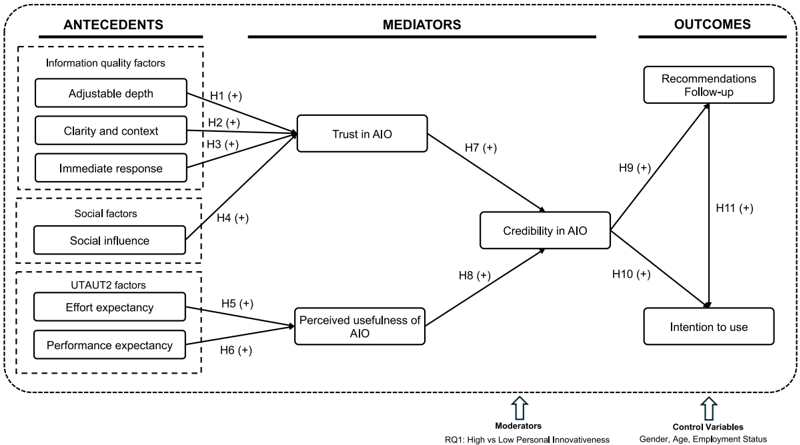
- In Study 1, the model explained 75.7% of variance in trust and 91.0% in credibility. Trust was most strongly associated with clarity and context (β = .419, p < .001), followed by adjustable depth (β = .335, p = .002) and social influence (β = .196, p < .001); response immediacy was not significant (β = .008, p = .874).
- Trust was strongly associated with credibility (β = .834, p < .001), and perceived usefulness had a smaller positive association with credibility (β = .229, p < .001). Credibility was associated with recommendation following (β = .877, p < .001) and intention to use (β = .553, p < .001); recommendation following was also associated with intention to use (β = .305, p = .005).
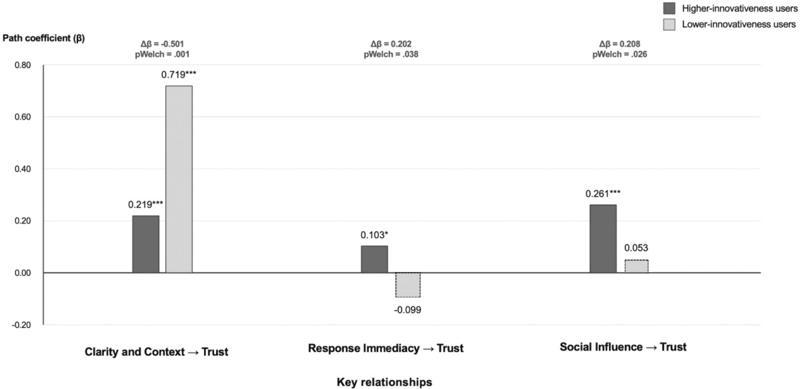
- Exploratory multigroup analysis found clarity/context was stronger for lower-innovativeness users (β = .719) than higher-innovativeness users (β = .219; Δβ = −.501, p = .001). Response immediacy and social influence were significant for higher-innovativeness users but not lower-innovativeness users (Δβ = .202, p = .038; Δβ = .208, p = .026).
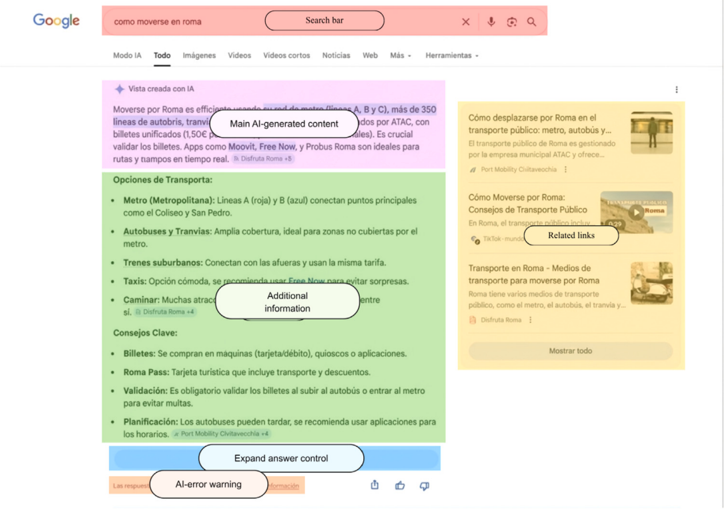
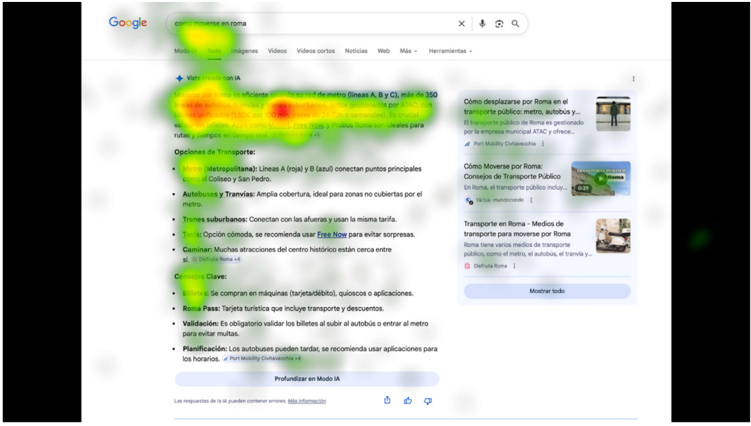
- Study 2 eye tracking showed attention concentrated on Main AI-generated content (M = 13.41 s fixation duration, M = 18.10 fixations, M = .65 s time to first fixation), with Additional information second (M = 7.96 s) and no analysable fixations on the AI-error warning. Interviews indicated 16 participants treated visible references as reliability cues, 17 did not notice the warning, and 9 described the default answer as reducing search effort.
Methods
- Study 1 used a cross-sectional online survey collected in March 2026 from a Spanish consumer panel, retaining 510 adult respondents with prior search-engine experience. It estimated a PLSc-SEM in SmartPLS with 10,000 bootstrap subsamples, then ran an exploratory PLS-MGA by personal innovativeness (n = 462 after missing-data exclusion).
- Study 2 collected eye-tracking and interview data in April 2026 from 20 Spanish university students (after excluding two recordings), using a Tobii Pro Nano at 60 Hz, six predefined AOIs, and a 30-second static simulated Spanish search query (“como moverse en roma”). Fixation metrics were compared with Friedman and Wilcoxon tests, and 60 verbal records were analysed inductively for themes.
- The two datasets were analysed separately and integrated only at the interpretation stage.
Limitations
- The paper states that Study 1 is cross-sectional and its paths are associations rather than causal effects; the Spanish panel had substantial prior GenAI exposure and may not represent less experienced populations; the median split for the exploratory MGA discards information and can create threshold-dependent differences; and the very high credibility R² = .910 may partly reflect conceptual proximity between credibility and its predictors.
- The paper states that Study 2 involved a small, demographically homogeneous Generation Z university sample, a simulated interface, a single 30-second low-stakes travel-planning task, and no opportunity to scroll, open citations, expand the answer, or reformulate the query, so findings are explanatory and contextual rather than population-level or generalisable to high-stakes contexts.
- The text also makes evident that the absence of analysable fixations on the AI-error warning does not rule out peripheral awareness or later recall, since some interviews reported noticing it; and because trust was not compared with objective answer accuracy, the findings are not evidence of trust calibration or miscalibration.
Model-written summary. Check it against the paper before relying on it.
Integrity signals
Registry
Cites
Statistics
Figures

Verification
Claims the paper makes
55 Own result · 18 Own method · 11 Not checked yet · 10 Own interpretation · 6 No full text of the sources · 3 Partly supported · 1 Supported · 1 Supported so far · 1 Not supported · 1 Sources not found · 1 Check pending · accuracy not yet measured
At least one cited source doesn’t support this claim or points to a different paper, and none confirmed it — see the verdicts below.
In the paper
“The R 2 of .910for Credibility is higher than the values reported in related AI-trust research.”
§ From search results to generative answers: A mixed-methods study of credibility assessment and trust formation in AI Overviews > 3.5. Structural model estimation results
What the sources say
- Disputedcites Zhan et al., 2024 sourceExperimental — accuracy not yet measured
Section 5.2.2 (Structural Model Analysis; page not provided) reports R² values of 0.841 for Trust in HVA and 0.542 for Intention to Use, not 0.910 for Credibility. The passage does not compare those values with related AI-trust research. (LLM, conf=0.88)
Checked by a reasoning model — may be wrong.
- Could not verifycites Choudhuri et al., 2025 sourceExperimental — accuracy not yet measured
The Measurement Model Evaluation figure reports adjusted R² values of 0.672 for Trust, 0.647 for Behavioral Intention, and 0.326 for Usage; it does not report an R² of 0.910 for Credibility. Searches for Credibility, 0.910, and comparisons with related AI-trust research found no passage addressing the claimed comparison. (LLM, conf=0.76)
- Disputedcites Tafesse and Sandhu, 2026 sourceExperimental — accuracy not yet measured
Section 4.4 (Model estimation; page unavailable) reports R² = 0.17 for perceived credibility, not 0.910. It compares that value with other constructs in the study, not with values from related AI-trust research. (LLM, conf=0.90)
Checked by a reasoning model — may be wrong.
plain- Asserted: passes — The authors put it forward as true.
- Checkable: passes — It can be checked against evidence.
- Load-bearing: unclear — It is unclear whether the paper’s conclusions depend on it.
- Based: passes — The paper gives a reason why it holds.
- Disputed
The sources with a verdict support this claim; the rest weren’t checked yet, have no full text we could read, or their verdicts aren’t rated yet.
In the paper
“In generative systems, visible citations can increase trust even when they are irrelevant, and users often do not inspect the supporting sources (Ding et al., 2025;Nahar et al., 2025;Tang et al., 2026).”
§ From search results to generative answers: A mixed-methods study of credibility assessment and trust formation in AI Overviews > 1. Introduction
What the sources say
- Supportedcites Ding et al., 2025 source
The Abstract reports that citations significantly increased trust even when they were random. The section “Does Checking Citations Indicate a Reduction in User Trust?” reports that participants manually checked only 193 of 1,976 answers with references (9.77%), supporting the statement that users often do not inspect sources. (LLM, conf=0.94)
- Not checked yetcites Nahar et al., 2025 source
Checked before — its earlier verdict is held back until a new check runs.
- Not checked — no full text of the sourcecites Tang et al., 2026 source
plaindirect- Asserted: passes — The authors put it forward as true.
- Checkable: passes — It can be checked against evidence.
- Load-bearing: passes — The paper’s conclusions depend on it.
- Based: passes — The paper gives a reason why it holds.
- Supported
The cited sources support only part of this claim — read each source’s verdict below.
In the paper
“U&G theory accounts for the informational value of clarity and context, and adjustable depth, insofar as these dimensions increase the comprehensibility, relevance, and verifiability of the response (Ruggiero, 2000).”
§ From search results to generative answers: A mixed-methods study of credibility assessment and trust formation in AI Overviews > 2.1. Theoretical framework
What the sources say
- Partly supportedcites Ruggiero, 2000 sourceExperimental — accuracy not yet measured
Ruggiero describes information-seeking as a media-use motivation (Theoretical Synopsis of U&G, p. 23) and discusses user choice, contextual clues, and access to information (Interactivity, p. 13). These passages provide a broad U&G basis for valuing information, but they do not establish that clarity, context, or adjustable response depth increase comprehensibility, relevance, or verifiability. (LLM, conf=0.83)
plaindirect- Asserted: passes — The authors put it forward as true.
- Checkable: passes — It can be checked against evidence.
- Load-bearing: passes — The paper’s conclusions depend on it.
- Based: passes — The paper gives a reason why it holds.
- Partly supported
The cited sources support only part of this claim — read each source’s verdict below.
In the paper
“Clarity and context, together with adjustable depth, were more strongly associated with trust than response immediacy”
§ From search results to generative answers: A mixed-methods study of credibility assessment and trust formation in AI Overviews > 3.7. Discussion of Study 1
What the sources say
- Partly supportedcites Larsson & Heintz, 2020 sourceExperimental — accuracy not yet measured
Section 2, “A multidisciplinary notion of transparency” (page unavailable), links users’ understanding of explanations and their context to trust in AI. It does not discuss adjustable depth or response immediacy, or compare how strongly those features are associated with trust. (LLM, conf=0.83)
- Not checked — no full text of the sourcecites Lee & Cha, 2025 source
boostedcorrelational- Asserted: passes — The authors put it forward as true.
- Checkable: passes — It can be checked against evidence.
- Load-bearing: passes — The paper’s conclusions depend on it.
- Based: passes — The paper gives a reason why it holds.
- Partly supported
A result the paper reports from its own data — it cites no other source for it, so there is none to check. The quote shows it is in the paper.
In the paper
“intention to use (𝛽 = .553;both p < .001)”
- Also stated in: § 3.5. Structural model estimation results · plain
“and intention to use (𝛽 = .553,p < .001)”
§ From search results to generative answers: A mixed-methods study of credibility assessment and trust formation in AI Overviews > Abstract
plaincorrelational- Asserted: passes — The authors put it forward as true.
- Checkable: passes — It can be checked against evidence.
- Load-bearing: passes — The paper’s conclusions depend on it.
- Based: passes — The paper gives a reason why it holds.
- Also stated in: § 3.5. Structural model estimation results · plain
A result the paper reports from its own data — it cites no other source for it, so there is none to check. The quote shows it is in the paper.
In the paper
“Performance expectancy (𝛽 = .637,p < .001)and effort expectancy (𝛽 = .357,p < .001)were positively associated with perceived usefulness.”
§ From search results to generative answers: A mixed-methods study of credibility assessment and trust formation in AI Overviews > 3.5. Structural model estimation results
plaincorrelational- Asserted: passes — The authors put it forward as true.
- Checkable: passes — It can be checked against evidence.
- Load-bearing: unclear — It is unclear whether the paper’s conclusions depend on it.
- Based: passes — The paper gives a reason why it holds.
A result the paper reports from its own data — it cites no other source for it, so there is none to check. The quote shows it is in the paper.
In the paper
“perceived usefulness (𝛽 = .229)”
- Also stated in: § 3.5. Structural model estimation results · plain
“Perceived usefulness was also positively associated with credibility (𝛽 = .229,f 2 = .061,t = 5.396, p < .001,95% BCa CI [0.009, 0.270])”
§ From search results to generative answers: A mixed-methods study of credibility assessment and trust formation in AI Overviews > Abstract
plaincorrelational- Asserted: passes — The authors put it forward as true.
- Checkable: passes — It can be checked against evidence.
- Load-bearing: passes — The paper’s conclusions depend on it.
- Based: passes — The paper gives a reason why it holds.
- Also stated in: § 3.5. Structural model estimation results · plain
A result the paper reports from its own data — it cites no other source for it, so there is none to check. The quote shows it is in the paper.
In the paper
“Eye tracking recorded no analysable fixations on the AI-error warning”
§ From search results to generative answers: A mixed-methods study of credibility assessment and trust formation in AI Overviews > Abstract
plain- Asserted: passes — The authors put it forward as true.
- Checkable: passes — It can be checked against evidence.
- Load-bearing: unclear — It is unclear whether the paper’s conclusions depend on it.
- Based: passes — The paper gives a reason why it holds.
A result the paper reports from its own data — it cites no other source for it, so there is none to check. The quote shows it is in the paper.
In the paper
“response immediacy was not significant (𝛽 = .008,p = .874)”
- Also stated in: § 3.5. Structural model estimation results · plain
“Response immediacy was not significantly associated with trust (𝛽 = .008,p = .874)”
§ From search results to generative answers: A mixed-methods study of credibility assessment and trust formation in AI Overviews > Abstract
plain- Asserted: passes — The authors put it forward as true.
- Checkable: passes — It can be checked against evidence.
- Load-bearing: passes — The paper’s conclusions depend on it.
- Based: passes — The paper gives a reason why it holds.
- Also stated in: § 3.5. Structural model estimation results · plain
A result the paper reports from its own data — it cites no other source for it, so there is none to check. The quote shows it is in the paper.
In the paper
“often interpreted visible references as indicators of reliability”
§ From search results to generative answers: A mixed-methods study of credibility assessment and trust formation in AI Overviews > Abstract
plaincorrelational- Asserted: passes — The authors put it forward as true.
- Checkable: passes — It can be checked against evidence.
- Load-bearing: passes — The paper’s conclusions depend on it.
- Based: passes — The paper gives a reason why it holds.
- Probably not a substantial claim. 13
- It may state two separate claims as one. 39
- The quote only partly states this claim. 2
Every source the paper cites for this claim was checked and supports it.
In the paper
“This combination is consistent with previous research integrating U&G with technology-adoption perspectives in AI-enabled services and search-engine contexts (Knuth & Masuhr, 2021;McLean & Osei-Frimpong, 2019).”
§ From search results to generative answers: A mixed-methods study of credibility assessment and trust formation in AI Overviews > 2.1. Theoretical framework
What the sources say
- Supportedcites Knuth & Masuhr, 2021 source
In §2, Hypothesis Development and Measurement, Knuth and Masuhr say they integrate factors from the Uses and Gratifications Approach and UTAUT and apply them to search-engine usage. This supports the search-engine-context example attributed to this citation; the separately cited AI-enabled-services context is not assessed here. (LLM, conf=0.93)
- Supportedcites McLean & Osei-Frimpong, 2019 source
The Theoretical Implications (p. 20) say the cited study combines Uses and Gratifications Theory with technology theories to examine adoption and use of AI-powered in-home voice assistants. That supports its use as an example of integrating U&G with technology-adoption perspectives in an AI-enabled context; the sentence also cites a separate work for the search-engine context. (LLM, conf=0.88)
plain- Asserted: passes — The authors put it forward as true.
- Checkable: passes — It can be checked against evidence.
- Load-bearing: fails — The paper’s conclusions may not depend on it.
- Based: passes — The paper gives a reason why it holds.
Probably not a substantial claim. The paper’s conclusions may not depend on it.
- Supported
The cited sources support only part of this claim — read each source’s verdict below.
In the paper
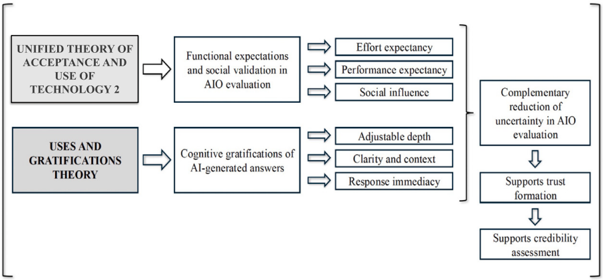
“UTAUT2 informs the roles of performance expectancy, effort expectancy, and social influence, whereas Uses and Gratifications Theory helps explain the informational value of clarity and context, and access to supporting material (Blut et al., 2022;Ruggiero, 2000).”
§ From search results to generative answers: A mixed-methods study of credibility assessment and trust formation in AI Overviews > 2.1. Theoretical framework
What the sources say
- Supportedcites Blut et al., 2022 source
The Overview of UTAUT identifies performance expectancy, effort expectancy, and social influence as predictors of intention and explains that UTAUT2 extends the original model for consumer contexts. The Uses and Gratifications Theory clause is attributable to the other citation, not Blut et al. No page number is provided in our copy. (LLM, conf=0.92)
- Partly supportedcites Ruggiero, 2000 sourceExperimental — accuracy not yet measured
Ruggiero describes information-seeking as a motivation for media use (U&G THEORY BUILDING, p. 11) and discusses information access through links and the difficulty of navigating results without contextual clues (INTERACTIVITY, p. 13). These passages support the broad U&G rationale, but the paper does not specifically establish the informational value of clarity or access to supporting material. (LLM, conf=0.82)
plain- Asserted: passes — The authors put it forward as true.
- Checkable: passes — It can be checked against evidence.
- Load-bearing: passes — The paper’s conclusions depend on it.
- Based: passes — The paper gives a reason why it holds.
It may state two separate claims as one.
- Supported
A result the paper reports from its own data — it cites no other source for it, so there is none to check. The quote shows it is in the paper.
In the paper
“In particular, the HTMT ratio between Performance Expectancy and Perceived Usefulness was .888,while their latent construct correlation was .813,which was lower than the square roots of the AVE for both Performance Expectancy (.878) and Perceived Usefulness (.912).”
§ From search results to generative answers: A mixed-methods study of credibility assessment and trust formation in AI Overviews > 3.4. Control of common method bias and assessment of the measurement model
plaincorrelational- Asserted: passes — The authors put it forward as true.
- Checkable: passes — It can be checked against evidence.
- Load-bearing: passes — The paper’s conclusions depend on it.
- Based: passes — The paper gives a reason why it holds.
It may state two separate claims as one.
A result the paper reports from its own data — it cites no other source for it, so there is none to check. The quote shows it is in the paper.
In the paper
“CVPAT further showed that the prediction loss for Credibility was significantly lower than that of the indicator-average benchmark (difference in loss = -.722,p < .001)and did not differ significantly from the linear-model benchmark (difference in loss = -.008,p = .569).”
§ From search results to generative answers: A mixed-methods study of credibility assessment and trust formation in AI Overviews > 3.5. Structural model estimation results
plain- Asserted: passes — The authors put it forward as true.
- Checkable: passes — It can be checked against evidence.
- Load-bearing: passes — The paper’s conclusions depend on it.
- Based: passes — The paper gives a reason why it holds.
It may state two separate claims as one.
A result the paper reports from its own data — it cites no other source for it, so there is none to check. The quote shows it is in the paper.
In the paper
“In the current model, the primary association reflects the dominant association between Trust and Credibility (𝛽 = .834,f 2 = 2.211), with a contribution from perceived usefulness (𝛽 = .229).”
§ From search results to generative answers: A mixed-methods study of credibility assessment and trust formation in AI Overviews > 3.5. Structural model estimation results
plaincorrelational- Asserted: passes — The authors put it forward as true.
- Checkable: passes — It can be checked against evidence.
- Load-bearing: passes — The paper’s conclusions depend on it.
- Based: passes — The paper gives a reason why it holds.
It may state two separate claims as one.
A result the paper reports from its own data — it cites no other source for it, so there is none to check. The quote shows it is in the paper.
In the paper
“Immediacy → Trust in | 0.103* | 2.105 | -0.099 | 1.195 | 0.202 | 0.041 | .084 | 0.038”
§ From search results to generative answers: A mixed-methods study of credibility assessment and trust formation in AI Overviews > 5. Limitations and future research directions
plaindirectn = 462 ·- Asserted: passes — The authors put it forward as true.
- Checkable: passes — It can be checked against evidence.
- Load-bearing: unclear — It is unclear whether the paper’s conclusions depend on it.
- Based: passes — The paper gives a reason why it holds.
It may state two separate claims as one.
A result the paper reports from its own data — it cites no other source for it, so there is none to check. The quote shows it is in the paper.
In the paper
“Adjustable depth → Trust | 0.381*** | 5.123 | 0.155 | 1.073 | 0.226 | 0.167 | .210 | 0.165”
§ From search results to generative answers: A mixed-methods study of credibility assessment and trust formation in AI Overviews > 5. Limitations and future research directions
plaindirectn = 462- Asserted: passes — The authors put it forward as true.
- Checkable: passes — It can be checked against evidence.
- Load-bearing: unclear — It is unclear whether the paper’s conclusions depend on it.
- Based: passes — The paper gives a reason why it holds.
It may state two separate claims as one.
A result the paper reports from its own data — it cites no other source for it, so there is none to check. The quote shows it is in the paper.
In the paper
“Social influence → Trust | 0.261*** | 5.611 | 0.053 | 0.657 | 0.208 | 0.022 | .062 | 0.026”
§ From search results to generative answers: A mixed-methods study of credibility assessment and trust formation in AI Overviews > 5. Limitations and future research directions
plaincorrelational- Asserted: passes — The authors put it forward as true.
- Checkable: passes — It can be checked against evidence.
- Load-bearing: unclear — It is unclear whether the paper’s conclusions depend on it.
- Based: passes — The paper gives a reason why it holds.
It may state two separate claims as one.
A result the paper reports from its own data — it cites no other source for it, so there is none to check. The quote shows it is in the paper.
In the paper
“The Expand answer control received the least attention among fixated AOIs: mean fixation duration = .64s (SD = .60),mean fixation count = 1.33 (SD = .58),and mean time to first fixation = 9.55 s (SD = 6.30).No analysable fixation occurred on the AI-error warning.”
§ From search results to generative answers: A mixed-methods study of credibility assessment and trust formation in AI Overviews > 3.9. Eye-tracking results
plain- Asserted: passes — The authors put it forward as true.
- Checkable: passes — It can be checked against evidence.
- Load-bearing: unclear — It is unclear whether the paper’s conclusions depend on it.
- Based: passes — The paper gives a reason why it holds.
It may state two separate claims as one.
A result the paper reports from its own data — it cites no other source for it, so there is none to check. The quote shows it is in the paper.
In the paper
“Gender → | 0.102 | | 0.224 | .823 | [-0.121, | ns”
- Also stated in: § 5. Limitations and future research directions · plain
“Gender → Intention to | 0.102 | | 1.476 | .140 | [-0.035, | ns”
§ From search results to generative answers: A mixed-methods study of credibility assessment and trust formation in AI Overviews > 5. Limitations and future research directions
plain- Asserted: passes — The authors put it forward as true.
- Checkable: passes — It can be checked against evidence.
- Load-bearing: unclear — It is unclear whether the paper’s conclusions depend on it.
- Based: passes — The paper gives a reason why it holds.
It may state two separate claims as one. The quote only partly states this claim.
- Also stated in: § 5. Limitations and future research directions · plain
A result the paper reports from its own data — it cites no other source for it, so there is none to check. The quote shows it is in the paper.
In the paper
“Age → Recommendation | 0.008 | | 0.343 | .732 | [-0.051,”
- Also stated in: § 5. Limitations and future research directions · plain
“Age → Intention to use | 0.011 | | 0.219 | .827 | [-0.061,”
§ From search results to generative answers: A mixed-methods study of credibility assessment and trust formation in AI Overviews > 5. Limitations and future research directions
plain- Asserted: passes — The authors put it forward as true.
- Checkable: passes — It can be checked against evidence.
- Load-bearing: unclear — It is unclear whether the paper’s conclusions depend on it.
- Based: passes — The paper gives a reason why it holds.
It may state two separate claims as one.
- Also stated in: § 5. Limitations and future research directions · plain
A result the paper reports from its own data — it cites no other source for it, so there is none to check. The quote shows it is in the paper.
In the paper
“Performance expectancy | 0.600*** | 7.750 | 0.567*** | 10.068 | 0.033 | 0.724 | .852 | 0.729”
§ From search results to generative answers: A mixed-methods study of credibility assessment and trust formation in AI Overviews > 5. Limitations and future research directions
plaindirectn = 462- Asserted: passes — The authors put it forward as true.
- Checkable: passes — It can be checked against evidence.
- Load-bearing: unclear — It is unclear whether the paper’s conclusions depend on it.
- Based: passes — The paper gives a reason why it holds.
It may state two separate claims as one.
A result the paper reports from its own data — it cites no other source for it, so there is none to check. The quote shows it is in the paper.
In the paper
“Effort expectancy → | 0.299*** | 3.969 | 0.435*** | 6.866 | -0.136 | 0.174 | .432 | 0.167”
§ From search results to generative answers: A mixed-methods study of credibility assessment and trust formation in AI Overviews > 5. Limitations and future research directions
plaindirectn = 462- Asserted: passes — The authors put it forward as true.
- Checkable: passes — It can be checked against evidence.
- Load-bearing: unclear — It is unclear whether the paper’s conclusions depend on it.
- Based: passes — The paper gives a reason why it holds.
It may state two separate claims as one.
A result the paper reports from its own data — it cites no other source for it, so there is none to check. The quote shows it is in the paper.
In the paper
“Lower-innovativeness users relied more strongly on clarity and context, whereas higher-innovativeness users appeared more responsive to immediacy and social influence.”
§ From search results to generative answers: A mixed-methods study of credibility assessment and trust formation in AI Overviews > 3.7. Discussion of Study 1
hedgedcorrelational- Asserted: passes — The authors put it forward as true.
- Checkable: passes — It can be checked against evidence.
- Load-bearing: passes — The paper’s conclusions depend on it.
- Based: passes — The paper gives a reason why it holds.
It may state two separate claims as one.
A result the paper reports from its own data — it cites no other source for it, so there is none to check. The quote shows it is in the paper.
In the paper
“Employment status→ | -0.003 | | 0.118 | .906 | [-0.053,”
- Also stated in: § 5. Limitations and future research directions · plain
“Employment status → | -0.051 | | 1.310 | .190 | [-0.127,”
§ From search results to generative answers: A mixed-methods study of credibility assessment and trust formation in AI Overviews > 5. Limitations and future research directions
plain- Asserted: passes — The authors put it forward as true.
- Checkable: passes — It can be checked against evidence.
- Load-bearing: fails — The paper’s conclusions may not depend on it.
- Based: passes — The paper gives a reason why it holds.
Probably not a substantial claim. The paper’s conclusions may not depend on it. It may state two separate claims as one.
- Also stated in: § 5. Limitations and future research directions · plain
A result the paper reports from its own data — it cites no other source for it, so there is none to check. The quote shows it is in the paper.
In the paper
“Recommendation | 0.283*** | 3.977 | 0.450** | 2.805 | -0.167 | 0.339 | .342 | 0.340”
§ From search results to generative answers: A mixed-methods study of credibility assessment and trust formation in AI Overviews > 5. Limitations and future research directions
plaincorrelational- Asserted: passes — The authors put it forward as true.
- Checkable: passes — It can be checked against evidence.
- Load-bearing: unclear — It is unclear whether the paper’s conclusions depend on it.
- Based: passes — The paper gives a reason why it holds.
It may state two separate claims as one.
A result the paper reports from its own data — it cites no other source for it, so there is none to check. The quote shows it is in the paper.
In the paper
“The Main AI-generated content received the longest fixation duration (M = 13.41 s, SD = 5.45), the most fixations (M = 18.10,SD = 9.40), and the shortest time to first fixation (M = .65s, SD = .78).”
§ From search results to generative answers: A mixed-methods study of credibility assessment and trust formation in AI Overviews > 3.9. Eye-tracking results
plain- Asserted: passes — The authors put it forward as true.
- Checkable: passes — It can be checked against evidence.
- Load-bearing: unclear — It is unclear whether the paper’s conclusions depend on it.
- Based: passes — The paper gives a reason why it holds.
It may state two separate claims as one.
A result the paper reports from its own data — it cites no other source for it, so there is none to check. The quote shows it is in the paper.
In the paper
“Trust in AIO | | 0.757 | | 0.665”
- Also stated in: § 5. Limitations and future research directions · plain
“Credibility in AIO | | 0.910 | | 0.719”
§ From search results to generative answers: A mixed-methods study of credibility assessment and trust formation in AI Overviews > 5. Limitations and future research directions
plaincorrelational- Asserted: passes — The authors put it forward as true.
- Checkable: passes — It can be checked against evidence.
- Load-bearing: passes — The paper’s conclusions depend on it.
- Based: passes — The paper gives a reason why it holds.
It may state two separate claims as one. The quote only partly states this claim.
- Also stated in: § 5. Limitations and future research directions · plain
A result the paper reports from its own data — it cites no other source for it, so there is none to check. The quote shows it is in the paper.
In the paper
“Additional information ranked second in fixation duration (M = 7.96 s, SD = 4.68) and fixation count (M = 11.25,SD = 10.08), but was first fixated later (M = 8.50 s, SD = 7.34).”
§ From search results to generative answers: A mixed-methods study of credibility assessment and trust formation in AI Overviews > 3.9. Eye-tracking results
plain- Asserted: passes — The authors put it forward as true.
- Checkable: passes — It can be checked against evidence.
- Load-bearing: unclear — It is unclear whether the paper’s conclusions depend on it.
- Based: passes — The paper gives a reason why it holds.
It may state two separate claims as one.
A result the paper reports from its own data — it cites no other source for it, so there is none to check. The quote shows it is in the paper.
In the paper
“Credibility in AIO → | 0.792*** | 24.589 | 0.836*** | 22.700 | -0.044 | 0.362 | .560 | 0.371”
§ From search results to generative answers: A mixed-methods study of credibility assessment and trust formation in AI Overviews > 5. Limitations and future research directions
plaindirectn = 462- Asserted: passes — The authors put it forward as true.
- Checkable: passes — It can be checked against evidence.
- Load-bearing: unclear — It is unclear whether the paper’s conclusions depend on it.
- Based: passes — The paper gives a reason why it holds.
It may state two separate claims as one.
A result the paper reports from its own data — it cites no other source for it, so there is none to check. The quote shows it is in the paper.
In the paper
“Perceived usefulness of | 0.251*** | 4.887 | 0.203* | 2.455 | 0.048 | 0.619 | .696 | 0.624”
§ From search results to generative answers: A mixed-methods study of credibility assessment and trust formation in AI Overviews > 5. Limitations and future research directions
plaindirectn = 462- Asserted: passes — The authors put it forward as true.
- Checkable: passes — It can be checked against evidence.
- Load-bearing: unclear — It is unclear whether the paper’s conclusions depend on it.
- Based: passes — The paper gives a reason why it holds.
It may state two separate claims as one.
A result the paper reports from its own data — it cites no other source for it, so there is none to check. The quote shows it is in the paper.
In the paper
“Trust in AIO → | 0.668*** | 13.764 | 0.754*** | 10.950 | -0.086 | 0.298 | .453 | 0.309”
§ From search results to generative answers: A mixed-methods study of credibility assessment and trust formation in AI Overviews > 5. Limitations and future research directions
plaindirect- Asserted: passes — The authors put it forward as true.
- Checkable: passes — It can be checked against evidence.
- Load-bearing: unclear — It is unclear whether the paper’s conclusions depend on it.
- Based: passes — The paper gives a reason why it holds.
It may state two separate claims as one.
A result the paper reports from its own data — it cites no other source for it, so there is none to check. The quote shows it is in the paper.
In the paper
“Credibility in AIO → | 0.484*** | 7.291 | 0.222 | 1.296 | 0.262 | 0.156 | .120 | 0.155”
§ From search results to generative answers: A mixed-methods study of credibility assessment and trust formation in AI Overviews > 5. Limitations and future research directions
plainn = 462- Asserted: passes — The authors put it forward as true.
- Checkable: passes — It can be checked against evidence.
- Load-bearing: unclear — It is unclear whether the paper’s conclusions depend on it.
- Based: passes — The paper gives a reason why it holds.
It may state two separate claims as one.
In the paper
“Measurement invariance was assessed using the MICOM procedure, including configural and compositional invariance, as well as equality of composite means and variances (Henseler et al., 2016).”
§ From search results to generative answers: A mixed-methods study of credibility assessment and trust formation in AI Overviews > 3.6. Multigroup analysis results
What the sources say
- Not checked yetcites Henseler et al., 2016 source
plainn = 462- Asserted: passes — The authors put it forward as true.
- Checkable: passes — It can be checked against evidence.
- Load-bearing: passes — The paper’s conclusions depend on it.
- Based: passes — The paper gives a reason why it holds.
Probably not a substantial claim. It may state two separate claims as one.
A claim is checked only against the cited paper’s full text, never its abstract, and none is available for its sources.
In the paper
“Credible information reduces uncertainty and is more likely to be followed, while repeated credible encounters can support future intention to use (Ali et al., 2023;T. Kim et al., 2025;Sussman & Siegal, 2003).”
§ From search results to generative answers: A mixed-methods study of credibility assessment and trust formation in AI Overviews > 2.6. Credibility and behavioural intentions
What the sources say
hedgeddirect- Asserted: passes — The authors put it forward as true.
- Checkable: passes — It can be checked against evidence.
- Load-bearing: passes — The paper’s conclusions depend on it.
- Based: passes — The paper gives a reason why it holds.
Probably not a substantial claim. It may state two separate claims as one.
In the paper
“As a statistical diagnostic, full-collinearity variance inflation factors were below 3 for all constructs, suggesting that common method bias was unlikely to substantially affect the estimated relationships (Koc, 2015).”
§ From search results to generative answers: A mixed-methods study of credibility assessment and trust formation in AI Overviews > 3.4. Control of common method bias and assessment of the measurement model
What the sources say
- Not checked — no full text of the sourcecites Koc, 2015 source
hedged- Asserted: passes — The authors put it forward as true.
- Checkable: passes — It can be checked against evidence.
- Load-bearing: unclear — It is unclear whether the paper’s conclusions depend on it.
- Based: passes — The paper gives a reason why it holds.
It may state two separate claims as one.
None of the sources cited for this claim have been checked yet.
In the paper
“Social influence is associated with trust rather than with intention to use because peer validation may reduce uncertainty before users form an independent assessment of the system's reliability (Krell et al., 2016); (Biloš & Budimir, 2024).”
§ From search results to generative answers: A mixed-methods study of credibility assessment and trust formation in AI Overviews > 2.1. Theoretical framework
What the sources say
hedgedcorrelational- Asserted: passes — The authors put it forward as true.
- Checkable: passes — It can be checked against evidence.
- Load-bearing: passes — The paper’s conclusions depend on it.
- Based: passes — The paper gives a reason why it holds.
It may state two separate claims as one.
What the paper did — it cites no source for this, so there is none to check. The quote shows it is in the paper.
In the paper
“All constructs were measured using seven-point Likert scales adapted from validated measures (see Appendix).”
§ From search results to generative answers: A mixed-methods study of credibility assessment and trust formation in AI Overviews > 3.3. Study 1 dataset, design, and sample
plain- Asserted: passes — The authors put it forward as true.
- Checkable: passes — It can be checked against evidence.
- Load-bearing: fails — The paper’s conclusions may not depend on it.
- Based: passes — The paper gives a reason why it holds.
Probably not a substantial claim. The paper’s conclusions may not depend on it.
In the paper
“Response immediacy may signal efficiency and technical competence, but its meaning is not uniform: rapid answers may reassure users when information is simple, whereas a slower response can be evaluated more favourably for complex information (J.Kim et al., 2025).”
§ From search results to generative answers: A mixed-methods study of credibility assessment and trust formation in AI Overviews > H2: Clarity and context are positively associated with trust in AIO.
What the sources say
- Not checked — no full text of the sourcecites J.Kim et al., 2025 source
hedgedconditional- Asserted: passes — The authors put it forward as true.
- Checkable: passes — It can be checked against evidence.
- Load-bearing: fails — The paper’s conclusions may not depend on it.
- Based: passes — The paper gives a reason why it holds.
Probably not a substantial claim. The paper’s conclusions may not depend on it. It may state two separate claims as one.
What the paper did — it cites no source for this, so there is none to check. The quote shows it is in the paper.
In the paper
“Because dichotomising a continuous measure can reduce information and create threshold-dependent differences, the MGA is interpreted as exploratory rather than as a definitive test of moderation.”
§ From search results to generative answers: A mixed-methods study of credibility assessment and trust formation in AI Overviews > 3.6. Multigroup analysis results
plaindirectn = 462- Asserted: passes — The authors put it forward as true.
- Checkable: passes — It can be checked against evidence.
- Load-bearing: passes — The paper’s conclusions depend on it.
- Based: passes — The paper gives a reason why it holds.
Probably not a substantial claim.
What the paper did — it cites no source for this, so there is none to check. The quote shows it is in the paper.
In the paper
“All endogenous indicators produced positive Q 2 predict values, ranging from .348 to .617,indicating that the model's predictions outperformed the mean-based benchmark.”
§ From search results to generative answers: A mixed-methods study of credibility assessment and trust formation in AI Overviews > 3.5. Structural model estimation results
hedged- Asserted: passes — The authors put it forward as true.
- Checkable: passes — It can be checked against evidence.
- Load-bearing: unclear — It is unclear whether the paper’s conclusions depend on it.
- Based: passes — The paper gives a reason why it holds.
It may state two separate claims as one.
A claim is checked only against the cited paper’s full text, never its abstract, and none is available for its sources.
In the paper
“Information science research shows that users judge credibility based on content, source, and interface cues, including surface and verifiable credibility (Liu, 2004;Rieh & Danielson, 2007).”
§ From search results to generative answers: A mixed-methods study of credibility assessment and trust formation in AI Overviews > 1. Introduction
What the sources say
plaincorrelational- Asserted: passes — The authors put it forward as true.
- Checkable: passes — It can be checked against evidence.
- Load-bearing: fails — The paper’s conclusions may not depend on it.
- Based: passes — The paper gives a reason why it holds.
Probably not a substantial claim. The paper’s conclusions may not depend on it.
What the paper did — it cites no source for this, so there is none to check. The quote shows it is in the paper.
In the paper
“Overall, these results support discriminant validity, although the construct pairs with HTMT ratios approaching the threshold should be interpreted with caution.”
§ From search results to generative answers: A mixed-methods study of credibility assessment and trust formation in AI Overviews > 3.4. Control of common method bias and assessment of the measurement model
plain- Asserted: passes — The authors put it forward as true.
- Checkable: passes — It can be checked against evidence.
- Load-bearing: unclear — It is unclear whether the paper’s conclusions depend on it.
- Based: passes — The paper gives a reason why it holds.
It may state two separate claims as one.
What the paper did — it cites no source for this, so there is none to check. The quote shows it is in the paper.
In the paper
“Discriminant validity was assessed using the heterotrait-monotrait ratio (HTMT) and the Fornell-Larcker criterion.”
§ From search results to generative answers: A mixed-methods study of credibility assessment and trust formation in AI Overviews > 3.4. Control of common method bias and assessment of the measurement model
plain- Asserted: passes — The authors put it forward as true.
- Checkable: passes — It can be checked against evidence.
- Load-bearing: passes — The paper’s conclusions depend on it.
- Based: passes — The paper gives a reason why it holds.
Probably not a substantial claim.
In the paper
“The inverse square root method also indicated sufficient power to detect standardised paths of approximately .10 (Kock & Hadaya, 2018).”
§ From search results to generative answers: A mixed-methods study of credibility assessment and trust formation in AI Overviews > 3.3. Study 1 dataset, design, and sample
What the sources say
- Not checked — no full text of the sourcecites Kock & Hadaya, 2018 source
hedged- Asserted: passes — The authors put it forward as true.
- Checkable: passes — It can be checked against evidence.
- Load-bearing: fails — The paper’s conclusions may not depend on it.
- Based: passes — The paper gives a reason why it holds.
Probably not a substantial claim. The paper’s conclusions may not depend on it.
None of the sources cited for this claim have been checked yet.
In the paper
“Questionnaire records were screened sequentially for eligibility and attention.Respondents first completed a visual check to confirm that they correctly identified an AIO (Li & Aral, 2025).Records with abnormally short completion times were then removed (Benítez et al., 2020), followed by records that failed an instructional manipulation check (Oppenheimer et al., 2009).”
§ From search results to generative answers: A mixed-methods study of credibility assessment and trust formation in AI Overviews > 3.3. Study 1 dataset, design, and sample
What the sources say
plain- Asserted: passes — The authors put it forward as true.
- Checkable: passes — It can be checked against evidence.
- Load-bearing: fails — The paper’s conclusions may not depend on it.
- Based: passes — The paper gives a reason why it holds.
Probably not a substantial claim. The paper’s conclusions may not depend on it.
A conclusion the paper draws from its own results — it cites no other source for it, so there is none to check. The quote shows it is in the paper.
In the paper
“visual prominence and visible references appeared to operate as authority cues for some participants and may encourage reliance without active source verification.”
§ From search results to generative answers: A mixed-methods study of credibility assessment and trust formation in AI Overviews > Abstract
hedgedconditional- Asserted: passes — The authors put it forward as true.
- Checkable: passes — It can be checked against evidence.
- Load-bearing: passes — The paper’s conclusions depend on it.
- Based: passes — The paper gives a reason why it holds.
It may state two separate claims as one.
In the paper
“The SRMR was .043,below the .08reference value (Hu & Bentler, 1999).”
§ From search results to generative answers: A mixed-methods study of credibility assessment and trust formation in AI Overviews > 3.5. Structural model estimation results
What the sources say
- Not checked — no full text of the sourcecites Hu & Bentler, 1999 source
plain- Asserted: passes — The authors put it forward as true.
- Checkable: passes — It can be checked against evidence.
- Load-bearing: passes — The paper’s conclusions depend on it.
- Based: passes — The paper gives a reason why it holds.
It may state two separate claims as one.
A conclusion the paper draws from its own results — it cites no other source for it, so there is none to check. The quote shows it is in the paper.
In the paper
“These results indicate that the predictive performance of Credibility does not collapse outside the estimation sample and is comparable to that of the linear benchmark.”
§ From search results to generative answers: A mixed-methods study of credibility assessment and trust formation in AI Overviews > 3.5. Structural model estimation results
hedged- Asserted: passes — The authors put it forward as true.
- Checkable: passes — It can be checked against evidence.
- Load-bearing: passes — The paper’s conclusions depend on it.
- Based: passes — The paper gives a reason why it holds.
It may state two separate claims as one.
None of the sources cited for this claim have been checked yet.
In the paper
“Both are expected to be positively associated with perceived usefulness, particularly in natural-language interfaces (Blut et al., 2022;Sugumar & Chandra, 2021;Venkatesh et al., 2003).”
§ From search results to generative answers: A mixed-methods study of credibility assessment and trust formation in AI Overviews > 2.4. Functional expectations and perceived usefulness
What the sources say
- Not checked yetcites Blut et al., 2022 source
Checked before — its earlier verdict is held back until a new check runs.
- Not checked yetcites Sugumar & Chandra, 2021 source
Checked before — its earlier verdict is held back until a new check runs.
- Not checked — no full text of the sourcecites Venkatesh et al., 2003 source
plaincorrelational- Asserted: passes — The authors put it forward as true.
- Checkable: passes — It can be checked against evidence.
- Load-bearing: passes — The paper’s conclusions depend on it.
- Based: passes — The paper gives a reason why it holds.
Probably not a substantial claim. It may state two separate claims as one.
- Not checked yet
What the paper did — it cites no source for this, so there is none to check. The quote shows it is in the paper.
In the paper
“Likewise, all HTMT ratios were below the .90threshold, although values close to this cut-off warrant cautious interpretation.”
§ From search results to generative answers: A mixed-methods study of credibility assessment and trust formation in AI Overviews > 3.4. Control of common method bias and assessment of the measurement model
plain- Asserted: passes — The authors put it forward as true.
- Checkable: passes — It can be checked against evidence.
- Load-bearing: passes — The paper’s conclusions depend on it.
- Based: passes — The paper gives a reason why it holds.
It may state two separate claims as one.
None of the sources cited for this claim have been checked yet.
In the paper
“It can support verification, but the mere visibility of references may also serve as an authority cue when users do not inspect them (Ding et al., 2025;Li & Aral, 2025;Tang et al., 2026).”
§ From search results to generative answers: A mixed-methods study of credibility assessment and trust formation in AI Overviews > 2.2. Transparency and trust formation
What the sources say
hedgedconditional- Asserted: passes — The authors put it forward as true.
- Checkable: passes — It can be checked against evidence.
- Load-bearing: passes — The paper’s conclusions depend on it.
- Based: passes — The paper gives a reason why it holds.
It may state two separate claims as one.
What the paper did — it cites no source for this, so there is none to check. The quote shows it is in the paper.
In the paper
“All VIF values were below this threshold (VIF < 3), indicating no problematic collinearity among the structural model predictors.”
§ From search results to generative answers: A mixed-methods study of credibility assessment and trust formation in AI Overviews > 3.5. Structural model estimation results
hedged- Asserted: passes — The authors put it forward as true.
- Checkable: passes — It can be checked against evidence.
- Load-bearing: passes — The paper’s conclusions depend on it.
- Based: passes — The paper gives a reason why it holds.
It may state two separate claims as one.
What the paper did — it cites no source for this, so there is none to check. The quote shows it is in the paper.
In the paper
“The study protocol was reviewed and approved by the Ethics Committee for Experimentation (CEUMA), Málaga, Spain (approval number CEUMA 47; Registry No. 122-2024-H).”
§ From search results to generative answers: A mixed-methods study of credibility assessment and trust formation in AI Overviews > Additional information
plain- Asserted: passes — The authors put it forward as true.
- Checkable: passes — It can be checked against evidence.
- Load-bearing: fails — The paper’s conclusions may not depend on it.
- Based: passes — The paper gives a reason why it holds.
Probably not a substantial claim. The paper’s conclusions may not depend on it.
What the paper did — it cites no source for this, so there is none to check. The quote shows it is in the paper.
In the paper
“Table 1 Measurement model reliability and convergent validity (n = 510).”
§ From search results to generative answers: A mixed-methods study of credibility assessment and trust formation in AI Overviews > 5. Limitations and future research directions
plainn = 510- Asserted: passes — The authors put it forward as true.
- Checkable: passes — It can be checked against evidence.
- Load-bearing: passes — The paper’s conclusions depend on it.
- Based: passes — The paper gives a reason why it holds.
It may state two separate claims as one.
None of the sources cited for this claim have been checked yet.
In the paper
“This pattern indicates a potential risk of reliance without active verification, although it was not uniform across participants.”
§ From search results to generative answers: A mixed-methods study of credibility assessment and trust formation in AI Overviews > 3.11. Discussion of Study 2
What the sources say
- Not matchedcites Li & Aral, 2025
Couldn’t be matched to a paper in Crossref, so it can’t be checked.
- Not checked — no full text of the sourcecites Tang et al., 2026 source
hedgedconditional- Asserted: passes — The authors put it forward as true.
- Checkable: passes — It can be checked against evidence.
- Load-bearing: passes — The paper’s conclusions depend on it.
- Based: passes — The paper gives a reason why it holds.
It may state two separate claims as one.
- Not matched
What the paper did — it cites no source for this, so there is none to check. The quote shows it is in the paper.
In the paper
“Study 2 involved a small, demographically homogeneous group of Generation Z university students with extensive prior experience using generative AI, along with a simulated interface and a single 30-second search task.”
§ From search results to generative answers: A mixed-methods study of credibility assessment and trust formation in AI Overviews > 5. Limitations and future research directions
plain- Asserted: passes — The authors put it forward as true.
- Checkable: passes — It can be checked against evidence.
- Load-bearing: passes — The paper’s conclusions depend on it.
- Based: passes — The paper gives a reason why it holds.
It may state two separate claims as one.
The paper relies on this without support.
Google AI Overviews display the generative answer by default within the search results.
“AIO differ because the generative answer is displayed by default within the search results.”
The paper relies on this without support.
Generative search partially delegates content synthesis, source selection, and answer presentation to an AI system.
“Generative search partially delegates content synthesis, source selection, and answer presentation to an AI system.”
The paper relies on this without support.
Existing evidence does not establish a uniform direction for differences across the relationships included in the model.
“However, existing evidence does not establish a uniform direction for these differences across the relationships included in the model.”
Self-check
Percentages, sums and reported differences re-computed from the paper’s own numbers.
Each contradiction between two passages listed here was confirmed by an independent check.
Rated minor: it would not touch a result — a value no result rests on, a p-value that stays on the same side of the significance level, or a conflict that is clerical, resolved elsewhere in the paper, or outside its own findings.
In the paper
§ From search results to generative answers: A mixed-methods study of credibility assessment and trust formation in AI Overviews > 3.5. Structural model estimation results
“For the three indicators measuring Credibility, Q 2 predict values ranged from .549 to .578.”
§ From search results to generative answers: A mixed-methods study of credibility assessment and trust formation in AI Overviews > 5. Limitations and future research directions
“| | CR1 | 0.908 | | | | | Credibility in AIO | CR2 CR3 | 0.897 0.887 | 0.917 | 0.918 | 0.801 | | | CR4 | 0.888 | | | |”
Citations
Cites
Using thematic analysis in psychology
Braun, V., & Clarke, V. (2006) · Qualitative Research in Psychology · doi:10.1191/1478088706qp063oa · Cited by 194,414
Hu, L., & Bentler, P. M. (1999) · Structural Equation Modeling A Multidisciplinary Journal · doi:10.1080/10705519909540118 · Cited by 108,788
Podsakoff, P. M., MacKenzie, S. B., Lee, J.-Y., & Podsakoff, N. P. (2003) · Journal of Applied Psychology · doi:10.1037/0021-9010.88.5.879 · Cited by 82,194
User Acceptance of Information Technology: Toward A Unified View1
Venkatesh, V., Morris, M. G., Davis, G. B., & Davis, F. D. (2003) · MIS Quarterly · doi:10.2307/30036540 · Cited by 45,035
A new criterion for assessing discriminant validity in variance-based structural equation modeling
Henseler, J., Ringle, C. M., & Sarstedt, M. (2015) · Journal of the Academy of Marketing Science · doi:10.1007/s11747-014-0403-8 · Cited by 38,459
Venkatesh, V., Thong, J. Y. L., & Xu, X. (2012) · MIS Quarterly · doi:10.2307/41410412 · Cited by 15,756
Common Method Bias in PLS-SEM: A Full Collinearity Assessment Approach
Kock, N. (2015) · International Journal of e-Collaboration · doi:10.4018/ijec.2015100101 · Cited by 10,215
Uses and Gratifications Research
Katz, E., Blumler, J. G., & Gurevitch, M. (1973) · Public Opinion Quarterly · doi:10.1086/268109 · Cited by 4,012
Agarwal, R., & Prasad, J. (1998) · Information Systems Research · doi:10.1287/isre.9.2.204 · Cited by 3,575
Instructional manipulation checks: Detecting satisficing to increase statistical power
Oppenheimer, D. M., Meyvis, T., & Davidenko, N. (2009) · Journal of Experimental Social Psychology · doi:10.1016/j.jesp.2009.03.009 · Cited by 3,493
Testing measurement invariance of composites using partial least squares
Henseler, J., Ringle, C. M., & Sarstedt, M. (2016) · International Marketing Review · doi:10.1108/imr-09-2014-0304 · Cited by 2,964
Trust in Automation: Integrating Empirical Evidence on Factors That Influence Trust
Hoff, K. A., & Bashir, M. (2015) · Human Factors: The Journal of the Human Factors and Ergonomics Society · doi:10.1177/0018720814547570 · Cited by 2,817
Uses and Gratifications Theory in the 21st Century
Ruggiero, T. E. (2000) · Mass Communication and Society · doi:10.1207/s15327825mcs0301_02 · Cited by 2,810
Minimum sample size estimation in PLS‐SEM: The inverse square root and gamma‐exponential methods
Kock, N., & Hadaya, P. (2018) · Information Systems Journal · doi:10.1111/isj.12131 · Cited by 2,621
Common method bias: It’ s bad, it’ s complex, it’ s widespread, and it’ s not easy to fix
Podsakoff, P. M., Podsakoff, N. P., Williams, L. J., Huang, C., & Yang, J. (2024) · Annual Review of Organizational Psychology and Organizational Behavior · doi:10.1146/annurev-orgpsych-110721-040030 · Cited by 1,899
Benitez, J., Henseler, J., Castillo, A., & Schuberth, F. (2020) · Information & Management · doi:10.1016/j.im.2019.05.003 · Cited by 1,788
Informational influence in organizations: An integrated approach to knowledge adoption
Sussman, S. W., & Siegal, W. S. (2003) · Information Systems Research · doi:10.1287/isre.14.1.47.14767 · Cited by 1,250
Perceptions of Internet Information Credibility
Flanagin, A., & Metzger, M. (2000) · Journalism & Mass Communication Quarterly · doi:10.1177/107769900007700304 · Cited by 1,203
Testing Moderating Effects in PLS Path Models: An Illustration of Available Procedures
Henseler, J., & Fassott, G. (2009) · Springer eBooks · doi:10.1007/978-3-540-32827-8_31 · Cited by 1,201
Schnackenberg, A. K., & Tomlinson, E. C. (2016) · Journal of Management · doi:10.1177/0149206314525202 · Cited by 762
McLean, G., & Osei-Frimpong, K. (2019) · Computers in Human Behavior · doi:10.1016/j.chb.2019.05.009 · Cited by 762
Cheng, X., Zhang, X., Cohen, J., & Mou, J. (2022) · Information Processing & Management · doi:10.1016/j.ipm.2022.102940 · Cited by 536
Transparency in artificial intelligence
Larsson, S., & Heintz, F. (2020) · Internet Policy Review · doi:10.14763/2020.2.1469 · Cited by 458
Credibility: A multidisciplinary framework
Rieh, S. Y., & Danielson, D. R. (2007) · Annual Review of Information Science and Technology · doi:10.1002/aris.2007.1440410114 · Cited by 336
Blut, M., Durham University Business School, U., Chong, A. Y. L., Nottingham University Business School–Ningbo, C., Tsigna, Z., Nottingham University Business School–Ningbo, C., Venkatesh, V., & Pamplin College of Business, V. T. (2022) · Journal of the Association for Information Systems · doi:10.17705/1jais.00719 · Cited by 228
Ali, F., Yasar, B., Ali, L., & Dogan, S. (2023) · International Journal of Hospitality Management · doi:10.1016/j.ijhm.2023.103588 · Cited by 185
Sebastián, M. G. D. B., Guede, J. R. S., & Antonovica, A. (2022) · Frontiers in Psychology · doi:10.3389/fpsyg.2022.993935 · Cited by 180
Effects of voice assistant recommendations on consumer behavior
Flavián, C., Akdim, K., & Casaló, L. V. (2022) · Psychology and Marketing · doi:10.1002/mar.21765 · Cited by 154
How do we assess the trustworthiness of AI? Introducing the trustworthiness assessment model (TrAM)
Schlicker, N., Baum, K. L., Uhde, A., Sterz, S., Hirsch, M. C., & Langer, M. (2025) · Computers in Human Behavior · doi:10.1016/j.chb.2025.108671 · Cited by 106
The impact of legitimacy-based motives on IS adoption success: An institutional theory perspective
Krell, K., Matook, S., & Rohde, F. (2016) · Information & Management · doi:10.1016/j.im.2016.02.006 · Cited by 102
Perceptions of credibility of scholarly information on the web
Liu, Z. (2004) · Information Processing & Management · doi:10.1016/s0306-4573(03)00064-5 · Cited by 87
Lewandowski, D., & Kammerer, Y. (2020) · Behaviour and Information Technology · doi:10.1080/0144929x.2020.1761450 · Cited by 84
Biloš, A., & Budimir, B. (2024) · Journal of Theoretical and Applied Electronic Commerce Research · doi:10.3390/jtaer19020045 · Cited by 84
Understanding user switch of information seeking: From search engines to generative AI
Zhou, T., & Li, S. (2026) · Journal of Librarianship and Information Science · doi:10.1177/09610006241244800 · Cited by 70
Toward the dynamic relationship between AI transparency and trust in AI: A case study on ChatGPT
Lee, C., & Cha, K. (2025) · International Journal of Human–Computer Interaction · doi:10.1080/10447318.2024.2405266 · Cited by 53
Healthcare Voice AI Assistants: Factors Influencing Trust and Intention to Use
Zhan, X., Abdi, N., Seymour, W., & Such, J. (2024) · Proceedings of the ACM on Human-Computer Interaction · doi:10.1145/3637339 · Cited by 46
Kim, T.-K., Kim, M. J., & Promsivapallop, P. (2024) · Current Issues in Tourism · doi:10.1080/13683500.2024.2364764 · Cited by 43
Sugumar, M., & Chandra, S. (2021) · Journal of International Technology and Information Management · doi:10.58729/1941-6679.1501 · Cited by 34
The effects of transparency perceptions on trustworthiness perceptions and trust
Tomlinson, E. C., & Schnackenberg, A. K. (2022) · Journal of Trust Research · doi:10.1080/21515581.2022.2060245 · Cited by 31
Citations and trust in LLM generated responses
Ding, Y., Facciani, M., Joyce, E., Poudel, A., Bhattacharya, S., Veeramani, B., Aguinaga, S., & Weninger, T. (2025) · Proceedings of the AAAI Conference on Artificial Intelligence · doi:10.1609/aaai.v39i22.34550 · Cited by 27
Kim, J., Kim, J. H., (Sam) Kim, S., Koo, C., & Chung, N. (2025) · International Journal of Hospitality Management · doi:10.1016/j.ijhm.2025.104239 · Cited by 22
da, C. A. N., & Nguyen, V.-H. (2025) · Cogent Education · doi:10.1080/2331186x.2025.2473851 · Cited by 18
Anders, C., Moorthy, P., Svensson, L., Müller, J., Heinze, O., Knaup, P., Wallwiener, M., Deutsch, T. M., Le, T.-V., & Weinert, L. (2024) · JMIR Human Factors · doi:10.2196/50926 · Cited by 17
What Guides Our Choices? Modeling Developers' Trust and Behavioral Intentions Towards Genai
Choudhuri, R., Trinkenreich, B., Pandita, R., Kalliamvakou, E., Steinmacher, I., Gerosa, M., Sanchez, C., & Sarma, A. (2025) · 2025 IEEE/ACM 47th International Conference on Software Engineering (ICSE) · doi:10.1109/icse55347.2025.00087 · Cited by 17
Catch me if you search: When contextual web search results affect the detection of hallucinations
Nahar, M., Lee, E.-J., Park, J. W., & Lee, D. (2025) · Computers in Human Behavior · doi:10.1016/j.chb.2025.108763 · Cited by 7
Wei, J., & Chen, Z. (2025) · Information Processing & Management · doi:10.1016/j.ipm.2025.104437 · Cited by 7
Tang, Z., Su, Y., Hansen, P., & Zhang, P. (2026) · Information Processing & Management · doi:10.1016/j.ipm.2026.104668 · Cited by 5
Decision drivers for search engine usage – The mediating and moderating role of lock-in effects
Knuth, I., & Masuhr, J. (2021) · International Journal of Business and Management · doi:10.5539/ijbm.v16n10p86 · Cited by 4
Tafesse, W., & Sandhu, M. (2026) · Cogent Business & Management · doi:10.1080/23311975.2026.2667448 · Cited by 4
Bozkurt, A., & Ramesh C., S. (2024) · Asian Journal of Distance Education · doi:10.5281/zenodo.14599168 · Cited by 4
Human Trust in AI Search: A Large-Scale Experiment
Li, H., & Aral, S. (2025) · arXiv · doi:10.48550/arxiv.2504.06435
Research works printed but not linked: 1
- Ringle, 2024, Smartpls 4 [computer software], SmartPLS.
Cited by
Still being checked.
Metadata
- Authors
- Casermeiro-Corpas, Y., Rejón-Guardia, F., Vallespín, M., & Molinillo, S.
- Affiliations
- Universidad de Málaga (ES)
- Venue
- Information Processing & Management
- Publisher
- Elsevier BV
- Published
- 2027-02
- Volume
- 64
- Issue
- 2
- Pages
- 105211
- ISSN
- 0020-0271 (ISSN-L)
- 0306-4573
- OpenAlex
- W7220864101
- Semantic Scholar
- 9fb8f8839be78802a016ab5320e8b1c2d489ad57
- Cited by
- 0
- References
- 46
- FWCI
- 0.00
- Type
- journal article
- Language
- en
- Open access
- hybrid
- doi.org
- Licence
- Locations
- Information Processing & Management (publishedVersion, cc-by-nc-nd)
- Funders
- European Regional Development Fund (Research Group SEJ-567, PID2022-137648OB-C22)
- Agencia Estatal de Investigación
- University of Malaga
- Ministerio de Ciencia e Innovación
- España Ministerio de Ciencia e Innovación (PID2022-137648OB-C22)
- Topics
- Physical Sciences › Computer Science › Information Systems › Information Retrieval and Search Behavior
- Physical Sciences › Computer Science › Information Systems › Expert finding and Q&A systems
- Social Sciences › Psychology › Developmental and Educational Psychology › Educational Strategies and Epistemologies
- Keywords
- AI Overviews, generative search, trust in AI, credibility assessment, answer quality, source verification, visual prominence, eye tracking, Google, information evaluation, perceived usefulness, recommendation intention
About these checks
Registry, retraction, Cites and statistics results are computed, not judged, with one exception: a printed reference that no index lists is read once by a model before it counts as a citation error. Claims are extracted by a model and kept only when their quote appears verbatim in the text; each cited source is then checked, with a model’s help, for whether it says what the claim relies on. Those verdicts can be wrong — read the claim’s quote and the cited source before relying on one.
A language model drew the claims from the paper on 2026-11-10, under version 3 of the claim definition (model deepseek-v4.1-flash, prompt extract-v3).
A second model labelled each claim on 2026-11-10 (model jev-1.13-20260917, definition revision gold-guideline-v0.2).
Cited sources are checked with a language model’s help (gpt-6-sol).
Statistics and arithmetic are recomputed, not judged.
Confidence bands are shown only for fields calibrated on our annotated test set. None is calibrated yet, so no band is shown.
What counts as a claim ›How we measure confidence ›How we check this ›
Are you an author, or do you see a problem with this page? Request a review
