

The DOI matches its Crossref record; 90 of the 91 references it cites were found in a registry or an index; none of the 65 sources its claims cite is checked for support yet.
Cognitive flexibility in adolescence: Neural and behavioral mechanisms of reward prediction error processing in adaptive decision making during development
Open accessAbstract
Adolescence is associated with quickly changing environmental demands which require excellent adaptive skills and high cognitive flexibility. Feedback-guided adaptive learning and cognitive flexibility are driven by reward prediction error (RPE) signals, which indicate the accuracy of expectations and can be estimated using computational models. Despite the importance of cognitive flexibility during adolescence, only little is known about how RPE processing in cognitive flexibility deviates between adolescence and adulthood. In this study, we investigated the developmental aspects of cognitive flexibility by means of computational models and functional magnetic resonance imaging (fMRI). We compared the neural and behavioral correlates of cognitive flexibility in healthy adolescents (12-16years) to adults performing a probabilistic reversal learning task. Using a modified risk-sensitive reinforcement learning model, we found that adolescents learned faster from negative RPEs than adults. The fMRI analysis revealed that within the RPE network, the adolescents had a significantly altered RPE-response in the anterior insula. This effect seemed to be mainly driven by increased responses to negative prediction errors. In summary, our findings indicate that decision making in adolescence goes beyond merely increased reward-seeking behavior and provides a developmental perspective to the behavioral and neural mechanisms underlying cognitive flexibility in the context of reinforcement learning.
Overview
AI snapshot
Written from the paper’s full text.
TL;DR
Adolescents (12–16 years) and adults performed a probabilistic reversal learning task during fMRI; computational modeling showed adolescents learned faster from negative reward prediction errors (RPEs) than adults. This behavioral difference was accompanied by altered RPE-related anterior insula responses, mainly increased responses to negative RPEs in adolescents.
Key findings
- Overall task performance did not differ between groups: adults made 73.83% ± 4.4% correct responses and adolescents 73.38% ± 4.6% (t(34) = .296, p = .769); reversals also did not differ (adults 23.35 ± 8.80, adolescents 26.11 ± 8.31; t(34) = −.965, p = .341).
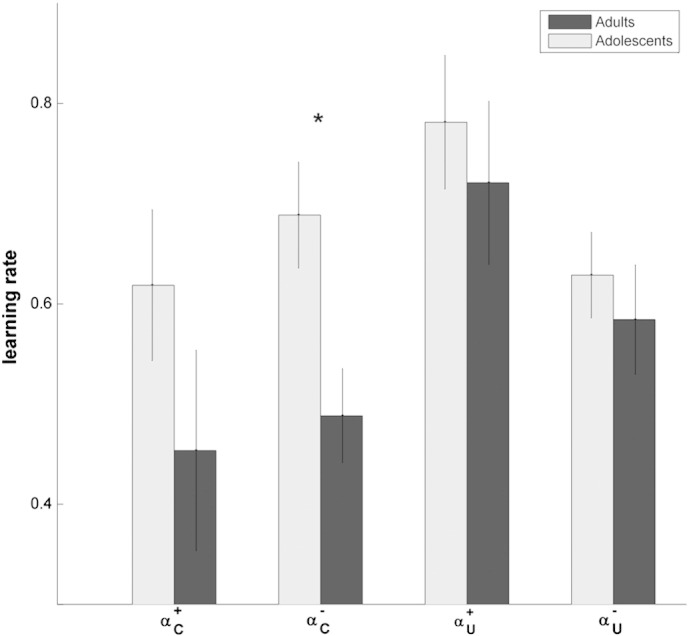
- The risk-sensitive model with anticorrelated valuation (RSAV) outperformed the other models, and adolescents had a significantly increased learning rate for negative RPEs in chosen objects (αc−: adults .49 ± .05, adolescents .69 ± .05; t(34) = −2.816, p = .04, corrected); other parameters did not differ significantly.
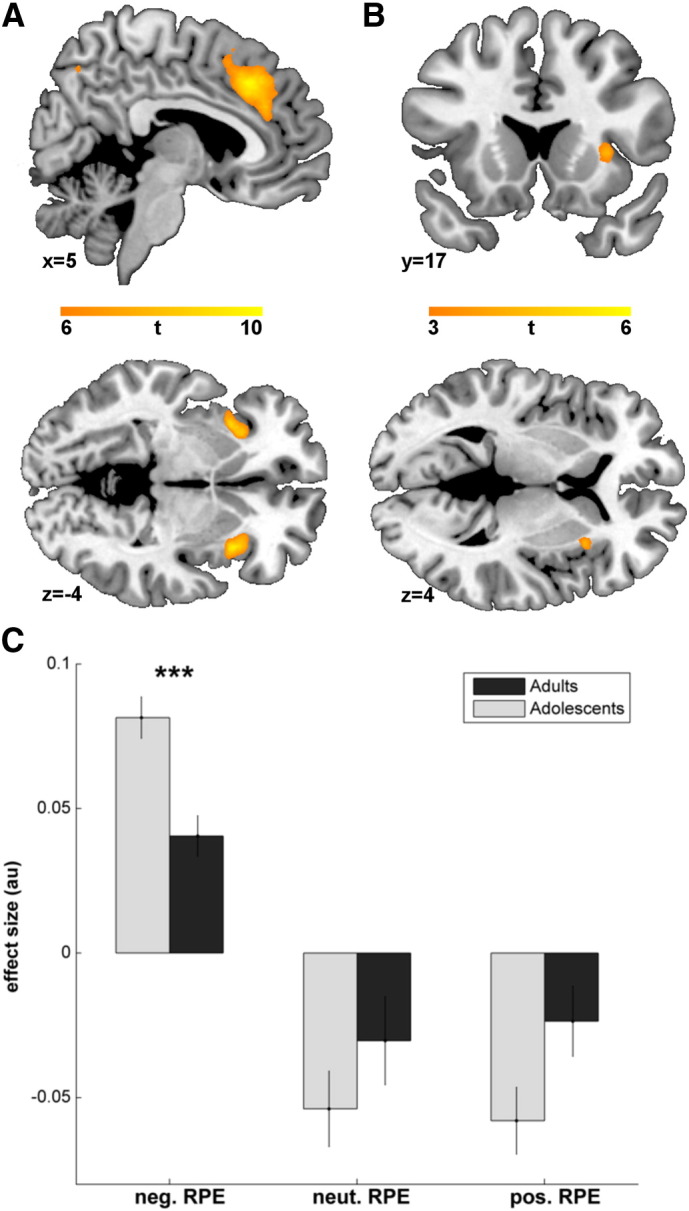
- fMRI showed a significant group difference in the right anterior insula (peak MNI x = 33, y = 18, z = 3; t = 4.60, k = 33), with increased activation for decreasing RPEs in adolescents.
- Exploratory binning of RPEs showed the anterior insula difference was driven by negative RPEs (adolescents vs adults: t(34) = −4.08, p < .001, corrected), while neutral (p = .734) and positive (p = .142) RPEs did not differ significantly.
Methods
- Thirty-seven subjects participated; one adolescent was excluded for excessive movement (> 2.5 mm scan-to-scan motion). Final groups were 19 adolescents aged 12–16 years (14.7 ± 1.3, 10 females) and 17 adults aged 20–29 years (25.6 ± 2.4, 10 females).
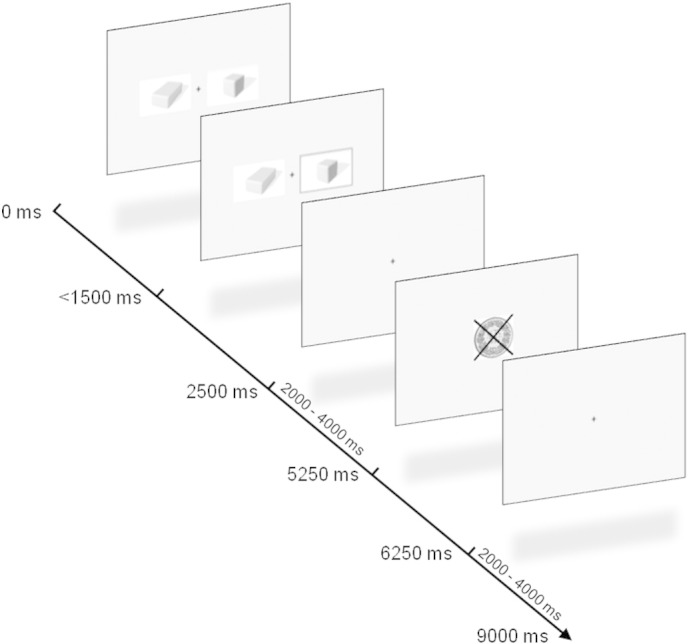
- Participants performed a probabilistic reversal learning task during fMRI: two runs of 60 trials each, plus 20 null trials per run; one stimulus was correct with 80% reward probability and the other with 20%, with reversals after at least 6 correct choices (maximum 10, randomly determined).
- Three reinforcement learning models were compared (Rescorla–Wagner, risk-sensitive, and RSAV); parameters were estimated by maximum log-likelihood using a genetic search algorithm, compared with AIC and Bayesian model selection. fMRI analysis used SPM8, with model-derived RPEs entered as a parametric modulator at feedback; group comparisons were restricted to RPE-processing areas and used p < .05 cluster-extent FWE (voxel height p < .001).
Limitations
- The paper states that the adolescent group had a relatively large age range (12–16 years), so the design cannot detect differences that may occur only early or late in adolescence.
- The paper states that the relatively small sample size prevented analysis of age-related changes within adolescence; larger samples and/or longitudinal designs are needed.
- Evident from the text: the study is cross-sectional, and for fMRI the authors estimated one single set of canonical model parameters for all participants rather than individual parameters, so neural analyses were not designed to model individual behavioral differences.
Model-written summary. Check it against the paper before relying on it.
Integrity signals
Registry
Cites
Statistics
Figures
Verification
Claims the paper makes
37 Not checked yet · 18 Own result · 9 Own interpretation · 6 Own method · 2 Sources not found · 2 No basis given
A result the paper reports from its own data — it cites no other source for it, so there is none to check. The quote shows it is in the paper.
In the paper
“whereas the other parameters did not differ significantly (αc+: adults: .45 ± .10, adolescents: .62 ± .07, t(34) = − 1.336, p = .95; αu+: adults: .72 ± .08, adolescents: .78 ± .07, t(34) = − .581, p = 1.00; αu−: adults: .58 ± .06, adolescents: .63 ± .04, t(34) = − .636, p = 1.00; τ: 2.4 ± .2, adolescents: 1.9 ± .2, t(34) = 1.595, p = .60).”
§ Cognitive flexibility in adolescence: Neural and behavioral mechanisms of reward prediction error processing in adaptive decision making during development > Results > Model comparison and parameters
plain- Asserted: passes — The authors put it forward as true.
- Checkable: passes — It can be checked against evidence.
- Load-bearing: unclear — It is unclear whether the paper’s conclusions depend on it.
- Based: passes — The paper gives a reason why it holds.
A result the paper reports from its own data — it cites no other source for it, so there is none to check. The quote shows it is in the paper.
In the paper
“The repeated measures ANOVA with factors group (adolescents, adults) and RPE (negative, neutral, positive) revealed a significant RPE-effect (indicating that the aIns is modulated by RPEs across all subjects, F(2,34) = 40.37, p < .001)”
§ Cognitive flexibility in adolescence: Neural and behavioral mechanisms of reward prediction error processing in adaptive decision making during development > Results > fMRI analysis
hedgedcorrelational- Asserted: passes — The authors put it forward as true.
- Checkable: passes — It can be checked against evidence.
- Load-bearing: unclear — It is unclear whether the paper’s conclusions depend on it.
- Based: passes — The paper gives a reason why it holds.
A result the paper reports from its own data — it cites no other source for it, so there is none to check. The quote shows it is in the paper.
In the paper
“The bilateral anterior insula (aIns), bilateral dorsomedial prefrontal cortex (dmPFC), and the dorsolateral prefrontal cortex were significantly anticorrelated with RPEs (decreasing RPEs elicit more activity, Table 2, Fig. 3A).”
§ Cognitive flexibility in adolescence: Neural and behavioral mechanisms of reward prediction error processing in adaptive decision making during development > Results > fMRI analysis
plaincorrelational- Asserted: passes — The authors put it forward as true.
- Checkable: passes — It can be checked against evidence.
- Load-bearing: passes — The paper’s conclusions depend on it.
- Based: passes — The paper gives a reason why it holds.
A result the paper reports from its own data — it cites no other source for it, so there is none to check. The quote shows it is in the paper.
In the paper
“The fMRI analysis revealed that within the RPE network, the adolescents had a significantly altered RPE-response in the anterior insula.”
- Also stated in: § fMRI analysis · plain
“We found one significant cluster in the right aIns (peak MNI x = 33, y = 18, z = 3; t = 4.60, k = 33, Fig. 3B) which showed increased activation for decreasing RPEs in adolescents.”
- Also stated in: § Discussion · plain
“In the group comparison, we found a significantly different activation in the aIns.”
§ Cognitive flexibility in adolescence: Neural and behavioral mechanisms of reward prediction error processing in adaptive decision making during development > Abstract
plaincorrelational- Asserted: passes — The authors put it forward as true.
- Checkable: passes — It can be checked against evidence.
- Load-bearing: passes — The paper’s conclusions depend on it.
- Based: passes — The paper gives a reason why it holds.
- Also stated in: § fMRI analysis · plain
A result the paper reports from its own data — it cites no other source for it, so there is none to check. The quote shows it is in the paper.
In the paper
“The groups also did not differ in the number of reversals which they performed. The adults switched on average 23.35 (± 8.80) times and the adolescents reversed 26.11 (± 8.31) times (t(34) = − .965, p = .341).”
§ Cognitive flexibility in adolescence: Neural and behavioral mechanisms of reward prediction error processing in adaptive decision making during development > Results > Behavior
plain- Asserted: passes — The authors put it forward as true.
- Checkable: passes — It can be checked against evidence.
- Load-bearing: unclear — It is unclear whether the paper’s conclusions depend on it.
- Based: passes — The paper gives a reason why it holds.
A result the paper reports from its own data — it cites no other source for it, so there is none to check. The quote shows it is in the paper.
In the paper
“Using a modified risk-sensitive reinforcement learning model, we found that adolescents learned faster from negative RPEs than adults.”
- Also stated in: § Model comparison and parameters · plain
“Post-hoc t-tests revealed that adolescents had a significantly increased learning rate for negative RPEs in chosen objects (αc−: adults: .49 ± .05, adolescents: .69 ± .05, t(34) = − 2.816, p = .04, multiple comparison corrected, Fig. 2)”
- Also stated in: § Discussion · plain
“By using an advanced reinforcement learning model, we found that adolescents learn more quickly from negative RPEs than adults.”
§ Cognitive flexibility in adolescence: Neural and behavioral mechanisms of reward prediction error processing in adaptive decision making during development > Abstract
plaindirect- Asserted: passes — The authors put it forward as true.
- Checkable: passes — It can be checked against evidence.
- Load-bearing: passes — The paper’s conclusions depend on it.
- Based: passes — The paper gives a reason why it holds.
- Rests on an assumption: The adolescent and adult groups did not differ on unmeasured variables that could confound the comparison of RPE processing.
- Also stated in: § Model comparison and parameters · plain
A result the paper reports from its own data — it cites no other source for it, so there is none to check. The quote shows it is in the paper.
In the paper
“but no significant group effect (indicating that the group difference was not caused by generally increased or decreased responses across all RPE bins, F(1,34) = 1.77, p = .193).”
§ Cognitive flexibility in adolescence: Neural and behavioral mechanisms of reward prediction error processing in adaptive decision making during development > Results > fMRI analysis
plain- Asserted: passes — The authors put it forward as true.
- Checkable: passes — It can be checked against evidence.
- Load-bearing: passes — The paper’s conclusions depend on it.
- Based: passes — The paper gives a reason why it holds.
A result the paper reports from its own data — it cites no other source for it, so there is none to check. The quote shows it is in the paper.
In the paper
“a significant group-by-RPE interaction (indicating that only some RPE bins differ between groups, F(2,34) = 4.60, p = .013)”
§ Cognitive flexibility in adolescence: Neural and behavioral mechanisms of reward prediction error processing in adaptive decision making during development > Results > fMRI analysis
plaincorrelational- Asserted: passes — The authors put it forward as true.
- Checkable: passes — It can be checked against evidence.
- Load-bearing: passes — The paper’s conclusions depend on it.
- Based: passes — The paper gives a reason why it holds.
A result the paper reports from its own data — it cites no other source for it, so there is none to check. The quote shows it is in the paper.
In the paper
“In our main effect analysis of RPEs in cognitive flexibility, we found areas which are typically positively correlated with RPEs (increasing RPEs elicit more activity) such as the putamen, ventromedial prefrontal cortex (vmPFC), amygdala and the posterior cingulate (Table 2).”
§ Cognitive flexibility in adolescence: Neural and behavioral mechanisms of reward prediction error processing in adaptive decision making during development > Results > fMRI analysis
plaincorrelational- Asserted: passes — The authors put it forward as true.
- Checkable: passes — It can be checked against evidence.
- Load-bearing: passes — The paper’s conclusions depend on it.
- Based: passes — The paper gives a reason why it holds.
A result the paper reports from its own data — it cites no other source for it, so there is none to check. The quote shows it is in the paper.
In the paper
“The boundaries did not differ between the groups (lower: t(34) = .64, p = .527; upper: t(34) = .70, p = .490).”
§ Cognitive flexibility in adolescence: Neural and behavioral mechanisms of reward prediction error processing in adaptive decision making during development > Materials and methods > fMRI data analysis
plain- Asserted: passes — The authors put it forward as true.
- Checkable: passes — It can be checked against evidence.
- Load-bearing: unclear — It is unclear whether the paper’s conclusions depend on it.
- Based: passes — The paper gives a reason why it holds.
A result the paper reports from its own data — it cites no other source for it, so there is none to check. The quote shows it is in the paper.
In the paper
“Interestingly, we found a marginally decreased number of punishments before the adolescents switched (t(34) = 1.71, p = .097, adolescents: 1.56 ± 0.22, adults: 1.71 ± 0.30).”
§ Cognitive flexibility in adolescence: Neural and behavioral mechanisms of reward prediction error processing in adaptive decision making during development > Results > Behavior
hedged- Asserted: passes — The authors put it forward as true.
- Checkable: passes — It can be checked against evidence.
- Load-bearing: unclear — It is unclear whether the paper’s conclusions depend on it.
- Based: passes — The paper gives a reason why it holds.
A result the paper reports from its own data — it cites no other source for it, so there is none to check. The quote shows it is in the paper.
In the paper
“Neutral (t(34) = 1.18, p = .734) and positive RPEs (t(34) = 2.06, p = .142) were not significantly different.”
§ Cognitive flexibility in adolescence: Neural and behavioral mechanisms of reward prediction error processing in adaptive decision making during development > Results > fMRI analysis
plain- Asserted: passes — The authors put it forward as true.
- Checkable: passes — It can be checked against evidence.
- Load-bearing: passes — The paper’s conclusions depend on it.
- Based: passes — The paper gives a reason why it holds.
A result the paper reports from its own data — it cites no other source for it, so there is none to check. The quote shows it is in the paper.
In the paper
“This effect seemed to be mainly driven by increased responses to negative prediction errors.”
- Also stated in: § fMRI analysis · plain
“Post-hoc t-tests of the three bins revealed that the interaction was caused by a significantly increased response to negative RPEs in adolescents compared to adults (t(34) = − 4.08, p < .001, corrected for multiple comparisons, Fig. 3C).”
- Also stated in: § Discussion · plain
“the differential activation was mainly driven by the most negative RPEs, while neutral or positive RPEs did not elicit significantly different responses per se.”
§ Cognitive flexibility in adolescence: Neural and behavioral mechanisms of reward prediction error processing in adaptive decision making during development > Abstract
plaindirect- Asserted: passes — The authors put it forward as true.
- Checkable: passes — It can be checked against evidence.
- Load-bearing: passes — The paper’s conclusions depend on it.
- Based: passes — The paper gives a reason why it holds.
- Also stated in: § fMRI analysis · plain
A result the paper reports from its own data — it cites no other source for it, so there is none to check. The quote shows it is in the paper.
In the paper
“we were able to show that in the context of cognitive flexibility, adolescents are more sensitive to negative RPEs than adults.”
§ Cognitive flexibility in adolescence: Neural and behavioral mechanisms of reward prediction error processing in adaptive decision making during development > Conclusions
boostedcorrelational- Asserted: passes — The authors put it forward as true.
- Checkable: passes — It can be checked against evidence.
- Load-bearing: passes — The paper’s conclusions depend on it.
- Based: passes — The paper gives a reason why it holds.
None of the sources cited for this claim have been checked yet.
In the paper
“It is well established that RPE-like signals are encoded by dopaminergic midbrain neurons (Schultz, 2002; Schultz et al., 1997).”
§ Cognitive flexibility in adolescence: Neural and behavioral mechanisms of reward prediction error processing in adaptive decision making during development > Introduction
What the sources say
boostedcorrelational- Asserted: passes — The authors put it forward as true.
- Checkable: passes — It can be checked against evidence.
- Load-bearing: passes — The paper’s conclusions depend on it.
- Based: passes — The paper gives a reason why it holds.
None of the sources cited for this claim have been checked yet.
In the paper
“Such RPE signals are projected to a decision making network including striatal, prefrontal, and insular regions (e.g., Blakemore and Robbins, 2012; Bromberg-Martin et al., 2010; Gläscher et al., 2009).”
§ Cognitive flexibility in adolescence: Neural and behavioral mechanisms of reward prediction error processing in adaptive decision making during development > Introduction
What the sources say
plaindirect- Asserted: passes — The authors put it forward as true.
- Checkable: passes — It can be checked against evidence.
- Load-bearing: unclear — It is unclear whether the paper’s conclusions depend on it.
- Based: passes — The paper gives a reason why it holds.
In the paper
“The reinforcement learning (RL) theory (Sutton and Barto, 1998) suggests that cognitive flexibility and adaptive learning are driven by reward prediction error (RPE) signals.”
§ Cognitive flexibility in adolescence: Neural and behavioral mechanisms of reward prediction error processing in adaptive decision making during development > Introduction
What the sources say
- Not checked yetcites Sutton and Barto, 1998
hedgeddirect- Asserted: passes — The authors put it forward as true.
- Checkable: passes — It can be checked against evidence.
- Load-bearing: passes — The paper’s conclusions depend on it.
- Based: passes — The paper gives a reason why it holds.
A conclusion the paper draws from its own results — it cites no other source for it, so there is none to check. The quote shows it is in the paper.
In the paper
“The neural responses of the aIns support our behavioral finding that adolescents were more sensitive to negative RPEs: the differential activation was mainly driven by the most negative RPEs, while neutral or positive RPEs did not elicit significantly different responses per se.”
§ Cognitive flexibility in adolescence: Neural and behavioral mechanisms of reward prediction error processing in adaptive decision making during development > Discussion
plaincorrelational- Asserted: passes — The authors put it forward as true.
- Checkable: passes — It can be checked against evidence.
- Load-bearing: passes — The paper’s conclusions depend on it.
- Based: passes — The paper gives a reason why it holds.
A conclusion the paper draws from its own results — it cites no other source for it, so there is none to check. The quote shows it is in the paper.
In the paper
“This implies that adolescents adjust their behavior more quickly after feedbacks which are worse than they expected.”
§ Cognitive flexibility in adolescence: Neural and behavioral mechanisms of reward prediction error processing in adaptive decision making during development > Discussion
plaindirect- Asserted: passes — The authors put it forward as true.
- Checkable: passes — It can be checked against evidence.
- Load-bearing: passes — The paper’s conclusions depend on it.
- Based: passes — The paper gives a reason why it holds.
In the paper
“it is known to show specific activation patterns during adolescence (Smith et al., 2014).”
§ Cognitive flexibility in adolescence: Neural and behavioral mechanisms of reward prediction error processing in adaptive decision making during development > Introduction
What the sources say
- Not checked yetcites Smith et al., 2014 source
boostedcorrelational- Asserted: passes — The authors put it forward as true.
- Checkable: passes — It can be checked against evidence.
- Load-bearing: passes — The paper’s conclusions depend on it.
- Based: passes — The paper gives a reason why it holds.
None of the sources cited for this claim have been checked yet.
In the paper
“Additionally, we hypothesized the anterior insular activity to be altered, because this region is crucially involved in RPE processing (Pessiglione et al., 2006; Seymour et al., 2004; Voon et al., 2010; Wittmann et al., 2008)”
- Also stated in: § Discussion · plain
“It has been found to process RPEs (Pessiglione et al., 2006; Seymour et al., 2004; Voon et al., 2010; Wittmann et al., 2008)”
§ Cognitive flexibility in adolescence: Neural and behavioral mechanisms of reward prediction error processing in adaptive decision making during development > Introduction
What the sources say
plaindirect- Asserted: passes — The authors put it forward as true.
- Checkable: passes — It can be checked against evidence.
- Load-bearing: passes — The paper’s conclusions depend on it.
- Based: passes — The paper gives a reason why it holds.
- Also stated in: § Discussion · plain
None of the sources cited for this claim have been checked yet.
In the paper
“The neural correlates of RPEs in probabilistic reversal learning tasks have been successfully examined in previous studies on healthy adults and found to positively correlate with mainly striatal and ventromedial prefrontal areas, and to negatively correlate with areas such as the dorsomedial prefrontal cortex and the anterior insula (Gläscher et al., 2009; Hampton et al., 2006; Hauser et al., 201”
§ Cognitive flexibility in adolescence: Neural and behavioral mechanisms of reward prediction error processing in adaptive decision making during development > Introduction
What the sources say
- Not checked yetcites Gläscher et al., 2009
- Not checked yetcites Hampton et al., 2006 source
- Not checked yetcites Hauser et al., 2014a, b
boostedcorrelational- Asserted: passes — The authors put it forward as true.
- Checkable: passes — It can be checked against evidence.
- Load-bearing: passes — The paper’s conclusions depend on it.
- Based: passes — The paper gives a reason why it holds.
None of the sources cited for this claim have been checked yet.
In the paper
“Computationally, these feedback-driven learning processes can well be described by using a RPE-learning model because the subjects learn entirely based on the feedback (e.g., Gläscher et al., 2009; Hauser et al., 2014a).”
§ Cognitive flexibility in adolescence: Neural and behavioral mechanisms of reward prediction error processing in adaptive decision making during development > Introduction
What the sources say
- Not checked yetcites Gläscher et al., 2009
- Not checked yetcites Hauser et al., 2014a
boosted- Asserted: passes — The authors put it forward as true.
- Checkable: passes — It can be checked against evidence.
- Load-bearing: passes — The paper’s conclusions depend on it.
- Based: passes — The paper gives a reason why it holds.
A conclusion the paper draws from its own results — it cites no other source for it, so there is none to check. The quote shows it is in the paper.
In the paper
“This suggests that the use of reinforcement learning methods to study cognitive flexibility may be more sensitive to differences in the learning process than common behavioral analyses.”
§ Cognitive flexibility in adolescence: Neural and behavioral mechanisms of reward prediction error processing in adaptive decision making during development > Discussion
hedgedconditional- Asserted: passes — The authors put it forward as true.
- Checkable: passes — It can be checked against evidence.
- Load-bearing: passes — The paper’s conclusions depend on it.
- Based: passes — The paper gives a reason why it holds.
In the paper
“it is highly relevant for error processing (Dosenbach et al., 2006)”
§ Cognitive flexibility in adolescence: Neural and behavioral mechanisms of reward prediction error processing in adaptive decision making during development > Introduction
What the sources say
- Not checked yetcites Dosenbach et al., 2006 source
plaincorrelational- Asserted: passes — The authors put it forward as true.
- Checkable: passes — It can be checked against evidence.
- Load-bearing: passes — The paper’s conclusions depend on it.
- Based: passes — The paper gives a reason why it holds.
In the paper
“In a seminal paper by Niv et al. (2012), the authors showed that tasks, where risk or outcome variance is not explicitly available, individual risk sensitivity can be assessed by using different learning rates for positive and negative RPEs.”
§ Cognitive flexibility in adolescence: Neural and behavioral mechanisms of reward prediction error processing in adaptive decision making during development > Materials and methods > Reinforcement learning models
What the sources say
- Not checked yetcites Niv et al., 2012 source
boosteddirect- Asserted: passes — The authors put it forward as true.
- Checkable: passes — It can be checked against evidence.
- Load-bearing: passes — The paper’s conclusions depend on it.
- Based: passes — The paper gives a reason why it holds.
In the paper
“Moreover, in their fMRI analysis, the authors only analyzed responses in the anterior cingulate, ventral striatum and the vmPFC (Javadi et al., 2014a, b).”
§ Cognitive flexibility in adolescence: Neural and behavioral mechanisms of reward prediction error processing in adaptive decision making during development > Discussion
What the sources say
- Not checked yetcites Javadi et al., 2014a, b
plain- Asserted: passes — The authors put it forward as true.
- Checkable: passes — It can be checked against evidence.
- Load-bearing: passes — The paper’s conclusions depend on it.
- Based: passes — The paper gives a reason why it holds.
A conclusion the paper draws from its own results — it cites no other source for it, so there is none to check. The quote shows it is in the paper.
In the paper
“Therefore, it cannot be determined whether their aIns showed similar developmental changes in RPE processing.”
§ Cognitive flexibility in adolescence: Neural and behavioral mechanisms of reward prediction error processing in adaptive decision making during development > Discussion
plain- Asserted: passes — The authors put it forward as true.
- Checkable: passes — It can be checked against evidence.
- Load-bearing: unclear — It is unclear whether the paper’s conclusions depend on it.
- Based: passes — The paper gives a reason why it holds.
None of the sources cited for this claim have been checked yet.
In the paper
“In their behavioral modeling, Javadi et al. (2014a) used a Rescorla–Wagner model which does not differentiate between learning from positive and negative RPEs (Krugel et al., 2009; Rescorla and Wagner, 1972).”
§ Cognitive flexibility in adolescence: Neural and behavioral mechanisms of reward prediction error processing in adaptive decision making during development > Discussion
What the sources say
- Not checked yetcites Krugel et al., 2009 source
- Not checked yetcites Rescorla and Wagner, 1972
plain- Asserted: passes — The authors put it forward as true.
- Checkable: passes — It can be checked against evidence.
- Load-bearing: passes — The paper’s conclusions depend on it.
- Based: passes — The paper gives a reason why it holds.
A conclusion the paper draws from its own results — it cites no other source for it, so there is none to check. The quote shows it is in the paper.
In the paper
“Therefore, it is evident that the authors could not detect an increased learning rate for negative RPEs.”
§ Cognitive flexibility in adolescence: Neural and behavioral mechanisms of reward prediction error processing in adaptive decision making during development > Discussion
boosted- Asserted: passes — The authors put it forward as true.
- Checkable: passes — It can be checked against evidence.
- Load-bearing: passes — The paper’s conclusions depend on it.
- Based: passes — The paper gives a reason why it holds.
In the paper
“The authors (Javadi et al., 2014a) found an increased decision noise in their adolescent sample compared to healthy adults.”
§ Cognitive flexibility in adolescence: Neural and behavioral mechanisms of reward prediction error processing in adaptive decision making during development > Discussion
What the sources say
- Not checked yetcites Javadi et al., 2014a
plaincorrelational- Asserted: passes — The authors put it forward as true.
- Checkable: passes — It can be checked against evidence.
- Load-bearing: unclear — It is unclear whether the paper’s conclusions depend on it.
- Based: passes — The paper gives a reason why it holds.
None of the sources cited for this claim have been checked yet.
In the paper
“We and others previously demonstrated that models which update both options are better suited to model such a probabilistic reinforcement learning tasks (Gläscher et al., 2009; Hauser et al., 2014a).”
§ Cognitive flexibility in adolescence: Neural and behavioral mechanisms of reward prediction error processing in adaptive decision making during development > Discussion
What the sources say
- Not checked yetcites Gläscher et al., 2009
- Not checked yetcites Hauser et al., 2014a
boostedcorrelational- Asserted: passes — The authors put it forward as true.
- Checkable: passes — It can be checked against evidence.
- Load-bearing: passes — The paper’s conclusions depend on it.
- Based: passes — The paper gives a reason why it holds.
A conclusion the paper draws from its own results — it cites no other source for it, so there is none to check. The quote shows it is in the paper.
In the paper
“Our neuroimaging results suggest that this difference is likely to be caused by an altered response of the aIns.”
§ Cognitive flexibility in adolescence: Neural and behavioral mechanisms of reward prediction error processing in adaptive decision making during development > Conclusions
hedgedconditional- Asserted: passes — The authors put it forward as true.
- Checkable: passes — It can be checked against evidence.
- Load-bearing: passes — The paper’s conclusions depend on it.
- Based: passes — The paper gives a reason why it holds.
None of the sources cited for this claim have been checked yet.
In the paper
“In reversal learning tasks, the feedback about the chosen object also informs about the value of the unchosen stimulus. Therefore, we and others used RPEs also to update the unchosen option (Gläscher et al., 2009; Hauser et al., 2014a).”
§ Cognitive flexibility in adolescence: Neural and behavioral mechanisms of reward prediction error processing in adaptive decision making during development > Materials and methods > Reinforcement learning models
What the sources say
- Not checked yetcites Gläscher et al., 2009
- Not checked yetcites Hauser et al., 2014a
plaindirect- Asserted: passes — The authors put it forward as true.
- Checkable: passes — It can be checked against evidence.
- Load-bearing: passes — The paper’s conclusions depend on it.
- Based: passes — The paper gives a reason why it holds.
In the paper
“However, the authors did not find any differences in prediction error processing in their regions-of-interest - despite their large adolescent sample.”
§ Cognitive flexibility in adolescence: Neural and behavioral mechanisms of reward prediction error processing in adaptive decision making during development > Discussion
What the sources say
- Not checked yetcites Javadi et al., 2014a
plain- Asserted: passes — The authors put it forward as true.
- Checkable: passes — It can be checked against evidence.
- Load-bearing: passes — The paper’s conclusions depend on it.
- Based: passes — The paper gives a reason why it holds.
In the paper
“it indicates (feedback) errors with a high reliability (Dosenbach et al., 2006)”
§ Cognitive flexibility in adolescence: Neural and behavioral mechanisms of reward prediction error processing in adaptive decision making during development > Discussion
What the sources say
- Not checked yetcites Dosenbach et al., 2006 source
plaincorrelational- Asserted: passes — The authors put it forward as true.
- Checkable: passes — It can be checked against evidence.
- Load-bearing: unclear — It is unclear whether the paper’s conclusions depend on it.
- Based: passes — The paper gives a reason why it holds.
None of the sources cited for this claim have been checked yet.
In the paper
“Despite the importance of RPE processing in adolescence, only few studies have investigated RPE processing in adolescents (Christakou et al., 2011; Cohen et al., 2010; Javadi et al., 2014a; van den Bos et al., 2012).”
§ Cognitive flexibility in adolescence: Neural and behavioral mechanisms of reward prediction error processing in adaptive decision making during development > Introduction
What the sources say
plain- Asserted: passes — The authors put it forward as true.
- Checkable: passes — It can be checked against evidence.
- Load-bearing: passes — The paper’s conclusions depend on it.
- Based: passes — The paper gives a reason why it holds.
A conclusion the paper draws from its own results — it cites no other source for it, so there is none to check. The quote shows it is in the paper.
In the paper
“This novel finding suggests that decision making in adolescence goes beyond merely increased reward-seeking behavior—at least in the context of cognitive flexibility.”
§ Cognitive flexibility in adolescence: Neural and behavioral mechanisms of reward prediction error processing in adaptive decision making during development > Conclusions
hedged- Asserted: passes — The authors put it forward as true.
- Checkable: passes — It can be checked against evidence.
- Load-bearing: passes — The paper’s conclusions depend on it.
- Based: passes — The paper gives a reason why it holds.
What the paper did — it cites no source for this, so there is none to check. The quote shows it is in the paper.
In the paper
“In this study, the age spectrum of our adolescent group had a relatively large age range (12–16 years).”
§ Cognitive flexibility in adolescence: Neural and behavioral mechanisms of reward prediction error processing in adaptive decision making during development > Discussion
plain- Asserted: passes — The authors put it forward as true.
- Checkable: passes — It can be checked against evidence.
- Load-bearing: passes — The paper’s conclusions depend on it.
- Based: passes — The paper gives a reason why it holds.
What the paper did — it cites no source for this, so there is none to check. The quote shows it is in the paper.
In the paper
“With our approach, however, we are not able to detect differences which may only occur early or late in adolescence.”
§ Cognitive flexibility in adolescence: Neural and behavioral mechanisms of reward prediction error processing in adaptive decision making during development > Discussion
hedged- Asserted: passes — The authors put it forward as true.
- Checkable: passes — It can be checked against evidence.
- Load-bearing: passes — The paper’s conclusions depend on it.
- Based: passes — The paper gives a reason why it holds.
In the paper
“It is well established that the aIns receives dopaminergic innervations (Gaspar et al., 1989) and processes dopamine-associated RPEs.”
§ Cognitive flexibility in adolescence: Neural and behavioral mechanisms of reward prediction error processing in adaptive decision making during development > Conclusions
What the sources say
- Not checked yetcites Gaspar et al., 1989 source
boostedcorrelational- Asserted: passes — The authors put it forward as true.
- Checkable: passes — It can be checked against evidence.
- Load-bearing: passes — The paper’s conclusions depend on it.
- Based: passes — The paper gives a reason why it holds.
What the paper did — it cites no source for this, so there is none to check. The quote shows it is in the paper.
In the paper
“Additionally, given the relatively small sample size, we were also not able to look at age-related changes during adolescence.”
§ Cognitive flexibility in adolescence: Neural and behavioral mechanisms of reward prediction error processing in adaptive decision making during development > Discussion
plaindirect- Asserted: passes — The authors put it forward as true.
- Checkable: passes — It can be checked against evidence.
- Load-bearing: passes — The paper’s conclusions depend on it.
- Based: passes — The paper gives a reason why it holds.
- It may state two separate claims as one. 9
- The quote only partly states this claim. 1
- Probably not a substantial claim. 26
A result the paper reports from its own data — it cites no other source for it, so there is none to check. The quote shows it is in the paper.
In the paper
“Both groups performed the task equally well with 73.83% (± 4.4%) correct responses in adults and 73.38% (± 4.6%) in adolescents (t(34) = .296, p = .769).”
§ Cognitive flexibility in adolescence: Neural and behavioral mechanisms of reward prediction error processing in adaptive decision making during development > Results > Behavior
plain- Asserted: passes — The authors put it forward as true.
- Checkable: passes — It can be checked against evidence.
- Load-bearing: unclear — It is unclear whether the paper’s conclusions depend on it.
- Based: passes — The paper gives a reason why it holds.
It may state two separate claims as one.
A result the paper reports from its own data — it cites no other source for it, so there is none to check. The quote shows it is in the paper.
In the paper
“We did not find any significantly increased activation for positive RPEs in adolescents.”
§ Cognitive flexibility in adolescence: Neural and behavioral mechanisms of reward prediction error processing in adaptive decision making during development > Results > fMRI analysis
plain- Asserted: passes — The authors put it forward as true.
- Checkable: passes — It can be checked against evidence.
- Load-bearing: passes — The paper’s conclusions depend on it.
- Based: passes — The paper gives a reason why it holds.
The quote only partly states this claim.
A result the paper reports from its own data — it cites no other source for it, so there is none to check. The quote shows it is in the paper.
In the paper
“We found a significant difference between the free parameters (F(4,136) = 73.45, p < .001) as well as an interaction between the parameters and the group (F(4,136) = 2.851, p = .026).”
§ Cognitive flexibility in adolescence: Neural and behavioral mechanisms of reward prediction error processing in adaptive decision making during development > Results > Model comparison and parameters
plaincorrelational- Asserted: passes — The authors put it forward as true.
- Checkable: passes — It can be checked against evidence.
- Load-bearing: passes — The paper’s conclusions depend on it.
- Based: passes — The paper gives a reason why it holds.
It may state two separate claims as one.
A result the paper reports from its own data — it cites no other source for it, so there is none to check. The quote shows it is in the paper.
In the paper
“The RSAV model clearly outperformed the other models across all subjects, as well as in both groups separately (Table 1).”
§ Cognitive flexibility in adolescence: Neural and behavioral mechanisms of reward prediction error processing in adaptive decision making during development > Results > Model comparison and parameters
boosted- Asserted: passes — The authors put it forward as true.
- Checkable: passes — It can be checked against evidence.
- Load-bearing: passes — The paper’s conclusions depend on it.
- Based: passes — The paper gives a reason why it holds.
It may state two separate claims as one.
None of the sources cited for this claim have been checked yet.
In the paper
“To test cognitive flexibility, probabilistic reversal learning tasks have often been used (e.g., Adleman et al., 2011; Britton et al., 2010; Clarke et al., 2004; Klanker et al., 2013; van der Plasse and Feenstra, 2008; Xue et al., 2013).”
§ Cognitive flexibility in adolescence: Neural and behavioral mechanisms of reward prediction error processing in adaptive decision making during development > Introduction
What the sources say
plaincorrelational- Asserted: passes — The authors put it forward as true.
- Checkable: passes — It can be checked against evidence.
- Load-bearing: passes — The paper’s conclusions depend on it.
- Based: passes — The paper gives a reason why it holds.
Probably not a substantial claim.
In the paper
“In cognitive neuroscience and neuropsychology, cognitive flexibility has mainly been operationalized by sudden and implicit shifts in reward contingencies that have to be detected based on external feedback (Scott, 1962).”
§ Cognitive flexibility in adolescence: Neural and behavioral mechanisms of reward prediction error processing in adaptive decision making during development > Introduction
What the sources say
- Not checked yetcites Scott, 1962 source
plain- Asserted: passes — The authors put it forward as true.
- Checkable: passes — It can be checked against evidence.
- Load-bearing: passes — The paper’s conclusions depend on it.
- Based: passes — The paper gives a reason why it holds.
Probably not a substantial claim.
None of the sources cited for this claim have been checked yet.
In the paper
“Interestingly, the authors report a marginally different switching probability after correctly punished trials—similar as in our study.”
§ Cognitive flexibility in adolescence: Neural and behavioral mechanisms of reward prediction error processing in adaptive decision making during development > Discussion
plain- Asserted: passes — The authors put it forward as true.
- Checkable: passes — It can be checked against evidence.
- Load-bearing: fails — The paper’s conclusions may not depend on it.
- Based: passes — The paper gives a reason why it holds.
Probably not a substantial claim. The paper’s conclusions may not depend on it. It may state two separate claims as one.
What the paper did — it cites no source for this, so there is none to check. The quote shows it is in the paper.
In the paper
“The study was approved by the local ethics committee and all adult participants gave written informed consent. For the adolescent group, the participants and their parents signed the consent form.”
§ Cognitive flexibility in adolescence: Neural and behavioral mechanisms of reward prediction error processing in adaptive decision making during development > Materials and methods > Participants
plain- Asserted: passes — The authors put it forward as true.
- Checkable: passes — It can be checked against evidence.
- Load-bearing: fails — The paper’s conclusions may not depend on it.
- Based: passes — The paper gives a reason why it holds.
Probably not a substantial claim. The paper’s conclusions may not depend on it. It may state two separate claims as one.
None of the sources cited for this claim have been checked yet.
In the paper
“While Cohen et al. (2010) found differential activations between adolescents and adults in striatal areas, van den Bos et al. (2012) were not able to replicate that finding, but found differences in the connectivity between the ventromedial prefrontal cortex and the ventral striatum.”
§ Cognitive flexibility in adolescence: Neural and behavioral mechanisms of reward prediction error processing in adaptive decision making during development > Introduction
What the sources say
plain- Asserted: passes — The authors put it forward as true.
- Checkable: passes — It can be checked against evidence.
- Load-bearing: passes — The paper’s conclusions depend on it.
- Based: passes — The paper gives a reason why it holds.
It may state two separate claims as one.
None of the sources cited for this claim have been checked yet.
In the paper
“Previous studies found developmental effects during tasks of cognitive flexibility (e.g., Christakou et al., 2009; Rubia et al., 2006; Smith et al., 2011) and in other cognitive domains (Christakou et al., 2011; Jarcho et al., 2012; Keulers et al., 2011; Masten et al., 2009; Somerville et al., 2011; Van Leijenhorst et al., 2010).”
§ Cognitive flexibility in adolescence: Neural and behavioral mechanisms of reward prediction error processing in adaptive decision making during development > Discussion
What the sources say
plaincorrelational- Asserted: passes — The authors put it forward as true.
- Checkable: passes — It can be checked against evidence.
- Load-bearing: fails — The paper’s conclusions may not depend on it.
- Based: passes — The paper gives a reason why it holds.
Probably not a substantial claim. The paper’s conclusions may not depend on it.
A conclusion the paper draws from its own results — it cites no other source for it, so there is none to check. The quote shows it is in the paper.
In the paper
“The increased insular activity (esp. to negative RPEs) might indicate that adolescents weight the emotional information more strongly which then leads to a faster adaptation from negative feedbacks.”
§ Cognitive flexibility in adolescence: Neural and behavioral mechanisms of reward prediction error processing in adaptive decision making during development > Discussion
hedgedconditional- Asserted: passes — The authors put it forward as true.
- Checkable: passes — It can be checked against evidence.
- Load-bearing: fails — The paper’s conclusions may not depend on it.
- Based: passes — The paper gives a reason why it holds.
Probably not a substantial claim. The paper’s conclusions may not depend on it. It may state two separate claims as one.
- The authors state this as an assumption: The dorsomedial prefrontal cortex is mainly involved in processing cognitive aspects, whereas the anterior insula processes visceral and emotional information.
None of the sources cited for this claim have been checked yet.
In the paper
“Similar as in our study, they did not find any RPE differences in these areas.”
§ Cognitive flexibility in adolescence: Neural and behavioral mechanisms of reward prediction error processing in adaptive decision making during development > Discussion
plain- Asserted: passes — The authors put it forward as true.
- Checkable: passes — It can be checked against evidence.
- Load-bearing: unclear — It is unclear whether the paper’s conclusions depend on it.
- Based: passes — The paper gives a reason why it holds.
It may state two separate claims as one.
None of the sources cited for this claim have been checked yet.
In the paper
“Unsurprisingly, the aIns has been ascribed to a wide variety of functions from processing visceral and emotional information (Critchley, 2005) to controlling attention and task demands (Dosenbach et al., 2006, 2007; Nelson et al., 2010).”
§ Cognitive flexibility in adolescence: Neural and behavioral mechanisms of reward prediction error processing in adaptive decision making during development > Discussion
What the sources say
plaincorrelational- Asserted: passes — The authors put it forward as true.
- Checkable: passes — It can be checked against evidence.
- Load-bearing: fails — The paper’s conclusions may not depend on it.
- Based: passes — The paper gives a reason why it holds.
Probably not a substantial claim. The paper’s conclusions may not depend on it.
None of the sources cited for this claim have been checked yet.
In the paper
“This is also in line with the assumption that the aIns is involved when a feedback is processed consciously (Nelson et al., 2010; Wheeler et al., 2008).”
§ Cognitive flexibility in adolescence: Neural and behavioral mechanisms of reward prediction error processing in adaptive decision making during development > Discussion
What the sources say
plaincorrelational- Asserted: passes — The authors put it forward as true.
- Checkable: passes — It can be checked against evidence.
- Load-bearing: fails — The paper’s conclusions may not depend on it.
- Based: passes — The paper gives a reason why it holds.
Probably not a substantial claim. The paper’s conclusions may not depend on it.
None of the sources cited for this claim have been checked yet.
In the paper
“It is well known that aIns activity often coincides with activation in the dmPFC (cf. Hauser et al., 2014a, 2014b; Nelson et al., 2010; Seymour et al., 2004).”
§ Cognitive flexibility in adolescence: Neural and behavioral mechanisms of reward prediction error processing in adaptive decision making during development > Discussion
What the sources say
boostedcorrelational- Asserted: passes — The authors put it forward as true.
- Checkable: passes — It can be checked against evidence.
- Load-bearing: fails — The paper’s conclusions may not depend on it.
- Based: passes — The paper gives a reason why it holds.
Probably not a substantial claim. The paper’s conclusions may not depend on it.
In the paper
“Adolescents are known to be more sensitive to the presence of peers (Chein et al., 2011) and peer rejection (Masten et al., 2009), and show a markedly increased prevalence in psychiatric disorders, such as anxiety, depression or substance abuse (Kessler et al., 2005, 2007).”
§ Cognitive flexibility in adolescence: Neural and behavioral mechanisms of reward prediction error processing in adaptive decision making during development > Discussion
What the sources say
- Not checked yetcites Chein et al., 2011 source
boostedcorrelational- Asserted: passes — The authors put it forward as true.
- Checkable: passes — It can be checked against evidence.
- Load-bearing: fails — The paper’s conclusions may not depend on it.
- Based: passes — The paper gives a reason why it holds.
Probably not a substantial claim. The paper’s conclusions may not depend on it.
The paper states this without a source or data behind it here, so there is nothing to check it against. The quote shows it is in the paper.
In the paper
“However, the developmental importance of this area has largely been neglected.”
§ Cognitive flexibility in adolescence: Neural and behavioral mechanisms of reward prediction error processing in adaptive decision making during development > Discussion
plain- Asserted: passes — The authors put it forward as true.
- Checkable: fails — It may be too vague to check against evidence.
- Load-bearing: fails — The paper’s conclusions may not depend on it.
- Based: fails — The paper may give no reason why it holds.
Probably not a substantial claim. It may be too vague to check against evidence. The paper’s conclusions may not depend on it. The paper may give no reason why it holds.
In the paper
“The aIns is a central hub in the brain and is one of the most commonly activated areas in human neuroimaging studies (Nelson et al., 2010).”
§ Cognitive flexibility in adolescence: Neural and behavioral mechanisms of reward prediction error processing in adaptive decision making during development > Discussion
What the sources say
- Not checked yetcites Nelson et al., 2010 source
plain- Asserted: passes — The authors put it forward as true.
- Checkable: passes — It can be checked against evidence.
- Load-bearing: fails — The paper’s conclusions may not depend on it.
- Based: passes — The paper gives a reason why it holds.
Probably not a substantial claim. The paper’s conclusions may not depend on it.
None of the sources cited for this claim have been checked yet.
In the paper
“Moreover, the aIns has been associated with processing information about risk (Burke and Tobler, 2011; Ishii et al., 2012; Paulus et al., 2003; Preuschoff et al., 2008).”
§ Cognitive flexibility in adolescence: Neural and behavioral mechanisms of reward prediction error processing in adaptive decision making during development > Discussion
What the sources say
plaincorrelational- Asserted: passes — The authors put it forward as true.
- Checkable: passes — It can be checked against evidence.
- Load-bearing: fails — The paper’s conclusions may not depend on it.
- Based: passes — The paper gives a reason why it holds.
Probably not a substantial claim. The paper’s conclusions may not depend on it.
None of the sources cited for this claim have been checked yet.
In the paper
“We additionally entered several regressors-of-no-interest into the GLM to improve model validity: choice values (value of chosen object) as parametric modulator at cue presentation, realignment-derived movement parameters, scan-to-scan movements greater than 1 mm, and cardiac pulsations (http://www.translationalneuromodeling.org/tapas/; Glover et al., 2000; Kasper et al., 2009).”
§ Cognitive flexibility in adolescence: Neural and behavioral mechanisms of reward prediction error processing in adaptive decision making during development > Materials and methods > fMRI data analysis
What the sources say
- Not checked yetcites Glover et al., 2000 source
- Not checked yetcites Kasper et al., 2009
plaindirect- Asserted: passes — The authors put it forward as true.
- Checkable: passes — It can be checked against evidence.
- Load-bearing: fails — The paper’s conclusions may not depend on it.
- Based: passes — The paper gives a reason why it holds.
Probably not a substantial claim. The paper’s conclusions may not depend on it.
In the paper
“Given that we have previously shown that reinforcement learning models with anticorrelated valuation fitted this task better than a standard Rescorla–Wagner model (Hauser et al., 2014a), we evaluated the risk-sensitive model with an anticorrelated valuation (RSAV) extension as a third model.”
§ Cognitive flexibility in adolescence: Neural and behavioral mechanisms of reward prediction error processing in adaptive decision making during development > Materials and methods > Reinforcement learning models
What the sources say
- Not checked yetcites Hauser et al., 2014a
plain- Asserted: passes — The authors put it forward as true.
- Checkable: passes — It can be checked against evidence.
- Load-bearing: passes — The paper’s conclusions depend on it.
- Based: passes — The paper gives a reason why it holds.
Probably not a substantial claim.
What the paper did — it cites no source for this, so there is none to check. The quote shows it is in the paper.
In the paper
“One participant (13.0 y, m) had to be excluded prior to analysis due to excessive movement (> 2.5 mm scan-to-scan motion).”
§ Cognitive flexibility in adolescence: Neural and behavioral mechanisms of reward prediction error processing in adaptive decision making during development > Materials and methods > Participants
plaindirectSingle case- Asserted: passes — The authors put it forward as true.
- Checkable: passes — It can be checked against evidence.
- Load-bearing: fails — The paper’s conclusions may not depend on it.
- Based: passes — The paper gives a reason why it holds.
Probably not a substantial claim. The paper’s conclusions may not depend on it.
In the paper
“it has a high predictive value for task switching in a similar cognitive flexibility task (Hampton and O'Doherty, 2007).”
§ Cognitive flexibility in adolescence: Neural and behavioral mechanisms of reward prediction error processing in adaptive decision making during development > Discussion
What the sources say
- Not checked yetcites Hampton and O'Doherty, 2007
plaincorrelational- Asserted: passes — The authors put it forward as true.
- Checkable: passes — It can be checked against evidence.
- Load-bearing: fails — The paper’s conclusions may not depend on it.
- Based: passes — The paper gives a reason why it holds.
Probably not a substantial claim. The paper’s conclusions may not depend on it.
In the paper
“Adolescents are known to be more sensitive to the presence of peers (Chein et al., 2011) and peer rejection (Masten et al., 2009), and show a markedly increased prevalence in psychiatric disorders, such as anxiety, depression or substance abuse (Kessler et al., 2005, 2007).”
§ Cognitive flexibility in adolescence: Neural and behavioral mechanisms of reward prediction error processing in adaptive decision making during development > Discussion
What the sources say
- Not checked yetcites Masten et al., 2009 source
boostedcorrelational- Asserted: passes — The authors put it forward as true.
- Checkable: passes — It can be checked against evidence.
- Load-bearing: fails — The paper’s conclusions may not depend on it.
- Based: passes — The paper gives a reason why it holds.
Probably not a substantial claim. The paper’s conclusions may not depend on it.
The paper states this without a source or data behind it here, so there is nothing to check it against. The quote shows it is in the paper.
In the paper
“Unfortunately, the authors did not report any analysis of the aIns.”
§ Cognitive flexibility in adolescence: Neural and behavioral mechanisms of reward prediction error processing in adaptive decision making during development > Discussion
plain- Asserted: passes — The authors put it forward as true.
- Checkable: passes — It can be checked against evidence.
- Load-bearing: fails — The paper’s conclusions may not depend on it.
- Based: passes — The paper gives a reason why it holds.
Probably not a substantial claim. The paper’s conclusions may not depend on it.
What the paper did — it cites no source for this, so there is none to check. The quote shows it is in the paper.
In the paper
“During scanning, there was no difference in movement between both groups (scan-to-scan movement: adults: mean = .079 mm ± .021; adolescents: mean = .076 mm ± .016; t(34) = .496, p = .623).”
§ Cognitive flexibility in adolescence: Neural and behavioral mechanisms of reward prediction error processing in adaptive decision making during development > Materials and methods > Participants
plain- Asserted: passes — The authors put it forward as true.
- Checkable: passes — It can be checked against evidence.
- Load-bearing: fails — The paper’s conclusions may not depend on it.
- Based: passes — The paper gives a reason why it holds.
Probably not a substantial claim. The paper’s conclusions may not depend on it.
None of the sources cited for this claim have been checked yet.
In the paper
“It is activated in a wide variety of cognitive and emotional tasks (Dosenbach et al., 2006) and forms the important salience network in resting state literature (Menon and Uddin, 2010).”
§ Cognitive flexibility in adolescence: Neural and behavioral mechanisms of reward prediction error processing in adaptive decision making during development > Discussion
What the sources say
plaincorrelational- Asserted: passes — The authors put it forward as true.
- Checkable: passes — It can be checked against evidence.
- Load-bearing: fails — The paper’s conclusions may not depend on it.
- Based: passes — The paper gives a reason why it holds.
Probably not a substantial claim. The paper’s conclusions may not depend on it. It may state two separate claims as one.
None of the sources cited for this claim have been checked yet.
In the paper
“It has also been associated with depression, anxiety or substance abuse (for reviews cf. Craig, 2009; Naqvi and Bechara, 2009).”
§ Cognitive flexibility in adolescence: Neural and behavioral mechanisms of reward prediction error processing in adaptive decision making during development > Discussion
What the sources say
plaincorrelational- Asserted: passes — The authors put it forward as true.
- Checkable: passes — It can be checked against evidence.
- Load-bearing: fails — The paper’s conclusions may not depend on it.
- Based: passes — The paper gives a reason why it holds.
Probably not a substantial claim. The paper’s conclusions may not depend on it.
In the paper
“It is strongly involved in empathy-related processes (Singer et al., 2004, 2009) and social rejection (Masten et al., 2009).”
§ Cognitive flexibility in adolescence: Neural and behavioral mechanisms of reward prediction error processing in adaptive decision making during development > Discussion
What the sources say
- Not checked yetcites Masten et al., 2009 source
boostedcorrelational- Asserted: passes — The authors put it forward as true.
- Checkable: passes — It can be checked against evidence.
- Load-bearing: fails — The paper’s conclusions may not depend on it.
- Based: passes — The paper gives a reason why it holds.
Probably not a substantial claim. The paper’s conclusions may not depend on it.
In the paper
“It is strongly involved in empathy-related processes (Singer et al., 2004, 2009) and social rejection (Masten et al., 2009).”
§ Cognitive flexibility in adolescence: Neural and behavioral mechanisms of reward prediction error processing in adaptive decision making during development > Discussion
What the sources say
- Not matchedcites Singer et al., 2004, 2009
Couldn’t be matched to a paper in Crossref, so it can’t be checked.
boostedcorrelational- Asserted: passes — The authors put it forward as true.
- Checkable: passes — It can be checked against evidence.
- Load-bearing: fails — The paper’s conclusions may not depend on it.
- Based: passes — The paper gives a reason why it holds.
Probably not a substantial claim. The paper’s conclusions may not depend on it.
- Not matched
In the paper
“Adolescents are known to be more sensitive to the presence of peers (Chein et al., 2011) and peer rejection (Masten et al., 2009), and show a markedly increased prevalence in psychiatric disorders, such as anxiety, depression or substance abuse (Kessler et al., 2005, 2007).”
§ Cognitive flexibility in adolescence: Neural and behavioral mechanisms of reward prediction error processing in adaptive decision making during development > Discussion
What the sources say
- Not matchedcites Kessler et al., 2005, 2007
Couldn’t be matched to a paper in Crossref, so it can’t be checked.
boosted- Asserted: passes — The authors put it forward as true.
- Checkable: passes — It can be checked against evidence.
- Load-bearing: fails — The paper’s conclusions may not depend on it.
- Based: passes — The paper gives a reason why it holds.
Probably not a substantial claim. The paper’s conclusions may not depend on it.
- Not matched
A conclusion the paper draws from its own results — it cites no other source for it, so there is none to check. The quote shows it is in the paper.
In the paper
“Therefore, an increased insular sensitivity to negative RPEs might not only affect decision making, but also other areas in which adolescence reflects a unique period, such as in social interactions or psychiatric disorders.”
§ Cognitive flexibility in adolescence: Neural and behavioral mechanisms of reward prediction error processing in adaptive decision making during development > Discussion
hedgedconditional- Asserted: passes — The authors put it forward as true.
- Checkable: passes — It can be checked against evidence.
- Load-bearing: fails — The paper’s conclusions may not depend on it.
- Based: passes — The paper gives a reason why it holds.
Probably not a substantial claim. The paper’s conclusions may not depend on it.
- The authors state this as an assumption: Reward prediction error-like signals reflect a general neural update signal in a variety of domains, not only in decision making.
The paper relies on this without support.
The adolescent and adult groups did not differ on unmeasured variables that could confound the comparison of RPE processing.
“The adolescent group consisted of 19 participants between 12 and 16 years (14.7 y ± 1.3, 10 females). The adult group consisted of 17 participants between 20 and 29 years (25.6 y ± 2.4, 10 females).”
The authors state this as an assumption.
The dorsomedial prefrontal cortex is mainly involved in processing cognitive aspects, whereas the anterior insula processes visceral and emotional information.
“However, it is assumed that the dmPFC is mainly involved in processing cognitive aspects, whereas the aIns rather processes visceral and emotional information (Nelson et al., 2010).”
The authors state this as an assumption.
Reward prediction error-like signals reflect a general neural update signal in a variety of domains, not only in decision making.
“RPE-like signals are assumed to reflect a general neural update signal in a variety of domains, not only in decision making (Friston, 2010; Iglesias et al., 2013).”
Claims other papers make about this one
Each is checked against this paper’s own text: does it say what the citing paper says it does?
In the citing paper
“These asymmetries are evident in studies demonstrating that adolescents learn faster from negative reward prediction errors than adults, and recruit the right AI to a greater degree during probabilistic reversal learning89.”
From Cognitive and behavioural flexibility: Neural mechanisms and clinical considerations (2021) · cites this paper as [89]
In the citing paper
“During a probabilistic reversal learning task requiring cognitive flexibility, the right anterior insular cortex (rAI) shows increased task-related responses to negative reward prediction errors in adolescents compared with adults (53).”
From Brain Mechanisms Supporting Flexible Cognition and Behavior in Adolescents With Autism Spectrum Disorder (2021) · cites this paper as [53]
Statistics that don’t add up
Each reported p-value recomputed from its test statistic and degrees of freedom.
Rated minor: it would not touch a result — a value no result rests on, a p-value that stays on the same side of the significance level, or a conflict that is clerical, resolved elsewhere in the paper, or outside its own findings.
In the paper
“F(2,34) = 4.60, p = .013”
§ Cognitive flexibility in adolescence: Neural and behavioral mechanisms of reward prediction error processing in adaptive decision making during development > Results > fMRI analysis
Reported p = .013 · recomputed p = .017
Statistics recomputed
Every reported test result, recomputed from its test statistic and degrees of freedom. A result shows as not adding up only once an independent check has confirmed it.
- Doesn’t add upF(2, 34) = 4.6reported p = .013 · recomputed p = .017
“F(2,34) = 4.60, p = .013”
- Consistentt(34) = 0.496reported p = .623 · recomputed p = .623
“t(34) = .496, p = .623”
- Consistentt(34) = 0.64reported p = .527 · recomputed p = .526
“t(34) = .64, p = .527”
- Consistentt(34) = 0.7reported p = .49 · recomputed p = .489
“t(34) = .70, p = .490”
- Consistentt(34) = 0.296reported p = .769 · recomputed p = .769
“t(34) = .296, p = .769”
- Consistentt(34) = -0.965reported p = .341 · recomputed p = .341
“t(34) = − .965, p = .341”
- Consistentt(34) = 1.71reported p = .097 · recomputed p = .096
“t(34) = 1.71, p = .097”
- ConsistentF(4, 136) = 73.45reported p < .001 · recomputed p < .001
“F(4,136) = 73.45, p < .001”
- ConsistentF(4, 136) = 2.851reported p = .026 · recomputed p = .026
“F(4,136) = 2.851, p = .026”
- Consistentt(34) = -2.816reported p = .04 · recomputed p = .008
“t(34) = − 2.816, p = .04”
The paper states a correction for multiple tests
- Consistentt(34) = -1.336reported p = .95 · recomputed p = .190
“t(34) = − 1.336, p = .95”
The paper states a correction for multiple tests
- Consistentt(34) = -0.581reported p = 1 · recomputed p = .565
“t(34) = − .581, p = 1.00”
The paper states a correction for multiple tests
- Consistentt(34) = -0.636reported p = 1 · recomputed p = .529
“t(34) = − .636, p = 1.00”
The paper states a correction for multiple tests
- Consistentt(34) = 1.595reported p = .6 · recomputed p = .120
“t(34) = 1.595, p = .60”
The paper states a correction for multiple tests
- ConsistentF(2, 34) = 40.37reported p < .001 · recomputed p < .001
“F(2,34) = 40.37, p < .001”
- ConsistentF(1, 34) = 1.77reported p = .193 · recomputed p = .192
“F(1,34) = 1.77, p = .193”
- Consistentt(34) = -4.08reported p < .001 · recomputed p < .001
“t(34) = − 4.08, p < .001”
- Consistentt(34) = 1.18reported p = .734 · recomputed p = .246
“t(34) = 1.18, p = .734”
The paper states a correction for multiple tests
- Consistentt(34) = 2.06reported p = .142 · recomputed p = .047
“t(34) = 2.06, p = .142”
The paper states a correction for multiple tests
Self-check
Percentages, sums and reported differences re-computed from the paper’s own numbers.
Rated minor: it would not touch a result — a value no result rests on, a p-value that stays on the same side of the significance level, or a conflict that is clerical, resolved elsewhere in the paper, or outside its own findings.
In the paper
“F(2,34) = 40.37, p < .001), a significant group-by-RPE interaction (indicating that only some RPE bins differ between groups, F(2,34) = 4.60, p = .013)”
§ Cognitive flexibility in adolescence: Neural and behavioral mechanisms of reward prediction error processing in adaptive decision making during development > Results > fMRI analysis
Reported 34 · recomputed 68
Citations
Cites
Genetic algorithms in search, optimization, and machine learning
(1989) · Choice Reviews Online · doi:10.5860/choice.27-0936 · Cited by 49,178
Reinforcement Learning: An Introduction
Sutton, R. S., & Barto, A. G. (1998) · IEEE Transactions on Neural Networks · doi:10.1109/tnn.1998.712192 · Cited by 27,225
Reinforcement Learning: An Introduction
Sutton, R. S., & Barto, A. (2005) · IEEE Transactions on Neural Networks · doi:10.1109/tnn.2004.842673 · Cited by 25,268
Kessler, R. C., Berglund, P., Demler, O., Jin, R., Merikangas, K. R., & Walters, E. E. (2005) · Archives of General Psychiatry · doi:10.1001/archpsyc.62.6.593 · Cited by 20,391
Information Theory and an Extension of the Maximum Likelihood Principle
Akaike, H. (1998) · Springer series in statistics · doi:10.1007/978-1-4612-1694-0_15 · Cited by 18,636
Genetic Algorithms in Search, Optimization and Machine Learning
Goldberg, D. E., & Robson, D. (1988) · Cited by 18,391
Goldberg, D. E., & Shakespeare, W. (2002) · Cited by 16,088
A neural substrate of prediction and reward
Schultz, W., Dayan, P., & Montague, P. R. (1997) · Science · doi:10.1126/science.275.5306.1593 · Cited by 9,388
The free-energy principle: a unified brain theory?
Friston, K. (2010) · Nature Reviews Neuroscience · doi:10.1038/nrn2787 · Cited by 8,120 · cited 1×
“RPE-like signals are assumed to reflect a general neural update signal in a variety of domains, not only in decision making (Friston, 2010; Iglesias et al., 2013).”
BackgroundRescorla, R. A. (1972) · Medical Entomology and Zoology · Cited by 7,268
Cited by
Sorted by citations
Importance of investing in adolescence from a developmental science perspective
Dahl, R. E., Allen, N. B., Wilbrecht, L., & Suleiman, A. B. (2018) · Nature · doi:10.1038/nature25770 · Cited by 1,196
Cognitive and behavioural flexibility: Neural mechanisms and clinical considerations
Uddin, L. Q. (2021) · Nature Reviews Neuroscience · doi:10.1038/s41583-021-00428-w · Cited by 698
The PhysIO Toolbox for Modeling Physiological Noise in fMRI Data
Kasper, L., Bollmann, S., Diaconescu, A. O., Hutton, C., Heinzle, J., Iglesias, S., Hauser, T. U., Sebold, M., Manjaly, Z., Pruessmann, K. P., et al. (2016) · Journal of Neuroscience Methods · doi:10.1016/j.jneumeth.2016.10.019 · Cited by 427
Self-citationBeyond stereotypes of adolescent risk taking: Placing the adolescent brain in developmental context
Römer, D., Reyna, V. F., & Satterthwaite, T. D. (2017) · Developmental Cognitive Neuroscience · doi:10.1016/j.dcn.2017.07.007 · Cited by 466
Emergence of system roles in normative neurodevelopment
Gu, S., Satterthwaite, T. D., Medaglia, J. D., Yang, M., Gur, R. E., Gur, R. C., & Bassett, D. S. (2015) · Proceedings of the National Academy of Sciences · doi:10.1073/pnas.1502829112 · Cited by 338
Metadata
- Authors
- Hauser, T. U., Iannaccone, R., Walitza, S., Brandeis, D., & Brem, S.
- Affiliations
- Wellcome Centre for Human Neuroimaging (GB)
- University of Zurich (CH)
- Corresponding author
- Hauser, Tobias U.
- Venue
- NeuroImage
- Publisher
- Elsevier BV
- Published
- 2015-01
- Volume
- 104
- Pages
- 347-354
- ISSN
- 1053-8119 (ISSN-L)
- PMC
- PMC4330550
- OpenAlex
- W2088333881
- Semantic Scholar
- 8130c15ff61aa1abdd0d9c20356489a71c12290d
- Cited by
- 203
- References
- 91
- Citations by year
- 2026: 11 · 2025: 25 · 2024: 21 · 2023: 21 · 2022: 19 · 2021: 24 · 2020: 22 · 2019: 14 · 2018: 15 · 2017: 12 · 2016: 12 · 2015: 7
- FWCI
- 5.72
- Type
- journal article
- Language
- en
- Open access
- hybrid
- doi.org
- Locations
- NeuroImage (publishedVersion, cc-by)
- Europe PMC (PubMed Central) (publishedVersion, cc-by)
- PubMed Central (publishedVersion, cc-by)
- PubMed (publishedVersion)
- Zurich Open Repository and Archive (University of Zurich) (acceptedVersion, other-oa)
- UCL Discovery (University College London) (submittedVersion)
- Repository for Publications and Research Data (ETH Zurich) (submittedVersion, cc-by-nc-sa)
- Zurich Open Repository and Archive (University of Zurich) (submittedVersion, other-oa)
- ETH Zürich Research Collection
- Zurich Open Repository and Archive (University of Zurich)
- Funders
- Swiss National Science Foundation (320030_130237, 151641)
- Hartmann Müller Foundation (1460)
- Topics
- Life Sciences › Neuroscience › Cognitive Neuroscience › Neural and Behavioral Psychology Studies
- Life Sciences › Neuroscience › Cellular and Molecular Neuroscience › Neurotransmitter Receptor Influence on Behavior
- Social Sciences › Decision Sciences › General Decision Sciences › Decision-Making and Behavioral Economics
- Keywords
- cognitive flexibility, adolescence, reward prediction error, adaptive decision-making, probabilistic reversal learning, risk-sensitive reinforcement learning, anterior insula, neural development, computational modeling
- MeSH terms
- Adolescent, Brain, Brain Mapping, Child, Cognition, Decision Making, Female, Humans, Learning, Magnetic Resonance Imaging, Male, Reward
About these checks
Registry, retraction, Cites and statistics results are computed, not judged, with one exception: a printed reference that no index lists is read once by a model before it counts as a citation error. Claims are extracted by a model and kept only when their quote appears verbatim in the text; each cited source is then checked, with a model’s help, for whether it says what the claim relies on. Those verdicts can be wrong — read the claim’s quote and the cited source before relying on one.
A language model drew the claims from the paper on 2026-10-06, under version 3 of the claim definition (model deepseek-v4.1-flash, prompt extract-v3).
A second model labelled each claim on 2026-10-06 (model jev-1.13-20260917, definition revision gold-guideline-v0.2).
Statistics and arithmetic are recomputed, not judged.
Confidence bands are shown only for fields calibrated on our annotated test set. None is calibrated yet, so no band is shown.
What counts as a claim ›How we measure confidence ›How we check this ›
Are you an author, or do you see a problem with this page? Request a review
