

Late Quaternary environmental change in eastern Beringia
Open accessThe DOI matches its Crossref record; 340 of the 342 references it cites were found in a registry or an index; none of the 399 sources its claims cite is checked for support yet.
Abstract
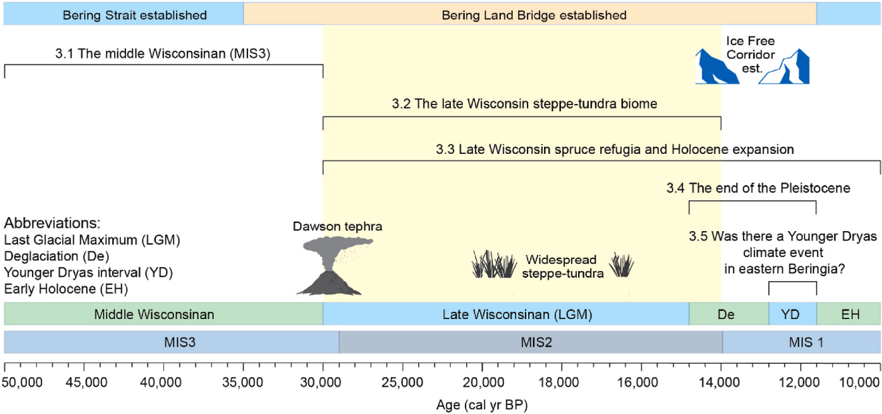
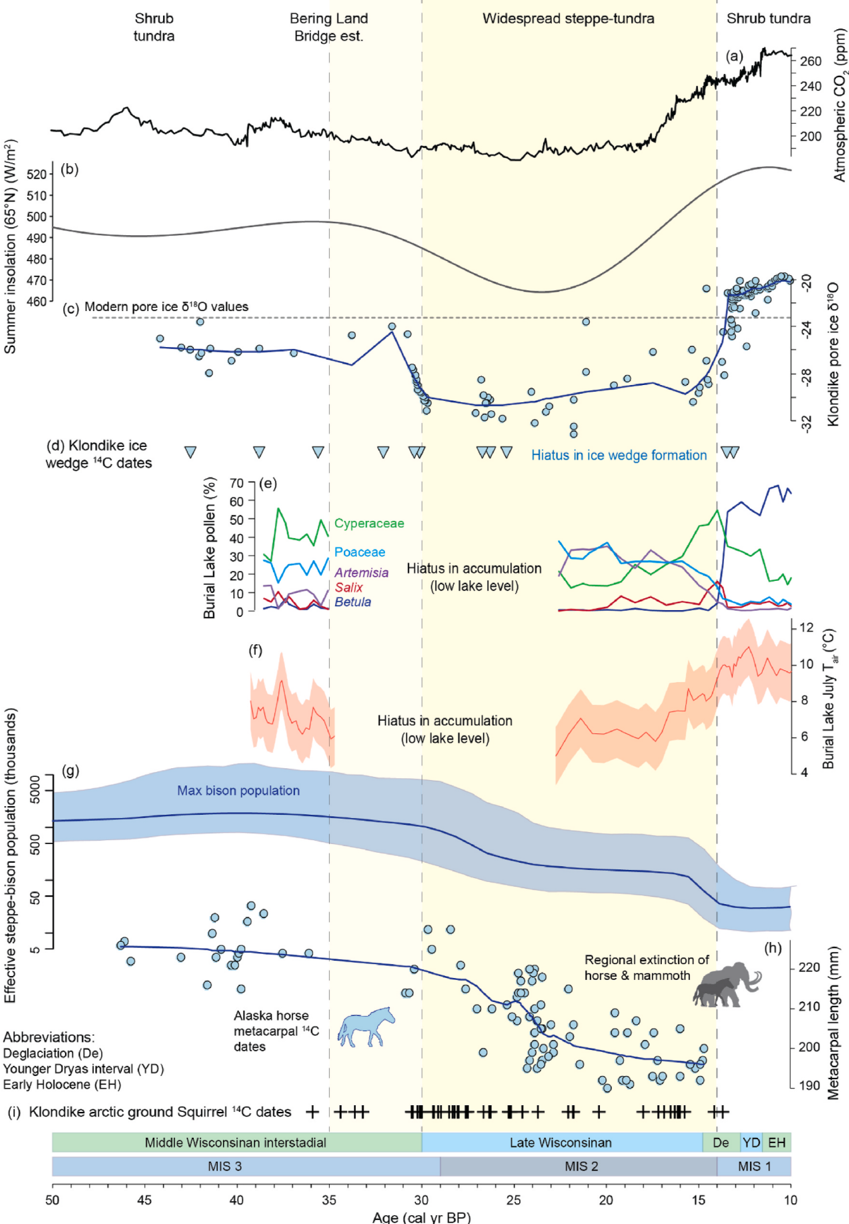
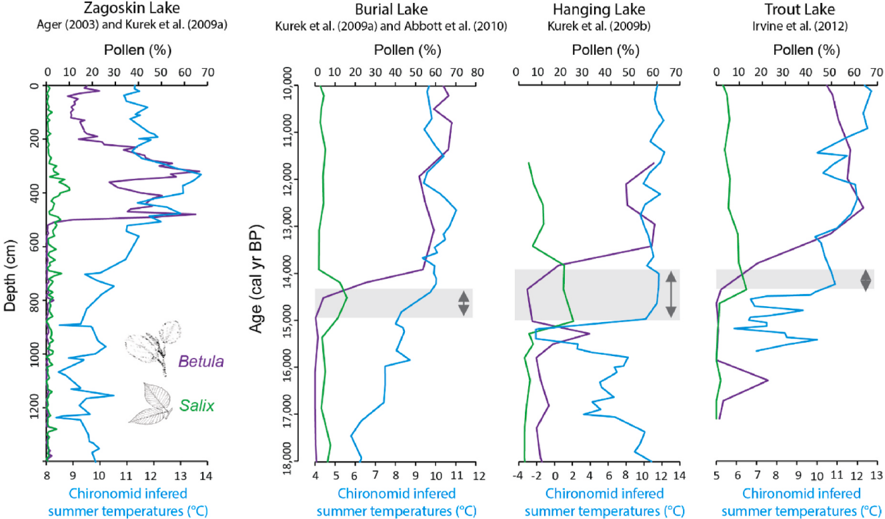
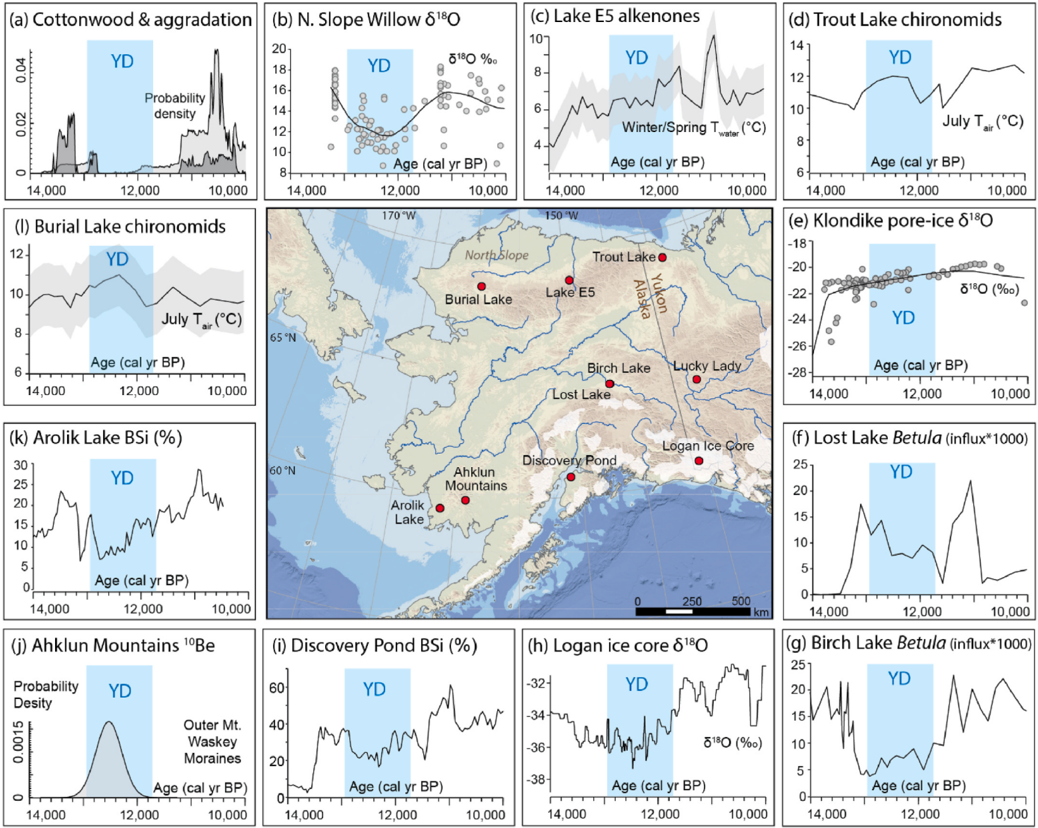
Eastern Beringia (Alaska and western Yukon) is an extensive, high-latitude region of North America that remained largely unglaciated throughout the Quaternary. Consequently, its sedimentary deposits preserve long-term environmental records that have intrigued scientists for nearly a century. Recent advances in palaeoecological proxies and dating methods have proved critical in addressing long-standing questions about regional late Quaternary environmental change. At the same time, they have led to new and sometimes controversial hypotheses. This review covers recent discoveries and unresolved questions focused on the period 57,000–10,000 calendar years before C.E. 1950 (cal yr BP). The middle Wisconsin interstadial (57,000–30,000 cal yr BP) was a period of relative warmth in eastern Beringia, compared with the late Wisconsin (30,000–14,000 cal yr BP). Early in the interstadial occasional Picea woodland was present amongst widespread shrub tundra. Palaeoecological, sedimentary and isotopic data indicate that climate was cooler and drier than the Holocene, with high rates of aeolian activity. Megafauna typically associated with the ‘mammoth steppe’ ecosystem (woolly mammoth [ Mammuthus primigenius ], horse [ Equus ] and steppe-bison [ Bison priscus ]) were present in some abundance. The transition towards late Wisconsin cold-stage conditions (35,000–30,000 cal yr BP) coincided with the establishment of the Bering Land Bridge and featured expansion of spatially varied, herbaceous vegetation, sometimes associated with deep active layers. Sedimentary DNA ( seda DNA) and macrofossil evidence show vegetation was not a prairie-like grassland, and the term “steppe-tundra” is a better descriptor. Permafrost pore-ice isotopic (δ 18 O) records suggest a step change in one or more climate drivers ca. 30,000 cal yr BP, by which time steppe-tundra was established across eastern Beringia. It remains uncertain whether Picea survived cold-stage conditions within isolated refugia, or whether it recolonized from south of the Laurentide-Cordilleran ice sheets. Genetic data suggest that Picea probably survived in situ ; however, there is no definitive fossil evidence to support this. The end-Pleistocene transition from steppe-tundra to shrub tundra began ca. 15,000 cal yr BP and took place within decades at local scales. The expansion of woody taxa coincided with rising sea levels, reduced sea-ice extent and an abrupt shift in atmospheric circulation that enhanced precipitation. During this time, Earth's orbital configuration caused high early-summer temperatures and strong seasonality, creating growing conditions very different from today. The vegetation consisted of Salix and Betula shrub tundra with open areas of herbs and graminoids. During the deglacial warming trend, the Younger Dryas oscillation (12,800–11,700 cal yr BP) was variably expressed. It is generally evident in records affected by adjacent oceans but can be absent at sites in continental areas. These past conditions and paleoenvironmental changes have implications for contemporary issues: hypotheses about Pleistocene mammalian extinction; sensitivity of eastern Beringia to major oceanic reorganizations and high-frequency climate variability; the nature of woody plant expansion with climate warming; grazing, hydroclimate and fire as controls over ecosystems; the efficacy of “Pleistocene rewilding” for carbon capture.
Overview
CoChat Summary
TL;DR
This review synthesizes late Quaternary environmental change in eastern Beringia (Alaska and western Yukon) from ~57,000 to 10,000 cal yr BP, covering the middle Wisconsin, late Wisconsin steppe-tundra, deglaciation, and Younger Dryas. It finds a cooler/drier-than-Holocene middle Wisconsin, a 35,000–30,000 cal yr BP shift to full-glacial steppe-tundra, and a variably expressed Younger Dryas, while unresolved questions remain about Picea refugia and steppe-tundra productivity.
Key findings
- The middle Wisconsin (57,000–30,000 cal yr BP) was relatively warm but cooler and drier than the Holocene; Burial Lake chironomid data indicate summer temperatures ~4°C lower than modern between 40,000–35,000 cal yr BP, and Jan Lake lake-level data suggest a 35–70% reduction in late Wisconsin precipitation vs the Holocene (ca.90–195 mm a−1 vs ca.300 mm a−1 today).
- The transition to late Wisconsin cold-stage conditions occurred 35,000–30,000 cal yr BP; the Bering Land Bridge was established ca.35,000 cal yr BP, and steppe-tundra was established across eastern Beringia by ca.30,000 cal yr BP, with a step change in permafrost pore-ice δ18O ca.30,000 cal yr BP.
- End-Pleistocene shrub expansion began ca.15,000 cal yr BP and occurred within decades at local scales; Salix generally expanded before Betula, which lagged by 600–1000 years at some sites; atmospheric reorganization ca.14,000 cal yr BP increased moisture, and the Bering Land Bridge was breached ca.11,000 cal yr BP.
- The Younger Dryas (12,800–11,700 cal yr BP) was variably expressed: evident in southern Alaska, southern Yukon, and north of the Brooks Range, but weak or absent in interior records; whether Picea survived in late Wisconsin refugia remains unresolved, and there are no convincing estimates of steppe-tundra plant or animal biomass.
Methods
- Design: narrative review/synthesis of late Quaternary environmental change in eastern Beringia, with temporal scope ~57,000–10,000 cal yr BP; excludes eastern Beringian archaeology and later Holocene palaeoenvironmental data.
- Data/sample: synthesizes published records from Alaska and western Yukon, including lake sediments, yedoma/permafrost, loess/palaeosols, ice cores, rodent middens, plant macrofossils, pollen, sedaDNA, stable isotopes, fossil insects, and megafauna remains; focuses on records meeting strict chronological criteria.
- Main analysis: qualitative synthesis and comparison of proxies and chronologies; no new data or code are presented.
Limitations
- Paper states: many records lie beyond the reliable limit of radiocarbon dating; early middle Wisconsin records are sparse and imprecisely dated; pollen data are biased by over-representation of Betula/Alnus and long-distance transport of Picea/Pinus; Picea refugia and steppe-tundra productivity remain unresolved; Younger Dryas expression may reflect proxy seasonality, chronological ambiguity, or overriding insolation/continentality.
- Text makes evident: as a review, it does not generate new primary data; conclusions depend on the dating quality and proxy limitations of cited studies; no code is used.
Model-written summary. Check it against the paper before relying on it.
Integrity signals
Registry
Cites
Statistics
Figures
Verification
Claims the paper makes
0 Valid · 7 Not valid · 282 Not checked · 188 Own results and interpretations
A result the paper states — it cites no source for it, so there is none to check. The quote shows it is in the paper.
In the paper
“Well dated temperature estimates are rare for the middle Wisconsin in eastern Beringia.”
§ Late quaternary environmental change in eastern Beringia > 3.1.2.1. Middle Wisconsin climate ca. 45,000-30,000 cal yr BP.
plain- Asserted: passes — The authors put it forward as true.
- Checkable: passes — It can be checked against evidence.
- Load-bearing: unclear — It is unclear whether the paper’s conclusions depend on it.
- Based: passes — The paper gives a reason why it holds.
A result the paper reports from its own data — it cites no other source for it, so there is none to check. The quote shows it is in the paper.
In the paper
“Pollen and insects from near the base of the silt indicate a dry, open meadow that contained herbs and some shrubs (graminoids 61 %, Betula 18 % and Alnus 9 %).”
§ Late quaternary environmental change in eastern Beringia > 3.1.2.
hedged- Asserted: passes — The authors put it forward as true.
- Checkable: passes — It can be checked against evidence.
- Load-bearing: unclear — It is unclear whether the paper’s conclusions depend on it.
- Based: passes — The paper gives a reason why it holds.
None of the sources cited for this claim have been checked yet.
In the paper
“Between 45,000-30,000 cal yr BP, sites at higher elevation and north of the Brooks Range record a form of shrub tundra, albeit one with a lower proportion of Salix and Betula pollen and more herb pollen than is typical for most modern and deglacial (ca.15,000-10,000 cal yr BP) shrub tundra.”
§ Late quaternary environmental change in eastern Beringia > 3.1.2.
plainstates an association- Asserted: passes — The authors put it forward as true.
- Checkable: passes — It can be checked against evidence.
- Load-bearing: passes — The paper’s conclusions depend on it.
- Based: passes — The paper gives a reason why it holds.
In the paper
“At Grand Lake (Elikchan-4), shifts in pollen, mirrored by marked changes in sediment properties (Minyuk and Subbotnikova, 2021), show vegetation varied between open and woody communities”
§ Late quaternary environmental change in eastern Beringia > 3.1.2.2. Climate variability.
What the sources say
- Not checked yetcites Minyuk and Subbotnikova, 2021 matched to “Rock magnetic properties of Grand Lake sediments as evidence of environmental changes during the last 60 000 years in North‐East Russia” (2021) source
plainstates an associationSingle case- Asserted: passes — The authors put it forward as true.
- Checkable: passes — It can be checked against evidence.
- Load-bearing: passes — The paper’s conclusions depend on it.
- Based: passes — The paper gives a reason why it holds.
In the paper
“A chironomid-based temperature reconstruction from the site indicates that summer temperatures were ~4 • C lower than modern values between 40,000-35,000 cal yr BP (Kurek et al., 2009a).”
§ Late quaternary environmental change in eastern Beringia > 3.1.2.1. Middle Wisconsin climate ca. 45,000-30,000 cal yr BP.
What the sources say
- Not checked yetcites Kurek et al., 2009a matched to “Late Quaternary paleoclimate of western Alaska inferred from fossil chironomids and its relation to vegetation histories” (2009) source
hedgedstates an associationSingle case- Asserted: passes — The authors put it forward as true.
- Checkable: passes — It can be checked against evidence.
- Load-bearing: unclear — It is unclear whether the paper’s conclusions depend on it.
- Based: passes — The paper gives a reason why it holds.
236 more claims
Create a free account to see all 477 claims and to verify the 360 references still open.
- It may state two separate claims as one. 190
- Probably not a substantial claim. 69
- The quote only partly states this claim. 1
Self-check
Percentages, sums and reported differences re-computed from the paper’s own numbers.
Each contradiction between two passages listed here was confirmed by an independent check.
Rated minor: it would not touch a result — a value no result rests on, a p-value that stays on the same side of the significance level, or a conflict that is clerical, resolved elsewhere in the paper, or outside its own findings.
In the paper
§ Late quaternary environmental change in eastern Beringia > 5. Conclusions
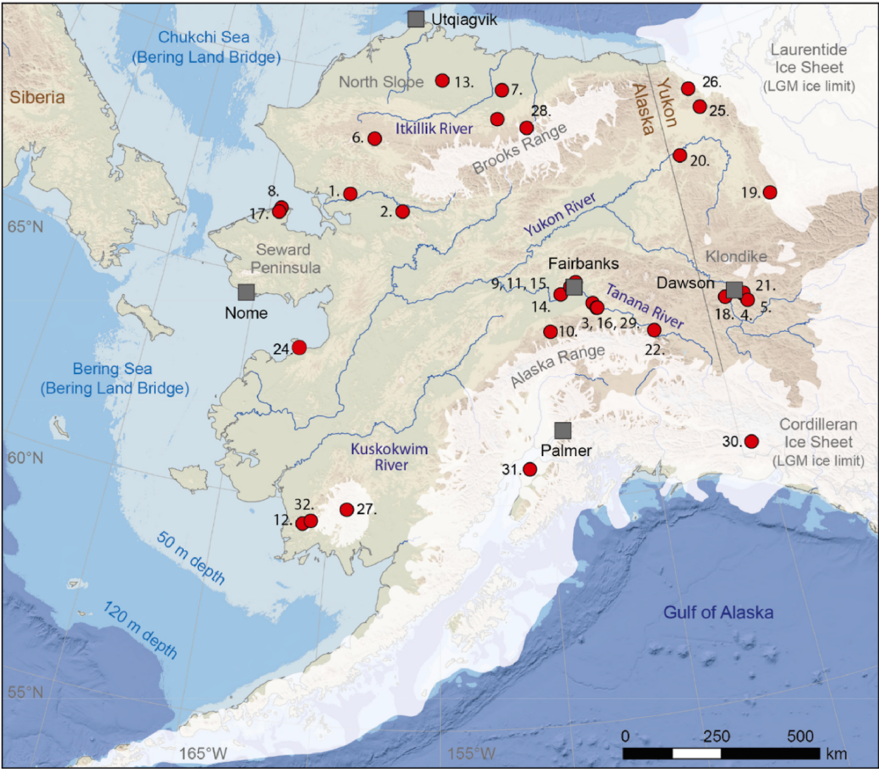
“Study sites are numbered with reference to Table2:”
§ Late quaternary environmental change in eastern Beringia > 3.1.1. Middle Wisconsin environments ca. 57,000-45,000 cal yr BP
“Table 3 Study sites described in the text.Site numbers (n.) correspond with numbering in Fig. 1.”
Rated minor: it would not touch a result — a value no result rests on, a p-value that stays on the same side of the significance level, or a conflict that is clerical, resolved elsewhere in the paper, or outside its own findings.
In the paper
§ Late quaternary environmental change in eastern Beringia > Abstract
“the late Wisconsin (30,000-14,000 cal yr BP)”
§ Late quaternary environmental change in eastern Beringia > 5. Conclusions
“| 30,000-15,000 | Late Wisconsin | MIS2, Last Glacial Maximum |”
Rated minor: it would not touch a result — a value no result rests on, a p-value that stays on the same side of the significance level, or a conflict that is clerical, resolved elsewhere in the paper, or outside its own findings.
In the paper
§ Late quaternary environmental change in eastern Beringia > 1. Introduction
“(22) Jan Lake, (24) Zagoskin Lake”
§ Late quaternary environmental change in eastern Beringia > 3.1.1. Middle Wisconsin environments ca. 57,000-45,000 cal yr BP
“23 Squanga Lake • 28′48.0133 • 38′24.011,000-present Ostracod δ 18 O, Calcite δ 18 O, LOI Lasher et al. (2021)”
Citations
Cites
The IntCal20 Northern Hemisphere Radiocarbon Age Calibration Curve (0–55 cal kBP)
Reimer, P. J., Austin, W. E. N., Bard, E., Bayliss, A., Blackwell, P. G., Bronk Ramsey, C., Butzin, M., Cheng, H., Edwards, R. L., Friedrich, M., et al. (2020) · Radiocarbon · doi:10.1017/rdc.2020.41 · Cited by 7,900
A Pliocene‐Pleistocene stack of 57 globally distributed benthic δ18O records
Lisiecki, L. E., & Raymo, M. E. (2005) · Paleoceanography · doi:10.1029/2004pa001071 · Cited by 7,377
Evidence for general instability of past climate from a 250-kyr ice-core record
Dansgaard, W., Johnsen, S. J., Clausen, H. B., Dahl-Jensen, D., Gundestrup, N. S., Hammer, C. U., Hvidberg, C. S., Steffensen, J. P., Sveinbjörnsdottir, A. E., Jouzel, J., et al. (1993) · Nature · doi:10.1038/364218a0 · Cited by 4,762
Insolation values for the climate of the last 10 million years
Berger, A., & Loutre, M. F. (1991) · Quaternary Science Reviews · doi:10.1016/0277-3791(91)90033-q · Cited by 4,386
Bayesian Coalescent Inference of Past Population Dynamics from Molecular Sequences
Drummond, A. J. (2005) · Molecular Biology and Evolution · doi:10.1093/molbev/msi103 · Cited by 3,143
Fire as a global ‘herbivore’: the ecology and evolution of flammable ecosystems
BOND, W., & KEELEY, J. (2005) · Trends in Ecology & Evolution · doi:10.1016/j.tree.2005.04.025 · Cited by 2,484
Rasmussen, S. O., Bigler, M., Blockley, S. P., Blunier, T., Buchardt, S. L., Clausen, H. B., Cvijanovic, I., Dahl-Jensen, D., Johnsen, S. J., Fischer, H., et al. (2014) · Quaternary Science Reviews · doi:10.1016/j.quascirev.2014.09.007 · Cited by 2,478
Climatic changes of the last 18,000 years: observations and model simulations
Members, C. (1988) · Science · doi:10.1126/science.241.4869.1043 · Cited by 1,969
Shrub expansion in tundra ecosystems: dynamics, impacts and research priorities
Myers-Smith, I. H., Forbes, B. C., Wilmking, M., Hallinger, M., Lantz, T., Blok, D., Tape, K. D., Macias-Fauria, M., Sass-Klaassen, U., Lévesque, E., et al. (2011) · Environmental Research Letters · doi:10.1088/1748-9326/6/4/045509 · Cited by 1,485
Increasing shrub abundance in the Arctic
Sturm, M., Racine, C., & Tape, K. (2001) · Nature · doi:10.1038/35079180 · Cited by 1,349
The evidence for shrub expansion in Northern Alaska and the Pan‐Arctic
TAPE, K., STURM, M., & RACINE, C. (2006) · Global Change Biology · doi:10.1111/j.1365-2486.2006.01128.x · Cited by 1,321
A 60 000 year Greenland stratigraphic ice core chronology
Svensson, A., Andersen, K. K., Bigler, M., Clausen, H. B., Dahl-Jensen, D., Davies, S. M., Johnsen, S. J., Muscheler, R., Parrenin, F., Rasmussen, S. O., et al. (2008) · Climate of the Past · doi:10.5194/cp-4-47-2008 · Cited by 1,109
Barber, V. A., Juday, G. P., & Finney, B. P. (2000) · Nature · doi:10.1038/35015049 · Cited by 1,055
Self-citationDenton, G. H., Anderson, R. F., Toggweiler, J. R., Edwards, R. L., Schaefer, J. M., & Putnam, A. E. (2010) · Science · doi:10.1126/science.1184119 · Cited by 957
Megaherbivores: The Influence of Very Large Body Size on Ecology
Owen-Smith, R. N. (1988) · Cambridge University Press eBooks · doi:10.1017/cbo9780511565441 · Cited by 955
Simulating Arctic Climate Warmth and Icefield Retreat in the Last Interglaciation
Otto-Bliesner, B. L., Marshall, S. J., Overpeck, J. T., Miller, G. H., Hu, A., & CAPE Last Interglacial Project members (2006) · Science · doi:10.1126/science.1120808 · Cited by 945
Revision of the EPICA Dome C CO 2 record from 800 to 600 kyr before present
Bereiter, B., Eggleston, S., Schmitt, J., Nehrbass‐Ahles, C., Stocker, T. F., Fischer, H., Kipfstuhl, S., & Chappellaz, J. (2015) · Geophysical Research Letters · doi:10.1002/2014gl061957 · Cited by 937
Links between climate and sea levels for the past three million years
Lambeck, K., Esat, T. M., & Potter, E.-K. (2002) · Nature · doi:10.1038/nature01089 · Cited by 914
Climate and human influences on global biomass burning over the past two millennia
Marlon, J. R., Bartlein, P. J., Carcaillet, C., Gavin, D. G., Harrison, S. P., Higuera, P. E., Joos, F., Power, M. J., & Prentice, I. C. (2008) · Nature Geoscience · doi:10.1038/ngeo313 · Cited by 823
Sugita, S. (2007) · The Holocene · doi:10.1177/0959683607075837 · Cited by 758
The Laurentide and Innuitian ice sheets during the Last Glacial Maximum
Dyke, A. S., Andrews, J. T., Clark, P. U., England, J. H., Miller, G. H., Shaw, J., & Veillette, J. J. (2002) · Quaternary Science Reviews · doi:10.1016/s0277-3791(01)00095-6 · Cited by 711
Firestone, R. B., West, A., Kennett, J. P., Becker, L., Bunch, T. E., Revay, Z. S., Schultz, P. H., Belgya, T., Kennett, D. J., Erlandson, J. M., et al. (2007) · Proceedings of the National Academy of Sciences · doi:10.1073/pnas.0706977104 · Cited by 690
Rise and Fall of the Beringian Steppe Bison
Shapiro, B., Drummond, A. J., Rambaut, A., Wilson, M. C., Matheus, P. E., Sher, A. V., Pybus, O. G., Gilbert, M. T. P., Barnes, I., Binladen, J., et al. (2004) · Science · doi:10.1126/science.1101074 · Cited by 675
Self-citationRouting of meltwater from the Laurentide Ice Sheet during the Younger Dryas cold episode
Broecker, W. S., Kennett, J. P., Flower, B. P., Teller, J. T., Trumbore, S., Bonani, G., & Wolfli, W. (1989) · Nature · doi:10.1038/341318a0 · Cited by 657
Goetz, S. J., Bunn, A. G., Fiske, G. J., & Houghton, R. A. (2005) · Proceedings of the National Academy of Sciences · doi:10.1073/pnas.0506179102 · Cited by 650
Higuera, P. E., Brubaker, L. B., Anderson, P. M., Hu, F. S., & Brown, T. A. (2009) · Ecological Monographs · doi:10.1890/07-2019.1 · Cited by 613
Freshwater Forcing of Abrupt Climate Change During the Last Glaciation
Clark, P. U., Marshall, S. J., Clarke, G. K. C., Hostetler, S. W., Licciardi, J. M., & Teller, J. T. (2001) · Science · doi:10.1126/science.1062517 · Cited by 607
Fifty thousand years of Arctic vegetation and megafaunal diet
Willerslev, E., Davison, J., Moora, M., Zobel, M., Coissac, E., Edwards, M. E., Lorenzen, E. D., Vestergård, M., Gussarova, G., Haile, J., et al. (2014) · Nature · doi:10.1038/nature12921 · Cited by 569
Self-citationThe role of seasonality in abrupt climate change
DENTON, G., ALLEY, R., COMER, G., & BROECKER, W. (2005) · Quaternary Science Reviews · doi:10.1016/j.quascirev.2004.12.002 · Cited by 563
Kaplan, J. O., Bigelow, N. H., Prentice, I. C., Harrison, S. P., Bartlein, P. J., Christensen, T. R., Cramer, W., Matveyeva, N. V., McGuire, A. D., Murray, D. F., et al. (2003) · Journal of Geophysical Research: Atmospheres · doi:10.1029/2002jd002559 · Cited by 548
Self-citationPaleoclimate simulations for North America over the past 21,000 years
Bartlein, P. J., Anderson, K. H., Anderson, P. M., Edwards, M. E., Mock, C. J., Thompson, R. S., Webb, R. S., Webb III, T., & Whitlock, C. (1998) · Quaternary Science Reviews · doi:10.1016/s0277-3791(98)00012-2 · Cited by 532
Self-citationPewe, T. L. (1975) · Professional Paper · doi:10.3133/pp835 · Cited by 525
The balance of nature? Ecological issues in the conservation of species and communities
Krebs, C. J. (1992) · Trends in Ecology & Evolution · doi:10.1016/0169-5347(92)90160-d · Cited by 506
Steppe-Tundra Transition: A Herbivore-Driven Biome Shift at the End of the Pleistocene
Zimov, S. A., Chuprynin, V. I., Oreshko, A. P., Chapin, F. S., Reynolds, J. F., & Chapin, M. C. (1995) · The American Naturalist · doi:10.1086/285824 · Cited by 481
Pleistocene extinctions: the pivotal role of megaherbivores
Owen-Smith, N. (1987) · Paleobiology · doi:10.1017/s0094837300008927 · Cited by 465
Frozen Fauna of the Mammoth Steppe: The Story of Blue Babe
Guthrie, R. D. (1990) · University of Chicago Press eBooks · doi:10.7208/chicago/9780226159713.001.0001 · Cited by 450
Summer warming explains widespread but not uniform greening in the Arctic tundra biome
Berner, L. T., Massey, R., Jantz, P., Forbes, B. C., Macias-Fauria, M., Myers-Smith, I., Kumpula, T., Gauthier, G., Andreu-Hayles, L., Gaglioti, B. V., et al. (2020) · Nature Communications · doi:10.1038/s41467-020-18479-5 · Cited by 436
Self-citationKasischke, E. S., Verbyla, D. L., Rupp, T. S., McGuire, A. D., Murphy, K. A., Jandt, R., Barnes, J. L., Hoy, E. E., Duffy, P. A., Calef, M., et al. (2010) · Canadian Journal of Forest Research · doi:10.1139/x10-098 · Cited by 376
Dalton, A. S., Margold, M., Stokes, C. R., Tarasov, L., Dyke, A. S., Adams, R. S., Allard, S., Arends, H. E., Atkinson, N., Attig, J. W., et al. (2020) · Quaternary Science Reviews · doi:10.1016/j.quascirev.2020.106223 · Cited by 374
Frozen fauna of the mammoth steppe: the story of Blue Babe
(1990) · Choice Reviews Online · doi:10.5860/choice.28-0295 · Cited by 373
Postglacial viability and colonization in North America’s ice-free corridor
Pedersen, M. W., Ruter, A., Schweger, C., Friebe, H., Staff, R. A., Kjeldsen, K. K., Mendoza, M. L. Z., Beaudoin, A. B., Zutter, C., Larsen, N. K., et al. (2016) · Nature · doi:10.1038/nature19085 · Cited by 369
Future uses of pollen analysis must include plant macrofossils
Birks, H. H., & Birks, H. J. B. (2000) · Journal of Biogeography · doi:10.1046/j.1365-2699.2000.00375.x · Cited by 365
Quaternary Extinctions: A Prehistoric Revolution
(2022) · University of Arizona Press eBooks · doi:10.2307/j.ctv264f91j · Cited by 360
Jones, B. M., Grosse, G., Arp, C. D., Jones, M. C., Walter Anthony, K. M., & Romanovsky, V. E. (2011) · Journal of Geophysical Research · doi:10.1029/2011jg001666 · Cited by 351
Dale Guthrie, R. (2001) · Quaternary Science Reviews · doi:10.1016/s0277-3791(00)00099-8 · Cited by 345
McCrystall, M. R., Stroeve, J., Serreze, M., Forbes, B. C., & Screen, J. A. (2021) · Nature Communications · doi:10.1038/s41467-021-27031-y · Cited by 343
The Alaska vegetation classification.
Viereck, L. A., Dyrness, C. T., Batten, A. R., & Wenzlick, K. J. (1992) · doi:10.2737/pnw-gtr-286 · Cited by 342
A 2-million-year-old ecosystem in Greenland uncovered by environmental DNA
Kjær, K. H., Winther Pedersen, M., De Sanctis, B., De Cahsan, B., Korneliussen, T. S., Michelsen, C. S., Sand, K. K., Jelavić, S., Ruter, A. H., Schmidt, A. M. A., et al. (2022) · Nature · doi:10.1038/s41586-022-05453-y · Cited by 341
Megaherbivores: The influence of very large body size on ecology
Albon, S. D. (1989) · Trends in Ecology & Evolution · doi:10.1016/0169-5347(89)90043-8 · Cited by 326
North Siberian Lakes: A Methane Source Fueled by Pleistocene Carbon
Zimov, S. A., Voropaev, Y. V., Semiletov, I. P., Davidov, S. P., Prosiannikov, S. F., Chapin, F. S., Chapin, M. C., Trumbore, S., & Tyler, S. (1997) · Science · doi:10.1126/science.277.5327.800 · Cited by 326
Radiocarbon Geochemistry of Modern and Ancient Arctic Lake Systems, Baffin Island, Canada
Abbott, M. B., & Stafford, T. W. (1996) · Quaternary Research · doi:10.1006/qres.1996.0031 · Cited by 324
Self-citationImpact of lower atmospheric carbon dioxide on tropical mountain ecosystems
Street-Perrott, F. A., Huang, Y., Perrott, R. A., Eglinton, G., Barker, P., Khelifa, L. B., Harkness, D. D., & Olago, D. O. (1997) · Science · doi:10.1126/science.278.5342.1422 · Cited by 323
Ecological consequences of Late Quaternary extinctions of megafauna
Johnson, C. N. (2009) · Proceedings of the Royal Society B: Biological Sciences · doi:10.1098/rspb.2008.1921 · Cited by 321
Glacial Survival of Boreal Trees in Northern Scandinavia
Parducci, L., Jørgensen, T., Tollefsrud, M. M., Elverland, E., Alm, T., Fontana, S. L., Bennett, K. D., Haile, J., Matetovici, I., Suyama, Y., et al. (2012) · Science · doi:10.1126/science.1216043 · Cited by 317
Self-citationThermokarst Lakes as a Source of Atmospheric CH 4 During the Last Deglaciation
Walter, K. M., Edwards, M. E., Grosse, G., Zimov, S. A., & Chapin, F. S. (2007) · Science · doi:10.1126/science.1142924 · Cited by 306
Self-citationKarger, D. N., Nobis, M. P., Normand, S., Graham, C. H., & Zimmermann, N. E. (2023) · Climate of the Past · doi:10.5194/cp-19-439-2023 · Cited by 301
DNA from soil mirrors plant taxonomic and growth form diversity
YOCCOZ, N. G., BRÅTHEN, K. A., GIELLY, L., HAILE, J., EDWARDS, M. E., GOSLAR, T., Von STEDINGK, H., BRYSTING, A. K., COISSAC, E., POMPANON, F., et al. (2012) · Molecular Ecology · doi:10.1111/j.1365-294x.2012.05545.x · Cited by 296
Self-citationIdentification of Younger Dryas outburst flood path from Lake Agassiz to the Arctic Ocean
Murton, J. B., Bateman, M. D., Dallimore, S. R., Teller, J. T., & Yang, Z. (2010) · Nature · doi:10.1038/nature08954 · Cited by 287
Last Interglacial Arctic warmth confirms polar amplification of climate change
(2006) · Quaternary Science Reviews · doi:10.1016/j.quascirev.2006.01.033 · Cited by 287
Putting the Younger Dryas cold event into context
Broecker, W. S., Denton, G. H., Edwards, R. L., Cheng, H., Alley, R. B., & Putnam, A. E. (2010) · Quaternary Science Reviews · doi:10.1016/j.quascirev.2010.02.019 · Cited by 285
Temperature and precipitation history of the Arctic
Miller, G. H., Brigham-Grette, J., Alley, R. B., Anderson, L., Bauch, H. A., Douglas, M. S. V., Edwards, M. E., Elias, S. A., Finney, B. P., Fitzpatrick, J. J., et al. (2010) · Quaternary Science Reviews · doi:10.1016/j.quascirev.2010.03.001 · Cited by 285
Self-citationCarbon loss from boreal forest wildfires offset by increased dominance of deciduous trees
Mack, M. C., Walker, X. J., Johnstone, J. F., Alexander, H. D., Melvin, A. M., Jean, M., & Miller, S. N. (2021) · Science · doi:10.1126/science.abf3903 · Cited by 281
Beringia as a glacial refugium for boreal trees and shrubs: new perspectives from mapped pollen data
Brubaker, L. B., Anderson, P. M., Edwards, M. E., & Lozhkin, A. V. (2005) · Journal of Biogeography · doi:10.1111/j.1365-2699.2004.01203.x · Cited by 271
Self-citationIce-age endurance: DNA evidence of a white spruce refugium in Alaska
Anderson, L. L., Hu, F. S., Nelson, D. M., Petit, R. J., & Paige, K. N. (2006) · Proceedings of the National Academy of Sciences · doi:10.1073/pnas.0605310103 · Cited by 264
Self-citationASPECTS OF THE PALEOGEOGRAPHY OF BERINGIA DURING THE LATE PLEISTOCENE
Hopkins, D. M. (1982) · Paleoecology of Beringia · doi:10.1016/b978-0-12-355860-2.50008-9 · Cited by 263
Mammoth steppe: a high-productivity phenomenon
Zimov, S. A., Zimov, N. S., Tikhonov, A. N., & Chapin, F. S. (2012) · Quaternary Science Reviews · doi:10.1016/j.quascirev.2012.10.005 · Cited by 252
New carbon dates link climatic change with human colonization and Pleistocene extinctions
Dale Guthrie, R. (2006) · Nature · doi:10.1038/nature04604 · Cited by 245
Rapid deglacial and early Holocene expansion of peatlands in Alaska
Jones, M. C., & Yu, Z. (2010) · Proceedings of the National Academy of Sciences · doi:10.1073/pnas.0911387107 · Cited by 243
Rapid body size decline in Alaskan Pleistocene horses before extinction
Dale Guthrie, R. (2003) · Nature · doi:10.1038/nature02098 · Cited by 242
Sher, A. V., Kuzmina, S. A., Kuznetsova, T. V., & Sulerzhitsky, L. D. (2005) · Quaternary Science Reviews · doi:10.1016/j.quascirev.2004.09.007 · Cited by 241
Climate and the southern limit of the western Canadian boreal forest
Hogg, E. H. (. (1994) · Canadian Journal of Forest Research · doi:10.1139/x94-237 · Cited by 241
A new global ice sheet reconstruction for the past 80 000 years
Gowan, E. J., Zhang, X., Khosravi, S., Rovere, A., Stocchi, P., Hughes, A. L. C., Gyllencreutz, R., Mangerud, J., Svendsen, J.-I., & Lohmann, G. (2021) · Nature Communications · doi:10.1038/s41467-021-21469-w · Cited by 237
Pleistocene Park: Return of the Mammoth's Ecosystem
Zimov, S. A. (2005) · Science · doi:10.1126/science.1113442 · Cited by 235
Ancient DNA reveals late survival of mammoth and horse in interior Alaska
Haile, J., Froese, D. G., MacPhee, R. D. E., Roberts, R. G., Arnold, L. J., Reyes, A. V., Rasmussen, M., Nielsen, R., Brook, B. W., Robinson, S., et al. (2009) · Proceedings of the National Academy of Sciences · doi:10.1073/pnas.0912510106 · Cited by 235
Self-citationMethane emissions proportional to permafrost carbon thawed in Arctic lakes since the 1950s
Walter Anthony, K., Daanen, R., Anthony, P., Schneider von Deimling, T., Ping, C.-L., Chanton, J. P., & Grosse, G. (2016) · Nature Geoscience · doi:10.1038/ngeo2795 · Cited by 232
MAMMALS OF THE MAMMOTH STEPPE AS PALEOENVIRONMENTAL INDICATORS
Guthrie, R. D. (1982) · Paleoecology of Beringia · doi:10.1016/b978-0-12-355860-2.50030-2 · Cited by 227
Walter, K. M., Chanton, J. P., Chapin, F. S., Schuur, E. A. G., & Zimov, S. A. (2008) · Journal of Geophysical Research: Biogeosciences · doi:10.1029/2007jg000569 · Cited by 226
TIME LAGS AND NOVEL ECOSYSTEMS IN RESPONSE TO TRANSIENT CLIMATIC CHANGE IN ARCTIC ALASKA
CHAPIN, F. S., & STARFIELD, A. M. (1997) · Climatic Change · doi:10.1023/a:1005337705025 · Cited by 220
The Holocene spread of Picea abies (L.) Karst. in Fennoscandia and adjacent areas
Giesecke, T., & Bennett, K. D. (2004) · Journal of Biogeography · doi:10.1111/j.1365-2699.2004.01095.x · Cited by 219
Physiological Significance of Low Atmospheric CO2 for Plant–Climate Interactions
Cowling, S. A., & Sykes, M. T. (1999) · Quaternary Research · doi:10.1006/qres.1999.2065 · Cited by 218
Muhs, D. R. (2003) · Quaternary Science Reviews · doi:10.1016/s0277-3791(03)00167-7 · Cited by 217
Late Quaternary dynamics of arctic biota from ancient environmental genomics
Wang, Y., Pedersen, M. W., Alsos, I. G., De Sanctis, B., Racimo, F., Prohaska, A., Coissac, E., Owens, H. L., Merkel, M. K. F., Fernandez-Guerra, A., et al. (2021) · Nature · doi:10.1038/s41586-021-04016-x · Cited by 211
Self-citationPlant responses to low [CO2] of the past
Gerhart, L. M., & Ward, J. K. (2010) · New Phytologist · doi:10.1111/j.1469-8137.2010.03441.x · Cited by 208
Plant DNA metabarcoding of lake sediments: How does it represent the contemporary vegetation
Alsos, I. G., Lammers, Y., Yoccoz, N. G., Jørgensen, T., Sjögren, P., Gielly, L., & Edwards, M. E. (2018) · PLOS ONE · doi:10.1371/journal.pone.0195403 · Cited by 202
Self-citationEffects of low atmospheric CO2 on plants: more than a thing of the past
Sage, R. F., & Coleman, J. R. (2001) · Trends in Plant Science · doi:10.1016/s1360-1385(00)01813-6 · Cited by 201
Rewilding is the new Pandora’s box in conservation
Nogués-Bravo, D., Simberloff, D., Rahbek, C., & Sanders, N. J. (2016) · Current Biology · doi:10.1016/j.cub.2015.12.044 · Cited by 199
Schirrmeister, L., Froese, D., Tumskoy, V., Grosse, G., & Wetterich, S. (2013) · Encyclopedia of Quaternary Science · doi:10.1016/b978-0-444-53643-3.00106-0 · Cited by 195
Self-citationPaleoecology of the Large-Mammal Community in Interior Alaska during the Late Pleistocene
Guthrie, R. D. (1968) · American Midland Naturalist · doi:10.2307/2423182 · Cited by 182
Kaufman, D. S., Axford, Y. L., Henderson, A. C. G., McKay, N. P., Oswald, W. W., Saenger, C., Anderson, R. S., Bailey, H. L., Clegg, B., Gajewski, K., et al. (2016) · Quaternary Science Reviews · doi:10.1016/j.quascirev.2015.10.021 · Cited by 180
Self-citationSTRUCTURALLY NOVEL BIOMES: A RESPONSE TO PAST WARMING IN BERINGIA
Edwards, M. E., Brubaker, L. B., Lozhkin, A. V., & Anderson, P. M. (2005) · Ecology · doi:10.1890/03-0787 · Cited by 171
Self-citationThe Patterns of Post-Glacial Spread of White Spruce
Ritchie, J. C., & MacDonald, G. M. (1986) · Journal of Biogeography · doi:10.2307/2844816 · Cited by 168
Jakobsson, M., Pearce, C., Cronin, T. M., Backman, J., Anderson, L. G., Barrientos, N., Björk, G., Coxall, H., de Boer, A., Mayer, L. A., et al. (2017) · Climate of the Past · doi:10.5194/cp-13-991-2017 · Cited by 163
Self-citationEFFECTS OF ROADSIDE DISTURBANCE ON SUBSTRATE AND VEGETATION PROPERTIES IN ARCTIC TUNDRA
Auerbach, N. A., Walker, M. D., & Walker, D. A. (1997) · Ecological Applications · doi:10.1890/1051-0761(1997)007[0218:eordos]2.0.co;2 · Cited by 163
Birks, H. H. (2003) · Quaternary Science Reviews · doi:10.1016/s0277-3791(02)00248-2 · Cited by 159
A Pleistocene Sand Sea on the Alaskan Arctic Coastal Plain
Carter, L. D. (1981) · Science · doi:10.1126/science.211.4480.381 · Cited by 159
Precise date for the Laacher See eruption synchronizes the Younger Dryas
Reinig, F., Wacker, L., Jöris, O., Oppenheimer, C., Guidobaldi, G., Nievergelt, D., Adolphi, F., Cherubini, P., Engels, S., Esper, J., et al. (2021) · Nature · doi:10.1038/s41586-021-03608-x · Cited by 157
Bison phylogeography constrains dispersal and viability of the Ice Free Corridor in western Canada
Heintzman, P. D., Froese, D., Ives, J. W., Soares, A. E. R., Zazula, G. D., Letts, B., Andrews, T. D., Driver, J. C., Hall, E., Hare, P. G., et al. (2016) · Proceedings of the National Academy of Sciences · doi:10.1073/pnas.1601077113 · Cited by 157
Self-citationВладимирович, Л. А., Anderson, P. M., Matrosova, T. V., & Minyuk, P. S. (2006) · Journal of Paleolimnology · doi:10.1007/s10933-006-9018-5 · Cited by 156
Sufficient conditions for rapid range expansion of a boreal conifer
Dial, R. J., Maher, C. T., Hewitt, R. E., & Sullivan, P. F. (2022) · Nature · doi:10.1038/s41586-022-05093-2 · Cited by 150
New perspectives on Beringian Quaternary paleogeography, stratigraphy, and glacial history
Brigham‐Grette, J. (2001) · Quaternary Science Reviews · doi:10.1016/s0277-3791(00)00134-7 · Cited by 149
Self-citationOswald, W. W., Anderson, P. M., Brown, T. A., Brubaker, L. B., Hu, F. S., Lozhkin, A. V., Tinner, W., & Kaltenrieder, P. (2005) · The Holocene · doi:10.1191/0959683605hl849rr · Cited by 149
Environment, vegetation and greenness (NDVI) along the North America and Eurasia Arctic transects
Walker, D. A., Epstein, H. E., Raynolds, M. K., Kuss, P., Kopecky, M. A., Frost, G. V., Daniëls, F. J. A., Leibman, M. O., Moskalenko, N. G., Matyshak, G. V., et al. (2012) · Environmental Research Letters · doi:10.1088/1748-9326/7/1/015504 · Cited by 148
Using Climate Divisions to Analyze Variations and Trends in Alaska Temperature and Precipitation
Bieniek, P. A., Walsh, J. E., Thoman, R. L., & Bhatt, U. S. (2014) · Journal of Climate · doi:10.1175/jcli-d-13-00342.1 · Cited by 147
Quaternary Environments at Cape Deceit (Seward Peninsula, Alaska): Evolution of a Tundra Ecosystem
Matthews, J. V. (1974) · Geological Society of America Bulletin · doi:10.1130/0016-7606(1974)85<1353:qeacds>2.0.co;2 · Cited by 143
Past and Present Vegetation of the Far Northwest of Canada
Ritchie, J. C. (1984) · doi:10.3138/9781487580353 · Cited by 140
Alaska Palaeo-Glacier Atlas (Version 2)
Kaufman, D. S., Young, N. E., Briner, J. P., & Manley, W. (2011) · Developments in quaternary science · doi:10.1016/b978-0-444-53447-7.00033-7 · Cited by 139
Murton, J. B., Goslar, T., Edwards, M. E., Bateman, M. D., Danilov, P. P., Savvinov, G. N., Gubin, S. V., Ghaleb, B., Haile, J., Kanevskiy, M., et al. (2015) · Permafrost and Periglacial Processes · doi:10.1002/ppp.1843 · Cited by 138
Self-citationAncient permafrost and a future, warmer Arctic
Froese, D. G., Westgate, J. A., Reyes, A. V., Enkin, R. J., & Preece, S. J. (2008) · Science · doi:10.1126/science.1157525 · Cited by 138
Self-citationCaissie, B. E., Brigham-Grette, J., Lawrence, K. T., Herbert, T. D., & Cook, M. S. (2010) · Paleoceanography · doi:10.1029/2008pa001671 · Cited by 138
Self-citationIs Alaska’s Boreal Forest Now Crossing a Major Ecological Threshold?
Mann, D. H., Rupp, T. S., Olson, M. A., & Duffy, P. A. (2012) · Arctic Antarctic and Alpine Research · doi:10.1657/1938-4246-44.3.319 · Cited by 135
A late‐quaternary vegetation history from hanging Lake, Northern Yukon: ecological archives M052-001
Cwynar, L. C. (1982) · Ecological Monographs · doi:10.2307/2937342 · Cited by 133
The Mt Logan Holocene—late Wisconsinan isotope record: tropical Pacific—Yukon connections
Fisher, D., Osterberg, E., Dyke, A., Dahl-Jensen, D., Demuth, M., Zdanowicz, C., Bourgeois, J., Koerner, R. M., Mayewski, P., Wake, C., et al. (2008) · The Holocene · doi:10.1177/0959683608092236 · Cited by 129
Anderson, P. M., & V. Lozhkin, A. (2001) · Quaternary Science Reviews · doi:10.1016/s0277-3791(00)00129-3 · Cited by 128
Thaw lakes and thaw sinks in the Imuruk Lake area, Seward Peninsula, Alaska
Hopkins, D. M. (1949) · The Journal of Geology · doi:10.1086/625591 · Cited by 128
Modern analogues of late-Quaternary pollen spectra from the western interior of North America
Anderson, P. M., Bartlein, P. J., Brubaker, L. B., Gajewski, K., & Ritchie, J. C. (1989) · Journal of Biogeography · doi:10.2307/2845212 · Cited by 123
Fossil and genomic evidence constrains the timing of bison arrival in North America
Froese, D., Stiller, M., Heintzman, P. D., Reyes, A. V., Zazula, G. D., Soares, A. E. R., Meyer, M., Hall, E., Jensen, B. J. L., Arnold, L. J., et al. (2017) · Proceedings of the National Academy of Sciences · doi:10.1073/pnas.1620754114 · Cited by 120
Self-citationAbbott, M. B., Finney, B. P., Edwards, M. E., & Kelts, K. R. (2000) · Quaternary Research · doi:10.1006/qres.1999.2112 · Cited by 120
Self-citationMann, D. H., Peteet, D. M., Reanier, R. E., & Kunz, M. L. (2002) · Quaternary Science Reviews · doi:10.1016/s0277-3791(01)00116-0 · Cited by 118
Late Quaternary Lacustrine Pollen Records from Southwestern Beringia
Lozhkin, A., Anderson, P. M., Eisner, W. R., Ravako, L. G., Hopkins, D. M., Brubaker, L. B., Colinvaux, P. A., & Miller, M. C. (1993) · Quaternary Research · doi:10.1006/qres.1993.1038 · Cited by 118
Löfverström, M., Caballero, R., Nilsson, J., & Kleman, J. (2014) · Climate of the Past · doi:10.5194/cp-10-1453-2014 · Cited by 118
Revising the biome concept for understanding and predicting global change impacts
Moncrieff, G. R., Bond, W. J., & Higgins, S. I. (2016) · Journal of Biogeography · doi:10.1111/jbi.12701 · Cited by 113
RELICS OF THE XEROPHYTE VEGETATION OF BERINGIA IN NORTHEASTERN ASIA
Yurtsev, B. A. (1982) · Elsevier eBooks · doi:10.1016/b978-0-12-355860-2.50018-1 · Cited by 113
Evidence of Ice Age humans in eastern Beringia suggests early migration to North America
Vachula, R. S., Huang, Y., Longo, W. M., Dee, S. G., Daniels, W. C., & Russell, J. M. (2019) · Quaternary Science Reviews · doi:10.1016/j.quascirev.2018.12.003 · Cited by 112
Geochemical evidence for the origin of late Quaternary loess in central Alaska
Muhs, D. R., & Budahn, J. R. (2006) · Canadian Journal of Earth Sciences · doi:10.1139/e05-115 · Cited by 111
Pleistocene Arctic megafaunal ecological engineering as a natural climate solution?
Macias‐Fauria, M., Jepson, P. R., Zimov, N., & Malhi, Y. S. (2020) · Philosophical Transactions of the Royal Society B Biological Sciences · doi:10.1098/rstb.2019.0122 · Cited by 110
Sea-ice-free Arctic during the Last Interglacial supports fast future loss
Guarino, M.-V., Sime, L. C., Schröeder, D., Malmierca-Vallet, I., Rosenblum, E., Ringer, M., Ridley, J., Feltham, D., Bitz, C., Steig, E. J., et al. (2020) · Nature Climate Change · doi:10.1038/s41558-020-0865-2 · Cited by 110
Permafrost response to last interglacial warming: field evidence from non-glaciated Yukon and Alaska
Reyes, A. V., FROESE, D. G., & Jensen, B. J. L. (2010) · Quaternary Science Reviews · doi:10.1016/j.quascirev.2010.07.013 · Cited by 109
Self-citationGoetcheus, V. G., & Birks, H. H. (2001) · Quaternary Science Reviews · doi:10.1016/s0277-3791(00)00127-x · Cited by 109
Ecosystem effects of CO 2 concentration: evidence from past climates
Prentice, I. C., & Harrison, S. P. (2009) · Climate of the Past · doi:10.5194/cp-5-297-2009 · Cited by 104
The environment of the bering land Bridge
Colinvaux, P. A. (1964) · Ecological Monographs · doi:10.2307/1948504 · Cited by 104
Results and paleoclimate implications of 35 years of paleoecological research in Alaska
Anderson, P. M., Edwards, M. E., & Brubaker, L. B. (2003) · Developments in quaternary science · doi:10.1016/s1571-0866(03)01019-4 · Cited by 102
Self-citationMeiri, M., Lister, A. M., Collins, M. J., Tuross, N., Goebel, T., Blockley, S., Zazula, G. D., van Doorn, N., Dale Guthrie, R., Boeskorov, G. G., et al. (2014) · Proceedings of the Royal Society B: Biological Sciences · doi:10.1098/rspb.2013.2167 · Cited by 102
Shur, Y. L., French, H. M., Bray, M. T., & Anderson, D. A. (2004) · Permafrost and Periglacial Processes · doi:10.1002/ppp.486 · Cited by 102
Martin, P. S., & Wright, H. E. (1968) · Soil Science · doi:10.1097/00010694-196810000-00020 · Cited by 101
Collapse of the mammoth-steppe in central Yukon as revealed by ancient environmental DNA
Murchie, T. J., Monteath, A. J., Mahony, M. E., Long, G. S., Cocker, S., Sadoway, T., Karpinski, E., Zazula, G., MacPhee, R. D. E., Froese, D., et al. (2021) · Nature Communications · doi:10.1038/s41467-021-27439-6 · Cited by 98
Self-citationAger, T. A. (2003) · Quaternary Research · doi:10.1016/s0033-5894(03)00068-1 · Cited by 98
Ice-age steppe vegetation in east Beringia
Zazula, G. D., Froese, D. G., Schweger, C. E., Mathewes, R. W., Beaudoin, A. B., Telka, A. M., Harington, C. R., & Westgate, J. A. (2003) · Nature · doi:10.1038/423603a · Cited by 97
Self-citationVäliranta, M., Kaakinen, A., Kuhry, P., Kultti, S., Salonen, J. S., & Seppä, H. (2010) · Journal of Biogeography · doi:10.1111/j.1365-2699.2010.02448.x · Cited by 97
Pico, T., Creveling, J. R., & Mitrovica, J. X. (2017) · Nature Communications · doi:10.1038/ncomms15612 · Cited by 95
Ice-age megafauna in Arctic Alaska: extinction, invasion, survival
Mann, D. H., Groves, P., Kunz, M. L., Reanier, R. E., & Gaglioti, B. V. (2013) · Quaternary Science Reviews · doi:10.1016/j.quascirev.2013.03.015 · Cited by 94
Self-citationPotter, B. A., Reuther, J. D., Holliday, V. T., Holmes, C. E., Miller, D. S., & Schmuck, N. (2017) · Quaternary International · doi:10.1016/j.quaint.2017.02.034 · Cited by 93
Müller, S., Tarasov, P. E., Andreev, A. A., Tütken, T., Gartz, S., & Diekmann, B. (2010) · Quaternary Science Reviews · doi:10.1016/j.quascirev.2010.04.024 · Cited by 93
Barber, V. A., & Finney, B. P. (2000) · Journal of Paleolimnology · doi:10.1023/a:1008113715703 · Cited by 93
Self-citationHogg, E. H., & Schwarz, A. G. (1997) · Journal of Biogeography · doi:10.1111/j.1365-2699.1997.00138.x · Cited by 91
Protection of Permafrost Soils from Thawing by Increasing Herbivore Density
Beer, C., Zimov, N., Olofsson, J., Porada, P., & Zimov, S. A. (2020) · Scientific Reports · doi:10.1038/s41598-020-60938-y · Cited by 90
(1982) · Elsevier eBooks · doi:10.1016/c2013-0-10866-5 · Cited by 90
Overview and significance of a 250 ka paleoclimate record from El’gygytgyn Crater Lake, NE Russia
Brigham‐Grette, J., Melles, M., Minyuk, P. S., & Party, S. (2006) · Journal of Paleolimnology · doi:10.1007/s10933-006-9017-6 · Cited by 89
Self-citationDavies, L. J., Jensen, B. J. L., FROESE, D. G., & Wallace, K. L. (2016) · Quaternary Science Reviews · doi:10.1016/j.quascirev.2016.05.026 · Cited by 88
Self-citationThe discovery of the Younger Dryas, and comments on the current meaning and usage of the term
Mangerud, J. (2020) · Boreas · doi:10.1111/bor.12481 · Cited by 87
McGuire, A. D., Ruess, R. W., Lloyd, A. H., Yarie, J., Clein, J. S., & Juday, G. P. (2010) · Canadian Journal of Forest Research · doi:10.1139/x09-206 · Cited by 86
Lifetime mobility of an Arctic woolly mammoth
Wooller, M. J., Bataille, C., Druckenmiller, P., Erickson, G. M., Groves, P., Haubenstock, N., Howe, T., Irrgeher, J., Mann, D., Moon, K., et al. (2021) · Science · doi:10.1126/science.abg1134 · Cited by 85
Self-citationMann, D. H., Groves, P., Reanier, R. E., & Kunz, M. L. (2010) · Quaternary Science Reviews · doi:10.1016/j.quascirev.2010.09.002 · Cited by 85
Late-Pleistocene Eolian Sand Sheets in Alaska
Lea, P. D., & Waythomas, C. F. (1990) · Quaternary Research · doi:10.1016/0033-5894(90)90040-r · Cited by 85
Vegetation-pollen-climate relationships for the arcto-boreal region of North America and Greenland
Anderson, P. M., Bartlein, P. J., Brubaker, L. B., Gajewski, K., & Ritchie, J. C. (1991) · Journal of Biogeography · doi:10.2307/2845692 · Cited by 83
Late Pleistocene mountain glaciation in Alaska: key chronologies
Briner, J. P., & Kaufman, D. S. (2008) · Journal of Quaternary Science · doi:10.1002/jqs.1196 · Cited by 83
Bigelow, N. H., & Edwards, M. E. (2001) · Quaternary Science Reviews · doi:10.1016/s0277-3791(00)00122-0 · Cited by 83
Self-citationThe Klondike goldfields and Pleistocene environments of Beringia
Froese, D. G., Zazula, G. D., Westgate, J. A., Preece, S. J., Sanborn, P. T., Reyes, A. V., & Pearce, N. J. G. (2009) · GSA Today · doi:10.1130/gsatg54a.1 · Cited by 82
Self-citationZazula, G. D., Froese, D. G., Elias, S. A., Kuzmina, S., & Mathewes, R. W. (2007) · Quaternary Science Reviews · doi:10.1016/j.quascirev.2006.12.006 · Cited by 82
Self-citationPollen-based quantitative land-cover reconstruction for northern Asia covering the last 40 ka cal BP
Cao, X., Tian, F., Li, F., Gaillard, M.-J., Rudaya, N., Xu, Q., & Herzschuh, U. (2019) · Climate of the Past · doi:10.5194/cp-15-1503-2019 · Cited by 81
Relative importance of weather and climate on wildfire growth in interior Alaska
Abatzoglou, J. T., & Kolden, C. A. (2011) · International Journal of Wildland Fire · doi:10.1071/wf10046 · Cited by 80
Kurek, J., Cwynar, L. C., Ager, T. A., Abbott, M. B., & Edwards, M. E. (2009) · Quaternary Science Reviews · doi:10.1016/j.quascirev.2008.12.001 · Cited by 80
Self-citationDated wood from Alaska and the Yukon: implications for forest refugia in Beringia
Hopkins, D. M., Smith, P. A., & Matthews, J. V. (1981) · Quaternary Research · doi:10.1016/0033-5894(81)90028-4 · Cited by 80
A re-evaluation and spatial analysis of evidence for a Younger Dryas climatic reversal in Beringia
Kokorowski, H. D., Anderson, P. M., Mock, C. J., & Lozhkin, A. V. (2008) · Quaternary Science Reviews · doi:10.1016/j.quascirev.2008.06.010 · Cited by 80
Zazula, G. D., Schweger, C. E., Beaudoin, A. B., & McCourt, G. H. (2005) · Quaternary International · doi:10.1016/j.quaint.2005.03.010 · Cited by 79
Permafrost evidence for severe winter cooling during the Younger Dryas in northern Alaska
Meyer, H., Schirrmeister, L., Yoshikawa, K., Opel, T., Wetterich, S., Hubberten, H., & Brown, J. (2010) · Geophysical Research Letters · doi:10.1029/2009gl041013 · Cited by 78
THE MODERN AND LATE‐QUATERNARY VEGETATION OF THE DOLL CREEK AREA, NORTH YUKON, CANADA
Ritchie, J. (1982) · New Phytologist · doi:10.1111/j.1469-8137.1982.tb04489.x · Cited by 77
The role of Northeast Pacific meltwater events in deglacial climate change
Praetorius, S. K., Condron, A., Mix, A. C., Walczak, M. H., McKay, J. L., & Du, J. (2020) · Science Advances · doi:10.1126/sciadv.aay2915 · Cited by 76
French, N. H. F., Jenkins, L. K., Loboda, T. V., Flannigan, M., Jandt, R., Bourgeau-Chavez, L. L., & Whitley, M. (2015) · International Journal of Wildland Fire · doi:10.1071/wf14167 · Cited by 76
Phasing of millennial-scale climate variability in the Pacific and Atlantic Oceans
Walczak, M. H., Mix, A. C., Cowan, E. A., Fallon, S., Fifield, L. K., Alder, J. R., Du, J., Haley, B., Hobern, T., Padman, J., et al. (2020) · Science · doi:10.1126/science.aba7096 · Cited by 75
Lader, R. T., Walsh, J. E., Bhatt, U. S., & Bieniek, P. A. (2017) · Journal of Applied Meteorology and Climatology · doi:10.1175/jamc-d-16-0415.1 · Cited by 75
Vegetation and paleoclimate of the last interglacial period, central Alaska
Muhs, D. R., Ager, T. A., & Begét, J. E. (2001) · Quaternary Science Reviews · doi:10.1016/s0277-3791(00)00132-3 · Cited by 74
Overkill, glacial history, and the extinction of North America's Ice Age megafauna
Meltzer, D. J. (2020) · Proceedings of the National Academy of Sciences · doi:10.1073/pnas.2015032117 · Cited by 72
Life and extinction of megafauna in the ice-age Arctic
Mann, D. H., Groves, P., Reanier, R. E., Gaglioti, B. V., Kunz, M. L., & Shapiro, B. (2015) · Proceedings of the National Academy of Sciences · doi:10.1073/pnas.1516573112 · Cited by 72
Self-citationKennedy, K., FROESE, D. G., Zazula, G. D., & Lauriol, B. (2010) · Quaternary Science Reviews · doi:10.1016/j.quascirev.2010.02.015 · Cited by 72
Self-citationLate Quaternary History of Tundra Vegetation in Northwestern Alaska
Anderson, P. M., Bartlein, P. J., & Brubaker, L. B. (1994) · Quaternary Research · doi:10.1006/qres.1994.1035 · Cited by 71
A framework for interpreting paleoclimatic variations in eastern Beringia
Bartlein, P. J., Anderson, P. M., Edwards, M. E., & McDowell, P. F. (1991) · Quaternary International · doi:10.1016/1040-6182(91)90041-l · Cited by 70
Self-citationThe Bering Strait was flooded 10,000 years before the Last Glacial Maximum
Farmer, J. R., Pico, T., Underwood, O. M., Cleveland Stout, R., Granger, J., Cronin, T. M., Fripiat, F., Martínez-García, A., Haug, G. H., & Sigman, D. M. (2023) · Proceedings of the National Academy of Sciences · doi:10.1073/pnas.2206742119 · Cited by 69
Gaglioti, B. V., Mann, D. H., Jones, B. M., Pohlman, J. W., Kunz, M. L., & Wooller, M. J. (2014) · Journal of Geophysical Research: Biogeosciences · doi:10.1002/2014jg002688 · Cited by 69
Self-citationPleistocene graminoid-dominated ecosystems in the Arctic
Blinnikov, M. S., Gaglioti, B. V., Walker, D. A., Wooller, M. J., & Zazula, G. D. (2011) · Quaternary Science Reviews · doi:10.1016/j.quascirev.2011.07.002 · Cited by 68
Self-citationLim, A. G., Jiskra, M., Sonke, J. E., Loiko, S. V., Kosykh, N., & Pokrovsky, O. S. (2020) · Biogeosciences · doi:10.5194/bg-17-3083-2020 · Cited by 68
The Fox permafrost tunnel: a late Quaternary geologic record in central Alaska
HAMILTON, T. D., CRAIG, J. L., & SELLMANN, P. V. (1988) · Geological Society of America Bulletin · doi:10.1130/0016-7606(1988)100<0948:tfptal>2.3.co;2 · Cited by 68
Hu, F. S., & Shemesh, A. (2003) · Quaternary Research · doi:10.1016/s0033-5894(03)00056-5 · Cited by 67
Traditional Eskimo Societies in Northwest Alaska
Burch, E. S. (1980) · Senri ethnological studies · doi:10.15021/00003456 · Cited by 67
Arp, C. D., & Jones, B. M. (2009) · Scientific investigations report · doi:10.3133/sir20085215 · Cited by 67
Pico, T., Mitrovica, J. X., & Mix, A. C. (2020) · Science Advances · doi:10.1126/sciadv.aay2935 · Cited by 66
Berger, G. W. (2003) · Quaternary Research · doi:10.1016/s0033-5894(03)00060-7 · Cited by 66
Courtin, J., Perfumo, A., ANDREEV, A. A., Opel, T., Stoof‐Leichsenring, K. R., Edwards, M. E., Murton, J. B., & Herzschuh, U. (2022) · Environmental DNA · doi:10.1002/edn3.336 · Cited by 65
Self-citationControls on recent Alaskan lake changes identified from water isotopes and remote sensing
Anderson, L., Birks, S. J., Rover, J., & Guldager, N. (2013) · Geophysical Research Letters · doi:10.1002/grl.50672 · Cited by 65
Self-citationLugovskoe: Geoarchaeology and culture of a paleolithic site
Zenin, V. N., Leshchinskiy, S. V., Zolotarev, K. V., Grootes, P. M., & Nadeau, M. J. (2006) · Archaeology, Ethnology and Anthropology of Eurasia · doi:10.1134/s1563011006010038 · Cited by 65
Hoffecker, J. F., Elias, S. A., & O'Rourke, D. H. (2014) · Science · doi:10.1126/science.1250768 · Cited by 64
Lora, J. M., Mitchell, J. L., & Tripati, A. E. (2016) · Geophysical Research Letters · doi:10.1002/2016gl071244 · Cited by 64
Response of tundra ecosystem in southwestern Alaska to Younger‐Dryas climatic oscillation
Hu, F. S., Lee, B., Kaufman, D. S., Yoneji, S., NELSON, D. M., & Henne, P. D. (2002) · Global Change Biology · doi:10.1046/j.1365-2486.2002.00550.x · Cited by 63
Douglas, T. A., Hiemstra, C. A., Anderson, J. E., Barbato, R. A., Bjella, K. L., Deeb, E. J., Gelvin, A. B., Nelsen, P. E., Newman, S. D., Saari, S. P., et al. (2021) · The Cryosphere · doi:10.5194/tc-15-3555-2021 · Cited by 63
Further cryostratigraphic observations in the CRREL permafrost tunnel, Fox, Alaska
Bray, M. T., French, H. M., & Shur, Y. L. (2006) · Permafrost and Periglacial Processes · doi:10.1002/ppp.558 · Cited by 63
Late Pleistocene climates of Beringia, based on analysis of fossil beetles
Elias, S. A. (2000) · Quaternary Research · doi:10.1006/qres.1999.2093 · Cited by 62
Synthesis of the Nature and Causes of Rapid Climate Transitions During the Quaternary
Maslin, M. A., Seidov, D., & Lowe, J. J. (2013) · Geophysical monograph · doi:10.1029/gm126p0009 · Cited by 61
Jones, M. C., Wooller, M. J., & Peteet, D. M. (2014) · Quaternary Science Reviews · doi:10.1016/j.quascirev.2013.12.025 · Cited by 61
Self-citationPorter, T. J., FROESE, D. G., Feakins, S. J., Bindeman, I. N., Mahony, M. E., Pautler, B. G., Reichart, G., Sanborn, P. T., Simpson, M. J., & Weijers, J. W. H. (2016) · Quaternary Science Reviews · doi:10.1016/j.quascirev.2016.02.006 · Cited by 61
Self-citationBray, P. J., Blockley, S. P. E., COOPE, G. R., Dadswell, L. F., Elias, S. A., Lowe, J. J., & Pollard, A. M. (2006) · Quaternary Science Reviews · doi:10.1016/j.quascirev.2006.01.023 · Cited by 61
Middle Wisconsinan Climate Fluctuations Recorded in Central Alaskan Loess
Begét, J. (2007) · Géographie physique et Quaternaire · doi:10.7202/032793ar · Cited by 59
Research works printed but not linked: 14
- Colinvaux, P.A., West, F.H., 1984. The Beringian ecosystem. The Quarterly Review of Archaeology 5, 10-16.
- Colinvaux, P.A., 1986. Plain thinking on the Bering Land Bridge vegetation and mammoth populations. The Quarterly Review of Archaeology 7.
- Elias, S.A., 2013. Beetle records/Late Pleistocene of North America. Encyclopaedia of Quaternary Science, second ed., pp. 222-236
- Elias, S., Brigham-Grette, J. (Eds.), 2001. Beringian Paleoenvironments -Festschrift in Honour of D.M. Hopkins. Quaternary Science Reviews, 20.
- Guthrie, R.D., 1984. Mosaics, allelochemics, and nutrients: an ecological theory of late Pleistocene megafaunal extinctions. In: Martin, P.S., Klein, R.G. (Eds.), Quaternary Extinctions. University of Arizona, Tucson, pp. 258-259.
- Guthrie, R.D., 1985. Woolly arguments against the mammoth steppe-a new look at the palynological data. Quarterly Review of Archaeology 6, 9-16.
- Guthrie, R.D., 1990a. New dates in Alaskan Quaternary moose, Cervalces- Alces-Archaeological, evolutionary and ecological implications. Curr. Res. Pleistocene 7.
- Hopkins, D.M., 1967. The Bering Land Bridge. Stanford University Press, Stanford.
- Hopla, E., Edwards, M., Farrell, M., Bunting, J., Fonville, T., Gaillard, M.-J., Sugita, S., 2019. New land cover estimates for late-Quaternary interior Alaska: implications for early human settlement. 20 th INQUA Congress, Dublin 2019. Abstract O-4058.
- Lisiecki, L.E., Raymo, M.E., 2005. A pliocene-pleistocene stack of 57 globally distributed benthic δ18O records. Paleoceanography 20.
- Murray, D.F., Murray, B.M., Yurtsev, B.A., Howenstein, R., 1983. Biogeographic significance of steppe vegetation in subarctic Alaska. In: Proceedings of the IV International Permafrost Conference, Fairbanks. National Academy Press, Washington, D.C., pp. 883-888
- Nakao, K., Ager, T.A., 1985. Climatic changes and vegetational history of the interior of Alaska inferred from drilled cores at Harding Lake. In: Nakao, K. (Ed.), Hydrological Regime and Climatic Changes in the Arctic Circle. Report of the Alaskan Paleohydrology Research Project, Laboratory of Hydrology, Department of Geophysics, Faculty of Science. Hokkaido University, Japan.
- Walter, H., 1979. Vegetation of the Earth, second ed., 274. Springer-Verlag, Heidelberg.
- Zazula, G.D., Telka, A.M., Harington, C.R., Schweger, C.E., Mathewes, R.W., 2006c. New spruce (Picea spp.) macrofossils from Yukon Territory: implications for Late Pleistocene refugia in Eastern Beringia. Arctic 59, 391-400.
Cited by
Hemisphere-wide evidence of Early Paleoindian megaherbivore specialization
Potter, B. A., Chatters, J. C., Prates, L., Pérez, S. I., Surovell, T. A., Politis, G. G., Wooller, M. J., & Kelly, R. L. (2026) · Science Advances · doi:10.1126/sciadv.aef9628 · Cited by 10
Self-citationArctic defaunation initiated a cascade of mammal–plant interaction shifts through dispersal dynamicsPreprint
Liu, S., Stoof‐Leichsenring, K. R., Hütt, M. ‐., Jia, W., Biskaborn, B. K., Diekmann, B., Kaufman, D. S., Meyer, H., Melles, M., Pestryakova, L. A., et al. (2025) · bioRxiv (Cold Spring Harbor Laboratory) · doi:10.1101/2025.06.23.661215 · Cited by 4
Edwards, M. E., Murton, J. B., Huang, M., Monteath, A., Lozhkin, A., Korzun, Y., & Wang, Y. (2026) · Arctic Antarctic and Alpine Research · doi:10.1080/15230430.2025.2593677 · Cited by 3
Self-citationDynamic connectivities of plant metacommunities at a millennial time-scale: the Beringia testbedPreprint
Herzschuh, U., Stoof‐Leichsenring, K. R., Farkas, L. Z., Liu, Y., Liu, S., Böhmer, T., Baisheva, I. A., Biskaborn, B. K., Courtin, J., Diekmann, B., et al. (2025) · bioRxiv (Cold Spring Harbor Laboratory) · doi:10.1101/2025.08.19.671027 · Cited by 3
Latest Pleistocene shrub expansion and steppe-tundra persistence in easternmost Beringia
Cocker, S. L., Francis, E., Wanket, C., Monteath, A., Kuzmina, S., Tirlea, D., Jensen, B. J. L., Heintzman, P. D., Shapiro, B., & FROESE, D. G. (2026) · Quaternary Science Reviews · doi:10.1016/j.quascirev.2026.110081 · Cited by 2
Self-citation
Metadata
- Authors
- Monteath, A. J., Edwards, M. E., Froese, D., Anderson, L., Gaglioti, B. V., Cocker, S. L., Brigham-Grette, J., Wooller, M. J., Finney, B., & Abbott, M. B.
- Affiliations
- British Antarctic Survey (GB)
- University of Alaska Fairbanks (US)
- University of Alberta (CA)
- Geosciences and Environmental Change Science Center (US)
- Idaho State University (US)
- University of Pittsburgh (US)
- Corresponding author
- Monteath, Alistair J.
- Edwards, Mary E.
- ORCID
- Venue
- Quaternary Science Reviews
- Publisher
- Elsevier BV
- Published
- 2025-11
- Volume
- 368
- Pages
- 109527
- ISSN
- 0277-3791 (ISSN-L)
- OpenAlex
- W4412807928
- Cited by
- 13
- References
- 342
- Citations by year
- 2026: 11 · 2025: 2
- FWCI
- 3.51
- Type
- journal article
- Language
- en
- Open access
- hybrid
- doi.org
- Licence
- cc-by
- www.elsevier.com/tdm/userlicense/1.0/ (tdm)
- www.elsevier.com/legal/tdmrep-license (tdm)
- creativecommons.org/licenses/by/4.0/ (vor)
- Locations
- Quaternary Science Reviews (publishedVersion, cc-by)
- NERC Open Research Archive (Natural Environment Research Council) (submittedVersion, cc-by)
- Funders
- National Science Foundation (2310505, ANS-2124824)
- Topics
- Physical Sciences › Earth and Planetary Sciences › Atmospheric Science › Geology and Paleoclimatology Research
- Physical Sciences › Earth and Planetary Sciences › Atmospheric Science › Climate change and permafrost
- Physical Sciences › Earth and Planetary Sciences › Oceanography › Marine and environmental studies
- Keywords
- Late Quaternary environmental change, eastern Beringia, mammoth steppe, steppe-tundra, shrub tundra, Bering Land Bridge, sedimentary DNA, megafauna, Holocene climate, aeolian activity, Pleistocene-Holocene transition
About these checks
Registry, retraction, Cites and statistics results are computed, not judged, with one exception: a printed reference that no index lists is read once by a model before it counts as a citation error. Claims are extracted by a model and kept only when their quote appears verbatim in the text; each cited source is then checked, with a model’s help, for whether it says what the claim relies on. Those verdicts can be wrong — read the claim’s quote and the cited source before relying on one.
A language model drew the claims from the paper on 2026-11-24, under version 3 of the claim definition (model deepseek-v4.1-flash, prompt extract-v3).
A second model labelled each claim on 2026-11-24 (model jev-1.13-20260917, definition revision gold-guideline-v0.2).
Statistics and arithmetic are recomputed, not judged.
Confidence bands are shown only for fields calibrated on our annotated test set. None is calibrated yet, so no band is shown.
What counts as a claim ›How we measure confidence ›How we check this ›
Are you an author, or do you see a problem with this page? Request a review
Data sources
Bibliographic data: Semantic Scholar, OpenAlex, Crossref.
Contains information from the Semantic Scholar Academic Graph Datasets, made available under the ODC Attribution License (ODC-BY 1.0).
Semantic Scholar’s data is described in: Kinney, R., et al. (2023). The Semantic Scholar Open Data Platform. arXiv:2301.10140.
