

Mesoprefrontal dopaminergic neurons: Can tyrosine availability influence their functions?
Open accessThe DOI matches its Crossref record; 63 of the 63 references it cites were found in a registry or an index.
Abstract
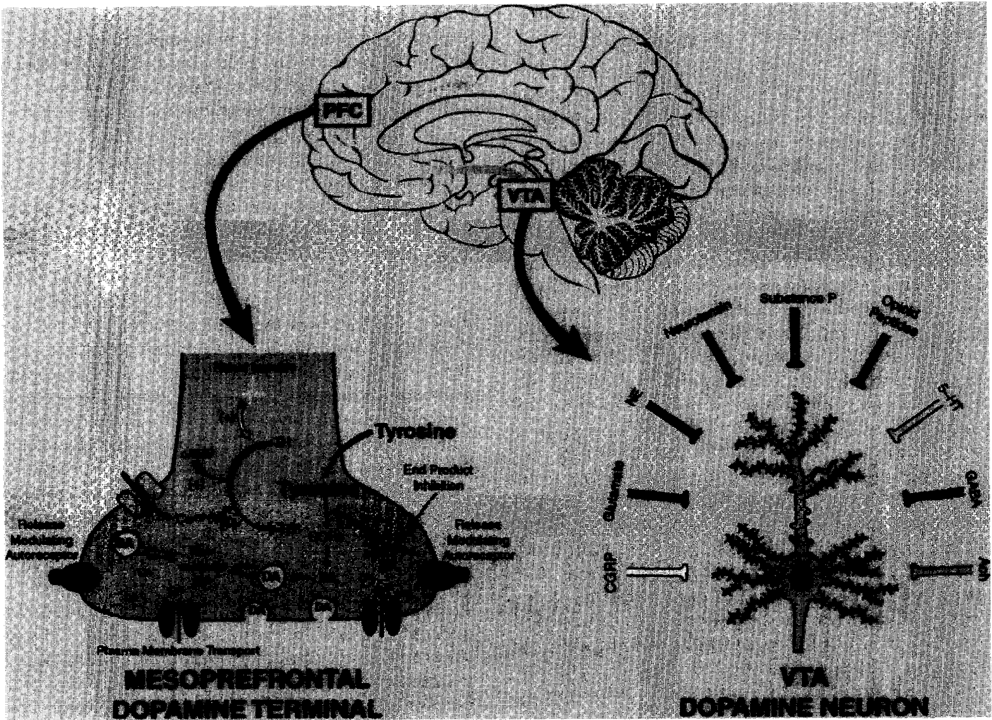
The dopamine (DA) neurons projecting to the prefrontal cortex (PFC) are thought to be involved in working memory, stress response, and the pathogenesis of schizophrenia. In this commentary, we review the current evidence supporting a precursor tyrosine dependence of these mesoprefrondal DN neurons. Several studies in rats employing different experimental paradigms [i.e. experimental diabetes and early-treated phenylketonuria (PKU) model] have shown that reduced tyrosine levels in brain can affect markedly the physiology and functions of these DA neurons. However, supplemental tyrosine is effective in enhancing functional transmitter outflow from mesoprefrontal DA neurons only under conditions where their physiological activity is enhanced and DA synthesis and release are uncoupled from intrinsic regulatory controls. Recent studies in humans have also suggested that variations in brain tyrosine levels can affect significantly higher cortical functions subserved by the PFC. In early-treated PKU patients with mildly reduced tyrosine levels, marked impairments in cognitive functions dependent on the dorsolateral PFC could be detected. In drug-treated schizophrenic patients, supplemental tyrosine was shown to have a disruptive effects on the smooth-pursuit eye movement performance task. Furthermore, tyrosine administration was effective in restoring impaired working memory in humans following cold stress paradigm, as assessed by a computer-based delayed matching to-sample memory task. These human studies, together with the current evidence obtained from animal experiments, suggest that the functions of the mesoprefrontal DA neurons can, under certain circumstances, be readily influenced by the availability of the precursor tyrosine.
Overview
The claims and statistics of this paper haven’t been checked yet.
Free: it reads the open-access text and checks the first 5 claims that cite a source we can check. Create a free account to check every claim.
Integrity signals
Registry
Cites
Statistics
Figures
Verification
Claims the paper makes
The claims and statistics of this paper haven’t been checked yet.
Free: it reads the open-access text and checks the first 5 claims that cite a source we can check. Create a free account to check every claim.
Claims other papers make about this one
Each is checked against this paper’s own text: does it say what the citing paper says it does?
The cited source says what the claim attributes to it.
In the citing paper
“low dose L-tyrosine (25 mg/kg) effectively increased L-tyrosine hydroxylation in a sustained manner, whereas higher dosage of L-tyrosine (50 mg/kg) triggered end-product inhibition (Tam & Roth, 1997).”
From Baseline-dependent effect of dopamine’s precursor L-tyrosine on working memory gating but not updating (2020) · cites this paper as Tam & Roth, 1997
Self-check
Percentages, sums and reported differences re-computed from the paper’s own numbers.
The self-check needs the paper’s full text.
Citations
Cites
The Metabolic and Molecular Bases of Inherited Disease
Scriver, R. C. (1995) · Medical Entomology and Zoology · Cited by 12,101
Psychopharmacology: The Fourth Generation of Progress
Bloom, F. E., & Kupfer, D. J. (1995) · Medical Entomology and Zoology · Cited by 2,985
Cellular basis of working memory
Goldman-Rakic, P. S. (1995) · Neuron · doi:10.1016/0896-6273(95)90304-6 · Cited by 2,663
Psychopharmacology: The Fourth Generation of Progress
Brophy, J. J. (1995) · JAMA: The Journal of the American Medical Association · doi:10.1001/jama.1995.03530220079046 · Cited by 1,582
A normative‐developmental study of executive function: A window on prefrontal function in children
Welsh, M. C., Pennington, B. F., & Groisser, D. B. (1991) · Developmental Neuropsychology · doi:10.1080/87565649109540483 · Cited by 1,313
Akbarian, S. (1995) · Archives of General Psychiatry · doi:10.1001/archpsyc.1995.03950160008002 · Cited by 1,002
Selemon, L. D. (1995) · Archives of General Psychiatry · doi:10.1001/archpsyc.1995.03950220015005 · Cited by 876
Neurotransmitter regulation of dopamine neurons in the ventral tegmental area
Kalivas, P. W. (1993) · Brain Research Reviews · doi:10.1016/0165-0173(93)90008-n · Cited by 708
Precursor control of neurotransmitter synthesis.
Wurtman, R. J., Hefti, F., & Melamed, E. (1980) · Pharmacological Reviews · doi:10.1016/s0031-6997(25)06841-3 · Cited by 671
Murphy, B. L., Arnsten, A. F., Goldman-Rakic, P. S., & Roth, R. H. (1996) · Proceedings of the National Academy of Sciences · doi:10.1073/pnas.93.3.1325 · Cited by 590
Self-citationDopaminergic innervation of the cerebral cortex: unexpected differences between rodents and primates
Berger, B., Gaspar, P., & Verney, C. (1991) · Trends in Neurosciences · doi:10.1016/0166-2236(91)90179-x · Cited by 588
Role of precursor availability in control of monoamine biosynthesis in brain.
Fernstrom, J. D. (1983) · Physiological Reviews · doi:10.1152/physrev.1983.63.2.484 · Cited by 489
Chapter 19 The determinants of stress-induced activation of the prefrontal cortical dopamine system
(1991) · Progress in Brain Research · doi:10.1016/s0079-6123(08)62691-6 · Cited by 364
Self-citationStress and the Mesocorticolimbic Dopamine Systemsa
ROTH, R. H., TAM, S., IDA, Y., YANG, J., & DEUTCH, A. Y. (1988) · Annals of the New York Academy of Sciences · doi:10.1111/j.1749-6632.1988.tb42102.x · Cited by 342
Self-citationChiodo, L. A., Bannon, M. J., Grace, A. A., Roth, R. H., & Bunney, B. S. (1984) · Neuroscience · doi:10.1016/0306-4522(84)90133-7 · Cited by 309
Self-citationBodis-Wollner, I. (1990) · Trends in Neurosciences · doi:10.1016/0166-2236(90)90113-o · Cited by 296
Synaptic regulation of mesocorticolimbic dopamine neurons
White, F. J. (1996) · Annual Review of Neuroscience · doi:10.1146/annurev.ne.19.030196.002201 · Cited by 289
Neuropsychology of Early-treated Phenylketonuria: Specific Executive Function Deficits
Welsh, M. C., Pennington, B. F., Ozonoff, S. J., Rouse, B. M., & McCabe, E. R. B. (1990) · Child Development · doi:10.1111/j.1467-8624.1990.tb03560.x · Cited by 277
Holzman, P. S. (1988) · Archives of General Psychiatry · doi:10.1001/archpsyc.1988.01800310049006 · Cited by 269
Frontal lobe dysfunctions in schizophrenia—I. Eye movement impairments
Levin, S. (1984) · Journal of Psychiatric Research · doi:10.1016/0022-3956(84)90046-3 · Cited by 258
(1997) · Humana Press eBooks · doi:10.1007/978-1-4757-2635-0 · Cited by 257
On the Plausibility of “The Neurodevelopmental Hypothesis” of Schizophrenia
Weinberger, D. (1996) · Neuropsychopharmacology · doi:10.1016/0893-133x(95)00199-n · Cited by 245
Mouse models of human phenylketonuria.
Shedlovsky, A., McDonald, J. D., Symula, D., & Dove, W. F. (1993) · Genetics · doi:10.1093/genetics/134.4.1205 · Cited by 244
Treatment with tyrosine, a neurotransmitter precursor, reduces environmental stress in humans
Banderet, L. E., & Lieberman, H. R. (1989) · Brain Research Bulletin · doi:10.1016/0361-9230(89)90096-8 · Cited by 208
Daviss, S. R., & Lewis, D. A. (1995) · Psychiatry Research · doi:10.1016/0165-1781(95)02720-3 · Cited by 187
Neuropsychology of Early-Treated Phenylketonuria: Specific Executive Function Deficits
Welsh, M. C., Pennington, B. F., Ozonoff, S., Rouse, B., & McCabe, E. R. B. (1990) · Child Development · doi:10.2307/1130832 · Cited by 181
Eye Tracking and Schizophrenia: A Selective Review
Levy, D. L., Holzman, P. S., Matthysse, S., & Mendell, N. R. (1994) · Schizophrenia Bulletin · doi:10.1093/schbul/20.1.47 · Cited by 180
Galloway, M. P., Wolf, M. E., & Roth, R. H. (1986) · The Journal of Pharmacology and Experimental Therapeutics · doi:10.1016/s0022-3565(25)38969-x · Cited by 144
Self-citationTyrosine reverses a cold-induced working memory deficit in humans
Shurtleff, D., Thomas, J. R., Schrot, J., Kowalski, K., & Harford, R. (1994) · Pharmacology Biochemistry and Behavior · doi:10.1016/0091-3057(94)90299-2 · Cited by 142
The Role of Mesoprefrontal Dopamine Neurons in Stress
Roth, R. H., & Horger, B. A. (1996) · Critical Reviews™ in Neurobiology · doi:10.1615/critrevneurobiol.v10.i3-4.60 · Cited by 130
Self-citationMayfield, R. D., Larson, G. A., Orona, R. A., & Zahniser, N. R. (1996) · Synapse · doi:10.1002/(sici)1098-2396(199602)22:2<132::aid-syn6>3.0.co;2-e · Cited by 110
Catecholamine synthesis: Physiological coupling to precursor supply
Milner, J. D., & Wurtman, R. J. (1986) · Biochemical Pharmacology · doi:10.1016/0006-2952(86)90071-7 · Cited by 102
Tam, S., & Roth, R. H. (1985) · Biochemical Pharmacology · doi:10.1016/0006-2952(85)90708-7 · Cited by 101
Self-citationAn animal model of early-treated PKU
Diamond, A., Ciaramitaro, V, Donner, E., Djali, S., & Robinson, M. (1994) · The Journal of Neuroscience · doi:10.1523/jneurosci.14-05-03072.1994 · Cited by 99
LOU, H. C., LYKKELUND, C., GERDES, A. ‐., UDESEN, H., & BRUHN, P. (1987) · Acta Paediatrica · doi:10.1111/j.1651-2227.1987.tb10521.x · Cited by 94
Neuropsychological deficits in early treated phenylketonuric children.
Pennington, B. F., van Doorninck, W. J., McCabe, L. L., & Er, M. (1985) · PubMed · Cited by 90
Bradberry, C. W., Lory, J. D., & Roth, R. H. (1991) · Journal of Neurochemistry · doi:10.1111/j.1471-4159.1991.tb01987.x · Cited by 88
Self-citationLykkelund, C., Nielsen, J. B., LOU, H. C., Rasmussen, V., Gerdes, A., Christensen, E., & G�ttler, F. (1988) · European Journal of Pediatrics · doi:10.1007/bf00441411 · Cited by 80
Waisbren, S., Brown, M., de Sonneville, L. M. J., & Levy, H. L. (1994) · Acta Paediatrica · doi:10.1111/j.1651-2227.1994.tb13464.x · Cited by 78
Smith, I. C. (1985) · Elsevier eBooks · doi:10.1016/b978-0-407-02312-3.50013-2 · Cited by 78
Tam, S. Y., Elsworth, J. D., Bradberry, C. W., & Roth, R. H. (1990) · Journal of Neural Transmission · doi:10.1007/bf01245830 · Cited by 75
Self-citationPhenylalanine levels of 6‐10mg/dl may not be as benign as once thought
Diamond, A. (1994) · Acta Paediatrica · doi:10.1111/j.1651-2227.1994.tb13462.x · Cited by 73
Diamond, A. D., & Herzberg, C. (1996) · Brain · doi:10.1093/brain/119.2.523 · Cited by 72
Acute tyrosine depletion reduces tyrosine hydroxylation rate in rat central nervous system
Fernstrom, M. H., & Fernstrom, J. D. (1995) · Life Sciences · doi:10.1016/0024-3205(95)02026-f · Cited by 69
Dopamine precursors and brain function in phenylalanine hydroxylase deficiency
Lou, H. C. (1994) · Acta Paediatrica · doi:10.1111/j.1651-2227.1994.tb13461.x · Cited by 61
Is There a Neuroanatomic Basis for Schizophrenia? An Old Question Revisited
Benes, F. M. (1995) · The Neuroscientist · doi:10.1177/107385849500100207 · Cited by 58
Badawy, A. A.-B., & Williams, D. L. (1982) · Biochemical Journal · doi:10.1042/bj2060165 · Cited by 58
Effect of high-dose tyrosine supplementation on brain function in adults with phenylketonuria
Pietz, J., Landwehr, R., Kutscha, A., Schmidt, H., de Sonneville, L. M. J., & Trefz, F. K. (1995) · The Journal of Pediatrics · doi:10.1016/s0022-3476(95)70031-5 · Cited by 56
Griffiths, P., Paterson, L., & Harvie, A. (1995) · Journal of Intellectual Disability Research · doi:10.1111/j.1365-2788.1995.tb00540.x · Cited by 50
Correlation of Wisconsin Card Sorting Test performance with eye tracking in schizophrenia
Litman, R. E., Hommer, D. W., Clem, T., Ornsteen, M., Ollo, C., & Pickar, D. (1991) · American Journal of Psychiatry · doi:10.1176/ajp.148.11.1580 · Cited by 47
Effects of systemicl-tyrosine on dopamine release from rat corpus striatum and nucleus accumbens
During, M. J., Acworth, I. N., & Wurtman, R. J. (1988) · Brain Research · doi:10.1016/0006-8993(88)90043-1 · Cited by 47
Fernstrom, M. H., Volk, E. A., Fernstrom, J. D., & Iuvone, P. M. (1986) · Life Sciences · doi:10.1016/0024-3205(86)90355-3 · Cited by 44
MacCready, R. A. (1974) · The Journal of Pediatrics · doi:10.1016/s0022-3476(74)80124-1 · Cited by 44
Bradberry, C. W., Karasic, D. H., Deutch, A. Y., & Roth, R. H. (1989) · Journal of Neural Transmission · doi:10.1007/bf01249231 · Cited by 44
Self-citationTam, S. Y., & Roth, R. H. (1990) · The Journal of Pharmacology and Experimental Therapeutics · doi:10.1016/s0022-3565(25)20219-1 · Cited by 44
Self-citationNeuropsychological Functioning in Treated Phenylketonuria
Faust, D., Libon, D. J., & Pueschel, S. M. (1987) · The International Journal of Psychiatry in Medicine · doi:10.2190/2209-39kw-bekl-w80j · Cited by 39
Iuvone, P. M., & Dunn, A. J. (1986) · Journal of Neurochemistry · doi:10.1111/j.1471-4159.1986.tb00687.x · Cited by 37
Tyrosine ameliorates a cold-induced delayed matching-to-sample performance decrement in rats
Shurtleff, D., Thomas, J. R., Ahlers, S. T., & Schrot, J. (1993) · Psychopharmacology · doi:10.1007/bf02244915 · Cited by 33
Cognition and Tyrosine Supplementation Among School-Aged Children With Phenylketonuria
Mazzocco, M. M. M., Yannicelli, S., Nord, A. M., van Doorninck, W., Davidson-Mundt, A. J., & Greene, C. L. (1992) · Archives of Pediatrics and Adolescent Medicine · doi:10.1001/archpedi.1992.02160230019009 · Cited by 30
Fernstrom, M. H., & Fernstrom, J. D. (1995) · Brain Research · doi:10.1016/0006-8993(94)01342-f · Cited by 28
Smith, I. C., & Brenton, D. P. (1995) · Springer eBooks · doi:10.1007/978-3-662-03147-6_12 · Cited by 26
Tyrosine enhances behavioral and mesocorticolimbic dopaminergic responses to aversive conditioning
Morrow, B. A., Elsworth, J. D., & Roth, R. H. (1996) · Synapse · doi:10.1002/(sici)1098-2396(199602)22:2<100::aid-syn2>3.0.co;2-h · Cited by 20
Self-citationL-Tyrosine Pharmacotherapy of Schizophrenia: Preliminary Data
Deutsch, S. I., Rosse, R. B., Schwartz, B. L., Banay‐Schwartz, M., McCarthy, M. F., & Johri, S. K. (1994) · Clinical Neuropharmacology · doi:10.1097/00002826-199402000-00006 · Cited by 15
Research works printed but not linked: 3
- Elsworth JD and Roth RH, Dopamine autoreceptor pharma- cology and function: Recent insights. In: The Dopamine Re- ceptors (Ed. Neve KA), pp. 223-265.
- Berman KF and Weinberger D, The prefrontal cortex in schizophrenia and other neuropsychiatric disease: In viva physiological correlates of cognitive deficits. In: Progress in Brain Research (Eds. Uylings HBM, Van Eden CG, DeBruin JPC, Corner MA and Feenstra MPG), Vol. 85, pp. 521-537. Elsevier Science, Amsterdam, 1990.
- Thomas JR, Shurtleff D, Schrot J and Moran R, Tyrosine reverses cold-stress induced impairment of DRL performance in rats. Sot Neurosci Abstr 20: 1564, 1994.
Cited by
Genetic and neurochemical modulation of prefrontal cognitive functions in children
Diamond, A., Briand, L., Fossella, J., & Gehlbach, L. (2004) · American Journal of Psychiatry · doi:10.1176/appi.ajp.161.1.125 · Cited by 381
Arginine metabolism and the synthesis of nitric oxide in the nervous system
Wiesinger, H. (2001) · Progress in Neurobiology · doi:10.1016/s0301-0082(00)00056-3 · Cited by 352
Wahlstrom, D., Collins, P., White, T., & Luciana, M. (2010) · Brain and Cognition · doi:10.1016/j.bandc.2009.10.013 · Cited by 311
Neurobehavioral evidence for changes in dopamine system activity during adolescence
Wahlstrom, D., White, T., & Luciana, M. (2010) · Neuroscience & Biobehavioral Reviews · doi:10.1016/j.neubiorev.2009.12.007 · Cited by 277
“degree of burst activity of DA neurons, the amount of DA turnover, the sensitivity to DA agonists and antagonists, the absence of impulse-and nerve-terminal autoreceptors, and the development of tolerance following chronic neuroleptic administration (Bannon and Roth, 1983; Bjorklund and Dunnett, 2007; Tam and Roth, 19…”
BackgroundWhite matter pathology in phenylketonuria☆
Anderson, P. J., & Leuzzi, V. (2010) · Molecular Genetics and Metabolism · doi:10.1016/j.ymgme.2009.10.005 · Cited by 190
Metadata
- Authors
- Tarn, S.-Y., & Roth, R. H.
- Affiliations
- Harvard University (US)
- Yale University (US)
- Corresponding author
- Roth, Robert H.
- Venue
- Biochemical Pharmacology
- Publisher
- Elsevier BV
- Published
- 1997-02
- Volume
- 53
- Issue
- 4
- Pages
- 441-453
- ISSN
- 0006-2952 (ISSN-L)
- OpenAlex
- W2087978632
- Cited by
- 74
- References
- 62
- Citations by year
- 2024: 1 · 2023: 1 · 2022: 2 · 2021: 1 · 2020: 3 · 2019: 3 · 2017: 5 · 2016: 2 · 2015: 1 · 2014: 1 · 2013: 2
- FWCI
- 0.28
- Type
- journal article
- Language
- en
- Open access
- hybrid
- doi.org
- Licence
- cc-by-nc-nd
- www.elsevier.com/tdm/userlicense/1.0/ (tdm)
- www.elsevier.com/legal/tdmrep-license (tdm)
- creativecommons.org/licenses/by-nc-nd/4.0/ (vor, 338 d)
- Locations
- Biochemical Pharmacology (publishedVersion, cc-by-nc-nd)
- PubMed (publishedVersion)
- Funders
- National Institute of Mental Health (MH14092)
- Topics
- Life Sciences › Neuroscience › Cellular and Molecular Neuroscience › Neurotransmitter Receptor Influence on Behavior
- Life Sciences › Biochemistry, Genetics and Molecular Biology › Biochemistry › Amino Acid Enzymes and Metabolism
- Health Sciences › Medicine › Psychiatry and Mental health › Schizophrenia research and treatment
- Keywords
- dopamine synthesis, phenylketonuria, experimental diabetes, tyrosine supplementation, working memory, schizophrenia, dorsolateral prefrontal cortex, cold stress, smooth pursuit eye movements, cognitive impairment
- MeSH terms
- Animals, Diabetes Mellitus, Experimental, Dopamine, Humans, Memory, Phenylketonurias, Schizophrenia, Species Specificity, Tyrosine, Prefrontal Cortex, Rats
About these checks
Registry, retraction, Cites and statistics results are computed, not judged, with one exception: a printed reference that no index lists is read once by a model before it counts as a citation error. Claims are extracted by a model and kept only when their quote appears verbatim in the text; each cited source is then checked, with a model’s help, for whether it says what the claim relies on. Those verdicts can be wrong — read the claim’s quote and the cited source before relying on one.
Statistics and arithmetic are recomputed, not judged.
Confidence bands are shown only for fields calibrated on our annotated test set. None is calibrated yet, so no band is shown.
What counts as a claim ›How we measure confidence ›How we check this ›
Are you an author, or do you see a problem with this page? Request a review
Data sources
Bibliographic data: Semantic Scholar, OpenAlex, Crossref.
Contains information from the Semantic Scholar Academic Graph Datasets, made available under the ODC Attribution License (ODC-BY 1.0).
Semantic Scholar’s data is described in: Kinney, R., et al. (2023). The Semantic Scholar Open Data Platform. arXiv:2301.10140.
