

The DOI matches its Crossref record; 97 of the 107 references it cites were found in a registry or an index; 4 of the 71 sources its claims cite were checked for support.
Effectiveness of interventions to improve drinking water, sanitation, and handwashing with soap on risk of diarrhoeal disease in children in low-income and middle-income settings: a systematic review and meta-analysis
Open accessAbstract
BACKGROUND: Estimates of the effectiveness of water, sanitation, and hygiene (WASH) interventions that provide high levels of service on childhood diarrhoea are scarce. We aimed to provide up-to-date estimates on the burden of disease attributable to WASH and on the effects of different types of WASH interventions on childhood diarrhoea in low-income and middle-income countries (LMICs). METHODS: In this systematic review and meta-analysis, we updated previous reviews following their search strategy by searching MEDLINE, Embase, Scopus, Cochrane Library, and BIOSIS Citation Index for studies of basic WASH interventions and of WASH interventions providing a high level of service, published between Jan 1, 2016, and May 25, 2021. We included randomised and non-randomised controlled trials conducted at household or community level that matched exposure categories of the so-called service ladder approach of the Sustainable Development Goal (SDG) for WASH. Two reviewers independently extracted study-level data and assessed risk of bias using a modified Newcastle-Ottawa Scale and certainty of evidence using a modified Grading of Recommendations, Assessment, Development, and Evaluation approach. We analysed extracted relative risks (RRs) and 95% CIs using random-effects meta-analyses and meta-regression models. This study is registered with PROSPERO, CRD42016043164. FINDINGS: 19 837 records were identified from the search, of which 124 studies were included, providing 83 water (62 616 children), 20 sanitation (40 799 children), and 41 hygiene (98 416 children) comparisons. Compared with untreated water from an unimproved source, risk of diarrhoea was reduced by up to 50% with water treated at point of use (POU): filtration (n=23 studies; RR 0·50 [95% CI 0·41-0·60]), solar treatment (n=13; 0·63 [0·50-0·80]), and chlorination (n=25; 0·66 [0·56-0·77]). Compared with an unimproved source, provision of an improved drinking water supply on premises with higher water quality reduced diarrhoea risk by 52% (n=2; 0·48 [0·26-0·87]). Overall, sanitation interventions reduced diarrhoea risk by 24% (0·76 [0·61-0·94]). Compared with unimproved sanitation, providing sewer connection reduced diarrhoea risk by 47% (n=5; 0·53 [0·30-0·93]). Promotion of handwashing with soap reduced diarrhoea risk by 30% (0·70 [0·64-0·76]). INTERPRETATION: WASH interventions reduced risk of diarrhoea in children in LMICs. Interventions supplying either water filtered at POU, higher water quality from an improved source on premises, or basic sanitation services with sewer connection were associated with increased reductions. Our results support higher service levels called for under SDG 6. Notably, no studies evaluated interventions that delivered access to safely managed WASH services, the level of service to which universal coverage by 2030 is committed under the SDG. FUNDING: WHO, Foreign, Commonwealth & Development Office, and National Institute of Environmental Health Sciences.
Overview
AI snapshot
Written from the paper’s full text.
TL;DR
This systematic review and meta-analysis found that water, sanitation, and hygiene interventions reduced childhood diarrhoea risk in low-income and middle-income countries, with larger reductions for point-of-use filtration, higher-quality water on premises, and sewer connection. No included study delivered safely managed WASH services.
Key findings
- Across 124 studies, there were 83 water comparisons (62,616 children), 20 sanitation comparisons (40,799 children), and 41 hygiene comparisons (98,416 children). Compared with untreated water from an unimproved source, diarrhoea risk was reduced by point-of-use filtration (n=23; RR 0·50 [95% CI 0·41–0·60]), solar treatment (n=13; 0·63 [0·50–0·80]), and chlorination (n=25; 0·66 [0·56–0·77]); improved drinking water on premises with higher water quality reduced risk by 52% (n=2; 0·48 [0·26–0·87]).
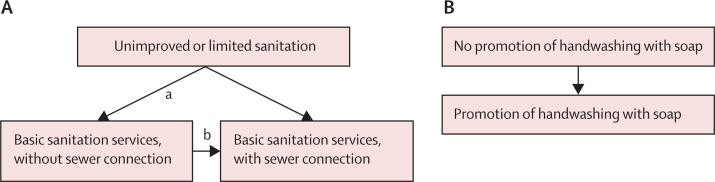
- Overall sanitation interventions reduced diarrhoea risk by 24% (RR 0·76 [95% CI 0·61–0·94]); compared with unimproved or limited sanitation, sewer connection reduced risk by 47% (n=5; 0·53 [0·30–0·93]) and basic sanitation without sewer connection by 21% (0·79 [0·61–1·03]).
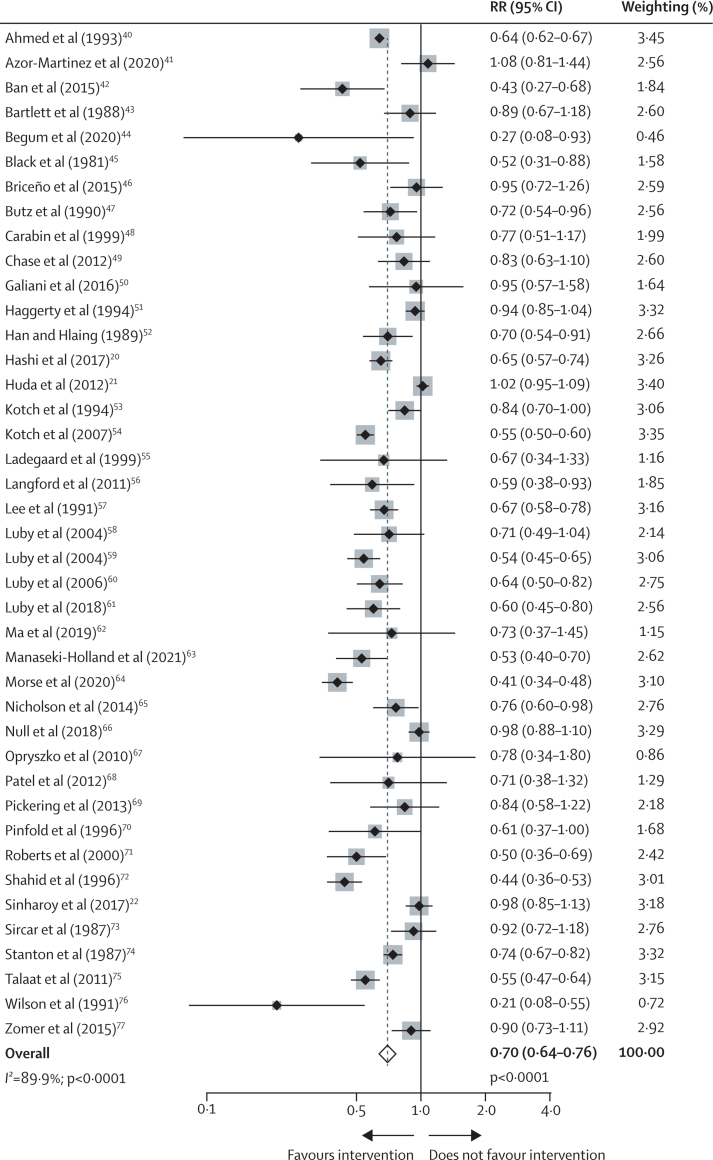
- Promotion of handwashing with soap reduced diarrhoea risk by 30% (RR 0·70 [95% CI 0·64–0·76]).
- No studies evaluated interventions delivering safely managed WASH services, and only five (4%) of 124 included studies reported results by sex.
Methods
- The authors updated previous reviews by searching MEDLINE, Embase, Scopus, Cochrane Library, and BIOSIS Citation Index for studies published between Jan 1, 2016, and May 25, 2021, covering literature from Jan 1, 1970, with prior reviews; eligible designs were randomised and non-randomised controlled trials at household or community level matching SDG WASH service-ladder exposure categories.
- Two reviewers independently extracted study-level data and assessed risk of bias using a modified Newcastle-Ottawa Scale and certainty of evidence using a modified GRADE approach.
- They analysed extracted relative risks and 95% CIs using random-effects meta-analyses and meta-regression models in Stata version 14.2; the study is registered with PROSPERO, CRD42016043164.
Limitations
- The paper states that it did not systematically search grey literature, and notes potential exposure misclassification, low compliance, response bias, high heterogeneity across studies, limitations related to study-level analysis, and possible confounding because WASH components and intervention approaches depend on study context.
- The paper states that evidence certainty ranged from moderate to very low, mainly because of non-randomised study designs, risk of bias, and imprecision; it also notes that GRADE was developed for health-care interventions and that complex public health interventions such as WASH are difficult to randomise or mask.
- Evident from the text: no studies delivered safely managed WASH services; evidence for higher-level services was scarce (e.g., only two studies for improved on-premises higher water quality, one for continuous supply, and five sewer-connection studies), and sex-disaggregated reporting was available in only five of 124 studies.
Model-written summary. Check it against the paper before relying on it.
Integrity signals
Registry
Cites
Statistics
Figures
Verification
Claims the paper makes
32 Not checked yet · 31 Own result · 13 Own method · 10 No basis given · 8 Own interpretation · 4 Sources not found · 2 Partly supported · accuracy not yet measured
The cited sources support only part of this claim — read each source’s verdict below.
In the paper
“However, quantification of the global burden of disease related to improvements to water, sanitation, and hygiene (WASH) is limited by the challenge of securing reliable estimates of risk from diverse settings, conditions, and populations.3, 6”
§ Effectiveness of interventions to improve drinking water, sanitation, and handwashing with soap on risk of diarrhoeal disease in children in low-income and middle-income settings: a systematic review and meta-analysis > Introduction
What the sources say
- Partly supportedcites [3] Freeman MC Garn JV Sclar GD The impact of sanitation on infectious disease and nutritional status: a systematic review and meta-analysis Int J Hyg Environ Health 220 2017 928 949 28602619 sourceExperimental — accuracy not yet measured
The Discussion (page unavailable) reports high heterogeneity across sanitation studies, linked to differences in disease burden, WASH coverage, environmental conditions, and interventions; it also says differing measurements made studies hard to compare. This supports the difficulty of obtaining comparable risk estimates across settings, but the paper does not explicitly establish that this limits quantification of the global disease burden from improvements to WASH as a whole. (LLM, conf=0.84)
- Supportedcites [6] Prüss-Ustün A Wolf J Bartram J Burden of disease from inadequate water, sanitation and hygiene for selected adverse health outcomes: an updated analysis with a focus on lowand middle-income countries Int J Hyg Environ Health 222 2019 765 777 31088724 PMC6593152 source
The Conclusions say WASH burden estimates are approximate, depend on exposure-response functions and assumptions, and omit some settings and populations. They also call for better trials and exposure-response data, supporting the claim that reliable risk estimates across diverse conditions are a limiting factor. Page numbers are not provided in our copy. (LLM, conf=0.90)
plain- Asserted: passes — The authors put it forward as true.
- Checkable: passes — It can be checked against evidence.
- Load-bearing: passes — The paper’s conclusions depend on it.
- Based: passes — The paper gives a reason why it holds.
- Partly supported
A result the paper reports from its own data — it cites no other source for it, so there is none to check. The quote shows it is in the paper.
In the paper
“and chlorination (n=25; 0·66 [0·56–0·77]; table 1)”
§ Effectiveness of interventions to improve drinking water, sanitation, and handwashing with soap on risk of diarrhoeal disease in children in low-income and middle-income settings: a systematic review and meta-analysis > Results
plaindirectn = 25- Asserted: passes — The authors put it forward as true.
- Checkable: passes — It can be checked against evidence.
- Load-bearing: passes — The paper’s conclusions depend on it.
- Based: passes — The paper gives a reason why it holds.
A result the paper reports from its own data — it cites no other source for it, so there is none to check. The quote shows it is in the paper.
In the paper
“No effect was found for other covariates (p>0·10; appendix 2 pp 13–14).”
§ Effectiveness of interventions to improve drinking water, sanitation, and handwashing with soap on risk of diarrhoeal disease in children in low-income and middle-income settings: a systematic review and meta-analysis > Results
plain- Asserted: passes — The authors put it forward as true.
- Checkable: passes — It can be checked against evidence.
- Load-bearing: unclear — It is unclear whether the paper’s conclusions depend on it.
- Based: passes — The paper gives a reason why it holds.
The paper states this without a source or data behind it here, so there is nothing to check it against. The quote shows it is in the paper.
In the paper
“Although a substantial body of evidence is available from interventions of basic WASH services (eg, simple improved drinking water or sanitation, or point-of-use drinking water treatment), evidence from interventions providing higher levels of WASH services remains scarce.”
§ Effectiveness of interventions to improve drinking water, sanitation, and handwashing with soap on risk of diarrhoeal disease in children in low-income and middle-income settings: a systematic review and meta-analysis > Introduction
plain- Asserted: passes — The authors put it forward as true.
- Checkable: passes — It can be checked against evidence.
- Load-bearing: passes — The paper’s conclusions depend on it.
- Based: passes — The paper gives a reason why it holds.
- Rests on an assumption: Previous analyses have often not considered intervention types extending beyond basic WASH services, such as drinking water delivered on premises, of high quality, or continuously available, or sanitation that safely disposes excreta or removes and safely treats it offsite.
A result the paper reports from its own data — it cites no other source for it, so there is none to check. The quote shows it is in the paper.
In the paper
“Compared with untreated water from an unimproved source, diarrhoea risk was reduced by 52% (n=2; 0·48 [0·26–0·87]) with provision of an improved drinking water supply on premises with higher water quality”
§ Effectiveness of interventions to improve drinking water, sanitation, and handwashing with soap on risk of diarrhoeal disease in children in low-income and middle-income settings: a systematic review and meta-analysis > Results
plaindirectn = 2- Asserted: passes — The authors put it forward as true.
- Checkable: passes — It can be checked against evidence.
- Load-bearing: passes — The paper’s conclusions depend on it.
- Based: passes — The paper gives a reason why it holds.
A result the paper reports from its own data — it cites no other source for it, so there is none to check. The quote shows it is in the paper.
In the paper
“The meta-regression model explained 17% of the between-study variance of sanitation studies.”
§ Effectiveness of interventions to improve drinking water, sanitation, and handwashing with soap on risk of diarrhoeal disease in children in low-income and middle-income settings: a systematic review and meta-analysis > Results
plaincorrelational- Asserted: passes — The authors put it forward as true.
- Checkable: passes — It can be checked against evidence.
- Load-bearing: unclear — It is unclear whether the paper’s conclusions depend on it.
- Based: passes — The paper gives a reason why it holds.
A result the paper reports from its own data — it cites no other source for it, so there is none to check. The quote shows it is in the paper.
In the paper
“filtration (n=23 studies; RR 0·50 [95% CI 0·41–0·60])”
§ Effectiveness of interventions to improve drinking water, sanitation, and handwashing with soap on risk of diarrhoeal disease in children in low-income and middle-income settings: a systematic review and meta-analysis > Abstract > Findings
plaindirectn = 23- Asserted: passes — The authors put it forward as true.
- Checkable: passes — It can be checked against evidence.
- Load-bearing: passes — The paper’s conclusions depend on it.
- Based: passes — The paper gives a reason why it holds.
A result the paper reports from its own data — it cites no other source for it, so there is none to check. The quote shows it is in the paper.
In the paper
“Overall, the random-effects meta-analysis of all 20 sanitation comparisons showed a reduction in risk of diarrhoea of 24% (RR 0·76 [95% CI 0·61–0·94]), with an I2 of 96% (appendix 2 p 10).”
§ Effectiveness of interventions to improve drinking water, sanitation, and handwashing with soap on risk of diarrhoeal disease in children in low-income and middle-income settings: a systematic review and meta-analysis > Results
plaindirect- Asserted: passes — The authors put it forward as true.
- Checkable: passes — It can be checked against evidence.
- Load-bearing: passes — The paper’s conclusions depend on it.
- Based: passes — The paper gives a reason why it holds.
A result the paper reports from its own data — it cites no other source for it, so there is none to check. The quote shows it is in the paper.
In the paper
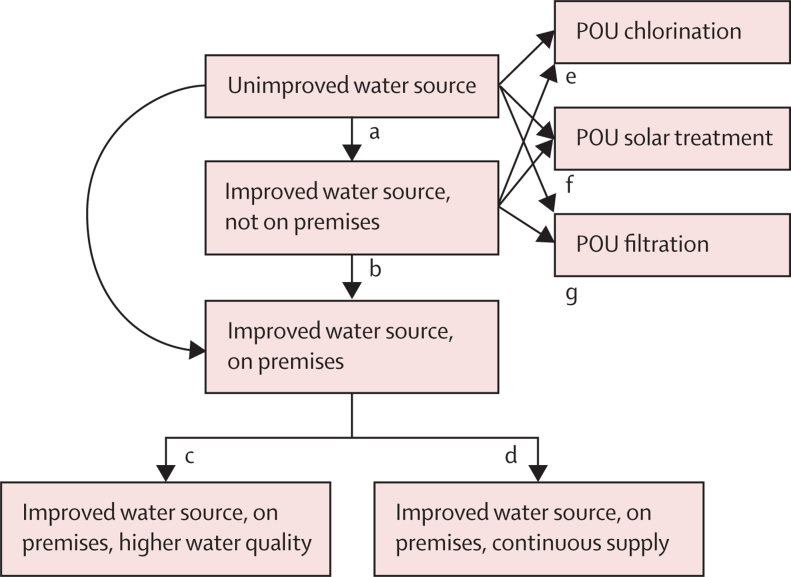
“The random-effects meta-regression model of drinking water interventions according to figure 1 indicated that provision of improved drinking water on premises with higher water quality or POU filtration was associated with a larger reduction in risk of diarrhoea than were other intervention types.”
§ Effectiveness of interventions to improve drinking water, sanitation, and handwashing with soap on risk of diarrhoeal disease in children in low-income and middle-income settings: a systematic review and meta-analysis > Results
hedgedcorrelational- Asserted: passes — The authors put it forward as true.
- Checkable: passes — It can be checked against evidence.
- Load-bearing: passes — The paper’s conclusions depend on it.
- Based: passes — The paper gives a reason why it holds.
A result the paper reports from its own data — it cites no other source for it, so there is none to check. The quote shows it is in the paper.
In the paper
“Sanitation interventions with a longer follow-up time (≥24 months) were associated with smaller reductions in diarrhoea (p=0·005).”
§ Effectiveness of interventions to improve drinking water, sanitation, and handwashing with soap on risk of diarrhoeal disease in children in low-income and middle-income settings: a systematic review and meta-analysis > Results
plaincorrelational- Asserted: passes — The authors put it forward as true.
- Checkable: passes — It can be checked against evidence.
- Load-bearing: unclear — It is unclear whether the paper’s conclusions depend on it.
- Based: passes — The paper gives a reason why it holds.
- Probably not a substantial claim. 33
- It may state two separate claims as one. 36
The cited sources support only part of this claim — read each source’s verdict below.
In the paper
“These estimates are not disaggregated by sex, despite calls and guidelines to do so in public health11, 12 and in the WASH sector.13”
§ Effectiveness of interventions to improve drinking water, sanitation, and handwashing with soap on risk of diarrhoeal disease in children in low-income and middle-income settings: a systematic review and meta-analysis > Introduction
What the sources say
- Partly supportedcites [11] Hawkes S Haseen F Aounallah-Skhiri H Measurement and meaning: reporting sex in health research Lancet 393 2019 497 499 30739669 sourceExperimental — accuracy not yet measured
In “Measurement and meaning: reporting sex in health research” (page not given), the authors call for more sex-related reporting and an accountability revolution in health research. That supports the public-health call cited here, but the paper does not provide a guideline for sex-disaggregating disease-burden estimates. The WASH-sector claim is attached to a different citation. (LLM, conf=0.82)
- Supportedcites [12] Heidari S Babor TF De Castro P Tort S Curno M Sex and Gender Equity in Research: rationale for the SAGER guidelines and recommended use Res Integr Peer Rev 1 2016 2 29451543 PMC5793986 source
The Results > SAGER guidelines section calls for research data to be reported disaggregated by sex, including data relevant to health problems. This supports the public-health-guidelines portion attributed to this source; the sentence does not attribute the WASH-specific guidelines or the status of WASH burden estimates to it. (LLM, conf=0.92)
- Not checked yetcites [13] Caruso BA Sinharoy SS Gender data gaps represent missed opportunities in WASH Lancet Glob Health 7 2019 e1617 31708141 source
plain- Asserted: passes — The authors put it forward as true.
- Checkable: passes — It can be checked against evidence.
- Load-bearing: fails — The paper’s conclusions may not depend on it.
- Based: passes — The paper gives a reason why it holds.
Probably not a substantial claim. The paper’s conclusions may not depend on it.
- Partly supported
A result the paper reports from its own data — it cites no other source for it, so there is none to check. The quote shows it is in the paper.
In the paper
“Further examined covariates, including improved sanitation (p=0·35) and rural setting (p=0·37), were not associated with risk of diarrhoeal disease; appendix 2 p 13).”
§ Effectiveness of interventions to improve drinking water, sanitation, and handwashing with soap on risk of diarrhoeal disease in children in low-income and middle-income settings: a systematic review and meta-analysis > Results
plain- Asserted: passes — The authors put it forward as true.
- Checkable: passes — It can be checked against evidence.
- Load-bearing: unclear — It is unclear whether the paper’s conclusions depend on it.
- Based: passes — The paper gives a reason why it holds.
It may state two separate claims as one.
A result the paper reports from its own data — it cites no other source for it, so there is none to check. The quote shows it is in the paper.
In the paper
“The total study population included 62 616 children in the drinking water analysis, 40 799 children in the sanitation analysis, and 98 416 children in the hygiene analysis.”
§ Effectiveness of interventions to improve drinking water, sanitation, and handwashing with soap on risk of diarrhoeal disease in children in low-income and middle-income settings: a systematic review and meta-analysis > Results
plain- Asserted: passes — The authors put it forward as true.
- Checkable: passes — It can be checked against evidence.
- Load-bearing: unclear — It is unclear whether the paper’s conclusions depend on it.
- Based: passes — The paper gives a reason why it holds.
It may state two separate claims as one.
A result the paper reports from its own data — it cites no other source for it, so there is none to check. The quote shows it is in the paper.
In the paper
“The meta-regression model explained 11% of the between-study variance of drinking water studies.”
§ Effectiveness of interventions to improve drinking water, sanitation, and handwashing with soap on risk of diarrhoeal disease in children in low-income and middle-income settings: a systematic review and meta-analysis > Results
plaincorrelational- Asserted: passes — The authors put it forward as true.
- Checkable: passes — It can be checked against evidence.
- Load-bearing: fails — The paper’s conclusions may not depend on it.
- Based: passes — The paper gives a reason why it holds.
Probably not a substantial claim. The paper’s conclusions may not depend on it.
A result the paper reports from its own data — it cites no other source for it, so there is none to check. The quote shows it is in the paper.
In the paper
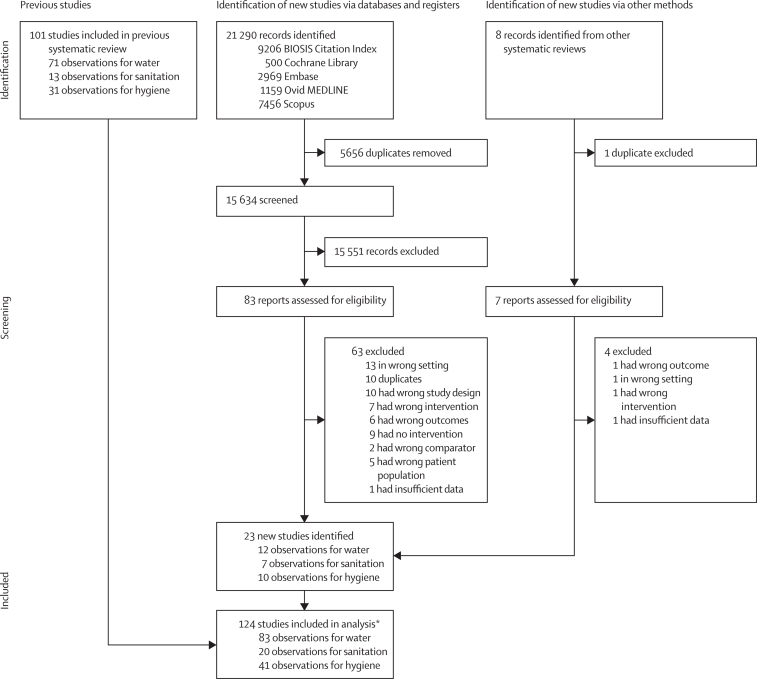
“21 290 records were identified from the search, of which 15 634 were screened and 83 assessed for eligibility (figure 3).”
§ Effectiveness of interventions to improve drinking water, sanitation, and handwashing with soap on risk of diarrhoeal disease in children in low-income and middle-income settings: a systematic review and meta-analysis > Results
plain- Asserted: passes — The authors put it forward as true.
- Checkable: passes — It can be checked against evidence.
- Load-bearing: fails — The paper’s conclusions may not depend on it.
- Based: passes — The paper gives a reason why it holds.
Probably not a substantial claim. The paper’s conclusions may not depend on it. It may state two separate claims as one.
A result the paper reports from its own data — it cites no other source for it, so there is none to check. The quote shows it is in the paper.
In the paper
“23 new studies were added to the previous meta-analyses, including 12 new comparisons for the water analysis, seven for the sanitation analysis, and ten for the hygiene analysis.”
§ Effectiveness of interventions to improve drinking water, sanitation, and handwashing with soap on risk of diarrhoeal disease in children in low-income and middle-income settings: a systematic review and meta-analysis > Results
plain- Asserted: passes — The authors put it forward as true.
- Checkable: passes — It can be checked against evidence.
- Load-bearing: fails — The paper’s conclusions may not depend on it.
- Based: passes — The paper gives a reason why it holds.
Probably not a substantial claim. The paper’s conclusions may not depend on it. It may state two separate claims as one.
A result the paper reports from its own data — it cites no other source for it, so there is none to check. The quote shows it is in the paper.
In the paper
“This systematic review contains evidence from 124 WASH interventions.”
§ Effectiveness of interventions to improve drinking water, sanitation, and handwashing with soap on risk of diarrhoeal disease in children in low-income and middle-income settings: a systematic review and meta-analysis > Introduction
plain- Asserted: passes — The authors put it forward as true.
- Checkable: passes — It can be checked against evidence.
- Load-bearing: fails — The paper’s conclusions may not depend on it.
- Based: passes — The paper gives a reason why it holds.
Probably not a substantial claim. The paper’s conclusions may not depend on it.
None of the sources cited for this claim have been checked yet.
In the paper
“Only four studies of drinking water (three POU filter studies36, 37, 38 and one POU chlorine study39) reported results by sex; thus, our estimates are not disaggregated by sex (appendix 1 pp 5–7).”
§ Effectiveness of interventions to improve drinking water, sanitation, and handwashing with soap on risk of diarrhoeal disease in children in low-income and middle-income settings: a systematic review and meta-analysis > Results
What the sources say
- Not checked yetcites [36] Aiken BA Stauber CE Ortiz GM Sobsey MD An assessment of continued use and health impact of the concrete biosand filter in Bonao, Dominican Republic Am J Trop Med Hyg 85 2011 309 317 21813853 PMC3144831 source
- Not matchedcites [37] Brown J Improving household drinking water quality: use of ceramic water filters in Cambodia https://www.wsp.org/sites/wsp/files/publications/926200724252_eap_cambodia_filter.pdf August, 2007
Couldn’t be matched to a paper in Crossref, so it can’t be checked.
- Not checked yetcites [38] Brown J Sobsey MD Loomis D Local drinking water filters reduce diarrheal disease in Cambodia: a randomized, controlled trial of the ceramic water purifier Am J Trop Med Hyg 79 2008 394 400 18784232 source
- Not checked yetcites [39] Harshfield E Lantagne D Turbes A Null C Evaluating the sustained health impact of household chlorination of drinking water in rural Haiti Am J Trop Med Hyg 87 2012 786 795 22987657 PMC3516252 source
plain- Asserted: passes — The authors put it forward as true.
- Checkable: passes — It can be checked against evidence.
- Load-bearing: unclear — It is unclear whether the paper’s conclusions depend on it.
- Based: passes — The paper gives a reason why it holds.
It may state two separate claims as one.
A result the paper reports from its own data — it cites no other source for it, so there is none to check. The quote shows it is in the paper.
In the paper
“In total, 124 studies were included in this systematic review, with 83 drinking water comparisons (78 separate studies), 20 sanitation comparisons (19 separate studies), and 41 hygiene comparisons (41 separate studies).”
§ Effectiveness of interventions to improve drinking water, sanitation, and handwashing with soap on risk of diarrhoeal disease in children in low-income and middle-income settings: a systematic review and meta-analysis > Results
plain- Asserted: passes — The authors put it forward as true.
- Checkable: passes — It can be checked against evidence.
- Load-bearing: fails — The paper’s conclusions may not depend on it.
- Based: passes — The paper gives a reason why it holds.
Probably not a substantial claim. The paper’s conclusions may not depend on it. It may state two separate claims as one.
The paper states this without a source or data behind it here, so there is nothing to check it against. The quote shows it is in the paper.
In the paper
“Scarce evidence was available for this exposure category; thus, addition of new evidence substantially changed estimates.”
§ Effectiveness of interventions to improve drinking water, sanitation, and handwashing with soap on risk of diarrhoeal disease in children in low-income and middle-income settings: a systematic review and meta-analysis > Discussion
plaindirect- Asserted: passes — The authors put it forward as true.
- Checkable: passes — It can be checked against evidence.
- Load-bearing: unclear — It is unclear whether the paper’s conclusions depend on it.
- Based: passes — The paper gives a reason why it holds.
It may state two separate claims as one.
The paper states this without a source or data behind it here, so there is nothing to check it against. The quote shows it is in the paper.
In the paper
“Around half of the handwashing interventions focused on handwashing promotion with or without soap provision, whereas the other half of interventions involved broader hygiene education, such as on food and kitchen hygiene or on safe drinking water and sanitation.”
§ Effectiveness of interventions to improve drinking water, sanitation, and handwashing with soap on risk of diarrhoeal disease in children in low-income and middle-income settings: a systematic review and meta-analysis > Discussion
plain- Asserted: passes — The authors put it forward as true.
- Checkable: passes — It can be checked against evidence.
- Load-bearing: fails — The paper’s conclusions may not depend on it.
- Based: passes — The paper gives a reason why it holds.
Probably not a substantial claim. The paper’s conclusions may not depend on it. It may state two separate claims as one.
A result the paper reports from its own data — it cites no other source for it, so there is none to check. The quote shows it is in the paper.
In the paper
“Nevertheless, pooled RRs were remarkably close comparing household or community versus institutional setting, low-income, and middle-income versus high-income settings, or different hygiene interventions.”
§ Effectiveness of interventions to improve drinking water, sanitation, and handwashing with soap on risk of diarrhoeal disease in children in low-income and middle-income settings: a systematic review and meta-analysis > Discussion
plain- Asserted: passes — The authors put it forward as true.
- Checkable: passes — It can be checked against evidence.
- Load-bearing: unclear — It is unclear whether the paper’s conclusions depend on it.
- Based: passes — The paper gives a reason why it holds.
It may state two separate claims as one.
None of the sources cited for this claim have been checked yet.
In the paper
“In these interventions, drinking water was not free from microbial contamination24, 95 and was still stored at household level85 after intervention implementation.”
§ Effectiveness of interventions to improve drinking water, sanitation, and handwashing with soap on risk of diarrhoeal disease in children in low-income and middle-income settings: a systematic review and meta-analysis > Discussion
What the sources say
- Not checked yetcites [24] Hunter PR Ramírez Toro GI Minnigh HA Impact on diarrhoeal illness of a community educational intervention to improve drinking water quality in rural communities in Puerto Rico BMC Public Health 10 2010 219 20426831 PMC2876105 source
- Not checked yetcites [95] Pickering AJ Crider Y Sultana S Effect of in-line drinking water chlorination at the point of collection on child diarrhoea in urban Bangladesh: a double-blind, cluster-randomised controlled trial Lancet Glob Health 7 2019 e1247 e1256 31402005 source
- Not checked yetcites [85] Ercumen A Arnold BF Kumpel E Upgrading a piped water supply from intermittent to continuous delivery and association with waterborne illness: a matched cohort study in urban India PLoS Med 12 2015 e1001892 PMC4624240 26505897 source
plain- Asserted: passes — The authors put it forward as true.
- Checkable: passes — It can be checked against evidence.
- Load-bearing: passes — The paper’s conclusions depend on it.
- Based: passes — The paper gives a reason why it holds.
It may state two separate claims as one.
A result the paper reports from its own data — it cites no other source for it, so there is none to check. The quote shows it is in the paper.
In the paper
“No sanitation studies reported results by sex.”
§ Effectiveness of interventions to improve drinking water, sanitation, and handwashing with soap on risk of diarrhoeal disease in children in low-income and middle-income settings: a systematic review and meta-analysis > Results
plain- Asserted: passes — The authors put it forward as true.
- Checkable: passes — It can be checked against evidence.
- Load-bearing: fails — The paper’s conclusions may not depend on it.
- Based: passes — The paper gives a reason why it holds.
Probably not a substantial claim. The paper’s conclusions may not depend on it.
In the paper
“Only one handwashing intervention reported results by sex.78”
§ Effectiveness of interventions to improve drinking water, sanitation, and handwashing with soap on risk of diarrhoeal disease in children in low-income and middle-income settings: a systematic review and meta-analysis > Results
What the sources say
- Not checked yetcites [78] Roberts L Jorm L Patel M Smith W Douglas RM McGilchrist C Effect of infection control measures on the frequency of diarrheal episodes in child care: a randomized, controlled trial Pediatrics 105 2000 743 746 10742314 source
plain- Asserted: passes — The authors put it forward as true.
- Checkable: passes — It can be checked against evidence.
- Load-bearing: fails — The paper’s conclusions may not depend on it.
- Based: passes — The paper gives a reason why it holds.
Probably not a substantial claim. The paper’s conclusions may not depend on it.
None of the sources cited for this claim have been checked yet.
In the paper
“We identified only two studies for the transition from improved water source on premises to improved source, on premises, and higher water quality,24, 95 and one study for the transition from improved water source on premises to improved source, on premises, and continuous supply.85”
§ Effectiveness of interventions to improve drinking water, sanitation, and handwashing with soap on risk of diarrhoeal disease in children in low-income and middle-income settings: a systematic review and meta-analysis > Discussion
What the sources say
- Not checked yetcites [24] Hunter PR Ramírez Toro GI Minnigh HA Impact on diarrhoeal illness of a community educational intervention to improve drinking water quality in rural communities in Puerto Rico BMC Public Health 10 2010 219 20426831 PMC2876105 source
- Not checked yetcites [95] Pickering AJ Crider Y Sultana S Effect of in-line drinking water chlorination at the point of collection on child diarrhoea in urban Bangladesh: a double-blind, cluster-randomised controlled trial Lancet Glob Health 7 2019 e1247 e1256 31402005 source
- Not checked yetcites [85] Ercumen A Arnold BF Kumpel E Upgrading a piped water supply from intermittent to continuous delivery and association with waterborne illness: a matched cohort study in urban India PLoS Med 12 2015 e1001892 PMC4624240 26505897 source
plain- Asserted: passes — The authors put it forward as true.
- Checkable: passes — It can be checked against evidence.
- Load-bearing: passes — The paper’s conclusions depend on it.
- Based: passes — The paper gives a reason why it holds.
It may state two separate claims as one.
None of the sources cited for this claim have been checked yet.
In the paper
“Safe and reliable drinking water, sanitation that separates excreta from human contact, and handwashing with soap at key times, such as after potential faecal contact and before eating or preparing food, have positive effects on health and social and economic wellbeing.1, 2, 3, 4, 5”
§ Effectiveness of interventions to improve drinking water, sanitation, and handwashing with soap on risk of diarrhoeal disease in children in low-income and middle-income settings: a systematic review and meta-analysis > Introduction
What the sources say
- Not checked yetcites [1] Clasen TF Alexander KT Sinclair D Interventions to improve water quality for preventing diarrhoea Cochrane Database Syst Rev 10 2015 CD004794 PMC4625648 26488938
- Not checked yetcites [2] Ejemot-Nwadiaro RI Ehiri JE Arikpo D Meremikwu MM Critchley JA Hand-washing promotion for preventing diarrhoea Cochrane Database Syst Rev 12 2021 CD004265 PMC8094449 33539552
- Not checked yetcites [3] Freeman MC Garn JV Sclar GD The impact of sanitation on infectious disease and nutritional status: a systematic review and meta-analysis Int J Hyg Environ Health 220 2017 928 949 28602619 source
- Not checked yetcites [4] Sclar GD Penakalapati G Caruso BA Exploring the relationship between sanitation and mental and social well-being: a systematic review and qualitative synthesis Soc Sci Med 217 2018 121 134 30316053 source
- Not checked yetcites [5] Wolf J Hunter PR Freeman MC Impact of drinking water, sanitation and handwashing with soap on childhood diarrhoeal disease: updated meta-analysis and meta-regression Trop Med Int Health 23 2018 508 525 29537671 source
plaindirect- Asserted: passes — The authors put it forward as true.
- Checkable: passes — It can be checked against evidence.
- Load-bearing: passes — The paper’s conclusions depend on it.
- Based: passes — The paper gives a reason why it holds.
It may state two separate claims as one.
The paper states this without a source or data behind it here, so there is nothing to check it against. The quote shows it is in the paper.
In the paper
“For the work of the Commission, updated estimates of disease burden attributable to WASH are needed, which require up-to-date estimates for the effect of different WASH exposures on risk of diarrhoea.”
§ Effectiveness of interventions to improve drinking water, sanitation, and handwashing with soap on risk of diarrhoeal disease in children in low-income and middle-income settings: a systematic review and meta-analysis > Introduction
plain- Asserted: passes — The authors put it forward as true.
- Checkable: passes — It can be checked against evidence.
- Load-bearing: passes — The paper’s conclusions depend on it.
- Based: passes — The paper gives a reason why it holds.
Probably not a substantial claim. It may state two separate claims as one.
What the paper did — it cites no source for this, so there is none to check. The quote shows it is in the paper.
In the paper
“The funders of the study had no role in study design, data collection, data analysis, data interpretation, or writing of the report.”
§ Effectiveness of interventions to improve drinking water, sanitation, and handwashing with soap on risk of diarrhoeal disease in children in low-income and middle-income settings: a systematic review and meta-analysis > Methods > Role of the funding source
plain- Asserted: passes — The authors put it forward as true.
- Checkable: passes — It can be checked against evidence.
- Load-bearing: fails — The paper’s conclusions may not depend on it.
- Based: passes — The paper gives a reason why it holds.
Probably not a substantial claim. The paper’s conclusions may not depend on it.
In the paper
“These results include those from three large, high-quality WASH trials, which led to discussion and questions about the health effects of basic WASH interventions (eg, provision of improved latrines or POU treatment of drinking water).16”
§ Effectiveness of interventions to improve drinking water, sanitation, and handwashing with soap on risk of diarrhoeal disease in children in low-income and middle-income settings: a systematic review and meta-analysis > Introduction
What the sources say
- Not checked yetcites [16] Cumming O Arnold BF Ban R The implications of three major new trials for the effect of water, sanitation and hygiene on childhood diarrhea and stunting: a consensus statement BMC Med 17 2019 173 31462230 PMC6712663 source
plaindirect- Asserted: passes — The authors put it forward as true.
- Checkable: passes — It can be checked against evidence.
- Load-bearing: fails — The paper’s conclusions may not depend on it.
- Based: passes — The paper gives a reason why it holds.
Probably not a substantial claim. The paper’s conclusions may not depend on it.
In the paper
“Risk of bias in individual studies was assessed by use of a modified Newcastle-Ottawa Scale,28 considering seven areas of bias: selection bias, response bias, follow-up bias, misclassification bias, assessment of bias in outcome, measurement of bias in outcome, and bias in analysis. Each study was assigned a score of up to nine, with a higher score indicating a smaller risk of bias (appendix 1 pp”
§ Effectiveness of interventions to improve drinking water, sanitation, and handwashing with soap on risk of diarrhoeal disease in children in low-income and middle-income settings: a systematic review and meta-analysis > Methods > Data analysis
What the sources say
- Not matchedcites [28] Wells G Shea B O'Connell D The Newcastle-Ottawa Scale (NOS) for assessing the quality of nonrandomised studies in meta-analyses http://www.ohri.ca/programs/clinical_epidemiology/oxford.asp
Couldn’t be matched to a paper in Crossref, so it can’t be checked.
plain- Asserted: passes — The authors put it forward as true.
- Checkable: passes — It can be checked against evidence.
- Load-bearing: passes — The paper’s conclusions depend on it.
- Based: passes — The paper gives a reason why it holds.
Probably not a substantial claim. It may state two separate claims as one.
- Not matched
In the paper
“A systematic review focusing on the effects of sewerage on incidence of diarrhoea included intervention and non-intervention studies, and searched the literature from Jan 1, 1966, to Feb 28, 2010.14”
§ Effectiveness of interventions to improve drinking water, sanitation, and handwashing with soap on risk of diarrhoeal disease in children in low-income and middle-income settings: a systematic review and meta-analysis > Introduction
What the sources say
- Not checked yetcites [14] Norman G Pedley S Takkouche B Effects of sewerage on diarrhoea and enteric infections: a systematic review and meta-analysis Lancet Infect Dis 10 2010 536 544 20620115 source
plain- Asserted: passes — The authors put it forward as true.
- Checkable: passes — It can be checked against evidence.
- Load-bearing: fails — The paper’s conclusions may not depend on it.
- Based: passes — The paper gives a reason why it holds.
Probably not a substantial claim. The paper’s conclusions may not depend on it. It may state two separate claims as one.
None of the sources cited for this claim have been checked yet.
In the paper
“The UN's Sustainable Development Goals (SDGs) include dedicated WASH targets (SDGs 6.1 and 6.2), which explicitly emphasise equity, address hygiene, and call for higher levels of drinking water and sanitation services for all,7 and are linked to all other SDGs.8”
§ Effectiveness of interventions to improve drinking water, sanitation, and handwashing with soap on risk of diarrhoeal disease in children in low-income and middle-income settings: a systematic review and meta-analysis > Introduction
What the sources say
- Not checked yetcites [7] UN Transforming our world: the 2030 Agenda for Sustainable Development 2015 United Nations New York, NY
- Not checked yetcites [8] UN Water Water and sanitation interlinkages across the 2030 Agenda for Sustainable Development 2016 United Nations Water Geneva
plaincorrelational- Asserted: passes — The authors put it forward as true.
- Checkable: passes — It can be checked against evidence.
- Load-bearing: fails — The paper’s conclusions may not depend on it.
- Based: passes — The paper gives a reason why it holds.
Probably not a substantial claim. The paper’s conclusions may not depend on it. It may state two separate claims as one.
In the paper
“We assessed the body of evidence by intervention type using a modified Grading of Recommendations, Assessment, Development, and Evaluation (GRADE) approach.29 We then used the five GRADE criteria to potentially downgrade the initial rating: risk of bias in individual studies, inconsistency (I2 >90%), indirectness, imprecision, and publication bias (appendix 2 pp 22–23).”
§ Effectiveness of interventions to improve drinking water, sanitation, and handwashing with soap on risk of diarrhoeal disease in children in low-income and middle-income settings: a systematic review and meta-analysis > Methods > Data analysis
What the sources say
- Not matchedcites [29] Schünemann HJ Brozek J Guyatt G Oxman AD GRADE handbook: introduction to GRADE handbook https://gdt.gradepro.org/app/handbook/handbook.html#h.w6r7mtvq3mjz 2013
Couldn’t be matched to a paper in Crossref, so it can’t be checked.
plain- Asserted: passes — The authors put it forward as true.
- Checkable: passes — It can be checked against evidence.
- Load-bearing: fails — The paper’s conclusions may not depend on it.
- Based: passes — The paper gives a reason why it holds.
Probably not a substantial claim. The paper’s conclusions may not depend on it. It may state two separate claims as one.
- Not matched
In the paper
“According to the WHO–UNICEF Joint Monitoring Programme for Water Supply, Sanitation and Hygiene, in 2020, 2·0 billion people did not have access to safely managed drinking water services, 3·6 billion did not have access to safely managed sanitation services, and 2·3 billion did not have access to handwashing facilities with soap and water at home.9”
§ Effectiveness of interventions to improve drinking water, sanitation, and handwashing with soap on risk of diarrhoeal disease in children in low-income and middle-income settings: a systematic review and meta-analysis > Introduction
What the sources say
- Not checked yetcites [9] WHO UNICEF Progress on household drinking water, sanitation and hygiene 2000–2020: five years into the SDGs 2021 World Health Organization and the United Nations Children's Fund Geneva
plain- Asserted: passes — The authors put it forward as true.
- Checkable: passes — It can be checked against evidence.
- Load-bearing: fails — The paper’s conclusions may not depend on it.
- Based: passes — The paper gives a reason why it holds.
Probably not a substantial claim. The paper’s conclusions may not depend on it. It may state two separate claims as one.
What the paper did — it cites no source for this, so there is none to check. The quote shows it is in the paper.
In the paper
“Two reviewers (JW and SH) screened study titles, abstracts, and full texts. These two reviewers were not involved in any of the included studies as a result of this new search. Any conflicts between the reviewers were resolved through consensus with a third reviewer (SB).”
§ Effectiveness of interventions to improve drinking water, sanitation, and handwashing with soap on risk of diarrhoeal disease in children in low-income and middle-income settings: a systematic review and meta-analysis > Methods > Search strategy and selection criteria
plain- Asserted: passes — The authors put it forward as true.
- Checkable: passes — It can be checked against evidence.
- Load-bearing: fails — The paper’s conclusions may not depend on it.
- Based: passes — The paper gives a reason why it holds.
Probably not a substantial claim. The paper’s conclusions may not depend on it. It may state two separate claims as one.
In the paper
“Frequently updated exposure–response relationships from systematic reviews are also needed for annual reporting of progress towards SDG 3 to ensure health and wellbeing for all, and specifically for target 3.9.2 on WASH-related mortality.17”
§ Effectiveness of interventions to improve drinking water, sanitation, and handwashing with soap on risk of diarrhoeal disease in children in low-income and middle-income settings: a systematic review and meta-analysis > Introduction
What the sources say
- Not matchedcites [17] WHO SDG 3.9.2 WASH deaths. The Global Health Observatory https://www.who.int/data/gho/data/indicators/indicator-details/GHO/sdg-3-9-2-wash-deaths 2022
Couldn’t be matched to a paper in Crossref, so it can’t be checked.
plain- Asserted: passes — The authors put it forward as true.
- Checkable: fails — It may be too vague to check against evidence.
- Load-bearing: fails — The paper’s conclusions may not depend on it.
- Based: passes — The paper gives a reason why it holds.
Probably not a substantial claim. It may be too vague to check against evidence. The paper’s conclusions may not depend on it.
- Not matched
In the paper
“This systematic review and meta-analysis followed Preferred Reporting Items for Systematic reviews and Meta-Analyses guidelines.33”
§ Effectiveness of interventions to improve drinking water, sanitation, and handwashing with soap on risk of diarrhoeal disease in children in low-income and middle-income settings: a systematic review and meta-analysis > Methods > Data analysis
What the sources say
- Not checked yetcites [33] Page MJ McKenzie JE Bossuyt PM The PRISMA 2020 statement: an updated guideline for reporting systematic reviews BMJ 372 2021 n71 33782057 PMC8005924
plain- Asserted: passes — The authors put it forward as true.
- Checkable: passes — It can be checked against evidence.
- Load-bearing: fails — The paper’s conclusions may not depend on it.
- Based: passes — The paper gives a reason why it holds.
Probably not a substantial claim. The paper’s conclusions may not depend on it.
What the paper did — it cites no source for this, so there is none to check. The quote shows it is in the paper.
In the paper
“The same two reviewers independently extracted data and assessed risk of bias. Any conflicts between reviewers over data extraction and bias assessment were resolved by discussion.”
§ Effectiveness of interventions to improve drinking water, sanitation, and handwashing with soap on risk of diarrhoeal disease in children in low-income and middle-income settings: a systematic review and meta-analysis > Methods > Search strategy and selection criteria
plain- Asserted: passes — The authors put it forward as true.
- Checkable: passes — It can be checked against evidence.
- Load-bearing: fails — The paper’s conclusions may not depend on it.
- Based: passes — The paper gives a reason why it holds.
Probably not a substantial claim. The paper’s conclusions may not depend on it. It may state two separate claims as one.
None of the sources cited for this claim have been checked yet.
In the paper
“Previous systematic reviews on WASH interventions and diarrhoea provided effect estimates for basic sanitation interventions3 or point-of-use (POU) water treatment.1”
§ Effectiveness of interventions to improve drinking water, sanitation, and handwashing with soap on risk of diarrhoeal disease in children in low-income and middle-income settings: a systematic review and meta-analysis > Introduction
What the sources say
- Not checked yetcites [3] Freeman MC Garn JV Sclar GD The impact of sanitation on infectious disease and nutritional status: a systematic review and meta-analysis Int J Hyg Environ Health 220 2017 928 949 28602619 source
- Not checked yetcites [1] Clasen TF Alexander KT Sinclair D Interventions to improve water quality for preventing diarrhoea Cochrane Database Syst Rev 10 2015 CD004794 PMC4625648 26488938
plain- Asserted: passes — The authors put it forward as true.
- Checkable: passes — It can be checked against evidence.
- Load-bearing: passes — The paper’s conclusions depend on it.
- Based: passes — The paper gives a reason why it holds.
It may state two separate claims as one.
In the paper
“A systematic review on different types of WASH interventions searched the literature up to early 2016 and found only one study reporting provision of higher-quality piped water and two studies of continuous water supply.5”
§ Effectiveness of interventions to improve drinking water, sanitation, and handwashing with soap on risk of diarrhoeal disease in children in low-income and middle-income settings: a systematic review and meta-analysis > Introduction
What the sources say
- Not checked yetcites [5] Wolf J Hunter PR Freeman MC Impact of drinking water, sanitation and handwashing with soap on childhood diarrhoeal disease: updated meta-analysis and meta-regression Trop Med Int Health 23 2018 508 525 29537671 source
plain- Asserted: passes — The authors put it forward as true.
- Checkable: passes — It can be checked against evidence.
- Load-bearing: unclear — It is unclear whether the paper’s conclusions depend on it.
- Based: passes — The paper gives a reason why it holds.
It may state two separate claims as one.
What the paper did — it cites no source for this, so there is none to check. The quote shows it is in the paper.
In the paper
“Basic sanitation services without sewer connection were graded as moderate certainty evidence and basic sanitation services with sewer connection were graded as very low certainty evidence mainly due to the non-randomised study designs and high risk of bias in services with sewer connection (appendix 2 pp 22–24).”
§ Effectiveness of interventions to improve drinking water, sanitation, and handwashing with soap on risk of diarrhoeal disease in children in low-income and middle-income settings: a systematic review and meta-analysis > Results
plain- Asserted: passes — The authors put it forward as true.
- Checkable: passes — It can be checked against evidence.
- Load-bearing: passes — The paper’s conclusions depend on it.
- Based: passes — The paper gives a reason why it holds.
It may state two separate claims as one.
What the paper did — it cites no source for this, so there is none to check. The quote shows it is in the paper.
In the paper
“POU interventions were graded as moderate certainty evidence and all other water interventions as very low certainty evidence (appendix 2 pp 22–24).”
§ Effectiveness of interventions to improve drinking water, sanitation, and handwashing with soap on risk of diarrhoeal disease in children in low-income and middle-income settings: a systematic review and meta-analysis > Results
plain- Asserted: passes — The authors put it forward as true.
- Checkable: passes — It can be checked against evidence.
- Load-bearing: passes — The paper’s conclusions depend on it.
- Based: passes — The paper gives a reason why it holds.
It may state two separate claims as one.
What the paper did — it cites no source for this, so there is none to check. The quote shows it is in the paper.
In the paper
“This study is registered with PROSPERO, CRD42016043164.”
§ Effectiveness of interventions to improve drinking water, sanitation, and handwashing with soap on risk of diarrhoeal disease in children in low-income and middle-income settings: a systematic review and meta-analysis > Abstract > Methods
plain- Asserted: passes — The authors put it forward as true.
- Checkable: passes — It can be checked against evidence.
- Load-bearing: fails — The paper’s conclusions may not depend on it.
- Based: passes — The paper gives a reason why it holds.
Probably not a substantial claim. The paper’s conclusions may not depend on it.
What the paper did — it cites no source for this, so there is none to check. The quote shows it is in the paper.
In the paper
“Two reviewers independently extracted study-level data and assessed risk of bias using a modified Newcastle-Ottawa Scale and certainty of evidence using a modified Grading of Recommendations, Assessment, Development, and Evaluation approach.”
§ Effectiveness of interventions to improve drinking water, sanitation, and handwashing with soap on risk of diarrhoeal disease in children in low-income and middle-income settings: a systematic review and meta-analysis > Abstract > Methods
plain- Asserted: passes — The authors put it forward as true.
- Checkable: passes — It can be checked against evidence.
- Load-bearing: passes — The paper’s conclusions depend on it.
- Based: passes — The paper gives a reason why it holds.
Probably not a substantial claim. It may state two separate claims as one.
A conclusion the paper draws from its own results — it cites no other source for it, so there is none to check. The quote shows it is in the paper.
In the paper
“Drinking water interventions, specifically drinking water of higher quality and water filtered at POU, reduced risk of diarrhoea up to around 50%.”
§ Effectiveness of interventions to improve drinking water, sanitation, and handwashing with soap on risk of diarrhoeal disease in children in low-income and middle-income settings: a systematic review and meta-analysis > Discussion
plaindirect- Asserted: passes — The authors put it forward as true.
- Checkable: passes — It can be checked against evidence.
- Load-bearing: passes — The paper’s conclusions depend on it.
- Based: passes — The paper gives a reason why it holds.
It may state two separate claims as one.
None of the sources cited for this claim have been checked yet.
In the paper
“Public health interventions, such as WASH, are often complex and contain several interacting components, require multiple behaviours and target groups, and are often inherently difficult to randomise or mask, which makes them more likely to be rated as low or very low certainty evidence compared with interventions that can be better controlled, such as clinical interventions.104, 105”
§ Effectiveness of interventions to improve drinking water, sanitation, and handwashing with soap on risk of diarrhoeal disease in children in low-income and middle-income settings: a systematic review and meta-analysis > Discussion
What the sources say
- Not checked yetcites [104] Movsisyan A Melendez-Torres GJ Montgomery P Outcomes in systematic reviews of complex interventions never reached “high” GRADE ratings when compared with those of simple interventions J Clin Epidemiol 78 2016 22 33 27038850 source
- Not checked yetcites [105] Murad MH Almasri J Alsawas M Farah W Grading the quality of evidence in complex interventions: a guide for evidence-based practitioners Evid Based Med 22 2017 20 22 27932400 source
hedgeddirect- Asserted: passes — The authors put it forward as true.
- Checkable: passes — It can be checked against evidence.
- Load-bearing: passes — The paper’s conclusions depend on it.
- Based: passes — The paper gives a reason why it holds.
It may state two separate claims as one.
What the paper did — it cites no source for this, so there is none to check. The quote shows it is in the paper.
In the paper
“We did not systematically search the grey literature, so we could have missed studies that were not published in peer-reviewed journals.”
§ Effectiveness of interventions to improve drinking water, sanitation, and handwashing with soap on risk of diarrhoeal disease in children in low-income and middle-income settings: a systematic review and meta-analysis > Discussion
hedged- Asserted: passes — The authors put it forward as true.
- Checkable: passes — It can be checked against evidence.
- Load-bearing: fails — The paper’s conclusions may not depend on it.
- Based: passes — The paper gives a reason why it holds.
Probably not a substantial claim. The paper’s conclusions may not depend on it. It may state two separate claims as one.
None of the sources cited for this claim have been checked yet.
In the paper
“Other research suggests that providing water on premises is important for overall wellbeing90 through benefits to quality of life, such as the ability to reallocate time previously used for water collection to income generation or leisure,91 positive health effects (eg, on musculoskeletal disorders),92 reduced labour and calorie expenditure,93 and a potential increase in water quantity for other”
§ Effectiveness of interventions to improve drinking water, sanitation, and handwashing with soap on risk of diarrhoeal disease in children in low-income and middle-income settings: a systematic review and meta-analysis > Discussion
What the sources say
- Not checked yetcites [90] Bisung E Elliott SJ Improvement in access to safe water, household water insecurity, and time savings: a cross-sectional retrospective study in Kenya Soc Sci Med 200 2018 1 8 29355826 source
- Not checked yetcites [91] Whittington D Cook J Valuing changes in time use in low- and middle-income countries J Benefit Cost Anal 10 suppl 1 2019 51 72 32983833 PMC7473062 source
- Not checked yetcites [92] Geere J-A Bartram J Bates L Carrying water may be a major contributor to disability from musculoskeletal disorders in low income countries: a cross-sectional survey in South Africa, Ghana and Vietnam J Glob Health 8 2018 010406 PMC5825974 29497503 source
- Not checked yetcites [93] Chew JF Corlin L Ona F Water source preferences and water quality perceptions among women in the eastern region, Ghana: a grounded theory study Int J Environ Res Public Health 16 2019 e3835 PMC6843409 31614511 source
hedgeddirect- Asserted: passes — The authors put it forward as true.
- Checkable: passes — It can be checked against evidence.
- Load-bearing: fails — The paper’s conclusions may not depend on it.
- Based: passes — The paper gives a reason why it holds.
Probably not a substantial claim. The paper’s conclusions may not depend on it. It may state two separate claims as one.
In the paper
“A previous Cochrane review on drinking water interventions, which was last updated in 2014 and had narrower inclusion criteria than in this review, found similar RRs for water treatment at POU but did not provide pooled estimates for source-based water improvements, piped water to households, or higher water quality supplied on premises.1”
§ Effectiveness of interventions to improve drinking water, sanitation, and handwashing with soap on risk of diarrhoeal disease in children in low-income and middle-income settings: a systematic review and meta-analysis > Discussion
What the sources say
- Not checked yetcites [1] Clasen TF Alexander KT Sinclair D Interventions to improve water quality for preventing diarrhoea Cochrane Database Syst Rev 10 2015 CD004794 PMC4625648 26488938
plain- Asserted: passes — The authors put it forward as true.
- Checkable: passes — It can be checked against evidence.
- Load-bearing: fails — The paper’s conclusions may not depend on it.
- Based: passes — The paper gives a reason why it holds.
Probably not a substantial claim. The paper’s conclusions may not depend on it. It may state two separate claims as one.
In the paper
“Of note, the GRADE approach was developed for rating the evidence of health-care interventions.29”
§ Effectiveness of interventions to improve drinking water, sanitation, and handwashing with soap on risk of diarrhoeal disease in children in low-income and middle-income settings: a systematic review and meta-analysis > Discussion
What the sources say
- Not matchedcites [29] Schünemann HJ Brozek J Guyatt G Oxman AD GRADE handbook: introduction to GRADE handbook https://gdt.gradepro.org/app/handbook/handbook.html#h.w6r7mtvq3mjz 2013
Couldn’t be matched to a paper in Crossref, so it can’t be checked.
plain- Asserted: passes — The authors put it forward as true.
- Checkable: passes — It can be checked against evidence.
- Load-bearing: fails — The paper’s conclusions may not depend on it.
- Based: passes — The paper gives a reason why it holds.
Probably not a substantial claim. The paper’s conclusions may not depend on it.
- Not matched
What the paper did — it cites no source for this, so there is none to check. The quote shows it is in the paper.
In the paper
“Additionally, there was a potential for exposure misclassification, low compliance and response bias, and high heterogeneity across studies, as well as limitations related to the analysis at study level.”
§ Effectiveness of interventions to improve drinking water, sanitation, and handwashing with soap on risk of diarrhoeal disease in children in low-income and middle-income settings: a systematic review and meta-analysis > Discussion
hedged- Asserted: passes — The authors put it forward as true.
- Checkable: passes — It can be checked against evidence.
- Load-bearing: unclear — It is unclear whether the paper’s conclusions depend on it.
- Based: passes — The paper gives a reason why it holds.
It may state two separate claims as one.
None of the sources cited for this claim have been checked yet.
In the paper
“Furthermore, much of sewered sanitation worldwide is not connected to adequate treatment of waste water, which results in high environmental contamination with faeces and subsequently increased risks of diarrhoeal disease in adjacent communities.102, 103”
§ Effectiveness of interventions to improve drinking water, sanitation, and handwashing with soap on risk of diarrhoeal disease in children in low-income and middle-income settings: a systematic review and meta-analysis > Discussion
What the sources say
- Not checked yetcites [102] Baum R Luh J Bartram J Sanitation: a global estimate of sewerage connections without treatment and the resulting impact on MDG progress Environ Sci Technol 47 2013 1994 2000 23323809 source
- Not checked yetcites [103] Berendes DM Sumner TA Brown JM Safely managed sanitation for all means fecal sludge management for at least 1.8 billion people in low and middle income countries Environ Sci Technol 51 2017 3074 3083 28128924 source
plaindirect- Asserted: passes — The authors put it forward as true.
- Checkable: passes — It can be checked against evidence.
- Load-bearing: unclear — It is unclear whether the paper’s conclusions depend on it.
- Based: passes — The paper gives a reason why it holds.
It may state two separate claims as one.
In the paper
“Second, intermittent piped water is a considerable issue in LMICs that affects both water quality and quantity, with hundreds of millions of people estimated to be affected.80”
§ Effectiveness of interventions to improve drinking water, sanitation, and handwashing with soap on risk of diarrhoeal disease in children in low-income and middle-income settings: a systematic review and meta-analysis > Discussion
What the sources say
- Not checked yetcites [80] Kumpel E Nelson KL Intermittent water supply: prevalence, practice, and microbial water quality Environ Sci Technol 50 2016 542 553 26670120 source
hedgedcorrelational- Asserted: passes — The authors put it forward as true.
- Checkable: passes — It can be checked against evidence.
- Load-bearing: fails — The paper’s conclusions may not depend on it.
- Based: passes — The paper gives a reason why it holds.
Probably not a substantial claim. The paper’s conclusions may not depend on it. It may state two separate claims as one.
In the paper
“GBD 2019 estimated substantially larger reductions in risk of diarrhoea with piped water compared with unimproved water (0·64 [0·56–0·73]), high-quality piped water compared with unimproved water (0·20 [0·09–0·49]), and compared with unimproved untreated water (0·09 [0·04–0·23]), and sewered sanitation or septic tanks compared with unimproved sanitation (0·31 [0·28–0·34]; appendix 2 pp 24–27).106”
§ Effectiveness of interventions to improve drinking water, sanitation, and handwashing with soap on risk of diarrhoeal disease in children in low-income and middle-income settings: a systematic review and meta-analysis > Discussion
What the sources say
- Not checked yetcites [106] GBD 2019 Risk Factors Collaborators Global burden of 87 risk factors in 204 countries and territories, 1990–2019: a systematic analysis for the Global Burden of Disease Study 2019 Lancet 396 2020 1223 1249 33069327 PMC7566194
hedgeddirect- Asserted: passes — The authors put it forward as true.
- Checkable: passes — It can be checked against evidence.
- Load-bearing: fails — The paper’s conclusions may not depend on it.
- Based: passes — The paper gives a reason why it holds.
Probably not a substantial claim. The paper’s conclusions may not depend on it. It may state two separate claims as one.
In the paper
“Freeman and colleagues3 found an overall RR of 0·77 (95% CI 0·66–0·91) for the effect of sanitation interventions on risk of diarrhoea in children, which is close to our pooled estimate of all sanitation interventions.”
§ Effectiveness of interventions to improve drinking water, sanitation, and handwashing with soap on risk of diarrhoeal disease in children in low-income and middle-income settings: a systematic review and meta-analysis > Discussion
What the sources say
- Not checked yetcites [3] Freeman MC Garn JV Sclar GD The impact of sanitation on infectious disease and nutritional status: a systematic review and meta-analysis Int J Hyg Environ Health 220 2017 928 949 28602619 source
plaindirect- Asserted: passes — The authors put it forward as true.
- Checkable: passes — It can be checked against evidence.
- Load-bearing: fails — The paper’s conclusions may not depend on it.
- Based: passes — The paper gives a reason why it holds.
Probably not a substantial claim. The paper’s conclusions may not depend on it. It may state two separate claims as one.
What the paper did — it cites no source for this, so there is none to check. The quote shows it is in the paper.
In the paper
“This meta-analysis presents effect estimates by intervention type and by the respective comparison WASH exposure level, instead of combining results of heterogeneous water, sanitation, and hygiene interventions, and different comparison exposure levels.”
§ Effectiveness of interventions to improve drinking water, sanitation, and handwashing with soap on risk of diarrhoeal disease in children in low-income and middle-income settings: a systematic review and meta-analysis > Discussion
plain- Asserted: passes — The authors put it forward as true.
- Checkable: passes — It can be checked against evidence.
- Load-bearing: passes — The paper’s conclusions depend on it.
- Based: passes — The paper gives a reason why it holds.
Probably not a substantial claim.
In the paper
“A Cochrane review on handwashing promotion and risk of diarrhoea found similar point estimates for the effects of handwashing promotion on reduction in risk of diarrhoea in communities across LMICs (0·71 [0·62–0·81]) and in day-care facilities and schools in high-income countries (0·70 [0·58–0·85]).2”
§ Effectiveness of interventions to improve drinking water, sanitation, and handwashing with soap on risk of diarrhoeal disease in children in low-income and middle-income settings: a systematic review and meta-analysis > Discussion
What the sources say
- Not checked yetcites [2] Ejemot-Nwadiaro RI Ehiri JE Arikpo D Meremikwu MM Critchley JA Hand-washing promotion for preventing diarrhoea Cochrane Database Syst Rev 12 2021 CD004265 PMC8094449 33539552
plain- Asserted: passes — The authors put it forward as true.
- Checkable: passes — It can be checked against evidence.
- Load-bearing: fails — The paper’s conclusions may not depend on it.
- Based: passes — The paper gives a reason why it holds.
Probably not a substantial claim. The paper’s conclusions may not depend on it.
In the paper
“A systematic review looking specifically at the association between sewer connection and risk of diarrhoea found an overall RR of 0·70 (0·61–0·79) for all sewer studies and of 0·41 (0·27–0·61) when sanitation service level at baseline or in the comparison group was very poor.14”
§ Effectiveness of interventions to improve drinking water, sanitation, and handwashing with soap on risk of diarrhoeal disease in children in low-income and middle-income settings: a systematic review and meta-analysis > Discussion
What the sources say
- Not checked yetcites [14] Norman G Pedley S Takkouche B Effects of sewerage on diarrhoea and enteric infections: a systematic review and meta-analysis Lancet Infect Dis 10 2010 536 544 20620115 source
plaincorrelational- Asserted: passes — The authors put it forward as true.
- Checkable: passes — It can be checked against evidence.
- Load-bearing: fails — The paper’s conclusions may not depend on it.
- Based: passes — The paper gives a reason why it holds.
Probably not a substantial claim. The paper’s conclusions may not depend on it. It may state two separate claims as one.
The authors state this as an assumption.
Handwashing interventions performed in day-care centres or day-care homes for children, and primary schools from high-income countries represent an increased potential for transmission of faecal pathogens.
“because we assumed that these settings represented an increased potential for transmission of faecal pathogens.”
The paper relies on this without support.
Previous analyses have often not considered intervention types extending beyond basic WASH services, such as drinking water delivered on premises, of high quality, or continuously available, or sanitation that safely disposes excreta or removes and safely treats it offsite.
“However, these analyses have often not considered intervention types extending beyond basic WASH services, such as drinking water delivered on premises, of high quality, or that is continuously available, or sanitation that safely disposes excreta or removes and safely treats it offsite.”
The paper relies on this without support.
In LMICs, the sanitary protection and effective treatment provided by both onsite and sewered sanitation systems are often of poor quality.
“In LMICs, the sanitary protection and effective treatment provided by both onsite and sewered sanitation systems are often of poor quality.”
The authors state this as an assumption.
Additional evidence on the provision of basic WASH services, such as POU water treatment, provision of basic sanitation services, and hygiene promotion, is unlikely to change the results of this analysis to a major extent.
“We believe that additional evidence on the provision of basic WASH services, such as POU water treatment, provision of basic sanitation services, and hygiene promotion, is unlikely to change the results of this analysis to a major extent. This assumption is supported by the comparison with results from previous reviews.”
Claims other papers make about this one
Each is checked against this paper’s own text: does it say what the citing paper says it does?
The source backs part of the claim, not all of it — or backs it for a different population, condition or comparison.
In the citing paper
“For drinking water, the highest diarrhoea-risk reduction relates to improved drinking water on premises with higher water quality, for sanitation to basic sanitation connected to sewer, and for hygiene to handwashing promotion usually with the provision of hygiene infrastructure such as handwashing stations with water and soap (Table 1, Table 2).4”
From Burden of disease attributable to unsafe drinking water, sanitation, and hygiene in domestic settings: a global analysis for selected adverse health outcomes (2023) · cites this paper as [4]
Experimental — accuracy not yet measuredThe source backs part of the claim, not all of it — or backs it for a different population, condition or comparison.
In the citing paper
“In addition, nationally representative exposure data on safely managed services is available for an increasing number of countries aggregated and published by the JMP”
From Burden of disease attributable to unsafe drinking water, sanitation, and hygiene in domestic settings: a global analysis for selected adverse health outcomes (2023) · cites this paper as [4]
Experimental — accuracy not yet measuredThe cited source says what the claim attributes to it.
In the citing paper
“The exposure–response relationships (figure 1, appendix 1 p 6) linking the different WASH exposure levels (Figure 2, Figure 3, Figure 4) and diarrhoea or acute respiratory infections have been estimated in two meta-analyses.4, 7”
The cited source says what the claim attributes to it.
In the citing paper
“As most of the 51 high-income countries (HICs) have near universal access to safely managed drinking water and sanitation services and as the available epidemiological evidence from intervention studies linking drinking water, sanitation, and disease outcomes originates mainly from LMICs,4 we do not estimate the burden of disease attributable to unsafe water and sanitation in HICs.”
The cited source says what the claim attributes to it.
In the citing paper
“and is combined with matching exposure–response relationships available through the up-to-date meta-analyses.4, 7”
The cited source says what the claim attributes to it.
In the citing paper
“This selection is based on a 2022 systematic review and meta-analysis4 that showed a lower RR compared with basic sanitation without sewered connections.”
In the citing paper
“We assessed risk of bias in individual studies using an adapted Newcastle-Ottawa scale applied in previous systematic reviews of the effect of handwashing with soap on diarrhoea.”
Self-check
Percentages, sums and reported differences re-computed from the paper’s own numbers.
Each contradiction between two passages listed here was confirmed by an independent check.
Rated minor: it would not touch a result — a value no result rests on, a p-value that stays on the same side of the significance level, or a conflict that is clerical, resolved elsewhere in the paper, or outside its own findings.
In the paper
§ Effectiveness of interventions to improve drinking water, sanitation, and handwashing with soap on risk of diarrhoeal disease in children in low-income and middle-income settings: a systematic review and meta-analysis > Discussion
“This finding could be due to two possible explanations.”
§ Effectiveness of interventions to improve drinking water, sanitation, and handwashing with soap on risk of diarrhoeal disease in children in low-income and middle-income settings: a systematic review and meta-analysis > Discussion
“Third, and related to the previous hypothesis, storage of drinking water is associated with considerable risk of recontamination83 and most of the piped water interventions on premises included in this analysis reported continuing household water storage.35, 84, 85, 86, 87, 88, 89”
Citations
Cites
The PRISMA 2020 statement: An updated guideline for reporting systematic reviews
Page, M. J., McKenzie, J. E., Bossuyt, P. M., Boutron, I., Hoffmann, T. C., Mulrow, C. D., Shamseer, L., Tetzlaff, J. M., Akl, E. A., Brennan, S. E., et al. (2021) · BMJ · doi:10.1136/bmj.n71 · Cited by 108,283
Murray, C. J. L., Aravkin, A. Y., Zheng, P., Abbafati, C., Abbas, K. M., Abbasi-Kangevari, M., Abd-Allah, F., Abdelalim, A., Abdollahi, M., Abdollahpour, I., et al. (2020) · The Lancet · doi:10.1016/s0140-6736(20)30752-2 · Cited by 9,854
Zhang, J., & Yu, K. F. (1998) · JAMA · doi:10.1001/jama.280.19.1690 · Cited by 4,138
Sex and Gender Equity in Research: rationale for the SAGER guidelines and recommended use
Heidari, S., Babor, T. F., De Castro, P., Tort, S., & Curno, M. (2016) · Research Integrity and Peer Review · doi:10.1186/s41073-016-0007-6 · Cited by 2,184
Prüss-Ustün, A., Wolf, J., Bartram, J., Clasen, T., Cumming, O., Freeman, M. C., Gordon, B., Hunter, P. R., Medlicott, K., & Johnston, R. (2019) · International Journal of Hygiene and Environmental Health · doi:10.1016/j.ijheh.2019.05.004 · Cited by 1,308
Self-citationEvaluation of networks of randomized trials
Salanti, G., Higgins, J. P., Ades, A., & Ioannidis, J. P. (2008) · Statistical Methods in Medical Research · doi:10.1177/0962280207080643 · Cited by 1,078
Choosing effect measures and computing estimates of effect
Higgins, J. P., Li, T., & Deeks, J. J. (2019) · Cochrane Handbook for Systematic Reviews of Interventions · doi:10.1002/9781119536604.ch6 · Cited by 977
Luby, S. P., Rahman, M., Arnold, B. F., Unicomb, L., Ashraf, S., Winch, P. J., Stewart, C. P., Begum, F., Hussain, F., Benjamin-Chung, J., et al. (2018) · The Lancet Global Health · doi:10.1016/s2214-109x(17)30490-4 · Cited by 759
Self-citationNull, C., Stewart, C. P., Pickering, A. J., Dentz, H. N., Arnold, B. F., Arnold, C. D., Benjamin-Chung, J., Clasen, T., Dewey, K. G., Fernald, L. C. H., et al. (2018) · The Lancet Global Health · doi:10.1016/s2214-109x(18)30005-6 · Cited by 602
Self-citationClasen, T., Boisson, S., Routray, P., Torondel, B., Bell, M., Cumming, O., Ensink, J., Freeman, M., Jenkins, M., Odagiri, M., et al. (2014) · The Lancet Global Health · doi:10.1016/s2214-109x(14)70307-9 · Cited by 537
Self-citation
Research works printed but not linked: 2
- 2020, Global burden of 87 risk factors in 204 countries and territories, 1990–2019: a systematic analysis for the Global Burden of Disease Study 2019, Lancet, 396, 1223, 10.1016/s0140-6736(20)30752-2 · DOI · Paper page
- Roberts, 2000, Effect of infection control measures on the frequency of diarrheal episodes in child care: a randomized, controlled trial, Pediatrics, 105, 743, 10.1542/peds.105.4.743 · DOI · Paper page
Cited by
Sorted by citations
Items 101–200 of 367
Vongpradith, A., Dominguez, R.-M. V., Car, L. T., Movo, A., Ostroff, S. M., He, J., Albertson, S. B., Carter, A., Bisignano, C., Bhoomadevi, A., et al. (2026) · The Lancet Infectious Diseases · doi:10.1016/s1473-3099(26)00194-5 · Cited by 25
Does financial inclusion improve household drinking water source? An application to the case of Togo
Dangui, K., & Jia, S. (2023) · Water International · doi:10.1080/02508060.2023.2242755 · Cited by 6
Mugambe, R. K., Ssekamatte, T., Isunju, J. B., et al. (2023) · Journal of Public Health · doi:10.1007/s10389-023-02087-w · Cited by 6
“Limited access to basic sanitation services is associated with infectious diseases such as cholera and hepatitis E, poor productivity, and low social and economic status compromising the quality of life (WHO 2022a; Wolf et al. 2022), especially in low and middle-income countries (LMICs).”
Gallandat, K., MacDougall, A. M., Jeandron, A., Saidi, J. M., Rumedeka, B. B., Malembaka, E. B., Azman, A. S., Bompangue, D. N., Cousens, S. N., Allen, E., et al. (2024) · PLoS neglected tropical diseases · doi:10.1371/journal.pntd.0012265 · Cited by 11
Self-citationImproving access to urban piped drinking water services in Africa: a scoping review
Weston, S. L., Nijhawan, A., Reddy, O., Kulabako, R. N., Macarthy, J. M., Kayaga, S., & Howard, G. (2024) · Water Science & Technology Water Supply · doi:10.2166/ws.2024.251 · Cited by 9
Revisiting transformative WASH: measuring impact
Stoler, J. B., Guzman, D. B., & Adams, E. A. (2023) · The Lancet Global Health · doi:10.1016/s2214-109x(23)00013-x · Cited by 6
Sustaining resource-oriented sanitation behaviors through informal institutions: Evidence from China
Hua, W., Wu, Z., Gao, C., et al. (2023) · Journal of Cleaner Production · doi:10.1016/j.jclepro.2023.138886 · Cited by 7
Harmon, O. A., Howe, T. S., Schaeffer, J. D., et al. (2024) · Public Health Reports · doi:10.1177/00333549241255260 · Cited by 6
Cha, S., Jung, S., Abera, T., Beyene, E. T., Schmidt, W., Ross, I., Jin, Y., & Bizuneh, D. B. (2024) · Global Health Science and Practice · doi:10.9745/ghsp-d-22-00541 · Cited by 7
Self-citationPrasad, S. K., Snyder, J. S., LaFon, E., O’Brien, L. A., Rogers, H., Cumming, O., Mills, J. E., Gordon, B. A., Wolfe, M. K., Freeman, M. C., et al. (2025) · BMJ Global Health · doi:10.1136/bmjgh-2025-018928 · Cited by 8
Self-citationGiraldo, J., & Gómez‐Marín, J. E. (2024) · Photodiagnosis and Photodynamic Therapy · doi:10.1016/j.pdpdt.2024.104441 · Cited by 5
Safe faecal sludge emptying and transport: compliance challenges and models for a public good
Grisaffi, C., Leinster, P., Mugo, K., Drabble, S., & Parker, A. (2025) · H2Open Journal · doi:10.2166/h2oj.2025.041 · Cited by 5
Impact of climate change on diarrhoea risk in low- and middle-income countries
Fatima, S. H., Judge, M. A., Souëf, P. N. L., & Bradshaw, C. J. A. (2025) · Environmental Research · doi:10.1016/j.envres.2025.122412 · Cited by 10
Experimenting to increase the effectiveness of a national campaign on hygiene behavior in Tanzania
Aunger, R. V., Coville, A., Kwezi, L., Mwakitalima, A., Mwambuli, K., Reichert, A. R., & Sansonetti, J. (2024) · Scientific Reports · doi:10.1038/s41598-024-67144-0 · Cited by 6
Debarre, L., Motoshita, M., Pfister, S., Boulay, A., & Margni, M. D. (2024) · The International Journal of Life Cycle Assessment · doi:10.1007/s11367-024-02395-7 · Cited by 5
Sustaining effective latrine cleaning in schools to protect child health in low-income settings
Velde, F. V., Levecke, B., Gabriël, S., Birhanu, Z., Mekonnen, Z., & Templeton, M. R. (2023) · Nature Water · doi:10.1038/s44221-023-00159-5 · Cited by 5
“Children in low-and middle-income countries are particularly vulnerable to exposure to these diseases as they often spend a substantial amount of their time in environments with poor sanitation, such as schools 11 .”
BackgroundBallard, A. M., Angulo, B. C., Laramee, N., Gallagher, J. P., Haardörfer, R., Freeman, M. C., Trostle, J., Eisenberg, J. N. S., Lee, G. O., Lévy, K., et al. (2024) · PLOS Global Public Health · doi:10.1371/journal.pgph.0003604 · Cited by 4
Self-citationCheung, H. H., Adriano, Z., Dwumfour–Asare, B., Nyarko, K. B., Scott, P., Nalá, R., Brown, J. M., Cumming, O., & Ross, I. (2024) · Health Policy and Planning · doi:10.1093/heapol/czae092 · Cited by 5
Self-citationQuattrochi, J. P., Croke, K. G., Dohou, C. J., Ghib, L. S., Bokasola, Y. L., Coville, A., & Mvukiyehe, E. (2025) · PLoS Medicine · doi:10.1371/journal.pmed.1004524 · Cited by 10
“Our finding of no effect on diarrhea contrasts with a meta-regression (conducted as part of a systematic review) which found use of an off-site improved water source reduces the relative risk of diarrhea by 19% compared to unimproved water [14].”
Gallandat, K., MacDougall, A. M., Jeandron, A., et al. (2023) · doi:10.31219/osf.io/na47d · Cited by 5
Self-citationAkter, F., Banze, N., Capitine, I. P. U., Chidziwisano, K., Chipungu, J., Cubai, C., Cumming, O., Dreibelbis, R., Katana, P. V., Manhiça, C., et al. (2024) · Research Square · doi:10.21203/rs.3.rs-3887658/v1 · Cited by 5
Self-citationMinimum material requirements for hand hygiene in community settings: a systematic review
O’Brien, L. A., Files, K., Snyder, J. S., Rogers, H., Cumming, O., Mills, J. E., Gordon, B. A., Freeman, M. C., Caruso, B. A., & Wolfe, M. K. (2025) · BMJ Global Health · doi:10.1136/bmjgh-2025-018926 · Cited by 5
“3 In addition to impacting individual”
Self-citationContact electrification-induced personal sanitation
Huo, Z., Kim, Y., & Kim, S. (2025) · Nature Reviews Clean Technology · doi:10.1038/s44359-025-00100-x · Cited by 4
Zhao, S., Ma, J., & Li, W. (2025) · One Health · doi:10.1016/j.onehlt.2025.101248 · Cited by 4
“A sanitary toilet is necessary but insufficient; higher-income households were more able to purchase soap, cleaning agents, and safe water, which enhanced the benefits of improved sanitation [31,32].”
MacLeod, C., Sidira, G., Kapazga, T., Njolomole, P., Panulo, M., Vigneri, M., Morse, T., Dreibelbis, R., & Chidziwisano, K. (2025) · PLOS Climate · doi:10.1371/journal.pclm.0000721 · Cited by 8
“These facilities pose significant public health risks and are associated with adverse outcomes such as diarrhoea, acute respiratory infections, undernutrition, and soil-transmitted helminthiasis [11–14].”
Affordability re-examined: beyond the health burden of safe water and clean cooking
Gill‐Wiehl, A., & Ray, I. (2026) · The Lancet Global Health · doi:10.1016/s2214-109x(25)00528-5 · Cited by 4
Wang, H., Alamri, S., Ayadi, M., et al. (2026) · International Journal of Hydrogen Energy · doi:10.1016/j.ijhydene.2026.155785 · Cited by 4
Flórez‐García, V., Torres-Saballeth, J., Molina, R. T., Acosta-Reyes, J. L., Guevara-Romero, E., Nohora, N., Santacruz‐Salas, E., & Acosta, T. (2025) · BMC Public Health · doi:10.1186/s12889-025-22577-8 · Cited by 4
“The implementation of devices has been effective in decreasing organic and inorganic contaminants in water, which would have positive effects, not only on cognition, but on many other health outcomes [59].”
Unggul, D. B., Ainy, K. N., & Jannah, R. (2023) · JURNAL KESEHATAN LINGKUNGAN · doi:10.20473/jkl.v15i1.2023.27-36 · Cited by 10
Watson, J., Osman, I. M.-E., Amon-Tanoh, M. A., Deola, C., MacDougall, A. M., & Cumming, O. (2023) · BMJ Global Health · doi:10.1136/bmjgh-2023-012633 · Cited by 4
Self-citationKerr, M., Cardinale, V., Vito, C. D., et al. (2024) · Journal of Global Health · doi:10.7189/jogh.14.04018 · Cited by 4
“In a recent meta-analysis, 30% of filter interventions after 2010 used the Lifestraw Family filter [18].”
BackgroundMethodGallandat, K., Hutchins, C., Malembaka, E. B., Jeandron, A., Saidi, J. M., Rumedeka, B. B., Muhemeri, J. B., Bompangue, D. N., Sewa, G., Seon, A., et al. (2024) · PLOS Water · doi:10.1371/journal.pwat.0000185 · Cited by 8
Self-citationZhang, J.-D., Cheng, X.-F., He, Y., et al. (2024) · Archives of Public Health · doi:10.1186/s13690-024-01429-8 · Cited by 4
“For example, drinking contaminated water may cause parasitic diseases [15], acute gastrointestinal diseases such as diarrhea [16], and even life-threatening [17].”
BackgroundRedondo, P., Mazhari, T., & Khanolkar, A. R. (2025) · Global Health Action · doi:10.1080/16549716.2025.2451610 · Cited by 8
Water, sanitation, and hygiene assessment at household level in the community: A narrative review
Devgade, P., & Patil, M. S. (2023) · Journal of Datta Meghe Institute of Medical Sciences University · doi:10.4103/jdmimsu.jdmimsu_453_22 · Cited by 4
Understanding on-site sanitation in rural Fiji: where definitions of sanitation back-ends differ
Nasim, N., Anthony, S., Daurewa, T., Gavidi, S., Horwitz, P., Jenkins, A., Jupiter, S. D., Liu, S., Mailautoka, K., Mangubhai, S., et al. (2023) · Environmental Science Water Research & Technology · doi:10.1039/d2ew00685e · Cited by 5
Wells, J., Abugo, D. G., Angong, J., et al. (2023) · Maternal and Child Nutrition · doi:10.1111/mcn.13612 · Cited by 4
“Studies employing HACCP and other quantitative approaches to explore child food contamination and hygiene in LMICs have identified common CCPs. Poor handwashing with soap (HWWS) practices (Bick et al., 2020; Davis et al., 2018; Islam et al., 2013), household animal ownership and the presence of animal waste (Barnes et…”
BackgroundInfluentialSelf-citationPrasad, S. K., Snyder, J. S., LaFon, E., O’Brien, L. A., Rogers, H., Cumming, O., Mills, J. E., Gordon, B., Wolfe, M. K., Freeman, M. C., et al. (2025) · medRxiv · doi:10.1101/2025.03.11.25323730 · Cited by 4
Self-citationSoboksa, N. E., Olkeba, B. K., & Aregu, M. B. (2024) · PLoS ONE · doi:10.1371/journal.pone.0303754 · Cited by 3
Munyemana, J. B., Kabayiza, J.-C., Seruyange, E., et al. (2025) · Clinical Microbiology and Infection · doi:10.1016/j.cmi.2025.06.018 · Cited by 3
Setting-driven design: a context-driven approach to behavioural design
Baxter, W., Mandeno, P., Aunger, R. V., & Brial, E. (2025) · Design Science · doi:10.1017/dsj.2025.10025 · Cited by 3
Grisaffi, C., Leinster, P., Sipuma, R., Owako, E., & Parker, A. (2026) · PLOS Water · doi:10.1371/journal.pwat.0000385 · Cited by 3
Caradonna, V., Hunyady, A., Nakakana, U. N., Iturriza, M., Micoli, F., Rossi, O., & Mancini, F. (2026) · Human Vaccines & Immunotherapeutics · doi:10.1080/21645515.2025.2603736 · Cited by 3
“13 Risk factors for Shigella infection include poor water, sanitation, and hygiene (WASH) standards, 14 and the disease is indeed prevalent in areas with inadequate sanitation and limited healthcare access.”
Braun, L., MacLeod, C., Wells, J., Chipungu, J., Amon-Tanoh, M. A., MacDougall, A. M., Opondo, C. J. R., Dreibelbis, R., Mahmud, Z. H., Lanata, C. F., et al. (2026) · BMJ Global Health · doi:10.1136/bmjgh-2025-018958 · Cited by 9
“Eligible study designs were randomised controlled trials (RCTs), including cluster-RCTs and individual-RCTs, non-randomised trials, and studies using time-series and interrupted time-series design, as per the methods used in recent related systematic 32 33 review.”
Self-citationShen, L., Wei, Y., Zhou, J., Li, Y., Qiao, L., You, D., Jiang, Y., Jiang, Z., Wei, X., & Ma, X. (2026) · Cell Reports Medicine · doi:10.1016/j.xcrm.2026.102588 · Cited by 6
“24 Among these, POU water treatment is particularly effective for children, reducing the average risk of diarrhea by about 42%.”
InfluentialLindmark, M., Meier, W., Calix, D., et al. (2023) · ACS ES&T Water · doi:10.1021/acsestwater.3c00425 · Cited by 3
Three Climate and Health Lessons from Nepal Ahead of COP28
Rublee, C. S., Bhatta, B., Nepal, P. F. S. D., Tiwari, S., Management, O. P., & Pant, S. (2023) · NAM Perspectives · doi:10.31478/202311f · Cited by 3
Associations of the utilization of household water treatment devices with mortality
Huang, S.-W., Zhou, H.-L., Zeng, R., & Yao, Y. (2024) · npj Clean Water · doi:10.1038/s41545-024-00300-1 · Cited by 4
“Recently published systematic reviews and meta-analyses have shown that the use of water disinfection and treatment equipment brings about substantial health and economic bene fi ts in less developed areas 9,10 .”
Almeida, S. B. S., Oliveira, P. D. J., de Souza, A. M. N., et al. (2024) · Brazilian Journal of Health Review · doi:10.34119/bjhrv7n2-090 · Cited by 3
Musango, L., Mandrosovololona, V., Randriatsarafara, F. M., Malala, R. V., Kirigia, J. M., & Ratsimbasoa, A. C. (2024) · BMC Public Health · doi:10.1186/s12889-024-20786-1 · Cited by 3
“The lack of these essential services contributes to the spread of infectious diseases, such as COVID-19 [11, 12].”
Sahoo, K. C., Suman, S. S., Mishra, M., Sinha, A., Das, D., & Pati, S. (2025) · International Journal of Transgender Health · doi:10.1080/26895269.2025.2452186 · Cited by 3
Hincapié, M., Galdos-Balzategui, A., Freitas, B. L. S., Reygadas, F., Sabogal-Paz, L. P., Pichel, N., Botero, L. R. B., Montoya, L. J., Galeano, L., Peláez, G. I. C., et al. (2025) · Water Research · doi:10.1016/j.watres.2025.123888 · Cited by 4
Ramay, B. M., Caudell, M. A., Castillo, C., Grajeda, L. M., dos Santos, L. F., Romero, J. C., López, M. R., Omulo, S., Ning, M. F., Palmer, G. H., et al. (2025) · Scientific Reports · doi:10.1038/s41598-025-03379-9 · Cited by 4
Simiyu, S. N., Busienei, P. J., Mbaya, N., Baker, K. K., Dreibelbis, R., & Cumming, O. (2025) · PLOS Global Public Health · doi:10.1371/journal.pgph.0004921 · Cited by 3
“Recent systematic reviews report that handwashing with soap reduces the risk of diarrhoeal diseases and acute respiratory infections by 30% and 17% respectively [1,2].”
Self-citationMwila-Kazimbaya, K., Davies, K., Mwenge, M., Tadiri, E., Chipungu, J., & Dreibelbis, R. (2025) · PLOS Water · doi:10.1371/journal.pwat.0000410 · Cited by 3
Abdullahi, L. H., Were, L. M., Hassan, M. A., & Rithaa, G. K. (2025) · BMJ Public Health · doi:10.1136/bmjph-2024-002050 · Cited by 3
Jensen, P. K. M., Hossain, Z. Z., Sultana, R., Ferdous, J., Almeida, S., & Begum, A. (2023) · Tropical Medicine and Infectious Disease · doi:10.3390/tropicalmed8050252 · Cited by 3
“Keeping the historical legacy in mind, it is noteworthy that except for the positive health impact of handwashing, improving water quality and sanitation has rarely been documented in the literature for low-resource settings [9].”
BackgroundDifficulty Accessing Drinking Water during COVID-19 Pandemic in Indonesia
Zahra, Z., Rahmat, B., Dharmayanti, I., et al. (2023) · Jurnal Penelitian Pendidikan IPA · doi:10.29303/jppipa.v9i3.3278 · Cited by 3
Gallandat, K., Hutchins, C., Malembaka, E. B., Jeandron, A., Saidi, J. M., Rumedeka, B. B., Muhemeri, J. B., Bompangue, D. N., Sewa, G., Seon, A., et al. (2023) · doi:10.31219/osf.io/dpnqh · Cited by 2
Self-citationWater Insecurity and Rights Erosion: A Comprehensive Analysis of Rohingya Refugee Camps in New Delhi
Dasgupta, A., Kar, S., Sundberg, T., Gautam, A. K., & Mukherjee, S. (2024) · Water · doi:10.3390/w16162268 · Cited by 2
Eugène, B. L., Jean, P. L. K., & Likwela, J. L. (2024) · Journal of Water Sanitation and Hygiene for Development · doi:10.2166/washdev.2024.243 · Cited by 5
Fekadu, G. A., Wordofa, M. A., Bogale, F., Fite, R. O., Alemu, K., Worku, A., Taddesse, L., Bekele, D., Tolera, G., Chan, G. J., et al. (2025) · Journal of Global Health · doi:10.7189/jogh.15.04080 · Cited by 2
“…in Albania [ 21 ], four in Bangladesh [ 22 – 25 ], one in Botswana [ 18 ], one in Burkina Faso [ 26 ], one in Burundi [ 27 ], two in China [ 3 , 4 ], one in Egypt [ 28 ], one in El Salvador [ 29 ], 15 in Ethiopia [ 30 – 44 ], two in Gambia [ 5 , 6 ], two in Guatemala [ 29 , 45 ], seven in…”
Frempong, C. S., Addo, P., Otoo, D. M., Okyere, D. K. M., Saka, B. A., & Mensah-Aidams, A. K. (2025) · Advances in Public Health · doi:10.1155/adph/1146260 · Cited by 2
“A study [48] found that food hygiene interventions, such as handwashing with soap, safe food preparation and improved kitchen sanitation, can reduce diarrhoeal diseases by up to 47 % .”
Tumwebaze, I. K., Akeyo, D., Shah, V., Ng'ang'a, N., & Simiyu, S. N. (2025) · Conflict and Health · doi:10.1186/s13031-025-00698-6 · Cited by 2
Liu, S., Wu, Z., An, Q., Wu, J., Bai, J., Sun, W., Guo, L., & Gong, L. (2025) · Frontiers in Public Health · doi:10.3389/fpubh.2025.1651315 · Cited by 2
Global trends in childhood urinary tract infections, 1990–2021: results from the GBD study
Zuo, X., Fang, C., Wang, C. Y., Fang, Z., Liang, Q., Dai, Z., Sun, M., Liu, L., & Wen, S. (2025) · Frontiers in Public Health · doi:10.3389/fpubh.2025.1593206 · Cited by 4
Guan, D., Chen, C., Zheng, Y., et al. (2025) · Ecotoxicology and Environmental Safety · doi:10.1016/j.ecoenv.2025.119281 · Cited by 2
Integrated global assessment of Escherichia coli emissions from wastewater treatment plants
Li, W., Yuan, Q., Wang, X., et al. (2025) · Eco-Environment & Health · doi:10.1016/j.eehl.2025.100209 · Cited by 2
“These risks are further exacerbated in settings where untreated or partially treated effluents are directly discharged into surface waters [11].”
Mwangi, B., Flax, V. L., Thuita, F., et al. (2026) · PLOS Global Public Health · doi:10.1371/journal.pgph.0003998 · Cited by 2
Pakdeerat, S., Chomkatekaew, C., Boonklang, P., Mothong, R., Patchsung, M., Wongprommoon, A., Angchagun, K., Dokket, Y., Faosap, A., Wongsuwan, G., et al. (2026) · Nature Communications · doi:10.1038/s41467-026-73286-8 · Cited by 2
“However, implementation of these measures remains challenging in many endemic regions 3,19 .”
Baggio, G., Adamowski, J., Hyde, V. J., & Qadir, M. (2023) · International Journal of Water Resources Development · doi:10.1080/07900627.2023.2273475 · Cited by 2
“…are well-established (Hutton & Chase, 2017; Koolwal & van de Walle, 2013; Lucier & Qadir, 2018; Shimamura et al., 2022; Wodon & Blackdenm, 2006; Wolf et al., 2022), this review identified a significant lack of evidence showing that small-scale water provisioning systems are providing such…”
BackgroundDalisay, S. N. M., Lumangaya, C. R., de Guzman, L. M. C., Leong, R. N. F., Siao, T. G., Leonardia, J. A., de Verya, C., & Belizario, V. Y. (2024) · International Journal of One Health · doi:10.14202/ijoh.2024.1-11 · Cited by 2
Thomas, J., Mughal, F., Roper, K. J., Kotsiri, A., Albalawi, W. O., Alshehri, A. A., Reddy, Y. B. S., Mukherjee, S., Pollakis, G. P., Paxton, W. A., et al. (2024) · Scientific Reports · doi:10.1038/s41598-024-52177-2 · Cited by 3
“Everyday hygiene products such as hand and body cleansers (soaps and sanitizers) as well as surface cleaners (sprays and wipes) provide easily accessible and affordable interventions that can considerably reduce the abundance of germs in and around us 19–22 .”
BackgroundTraoré, G. S., Fokou, G., Wognin, A. S., Dié, S. A. G., Amanzou, N. A. A., Heitz-Tokpa, K., Tétchi, S. M., Seko, M. O., Sanhoun, A. R., Traoré, A., et al. (2024) · BMC Public Health · doi:10.1186/s12889-024-18838-7 · Cited by 2
“Moreover, the promotion of handwashing with soap can reduce the risk of diarrhoea by 30% (0·70 [0·64–0·76]) [11] and the risk of acute respiratory infection morbidity by about 17% (RR 0·83 [95% CI 0·76–0·90]) [12].”
BackgroundJeyakumar, A., Giri, B. R., & Godbharle, S. R. (2024) · Journal of Water and Health · doi:10.2166/wh.2024.288 · Cited by 3
Haque, S. S., Kirby, M. A., Iyakaremye, L., Gebremariam, A., Freeman, M. C., Chang, H. H., & Clasen, T. (2024) · PLOS Water · doi:10.1371/journal.pwat.0000161 · Cited by 2
Self-citationYang, X. Y., Ding, S., Guo, J., Peng, S., Duan, Z., & Liu, S. (2024) · Clinical and Translational Gastroenterology · doi:10.14309/ctg.0000000000000801 · Cited by 2
Rizk, O., Bick, S., White, B., Chidziwisano, K., & Dreibelbis, R. (2025) · International Journal of Hygiene and Environmental Health · doi:10.1016/j.ijheh.2024.114516 · Cited by 1
Improving the health of the rural population in India through bundling WASH practices
Nguyễn, T. T., Rahut, D. B., Timilsina, R. R., Hung, M., Sonobe, T., & Manchanda, N. K. (2025) · Frontiers in Health Services · doi:10.3389/frhs.2025.1500504 · Cited by 2
Effective community mobilization: Evidence from Mali
Alzúa, M., Cárdenas, J., & Djebbari, H. (2025) · World Development · doi:10.1016/j.worlddev.2025.106956 · Cited by 2
“However, the success of CLTS varied considerably (Wolf et al., 2022; Cameron et al., 2022) according to physical and sanitary factors (population density, geography, or initial burden of the disease).”
Computational Intelligence in Smart Farming: Vision and Trials
Mishra, A., & Goel, L. (2025) · Springer eBooks · doi:10.1007/978-981-97-9006-7_7 · Cited by 2
Victor, C. P., Garn, J. V., Nalá, R., Manuel, J. L., Mangamela, M., McGunegill, S., Snyder, J. S., Hubbard, S., Fagnant-Sperati, C. S., Brown, J. M., et al. (2026) · Nature Water · doi:10.1038/s44221-026-00624-x · Cited by 3
“Sustainable Development Goal 6.1 calls for universal access to safely managed water services (that is, water provided at the home that is available when needed and free from chemical and microbial contamination) 4 .”
InfluentialSelf-citationWASH services and health: syntheses and contexts
Heller, L. (2022) · The Lancet · doi:10.1016/s0140-6736(22)01108-4 · Cited by 3
Musango, L., Mandrosovololona, V., Fidiniaina, R. M., et al. (2023) · Research Square · doi:10.21203/rs.3.rs-2996128/v1 · Cited by 2
Ante-Testard, P. A., Rerolle, F., Nguyen, A., et al. (2023) · medRxiv · doi:10.1101/2023.08.09.23293893 · Cited by 2
Self-citationCaruso, B. A., Ballard, A. M., Sobolik, J. S., et al. (2023) · Research Square · doi:10.21203/rs.3.rs-3594151/v1 · Cited by 2
Self-citationCheung, H. H., Adriano, Z., Dwumfour–Asare, B., Nyarko, K. B., Scott, P., Nalá, R., Brown, J. M., Cumming, O., & Ross, I. (2024) · Research Square · doi:10.21203/rs.3.rs-3752636/v1 · Cited by 2
Self-citationErcümen, A., Mertens, A., Butzin-Dozier, Z., Jung, D. K., Ali, S., Achando, B. S., Rao, G., Hemlock, C., Pickering, A. J., Stewart, C. P., et al. (2024) · medRxiv · doi:10.1101/2024.05.10.24307069 · Cited by 2
Self-citationMwangi, B., Flax, V. L., Thuita, F., et al. (2024) · medRxiv · doi:10.1101/2024.11.13.24317266 · Cited by 2
Pakdeerat, S., Chomkatekaew, C., Boonklang, P., Wongprommoon, A., Angchagun, K., Dokket, Y., Faosap, A., Wongsuwan, G., Amornchai, P., Wuthiekanun, V., et al. (2024) · medRxiv · doi:10.1101/2024.11.21.24317607 · Cited by 2
Hilton, S. P., An, N. H., O’Brien, L. A., et al. (2025) · medRxiv · doi:10.1101/2025.03.12.25323775 · Cited by 2
“Hand hygiene interventions are relatively inexpensive to implement [1] and can prevent several infectious diseases including enteric and respiratory infections, which account for a large burden of disease [2 – 4] and high healthcare costs [5].”
Self-citationMinimum material requirements for hand hygiene in community settings: A systematic reviewPreprint
O’Brien, L. A., Files, K., Snyder, J. S., et al. (2025) · medRxiv · doi:10.1101/2025.03.12.25323858 · Cited by 2
Self-citationFreeman, M. C., Victor, C. P., Garn, J. V., Kann, R. S., Fagnant-Sperati, C. S., Kowalsky, E., Manuel, J. L., Mangamela, M., McGunegill, S., Miller-Petrie, M. K., et al. (2025) · Research Square · doi:10.21203/rs.3.rs-6697339/v1 · Cited by 3
Self-citationWells, J., Waiswa, J. A., Valá, A., et al. (2025) · medRxiv · doi:10.1101/2025.08.13.25332637 · Cited by 2
Child exposure to animal feces and zoonotic pathogens in northwest Ecuador: A mixed-methods studyPreprint
Albán, V., Ballard, A. M., Jesser, K. J., et al. (2025) · medRxiv · doi:10.1101/2025.08.28.25334671 · Cited by 2
Self-citationPooseesod, K., Umezaki, M., Phetrak, A., & Phuanukoonnon, S. (2023) · Frontiers in Public Health · doi:10.3389/fpubh.2023.1099831 · Cited by 1
“Both theoretical frameworks for behaviour change in handwashing (21, 23) and empirical evidence (12, 13, 22, 73, 77)”
BackgroundLalangui, K., Mantilla, M. C. S., Sánchez-Murillo, M., Carrera-Alvarez, A., Duque-Cuasapaz, M., & Quentin, E. (2024) · Frontiers in Public Health · doi:10.3389/fpubh.2024.1412362 · Cited by 1
Katana, P. V., Malembaka, E. B., Bugeme, P. M., et al. (2024) · PLoS neglected tropical diseases · doi:10.1371/journal.pntd.0011934 · Cited by 1
Self-citationNtakarutimana, A., & Tschida, P. A. (2024) · Journal of Social Behavioral and Health Sciences · doi:10.5590/jerap.2024.18.1.21 · Cited by 1
“Higher adoption and sustainability of WASH behaviors, including handwashing, drinking water treatment, safe water storage, and safe sanitation, are required to reduce the risks of diarrhea (Darvesh et al., 2027; Haque et al., 2022; Nguyen et al., 2012; Wolf et al., 2022).”
Metadata
- Authors
- Wolf, J., Hubbard, S., Brauer, M., Ambelu, A., Arnold, B. F., Bain, R., Bauza, V., Brown, J., Caruso, B. A., Clasen, T., Colford, J. M., Freeman, M. C., Gordon, B., Johnston, R. B., Mertens, A., Prüss-Ustün, A., Ross, I., Stanaway, J., Zhao, J. T., Cumming, O., & Boisson, S.
- Affiliations
- World Health Organization (CH)
- Emory University (US)
- University of British Columbia (CA)
- Jimma University (ET)
- University of California, Berkeley (US)
- United Nations Children's Fund (US)
- University of North Carolina at Chapel Hill (US)
- London School of Hygiene & Tropical Medicine (GB)
- University of Washington (US)
- Corresponding author
- Wolf, Jennyfer
- ORCID
- Venue
- The Lancet
- Publisher
- Elsevier BV
- Published
- 2022-07
- Volume
- 400
- Issue
- 10345
- Pages
- 48-59
- ISSN
- 0099-5355 (ISSN-L)
- 0140-6736
- PMC
- PMC9251635
- OpenAlex
- W4283761346
- Semantic Scholar
- ac0a013daa3e1a835fed62d0b9fd9ad754fa97fc
- Cited by
- 377
- References
- 107
- Citations by year
- 2026: 103 · 2025: 110 · 2024: 89 · 2023: 66 · 2022: 8
- FWCI
- 9.21
- Type
- journal article
- Language
- en
- Update notices
- Open access
- hybrid
- doi.org
- Licence
- Locations
- The Lancet (publishedVersion, cc-by)
- PubMed Central (publishedVersion, cc-by)
- PubMed (publishedVersion)
- LSHTM Research Online (London School of Hygiene and Tropical Medicine) (acceptedVersion)
- eScholarship (California Digital Library) (submittedVersion, cc-by)
- Funders
- World Health Organization
- Emory University
- University of Bristol
- Foreign, Commonwealth and Development Office
- National Institutes of Health
- National Institute of Environmental Health Sciences (5T32ES12870, T32ES012870)
- Topics
- Health Sciences › Nursing › Nutrition and Dietetics › Child Nutrition and Water Access
- Health Sciences › Medicine › Infectious Diseases › Viral gastroenteritis research and epidemiology
- Physical Sciences › Environmental Science › Water Science and Technology › Water Resource Management and Quality
- Keywords
- childhood diarrhea, drinking water, sanitation, handwashing with soap, water, sanitation and hygiene interventions, household water treatment, solar disinfection, chlorination, household water filtration, handwashing promotion, low- and middle-income countries, SDG 6
- MeSH terms
- Child, Diarrhea, Hand Disinfection, Humans, Sanitation, Soaps, Drinking Water
About these checks
Registry, retraction, Cites and statistics results are computed, not judged, with one exception: a printed reference that no index lists is read once by a model before it counts as a citation error. Claims are extracted by a model and kept only when their quote appears verbatim in the text; each cited source is then checked, with a model’s help, for whether it says what the claim relies on. Those verdicts can be wrong — read the claim’s quote and the cited source before relying on one.
A language model drew the claims from the paper on 2026-10-08, under version 3 of the claim definition (model deepseek-v4.1-flash, prompt extract-v3).
A second model labelled each claim on 2026-10-08 (model jev-1.13-20260917, definition revision gold-guideline-v0.2).
Cited sources are checked with a language model’s help (gpt-6-sol).
Statistics and arithmetic are recomputed, not judged.
Confidence bands are shown only for fields calibrated on our annotated test set. None is calibrated yet, so no band is shown.
What counts as a claim ›How we measure confidence ›How we check this ›
Are you an author, or do you see a problem with this page? Request a review
