

The economics of small business finance: The roles of private equity and debt markets in the financial growth cycle
Open accessThe DOI matches its Crossref record; 217 of the 230 references it cites were found in a registry or an index, and 1 are not checked yet; 24 of the 170 sources its claims cite were checked for support.
Abstract
This article examines the economics of financing small business in private equity and debt markets. Firms are viewed through a financial growth cycle paradigm in which different capital structures are optimal at different points in the cycle. We show the sources of small business finance, and how capital structure varies with firm size and age. The interconnectedness of small firm finance is discussed along with the impact of the macroeconomic environment. We also analyze a number of research and policy issues, review the literature, and suggest topics for future research.
Verified 2026-11-25 · 1 reference not checked yet
Overview
CoChat Summary
TL;DR
This article reviews the economics of small business finance through a financial growth cycle paradigm, emphasizing informational opacity and the roles of private equity and debt markets. It documents US small business funding sources and contracts, and analyzes vulnerability to macroeconomic shocks, credit crunches, and bank consolidation.
Key findings
- US small business finance is split roughly evenly between equity (49.63%) and debt (50.37%); the largest sources are the principal owner, commercial banks, and trade creditors, together accounting for 70.10% of total funding. Commercial banks provide 18.75%, trade credit 15.78%, principal owner equity 31.33%, angel finance 3.59%, venture capital 1.85%, and credit card debt 0.14%.
- Financial institution debt is used by 54.23% of small businesses; 86.95% name a commercial bank as their primary financial institution. Average relationship length is 6.64 years overall and 9.01 years with the primary institution; 52.03% of financial institution debt is under lines of credit, 91.94% is secured, and 51.63% is guaranteed.
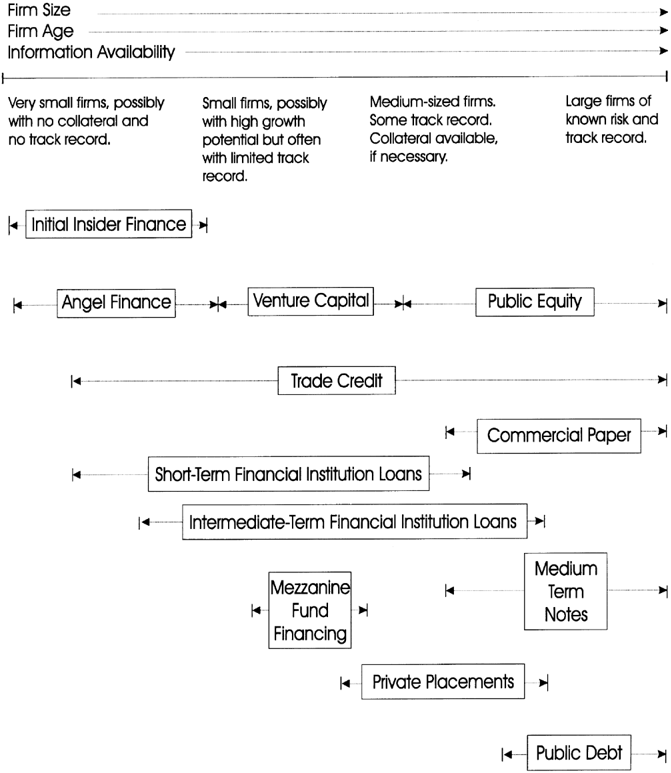
- The growth cycle paradigm predicts younger/more opaque firms rely on insider finance, trade credit, and angel finance, then venture capital and banks, and eventually public markets. However, 1993 NSSBF data show insider finance does not dominate external finance even for adolescents (upper bound 56.8% insider, roughly equal to external), and financial institution debt is important to very young firms, often based on personal guarantees or collateral.
- Macro vulnerability: the early-1990s credit crunch saw real C&I loans fall 23.2% ($596.7 billion to $458.2 billion) and estimated small business lending fall 38.5% ($143.7 billion to $88.4 billion). Banks with less than $100 million in assets held about 9% of portfolios in small business loans versus about 2% for banks over $10 billion; large banks charged about 100 basis points less and required collateral about 25% less often than small banks, other things equal.
Methods
- Design: review and synthesis organized around the financial growth cycle paradigm, covering theoretical and empirical literature on private equity and debt markets, contracts, and macroeconomic vulnerability.
- Data: primarily the 1993 National Survey of Small Business Finances (NSSBF) for US small business finance tables, plus other sources including NFIB, SCF, STBL, CALL, CRA, Venture Economics/VentureOne, and international data.
- Analysis: descriptive tabulations (Tables 1 and 2) and literature synthesis; the paper is a review rather than a new primary empirical study.
Limitations
- Paper-stated: Table 1 data are not completely accurate or consistent and should be considered rough estimates; angel finance estimates are imprecise (range $15 billion to $120 billion); 1993 data may not reflect current conditions; weighted averages mask considerable heterogeneity.
- Paper-stated: the growth cycle paradigm is not intended to fit all small businesses; firm size, age, and information availability are far from perfectly correlated, and the points at which different funding sources begin and end are not definitive.
- Evident from the text: informational opacity and the intertwining of personal and business finances make small business finance difficult to research, and data on owners’ finances are often unavailable; the paper relies heavily on existing literature and available data rather than new primary data collection.
Model-written summary. Check it against the paper before relying on it.
Integrity signals
Registry
Cites
Statistics
Figures
Verification
Claims the paper makes
22 Valid · 27 Not valid · 107 Not checked · 201 Own results and interpretations
Every source the paper cites for this claim was checked and supports it.
In the paper
“This use of personal assets to help with external ®nance also highlights another important aspect of small business ®nance ± the ®nancial intertwining of owners and their businesses (Ang, 1992).”
§ The economics of small business ®nance: The roles of private equity and debt markets in the ®nancial growth cycle > 2.3. The ®nancial growth cycle of small business
What the sources say
- Supportedcites Ang, 1992 matched to “On the Theory of Finance for Privately Held Firms” (1992) source
In “Integrating Personal and Business Accounts,” Ang says that personal guarantees or collateral make business risk inseparable from owners’ personal risk. “The Financing Decision” also identifies owners’ assets used for loan guarantees as contributions to the business. Together, these passages support the cited point that using personal assets to obtain external finance intertwines owners’ and businesses’ finances. (LLM, conf=0.94)
plainstates an association- Asserted: passes — The authors put it forward as true.
- Checkable: passes — It can be checked against evidence.
- Load-bearing: unclear — It is unclear whether the paper’s conclusions depend on it.
- Based: passes — The paper gives a reason why it holds.
- Supported
The cited sources support only part of this claim — read each source’s verdict below.
In the paper
“Costly state veri®cation (Townsend, 1979;Diamond, 1984) and adverse selection (Myers, 1984;Myers and Majluf, 1984;Nachman and Noe, 1994) arguments suggest the optimality of debt contracts after insider ®nance has been exhausted.”
§ The economics of small business ®nance: The roles of private equity and debt markets in the ®nancial growth cycle > 2.3. The ®nancial growth cycle of small business
What the sources say
- Partly supportedcites Townsend, 1979 matched to “Optimal contracts and competitive markets with costly state verification” (1979) sourceExperimental — accuracy not yet measured
Section 3 characterizes an optimal contract for a firm financing an investment project as a bond that defaults when returns fall below a threshold, supporting the costly-state-verification rationale for debt. The paper does not establish that debt becomes optimal only after insider finance has been exhausted. The adverse-selection citations in the sentence refer to other sources, not Townsend. (LLM, conf=0.85)
- Not checked — no full text of the sourcecites Diamond, 1984 matched to “Financial intermediation and delegated monitoring” (1984) source
- Not matchedcites Myers, 1984
More than one paper fits this citation.
hedgedstates a cause- Asserted: passes — The authors put it forward as true.
- Checkable: passes — It can be checked against evidence.
- Load-bearing: passes — The paper’s conclusions depend on it.
- Based: passes — The paper gives a reason why it holds.
- Partly supported
The cited sources support only part of this claim — read each source’s verdict below.
In the paper
“An agency problem arises in the relationship between the entrepreneur and the venture capitalist in which the entrepreneur may expend insucient eort, exhibit expense preference behavior, or lack sucient information or skill to make optimal production decisions.”
§ The economics of small business ®nance: The roles of private equity and debt markets in the ®nancial growth cycle > 3.2. The venture capital market
What the sources say
- Not checked — no full text of the sourcecites Cooper and Carleton, 1979 matched to “Dynamics of Borrower‐Lender Interaction: Partitioning Final Payoff in Venture Capital Finance” (1979) source
- Partly supportedcites Bergemann and Hege, 1998 matched to “Venture capital financing, moral hazard, and learning” (1998) sourceExperimental — accuracy not yet measured
Section 2.3, “Moral hazard and financing,” describes an entrepreneur who may reduce costly effort or divert investment funds to private ends, supporting the insufficient-effort and expense-preference parts of the claim. It does not identify a lack of the entrepreneur’s information or skill as a cause of poor production decisions; it instead says the entrepreneur and venture capitalists initially have the same assessment of the project. (LLM, conf=0.88)
hedgedstates a possible cause- Asserted: passes — The authors put it forward as true.
- Checkable: passes — It can be checked against evidence.
- Load-bearing: passes — The paper’s conclusions depend on it.
- Based: passes — The paper gives a reason why it holds.
Every source the paper cites for this claim was checked and supports it.
In the paper
“Since 1990, this share has about doubled to 30% (Fenn et al., 1997).”
§ The economics of small business ®nance: The roles of private equity and debt markets in the ®nancial growth cycle > 3. The role of private equity markets in small business ®nance
What the sources say
- Supportedcites Fenn et al., 1997 matched to “The Private Equity Market: An Overveiw” (1997) source
In “IPO Firms that Received Private Equity Backing,” the paper states that the share of IPOs with venture backing averaged 15% during the 1980s and doubled to 30% since 1990. This directly supports the cited claim. (LLM, conf=0.95)
plainstates an association- Asserted: passes — The authors put it forward as true.
- Checkable: passes — It can be checked against evidence.
- Load-bearing: unclear — It is unclear whether the paper’s conclusions depend on it.
- Based: passes — The paper gives a reason why it holds.
- Supported
The cited sources support only part of this claim — read each source’s verdict below.
In the paper
“During the 1980s, approximately 15% of all IPOs were backed by venture capital, well out of proportion to the fraction of all ®rms that received venture capital.”
§ The economics of small business ®nance: The roles of private equity and debt markets in the ®nancial growth cycle > 3. The role of private equity markets in small business ®nance
What the sources say
- Partly supportedcites Fenn et al., 1997 matched to “The Private Equity Market: An Overveiw” (1997) sourceExperimental — accuracy not yet measured
The section “IPO Firms that Received Private Equity Backing” states that venture-backed IPOs averaged 15% of IPOs during the 1980s. It does not give the fraction of all firms that received venture capital or make the claimed comparison with that fraction. (LLM, conf=0.84)
plainstates an association- Asserted: passes — The authors put it forward as true.
- Checkable: passes — It can be checked against evidence.
- Load-bearing: unclear — It is unclear whether the paper’s conclusions depend on it.
- Based: passes — The paper gives a reason why it holds.
- Partly supported
184 more claims · 6 with their cited sources checked
Create a free account to see all 357 claims and to verify the 12 references still open.
- Probably not a substantial claim. 94
- It may state two separate claims as one. 87
- Borderline: one of the tests for a substantial claim is unclear. 2
Claims other papers make about this one
Each is checked against this paper’s own text: does it say what the citing paper says it does?
The cited source says what the claim attributes to it.
In the citing paper
“SMEs are more dependent on external financing supplied by commercial banks (Berger and Udell 1998) because most of them are not qualified to raise money from the stock market.”
From Local Bank, Digital Financial Inclusion and SME Financing Constraints: Empirical Evidence from China (2022) · cites this paper as Berger and Udell 1998
Self-check
Percentages, sums and reported differences re-computed from the paper’s own numbers.
Rated minor: it would not touch a result — a value no result rests on, a p-value that stays on the same side of the significance level, or a conflict that is clerical, resolved elsewhere in the paper, or outside its own findings.
In the paper
“Non®nancial business/government debt provides 19.26% of small business funding (mostly trade credit)”
§ The economics of small business ®nance: The roles of private equity and debt markets in the ®nancial growth cycle > 4. The role of private debt markets in small business ®nance
Reported 19.26 · recomputed 18.01
Citations
Cites
Corporate financing and investment decisions when firms have information that investors do not have
Myers, S. C., & Majluf, N. S. (1984) · Journal of Financial Economics · doi:10.1016/0304-405x(84)90023-0 · Cited by 18,957
The Cost of Capital, Corporation Finance and the Theory of Investment
Miller, M. H. (1958) · American Economic Review · Cited by 14,574
Determinants of corporate borrowing
Myers, S. C. (1977) · Journal of Financial Economics · doi:10.1016/0304-405x(77)90015-0 · Cited by 13,169
Credit Rationing in Markets with Imperfect Information
Stiglitz, J. E., & Weiss, A. (1981) · Columbia University · doi:10.7916/d8v12ft1 · Cited by 12,769 · cited 1×
“…pledging outside collateral may help resolve adverse selection problems when the borrower has more information about the quality of the investment than the lender, and may help prevent credit rationing (Stiglitz and Weiss 1981, 1986, Bester 1985, Chan and Kanatas 1985, Besanko and Thakor 1987a,b).”
The cost of capital, corporation finance and the theory of investment
Terra, P. R. (2008) · Revista de Administração e Contabilidade da Unisinos · doi:10.4013/base.20082.07 · Cited by 8,615
Financial intermediation and delegated monitoring
Diamond, D. W. (1984) · The Review of Economic Studies · doi:10.2307/2297430 · Cited by 8,476 · cited 2×
“Costly state verification (Townsend 1979, Diamond 1984) and adverse selection (Myers 1984, Myers and Majluf 1984, Nachman and Noe 1994) arguments suggest the optimality of debt contracts after insider cFor example, there are generally accepted definitions of the stages of finance for the kind of…”
Corporate Financing and Investment Decisions When Firms Have InformationThat Investors Do Not Have
Myers, S., & Majluf, N. (1984) · doi:10.3386/w1396 · Cited by 6,745
The Benefits of Lending Relationships: Evidence from Small Business Data
PETERSEN, M. A., & RAJAN, R. G. (1994) · The Journal of Finance · doi:10.1111/j.1540-6261.1994.tb04418.x · Cited by 5,440 · cited 4×
“…whereas mortgages, equipment loans, motor vehicle loans, and other loans may more often be transactionsdriven .zs It was also found that dependence on trade credit decreased with the length of the banking relationship, supporting the value of relationship lending (Petersen and Rajan 1994, 1995).”
InfluentialInside the black box: the credit channel of monetary policy transmission
Bernanke, B. S., & Gertler, M. (1995) · Journal of Economic Perspectives · doi:10.1257/jep.9.4.27 · Cited by 4,211
Insiders and Outsiders: The Choice between Informed and Arm's‐Length Debt
RAJAN, R. G. (1992) · The Journal of Finance · doi:10.1111/j.1540-6261.1992.tb04662.x · Cited by 3,902 · cited 1×
“Some research suggests that these firms may try to reduce the control of their banks by issuing public debt, even though public debt may entail higher costs (Diamond 1991, 1993, Rajan 1992, Houston and James 1996).”
Research works printed but not linked: 11
- 66. Cook, L., 1997. Trade ®nance, bank ®nance, and capital market imperfections. Working paper. Harvard University, Cambridge, MA.
- 89. Freear, J., Sohl, J.E., Wetzel, W.E., Jr., 1994. The private investor market for venture capital. The Financier 1, 7±19.
- 112. Hancock, D., Wilcox, J.A., 1997. Bank capital, nonbank ®nance, and real estate activity. Journal of Housing Research 8, 75±105.
- 117. Hempel, G., Coleman, A., Simonson, D., 1986. Bank Management, Wiley, New York.
- 119. Ho, R., 1997. Credit-card use to ®nance small business is soaring, says survey of small ®rms. Wall Street Journal B2, Sept. 25.
- 153. Megginson, W.L., Weiss, K.A., 1991. Venture capitalist certi®cation in initial public oerings. Journal of Finance 46, 903±979.
- 162. Morsman Jr., E., 1986. Commercial loan structuring. Journal of Commercial Bank Lending 68, 2± 20.
- 187. Ravid, S.A., 1996. Debt maturity ± A survey. Financial Markets, Institutions and Instruments 5 (3), 1±68.
- 217. Wetzel Jr. W.E., 1994. Venture capital. In: Bygrave, W.D. (Ed.), Portable MBA in Entrepreneur- ship. Wiley, New York, pp. 172±194.
- 219. White, L.J., 1995. An analytical framework. In: Zahid, S.N. (Ed.), Financial Sector Development in Asia. Oxford University Press, New York, pp. 3±35.
- 222. McKean, R. (Ed.), Issues in Defense Economics. Columbia University Press, New York.
Cited by
Items 1,301–1,400 of 3,739
What Is Fueling FinTech Lending? The Role of Banking Market Structure
Balyuk, T., Berger, A. N., & Hackney, J. (2020) · The Review of Corporate Finance Studies · doi:10.1093/rcfs/cfae028 · Cited by 141
Self-citationKeilbach, M., Audretsch, D. B., & Tamvada, J. P. (2008) · International studies in entrepreneurship · doi:10.1007/978-0-387-78695-7 · Cited by 20
PERFORMANCE OF NEWLY-FORMED MICRO FIRMS: THE ROLE OF CAPITAL FINANCING IN MINORITY-OWNED ENTERPRISES
Ortiz‐Walters, R., & Gius, M. P. (2012) · Journal of Developmental Entrepreneurship · doi:10.1142/s1084946712500148 · Cited by 14
Credit, venture capital and regional economic growth
Pistoresi, B., & Venturelli, V. (2013) · Journal of Economics and Finance · doi:10.1007/s12197-013-9277-8 · Cited by 21
“Mutual banks are found to be particularly interesting in our study at the regional level, since they normally operate within relative small geographical areas and have simple organisational structures with decision‐making autonomy granted to the periphery (Berger and Udell, 2002). The aim of the distinction between co…”
BackgroundResultThe Impact of Financial Resources Management on SME Performance
Mastura, S., & Abu, S. (2014) · Cited by 14
Berger, A. N., Irresberger, F., & Roman, R. A. (2020) · Journal of money credit and banking · doi:10.1111/jmcb.12738 · Cited by 15
“In addition, many small businesses rely on owners, family, and friends for critical funding (e.g., Berger and Udell, 1998), so household financial problems may also adversely affect financially constrained small businesses.”
Self-citationSmall businesses are promoting innovation!! Do we know this?
Harel, R., Schwartz, D., & Kaufmann, D. (2019) · Small Enterprise Research · doi:10.1080/13215906.2019.1569552 · Cited by 20
“According to Berger and Udell (1998), small businesses’ lack of access to funding sources, recognized in the literature as one of the main barriers to innovation, stems from various elements in the relationship between businesses and formal sources of financing.”
BackgroundThe early development of International New Ventures: a multidimensional exploration
Kirwan, P., Ratinho, T., van der Sijde, P., & Groen, A. J. (2019) · International Journal of Entrepreneurial Behaviour & Research · doi:10.1108/ijebr-12-2017-0508 · Cited by 18
Auditing and credit granting to SMEs: an integrative perceptual model
Cobo, E. P., Crespo, A., & del Corte, J. M. (2019) · Managerial Auditing Journal · doi:10.1108/maj-12-2018-2118 · Cited by 29
Laborda, J., Fumás, V. S., & Suárez, C. (2020) · Journal of Open Innovation Technology Market and Complexity · doi:10.3390/joitmc6020033 · Cited by 17
SME ACCESS TO FINANCE AND THE GLOBAL FINANCIAL CRISIS
Udell, G. F. (2020) · Journal of Financial Management Markets and Institutions · doi:10.1142/s2282717x20400034 · Cited by 18
Self-citationIs Trade Credit a Sustainable Resource for Medium-Sized Italian Green Companies?
Arcuri, M. C., & Pisani, R. (2021) · Sustainability · doi:10.3390/su13052872 · Cited by 19
“The competitive advantage could be particularly big for small, young, and opaque firms [53,54], or those operating in countries with poorly-developed financial institutions [43].”
BackgroundCredit cards and small business dynamics: Evidence from China
Yuan, Y. Z., Rong, Z., Xu, N., & Lu, Y. (2021) · Pacific-Basin Finance Journal · doi:10.1016/j.pacfin.2021.101570 · Cited by 14
FINANCIAL CYCLES IN THE ECONOMY AND IN ECONOMIC RESEARCH: A CASE STUDY IN CHINA
Qin, Y., Xu, Z., Wang, X., Škare, M., & Porada-Rochoń, M. (2021) · Technological and Economic Development of Economy · doi:10.3846/tede.2021.15439 · Cited by 16
Zero-debt capital structure and the firm life cycle: empirical evidence from privately held SMEs
Lefebvre, V. (2021) · Venture Capital · doi:10.1080/13691066.2021.2001700 · Cited by 18
“To reduce dependency toward customers, and because internal cash flows are not enough to grow, smaller and younger firms have no other choice than to borrow money to finance growth at some point (Berger and Udell 1998).”
BackgroundResultInfluentialThe Banks and the Italian Economy
Silipo, D. B. (2009) · Physica-Verlag eBooks · doi:10.1007/978-3-7908-2112-3 · Cited by 17
Small Firm Behaviour in Sri Lanka
Batten, J. A., & Hettihewa, S. (1999) · Small Business Economics · doi:10.1023/a:1008147928172 · Cited by 23
Betschinger, M. (2014) · Strategic Management Journal · doi:10.1002/smj.2302 · Cited by 13
The role of personal loans in the financing of SMEs
Briozzo, A., & Vigier, H. P. (2014) · Academia Revista Latinoamericana de Administración · doi:10.1108/arla-10-2013-0167 · Cited by 27
Analysis of External Financing Use: A Study of Small and Medium Enterprises in Malawi
Mulaga, A. N. (2013) · International Journal of Business and Management · doi:10.5539/ijbm.v8n7p55 · Cited by 14
“As argued by Berger and Udell (1998) low cost of lending encourages use of external financing.”
BackgroundSources of Financing for New Technology Firms: Evidence from the Kauffman Firm Survey
Coleman, S., & Robb, A. (2010) · Contributions to economics · doi:10.1007/978-3-7908-2623-4_10 · Cited by 14
“Berger and Udell (1998) put forth a “life cycle” theory of financing which contends that firms use different types of financing for different stages of growth.”
BackgroundReflection of owner’s attributes in financing decisions of SMEs
Ps, R., & Kumar, S. (2018) · Small Enterprise Research · doi:10.1080/13215906.2018.1428908 · Cited by 22
“Authors such as Berger and Udell (1998) have documented that research on the supply of finance to SMEs has been investigated more as compared to demand of finance by SMEs.”
BackgroundEntrepreneurial finance journeys: embeddedness and the finance escalator
Murzacheva, E., & Levie, J. (2020) · Venture Capital · doi:10.1080/13691066.2020.1767756 · Cited by 20
“On the one hand, the finance escalator is a universal model, built from pecking order and trade-off theories (Myers 1984; Berger and Udell 1998; Baldock and Mason 2015).”
BackgroundA Structural form Default Prediction Model for SMEs, Evidence from the Dutch Market
Rikkers, F., & Thibeault, A. E. (2009) · Multinational Finance Journal · doi:10.17578/13-3/4-4 · Cited by 15
“As a result, small firms often cannot credibly convey their quality (Berger and Udell, 1998).”
BackgroundWhy Do Firms Switch Banks? Evidence from China
Yin, W., & Matthews, K. (2018) · Emerging Markets Finance and Trade · doi:10.1080/1540496x.2017.1343141 · Cited by 14
“The disadvantage for borrowers seeking external funding between small firms and financiers is highlighted byKeasey andWatson (1993) and Berger and Udell (1998).”
SME Financing in Europe : Measures to Improve the Rating Culture Under the New Banking Rules
Ayadi, R. (2008) · Cited by 19
The regulatory challenge to relationship marketing in UK banking
Ashton, J. K., & Pressey, A. D. (2004) · International Journal of Bank Marketing · doi:10.1108/02652320410559358 · Cited by 14
The Pricing of Sequential Bank Loans
Athavale, M., & Edmister, R. O. (2004) · Financial Review · doi:10.1111/j.0732-8516.2004.00074.x · Cited by 15
Credit, banks and small business in America
Dunkelberg, W. C. (1998) · Journal of Banking & Finance · doi:10.1016/s0378-4266(98)00036-3 · Cited by 16
Negócios nanicos, garantias e acesso a crédito
Nerí, M. C., & Giovanini, F. D. S. (2005) · Revista de Economia Contemporânea · doi:10.1590/s1415-98482005000300007 · Cited by 14
La financiación de nuevas empresas en Colombia, una mirada desde la demanda
Bulla, F. J. M., & Naranjo, G. F. (2011) · Revista Escuela de Administración de Negocios · doi:10.21158/01208160.n70.2011.538 · Cited by 14
Potential Competitive Effects of Basel II on Banks in SME Credit Markets in the United States
Berger, A. N. (2004) · Finance and Economics Discussion Series · doi:10.17016/feds.2004.12 · Cited by 42
Self-citationComment on Avery, Bostic and Samolyk
Mann, R. J. (1998) · Journal of Banking & Finance · doi:10.1016/s0378-4266(98)00035-1 · Cited by 14
Debt and Taxes: Evidence from bank-financed unlisted firmsPreprint
Bartholdy, J., & Mateus, C. (2006) · RePEc: Research Papers in Economics · Cited by 17
Federal Home Loan Bank Lending to Community Banks: Are Targeted Subsidies Necessary?Preprint
Craig, B. R., & Thomson, J. B. (2001) · SSRN Electronic Journal · doi:10.2139/ssrn.282410 · Cited by 27
“Why would Congress extend another subsidy to support lending to sectors of the economy for which there is already a litany of programs – such as the Small Business Administration’s loan guarantee program for small business loans and the Farm Credit Banks in agriculture – designed to do that? One possible answer lies i…”
BackgroundSMEs, FDI and Financial ConstraintsPreprint
Maeseneire, W. D., & Claeys, T. (2007) · SSRN Electronic Journal · doi:10.2139/ssrn.968694 · Cited by 14
A Multistage Model of Loans and the Role of RelationshipsPreprint
Chakravarty, S., & Yilmazer, T. (2004) · SSRN Electronic Journal · doi:10.2139/ssrn.519822 · Cited by 14
Venture Debt Financing: Determinants of the Lending DecisionPreprint
Fischer, T., & de Rassenfosse, G. (2011) · SSRN Electronic Journal · doi:10.2139/ssrn.1909602 · Cited by 14
Do Energy Efficient Firms Have Better Access to Finance?
Brutscher, P.-B., Ravillard, P., & Semieniuk, G. (2021) · The Energy Journal · doi:10.5547/01956574.42.6.pbru · Cited by 15
“As we review below, only 10 out of 28 European countries have policies in place that explicitly target improving the access to finance for efficiency investments, even though it is well known that such access is limited, especially for small and me - dium-sized enterprises (Berger & Udell, 1998).”
BackgroundSME financing through public equity: review of the Indian SME exchanges
Ghalke, A., Kumar, S., & Rao, D. N. (2022) · Indian Growth and Development Review · doi:10.1108/igdr-10-2021-0138 · Cited by 13
Liang, D., Ewing, B. T., Cardella, E., & Song, L. (2022) · Natural Hazards Review · doi:10.1061/(asce)nh.1527-6996.0000602 · Cited by 12
Trade credit provision and stock price crash risk
Wang, M., Goodell, J. W., Huang, W., & Jiang, Y. (2023) · International Review of Financial Analysis · doi:10.1016/j.irfa.2023.102908 · Cited by 18
Coronel-Pangol, K., Paule-Vianez, J., & Orden‐Cruz, C. (2023) · International Entrepreneurship and Management Journal · doi:10.1007/s11365-023-00906-w · Cited by 17
Getting left behind? The localised consequences of exclusion from the credit market for UK SMEs
Cowling, M., Brown, R., Liu, W., & Rocha, A. (2023) · Cambridge Journal of Regions Economy and Society · doi:10.1093/cjres/rsad033 · Cited by 15
Heo, Y. J. (2023) · Journal of International Money and Finance · doi:10.1016/j.jimonfin.2023.102987 · Cited by 16
Understanding drought shocks: Bank financial stability and loan performance
Özsoy, S. M., Rasteh, M., & Yönder, E. (2025) · Global Finance Journal · doi:10.1016/j.gfj.2025.101100 · Cited by 24
Different strokes for different folks: a configurational analysis of entrepreneurial ecosystems
Bennett, D., Vedula, S., & ARAKI, M. E. (2025) · Small Business Economics · doi:10.1007/s11187-025-01038-x · Cited by 27
“Mean-while, access to business loans and grants are more important for early-stage ventures and many small businesses not focused on rapid scaling (Berger & Udell, 1998).”
Loan availability and investment: can innovative companies better cope with loan denials?
Mueller, E., & Reize, F. (2013) · Applied Economics · doi:10.1080/00036846.2013.808314 · Cited by 13
“For example, Berger and Udell (1998) find that for small US businesses bank loans comprise 27% of the total firm financing, thus they are the most important external source of financing.”
Muscettola, M. (2013) · International Journal of Economics and Finance · doi:10.5539/ijef.v5n12p24 · Cited by 17
“…between three of the major theories on capital structure: The Trade-off theory (Note 2) (Modigliani & Miller, 1963; De Angelo & Masulis, 1980; Miller, 1977), the Pecking order theory (Note 3) (Myers, 1984; Myers & Majluf, 1984) and the Financial growth cycle theory (Note 4) (Berger & Udell, 1998).”
BackgroundRipple Effects from Industry Defaults
Bams, D., Pisa, M., & Wolff, C. C. P. (2013) · Small Business Economics · doi:10.1007/s11187-019-00308-9 · Cited by 16
Open development and scaling-up of clustered enterprises in Nigeria’s informal sector
Jegede, O. O. (2020) · African Journal of Science Technology Innovation and Development · doi:10.1080/20421338.2020.1718363 · Cited by 15
The application of venture capital strategies tomusharakahfinancing
Abdul-Rahman, A., Nor, S. M., & Salmat, M. F. (2020) · Journal of Islamic accounting and business research · doi:10.1108/jiabr-05-2016-0061 · Cited by 35
Hui, Z., Piao, X., & Park, S. (2021) · Sustainability · doi:10.3390/su13041625 · Cited by 17
“Many previous studies have found that organizational outcomes are influenced by the CEO’s human capital in terms of experience [20,21].”
Background“Early-stage financing diversity and firms’ export intensity: a cross-country analysis”
Castellani, D., Giaretta, E., & Staglianò, R. (2021) · Finance research letters · doi:10.1016/j.frl.2021.102030 · Cited by 17
Rauwerda, K., & de Graaf, F. J. (2021) · Management Decision · doi:10.1108/md-09-2019-1269 · Cited by 17
Intercept of Financial, Economic and Educational Transformations: Bibliometric Analysis
Novikov, V. (2021) · Financial Markets Institutions and Risks · doi:10.21272/fmir.5(2).120-129.2021 · Cited by 13
Factors Affecting Capital Structure of Indian Venture Capital-Backed Growth Firms
Panda, S. (2015) · Springer eBooks · doi:10.1007/978-81-322-2086-2_5 · Cited by 16
L’impact de la crise de 2008 sur le rationnement du crédit des PME françaises
Alexandre, H., & Buisson-Stéphan, H. (2014) · Revue internationale P M E Économie et gestion de la petite et moyenne entreprise · doi:10.7202/1026069ar · Cited by 21
Blanco‐Oliver, A., Pino‐Mejías, R., & Lara‐Rubio, J. (2014) · Innovar · doi:10.15446/innovar.v24n1spe.47615 · Cited by 19
Determinants of Voluntary Disclosure of Sales by Small Private Companies
Ceustermans, S., & Breesch, D. (2013) · Journal of International Financial Management and Accounting · doi:10.1111/jifm.12055 · Cited by 18
Are the cultural accounting values a relevant issue for the SMEs’ financing options?
Albuquerque, F., Quirós, J. T., & Justino, M. D. R. T. F. (2016) · Contaduría y Administración · doi:10.1016/j.cya.2016.04.004 · Cited by 20
“These factors have been analyzed in the context of behavioural finance and competitive strategies (Ang, 1991; Berger & Udell, 1998; Churchill & Lewis, 1983; Gibb & Davies, 1990; Scott & Bruce, 1987).”
BackgroundMethodResultInfluentialWhat finance for what investment? Survey-based evidence for European companies
Ferrando, A., & Preuss, C. (2018) · Economia Politica · doi:10.1007/s40888-018-0108-4 · Cited by 21
“…to finance than smaller firms: While large firms enjoy benefits from large scale lending or can collect funds from public equity and debt markets, small and young firms often face credit constraints due a short track record and limited collateral and informational opacity (Berger and Udell, 1998).”
BackgroundInfluentialDo Community Banks Contribute to International Trade? Evidence from U.S. Small Business Banking
Holod, D., & Torna, G. (2016) · Journal of International Financial Markets Institutions and Money · doi:10.1016/j.intfin.2018.07.006 · Cited by 14
Determinants of SME Credit in Mumbai-Empirical Analysis On Factors
Kumari, R., & Trivedi, P. (2018) · The Journal of developing areas · doi:10.1353/jda.2019.0030 · Cited by 13
“The study conducted by Berger and Udell(2006) found that banks are likely to consider comparatively more experienced and older clients for loans relative to young clients.It is observed that male customers tend to receive facvorable responses from bank compared to female customers.Research studies focused on various l…”
BackgroundInfluentialAn assessment of the influence of personal branding on financing entrepreneurial ventures
Elmassah, S., Michael, I., James, R., & Ghimpu, I. (2019) · Heliyon · doi:10.1016/j.heliyon.2019.e01164 · Cited by 26
“This owes to their absence of a demonstrated track record of business, financial viability and success (Berger and Udell, 1998), and concomitantly, the absence of information sought by traditional lenders to estimate the level of risk in financing entrepreneurs, and also their competence and…”
BackgroundSardo, F., Serrasqueiro, Z., & Fėlix, E. G. S. (2020) · Structural Change and Economic Dynamics · doi:10.1016/j.strueco.2020.02.003 · Cited by 16
A META-ANALYSIS OF ISLAMIC MICROFINANCE : CASE BASED EVIDENCE FROM INDIA
Irfan, M. (2020) · Journal of Islamic Monetary Economics and Finance · doi:10.21098/jimf.v6i1.1202 · Cited by 13
“Small businesses work with the assistance of the equity and debt market, which shows financial growth as well as economic development (Berger & Udell, 1998).”
BackgroundBalboa, M., Martí, J., & Tanaka, Á. T. (2015) · European Journal of Finance · doi:10.1080/1351847x.2016.1151803 · Cited by 18
“…to cash flow in firms before receiving VC, which is based on different methodologies and on samples from Belgium (Manigart, Baeyens, and Verschueren 2002), Italy and Spain (Bertoni, Colombo, and Croce 2010; Bertoni, Ferrer, and Martí 2013), and France and the UK (Engel and Stiebale 2014).”
InfluentialTeyssier, C. (2011) · Revue internationale P M E Économie et gestion de la petite et moyenne entreprise · doi:10.7202/1013661ar · Cited by 17
Financial reform and transition in China: a study of the evolution of banks in rural China
Shen, M., Huang, J., Zhang, L., & Rozelle, S. (2010) · Agricultural Finance Review · doi:10.1108/00021461011088468 · Cited by 16
“A banking survey in the USA illustrates that 92 percent of small business debt to financial institutions is secured with collateral ( Berger and Udell, 1998”
BackgroundNationwide Branch Banking and the Presence of Large Banks in Rural Areas
Gilbert, R. A. (2000) · doi:10.20955/r.82.13-28 · Cited by 15
“Bank credit is more important for small businesses than for larger businesses (Berger and Udell, 1998).”
BackgroundPaananen, M., Renders, A., & Blomkvist, M. (2016) · Accounting in Europe · doi:10.1080/17449480.2016.1156240 · Cited by 16
“This is important since prior research shows that financially constrained firms invest less and have a lower growth (Berger & Udell, 1998; Galindo & Schiantarelli, 2003).”
BackgroundMethodBianco, S. D., Amini, C., & Signorelli, M. (2016) · Emerging Markets Finance and Trade · doi:10.1080/1540496x.2016.1216840 · Cited by 20
Funding self-employment – the role of consumer credit
Kneiding, C., & Kritikos, A. S. (2012) · Applied Economics · doi:10.1080/00036846.2011.637895 · Cited by 16
“This lack of data is probably the main reason why small business finance is ‘one of the most under researched areas in finance’ (Berger and Udell, 1998).”
InfluentialWhat factors determine the use of venture capital? evidence from the Irish software sector
Hogan, T., & Hutson, E. (2005) · Venture Capital · doi:10.1080/13691060500268249 · Cited by 16
Credit Rationing in Small Firm-Bank RelationshipsPreprint
Kirschenmann, K. (2011) · SSRN Electronic Journal · doi:10.2139/ssrn.1785414 · Cited by 13
Currency Denomination of Bank Loans : Evidence from Small Firms in Transition CountriesPreprint
Brown, M., Ongena, S. R. G., & Yesin, P. A. (2008) · RePEc: Research Papers in Economics · Cited by 18
Höheres Beschäftigungswachstum durch Venture Capital
Engel, D. (2001) · MADOC (University of Mannheim) · Cited by 13
WHAT DO WE KNOW ABOUT THE FINANCIAL BEHAVIOUR OF THE SPANISH SME?: AN EMPIRICAL ANALYSIS*Preprint
Riportella, C. C., & Casasola, M. J. (2003) · RePEc: Research Papers in Economics · Cited by 13
From Housing Bust to Credit Crunch: Evidence from Small Business LoansPreprint
Huang, H., & Stephens, E. (2012) · SSRN Electronic Journal · doi:10.2139/ssrn.2042260 · Cited by 13
Testing the concentration-performance relationship in the Tunisian banking sectorPreprint
Hakimi, A., Hamdi, H., & Djlassi, M. (2013) · RePEc: Research Papers in Economics · Cited by 13
Guest editorial: Women and the financing of entrepreneurial ventures: More pieces for the Jigsaw
Leitch, C. M., & Hill, F. (2006) · Venture Capital · doi:10.1080/13691060600572375 · Cited by 13
“Importantly, Watson draws attention to opposing conclusions deriving from the application of pecking order theory (Myers, 1984 ) and Berger and Udell's ( 1998 ) finance gap theory concerning the relative levels of external funding required by older and younger firms.”
BackgroundCredit Terms, Credit Accessibility and Performance of Agricultural Cooperatives in Rwanda
Byaruhanga, I. K. (2012) · Cited by 13
An empirical analysis of crowdfunding in Sub-Saharan Africa
Hiller, A. (2017) · Qucosa (Saxon State and University Library Dresden) · Cited by 18
Risk, Uncertainty and Entrepreneurship: Evidence from a Lab-in-the-Field ExperimentPreprint
Koudstaal, M., Sloof, R., & van Praag, M. (2014) · SSRN Electronic Journal · doi:10.2139/ssrn.2512167 · Cited by 21
Debt and Taxes: Evidence from Bank-Financed Small and Medium-Sized FirmsPreprint
Bartholdy, J., & Mateus, C. (2005) · SSRN Electronic Journal · doi:10.2139/ssrn.672104 · Cited by 16
Innovation Policies and New Regional Growth Paths: A Place-Based System Failure Framework
Grillitsch, M., & Trippl, M. (2018) · Cambridge University Press eBooks · doi:10.1017/9781108529525.012 · Cited by 40
Fintech and large banks for SME financing: Evidence from China
Ming, L., Wu, Y., Yang, S., & Yang, X. (2025) · Accounting and Finance · doi:10.1111/acfi.13395 · Cited by 27
Saridakis, G., Frankish, J. S., & STOREY, D. J. (2021) · British Journal of Management · doi:10.1111/1467-8551.12563 · Cited by 12
Local versus national banking development in Europe: who is the winner?
Fasano, F., & Rocca, M. L. (2023) · Eurasian economic review : · doi:10.1007/s40821-022-00233-0 · Cited by 15
“More-over, the authors interestingly observed that the development of local banking sectors matters only for Small and Medium-sized Enterprises (SMEs), which face high asymmetric information problems in debt contract negotiations (Berger & Udell, 1998).”
The Ecosystem of FinTech Companies in India
Joy, B., & Thomas, A. E. (2023) · International Journal of E-Business Research · doi:10.4018/ijebr.316148 · Cited by 12
Li, J., Zhao, Z., Cong, L. M., & Xu, Y. (2023) · Applied Economics · doi:10.1080/00036846.2023.2289914 · Cited by 13
“Second, both academia and the business world recognize that small businesses worldwide generally face financial constraints issues, particularly in developing economies (Berger and Udell 1998; Cheng and Yang 2022).”
Emission Levels and Greenhouse Gas Emissions Disclosure: Evidence From Private Firms
Grahn, A. (2018) · Journal of Business Ethics · doi:10.1007/s10551-024-05697-w · Cited by 17
“In the relationship lending literature, the closeness of bank relationships is proxied by the number of bank relationships a firm has (Berger & Udell, 1998; Bigus & Hillebrand, 2017; Ongena et al., 2012).”
Tran, D., Duy, T. P., & Nguyen, Q. K. (2025) · SAGE Open · doi:10.1177/21582440251339290 · Cited by 29
“The changes in monetary policy, specifically bank credit, substantially influence risk-taking behavior and hence firms’ capital structure strategy (N. Berger & F. Udell, 1998).”
Firm and country characteristics related to cumulative contribution to society
Serrano‐Cinca, C., Fernández, B. C., & Callén, Y. F. (2020) · Sustainability Accounting Management and Policy Journal · doi:10.1108/sampj-07-2019-0260 · Cited by 16
Chu, L. K. (2021) · Journal of Emerging Market Finance · doi:10.1177/09726527211015317 · Cited by 14
“Additionally, small and medium firms are believed to be put in an unfavorable light to suppliers of finance because of short time operating, low creditworthiness (Gertler, 1988), poor solvency, low real assets (Guariglia, 2008), and informational opacity (Berger & Udell, 1998).”
BackgroundZabri, S. M., Ahmad, K., & Adonia, S. A. (2021) · Cogent Business & Management · doi:10.1080/23311975.2021.1912524 · Cited by 23
“This financing pattern can be explained by a number of theories, such as signalling theory, information asymmetry and the financial growth paradigm (A.N. Berger & Udell, 1998).”
BackgroundCROWDFUNDING FOR STARTUPS IN INDIA
Vijayalakshmi, P., & Priyadarshini, V. (2021) · International Journal of Engineering Technology and Management Sciences · doi:10.46647/ijetms.2021.v05i02.003 · Cited by 12
Nassoro, G., & Jaraj, K. (2022) · AFRICAN JOURNAL OF BUSINESS MANAGEMENT · doi:10.5897/ajbm2021.9295 · Cited by 12
“The problem of acquiring loans from financial institutions is more pronounced for SMEs (Berger and Udell, 2007).”
BackgroundEarly backers' social and geographic influences on the success of crowdfunding
Ma, Z. (2022) · Journal of Research in Interactive Marketing · doi:10.1108/jrim-01-2022-0008 · Cited by 15
Metadata
- Authors
- N. Berger, A., & F. Udell, G.
- Venue
- Journal of Banking & Finance
- Publisher
- Elsevier BV
- Published
- 1998-08
- Volume
- 22
- Issue
- 6-8
- Pages
- 613-673
- ISSN
- 0378-4266 (ISSN-L)
- OpenAlex
- W2119780569
- Semantic Scholar
- dfc06f7f7eb83d2c0e2a1d67ecb95b520a406843
- Cited by
- 3,690
- References
- 230
- Citations by year
- 2026: 136 · 2025: 148 · 2024: 144 · 2023: 193 · 2022: 155 · 2021: 211 · 2020: 200 · 2019: 156 · 2018: 208 · 2017: 174 · 2016: 186 · 2015: 187 · 2014: 168 · 2013: 177 · 2012: 171
- FWCI
- 169.26
- Type
- journal article
- Language
- en
- Open access
- hybrid
- doi.org
- Licence
- cc-by-nc-nd
- www.elsevier.com/tdm/userlicense/1.0/ (tdm)
- www.elsevier.com/legal/tdmrep-license (tdm)
- creativecommons.org/licenses/by-nc-nd/4.0/ (vor, 125 d)
- Locations
- Journal of Banking & Finance (publishedVersion, cc-by-nc-nd)
- RePEc: Research Papers in Economics (submittedVersion)
- Funders
- York University
- Topics
- Social Sciences › Economics, Econometrics and Finance › Finance › Private Equity and Venture Capital
- Social Sciences › Economics, Econometrics and Finance › Finance › Corporate Finance and Governance
- Social Sciences › Economics, Econometrics and Finance › Finance › Banking stability, regulation, efficiency
- Keywords
- small business financing, private equity, debt markets, capital structure, firm size, firm age, macroeconomic conditions
About these checks
Registry, retraction, Cites and statistics results are computed, not judged, with one exception: a printed reference that no index lists is read once by a model before it counts as a citation error. Claims are extracted by a model and kept only when their quote appears verbatim in the text; each cited source is then checked, with a model’s help, for whether it says what the claim relies on. Those verdicts can be wrong — read the claim’s quote and the cited source before relying on one.
The claim verdicts this report counts are experimental: their accuracy is not yet measured.
A language model drew the claims from the paper on 2026-10-10, under version 3 of the claim definition (model deepseek-v4.1-flash, prompt extract-v3).
A second model labelled each claim on 2026-10-10 (model jev-1.13-20260917, definition revision gold-guideline-v0.2).
Cited sources are checked with a language model’s help (gpt-6-sol).
Statistics and arithmetic are recomputed, not judged.
Confidence bands are shown only for fields calibrated on our annotated test set. None is calibrated yet, so no band is shown.
What counts as a claim ›How we measure confidence ›How we check this ›
Are you an author, or do you see a problem with this page? Request a review
Data sources
Bibliographic data: Semantic Scholar, OpenAlex, Crossref.
Contains information from the Semantic Scholar Academic Graph Datasets, made available under the ODC Attribution License (ODC-BY 1.0).
Semantic Scholar’s data is described in: Kinney, R., et al. (2023). The Semantic Scholar Open Data Platform. arXiv:2301.10140.
