

The economics of small business finance: The roles of private equity and debt markets in the financial growth cycle
Open accessThe DOI matches its Crossref record; 217 of the 230 references it cites were found in a registry or an index, and 1 are not checked yet; 24 of the 170 sources its claims cite were checked for support.
Abstract
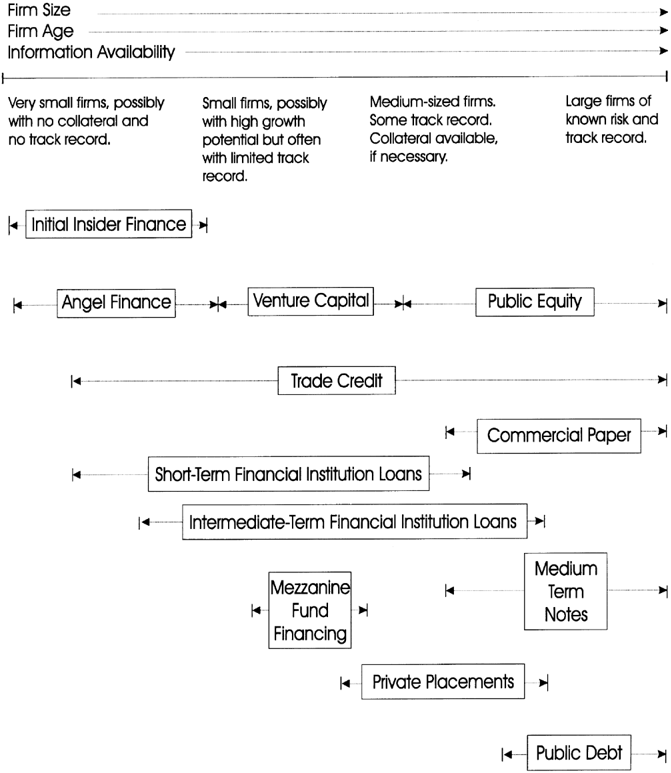
This article examines the economics of financing small business in private equity and debt markets. Firms are viewed through a financial growth cycle paradigm in which different capital structures are optimal at different points in the cycle. We show the sources of small business finance, and how capital structure varies with firm size and age. The interconnectedness of small firm finance is discussed along with the impact of the macroeconomic environment. We also analyze a number of research and policy issues, review the literature, and suggest topics for future research.
Verified 2026-11-25 · 1 reference not checked yet
Overview
CoChat Summary
TL;DR
This article reviews the economics of small business finance through a financial growth cycle paradigm, emphasizing informational opacity and the roles of private equity and debt markets. It documents US small business funding sources and contracts, and analyzes vulnerability to macroeconomic shocks, credit crunches, and bank consolidation.
Key findings
- US small business finance is split roughly evenly between equity (49.63%) and debt (50.37%); the largest sources are the principal owner, commercial banks, and trade creditors, together accounting for 70.10% of total funding. Commercial banks provide 18.75%, trade credit 15.78%, principal owner equity 31.33%, angel finance 3.59%, venture capital 1.85%, and credit card debt 0.14%.
- Financial institution debt is used by 54.23% of small businesses; 86.95% name a commercial bank as their primary financial institution. Average relationship length is 6.64 years overall and 9.01 years with the primary institution; 52.03% of financial institution debt is under lines of credit, 91.94% is secured, and 51.63% is guaranteed.
- The growth cycle paradigm predicts younger/more opaque firms rely on insider finance, trade credit, and angel finance, then venture capital and banks, and eventually public markets. However, 1993 NSSBF data show insider finance does not dominate external finance even for adolescents (upper bound 56.8% insider, roughly equal to external), and financial institution debt is important to very young firms, often based on personal guarantees or collateral.
- Macro vulnerability: the early-1990s credit crunch saw real C&I loans fall 23.2% ($596.7 billion to $458.2 billion) and estimated small business lending fall 38.5% ($143.7 billion to $88.4 billion). Banks with less than $100 million in assets held about 9% of portfolios in small business loans versus about 2% for banks over $10 billion; large banks charged about 100 basis points less and required collateral about 25% less often than small banks, other things equal.
Methods
- Design: review and synthesis organized around the financial growth cycle paradigm, covering theoretical and empirical literature on private equity and debt markets, contracts, and macroeconomic vulnerability.
- Data: primarily the 1993 National Survey of Small Business Finances (NSSBF) for US small business finance tables, plus other sources including NFIB, SCF, STBL, CALL, CRA, Venture Economics/VentureOne, and international data.
- Analysis: descriptive tabulations (Tables 1 and 2) and literature synthesis; the paper is a review rather than a new primary empirical study.
Limitations
- Paper-stated: Table 1 data are not completely accurate or consistent and should be considered rough estimates; angel finance estimates are imprecise (range $15 billion to $120 billion); 1993 data may not reflect current conditions; weighted averages mask considerable heterogeneity.
- Paper-stated: the growth cycle paradigm is not intended to fit all small businesses; firm size, age, and information availability are far from perfectly correlated, and the points at which different funding sources begin and end are not definitive.
- Evident from the text: informational opacity and the intertwining of personal and business finances make small business finance difficult to research, and data on owners’ finances are often unavailable; the paper relies heavily on existing literature and available data rather than new primary data collection.
Model-written summary. Check it against the paper before relying on it.
Integrity signals
Registry
Cites
Statistics
Figures
Verification
Claims the paper makes
22 Valid · 27 Not valid · 107 Not checked · 201 Own results and interpretations
Every source the paper cites for this claim was checked and supports it.
In the paper
“This use of personal assets to help with external ®nance also highlights another important aspect of small business ®nance ± the ®nancial intertwining of owners and their businesses (Ang, 1992).”
§ The economics of small business ®nance: The roles of private equity and debt markets in the ®nancial growth cycle > 2.3. The ®nancial growth cycle of small business
What the sources say
- Supportedcites Ang, 1992 matched to “On the Theory of Finance for Privately Held Firms” (1992) source
In “Integrating Personal and Business Accounts,” Ang says that personal guarantees or collateral make business risk inseparable from owners’ personal risk. “The Financing Decision” also identifies owners’ assets used for loan guarantees as contributions to the business. Together, these passages support the cited point that using personal assets to obtain external finance intertwines owners’ and businesses’ finances. (LLM, conf=0.94)
plainstates an association- Asserted: passes — The authors put it forward as true.
- Checkable: passes — It can be checked against evidence.
- Load-bearing: unclear — It is unclear whether the paper’s conclusions depend on it.
- Based: passes — The paper gives a reason why it holds.
- Supported
The cited sources support only part of this claim — read each source’s verdict below.
In the paper
“Costly state veri®cation (Townsend, 1979;Diamond, 1984) and adverse selection (Myers, 1984;Myers and Majluf, 1984;Nachman and Noe, 1994) arguments suggest the optimality of debt contracts after insider ®nance has been exhausted.”
§ The economics of small business ®nance: The roles of private equity and debt markets in the ®nancial growth cycle > 2.3. The ®nancial growth cycle of small business
What the sources say
- Partly supportedcites Townsend, 1979 matched to “Optimal contracts and competitive markets with costly state verification” (1979) sourceExperimental — accuracy not yet measured
Section 3 characterizes an optimal contract for a firm financing an investment project as a bond that defaults when returns fall below a threshold, supporting the costly-state-verification rationale for debt. The paper does not establish that debt becomes optimal only after insider finance has been exhausted. The adverse-selection citations in the sentence refer to other sources, not Townsend. (LLM, conf=0.85)
- Not checked — no full text of the sourcecites Diamond, 1984 matched to “Financial intermediation and delegated monitoring” (1984) source
- Not matchedcites Myers, 1984
More than one paper fits this citation.
hedgedstates a cause- Asserted: passes — The authors put it forward as true.
- Checkable: passes — It can be checked against evidence.
- Load-bearing: passes — The paper’s conclusions depend on it.
- Based: passes — The paper gives a reason why it holds.
- Partly supported
The cited sources support only part of this claim — read each source’s verdict below.
In the paper
“An agency problem arises in the relationship between the entrepreneur and the venture capitalist in which the entrepreneur may expend insucient eort, exhibit expense preference behavior, or lack sucient information or skill to make optimal production decisions.”
§ The economics of small business ®nance: The roles of private equity and debt markets in the ®nancial growth cycle > 3.2. The venture capital market
What the sources say
- Not checked — no full text of the sourcecites Cooper and Carleton, 1979 matched to “Dynamics of Borrower‐Lender Interaction: Partitioning Final Payoff in Venture Capital Finance” (1979) source
- Partly supportedcites Bergemann and Hege, 1998 matched to “Venture capital financing, moral hazard, and learning” (1998) sourceExperimental — accuracy not yet measured
Section 2.3, “Moral hazard and financing,” describes an entrepreneur who may reduce costly effort or divert investment funds to private ends, supporting the insufficient-effort and expense-preference parts of the claim. It does not identify a lack of the entrepreneur’s information or skill as a cause of poor production decisions; it instead says the entrepreneur and venture capitalists initially have the same assessment of the project. (LLM, conf=0.88)
hedgedstates a possible cause- Asserted: passes — The authors put it forward as true.
- Checkable: passes — It can be checked against evidence.
- Load-bearing: passes — The paper’s conclusions depend on it.
- Based: passes — The paper gives a reason why it holds.
Every source the paper cites for this claim was checked and supports it.
In the paper
“Since 1990, this share has about doubled to 30% (Fenn et al., 1997).”
§ The economics of small business ®nance: The roles of private equity and debt markets in the ®nancial growth cycle > 3. The role of private equity markets in small business ®nance
What the sources say
- Supportedcites Fenn et al., 1997 matched to “The Private Equity Market: An Overveiw” (1997) source
In “IPO Firms that Received Private Equity Backing,” the paper states that the share of IPOs with venture backing averaged 15% during the 1980s and doubled to 30% since 1990. This directly supports the cited claim. (LLM, conf=0.95)
plainstates an association- Asserted: passes — The authors put it forward as true.
- Checkable: passes — It can be checked against evidence.
- Load-bearing: unclear — It is unclear whether the paper’s conclusions depend on it.
- Based: passes — The paper gives a reason why it holds.
- Supported
The cited sources support only part of this claim — read each source’s verdict below.
In the paper
“During the 1980s, approximately 15% of all IPOs were backed by venture capital, well out of proportion to the fraction of all ®rms that received venture capital.”
§ The economics of small business ®nance: The roles of private equity and debt markets in the ®nancial growth cycle > 3. The role of private equity markets in small business ®nance
What the sources say
- Partly supportedcites Fenn et al., 1997 matched to “The Private Equity Market: An Overveiw” (1997) sourceExperimental — accuracy not yet measured
The section “IPO Firms that Received Private Equity Backing” states that venture-backed IPOs averaged 15% of IPOs during the 1980s. It does not give the fraction of all firms that received venture capital or make the claimed comparison with that fraction. (LLM, conf=0.84)
plainstates an association- Asserted: passes — The authors put it forward as true.
- Checkable: passes — It can be checked against evidence.
- Load-bearing: unclear — It is unclear whether the paper’s conclusions depend on it.
- Based: passes — The paper gives a reason why it holds.
- Partly supported
184 more claims · 6 with their cited sources checked
Create a free account to see all 357 claims and to verify the 12 references still open.
- Probably not a substantial claim. 94
- It may state two separate claims as one. 87
- Borderline: one of the tests for a substantial claim is unclear. 2
Claims other papers make about this one
Each is checked against this paper’s own text: does it say what the citing paper says it does?
The cited source says what the claim attributes to it.
In the citing paper
“SMEs are more dependent on external financing supplied by commercial banks (Berger and Udell 1998) because most of them are not qualified to raise money from the stock market.”
From Local Bank, Digital Financial Inclusion and SME Financing Constraints: Empirical Evidence from China (2022) · cites this paper as Berger and Udell 1998
Self-check
Percentages, sums and reported differences re-computed from the paper’s own numbers.
Rated minor: it would not touch a result — a value no result rests on, a p-value that stays on the same side of the significance level, or a conflict that is clerical, resolved elsewhere in the paper, or outside its own findings.
In the paper
“Non®nancial business/government debt provides 19.26% of small business funding (mostly trade credit)”
§ The economics of small business ®nance: The roles of private equity and debt markets in the ®nancial growth cycle > 4. The role of private debt markets in small business ®nance
Reported 19.26 · recomputed 18.01
Citations
Cites
Corporate financing and investment decisions when firms have information that investors do not have
Myers, S. C., & Majluf, N. S. (1984) · Journal of Financial Economics · doi:10.1016/0304-405x(84)90023-0 · Cited by 18,957
The Cost of Capital, Corporation Finance and the Theory of Investment
Miller, M. H. (1958) · American Economic Review · Cited by 14,574
Determinants of corporate borrowing
Myers, S. C. (1977) · Journal of Financial Economics · doi:10.1016/0304-405x(77)90015-0 · Cited by 13,169
Credit Rationing in Markets with Imperfect Information
Stiglitz, J. E., & Weiss, A. (1981) · Columbia University · doi:10.7916/d8v12ft1 · Cited by 12,769 · cited 1×
“…pledging outside collateral may help resolve adverse selection problems when the borrower has more information about the quality of the investment than the lender, and may help prevent credit rationing (Stiglitz and Weiss 1981, 1986, Bester 1985, Chan and Kanatas 1985, Besanko and Thakor 1987a,b).”
The cost of capital, corporation finance and the theory of investment
Terra, P. R. (2008) · Revista de Administração e Contabilidade da Unisinos · doi:10.4013/base.20082.07 · Cited by 8,615
Financial intermediation and delegated monitoring
Diamond, D. W. (1984) · The Review of Economic Studies · doi:10.2307/2297430 · Cited by 8,476 · cited 2×
“Costly state verification (Townsend 1979, Diamond 1984) and adverse selection (Myers 1984, Myers and Majluf 1984, Nachman and Noe 1994) arguments suggest the optimality of debt contracts after insider cFor example, there are generally accepted definitions of the stages of finance for the kind of…”
Corporate Financing and Investment Decisions When Firms Have InformationThat Investors Do Not Have
Myers, S., & Majluf, N. (1984) · doi:10.3386/w1396 · Cited by 6,745
The Benefits of Lending Relationships: Evidence from Small Business Data
PETERSEN, M. A., & RAJAN, R. G. (1994) · The Journal of Finance · doi:10.1111/j.1540-6261.1994.tb04418.x · Cited by 5,440 · cited 4×
“…whereas mortgages, equipment loans, motor vehicle loans, and other loans may more often be transactionsdriven .zs It was also found that dependence on trade credit decreased with the length of the banking relationship, supporting the value of relationship lending (Petersen and Rajan 1994, 1995).”
InfluentialInside the black box: the credit channel of monetary policy transmission
Bernanke, B. S., & Gertler, M. (1995) · Journal of Economic Perspectives · doi:10.1257/jep.9.4.27 · Cited by 4,211
Insiders and Outsiders: The Choice between Informed and Arm's‐Length Debt
RAJAN, R. G. (1992) · The Journal of Finance · doi:10.1111/j.1540-6261.1992.tb04662.x · Cited by 3,902 · cited 1×
“Some research suggests that these firms may try to reduce the control of their banks by issuing public debt, even though public debt may entail higher costs (Diamond 1991, 1993, Rajan 1992, Houston and James 1996).”
Research works printed but not linked: 11
- 66. Cook, L., 1997. Trade ®nance, bank ®nance, and capital market imperfections. Working paper. Harvard University, Cambridge, MA.
- 89. Freear, J., Sohl, J.E., Wetzel, W.E., Jr., 1994. The private investor market for venture capital. The Financier 1, 7±19.
- 112. Hancock, D., Wilcox, J.A., 1997. Bank capital, nonbank ®nance, and real estate activity. Journal of Housing Research 8, 75±105.
- 117. Hempel, G., Coleman, A., Simonson, D., 1986. Bank Management, Wiley, New York.
- 119. Ho, R., 1997. Credit-card use to ®nance small business is soaring, says survey of small ®rms. Wall Street Journal B2, Sept. 25.
- 153. Megginson, W.L., Weiss, K.A., 1991. Venture capitalist certi®cation in initial public oerings. Journal of Finance 46, 903±979.
- 162. Morsman Jr., E., 1986. Commercial loan structuring. Journal of Commercial Bank Lending 68, 2± 20.
- 187. Ravid, S.A., 1996. Debt maturity ± A survey. Financial Markets, Institutions and Instruments 5 (3), 1±68.
- 217. Wetzel Jr. W.E., 1994. Venture capital. In: Bygrave, W.D. (Ed.), Portable MBA in Entrepreneur- ship. Wiley, New York, pp. 172±194.
- 219. White, L.J., 1995. An analytical framework. In: Zahid, S.N. (Ed.), Financial Sector Development in Asia. Oxford University Press, New York, pp. 3±35.
- 222. McKean, R. (Ed.), Issues in Defense Economics. Columbia University Press, New York.
Cited by
Items 1,401–1,500 of 3,739
Stoiljković, A., Tomić, S., Leković, B., & Matić, M. (2022) · Sustainability · doi:10.3390/su15010778 · Cited by 29
APROXIMACIÓN EMPÍRICA A LOS PROBLEMAS FINANCIEROS DE LA PYME INDUSTRIAL GALLEGA
Otero, L. A., López, S. F., Pérez, R. R., & Pérez, S. R. R. (2007) · Revista Galega de Economía · Cited by 22
Capital Structure Decisions of French Very Small Businesses
Aktas, N., Bellettre, I., & Cousin, J.-G. (2011) · Finance · doi:10.3917/fina.321.0043 · Cited by 23
Investing in R&D: small- and medium-sized enterprise financing preferences
Riding, A., Orser, B., & Chamberlin, T. (2012) · Venture Capital · doi:10.1080/13691066.2012.654601 · Cited by 12
Multiple Equilibria in Markets with Screening
Direr, A. (2008) · Journal of money credit and banking · doi:10.1111/j.1538-4616.2008.00136.x · Cited by 12
Neuberger, D., Räthke, S., & Schacht, C. (2006) · Economic Notes · doi:10.1111/j.1468-0300.2006.00168.x · Cited by 23
Constraints of Manufacture based Small and Medium Enterprise (SME) Development in Bangladesh
Ahmed, F., & ., M. H. (2011) · Journal of Social and Development Sciences · doi:10.22610/jsds.v1i3.632 · Cited by 12
“Cost controls or price increases often resolve this problem (Berger and Udell, 1998).”
BackgroundEl financiamiento de las pymes del sector de software y servicios informáticos en Argentina
Guercio, M., Vigier, H. P., Briozzo, A., & Martínez, L. B. (2016) · Cuadernos de Economía · doi:10.15446/cuad.econ.v35n69.46654 · Cited by 25
Predictive Strength of Lending Technologies in Funding SMEs
Brighi, P., Lucarelli, C., & Venturelli, V. (2018) · Journal of Small Business Management · doi:10.1111/jsbm.12444 · Cited by 19
Does connectedness improve SMEs’ access to formal finance? Evidence from post-communist economies
Ruziev, K., & Webber, D. J. (2018) · Post-Communist Economies · doi:10.1080/14631377.2018.1470855 · Cited by 16
Institutional barriers to venture capital financing: an explorative study for the case of Iran
Shojaei, S. M., Motavaseli, M., Bitaab, A., Chitsazan, H., & Elyasi, G. M. (2018) · Journal of Entrepreneurship in Emerging Economies · doi:10.1108/jeee-01-2018-0001 · Cited by 16
Capital Acquisition Attitudes: Gender and Experience
Carter, R. B., & Auken, H. V. (2007) · The Journal of Entrepreneurial Finance · doi:10.57229/2373-1761.1027 · Cited by 15
“This includes information about alternative sources of capital as well as the process through which capital is acquired (Berger and Udell, 1998; Gibson, 1992).”
BackgroundThe financial structure of Technology-Based Firms
Guercio, M., Briozzo, A., Vigier, H. P., et al. (2020) · Revista Contabilidade & Finanças · doi:10.1590/1808-057x201909580 · Cited by 12
A new theoretical model of government backed venture capital funding
Fazekas, B., & Becsky-Nagy, P. (2021) · Acta Oeconomica · doi:10.1556/032.2021.00024 · Cited by 10
An Investigation into Innovations in SMEs: Evidence from the West Midlands, UK
Wang, Y., & Costello, P. (2009) · The Journal of Entrepreneurship · doi:10.1177/097135570801800104 · Cited by 22
“Under this circumstance, small fi rms have to rely on their limited internal capital, such as personal equity (Peterson & Shulman, 1987), family loan and trade credit (Berger & Udell, 1998; Romano et al., 2000).”
BackgroundComportement et gouvernance des moyennes entreprises familiales au capital ouvert
Vigoureux, F. L., & Aurégan, P. (2010) · Revue internationale P M E Économie et gestion de la petite et moyenne entreprise · doi:10.7202/1012494ar · Cited by 12
Credit Ratings and Short-term Debt Financing: An Empirical Analysis of Listed Firms in Korea
Chong, B., Hwang, I.-D., & Kim, Y. (2015) · Asia-Pacific Journal of Financial Studies · doi:10.1111/ajfs.12083 · Cited by 15
Financing instruments and strategies of agribusiness: Evidence from Taiwan
Liang, L., Shih, K., & Chung, Y.-H. (2010) · Global Journal of Business Management · doi:10.5897/ajbm.9000296 · Cited by 12
Banks, regions and development
Alessandrini, P., Papi, L., & Zazzaro, A. (2012) · PSL quarterly review · doi:10.13133/2037-3643/10347 · Cited by 13
Beg, Borrow, and Deal? Entrepreneurs' Choice of Financing and New Firm InnovationPreprint
Smith, S. W. (2011) · SSRN Electronic Journal · doi:10.2139/ssrn.1573685 · Cited by 12
Inter-firm credit and industrial links.
Cuñat, V. (2001) · London School of Economics and Political Science Theses Online (London School of Economics and Political Science) · Cited by 13
The Financial System Capacities in China and IndiaPreprint
Allen, F., Chakrabarti, R., De, S., Qian, J., & Qian, M. (2008) · SSRN Electronic Journal · doi:10.2139/ssrn.1260947 · Cited by 13
REPLICATING MICROFINANCE IN THE UNITED STATES: OPPORTUNITIES AND CHALLENGESPreprint
Schreiner, M. J., & Morduch, J. (2001) · RePEc: Research Papers in Economics · Cited by 31
EFFECTS OF MICROFINANCING ON MICRO AND SMALL ENTERPRISES (MSEs) IN SOUTHWEST NIGERIA
Babajide, A. A. (2011) · Covenant University Repository (Covenant University) · Cited by 27
Availability of Financing, Regulatory Business Costs and National Entrepreneurial PropensityPreprint
Ho, Y., & Wong, P. K. (2005) · SSRN Electronic Journal · doi:10.2139/ssrn.775485 · Cited by 10
Declerck, F., & Viviani, J. L. (2010) · RePEc: Research Papers in Economics · doi:10.18461/pfsd.2010.1035 · Cited by 12
Tests of the Pecking Order Theory and the Firm Life CyclePreprint
Bulan, L. T., & Yan, Z. (2009) · SSRN Electronic Journal · doi:10.2139/ssrn.1347430 · Cited by 14
Growth History, Knowledge Intensity and Capital Structure in Small FirmsPreprint
Gellatly, G., Thornhill, S., & Riding, A. (2009) · SSRN Electronic Journal · doi:10.2139/ssrn.1402904 · Cited by 12
Finance and Inequality: Exploring Pro-Poor Investment Channels in Africa
Asongu, S. A. (2011) · Munich Personal RePEc Archive (Ludwig Maximilian University of Munich) · doi:10.2139/ssrn.2493156 · Cited by 16
“Absence of equal opportunities in access to finance may prompt corruption(Berger & Udell,1998), slower firm growth(Ayyagari et al.,2006; Beck et al.,2005), reduction in entrepreneurial activities and lack of convergence in growth rates between rich and poor countries(Banerjee & Duflo, 2005),…”
Working capital management and profitability of UK firms : a contingency theory approach
Tingbani, I. (2015) · Bournemouth University Research Online (Bournemouth University) · Cited by 23
SME Capital Structure: The Dominance of Demand FactorsPreprint
Bell, K., & Vos, E. (2009) · SSRN Electronic Journal · doi:10.2139/ssrn.1456725 · Cited by 18
Financial Life Cycle and Capital StructurePreprint
Kim, B., & Suh, J. (2010) · SSRN Electronic Journal · doi:10.2139/ssrn.1534628 · Cited by 12
Quantitative Easing and Corporate InnovationPreprint
Grimm, N., Laeven, L. A., & Popov, A. A. (2021) · SSRN Electronic Journal · doi:10.2139/ssrn.3971973 · Cited by 22
Foreign Currency Borrowing by Small FirmsPreprint
Brown, M., Ongena, S. R. G., & Yesin, P. A. (2009) · SSRN Electronic Journal · doi:10.2139/ssrn.1338799 · Cited by 15
Baygan, G., & Freudenberg, M. (2000) · OECD science, technology and industry working papers · doi:10.1787/084236411045 · Cited by 87
New Bank Start-Ups: Entrepreneurs Funding Other Entrepreneurs
DeYoung, R. (2002) · The Journal of Entrepreneurial Finance · doi:10.57229/2373-1761.1098 · Cited by 11
Lefebvre, V. (2023) · Journal of Small Business Management · doi:10.1080/00472778.2023.2182440 · Cited by 19
“…potential slack via debt issuance is positively correlated with firm size, age, and tangibility, which is consistent with the idea that older and larger firms, as well as firms with more tangible assets, are less informationally opaque and can thus more easily raise debt (Berger & Udell, 1998).”
BackgroundDoes gender matter in financing SMEs in green industry?
Arcuri, M. C., Tommaso, C. D., & Pisani, R. (2024) · Research in International Business and Finance · doi:10.1016/j.ribaf.2024.102222 · Cited by 19
Honjo, Y., Ikeuchi, K., & Nakamura, H. (2024) · Japan and the World Economy · doi:10.1016/j.japwor.2024.101253 · Cited by 15
Saona, P., Martín, P. S., & González, E. V. (2024) · Emerging Markets Review · doi:10.1016/j.ememar.2024.101163 · Cited by 11
New Venture Governance: An Integrative, Multidisciplinary Review
Deb, P., Sreekumar, V., Sen, P., Duru, A. I., & Brannon, D. L. (2024) · Academy of Management Annals · doi:10.5465/annals.2022.0167 · Cited by 13
Substitutes or complements? Use of trade credit and bank credit by family SMEs
Jin, X., Li, J., Wang, Y., & Wang, Y. (2024) · The British Accounting Review · doi:10.1016/j.bar.2024.101464 · Cited by 12
Qian, Y., & Xi, X. (2024) · Journal of the Knowledge Economy · doi:10.1007/s13132-024-02294-0 · Cited by 15
“…as artificial intelligence, big data, and cloud computing have greatly reduced information asymmetry, thereby helping entrepreneurs analyze and screen risks, mitigate adverse selection, and cultivate people’s entrepreneurial awareness (Barnett et al., 2019; Berger et al., 1998; Tan et al., 2022).”
Unlocking funding success: intercultural entrepreneurship dynamics in European startups
Martielli, F., Laus, V., Salvi, A., & Kotásková, A. (2024) · International Entrepreneurship and Management Journal · doi:10.1007/s11365-024-01038-5 · Cited by 15
“In addition to the growth in startups’ value, innovative and youthful startups play a crucial role in fostering employment, prosperity, and growth, making them a vital element of vibrant economies (Berger & Udell, 1998; Denis, 2004; Klein et al., 2019; Shane & Cable, 2002 ).”
Why SMEs go to crowdfunding? The role of financial constraints and agency issues
Fasano, F., Rocca, M. L., Vidal, J. S., & Boutouar, Y. (2025) · Small Business Economics · doi:10.1007/s11187-025-01046-x · Cited by 27
“Unlisted businesses and, more broadly, small-and medium-sized enterprises (SMEs) struggle with informational asymmetries in financial markets (Fasano & La Rocca, 2023), for which they are consequently classified by nature as financially constrained SMEs (Berger & Udell, 1998).”
Rungani, E. C., & Fatoki, O. (2010) · AFRICAN JOURNAL OF BUSINESS MANAGEMENT · doi:10.5897/ajbm.9000194 · Cited by 11
Welfens, P. J. J., & Ryan, C. (2011) · Springer eBooks · doi:10.1007/978-3-642-16274-9 · Cited by 24
Hulsink, W., & Scholten, V. E. (2016) · Venture Capital · doi:10.1080/13691066.2017.1261454 · Cited by 15
“Investors are only willing to invest in this type of new firms when, after years of development, there is a real chance of success (Berger and Udell 1998).”
BackgroundCorporate misconduct, trade credit and charitable donations: evidence from Chinese listed companies
Liu, Z., Zeng, S., Xu, X., Lin, H., & Ma, H. (2019) · Chinese Management Studies · doi:10.1108/cms-07-2017-0209 · Cited by 11
Funding for start-ups in India: what shakes it?
Ghosh, S. (2020) · Journal of Entrepreneurship in Emerging Economies · doi:10.1108/jeee-05-2020-0142 · Cited by 17
Colombo, M. G., Guerini, M., Rossi‐Lamastra, C., & Bonaccorsi, A. J. (2021) · The Journal of Technology Transfer · doi:10.1007/s10961-021-09848-3 · Cited by 18
Evaluation of women’s access to building credits from banks in Nigeria
Afolabi, A. O., & Akinlolu, I. R. (2021) · Banks and Bank Systems · doi:10.21511/bbs.16(4).2021.05 · Cited by 16
Honjo, Y., Kwak, C., & Uchida, H. (2022) · Japan and the World Economy · doi:10.1016/j.japwor.2022.101145 · Cited by 20
Loan Commitments and Private Firms
Agarwal, S. D., Chomsisengphet, S., & Driscoll, J. C. (2004) · Finance and Economics Discussion Series · doi:10.17016/feds.2004.27 · Cited by 15
Are SMEs large firms in miniature? Evidence from the growth of German SMEs
Bannier, C. E., & Zahn, S. (2012) · International Journal of Entrepreneurship and Small Business · doi:10.1504/ijesb.2012.048848 · Cited by 18
Donati, C., & Sarno, D. (2014) · Industrial and Corporate Change · doi:10.1093/icc/dtu030 · Cited by 11
Cassia, L., & Vismara, S. (2009) · Aisberg (University of Bergamo) · Cited by 13
The countercyclical role of Italian local banks during the financial crisis
Manitiu, D. N., & Pedrini, G. (2016) · Applied Economics · doi:10.1080/00036846.2016.1245840 · Cited by 13
Gamage, P. (2013) · Corporate Ownership and Control · doi:10.22495/cocv10i3c3art6 · Cited by 11
“Previous studies (see Storey, 1994; Berger and Udell, 1998; Michaelas et al., 1999) also suggest that bank financing depends on whether lending can be secured by collateral.”
BackgroundPeel, M. J. (2018) · Accounting and Business Research · doi:10.1080/00014788.2018.1493374 · Cited by 12
“The influential study of Berger and Udell (1998) emphasises that small start-up firms are the most informationally opaque, in that they lack a track record and so ‘may have difficulty building reputations to signal high quality ... to overcome informational opacity’ (p. 16). When investigating the financing of Belgian…”
BackgroundDvorský, J., Rózsa, Z., Petráková, Z., & Kotásková, A. (2018) · Marketing and Management of Innovations · doi:10.21272/mmi.2018.3-01 · Cited by 12
Ownership concentration, firm life cycle, and leverage: Evidence from Italian family firms
Mbanyele, W. (2020) · Cogent Economics & Finance · doi:10.1080/23322039.2020.1838687 · Cited by 11
“Young firms usually use internal funds and loans from friends and relative in contrast to mature firms which use more debt as they accumulate more assets which are pledged as collateral when borrowing (Berger & Udell, 1998).”
BackgroundCapital Markets for Small- and Medium-sized Enterprises and Startups in Korea
Binh, K. B., Jhang, H., Park, D., & Ryu, D. (2020) · Journal of Asian Finance Economics and Business · doi:10.13106/jafeb.2020.vol7.no12.195 · Cited by 15
“However, bondholders do not require firms to repay their debts earlier because bondholders can sell their bonds in the market.9 Thus, firms can freely use the money raised from issuing bonds with no liability until the bonds’ maturity dates; this capital is usually used for investments in fixed assets or R&D (Berger &…”
BackgroundVoluntary Disclosure of Sales and the Extent of Trade Credit in Small Private Companies
Ceustermans, S., Breesch, D., & Branson, J. (2017) · Accounting in Europe · doi:10.1080/17449480.2017.1282617 · Cited by 16
“390 S. Ceustermans et al. According to Berger and Udell (1998), information asymmetries tend to be greater in small private companies, because they are more informational opaque than large and listed companies.”
BackgroundTrade credit and firm investments: empirical evidence from Italian cooperative banks
Filomeni, S., Modina, M., & Tabacco, E. (2022) · Review of Quantitative Finance and Accounting · doi:10.1007/s11156-022-01122-3 · Cited by 12
“1993; Berger and Udell 1998).”
BackgroundThe growth process of IPO firms
Lefebvre, V. (2023) · Journal of Business Venturing Insights · doi:10.1016/j.jbvi.2023.e00377 · Cited by 21
Adequacy of Financial Facilities for Small-Medium Businesses: Empirical Findings from Malaysia
Abdullah, M. A., & Manan, S. K. A. (2010) · Cited by 11
Factoring - Instrument Of Financing In Business Practice –Some Important Legal Aspects
Spasić, I., Bejatović, M., & Mijatović, M. D. (2012) · Economic Research-Ekonomska Istraživanja · doi:10.1080/1331677x.2012.11517502 · Cited by 17
Gudov, A. (2013) · Journal of Chinese Entrepreneurship · doi:10.1108/17561391311297879 · Cited by 24
Deterioration in Borrowing Terms of Small Businesses: An Agency Perspective
Hedges, P. L., Wu, Z., & Chua, J. H. (2007) · Journal of Small Business & Entrepreneurship · doi:10.1080/08276331.2007.10593382 · Cited by 11
Descriptive analysis on the pattern of SME financing in Malaysia
Manan, S. K. A., Othman, J. B., & Shahadan, M. A. (2011) · International Symposium & Exhibition in Sustainable Energy & Environment (ISESEE) · doi:10.1109/isesee.2011.5977122 · Cited by 17
“[4] for example, in their study on small business finance in the US, concluded that smaller and younger SMEs relied on internal source of financing (personal or family savings), trade credit and angel finance for initial capital.”
BackgroundInfluentialDo guarantee banks mitigate credit restrictions for SMEs?
Valentin, A., & Henschel, T. (2013) · International Journal of Entrepreneurship and Small Business · doi:10.1504/ijesb.2013.057203 · Cited by 11
The impact of fund inflows on staging and investment behaviour
Lauterbach, R., Haß, L. H., & Schweizer, D. (2014) · International Small Business Journal Researching Entrepreneurship · doi:10.1177/0266242613500504 · Cited by 12
“Berger and Udell (1998) discuss the impact of the macroeconomic environment on small firm finance whilst in a more recent study, Kaplan and Schoar (2005) find that aggregate industry returns tend to be lower following a boom, with most of the effect driven by the poor performance of new entrants.”
BackgroundThe Information Content of Equity REIT Bank Credit Facility Announcements
Campbell, R., Devos, E., & Spieler, A. C. (2008) · Journal of Real Estate Portfolio Management · doi:10.1080/10835547.2008.12089794 · Cited by 11
The Use of Weather Derivatives by Small- and Medium-Sized Enterprises: Reasons and Obstacles
Bank, M., & Wiesner, R. (2010) · Journal of Small Business & Entrepreneurship · doi:10.1080/08276331.2010.10593503 · Cited by 12
“Moreover, personal savings and bank debt characterize the capital structure of SMEs (Avery and Bostic, 1998; Berger and Udell, 1998; European Commission, 2003b).”
BackgroundENTREPRENEURSHIP RESEARCH IN THE POLAND
Czemiel-Grzybowska, W., & Skowronek-Mielczarek, A. (2015) · Technological and Economic Development of Economy · doi:10.3846/20294913.2015.1070770 · Cited by 11
Blaseg, D., & Koetter, M. (2016) · New economic windows · doi:10.1007/978-3-319-42448-4_3 · Cited by 12
Collateral in lending relationships. A study on European SMEs microdata
Agostino, M., & Trivieri, F. (2016) · International Review of Applied Economics · doi:10.1080/02692171.2016.1257580 · Cited by 16
“…– because of their informational opaqueness, associated to their size or to the lack of operating history and reputation – are more likely to suffer from severe informational asymmetries (Berger and Udell 1998; Cole, Goldberg, and White 2004; Hyytinen and Pajarinen 2008; Blazy and Weill 2013).”
BackgroundFrom housing bust to credit crunch: Evidence from small business loans
Huang, H., & Stephens, E. (2015) · Canadian Journal of Economics/Revue canadienne d économique · doi:10.1111/caje.12160 · Cited by 19
Venture Capitalists’ Role in New Venture Internationalization
Lutz, E., & George, G. (2012) · The Journal of Private Equity · doi:10.3905/jpe.2012.16.1.026 · Cited by 25
The Role of R&D in Entrepreneurial Finance and Performance
Robb, A., & Seamans, R. (2014) · Emerald Group Publishing Limited eBooks · doi:10.1108/s0742-332220140000031010 · Cited by 18
Small Business Lending: The Roles of Technology and Regulationfrom Pre-crisis to Crisis to Recovery
Berger, A. N., & Black, L. K. (2019) · Oxford University Press eBooks · doi:10.1093/oxfordhb/9780198824633.013.15 · Cited by 20
Self-citationCapizzi, V., Giovannini, R., & Pesic, V. (2011) · Journal of Applied Finance and Banking · Cited by 18
Finance of Small Bio-pharmaceutical Industry in Finland - Descriptive AnalysisPreprint
Hermans, R. (2004) · RePEc: Research Papers in Economics · Cited by 16
Supplier Relationships and Small Business Use of Trade CreditPreprint
Aaronson, D. M., Bostic, R. W., Huck, P. F., et al. (2001) · SSRN Electronic Journal · doi:10.2139/ssrn.255570 · Cited by 11
Trade Credit and Profitability in Small and Medium Enterprises
Tang, Y. (2014) · Cited by 18
Foreign Currency Loans - Demand or Supply Driven?Preprint
Brown, M., Kirschenmann, K., & Ongena, S. R. G. (2010) · RePEc: Research Papers in Economics · Cited by 11
The Demand for Debt Finance by Entrepreneurial FirmsPreprint
Huyghebaert, N., Hulle, C. V., & Gucht, L. M. V. D. (2001) · SSRN Electronic Journal · doi:10.2139/ssrn.261651 · Cited by 13
“2 Berger and Udell (1998) discuss the sources of financing that firms can contract, according to firm age.”
The Paradox of PriorityPreprint
Longhofer, S. D., & Santos, J. A. C. (2001) · SSRN Electronic Journal · doi:10.2139/ssrn.253165 · Cited by 9
“Berger and Udell (1998) report that over 90% of bank loans to small business borrowers are collateralized, while Carey (1995) finds that a substantial majority of bank loan agreements with large firms contain a senior covenant, regardless of whether the borrower has any public debt outstanding.”
BackgroundDoes the CFO Matter in Family Firms? Evidence from ItalyPreprint
Giuli, A. D., & Caselli, S. (2007) · SSRN Electronic Journal · doi:10.2139/ssrn.1015738 · Cited by 10
Brevoort, K. P., Holmes, J. A., & Wolken, J. D. (2010) · SSRN Electronic Journal · Cited by 11
Does Innovation Affect Credit Access? New Empirical Evidence from Italian Small Business LendingPreprint
Bellucci, A., Favaretto, I., & Giombini, G. (2014) · RePEc: Research Papers in Economics · Cited by 10
Do Liquidity Constraints Matter for New Entrepreneurs?Preprint
Moore, K. B. (2004) · SSRN Electronic Journal · doi:10.2139/ssrn.632342 · Cited by 11
The Anatomy of a Credit Supply Shock: Evidence from an Internal Credit MarketPreprint
Liberti, J. M., & Sturgess, J. D. (2014) · SSRN Electronic Journal · doi:10.2139/ssrn.2392013 · Cited by 10
Palacín-Sánchez, M.-J., Canto-Cuevas, F.-J., & di Pietro, F. (2021) · International Review of Finance · doi:10.1111/irfi.12363 · Cited by 25
Elgammal, M., Bakri, A. A. K. A., & AlJanahi, A. Y. (2023) · Cogent Economics & Finance · doi:10.1080/23322039.2023.2183667 · Cited by 10
“…and life cycle, the owner’s gender, the industry, size, geographical location, the entrepreneur’s risk appetite, information and collateral availability, and, most importantly, the ease and accessibility of businesses to alternative sources of finance (Berger & Udell, 1998; La Rocca et al., 2011).”
BackgroundMethodC-level managers and born-digitals' scaling: The case of Initial Coin Offerings (ICOs)
Gartner, J., & Moro, A. (2023) · Technological Forecasting and Social Change · doi:10.1016/j.techfore.2023.122943 · Cited by 14
Krasniqi, B. A., Kotorri, M., & Aliu, F. (2023) · South East European Journal of Economics and Business · doi:10.2478/jeb-2023-0018 · Cited by 18
“Owing to problems related to the market efficiency of the supply of finance to small firms and the potential problem of credit rationing, not all firms could access the funds they require (Berger and Udell 1998).”
BackgroundImpact of supply chain finance on the business risk of core enterprises: evidence from China
Zhao, Z., & Lei, W. (2024) · Journal of Business and Industrial Marketing · doi:10.1108/jbim-08-2023-0490 · Cited by 10
Enhancing credit risk assessments of SMEs with non-financial information
Wahlstrøm, R. R., Becker, L., & Fornes, T. N. (2024) · Cogent Economics & Finance · doi:10.1080/23322039.2024.2418910 · Cited by 21
“…asymmetry than larger corporations, making it more difficult for them to access formal capital, as they face challenges in conveying their standing to lenders and investors (Beck & Demirguc-Kunt, 2006; Beck et al., 2008; Berger & Udell, 1998, 2002; Block et al., 2018; Masiak et al., 2019).”
Metadata
- Authors
- N. Berger, A., & F. Udell, G.
- Venue
- Journal of Banking & Finance
- Publisher
- Elsevier BV
- Published
- 1998-08
- Volume
- 22
- Issue
- 6-8
- Pages
- 613-673
- ISSN
- 0378-4266 (ISSN-L)
- OpenAlex
- W2119780569
- Semantic Scholar
- dfc06f7f7eb83d2c0e2a1d67ecb95b520a406843
- Cited by
- 3,690
- References
- 230
- Citations by year
- 2026: 136 · 2025: 148 · 2024: 144 · 2023: 193 · 2022: 155 · 2021: 211 · 2020: 200 · 2019: 156 · 2018: 208 · 2017: 174 · 2016: 186 · 2015: 187 · 2014: 168 · 2013: 177 · 2012: 171
- FWCI
- 169.26
- Type
- journal article
- Language
- en
- Open access
- hybrid
- doi.org
- Licence
- cc-by-nc-nd
- www.elsevier.com/tdm/userlicense/1.0/ (tdm)
- www.elsevier.com/legal/tdmrep-license (tdm)
- creativecommons.org/licenses/by-nc-nd/4.0/ (vor, 125 d)
- Locations
- Journal of Banking & Finance (publishedVersion, cc-by-nc-nd)
- RePEc: Research Papers in Economics (submittedVersion)
- Funders
- York University
- Topics
- Social Sciences › Economics, Econometrics and Finance › Finance › Private Equity and Venture Capital
- Social Sciences › Economics, Econometrics and Finance › Finance › Corporate Finance and Governance
- Social Sciences › Economics, Econometrics and Finance › Finance › Banking stability, regulation, efficiency
- Keywords
- small business financing, private equity, debt markets, capital structure, firm size, firm age, macroeconomic conditions
About these checks
Registry, retraction, Cites and statistics results are computed, not judged, with one exception: a printed reference that no index lists is read once by a model before it counts as a citation error. Claims are extracted by a model and kept only when their quote appears verbatim in the text; each cited source is then checked, with a model’s help, for whether it says what the claim relies on. Those verdicts can be wrong — read the claim’s quote and the cited source before relying on one.
The claim verdicts this report counts are experimental: their accuracy is not yet measured.
A language model drew the claims from the paper on 2026-10-10, under version 3 of the claim definition (model deepseek-v4.1-flash, prompt extract-v3).
A second model labelled each claim on 2026-10-10 (model jev-1.13-20260917, definition revision gold-guideline-v0.2).
Cited sources are checked with a language model’s help (gpt-6-sol).
Statistics and arithmetic are recomputed, not judged.
Confidence bands are shown only for fields calibrated on our annotated test set. None is calibrated yet, so no band is shown.
What counts as a claim ›How we measure confidence ›How we check this ›
Are you an author, or do you see a problem with this page? Request a review
Data sources
Bibliographic data: Semantic Scholar, OpenAlex, Crossref.
Contains information from the Semantic Scholar Academic Graph Datasets, made available under the ODC Attribution License (ODC-BY 1.0).
Semantic Scholar’s data is described in: Kinney, R., et al. (2023). The Semantic Scholar Open Data Platform. arXiv:2301.10140.
