

The economics of small business finance: The roles of private equity and debt markets in the financial growth cycle
Open accessThe DOI matches its Crossref record; 217 of the 230 references it cites were found in a registry or an index, and 1 are not checked yet; 24 of the 170 sources its claims cite were checked for support.
Abstract
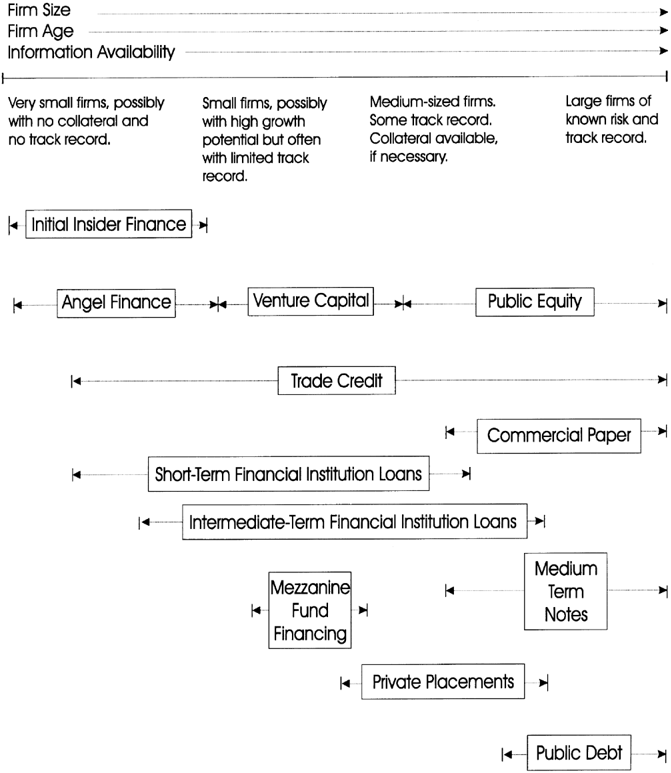
This article examines the economics of financing small business in private equity and debt markets. Firms are viewed through a financial growth cycle paradigm in which different capital structures are optimal at different points in the cycle. We show the sources of small business finance, and how capital structure varies with firm size and age. The interconnectedness of small firm finance is discussed along with the impact of the macroeconomic environment. We also analyze a number of research and policy issues, review the literature, and suggest topics for future research.
Verified 2026-11-25 · 1 reference not checked yet
Overview
CoChat Summary
TL;DR
This article reviews the economics of small business finance through a financial growth cycle paradigm, emphasizing informational opacity and the roles of private equity and debt markets. It documents US small business funding sources and contracts, and analyzes vulnerability to macroeconomic shocks, credit crunches, and bank consolidation.
Key findings
- US small business finance is split roughly evenly between equity (49.63%) and debt (50.37%); the largest sources are the principal owner, commercial banks, and trade creditors, together accounting for 70.10% of total funding. Commercial banks provide 18.75%, trade credit 15.78%, principal owner equity 31.33%, angel finance 3.59%, venture capital 1.85%, and credit card debt 0.14%.
- Financial institution debt is used by 54.23% of small businesses; 86.95% name a commercial bank as their primary financial institution. Average relationship length is 6.64 years overall and 9.01 years with the primary institution; 52.03% of financial institution debt is under lines of credit, 91.94% is secured, and 51.63% is guaranteed.
- The growth cycle paradigm predicts younger/more opaque firms rely on insider finance, trade credit, and angel finance, then venture capital and banks, and eventually public markets. However, 1993 NSSBF data show insider finance does not dominate external finance even for adolescents (upper bound 56.8% insider, roughly equal to external), and financial institution debt is important to very young firms, often based on personal guarantees or collateral.
- Macro vulnerability: the early-1990s credit crunch saw real C&I loans fall 23.2% ($596.7 billion to $458.2 billion) and estimated small business lending fall 38.5% ($143.7 billion to $88.4 billion). Banks with less than $100 million in assets held about 9% of portfolios in small business loans versus about 2% for banks over $10 billion; large banks charged about 100 basis points less and required collateral about 25% less often than small banks, other things equal.
Methods
- Design: review and synthesis organized around the financial growth cycle paradigm, covering theoretical and empirical literature on private equity and debt markets, contracts, and macroeconomic vulnerability.
- Data: primarily the 1993 National Survey of Small Business Finances (NSSBF) for US small business finance tables, plus other sources including NFIB, SCF, STBL, CALL, CRA, Venture Economics/VentureOne, and international data.
- Analysis: descriptive tabulations (Tables 1 and 2) and literature synthesis; the paper is a review rather than a new primary empirical study.
Limitations
- Paper-stated: Table 1 data are not completely accurate or consistent and should be considered rough estimates; angel finance estimates are imprecise (range $15 billion to $120 billion); 1993 data may not reflect current conditions; weighted averages mask considerable heterogeneity.
- Paper-stated: the growth cycle paradigm is not intended to fit all small businesses; firm size, age, and information availability are far from perfectly correlated, and the points at which different funding sources begin and end are not definitive.
- Evident from the text: informational opacity and the intertwining of personal and business finances make small business finance difficult to research, and data on owners’ finances are often unavailable; the paper relies heavily on existing literature and available data rather than new primary data collection.
Model-written summary. Check it against the paper before relying on it.
Integrity signals
Registry
Cites
Statistics
Figures
Verification
Claims the paper makes
22 Valid · 27 Not valid · 107 Not checked · 201 Own results and interpretations
Every source the paper cites for this claim was checked and supports it.
In the paper
“This use of personal assets to help with external ®nance also highlights another important aspect of small business ®nance ± the ®nancial intertwining of owners and their businesses (Ang, 1992).”
§ The economics of small business ®nance: The roles of private equity and debt markets in the ®nancial growth cycle > 2.3. The ®nancial growth cycle of small business
What the sources say
- Supportedcites Ang, 1992 matched to “On the Theory of Finance for Privately Held Firms” (1992) source
In “Integrating Personal and Business Accounts,” Ang says that personal guarantees or collateral make business risk inseparable from owners’ personal risk. “The Financing Decision” also identifies owners’ assets used for loan guarantees as contributions to the business. Together, these passages support the cited point that using personal assets to obtain external finance intertwines owners’ and businesses’ finances. (LLM, conf=0.94)
plainstates an association- Asserted: passes — The authors put it forward as true.
- Checkable: passes — It can be checked against evidence.
- Load-bearing: unclear — It is unclear whether the paper’s conclusions depend on it.
- Based: passes — The paper gives a reason why it holds.
- Supported
The cited sources support only part of this claim — read each source’s verdict below.
In the paper
“Costly state veri®cation (Townsend, 1979;Diamond, 1984) and adverse selection (Myers, 1984;Myers and Majluf, 1984;Nachman and Noe, 1994) arguments suggest the optimality of debt contracts after insider ®nance has been exhausted.”
§ The economics of small business ®nance: The roles of private equity and debt markets in the ®nancial growth cycle > 2.3. The ®nancial growth cycle of small business
What the sources say
- Partly supportedcites Townsend, 1979 matched to “Optimal contracts and competitive markets with costly state verification” (1979) sourceExperimental — accuracy not yet measured
Section 3 characterizes an optimal contract for a firm financing an investment project as a bond that defaults when returns fall below a threshold, supporting the costly-state-verification rationale for debt. The paper does not establish that debt becomes optimal only after insider finance has been exhausted. The adverse-selection citations in the sentence refer to other sources, not Townsend. (LLM, conf=0.85)
- Not checked — no full text of the sourcecites Diamond, 1984 matched to “Financial intermediation and delegated monitoring” (1984) source
- Not matchedcites Myers, 1984
More than one paper fits this citation.
hedgedstates a cause- Asserted: passes — The authors put it forward as true.
- Checkable: passes — It can be checked against evidence.
- Load-bearing: passes — The paper’s conclusions depend on it.
- Based: passes — The paper gives a reason why it holds.
- Partly supported
The cited sources support only part of this claim — read each source’s verdict below.
In the paper
“An agency problem arises in the relationship between the entrepreneur and the venture capitalist in which the entrepreneur may expend insucient eort, exhibit expense preference behavior, or lack sucient information or skill to make optimal production decisions.”
§ The economics of small business ®nance: The roles of private equity and debt markets in the ®nancial growth cycle > 3.2. The venture capital market
What the sources say
- Not checked — no full text of the sourcecites Cooper and Carleton, 1979 matched to “Dynamics of Borrower‐Lender Interaction: Partitioning Final Payoff in Venture Capital Finance” (1979) source
- Partly supportedcites Bergemann and Hege, 1998 matched to “Venture capital financing, moral hazard, and learning” (1998) sourceExperimental — accuracy not yet measured
Section 2.3, “Moral hazard and financing,” describes an entrepreneur who may reduce costly effort or divert investment funds to private ends, supporting the insufficient-effort and expense-preference parts of the claim. It does not identify a lack of the entrepreneur’s information or skill as a cause of poor production decisions; it instead says the entrepreneur and venture capitalists initially have the same assessment of the project. (LLM, conf=0.88)
hedgedstates a possible cause- Asserted: passes — The authors put it forward as true.
- Checkable: passes — It can be checked against evidence.
- Load-bearing: passes — The paper’s conclusions depend on it.
- Based: passes — The paper gives a reason why it holds.
Every source the paper cites for this claim was checked and supports it.
In the paper
“Since 1990, this share has about doubled to 30% (Fenn et al., 1997).”
§ The economics of small business ®nance: The roles of private equity and debt markets in the ®nancial growth cycle > 3. The role of private equity markets in small business ®nance
What the sources say
- Supportedcites Fenn et al., 1997 matched to “The Private Equity Market: An Overveiw” (1997) source
In “IPO Firms that Received Private Equity Backing,” the paper states that the share of IPOs with venture backing averaged 15% during the 1980s and doubled to 30% since 1990. This directly supports the cited claim. (LLM, conf=0.95)
plainstates an association- Asserted: passes — The authors put it forward as true.
- Checkable: passes — It can be checked against evidence.
- Load-bearing: unclear — It is unclear whether the paper’s conclusions depend on it.
- Based: passes — The paper gives a reason why it holds.
- Supported
The cited sources support only part of this claim — read each source’s verdict below.
In the paper
“During the 1980s, approximately 15% of all IPOs were backed by venture capital, well out of proportion to the fraction of all ®rms that received venture capital.”
§ The economics of small business ®nance: The roles of private equity and debt markets in the ®nancial growth cycle > 3. The role of private equity markets in small business ®nance
What the sources say
- Partly supportedcites Fenn et al., 1997 matched to “The Private Equity Market: An Overveiw” (1997) sourceExperimental — accuracy not yet measured
The section “IPO Firms that Received Private Equity Backing” states that venture-backed IPOs averaged 15% of IPOs during the 1980s. It does not give the fraction of all firms that received venture capital or make the claimed comparison with that fraction. (LLM, conf=0.84)
plainstates an association- Asserted: passes — The authors put it forward as true.
- Checkable: passes — It can be checked against evidence.
- Load-bearing: unclear — It is unclear whether the paper’s conclusions depend on it.
- Based: passes — The paper gives a reason why it holds.
- Partly supported
184 more claims · 6 with their cited sources checked
Create a free account to see all 357 claims and to verify the 12 references still open.
- Probably not a substantial claim. 94
- It may state two separate claims as one. 87
- Borderline: one of the tests for a substantial claim is unclear. 2
Claims other papers make about this one
Each is checked against this paper’s own text: does it say what the citing paper says it does?
The cited source says what the claim attributes to it.
In the citing paper
“SMEs are more dependent on external financing supplied by commercial banks (Berger and Udell 1998) because most of them are not qualified to raise money from the stock market.”
From Local Bank, Digital Financial Inclusion and SME Financing Constraints: Empirical Evidence from China (2022) · cites this paper as Berger and Udell 1998
Self-check
Percentages, sums and reported differences re-computed from the paper’s own numbers.
Rated minor: it would not touch a result — a value no result rests on, a p-value that stays on the same side of the significance level, or a conflict that is clerical, resolved elsewhere in the paper, or outside its own findings.
In the paper
“Non®nancial business/government debt provides 19.26% of small business funding (mostly trade credit)”
§ The economics of small business ®nance: The roles of private equity and debt markets in the ®nancial growth cycle > 4. The role of private debt markets in small business ®nance
Reported 19.26 · recomputed 18.01
Citations
Cites
Corporate financing and investment decisions when firms have information that investors do not have
Myers, S. C., & Majluf, N. S. (1984) · Journal of Financial Economics · doi:10.1016/0304-405x(84)90023-0 · Cited by 18,957
The Cost of Capital, Corporation Finance and the Theory of Investment
Miller, M. H. (1958) · American Economic Review · Cited by 14,574
Determinants of corporate borrowing
Myers, S. C. (1977) · Journal of Financial Economics · doi:10.1016/0304-405x(77)90015-0 · Cited by 13,169
Credit Rationing in Markets with Imperfect Information
Stiglitz, J. E., & Weiss, A. (1981) · Columbia University · doi:10.7916/d8v12ft1 · Cited by 12,769 · cited 1×
“…pledging outside collateral may help resolve adverse selection problems when the borrower has more information about the quality of the investment than the lender, and may help prevent credit rationing (Stiglitz and Weiss 1981, 1986, Bester 1985, Chan and Kanatas 1985, Besanko and Thakor 1987a,b).”
The cost of capital, corporation finance and the theory of investment
Terra, P. R. (2008) · Revista de Administração e Contabilidade da Unisinos · doi:10.4013/base.20082.07 · Cited by 8,615
Financial intermediation and delegated monitoring
Diamond, D. W. (1984) · The Review of Economic Studies · doi:10.2307/2297430 · Cited by 8,476 · cited 2×
“Costly state verification (Townsend 1979, Diamond 1984) and adverse selection (Myers 1984, Myers and Majluf 1984, Nachman and Noe 1994) arguments suggest the optimality of debt contracts after insider cFor example, there are generally accepted definitions of the stages of finance for the kind of…”
Corporate Financing and Investment Decisions When Firms Have InformationThat Investors Do Not Have
Myers, S., & Majluf, N. (1984) · doi:10.3386/w1396 · Cited by 6,745
The Benefits of Lending Relationships: Evidence from Small Business Data
PETERSEN, M. A., & RAJAN, R. G. (1994) · The Journal of Finance · doi:10.1111/j.1540-6261.1994.tb04418.x · Cited by 5,440 · cited 4×
“…whereas mortgages, equipment loans, motor vehicle loans, and other loans may more often be transactionsdriven .zs It was also found that dependence on trade credit decreased with the length of the banking relationship, supporting the value of relationship lending (Petersen and Rajan 1994, 1995).”
InfluentialInside the black box: the credit channel of monetary policy transmission
Bernanke, B. S., & Gertler, M. (1995) · Journal of Economic Perspectives · doi:10.1257/jep.9.4.27 · Cited by 4,211
Insiders and Outsiders: The Choice between Informed and Arm's‐Length Debt
RAJAN, R. G. (1992) · The Journal of Finance · doi:10.1111/j.1540-6261.1992.tb04662.x · Cited by 3,902 · cited 1×
“Some research suggests that these firms may try to reduce the control of their banks by issuing public debt, even though public debt may entail higher costs (Diamond 1991, 1993, Rajan 1992, Houston and James 1996).”
Research works printed but not linked: 11
- 66. Cook, L., 1997. Trade ®nance, bank ®nance, and capital market imperfections. Working paper. Harvard University, Cambridge, MA.
- 89. Freear, J., Sohl, J.E., Wetzel, W.E., Jr., 1994. The private investor market for venture capital. The Financier 1, 7±19.
- 112. Hancock, D., Wilcox, J.A., 1997. Bank capital, nonbank ®nance, and real estate activity. Journal of Housing Research 8, 75±105.
- 117. Hempel, G., Coleman, A., Simonson, D., 1986. Bank Management, Wiley, New York.
- 119. Ho, R., 1997. Credit-card use to ®nance small business is soaring, says survey of small ®rms. Wall Street Journal B2, Sept. 25.
- 153. Megginson, W.L., Weiss, K.A., 1991. Venture capitalist certi®cation in initial public oerings. Journal of Finance 46, 903±979.
- 162. Morsman Jr., E., 1986. Commercial loan structuring. Journal of Commercial Bank Lending 68, 2± 20.
- 187. Ravid, S.A., 1996. Debt maturity ± A survey. Financial Markets, Institutions and Instruments 5 (3), 1±68.
- 217. Wetzel Jr. W.E., 1994. Venture capital. In: Bygrave, W.D. (Ed.), Portable MBA in Entrepreneur- ship. Wiley, New York, pp. 172±194.
- 219. White, L.J., 1995. An analytical framework. In: Zahid, S.N. (Ed.), Financial Sector Development in Asia. Oxford University Press, New York, pp. 3±35.
- 222. McKean, R. (Ed.), Issues in Defense Economics. Columbia University Press, New York.
Cited by
Items 1,201–1,300 of 3,739
The Determinants of Capital Structure of Qatari Listed Companies
Ba-Abbad, K., & Ahmad‐Zaluki, N. A. (2012) · International Journal of Academic Research in Accounting Finance and Management Sciences · Cited by 23
Jude, F. A., & Adamou, N. (2018) · International Journal of Economics and Finance · doi:10.5539/ijef.v10n5p231 · Cited by 23
Do investors in SMEs herd? Evidence from French and UK equity markets
Benkraiem, R., Bouattour, M., Galariotis, E., & Miloudi, A. (2019) · Small Business Economics · doi:10.1007/s11187-019-00284-0 · Cited by 19
Interaction Between Trade Credit And Debt: Evidence From The Italian Market
Gibilaro, L., & Mattarocci, G. (2010) · International Business & Economics Research Journal (IBER) · doi:10.19030/iber.v10i3.4106 · Cited by 18
Are Financing Decisions of Family-Owned SMEs Different? Empirical Evidence Using Panel Data
Serrasqueiro, Z., Nunes, P. M., & da Silva, J. V. (2012) · Journal of Management & Organization · doi:10.1017/s1833367200000857 · Cited by 44
Peltoniemi, J. (2004) · Cited by 28
Baeyens, K., Manigart, S., & Verschueren, I. (2003) · Edward Elgar Publishing eBooks · doi:10.4337/9781781956335.00013 · Cited by 19
Foreign Currency Lending in Emerging Europe: Bank Level EvidencePreprint
Brown, M., & Haas, R. D. (2011) · SSRN Electronic Journal · doi:10.2139/ssrn.1740449 · Cited by 17
“Third, the share of foreign currency assets held by a bank will also be related to the currency structure of its liabilities .”
Colombo, M. G., & Murtinu, S. (2014) · SSRN Electronic Journal · doi:10.2139/ssrn.2565022 · Cited by 17
Soft Information in Small Business LendingPreprint
García-Appendini, E. (2007) · SSRN Electronic Journal · doi:10.2139/ssrn.968178 · Cited by 18
“This shows that the firms that ask for a loan from a financial institution have a slightly more developed governance structure, and is in line with the financial growth cycle of the firms (Berger and Udell 1998).”
BackgroundResultKinyua, K. M., Changwony, F. K., & Campbell, K. (2024) · Small Business Economics · doi:10.1007/s11187-024-00940-0 · Cited by 34
Do more financing obstacles trigger tax avoidance behavior? Evidence from Indian SMEs
Elbannan, M. A., & Farooq, O. (2019) · Journal of Economics and Finance · doi:10.1007/s12197-019-09481-9 · Cited by 19
Venture debt: a catalyst for Indian entrepreneurship
Iyer, S. V. (2020) · Venture Capital · doi:10.1080/13691066.2020.1801141 · Cited by 16
Firm performance under financial constraints: evidence from sub-Saharan African countries
Abdisa, L. T., & Hawitibo, A. L. (2021) · Journal of Innovation and Entrepreneurship · doi:10.1186/s13731-021-00177-1 · Cited by 23
Analysing SME investment, financing constraints and its determinants. A stochastic frontier approach
Martinez‐Cillero, M., Lawless, M., & O’Toole, C. M. (2023) · International Review of Economics & Finance · doi:10.1016/j.iref.2023.01.029 · Cited by 16
SMEs ' diversification of financing sources: Strategy or desperation?
Chit, M. M., & Rizov, M. (2023) · International Journal of Finance & Economics · doi:10.1002/ijfe.2822 · Cited by 28
Venture capital and corporate financialization: Evidence from China
Xie, H., Tian, C., & Pang, F. (2023) · The Quarterly Review of Economics and Finance · doi:10.1016/j.qref.2023.12.002 · Cited by 15
On Heaven’s Lathe: State, Rule of Law, and Economic Development
Chen, D., & Deakin, S. F. (2015) · The Law and Development Review · doi:10.1515/ldr-2014-0031 · Cited by 24
“Bank-led finance, which makes fewer demands on judicial and regulatory resources than armslength finance through equity or bond markets, may be expected to play a major role to play in countries where growth is led by manufacturing and natural resources firms and where judicial and legal institutions are still in the…”
BackgroundConnectedness and SME Financing in Post-Communist Economies: Evidence from Uzbekistan
Ruziev, K., & Midmore, P. (2015) · The Journal of Development Studies · doi:10.1080/00220388.2014.989991 · Cited by 23
“Of these around 70 per cent applied for formal finance, which in this study just comprises bank credits – the predominant source of external finance for small enterprises (Berger & Udell, 1998).”
BackgroundThe Big Family: Informal Financing of Small‐ and Medium‐Sized Businesses by Guanxi
Sheng, H. H., & Mendes‐Da‐Silva, W. (2014) · Thunderbird International Business Review · doi:10.1002/tie.21609 · Cited by 18
“This idea is also shared by Berger and Udell (1998).”
BackgroundResultInfluentialLeitner, S. M., & Stehrer, R. (2013) · Latin american journal of economics · doi:10.7764/laje.50.1.1 · Cited by 29
Business advice and lending in small firms
Rostamkalaei, A., & Freel, M. (2016) · Environment and Planning C Politics and Space · doi:10.1177/0263774x16665620 · Cited by 36
“Relatedly, in assessing the riskiness of the business, the ability of firms to provide collateral to partially insure the loan and reduce moral hazard has been widely discussed in the literature (e.g. Berger & Udell 1998; Parker 2002).”
Background(2016) · Intellectual Discourse · Cited by 16
The finance of innovation in Africa
Ayalew, M. M., Zhang, X., & Hailu, D. H. (2019) · European Journal of Innovation Management · doi:10.1108/ejim-11-2018-0242 · Cited by 20
Nastiti, P. K. Y., Atahau, A. D. R., & Supramono, S. (2019) · Business Management and Education · doi:10.3846/bme.2019.10409 · Cited by 25
“As suggested by Berger and Udell (1998), older enterprises are better able to secure financing sources than their younger counterparts because they can access external financing sources more quickly and with lower costs.”
BackgroundInfluentialDoes face-to-face contact matter? Evidence on loan pricing
Gabbi, G., Giammarino, M., Matthias, M., Monferrà, S., & Sampagnaro, G. (2019) · European Journal of Finance · doi:10.1080/1351847x.2019.1703023 · Cited by 18
“However, Berger and Udell (1995) and Boot (2000) find that the duration of the bank–borrower relationship positively affects the cost of credit.”
BackgroundMethodInfluentialWang, S., Zhao, S., Shao, D., & Liu, H. (2020) · Sustainability · doi:10.3390/su12187740 · Cited by 17
“Non-SOEs rely more on government subsidies for various reasons, including the asymmetry of market information [53], lack of guarantee mechanisms and internal financing channels [54,55], and high instability of the external financing environment [56].”
BackgroundMarket differences and adjustment speed of debt, equity, and debt maturity
Tekin, H. (2020) · Australian Journal of Management · doi:10.1177/0312896220968266 · Cited by 20
“Specifically, Berger and Udell (1998) mention in Marshall et al. (2019) that small and younger companies have higher private equity and lower public debt.”
BackgroundKrainer, R. E. (2014) · Journal of International Money and Finance · doi:10.1016/j.jimonfin.2014.03.009 · Cited by 21
Capital structure determinants for arts nonprofits
Charles, C., Sloan, M. F., & Butler, J. S. (2021) · Nonprofit Management and Leadership · doi:10.1002/nml.21454 · Cited by 17
Rocca, T. L., Rocca, M. L., Fasano, F., & Cariola, A. (2022) · Corporate Social Responsibility and Environmental Management · doi:10.1002/csr.2354 · Cited by 17
Bank size, lending paradigms, and usage of Farm Service Agency's guaranteed loan programs
Dodson, C. B. (2014) · Agricultural Finance Review · doi:10.1108/afr-01-2013-0002 · Cited by 23
The Survival and Success of Penny Stock IPOs: Canadian Evidence
Carpentier, C., & Suret, J. (2007) · Cited by 17
Microfinance Institutions: Financial and Social Performance
Mersland, R., & Strøm, R. Ø. (2014) · Palgrave Macmillan UK eBooks · doi:10.1057/9781137399663 · Cited by 41
Financing decisions of migrant family businesses: the case of a Ghanaian-owned shop in Kent
Boateng, B. O., Silva, M., & SEAMAN, C. E. A. (2018) · Journal of Family Business Management · doi:10.1108/jfbm-11-2017-0037 · Cited by 16
Johansson, J., & Malmström, M. (2013) · Entrepreneurship Research Journal · doi:10.1515/erj-2012-0011 · Cited by 21
“Ventures need to make relevant and reliable business model information transparent to access finance (Baysinger and Hoskisson 1990; Berger and Udell 1998; Diamond 1985; Tomkins 2001) but may not be able or willing to do so.”
BackgroundLoan characteristics and credit riskPreprint
Jiménez, G., & Saurina, J. (2003) · RePEc: Research Papers in Economics · Cited by 22
Information Monopoly and Commitment in Intermediary-Firm Relationships
Jean-Baptiste, E. L. (2005) · Journal of Financial Services Research · doi:10.1007/s10693-005-6410-7 · Cited by 16
What makes community reinvestment act agreements work? A study of lender responses
Bostic, R. W., & Robinson, B. L. (2005) · Housing Policy Debate · doi:10.1080/10511482.2005.9521554 · Cited by 16
Banking structure and economic growth: Evidence from China
Lin, J. Y., & Sun, X. (2009) · Frontiers of Economics in China · doi:10.1007/s11459-009-0026-z · Cited by 20
Corporate governance and performance: An empirical evidence from textile sector of Pakistan
Gull, A. A., Saeed, A., & Abid, A. (2013) · AFRICAN JOURNAL OF BUSINESS MANAGEMENT · doi:10.5897/ajbm2013.6952 · Cited by 16
Bank Competition and Firm Creation
Dell’Ariccia, G. (2001) · IMF Working Paper · doi:10.5089/9781451843910.001 · Cited by 29
Krainer, R. E. (2002) · International Review of Law and Economics · doi:10.1016/s0144-8188(01)00078-3 · Cited by 16
Framework for Venture Capital in the Accession Countries to the European UnionPreprint
Schoefer, P., & Leitinger, R. (2002) · SSRN Electronic Journal · doi:10.2139/ssrn.314412 · Cited by 16
Salawu, R. O., & Obafemi Awolowo University-Ile-Ife (2007) · SSRN Electronic Journal · Cited by 16
Baeyens, K., & Manigart, S. (2006) · RePEc: Research Papers in Economics · Cited by 21
Structures and Trends in German BankingPreprint
Nestmann, T., Koetter, M., Stolz, S. M., & Wedow, M. (2004) · SSRN Electronic Journal · doi:10.2139/ssrn.605721 · Cited by 21
“This is in line with findings of Berger and Udell (1998) who also report results for small corporations in the US that emphasise the importance of trade credit as source of funds.”
InfluentialSupplier Certification and Trade CreditPreprint
García-Appendini, E. (2011) · SSRN Electronic Journal · doi:10.2139/ssrn.1795107 · Cited by 20
Financing Constraints, Home Equity and Selection into EntrepreneurshipPreprint
Jensen, T. L., Leth-Petersen, S., & Nanda, R. (2014) · SSRN Electronic Journal · doi:10.2139/ssrn.2506111 · Cited by 23
Commercial Lending Distance and Historically Underserved AreasPreprint
DeYoung, R. E., Frame, W. S., Glennon, D. C., et al. (2007) · SSRN Electronic Journal · doi:10.2139/ssrn.998554 · Cited by 16
Banking Risk Management in India and RBI SupervisionPreprint
Arora, D., & Agarwal, R. K. (2009) · SSRN Electronic Journal · doi:10.2139/ssrn.1446264 · Cited by 16
Private Equity for SME: A Behavioural Model of the Demand-Side PerspectivePreprint
Brettel, M., Breuer, W., Espel, P., & Abedin, A. (2008) · SSRN Electronic Journal · doi:10.2139/ssrn.1141068 · Cited by 21
“This usually leads to hidden information in the SME context (Berger and Udell, 1998).”
Performance and corporate governance in microfinance institutions
Mersland, R., & Strøm, R. Ø. (2007) · Munich Personal RePEc Archive (Ludwig Maximilian University of Munich) · Cited by 61
Determinants of Financial Capital Use: Review of theories and implications for rural businessesPreprint
Curtiss, J., & Curtiss, J. (2012) · RePEc: Research Papers in Economics · doi:10.22004/ag.econ.122846 · Cited by 17
Corporate governance and ownership in microfinance organizations
Mersland, R. (2009) · NVA (Nasjonalt vitenarkiv) · doi:10.2139/ssrn.5377770 · Cited by 24
Innovative Start-Ups in Italy: Their Special Features and the Effects of the 2012 LawPreprint
Russo, P. F., Magri, S., & Rampazzi, C. (2016) · SSRN Electronic Journal · doi:10.2139/ssrn.2863871 · Cited by 16
Start-up capital: Differences between male and female entrepreneursPreprint
Thurik, R., & Verheul, I. (2000) · RePEc: Research Papers in Economics · Cited by 16
Bertoni, F., Ferrer, M. A., & Martí, J. (2011) · Small Business Economics · doi:10.1007/s11187-011-9384-x · Cited by 99
“The empirical evidence is consistent in confirming that VC plays a positive role on employment (Wasmer and Weil 2000; Belke et al. 2006; Bertoni et al. 2007), sales (Bertoni et al. 2011), innovation (Kortum and Lerner 2000), and productivity (Alemany and Martı́ 2006; Chemmanur et al. 2011; Croce et…”
BackgroundBaldock, R. (2015) · Venture Capital · doi:10.1080/13691066.2015.1021028 · Cited by 17
“Whilst these present a strong case for IDE entrepreneurs to seek risk equity finance, there is a need for more fine-grained understanding of these entrepreneurs (Carsrud and Brannback 2011), notably in relation to their selection and use of public or private equity. The adoption of NEDS with specialist skills (Barrow…”
BackgroundInfluentialChallenges for China's banks: Investment policies to support technology-based start-ups
Wonglimpiyarat, J. (2016) · Technology in Society · doi:10.1016/j.techsoc.2016.05.002 · Cited by 20
The impact of corporate distress along the supply chain: evidences from United States
Gibilaro, L., & Mattarocci, G. (2019) · Supply Chain Management An International Journal · doi:10.1108/scm-08-2018-0275 · Cited by 18
Industry, Firm, and Country Level Dynamics of Capital Structure: A Case of Pakistani Firms
Liaqat, I., Khan, M. A., Popp, J., & Oláh, J. (2021) · Journal of risk and financial management · doi:10.3390/jrfm14090428 · Cited by 19
Bibliometric analysis of alternative financing for entrepreneurship
Coronel-Pangol, K., Orden‐Cruz, C., & Paule-Vianez, J. (2022) · Cuadernos de Gestión · doi:10.5295/cdg.211559kc · Cited by 31
Entrepreneurial finance, agency problems and Islamic ethics: complementarities and constraints
Ahmed, H., & Aassouli, D. (2022) · Venture Capital · doi:10.1080/13691066.2022.2067017 · Cited by 37
“Due to these reasons, traditional banks are reluctant to finance start-ups and initial funding often comes from entrepreneurs’ own resources, friends and family, and also from angel investors and venture capitalists (Berger and Udell 1998; Denis 2004).”
BackgroundFinancial Reporting Quality and Private Firms’ Access to Trade Credit Capital
Elemes, A., & Filip, A. (2022) · The International Journal of Accounting · doi:10.1142/s109440602250010x · Cited by 23
Bank lending to small firms: Metamorphosis of a financing model
Russo, P. F., Nigro, V., & Pastorelli, S. (2023) · International Review of Economics & Finance · doi:10.1016/j.iref.2023.10.017 · Cited by 23
The bright side of social trust and entrepreneurial finance
Maung, M. T. (2024) · International Review of Economics & Finance · doi:10.1016/j.iref.2024.02.046 · Cited by 19
Ashraf, S., Sarhan, A. A., de Almeida, A. M. M., & Teles, S. (2024) · International Journal of Hospitality Management · doi:10.1016/j.ijhm.2024.104067 · Cited by 24
Pre-Consolidation and Post-Consolidation of Nigerian Banking Sector: A Dynamic Comparison
Odeleye, A. T. (2013) · International Journal of Economics and Financial Issues · Cited by 15
St‐Pierre, J., & Fadil, N. (2011) · Revue internationale P M E Économie et gestion de la petite et moyenne entreprise · doi:10.7202/1013669ar · Cited by 30
SME Access to Intermediated Credit: What Do We Know and What Don't We Know?
Udell, G. F. (2015) · RePEc: Research Papers in Economics · Cited by 25
Self-citationWhy should banks provide entrepreneurship training seminars?
Coad, A., Frankish, J. S., Roberts, R. G., & STOREY, D. J. (2016) · International Small Business Journal Researching Entrepreneurship · doi:10.1177/0266242615593138 · Cited by 21
“The former is the ability to access fixed and working capital – normally from own resources, fellow traders or from a financial institution such as a bank (Berger and Udell, 1998).”
BackgroundAnálisis de riesgo crediticio, propuesta del modelo credit scoring
Fica, A. L. L., CASANOVA, M. A. A., & Mardones, J. G. (2017) · Revista Facultad de Ciencias Económicas · doi:10.18359/rfce.2666 · Cited by 57
Rajamani, K. (2021) · Eurasian studies in business and economics · doi:10.1007/978-3-030-63149-9_14 · Cited by 21
The Bank Specific Determinants of Loan Growth and Stability: Evidence from Indonesia
Pasaribu, P., & Mindosa, B. (2021) · Journal of Indonesian Economy and Business · doi:10.22146/jieb.v36i2.1385 · Cited by 37
Does capital structure affect the differences in the financial performance of small enterprises?
Stoiljković, A., Tomić, S., & Uzelac, O. (2021) · Strategic Management · doi:10.5937/straman2103072s · Cited by 19
“As companies get older and larger, they will tend to use more external sources of capital (Berger & Udell, 1998).”
BackgroundBoccaletti, S., Rossi, E., & Rossolini, M. (2022) · Journal of International Financial Management and Accounting · doi:10.1111/jifm.12157 · Cited by 15
Evolución comparada de los spin-offs universitarios españoles
Herrero, F. V., & Ángel, P. O. (2010) · Clm.economía: Revista económica de Castilla - La Mancha · Cited by 29
Trade credit: a real option for bootstrapping small firms
Bosse, D. A., & Arnold, T. M. (2010) · Venture Capital · doi:10.1080/13691060903411560 · Cited by 21
“For example, Berger and Udell (1998) examined the sources of small business finance and how capital structure”
BackgroundA wind of change? Reforms of Tax Systems since the launch of Europe 2020
Garnier, G., György, E., Heineken, K., Mathé, M., Puglisi, L., Ruà, S., Skonieczna, A. M., & Mierlo, A. V. (2015) · Reflets et perspectives de la vie économique · doi:10.3917/rpve.532.0075 · Cited by 22
ENTRY COSTS, FINANCIAL FRICTIONS, AND CROSS-COUNTRY DIFFERENCES IN INCOME AND TFP
Bah, E.-H. M., & Fang, L. (2014) · Macroeconomic Dynamics · doi:10.1017/s1365100514000649 · Cited by 16
“Berger and Udell (1998) use data from National Survey of Small Business Finances (NSSBF) to analyze financial structure of small businesses.”
Efectos del ciclo económico en el crédito comercial: el caso de la pyme española
Canto-Cuevas, F.-J., Palacín-Sánchez, M.-J., & di Pietro, F. (2015) · European Research on Management and Business Economics · doi:10.1016/j.iedee.2015.11.001 · Cited by 32
What drives voluntary audit adoption in small German companies?
Weik, A., Eierle, B., & Ojala, H. (2018) · International Journal of Auditing · doi:10.1111/ijau.12134 · Cited by 23
“Privately held companies do not have direct access to the capital markets, which makes them turn instead to debt financing (Berger & Udell, 1998).”
SME Steeplechase: When Obtaining Money Is Harder Than Innovating
Guercio, M., Martínez, L. B., & Bariviera, A. F. (2019) · International Journal of Financial Studies · doi:10.3390/ijfs7020025 · Cited by 22
Employment policies in private loss firms: Return to profitability and the role of family CEOs
Kettunen, J., Martikainen, M., & Voulgaris, G. (2021) · Journal of Business Research · doi:10.1016/j.jbusres.2021.06.029 · Cited by 25
“For family entrepreneurs and insiders, need as a concept of commitment can be decisive, as their personal finances are often intertwined with the firm (Berger & Udell, 1998; Tsoutsoura, 2015).”
Board characteristics and firm performance: The case of Jordanian non-financial institutions
Marashdeh, Z., Alomari, M. W., Aleqab, M. M., & Alqatamin, R. M. (2021) · Journal of Governance and Regulation · doi:10.22495/jgrv10i3art13 · Cited by 18
The Changing Geography of the U.S. Banking Industry
DeYoung, R. E., Klier, T., & McMillen, D. P. (2004) · Cited by 15
Martínez‐Victoria, M., Lario, N. A., & Maté‐Sánchez‐Val, M. (2017) · Agribusiness · doi:10.1002/agr.21513 · Cited by 15
Chile: A Strategy To Promote Innovative Small And Medium Enterprises
Goldberg, M., & Palladini, E. (2008) · World Bank, Washington, DC eBooks · doi:10.1596/1813-9450-4518 · Cited by 15
Start-Up Capital: Differences Between Male and Female Entrepreneurs. 'Does Gender Matter'?Preprint
Verheul, I., & Thurik, R. (1999) · RePEc: Research Papers in Economics · Cited by 15
Achleitner, A., Schraml, S., & Tappeiner, F. (2008) · SSRN Electronic Journal · doi:10.2139/ssrn.1299573 · Cited by 15
“To retain ownership and control over the family business, owner managers rely heavily on internally generated funds in order to reduce outsiders’ financial influence (Berger and Udell, 1998; Poutziouris, 2001; Romano et al., 2001).”
BackgroundDai, N., Ivanov, V. I., & Cole, R. A. (2017) · SSRN Electronic Journal · doi:10.2139/ssrn.1437829 · Cited by 54
Ownership Structure, Governance, and Innovation: Evidence from ItalyPreprint
Minetti, R., Murro, P., & Paiella, M. (2011) · RePEc: Research Papers in Economics · Cited by 15
The effects of bank mergers on credit availability: evidence from corporate dataPreprint
Bonaccorsi, E., & Gobbi, G. (2003) · RePEc: Research Papers in Economics · Cited by 15
Can Sustainable Investing Save the World? Reviewing the Mechanisms of Investor ImpactPreprint
Koelbel, J., Heeb, F., Paetzold, F., & Busch, T. (2018) · SSRN Electronic Journal · doi:10.2139/ssrn.3289544 · Cited by 17
LEGALITY AND VENTURE GOVERNANCE AROUND THE WORLDPreprint
Cumming, D. J., Schmidt, D. M., & Walz, U. (2004) · RePEc: Research Papers in Economics · Cited by 17
Financing Patterns of European SMEs An Empirical TaxonomyPreprint
Moritz, A., Block, J., & Heinz, A. (2015) · SSRN Electronic Journal · doi:10.2139/ssrn.2693564 · Cited by 18
Leasing: An Alternative Financing Mechanism for SMEs
Hossain, M. M. (2013) · ABC Journal of Advanced Research · doi:10.18034/abcjar.v2i1.20 · Cited by 17
Constraints to formal small business performance in the service sector in Cameroon
Kabange, M., & Simatele, M. C. (2022) · African Journal of Economic and Management Studies · doi:10.1108/ajems-07-2021-0331 · Cited by 9
Impact of climate change risks on equity capital: Evidence-based on Chinese markets
Yue, X., Kong, X., Zhao, Q., & Ho, K. (2024) · Pacific-Basin Finance Journal · doi:10.1016/j.pacfin.2024.102541 · Cited by 15
Metadata
- Authors
- N. Berger, A., & F. Udell, G.
- Venue
- Journal of Banking & Finance
- Publisher
- Elsevier BV
- Published
- 1998-08
- Volume
- 22
- Issue
- 6-8
- Pages
- 613-673
- ISSN
- 0378-4266 (ISSN-L)
- OpenAlex
- W2119780569
- Semantic Scholar
- dfc06f7f7eb83d2c0e2a1d67ecb95b520a406843
- Cited by
- 3,690
- References
- 230
- Citations by year
- 2026: 136 · 2025: 148 · 2024: 144 · 2023: 193 · 2022: 155 · 2021: 211 · 2020: 200 · 2019: 156 · 2018: 208 · 2017: 174 · 2016: 186 · 2015: 187 · 2014: 168 · 2013: 177 · 2012: 171
- FWCI
- 169.26
- Type
- journal article
- Language
- en
- Open access
- hybrid
- doi.org
- Licence
- cc-by-nc-nd
- www.elsevier.com/tdm/userlicense/1.0/ (tdm)
- www.elsevier.com/legal/tdmrep-license (tdm)
- creativecommons.org/licenses/by-nc-nd/4.0/ (vor, 125 d)
- Locations
- Journal of Banking & Finance (publishedVersion, cc-by-nc-nd)
- RePEc: Research Papers in Economics (submittedVersion)
- Funders
- York University
- Topics
- Social Sciences › Economics, Econometrics and Finance › Finance › Private Equity and Venture Capital
- Social Sciences › Economics, Econometrics and Finance › Finance › Corporate Finance and Governance
- Social Sciences › Economics, Econometrics and Finance › Finance › Banking stability, regulation, efficiency
- Keywords
- small business financing, private equity, debt markets, capital structure, firm size, firm age, macroeconomic conditions
About these checks
Registry, retraction, Cites and statistics results are computed, not judged, with one exception: a printed reference that no index lists is read once by a model before it counts as a citation error. Claims are extracted by a model and kept only when their quote appears verbatim in the text; each cited source is then checked, with a model’s help, for whether it says what the claim relies on. Those verdicts can be wrong — read the claim’s quote and the cited source before relying on one.
The claim verdicts this report counts are experimental: their accuracy is not yet measured.
A language model drew the claims from the paper on 2026-10-10, under version 3 of the claim definition (model deepseek-v4.1-flash, prompt extract-v3).
A second model labelled each claim on 2026-10-10 (model jev-1.13-20260917, definition revision gold-guideline-v0.2).
Cited sources are checked with a language model’s help (gpt-6-sol).
Statistics and arithmetic are recomputed, not judged.
Confidence bands are shown only for fields calibrated on our annotated test set. None is calibrated yet, so no band is shown.
What counts as a claim ›How we measure confidence ›How we check this ›
Are you an author, or do you see a problem with this page? Request a review
Data sources
Bibliographic data: Semantic Scholar, OpenAlex, Crossref.
Contains information from the Semantic Scholar Academic Graph Datasets, made available under the ODC Attribution License (ODC-BY 1.0).
Semantic Scholar’s data is described in: Kinney, R., et al. (2023). The Semantic Scholar Open Data Platform. arXiv:2301.10140.
