

Global impact of the first year of COVID-19 vaccination: a mathematical modelling study
Open accessThe DOI matches its Crossref record; 23 of the 26 references it cites were found in a registry or an index; 4 of the 8 sources its claims cite were checked for support.
Abstract
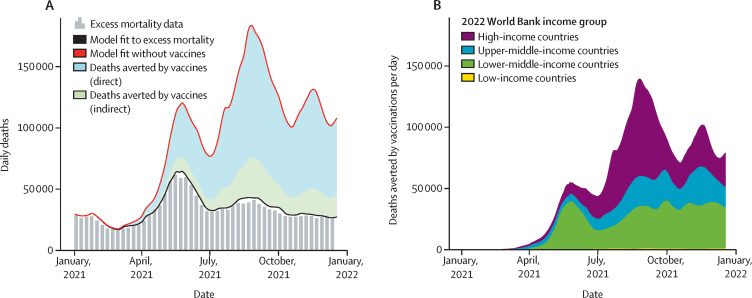
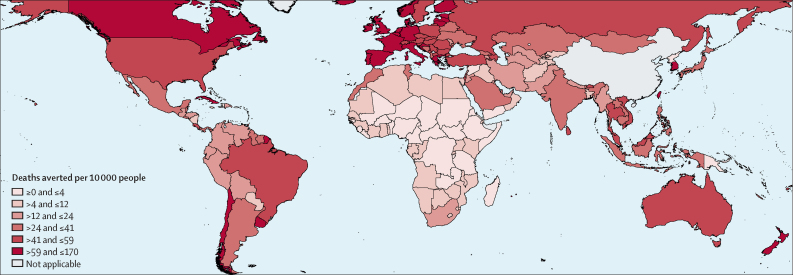
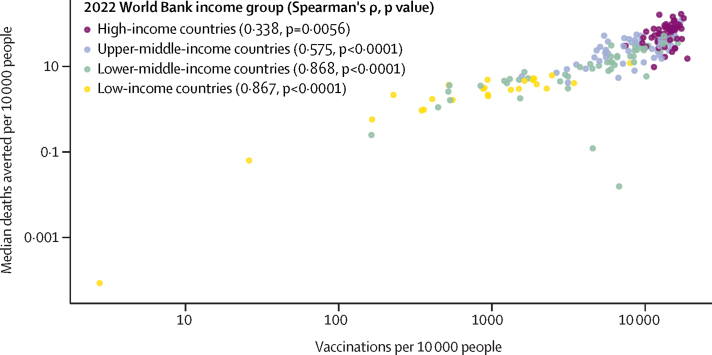
BACKGROUND: The first COVID-19 vaccine outside a clinical trial setting was administered on Dec 8, 2020. To ensure global vaccine equity, vaccine targets were set by the COVID-19 Vaccines Global Access (COVAX) Facility and WHO. However, due to vaccine shortfalls, these targets were not achieved by the end of 2021. We aimed to quantify the global impact of the first year of COVID-19 vaccination programmes. METHODS: A mathematical model of COVID-19 transmission and vaccination was separately fit to reported COVID-19 mortality and all-cause excess mortality in 185 countries and territories. The impact of COVID-19 vaccination programmes was determined by estimating the additional lives lost if no vaccines had been distributed. We also estimated the additional deaths that would have been averted had the vaccination coverage targets of 20% set by COVAX and 40% set by WHO been achieved by the end of 2021. FINDINGS: Based on official reported COVID-19 deaths, we estimated that vaccinations prevented 14·4 million (95% credible interval [Crl] 13·7-15·9) deaths from COVID-19 in 185 countries and territories between Dec 8, 2020, and Dec 8, 2021. This estimate rose to 19·8 million (95% Crl 19·1-20·4) deaths from COVID-19 averted when we used excess deaths as an estimate of the true extent of the pandemic, representing a global reduction of 63% in total deaths (19·8 million of 31·4 million) during the first year of COVID-19 vaccination. In COVAX Advance Market Commitment countries, we estimated that 41% of excess mortality (7·4 million [95% Crl 6·8-7·7] of 17·9 million deaths) was averted. In low-income countries, we estimated that an additional 45% (95% CrI 42-49) of deaths could have been averted had the 20% vaccination coverage target set by COVAX been met by each country, and that an additional 111% (105-118) of deaths could have been averted had the 40% target set by WHO been met by each country by the end of 2021. INTERPRETATION: COVID-19 vaccination has substantially altered the course of the pandemic, saving tens of millions of lives globally. However, inadequate access to vaccines in low-income countries has limited the impact in these settings, reinforcing the need for global vaccine equity and coverage. FUNDING: Schmidt Science Fellowship in partnership with the Rhodes Trust; WHO; UK Medical Research Council; Gavi, the Vaccine Alliance; Bill & Melinda Gates Foundation; National Institute for Health Research; and Community Jameel.
Overview
CoChat Summary
## TL;DR
This mathematical modelling study estimated that COVID-19 vaccination averted 14.4 million deaths based on reported deaths, or 19.8 million deaths when excess mortality was used, across 185 countries and territories during Dec 8, 2020–Dec 8, 2021. The paper argues that vaccine inequity limited impact in low-income settings and that reaching COVAX/WHO coverage targets could have saved substantially more lives.
## Key findings
- Using officially reported COVID-19 deaths, vaccination prevented 14.4 million deaths (95% CrI 13.7–15.9) in 185 countries and territories over the first year of vaccination.
- Using excess mortality, vaccination averted 19.8 million deaths (95% CrI 19.1–20.4), corresponding to a 63% reduction in total deaths (19.8 million of 31.4 million) during that year.
- In COVAX AMC countries, vaccinations averted 7.4 million deaths (95% CrI 6.8–7.7), representing 41% of estimated excess mortality (7.4 million of 17.9 million).
- If the WHO 40% target had been met in every country by the end of 2021, an additional 599,300 deaths (95% CrI 577,700–622,400) could have been averted; in low-income countries, meeting the COVAX 20% target could have averted an additional 45% of deaths, and the WHO 40% target an additional 111% of deaths.
## Methods
- The authors fit a previously published age-structured SEIRS transmission model with vaccination to reported COVID-19 mortality and to all-cause excess mortality in 185 countries and territories (excluding China), using country-level demography, mixing patterns, health-care capacity, and vaccination rollout data.
- Vaccination effects were modelled as protection against infection, severe disease, and onward transmission; the model also explicitly represented the delta variant and vaccine efficacy by country based on likely vaccine types used.
- They estimated deaths averted by comparing the fitted observed scenario against counterfactual scenarios with no vaccines, and with vaccines distributed to meet COVAX 20% and WHO 40% coverage targets by Dec 8, 2021, using Bayesian fitting with Metropolis-Hastings MCMC and 100 draws for uncertainty.
## Limitations
- The paper states that impact estimates were limited by uncertainty in excess mortality, gaps in genomic surveillance, and lack of detailed vaccination data for many countries; key inputs had to rely on working assumptions about vaccine type, rollout, and variant spread.
- The authors explicitly note a limitation of the COVAX/WHO target analysis: the targets were meant for the end of 2021, while the modelling endpoint was Dec 8, 2021, so some countries may have been closer to target by year-end than the model captured.
- Evident from the text: the counterfactual did not adjust for how governments or populations might have responded without vaccines, nor for possible changes in mobility, non-pharmaceutical interventions, or viral evolution, so the estimated deaths averted are model-dependent.
Model-written summary. Check it against the paper before relying on it.
Integrity signals
Registry
Cites
Statistics
Figures
Verification
Claims the paper makes
2 Valid · 2 Not valid · 4 Not checked · 48 Own results and interpretations
The cited sources that could be checked couldn’t confirm or dispute this claim.
In the paper
“In this analysis, we consequently focused on fitting to all-cause excess mortality, which provides a more complete description of the pandemic.15”
§ Global impact of the first year of COVID-19 vaccination: a mathematical modelling study > Discussion
What the sources say
- Could not verifycites [15] WHO Global excess deaths associated with COVID-19, January 2020–December 2021 https://www.who.int/data/stories/global-excess-deaths-associated-with-covid-19-january-2020-december-2021 May, 2022 sourceExperimental — accuracy not yet measured
The Methods (Statistical analysis) and Results examine hospital admission and emergency care attendance among people with delta versus alpha infections. The Discussion addresses limitations of those hospital-care data, but does not assess all-cause excess mortality or say that fitting to it gives a more complete description of the pandemic. Searches for “all-cause excess mortality” and “excess deaths” found no supporting passage; page numbers were not available in our copy. (LLM, conf=0.76)
plainstates a cause- Asserted: passes — The authors put it forward as true.
- Checkable: passes — It can be checked against evidence.
- Load-bearing: passes — The paper’s conclusions depend on it.
- Based: passes — The paper gives a reason why it holds.
- Could not verify
Every source the paper cites for this claim was checked and supports it.
In the paper
“Under-ascertainment of COVID-19 mortality is a known issue that has hindered our understanding of the pandemic.23”
§ Global impact of the first year of COVID-19 vaccination: a mathematical modelling study > Discussion
What the sources say
- Supportedcites [23] Whittaker C Walker PGT Alhaffar M Under-reporting of deaths limits our understanding of true burden of COVID-19 BMJ 375 2021 n2239 34642172 source
In “Renewed case for vaccine equity” (page unavailable), the paper calls it a myth that high-income countries were harder hit and shows that accounting for under-reporting changes the estimated share of COVID-19 mortality borne by low- and middle-income countries. This supports the claim that under-ascertainment has obscured understanding of the pandemic’s mortality burden. (LLM, conf=0.86)
boostedstates a cause- Asserted: passes — The authors put it forward as true.
- Checkable: passes — It can be checked against evidence.
- Load-bearing: passes — The paper’s conclusions depend on it.
- Based: passes — The paper gives a reason why it holds.
- Supported
The cited sources that could be checked couldn’t confirm or dispute this claim.
In the paper
“Our impact estimates were also limited by the inherent uncertainty in model-based estimates of excess mortality.13”
§ Global impact of the first year of COVID-19 vaccination: a mathematical modelling study > Discussion
What the sources say
- Could not verifycites [13] The Economist The pandemic's true death toll The Economist Nov 2, 2021 https://www.economist.com/graphic-detail/coronavirus-excess-deaths-estimates sourceExperimental — accuracy not yet measured
The Discussion describes limitations of estimates of vaccine effects on transmission, including testing behavior and previous infection status. A search for excess mortality, model-based mortality estimates, and deaths found no passage addressing uncertainty in excess-mortality estimates. Page numbers were not available in our copy. (LLM, conf=0.76)
plain- Asserted: passes — The authors put it forward as true.
- Checkable: passes — It can be checked against evidence.
- Load-bearing: unclear — It is unclear whether the paper’s conclusions depend on it.
- Based: passes — The paper gives a reason why it holds.
- Could not verify
The cited sources support only part of this claim — read each source’s verdict below.
In the paper
“Importantly, these estimates based on official reported COVID-19 deaths represent the lower bound of deaths averted at the global level due to the considerable levels of under-reporting of COVID-19 mortality documented worldwide.23”
§ Global impact of the first year of COVID-19 vaccination: a mathematical modelling study > Methods > Excess mortality and COVID-19 mortality data
What the sources say
- Partly supportedcites [23] Whittaker C Walker PGT Alhaffar M Under-reporting of deaths limits our understanding of true burden of COVID-19 BMJ 375 2021 n2239 34642172 sourceExperimental — accuracy not yet measured
In “Renewed case for vaccine equity” (page not provided), the paper says that under-reporting affects reported COVID-19 mortality and that excess-mortality estimates suggest a higher share of deaths in low- and middle-income countries. It also reports estimates of deaths that further vaccination could avert in those countries. It does not say that estimates based on officially reported deaths are a lower bound for deaths averted globally. (LLM, conf=0.83)
plainstates a cause- Asserted: passes — The authors put it forward as true.
- Checkable: passes — It can be checked against evidence.
- Load-bearing: passes — The paper’s conclusions depend on it.
- Based: passes — The paper gives a reason why it holds.
- Partly supported
A result the paper reports from its own data — it cites no other source for it, so there is none to check. The quote shows it is in the paper.
In the paper
“Notably, our model fits were unable to recreate excess mortality death tolls in recent epidemic waves in Iraq and Sudan because of the depletion of the susceptible population.”
§ Global impact of the first year of COVID-19 vaccination: a mathematical modelling study > Discussion
plainstates a cause- Asserted: passes — The authors put it forward as true.
- Checkable: passes — It can be checked against evidence.
- Load-bearing: unclear — It is unclear whether the paper’s conclusions depend on it.
- Based: passes — The paper gives a reason why it holds.
32 more claims
Create a free account to see all 56 claims and to verify the 3 references still open.
- It may state two separate claims as one. 14
- Probably not a substantial claim. 6
Claims other papers make about this one
Each is checked against this paper’s own text: does it say what the citing paper says it does?
The cited source says what the claim attributes to it.
In the citing paper
“Global COVID-19 vaccination programmes are estimated to have prevented 19.8 million deaths worldwide during the first year of roll-out(12)”
Citations
Cites
Estimated transmissibility and impact of SARS-CoV-2 lineage B.1.1.7 in England
Davies, N. G., Abbott, S., Barnard, R. C., Jarvis, C. I., Kucharski, A. J., Munday, J. D., Pearson, C. A. B., Russell, T. W., Tully, D. C., Washburne, A. D., et al. (2021) · Science · doi:10.1126/science.abg3055 · Cited by 2,581 · cited 1×
“20,21 Any epidemiological differences associated with previous variants were assumed to be reflected by their effects on mortality, 22 which were subsequently captured by the estimated R t trend.”
Estimated transmissibility and impact of SARS-CoV-2 lineage B.1.1.7 in England
Davies, N. G., Abbott, S., Barnard, R. C., Jarvis, C. I., Kucharski, A. J., Munday, J. D., Pearson, C. A. B., Russell, T. W., Tully, D. C., Washburne, A. D., et al. (2020) · doi:10.1101/2020.12.24.20248822 · Cited by 2,557
Wang, H., Paulson, K. R., Pease, S. A., Watson, S., Comfort, H., Zheng, P., Aravkin, A. Y., Bisignano, C., Barber, R. M., Alam, T., et al. (2022) · The Lancet · doi:10.1016/s0140-6736(21)02796-3 · Cited by 2,069
Wouters, O. J., Shadlen, K. C., Salcher-Konrad, M., Pollard, A. J., Larson, H. J., Teerawattananon, Y., & Jit, M. (2021) · The Lancet · doi:10.1016/s0140-6736(21)00306-8 · Cited by 1,288
Walker, P. G. T., Whittaker, C., Watson, O. J., Baguelin, M., Winskill, P., Hamlet, A., Djafaara, B. A., Cucunubá, Z., Olivera Mesa, D., Green, W., et al. (2020) · Science · doi:10.1126/science.abc0035 · Cited by 993
Self-citationTwohig, K. A., Nyberg, T., Zaidi, A., Thelwall, S., Sinnathamby, M. A., Aliabadi, S., Seaman, S. R., Harris, R. J., Hope, R., Lopez-Bernal, J., et al. (2022) · The Lancet Infectious Diseases · doi:10.1016/s1473-3099(21)00475-8 · Cited by 803 · cited 1×
“20,21 Any epidemiological differences associated with previous variants were assumed to be reflected by their effects on mortality, 22 which were subsequently captured by the estimated R t trend.”
Karlinsky, A., & Kobak, D. (2021) · eLife · doi:10.7554/elife.69336 · Cited by 772 · cited 1×
“11 Robust vital registration systems do not exist in many parts of the world, with WHO estimating that 40% of global deaths that occurred in 2020 were unregistered, 12 and therefore data on excess mortality are not available for every country.”
Understanding COVID-19 vaccine hesitancy
Machingaidze, S., & Wiysonge, C. S. (2021) · Nature Medicine · doi:10.1038/s41591-021-01459-7 · Cited by 590 · cited 1×
“7 This considerable heterogeneity in vaccination coverage has resulted in continued reliance on non-pharmaceutical interventions for pandemic management in some countries 8 but concomitantly enabled other nations to relax interventions as a route out of the pandemic.”
Twohig, K. A., Nyberg, T., Zaidi, A., Thelwall, S., Sinnathamby, M., Aliabadi, S., Seaman, S. R., Harris, R., Hope, R., Bernal, J. L., et al. (2021) · Northumbria Research Link (Northumbria University) · doi:10.17863/cam.76294 · Cited by 514
Effect of Covid-19 Vaccination on Transmission of Alpha and Delta Variants
Eyre, D. W., Taylor, D., Purver, M., Chapman, D., Fowler, T., Pouwels, K. B., Walker, A. S., & Peto, T. E. A. (2022) · New England Journal of Medicine · doi:10.1056/nejmoa2116597 · Cited by 464 · cited 2×
“19 We inferred vaccine efficacy for each country on the basis of vaccine types known to be predominantly used in each country.”
Cited by
Items 1,401–1,500 of 1,777
Toward a Healthier Future: Lessons From the COVID-19 Pandemic
Goldman, M., & Sansonetti, P. J. (2024) · Frontiers for Young Minds · doi:10.3389/frym.2024.1271484
Stationary Wavelet Entropy and Cat Swarm Optimization to Detect COVID-19
Wu, M., Chen, S., Wang, J., Wang, S., Górriz, J. M., & Zhang, Y. (2024) · Lecture notes in computer science · doi:10.1007/978-3-031-61137-7_15
Everything, everywhere, all at once
Sarnecki, J. (2024) · Veritas (Porto Alegre) · doi:10.15448/1984-6746.2024.1.45427
RBD design increases the functional antibody titers elicited by SARS-CoV-2 spike vaccination
Dickey, T. H., Salinas, N. D., Patel, P. Y., Orr-Gonzalez, S., Ouahes, T., McAleese, H., Richardson, B., Singleton, M., Murphy, M. J., Eaton, B., et al. (2024) · Antiviral Research · doi:10.1016/j.antiviral.2024.105937
Yin, J. D.-C. (2024) · Online Journal of Public Health Informatics · doi:10.2196/55104 · Cited by 3
“This influence was particularly pronounced during the COVID-19 pandemic, where misinformation proliferated alongside scientific communication, complicating public health responses [7,8].”
BackgroundZarin, R., Khan, Y., Ahmad, M., et al. (2024) · Computer Methods in Biomechanics & Biomedical Engineering · doi:10.1080/10255842.2024.2364817
Identifying Host and Bacterial Biomarkers to Predict Sepsis
Lewis, M. L. (2024) · Cronfa (Swansea University) · doi:10.23889/suthesis.66753
Optimal Control Model of University-PhD-Postdoc-Industry (UPPI) Migration and Unemployment
Adeniji, A. A., Adeniyi, M. O., Shatalov, M. Y., et al. (2024) · Contemporary Mathematics · doi:10.37256/cm.5220242986
“To note, mathematical modelling helps by implementing the effective optimal control model by measuring the control strategies of situations either in measuring the impact of vaccination [9], infectious diseases such as Mpox [10], and measures the population rate [11].”
MethodApproved vaccines for the COVID-19 pandemic: Linking in future perspectives
Fonseca, L. M. D. S., Hodel, K. V. S., Rocha, V. P. C., Soares, M. B. P., & Machado, B. A. S. (2024) · Elsevier eBooks · doi:10.1016/b978-0-443-18703-2.00014-1
Ferris, B. F., Balasubramanian, S., Rajamanickam, A., et al. (2024) · PLoS ONE · doi:10.1371/journal.pone.0305819
“Many low and lower-middle-income countries did not meet the vaccination coverage targets set by COVAX and the WHO [1].”
BackgroundRofail, D., Hussein, M. A., Naumann, U., Podolanczuk, A. J., Norton, T. D., Ali, S., Mastey, V., Ivanescu, C., Hirshberg, B., & Geba, G. P. (2024) · Infectious Diseases and Therapy · doi:10.1007/s40121-024-01013-1
“While the introduction of comprehensive vaccine programs has reduced the number of deaths due to COVID-19 [2], the virus that causes COVID-19, SARS-CoV-2, continues to evolve and the number of new infections continues to rise [1].”
Factors Associated With Severity of COVID-19 Disease in Vaccinated Patients
Bahar, T., Rahman, S., Anne, R. T., Chowdhury, Z. Z., Hossain, M. M., Akter, S., Ali, M., & Wazib, A. (2024) · Journal of Dhaka Medical College · doi:10.3329/jdmc.v31i2.73148
Gao, X. Y., Zhao, C., Yang, J., Yang, Z., Feng, J., Zhan, S., Fan, D., & Liu, Z. (2024) · medRxiv · doi:10.1101/2024.07.09.24309613
“11 Our results revealed a negative correlation between the number of vaccinated individuals and the increase in the burden of GBS, suggesting that vaccination played a crucial role in controlling the GBS burden by mitigating the spread of SARS-CoV-2.”
ResultInfluentialCOVID-19 ethics: unique aspects and a review as of early 2024
Shandera, W. X. (2024) · Bioethics News · doi:10.1007/s40592-024-00199-x · Cited by 1
Marín, D. (2024) · Journal of Regulatory Science · doi:10.21423/jrs.regsci.121283
Radkowski, P., dziora, B. K., Witt-Majch, A., et al. (2024) · Asian Journal of Epidemiology · doi:10.3923/aje.2024.6.14
Warren, J., Cheng, D., Crawford, N. W., Jones, B., Ng, R., Alafaci, A., Stub, D., Lew, P., & Taylor, A. (2024) · Heart Lung and Circulation · doi:10.1016/j.hlc.2024.06.007
Efectos secundarios y reacciones post vacunas de COVID-19
Tenorio-Figueroa, C. J., Alvarez, R. P. S., & Cantos, Y. Y. Q. (2024) · Revista Científica de Salud BIOSANA · doi:10.62305/biosana.v4i4.206
Bhatt, U., Hérate, C., Estelien, R., Relouzat, F., Dereuddre‐Bosquet, N., Maciorowski, D., Diop, C., Couto, E., Staiti, J., Cavarelli, M., et al. (2024) · Vaccines · doi:10.3390/vaccines12080882
“Over the past years, the world has witnessed the expedited development and approval of several efficacious and safe gene-based vaccines for COVID-19, such as mRNA-and adenovirus-based vaccines, which saved millions of lives [20].”
BackgroundUsing smartphones to study vaccination decisions in the wild
Girardini, N. A., Stopczynski, A., Baranov, O., Betsch, C., Brockmann, D., Lehmann, S., & BOHM, R. M. (2024) · PLOS Digital Health · doi:10.1371/journal.pdig.0000550 · Cited by 1
“In the special case of the COVID-19 pandemic, it has been estimated that vaccines prevented about 20 million deaths during the first year of COVID-19 vaccination only [2].”
BackgroundDyplomacja Chińskiej Republiki Ludowej w okresie pandemii COVID-19 wobec państw Afryki
Dębska, M. (2024) · Politeja · doi:10.12797/politeja.20.2024.89.13
Yen, Y., Chan, S.-Y., Lai, Y., et al. (2024) · BMC Infectious Diseases · doi:10.1186/s12879-024-09654-w
Estadilla, C. D. S., Mar, J., Ibarrondo, O., Stollenwerk, N., & Aguiar, M. (2024) · Journal of Epidemiology and Global Health · doi:10.1007/s44197-024-00286-6
“5, which compares the results from this study, He et al. (2022) [ 19 ], and selected countries from Watson et al. (2022) [18].”
MethodResultVaccination against COVID-19 in a post-pandemic era
Neto, F. L., Ceccato, A., & Ranzani, O. (2024) · European Respiratory Society eBooks · doi:10.1183/2312508x.10020223
Tahir, N., Jung, C., Lee, S., Azizah, N., Azizah, N., & Li, T. (2024) · doi:10.2196/preprints.65708
Changes in Lifestyle and Eating Habits of the Libyan Population During the COVID-19 Pandemic
El-Mani, S. F., Eltuhami, A., Mansour, R. M., Elabbar, L., Bosrewill, N., Burwag, S., Alfadil, M., & Elabbar, W. (2024) · Libyan journal of public health practices. · doi:10.37376/ljphp.v1i1.6835
Finch, E., Nilles, E. J., Paulino, C. T., Skewes-Ramm, R., Lau, C. L., Lowe, R., & Kucharski, A. J. (2024) · The Lancet Regional Health - Americas · doi:10.1016/j.lana.2024.100860 · Cited by 5
Senoga, U., Guwatudde, D., Isunju, J. B., et al. (2024) · BMC Public Health · doi:10.1186/s12889-024-19869-w
“For instance, by the end of the first year of vaccination, COVID-19 vaccination had prevented 63% of global deaths [13].”
Modelling the impact of vaccination on SARS-CoV-2 transmission in EnglandPreprint
Derqui, N., Mishra, S., Hinsley, W. R., Bhatt, S., & Laydon, D. J. (2024) · medRxiv · doi:10.1101/2024.09.06.24313210 · Cited by 1
Hillery, A. M. (2024) · Elsevier eBooks · doi:10.1016/b978-0-443-28934-7.00009-1
Neurologische Langzeitfolgen von COVID-19
Bremer, B., & Franke, C. (2024) · Fortschritte der Neurologie · Psychiatrie · doi:10.1055/a-2335-0198
Feuchtenberger, M., Kovacs, M. S., Eder, A., Nigg, A. P., Almanzar, G., Prelog, M., & Schäfer, A. (2024) · Rheumatology Advances in Practice · doi:10.1093/rap/rkae111
Silva, T. C., Boaventura, V. S., Pearce, N. E., & Barral‐Netto, M. (2024) · International Journal of Infectious Diseases · doi:10.1016/j.ijid.2024.107241 · Cited by 1
Predictors for COVID-19-Specific and Non-COVID-19-Specific Deaths: A Cohort Study in Taiwan
Chan, S.-Y., Lai, H.-H., Lai, Y., Huang, C., Chen, C.-C., Chang, S., Yen, Y., & Chiu, Y.-C. (2024) · Asia Pacific Journal of Public Health · doi:10.1177/10105395241282634
“18 Moreover, COVID-19 vaccines can elicit immune responses and induce the production of neutralizing antibodies, 19 which could reduce infection severity and mortality rates.”
Cardiovascular presentations during the COVID-19 pandemic: an interrupted time series analysis
Sritharan, H. P., Nguyen, H. H., Allahwala, U. K., & Bhindi, R. (2024) · Journal of Public Health · doi:10.1093/pubmed/fdae248
Modelling antibody dynamics in humans after different Ad26.COV2.S vaccination schemes
Dari, A., Ruixo, J. J. P., Gars, M. L., Struyf, F., & Jacqmin, P. (2024) · British Journal of Clinical Pharmacology · doi:10.1111/bcp.16251
Babaahmadi, M. K., Iravani, M. M., Orandi, A., Orandi, A., Fallah, E., Ghazi, S. F., Malekabad, E. S., & Khorramnia, S. (2024) · Studies in Medical Sciences · doi:10.61186/umj.35.4.250
Equitable Uptake of Life-Saving COVID-19 Primary Vaccine Series in Community Health Centers
Hechter, R. C. (2024) · American Journal of Public Health · doi:10.2105/ajph.2024.307822
Surtaieva, N., Yakovenko, O., Соловйов, С. О., et al. (2024) · Ukrainian Scientific Medical Youth Journal · doi:10.32345/usmyj.3(149).2024.166-174
Creativity and Crisis: From Possibilities to Making Them Happen
Ivčević, Z., & Pei, Y. (2024) · Palgrave studies in creativity and innovation in organizations · doi:10.1007/978-3-031-61782-9_14
Mazur, M., Bański, J., & Kamińska, W. (2024) · International Journal of Environmental Research and Public Health · doi:10.3390/ijerph21101342
Stability Analysis and Simulation of Diffusive Vaccinated Models
Al-Shamiri, M. M. A., Avinash, N., Chellamani, P., et al. (2024) · Complexity · doi:10.1155/2024/5595996
Hannawa, A. F., Spitzberg, B. H., Bhusal, A., Harriman, A., & Little, T. D. (2024) · Health Communication · doi:10.1080/10410236.2024.2413762 · Cited by 2
“Worldwide, a modeling study estimated that full vaccination could have saved up to 14 million lives across 185 countries between December 2020 and December 2021 (Watson et al., 2022).”
Pimentel, R. M. M., Macedo, H., de Abreu, L. C., et al. (2026) · International Journal of Preventive Medicine · doi:10.4103/ijpvm.ijpvm_403_24
“[27,28] Our study suggests the importance of booster doses to reduce the epidemic peaks found in the months of 2022.”
Facing stress and inflammation: From the cell to the planet
Cavaillon, J., & Chaudry, I. H. (2024) · World Journal of Experimental Medicine · doi:10.5493/wjem.v14.i4.96422
Weintraub, W., & Waksman, O. (2024) · Elsevier eBooks · doi:10.1016/b978-0-443-14001-3.00002-9
Insights from qualitative and bifurcation analysis of COVID-19 vaccination model in Bangladesh
Kuddus, M. A., Mohiuddin, M., Paul, A. K., & Rahman, A. (2024) · PLoS ONE · doi:10.1371/journal.pone.0312780 · Cited by 2
“To evaluate the effectiveness of COVID-19 vaccination programs, Watson et al., 2022 estimated the number of additional lives that would have been lost if vaccines had not been distributed [34].”
MethodLöfström, E., Eringfält, A., Kötz, A., Tham, J., & Undén, J. (2024) · Apmis · doi:10.1111/apm.13489 · Cited by 1
Vaccine Confidence Among Young Adults During COVID-19: A Cross-Sectional Study from Turkey
Türkmen, L. (2024) · Journal of Multidisciplinary Healthcare · doi:10.2147/jmdh.s487424 · Cited by 1
Mushattat, S. J., Faieq, Z. A., JABBAR, A., et al. (2024) · BIO Web of Conferences · doi:10.1051/bioconf/202413906021
Krotinger, A., Yang, L., & Taylor, S. (2024) · Collaborative bioethics · doi:10.1007/978-3-031-72371-1_10
Luong, T.-D., & Le, D. V. (2024) · Health Economics Review · doi:10.1186/s13561-024-00569-5 · Cited by 3
The Crises and the Global Economy in the Twenty-First Century
Reddy, Y. V., Ray, P., & Chakraborty, P. (2024) · doi:10.1093/9780198934288.003.0005
Impact of the Crisis on Fiscal Positions
Reddy, Y. V., Ray, P., & Chakraborty, P. (2024) · doi:10.1093/9780198934288.003.0003
Reddy, Y. V., Ray, P., & Chakraborty, P. (2024) · doi:10.1093/9780198934288.003.0006
Reddy, Y. V., Ray, P., & Chakraborty, P. (2024) · doi:10.1093/9780198934288.003.0001
Reddy, Y. V., Ray, P., & Chakraborty, P. (2024) · doi:10.1093/9780198934288.002.0006
Preventing Transmission of COVID-19 and Other Respiratory Infections in Otolaryngology Practices
Durand, M. L. (2024) · Springer eBooks · doi:10.1007/978-3-031-68449-4_35
Response to the Crisis and Fiscal Implications
Reddy, Y. V., Ray, P., & Chakraborty, P. (2024) · doi:10.1093/9780198934288.003.0004
Taxation and Regulation of the Financial Sector
Reddy, Y. V., Ray, P., & Chakraborty, P. (2024) · doi:10.1093/9780198934288.003.0012
Crisis and Public Debt Management
Reddy, Y. V., Ray, P., & Chakraborty, P. (2024) · doi:10.1093/9780198934288.003.0009
Reddy, Y. V., Ray, P., & Chakraborty, P. (2024) · doi:10.1093/9780198934288.003.0007
Reddy, Y. V., Ray, P., & Chakraborty, P. (2024) · doi:10.1093/9780198934288.003.0002
Reddy, Y. V., Ray, P., & Chakraborty, P. (2024) · doi:10.1093/9780198934288.002.0004
Public Debt, National Income, and Growth
Reddy, Y. V., Ray, P., & Chakraborty, P. (2024) · doi:10.1093/9780198934288.003.0008
Sub-national Finance and Crisis
Reddy, Y. V., Ray, P., & Chakraborty, P. (2024) · doi:10.1093/9780198934288.003.0013
Reddy, Y. V., Ray, P., & Chakraborty, P. (2024) · doi:10.1093/9780198934288.003.0014
Reddy, Y. V., Ray, P., & Chakraborty, P. (2024) · doi:10.1093/9780198934288.002.0007
Special considerations for the nonclinical safety assessment of vaccines
Wolf, J. J. (2024) · Elsevier eBooks · doi:10.1016/b978-0-443-13344-2.00007-9
Martinez, L. S., Savage, M. W., Williams, D. M., Alvarado, J., Cordon-Mulbry, C., Dickerson, D., Roquia, R., Spitzberg, B. H., Peddecord, K. M., Issa, E., et al. (2024) · Health Communication · doi:10.1080/10410236.2024.2432066
“…addressing the COVID-19 pandemic (Arbel et al., 2023; Atkeson, 2023; Bollyky et al., 2023; Lin et al., 2023; Schmidt, 2020; Thaweethai et al., 2023; Watson et al., 2022; Wu et al., 2023; Yamana et al., 2023) as well as future outbreaks of other infectious diseases, current vaccine hesitancy across…”
Gheeraert, A., Leroux, V., Mias‐Lucquin, D., et al. (2024) · bioRxiv (Cold Spring Harbor Laboratory) · doi:10.1101/2024.12.12.628120
López, D., & Zumárraga, J. (2024) · International Journal of Molecular Sciences · doi:10.3390/ijms252413477
Moran, C., Seidel, S., Abolhosseini, S., Coroiu, A., Sohail, R., Gamboa, J., Valdarchi, A. B., Hernández, L., & Campbell, T. S. (2024) · International Journal of Behavioral Medicine · doi:10.1007/s12529-024-10337-8
“Widespread COVID-19 vaccination has prevented millions of deaths globally [4], and contributed to the alleviation of pressure on healthcare systems worldwide [5].”
de Carvalho, R. L. R., Pereira, D. N., Chagas, V. S., Augusto, V. M., Costa, F. R., Nascimento, G. F., Ruschel, K. B., Moreira, L. B., Carneiro, M., Júnior, M. H. G., et al. (2024) · BMC Infectious Diseases · doi:10.1186/s12879-024-10305-3 · Cited by 1
Kakoly, N. S., Hasan, S. M. K., Hoque, M. M., Ratul, R. H., Khan, M. A. S., Mitra, D. K., & Billah, B. (2024) · PLoS ONE · doi:10.1371/journal.pone.0311508 · Cited by 1
Vaccination Decisions and Social Capital in JapanPreprint
Okubo, T., & Noy, I. (2024) · SSRN Electronic Journal · doi:10.2139/ssrn.5064596
Clinical manifestations in POST-COVID-19 patients
dos Santos, T. C. P., Santos, P. W. D. S., de Souza, S. A., Santos, P. H. L. D. S., Torres, H. D. S., Nascimento, M. E. C. B., Baptista, A. F., & Hazime, F. A. (2024) · Manual Therapy Posturology & Rehabilitation Journal · doi:10.17784/mtprehabjournal.2024.22.1384
GLOBAL COOPERATION: IMPACT OF PANDEMICS AND GLOBAL CRISES ON TRADE AND ECONOMIC STABILITY
Akıncı, Ö. S., & Taşkın, E. (2024) · Kafkas Üniversitesi İktisadi ve İdari Bilimler Fakültesi Dergisi · doi:10.36543/kauiibfd.2024.029
Educação permanente em saúde em tempos de COVID-19
Paulino, G. B. (2023) · doi:10.47749/t/unicamp.2023.1408758
Sheehan, J., Trauth, A. J., Hagensee, M. E., & Ramsay, A. J. (2025) · Pathogens · doi:10.3390/pathogens14010044 · Cited by 1
Rinchai, D., Deola, S., Kabeer, B. S. A., Gentilcore, G., Toufiq, M., Mathew, L. S., Liu, L., Vempalli, F. R., Mubarak, G., Lorenz, S., et al. (2025) · bioRxiv (Cold Spring Harbor Laboratory) · doi:10.1101/2025.01.09.631990
Knowledge and Behavioral Beliefs Related to Vaccination Hesitancy Among Healthcare Workers
(2025) · Frontiers research topics · doi:10.3389/978-2-8325-5893-5
Rasmussen, S. A., Perrotta, K., Conover, E. A., Curran, C. P., & Običan, S. G. (2025) · Birth Defects Research · doi:10.1002/bdr2.2433 · Cited by 1
Hybrid polymeric systems for potential applications in vaccine delivery
Kean, E. A., & Adeleke, O. A. (2025) · Elsevier eBooks · doi:10.1016/b978-0-443-15564-2.00011-1
de León, U. A.-P., Pérez, Á. G. C., & Avila-Vales, E. J. (2025) · Elsevier eBooks · doi:10.1016/b978-0-44-328814-2.00009-6
KLRB1 expression in nasopharyngeal mucosa as a prognostic biomarker in COVID-19 patients
García‐Aranda, M., Onieva-García, M. Á., Martín‐García, D., López, R. Q., López, I., Padilla-Ruiz, M., Téllez, T., Martínez-Gálvez, B., Hortas, M. L., García‐Galindo, A., et al. (2025) · Scientific Reports · doi:10.1038/s41598-025-86846-7 · Cited by 2
Li, J., Yan, H., Li, J., Feng, L., Feng, Y., Mao, H., Wang, X., Li, X., Song, W., Wu, G., et al. (2025) · Journal of Medical Virology · doi:10.1002/jmv.70189 · Cited by 2
Automated Segmentation of Computed Tomography Images for COVID-19 Patient Evaluation
Marques, J. V. M., Gonçalves, C. D. A., Filho, A. O. D. C., et al. (2025) · Lecture notes in computer science · doi:10.1007/978-3-031-79035-5_9
Martínez-Salinas, E. J., Arunachalam, V., Seibel, C., et al. (2024) · Revista Colombiana de Estadística · doi:10.15446/rce.v47n2.112805
Evidence from Experiments and Behavioural Insights
Galizzi, M. M. (2024) · Cambridge University Press eBooks · doi:10.1017/9781009438438.003
Wang, L., Swayze, S., Siddiqi, A., Baral, S., Sander, B., Sbihi, H., Kwong, J. C., & Mishra, S. (2025) · medRxiv · doi:10.1101/2025.01.30.25321209
La vaccination, la plus grande avancée de la médecine
Fischer, A. (2025) · Bulletin de l Académie Nationale de Médecine · doi:10.1016/j.banm.2024.09.004
Burhan, E., Azzumar, F., Sinuraya, F. A. G., Rakasiwi, M. I. D., Akbar, I., Mubarak, F., Rengganis, A. T., Rachmadi, R. A., & Afidjati, H. (2025) · JMIR Research Protocols · doi:10.2196/56519
Warner, B. M., Vendramelli, R., Boese, A. S., et al. (2025) · PLoS ONE · doi:10.1371/journal.pone.0316952
“It has been estimated that within the first year of their combined use, vaccines against SARS-CoV-2 may have saved as many as 20 million lives [1].”
Gao, X., Zhao, C., Yang, J., Yang, Z., Feng, J., Zhan, S., Fan, D., & Liu, Z. (2025) · SSRN Electronic Journal · doi:10.2139/ssrn.5122479
Meeraus, W. H., Postema, A., Gray, C. M., Lee, A. C.-Y., Maria, A. S., Furtado, B. E., Conde‐Sousa, E., Ouwens, M., Valverde, D. A., da Cunha, C. A., et al. (2025) · Vaccine · doi:10.1016/j.vaccine.2025.126955
Carroll, M. L., Fox, H. R., Tran, A., Chellappan, G., Rojas, L. V., Karengil, G., Karandish, F., Langston, J. W., Fall, B. M., Whalen, M. M., et al. (2025) · Vaccine · doi:10.1016/j.vaccine.2025.126988
“In their first year, vaccines reduced COVID-19 deaths by 63 % in 185 countries [1].”
Ayling, K., Jackson, H., Jia, R., Royal, S., Fairclough, L. C., & Vedhara, K. (2025) · Brain Behavior and Immunity · doi:10.1016/j.bbi.2025.03.011 · Cited by 4
“…vaccines in late 2020 turned the tide on the COVID-19 pandemic, saving at least 1.4 million lives in Europe alone (The WHO European Respiratory Surveillance Network, 2024) and an estimated 14.4 million worldwide within a year of their first use outside of clinical trials (Watson et al., 2022).”
InfluentialMukenge, E. K., Sumbu, B. M.-M., Nkodila, A. N., Muwonga, J. M., Makulo, J. R. R., Ngole, M. Z., Bepouka, B. I., Longokolo, M. M., Kamwiziku, G. K., Situakibanza, H. N.-T., et al. (2025) · BMC Infectious Diseases · doi:10.1186/s12879-025-10754-4
Metadata
- Authors
- Watson, O. J., Barnsley, G., Toor, J., Hogan, A. B., Winskill, P., & Ghani, A. C.
- Affiliations
- Imperial College London (GB)
- Corresponding author
- Watson, Oliver J
- Venue
- The Lancet Infectious Diseases
- Publisher
- Elsevier BV
- Published
- 2022-09
- Volume
- 22
- Issue
- 9
- Pages
- 1293-1302
- ISSN
- 1473-3099 (ISSN-L)
- PMC
- PMC9225255
- OpenAlex
- W4283395367
- Semantic Scholar
- e048be45c9e0900c299d78c2cb327ce9afd77467
- Cited by
- 1,769
- References
- 26
- Citations by year
- 2026: 165 · 2025: 341 · 2024: 533 · 2023: 578 · 2022: 150
- FWCI
- 237.54
- Type
- journal article
- Language
- en
- Update notices
- erratum (2023-10-01)
- Open access
- hybrid
- doi.org
- Licence
- cc-by
- www.elsevier.com/tdm/userlicense/1.0/ (tdm)
- www.elsevier.com/legal/tdmrep-license (tdm)
- creativecommons.org/licenses/by/4.0/ (vor)
- Locations
- The Lancet Infectious Diseases (publishedVersion, cc-by)
- PubMed Central (publishedVersion, cc-by)
- PubMed (publishedVersion)
- LSHTM Research Online (London School of Hygiene and Tropical Medicine) (acceptedVersion)
- Spiral (Imperial College London) (submittedVersion, other-oa)
- Funders
- Bill and Melinda Gates Foundation
- GAVI Alliance
- National Institute for Health and Care Research
- Imperial College London
- Medical Research Council (MR/R015600/1, MC_PC_19012)
- Topics
- Physical Sciences › Mathematics › Modeling and Simulation › COVID-19 epidemiological studies
- Health Sciences › Medicine › Infectious Diseases › SARS-CoV-2 and COVID-19 Research
- Social Sciences › Health › Vaccine Coverage and Hesitancy
- Keywords
- COVID-19 vaccination, vaccine impact, COVID-19 mortality, excess mortality, mortality averted, COVAX, vaccine equity, low-income countries, mathematical transmission model, global health equity, SARS-CoV-2, advance market commitments
- MeSH terms
- COVID-19, COVID-19 Vaccines, Humans, Models, Theoretical, Vaccination, Vaccines, Global Health
About these checks
Registry, retraction, Cites and statistics results are computed, not judged, with one exception: a printed reference that no index lists is read once by a model before it counts as a citation error. Claims are extracted by a model and kept only when their quote appears verbatim in the text; each cited source is then checked, with a model’s help, for whether it says what the claim relies on. Those verdicts can be wrong — read the claim’s quote and the cited source before relying on one.
The claim verdicts this report counts are experimental: their accuracy is not yet measured.
A language model drew the claims from the paper on 2026-10-10, under version 3 of the claim definition (model deepseek-v4.1-flash, prompt extract-v3).
A second model labelled each claim on 2026-10-10 (model jev-1.13-20260917, definition revision gold-guideline-v0.2).
Cited sources are checked with a language model’s help (gpt-6-sol).
Statistics and arithmetic are recomputed, not judged.
Confidence bands are shown only for fields calibrated on our annotated test set. None is calibrated yet, so no band is shown.
What counts as a claim ›How we measure confidence ›How we check this ›
Are you an author, or do you see a problem with this page? Request a review
Data sources
Bibliographic data: Semantic Scholar, OpenAlex, Crossref.
Contains information from the Semantic Scholar Academic Graph Datasets, made available under the ODC Attribution License (ODC-BY 1.0).
Semantic Scholar’s data is described in: Kinney, R., et al. (2023). The Semantic Scholar Open Data Platform. arXiv:2301.10140.
