

Global impact of the first year of COVID-19 vaccination: a mathematical modelling study
Open accessThe DOI matches its Crossref record; 23 of the 26 references it cites were found in a registry or an index; 4 of the 8 sources its claims cite were checked for support.
Abstract
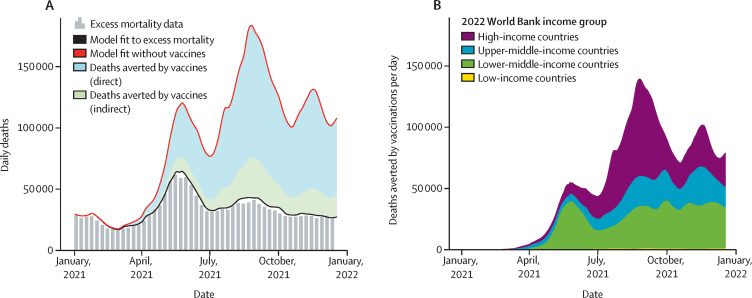
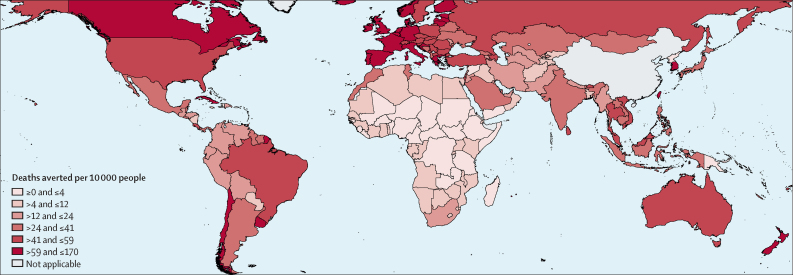
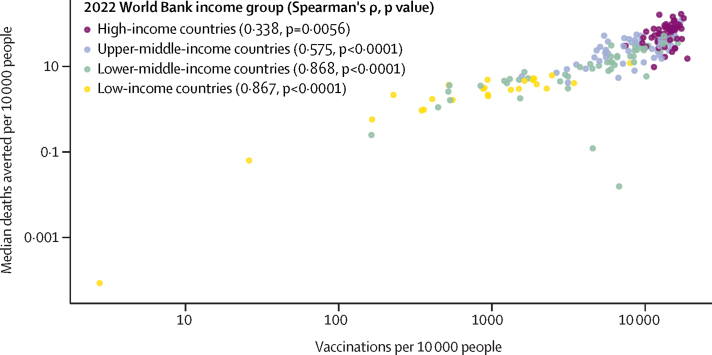
BACKGROUND: The first COVID-19 vaccine outside a clinical trial setting was administered on Dec 8, 2020. To ensure global vaccine equity, vaccine targets were set by the COVID-19 Vaccines Global Access (COVAX) Facility and WHO. However, due to vaccine shortfalls, these targets were not achieved by the end of 2021. We aimed to quantify the global impact of the first year of COVID-19 vaccination programmes. METHODS: A mathematical model of COVID-19 transmission and vaccination was separately fit to reported COVID-19 mortality and all-cause excess mortality in 185 countries and territories. The impact of COVID-19 vaccination programmes was determined by estimating the additional lives lost if no vaccines had been distributed. We also estimated the additional deaths that would have been averted had the vaccination coverage targets of 20% set by COVAX and 40% set by WHO been achieved by the end of 2021. FINDINGS: Based on official reported COVID-19 deaths, we estimated that vaccinations prevented 14·4 million (95% credible interval [Crl] 13·7-15·9) deaths from COVID-19 in 185 countries and territories between Dec 8, 2020, and Dec 8, 2021. This estimate rose to 19·8 million (95% Crl 19·1-20·4) deaths from COVID-19 averted when we used excess deaths as an estimate of the true extent of the pandemic, representing a global reduction of 63% in total deaths (19·8 million of 31·4 million) during the first year of COVID-19 vaccination. In COVAX Advance Market Commitment countries, we estimated that 41% of excess mortality (7·4 million [95% Crl 6·8-7·7] of 17·9 million deaths) was averted. In low-income countries, we estimated that an additional 45% (95% CrI 42-49) of deaths could have been averted had the 20% vaccination coverage target set by COVAX been met by each country, and that an additional 111% (105-118) of deaths could have been averted had the 40% target set by WHO been met by each country by the end of 2021. INTERPRETATION: COVID-19 vaccination has substantially altered the course of the pandemic, saving tens of millions of lives globally. However, inadequate access to vaccines in low-income countries has limited the impact in these settings, reinforcing the need for global vaccine equity and coverage. FUNDING: Schmidt Science Fellowship in partnership with the Rhodes Trust; WHO; UK Medical Research Council; Gavi, the Vaccine Alliance; Bill & Melinda Gates Foundation; National Institute for Health Research; and Community Jameel.
Overview
CoChat Summary
## TL;DR
This mathematical modelling study estimated that COVID-19 vaccination averted 14.4 million deaths based on reported deaths, or 19.8 million deaths when excess mortality was used, across 185 countries and territories during Dec 8, 2020–Dec 8, 2021. The paper argues that vaccine inequity limited impact in low-income settings and that reaching COVAX/WHO coverage targets could have saved substantially more lives.
## Key findings
- Using officially reported COVID-19 deaths, vaccination prevented 14.4 million deaths (95% CrI 13.7–15.9) in 185 countries and territories over the first year of vaccination.
- Using excess mortality, vaccination averted 19.8 million deaths (95% CrI 19.1–20.4), corresponding to a 63% reduction in total deaths (19.8 million of 31.4 million) during that year.
- In COVAX AMC countries, vaccinations averted 7.4 million deaths (95% CrI 6.8–7.7), representing 41% of estimated excess mortality (7.4 million of 17.9 million).
- If the WHO 40% target had been met in every country by the end of 2021, an additional 599,300 deaths (95% CrI 577,700–622,400) could have been averted; in low-income countries, meeting the COVAX 20% target could have averted an additional 45% of deaths, and the WHO 40% target an additional 111% of deaths.
## Methods
- The authors fit a previously published age-structured SEIRS transmission model with vaccination to reported COVID-19 mortality and to all-cause excess mortality in 185 countries and territories (excluding China), using country-level demography, mixing patterns, health-care capacity, and vaccination rollout data.
- Vaccination effects were modelled as protection against infection, severe disease, and onward transmission; the model also explicitly represented the delta variant and vaccine efficacy by country based on likely vaccine types used.
- They estimated deaths averted by comparing the fitted observed scenario against counterfactual scenarios with no vaccines, and with vaccines distributed to meet COVAX 20% and WHO 40% coverage targets by Dec 8, 2021, using Bayesian fitting with Metropolis-Hastings MCMC and 100 draws for uncertainty.
## Limitations
- The paper states that impact estimates were limited by uncertainty in excess mortality, gaps in genomic surveillance, and lack of detailed vaccination data for many countries; key inputs had to rely on working assumptions about vaccine type, rollout, and variant spread.
- The authors explicitly note a limitation of the COVAX/WHO target analysis: the targets were meant for the end of 2021, while the modelling endpoint was Dec 8, 2021, so some countries may have been closer to target by year-end than the model captured.
- Evident from the text: the counterfactual did not adjust for how governments or populations might have responded without vaccines, nor for possible changes in mobility, non-pharmaceutical interventions, or viral evolution, so the estimated deaths averted are model-dependent.
Model-written summary. Check it against the paper before relying on it.
Integrity signals
Registry
Cites
Statistics
Figures
Verification
Claims the paper makes
2 Valid · 2 Not valid · 4 Not checked · 48 Own results and interpretations
The cited sources that could be checked couldn’t confirm or dispute this claim.
In the paper
“In this analysis, we consequently focused on fitting to all-cause excess mortality, which provides a more complete description of the pandemic.15”
§ Global impact of the first year of COVID-19 vaccination: a mathematical modelling study > Discussion
What the sources say
- Could not verifycites [15] WHO Global excess deaths associated with COVID-19, January 2020–December 2021 https://www.who.int/data/stories/global-excess-deaths-associated-with-covid-19-january-2020-december-2021 May, 2022 sourceExperimental — accuracy not yet measured
The Methods (Statistical analysis) and Results examine hospital admission and emergency care attendance among people with delta versus alpha infections. The Discussion addresses limitations of those hospital-care data, but does not assess all-cause excess mortality or say that fitting to it gives a more complete description of the pandemic. Searches for “all-cause excess mortality” and “excess deaths” found no supporting passage; page numbers were not available in our copy. (LLM, conf=0.76)
plainstates a cause- Asserted: passes — The authors put it forward as true.
- Checkable: passes — It can be checked against evidence.
- Load-bearing: passes — The paper’s conclusions depend on it.
- Based: passes — The paper gives a reason why it holds.
- Could not verify
Every source the paper cites for this claim was checked and supports it.
In the paper
“Under-ascertainment of COVID-19 mortality is a known issue that has hindered our understanding of the pandemic.23”
§ Global impact of the first year of COVID-19 vaccination: a mathematical modelling study > Discussion
What the sources say
- Supportedcites [23] Whittaker C Walker PGT Alhaffar M Under-reporting of deaths limits our understanding of true burden of COVID-19 BMJ 375 2021 n2239 34642172 source
In “Renewed case for vaccine equity” (page unavailable), the paper calls it a myth that high-income countries were harder hit and shows that accounting for under-reporting changes the estimated share of COVID-19 mortality borne by low- and middle-income countries. This supports the claim that under-ascertainment has obscured understanding of the pandemic’s mortality burden. (LLM, conf=0.86)
boostedstates a cause- Asserted: passes — The authors put it forward as true.
- Checkable: passes — It can be checked against evidence.
- Load-bearing: passes — The paper’s conclusions depend on it.
- Based: passes — The paper gives a reason why it holds.
- Supported
The cited sources that could be checked couldn’t confirm or dispute this claim.
In the paper
“Our impact estimates were also limited by the inherent uncertainty in model-based estimates of excess mortality.13”
§ Global impact of the first year of COVID-19 vaccination: a mathematical modelling study > Discussion
What the sources say
- Could not verifycites [13] The Economist The pandemic's true death toll The Economist Nov 2, 2021 https://www.economist.com/graphic-detail/coronavirus-excess-deaths-estimates sourceExperimental — accuracy not yet measured
The Discussion describes limitations of estimates of vaccine effects on transmission, including testing behavior and previous infection status. A search for excess mortality, model-based mortality estimates, and deaths found no passage addressing uncertainty in excess-mortality estimates. Page numbers were not available in our copy. (LLM, conf=0.76)
plain- Asserted: passes — The authors put it forward as true.
- Checkable: passes — It can be checked against evidence.
- Load-bearing: unclear — It is unclear whether the paper’s conclusions depend on it.
- Based: passes — The paper gives a reason why it holds.
- Could not verify
The cited sources support only part of this claim — read each source’s verdict below.
In the paper
“Importantly, these estimates based on official reported COVID-19 deaths represent the lower bound of deaths averted at the global level due to the considerable levels of under-reporting of COVID-19 mortality documented worldwide.23”
§ Global impact of the first year of COVID-19 vaccination: a mathematical modelling study > Methods > Excess mortality and COVID-19 mortality data
What the sources say
- Partly supportedcites [23] Whittaker C Walker PGT Alhaffar M Under-reporting of deaths limits our understanding of true burden of COVID-19 BMJ 375 2021 n2239 34642172 sourceExperimental — accuracy not yet measured
In “Renewed case for vaccine equity” (page not provided), the paper says that under-reporting affects reported COVID-19 mortality and that excess-mortality estimates suggest a higher share of deaths in low- and middle-income countries. It also reports estimates of deaths that further vaccination could avert in those countries. It does not say that estimates based on officially reported deaths are a lower bound for deaths averted globally. (LLM, conf=0.83)
plainstates a cause- Asserted: passes — The authors put it forward as true.
- Checkable: passes — It can be checked against evidence.
- Load-bearing: passes — The paper’s conclusions depend on it.
- Based: passes — The paper gives a reason why it holds.
- Partly supported
A result the paper reports from its own data — it cites no other source for it, so there is none to check. The quote shows it is in the paper.
In the paper
“Notably, our model fits were unable to recreate excess mortality death tolls in recent epidemic waves in Iraq and Sudan because of the depletion of the susceptible population.”
§ Global impact of the first year of COVID-19 vaccination: a mathematical modelling study > Discussion
plainstates a cause- Asserted: passes — The authors put it forward as true.
- Checkable: passes — It can be checked against evidence.
- Load-bearing: unclear — It is unclear whether the paper’s conclusions depend on it.
- Based: passes — The paper gives a reason why it holds.
32 more claims
Create a free account to see all 56 claims and to verify the 3 references still open.
- It may state two separate claims as one. 14
- Probably not a substantial claim. 6
Claims other papers make about this one
Each is checked against this paper’s own text: does it say what the citing paper says it does?
The cited source says what the claim attributes to it.
In the citing paper
“Global COVID-19 vaccination programmes are estimated to have prevented 19.8 million deaths worldwide during the first year of roll-out(12)”
Citations
Cites
Estimated transmissibility and impact of SARS-CoV-2 lineage B.1.1.7 in England
Davies, N. G., Abbott, S., Barnard, R. C., Jarvis, C. I., Kucharski, A. J., Munday, J. D., Pearson, C. A. B., Russell, T. W., Tully, D. C., Washburne, A. D., et al. (2021) · Science · doi:10.1126/science.abg3055 · Cited by 2,581 · cited 1×
“20,21 Any epidemiological differences associated with previous variants were assumed to be reflected by their effects on mortality, 22 which were subsequently captured by the estimated R t trend.”
Estimated transmissibility and impact of SARS-CoV-2 lineage B.1.1.7 in England
Davies, N. G., Abbott, S., Barnard, R. C., Jarvis, C. I., Kucharski, A. J., Munday, J. D., Pearson, C. A. B., Russell, T. W., Tully, D. C., Washburne, A. D., et al. (2020) · doi:10.1101/2020.12.24.20248822 · Cited by 2,557
Wang, H., Paulson, K. R., Pease, S. A., Watson, S., Comfort, H., Zheng, P., Aravkin, A. Y., Bisignano, C., Barber, R. M., Alam, T., et al. (2022) · The Lancet · doi:10.1016/s0140-6736(21)02796-3 · Cited by 2,069
Wouters, O. J., Shadlen, K. C., Salcher-Konrad, M., Pollard, A. J., Larson, H. J., Teerawattananon, Y., & Jit, M. (2021) · The Lancet · doi:10.1016/s0140-6736(21)00306-8 · Cited by 1,288
Walker, P. G. T., Whittaker, C., Watson, O. J., Baguelin, M., Winskill, P., Hamlet, A., Djafaara, B. A., Cucunubá, Z., Olivera Mesa, D., Green, W., et al. (2020) · Science · doi:10.1126/science.abc0035 · Cited by 993
Self-citationTwohig, K. A., Nyberg, T., Zaidi, A., Thelwall, S., Sinnathamby, M. A., Aliabadi, S., Seaman, S. R., Harris, R. J., Hope, R., Lopez-Bernal, J., et al. (2022) · The Lancet Infectious Diseases · doi:10.1016/s1473-3099(21)00475-8 · Cited by 803 · cited 1×
“20,21 Any epidemiological differences associated with previous variants were assumed to be reflected by their effects on mortality, 22 which were subsequently captured by the estimated R t trend.”
Karlinsky, A., & Kobak, D. (2021) · eLife · doi:10.7554/elife.69336 · Cited by 772 · cited 1×
“11 Robust vital registration systems do not exist in many parts of the world, with WHO estimating that 40% of global deaths that occurred in 2020 were unregistered, 12 and therefore data on excess mortality are not available for every country.”
Understanding COVID-19 vaccine hesitancy
Machingaidze, S., & Wiysonge, C. S. (2021) · Nature Medicine · doi:10.1038/s41591-021-01459-7 · Cited by 590 · cited 1×
“7 This considerable heterogeneity in vaccination coverage has resulted in continued reliance on non-pharmaceutical interventions for pandemic management in some countries 8 but concomitantly enabled other nations to relax interventions as a route out of the pandemic.”
Twohig, K. A., Nyberg, T., Zaidi, A., Thelwall, S., Sinnathamby, M., Aliabadi, S., Seaman, S. R., Harris, R., Hope, R., Bernal, J. L., et al. (2021) · Northumbria Research Link (Northumbria University) · doi:10.17863/cam.76294 · Cited by 514
Effect of Covid-19 Vaccination on Transmission of Alpha and Delta Variants
Eyre, D. W., Taylor, D., Purver, M., Chapman, D., Fowler, T., Pouwels, K. B., Walker, A. S., & Peto, T. E. A. (2022) · New England Journal of Medicine · doi:10.1056/nejmoa2116597 · Cited by 464 · cited 2×
“19 We inferred vaccine efficacy for each country on the basis of vaccine types known to be predominantly used in each country.”
Cited by
Items 1,701–1,777 of 1,777
Reaching the margins: examining equity in Indonesia’s COVID-19 vaccination strategy
Herlinda, O., Jundullah, S. M., & Saminarsih, D. S. (2026) · BMJ Global Health · doi:10.1136/bmjgh-2025-019597
Luby, S. P., & Rashid, S. F. (2026) · Oxford University Press eBooks · doi:10.1093/9780197651933.003.0015
Álvarez-Najar, J. P., Iguacel, I., Martínez‐Jarreta, B., Couto-Alfonso, S., & de Blas, I. (2025) · Colombia medica · doi:10.25100/cm.v56i4.6609
Health vs. wealth? A managerial effectiveness analysis of the COVID-19
Thieme, C., Giménez, V., Prior, D., & Tortosa‐Ausina, E. (2026) · Economic Analysis and Policy · doi:10.1016/j.eap.2026.05.002
Clarke, C., Esposito, D. B., Urdaneta, V., Mukherjee, P., & Buttery, A. K. (2026) · Human Vaccines & Immunotherapeutics · doi:10.1080/21645515.2026.2662118
“14,15 In addition to assessment of VE, national health authorities implemented enhanced safety surveillance programs, building on existing reporting systems and innovative use of near-real time digital data-collection technologies.”
Khan, A., & Tidman, M. M. (2026) · Cureus · doi:10.7759/cureus.109407
“Similar patterns were observed in other lower-income countries such as Yemen, Pakistan, and Bangladesh, as well as higher-income countries such as Sweden, the United States, and Norway, where RI plummeted during the COVID-19 pandemic [21-24].”
Liu, C., Okoli, G. N., Chen, R. Y. L., Sullivan, S. G., & Cowling, B. J. (2026) · Clinical Infectious Diseases · doi:10.1093/cid/ciag346 · Cited by 1
Vicente, C., Froes, F., Lopalco, P. L., Heffernan, C., Nilforooshan, R., Martin, F., Leroux‐Roels, I., Nesher, L., Déplanque, T., Dani, N., et al. (2026) · Expert Review of Vaccines · doi:10.1080/14760584.2026.2684962 · Cited by 1
Agreement between seroprevalence- and model-based estimates of COVID-19 burden
Owusu‐Boaitey, N., Böttcher, L., Meyerowitz‐Katz, G., Howard, J., Gorski, D. H., Besançon, L., & Барчук, А. А. (2026) · Global Health Action · doi:10.1080/16549716.2026.2683286 · Cited by 1
“Assumed age-specific fatality risk also influenced estimates of deaths averted by vaccination [1,2,45].”
Single-Use Technologies for Biomanufacturing
Bisschops, M. A. T., Castan, A., Manser, B., & Massana-Muñoz, X. (2026) · Elsevier eBooks · doi:10.1016/b978-0-443-24738-5.00095-1
COVID‐19 Outcomes and Vaccination Response Among Patients With Psoriasis Receiving Biologics
Bar, D., Pavlotsky, F., Barzilai, A., & Baum, S. (2026) · Dermatologic Therapy · doi:10.1155/dth/2037939
Cheli, B., Bellavite, P., Foschi, R., Bagnato, A., Gregori, M., Trambusti, G., & Donzelli, A. (2026) · F1000Research · doi:10.12688/f1000research.181425.1
Nishiyama, S., & Nishiura, H. (2026) · Vaccine X · doi:10.1016/j.jvacx.2026.100859
Yang, L., Zhou, Z., Lin, Q., Chen, Y., Sun, Y. N., & Wang, Z. (2026) · BMC Infectious Diseases · doi:10.1186/s12879-026-13826-1
“During the COVID-19 pandemic, vaccination is estimated to have prevented more than 14.4 million deaths due to COVID-19 between December 2020 and December 2021 [1].”
InfluentialHuth, D., Hennemann, S., Witthöft, M., & Bräscher, A. (2026) · Frontiers in Public Health · doi:10.3389/fpubh.2026.1821349
Le, D. T. H., Yang, C., Zhang, Y., Zhao, G., Seow, B. Y. L., Zhao, X., Balakrishnan, N., Bae, K. H., Hui, J. H. P., & Yang, Y. Y. (2026) · Journal of Controlled Release · doi:10.1016/j.jconrel.2026.115136
Palmer, P., Fedosyuk, S., Parthasarathy, S., Holbrook, J. A., George, C. L., O’Reilly, L., Wiegand, L., Carnell, G., Heeney, J. L., & Vishwanath, S. (2026) · Cell Reports Methods · doi:10.1016/j.crmeth.2026.101508
Does education shield against vaccine hesitancy? Evidence from the East–West divide
Fawaz, Y. (2026) · Social Science & Medicine · doi:10.1016/j.socscimed.2026.119464
Cost‐Effectiveness of Vaccination Strategies for COVID‐19: A Systematic Review
Yang, Y., Weng, J., Tao, Y., Luo, B., Lian, D., Li, F., Yan, J., & Chen, Y. (2026) · Journal of Evidence-Based Medicine · doi:10.1111/jebm.70136
“…vaccine delivered, 55.9% of the world population received at least one dose of a vaccine, 45.5% received two doses, and 4.3% received a booster dose, estimated to prevent 14.4 million deaths or 19.8 million excess deaths, representing a reduction of 63% in total deaths across the world [ 7 ].”
InfluentialImagination and Idealism After the COVID-19 Pandemic
Farrelly, C. (2026) · Oxford University Press eBooks · doi:10.1093/9780197830062.003.0005
Farrelly, C. (2026) · Oxford University Press eBooks · doi:10.1093/9780197830062.003.0012
Equality and the Intersectionality of Biological Aging
Farrelly, C. (2026) · Oxford University Press eBooks · doi:10.1093/9780197830062.003.0007
The Good Life as a Constraint on Longevity Science
Farrelly, C. (2026) · Oxford University Press eBooks · doi:10.1093/9780197830062.003.0010
Philosophy and the “Framing” of Translational Science
Farrelly, C. (2026) · Oxford University Press eBooks · doi:10.1093/9780197830062.003.0002
Farrelly, C. (2026) · Oxford University Press eBooks · doi:10.1093/9780197830062.003.0003
“Fair Innings,” Women, and Longevity Science
Farrelly, C. (2026) · Oxford University Press eBooks · doi:10.1093/9780197830062.003.0008
Farrelly, C. (2026) · Oxford University Press eBooks · doi:10.1093/9780197830062.003.0009
Public Health Must Transcend Folkbiology
Farrelly, C. (2026) · Oxford University Press eBooks · doi:10.1093/9780197830062.003.0006
Farrelly, C. (2026) · Oxford University Press eBooks · doi:10.1093/9780197830062.003.0011
Introduction: The Tale of the Journey Through the Ocean of Longevity
Farrelly, C. (2026) · Oxford University Press eBooks · doi:10.1093/9780197830062.003.0001
The Frankensteinification of Translational Gerontology
Farrelly, C. (2026) · Oxford University Press eBooks · doi:10.1093/9780197830062.003.0004
Lin, S., Zhang, G., Wang, Q., Niu, K., & Liu, Q. (2026) · Viruses · doi:10.3390/v18070745
“Extensive epidemiological studies comparing vaccinated and unvaccinated populations have consistently demonstrated that vaccination significantly reduces the rates of severe disease, hospitalization, and mortality for both influenza viruses and SARS-CoV-2 [48,49].”
Socioeconomic determinants of COVID-19 vaccination and mortality: a cross-national path analysis
İpek, F., Erpek, E., Genç, V., Bars, A., Erdem, S., & Akar, S. (2026) · BMC Public Health · doi:10.1186/s12889-026-28293-1
“For example, global estimates suggest that vaccines prevented approximately 41% of deaths during the first year of rollout [32], while analyses conducted during Delta dominance reported that a 10% increase in vaccination coverage was associated with reductions of 8% in mortality and 7% in incidence…”
InfluentialSiniscalchi, C., Imbalzano, E., Basaglia, M., Cerundolo, N., Meschi, T., Prati, B., Parise, A., Nouvenne, A., & Micco, P. D. (2026) · Vaccines · doi:10.3390/vaccines14070611
“Over time, age, frailty, sex, comorbidity burden, inflammatory biomarkers, and respiratory status emerged as some of the most robust determinants of prognosis [73–77].”
Nondo, T. R., Odera, E. O., Nhenga, T. C., & Mutanana, N. (2026) · Research Square · doi:10.21203/rs.3.rs-9717764/v1
Santos, A. D. S., de Araújo, L. P., Orts, D. J. B., da Costa, H. H. M., Matteucci, K. C., Silva, E. N., Oliveira, K. C., Galdino, G., Prudêncio, C. R., Corsetti, P. P., et al. (2026) · Frontiers in Immunology · doi:10.3389/fimmu.2026.1775087
Th1/Th2/Th17 Cytokines as Mortality Predictors in Older Adults with COVID-19 Pneumonia
Mu, H., Yin, Y., & Zhang, H. (2026) · Jundishapur Journal of Microbiology · doi:10.5812/jjm-171273
Implementation evaluation of the COVID-19 vaccination: Speed, equity and mortality trends
Matthew, I., Viljoen, M., & McCartney, J. (2026) · African Journal of Primary Health Care & Family Medicine · doi:10.4102/phcfm.v18i1.5248
“27 However, several additional factors may also have influenced mortality patterns during the pandemic, including improvements in clinical management, changes in variant virulence, prior infection-induced immunity and non-pharmaceutical interventions.”
Makieu, P., Sahr, F., & Turay, A. (2026) · Journal of Artificial Intelligence for Medical Sciences · doi:10.55578/joaims.260713.001
“The distinct expression patterns visualized in Figure 5 provide a direct link between the model features and underlying tumour biology, helping to address the inherent opacity of many machine learning classifiers and thereby enhancing clinical credibility [20].”
Bonanad, C., Alfaro, R., Morán-Bayón, Á., Cainzos‐Achirica, M., García‐Lledó, A., Raposeiras‐Roubín, S., Vivas, D., Freixa‐Pamias, R., Mora, J., Martín-Toro, M. A., et al. (2026) · Medicina de Familia SEMERGEN · doi:10.1016/j.semerg.2026.102819
Beaulieu, M., Hozé, N., Vieillefond, V., Goetschy, T., Cosentino, G., Blanquart, F., Débarre, F., & Guedj, J. (2026) · PLoS Computational Biology · doi:10.1371/journal.pcbi.1013811
Pimentel, Y. O., & Gardellini, T. (2026) · Revista Saluta · doi:10.37594/saluta.v1i14.2240
The potential public health consequences of “mRNA vaccine stigmatization” in the US
Motta, M. (2026) · Politics and the Life Sciences · doi:10.1017/pls.2026.10027
Jang, D., Choi, S., Choi, B., & Kim, S. (2026) · Journal of Global Health · doi:10.7189/jogh.16.04246
“By this stage of the pandemic, SARS-CoV-2 transmission had become globally widespread, placing sustained pressure on national health systems [ 35 ].”
López, O., Gaillard, M. E., Aispuro, P. M., Locati, L., Pschunder, B., Zurita, M. E., Escudero, C., Bottero, D., & Hozbor, D. F. (2026) · Frontiers in Immunology · doi:10.3389/fimmu.2026.1883311
COVID-19 Vaccination in Children: A Global Perspective
Joshi, H. S., Dixit, A. M., Koparkar, A. R., Kharya, P., Mohanty, A., Mittal, M., & Rath, R. S. (2026) · Journal of Health Management · doi:10.1177/09720634261466390
Askarian, M., Bayati, S., Rajabi, H., et al. (2026) · Research Square · doi:10.21203/rs.3.rs-10306536/v1
Ackland, J., Barozi, V., Penrice-Randal, R., Hartley, C., Hiscox, J., Griffiths, G., Page, C. P., Carroll, M. W., Singh, D., Niranjan, M., et al. (2026) · Journal of Immunology · doi:10.1093/jimmun/vkag189
Lack of Rigour on COVID-19 Vaccines
Lataster, R. (2026) · Journal of Bioethical Inquiry · doi:10.1007/s11673-025-10548-y
Kazenza, B. M., Masokolo, B., Mbunga, B. K., Egbende, L., Elemo, S., Lukusa, J., Makindu, D., Nkamba, D. M., Ishoso, D. K., Lusamba, P.-S. D., et al. (2026) · Vaccine · doi:10.1016/j.vaccine.2026.129033
Global Burden of COVID-19 (2019–2024)
Bhat, M., & Bhat, S. (2026) · Springer eBooks · doi:10.1007/978-3-032-26000-0_2
Bhattacharya, S., Bairagi, N., & Sarkar, B. (2026) · Computers & Industrial Engineering · doi:10.1016/j.cie.2026.112315
The VAccine cLinical study reporting gUidEline: the VALUE checklist with explanation and elaboration
Duan, Y., Ma, Y., Shi, L., Xu, Z., Luo, J., Moher, D., Rodewald, L. E., Shao, R., Yu, L., Li, Y.-J., et al. (2026) · EBioMedicine · doi:10.1016/j.ebiom.2026.106439
Lawal, O. U., Parreira, V. R., Overton, A. K., et al. (2026) · Viruses · doi:10.3390/v18080923
“These detection patterns occurred during phases of widespread vaccination [38,39].”
Ali, M., Brady, M., Campbell, P., Rooney, S., Williams, L. J., Paul, L., Mason, H., Manoukian, S., Chung, C. S., Barber, M., et al. (2026) · Health and Social Care Delivery Research · doi:10.3310/gjma0602 · Cited by 1
Science and the Common Good: Reconceptualising the Relationship
Hamilton, K., Fransisca, K., Sandrussi, A., et al. (2026) · Minerva · doi:10.1007/s11024-026-09662-x
Erdem, O. (2026) · Springer eBooks · doi:10.1007/978-3-032-24189-4_4
Known Vaccine-Associated Adverse Events
Tilak, K., Adams, F., & Harrison, C. J. (2026) · Springer eBooks · doi:10.1007/978-1-0716-5464-4_3
Closure strategies to mitigate future respiratory pandemics
Doohan, P., Johnson, R., Løchen, A., Morgenstern, C., Haw, D., Sabino, A., Patouillard, E., Forchini, G., & Hauck, K. (2026) · Nature Health · doi:10.1038/s44360-026-00192-0
COVID-19 Vaccines Innovation and Challenges
Mowrer, C. T., Delair, S. F., & Chang, A. J. (2026) · Springer eBooks · doi:10.1007/978-1-0716-5464-4_26
The Future of Vaccines and Vaccine Confidence
Moulton, M., Dhillon, S., & Chatterjee, A. (2026) · Springer eBooks · doi:10.1007/978-1-0716-5464-4_29
Metabolic Signatures Associated with COVID-19 Vaccination in Serum from Healthy Individuals
AlEissa, M. M., Nimer, R. M., AlMalki, R. H., AlAhmari, R., Alsaieedi, A., Al-Rukhayes, M., Saleh, N. M., Albugami, R. R., AlQurashi, R. A., Hawsa, E. A., et al. (2026) · Vaccines · doi:10.3390/vaccines14090771
Investments in seasonal influenza vaccination programs pack a punch for pandemic preparedness
Shen, A. K., Tupps, C., Bino, S., et al. (2026) · Vaccine · doi:10.1016/j.vaccine.2026.129098
Okholm, A. K., Fougeroux, C. E., Hagen, S. H., Paludan, S. R., Nielsen, M. A., de Jongh, W. A., & Sander, A. F. (2026) · Vaccine · doi:10.1016/j.vaccine.2026.129117 · Cited by 1
Viral Infections of the Respiratory Tract in Adults
Coghill, L., & Gitu, A. C. (2026) · Springer eBooks · doi:10.1007/978-1-4939-0779-3_169-2
5. The Supposed Impotence of Ethics
ten Have, H. (2026) · Open Book Publishers · doi:10.11647/obp.0548.05 · Cited by 1
Global vaccine readiness: equity-by-design in pandemic preparedness and response
Ghafari, M., Watson, O. J., Dascalu, S., et al. (2026) · Expert Review of Vaccines · doi:10.1080/14760584.2026.2732508
Self-citationDauji, S., Saha, S., & Karmakar, S. (2026) · Journal of Health Management · doi:10.1177/09720634261486568
Hammal, F., Lau, V. I., Sligl, W., Jacka, M. J., Opgenorth, D. L., Wilcox, M. E., Fiest, K. M., Niven, D. J., Stelfox, H. T., Zuege, D. J., et al. (2026) · Canadian Journal of Respiratory Critical Care and Sleep Medicine · doi:10.1080/24745332.2026.2722350
Government as orchestrator: Ecosystem transformation at scale and speed
Adner, R. (2026) · Strategic Management Journal · doi:10.1002/smj.70129 · Cited by 2
Beyond correlation and causation: epistemic caution, anomalous findings, and COVID-19 vaccine safety
Siebner, A. S., Rubio‐Casillas, A., Raszek, M., Cowley, D. E., Fabrowski, M., Piscopo, M., Brogna, C., Uversky, V. N., Redwan, E. M. M. M., & Genova, S. (2026) · Philosophy Ethics and Humanities in Medicine · doi:10.1186/s13010-026-00232-3
“The newly established mRNA vaccines are estimated to have saved 14–20 million lives worldwide in the first year of rollout, according to the World Health Organization [1].”
Vaccine attitudes and perceptions in a post-COVID Era: what lessons can be learned in Tunisia?Preprint
Mansour, N. B., Benzina, B., Fray, S., Hariz, E., Gzara, A., Romdhane, H. B., Mueller, J. E., & Miled, S. B. (2026) · medRxiv · doi:10.64898/2026.10.02.26364577
Li, X., & Hassoun, N. J. (2026) · De Gruyter eBooks · doi:10.1515/9783111519975-026
Health economics: a global review and prospection
DAMIAN, T.-G. (2026) · Cognitive Sustainability · doi:10.55343/cogsust.24023
Mu, Y., Wang, Y., Gu, X., et al. (2026) · JMIR Public Health and Surveillance · doi:10.2196/88931
“COVID-19 vaccines have substantially reduced severe disease and mortality worldwide [5,6].”
Health literacy and vaccine hesitancy: a systematic review of observational studies
Kouvari, K., Lamnisos, D., Devledian, M. C., Hadjikou, A., & Heraclides, A. (2026) · Journal of Public Health · doi:10.1007/s10389-026-02886-x
Coetzee, B., Haine, P., & Kagee, A. (2026) · Journal of Health Psychology · doi:10.1177/13591053261493242
Metadata
- Authors
- Watson, O. J., Barnsley, G., Toor, J., Hogan, A. B., Winskill, P., & Ghani, A. C.
- Affiliations
- Imperial College London (GB)
- Corresponding author
- Watson, Oliver J
- Venue
- The Lancet Infectious Diseases
- Publisher
- Elsevier BV
- Published
- 2022-09
- Volume
- 22
- Issue
- 9
- Pages
- 1293-1302
- ISSN
- 1473-3099 (ISSN-L)
- PMC
- PMC9225255
- OpenAlex
- W4283395367
- Semantic Scholar
- e048be45c9e0900c299d78c2cb327ce9afd77467
- Cited by
- 1,769
- References
- 26
- Citations by year
- 2026: 165 · 2025: 341 · 2024: 533 · 2023: 578 · 2022: 150
- FWCI
- 237.54
- Type
- journal article
- Language
- en
- Update notices
- erratum (2023-10-01)
- Open access
- hybrid
- doi.org
- Licence
- cc-by
- www.elsevier.com/tdm/userlicense/1.0/ (tdm)
- www.elsevier.com/legal/tdmrep-license (tdm)
- creativecommons.org/licenses/by/4.0/ (vor)
- Locations
- The Lancet Infectious Diseases (publishedVersion, cc-by)
- PubMed Central (publishedVersion, cc-by)
- PubMed (publishedVersion)
- LSHTM Research Online (London School of Hygiene and Tropical Medicine) (acceptedVersion)
- Spiral (Imperial College London) (submittedVersion, other-oa)
- Funders
- Bill and Melinda Gates Foundation
- GAVI Alliance
- National Institute for Health and Care Research
- Imperial College London
- Medical Research Council (MR/R015600/1, MC_PC_19012)
- Topics
- Physical Sciences › Mathematics › Modeling and Simulation › COVID-19 epidemiological studies
- Health Sciences › Medicine › Infectious Diseases › SARS-CoV-2 and COVID-19 Research
- Social Sciences › Health › Vaccine Coverage and Hesitancy
- Keywords
- COVID-19 vaccination, vaccine impact, COVID-19 mortality, excess mortality, mortality averted, COVAX, vaccine equity, low-income countries, mathematical transmission model, global health equity, SARS-CoV-2, advance market commitments
- MeSH terms
- COVID-19, COVID-19 Vaccines, Humans, Models, Theoretical, Vaccination, Vaccines, Global Health
About these checks
Registry, retraction, Cites and statistics results are computed, not judged, with one exception: a printed reference that no index lists is read once by a model before it counts as a citation error. Claims are extracted by a model and kept only when their quote appears verbatim in the text; each cited source is then checked, with a model’s help, for whether it says what the claim relies on. Those verdicts can be wrong — read the claim’s quote and the cited source before relying on one.
The claim verdicts this report counts are experimental: their accuracy is not yet measured.
A language model drew the claims from the paper on 2026-10-10, under version 3 of the claim definition (model deepseek-v4.1-flash, prompt extract-v3).
A second model labelled each claim on 2026-10-10 (model jev-1.13-20260917, definition revision gold-guideline-v0.2).
Cited sources are checked with a language model’s help (gpt-6-sol).
Statistics and arithmetic are recomputed, not judged.
Confidence bands are shown only for fields calibrated on our annotated test set. None is calibrated yet, so no band is shown.
What counts as a claim ›How we measure confidence ›How we check this ›
Are you an author, or do you see a problem with this page? Request a review
Data sources
Bibliographic data: Semantic Scholar, OpenAlex, Crossref.
Contains information from the Semantic Scholar Academic Graph Datasets, made available under the ODC Attribution License (ODC-BY 1.0).
Semantic Scholar’s data is described in: Kinney, R., et al. (2023). The Semantic Scholar Open Data Platform. arXiv:2301.10140.
