

Climate change and mental health research methods, gaps, and priorities: a scoping review
Open accessThe DOI matches its Crossref record; 85 of the 85 references it cites were found in a registry or an index.
Abstract
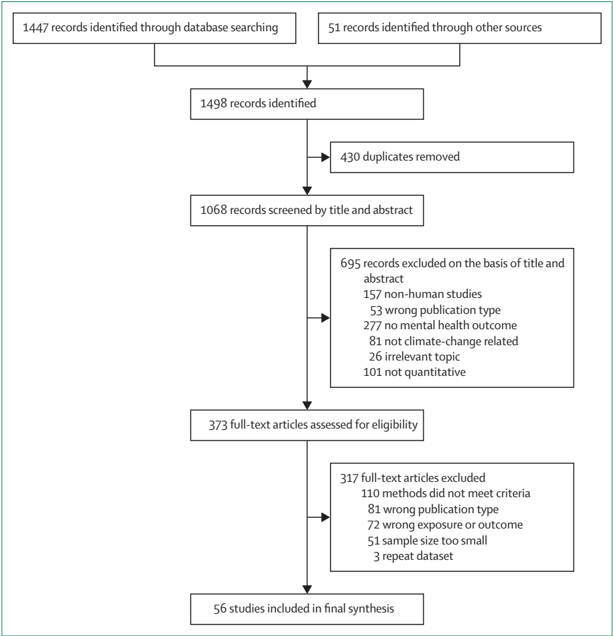
Research on climate change and mental health is a new but rapidly growing field. To summarise key advances and gaps in the current state of climate change and mental health studies, we conducted a scoping review that comprehensively examined research methodologies using large-scale datasets. We identified 56 eligible articles published in Embase, PubMed, PsycInfo, and Web of Science between Jan 1, 2000, and Aug 9, 2020. The primary data collection method used was surveys, which focused on self-reported mental health effects due to acute and subacute climate events. Other approaches used administrative health records to study the effect of environmental temperature on hospital admissions for mental health conditions, and national vital statistics to assess the relationship between environmental temperature and suicide rates with regression analyses. Our work highlights the need to link population-based mental health outcome databases to weather data for causal inference. Collaborations between mental health providers and data scientists can guide the formation of clinically relevant research questions on climate change.
Overview
The claims and statistics of this paper haven’t been checked yet.
Free: it reads the open-access text and checks the first 5 claims that cite a source we can check. Create a free account to check every claim.
Integrity signals
Registry
Cites
Statistics
Figures
Verification
Claims the paper makes
The claims and statistics of this paper haven’t been checked yet.
Free: it reads the open-access text and checks the first 5 claims that cite a source we can check. Create a free account to check every claim.
Claims other papers make about this one
Each is checked against this paper’s own text: does it say what the citing paper says it does?
The cited source doesn’t support the claim as written.
In the citing paper
“Recent systematic and scoping reviews have explored diverse concepts such as climate change perceptions or emotions [22, 23], reported only on the direct impacts of climate change [24–28], or have focused on adolescents [29].”
From The relationship between climate change and mental health: a systematic review of the association between eco-anxiety, psychological distress, and symptoms of major affective disorders (2024) · cites this paper as [24]
Checked by a reasoning model — may be wrong.
Experimental — accuracy not yet measured
Self-check
Percentages, sums and reported differences re-computed from the paper’s own numbers.
The self-check needs the paper’s full text.
Citations
Cites
PRISMA Extension for Scoping Reviews (PRISMA-ScR): Checklist and Explanation
Tricco, A. C., Lillie, E., Zarin, W., O'Brien, K. K., Colquhoun, H., Levac, D., Moher, D., Peters, M. D. J., Horsley, T., Weeks, L., et al. (2018) · Annals of Internal Medicine · doi:10.7326/m18-0850 · Cited by 43,565
Stang, A. (2010) · European Journal of Epidemiology · doi:10.1007/s10654-010-9491-z · Cited by 17,396
KESSLER, R. C., ANDREWS, G., COLPE, L. J., HIRIPI, E., MROCZEK, D. K., NORMAND, S.-L. T., WALTERS, E. E., & ZASLAVSKY, A. M. (2002) · Psychological Medicine · doi:10.1017/s0033291702006074 · Cited by 10,327
Solastalgia: The Distress Caused by Environmental Change
Albrecht, G., Sartore, G.-M., Connor, L., Higginbotham, N., Freeman, S., Kelly, B., Stain, H., Tonna, A., & Pollard, G. (2007) · Australasian Psychiatry · doi:10.1080/10398560701701288 · Cited by 1,369
The Impact of Climate Change on Mental Health: A Systematic Descriptive Review
Cianconi, P., Betrò, S., & Janiri, L. (2020) · Frontiers in Psychiatry · doi:10.3389/fpsyt.2020.00074 · Cited by 1,320
Watts, N., Amann, M., Ayeb-Karlsson, S., Belesova, K., Bouley, T., Boykoff, M., Byass, P., Cai, W., Campbell-Lendrum, D., Chambers, J., et al. (2018) · The Lancet · doi:10.1016/s0140-6736(17)32464-9 · Cited by 1,236
Climate change and mental health: a causal pathways framework
Berry, H. L., Bowen, K., & Kjellstrom, T. (2010) · International Journal of Public Health · doi:10.1007/s00038-009-0112-0 · Cited by 1,035
The psychological impacts of global climate change
Doherty, T. J., & Clayton, S. (2011) · American Psychologist · doi:10.1037/a0023141 · Cited by 894
Climate change and mental health: risks, impacts and priority actions
Hayes, K., Blashki, G., Wiseman, J., Burke, S., & Reifels, L. (2018) · International Journal of Mental Health Systems · doi:10.1186/s13033-018-0210-6 · Cited by 746
Twitter as a Tool for Health Research: A Systematic Review
Sinnenberg, L., Buttenheim, A. M., Padrez, K., Mancheno, C., Ungar, L., & Merchant, R. M. (2017) · American Journal of Public Health · doi:10.2105/ajph.2016.303512 · Cited by 634
Trends in mental illness and suicidality after Hurricane Katrina
Kessler, R. C., Galea, S., Gruber, M. J., Sampson, N. A., Ursano, R. J., & Wessely, S. (2008) · Molecular Psychiatry · doi:10.1038/sj.mp.4002119 · Cited by 617
Higher temperatures increase suicide rates in the United States and Mexico
Burke, M., González, F., Baylis, P., Heft-Neal, S., Baysan, C., Basu, S., & Hsiang, S. (2018) · Nature Climate Change · doi:10.1038/s41558-018-0222-x · Cited by 604
Using electronic health records for population health research: a review of methods and applications
Casey, J. A., Schwartz, B. S., Stewart, W. F., & Adler, N. E. (2016) · Annual Review of Public Health · doi:10.1146/annurev-publhealth-032315-021353 · Cited by 590
The effect of heat waves on mental health in a temperate Australian city
Hansen, A., Bi, P., Nitschke, M., Ryan, P., Pisaniello, D., & Tucker, G. (2008) · Environmental Health Perspectives · doi:10.1289/ehp.11339 · Cited by 569
Empirical evidence of mental health risks posed by climate change
Obradovich, N., Migliorini, R., Paulus, M. P., & Rahwan, I. (2018) · Proceedings of the National Academy of Sciences · doi:10.1073/pnas.1801528115 · Cited by 492
Climate models predict increasing temperature variability in poor countries
Bathiany, S., Dakos, V., Scheffer, M., & Lenton, T. M. (2018) · Science Advances · doi:10.1126/sciadv.aar5809 · Cited by 479
Crop-damaging temperatures increase suicide rates in India
Carleton, T. A. (2017) · Proceedings of the National Academy of Sciences · doi:10.1073/pnas.1701354114 · Cited by 446
Fraley, R. C., & Vazire, S. (2014) · PLoS ONE · doi:10.1371/journal.pone.0109019 · Cited by 409
The psychological effects of climate change on children
Burke, S. E. L., Sanson, A. V., & Van Hoorn, J. (2018) · Current Psychiatry Reports · doi:10.1007/s11920-018-0896-9 · Cited by 391
Temperature and mental health: Evidence from the spectrum of mental health outcomes
Mullins, J. T., & White, C. (2019) · Journal of Health Economics · doi:10.1016/j.jhealeco.2019.102240 · Cited by 383
Flooding and Mental Health: A Systematic Mapping Review
Fernandez, A., Black, J., Jones, M., Wilson, L., Salvador-Carulla, L., Astell-Burt, T., & Black, D. (2015) · PLOS ONE · doi:10.1371/journal.pone.0119929 · Cited by 382
Differentiating environmental concern in the context of psychological adaption to climate change
Helm, S. V., Pollitt, A., Barnett, M. A., Curran, M. A., & Craig, Z. R. (2018) · Global Environmental Change · doi:10.1016/j.gloenvcha.2017.11.012 · Cited by 307
Climate change: The next challenge for public mental health?
Bourque, F., & Cunsolo Willox, A. (2014) · International Review of Psychiatry · doi:10.3109/09540261.2014.925851 · Cited by 285
Suicide and drought in New South Wales, Australia, 1970–2007
Hanigan, I. C., Butler, C. D., Kokic, P. N., & Hutchinson, M. F. (2012) · Proceedings of the National Academy of Sciences · doi:10.1073/pnas.1112965109 · Cited by 257
Stanke, C., Murray, V., Amlôt, R., Nurse, J., & Williams, R. (2012) · PLoS Currents · doi:10.1371/4f9f1fa9c3cae · Cited by 254
Administrative and Claims Records as Sources of Health Care Cost Data
Riley, G. F. (2009) · Medical Care · doi:10.1097/mlr.0b013e31819c95aa · Cited by 251
Increasing ambient temperature reduces emotional well-being
Noelke, C., McGovern, M., Corsi, D. J., Jimenez, M. P., Stern, A., Wing, I. S., & Berkman, L. (2016) · Environmental Research · doi:10.1016/j.envres.2016.06.045 · Cited by 247
Relationship between daily suicide counts and temperature in England and Wales
Page, L. A., Hajat, S., & Kovats, R. S. (2007) · British Journal of Psychiatry · doi:10.1192/bjp.bp.106.031948 · Cited by 245
Mental health effects of climate change
Padhy, S., Sarkar, S., Panigrahi, M., & Paul, S. (2015) · Indian Journal of Occupational and Environmental Medicine · doi:10.4103/0019-5278.156997 · Cited by 238
Wang, X., Lavigne, E., Ouellette-kuntz, H., & Chen, B. E. (2014) · Journal of Affective Disorders · doi:10.1016/j.jad.2013.10.042 · Cited by 215
Sample size: how many participants do I need in my research?
Martínez-Mesa, J., González-Chica, D. A., Bastos, J. L., Bonamigo, R. R., & Duquia, R. P. (2014) · Anais Brasileiros de Dermatologia · doi:10.1590/abd1806-4841.20143705 · Cited by 210
Drought as a mental health exposure
OBrien, L. V., Berry, H. L., Coleman, C., & Hanigan, I. C. (2014) · Environmental Research · doi:10.1016/j.envres.2014.03.014 · Cited by 197
Basu, R., Gavin, L., Pearson, D., Ebisu, K., & Malig, B. (2018) · American Journal of Epidemiology · doi:10.1093/aje/kwx295 · Cited by 195
Temperature-related deaths in people with psychosis, dementia and substance misuse
Page, L. A., Hajat, S., Kovats, R. S., & Howard, L. M. (2012) · British Journal of Psychiatry · doi:10.1192/bjp.bp.111.100404 · Cited by 193
Projected Behavioral Impacts of Global Climate Change
Evans, G. W. (2019) · Annual Review of Psychology · doi:10.1146/annurev-psych-010418-103023 · Cited by 192
The health effects of flooding: social research results from England and Wales
Tunstall, S., Tapsell, S., Green, C., Floyd, P., & George, C. (2006) · Journal of Water and Health · doi:10.2166/wh.2006.031 · Cited by 190
Pietrzak, R. H., Tracy, M., Galea, S., Kilpatrick, D. G., Ruggiero, K. J., Hamblen, J. L., Southwick, S. M., & Norris, F. H. (2012) · PLoS ONE · doi:10.1371/journal.pone.0038964 · Cited by 180
Acierno, R., Ruggiero, K. J., Kilpatrick, D. G., Resnick, H. S., & Galea, S. (2006) · The American Journal of Geriatric Psychiatry · doi:10.1097/01.jgp.0000221327.97904.b0 · Cited by 174
The health and wellbeing of Australian farmers: a longitudinal cohort study
Brew, B., Inder, K., Allen, J., Thomas, M., & Kelly, B. (2016) · BMC Public Health · doi:10.1186/s12889-016-3664-y · Cited by 171
The Impact of Drought on Mental Health in Rural and Regional Australia
Edwards, B., Gray, M., & Hunter, B. H. (2014) · Social Indicators Research · doi:10.1007/s11205-014-0638-2 · Cited by 167
Health of the Homeless and Climate Change
Ramin, B., & Svoboda, T. J. (2009) · Journal of Urban Health · doi:10.1007/s11524-009-9354-7 · Cited by 167
Louis, M. E. S., & Hess, J. J. (2008) · American Journal of Preventive Medicine · doi:10.1016/j.amepre.2008.08.023 · Cited by 161
A relationship between environmental degradation and mental health in rural Western Australia
Speldewinde, P., Cook, A. G., Davies, P., & Weinstein, P. (2009) · Health & Place · doi:10.1016/j.healthplace.2009.02.011 · Cited by 145
Vida, S., Durocher, M., Ouarda, T. B. M. J., & Gosselin, P. (2012) · Psychiatric Services · doi:10.1176/appi.ps.201100485 · Cited by 133
Drought‐related stress among farmers: findings from the Australian Rural Mental Health Study
Austin, E. K., Handley, T., Kiem, A. S., Rich, J. L., Lewin, T. J., Askland, H. H., Askarimarnani, S. S., Perkins, D. A., & Kelly, B. J. (2018) · Medical Journal of Australia · doi:10.5694/mja17.01200 · Cited by 129
Linares, C., Culqui, D. R., Carmona, R., Ortíz, C., & Díaz, J. (2016) · Environmental Research · doi:10.1016/j.envres.2016.10.020 · Cited by 119
Ding, N., Berry, H. L., & Bennett, C. M. (2016) · PLOS ONE · doi:10.1371/journal.pone.0164190 · Cited by 113
Chan, E., Lam, H., So, S., Goggins, W., Ho, J., Liu, S., & Chung, P. (2018) · International Journal of Environmental Research and Public Health · doi:10.3390/ijerph15040754 · Cited by 107
A novel surveillance approach for disaster mental health
Gruebner, O., Lowe, S. R., Sykora, M., Shankardass, K., Subramanian, S. V., & Galea, S. (2017) · PLOS ONE · doi:10.1371/journal.pone.0181233 · Cited by 105
Climate Change and Levels of Violence in Socially Disadvantaged Neighborhood Groups
Mares, D. M. (2013) · Journal of Urban Health · doi:10.1007/s11524-013-9791-1 · Cited by 105
Associations between seasonal temperature and dementia-associated hospitalizations in New England
Wei, Y., Wang, Y., Lin, C.-K., Yin, K., Yang, J., Shi, L., Li, L., Zanobetti, A., & Schwartz, J. D. (2019) · Environment International · doi:10.1016/j.envint.2018.12.054 · Cited by 97
Pollack, A. A., Weiss, B., & Trung, L. T. (2016) · BJPsych Open · doi:10.1192/bjpo.bp.115.002170 · Cited by 83
Long-term exposure to high temperature associated with the incidence of major depressive disorder
Chen, N.-T., Lin, P.-H., & Guo, Y.-L. L. (2019) · Science of The Total Environment · doi:10.1016/j.scitotenv.2018.12.434 · Cited by 81
Flood- and Weather-Damaged Homes and Mental Health: An Analysis Using England’s Mental Health Survey
Graham, H., White, P., Cotton, J., & McManus, S. (2019) · International Journal of Environmental Research and Public Health · doi:10.3390/ijerph16183256 · Cited by 79
Relationship of suicide rates with climate and economic variables in Europe during 2000–2012
Fountoulakis, K. N., Chatzikosta, I., Pastiadis, K., Zanis, P., Kawohl, W., Kerkhof, A. J. F. M., Navickas, A., Höschl, C., Lecic-Tosevski, D., Sorel, E., et al. (2016) · Annals of General Psychiatry · doi:10.1186/s12991-016-0106-2 · Cited by 76
Friel, S., Berry, H., Dinh, H., O’Brien, L., & Walls, H. L. (2014) · BMC Public Health · doi:10.1186/1471-2458-14-1102 · Cited by 74
Mulchandani, R., Armstrong, B., Beck, C. R., Waite, T. D., Amlôt, R., Kovats, S., Leonardi, G., Rubin, G. J., & Oliver, I. (2020) · BMC Public Health · doi:10.1186/s12889-020-8424-3 · Cited by 73
Thornicroft, G. (2020) · The Lancet Public Health · doi:10.1016/s2468-2667(20)30002-5 · Cited by 73
Drought and Distress in Southeastern Australia
Hanigan, I. C., Schirmer, J., & Niyonsenga, T. (2018) · EcoHealth · doi:10.1007/s10393-018-1339-0 · Cited by 72
Climate Change: A Call to Action for the Psychiatric Profession
Coverdale, J., Balon, R., Beresin, E. V., Brenner, A. M., Guerrero, A. P. S., Louie, A. K., & Roberts, L. W. (2018) · Academic Psychiatry · doi:10.1007/s40596-018-0885-7 · Cited by 69
Global warming possibly linked to an enhanced risk of suicide: Data from Italy, 1974–2003
Preti, A., Lentini, G., & Maugeri, M. (2007) · Journal of Affective Disorders · doi:10.1016/j.jad.2006.12.003 · Cited by 62
Long-Term Ambient Temperature and Externalizing Behaviors in Adolescents
Younan, D., Li, L., Tuvblad, C., Wu, J., Lurmann, F., Franklin, M., Berhane, K., McConnell, R., Wu, A. H., Baker, L. A., et al. (2018) · American Journal of Epidemiology · doi:10.1093/aje/kwy104 · Cited by 61
Helama, S., Holopainen, J., & Partonen, T. (2013) · Environmental Health and Preventive Medicine · doi:10.1007/s12199-013-0329-7 · Cited by 57
Zhao, D., Zhang, X., Xie, M., Cheng, J., Zhang, H., Wang, S., Li, K., Yang, H., Wen, L., Wang, X., et al. (2016) · The Science of The Total Environment · doi:10.1016/j.scitotenv.2016.06.045 · Cited by 57
Medici, C. R., Vestergaard, C. H., Hadzi-Pavlovic, D., Munk-Jørgensen, P., & Parker, G. (2016) · Journal of Affective Disorders · doi:10.1016/j.jad.2016.06.053 · Cited by 56
Heat stress, health and well-being: findings from a large national cohort of Thai adults
Tawatsupa, B., Yiengprugsawan, V., Kjellstrom, T. E., Seubsman, S., Sleigh, A. C., & the Thai Cohort Study Team (2012) · BMJ Open · doi:10.1136/bmjopen-2012-001396 · Cited by 53
Liu, X., Liu, H., Fan, H., Liu, Y., & Ding, G. (2018) · International Journal of Environmental Research and Public Health · doi:10.3390/ijerph16010087 · Cited by 52
Climate change and risk of completed suicide
Dumont, C., Haase, E., Dolber, T., Lewis, J., & Coverdale, J. (2020) · Journal of Nervous & Mental Disease · doi:10.1097/nmd.0000000000001162 · Cited by 50
Bistricky, S. L., Long, L. J., Lai, B. S., Gallagher, M. W., Kanenberg, H., Elkins, S. R., Harper, K. L., & Short, M. B. (2019) · Journal of Affective Disorders · doi:10.1016/j.jad.2019.07.044 · Cited by 49
Sim, K., Kim, Y., Hashizume, M., Gasparrini, A., Armstrong, B., Sera, F., Ng, C. F. S., Honda, Y., & Chung, Y. (2020) · Environment International · doi:10.1016/j.envint.2020.105829 · Cited by 48
Ambient temperature and risk of death from accidental drug overdose in New York City, 1990–2006
Bohnert, A. S. B., Prescott, M. R., Vlahov, D., Tardiff, K. J., & Galea, S. (2010) · Addiction · doi:10.1111/j.1360-0443.2009.02887.x · Cited by 46
Müller, H., Biermann, T., Renk, S., Reulbach, U., Ströbel, A., Kornhuber, J., & Sperling, W. (2011) · Chronobiology International · doi:10.3109/07420528.2011.618418 · Cited by 44
Fullerton, C. S., McKibben, J. B. A., Reissman, D. B., Scharf, T., Kowalski-Trakofler, K. M., Shultz, J. M., & Ursano, R. J. (2013) · Disaster Medicine and Public Health Preparedness · doi:10.1017/dmp.2013.6 · Cited by 43
Fountoulakis, K. Ν., Savopoulos, C. G., Zanis, P., Apostolopoulou, M. I., Fountoukidis, I., Kakaletsis, N., Kanellos, I., Dimellis, D., Hyphantis, T. N., Tsikerdekis, A., et al. (2016) · Journal of Affective Disorders · doi:10.1016/j.jad.2016.01.008 · Cited by 42
Sung, T., Chen, M.-J., & Su, H.-J. J. (2012) · Social Psychiatry and Psychiatric Epidemiology · doi:10.1007/s00127-012-0542-5 · Cited by 40
Do hotter temperatures increase the incidence of self-harm hospitalisations?
Williams, M. N., Hill, S. R., & Spicer, J. (2016) · Psychology, Health & Medicine · doi:10.1080/13548506.2015.1028945 · Cited by 36
Lee, H., Jung, J., Myung, W., Baek, J. H., Kang, J. M., Kim, D. K., & Kim, H. (2019) · Environment International · doi:10.1016/j.envint.2019.105146 · Cited by 32
Peng, M., Liu, A., Zhou, J., Wen, S., Li, S., Yang, T., Li, X., Huang, X., Abuaku, B., & Tan, H. (2011) · Medical Principles and Practice · doi:10.1159/000323757 · Cited by 29
Patterns and Predictors of Primary Mental Health Service Use Following Bushfire and Flood Disasters
Reifels, L., Bassilios, B., Spittal, M. J., King, K., Fletcher, J., & Pirkis, J. (2015) · Disaster Medicine and Public Health Preparedness · doi:10.1017/dmp.2015.23 · Cited by 26
Parker, G. B., Hadži-Pavlović, D., & Graham, R. (2016) · Journal of Affective Disorders · doi:10.1016/j.jad.2016.11.006 · Cited by 24
Barlett, C. P., DeWitt, C. C., Madison, C. S., Heath, J. B., Maronna, B., & Kirkpatrick, S. M. (2019) · Psychology of Violence · doi:10.1037/vio0000235 · Cited by 22
Powers, J. R., Loxton, D., Baker, J., Rich, J. L., & Dobson, A. J. (2012) · Australian and New Zealand Journal of Public Health · doi:10.1111/j.1753-6405.2012.00848.x · Cited by 20
Association Between Suicide and Environmental Variables in the North of Spain: A 14-Year Analysis
Santurtún, M., Sanchez‐Lorenzo, A., del Real, Á., Zarrabeitia, M. T., & Santurtún, A. (2018) · Culture Medicine and Psychiatry · doi:10.1007/s11013-018-9578-7 · Cited by 17
Intergenerational Echoes of Climate Change
Malaspina, D., Howell, E. A., & Spicer, J. (2020) · JAMA Psychiatry · doi:10.1001/jamapsychiatry.2020.0604 · Cited by 16
Correlation Between Climate Change and Dysphoria in Primary Care.
Temte, J. L., Holzhauer, J. R., & Kushner, K. (2019) · PubMed · Cited by 15
Research works printed but not linked: 3
- 10. Hayes K, Blashki G, Wiseman J, Burke S, Reifels L. Climate change and mental health: risks, impacts and priority actions. Int J Ment Health Syst 2018; 12: 28. · DOI · Paper page
- 16. McMichael A. Climate change and the health of nations: famines, fevers, and the fate of populations. Oxford: Oxford University Press, 2017.
- 76. Vida S, Durocher M, Ouarda TB, Gosselin P. Relationship between ambient temperature and humidity and visits to mental health emergency departments in Québec. Psychiatr Serv 2012; 63: 1150-53. · DOI · Paper page
Cited by
Romanello, M., Napoli, C. D., Green, C., Kennard, H., Lampard, P., Scamman, D., Walawender, M., Ali, Z., Ameli, N., Ayeb-Karlsson, S., et al. (2023) · The Lancet · doi:10.1016/s0140-6736(23)01859-7 · Cited by 1,275
Lawrance, E. L., Thompson, R., Newberry Le Vay, J., Page, L., & Jennings, N. (2022) · International Review of Psychiatry · doi:10.1080/09540261.2022.2128725 · Cited by 500
“change and mental health have been extensively captured elsewhere (58).”
BackgroundRising temperatures erode human sleep globally
Minor, K., Bjerre-Nielsen, A., Jonasdottir, S. S., Lehmann, S., & Obradovich, N. (2022) · One Earth · doi:10.1016/j.oneear.2022.04.008 · Cited by 261
Cosh, S. M., Ryan, R., Fallander, K., Robinson, K., Tognela, J., Tully, P. J., & Lykins, A. D. (2024) · BMC Psychiatry · doi:10.1186/s12888-024-06274-1 · Cited by 138
Hope, Coping and Eco-Anxiety: Young People’s Mental Health in a Climate-Impacted Australia
Gunasiri, H., Wang, Y., Watkins, E.-M., Capetola, T., Henderson-Wilson, C., & Patrick, R. (2022) · International Journal of Environmental Research and Public Health · doi:10.3390/ijerph19095528 · Cited by 119
“WHO considers climate change a social determinant for mental health [26].”
Background
Metadata
- Authors
- Hwong, A. R., Wang, M., Khan, H., Chagwedera, D. N., Grzenda, A., Doty, B., Benton, T., Alpert, J., Clarke, D., & Compton, W. M.
- Affiliations
- San Francisco VA Medical Center (US)
- The University of Texas Southwestern Medical Center (US)
- University of California, Davis (US)
- University of California, San Francisco (US)
- University of California, Los Angeles (US)
- American Psychiatric Association (US)
- University of Pennsylvania (US)
- Albert Einstein College of Medicine (US)
- National Institute on Drug Abuse (US)
- Corresponding author
- Hwong, Alison R
- ORCID
- Grzenda, Adrienne
- Venue
- The Lancet Planetary Health
- Publisher
- Elsevier BV
- Published
- 2022-03
- Volume
- 6
- Issue
- 3
- Pages
- e281-e291
- ISSN
- 2542-5196 (ISSN-L)
- OpenAlex
- W4220737641
- Semantic Scholar
- 0d86e3fdcc82db3e13fcd18d436629437629c0a3
- Cited by
- 154
- References
- 85
- Citations by year
- 2026: 32 · 2025: 52 · 2024: 37 · 2023: 25 · 2022: 8
- FWCI
- 2.95
- Type
- journal article
- Language
- en
- Open access
- gold
- doi.org
- Licence
- cc-by
- www.elsevier.com/tdm/userlicense/1.0/ (tdm)
- www.elsevier.com/legal/tdmrep-license (tdm)
- creativecommons.org/licenses/by/4.0/ (vor)
- Locations
- The Lancet Planetary Health (publishedVersion, cc-by)
- PubMed (publishedVersion)
- Topics
- Physical Sciences › Environmental Science › Health, Toxicology and Mutagenesis › Climate Change and Health Impacts
- Health Sciences › Medicine › Psychiatry and Mental health › Mental Health Treatment and Access
- Social Sciences › Sociology and Political Science › Climate Change Communication and Perception
- Keywords
- climate change, mental health, research gaps, research priorities, research methodology, climate events, ambient temperature, hospitalization, suicide rates, meteorological observations, causal inference, climate change and health
- MeSH terms
- Humans, Mental Health, Research Design, Suicide, Temperature, Climate Change
About these checks
Registry, retraction, Cites and statistics results are computed, not judged, with one exception: a printed reference that no index lists is read once by a model before it counts as a citation error. Claims are extracted by a model and kept only when their quote appears verbatim in the text; each cited source is then checked, with a model’s help, for whether it says what the claim relies on. Those verdicts can be wrong — read the claim’s quote and the cited source before relying on one.
Statistics and arithmetic are recomputed, not judged.
Confidence bands are shown only for fields calibrated on our annotated test set. None is calibrated yet, so no band is shown.
What counts as a claim ›How we measure confidence ›How we check this ›
Are you an author, or do you see a problem with this page? Request a review
Data sources
Bibliographic data: Semantic Scholar, OpenAlex, Crossref.
Contains information from the Semantic Scholar Academic Graph Datasets, made available under the ODC Attribution License (ODC-BY 1.0).
Semantic Scholar’s data is described in: Kinney, R., et al. (2023). The Semantic Scholar Open Data Platform. arXiv:2301.10140.
