

The Political Salience of Cultural Difference: Why Chewas and Tumbukas Are Allies in Zambia and Adversaries in Malawi
Open accessThe DOI matches its Crossref record; 52 of the 54 references it cites were found in a registry or an index, and 1 are not checked yet; none of the 26 sources its claims cite is checked for support yet.
Abstract
This paper explores the conditions under which cultural cleavages become politically salient. It does so by taking advantage of the natural experiment afforded by the division of the Chewa and Tumbuka peoples by the border between Zambia and Malawi. I document that, while the objective cultural differences between Chewas and Tumbukas on both sides of the border are identical, the political salience of the division between these communities is altogether different. I argue that this difference stems from the different sizes of the Chewa and Tumbuka communities in each country relative to each country's national political arena. In Malawi, Chewas and Tumbukas are each large groups vis-à-vis the country as a whole and, thus, serve as viable bases for political coalition-building. In Zambia, Chewas and Tumbukas are small relative to the country as a whole and, thus, not useful to mobilize as bases of political support. The analysis suggests that the political salience of a cultural cleavage depends not on the nature of the cleavage itself (since it is identical in both countries) but on the sizes of the groups it defines and whether or not they will be useful vehicles for political competition.
Checked 2026-11-22 · 1 reference not checked yet
Overview
CoChat Summary
## TL;DR
Posner argues that a cultural cleavage becomes politically and socially salient when the groups it defines are large enough to be useful coalitional building blocks in a given political arena. Using survey evidence from Chewa and Tumbuka villages in Zambia and Malawi, he shows that the same cultural differences are politically and socially much more salient in Malawi than in Zambia because of differences in group size relative to the national arena.
## Key findings
- In the border-area survey, respondents in all four villages identified the same Chewa-Tumbuka cultural differences; 83% overall could name at least one difference, with an average of 1.36 differences mentioned, and the average among those naming at least one was nearly identical across borders (1.66 in Zambia, 1.70 in Malawi).
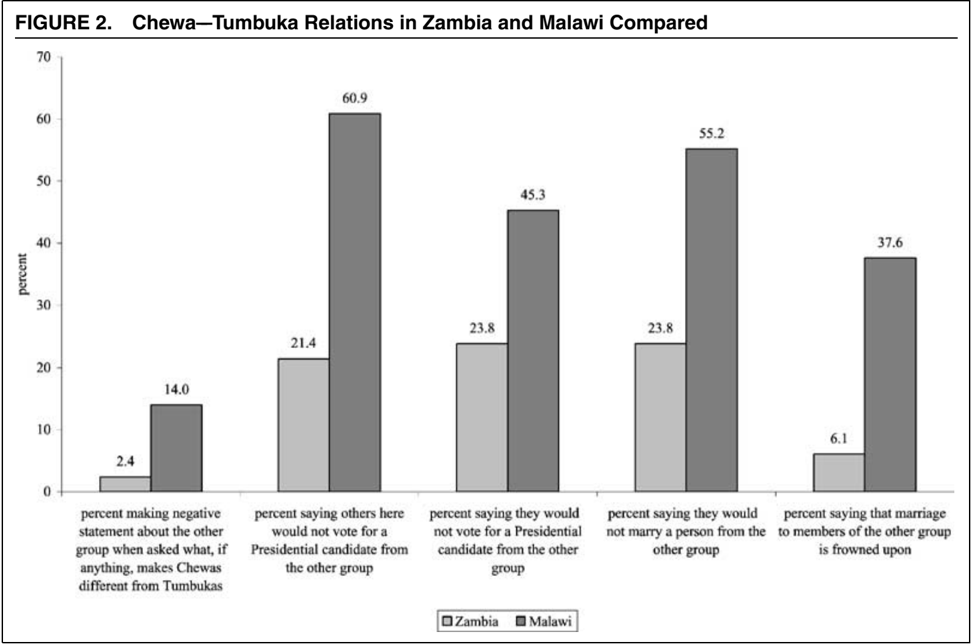
- Yet the cleavage was much more socially and politically salient in Malawi: 61% of Malawians versus 21% of Zambians said others in their village would be unwilling to vote for a candidate from the other group; 45% of Malawians versus 24% of Zambians said they themselves would not vote for such a candidate.
- On marriage, 55% of Malawians versus 24% of Zambians said they would not marry a member of the other group, and 38% of Malawians versus 6% of Zambians said intermarriage was frowned upon.
- The paper’s regressions find that the perceived number of cultural differences is not a significant predictor of attitudes in any of the four models, while country is strongly significant; the table notes sample sizes of 172, 175, 176, and 172.
## Methods
- Comparative natural-experiment design: the Zambia-Malawi border partitions Chewas and Tumbukas, who are otherwise culturally similar across sides of the border, allowing comparison of the same cleavage in different political settings.
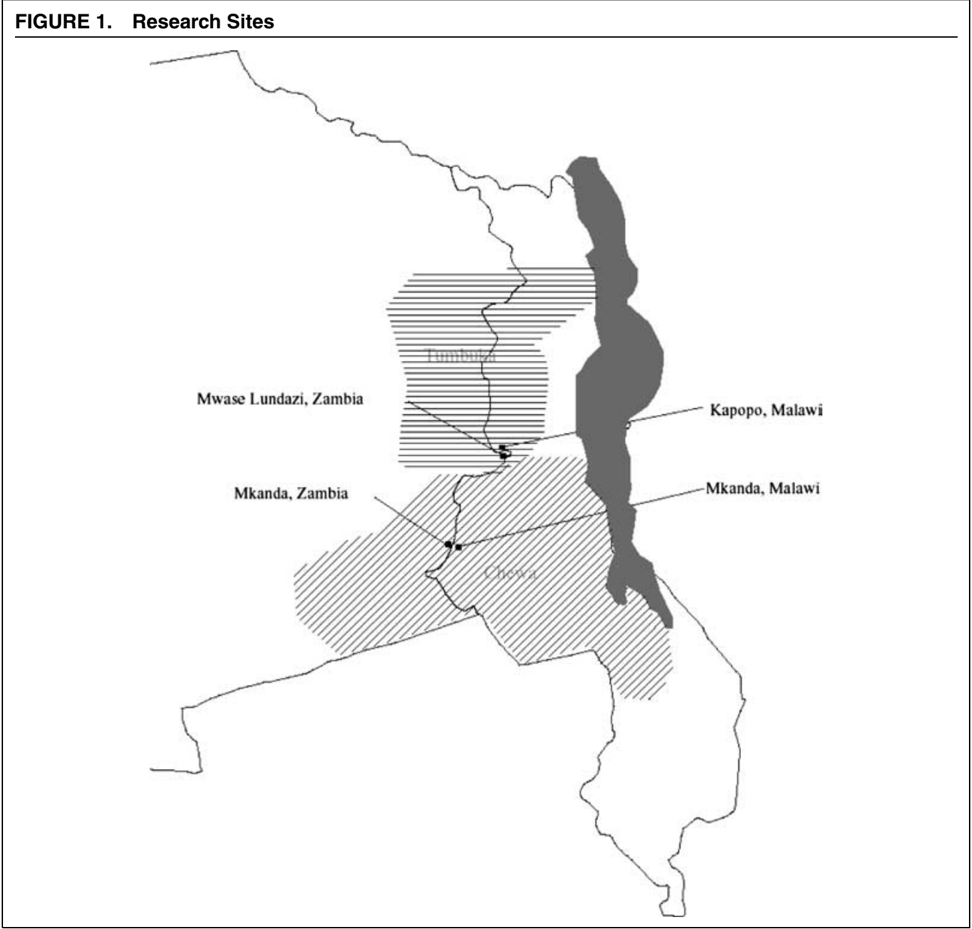
- Original field survey in July-August 2001 in four villages directly across the border: two Chewa villages and two Tumbuka villages; 42 respondents in each Zambian village and 48 in each Malawian village, for a total sample of 180, selected by random stratified quota sampling from every third unrelated household.
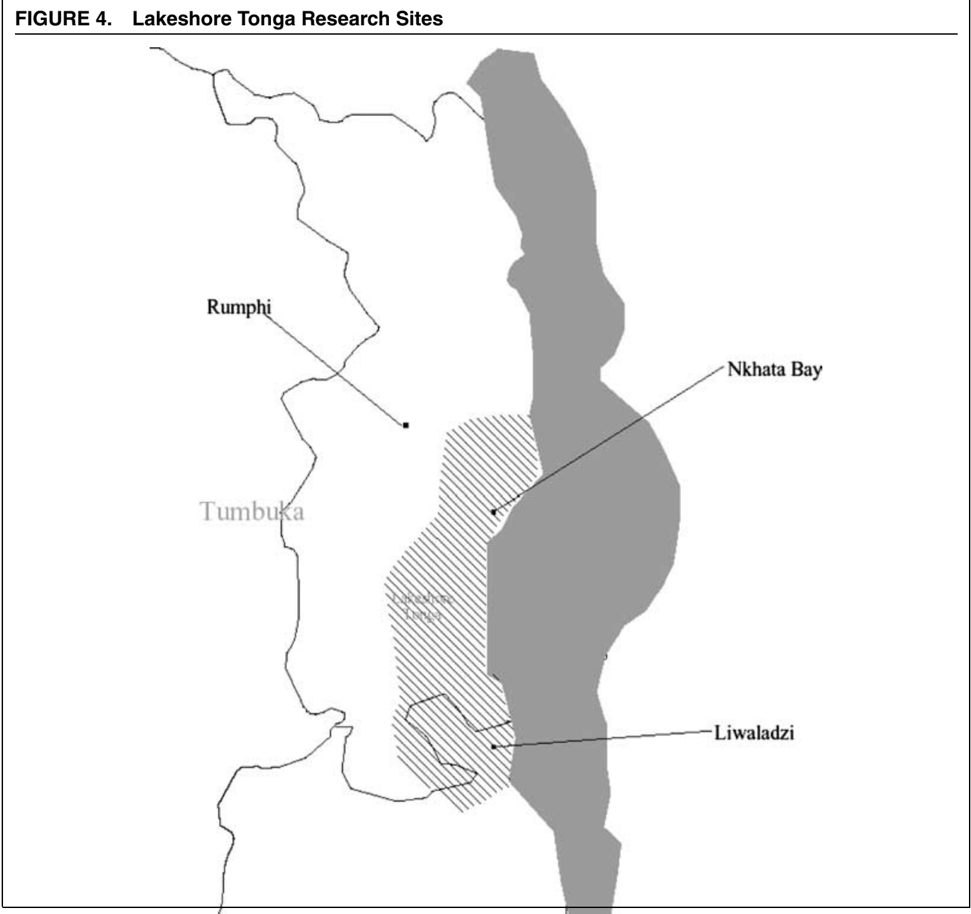
- Main analysis combines open-ended survey responses, descriptive comparisons, logit regressions controlling for tribal affiliation, gender, age, and the number of reported cultural differences, plus a second survey of 30 Lakeshore Tonga respondents to test whether an administrative boundary can create salience.
## Limitations
- Stated by the paper: the author notes that testing whether social divisions are products of political divisions would require time-series data on changes in political divisions, trust, and intermarriage, which are “currently unavailable.”
- Stated by the paper: the Lakeshore Tonga administrative-boundary test is described as “suggestive” because the sample is small.
- Evident from the text: the main survey is limited to four villages in one border region and relies on self-reported attitudes and a small, non-national sample, so generalization beyond the studied sites is not directly demonstrated.
Model-written summary. Check it against the paper before relying on it.
Integrity signals
Registry
Cites
Statistics
Figures
Verification
Claims the paper makes
0 Valid · 1 Not valid · 17 Not checked · 101 Own results and interpretations
A result the paper reports from its own data — it cites no other source for it, so there is none to check. The quote shows it is in the paper.
In the paper
“In fact, the modal Zambian response to our request for a list of differences between Chewas and Tumbukas was to emphasize that 'We are one' or 'We are united.'”
plain- Asserted: passes — The authors put it forward as true.
- Checkable: passes — It can be checked against evidence.
- Load-bearing: passes — The paper’s conclusions depend on it.
- Based: passes — The paper gives a reason why it holds.
A result the paper reports from its own data — it cites no other source for it, so there is none to check. The quote shows it is in the paper.
In the paper
“The most important finding, however, is that, controlling for all of these other factors, the most powerful determinant of a respondent's attitudes toward members of the other community is his or her physical- -and, it bears underscoring, from an historical perspective, entirely accidental- location on one side of the Zambia-Malawi border or the other.”
boostedstates a cause- Asserted: passes — The authors put it forward as true.
- Checkable: passes — It can be checked against evidence.
- Load-bearing: passes — The paper’s conclusions depend on it.
- Based: passes — The paper gives a reason why it holds.
A result the paper reports from its own data — it cites no other source for it, so there is none to check. The quote shows it is in the paper.
In the paper
“Malawian respondents are significantly less willing to vote for a presidential candidate from the other group and significantly less willing to marry across group lines than are their otherwise identical Zambian counterparts.”
plainstates an association- Asserted: passes — The authors put it forward as true.
- Checkable: passes — It can be checked against evidence.
- Load-bearing: passes — The paper’s conclusions depend on it.
- Based: passes — The paper gives a reason why it holds.
A result the paper reports from its own data — it cites no other source for it, so there is none to check. The quote shows it is in the paper.
In the paper
“Again and again, respondents in all four villages identified the same attributes as distinguishing members of the two communities.”
plain- Asserted: passes — The authors put it forward as true.
- Checkable: passes — It can be checked against evidence.
- Load-bearing: passes — The paper’s conclusions depend on it.
- Based: passes — The paper gives a reason why it holds.
A result the paper reports from its own data — it cites no other source for it, so there is none to check. The quote shows it is in the paper.
In the paper
“While the specific cultural practices that respondents mentioned varied somewhat from person to person, nearly every interviewee on both sides of the border (83% overall) was able to identify at least one attribute, tradition, or custom- -and often several- -that made Chewas and Tumbukas culturally different from one another.”
plain- Asserted: passes — The authors put it forward as true.
- Checkable: passes — It can be checked against evidence.
- Load-bearing: passes — The paper’s conclusions depend on it.
- Based: passes — The paper gives a reason why it holds.
66 more claims
Create a free account to see all 119 claims and every source verdict.
- It may state two separate claims as one. 42
- Probably not a substantial claim. 8
Citations
Cites
The clash of civilizations and the remaking of world order
(1997) · Long Range Planning · doi:10.1016/s0024-6301(97)80966-1 · Cited by 7,457
Political Order in Changing Societies
Huntington, S. P. (1970) · Verfassung in Recht und Übersee · doi:10.5771/0506-7286-1970-2-257 · Cited by 6,333
Kuper, L., & Horowitz, D. L. (1986) · Contemporary Sociology · doi:10.2307/2069338 · Cited by 4,869
Democracy in Plural Societies: A Comparative Exploration
Nagata, J., & Lijphart, A. (1979) · International Journal · doi:10.2307/40201796 · Cited by 2,255
Ethnic and Cultural Diversity by Country*
Fearon, J. D. (2003) · Journal of Economic Growth · doi:10.1023/a:1024419522867 · Cited by 1,829 · cited 1×
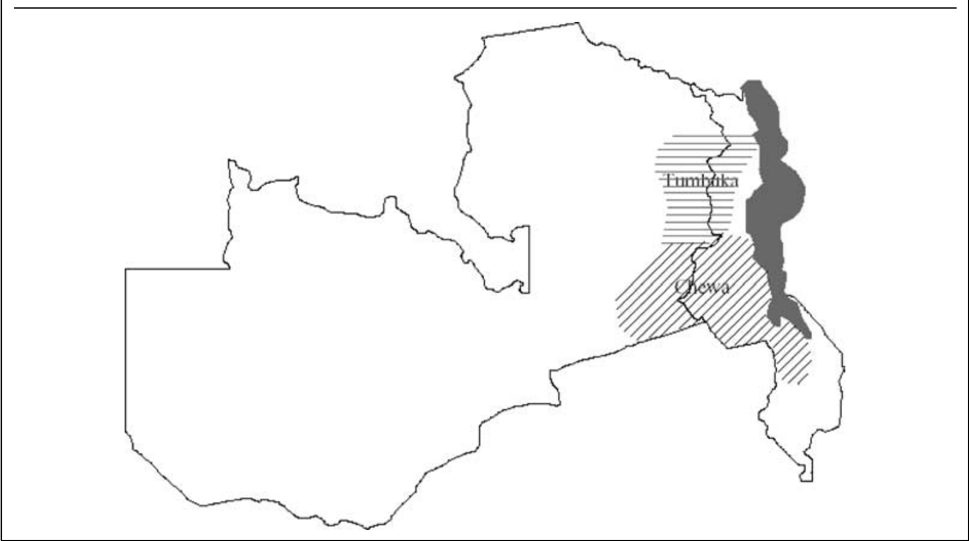
“As Figure 3 makes clear, the Chewa and Tumbuka communities are both large in Malawi (28% and 12% of the national population, respectively) but peripheral in Zambia (7% and 4%, respectively).16 Much more 16 Malawi’s figures come from Fearon 2003.”
BackgroundExplaining Interethnic Cooperation
Fearon, J. D., & Laitin, D. D. (1996) · American Political Science Review · doi:10.2307/2945838 · Cited by 1,606
Ethnologue: Languages of the World
(2015) · Choice Reviews Online · doi:10.5860/choice.192005 · Cited by 1,176
Social Mobilization and Political Development
Deutsch, K. W. (1961) · American Political Science Review · doi:10.1017/s0003055400125134 · Cited by 1,077
Why Ethnic Parties Succeed: Patronage and Ethnic Head Counts in India
Chandra, K. (2004) · Cambridge University Press eBooks · doi:10.1017/9781108573481 · Cited by 1,064
Horowitz, D. L. (2001) · University of California Press eBooks · doi:10.1525/9780520342057 · Cited by 925
Research works printed but not linked: 6
- Vail, Leroy, and Landeg White. 1989. 'Tribalism in the Political History of Malawi.' In The Creation of Tribalism in Southern Africa , ed. Leroy Vail. Berkeley and Los Angeles: University of California Press, 151- -92.
- Lijphart, Arend. 1977. DemocracyinPlural Societies: A Comparative Exploration . New Haven, CT: Yale University Press.
- Henkel, Reinhard. 1985. 'Mission Stations in Zambia: Their Location and Diffusion Patterns.' Zambia Geographical Journal 35: 1- -18.
- Hobsbawm, Eric. 1996. 'Are all Tongues Equal?' In Living as Equals , ed. Paul Barker. New York: Oxford University Press, 85- 98.
- Bratton, Michael. 1994. 'Economic Crisis and Political Realignment in Zambia.' In Economic Change and Political Liberalization in Sub-Saharan Africa , ed. Jennifer A. Widner. Baltimore: Johns Hopkins University Press, 101- -28.
- Lipset, Seymour Martin, and Stein Rokkan. 1967. 'Cleavage Structures, Party Systems and Voter Alignments: An Introduction.' In Party Systems and Voter Alignments: Cross-National Perspectives , ed. Seymour M. Lipset and Stein Rokkan. New York: Free Press, 1- -64.
Cited by
Items 201–300 of 948
Tweeting identity? Ukrainian, Russian, and #Euromaidan
Metzger, M. M., Bonneau, R., Nagler, J., & Tucker, J. A. (2015) · Journal of Comparative Economics · doi:10.1016/j.jce.2015.12.004 · Cited by 35
Regional cleavages in African politics: Persistent electoral blocs and territorial oppositions
Boone, C., Wahman, M., Kyburz, S., & Linke, A. M. (2022) · Political Geography · doi:10.1016/j.polgeo.2022.102741 · Cited by 50
“36 As observed by Posner (2004b).”
InfluentialCotofan, M., Dur, R. A. J., & Meier, S. (2023) · Journal of Economic Behavior & Organization · doi:10.1016/j.jebo.2023.11.023 · Cited by 36
“A number of studies in multiple disciplines show that competition increases group conflict and outgroup hostility (e.g. Bornstein et al., 2002; Posner, 2004; Choi and Bowles, 2007; Bowles, 2009; Goette et al., 2012).9 In addition, Bianchi et al. (2018) shows that economic down- 9A related…”
BackgroundInstitutional Performance and Vote Buying in India
Heath, O., & Tillin, L. (2017) · Studies in Comparative International Development · doi:10.1007/s12116-017-9254-x · Cited by 33
“…of this tightly controlled comparison, we join a number of other researchers (see, for example Laitin 1986; Miguel 2004; Miles and Rochefort 1991; Posner 2004) who have also exploited the partitioning of ethnic groups by administrative boundaries to study how similar social groups respond to…”
BackgroundWaring, T. M., & Bell, A. V. (2013) · Evolution and Human Behavior · doi:10.1016/j.evolhumbehav.2013.07.003 · Cited by 34
Collective Action in Diverse Sierra Leone Communities
Glennerster, R., Miguel, E. A., & Rothenberg, A. D. (2010) · National Bureau of Economic Research · doi:10.3386/w16196 · Cited by 39
Using Qualitative Information to Improve Causal Inference
Glynn, A., & Ichino, N. (2014) · American Journal of Political Science · doi:10.1111/ajps.12154 · Cited by 42
Explaining the number of rebel groups in civil wars
Walter, B. F. (2018) · International Interactions · doi:10.1080/03050629.2019.1554573 · Cited by 36
“Second, colonial policies often divided political power along ethnic lines not religious or linguistic lines, making this cleavage particularly salient when mobilizing support for political change (Posner 2004b).”
BackgroundGadjanova, E. (2012) · Ethnopolitics · doi:10.1080/17449057.2012.730261 · Cited by 37
“Political science research shows that the relevant group divisions politicized within multi-ethnic states depend on which are most useful to politicians rather than only their salience for voters (Posner, 2004).”
BackgroundLiu, A. H. (2016) · Democratization · doi:10.1080/13510347.2016.1245292 · Cited by 38
Culture, Politics, and Development
Woolcock, M. J. V. (2015) · Oxford University Press eBooks · doi:10.1093/oxfordhb/9780199845156.013.11 · Cited by 28
Zhang, N., Aidenberger, A., Rauhut, H., & Winter, F. (2019) · European Sociological Review · doi:10.1093/esr/jcz030 · Cited by 33
“Of course, the precise location of ethnic boundaries is likely to vary from society to society depending on the dominant frames supplied by politics and the popular media (Posner, 2004; Miguel and Gugerty, 2005; Wimmer, 2008; Hopkins, 2010).”
Chai, S. (2005) · European Sociological Review · doi:10.1093/esr/jci026 · Cited by 26
“Posner (2004).”
Partisan Portfolio Allocation in African Democracies
Ariotti, M. H., & Golder, S. (2017) · Comparative Political Studies · doi:10.1177/0010414017710256 · Cited by 29
“It is important therefore not simply to enumerate the number of different ethnic groups in a country as FRT (2015) do but to enumerate politically relevant ethnic groups over time (Posner, 2004a).”
BackgroundPolitical participation in Africa:Participatory inequalities and the role of resourcesPreprint
Isaksson, A. (2010) · RePEc: Research Papers in Economics · Cited by 26
Perils or Promise of Ethnic Integration? Evidence from a Hard Case in BurundiPreprint
Samii, C. (2013) · SSRN Electronic Journal · doi:10.2139/ssrn.2198358 · Cited by 26
Walsh, J., Vaida, N., Coman, A., & Fiske, S. T. (2022) · Psychological Science in the Public Interest · doi:10.1177/15291006231161337 · Cited by 26
“Antagonistic relations between different communities (Posner, 2004), the motivation to compete for scarce resources (Riek et al., 2006), and the motivation to assert group differences (Ybarra & Ramón, 2004) are factors that are likely to lead to divergence in the construction of these narratives.”
BackgroundCampaign appeals in Nigeria's 2007 gubernatorial elections
Kuenzi, M. T., & Lambright, G. M. S. (2013) · Democratization · doi:10.1080/13510347.2013.833905 · Cited by 27
The Privatization of Public Services in American Cities
Trounstine, J. L. (2015) · Social Science History · doi:10.1017/ssh.2015.61 · Cited by 28
Experimental Political Science
McDermott, R. (2014) · Elsevier eBooks · doi:10.1016/b978-0-12-404681-8.00013-3 · Cited by 25
Nation-state or nation-family? Nationalism in marginalised African societies
Bhandari, A., & Mueller, L. (2019) · The Journal of Modern African Studies · doi:10.1017/s0022278x1900003x · Cited by 26
Fertilizer and votes: Does strategic economic policy explain the 2009 Malawi election?
Brazys, S. R., Heaney, P., & Walsh, P. P. (2015) · Electoral Studies · doi:10.1016/j.electstud.2015.03.007 · Cited by 33
“In one of the few studies to link economic performance to electoral outcomes, Posner and Simon (2002) found that incumbents were punished for poor economic performance in Zambian elections between 1991 and 1996.”
BackgroundOstwald, K., & Subhan, M. S. (2021) · Asian Politics & Policy · doi:10.1111/aspp.12565 · Cited by 28
Ethnicity, Religion, and Conflict in Ghana: The Roots of GA Nativism
Asante, R. (2011) · Ghana Studies · doi:10.1353/ghs.2011.0003 · Cited by 24
Whitt, S. (2012) · Journal of Conflict Resolution · doi:10.1177/0022002712459714 · Cited by 26
“…most likely where ethnic divisions become highly salient and polarizing and cooperative norms and institutions are either absent or have eroded (Sambanis 2001; Elbadawi and Sambanis 2002; Posner 2004; Montalvo and Reynal-Querol 2005; Hegre and Sambanis 2006; Wood 2008; Bhavnani and Miodownik 2009).”
BackgroundThe Ethnicity Distraction ? Political Credibility And Partisan Preferences In Africa
Keefer, P. E. (2010) · The World Bank Open Knowledge Repository (World Bank) · doi:10.1596/1813-9450-5236 · Cited by 24
Ethnic diversity and development in Kenya: limitations of ethnicity as a category of analysis
Kabiri, N. (2014) · Commonwealth and Comparative Politics · doi:10.1080/14662043.2014.957500 · Cited by 23
“…the fact whether ethnic mobilisation will procure dividends (see, for example, Barkan & Chege, 1989; Berman, 1998, p. 341; Elkins, 2008; Habyarimana, Humphreys, Posner, & Weinstein, 2008; Kabiri, 2010; Kaspin, 1995; Kendhammer, 2010; Miguel, 2004; Nnyago, 2008; Posner, 2004b) or penalties.”
BackgroundIndigenous Peasant ‘Otherness’: Rural Identities and Political Processes in B olivia
Fontana, L. B. (2014) · Bulletin of Latin American Research · doi:10.1111/blar.12207 · Cited by 29
“This evidence can be linked to the hypothesis of Daniel Posner (2004), who argues that the relevance of ethnic divisions depends on the political and social arena where groups coexist, which constitutes how these groups come to be defined.”
Political candidates’ attitudes towards group representation
Coffé, H., & Reiser, M. (2018) · Journal of Legislative Studies · doi:10.1080/13572334.2018.1516603 · Cited by 26
“In addition, the group’s identity has to be considered salient or needs to have been mobilised by politicians as politically relevant (Posner, 2004).”
BackgroundMarquardt, K. L., & Herrera, Y. M. (2015) · Social Science Quarterly · doi:10.1111/ssqu.12187 · Cited by 26
Seeds of Distrust: Conflict in UgandaPreprint
Rohner, D., Thoenig, M., & Zilibotti, F. (2011) · SSRN Electronic Journal · doi:10.2139/ssrn.1972310 · Cited by 22
Reny, T. T. (2017) · Political Research Quarterly · doi:10.1177/1065912917713155 · Cited by 27
Conflict Over the Commons: Government Bias and Communal Conflicts in Darfur and Eastern Sudan
Brosché, J. (2022) · Ethnopolitics · doi:10.1080/17449057.2021.2018221 · Cited by 54
“Disputes over local administrative units are particularly prone to become salient if adjustments change the balance of power between groups (Posner, 2004).”
BackgroundApplied Social Science Methodology: An Introductory Guide
Gerring, J., & Christenson, D. P. (2017) · Cited by 42
Ethnic versus national identity in Ethiopia: Is ethnic identity growing and among whom?
Ishiyama, J., & Basnet, P. (2022) · African Security Review · doi:10.1080/10246029.2021.2009530 · Cited by 21
Cash Crops, Print Technologies, and the Politicization of Ethnicity in Africa
Pengl, Y., Roessler, P. G., & Rueda, V. (2021) · American Political Science Review · doi:10.1017/s0003055421000782 · Cited by 35
Vote-buying, anti-corruption campaigns, and identity in African elections
Kao, K., Lust, E., & Rakner, L. (2022) · World Development · doi:10.1016/j.worlddev.2022.106064 · Cited by 30
Imagined democracy? Nation-building and elections in Central Asia
Beacháin, D. Ó., & Kevlihan, R. (2015) · Nationalities Papers · doi:10.1080/00905992.2014.916662 · Cited by 33
“Research in other regions, for example, has highlighted the manner in which electoral competition can encourage the development of shared or competing identities that have implications for national cohesion and stability (Posner 2004).”
BackgroundCorruption Along Ethnic Lines: A Study of Individual Corruption Experiences in 17 African Countries
Isaksson, A. (2014) · The Journal of Development Studies · doi:10.1080/00220388.2014.947282 · Cited by 25
“The size of groups matters for whether they serve as viable bases for political coalition building and is thereby likely to affect the political landscape and the salience attached to group divisions (Posner, 2004).”
Backgroundla Calle, L. D., & Miley, T. J. (2008) · European Journal of Political Research · doi:10.1111/j.1475-6765.2008.00776.x · Cited by 21
Raymond, C. D. (2014) · Comparative European Politics · doi:10.1057/cep.2014.27 · Cited by 21
Explaining the (local) ethnic census: subnational variation in ethnic politics in Kenyan elections
Harris, K. A. (2022) · The Journal of Modern African Studies · doi:10.1017/s0022278x22000076 · Cited by 20
Impact of Cultural Diversity on Western Balkan Countries’ Performance
Hysa, E. (2020) · Journal of Ethnic and Cultural Studies · doi:10.29333/ejecs/292 · Cited by 22
“Criticised by Alesina et al. (2003); Fearon (2003), and Posner (2004).”
BackgroundDoes Ethnic Federalism Lead to Greater Ethnic Identity? The Case of Ethiopia
Ishiyama, J. (2022) · Publius The Journal of Federalism · doi:10.1093/publius/pjac023 · Cited by 20
Cultural and religious demography and violent Islamist groups in Africa
Dowd, C. (2014) · Political Geography · doi:10.1016/j.polgeo.2014.09.006 · Cited by 23
“…cultural demography: the sizes of the groups that the cleavage defines relative to the political and social arenas in which they are operating,’ thus explaining ‘why one cultural cleavage came to emerge as the axis of political competition and conflict rather than another’ (Posner, 2004, p. 530).”
BackgroundThe hunger games: Food prices, ethnic cleavages and nonviolent unrest in Africa
Abbs, L. (2019) · Journal of Peace Research · doi:10.1177/0022343319866487 · Cited by 22
“These locations do not exhibit the social barriers associated with politically relevant groups (Posner, 2004) and therefore make a good comparison with more socially constrained local ethnic contexts.”
BackgroundElectoral Systems and Citizen-Elite Ideological Congruence
Golder, M., & Ferland, B. (2017) · Oxford University Press eBooks · doi:10.1093/oxfordhb/9780190258658.013.11 · Cited by 40
Majed, R. (2020) · Social Forces · doi:10.1093/sf/soaa076 · Cited by 26
“…1959), more recent studies have looked at the relationship between ethnic salience,class cleavage,and civil war (Gubler and Selway 2012; Siroky and Hechter 2016) and the importance of group size (Posner 2004) or institutional setting (Chandra 2012) in determining the variations in ethnic salience.”
BackgroundRegional Inequalities and Civil Conflict in 21 Sub-Saharan African Countries, 1986–2004
Østby, G., & Rød, J. K. (2006) · Cited by 20
INSTITUTIONS IN NEW DEMOCRACIES: VARIATIONS IN AFRICAN POLITICAL PARTY SYSTEMS
Riedl, R. B. (2008) · ProQuest Demo Repository · Cited by 27
Local Government Proliferation, Diversity, and ConflictPreprint
Bazzi, S., & Gudgeon, M. (2016) · RePEc: Research Papers in Economics · Cited by 33
Ethnic Divisions and Production in FirmsPreprint
Hjort, J. (2013) · SSRN Electronic Journal · doi:10.2139/ssrn.2353298 · Cited by 30
Why Does Ethnic Partition Foster Violence? Unpacking the Deep Historical Roots of Civil Conflicts
Ito, G. (2019) · Journal of Peace Research · doi:10.1177/0022343320957377 · Cited by 22
“This essentially mirrors the earlier case-based, quasi-experimental findings in Posner (2004) that the political salience of cultural differences in the domestic political arena depends on groups’ size and their utility as the vehicles for political competition.”
BackgroundResultInfluentialMérola, V., & Helgason, A. F. (2016) · The Journal of Politics · doi:10.1086/686254 · Cited by 21
“For example, scholars have modeled vote choice as a function of the voter’s strategic calculation to identify with the ethnic groups that maximize their material or psychological well-being (Penn 2008; Posner 2004; Shayo 2009).”
BackgroundWhy Armies Break: Explaining Mass Desertion in Conventional WarPreprint
Lyall, J. (2014) · SSRN Electronic Journal · doi:10.2139/ssrn.2524561 · Cited by 25
de Kadt, D. (2017) · SSRN Electronic Journal · doi:10.2139/ssrn.2922125 · Cited by 20
Culture, Politics, and Development
Woolcock, M. J. V. (2014) · World Bank, Washington, DC eBooks · doi:10.1596/1813-9450-6939 · Cited by 24
Wood, E. J. (2009) · Oxford University Press eBooks · doi:10.1093/oxfordhb/9780199566020.003.0005 · Cited by 21
Reciprocity and Discrimination: An Experiment of Hindu‐Muslim Cooperation in Indian Slums
Tusicisny, A. (2016) · Political Psychology · doi:10.1111/pops.12340 · Cited by 20
van de Walle, N. (2009) · Collection Histoire africaine · doi:10.3917/kart.gazib.2009.01.0133 · Cited by 25
Do we harm others even if we don't need to?
Cacault, M. P., Goette, L. F., Lalive, R., & Thoenig, M. (2015) · Frontiers in Psychology · doi:10.3389/fpsyg.2015.00729 · Cited by 23
“…aspect of human social behavior has been an enduring puzzle in evolutionary biology (Darwin, 1871; Hamilton, 1975), in social sciences (Baron, 2001; Posner, 2004; Sambanis et al., 2012) and in humanities as illustrated by our quote from Mephistopheles’ famous statement to Faust (von Goethe, 1808).”
BackgroundElections and Immigration Policy in Autocracy: Evidence from Russia and Kazakhstan
Joo, S. H. (2022) · Government and Opposition · doi:10.1017/gov.2022.47 · Cited by 18
“For instance, studies on Sub-Saharan Africa demonstrate that politicians tend to play the ethnic card to mobilize public support and win elections (Eifert et al. 2010; Posner 2004).”
BackgroundResearch Methods for Public Policy
Kilonzo, S. M., & Ojebode, A. (2022) · Springer eBooks · doi:10.1007/978-3-030-99724-3_4 · Cited by 34
Elfversson, E. (2019) · Comparative Political Studies · doi:10.1177/0010414019830734 · Cited by 31
“This differentiation between different sources of bias also contributes to the literature on ethnic politics Elfversson 2085 by identifying circumstances that may make ethnic ties particularly salient or durable (cf. Posner, 2004).”
BackgroundThe Merits of Money and "Muscle": Essays on Criminality, Elections and Democracy in India
Vaishnav, M. (2012) · doi:10.7916/d832030w · Cited by 24
“Within patronage democracies, the salience of ethnic cleavages is not uniformly distributed but often varies across time and space (Bates 1983; Horowitz 1985; Chandra 2004; Posner 2004; 2005).”
BackgroundInfluentialIdentity Politics and the Jos Crisis: Evidence, Lessons, and Challenges of Good Governance
Ambe-Uva, T. N. (2011) · World Futures · doi:10.1080/02604027.2010.503546 · Cited by 16
“…role of formal and informal institutions for conflict regulation, the different sizes of groups relative to the national arena, and the extent to which different identities (ethnic, regional, religious, class, etc.) overlap with, or crosscut, each other (Horowitz 1985; Posner 2004; Weingast 1997).”
BackgroundPiombo, J. (2005) · Party Politics · doi:10.1177/1354068805053212 · Cited by 16
Abman, R., & Carney, C. (2019) · SSRN Electronic Journal · doi:10.2139/ssrn.3393260 · Cited by 16
“The fact that there are few dominant ethnic groups has led to tensions within the political system (Posner, 2004). There is also limited trust of and economic interaction with individuals of other ethnicities in Malawi (Robinson, 2016). Having established above that the president in Malawi has significant ability to d…”
Proximate Exposure to Conflict and the Spatiotemporal Correlates of Social Trust
Lewis, J. S., & Topal, S. A. (2022) · Political Psychology · doi:10.1111/pops.12864 · Cited by 21
Separated by Degrees: Social Closure by Education Levels Strengthens Contemporary Political Divides
de Jong, J., & Kamphorst, J. (2024) · Comparative Political Studies · doi:10.1177/00104140241271104 · Cited by 27
“After decades of educational expansion, citizens with tertiary education now make up around 35 – 50% of Western societies (OECD, 2019), making them a sizable and potentially mobilizable social group (Posner, 2004).”
Pérez, E. O., Goldman, S., Huo, Y. J., Nteta, T. M., & Tropp, L. R. (2024) · Political Science Research and Methods · doi:10.1017/psrm.2024.61 · Cited by 18
“Psychological and political scientists have documented the role of institutions and leaders, among other factors, in triggering categorization by highlighting more substantive distinctions between individuals, such as race , ethnicity , gender , and party (e.g., Chandra, 2004; Posner, 2004).”
The Asymmetric Role of Religious Appeals in India
Chhibber, P. K., & Sekhon, J. S. (2015) · Cited by 23
Violent Rhetoric in Protracted Group Conflicts: Experimental Evidence from Israel and India
Gubler, J. R., & Kalmoe, N. P. (2015) · Political Research Quarterly · doi:10.1177/1065912915608947 · Cited by 15
Hern, E. A. (2016) · Studies in Comparative International Development · doi:10.1007/s12116-016-9226-6 · Cited by 16
Brown, M. S., & O’Brien, D. P. (2019) · Asian Ethnicity · doi:10.1080/14631369.2019.1636637 · Cited by 15
Righteous Revolutionaries: Morality, Mobilization, and Violence in the Making of the Chinese State
Javed, J. (2021) · University of Michigan Press eBooks · doi:10.3998/mpub.10131159 · Cited by 19
Racism Is Not Enough: Minority Coalition Building in San Francisco, Seattle, and Vancouver
Kim, J. Y. (2020) · Studies in American Political Development · doi:10.1017/s0898588x20000115 · Cited by 15
The Political Boundaries of Ethnic Divisions
Bazzi, S., & Gudgeon, M. (2018) · National Bureau of Economic Research · doi:10.3386/w24625 · Cited by 19
The Economics of Language Policy
Gazzola, M., & Wickström, B. (2016) · Project Muse (Johns Hopkins University) · Cited by 26
What drives support for separatism? Exposure to conflict and relative ethnic size in Biafra, Nigeria
Lewis, J. S. (2022) · Nations and Nationalism · doi:10.1111/nana.12907 · Cited by 21
Pardelli, G., & Kustov, A. (2022) · World Politics · doi:10.1017/s0043887121000241 · Cited by 17
The politicization of indigenous identities in Peru
Raymond, C. D., & Arce, M. (2011) · Party Politics · doi:10.1177/1354068811407597 · Cited by 14
Colonialism, Landlords, and Public Goods Provision in India: A Controlled Comparative Analysis
Verghese, A. (2018) · The Journal of Development Studies · doi:10.1080/00220388.2018.1487057 · Cited by 16
Blair, R., Karim, S., Gilligan, M., et al. (2016) · SSRN Electronic Journal · doi:10.2139/ssrn.2772634 · Cited by 14
When the Sorting Hat Sorts Randomly: A Natural Experiment on CulturePreprint
Ricart‐Huguet, J., & Paluck, E. L. (2020) · SSRN Electronic Journal · doi:10.2139/ssrn.3568261 · Cited by 13
Ethnic identity, region and attitudes towards male circumcision in a high HIV-prevalence country
Dionne, K. Y., & Poulin, M. J. (2013) · Global Public Health · doi:10.1080/17441692.2013.790988 · Cited by 13
“During the colonial era, administrators and local authorities mobilised some ethnic groups for political purposes, effectively creating ethnic divisions in the political arena that persist today (Kaspin, 1995; Posner, 2004; Vail & White, 1989).”
BackgroundReligious riots and electoral politics in India
Iyer, S., & Shrivastava, A. (2018) · Apollo (University of Cambridge) · doi:10.17863/cam.18612 · Cited by 13
“As well, a much broader literature has been examining the effect of ethnic, social and armed conflict on economic, demographic, developmental and political outcomes (Beck and Tolnay, 1990; DiPasquale and Glaeser, 1998; Posner, 2004; Berrebi and Klor, 2008; Eifert, Miguel and Posner, 2010; Berman, Dinecco and Onoraro,…”
Selway, J. (2015) · Cited by 13
Déterminants de l'identification ethnique en Afrique de l'Ouest
Bossuroy, T. (2007) · Afrique contemporaine · doi:10.3917/afco.220.0119 · Cited by 19
Shetler, J. B. (2010) · Journal of Peace Research · doi:10.1177/0022343310376441 · Cited by 13
State Capacity, Inequality and Inter-Group Violence in Sub-Saharan Africa: 1989–2011
Rudolfsen, I. (2017) · Civil Wars · doi:10.1080/13698249.2017.1345541 · Cited by 20
Size Matters: The Effect of the Size of Ethnic Groups on Development
Dimico, A. (2016) · Oxford Bulletin of Economics and Statistics · doi:10.1111/obes.12145 · Cited by 14
“[102] Posner, Daniel (2004a), The Political Salience of Cultural Different: Why Chewas and Tumbukas are Allies in Zambia and Adversaries in Malawi, American Political Science Review (2004), 98: 529-545”
Fractionalization and Inter‐Group Differences
Lind, J. T. (2007) · Kyklos · doi:10.1111/j.1467-6435.2007.00363.x · Cited by 14
“Posner (2004) argues that the grouping of ethnicities found in the standard sources of data is inappropriate.”
Greenwood, J. (2021) · Teaching in Higher Education · doi:10.1080/13562517.2021.1965567 · Cited by 14
“The fi rst article uses the colonial-era drawing of the border between Malawi and Zambia to investigate the role of group size in the di ff ering political salience of Chewa and Tumbuka ethnicity in each country (Posner 2004).”
MethodBuilding tribes: How administrative units shaped ethnic groups in Africa
Müller‐Crepon, C. (2024) · American Journal of Political Science · doi:10.1111/ajps.12835 · Cited by 20
Ethnic Minorities, Political Competition, and Democracy: Circumstantial Liberals
Rovný, J. (2024) · doi:10.1093/9780198906742.001.0001 · Cited by 20
Costalli, S., & Moro, F. N. (2011) · Ethnic and Racial Studies · doi:10.1080/01419870.2011.556748 · Cited by 13
“Still, other scholars have replied that such results may depend on an unreliable index (Posner 2004) or have highlighted the fundamental difference between ethnic and non-ethnic conflicts, maintaining that ethnic fragmentation only matters in the first category of wars (Sambanis 2001).”
BackgroundResultde Soysa, I., & Almås, S. (2019) · Kyklos · doi:10.1111/kykl.12210 · Cited by 14
Reny, M.-E. (2009) · Ethnic and Racial Studies · doi:10.1080/01419870701722463 · Cited by 14
Metadata
- Authors
- POSNER, D. N.
- Affiliations
- University of California, Los Angeles (US)
- Corresponding author
- POSNER, DANIEL N.
- ORCID
- POSNER, DANIEL N.
- Venue
- American Political Science Review
- Publisher
- Cambridge University Press (CUP)
- Published
- 2004-11
- Volume
- 98
- Issue
- 4
- Pages
- 529-545
- ISSN
- 0003-0554 (ISSN-L)
- 1537-5943
- OpenAlex
- W2169278049
- Cited by
- 940
- References
- 54
- Citations by year
- 2026: 22 · 2025: 22 · 2024: 117 · 2023: 45 · 2022: 40 · 2021: 28 · 2020: 94 · 2019: 34 · 2018: 72 · 2017: 45 · 2016: 49 · 2015: 46 · 2014: 58 · 2013: 45 · 2012: 32
- FWCI
- 79.46
- Type
- journal article
- Language
- en
- Open access
- green
- www.escholarship.org
- Locations
- American Political Science Review (publishedVersion)
- eScholarship (California Digital Library) (submittedVersion)
- RePEc: Research Papers in Economics (submittedVersion)
- Topics
- Social Sciences › Sociology and Political Science › Political Conflict and Governance
- Social Sciences › Sociology and Political Science › African Studies and Ethnography
- Social Sciences › Political Science and International Relations › Electoral Systems and Political Participation
- Keywords
- cultural cleavages, political salience, Chewa, Tumbuka, ethnic politics, ethnic group size, political coalition building, ethnic mobilization
About these checks
Registry, retraction, Cites and statistics results are computed, not judged, with one exception: a printed reference that no index lists is read once by a model before it counts as a citation error. Claims are extracted by a model and kept only when their quote appears verbatim in the text; each cited source is then checked, with a model’s help, for whether it says what the claim relies on. Those verdicts can be wrong — read the claim’s quote and the cited source before relying on one.
A language model drew the claims from the paper on 2026-10-11, under version 3 of the claim definition (model deepseek-v4.1-flash, prompt extract-v3).
A second model labelled each claim on 2026-10-11 (model jev-1.13-20260917, definition revision gold-guideline-v0.2).
Statistics and arithmetic are recomputed, not judged.
Confidence bands are shown only for fields calibrated on our annotated test set. None is calibrated yet, so no band is shown.
What counts as a claim ›How we measure confidence ›How we check this ›
Are you an author, or do you see a problem with this page? Request a review
Data sources
Bibliographic data: Semantic Scholar, OpenAlex, Crossref.
Contains information from the Semantic Scholar Academic Graph Datasets, made available under the ODC Attribution License (ODC-BY 1.0).
Semantic Scholar’s data is described in: Kinney, R., et al. (2023). The Semantic Scholar Open Data Platform. arXiv:2301.10140.
