

The Political Salience of Cultural Difference: Why Chewas and Tumbukas Are Allies in Zambia and Adversaries in Malawi
Open accessThe DOI matches its Crossref record; 52 of the 54 references it cites were found in a registry or an index, and 1 are not checked yet; none of the 26 sources its claims cite is checked for support yet.
Abstract
This paper explores the conditions under which cultural cleavages become politically salient. It does so by taking advantage of the natural experiment afforded by the division of the Chewa and Tumbuka peoples by the border between Zambia and Malawi. I document that, while the objective cultural differences between Chewas and Tumbukas on both sides of the border are identical, the political salience of the division between these communities is altogether different. I argue that this difference stems from the different sizes of the Chewa and Tumbuka communities in each country relative to each country's national political arena. In Malawi, Chewas and Tumbukas are each large groups vis-à-vis the country as a whole and, thus, serve as viable bases for political coalition-building. In Zambia, Chewas and Tumbukas are small relative to the country as a whole and, thus, not useful to mobilize as bases of political support. The analysis suggests that the political salience of a cultural cleavage depends not on the nature of the cleavage itself (since it is identical in both countries) but on the sizes of the groups it defines and whether or not they will be useful vehicles for political competition.
Checked 2026-11-22 · 1 reference not checked yet
Overview
CoChat Summary
## TL;DR
Posner argues that a cultural cleavage becomes politically and socially salient when the groups it defines are large enough to be useful coalitional building blocks in a given political arena. Using survey evidence from Chewa and Tumbuka villages in Zambia and Malawi, he shows that the same cultural differences are politically and socially much more salient in Malawi than in Zambia because of differences in group size relative to the national arena.
## Key findings
- In the border-area survey, respondents in all four villages identified the same Chewa-Tumbuka cultural differences; 83% overall could name at least one difference, with an average of 1.36 differences mentioned, and the average among those naming at least one was nearly identical across borders (1.66 in Zambia, 1.70 in Malawi).
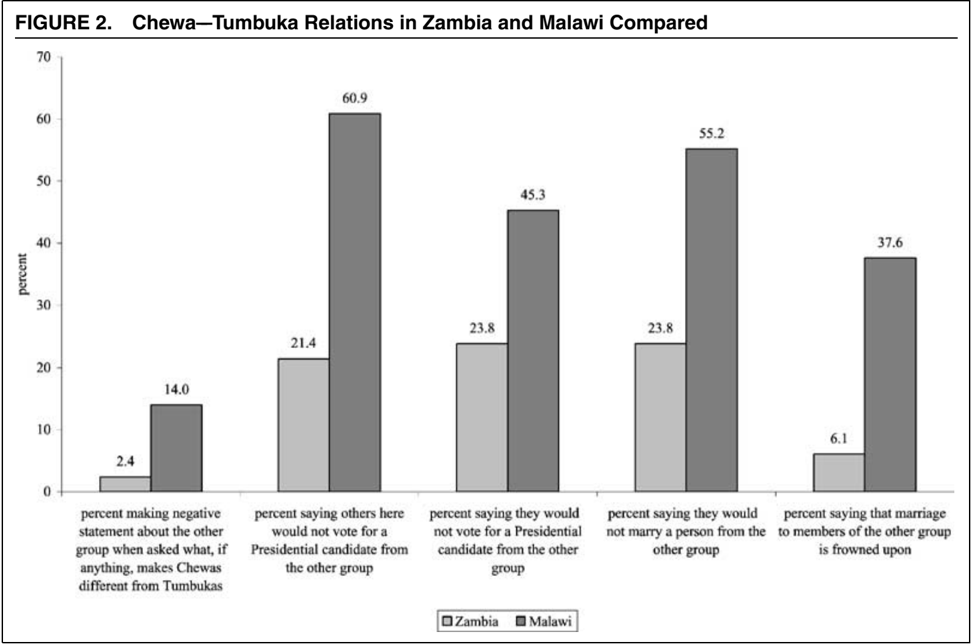
- Yet the cleavage was much more socially and politically salient in Malawi: 61% of Malawians versus 21% of Zambians said others in their village would be unwilling to vote for a candidate from the other group; 45% of Malawians versus 24% of Zambians said they themselves would not vote for such a candidate.
- On marriage, 55% of Malawians versus 24% of Zambians said they would not marry a member of the other group, and 38% of Malawians versus 6% of Zambians said intermarriage was frowned upon.
- The paper’s regressions find that the perceived number of cultural differences is not a significant predictor of attitudes in any of the four models, while country is strongly significant; the table notes sample sizes of 172, 175, 176, and 172.
## Methods
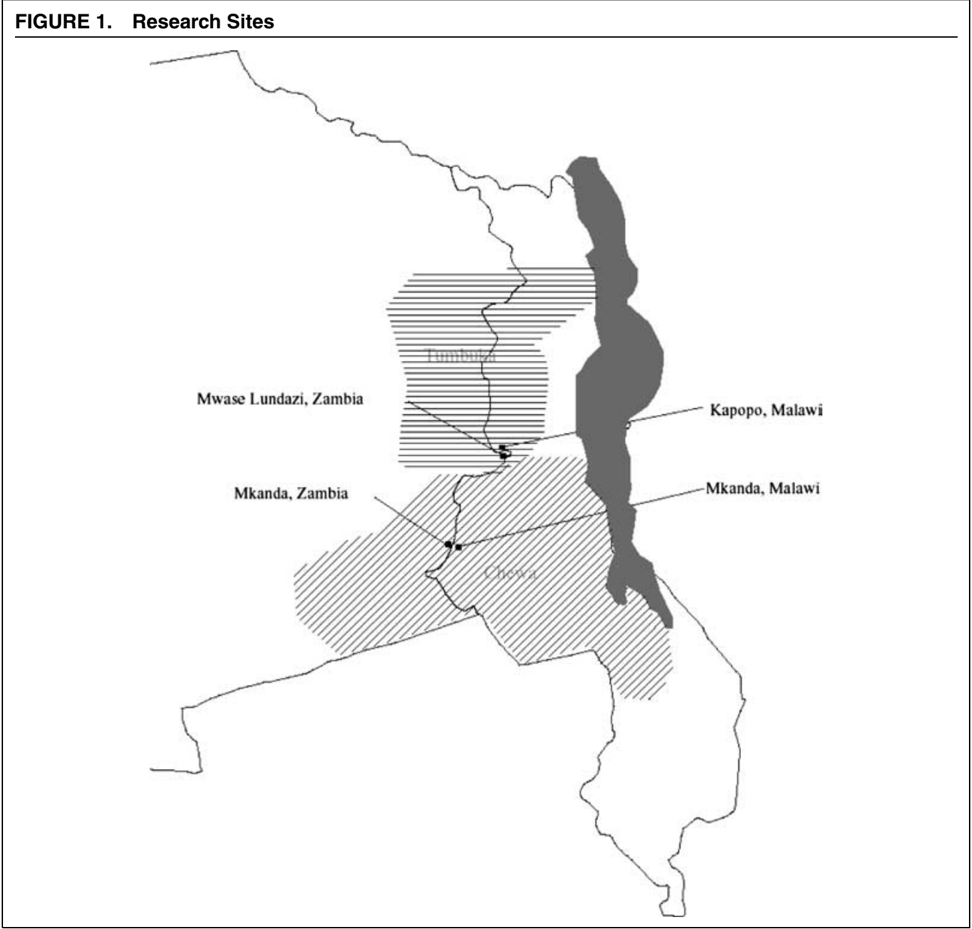
- Comparative natural-experiment design: the Zambia-Malawi border partitions Chewas and Tumbukas, who are otherwise culturally similar across sides of the border, allowing comparison of the same cleavage in different political settings.
- Original field survey in July-August 2001 in four villages directly across the border: two Chewa villages and two Tumbuka villages; 42 respondents in each Zambian village and 48 in each Malawian village, for a total sample of 180, selected by random stratified quota sampling from every third unrelated household.
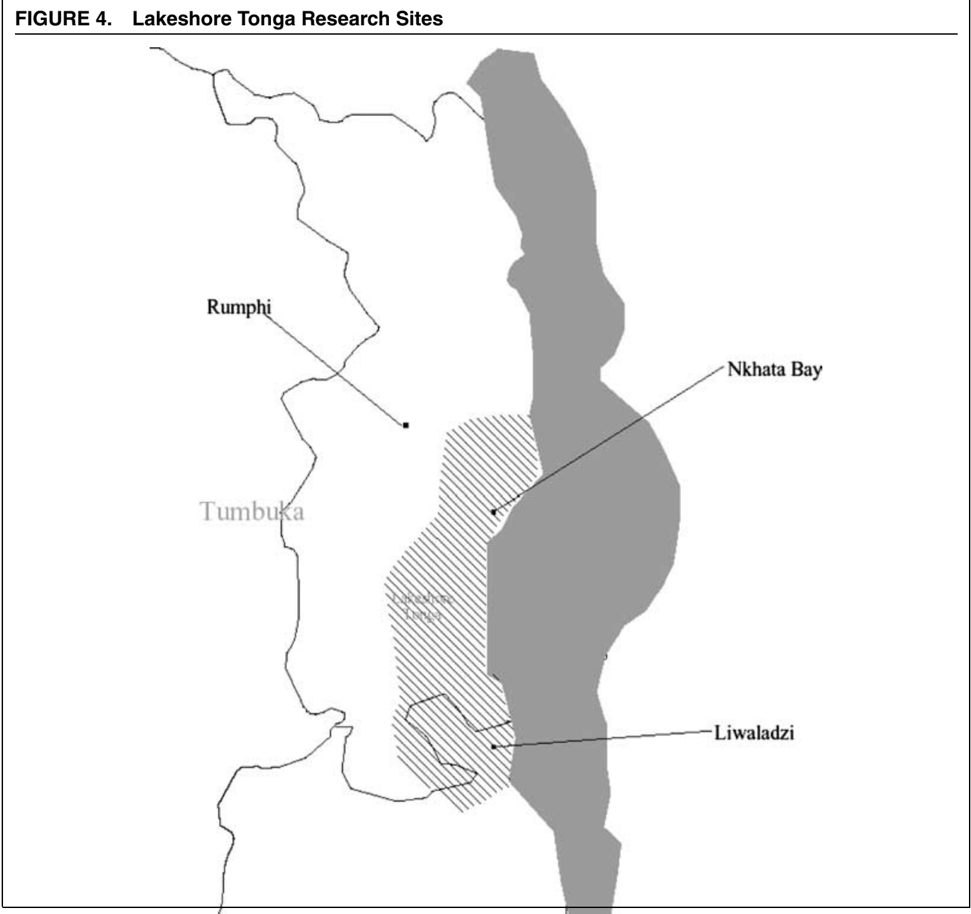
- Main analysis combines open-ended survey responses, descriptive comparisons, logit regressions controlling for tribal affiliation, gender, age, and the number of reported cultural differences, plus a second survey of 30 Lakeshore Tonga respondents to test whether an administrative boundary can create salience.
## Limitations
- Stated by the paper: the author notes that testing whether social divisions are products of political divisions would require time-series data on changes in political divisions, trust, and intermarriage, which are “currently unavailable.”
- Stated by the paper: the Lakeshore Tonga administrative-boundary test is described as “suggestive” because the sample is small.
- Evident from the text: the main survey is limited to four villages in one border region and relies on self-reported attitudes and a small, non-national sample, so generalization beyond the studied sites is not directly demonstrated.
Model-written summary. Check it against the paper before relying on it.
Integrity signals
Registry
Cites
Statistics
Figures
Verification
Claims the paper makes
0 Valid · 1 Not valid · 17 Not checked · 101 Own results and interpretations
A result the paper reports from its own data — it cites no other source for it, so there is none to check. The quote shows it is in the paper.
In the paper
“In fact, the modal Zambian response to our request for a list of differences between Chewas and Tumbukas was to emphasize that 'We are one' or 'We are united.'”
plain- Asserted: passes — The authors put it forward as true.
- Checkable: passes — It can be checked against evidence.
- Load-bearing: passes — The paper’s conclusions depend on it.
- Based: passes — The paper gives a reason why it holds.
A result the paper reports from its own data — it cites no other source for it, so there is none to check. The quote shows it is in the paper.
In the paper
“The most important finding, however, is that, controlling for all of these other factors, the most powerful determinant of a respondent's attitudes toward members of the other community is his or her physical- -and, it bears underscoring, from an historical perspective, entirely accidental- location on one side of the Zambia-Malawi border or the other.”
boostedstates a cause- Asserted: passes — The authors put it forward as true.
- Checkable: passes — It can be checked against evidence.
- Load-bearing: passes — The paper’s conclusions depend on it.
- Based: passes — The paper gives a reason why it holds.
A result the paper reports from its own data — it cites no other source for it, so there is none to check. The quote shows it is in the paper.
In the paper
“Malawian respondents are significantly less willing to vote for a presidential candidate from the other group and significantly less willing to marry across group lines than are their otherwise identical Zambian counterparts.”
plainstates an association- Asserted: passes — The authors put it forward as true.
- Checkable: passes — It can be checked against evidence.
- Load-bearing: passes — The paper’s conclusions depend on it.
- Based: passes — The paper gives a reason why it holds.
A result the paper reports from its own data — it cites no other source for it, so there is none to check. The quote shows it is in the paper.
In the paper
“Again and again, respondents in all four villages identified the same attributes as distinguishing members of the two communities.”
plain- Asserted: passes — The authors put it forward as true.
- Checkable: passes — It can be checked against evidence.
- Load-bearing: passes — The paper’s conclusions depend on it.
- Based: passes — The paper gives a reason why it holds.
A result the paper reports from its own data — it cites no other source for it, so there is none to check. The quote shows it is in the paper.
In the paper
“While the specific cultural practices that respondents mentioned varied somewhat from person to person, nearly every interviewee on both sides of the border (83% overall) was able to identify at least one attribute, tradition, or custom- -and often several- -that made Chewas and Tumbukas culturally different from one another.”
plain- Asserted: passes — The authors put it forward as true.
- Checkable: passes — It can be checked against evidence.
- Load-bearing: passes — The paper’s conclusions depend on it.
- Based: passes — The paper gives a reason why it holds.
66 more claims
Create a free account to see all 119 claims and every source verdict.
- It may state two separate claims as one. 42
- Probably not a substantial claim. 8
Citations
Cites
The clash of civilizations and the remaking of world order
(1997) · Long Range Planning · doi:10.1016/s0024-6301(97)80966-1 · Cited by 7,457
Political Order in Changing Societies
Huntington, S. P. (1970) · Verfassung in Recht und Übersee · doi:10.5771/0506-7286-1970-2-257 · Cited by 6,333
Kuper, L., & Horowitz, D. L. (1986) · Contemporary Sociology · doi:10.2307/2069338 · Cited by 4,869
Democracy in Plural Societies: A Comparative Exploration
Nagata, J., & Lijphart, A. (1979) · International Journal · doi:10.2307/40201796 · Cited by 2,255
Ethnic and Cultural Diversity by Country*
Fearon, J. D. (2003) · Journal of Economic Growth · doi:10.1023/a:1024419522867 · Cited by 1,829 · cited 1×
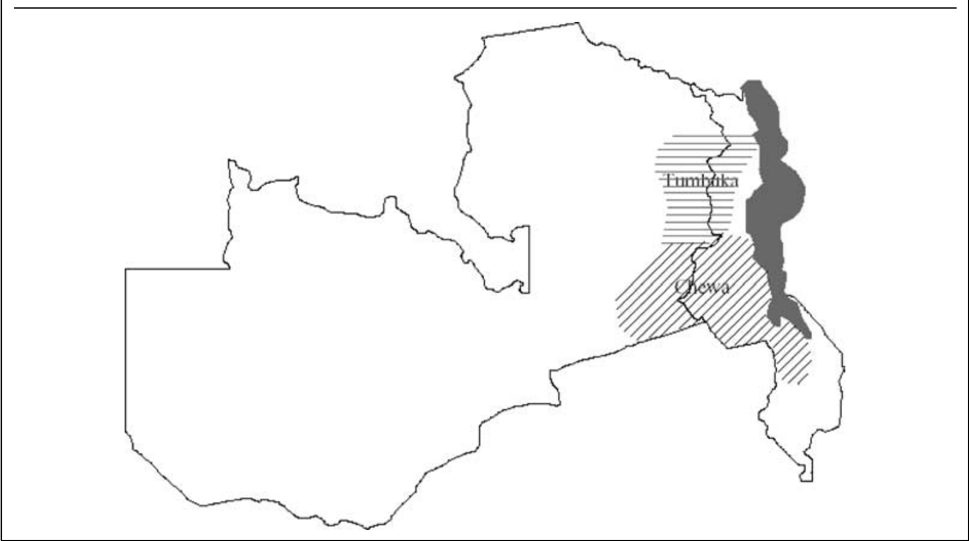
“As Figure 3 makes clear, the Chewa and Tumbuka communities are both large in Malawi (28% and 12% of the national population, respectively) but peripheral in Zambia (7% and 4%, respectively).16 Much more 16 Malawi’s figures come from Fearon 2003.”
BackgroundExplaining Interethnic Cooperation
Fearon, J. D., & Laitin, D. D. (1996) · American Political Science Review · doi:10.2307/2945838 · Cited by 1,606
Ethnologue: Languages of the World
(2015) · Choice Reviews Online · doi:10.5860/choice.192005 · Cited by 1,176
Social Mobilization and Political Development
Deutsch, K. W. (1961) · American Political Science Review · doi:10.1017/s0003055400125134 · Cited by 1,077
Why Ethnic Parties Succeed: Patronage and Ethnic Head Counts in India
Chandra, K. (2004) · Cambridge University Press eBooks · doi:10.1017/9781108573481 · Cited by 1,064
Horowitz, D. L. (2001) · University of California Press eBooks · doi:10.1525/9780520342057 · Cited by 925
Research works printed but not linked: 6
- Vail, Leroy, and Landeg White. 1989. 'Tribalism in the Political History of Malawi.' In The Creation of Tribalism in Southern Africa , ed. Leroy Vail. Berkeley and Los Angeles: University of California Press, 151- -92.
- Lijphart, Arend. 1977. DemocracyinPlural Societies: A Comparative Exploration . New Haven, CT: Yale University Press.
- Henkel, Reinhard. 1985. 'Mission Stations in Zambia: Their Location and Diffusion Patterns.' Zambia Geographical Journal 35: 1- -18.
- Hobsbawm, Eric. 1996. 'Are all Tongues Equal?' In Living as Equals , ed. Paul Barker. New York: Oxford University Press, 85- 98.
- Bratton, Michael. 1994. 'Economic Crisis and Political Realignment in Zambia.' In Economic Change and Political Liberalization in Sub-Saharan Africa , ed. Jennifer A. Widner. Baltimore: Johns Hopkins University Press, 101- -28.
- Lipset, Seymour Martin, and Stein Rokkan. 1967. 'Cleavage Structures, Party Systems and Voter Alignments: An Introduction.' In Party Systems and Voter Alignments: Cross-National Perspectives , ed. Seymour M. Lipset and Stein Rokkan. New York: Free Press, 1- -64.
Cited by
Items 801–900 of 948
Conclusions, Reflections, and Avenues for Future Research
Owolabi, O. P. (2023) · Oxford University Press eBooks · doi:10.1093/oso/9780197673027.003.0008
Owolabi, O. P. (2023) · Oxford University Press eBooks · doi:10.1093/oso/9780197673027.002.0004
Comparing Portuguese Forced Settlement and Colonial Occupation: Cape Verde and Guinea-Bissau
Owolabi, O. P. (2023) · Oxford University Press eBooks · doi:10.1093/oso/9780197673027.003.0006
Statistical Results Using Alternative Measures of Postcolonial Democracy
Owolabi, O. P. (2023) · Oxford University Press eBooks · doi:10.1093/oso/9780197673027.005.0003
Owolabi, O. P. (2023) · Oxford University Press eBooks · doi:10.1093/oso/9780197673027.002.0008
Former Colonies in OLS Data Models
Owolabi, O. P. (2023) · Oxford University Press eBooks · doi:10.1093/oso/9780197673027.005.0001
Owolabi, O. P. (2023) · Oxford University Press eBooks · doi:10.1093/oso/9780197673027.003.0004
Owolabi, O. P. (2023) · Oxford University Press eBooks · doi:10.1093/oso/9780197673027.003.0003
Advance Praise for Ruling Emancipated Slaves and Indigenous Subjects
Owolabi, O. P. (2023) · Oxford University Press eBooks · doi:10.1093/oso/9780197673027.002.0001
Data Sources for Key Variables
Owolabi, O. P. (2023) · Oxford University Press eBooks · doi:10.1093/oso/9780197673027.005.0002
A Historical Overview of Forced Settlement and Colonial Occupation in the Global South
Owolabi, O. P. (2023) · Oxford University Press eBooks · doi:10.1093/oso/9780197673027.003.0002
Comparing British Forced Settlement and Colonial Occupation: Jamaica and Sierra Leone
Owolabi, O. P. (2023) · Oxford University Press eBooks · doi:10.1093/oso/9780197673027.003.0005
Owolabi, O. P. (2023) · Oxford University Press eBooks · doi:10.1093/oso/9780197673027.003.0001
Owolabi, O. P. (2023) · Oxford University Press eBooks · doi:10.1093/oso/9780197673027.002.0003
Animasawun, G. (2014) · IBADAN JOURNAL OF THE SOCIAL SCIENCES · doi:10.36108/ijss/4102.21.0120
“This connects with the view in most academic literature as summed up by Posner (2004:259) that: "The mere presence of cultural differences cannot possibly be a sufficient condition for the emergence of political and social strife for there are far more cleavages in the world than there are…”
BackgroundCONFLICT OF INTEREST, POLICY EFFECTIVENESS, AND ELECTORAL SUPPORT: EVIDENCE FROM A SURVEY EXPERIMENT
Sedashov, E., & Krikunov, K. A. (2023) · Вестник Пермского университета Политология · doi:10.17072/2218-1067-2023-1-30-38
Power mismatch and civil conflict: an empirical investigation
Morelli, M., Ogliari, L., & Hong, L. (2023) · Economic Policy · doi:10.1093/epolic/eiad030
Ethnic, Linguistic, Religious, and Regional Minority Participation and Representation in Africa
MacLean, L. M., & Harris, K. A. (2023) · doi:10.1093/obo/9780199756223-0368
Nkansah, G. B. (2023) · CUB Ph.D. Dissertations (Corvinus University of Budapest) · doi:10.14267/phd.2023059
Peace of Mind: Examining Election-Induced Anxiety among Minorities in IndiaPreprint
Jafar, J., & Singh, T. P. (2023) · OSF Preprints (OSF Preprints) · doi:10.31219/osf.io/hpu5y
Divergent Trajectories across Rebel Victories
Liu, S. (2024) · Oxford University Press eBooks · doi:10.1093/oso/9780197696705.003.0006
Liu, S. (2024) · Oxford University Press eBooks · doi:10.1093/oso/9780197696705.005.0003
State-building through Rebel–Civilian Ties
Liu, S. (2024) · Oxford University Press eBooks · doi:10.1093/oso/9780197696705.003.0002
The Liberia Civil War (1989–1996)
Liu, S. (2024) · Oxford University Press eBooks · doi:10.1093/oso/9780197696705.003.0005
Liu, S. (2024) · Oxford University Press eBooks · doi:10.1093/oso/9780197696705.003.0003
Liu, S. (2024) · Oxford University Press eBooks · doi:10.1093/oso/9780197696705.003.0007
(2024) · Oxford University Press eBooks · doi:10.1093/oso/9780197696705.002.0010
The Zimbabwe Liberation War (1972–1979)
Liu, S. (2024) · Oxford University Press eBooks · doi:10.1093/oso/9780197696705.003.0004
Liu, S. (2024) · Oxford University Press eBooks · doi:10.1093/oso/9780197696705.005.0002
(2024) · Oxford University Press eBooks · doi:10.1093/oso/9780197696705.002.0003
(2024) · Oxford University Press eBooks · doi:10.1093/oso/9780197696705.002.0007
(2024) · Oxford University Press eBooks · doi:10.1093/oso/9780197696705.002.0006
Liu, S. (2024) · Oxford University Press eBooks · doi:10.1093/oso/9780197696705.005.0001 · Cited by 2
Bonding, Bridging, & Bypassing: Understanding Ethnic Politics in Diverse Societies
9780197743980, & Fox, C. A. (2024) · doi:10.1093/oso/9780197743959.001.0001 · Cited by 1
Fox, C. A. (2024) · Oxford University Press eBooks · doi:10.1093/oso/9780197743959.003.0008
(2024) · Oxford University Press eBooks · doi:10.1093/oso/9780197696705.002.0009
Fox, C. A. (2024) · Oxford University Press eBooks · doi:10.1093/oso/9780197743959.002.0009
Fox, C. A. (2024) · Oxford University Press eBooks · doi:10.1093/oso/9780197743959.003.0006
Fox, C. A. (2024) · Oxford University Press eBooks · doi:10.1093/oso/9780197743959.003.0010
Fox, C. A. (2024) · Oxford University Press eBooks · doi:10.1093/oso/9780197743959.005.0003
Fox, C. A. (2024) · Oxford University Press eBooks · doi:10.1093/oso/9780197743959.003.0007
Fox, C. A. (2024) · Oxford University Press eBooks · doi:10.1093/oso/9780197743959.003.0003
Fox, C. A. (2024) · Oxford University Press eBooks · doi:10.1093/oso/9780197743959.002.0004
Fox, C. A. (2024) · Oxford University Press eBooks · doi:10.1093/oso/9780197743959.002.0003
Fox, C. A. (2024) · Oxford University Press eBooks · doi:10.1093/oso/9780197743959.003.0005
Fox, C. A. (2024) · Oxford University Press eBooks · doi:10.1093/oso/9780197743959.005.0001
Religious Polarization in Indonesia
Fox, C. A. (2024) · Oxford University Press eBooks · doi:10.1093/oso/9780197743959.003.0009
(2024) · Oxford University Press eBooks · doi:10.1093/oso/9780197696705.002.0004
Fox, C. A. (2024) · Oxford University Press eBooks · doi:10.1093/oso/9780197743959.002.0007
Glossary of Indonesian Political Parties
Fox, C. A. (2024) · Oxford University Press eBooks · doi:10.1093/oso/9780197743959.002.0008
Fox, C. A. (2024) · Oxford University Press eBooks · doi:10.1093/oso/9780197743959.005.0002
Liu, S. (2024) · Oxford University Press eBooks · doi:10.1093/oso/9780197696705.003.0001
Fox, C. A. (2024) · Oxford University Press eBooks · doi:10.1093/oso/9780197743959.003.0002
Fox, C. A. (2024) · Oxford University Press eBooks · doi:10.1093/oso/9780197743959.003.0004
Fox, C. A. (2024) · Oxford University Press eBooks · doi:10.1093/oso/9780197743959.003.0001
Jung, J. (2024) · Journal for the Scientific Study of Religion · doi:10.1111/jssr.12909
Mayik, J. (2024) · PDXScholar (Portland State University) · doi:10.15760/etd.3718 · Cited by 3
Rovný, J. (2024) · Oxford University Press eBooks · doi:10.1093/9780198906742.003.0008
Rovný, J. (2024) · Oxford University Press eBooks · doi:10.1093/9780198906742.003.0016
Permanent or Provisional? The Sudeten Germans
Rovný, J. (2024) · Oxford University Press eBooks · doi:10.1093/9780198906742.003.0011
Rovný, J. (2024) · Oxford University Press eBooks · doi:10.1093/9780198906742.005.0008
Rovný, J. (2024) · Oxford University Press eBooks · doi:10.1093/9780198906742.005.0007
Rovný, J. (2024) · Oxford University Press eBooks · doi:10.1093/9780198906742.002.0006
Rovný, J. (2024) · Oxford University Press eBooks · doi:10.1093/9780198906742.002.0007
Rovný, J. (2024) · Oxford University Press eBooks · doi:10.1093/9780198906742.003.0006
Major Minority: The Estonian Russians
Rovný, J. (2024) · Oxford University Press eBooks · doi:10.1093/9780198906742.003.0013 · Cited by 1
Rovný, J. (2024) · Oxford University Press eBooks · doi:10.1093/9780198906742.005.0005
Rovný, J. (2024) · Oxford University Press eBooks · doi:10.1093/9780198906742.005.0009
Ethnicity and Formation of Political Competition
Rovný, J. (2024) · Oxford University Press eBooks · doi:10.1093/9780198906742.005.0004
Rovný, J. (2024) · Oxford University Press eBooks · doi:10.1093/9780198906742.005.0002
Rovný, J. (2024) · Oxford University Press eBooks · doi:10.1093/9780198906742.005.0001
Rovný, J. (2024) · Oxford University Press eBooks · doi:10.1093/9780198906742.002.0005
Democratic Denizens: The Slovak Hungarians
Rovný, J. (2024) · Oxford University Press eBooks · doi:10.1093/9780198906742.003.0012
Ethnicity and Ideology: A Theory
Rovný, J. (2024) · Oxford University Press eBooks · doi:10.1093/9780198906742.003.0003
Rovný, J. (2024) · Oxford University Press eBooks · doi:10.1093/9780198906742.005.0003
Ethnicity and Democratic Resilience
Rovný, J. (2024) · Oxford University Press eBooks · doi:10.1093/9780198906742.003.0009
Rovný, J. (2024) · Oxford University Press eBooks · doi:10.1093/9780198906742.003.0001
Ethnicity and the Formation of Political Competition
Rovný, J. (2024) · Oxford University Press eBooks · doi:10.1093/9780198906742.003.0007
Rovný, J. (2024) · Oxford University Press eBooks · doi:10.1093/9780198906742.003.0015
Ethnicity and Democratic Resilience Individual Analyses
Rovný, J. (2024) · Oxford University Press eBooks · doi:10.1093/9780198906742.005.0006
Irgil, E. (2024) · Palgrave studies in otherness and communication. · doi:10.1007/978-3-031-65084-0_15
Humphreys, A. R. C., & Suganami, H. (2024) · Oxford University Press eBooks · doi:10.1093/oso/9780198823582.002.0006
Humphreys, A. R. C., & Suganami, H. (2024) · Oxford University Press eBooks · doi:10.1093/oso/9780198823582.003.0006
Humphreys, A. R. C., & Suganami, H. (2024) · Oxford University Press eBooks · doi:10.1093/oso/9780198823582.003.0005
Hume and the Regularity View of Causation
Humphreys, A. R. C., & Suganami, H. (2024) · Oxford University Press eBooks · doi:10.1093/oso/9780198823582.003.0002
Humphreys, A. R. C., & Suganami, H. (2024) · Oxford University Press eBooks · doi:10.1093/oso/9780198823582.003.0010
Humphreys, A. R. C., & Suganami, H. (2024) · Oxford University Press eBooks · doi:10.1093/oso/9780198823582.003.0001
Beyond Causal Realism and Idealism: Van Fraassen and the Possibility of Agnosticism
Humphreys, A. R. C., & Suganami, H. (2024) · Oxford University Press eBooks · doi:10.1093/oso/9780198823582.003.0004
Bhaskar, Causal Realism, and the Conduct of Causal Inquiry
Humphreys, A. R. C., & Suganami, H. (2024) · Oxford University Press eBooks · doi:10.1093/oso/9780198823582.003.0003
Humphreys, A. R. C., & Suganami, H. (2024) · Oxford University Press eBooks · doi:10.1093/oso/9780198823582.003.0009
Causal Statements and Statements of Necessary and/or Sufficient Conditions
Humphreys, A. R. C., & Suganami, H. (2024) · Oxford University Press eBooks · doi:10.1093/oso/9780198823582.005.0001
Humphreys, A. R. C., & Suganami, H. (2024) · Oxford University Press eBooks · doi:10.1093/oso/9780198823582.003.0007
Humphreys, A. R. C., & Suganami, H. (2024) · Oxford University Press eBooks · doi:10.1093/oso/9780198823582.003.0008
Humphreys, A. R. C., & Suganami, H. (2024) · Oxford University Press eBooks · doi:10.1093/oso/9780198823582.002.0003
The Religious Landscape of Malawi and Prospects for Covenantal Pluralism
Tembo, D. (2024) · The Review of Faith & International Affairs · doi:10.1080/15570274.2024.2414583
“However, there are negative attitudes towards individuals from different religious and ethnic backgrounds (Posner 2004).”
Violence as a Signal in Electoral DemocracyPreprint
Shinali, T., Bhattacharya, S., & Mukherjee, A. (2024) · SSRN Electronic Journal · doi:10.2139/ssrn.5064373
‘We Are Here’: The Lhomwe Cultural Revival
Robinson, A. L. (2024) · Oxford University Press eBooks · doi:10.1093/oso/9780198909712.003.0006
Robinson, A. L. (2024) · Oxford University Press eBooks · doi:10.1093/oso/9780198909712.002.0008
Group-Based Pride and the Adoption of Ethnic Markers
Robinson, A. L. (2024) · Oxford University Press eBooks · doi:10.1093/oso/9780198909712.003.0007
Robinson, A. L. (2024) · Oxford University Press eBooks · doi:10.1093/oso/9780198909712.003.0009
Metadata
- Authors
- POSNER, D. N.
- Affiliations
- University of California, Los Angeles (US)
- Corresponding author
- POSNER, DANIEL N.
- ORCID
- POSNER, DANIEL N.
- Venue
- American Political Science Review
- Publisher
- Cambridge University Press (CUP)
- Published
- 2004-11
- Volume
- 98
- Issue
- 4
- Pages
- 529-545
- ISSN
- 0003-0554 (ISSN-L)
- 1537-5943
- OpenAlex
- W2169278049
- Cited by
- 940
- References
- 54
- Citations by year
- 2026: 22 · 2025: 22 · 2024: 117 · 2023: 45 · 2022: 40 · 2021: 28 · 2020: 94 · 2019: 34 · 2018: 72 · 2017: 45 · 2016: 49 · 2015: 46 · 2014: 58 · 2013: 45 · 2012: 32
- FWCI
- 79.46
- Type
- journal article
- Language
- en
- Open access
- green
- www.escholarship.org
- Locations
- American Political Science Review (publishedVersion)
- eScholarship (California Digital Library) (submittedVersion)
- RePEc: Research Papers in Economics (submittedVersion)
- Topics
- Social Sciences › Sociology and Political Science › Political Conflict and Governance
- Social Sciences › Sociology and Political Science › African Studies and Ethnography
- Social Sciences › Political Science and International Relations › Electoral Systems and Political Participation
- Keywords
- cultural cleavages, political salience, Chewa, Tumbuka, ethnic politics, ethnic group size, political coalition building, ethnic mobilization
About these checks
Registry, retraction, Cites and statistics results are computed, not judged, with one exception: a printed reference that no index lists is read once by a model before it counts as a citation error. Claims are extracted by a model and kept only when their quote appears verbatim in the text; each cited source is then checked, with a model’s help, for whether it says what the claim relies on. Those verdicts can be wrong — read the claim’s quote and the cited source before relying on one.
A language model drew the claims from the paper on 2026-10-11, under version 3 of the claim definition (model deepseek-v4.1-flash, prompt extract-v3).
A second model labelled each claim on 2026-10-11 (model jev-1.13-20260917, definition revision gold-guideline-v0.2).
Statistics and arithmetic are recomputed, not judged.
Confidence bands are shown only for fields calibrated on our annotated test set. None is calibrated yet, so no band is shown.
What counts as a claim ›How we measure confidence ›How we check this ›
Are you an author, or do you see a problem with this page? Request a review
Data sources
Bibliographic data: Semantic Scholar, OpenAlex, Crossref.
Contains information from the Semantic Scholar Academic Graph Datasets, made available under the ODC Attribution License (ODC-BY 1.0).
Semantic Scholar’s data is described in: Kinney, R., et al. (2023). The Semantic Scholar Open Data Platform. arXiv:2301.10140.
