

The Political Salience of Cultural Difference: Why Chewas and Tumbukas Are Allies in Zambia and Adversaries in Malawi
Open accessThe DOI matches its Crossref record; 52 of the 54 references it cites were found in a registry or an index, and 1 are not checked yet; none of the 26 sources its claims cite is checked for support yet.
Abstract
This paper explores the conditions under which cultural cleavages become politically salient. It does so by taking advantage of the natural experiment afforded by the division of the Chewa and Tumbuka peoples by the border between Zambia and Malawi. I document that, while the objective cultural differences between Chewas and Tumbukas on both sides of the border are identical, the political salience of the division between these communities is altogether different. I argue that this difference stems from the different sizes of the Chewa and Tumbuka communities in each country relative to each country's national political arena. In Malawi, Chewas and Tumbukas are each large groups vis-à-vis the country as a whole and, thus, serve as viable bases for political coalition-building. In Zambia, Chewas and Tumbukas are small relative to the country as a whole and, thus, not useful to mobilize as bases of political support. The analysis suggests that the political salience of a cultural cleavage depends not on the nature of the cleavage itself (since it is identical in both countries) but on the sizes of the groups it defines and whether or not they will be useful vehicles for political competition.
Checked 2026-11-22 · 1 reference not checked yet
Overview
CoChat Summary
## TL;DR
Posner argues that a cultural cleavage becomes politically and socially salient when the groups it defines are large enough to be useful coalitional building blocks in a given political arena. Using survey evidence from Chewa and Tumbuka villages in Zambia and Malawi, he shows that the same cultural differences are politically and socially much more salient in Malawi than in Zambia because of differences in group size relative to the national arena.
## Key findings
- In the border-area survey, respondents in all four villages identified the same Chewa-Tumbuka cultural differences; 83% overall could name at least one difference, with an average of 1.36 differences mentioned, and the average among those naming at least one was nearly identical across borders (1.66 in Zambia, 1.70 in Malawi).
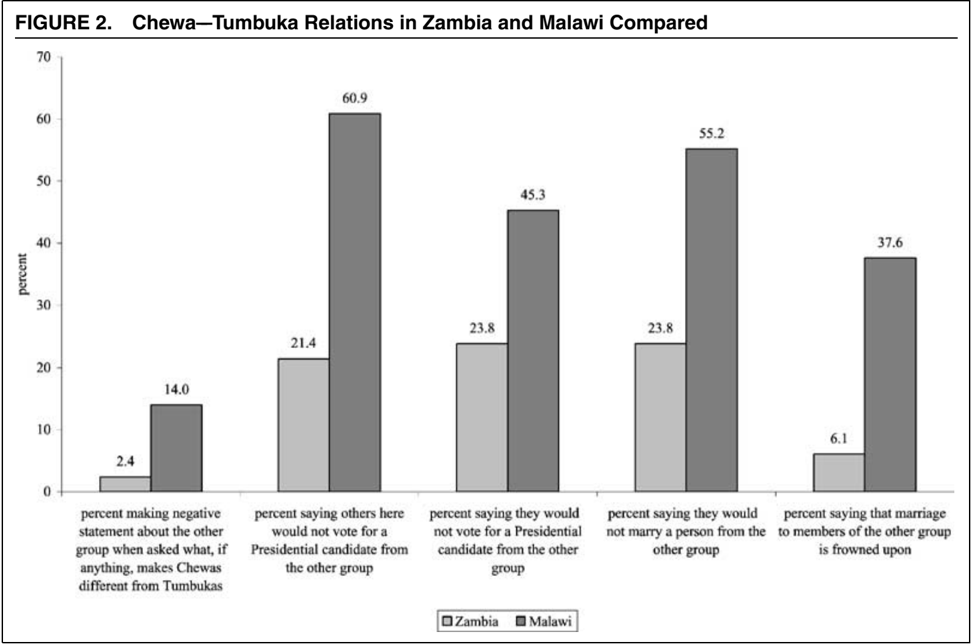
- Yet the cleavage was much more socially and politically salient in Malawi: 61% of Malawians versus 21% of Zambians said others in their village would be unwilling to vote for a candidate from the other group; 45% of Malawians versus 24% of Zambians said they themselves would not vote for such a candidate.
- On marriage, 55% of Malawians versus 24% of Zambians said they would not marry a member of the other group, and 38% of Malawians versus 6% of Zambians said intermarriage was frowned upon.
- The paper’s regressions find that the perceived number of cultural differences is not a significant predictor of attitudes in any of the four models, while country is strongly significant; the table notes sample sizes of 172, 175, 176, and 172.
## Methods
- Comparative natural-experiment design: the Zambia-Malawi border partitions Chewas and Tumbukas, who are otherwise culturally similar across sides of the border, allowing comparison of the same cleavage in different political settings.
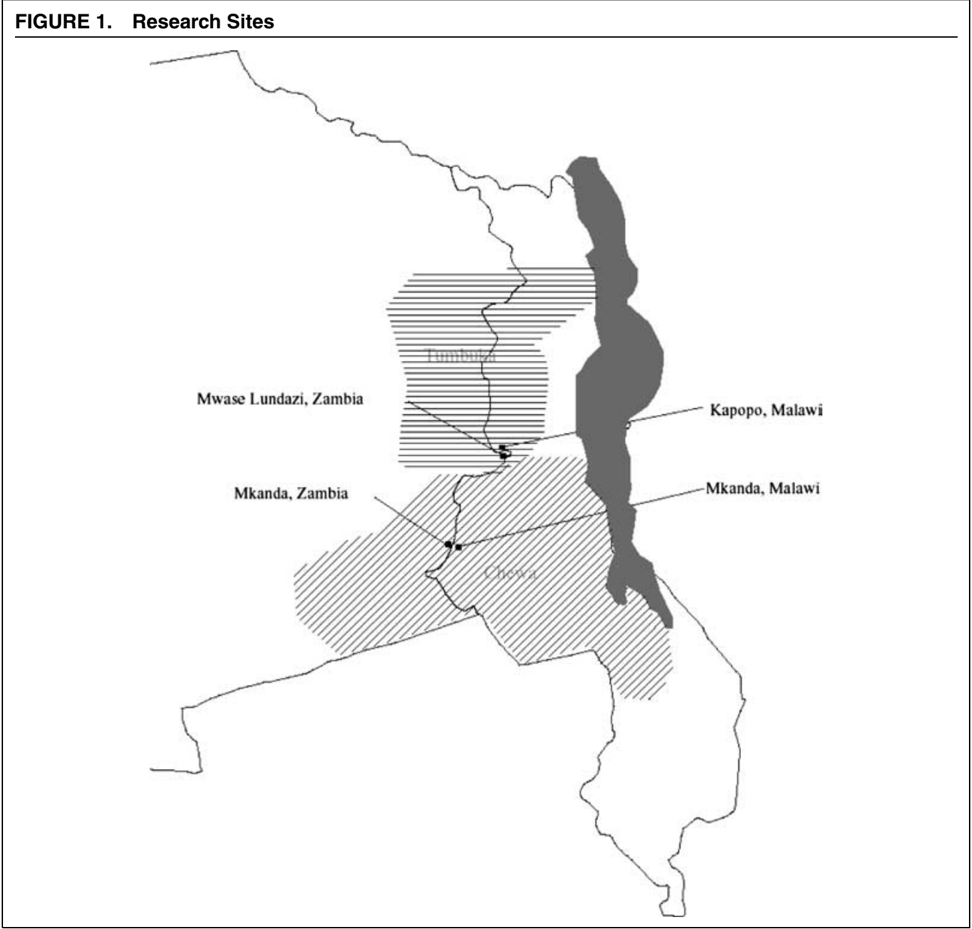
- Original field survey in July-August 2001 in four villages directly across the border: two Chewa villages and two Tumbuka villages; 42 respondents in each Zambian village and 48 in each Malawian village, for a total sample of 180, selected by random stratified quota sampling from every third unrelated household.
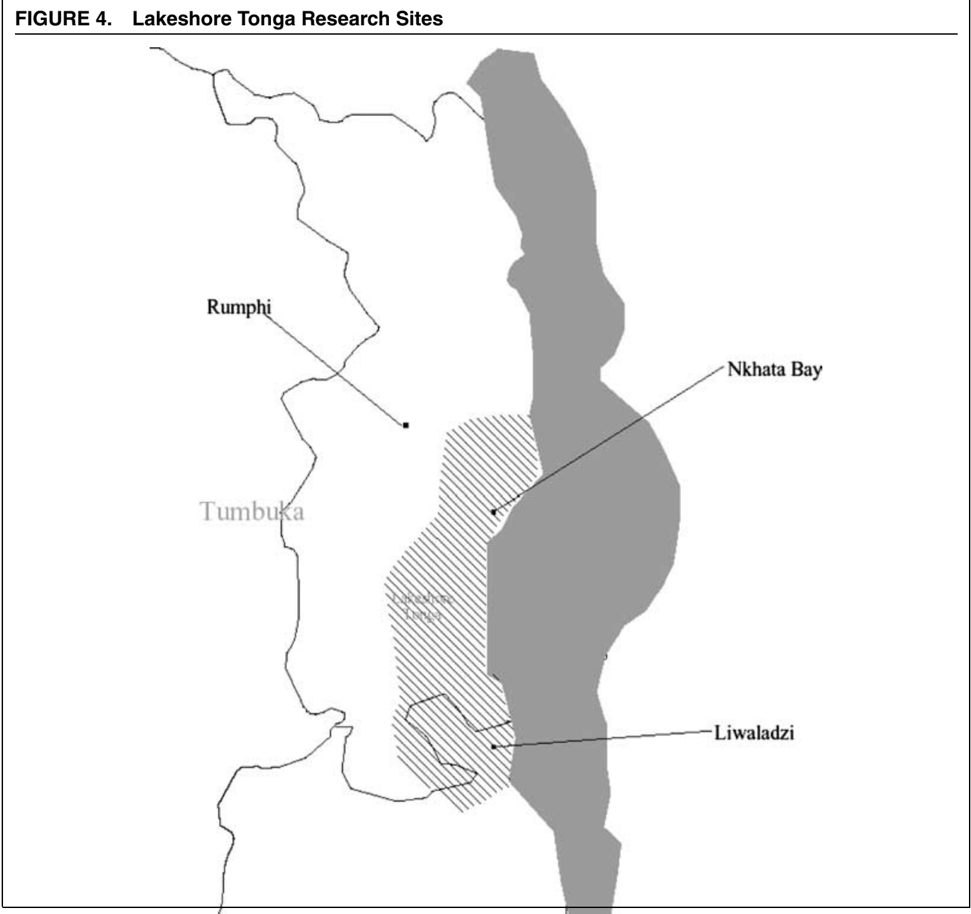
- Main analysis combines open-ended survey responses, descriptive comparisons, logit regressions controlling for tribal affiliation, gender, age, and the number of reported cultural differences, plus a second survey of 30 Lakeshore Tonga respondents to test whether an administrative boundary can create salience.
## Limitations
- Stated by the paper: the author notes that testing whether social divisions are products of political divisions would require time-series data on changes in political divisions, trust, and intermarriage, which are “currently unavailable.”
- Stated by the paper: the Lakeshore Tonga administrative-boundary test is described as “suggestive” because the sample is small.
- Evident from the text: the main survey is limited to four villages in one border region and relies on self-reported attitudes and a small, non-national sample, so generalization beyond the studied sites is not directly demonstrated.
Model-written summary. Check it against the paper before relying on it.
Integrity signals
Registry
Cites
Statistics
Figures
Verification
Claims the paper makes
0 Valid · 1 Not valid · 17 Not checked · 101 Own results and interpretations
A result the paper reports from its own data — it cites no other source for it, so there is none to check. The quote shows it is in the paper.
In the paper
“In fact, the modal Zambian response to our request for a list of differences between Chewas and Tumbukas was to emphasize that 'We are one' or 'We are united.'”
plain- Asserted: passes — The authors put it forward as true.
- Checkable: passes — It can be checked against evidence.
- Load-bearing: passes — The paper’s conclusions depend on it.
- Based: passes — The paper gives a reason why it holds.
A result the paper reports from its own data — it cites no other source for it, so there is none to check. The quote shows it is in the paper.
In the paper
“The most important finding, however, is that, controlling for all of these other factors, the most powerful determinant of a respondent's attitudes toward members of the other community is his or her physical- -and, it bears underscoring, from an historical perspective, entirely accidental- location on one side of the Zambia-Malawi border or the other.”
boostedstates a cause- Asserted: passes — The authors put it forward as true.
- Checkable: passes — It can be checked against evidence.
- Load-bearing: passes — The paper’s conclusions depend on it.
- Based: passes — The paper gives a reason why it holds.
A result the paper reports from its own data — it cites no other source for it, so there is none to check. The quote shows it is in the paper.
In the paper
“Malawian respondents are significantly less willing to vote for a presidential candidate from the other group and significantly less willing to marry across group lines than are their otherwise identical Zambian counterparts.”
plainstates an association- Asserted: passes — The authors put it forward as true.
- Checkable: passes — It can be checked against evidence.
- Load-bearing: passes — The paper’s conclusions depend on it.
- Based: passes — The paper gives a reason why it holds.
A result the paper reports from its own data — it cites no other source for it, so there is none to check. The quote shows it is in the paper.
In the paper
“Again and again, respondents in all four villages identified the same attributes as distinguishing members of the two communities.”
plain- Asserted: passes — The authors put it forward as true.
- Checkable: passes — It can be checked against evidence.
- Load-bearing: passes — The paper’s conclusions depend on it.
- Based: passes — The paper gives a reason why it holds.
A result the paper reports from its own data — it cites no other source for it, so there is none to check. The quote shows it is in the paper.
In the paper
“While the specific cultural practices that respondents mentioned varied somewhat from person to person, nearly every interviewee on both sides of the border (83% overall) was able to identify at least one attribute, tradition, or custom- -and often several- -that made Chewas and Tumbukas culturally different from one another.”
plain- Asserted: passes — The authors put it forward as true.
- Checkable: passes — It can be checked against evidence.
- Load-bearing: passes — The paper’s conclusions depend on it.
- Based: passes — The paper gives a reason why it holds.
66 more claims
Create a free account to see all 119 claims and every source verdict.
- It may state two separate claims as one. 42
- Probably not a substantial claim. 8
Citations
Cites
The clash of civilizations and the remaking of world order
(1997) · Long Range Planning · doi:10.1016/s0024-6301(97)80966-1 · Cited by 7,457
Political Order in Changing Societies
Huntington, S. P. (1970) · Verfassung in Recht und Übersee · doi:10.5771/0506-7286-1970-2-257 · Cited by 6,333
Kuper, L., & Horowitz, D. L. (1986) · Contemporary Sociology · doi:10.2307/2069338 · Cited by 4,869
Democracy in Plural Societies: A Comparative Exploration
Nagata, J., & Lijphart, A. (1979) · International Journal · doi:10.2307/40201796 · Cited by 2,255
Ethnic and Cultural Diversity by Country*
Fearon, J. D. (2003) · Journal of Economic Growth · doi:10.1023/a:1024419522867 · Cited by 1,829 · cited 1×
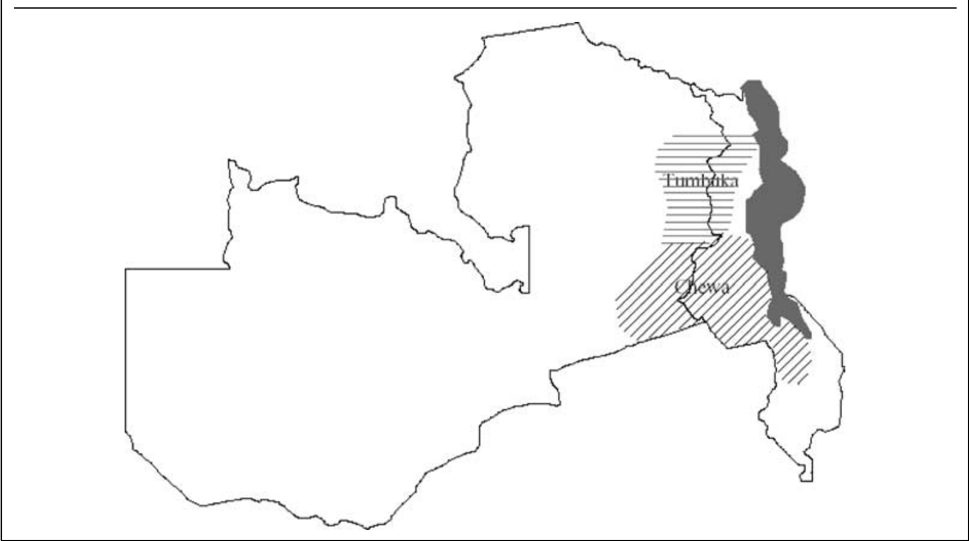
“As Figure 3 makes clear, the Chewa and Tumbuka communities are both large in Malawi (28% and 12% of the national population, respectively) but peripheral in Zambia (7% and 4%, respectively).16 Much more 16 Malawi’s figures come from Fearon 2003.”
BackgroundExplaining Interethnic Cooperation
Fearon, J. D., & Laitin, D. D. (1996) · American Political Science Review · doi:10.2307/2945838 · Cited by 1,606
Ethnologue: Languages of the World
(2015) · Choice Reviews Online · doi:10.5860/choice.192005 · Cited by 1,176
Social Mobilization and Political Development
Deutsch, K. W. (1961) · American Political Science Review · doi:10.1017/s0003055400125134 · Cited by 1,077
Why Ethnic Parties Succeed: Patronage and Ethnic Head Counts in India
Chandra, K. (2004) · Cambridge University Press eBooks · doi:10.1017/9781108573481 · Cited by 1,064
Horowitz, D. L. (2001) · University of California Press eBooks · doi:10.1525/9780520342057 · Cited by 925
Research works printed but not linked: 6
- Vail, Leroy, and Landeg White. 1989. 'Tribalism in the Political History of Malawi.' In The Creation of Tribalism in Southern Africa , ed. Leroy Vail. Berkeley and Los Angeles: University of California Press, 151- -92.
- Lijphart, Arend. 1977. DemocracyinPlural Societies: A Comparative Exploration . New Haven, CT: Yale University Press.
- Henkel, Reinhard. 1985. 'Mission Stations in Zambia: Their Location and Diffusion Patterns.' Zambia Geographical Journal 35: 1- -18.
- Hobsbawm, Eric. 1996. 'Are all Tongues Equal?' In Living as Equals , ed. Paul Barker. New York: Oxford University Press, 85- 98.
- Bratton, Michael. 1994. 'Economic Crisis and Political Realignment in Zambia.' In Economic Change and Political Liberalization in Sub-Saharan Africa , ed. Jennifer A. Widner. Baltimore: Johns Hopkins University Press, 101- -28.
- Lipset, Seymour Martin, and Stein Rokkan. 1967. 'Cleavage Structures, Party Systems and Voter Alignments: An Introduction.' In Party Systems and Voter Alignments: Cross-National Perspectives , ed. Seymour M. Lipset and Stein Rokkan. New York: Free Press, 1- -64.
Cited by
Items 401–500 of 948
Ethnicity and Conflict: The Northern Ireland Troubles
McBride, I. (2023) · Journal of British Studies · doi:10.1017/jbr.2023.11 · Cited by 20
Ethnoconfessional Nationalism in the Balkans: Analysis, Manifestations and Management
Bardos, G. N. (2013) · doi:10.7916/d8zp4d94 · Cited by 5
Langer, A., & Stewart, F. (2015) · World Bank, Washington, DC eBooks · doi:10.1596/22514 · Cited by 11
“Consequently, the emphasis on differences within such an alliance are minimized, and those with outsiders are emphasized (see Posner, 2004). fundamentally unjust, as people suffer or are privileged simply because of the group to which they belong, rather than their individual merit or efforts.”
BackgroundMicrodynamics of War-to-Peace Transitions: Evidence from Burundi
Samii, C. (2011) · doi:10.7916/d8736xvw · Cited by 6
“A combination of ethnocentrism and scarcity may result in ethnic identities defining salient lines of conflict (Brewer, 1999; Green and Seher, 2003; Posner, 2004).”
BackgroundThe Political Economy of Support for Sharia: Evidence from the Russian North Caucasus
Dzutsati, V., Siroky, D. S., & Владимирович, Д. Х. (2016) · Politics and Religion · doi:10.1017/s1755048316000134 · Cited by 5
“Scholars have long recognized that the context determines the salience of a given identity, since it shapes the utility of adopting a particular identity market as primary, and imbues it with meaning (Mozaffer and Scarritt 1999; Posner 2004; Eifert, Miguel, and Posner 2010; Olzak and Shanahan 2014).”
BackgroundCrafting Mass Partisanship at the Grass Roots, from the Top DownPreprint
Samuels, D., & Zucco, C. (2012) · SSRN Electronic Journal · doi:10.2139/ssrn.2002166 · Cited by 5
Piombo, J. (2004) · Open University of Cape Town (University of Cape Town) · Cited by 5
Endogenous Colonial Borders: Precolonial States and Geography in the Partition of AfricaPreprint
Paine, J., Qiu, X., & Ricart‐Huguet, J. (2021) · SSRN Electronic Journal · doi:10.2139/ssrn.3934110 · Cited by 5
Cueing Without Parties: Experimental Evidence from Peru
de la Cerda, N. (2025) · Political Behavior · doi:10.1007/s11109-025-10059-x · Cited by 8
“As research on political legacies and ethnic mobilization has shown, elites can strategi - cally emphasize specific dimensions of conflict to influence the salience of social identities (Adida 2015; De La Cerda 2022; Posner 2004; Torcal and Mainwaring 2003).”
Can institutions explain mass violence? Amhara ‘settler’ discourse and Ethiopia's ethnic federalism
Demerew, K. (2024) · Nations and Nationalism · doi:10.1111/nana.13004 · Cited by 7
“…(Rothchild & Roeder, 2005), cross-ethnic coalition-building through power-dividing designs (Roeder, 2005), preference for political mobilisation of certain ethnic identities over others (Boone, 2017; Posner, 2004) and rents-based interactions among different groups of elites (North et al., 2013).”
Eastern Europe: Politics and Ethnicity
Rovný, J. (2024) · Oxford University Press eBooks · doi:10.1093/9780198906742.003.0004 · Cited by 4
Colonial Mapmaking, Ethnic Identity, and Traditional Authority in Africa
Houle, C., & Conroy-Krutz, J. (2025) · British Journal of Political Science · doi:10.1017/s0007123424000759 · Cited by 4
“Identities are fluid, constructed, and situational (Brubaker 2004), and individuals can emphasize different category sets, including ethnicity and nation, in their repertoires (Posner 2004).”
Larreguy, H., & Marshall, J. (2013) · Cited by 6
When are Minorities Worse Off? A Systematic Investigation of Size and Status
Gerring, J., Thacker, S. C., Lu, Y., & Oncel, E. (2017) · The Journal of Development Studies · doi:10.1080/00220388.2016.1277018 · Cited by 4
Ancestral and instrumental in the politics of ethnic and religious conflict
Stein, A. A., & Harel‐Shalev, A. (2017) · Ethnic and Racial Studies · doi:10.1080/01419870.2017.1312012 · Cited by 8
“In Posner’s parsimonious model, social identity is not about affect or a product of deep attachments, rather it is about the utility of a mobilizable coalition (as also in Posner 2004, 2005), which is solely a function of its relative size in a particular political setting.”
BackgroundClass, Ethnicity, and Cooperation Among Women: Evidence from a Public Goods Experiment in Lebanon
Marshall, L. B., & Paler, L. (2020) · Journal of Experimental Political Science · doi:10.1017/xps.2020.3 · Cited by 4
Territorial origins of center-seeking and self-determination claims in Africa
Lewis, J. S., & Widmeier, M. (2021) · Political Geography · doi:10.1016/j.polgeo.2021.102564 · Cited by 5
Political mobilization of layered ethnic identities
Czuba, K. (2022) · Ethnic and Racial Studies · doi:10.1080/01419870.2022.2154614 · Cited by 8
López‐Santana, M., & Tanca, D. E. (2024) · Journal of Comparative Policy Analysis Research and Practice · doi:10.1080/13876988.2024.2401809 · Cited by 13
“Explorations of units below the national level, such as authoritarian subnational enclaves, electoral districts (Ziblatt 2009), tribal areas (Posner 2004), or geographic sites (Riofrancos 2020), have been used as cases to answer questions on democratic consolidation, electoral fraud, resource…”
An agent-based model of cooperation with cross-cutting identity dimensions
Cioroianu, I. (2020) · Journal of Computational Social Science · doi:10.1007/s42001-020-00065-w · Cited by 4
Racial Politics and Campaign Strategy in South Africa's 2009 Election
MacDonald, G. (2015) · Politikon · doi:10.1080/02589346.2015.1005792 · Cited by 4
(2012) · Journal of Sociology · doi:10.1177/1440783312459101 · Cited by 4
Legacies of Anglo‐French colonial borders: A West African and Southeast Asian comparison
Miles, W. F. S. (2008) · Journal of Borderlands Studies · doi:10.1080/08865655.2008.9695699 · Cited by 4
“(Grundy-Warr 1993 helps frame the region’s demographic movement in terms of intra-state conflict.) The overarching phenomenon of indigenous peoples finding themselves in different postcolonial states nevertheless remains an important descriptor of the area. Several anthropological studies have focused on several of th…”
BackgroundInfluentialInternational Trade and Horizontal Inequalities: Conceptual and Empirical Linkages
Langer, A., & Stewart, F. (2012) · European Journal of Development Research · doi:10.1057/ejdr.2012.25 · Cited by 4
de Soysa, I. (2011) · International Area Studies Review · doi:10.1177/223386591101400101 · Cited by 5
Why do they Return? Evaluating the Impact of ICTY Justice on Reconciliation. ∗
Nalepa, M. (2007) · Cited by 4
Caste, Class, and Capital : The Social and Political Origins of Economic Policy in India
Murali, K. (2017) · Cited by 4
INSTITUTIONS AND ETHNIC POLITICS IN AFRICA
(2005) · Cambridge University Press eBooks · doi:10.1017/cbo9780511808661.002 · Cited by 4
Beyond the income effect of international trade on ethnic wars in Africa
Candau, F., Gbandi, T., & Guepie, G. (2021) · Economics of Transition and Institutional Change · doi:10.1111/ecot.12300 · Cited by 7
Ethnicity and Election Outcomes in GhanaPreprint
Bossuroy, T. (2011) · RePEc: Research Papers in Economics · Cited by 11
Development at the border : a study of national integration in post-colonial West AfricaPreprint
Cogneau, D., Mesplé‐Somps, S., & Spielvogel, G. (2010) · RePEc: Research Papers in Economics · Cited by 4
Ethnic Solidarity and the Individual Determinants of Ethnic IdentificationPreprint
Bossuroy, T. (2011) · RePEc: Research Papers in Economics · Cited by 4
Population and Civil WarPreprint
Acemoğlu, D., Fergusson, L., & Johnson, S. (2017) · SSRN Electronic Journal · doi:10.2139/ssrn.2947307 · Cited by 4
The political economy of war and peace
Coyne, C. J., & Pellillo, A. (2013) · Edward Elgar Publishing eBooks · doi:10.4337/9781849802857.00042 · Cited by 21
Civil WarPreprint
Blattman, C., & Miguel, E. A. (2009) · SSRN Electronic Journal · doi:10.2139/ssrn.1392456 · Cited by 5
Abascal, M., Ganter, F., & Baldassarri, D. (2021) · doi:10.31235/osf.io/ve4aw · Cited by 4
Separated by Degrees: Social Closure by Education Levels Strengthens Contemporary Political DividesPreprint
de Jong, J., & Kamphorst, J. (2024) · doi:10.31219/osf.io/rcvnt · Cited by 4
Symptoms and Stereotypes: Perceptions and Responses to Covid-19 in Malawi and Zambia
Ferree, K. E., Dulani, B., Harris, A. S., Kao, K., Lust, E., Jansson, C. A., & Metheney, E. A. (2023) · Comparative Political Studies · doi:10.1177/00104140231152753 · Cited by 3
“While most previous research on identity in Malawi and Zambia emphasizes ethnicity (Dionne, 2015; Dionne & Poulin, 2013; Ejdemyr et al., 2018; Posner, 2004), village (Dionne, 2015), region (Ferree & Horowitz, 2010; Posner, 2005), crossborder migration, and flows of refugees have been shown to create divisions in 1804…”
InfluentialTo Marry or Not to Marry? Gender and Interethnic Group Trust
Shair‐Rosenfield, S., & Liu, A. H. (2023) · The Journal of Race Ethnicity and Politics · doi:10.1017/rep.2023.20 · Cited by 3
“Yet, prior research has demonstrated the link between this type of measure of intergroup relations and intergroup conflict (Posner 2004).”
BackgroundEthnic Ties, Organized Opposition and Voter Defection in Authoritarian Elections
Cheng, C.-Y., & Lin, Y.-T. (2021) · Government and Opposition · doi:10.1017/gov.2021.48 · Cited by 2
“Our findings, in this vein, may seem counterintuitive for those familiar with the literature on ethnic politics in democracies (e.g. Posner 2004), as we have shown how relative group size can undermine ethnic mobilization.”
Reservations and the politics of fear
Anderson, S., & François, P. (2023) · Journal of Public Economics · doi:10.1016/j.jpubeco.2023.104963 · Cited by 4
Perceived inequality and variability in the expression of parochial altruism
Ross, C. T., & Pisor, A. C. (2025) · Evolutionary Human Sciences · doi:10.1017/ehs.2024.43 · Cited by 6
Bunker, K. (2025) · Election Law Journal Rules Politics and Policy · doi:10.1089/elj.2024.0064 · Cited by 3
“Theories of vertical integration can provide a compelling framework for further understanding how local cleavages can aggregate into broader political divisions (Posner, 2004, 2019).”
Uncle Wuffle’s Reflections on Political Science Methodology
Wuffle, A. (2014) · PS Political Science & Politics · doi:10.1017/s1049096514001747 · Cited by 3
Bochsler, D. (2020) · Democratization · doi:10.1080/13510347.2020.1799980 · Cited by 3
Vinson, L. T., & Rudloff, P. (2021) · Ethnopolitics · doi:10.1080/17449057.2020.1863019 · Cited by 5
“…2017; Stewart, 2008); self-interested political entrepreneurs who mobilize ethnic identities—the instrumentalist argument—particularly around election periods (Brass, 1997; Gagnon, 1994; Posner, 2004); and ethnic favouritism or weak mechanisms of inclusion at the national level (Miguel, 2004).”
BackgroundExplaining identity formation in Asia
Liu, A. H., & Selway, J. (2021) · Asian Politics & Policy · doi:10.1111/aspp.12564 · Cited by 3
Teaching and researching International Development: Amplifying voices from the Global South
Zimbalist, Z., & Asprón, J. (2023) · Journal of International Development · doi:10.1002/jid.3807 · Cited by 4
From Social Networks to Political Parties: Indigenous Party-Building in Bolivia
Giusti-Rodríguez, M. (2023) · American Political Science Review · doi:10.1017/s0003055423001272 · Cited by 3
Ancestral institutions and the salience of African ethnicity: Theory and Evidence
Adera, A. (2024) · Journal of Institutional Economics · doi:10.1017/s1744137423000371 · Cited by 4
“Likewise, both Zambia and Malawi have similar ELF, yet the Chewa and Tumbuka ethnic groups are friendly in Zambia while they are enemies in Malawi (Posner, 2004, 2005).”
BackgroundRepression, Interests and Outgroup Attitudes: A Survey Experiment in Post-Coup Myanmar
Chew, I., & Jap, J. (2024) · Comparative Political Studies · doi:10.1177/00104140241237456 · Cited by 3
“This premise is not new; we know that instrumental consideration can determine how individuals choose to self-identify (Laitin, 1995), as well as dictate which identity cleavages become politically salient (Posner, 2004).”
Identity, Industry, and Perceptions of Climate Futures
Zucker, N. (2024) · The Journal of Politics · doi:10.1086/732992 · Cited by 5
Identity conflict, ethnocentrism and social cohesion
Sestito, M. (2024) · Journal of Development Economics · doi:10.1016/j.jdeveco.2024.103426 · Cited by 16
Ethnicity and Elections: Electoral Context Affects Parties' Use of Ethnic References
Gremler, F., & Haiges, L. (2025) · Swiss Political Science Review · doi:10.1111/spsr.12641 · Cited by 3
English, community and opportunity in northern Malawi
McNamara, T. (2015) · The Australian Journal of Anthropology · doi:10.1111/taja.12155 · Cited by 6
", Profiroiu, C. M., & NEGOIȚĂ, I. C. (2022) · Transylvanian Review of Administrative Sciences · doi:10.24193/tras.65e.6 · Cited by 3
“In terms of case-selection and analysis, Romania and Poland are (mostly) similar (Posner, 2004) in many regards when discussing the prefecture and its role.”
BackgroundGelbman, S. M., & Rhodes, J. H. (2011) · Polity · doi:10.1057/pol.2010.30 · Cited by 3
State, Society and Separatism in Punjab
Bakke, K. M. (2009) · Regional & Federal Studies · doi:10.1080/13597560902753560 · Cited by 3
“Whether ethnicity is sufficient to establish a critical mass in the region depends largely on the ethnic group’s share of the regional population (cf. Posner, 2004).”
BackgroundO poder da caneta: a Medida Provisória no processo legislativo estadual
Ricci, P., & Tomio, F. R. D. L. (2012) · Opinião Pública · doi:10.1590/s0104-62762012000200001 · Cited by 3
“5Um exemplo conhecido na literatura de limites políticos e jurisdicionais é aquele oferecido por Posner que compara o comportamento político de dois grupos étnicos em dois países africanos (POSNER, 2004).”
BackgroundDunning, T., & Nilekani, J. (2010) · Cited by 6
Payette, A. (2015) · Asiatische Studien – Études Asiatiques · doi:10.1515/asia-2015-0015 · Cited by 3
An Opportunity for Backing Down: Looking for an Electoral Connection to Audience Costs
Yasui, K., & Nakai, R. (2016) · Japanese Journal of Political Science · doi:10.1017/s1468109916000025 · Cited by 3
Rational Choice: Ein kritisches Plädoyer für Theorien der rationalen Entscheidung
Dür, A. (2016) · innsbruck university press · doi:10.15203/ozp.14.vol41iss1 · Cited by 3
Whose Mobilisation? : An Ontological Primer on the Mobilisation of National Minorities
Zuber, C. I. (2013) · KOPS (University of Konstanz) · Cited by 3
Uncultured: Civil War and Cultural Policy
Kirschner, S. A. (2018) · Civil Wars · doi:10.1080/13698249.2018.1466087 · Cited by 4
“…or the number, relative size, location or political power of groups (Gurr and Moore 1997, Varshney 2001, Fearon and Laitin 2003, Toft 2003, Posner 2004, Fearon et al. 2007, Bhavnani and Miodownik 2009, Cederman et al. 2011, 2013, Gubler and Selway 2012, Kasara 2013, Tezcür 2016).2 The few…”
BackgroundWhy People Fight: Inequality, Exclusion, and a Sense of Injustice
Bank, W., & Nations, U. (2018) · World Bank, Washington, DC eBooks · doi:10.1596/978-1-4648-1162-3_ch4 · Cited by 5
Constructing generalizable geographic natural experiments
Kuffuor, O., Visconti, G., & Young, K. (2022) · Research & Politics · doi:10.1177/20531680221113763 · Cited by 7
“Such geographic natural experiments (GNEs) have been used to study topics such as ethnic relations in Zambia andMalawi (Posner, 2004), political polarization in the United States (Nall, 2018), electoral choices after disasters in Chile (Visconti, 2022), and support for authoritarian regimes in East Germany (Kern and H…”
BackgroundInfluentialCivil and Ethnic Conflict in Historical Political Economy
Jha, S. (2022) · Oxford University Press eBooks · doi:10.1093/oxfordhb/9780197618608.013.31 · Cited by 3
5 Cosmopolitans and Parochials: Economy, Culture, and Political Conflict
Kahler, M. (2020) · Stanford University Press eBooks · doi:10.1515/9781503612709-009 · Cited by 3
The New Political Economy of Colonialism
Pepinsky, T. B. (2015) · Wiley eBooks · doi:10.1002/9781118900772.etrds0345 · Cited by 4
“These include the evolution of property rights regimes (Firmin-Sellers, 1995, 2000) and the legacies of colonial borders on postcolonial ethnic politics (Miguel, 2004; Posner, 2003, 2004).”
BackgroundOstwald, K. (2013) · SSRN Electronic Journal · doi:10.2139/ssrn.2369548 · Cited by 4
What Explains the Rise of Majority-Minority Tensions and Conflict in Xinjiang?Preprint
Hasmath, R. (2013) · SSRN Electronic Journal · doi:10.2139/ssrn.2211236 · Cited by 3
Redistricting and the Personal Vote: When Natural Experiments are Neither Natural nor ExperimentsPreprint
Sekhon, J., & Titiunik, R. (2009) · SSRN Electronic Journal · doi:10.2139/ssrn.1443430 · Cited by 196
de Kadt, D. (2019) · SocArXiv (OSF Preprints) · doi:10.31235/osf.io/z87k3 · Cited by 3
Fokwa, A. M. (2025) · Review of Behavioral Finance · doi:10.1108/rbf-09-2024-0258 · Cited by 3
Political change in African cities: transforming state-society relations
Hoelscher, K., Lawanson, T., & Paller, J. W. (2026) · World Development · doi:10.1016/j.worlddev.2026.107389 · Cited by 2
Cummings, C. (2026) · Ethnopolitics · doi:10.1080/17449057.2026.2646505 · Cited by 2
Yakter, A. (2018) · European Journal of Political Research · doi:10.1111/1475-6765.12283 · Cited by 2
“…– are particularly potent politically given their inherent, indivisible and relatively rigid nature (Lipset & Rokkan 1967; Rae & Taylor 1970), their central role in in-group coordination (Bates 1983; Fearon & Laitin 1996) and their mobilisation by political actors (Chandra 2004; Posner 2004).”
BackgroundRetractedLiu, Y., Qiao, M., & Wei, H. (2021) · Public Administration · doi:10.1111/padm.12805 · Cited by 2
“I need to protect everyone”: Exploring Banyamulenge Violent Masculinity
Davey, C. (2022) · Journal of African Military History · doi:10.1163/24680966-bja10012 · Cited by 3
Toward a Dynamical—in the Field—Approach to Collective Memory
Coman, A. (2022) · Oxford University Press eBooks · doi:10.1093/oso/9780197568675.003.0019 · Cited by 2
Decentralization, ethnic fractionalization, and public services: evidence from Kenyan healthcare
Hémet, C., Wren‐Lewis, L., & Mahoney, J. (2026) · Journal of Economic Geography · doi:10.1093/jeg/lbag043 · Cited by 2
Global Migration and Illiberalism in Russia, Eurasia, and Eastern Europe
Heusala, A.-L., Aitamurto, K., & Eraliev, S. (2024) · Helsinki University Press eBooks · doi:10.33134/hup-26 · Cited by 5
Robinson, A. L. (2024) · doi:10.1093/oso/9780198909712.001.0001 · Cited by 4
Fraenkel, J., & Crawley, S. (2025) · Ethnopolitics · doi:10.1080/17449057.2025.2516905 · Cited by 3
Clientelist politics in Nigeria: Core voters, control and compliance
Zovighian, D. (2025) · World Development · doi:10.1016/j.worlddev.2025.107281 · Cited by 6
Berkman, M. (2017) · Journal of Modern Jewish Studies · doi:10.1080/14725886.2017.1412597 · Cited by 2
Ethnic Inclusiveness of the Central State Government and Economic Growth in Sub-Saharan Africa
Gaspart, F., & Pecher, P. (2019) · Journal of African Economies · doi:10.1093/jae/ejy020 · Cited by 3
“The ELF index sometimes uses the wrong cleavages for the issue studied.7 To illustrate, Posner (2004c) studies the case of the Chewa and Tumbaka ethnic groups of both Zambia and Malawi.”
BackgroundMethodInfluentialMichelitch, K. G. (2010) · Cited by 2
Reciprocity and Prejudice: An Experiment of Hindu-Muslim Cooperation in the Slums of Mumbai
Tusicisny, A. (2013) · doi:10.7916/d88p5ztn · Cited by 3
Stronger than Yesterday: The Effect of Ethnic Conflict on Ethnic Identity
Shymonyak, A. V. (2014) · The Eagle Feather · doi:10.12794/tef.2014.326 · Cited by 2
Ross, M. H. (2010) · Americanae (AECID Library) · Cited by 2
Coattails and the forces that drive them: Evidence from Mexico
Gomberg, A. M., Gutiérrez, E., López, P. M. R., & Vázquez, A. (2018) · European Journal of Political Economy · doi:10.1016/j.ejpoleco.2018.10.001 · Cited by 5
“…2014) and developing countries (Larreguy, et al 2014), the relationship between informal institutions and a variety of outcomes (Miguel 2004; Posner 2004; Berger 2009), the impact of mobilization campigns on electoral outcomes (Middleton and Green 2008) and that of road connectivity on…”
BackgroundBarker, M. (2020) · DigitalCommons-Macalester (Macalester College) · Cited by 2
In defense of a divided opposition: programmatic distribution and ethnic minor party support
Carlson, E. (2020) · Political Science Research and Methods · doi:10.1017/psrm.2020.36 · Cited by 2
“Zambian voters avoid ethnic voting, and instead align with larger identity groups, when their ethnic group is not large enough to form a minimum winning coalition (Posner, 2004).”
BackgroundYakter, A. (2019) · European Journal of Political Research · doi:10.1111/1475-6765.12315 · Cited by 20
Election pledges in India: comparisons with Western democracies
Adhikari, P., Mariam, S., & Thomson, R. (2022) · Commonwealth and Comparative Politics · doi:10.1080/14662043.2022.2087356 · Cited by 2
“These are parties that make pledges intended to appeal to their distinct constituencies by directing material resources or opportunities to them (Posner, 2004; Torcal & Mainwaring, 2003).”
BackgroundBureaucrats as policy makers: Minority accommodation and exclusion in ethnic nation‐states
Talal, O. (2022) · Politics & Policy · doi:10.1111/polp.12507 · Cited by 2
Zhao, K., Hua-hua, H., Liu, X., & Wu, W. (2023) · Journal of the Knowledge Economy · doi:10.1007/s13132-023-01389-4 · Cited by 2
“For example, Posner (2004) uses the colonial border between Zambia and Malawi, which is drawn by the British South African Company and split two different ethnic groups, to study the political salience of cultural cleavages.”
Metadata
- Authors
- POSNER, D. N.
- Affiliations
- University of California, Los Angeles (US)
- Corresponding author
- POSNER, DANIEL N.
- ORCID
- POSNER, DANIEL N.
- Venue
- American Political Science Review
- Publisher
- Cambridge University Press (CUP)
- Published
- 2004-11
- Volume
- 98
- Issue
- 4
- Pages
- 529-545
- ISSN
- 0003-0554 (ISSN-L)
- 1537-5943
- OpenAlex
- W2169278049
- Cited by
- 940
- References
- 54
- Citations by year
- 2026: 22 · 2025: 22 · 2024: 117 · 2023: 45 · 2022: 40 · 2021: 28 · 2020: 94 · 2019: 34 · 2018: 72 · 2017: 45 · 2016: 49 · 2015: 46 · 2014: 58 · 2013: 45 · 2012: 32
- FWCI
- 79.46
- Type
- journal article
- Language
- en
- Open access
- green
- www.escholarship.org
- Locations
- American Political Science Review (publishedVersion)
- eScholarship (California Digital Library) (submittedVersion)
- RePEc: Research Papers in Economics (submittedVersion)
- Topics
- Social Sciences › Sociology and Political Science › Political Conflict and Governance
- Social Sciences › Sociology and Political Science › African Studies and Ethnography
- Social Sciences › Political Science and International Relations › Electoral Systems and Political Participation
- Keywords
- cultural cleavages, political salience, Chewa, Tumbuka, ethnic politics, ethnic group size, political coalition building, ethnic mobilization
About these checks
Registry, retraction, Cites and statistics results are computed, not judged, with one exception: a printed reference that no index lists is read once by a model before it counts as a citation error. Claims are extracted by a model and kept only when their quote appears verbatim in the text; each cited source is then checked, with a model’s help, for whether it says what the claim relies on. Those verdicts can be wrong — read the claim’s quote and the cited source before relying on one.
A language model drew the claims from the paper on 2026-10-11, under version 3 of the claim definition (model deepseek-v4.1-flash, prompt extract-v3).
A second model labelled each claim on 2026-10-11 (model jev-1.13-20260917, definition revision gold-guideline-v0.2).
Statistics and arithmetic are recomputed, not judged.
Confidence bands are shown only for fields calibrated on our annotated test set. None is calibrated yet, so no band is shown.
What counts as a claim ›How we measure confidence ›How we check this ›
Are you an author, or do you see a problem with this page? Request a review
Data sources
Bibliographic data: Semantic Scholar, OpenAlex, Crossref.
Contains information from the Semantic Scholar Academic Graph Datasets, made available under the ODC Attribution License (ODC-BY 1.0).
Semantic Scholar’s data is described in: Kinney, R., et al. (2023). The Semantic Scholar Open Data Platform. arXiv:2301.10140.
