

The Political Salience of Cultural Difference: Why Chewas and Tumbukas Are Allies in Zambia and Adversaries in Malawi
Open accessThe DOI matches its Crossref record; 52 of the 54 references it cites were found in a registry or an index, and 1 are not checked yet; none of the 26 sources its claims cite is checked for support yet.
Abstract
This paper explores the conditions under which cultural cleavages become politically salient. It does so by taking advantage of the natural experiment afforded by the division of the Chewa and Tumbuka peoples by the border between Zambia and Malawi. I document that, while the objective cultural differences between Chewas and Tumbukas on both sides of the border are identical, the political salience of the division between these communities is altogether different. I argue that this difference stems from the different sizes of the Chewa and Tumbuka communities in each country relative to each country's national political arena. In Malawi, Chewas and Tumbukas are each large groups vis-à-vis the country as a whole and, thus, serve as viable bases for political coalition-building. In Zambia, Chewas and Tumbukas are small relative to the country as a whole and, thus, not useful to mobilize as bases of political support. The analysis suggests that the political salience of a cultural cleavage depends not on the nature of the cleavage itself (since it is identical in both countries) but on the sizes of the groups it defines and whether or not they will be useful vehicles for political competition.
Checked 2026-11-22 · 1 reference not checked yet
Overview
CoChat Summary
## TL;DR
Posner argues that a cultural cleavage becomes politically and socially salient when the groups it defines are large enough to be useful coalitional building blocks in a given political arena. Using survey evidence from Chewa and Tumbuka villages in Zambia and Malawi, he shows that the same cultural differences are politically and socially much more salient in Malawi than in Zambia because of differences in group size relative to the national arena.
## Key findings
- In the border-area survey, respondents in all four villages identified the same Chewa-Tumbuka cultural differences; 83% overall could name at least one difference, with an average of 1.36 differences mentioned, and the average among those naming at least one was nearly identical across borders (1.66 in Zambia, 1.70 in Malawi).
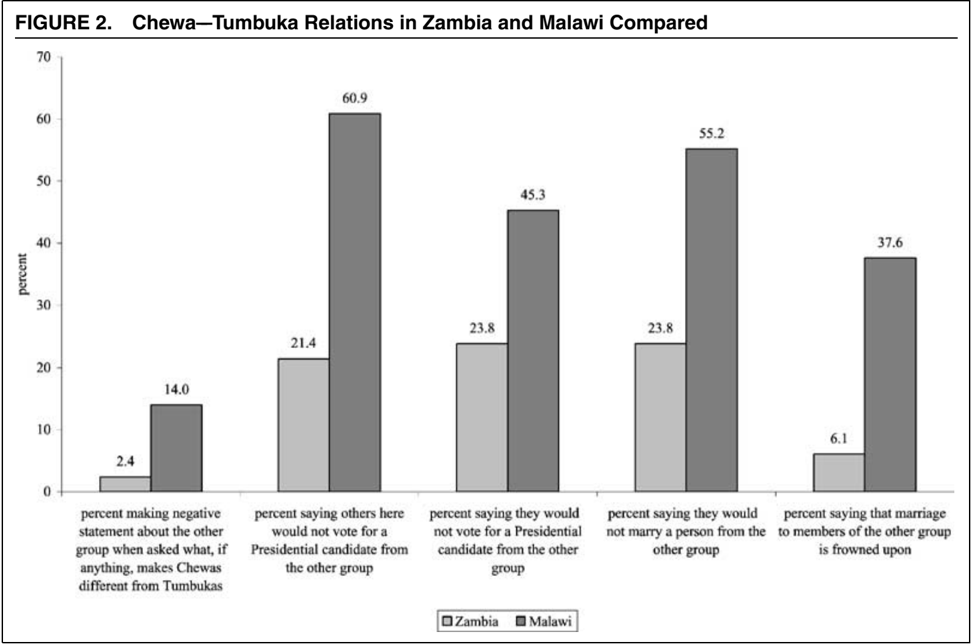
- Yet the cleavage was much more socially and politically salient in Malawi: 61% of Malawians versus 21% of Zambians said others in their village would be unwilling to vote for a candidate from the other group; 45% of Malawians versus 24% of Zambians said they themselves would not vote for such a candidate.
- On marriage, 55% of Malawians versus 24% of Zambians said they would not marry a member of the other group, and 38% of Malawians versus 6% of Zambians said intermarriage was frowned upon.
- The paper’s regressions find that the perceived number of cultural differences is not a significant predictor of attitudes in any of the four models, while country is strongly significant; the table notes sample sizes of 172, 175, 176, and 172.
## Methods
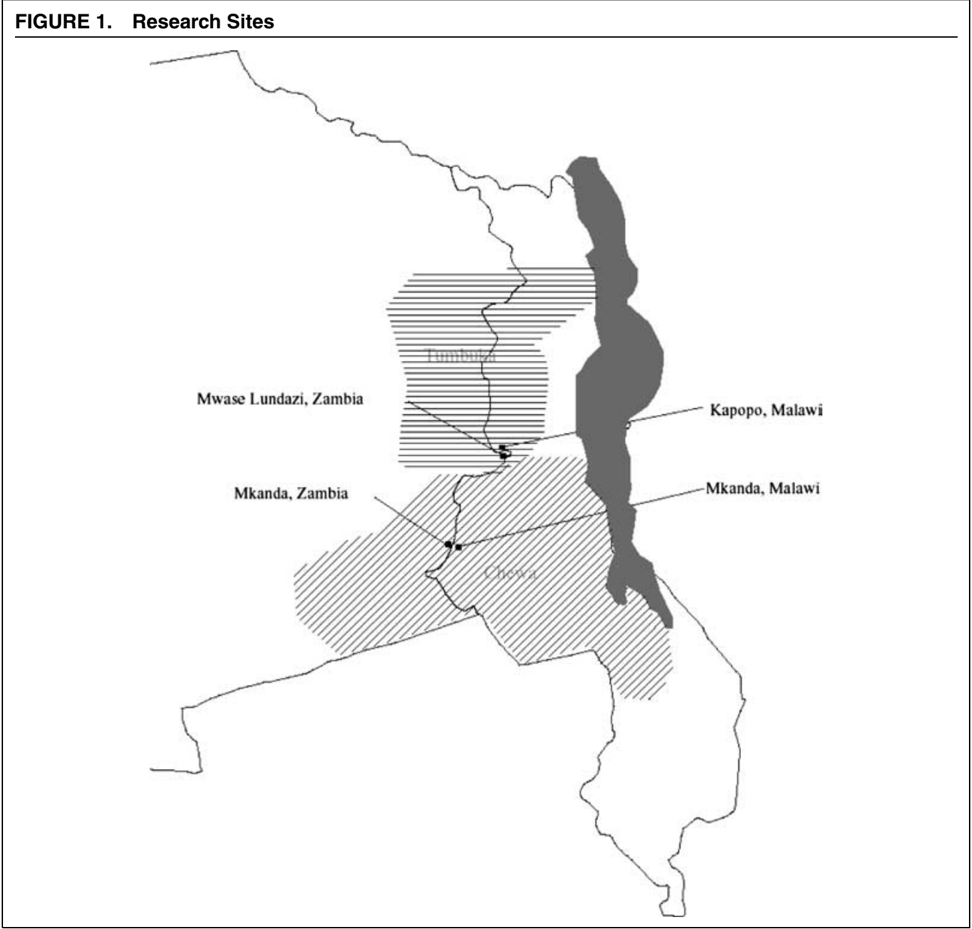
- Comparative natural-experiment design: the Zambia-Malawi border partitions Chewas and Tumbukas, who are otherwise culturally similar across sides of the border, allowing comparison of the same cleavage in different political settings.
- Original field survey in July-August 2001 in four villages directly across the border: two Chewa villages and two Tumbuka villages; 42 respondents in each Zambian village and 48 in each Malawian village, for a total sample of 180, selected by random stratified quota sampling from every third unrelated household.
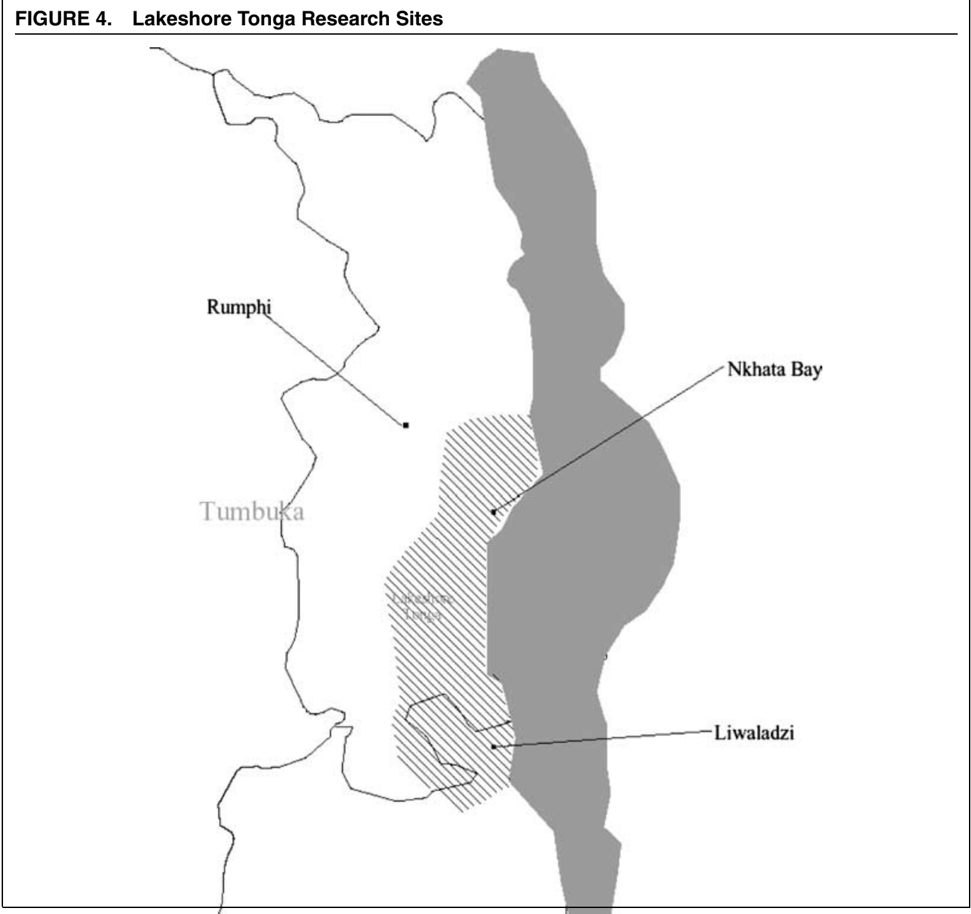
- Main analysis combines open-ended survey responses, descriptive comparisons, logit regressions controlling for tribal affiliation, gender, age, and the number of reported cultural differences, plus a second survey of 30 Lakeshore Tonga respondents to test whether an administrative boundary can create salience.
## Limitations
- Stated by the paper: the author notes that testing whether social divisions are products of political divisions would require time-series data on changes in political divisions, trust, and intermarriage, which are “currently unavailable.”
- Stated by the paper: the Lakeshore Tonga administrative-boundary test is described as “suggestive” because the sample is small.
- Evident from the text: the main survey is limited to four villages in one border region and relies on self-reported attitudes and a small, non-national sample, so generalization beyond the studied sites is not directly demonstrated.
Model-written summary. Check it against the paper before relying on it.
Integrity signals
Registry
Cites
Statistics
Figures
Verification
Claims the paper makes
0 Valid · 1 Not valid · 17 Not checked · 101 Own results and interpretations
A result the paper reports from its own data — it cites no other source for it, so there is none to check. The quote shows it is in the paper.
In the paper
“In fact, the modal Zambian response to our request for a list of differences between Chewas and Tumbukas was to emphasize that 'We are one' or 'We are united.'”
plain- Asserted: passes — The authors put it forward as true.
- Checkable: passes — It can be checked against evidence.
- Load-bearing: passes — The paper’s conclusions depend on it.
- Based: passes — The paper gives a reason why it holds.
A result the paper reports from its own data — it cites no other source for it, so there is none to check. The quote shows it is in the paper.
In the paper
“The most important finding, however, is that, controlling for all of these other factors, the most powerful determinant of a respondent's attitudes toward members of the other community is his or her physical- -and, it bears underscoring, from an historical perspective, entirely accidental- location on one side of the Zambia-Malawi border or the other.”
boostedstates a cause- Asserted: passes — The authors put it forward as true.
- Checkable: passes — It can be checked against evidence.
- Load-bearing: passes — The paper’s conclusions depend on it.
- Based: passes — The paper gives a reason why it holds.
A result the paper reports from its own data — it cites no other source for it, so there is none to check. The quote shows it is in the paper.
In the paper
“Malawian respondents are significantly less willing to vote for a presidential candidate from the other group and significantly less willing to marry across group lines than are their otherwise identical Zambian counterparts.”
plainstates an association- Asserted: passes — The authors put it forward as true.
- Checkable: passes — It can be checked against evidence.
- Load-bearing: passes — The paper’s conclusions depend on it.
- Based: passes — The paper gives a reason why it holds.
A result the paper reports from its own data — it cites no other source for it, so there is none to check. The quote shows it is in the paper.
In the paper
“Again and again, respondents in all four villages identified the same attributes as distinguishing members of the two communities.”
plain- Asserted: passes — The authors put it forward as true.
- Checkable: passes — It can be checked against evidence.
- Load-bearing: passes — The paper’s conclusions depend on it.
- Based: passes — The paper gives a reason why it holds.
A result the paper reports from its own data — it cites no other source for it, so there is none to check. The quote shows it is in the paper.
In the paper
“While the specific cultural practices that respondents mentioned varied somewhat from person to person, nearly every interviewee on both sides of the border (83% overall) was able to identify at least one attribute, tradition, or custom- -and often several- -that made Chewas and Tumbukas culturally different from one another.”
plain- Asserted: passes — The authors put it forward as true.
- Checkable: passes — It can be checked against evidence.
- Load-bearing: passes — The paper’s conclusions depend on it.
- Based: passes — The paper gives a reason why it holds.
66 more claims
Create a free account to see all 119 claims and every source verdict.
- It may state two separate claims as one. 42
- Probably not a substantial claim. 8
Citations
Cites
The clash of civilizations and the remaking of world order
(1997) · Long Range Planning · doi:10.1016/s0024-6301(97)80966-1 · Cited by 7,457
Political Order in Changing Societies
Huntington, S. P. (1970) · Verfassung in Recht und Übersee · doi:10.5771/0506-7286-1970-2-257 · Cited by 6,333
Kuper, L., & Horowitz, D. L. (1986) · Contemporary Sociology · doi:10.2307/2069338 · Cited by 4,869
Democracy in Plural Societies: A Comparative Exploration
Nagata, J., & Lijphart, A. (1979) · International Journal · doi:10.2307/40201796 · Cited by 2,255
Ethnic and Cultural Diversity by Country*
Fearon, J. D. (2003) · Journal of Economic Growth · doi:10.1023/a:1024419522867 · Cited by 1,829 · cited 1×
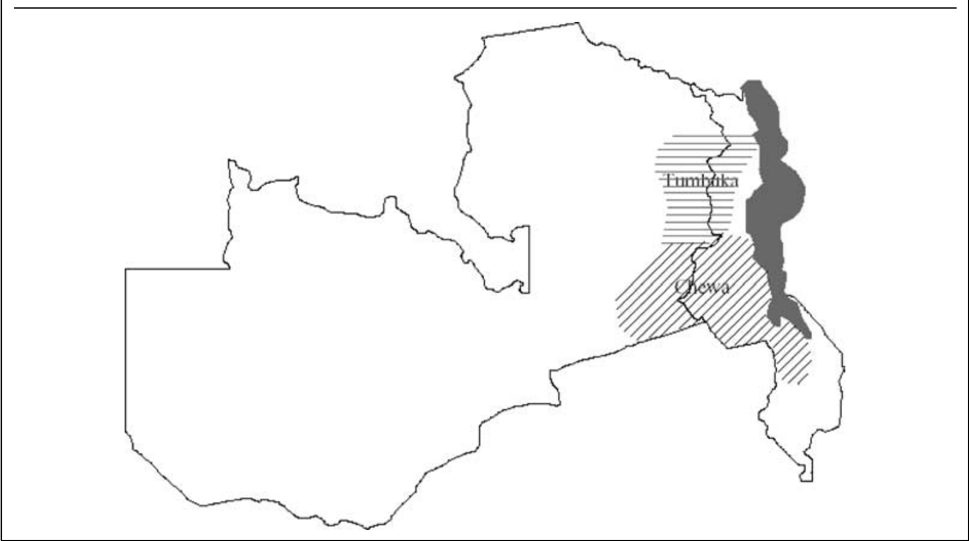
“As Figure 3 makes clear, the Chewa and Tumbuka communities are both large in Malawi (28% and 12% of the national population, respectively) but peripheral in Zambia (7% and 4%, respectively).16 Much more 16 Malawi’s figures come from Fearon 2003.”
BackgroundExplaining Interethnic Cooperation
Fearon, J. D., & Laitin, D. D. (1996) · American Political Science Review · doi:10.2307/2945838 · Cited by 1,606
Ethnologue: Languages of the World
(2015) · Choice Reviews Online · doi:10.5860/choice.192005 · Cited by 1,176
Social Mobilization and Political Development
Deutsch, K. W. (1961) · American Political Science Review · doi:10.1017/s0003055400125134 · Cited by 1,077
Why Ethnic Parties Succeed: Patronage and Ethnic Head Counts in India
Chandra, K. (2004) · Cambridge University Press eBooks · doi:10.1017/9781108573481 · Cited by 1,064
Horowitz, D. L. (2001) · University of California Press eBooks · doi:10.1525/9780520342057 · Cited by 925
Research works printed but not linked: 6
- Vail, Leroy, and Landeg White. 1989. 'Tribalism in the Political History of Malawi.' In The Creation of Tribalism in Southern Africa , ed. Leroy Vail. Berkeley and Los Angeles: University of California Press, 151- -92.
- Lijphart, Arend. 1977. DemocracyinPlural Societies: A Comparative Exploration . New Haven, CT: Yale University Press.
- Henkel, Reinhard. 1985. 'Mission Stations in Zambia: Their Location and Diffusion Patterns.' Zambia Geographical Journal 35: 1- -18.
- Hobsbawm, Eric. 1996. 'Are all Tongues Equal?' In Living as Equals , ed. Paul Barker. New York: Oxford University Press, 85- 98.
- Bratton, Michael. 1994. 'Economic Crisis and Political Realignment in Zambia.' In Economic Change and Political Liberalization in Sub-Saharan Africa , ed. Jennifer A. Widner. Baltimore: Johns Hopkins University Press, 101- -28.
- Lipset, Seymour Martin, and Stein Rokkan. 1967. 'Cleavage Structures, Party Systems and Voter Alignments: An Introduction.' In Party Systems and Voter Alignments: Cross-National Perspectives , ed. Seymour M. Lipset and Stein Rokkan. New York: Free Press, 1- -64.
Cited by
Case Selection Techniques in Case Study Research: A Menu of Qualitative and Quantitative Options
Seawright, J., & Gerring, J. (2008) · Political Research Quarterly · doi:10.1177/1065912907313077 · Cited by 3,827
The Logic of Violence in Civil War
Kalyvas, S. N. (2006) · Cambridge University Press eBooks · doi:10.1017/cbo9780511818462 · Cited by 3,314
Ethnic Diversity and Economic Performance
Alesina, A., & La Ferrara, E. (2005) · Journal of Economic Literature · doi:10.1257/002205105774431243 · Cited by 2,062
The Oxford Handbook of Comparative Politics
(2009) · Oxford University Press eBooks · doi:10.1093/oxfordhb/9780199566020.001.0001 · Cited by 1,320
Institutions and Ethnic Politics in Africa
Posner, D. N. (2005) · doi:10.1017/cbo9780511808661 · Cited by 1,113
Self-citationInstitutions and Ethnic Politics in Africa
Walle, N. V. D., & Posner, D. N. (2005) · Foreign Affairs · doi:10.2307/20031830 · Cited by 647
Self-citationTribe or Nation? Nation Building and Public Goods in Kenya versus Tanzania
Miguel, E. (2004) · World Politics · doi:10.1017/s0043887100004330 · Cited by 528
Does Indiscriminate Violence Incite Insurgent Attacks?: Evidence from Chechnya
Lyall, J. (2009) · Journal of Conflict Resolution · doi:10.1177/0022002708330881 · Cited by 499
Natural Experiments in the Social Sciences: A Design-Based Approach
Dunning, T. (2012) · Thammasat University Digital Collections · Cited by 466
Party Competition between Unequals: Strategies and Electoral Fortunes in Western Europe
Meguid, B. M. (2008) · Cited by 456
Authoritarian Origins of Democratic Party Systems in Africa
Riedl, R. B. (2014) · doi:10.1017/cbo9781107045484 · Cited by 424
Case Selection for Case‐Study Analysis: Qualitative and Quantitative Techniques
Gerring, J. (2009) · The Oxford Handbook of Political Methodology · doi:10.1093/oxfordhb/9780199286546.003.0028 · Cited by 414
Causal effect of intergroup contact on exclusionary attitudes
Enos, R. D. (2014) · Proceedings of the National Academy of Sciences · doi:10.1073/pnas.1317670111 · Cited by 391
“In addition to this inability, the causal mechanisms remain disputed: Proposed mechanisms for the correlation between intergroup contact and intergroup conflict include evolutionary (10, 11), cognitive (12), economic (13, 14), and political (15) processes.”
BackgroundGeographic Boundaries as Regression Discontinuities
Keele, L. J., & Titiunik, R. (2015) · Political Analysis · doi:10.1093/pan/mpu014 · Cited by 391
Seeds of distrust: conflict in Uganda
Rohner, D., Thoenig, M., & Zilibotti, F. (2013) · Journal of Economic Growth · doi:10.1007/s10887-013-9093-1 · Cited by 371
Ethnicity and electoral politics
(2007) · Choice Reviews Online · doi:10.5860/choice.44-7072 · Cited by 364
Improving Causal Inference: Strengths and Limitations of Natural Experiments
Dunning, T. (2008) · Political Research Quarterly · doi:10.1177/1065912907306470 · Cited by 352
Ethnic Divisions and Production in Firms *
Hjort, J. (2014) · The Quarterly Journal of Economics · doi:10.1093/qje/qju028 · Cited by 312
The Political Economy of Kenya's Crisis
Mueller, S. D. (2008) · Journal of Eastern African Studies · doi:10.1080/17531050802058302 · Cited by 316
The Pitfalls and Promise of Focus Groups as a Data Collection Method
Cyr, J. (2016) · Sociological Methods & Research · doi:10.1177/0049124115570065 · Cited by 317
Cross-cutting Cleavages and Ethnic Voting: An Experimental Study of Cousinage in Mali
DUNNING, T., & HARRISON, L. (2010) · American Political Science Review · doi:10.1017/s0003055409990311 · Cited by 301
Legitimating beliefs: Sources and indicators
Levi, M., & Sacks, A. (2009) · Regulation & Governance · doi:10.1111/j.1748-5991.2009.01066.x · Cited by 269
“Across Africa, ethnicity plays a highly salient role in the allocation of public goods (Bates 1983, 152; Kasfir 1979; Posner 2004).”
BackgroundDUNNING, T., & NILEKANI, J. (2013) · American Political Science Review · doi:10.1017/s0003055412000573 · Cited by 264
“…some constructivist and psychological theories, in which the sanctioning of particular ethnic categories by the state makes in-group and out-group distinctions based on those categories politically salient (Bates 1983; Chandra 2005; Laitin 1986; Posner 2004; 2005; Tajfel and Turner 1979).”
BackgroundEthnic Diversity and Economic Performance
Alesina, A., & Ferrara, E. L. (2004) · National Bureau of Economic Research · doi:10.3386/w10313 · Cited by 254
African Politics in Comparative Perspective
Hyden, G. (2005) · Cambridge University Press eBooks · doi:10.1017/cbo9780511791079 · Cited by 240
Cunningham, K. G., Bakke, K. M., & Seymour, L. J. M. (2012) · Journal of Conflict Resolution · doi:10.1177/0022002711429697 · Cited by 231
Gerring, J. (2017) · Annual Review of Political Science · doi:10.1146/annurev-polisci-092415-024158 · Cited by 225
Misunderstandings About the Regression Discontinuity Design in the Study of Close Elections
de la Cuesta, B., & Imai, K. (2016) · Annual Review of Political Science · doi:10.1146/annurev-polisci-032015-010115 · Cited by 222
Ethnic Diversity and Economic Performance
Alesina, A. F., & La Ferrara, E. (2003) · SSRN Electronic Journal · doi:10.2139/ssrn.569881 · Cited by 214
Bricks and Mortar Clientelism: Sectarianism and the Logics of Welfare Allocation in Lebanon
Cammett, M., & Issar, S. (2010) · World Politics · doi:10.1017/s0043887110000080 · Cited by 245
Ordinary People, Extraordinary Risks: Participation in an Ethnic Rebellion
TEZCÜR, G. M. (2016) · American Political Science Review · doi:10.1017/s0003055416000150 · Cited by 215
An Experimental Template for Case Study Research
Gerring, J., & McDermott, R. (2007) · American Journal of Political Science · doi:10.1111/j.1540-5907.2007.00275.x · Cited by 208
Robinson, A. L. (2014) · World Politics · doi:10.1017/s0043887114000239 · Cited by 207
Information and Ethnic Politics in Africa
Conroy-Krutz, J. (2013) · British Journal of Political Science · doi:10.1017/s0007123412000300 · Cited by 206
When Natural Experiments Are Neither Natural nor Experiments
SEKHON, J. S., & TITIUNIK, R. (2012) · American Political Science Review · doi:10.1017/s0003055411000542 · Cited by 201
A History of Identities, Violence, and Stability in Nigeria.
Osaghae, E. E., & Suberu, R. T. (2005) · Cited by 350
Ethnic Favoritism in Education in Kenya
Kramon, E., & Posner, D. N. (2016) · Quarterly Journal of Political Science · doi:10.1561/100.00015005 · Cited by 193
Self-citationBoone, C. (2011) · Comparative Political Studies · doi:10.1177/0010414011407465 · Cited by 191
“The politician must have an “electorally significant group”—defined by group size or position in the electoral system—to launch appeals (see Posner, 2004).”
BackgroundThe Case Study: What it is and What it Does
Gerring, J. (2009) · The Oxford Handbook of Comparative Politics · doi:10.1093/oxfordhb/9780199566020.003.0004 · Cited by 189
Polarization as Craft: Party Formation and State Violence in Zimbabwe
LeBas, A. (2006) · Comparative Politics · doi:10.2307/20434010 · Cited by 186
MICHELITCH, K. (2015) · American Political Science Review · doi:10.1017/s0003055414000628 · Cited by 186
“Significantly, Posner (2004) finds that two ethnic groups who had been long time copartisans in one country, as opposed to noncopartisans in a contiguous country, perceived their identity as closer as a long-run consequence.”
BackgroundLost Autonomy, Nationalism and Separatism
Siroky, D. S., & Cuffe, J. (2015) · Comparative Political Studies · doi:10.1177/0010414013516927 · Cited by 180
“While not directly related to separatism, see Posner’s (2004) discussion of how the”
BackgroundEthnic Diversity, Segregation and Ethnocentric Trust in Africa
Robinson, A. L. (2020) · British Journal of Political Science · doi:10.1017/s0007123417000540 · Cited by 176
“46 Chirwa 1998; Dulani and Dionne 2014; Ejdemyr, Kramon, and Robinson Forthcoming; Ferree and Horowitz 2010; Forster 1994; Kaspin 1995; Osei-Hwedie 1998; Posner 2004; Robinson 2016a; Robinson 2016b; Vail and White 1991.”
BackgroundEthnic Mobilization and Ethnic Violence
Fearon, J. D. (2009) · The Oxford Handbook of Political Economy · doi:10.1093/oxfordhb/9780199548477.003.0047 · Cited by 174
Measuring Ethnic Voting: Do Proportional Electoral Laws Politicize Ethnicity?
Huber, J. D. (2012) · American Journal of Political Science · doi:10.1111/j.1540-5907.2012.00601.x · Cited by 169
Perceived Discrimination and Political Behavior
Oskooii, K. A. R. (2020) · British Journal of Political Science · doi:10.1017/s0007123418000133 · Cited by 167
“(Chandra 2006; Garcia-Rios 2015; Posner 2004; Roccas and Brewer 2002).”
BackgroundSeeing the World Through the Other's Eye: An Online Intervention Reducing Ethnic Prejudice
SIMONOVITS, G., KÉZDI, G., & KARDOS, P. (2018) · American Political Science Review · doi:10.1017/s0003055417000478 · Cited by 166
Power and the Vote: Elections and Electricity in the Developing World
Min, B. (2015) · Cited by 161
The Ethnicity–Policy Preference Link in Sub-Saharan Africa
Lieberman, E. S., & McClendon, G. H. (2013) · Comparative Political Studies · doi:10.1177/0010414012463876 · Cited by 161
“…including an increasing focus on socially or politically relevant ethnic categories (Alesina, Devleeschauwer, Easterly, Kurlat, & Wacziarg, 2003; Posner, 2004a; Wimmer, Cederman, & Min, 2009) and on the degree of economic inequality across ethnic groups (Baldwin & Huber, 2010), the overall…”
BackgroundInfluentialCollective Action in Diverse Sierra Leone Communities
Glennerster, R., Miguel, E. A., & Rothenberg, A. D. (2013) · The Economic Journal · doi:10.1111/ecoj.12030 · Cited by 171
Algan, Y., Hémet, C., & Laitin, D. D. (2016) · Journal of Political Economy · doi:10.1086/686010 · Cited by 190
Agents of the Regime? Traditional Leaders and Electoral Politics in South Africa
de Kadt, D., & Larreguy, H. (2018) · The Journal of Politics · doi:10.1086/694540 · Cited by 193
“The reasons for this are complex and have borne out a series of narrower debates about when and why ethnic voting occurs (Carlson 2015; Dunning and Harrison 2010; Eifert, Miguel, and Posner 2010; Posner 2004).”
BackgroundLand grievances and the mobilization of electoral violence
Klaus, K., & Mitchell, M. I. (2015) · Journal of Peace Research · doi:10.1177/0022343315580145 · Cited by 200
Competition Between Organizational Groups: Its Impact on Altruistic and Anti-Social Motivations
Goette, L. F., Huffman, D., Meier, S., & Sutter, M. (2011) · Management Science · doi:10.1287/mnsc.1110.1466 · Cited by 179
“der in Zambia (Posner 2004), and conflict between”
BackgroundHorizontal Inequality and Communal Violence: Evidence from Indonesian Districts
Mancini, L. L. (2008) · Palgrave Macmillan UK eBooks · doi:10.1057/9780230582729_6 · Cited by 172
“Using survey data from nine African countries, Bannon, Miguel and Posner (2004) find that ethnic fractionalisation is negatively associated with the probability that individuals identify themselves first and foremost in ethnic terms, which implies that in more ethnically fragmented societies the salience of ethnicity…”
BackgroundResultInfluentialFrom classrooms to conflict in Rwanda
King, E. (2014) · Choice Reviews Online · doi:10.5860/choice.185824 · Cited by 155
Nationalism and Ethnic-Based Trust: Evidence From an African Border Region
Robinson, A. L. (2016) · Comparative Political Studies · doi:10.1177/0010414016628269 · Cited by 208
Explaining Institutional Change: Policy Areas, Outside Options, and the Bretton Woods Institutions
Lipscy, P. Y. (2014) · American Journal of Political Science · doi:10.1111/ajps.12130 · Cited by 160
Okamoto, D. G., & Mora, G. C. (2014) · Annual Review of Sociology · doi:10.1146/annurev-soc-071913-043201 · Cited by 192
The Promising Integration of Qualitative Methods and Field Experiments
Levy Paluck, E. (2010) · The ANNALS of the American Academy of Political and Social Science · doi:10.1177/0002716209351510 · Cited by 127
Is the Science of Comparative Politics Possible?
Przeworski, A. (2009) · Oxford University Press eBooks · doi:10.1093/oxfordhb/9780199566020.003.0006 · Cited by 143
Beyond Ethnic Politics in Africa
Koter, D. (2016) · Cambridge University Press eBooks · doi:10.1017/cbo9781316761366 · Cited by 124
Identity and political preferences in Ukraine – before and after the Euromaidan
Pop-Elecheș, G., & Robertson, G. B. (2018) · Post-Soviet Affairs · doi:10.1080/1060586x.2018.1452181 · Cited by 178
“Ethnic or ethnonational identities are not always politically salient (Posner 2004).”
BackgroundClose to Home: Local Ties and Voting Radical Right in Europe
Fitzgerald, J. (2018) · Cambridge University Press eBooks · doi:10.1017/9781108377218 · Cited by 180
Cultural contestation in ethnic conflict
(2008) · Choice Reviews Online · doi:10.5860/choice.45-2852 · Cited by 116
Fontana, L. B., & Grugel, J. B. (2015) · World Development · doi:10.1016/j.worlddev.2015.08.023 · Cited by 156
“…identities, and the existence of straightforward division between the powerful and the dispossessed along these static ethnic lines, when most ethnic identities are in fact fluid social constructions, dependent on politics and subject to change (Lucero, 2006; Li, 2000; Posner, 2004; Sylvain, 2002).”
BackgroundRuthless Rulers: Coalition Size and the Severity of Civil Conflict
HEGER, L., & SALEHYAN, I. (2007) · International Studies Quarterly · doi:10.1111/j.1468-2478.2007.00456.x · Cited by 107
“We do not assume that ethnicity is fixed or ‘‘primordial’’; rather, we agree with the view that salient ethnic identities are socially constructed and partially a function of incentives generated by social and political institutions (Miles and Rochefort 1991; Laitin 1998; Posner 2004).”
BackgroundBleck, J., & Michelitch, K. G. (2017) · The Journal of Politics · doi:10.1086/690616 · Cited by 109
“This technique draws on the fact that allowing children to marry a member of an ethnic group indicates a high degree of cultural acceptance of that group; Posner (2004) also uses this measure of cultural acceptance in Zambia and Malawi.”
For Whom the Bell Tolls: The Political Legacy of China's Cultural Revolution
Wang, Y. (2017) · British Journal of Political Science · doi:10.1017/s0007123419000255 · Cited by 109
Elections and Social Conflict in Africa, 1990–2009
Salehyan, I., & Linebarger, C. (2014) · Studies in Comparative International Development · doi:10.1007/s12116-014-9163-1 · Cited by 142
“Ethnic conflict is especially likely in those cases where large groups compete for power and when significant segments of the population are excluded from state institutions (Reynal-Querol 2002; Posner 2004; Buhaug et al. 2008).”
Perils or Promise of Ethnic Integration? Evidence from a Hard Case in Burundi
SAMII, C. (2013) · American Political Science Review · doi:10.1017/s0003055413000282 · Cited by 102
“…not only as a means of describing oneself, but also as a likely determinant of one’s life prospects and an important marker on which to condition cooperation (Akerlof and Kranton 2000; Brewer 1999; Chandra 2006; Eifert, Miguel, and Posner 2010; Fearon 2003; Green and Seher 2003; Posner 2004).”
BackgroundDo strong group identities fuel intolerance? Evidence from the south African case
Gibson, J. L. (2006) · Political Psychology · doi:10.1111/j.1467-9221.2006.00528.x · Cited by 100
Walter, B. F. (2017) · Annual Review of Political Science · doi:10.1146/annurev-polisci-060415-093921 · Cited by 162
“This includes group-level research on rebel organization (Krause 2013/14; Staniland 2014); rebel alliances (Akcinaroglu 2012; Christia 2012; Posner 2004; CKurtado 2007; Seymour 2014), rebel fractionalization (Woldemarian 2011; Warren & Troy 2014), rebel on rebel fighting (Cunningham, Bakke &…”
BackgroundRenegotiating the World Order: Institutional Change in International Relations
Lipscy, P. Y. (2017) · Cited by 96
Acemoğlu, D., Fergusson, L., & Johnson, S. (2019) · The Review of Economic Studies · doi:10.1093/restud/rdz042 · Cited by 112
Religion and the Political Organization of Muslims in Europe
Warner, C. M., & Wenner, M. W. (2006) · Perspectives on Politics · doi:10.1017/s1537592706060300 · Cited by 110
Crafting Mass Partisanship at the Grass Roots
Samuels, D., & Zucco, C. (2015) · British Journal of Political Science · doi:10.1017/s0007123413000549 · Cited by 48
Ethnic Inequality and the Ethnification of Political Parties
Huber, J. D., & Suryanarayan, P. (2015) · World Politics · doi:10.1017/s0043887115000349 · Cited by 99
When democratization radicalizes: The Kurdish nationalist movement in Turkey
Tezcür, G. M. (2010) · Journal of Peace Research · doi:10.1177/0022343310386156 · Cited by 134
Gurses, M. (2018) · University of Michigan Press eBooks · doi:10.3998/mpub.9946395 · Cited by 102
Against the concept of ethnic conflict
Gilley, B. (2004) · Third World Quarterly · doi:10.1080/0143659042000256959 · Cited by 91
Natural Experiments Based on Geography
Keele, L. J., & Titiunik, R. (2015) · Political Science Research and Methods · doi:10.1017/psrm.2015.4 · Cited by 98
The Logic of Ethnic and Religious Conflict in Africa
McCauley, J. F. (2017) · Cambridge University Press eBooks · doi:10.1017/9781316796252 · Cited by 104
BRICKS AND MORTAR CLIENTELISM: Sectarianism and the Logics of Welfare Allocation in Lebanon.
Cammett, M. C., & Issar, S. (2010) · PubMed · doi:10.1353/wp.0.0056 · Cited by 90
Field Experiments and Natural Experiments
Gerber, A. S., & GREEN, D. P. (2009) · Oxford University Press eBooks · doi:10.1093/oxfordhb/9780199286546.003.0015 · Cited by 138
The Fundamentals of Political Science Research
Kellstedt, P. M., & Whitten, G. D. (2018) · Cambridge University Press eBooks · doi:10.1017/9781108131704 · Cited by 194
Isaacs, M. (2016) · Journal of Peace Research · doi:10.1177/0022343315626771 · Cited by 118
Why Horizontal Inequalities Matter: Some Implications for Measurement.
Stewart, F., Brown, G. K., & Mancini, L. L. (2005) · Cited by 126
Social cleavages and political dealignment in contemporary Chile, 1995–2009
Bargsted, M., & Somma, N. M. (2013) · Party Politics · doi:10.1177/1354068813514865 · Cited by 94
“This creates or deepens certain political conflicts and identities – though not necessarily intentionally (Hetherington, 2001; Mainwaring et al., 2013; Posner, 2004; Torcal and Mainwaring, 2003).”
BackgroundPolitical violence and social networks: Experimental evidence from a Nigerian election
Fafchamps, M., & Vicente, P. C. (2012) · Journal of Development Economics · doi:10.1016/j.jdeveco.2012.09.003 · Cited by 96
“In this paper we are not interested in the average treatment effect, which is discussed in detail in Collier and Vicente (2008). Our focus is on reinforcement and diffusion through social networks.”
BackgroundAfrican Borders as Sources of Natural Experiments Promise and Pitfalls
McCauley, J. F., & Posner, D. (2014) · Political Science Research and Methods · doi:10.1017/psrm.2014.37 · Cited by 94
Self-citationCitizenship versus Ethnicity: The Role of Institutions in Shaping Identity Choice
Penn, E. M. (2008) · The Journal of Politics · doi:10.1017/s0022381608080997 · Cited by 96
“6An important type of ‘‘situation’’ that I don’t consider is the strategic behavior of political elites seeking personal gain, as in Posner (2004).”
BackgroundCities, Constitutions, and Sovereign Borrowing in Europe, 1274–1785
Stasavage, D. (2007) · International Organization · doi:10.1017/s002081830707018x · Cited by 80
Explaining African ethnic diversity
Green, E. D. (2012) · International Political Science Review · doi:10.1177/0192512112455075 · Cited by 103
Individual Identity Attachments and International Conflict: The Importance of Territorial Threat
Gibler, D. M., Hutchison, M. L., & Miller, S. V. (2012) · Comparative Political Studies · doi:10.1177/0010414012463899 · Cited by 102
“A more serious problem may stem from the overrepresentation of higher democracy levels in the sample because ethnicity often provides a way of motivating voting blocs prior to election (Eifert et al., 2010; Posner, 2004).”
BackgroundThe Diverse Effects of Diversity on Democracy
Gerring, J., Hoffman, M., & Zarecki, D. (2016) · British Journal of Political Science · doi:10.1017/s000712341600003x · Cited by 91
Diversity, Institutions, and Economic Outcomes: Post-WWII Displacement in Poland
Charnysh, V. (2019) · American Political Science Review · doi:10.1017/s0003055419000042 · Cited by 76
“Yet, what matters most for extrapolating from the Polish case is not the type of cleavage but whether the cleavage represents a salient social identity in a given context (Posner 2004).”
BackgroundIdentifying the prevalence, correlates, and policy consequences of anti-vaccine social identity
Motta, M., Callaghan, T., Sylvester, S. M., & Trujillo, K. L. (2021) · Politics Groups and Identities · doi:10.1080/21565503.2021.1932528 · Cited by 91
“…also influence politics and policy attitudes because they generally shape people’s attitudes and actions (Schildkraut 2014), though to be politically relevant, they must be both salient to the individual and linked to the political and policy climate (Posner 2004; Schildkraut 2014).”
BackgroundAntidote to Backsliding: Ethnic Politics and Democratic Resilience
Rovný, J. (2023) · American Political Science Review · doi:10.1017/s000305542200140x · Cited by 123
Abman, R., & Carney, C. (2020) · Journal of Environmental Economics and Management · doi:10.1016/j.jeem.2020.102342 · Cited by 75
Metadata
- Authors
- POSNER, D. N.
- Affiliations
- University of California, Los Angeles (US)
- Corresponding author
- POSNER, DANIEL N.
- ORCID
- POSNER, DANIEL N.
- Venue
- American Political Science Review
- Publisher
- Cambridge University Press (CUP)
- Published
- 2004-11
- Volume
- 98
- Issue
- 4
- Pages
- 529-545
- ISSN
- 0003-0554 (ISSN-L)
- 1537-5943
- OpenAlex
- W2169278049
- Cited by
- 940
- References
- 54
- Citations by year
- 2026: 22 · 2025: 22 · 2024: 117 · 2023: 45 · 2022: 40 · 2021: 28 · 2020: 94 · 2019: 34 · 2018: 72 · 2017: 45 · 2016: 49 · 2015: 46 · 2014: 58 · 2013: 45 · 2012: 32
- FWCI
- 79.46
- Type
- journal article
- Language
- en
- Open access
- green
- www.escholarship.org
- Locations
- American Political Science Review (publishedVersion)
- eScholarship (California Digital Library) (submittedVersion)
- RePEc: Research Papers in Economics (submittedVersion)
- Topics
- Social Sciences › Sociology and Political Science › Political Conflict and Governance
- Social Sciences › Sociology and Political Science › African Studies and Ethnography
- Social Sciences › Political Science and International Relations › Electoral Systems and Political Participation
- Keywords
- cultural cleavages, political salience, Chewa, Tumbuka, ethnic politics, ethnic group size, political coalition building, ethnic mobilization
About these checks
Registry, retraction, Cites and statistics results are computed, not judged, with one exception: a printed reference that no index lists is read once by a model before it counts as a citation error. Claims are extracted by a model and kept only when their quote appears verbatim in the text; each cited source is then checked, with a model’s help, for whether it says what the claim relies on. Those verdicts can be wrong — read the claim’s quote and the cited source before relying on one.
A language model drew the claims from the paper on 2026-10-11, under version 3 of the claim definition (model deepseek-v4.1-flash, prompt extract-v3).
A second model labelled each claim on 2026-10-11 (model jev-1.13-20260917, definition revision gold-guideline-v0.2).
Statistics and arithmetic are recomputed, not judged.
Confidence bands are shown only for fields calibrated on our annotated test set. None is calibrated yet, so no band is shown.
What counts as a claim ›How we measure confidence ›How we check this ›
Are you an author, or do you see a problem with this page? Request a review
Data sources
Bibliographic data: Semantic Scholar, OpenAlex, Crossref.
Contains information from the Semantic Scholar Academic Graph Datasets, made available under the ODC Attribution License (ODC-BY 1.0).
Semantic Scholar’s data is described in: Kinney, R., et al. (2023). The Semantic Scholar Open Data Platform. arXiv:2301.10140.
