

The Political Salience of Cultural Difference: Why Chewas and Tumbukas Are Allies in Zambia and Adversaries in Malawi
Open accessThe DOI matches its Crossref record; 52 of the 54 references it cites were found in a registry or an index, and 1 are not checked yet; none of the 26 sources its claims cite is checked for support yet.
Abstract
This paper explores the conditions under which cultural cleavages become politically salient. It does so by taking advantage of the natural experiment afforded by the division of the Chewa and Tumbuka peoples by the border between Zambia and Malawi. I document that, while the objective cultural differences between Chewas and Tumbukas on both sides of the border are identical, the political salience of the division between these communities is altogether different. I argue that this difference stems from the different sizes of the Chewa and Tumbuka communities in each country relative to each country's national political arena. In Malawi, Chewas and Tumbukas are each large groups vis-à-vis the country as a whole and, thus, serve as viable bases for political coalition-building. In Zambia, Chewas and Tumbukas are small relative to the country as a whole and, thus, not useful to mobilize as bases of political support. The analysis suggests that the political salience of a cultural cleavage depends not on the nature of the cleavage itself (since it is identical in both countries) but on the sizes of the groups it defines and whether or not they will be useful vehicles for political competition.
Checked 2026-11-22 · 1 reference not checked yet
Overview
CoChat Summary
## TL;DR
Posner argues that a cultural cleavage becomes politically and socially salient when the groups it defines are large enough to be useful coalitional building blocks in a given political arena. Using survey evidence from Chewa and Tumbuka villages in Zambia and Malawi, he shows that the same cultural differences are politically and socially much more salient in Malawi than in Zambia because of differences in group size relative to the national arena.
## Key findings
- In the border-area survey, respondents in all four villages identified the same Chewa-Tumbuka cultural differences; 83% overall could name at least one difference, with an average of 1.36 differences mentioned, and the average among those naming at least one was nearly identical across borders (1.66 in Zambia, 1.70 in Malawi).
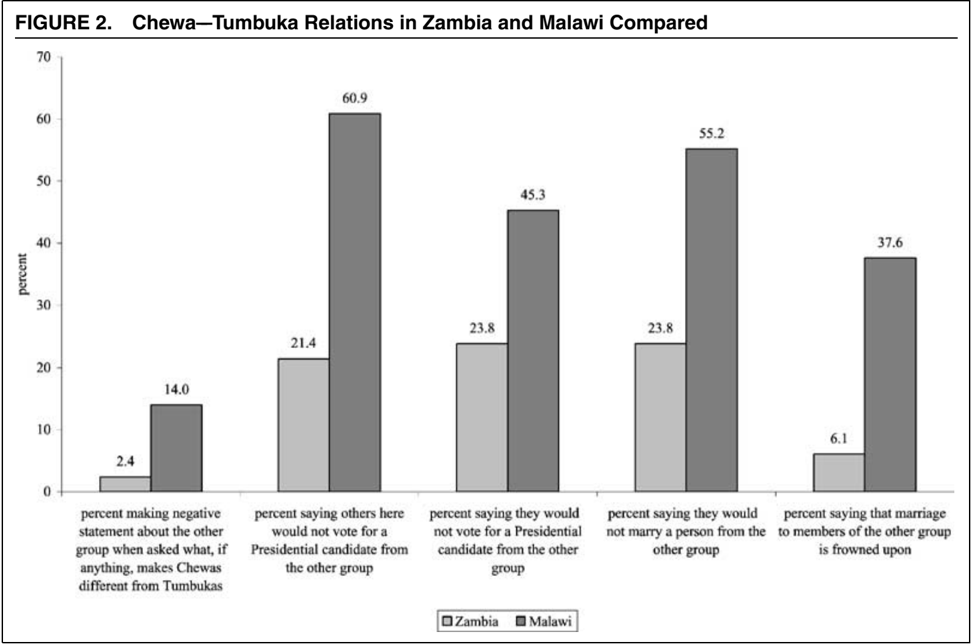
- Yet the cleavage was much more socially and politically salient in Malawi: 61% of Malawians versus 21% of Zambians said others in their village would be unwilling to vote for a candidate from the other group; 45% of Malawians versus 24% of Zambians said they themselves would not vote for such a candidate.
- On marriage, 55% of Malawians versus 24% of Zambians said they would not marry a member of the other group, and 38% of Malawians versus 6% of Zambians said intermarriage was frowned upon.
- The paper’s regressions find that the perceived number of cultural differences is not a significant predictor of attitudes in any of the four models, while country is strongly significant; the table notes sample sizes of 172, 175, 176, and 172.
## Methods
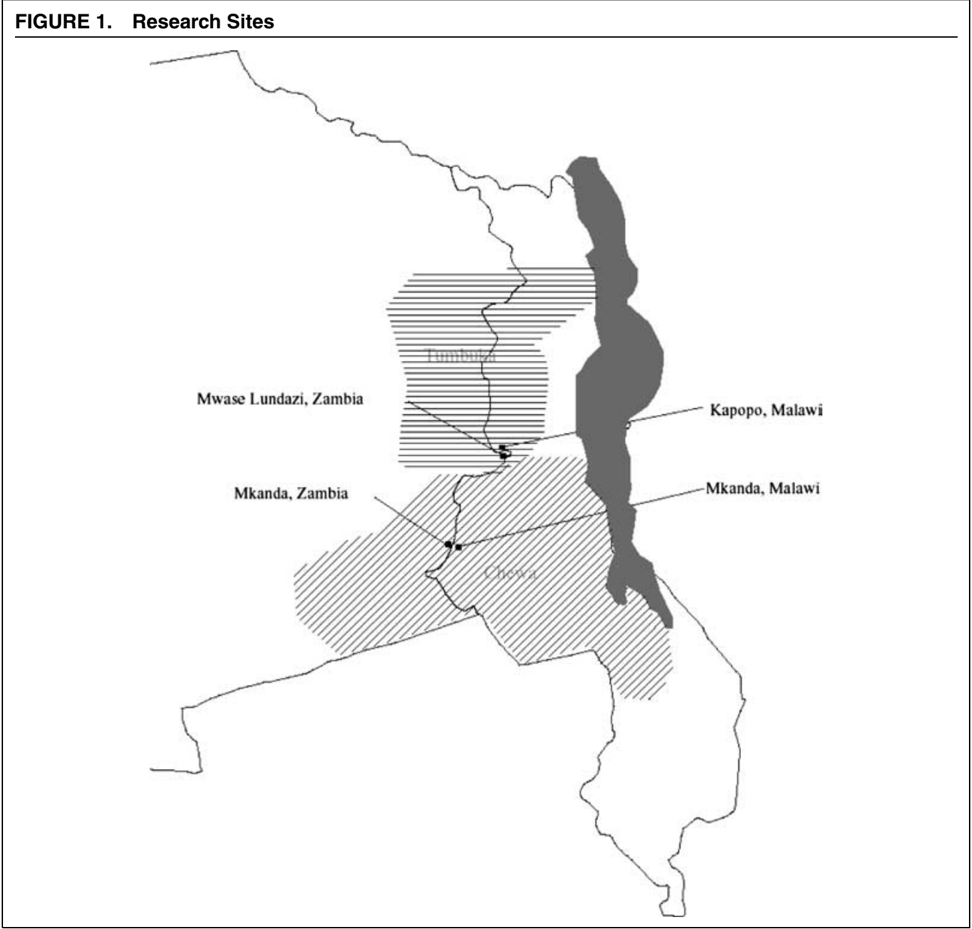
- Comparative natural-experiment design: the Zambia-Malawi border partitions Chewas and Tumbukas, who are otherwise culturally similar across sides of the border, allowing comparison of the same cleavage in different political settings.
- Original field survey in July-August 2001 in four villages directly across the border: two Chewa villages and two Tumbuka villages; 42 respondents in each Zambian village and 48 in each Malawian village, for a total sample of 180, selected by random stratified quota sampling from every third unrelated household.
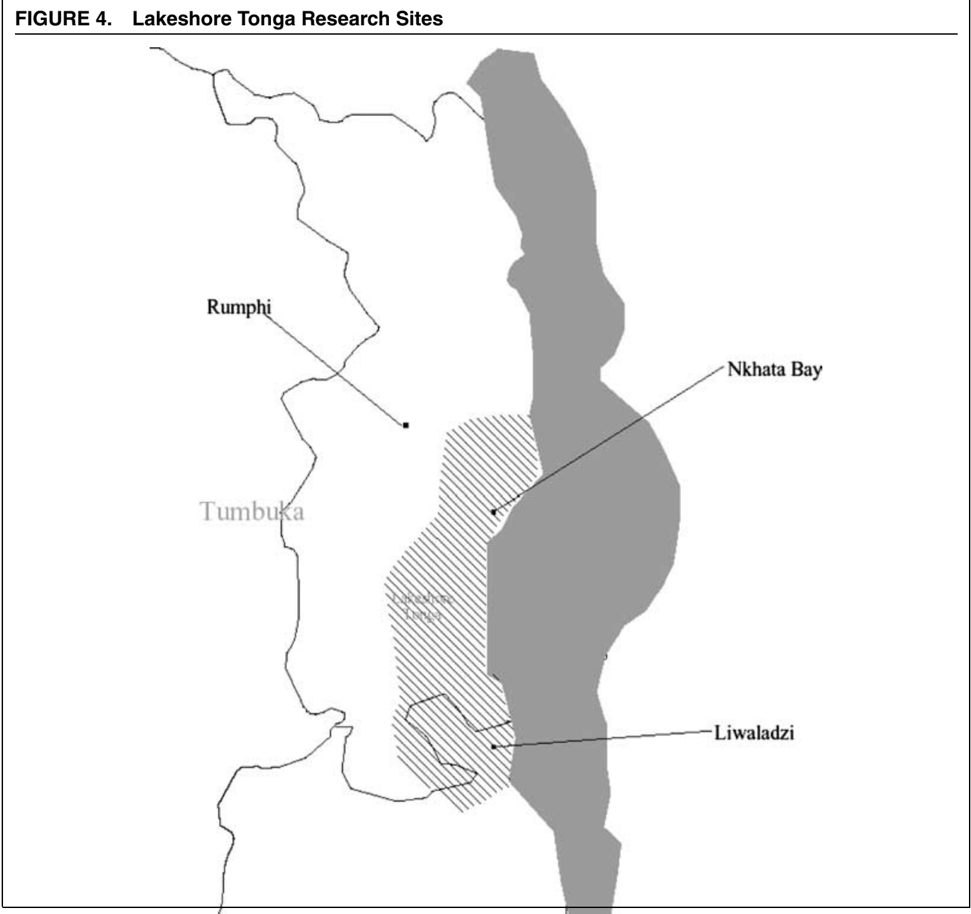
- Main analysis combines open-ended survey responses, descriptive comparisons, logit regressions controlling for tribal affiliation, gender, age, and the number of reported cultural differences, plus a second survey of 30 Lakeshore Tonga respondents to test whether an administrative boundary can create salience.
## Limitations
- Stated by the paper: the author notes that testing whether social divisions are products of political divisions would require time-series data on changes in political divisions, trust, and intermarriage, which are “currently unavailable.”
- Stated by the paper: the Lakeshore Tonga administrative-boundary test is described as “suggestive” because the sample is small.
- Evident from the text: the main survey is limited to four villages in one border region and relies on self-reported attitudes and a small, non-national sample, so generalization beyond the studied sites is not directly demonstrated.
Model-written summary. Check it against the paper before relying on it.
Integrity signals
Registry
Cites
Statistics
Figures
Verification
Claims the paper makes
0 Valid · 1 Not valid · 17 Not checked · 101 Own results and interpretations
A result the paper reports from its own data — it cites no other source for it, so there is none to check. The quote shows it is in the paper.
In the paper
“In fact, the modal Zambian response to our request for a list of differences between Chewas and Tumbukas was to emphasize that 'We are one' or 'We are united.'”
plain- Asserted: passes — The authors put it forward as true.
- Checkable: passes — It can be checked against evidence.
- Load-bearing: passes — The paper’s conclusions depend on it.
- Based: passes — The paper gives a reason why it holds.
A result the paper reports from its own data — it cites no other source for it, so there is none to check. The quote shows it is in the paper.
In the paper
“The most important finding, however, is that, controlling for all of these other factors, the most powerful determinant of a respondent's attitudes toward members of the other community is his or her physical- -and, it bears underscoring, from an historical perspective, entirely accidental- location on one side of the Zambia-Malawi border or the other.”
boostedstates a cause- Asserted: passes — The authors put it forward as true.
- Checkable: passes — It can be checked against evidence.
- Load-bearing: passes — The paper’s conclusions depend on it.
- Based: passes — The paper gives a reason why it holds.
A result the paper reports from its own data — it cites no other source for it, so there is none to check. The quote shows it is in the paper.
In the paper
“Malawian respondents are significantly less willing to vote for a presidential candidate from the other group and significantly less willing to marry across group lines than are their otherwise identical Zambian counterparts.”
plainstates an association- Asserted: passes — The authors put it forward as true.
- Checkable: passes — It can be checked against evidence.
- Load-bearing: passes — The paper’s conclusions depend on it.
- Based: passes — The paper gives a reason why it holds.
A result the paper reports from its own data — it cites no other source for it, so there is none to check. The quote shows it is in the paper.
In the paper
“Again and again, respondents in all four villages identified the same attributes as distinguishing members of the two communities.”
plain- Asserted: passes — The authors put it forward as true.
- Checkable: passes — It can be checked against evidence.
- Load-bearing: passes — The paper’s conclusions depend on it.
- Based: passes — The paper gives a reason why it holds.
A result the paper reports from its own data — it cites no other source for it, so there is none to check. The quote shows it is in the paper.
In the paper
“While the specific cultural practices that respondents mentioned varied somewhat from person to person, nearly every interviewee on both sides of the border (83% overall) was able to identify at least one attribute, tradition, or custom- -and often several- -that made Chewas and Tumbukas culturally different from one another.”
plain- Asserted: passes — The authors put it forward as true.
- Checkable: passes — It can be checked against evidence.
- Load-bearing: passes — The paper’s conclusions depend on it.
- Based: passes — The paper gives a reason why it holds.
66 more claims
Create a free account to see all 119 claims and every source verdict.
- It may state two separate claims as one. 42
- Probably not a substantial claim. 8
Citations
Cites
The clash of civilizations and the remaking of world order
(1997) · Long Range Planning · doi:10.1016/s0024-6301(97)80966-1 · Cited by 7,457
Political Order in Changing Societies
Huntington, S. P. (1970) · Verfassung in Recht und Übersee · doi:10.5771/0506-7286-1970-2-257 · Cited by 6,333
Kuper, L., & Horowitz, D. L. (1986) · Contemporary Sociology · doi:10.2307/2069338 · Cited by 4,869
Democracy in Plural Societies: A Comparative Exploration
Nagata, J., & Lijphart, A. (1979) · International Journal · doi:10.2307/40201796 · Cited by 2,255
Ethnic and Cultural Diversity by Country*
Fearon, J. D. (2003) · Journal of Economic Growth · doi:10.1023/a:1024419522867 · Cited by 1,829 · cited 1×
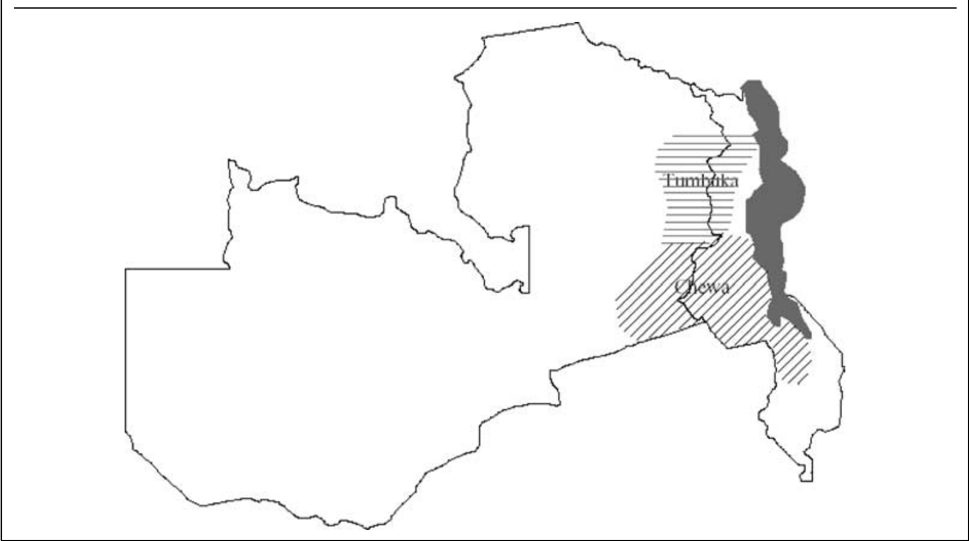
“As Figure 3 makes clear, the Chewa and Tumbuka communities are both large in Malawi (28% and 12% of the national population, respectively) but peripheral in Zambia (7% and 4%, respectively).16 Much more 16 Malawi’s figures come from Fearon 2003.”
BackgroundExplaining Interethnic Cooperation
Fearon, J. D., & Laitin, D. D. (1996) · American Political Science Review · doi:10.2307/2945838 · Cited by 1,606
Ethnologue: Languages of the World
(2015) · Choice Reviews Online · doi:10.5860/choice.192005 · Cited by 1,176
Social Mobilization and Political Development
Deutsch, K. W. (1961) · American Political Science Review · doi:10.1017/s0003055400125134 · Cited by 1,077
Why Ethnic Parties Succeed: Patronage and Ethnic Head Counts in India
Chandra, K. (2004) · Cambridge University Press eBooks · doi:10.1017/9781108573481 · Cited by 1,064
Horowitz, D. L. (2001) · University of California Press eBooks · doi:10.1525/9780520342057 · Cited by 925
Research works printed but not linked: 6
- Vail, Leroy, and Landeg White. 1989. 'Tribalism in the Political History of Malawi.' In The Creation of Tribalism in Southern Africa , ed. Leroy Vail. Berkeley and Los Angeles: University of California Press, 151- -92.
- Lijphart, Arend. 1977. DemocracyinPlural Societies: A Comparative Exploration . New Haven, CT: Yale University Press.
- Henkel, Reinhard. 1985. 'Mission Stations in Zambia: Their Location and Diffusion Patterns.' Zambia Geographical Journal 35: 1- -18.
- Hobsbawm, Eric. 1996. 'Are all Tongues Equal?' In Living as Equals , ed. Paul Barker. New York: Oxford University Press, 85- 98.
- Bratton, Michael. 1994. 'Economic Crisis and Political Realignment in Zambia.' In Economic Change and Political Liberalization in Sub-Saharan Africa , ed. Jennifer A. Widner. Baltimore: Johns Hopkins University Press, 101- -28.
- Lipset, Seymour Martin, and Stein Rokkan. 1967. 'Cleavage Structures, Party Systems and Voter Alignments: An Introduction.' In Party Systems and Voter Alignments: Cross-National Perspectives , ed. Seymour M. Lipset and Stein Rokkan. New York: Free Press, 1- -64.
Cited by
Items 501–600 of 948
Brie, E., & Mathieu, F. (2024) · Nations and Nationalism · doi:10.1111/nana.13026 · Cited by 2
Gibson, J. L., & Souers, S. W. (2005) · Cited by 2
Conceptualization, Field Research and Refugee-Host Relations in Guinea
Onoma, A. K. (2015) · Méthod(e)s African Review of Social Sciences Methodology · doi:10.1080/23754745.2015.1017273 · Cited by 2
“It is because of all of these reasons that the numbers argument, whether in the study of refugees or in the more general study of civil relations as seen in the work of Posner (2004), is problematic.”
ResultSocial Relationships and the Prevention of Anti-Christian Violence in Egypt
Brownlee, J. M. (2018) · The Middle East Journal · doi:10.3751/72.1.14 · Cited by 4
The role of ultra-orthodox political parties in Israeli democracy
Howson, L. (2015) · University of Liverpool · doi:10.17638/02006321 · Cited by 22
Higashijima, M., & Nakai, R. (2011) · SSRN Electronic Journal · Cited by 2
Researching Ethnic Relations as the Outcome of Political ProcessesPreprint
Flesken, A. (2014) · SSRN Electronic Journal · doi:10.2139/ssrn.2482270 · Cited by 2
“While the relationship between members of the Chewas and Tumbukas is character‐ ized by antagonism in Malawi, it is amicable in Zambia (Posner 2004).”
BackgroundInfluentialGrossman, G. (2013) · SSRN Electronic Journal · doi:10.2139/ssrn.2250128 · Cited by 2
Foreign Sponsorship and the Development of Rebel Parties
Marshall, M. C. (2015) · University of North Texas Digital Library (University of North Texas) · doi:10.12794/metadc822815 · Cited by 2
Kellstedt, P. M., & Whitten, G. D. (2013) · Cambridge University Press eBooks · doi:10.1017/cbo9781139104258.014 · Cited by 2
Chirwa, M. S. (2026) · Warwick Research Archive Portal (University of Warwick) · doi:10.82444/warw.33756130 · Cited by 2
Voting for Compromises: Alternative Voting Methods in Polarized SocietiesPreprint
Alós‐Ferrer, C., & Buckenmaier, J. (2021) · SSRN Electronic Journal · doi:10.2139/ssrn.3915687 · Cited by 5
“As previous work indicates that group size may affect willingness to compromise (Posner, 2004; Huber, 2012), it is important to study asymmetric electorates with interest 7Participants were recruited using the online research platform Prolific (Palan and Schitter, 2018) from a large subject pool…”
BackgroundMethodThe Political Construction of Indigeneity: Theory and Evidence from IndonesiaPreprint
Toha, R. J., & Pepinsky, T. B. (2022) · SSRN Electronic Journal · doi:10.2139/ssrn.4135406 · Cited by 3
Determinants of ethnic identification in West-Africa
Bossuroy, T. (2006) · Cited by 2
Salazar, L., Maffioli, A., Aramburu, J., & Adrianzén, M. A. (2016) · doi:10.18235/0012282 · Cited by 4
WhatsApp in Sierra Leone Politics: Burning Bridges or Building Them?
Silverman, J. (2022) · African Conflict and Peacebuilding Review · doi:10.2979/africonfpeacrevi.12.1.04 · Cited by 1
Bochsler, D., Grofman, B., & Hänni, M. (2023) · Journal of Elections Public Opinion and Parties · doi:10.1080/17457289.2023.2214735 · Cited by 3
“We identi fi ed rare cases of ethnic parties mobilizing voters across several ethnic minority groups with a joint political agenda (Chandra 2011, 155 – 157; see also Posner 2004).”
Explaining change in linguistic voting: The case of Catalonia
Orriols, L., & Simón, P. (2024) · Nations and Nationalism · doi:10.1111/nana.13041 · Cited by 2
“This thesis suggests that cultural cleavages can be mobilised depending on the group size and their utility as vehicles for political competition (Posner, 2004: 537 – 541).”
Coalitional psychology and the evolution of nationalistic cultures
Sijilmassi, A., Safra, L., & Baumard, N. (2024) · Behavioral and Brain Sciences · doi:10.1017/s0140525x2400133x · Cited by 1
Sectoral Interests and Regional Bloc Voting in African Countries
Boone, C., Crespin-Boucaud, J., & Kim, E. K. (2025) · Studies in Comparative International Development · doi:10.1007/s12116-024-09446-y · Cited by 3
Talal, O. (2025) · Nationalities Papers · doi:10.1017/nps.2025.10075 · Cited by 1
Berlinguer, I Love You (Still): The Downstream Effects of Expressive Voting
Leo, R. D., Dinas, E., & Meiske, B. (2025) · Political Behavior · doi:10.1007/s11109-025-10095-7 · Cited by 1
DIXIT, A. G. (2025) · American Political Science Review · doi:10.1017/s0003055425101305 · Cited by 1
“Many prominent explanations for ethnic divisions emphasize group-level factors, such as political mobilization along group lines, competition between groups, or coordination across groups (Eifert, Miguel, and Posner 2010; Huber 2017; Lee 2020; Posner 2004; Varshney 2003; Wilkinson 2004).”
Cognitive Adaptation to Culturally Evolved Ethnic Landscapes
Moya, C., & Boyd, R. T. (2026) · Theory and history in the human and social sciences · doi:10.1007/978-3-032-11918-6_3 · Cited by 2
Diprose, R. (2018) · Journal of Indonesian Social Sciences and Humanities · doi:10.14203/jissh.v2i0.22 · Cited by 1
“Posner (2004), in particular, argues that 10 While there is obviously some predisposition for newspapers to report violence for its newsworthiness, one would expect that not only would this exist in both districts, but that using three sources of newspapers would have somewhat ameliorated any…”
BackgroundResultExplaining Subnational Variation in Voter Coordination and Party Entry in Electoral Competition
Potter, J. D. (2013) · Open Scholarship Institutional Repository (Washington University in St. Louis) · doi:10.7936/k7dn435h · Cited by 1
de Albuquerque, A. L. (2014) · doi:10.7916/d8br8qcc · Cited by 1
Kinder, D. R. (2011) · Cambridge University Press eBooks · doi:10.1017/cbo9780511921452.036 · Cited by 1
The Seeds of Power: 'Good Governance' in Nigeria's Debt-Relief Gains
Phillips, J. (2012) · Cited by 1
Does multiparty competition increase ethnic security fears? Evidence from North India
Heath, O. (2014) · Party Politics · doi:10.1177/1354068814560935 · Cited by 1
“In addition, according to Posner (2004) the political salience of ethnic difference is contingent on the size of the group in question.”
BackgroundConstitutional Definition of the Demos and Inter‐Ethnic Relations
Koós, A. K. (2016) · Politics & Policy · doi:10.1111/polp.12170 · Cited by 1
MacDonald, G. (2013) · Digital Commons - DU (University of Denver) · Cited by 1
The Post 9-11 US Foreign Policy towards South Asia
Khaliq, S. (2017) · South Asian Survey · doi:10.1177/0971523117753759 · Cited by 1
“…2009); social services (Berman & Laitin, 2008; Burgoon, 2006; Skocpol, 1979); education (Fair, 2007); administrative boundaries and political environment (Posner, 2004); geography (Kaplan, 2012); external factor (Haider, Saeed & Martin 2015); and the growth in urban population (Nasr, 2000).”
BackgroundHelle, S.-E. (2016) · Springer eBooks · doi:10.1007/978-3-658-09216-0_4 · Cited by 1
Jensen, C. B., Kuenzi, M. T., & Mehanna, J.-G. (2022) · Africa Spectrum · doi:10.1177/00020397221082946 · Cited by 6
“Nevertheless, even in countries where ethnic politics dominate, ethnic identity can play a similar role to partisan veto players (e.g. Buttorff, 2015; Kuenzi and Lambright, 2005; McCauley, 2014; Posner, 2004a, 2004b).”
BackgroundMethodLiu, A. H., & Selway, J. (2023) · University of Michigan Press eBooks · doi:10.3998/mpub.12333333 · Cited by 3
Elections in Africa: Successes and Failures of Ethnic and Regional Electoral Consolidation
Turovsky, R. F., & Sukhova, M. (2023) · World Economy and International Relations · doi:10.20542/0131-2227-2023-67-10-108-119 · Cited by 1
Giusti-Rodríguez, M. (2023) · Comparative Politics · doi:10.5129/001041523x17011215536598 · Cited by 1
Pernia, R. A. (2023) · Asian Journal of Political Science · doi:10.1080/02185377.2023.2293708 · Cited by 1
“A variant of experimental approach called natural experiments has been featured in increasing numbers in political science researches (Ansolabehere et al., 2000; Brady & McNulty, 2004; Cox et al., 2000; Gerber et al., 2011; Krasno & Green, 2005; Posner, 2004).”
BackgroundHeterogeneous Electoral Constituencies Against Legislative Gridlock
Bloks, S. A. (2024) · Res Publica · doi:10.1007/s11158-024-09696-6 · Cited by 2
“…choice to politicise the identity, from a set of potentially mobilisable social categories, that provides a useful vehicle for political competition and helps the political party secure membership in the politically and economically most useful coalition (Posner 2004; 2005, pp. 2–6, 138–139).”
Horizontal inequalities and market instability in Africa
Brown, G. K., & Stewart, F. (2012) · Cambridge University Press eBooks · doi:10.1017/cbo9781139198998.014 · Cited by 2
Ethnic Voting and Party System Stability
Birnir, J. K. (2001) · Cambridge University Press eBooks · doi:10.1017/cbo9780511607530.005 · Cited by 1
der Windt, P. C. V. (2016) · Columbia Academic Commons (Columbia University) · doi:10.7916/d8np245g · Cited by 3
Does Culture Matter to Pro-Social Behavior? Evidence from a Cross-Ethnic Lab Experiment
Sun, F., ., X. W., ., Q. Y., Yi, Q., & Wu, M. (2015) · Journal of Economics and Behavioral Studies · doi:10.22610/jebs.v7i6(j).621 · Cited by 1
“…a greater barrier to cooperation than ethnic diversity, and cooperation is much 308 more likely to be determined by interactions at a finer scale (Posner, 2004; Waring 309 and Bell, 2013); we found that mean contributions in GS3 were lower than the other 310 two group structures for the ethnic…”
BackgroundDependent Agency and the AIDS Enterprise: Global Programs, Local Actions
Anderson, E.-L., & Patterson, A. S. (2016) · Palgrave Macmillan US eBooks · doi:10.1057/978-1-137-58148-8_1 · Cited by 1
Political Quotas and Governance
Anderson, S. (2020) · eScholarship (California Digital Library) · doi:10.26085/c3hs30 · Cited by 1
Counting Lives: Colonial Institutions and Africa’s Prevailing Conflicts
Thompson, O. P., & Fernandes, T. (2020) · Springer eBooks · doi:10.1007/978-3-030-38922-2_47 · Cited by 2
Who trusts? Ethnicity, integration, and attitudes toward elected officials in urban Nigeria
LeBas, A. (2017) · Working Paper Series · doi:10.35188/unu-wider/2017/352-3 · Cited by 1
Persson, A. (2021) · Oxford University Press eBooks · doi:10.1093/oxfordhb/9780198858218.013.28 · Cited by 2
Kellstedt, P. M., & Whitten, G. D. (2018) · Cambridge University Press eBooks · doi:10.1017/9781108131704.008 · Cited by 1
Ethnicity and Ethnic Politics in Zambia
Posner, D. (2005) · Cambridge University Press eBooks · doi:10.1017/cbo9780511808661.008 · Cited by 1
Self-citationLeft-Wing Extremist Violence: A Comparative Study of the Maoist Rebellion in Nepal and IndiaPreprint
Bhattacharya, S. (2010) · SSRN Electronic Journal · doi:10.2139/ssrn.1666902 · Cited by 1
Familial Networks as a Source of Electoral Advantage: Evidence from the PhilippinesPreprint
Davidson, M. W., Hicken, A. D., & Ravanilla, N. (2014) · SSRN Electronic Journal · doi:10.2139/ssrn.2486123 · Cited by 1
Multiple Regression Model Specification
Kellstedt, P. M., & Whitten, G. D. (2013) · Cambridge University Press eBooks · doi:10.1017/cbo9781139104258.011 · Cited by 1
Electoral Systems and the Success of Ethnoregional PartiesPreprint
Lublin, D. I. (2009) · SSRN Electronic Journal · Cited by 1
Elite Strategy, Social Structure and Catholic-Protestant Cleavage in the Canadian Provinces
Fairie, P. M. (2013) · Libraries and Cultural Resources (University of Calgary) · doi:10.5072/prism/25866 · Cited by 1
Reilly, J. E. (2014) · CUNY Academic Works (City University of New York) · Cited by 3
Ethnic Voting: Testing the Observable Implications of the Argument for Mass Behavior
Posner, D. (2005) · Cambridge University Press eBooks · doi:10.1017/cbo9780511808661.013 · Cited by 1
Self-citationThe Social Effects of Ethnic Diversity at the Local LevelPreprint
Algan, Y., Hémet, C., & Laitin, D. D. (n.d.) · RePEc: Research Papers in Economics · Cited by 1
Shirah, R. (2014) · eScholarship (California Digital Library) · Cited by 4
Exchanging fertilizer for votesPreprint
Westberg, N. B. (2015) · RePEc: Research Papers in Economics · Cited by 1
Ethnocultural Diversity and Aspects of Political Culture
Salat, L., Călușer, M., Gorcea, A., & Moșteanu, O. (2009) · DOAJ (DOAJ: Directory of Open Access Journals) · Cited by 1
Kikuyu or Kenyan? Government Service Provision and the Salience of Ethnic IdentitiesPreprint
Peterson, B. D. (2016) · SSRN Electronic Journal · doi:10.2139/ssrn.2773896 · Cited by 1
Public Goods and the Salience of Local Ethnic Diversity: The Case of Teacher Absenteeism in AfricaPreprint
McGuirk, E. F. (2016) · SSRN Electronic Journal · doi:10.2139/ssrn.2779542 · Cited by 1
“…factors (Glennerster et al., 2012), post-colonial national policies (Miguel, 2004) and current day political competition (Eifert et al., 2010, Posner, 2004a), as well as the country-wide effects of macroeconomic policies that are associated with ethnic diversity (Easterly and Levine, 1997;…”
BackgroundInfluentialThe Agricultural Roots of Market EconomyPreprint
Wang, Y. (2014) · SSRN Electronic Journal · Cited by 1
Weak States in Africa: A Literature Review on Why They PersistPreprint
Wehyee, Y. (2016) · SSRN Electronic Journal · doi:10.2139/ssrn.2844243 · Cited by 1
Giorgi, E. G. D., & Mirata, G. (2009) · Cited by 1
The Psychology of Political-Territorial Identification
Curtis, K. A. (2013) · CU Scholar (University of Colorado Boulder) · Cited by 2
Somerville, C. M. (2013) · doi:10.1093/obo/9780199756223-0114 · Cited by 1
Gibson, C. C., & Zimmerman, B. (2015) · Oxford University Press eBooks · doi:10.1093/obo/9780199756223-0134 · Cited by 2
Marking Boundaries: Managing Intra-Ethnic Competition in Africa
Gichohi, M. K. (2016) · eScholarship (California Digital Library) · Cited by 2
Civil Conflict and Ethnic Identity: A Disaggregated Level Study in AfricaPreprint
Jiang, H. (2018) · SSRN Electronic Journal · doi:10.2139/ssrn.3280636 · Cited by 1
State Capacity and Demand for Identity: Evidence from Political Instability in MaliPreprint
Ananyev, M., & Poyker, M. (2019) · SSRN Electronic Journal · doi:10.2139/ssrn.3419294 · Cited by 1
Wigmore-Shepherd, D. S. (2019) · Sussex Research Online (University of Sussex) · Cited by 2
Do Birds of a Feather Flock Together? Rebel Constituencies and Civil War AlliancesPreprint
Balcells, L., Chen, C., & Pischedda, C. (2020) · SSRN Electronic Journal · doi:10.2139/ssrn.3628832 · Cited by 1
Yakter, A. (2018) · Deep Blue (University of Michigan) · Cited by 1
Inequality and Social Identity: Micro-Level Evidence Using a Measure of Perceived Economic PositionPreprint
Adera, A., & Tabakis, C. (2021) · SSRN Electronic Journal · doi:10.2139/ssrn.3995036 · Cited by 2
“Democratic Quality: As in (Quaranta 2018), we construct quality of democracy measure at individual level from “How satisfied are you with the way democracy works in [your country]?”.”
Gerring, J., & Veenendaal, W. P. (2020) · Cambridge University Press eBooks · doi:10.1017/9781108657099.018 · Cited by 1
Implications and Future Research
Liu, S. (2024) · Oxford University Press eBooks · doi:10.1093/oso/9780197696705.003.0008 · Cited by 1
Halm, W. M., Armenta, A., Hopkins, D., Sigler, G., & Abascal, M. (2024) · SocArXiv (OSF Preprints) · doi:10.31235/osf.io/87t9j · Cited by 5
Development Mismatch? Evidence from Agricultural Projects in Pastoral AfricaPreprint
Mcguirk, E., & Nunn, N. (2024) · Social Science Research Network · doi:10.2139/ssrn.5032555
“…, Esteban, Mayoral and Ray, 2012 , Rohner, Thoenig and Zilibotti, 2013 , Michalopoulos and Papaioannou, 2016 , Berman, Couttenier, Rohner and Thoenig, 2017 , McGuirk and Burke, 2020 , Moscona, Nunn and Robinson, 2020 , Arbatli, Ashraf, Galor and Klemp, 2020 , Eberle, Rohner and Thoenig, 2020 ).”
The Natural Limits of Segregation and Re-Integraton: Race, Space, and Voting in the New South AfricaPreprint
de Kadt, D., & Sands, M. L. (2014) · SSRN Electronic Journal · doi:10.2139/ssrn.2500958 · Cited by 1
Brazys, S. R., Heaney, P., & Walsh, P. P. (2018) · SSRN Electronic Journal · doi:10.2139/ssrn.2401600 · Cited by 1
“Posner (2004) again highlighted the Malawian ethnic-divide in asking why the Chewa/Tumbukas ethnic cleavage appeared to matter in Malawi but not in neighboring Zamiba.”
BackgroundRuan, S. (2013) · DukeSpace (Duke University)
Regime Change and Ethnic Politics in Africa
Posner, D. (2005) · Cambridge University Press eBooks · doi:10.1017/cbo9780511808661.015
Self-citationDonor and Non-State Actor Service Provision and Legitimating Beliefs in Sub-Saharan AfricaPreprint
Sacks, A. (2011) · SSRN Electronic Journal · doi:10.2139/ssrn.1854984
The Political Economy of Social InclusionPreprint
Dessy, S., Pallage, S., & Vencatachellum, D. (2012) · SSRN Electronic Journal · doi:10.2139/ssrn.1991288
“Second, we also draw from research in various social science sub-fields including, economics, political science, and sociology to document that inclusive policies have an opportunity cost in political competition arenas where cultural cleavages have political salience, in the sense of Posner (2004).”
InfluentialNational identity in post-apartheid South Africa
Romo, M. (2011) · Open University of Cape Town (University of Cape Town)
Kellstedt, P. M., & Whitten, G. D. (2008) · Cambridge University Press eBooks · doi:10.1017/cbo9780511807220.009
A democracia reduz a desigualdade econômica?
Fernandes, I. F. D. A. L. (2014) · Digital Library of Theses and Dissertations (Universidade de São Paulo) · doi:10.11606/t.8.2014.tde-18032015-113901 · Cited by 3
The Ethnic Effect on Regime Stability
Birnir, J. K. (2001) · Cambridge University Press eBooks · doi:10.1017/cbo9780511607530.007
Ethnicity, Religion, and Conflict in Ghana: The Roots of GA Nativism
Asante, R. (2011) · Ghana Studies · doi:10.3368/gs.14.1.81 · Cited by 29
Poteete, A. R. (2013) · SSRN Electronic Journal
Instrumentalisation des identités ethniques et régimes politiques: le cas de la Guinée postcoloniale
Diallo, O. B. (2013) · uO Research (University of Ottawa)
Diversity and Development: The Interaction of Political Institutions with Social ContextPreprint
Hanson, J. K. (2012) · SSRN Electronic Journal · doi:10.2139/ssrn.1903117
The inevitable clash? Inter-religious violence and local power-sharing in Nigeria
Vinson, L. T. (2013) · University of Minnesota Digital Conservancy (University of Minnesota) · Cited by 1
COST AND BENEFITS OF NATURAL EXPERIMENTS IN POLITICAL SCIENCEPreprint
Labzina, E. (2011) · SSRN Electronic Journal
All Good Things Do Not Go Together: The Political Economy of Nation Formation in TanzaniaPreprint
Green, E. D. (2009) · SSRN Electronic Journal
Kellstedt, P. M., & Whitten, G. D. (2008) · Cambridge University Press eBooks · doi:10.1017/cbo9780511807220.003
Metadata
- Authors
- POSNER, D. N.
- Affiliations
- University of California, Los Angeles (US)
- Corresponding author
- POSNER, DANIEL N.
- ORCID
- POSNER, DANIEL N.
- Venue
- American Political Science Review
- Publisher
- Cambridge University Press (CUP)
- Published
- 2004-11
- Volume
- 98
- Issue
- 4
- Pages
- 529-545
- ISSN
- 0003-0554 (ISSN-L)
- 1537-5943
- OpenAlex
- W2169278049
- Cited by
- 940
- References
- 54
- Citations by year
- 2026: 22 · 2025: 22 · 2024: 117 · 2023: 45 · 2022: 40 · 2021: 28 · 2020: 94 · 2019: 34 · 2018: 72 · 2017: 45 · 2016: 49 · 2015: 46 · 2014: 58 · 2013: 45 · 2012: 32
- FWCI
- 79.46
- Type
- journal article
- Language
- en
- Open access
- green
- www.escholarship.org
- Locations
- American Political Science Review (publishedVersion)
- eScholarship (California Digital Library) (submittedVersion)
- RePEc: Research Papers in Economics (submittedVersion)
- Topics
- Social Sciences › Sociology and Political Science › Political Conflict and Governance
- Social Sciences › Sociology and Political Science › African Studies and Ethnography
- Social Sciences › Political Science and International Relations › Electoral Systems and Political Participation
- Keywords
- cultural cleavages, political salience, Chewa, Tumbuka, ethnic politics, ethnic group size, political coalition building, ethnic mobilization
About these checks
Registry, retraction, Cites and statistics results are computed, not judged, with one exception: a printed reference that no index lists is read once by a model before it counts as a citation error. Claims are extracted by a model and kept only when their quote appears verbatim in the text; each cited source is then checked, with a model’s help, for whether it says what the claim relies on. Those verdicts can be wrong — read the claim’s quote and the cited source before relying on one.
A language model drew the claims from the paper on 2026-10-11, under version 3 of the claim definition (model deepseek-v4.1-flash, prompt extract-v3).
A second model labelled each claim on 2026-10-11 (model jev-1.13-20260917, definition revision gold-guideline-v0.2).
Statistics and arithmetic are recomputed, not judged.
Confidence bands are shown only for fields calibrated on our annotated test set. None is calibrated yet, so no band is shown.
What counts as a claim ›How we measure confidence ›How we check this ›
Are you an author, or do you see a problem with this page? Request a review
Data sources
Bibliographic data: Semantic Scholar, OpenAlex, Crossref.
Contains information from the Semantic Scholar Academic Graph Datasets, made available under the ODC Attribution License (ODC-BY 1.0).
Semantic Scholar’s data is described in: Kinney, R., et al. (2023). The Semantic Scholar Open Data Platform. arXiv:2301.10140.
